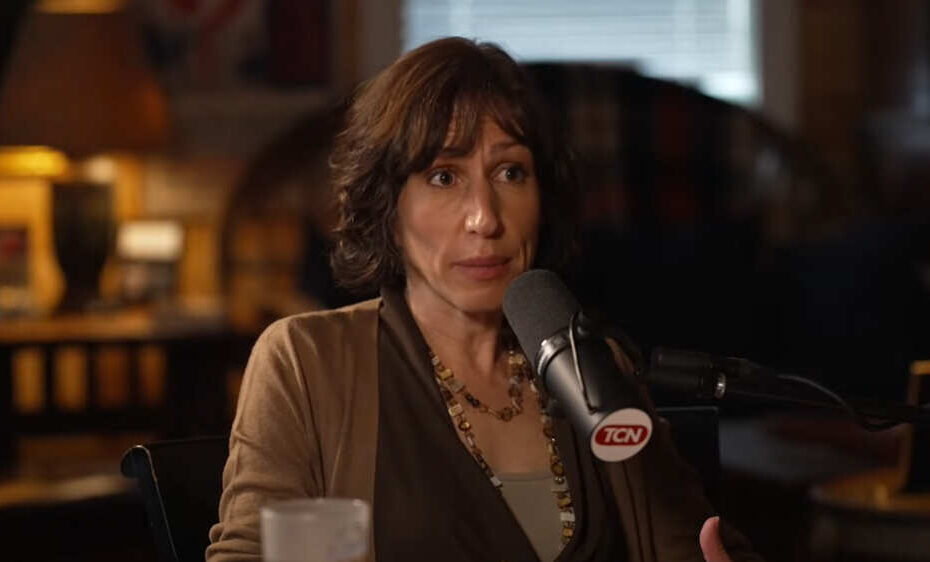
Read the full transcript of Nuclear Age Peace Foundation’s president Dr. Ivana Hughes’ interview on The Tucker Carlson Show on “How Launching a Single Nuke Could Wipe Out All of Humanity”, October 17, 2025.
TUCKER CARLSON: Thank you, professor, for doing this. Let me start with the most simple of all questions. How are nuclear weapons different from conventional weapons?
The Fundamental Difference Between Nuclear and Conventional Weapons
DR. IVANA HUGHES: Nuclear weapons are different from conventional weapons in many ways. One of the things that I like to say is that they really defy the kind of concept of both space and time. And let me explain what I mean by that.
If you have a conventional weapon and you explode it over a city wherever, that explosion is going to have an impact in that local place, and it’s going to have that impact in time, and then you could come back and clean up the area and rebuild and so on. Nuclear weapons are not like that.
A nuclear explosion in one place, in one location, and in one split moment of time can have both global effects and it can have impacts over actually even thousands of years through the effects of radiation and the kind of radioactive isotopes that get deposited in the environment there.
There are a number of ways in which even a single nuclear weapon explosion can be incredibly dangerous and devastating. And then there are a number of impacts in which a nuclear war in which many nuclear weapons are used can be, obviously, quite clearly, much more devastating.
The Devastating Power of a Single Nuclear Weapon
So the thing that people know about nuclear weapons is that one nuclear weapon can be much more powerful than any kind of chemical explosion. For example, the atomic bombings of Hiroshima and Nagasaki 80 years ago, almost exactly, had what’s called energy yields of 15 and 21 kilotons of TNT.
Now, these bombs were made out of uranium and plutonium—uranium for the Hiroshima bomb and plutonium for the Nagasaki bomb. But when we describe their energy yield, we describe it in terms of the equivalent amount of chemical explosive that you would need. So that’s where the 15 kilotons, 15,000 tons of TNT, how much you would have needed of chemical explosives to produce the energy equivalent to that explosion. And that in and of itself is huge.
Just to give you one kind of point of comparison, the Oklahoma City bombing, which I’m sure you remember—it was actually the first year that I was living in the United States. It was in April of 1995, and it was a devastating event. It was the equivalent of two and a half tons of TNT.
So Timothy McVeigh had filled the Ryder truck with chemical explosives, lit it up outside of a federal building, killed 168 people, including 19 children in a daycare center. And there was damage in a radius of up to, I think, 16 blocks, something of that order. So absolutely an incredible and devastating event.
At the same time, that explosion was 6,000 times less energetic than the bombing of Hiroshima. So 15,000 tons of TNT versus two and a half tons of TNT. So that just begins to give you a scale for just how powerful a single nuclear weapon can be.
And then on top of it is that we now have weapons that are far more powerful than the Hiroshima and Nagasaki bombs. In fact, in 1945, the US had three nuclear weapons. One was used as a “test,” the Trinity test, in the desert of New Mexico. And then two were used on the attacks on Japanese cities of Hiroshima and Nagasaki. Today we actually have on the order of 12 and a half thousand nuclear warheads, many of which are far more powerful.
TUCKER CARLSON: How much more powerful?
Modern Nuclear Weapons: Thousands of Times More Destructive
DR. IVANA HUGHES: So we know that both US and Russia have nuclear bombs currently that are on the order of one megaton. That’s about 70 times more powerful than the Hiroshima bomb.
At the height of the Cold War, when we were first testing nuclear weapons and actually first testing hydrogen bombs, which are different from the atomic bombs that were used in Hiroshima and Nagasaki—and I can explain that as well—we were even testing… The largest test that the US had ever conducted took place in the Marshall Islands. It’s called the Bravo Test, Castle Bravo test. And there was 1,000 Hiroshima bomb equivalents.
And yet the Soviets actually tested something even more powerful. They did so up in the North Sea region called Novaya Zemlya. And they tested, some accounts say, 50 megatons. So that’s more than 3,000 Hiroshima bombs equivalents. I’ve even seen accounts to say 58 megatons. So that would be basically 4,000 Hiroshima bomb equivalents.
The Castle Bravo Test, which took place on March 1st of 1954—that test, that mushroom cloud… So we all have this vision of a nuclear explosion that produces the mushroom cloud. That mushroom cloud was 25 miles or 40 kilometers high, and at the widest, about 60 miles wide. 60 miles wide. The mushroom cloud, it’s quite simply something that’s unimaginable.
The Long-Term Consequences: Radiation That Lasts Decades
And that test actually had truly devastating consequences for people living in the Marshall Islands. About 100 miles from where the test was conducted, the population was living in a place called Rongelap Atoll. And those people were very severely impacted by the test. It’s a long story. They stayed there for three days. They were moved away.
But to kind of cut to the present day, and this is actually from some of the research that I’ve done with colleagues and students at Columbia University, currently, there’s still parts of the Marshall Islands where radiological contamination is very high. And that testing ended in 1958.
TUCKER CARLSON: So what would happen if a nuclear weapon, modern nuclear weapon, detonated over Times Square?
A Nuclear Attack on Times Square: The Unthinkable Scenario
DR. IVANA HUGHES: Yes, over Times Square. One megaton bomb is going to have… So there are two different kinds of explosions. One can be an air burst and one can be a surface explosion.
In the case of an airburst, what you actually do is you cause a lot more damage. The shock wave is stronger and the destruction of the city is much more effective. A surface burst produces more radiation and kind of more of those long-term effects.
So between the two, let’s just say that the radius of this fireball is about a mile. And so you now have, depending on where it explodes, you have a radius that… And the fireball is quite literally the temperature of the sun. And so you have a fireball where everything is evaporated, absolutely evaporated.
And then again, depending on if it’s an air burst or a surface explosion, you kind of have these different concentric circles of heavy blast damage where just everything is absolutely destroyed. The shock wave is such that it just… Everything collapses, buildings collapse, everything collapses.
Then you might have a kind of lethal radiation dose, concentric circles. Then you might have moderate damage where you still have buildings collapsing, injuries are widespread and so on. And you kind of keep going, but you start out with quite literally evaporating everything in this fireball, and you kind of keep going out of that.
And in New York City, for an airburst, you’re looking at something like on the order of one and a half million people dying and about 2 million people being very severely injured.
The Horror of Third-Degree Burns and Human Suffering
There’s also a concentric circle where the temperature is so high that everybody gets third-degree burns. And this is something that happened, of course, in Hiroshima and Nagasaki. It’s where people’s skin quite literally melts.
There are descriptions from survivors of the bombing of seeing people with their skin looking like it was clothing just hanging over them. This is quite simply a site of total and absolute horror and devastation.
And it would destroy a US city, the thing that we know, and render it uninhabitable, and render it potentially uninhabitable for decades, hundreds of years, potentially even thousands of years. Again, it all depends on how you do it, how large the weapon is, how it’s detonated.
Why One Nuclear Weapon Leads to Full-Scale Nuclear War
But the really scary thing that we do know, and this comes from the kinds of war games that take place in Washington all the time, is that because we now live in a world with 12 and a half thousand nuclear warheads, it doesn’t just end with one nuclear warhead being used on one city.
We not only have all of those warheads, we also have things like intercontinental ballistic missiles which can actually carry multiple warheads at once, deliver them all to the same target. So you might, if you wanted to attack New York City, you might explode one in Times Square, but you might explode one on the Upper West Side and another in Brooklyn and another… So you could have a kind of a constellation of explosions.
And the war games in Washington suggest that 100% of the time, one nuclear weapons explosion, regardless of how it starts—an accident, a miscalculation, a deliberate use—it all ends in a full-blown nuclear war.
Launch on Warning: The Protocol That Guarantees Escalation
And part of the reason why it all ends in a full-blown nuclear war is that the kinds of structures we’ve built, the kinds of policies that we have on this are such that you pretty much just follow the protocol, and the protocol is that you attack.
The United States has something called “launch on warning.” And that means that if we think we’re being attacked, even though we haven’t absorbed an attack, even though we haven’t actually seen that a warhead has exploded in one of our cities, we launch an attack. And these decisions are made in a matter of minutes.
This is described really with amazing clarity in the book by Annie Jacobsen, “Nuclear War: A Scenario,” where she describes exactly minute by minute, how nuclear war starts and can start, and then what happens for the next 72 minutes, and then these long-term consequences of nuclear war. And I can talk about some of them.
TUCKER CARLSON: So 72 minutes, the entire war, that’s the duration of the war.
The Devastating Timeline of Nuclear War
DR. IVANA HUGHES: That’s the duration of a war between the United States and Russia. In Annie’s book, the scenario is that basically the US gets attacked by a kind of lone warhead coming from North Korea, attacking Washington D.C. That’s an intercontinental ballistic missile, which we detect within seconds of the launch. And then there’s a second. In her scenario, there’s a second warhead being exploded, launched from a submarine in the Pacific and exploding in Diablo Canyon, which is a nuclear power plant in Southern California.
And in that scenario, the US then responds to the nose. It’s being attacked by North Korea in a matter of minutes, makes a decision to attack North Korea. I think the response is something like 82 nuclear warheads. But the route that the warheads take from our ICBM silos in the Midwest, in the Dakotas and so on, the route goes over Russia.
And in Annie’s book, the scenario is such that the US can’t communicate fast enough with the Russian leadership. And Russians now think they’re under attack because they’re detecting these warheads coming their way. And so they launch an attack, 1,000 nuclear warheads. And then the US responds in turn and attacks the United States. And these kinds of estimates of what would happen, the number of casualties, people who would die and so on in a US Russia, full blown nuclear war.
The current estimate, and this is based on slightly more than 1,000 warheads from each direction. And it’s equivalent to about one third of the current arsenals. The number of casualties from the moment of the explosions is on the order of 360 million people. And that’s nothing. But the deaths from, you know, you were either incinerated or, you know, your body was broken into, who knows how many pieces by the shockwave that’s not even including deaths from radiation, which would occur over some period of time, of course, very intensely in the immediate aftermath, but then also over time.
Global Environmental Catastrophe
And then there is the business of what such a nuclear war would actually do to the environment of the planet. And there it’s not just about local effects. Now we get into the global effect. So back to my initial assertion. The nuclear weapons sort of defy rules of time and space.
The time aspect is these radiation impacts that can really. The radiation contamination that can last for decades, hundreds, even thousands of years for certain radioactive isotopes. The spatial aspect is that, of course, there is a local impact of the nuclear explosion, but in the case of a nuclear war, the impact becomes global.
And there are at least two different ways in which this happens. One way is called nuclear winter. I can explain what that is. And the other is ozone layer destruction. And these are actually things that we’ve known about both of them for a long time. Although I will say that more recently we’ve had much better simulations, just much more computer power, much more sort of ability to really figure out what that would look like.
TUCKER CARLSON: So let’s start in order. What’s nuclear winter?
Understanding Nuclear Winter
DR. IVANA HUGHES: So nuclear winter is the idea that following a nuclear war, there would be such widespread fires everywhere that would burn things like everything that’s in the city and produce so much soot that would go up into the atmosphere and block incoming sunlight. And that as a consequence of this, for a period of about, again, depends on how many warheads, what energy yields and so on. But for a period of up to about 10 years, temperatures would drop so significantly, some estimates for the war that I keep citing of one third of US and Russian arsenals are used up.
The estimate is 10 to 15 degrees Celsius. That’s about 18 to 27 degrees Fahrenheit. This is a completely different planet. And those temperature drops occur very, very quickly. And so the temperature drop, what it does is it actually makes it impossible for food to grow, in particular in the northern hemisphere, in kind of our breadbasket latitudes.
And food just begins. Stops growing, agriculture begins to fail, and people begin to starve. And the estimates there, there’s a paper that was published in Nature Food by Alan Robach and Lily Gia and their colleagues at Rutgers University. According to that paper, this particular scenario where I said 360 million people would die from the attacks, they estimate over 5 billion people would die of starvation by a billion.
TUCKER CARLSON: Over 5 billion within 2 years of a nuclear war from starvation all around the planet. And here’s a kicker, actually, the number is actually really more than 6 billion. Because when they wrote the paper, they based all of their calculations, simulations, modeling on a worldwide population of 7 billion. We now have more than 8 billion people on the planet. So that just quite simply means that you’re going to have an extra 1 billion people dying of starvation.
So it’s really, I mean, this is quite simply, this is not. This is the end of human civilization. This is the end of humanity as we know it. I’m not saying I don’t think we know that everyone would die, although it’s quite possible. I don’t think it means all of life on the planet would be extinguished, although even that’s possible. But this is quite simply not the planet we live on today.
Ozone Layer Destruction
And then on top of it, there’s the radiation effects. And I can talk more about radiation. And then there’s this business of ozone layer destruction. And that’s somebody at Columbia who might. Actually knew quite well. He passed away recently in his 90s. His name was Mal Ruderman. He was one of the first people who they wrote about in the 1970s about nitric oxide production as a consequence of nuclear war and the impact that this would have on ozone layer. On the ozone layer. And that kind of research has been done also more recently with the new model simulations and so on.
Those estimates suggest that the war scenario I keep mentioning between US and Russia would result in 70% ozone layer destruction. This is, again, this is not a place where you go out to sunbathe. This is a place in which UV radiation is incredibly dangerous. Not just to people, but it would also impact agricultural production because it would impact plants. So again, this would be another hit on food supplies.
But all of this is just so horrific, this idea that we would ever conduct something like nuclear war. I mean, Reagan and Gorbachev said in 1986, “Nuclear war cannot be won and must never be fought.” Khrushchev said in the 1960s that “the survivors would envy the dead.” And yet here we are, 80 years into the nuclear age, still in. I would say, in many ways playing nuclear roulette with. Not.
TUCKER CARLSON: Yeah. Ever more recklessly, especially in the last three years. Let me ask you a couple of questions just to tie up what you just said. You said in the simulation. The theoretical account that Annie Jacobson wrote about in her book, very influential book, Diablo Canyon nuclear site in California is hit with a nuclear weapon. What is the effect of a nuclear power plant getting hit by a nuclear weapon?
Nuclear Power Plants as Weapons
DR. IVANA HUGHES: That’s just. That one is really, really devastating. I hadn’t actually. I mean, I think with the war in Ukraine, we had sort of gotten a sense, right. That a nuclear power plant presents this very kind of special type of threat in war zones. And this was the war in Ukraine was actually quite simply the first war where we had active fighting in a country, active military conflict, violent conflict in a country that had nuclear power plants. That just had not been the case previously.
And there are a whole lot of things you could say about nuclear power and potential dangerous threats and so on. But in. In the case of a conflict, a nuclear power plant can become a weapon in and of itself, of course. So I read the book a while back, so I.
TUCKER CARLSON: But is it possible you could get an exponential effect?
DR. IVANA HUGHES: Absolutely. No, no, no. This is. This is now a radiation, you know, so now people are dying all over the Western United States from the absolutely enormous amount of radioactivity that is spread. Right. So you hit the nuclear power plant. It’s not the blast and the fireball. I mean, yes, it is there locally, but that’s not what’s going to kill the people in LA. What’s going to kill the people in LA is the radiation that’s going to spread.
TUCKER CARLSON: So what does that look like? That was my second question. You said you would flesh out the concept of the danger of radiation. Like what does that look like? We know something about that because of the bombings 80 years ago.
The Legacy of Nuclear Testing
DR. IVANA HUGHES: But we know something about that because of the bombings from. Absolutely. And I can say a little more about those. But we also know a whole lot about the impact of nuclear explosions on the environment, the impact of radiation on the environment. Because Hiroshima and Nagasaki were not the only two or even Count Trinity three times. It’s not that we’ve exploded nuclear weapons three times. We’ve exploded nuclear weapons more than 2,000 times on this planet.
And that was as part of nuclear weapons full nuclear weapons explosions as part of what is referred to as nuclear weapons testing programs. I was in March at the United Nations actually at the third meeting of states parties of a treaty called the Treaty on the Prohibition of Nuclear Weapons. And I was speaking to a woman from French Polynesia where the French tested nuclear weapons. She’s actually a member of the French Polynesian Parliament now. Her name is Hinamuera Cross. She’s a relatively young woman, I think in her 30s. She’s a mother. She’s had leukemia for many years. And many people in French Polynesia have been impacted by the testing that took place there.
TUCKER CARLSON: Leukemia can be a result of exposure radiation.
DR. IVANA HUGHES: Absolutely. And I can explain that as well. But Hina Moera said to me something really interesting. She said, you know, when we call it testing, when I was young and people would talk about, oh, we had the testing, I just imagined scientists kind of playing in a laboratory and you know, doing some kind of a test. These were full blown nuclear explosions.
They described. Bravo described the Soviet so called test, the Tsar Bomba. There were over 2,000 such explosions, many of them atmospheric tests, the majority still underground tests. But even underground tests have had devastating consequences. In 1963 there was really a kind of seminal agreement that was made initially just by the US, the Soviet Union and the United Kingdom of stopping atmospheric testing. And that was a real victory for the people of the world because it helped to some.
Atmospheric testing continued. China and France actually both continued to test in the atmosphere post 1963. France tested in the atmosphere until 1974 and China tested in the atmosphere until 1980. So both, both of those continued. Everybody else has conducted, to our knowledge, underground tests, to my knowledge, only underground tests.
TUCKER CARLSON: So tell us about the effects of radiation. So how long does the pollution last? How bad is it?
The Science Behind Nuclear Weapons: Fission vs. Fusion
DR. IVANA HUGHES: Yeah, so depending on what kind of a bomb you have. Let me go back to a kind of key distinction here. We have two types of nuclear weapons, one we refer to as atomic bombs. Those are again 1945 weapons. Those are based on the process of fission.
Fission is when a nucleus of an atom splits and basically one element—we all know elements like hydrogen and oxygen and carbon and so on—but an element like uranium or plutonium splits and produces two other elements. And energy is produced in such a reaction. A tiny amount of energy is produced in one reaction. But when you have many, many, many reactions, you can have a lot of energy.
The other process is called fusion. And that’s when actually nuclei of two elements come together and produce energy that way. So for example, two hydrogen nuclei come together to form helium and energy is produced that way. That process actually takes place in the sun. That’s how the sun produces its energy.
So fusion is a good thing. We quite simply wouldn’t have life on this planet if it weren’t for fusion. But again, using fusion for the purpose of weapons is a whole other thing.
Here’s the interesting thing about fusion or hydrogen bombs. In order to actually bring—let’s just step one second to just remember what an atom is, what elements are. So we have different elements on the planet. The atoms are sort of the smallest units of the element, but those atoms are made up of different kinds of particles.
So the nucleus is at the center of the atom. It might have just a single proton, like in hydrogen, or it might also have more protons and also neutrons and so on. And then there are electrons around it. In chemical reactions, everything happens with the electrons. So the nuclei just stayed the same.
With nuclear reactions, everything is about what happens in the nucleus. The nucleus either splits in fission, or nuclei come together in fusion. In fusion, if you have a nucleus that is positively charged, electrons are negatively charged. This is what keeps the atom stable. If you have one nucleus that’s positively charged trying to come together with another nucleus that’s positively charged, they repel each other, right? Like a magnet, so they repel each other.
So you actually need to invest energy to overcome that electrostatic repulsion. And the amount of energy that’s needed can only be supplied by something like a fission bomb. So even for fusion, for hydrogen weapons, we actually need to have fission as the fuel. That kind of sets up the conditions for the fusion to actually take place.
The Devastating Power of Hydrogen Bombs
TUCKER CARLSON: How much more powerful is a hydrogen bomb than the bombs dropped on Hiroshima and Nagasaki?
DR. IVANA HUGHES: So the Bravo one was a thousand times more powerful than a Hiroshima bomb. Currently, if we have a 1 megaton bomb, that’s about 70 Hiroshima bombs. But hydrogen bombs, actually, there’s kind of no limit. You could keep making them bigger and bigger and bigger. Somehow we’ve stopped making the really big ones.
I think China has probably the most powerful, the most high energy hydrogen bombs currently in their arsenals. I think they have five megaton bombs, hydrogen bombs in their arsenals, that’s more than 300 Hiroshima bomb equivalents. But then again, if you have a missile that can carry 10 warheads, it almost doesn’t matter how much a single one is.
But just back to radiation. So basically what you’re doing is you’re producing this chain reaction of splitting atoms or fusing them. And in so doing you produce some radioactive isotopes, radioactive elements that are going to basically be in the environment. Locally they’re going to get blown up, evaporated, going into the mushroom cloud.
You produce these radioactive isotopes. They’re mixed with everything. Some of that will kind of fall back onto the planet locally, some of it will be carried up into the atmosphere, high level stratosphere and so on, and actually become part of sort of a global deposition where you go so high up in the atmosphere it stays up there. And then you could also end up having, depending on exactly how far up it goes, you could have it come down with weather events.
TUCKER CARLSON: So it’s raining nuclear isotopes.
Nuclear Testing and Radioactive Fallout in America
DR. IVANA HUGHES: Raining radioactive nuclear isotopes. The U.S., I mentioned the testing in the Marshall Islands. We also tested in another Pacific island state called Republic of Kiribati. And we tested on our own soil, both in Nevada, where there were 100 atmospheric tests and some 828 underground tests, as well as in Alaska where there were just underground tests.
But the testing in Nevada actually produced fallout that went all around the United States. And it quite simply depended on whether or not there was rain locally. So the fallout was carried across towards the east, given the easterly winds. And then if there was a rain, a weather event in some place, the fallout would get deposited there.
And there are maps of the United States that quite simply look like you sort of gave an empty map to a child and they played with paint and kind of sprayed blotches of paint onto it.
TUCKER CARLSON: A Jackson Pollock painting.
DR. IVANA HUGHES: Yeah, exactly. And it’s where radiation had been deposited from these tests.
TUCKER CARLSON: Do we know the health effects of that?
The Deadly Health Impacts of Radioactive Isotopes
DR. IVANA HUGHES: The health effects are very severe and very serious. So let me just name a few of them. The top radioactive isotopes that are problematic: there’s something called iodine-131, there’s something called cesium-137, something called strontium-90, and there are a number of different isotopes of plutonium.
And the thing about these is that they quite simply last in the environment for different amounts of time. So some of them, there’s a concept called half-life. So a radioactive isotope will have a specific half-life. And what that means is if you have, if you start out with say 1,000 atoms of this isotope, after its half-life, you will have 500. And after another half-life, you’ll have 250 and so on. And so after six, seven, call it even 10 half-lives, it’s going to be gone from the environment.
Iodine-131 has a very short half-life. It’s eight days. And so within a matter of weeks, it’s gone from the environment. But if you were there at the time of the explosion, and if you got exposed to iodine-131, that actually went into your body, mostly because the iodine actually went into the grass and then the cows ate the grass and people—
TUCKER CARLSON: It goes right to your thyroid.
DR. IVANA HUGHES: It goes right to your thyroid. And it has caused, who knows, numerous, numerous cancers in this country. But actually in many other parts of the world.
Strontium-90 and Cesium-137 have half-lives of about 30 years each. That means they stick in the environment for a couple hundred years at least. And what’s interesting about both of these isotopes: strontium-90 is chemically similar to calcium. And you know that when you drink milk or eat cheese or whatever, you take in calcium, that calcium goes into your bones, goes into, it’s building up your bone marrow.
And Strontium-90 will go to those exact places. So the reason we mentioned leukemia earlier, the reason that people got—and especially they called leukemia “the atomic bomb disease” in Hiroshima and Nagasaki after the bombings—the reason for that was the exposure to strontium-90. Also importantly, because it acts like calcium, it also gets incorporated by plants, will take it up from the environment and you can ingest it.
Cesium-137, same half-life, around for a long time, is chemically similar to potassium. And you also know that if you eat banana or if you drink some kind of electrolyte drink or something, you take in potassium. Well, the same thing happens if cesium is in the soil. Plants will take it up, thinking because it behaves like potassium. They take it up, it gets incorporated.
And now when you eat that food, that cesium is now getting incorporated into your cells, the kinds of soft tissues that use potassium. Your brain actually needs a lot of potassium. And so when, instead of taking up potassium, you’ve now brought cesium-137 into your body. Now this cesium is this radioactive isotope that’s going to, basically, after a certain amount of time, it’s going to split and it’s going to give off gamma radiation.
And now that gamma radiation is inside your body, it’s attacking your cells, it’s attacking your DNA, it’s making you sick. And a lot of kind of soft tissue cancers, including brain cancer, come from that cesium-137.
The Legacy of Hiroshima and Nagasaki
TUCKER CARLSON: Do you see markedly higher rates of those cancers after Hiroshima and Nagasaki?
DR. IVANA HUGHES: Yes. Oh, absolutely. I mean, the estimates for the casualties of the Hiroshima, Nagasaki bombings, it’s often cited what people think it was like 70—the idea is maybe 70,000 people died on the day of the attack and then another 70,000 by the end of 1945 from both kind of acute radiation sickness as well as cancer. But the cancers continue to happen.
There’s a particularly touching story of a young girl who was two years old in Hiroshima the day of the bombings. Her name was Sadako Sasaki. And when she was 12, so 10 years after the bombing, she developed leukemia. She had been growing well and was very athletic and very active, and she developed leukemia.
And she is the one who—she learned the story of the paper crane, the folding of the origami.
TUCKER CARLSON: Yes.
DR. IVANA HUGHES: And she learned the story that if you fold 1,000 paper cranes, your wish will come true. There are now some differences in kind of details of what happened, how many paper cranes she folded, and so on. But needless to say, she died.
And after she died, it was actually her friends who wanted to do something in her honor. And essentially over the decades, the paper cranes that she was folding really became a kind of symbol of peace and this sort of message. When she was wishing, folding the paper cranes, she was wishing not just to get better, but she was wishing for world peace. And that’s kind of what got taken up by her friends.
Nuclear Winter and the End of Civilization
TUCKER CARLSON: So if you had the U.S. and Russia fire one third of their nuclear arsenals, you’re saying that every study projection has shown an elimination of life on Earth, basically? Certainly human life on Earth, human civilization.
DR. IVANA HUGHES: Yeah, I would say it’s absolutely, certainly end of the world as we know it. Whether we all perish or some people survive, the latter is certainly possible.
Actually, the UN is now advancing a study on the consequences of nuclear war, something that really hasn’t been studied in terms of the world that we currently live in. So we live in a very globalized world. We often might eat food from other places in the world. What does that look like in the current context? That wasn’t necessarily true to the same degree in the 1980s. People, for example, ate food that was more local and so on. So what does that look like today?
The science of nuclear winter and for example, ozone layer destruction, that’s very, very solid science. It gets attacked all the time, but it is very solid.
TUCKER CARLSON: You said this has been something that people have been studying for 80 years. How many nuclear weapons are there in the world?
The Global Nuclear Arsenal Today
DR. IVANA HUGHES: Globally today, we have twelve and a half thousand nuclear warheads in the world in possession of nine nuclear armed states. U.S. and Russia have the vast majority. Over 90% of the nuclear warheads are in the possession of U.S. and Russia.
TUCKER CARLSON: Are we pretty sure of that? I mean, we know where these warheads are?
DR. IVANA HUGHES: Yeah. No, we actually know. The good news about nuclear weapons is they’re not a garage project. There are other things you could do in your garage that could be very dangerous. You can’t do that with nuclear weapons. It takes a tremendous amount of not just resources and kind of human ingenuity, but infrastructure. Part of the reason they did that in the Manhattan Project, in the Los Alamos, it was all that isolation and so on.
TUCKER CARLSON: Do we know where they are?
DR. IVANA HUGHES: We do for the most part. We know where they are. Probably not all of them. I think it’s kind of known where, for example, Russia’s military bases are, but perhaps not exactly how many where and how. The other piece is that we do have a lot of nuclear warheads on submarines, which could be pretty much anywhere in the world’s oceans.
TUCKER CARLSON: What’s interesting. So submarines keep moving most of the time.
DR. IVANA HUGHES: Yeah.
TUCKER CARLSON: Isn’t it dangerous to have a nuclear warhead continuously on a boat?
The Dangers of Nuclear Submarines
DR. IVANA HUGHES: Yeah. Some of these nuclear submarines are carrying so many warheads, they’re carrying so many missiles, and each missile is carrying warheads. They called them “handmaidens of the apocalypse.” There were incidents in the 1950s where a U.S. and the Soviet submarine crashed into one another. They were nuclear armed.
TUCKER CARLSON: What happened?
The History of Nuclear Close Calls
DR. IVANA HUGHES: And nothing happened. Like, we’ve actually been. I mean, this is one way of looking at the history of the entire nuclear age. So 80 years of the nuclear age is that we’ve been very lucky that the scenarios I’m describing, the scenario Andy Jacobson is describing, the scenario I’m describing nuclear winter, ozone layer destruction.
There’s a whole other thing which you probably also know about because I know you spoke with Dennis Quaid, the electromagnetic pulse. That’s another thing you could do. You could shut down the electricity over entire countries. Like you need like three nuclear warheads to shut down the electricity over the entire United States.
And this isn’t a case where, you know, it’s a blackout and we’re all inconvenienced for a week. This is like the electricity is not coming back. So you wouldn’t even need to explode nuclear weapons on cities. You’d just need to shut down our electrical grid and then, you know, good luck.
TUCKER CARLSON: The country starves to death.
DR. IVANA HUGHES: Yeah, yeah. Good luck to all of us.
TUCKER CARLSON: So during the Cold War, a Russian sub, Soviet sub, and a US sub collided. Luckily, you know, the bombs didn’t go off. But there were also examples of warheads being lost. Right?
DR. IVANA HUGHES: Yeah, warheads being lost. Warheads being dropped to the bottom of the ocean. There are about 50 nuclear warheads at the bottom of the ocean.
TUCKER CARLSON: So wait, there are 50 nuclear warheads right now at the bottom of the ocean?
DR. IVANA HUGHES: Right now at the bottom of the ocean, yes.
TUCKER CARLSON: And no one’s tried to retrieve them.
DR. IVANA HUGHES: Fell off the submarine, fell off a plane, you know, all kinds of accidents. It wasn’t just two submarines colliding. It was also, there was also airplanes carrying nuclear warheads colliding. Yeah. There was once a nuclear warhead that was dropped quite literally into someone’s backyard in South Carolina. It didn’t go off. It had multiple security systems. And the last one held, everything else, you know, had given way.
TUCKER CARLSON: Wait, the US Military dropped a nuclear bomb in someone’s backyard in South Carolina?
The Cuban Missile Crisis and Black Saturday
DR. IVANA HUGHES: Yeah, absolutely. I forget the exact year this was. Most of these incidents were in the 1950s, but that was a period of really stupid accidents. And then what is often referred to in the field as close calls sort of got more sophisticated. In 1962, of course, we had the Cuban Missile Crisis.
TUCKER CARLSON: Famously.
DR. IVANA HUGHES: That’s a whole, famously a whole set of things. And really what we understand from that is that could have led to a nuclear war. You know, from deliberate, Kennedy was under a tremendous amount of pressure to actually invade Cuba by that point. The Soviets actually had nuclear warheads and missiles in Cuba. You know, had that invasion occurred, we quite simply would have had a nuclear war.
But it wasn’t just that. There were incidents during that 13-day period, three of them on the same day, October 27th. It was a Saturday. It’s often referred to as Black Saturday. There were three things that happened that day.
One was a US plane that was doing some monitoring near the North Pole and had accidentally gone off, lost radar, lost the ability to navigate where they were and gone deep into the Soviet Union and was actually too high up for the Soviet air defense. And they really tried to shoot it down, but the guy escaped.
Then there was an airplane that was shut down over Cuba and the American captain was killed on that day. And Kennedy did not decide to move towards an invasion and so on.
And then perhaps the most serious one was where the US was trying to enforce a blockade. The Soviets weren’t supposed to be coming to Cuba to bring any sort of military equipment. And to enforce this blockade, they were using something called depth charges, but they were using simulating depth charges. Depth charges are a weapon to attack a submarine. And so they were using ones that would sort of simulate an attack, but not really attack.
And one Soviet submarine had three officers on board, was being attacked by these depth charges. They interpreted it as a real attack. They actually thought that maybe there was a war going on and they were nuclear armed. They had a nuclear torpedo on board. And what they needed, this wasn’t like they needed permission from some higher authority. They needed all three of them to agree to employ the nuclear warhead.
One of them, his name was Captain Arkhipov, decided that he did not want to approve the use of the nuclear torpedo and basically saved the world in that moment.
The very next day, October 28, was actually the end of the Cuban Missile Crisis, where the Soviets agreed to withdraw their nuclear missiles from Cuba. President Kennedy had in turn agreed that the US would withdraw its nuclear missiles from Turkey. This wasn’t known until relatively recently because at the time, Kennedy asked Khrushchev, “You have my word we’ll do this, but I just need a little time and I’m not going to make it public.” And that was the agreement. It ended the Cuban Missile Crisis. And that was a very, very, very dangerous moment.
Kennedy’s Commitment to Nuclear Disarmament
TUCKER CARLSON: And it seems to have changed President Kennedy’s views of nuclear weapons or hardened his views. And he became entirely committed to preventing new nations from acquiring nuclear weapons.
DR. IVANA HUGHES: He became committed to preventing new nations from acquiring nuclear weapons. That was absolutely really important to him. But he was also, he was very, he was looking towards disarmament. And it was even before the Cuban Missile Crisis in 1961, he gave a very famous speech at the United Nations General Assembly in which he stated something to the effect of, “We must abolish nuclear weapons before they abolish us.”
So this is quite simply something we’ve known for a long time. And Kennedy understood this before we understood nuclear winter, before we understood ozone layer destruction, maybe around the time we were figuring out electromagnetic pulse and so on. So he understood this at a very deep level.
The part where he really put in his energy was the Atmospheric Test Ban Treaty, and that was negotiated with Khrushchev the following year in 1963. That was a tremendous achievement and a really, really important achievement.
Going back to our discussion of radiation, often sometimes when I sit in a room full of people or stand or whatever and speak about this, I sometimes say, there are people in this room who are alive today because of that Atmospheric Test Ban Treaty. Because had we continued to test to the degree and the levels that we were doing, we would have just sickened more and more and more people in our own country and around the world.
One thing I’ll just add is that I didn’t say earlier because I was talking about the isotopes. I never told you about plutonium. There are actually different isotopes of plutonium, and some of them have half-lives of thousands of years. There’s an isotope of plutonium with a 24,500 year half-life. That means that thing’s going to be in the environment for, you know, a couple of hundred thousand years.
So this is, this is again back to that issue of transcending time and space. This is not something that just has an immediate effect. We clean it up and we move on. The plutonium, in fact, the plutonium has been deposited globally. And we actually have an understanding that hundreds of years from now, hopefully there will be scientists who studied the planet who will say, “Oh, look, this is when they tested nuclear weapons. Here’s the plutonium line in the geologic record.”
Kennedy and Israel’s Nuclear Program
TUCKER CARLSON: Can I ask you about President Kennedy’s efforts to prevent nuclear war? One of the things he did that’s been written about to some extent is try to prevent David Ben-Gurion, then Prime Minister of Israel, from developing a nuclear weapon at the Dimona site. I think we have a lot of correspondence now that shows the President demanding inspections of the Dimona site. Ben-Gurion resigned as Prime Minister, I think, as a result of this controversy. What happened there?
DR. IVANA HUGHES: Yeah, I think Israel was really avoiding any sort of oversight. President Kennedy thought that proliferation of nuclear weapons was incredibly dangerous. He was definitely concerned and didn’t want other countries acquiring nuclear weapons. This eventually led, even after his death, to the Nuclear Non-Proliferation Treaty, whose goal was that. But there are other goals, and I can talk about them as well.
In the case of Israel, he felt very strongly that if this was our ally and we were going to tell the rest of the world not to acquire nuclear weapons, we also had to actually, you know, do what we were preaching and sort of be consistent in our approach to Israeli nuclear weapons.
But they went ahead. And I mean, it’s thought that the first functional Israeli nuclear weapon was developed in 1966. And so this was actually, interestingly before the Nuclear Non-Proliferation Treaty came together. It was negotiated over a long period of time, but finally signed in 1968 and then it entered into force in 1970. It’s still currently one of the largest international agreements amongst states in the United Nations.
The Nuclear Non-Proliferation Treaty
TUCKER CARLSON: How many nuclear armed states have signed it?
DR. IVANA HUGHES: So that treaty recognizes five nuclear weapons states. They’re US, Russia, United Kingdom, France and China. Those are the five that had nuclear weapons up to that point, declared nuclear weapons arsenals. Again, Israel had actually begun its program. At this point, Israel is thought to have 90 nuclear warheads.
The other five, what’s interesting is they were from the very beginning of the treaty, all five were recognized as nuclear weapons states. But China and France didn’t join the treaty until 1992. So it sometimes takes time for these treaties to actually bring everyone in.
TUCKER CARLSON: So the other nations could be India, Pakistan, North Korea.
DR. IVANA HUGHES: So there, yes. So there are four others. So nine nuclear armed states, five recognized by the United Nations, also all five members of the UN Security Council with veto power. And then the four that are outside of the treaty: Israel, which has this unique policy of ambiguity of an undeclared nuclear arsenal. But again, we think it’s a 90 nuclear warhead arsenal.
TUCKER CARLSON: And we’re pretty sure that there is.
DR. IVANA HUGHES: Yeah. Oh, absolutely. I think there’s no doubt about whether or not they have them. India and Pakistan never joined the Nuclear Non-Proliferation Treaty. Both essentially tested nuclear weapons underground. They each have on the order of 150 nuclear warheads today.
And then North Korea was actually a part of the treaty until they left the treaty in the early 2000s and have since pursued a nuclear weapons program. We think that North Korea actually currently has 50, 60, maybe 70 nuclear warheads. What North Korea has done is it has also actually developed the delivery systems. And we think that today North Korea actually has the kind of delivery systems that could deliver a nuclear warhead to any part of the United States.
And this to me is actually really, for many reasons why we have to eliminate nuclear weapons. I can make a case about that very strongly. But in the case of North Korea, it seems utterly crazy to me that you have a country like the United States, which let’s for just a moment imagine that we live in a world free of nuclear weapons. Who’s going to attack the United States? You know, we’ve got the oceans, we’ve got the conventional military.
I’ve actually heard our mutual friend Professor Jeffrey Sachs say that the United States could be the safest country in the history of humanity. But in a world with nuclear weapons, we are so vulnerable. And we’re not just vulnerable with however you want to classify Russia and China, but let’s call them peer adversaries or near peer adversaries. We’re vulnerable to them, but we’re also vulnerable to a country like North Korea, which is relatively small, relatively poor. This is not a world superpower. And yet North Korea could destroy the United States as we know it.
Iran’s Nuclear Capabilities
TUCKER CARLSON: Where is Iran? This is such a heavily politicized question, but there’s got to be a science-based answer. Where is Iran on the continuum toward getting a nuclear weapon?
DR. IVANA HUGHES: Iran has been enriching uranium to 60%, which is, you don’t need that for nuclear power. It is not quite weapons grade. Although if you wanted to make a weapon, you actually could make a weapon even out of the highly enriched uranium they currently have.
Now my understanding is that they, and I actually listened to their statements in venues like the Nuclear Non-Proliferation Treaty meetings at the UN. They always say they’re not interested in building nuclear weapons. They do emphasize that their religion, you know, doesn’t, you know, requires them not to pursue nuclear weapons. I actually think that they’re not pursuing nuclear weapons.
TUCKER CARLSON: How hard would it be for, I mean, they have every incentive to. Any country that, you know, has its capital city bombed, probably wants a nuclear deterrent. I would think it was just common sense. How hard is it? Given where they are right now technologically, how hard would it be for them to build a nuclear weapon?
DR. IVANA HUGHES: I don’t think it would be very hard. I think if they wanted a nuclear weapon, they could have had it a long time ago.
TUCKER CARLSON: How hard in general is it to build one?
The Challenge of Nuclear Disarmament
DR. IVANA HUGHES: It is hard. It is a huge investment of resources, both human and financial resources. It is a hard, hard thing to do. It’s not a garage project. It’s not something that’s going to evade.
Especially if we were to pursue nuclear disarmament, especially in the world of today’s technologies, it would be very, relatively easy to track activity, to set up inspections, to do the kinds of things there would be would rid the world of this threat.
TUCKER CARLSON: Right after 9/11, we heard a lot about the potential for a dirty bomb, nuclear material with conventional explosives attached that would pollute an area. What would that look like? Is that an actual threat?
DR. IVANA HUGHES: I think that’s still, that remains a threat. I think that woke up some people in the early 2000s to kind of think a little bit about the threat of nuclear weapons.
Interestingly, it was in 2007, I think this sort of terrorist threat was a big part of why they did this. Kissinger and George Shultz, both of whom were former secretaries of state under Republican presidents, as well as Bill Perry, Department of Secretary of Defense under Bill Clinton, and Sam Nunn, a longtime Democratic senator from Georgia, brought the four of them together in 2007. They wrote the first of a series of articles in the Wall Street Journal titled something like “Toward the World Free of Nuclear Weapons,” in which they actually make the case for both why we need a world free of nuclear weapons and why the United States should lead that effort.
The Logic of Retaliation
TUCKER CARLSON: Can I ask a dumb question I’ve asked before? So you’ve said it’s been long standing policy for over 70 years that if the United States believes there are incoming nuclear missiles that it will strike the country of origin. What’s the thinking there? I’ve never questioned that. But if you think about it, I mean, if there’s nothing you can do to stop…
DR. IVANA HUGHES: I think so much of this is actually, I love, there’s a quote from Daniel Ellsberg, who released the Pentagon Papers and is best known for that. He passed away a little over a year ago or so. Daniel Ellsberg, after that kind of effort to end the Vietnam War, really ended up spending decades speaking about nuclear disarmament and nuclear weapons issues.
And in his book “The Doomsday Machine,” there’s a quote I really, really love. He says that nuclear weapons policies, past and current, are “dizzyingly insane and immoral.” And that’s really all I have to say in response to why would we, if we think we’re being attacked by one or two nuclear warheads, why would we send 82 to North Korea?
TUCKER CARLSON: Well, I mean, if you can’t, if there’s some way to stop the nuclear attack, then of course, I mean, if it’s them or us, I’m for us always. However, if there’s no way to stop the missiles from coming, if there really is no technology that allows that, then what is the point of killing 100 million other people?
DR. IVANA HUGHES: Yeah.
TUCKER CARLSON: If you’re going to die.
The Problem with Nuclear Deterrence
DR. IVANA HUGHES: It’s a really good question. I think one of the problems we have currently in this country is number one, most people are not aware of this threat, don’t understand nuclear weapons, don’t understand what they could do. Sometimes when I speak or write, people will respond, “Oh, I remember duck and cover when I was in school.” And people of a certain generation still sort of have a sense for what is going on, but many young people are just utterly unaware.
There is a section of society, however, that is aware and understands what nuclear weapons are and understands some of the basic facts that we’ve been talking about and so on, but has been convinced by this idea that nuclear deterrence works and nuclear weapons keep us safe. And that’s just all there is to it. And there’s just no way to undo or put the genie back in the bottle or any of that.
And the truth is that there are many problems with nuclear deterrence. The first and kind of, to me most fundamental, is that there is quite simply no plan B for what happens if nuclear deterrence fails. It’s just kind of like on autopilot. We’re under attack, we’re going to attack them.
And even if you think about a scenario in which we somehow actually managed, whoever the enemies are, we managed to disarm them or disable, or even if we somehow magically had a dome over the country, which by the way, we’re not going to, it’s never going to work. We’ve tried this and there’s just no way to actually do that. But even if we did, to destroy such an enemy, right, we would need to use so many hundreds or thousands of warheads that we would create nuclear winter, we’d create ozone layer destruction.
It would be, in the Cold War we called it Mutually Assured Destruction or MAD. It is actually always SAD, it’s always Self Assured Destruction. If you’re going to go into nuclear war, whether or not you end up getting attacked, you’re going to create conditions that are going to actually destroy your own nation.
I just want to tell you a story about the United States. The claim that I made a little earlier about the United States actually having, in my mind, having the most to gain from pursuing a world free of nuclear weapons. I was at a place called Wilton Park. It’s in the United Kingdom. It was like being in a Jane Austen novel. And it’s a place where the UK’s foreign ministry basically brings experts, diplomats, academics and so on to discuss various issues all year long. And one week a year they devote to this nuclear non-proliferation treaty diplomacy.
And I was invited there last December. And these meetings are held, it was about 30 of us actually spoke, but it’s a large room, it’s about 80 people, and it was all very, very interactive. And in one such exchange, I actually made this case that the United States has the most to gain from a world free of nuclear weapons.
And these meetings are held under what’s called Chatham House Rules. So I can talk about what happened, but I can’t talk about who said it. So I’m not going to say who said it. But a person responded to me, and I had made a comment to their remarks and then made this comment about the US, and this person responded to me, after which I wasn’t allowed, according to the rules, to respond.
So I’ll tell you what the response was. The response was, “You’re right.” And I was shocked that they accepted this. “You’re right, that the United States would be safer in a world free of nuclear weapons, but our allies would not be.”
And so, because I wasn’t allowed to respond in the room, I waited until it was after that session had ended. In the lunch line, I approached this person and I said, “How would the American people feel if you told them that we’re not pursuing nuclear disarmament because of our allies?” And take a guess what he responded to me.
TUCKER CARLSON: I don’t think he cares what the American people think.
DR. IVANA HUGHES: He said, “Now you sound like Trump.” And I said, “That’s not an answer.” He goes, the person goes, “You want an answer? There would be no Europe. It would all be Mother Russia.” So, you know, there’s this…
TUCKER CARLSON: Well, they’re deranged.
DR. IVANA HUGHES: Yeah, yeah. But I mean, seriously…
TUCKER CARLSON: They’d be better off anyway.
DR. IVANA HUGHES: How are we accepting to be under mortal threat as a nation, as a people, as humanity, all the time? JFK had another, he had so many brilliant statements and quotes and so on. Another one was like, “Humanity was not meant to live in a prison awaiting its final destruction.” I mean, that was his view, was we’re all just sitting in this prison awaiting the nuclear war destroying our world.
The Erosion of Nuclear Taboos
TUCKER CARLSON: It does seem like we’re, and there’s just been this thing, the Doomsday Clock, and I don’t know how take that very seriously because how would you measure that? But just watching the rhetoric carefully, it has changed since the Ukraine war started. And you’re seeing, I read a piece by some lunatic at the Atlantic Council recently suggesting that we engage in a limited nuclear strike.
DR. IVANA HUGHES: Absolutely insanity.
TUCKER CARLSON: And so the taboo around using nuclear weapons, at least in this country, has almost evaporated. What is that?
DR. IVANA HUGHES: Yeah, I mean, I think the taboo is still there, but I think some people are definitely pushing the envelope and pretending as if we really can fight and win a nuclear war.
TUCKER CARLSON: So may I ask, what is a, what does that, though, technically a limited nuclear strike?
DR. IVANA HUGHES: I think people think that you could have exchanges on, say that we gave Ukraine a few kind of low energy yield, and low energy yield means Hiroshima bombs or that kind of size and near range that you could use on the battlefield.
TUCKER CARLSON: Nuclear weapons.
DR. IVANA HUGHES: Yeah, nuclear weapons.
TUCKER CARLSON: And people have called for that.
DR. IVANA HUGHES: Yeah, I think that’s in discussion. I mean, I think the…
TUCKER CARLSON: Anyone who discusses that should be imprisoned for treason.
DR. IVANA HUGHES: I agree. I agree. I agree.
TUCKER CARLSON: Yeah. Any policymaker who advocates for that is imperiling our entire nation and world. And that’s a crime.
DR. IVANA HUGHES: No, in the fall of 2022, after the start of the Ukraine war, there were serious discussions in the White House and an estimate from the Biden administration that there was a 50% chance of nuclear weapons use over the war.
TUCKER CARLSON: You teach at Columbia. I mean, you must know some of the people in the Biden White House. I mean, what?
DR. IVANA HUGHES: I actually don’t.
TUCKER CARLSON: You don’t? Okay. They don’t want to talk to you. But, I mean, these are supposedly adults. Jake Sullivan and Tony Blinken. What are they thinking?
The Absence of Plan B
DR. IVANA HUGHES: I mean, the closest I come to is when I try to speak to diplomats. These are people mostly from the State Department or from the US Mission to the United Nations or examples like the one I gained from Wilton Park. I’ve also spoken to diplomats from other nuclear weapons states, including a UK diplomat, where I was making this case that nuclear deterrence could fail.
And he goes, “Yeah, yeah, you’re right.” And I said, “And then what? We destroyed the entire human civilization? We destroyed the planet. We make it inhospitable to not just human life.” And that’s not going to happen.
So they not only don’t have a plan B for if nuclear deterrence fails, they also really don’t want to think about it. Right? To them, the solution is just, you just keep going. And to me, it’s just unfathomable. To me, the idea that we’re kind of putting all of our eggs in this nuclear deterrence basket when we actually recognize that things could go wrong, not just deliberately, not just because someone decided to implement the strike, but because accidents could happen, because a miscalculation could happen.
Besides the Cuban Missile Crisis, besides these absolutely ridiculous stupid accidents in the 50s and even the 60s, in the 1980s, we had two incidents in 1983, the first one in September, the second one in November, where we quite literally could have had the start of a nuclear war.
One was called Able Archer, that was in November, that was a NATO exercise. They had actually added some new kind of elements of realism that were interpreted then by the Soviets for the real thing. They thought they were under attack. They started quite literally putting nuclear warheads onto missiles and were ready to attack. And thankfully it didn’t go all the way.
In September, there was an incident where an officer in the Soviet army in some military base that was monitoring whether the Soviet Union was under attack received literally a computer glitch, five signals in a row that warheads were coming towards the Soviet Union from the United States. And it turns out those glitches came from an alignment between high altitude clouds and satellites. So something that had not been predicted or accounted for.
And according to the computers, the Soviet Union was under attack. This person, his name was Captain Stanislav Petrov, had decided this was a false alarm and actually didn’t pass the information onto his superiors, thus averting nuclear war.
The Cuban Missile Crisis incident that I was describing with the submarine, that’s often referred to the man who saved the world. And then Petrov is also sometimes referred to as the man who saved the world.
We’ve quite simply been, have had so many incidents where we just actually got lucky. And there are scholars who really kind of study all of these examples who say, no, no, no, it’s not the nuclear deterrence has worked. It’s that we have really been very lucky.
The UK’s Nuclear Capability and US Involvement
TUCKER CARLSON: Not all countries that have nuclear weapons are the same, though some are clearly a greater threat, not because they’re more evil necessarily, but because they’re more unstable. And the UK, I would say, is a perfectly authoritarian country, a failed state in a lot of ways. That’s got rioting in the streets. It’s clearly in a very steep downward trajectory. Why should we sit back and allow the UK to have nuclear weapons?
DR. IVANA HUGHES: It actually gets much better than that. The UK has nuclear warheads. They’re their own nuclear warheads. But the only way they can launch them is using US delivery systems. And so it’s not just that they have them, it’s that it actually would help them to have a viable, quote unquote, “nuclear deterrent.”
So it’s that one’s actually in our corner squarely. And we just recently transferred or began transferring some nuclear warheads onto UK soil. It was something we used to do, and then we removed them and now we brought them back.
TUCKER CARLSON: Why would we do that?
DR. IVANA HUGHES: I don’t know.
TUCKER CARLSON: In a country that’s collapsing, that will not be there in current form in 20 years, that seems very reckless. I mean, when the Soviet Union collapsed in ’91, they moved nuclear warheads out of a bunch of different satellite states, including Ukraine.
DR. IVANA HUGHES: Ukraine and Belarus and Kazakhstan.
TUCKER CARLSON: Right. And when South Africa ended apartheid in 1994, they moved the nuclear weapons out.
DR. IVANA HUGHES: So.
TUCKER CARLSON: But we’re moving nuclear weapons into an increasingly volatile country.
US Nuclear Weapons Deployed Across Europe
DR. IVANA HUGHES: We actually have—so we, of course, have our own nuclear weapons, and then we have on our territory, as well as in these submarines that travel all around the planet. And we also have nuclear weapons warheads in five other Europe now, six, because it’s clear we brought some back to the United Kingdom. We have them in Germany, Italy, Belgium, Netherlands and Turkey.
TUCKER CARLSON: Do we have any in Romania?
DR. IVANA HUGHES: Not to my knowledge. To me, you look at a globe and you look at how small Europe is. Nuclear weapons in Europe are just about the craziest thing that you could be doing.
TUCKER CARLSON: And they’re all aimed at Russia.
DR. IVANA HUGHES: They are. Yeah, aimed at—many of them would need bombers, planes to be delivered.
TUCKER CARLSON: I meant figuratively aimed. They’re there to deter Russia.
DR. IVANA HUGHES: They’re there to deter Russia. I mean, what a country like Belgium is doing with nuclear weapons, because really, all you would need is like, Belgium is so small, you’d need 10 nuclear warheads to destroy all of Belgium. So there’s never Belgium ever again. It just—it’s real insanity.
TUCKER CARLSON: Well, Belgium can’t even settle its own ethnic disputes internally.
DR. IVANA HUGHES: Yeah.
TUCKER CARLSON: Yeah. So, wow, this—it doesn’t seem like we’re moving in the right direction and we’re not moving.
The Treaty on the Prohibition of Nuclear Weapons
DR. IVANA HUGHES: In the right direction. Although there are some developments in the international scene. So let me just make this case for the US just to underscore this point that the US has a lot to gain from this.
So in 2007, Kissinger, Schultz, Perry, Nunn, they write this article, they say the US should be leading the world towards a world free of nuclear weapons. The US has a lot to gain from this. And then it was, I think that whole—in 2010, there was actually a review conference of the Nuclear Non-Proliferation Treaty that actually had come up with a kind of action plan that was very promising. It was a 13 steps towards a world free of nuclear weapons kind of action plan with very specific, both a kind of set of goals and timelines and so on.
And then by 2015, all of that had collapsed. And in large part because of what happened in Ukraine in 2014. Now we start to see this distrust between the United States and Russia. It’s again, it’s no longer maybe we’re working together to rid the world of the threat which was really the goal of both Reagan and Gorbachev. Instead, now we’re adversaries again. And now in some sense the international community is sort of locked in on kind of living in a world which could end at any point.
And it was really a group, a large group of states. This was an effort that was beginning right around that time that focused on what people refer to as humanitarian consequences of nuclear weapons. So this is again going back to what have nuclear weapons done to people in Hiroshima and Nagasaki? What have they done through these nuclear so-called nuclear testing programs, the 2,000 explosions around the planet and what is the research, the kind of stuff that I’ve been describing, nuclear winter, ozone layer destruction, so on that tells us about what is at stake in the world with nuclear weapons.
So these states started negotiating eventually an agreement which is called the Treaty on the Prohibition of Nuclear Weapons that was negotiated in 2017. And it’s an international treaty that entered into force in 2021 and that currently has 73 state parties and another 25 signatories.
So in an international agreement there are two levels. One is a signatory, a head of state or someone like a foreign minister signs and that signals to the country is sort of ready to commit to these things in principle. And then the ratification follows often through national legislative bodies, whatever the rules of a particular country are. And after ratification, the country is actually committed to everything outlined in the agreement.
So the Treaty on the Prohibition of Nuclear Weapons, or TPNW, basically arose now almost 10 years ago and has been active since entering into force in 2021. And the goals of this treaty are quite simply to prohibit any and all activities having to do with nuclear weapons.
And the idea here is that the countries that are part of it, so clearly none of the nuclear armed states are part of it. And I would say not yet. But the idea here is that because of things like nuclear winter, because of things like radiation that spreads all around the planet, these countries are saying that your nuclear arsenals are not just the top threat to your enemies or to your own populations, they’re actually a threat to all of us as well. And we want a say in the fact that you currently hold the ability to destroy the world as well.
The Problem with Nuclear Deterrence
TUCKER CARLSON: I bet they do want to say, but they’re not getting one because nobody cares. So if you’re North Korea, it’s like, why do we care what you think? If you’re the United States, why do we care what you think?
I mean, it does seem like the way that states deal with each other encourages everybody to get a nuclear weapon. We don’t boss North Korea around anymore because they have nuclear weapons. We just killed a bunch of people, including civilians in Tehran, and there’s nothing they can do about it because they don’t have nuclear weapons.
So that’s—those are law of the jungle rules, which I object to as a Christian, but they seem in force. I don’t know what you do about that.
DR. IVANA HUGHES: So I think the idea that—I think to me, it is nuclear deterrence that is the problem in and of itself. Because if we’re going to continue to claim that we have nuclear weapons because they keep us safe, then absolutely everything you just said follows from that. Right? Then every country that can should acquire nuclear weapons for itself to keep itself safe. That is, of course, preposterous.
TUCKER CARLSON: I totally agree, but I would flip it around. I mean, by the way, I just want to say—yeah, I’m arguing with you because I don’t think any of this will work. But I share your views on the goals. I mean, I think nuclear weapons are evil. I think they’re actually probably inspired by supernatural forces. That’s my view. And I think they’ve wrecked the world already.
However, I just know the way people are. And I don’t think that people have nuclear weapons in order to secure their own safety. I think they have nuclear weapons to ensure their own power.
DR. IVANA HUGHES: I have at times described it as a license to be bad. Well, of course, you get to do whatever.
TUCKER CARLSON: What are you going to do about it? I got nuclear weapons.
The Doomsday Clock and Presidential Records
DR. IVANA HUGHES: Right. I mean, I think from my perspective, kind of looking through the history, it’s been actually really interesting to study. You mentioned the Doomsday Clock, so let me just say something for a minute or two about that, for people who don’t know.
So the Doomsday Clock is something the Bulletin of the Atomic Scientists, which was founded by the likes of Einstein and Oppenheimer, who were very worried about the threat of nuclear weapons in the mid-1940s. They founded this organization in 1947. They were publishing their first issue of the Bulletin, and they asked an artist, Mardel Langsdorf or something, to draw a cover. And she just—she drew a cover with a clock with the time showing seven minutes to midnight because she thought we were sort of, that was a kind of good representation of how dangerous things were, with midnight representing things, this sort of nuclear Armageddon, end of the world type of scenario.
And over time, the clock sort of became something that they would annually sort of adjust and became a kind of indicator of where we are in terms of the dangers. Also over time, they added other existential threats to their considerations of the time of the clock.
Currently, the clock is 89 seconds to midnight. And we can totally talk about, oh, is this, how do you make sense of these numbers and so on? I don’t really see them as—I don’t see them literally as, oh, it’s 89 seconds to midnight. And that somehow means something. I see them as relative numbers.
So are we—for example, one way you can think about it, it is at the beginning versus at the end of a presidency. Right. Is the Doomsday Clock further or closer to midnight? And I did this little analysis. Since 1947, we’ve had 14 presidents, interestingly, seven Republicans and seven Democrats, and very interestingly, only under five presidents has the clock actually moved away from midnight.
And those five were four Republicans, Eisenhower, Nixon, Reagan and Bush Sr. And only one Democrat, you can probably guess, John F. Kennedy. Those are the ones paid for it.
TUCKER CARLSON: Yep.
DR. IVANA HUGHES: And so under Republican administrations, there has been a move, a cumulative move away from midnight of something like 19 minutes and 10 seconds over time. The farthest we’ve ever been from midnight was in 1991. It was 17 minutes to midnight. So we’ve really done a lot of damage since.
And Democrats have actually brought the clock closer to midnight by actually, I got those numbers. Democrats 19 minutes and 10 seconds, staggering 19 minutes and 10 seconds towards midnight, and Republicans 13 minutes and 39 seconds away from midnight. So on the whole, the Republicans have been much better than Democrats.
And I think we have to—I think for this country, first and foremost, the general public needs to be aware of what’s at stake and needs to hold its leaders responsible. I think President Trump is probably since John F. Kennedy and then arguably Reagan as well, who was very committed to this after a certain point in his presidency. President Trump is the only one who has said things like, we have so many nuclear weapons, we could destroy the world with them. He has questioned our plans to modernize the nuclear arsenals and spend actually a tremendous amount of money on them. So I think that the US public.
Modernizing the Nuclear Arsenal
TUCKER CARLSON: Can I ask you just what would be the thinking behind, quote, “modernizing the nuclear arsenal”?
DR. IVANA HUGHES: Oh, that’s—those are plans that have been set in place for more than 10 years. Those are plans that have been made under President Obama. So President Obama got up in Prague and talked about the goal of a world free of nuclear weapons in 2008, and then more or less turned around and made plans for modernizing the US nuclear arsenal.
The logic is that our weapons are going to get too old and we need new ones. But the price tag is currently estimated up to $2 trillion. But given the overruns and all kinds of ways in which these types of programs can go over budget, who knows? We’re literally talking about spending trillions of dollars to perfect the way of destroying the world.
TUCKER CARLSON: I mean, is anyone saying that our current nuclear arsenal just wouldn’t work?
DR. IVANA HUGHES: I don’t think that’s—I think it’s a—I think it’s a plan over a decade or two of kind of replacing. I do think that they’ve in some sense, consistently been updating. But this is a whole other—this is a whole other sort of new way of building them, making them. I mean, a lot of this is.
TUCKER CARLSON: Payoff to defense contractors.
DR. IVANA HUGHES: It’s driven by the military industrial complex. No doubt about it. This is a very important stream of income for them. The US not only spends more on defense than the next 10 countries combined, we also spend more on nuclear weapons than all countries that have them combined.
The Need for Social Stigmatization
TUCKER CARLSON: So I think here’s my conclusion to everything that you said. I mean, I agree with your goals vehemently. But I don’t know how to achieve them. I’m skeptical of treaties because people just ignore them or won’t sign them or whatever. I do think the first step toward any change begins with articulating the truth.
DR. IVANA HUGHES: Yeah.
TUCKER CARLSON: And re-stigmatizing the use of nuclear weapons. Anyone who is even suggesting or thinking about or opening the possibility of using nuclear weapons is a threat to the world. And that’s certainly worse than cigarette smoking or drunk driving or any other crime that we heavily stigmatize in this country.
DR. IVANA HUGHES: Absolutely.
TUCKER CARLSON: And that person should be disinvited from every dinner party. And you should look at that person and scream “criminal” at him, because that’s what he is. And let’s just start there.
DR. IVANA HUGHES: Yeah.
TUCKER CARLSON: If I light a cigarette in an elevator—
DR. IVANA HUGHES: Elevator.
TUCKER CARLSON: I am a criminal and I’m treated like one. If you did that and someone caught you on video, you’d lose your job. Light a cigarette in an elevator. But if you get up at the Atlantic Council, you’re like, “We may need to use low yield nuclear weapons on the battlefield in Ukraine or lob them into Russia to win the eastern provinces back.” It’s like, well, we’ll debate it.
No, no, you’re evil and you’re a threat to the world. Maybe we just start there with social sanction.
Nuclear Weapons as a Symbol of Shame
DR. IVANA HUGHES: Absolutely. I think we also have to, in some sense, stigmatize the very idea that somehow nuclear weapons are a symbol of progress, of advancement, of success. I really do think that the ability to destroy humanity should be seen as a symbol of shame.
TUCKER CARLSON: Yeah. Fireballs are not progress, actually.
DR. IVANA HUGHES: No, I don’t think so.
TUCKER CARLSON: They’re a symbol of hell.
DR. IVANA HUGHES: Yeah, absolutely. Pope Francis was actually a strong supporter of the treaty on the prohibition of nuclear weapons. And he wrote, declared, stated more than once that the mere possession of nuclear weapons was immoral.
The Most Important Issue in the World
DR. IVANA HUGHES: And in my mind, this is quite simply the most important issue in the world because everything else is not going to get solved if we destroy the world.
TUCKER CARLSON: In the nuclear world, most mistakes are fixable. This one isn’t.
DR. IVANA HUGHES: Yeah, absolutely. And I mentioned Jeffrey Sachs before as well. We were at the Vatican together last November and he said something like, “We can fix all these other things unless we blow ourselves up.” And that’s quite simply what we’re facing.
TUCKER CARLSON: I totally agree.
The Power of Public Engagement
DR. IVANA HUGHES: And without the general public really waking up to the realities of what we’re facing—people were very engaged in the 1960s. Some of that general public engagement was really key to Kennedy’s action, getting the atmospheric test ban treaty passed because it needed to be ratified by the Senate.
And the senators were absolutely not interested in passing this. He galvanized the general public. He went on a kind of two-month tour speaking to people about the issue. And by the time the Senate voted, it was an 81 to 18 senator vote. I mean, it was an absolute—
TUCKER CARLSON: Well, again, I would refer you to the end of that story. He was replaced by maybe the worst president in American history who embraced not just the Vietnam War, but nuclear proliferation.
DR. IVANA HUGHES: Yeah.
TUCKER CARLSON: And Professor, I really appreciate this. Hope every member of the US Senate sees it. And I hope you keep trying to stigmatize the most obvious evil I can think of, which is nuclear war.
DR. IVANA HUGHES: Thank you so much. Thank you for having me.
TUCKER CARLSON: Thank you.
Related Posts
- Transcript: World’s First AI Actress Interview on Piers Morgan Show: ft. Tom Conti, Tom Bilyeu & Prof Jiang
- In Vivo Podcast: w/ Cathy Tie and Prof. Jiang on Editing Embryos (Transcript)
- Transcript of Evy Poumpouras Interview: Read People, Spot Lies & More – FO563 Raj Shamani
- DOAC AI Emergency Debate: ft. Ed Zitron, Andrew McAfee, Nate Soares & Roman Yampolskiy (Transcript)
- Transcript of Norman Finkelstein Interview: Tucker Carlson Show