Share & Care!
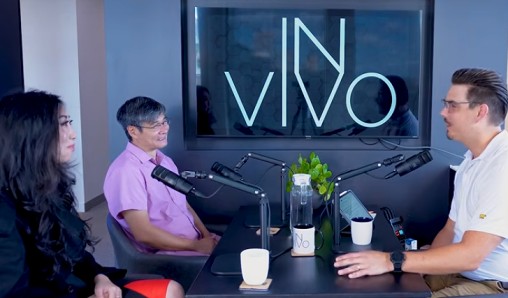
EDITOR’S NOTE: In this episode of the In Vivo Podcast, host Dr. Tim Gabor sits down with Origin Genomics founder Cathy Tie and geopolitical historian Prof. Jiang to explore the frontier of human germline gene editing. The conversation moves from Cathy’s unconventional path through biotech and music to a wide-ranging debate about how the technology could reshape global power, healthcare, and the future of the species. Along the way, the two guests offer sharply different perspectives on ethics, longevity, and what nations and individuals should do with this new ability to rewrite the code of life. This interview episode was premiered September 15, 2026.
TRANSCRIPT:
Welcome and Introductions
DR. TIM GABOR: (00:00:07 – 00:00:14) Miss Cathy Tie, thank you so much for joining me. And Professor Jiang, what an absolute honor to have you here.
PROF. JIANG: (00:00:15 – 00:00:15) Thanks, Tim.
DR. TIM GABOR: (00:00:16 – 00:00:35) This is going to be a unique conversation because obviously people know you very well for your geopolitical analysis and your view of history and predicting the future based on history. But I haven’t heard you speak much on the role of biotech.
Well, that’s because I don’t know anything.
Well, you’re going to get an education here today from an expert.
PROF. JIANG: (00:00:35 – 00:00:36) I’m here to learn. Yes.
DR. TIM GABOR: (00:00:36 – 00:01:29) Wonderful. And so one of the most controversial biotech frontiers right now is germline editing. And this is something that you’re doing and going to be doing with your company, Origin Genomics. And it’s something that we should talk about because the future is interesting and it’s moving quickly and we should discuss it.
But before we start, let’s get a little bit of insight into your origin story, no pun intended. So at a very young age you started your first biotech company, Ranomics, here in Toronto. That’s something else I should mention: we are three Torontonians here. Welcome home, welcome home.
Tell us a little bit about you, where you started, because you were very young. You’re definitely an outlier in terms of the whole biotech bro industry — first of all, not a bro, but started very, very young. How did you get involved?
Cathy Tie’s Origin Story: From Mississauga to Biotech
CATHY TIE: (00:01:30 – 00:03:30) Well, first of all, thanks for having me. Super excited to be here. It’s cool that we’re all from Toronto and we’re back here in our hometown.
I started in a really unconventional way. I grew up in the GTA. I grew up in Mississauga. I’ve always been interested in science and technology. When I was in high school, I would take the subway to go do research at the University of Toronto campus with professors and grad students. And by the time I was 16, I published my first paper in a peer-reviewed journal — on the characterization of RNF20 and RNF40, very specific proteins in antibody design.
Then when I was 18, I started studying bioinformatics at University of Toronto and kept doing research and kept publishing. But I felt like academia was very limiting in a lot of ways, because I look around me and all these grad students are depressed, overworked, being paid $30,000 to $40,000 a year. And they’re supposed to be the most educated, smart people in biotech, or in my field, genetics. And I thought that was really depressing.
I also wanted my work to mean so much more than just publishing papers. So that’s when I found out about getting venture capital funding, starting companies, as a different route than just academia, doing grant-funded research, doing grad student work, and then being a postdoc, and then fighting for the limited number of professorship positions in Canada or in the US. It was all getting more and more competitive to become a professor. This was 2014.
So that’s when I discovered there’s another world where you can do research, but in a private industry setting. I was also interested in programming, so I got exposed to hackathons, startup weekends, venture capitalists, around the same time as well. I actually won the hackathon Hack the North — the biggest hackathon in Canada. It was the first year it happened. I won it and I won four iPads. I was like, “Whoa, you can just build things.”
DR. TIM GABOR: (00:03:30 – 00:03:32) Four iPads at that time. Amazing.
CATHY TIE: (00:03:32 – 00:03:43) Yeah, that’s kind of how I got started. I found out about this other world where you can do research without having to do 10 years of academia work for no pay.
DR. TIM GABOR: (00:03:43 – 00:04:34) Yes. You broke the code, you broke through the matrix, you found a different way, because you’re right — there’s a huge amount of competition for academic positions, and the grad students are very underpaid. So you found a way around that, which is very interesting.
Let’s talk about Ranomics for a second, because it works and feeds into what you’re doing now very well. What you were studying there were variants of unknown significance. This is a very interesting concept, because as genetic analysis and sequencing became, and is becoming, more of a day-to-day thing, we start seeing these mutations that pop up that have unknown significance. And there was nobody at the time really commercializing that or even looking into it, and that’s what you focused on. So tell us a little bit about that concept of unknown significance, the variants.
Ranomics and the Puzzle of Genetic Variants of Unknown Significance
CATHY TIE: (00:04:35 – 00:04:39) So the genetic code is really interesting, because it is the code of life.
DR. TIM GABOR: (00:04:40 – 00:04:40) Yes.
CATHY TIE: (00:04:40 – 00:07:21) It programs all of the proteins that make us who we are. Every function in our cell is an expression of what was already in our genetics, especially from the embryo stage.
So when I was building my first company and doing research at 18, it was 2014, 2015, and direct-to-consumer genetic testing just became really big.
As humans, we have 3.3 billion letters in our code. We have about 30,000, 33,000 genes, and each of them programs something different. And even the code within the introns, the non-coding regions, can also mean something too. So there’s a lot of mystery and a lot of meaning to this code.
At the time, it was the era of reading this code — sequencing the genome, doing genome sequencing, direct-to-consumer tests. It’s all about reading the genetic code. What can you learn from someone’s genetic code? Can you predict a disease? That was the whole genetic testing industry. Can you find your long-lost cousins? A lot of people found out they were related to half-siblings, because some town had — you just find out you have a lot of lost family. And some people find out where they’re actually from. So that was the era of reading DNA.
Then in about 2017, 2018, we started writing DNA. This is where it gets really interesting, because you have all this code and you can reprogram it to do different things. Instead of just predicting disease — hey, you’re going to get this cancer — you can actually prevent it or cure it with gene editing.
In 2021, early 2020s, the first FDA-approved gene therapy happened. It was Casgevy, for sickle cell — the idea of correcting the mutation for sickle cell after someone’s born. So if you’re a teenager or an adult, you can actually cure sickle cell with Casgevy. Now, this was really expensive, so it’s not super accessible, but it did happen.
Yes. So that began this era of gene therapy, or writing the genetic code. I’ll just stop there, but yeah, that’s —
DR. TIM GABOR: (00:07:21 – 00:09:50) An important point to make is that that therapy, and other therapies that came after it, were applied once you were already born and mature. So these things don’t become heritable — very little ethical implication, unless you project forward, and we’re going to get into the idea of eugenics and genetic engineering. So at that point, not much of an ethical problem, you could say, or ethical implications.
But now we’re getting to the point where we have the ability to do germline editing, which is editing and fixing things in the germline, prior to somebody being born. And there are implications there, things that should be discussed. What’s going to be interesting is to get Professor Jiang’s opinion on how that’s going to change the power balance globally. It might seem odd to say at first, but germline editing is a huge frontier, lots of possibilities, but it is in some way similar to other power-disturbing, forcing functions, like nuclear energy, AI — things that can be weaponized. So as nations start to build the ability to do this, there are considerations that have to be thought of. We’re going to get Professor Jiang’s opinion on that, because he’s an expert on that.
Before we move into that, another interesting thing about yourself: you’re a very accomplished piano player and performer, which resonates with me because I grew up with a mother who was a Central Eastern European piano teacher with a piano school in the basement, so I can empathize with what it takes. You recently had a very beautiful performance at Carnegie Hall for your 30th birthday party — a little bit of controversy as to how it was covered by some of the media, which was not fair. Tell us about that. And actually, what I want to ask about specifically is how does your musical education play into your scientific education? Is there a parallel? Because I find that there are a lot of scientists who are artists too and are very creative. Music is very interesting because it’s based on a code, just like DNA is, and you can read and write it as well, just like DNA. How does that play into how you view science?
A Return to the Piano: Carnegie Hall and Finding Balance
CATHY TIE: (00:09:51 – 00:10:26) When I was a kid, I was kind of forced into piano, but I learned to really like it. When I was 5 years old, I discovered I have perfect pitch, which is when you hear a note and you know exactly what note it is. I can hear many notes at the same time and know exactly what notes they are.
So I did really like it for some time, but then when I got pushed into doing it really aggressively, I didn’t really like it as much. By the time I was put into the Royal Conservatory of Music program, I passed the highest level of piano exams when I was 11 years old. So it took —
DR. TIM GABOR: (00:10:26 – 00:10:31) This is a huge accomplishment. Most people don’t do that until they’re 18 or 19, if they ever make it that far.
CATHY TIE: (00:10:31 – 00:12:55) Yeah, it’s a lot of work. When you’re 9 or 10, I was locked in a room for a whole day. My whole summer would just be me in a really small room with an upright piano, just practicing Beethoven. That’s literally all I did. And I had very few friends because of that. So it was both something I loved and also something that kind of traumatized me in a way. I actually stepped away from it for a really long time.
Same with science, I would say. When I was a teenager, and then when I started my first company, I was really into science. I was into the genetics, genomics industry, the genetic testing industry. I tried my best to fix it. I published the papers I wrote. I was so into making the science work and bringing it out to the world.
I think at some point, for both of those things, I took a really long gap because I was really lost. I wanted to step away from piano because I just didn’t want to play anymore, didn’t want to practice. And I think I achieved certain things and I just didn’t know where else to go after that — finished level 10 with piano, did my first company, won a bunch of awards for that, Thiel Fellowship, Forbes 30 Under 30. I kind of got everything I thought I wanted, and then I was lost after that.
Then when I was 30 is when I realized I wanted to come back to these things that I really, really enjoyed before everything else happened. It was kind of symbolic for me to do so much piano practicing again and to perform at Carnegie Hall, similar to how I came back to science after spending years building a tech company.
So for my 30th birthday this year, I rented out the whole Carnegie Hall — Zankel Hall specifically — and the reception area. I dedicated the evening to two nonprofit organizations, one in science and one in music. The one in music was the Canadian Sinfonietta, my piano teacher’s husband’s chamber group in Canada. Their youth orchestra came to New York and played with me. The science organization was Cold Spring Harbor Laboratory, where I serve on the association board. It’s where James Watson lived — he was the co-discoverer of DNA — and eight other Nobel laureates lived there too, so it’s pretty cool.
DR. TIM GABOR: (00:12:55 – 00:12:55) RIP James Watson.
CATHY TIE: (00:12:55 – 00:12:57) RIP to a real one.
DR. TIM GABOR: (00:12:57 – 00:12:57) Yeah, yeah.
CATHY TIE: (00:12:57 – 00:13:05) So it was really symbolic, and I was really glad to do it. That was back in April. We’re going to play a little —
DR. TIM GABOR: (00:13:05 – 00:13:35) We’re going to have a little treat later on. And I can empathize with you on stepping away from music. It’s funny how when you’re forced to do something as a kid, you hate it, and then you learn to appreciate it much later. I have the same appreciation — I was forced to play, stepped away from it, but now I play every day, and I thank my mom all the time for that skill.
Okay, so I want to get into some first principles about germline editing, but before we do, why don’t we get Professor Jiang’s story? So you’re also a Torontonian?
Professor Jiang’s Journey: From South China to Beijing
PROF. JIANG: (00:13:36 – 00:13:42) Yeah, so my background is nowhere near as impressive as Cathy’s.
DR. TIM GABOR: (00:13:42 – 00:13:42) It’s hard to beat.
PROF. JIANG: (00:13:43 – 00:15:57) I was born in a village in South China, right after the Cultural Revolution. I was born in 1976, right before Chairman Mao dies, and that signals the end of the Cultural Revolution. It was a very traumatic event for the entire nation, especially for my father. In 1965, he was about to be the first member of our entire family, our entire lineage — which goes back hundreds of years — to go to university. But because of the Cultural Revolution, he went to a village to teach high school. After the Cultural Revolution, he took the opportunity to immigrate to Toronto, where we had relatives, and he’s been here ever since.
I was born in ’76, and then in 1982 we came over, after he had been here for a couple of years. I grew up in Toronto, in a lower-class neighborhood. Because I was very ambitious and very lucky, I applied at the right time to Yale. I got in on a full scholarship. I studied English literature there. I was thinking of going to law school, but at the end of the day I didn’t really like law. I didn’t like the very constrained, regimented way of seeing the world. And also, lawyers are miserable people. I’m not sure if you’ve met any lawyers, but I know a few, and they are not happy people.
So I gave that up and I went to China to teach English, thinking that there are 1.3 billion people in China, but I’m the only one who speaks English, and therefore I can monopolize the English teaching sector. It didn’t really work out that way. But I’ve been working in Chinese education reform for the past 25 years, with some successes but mostly failure. A couple of years ago I started to upload my lectures to my high school students on YouTube, and here we are. It’s been a very strange, wild journey.
DR. TIM GABOR: (00:15:58 – 00:16:03) This is a fantastic opportunity to get — and for the record, you live in China?
PROF. JIANG: (00:16:04 – 00:16:05) Right now I live in Beijing with my family.
DR. TIM GABOR: (00:16:06 – 00:16:41) Right on. So this will be a fascinating look into how North America approaches technology, how China approaches technology — two different, very different ways that are approached. And as a result of that, we have power imbalances, or balances, or shifting of power, and I think biotech is going to be a very important aspect of that. Famously, there have been some missteps that China has done. They also have some fantastic scientists who are pushing the science very well, and it’s because they have a very different approach.
PROF. JIANG: (00:16:41 – 00:16:41) That’s right.
DR. TIM GABOR: (00:16:41 – 00:17:01) We’re going to get your insights on that. Let’s go back to germline editing, which is what you’re doing now with Origin Genomics. What is germline editing? How is it different from what you just described when we first began, post-germline, somatic editing? How is it different? Why is it important?
What Is Germline Editing?
CATHY TIE: (00:17:01 – 00:17:53) Okay, so there are two types of cells in a human body: somatic cells and germline cells. Somatic cells are anything not reproduction-related, and germline cells are anything reproduction-related — sperm, egg, embryos.
So basically, the only dividing cells in the body — where CRISPR works best — is in dividing cells. And the most rapidly dividing cells, outside of cancer, are the embryo. I don’t want to get too technical, but essentially the biggest bottleneck with gene editing, after all the CRISPR hype from 2018, 2019, about writing DNA, is that there’s a delivery vehicle challenge: when we are adults, we have trillions of cells in our body, and the gene therapy has to go to the right cells.
DR. TIM GABOR: (00:17:53 – 00:17:53) That’s right.
CATHY TIE: (00:17:53 – 00:18:22) So as a result, you have to use something called AAVs — that’s the most common form of delivery, which is like a virus. It’s a virus that has to travel through your body and deliver the gene therapy to the right cells. If you look at all the failures with gene therapies, especially recently, and in clinical trials where these gene therapies have failed, it’s mostly, if not all, due to the virus negatively impacting the patient, killing the patient, because we’re not used to that viral load.
DR. TIM GABOR: (00:18:22 – 00:18:46) That’s right. And let me add a little caveat: people hear “viruses” and they freak out. People need to know that viruses are a very common tool in the lab as a delivery mechanism for DNA. Why? Because that’s what viruses do — they sit on cells, they inject DNA, and we can hijack them to do that bidding for us. Just want to get that out of the way, so people aren’t thinking you’re talking about some bioweapon or something like that. It’s a tool.
CATHY TIE: (00:18:46 – 00:18:48) Everyone uses this for gene therapies.
DR. TIM GABOR: (00:18:49 – 00:18:49) I’ve used it.
CATHY TIE: (00:18:49 – 00:21:06) All the companies — CRISPR Therapeutics, Mammoth Biosciences, everybody in the CRISPR space — has to use this, because that’s the only way to deliver the gene therapy into the body.
Going back to your point on what’s really interesting about the dynamic of biotech and its distribution — how each country plays in this arena, it’s pretty interesting. I’ve been watching this for over 10 years now. I think China is very good at the 1-to-100. The US is very good at the 0-to-1. It’s different, though, when you apply that to biotech versus any other field, like manufacturing or even the internet.
When I was in my early 20s, I observed that when you look at Google or Facebook, these types of platforms in the US, China can easily just shut them out and create their local, Chinese version. But the difference between that, and even manufacturing, versus biotech, is that biotech is global. If the gene therapy or the cancer treatment works here, then it works everywhere. That’s how biotech naturally works. So it’s a little bit different of a dynamic than any other previous technology, where we have established playbooks for how each country plays with the new frontier technology.
I noticed that a while back, and I think the only way for a country like China to compete on that zero-to-one level is to bring the ecosystem there. That’s why I think there was the Thousand Talents Plan — bringing people who make these technologies back to their home country and developing the ecosystem there.
When you look at this in concrete facts, in the US there are 8 biotech companies worth over $200 billion in market cap, and there are zero in China. So this ecosystem, this global dynamic for the biotech area, is very different — it doesn’t have a $200 billion market cap company, a Google equivalent, in China. The biotech sphere is just fundamentally different. This ties into the bioethics component as well. Bioethics was something that I think was truly invented after World War II.
DR. TIM GABOR: (00:21:06 – 00:21:07) Yeah.
Zero to One vs. One to Hundred: How the US and China Innovate Differently
CATHY TIE: (00:21:07 – 00:21:57) The US, if you look at CRISPR and a lot of biotech innovations, is definitely leading in a lot of that. But at the same time, I think one of the biggest things hindering its growth and innovation is the overcorrection of bioethics post-World War II. When you look at China, it’s quite the opposite — it has a very aggressive mentality to grow at all costs.
When you look at these two different dynamics, especially in a global technology like biotech, the dynamics are going to be fundamentally different than what we’ve seen in previous eras with other technologies, like the internet, engineering, space, defense, etc. So that’s kind of my general take on that, and it definitely all plays into germline gene editing and how that’s perceived, and how different countries will contribute to this field as well.
DR. TIM GABOR: (00:21:57 – 00:23:01) If anybody’s interested in the effects of World War II and bioethics, I would highly recommend the book War Against the Weak by Edwin Black. Have you ever read it? He’s also written a Pulitzer Prize-winning book, IBM and the Holocaust, which is fascinating. Because of a lot of the atrocities the Nazis performed, bioethics became a thing, and we overcorrected. This is true.
I’m sitting here hearing you talk about technology, North America, and China. One thing that comes to mind now — I’d like to get your insight on this. I think of autonomous vehicles, for example. In China, it’s a very big thing. Correct me if I’m wrong — it’s very common now, at least in the bigger cities, as far as I understand. Here, lots of bureaucracy, lots of red tape. I think that’s a nice parallel to show how these two countries, or continents, approach these frontier technologies. Where does this come from in China, culturally speaking — the 0-to-1 and 1-to-100?
PROF. JIANG: (00:23:01 – 00:23:02) Yeah.
DR. TIM GABOR: (00:23:02 – 00:23:11) How has China, over the last 100 years, developed this approach with technology? Where does that come from? It’s completely different from North America, right?
Bioethics After World War II
PROF. JIANG: (00:23:11 – 00:26:39) So we need to go back to the 1980s and understand the policymakers and their decision-making process — what is their vision for China? How can China not just catch up to the United States, but also leapfrog over the United States? Very long-term thinking.
The policy approach they adopted was to do technology transfer. The idea was that they would create a regulatory environment — tax incentives, free land, very generous government support and subsidies — which would allow American, and also German and other Western, companies to come into China and build a manufacturing hub to export products around the world. This was extremely beneficial for both China and the Western manufacturers and consumers, and ultimately this made China the world’s foremost manufacturing power.
But those 30, 40 years cemented in China a certain mentality of perceiving the world and doing business, which is: we don’t need to do innovation, we don’t need to go from 0 to 1, we can just do scaling from 1 to 100. And China does manufacturing scaling better than anyone else in the world. In fact, over the past 10 years, the United States has tried very hard to offshore manufacturing dependence to other places, and that hasn’t worked, because at a manufacturing level, no one competes and no one is as competitive as China.
Often, if you are importing manufactured goods from Vietnam or Malaysia or Thailand, they’re not actually local companies — they’re companies that have moved to these countries in order to escape American sanctions. So China does 1-to-100 better than anyone else. But as Cathy points out, 0-to-1 and 1-to-100 are two vastly different things, and as a result, China can’t really do 0-to-1 well. But its entire policymaking level, its entire economy, its entire education system revolves around the 1-to-100 goal, and so it cannot actually pivot. These things are mutually exclusive.
And I would say the same is true for the United States. What the United States does is 0-to-1 well. It doesn’t do manufacturing at all, because it offshores manufacturing to China. So people say there’s this major competition between China and the United States, but if you actually look at what’s really happening on the ground, I would say the economies are actually complementary, as opposed to in competition against each other.
For example, in science, people don’t really appreciate this, but the United States and China have always worked really well together, ever since the 1980s. The classic example: Harvard was trying to conduct a DNA study, and you can actually do that in the United States because of privacy laws.
DR. TIM GABOR: (00:26:39 – 00:26:40) Yes.
PROF. JIANG: (00:26:40 – 00:28:20) You could be sued if you try to collect DNA, but China doesn’t have privacy laws, and Chinese consumers are blissfully ignorant. So Harvard was able to go to China, go to these villages, and conduct these massive DNA studies, which really enhanced our understanding of the human genome at a very low cost.
This sort of cooperation between American scientists and Chinese scientists has been ongoing, and it actually transcends the nation-state rivalry, and there are lots of examples. Some have been very controversial — for example, CRISPR technology being implemented in China. I forget the person’s name, but he’s a Stanford graduate student, and he went to Shenzhen to try to use CRISPR to immunize infants, babies, from the possibility of an HIV infection. That was very controversial, and because of the media backlash, this man was imprisoned and sanctioned by the Chinese government. But I’m telling you right now, this actually happens a lot in China.
DR. TIM GABOR: More than we realize?
PROF. JIANG: More than we realize. It’s all covered up, because what science does is often — no offense to Cathy — but a lot of science is actually not transparent to the public. It’s not open. The funding sources are murky. The actual processes are maybe too complicated, too complex for government officials to fully appreciate. The classic example, of course, is the gain-of-function research.
DR. TIM GABOR: (00:28:20 – 00:28:20) Yes.
PROF. JIANG: (00:28:21 – 00:28:23) In Wuhan.
DR. TIM GABOR: (00:28:23 – 00:29:00) That’s right, that’s right. That was the gentleman.
Help me understand how, or why, China has developed this ability to think long term, because I’ve actually always thought about this. When I look at people who are successful and doing really well in life, they all tend to have a great ability to think long term rather than short term. This is obvious on a very large scale in China.
CATHY TIE: (00:29:00 – 00:29:01) How —
DR. TIM GABOR: (00:29:01 – 00:29:03) — how did that develop in China?
China’s Long-Term Thinking and Its Limits
PROF. JIANG: (00:29:03 – 00:30:48) I think the first thing that differentiates China from other places is the techno-utopianism of the culture and the people. If you’re Chinese, you are really appreciative of what technology has done for your society. Go back to the 1980s — China was one of the poorest places in the world, and technology has allowed China to become extremely rich and leapfrog over Western economies. If you go to China today, in many areas China is far more advanced than Europe or the United States. Europe doesn’t have air conditioning — that’s the thing the Chinese joke about this summer.
The Chinese have grown up in an environment in which technology is constantly evolving, and that’s brought tremendous benefit to the Chinese people. So culturally, the Chinese are extremely techno-utopian, so they are open to new possibilities, like biotech and AI. Whereas in the West, I think because of concern about bioethics, and maybe some dystopian incidents in the past, for example World War II, people are much more skeptical, more fearful of dystopia. That’s number one difference.
Another difference is that China is a very top-down system, a very strong bureaucracy. So it’s not that they think ahead, it’s more like they can get things done. The classic example is the high-speed rail system. Wouldn’t it be wonderful if we had a high-speed rail to connect Toronto and Montreal?
DR. TIM GABOR: (00:30:49 – 00:30:50) It would be absolutely wonderful, right?
PROF. JIANG: (00:30:50 – 00:31:11) But because of regulations, because of vested interests, because of unions, there are a thousand different factors at work to prevent this from happening. China doesn’t have this issue. You have one central authority, and they’re able to basically implement whatever vision they want.
DR. TIM GABOR: (00:31:11 – 00:31:33) That’s a very interesting paradox, because China is a very bureaucratic-heavy country and system, yet it moves quickly. And here we like to think we’re more of a democratic system, not so bureaucratic, yet we move slowly and bump into red tape that prevents things like that. That’s an interesting paradox I’d never thought about.
PROF. JIANG: (00:31:34 – 00:31:47) Right. But I will also caution you and say, even though these two things sound fantastic — techno-utopianism as well as centralized planning — it does lead to long-term thinking.
CATHY TIE: (00:31:47 – 00:31:47) Yes.
PROF. JIANG: (00:31:48 – 00:31:51) There are problems with this system.
DR. TIM GABOR: (00:31:51 – 00:31:51) Sure.
PROF. JIANG: (00:31:51 – 00:33:31) Okay, the biggest issue is risk mitigation — identifying risks, making sure you account for these risks in your planning. China does not do that. The example, again, is the high-speed rail system. Sure, it’s fantastic that you’re able to build out this national railway system in less than 10 years that is very efficient — they’re always on time, I’ve been on these trains lots of times, they’re fantastic. But if you go long term and say, okay, 10, 20 years from now, what are some issues that could arise from the high-speed rail?
The first issue is maintenance: are you able to maintain this high-speed rail system in a way that is safe and effective for the nation? I have questions about that — maintenance is a huge issue in China. Number two is just cost-effectiveness, because these high-speed rail systems are losing a lot of money. Right now the government subsidizes the high-speed rail, and therefore it continues. But if China were to face a budget crunch because of global supply chain disruptions — if China is no longer able to export goods and it’s facing a fiscal crisis — well, what impact would that have on the high-speed rail system? There are some economists who argue the high-speed rail system is a white elephant.
DR. TIM GABOR: (00:33:31 – 00:33:37) And how would that trickle down through the whole economy? People can’t travel, and the like.
PROF. JIANG: (00:33:38 – 00:34:07) I would say another huge issue that the Chinese don’t really think about is the safety issue. You can design a system that looks perfectly safe, and there’s a 1-in-10,000 chance of an accident happening, but when the accident happens, lots of people die. There was a derailment in Wenzhou many years back that killed about 2,000 people.
CATHY TIE: Really?
PROF. JIANG: Yes.
CATHY TIE: (00:34:07 – 00:34:07) Wow.
PROF. JIANG: (00:34:08 – 00:35:26) So it’s really important to appreciate this. We can talk about the great things about China, but these three issues — understanding long-term risk, being cost-effective, and safety issues — they can also apply to biotechnology.
DR. TIM GABOR: Yes.
PROF. JIANG: So yes, it’s possible that China steams ahead in biotechnology in the short term. But in the long term — I’m talking more like a 20-year time frame — this speed could create more issues.
DR. TIM GABOR: At what expense?
PROF. JIANG: At what expense, right. And a huge issue in China right now is artificial intelligence, self-driving cars, renewables, because honestly, we don’t yet know how to make these things profitable. All these things are being subsidized by the government, and that’s great — the government is thinking long term, it wants China to progress technologically. But if you just look at things from a basic economic cost-benefit analysis, you have to ask yourself, should China actually be engaging in this technology? I’m sorry to say this, but I think a classical economist would say no, China should not be doing this.
Inside Origin Genomics: Editing Embryos Without Viruses
DR. TIM GABOR: (00:35:27 – 00:36:11) Interesting. Okay, so speaking of technology, let’s go back to Origin Genomics for a second. Because of safety issues — there’s a very good point in terms of biotech: trains, biotech, safety issues in both. Biotech, or specifically germline editing, has the added possibility that the changes and corrections you’re doing are heritable. So there’s a very unique aspect there, where you will pass these things on to the next generation, and the next, and the next. So that’s got some interesting implications.
But let’s talk about specifically what it is you guys are doing now. What have you accomplished? What are you hoping to do? Where do you guys stand right now?
CATHY TIE: (00:36:12 – 00:37:16) So I took on this challenge of using gene editing to get rid of particular genetic diseases, in a different format than what has traditionally been done in my field, which is administering gene therapies via a virus into a body. We’ve seen that that’s really expensive, it doesn’t really work, and it’s really invasive. Casgevy, for example, you have to get chemotherapy, it’s $2 million, and then you also can’t reproduce afterwards — it destroys all of your gametes.
So with what I’m building, I realized that the only way to make CRISPR work, at least in 2026, is actually in dividing cells, which is an embryo. We have really good technology now to sequence the DNA of an embryo, or the DNA of both parents, before the embryo is created, to know if this embryo is going to carry a really deadly disease — like Tay-Sachs, sickle cell, hereditary cancers. You can actually design gene editors to go directly into the embryo and correct that mutation before the cell starts dividing, into 2, 4, 8, hundreds, thousands, and then millions and billions.
DR. TIM GABOR: (00:37:16 – 00:37:22) So as they divide, the fix gets passed on to daughter cells and spreads throughout the whole body.
CATHY TIE: Exactly.
CATHY TIE: (00:37:22 – 00:40:35) So then you don’t need the virus anymore, which is the main reason why this doesn’t work right now, and why it’s so expensive, and hurts people.
Now, this entire field of heritable gene editing — anything to do with changing the DNA of an embryo — becomes really controversial. For some reason, this has been happening for decades. Even when IVF was first invented, it was on the front page of Time magazine: “Oh my God, Frankenstein, test tube babies. This is something to be afraid of.” Versus now, when we look back on it, it’s kind of foolish to say that, because now we have 2 million lives every year born through IVF. It has helped so many families create children, have their own children, if they weren’t able to themselves.
So there’s a weird media frenzy around germline gene editing as well, and I think it can actually help a lot of people. Ever since I decided to work on this, I’ve received emails and messages from families across the world, in different countries, different languages, saying, “My family has spinal muscular atrophy,” or “My family has Alzheimer’s, hereditary breast cancer, cystic fibrosis, Huntington’s.” All of these diseases have just one gene, where you can make a really precise correction of one nucleotide, one A, T, C, or G, and correct it for life. It has the potential to do that.
In the US, in 2011 or 2012, Congress pulled all the funding from federal entities like the FDA to review this technology. So the FDA doesn’t have a framework or funding to review this for approval for clinical use, and it’s been 15 years. I think that just goes to show how much stagnation there is in reviewing the safety data, in just changing one’s perspective on this — that it can actually help a lot of people.
I think the biggest thing is that there’s a really big unmet medical need. It’s not that we’re trying to do this for no good reason — there’s a very clear reason. There are hundreds of millions of people around the world who have these diseases, and every generation, they pass it down to the next generation and the next. Trillions of dollars are spent every year globally to treat these diseases after someone’s born, and it’s extremely invasive. There’s a lot of suffering.
I came into the field thinking you’re supposed to use medicine to help people, and now I’m realizing there’s so much bureaucracy and politics, and even fellow scientists try to follow the media-approved narrative, saying this is unethical. How is this unethical, when we’re trying to do this in model organisms and cell lines, showing the safety data, the efficacy data? So I think this is the right thing to do, especially given the limitations of current technologies.
When you zoom out and think longer term, bigger picture — right now people have these diseases and they have to get gene therapies or pharmaceutical products to treat them. There’s a lot of people involved in that industry, and then when you pass it down, it’s like another subscription.
DR. TIM GABOR: (00:40:35 – 00:40:44) You’re basically describing a disruption of a subscription model.
CATHY TIE: Yeah, very disruptive. Very disruptive to a lot of people who are making a lot of money.
CATHY TIE: (00:40:44 – 00:41:18) And that’s just the whole medical system in every country. You’re supposed to treat these things after someone’s born. There’s diagnostics, there’s the therapeutic industry, and then when your kid has that disease, they have to redo that again — for Casgevy, it’s another $2 million for the pharma company. What I’m saying is that if you actually correct it in the embryo, you never have to get that disease again. Your kids don’t get it, their kids don’t get it. I think that’s a net positive, but for some reason there is a weird negative aura around this technology, when it comes to the controversy and the pushback.
Why Germline Editing Faces So Much Pushback
DR. TIM GABOR: (00:41:18 – 00:42:04) Yes, and I think a lot of that comes from misunderstanding. People immediately think about what we mentioned earlier — eugenics, genetic engineering to create super soldiers, or whatever it might be. You made a really good point with IVF. Robert Edwards, the father of IVF, was heavily criticized when it happened. People claimed he was playing God. But now, in retrospect, like you said, 2 million people have been born through IVF, lots of happy families. It’s touched our family personally. And now, in hindsight, nobody complains about it. So what do you think it’s going to take for germline editing to have that same reversal, the way IVF had?
CATHY TIE: (00:42:05 – 00:42:56) I want to provide another example — it’s not just biotech. When electricity was first invented, the gas industry had so much propaganda saying electricity could kill you, that it’s like witchcraft. I have photos of this too. When there’s a shift in power, when a new technology arises that can change the distribution of power, there’s always going to be a lot of pushback, especially — you can see it in the media and propaganda more clearly in hindsight. Like what we’re seeing with IVF now, it’s very acceptable, it’s applauded as a technology. He even won a Nobel Prize for it. But when you’re going through it, there’s always so much pushback from the people you challenge, when it comes to power redistribution with a new technology. I think that’s what we’re at with germline gene editing, because of the reasons I explained, and how it can fundamentally change the medical system.
DR. TIM GABOR: (00:42:56 – 00:43:32) I’ll put this out there — just occurred to me. In the absence of germline editing, what happens sometimes is a family will have genetic testing prior to a child being born, and if something devastating comes up, oftentimes abortion is an option that people take. So you would think this would be a counter to that — we can actually prevent abortions from happening, whatever your position is on abortion — but this would be a way to counteract that. Rather than aborting a fetus, fix it.
CATHY TIE: (00:43:32 – 00:44:03) Not just aborting — when you’re going through IVF and you know someone in your family has a disease, or one of the parents has a disease, maybe both, you do something called PGT, preimplantation genetic testing. You screen all of the available embryos for the particular mutation, and then discard the embryos that have the mutation, and only implant the ones that are healthy and don’t have the mutation. The problem is, a lot of families don’t have a lot of viable embryos to begin with. When you’re going through IVF, you’re typically a little bit older, you have a limited —
DR. TIM GABOR: (00:44:03 – 00:44:04) Statistics and numbers game at some point.
CATHY TIE: (00:44:04 – 00:44:31) And also, you should give people more choices. If they want to use more embryos, have more children, this technology would allow them to do that and have more viable embryos to choose from. Or if they want to have multiple children that all don’t contain the mutation, they can have the choice to do that. So I think it’s a very complementary technology to the existing IVF workflow, and what’s available right now for genetic screening and disease prevention. It just adds very naturally on top.
IVF, PGT, and Reproductive Technology in China
DR. TIM GABOR: (00:44:31 – 00:45:02) It does plug into the IVF workflow very well. Professor Jiang, what is China’s perspective, culturally? People, society in general — what is their perspective and opinion of IVF? Does that occur often there? Is it a viable option? Also, in the context of the former one-child policy, did that prevent IVF from becoming a thing, or is it a thing? What’s IVF like in China?
PROF. JIANG: (00:45:03 – 00:46:31) I could be wrong, but what I believe is that IVF is actually illegal in China. I’ll need to fact-check this, but I know that surrogacy is illegal. Why is surrogacy illegal? Because it’s seen as a form of exploitation — where I’m a wealthy woman and I can’t be bothered to have my own child, or maybe I’m too old to have my own child, so I bribe a younger woman to have this child on my behalf. This raises a lot of ethical questions that highlight inequality in China, and the government is very sensitive toward that. So surrogacy is illegal in China. What wealthy women tend to do — and it’s actually pretty common in China — is fly to the United States, or a Western country, and do a surrogacy there, because it’s not illegal in the United States, and they hide the surrogacy from Chinese officials. So I believe IVF is also illegal, for the same reasons.
CATHY TIE: (00:46:31 – 00:46:40) Just to jump in — I think IVF is legal, but certain things are illegal, like you cannot select gender, and you can’t do surrogacy.
PROF. JIANG: (00:46:40 – 00:46:44) So that makes a lot of sense. Okay, but I know it’s pretty heavily regulated.
CATHY TIE: Yes.
Origin Genomics Today: Approvals and the Road Ahead
DR. TIM GABOR: (00:46:44 – 00:46:58) Interesting, interesting. Okay, so Origin Genomics — where do you guys stand right now in terms of approvals, rolling out a product, for lack of a better term? Where are you right now in the process?
CATHY TIE: (00:46:58 – 00:47:30) We’ve made a lot of progress. I realized that the center of gravity for bioethics, despite the challenges, is actually still in the United States. So I decided to set up a company and a lab in the United States to take this head-on. With Origin Genomics, we have a laboratory that is IRB-approved. IRB is a third-party ethics committee that reviews your protocols — they review your protocols, the patient consent process and forms, and approve them before you can start your experiments and your work. So we have that approval to do human germline gene editing.
DR. TIM GABOR: (00:47:31 – 00:47:32) Are you the first company to get that approval?
CATHY TIE: (00:47:33 – 00:50:09) At least publicly, yes.
We have donated human samples, embryos that contain disease mutations, and we’re working on prime editors and base editors to help correct those mutations. With gene editing, there are different types of editors, and it’s important to distinguish what we have available now versus before. I think before — when there was more controversy — one of the biggest pushbacks was on the double DNA strand break, causing safety concerns: what if you have an unintended consequence, like an off-target mutation, or a chromosomal abnormality, a loss of heterozygosity?
Now, with the newer technologies, there was a paper that came out in June from a Columbia group that showed very precise changes done with base editors in human embryos, and it didn’t have any off-targets or chromosomal abnormality. When you extrapolate that further and use it for a therapeutic context — not just making any mutation precisely, but correcting a mutation known in that embryo to cause disease — what you have is a therapeutic germline gene editing platform, where someone can give you their embryos, you can design an editor just for their mutation, safely introduce it into their embryo, and correct that mutation before it’s implanted and becomes a baby.
I would say this should only be used for very, very dire diseases known to have a genetic factor, like one specific mutation, because that’s where this technology has shown to work really well and really safely. So what we’re doing at Origin Genomics is producing a lot of that data. I’m also doing a lot of other work — I just wrote a paper, I hadn’t written one since I was a teenager, so this was a really big challenge for me. Over the summer, I wrote a paper for Cell Press: Trends in Genetics, as a single author, on therapeutic germline gene editing, and it’ll come out in the next two weeks or so. It talks about this entire workflow, how this fits into IVF, why this is the right time to do it, what new technologies have been developed to make this safer than ever, and what still needs to be de-risked for this to be implemented in the clinic.
My hope is that one day Origin Genomics can help couples and families with these hereditary diseases not pass them down to their children, and still have as many healthy children as they’d like. Then the diseases they carry will no longer cause suffering in their offspring, and their offspring’s offspring. That’s the goal.
DR. TIM GABOR: (00:50:09 – 00:50:52) You mentioned focusing on the most extreme cases, but also, for lack of a better term, the simplest cases. What people need to appreciate, when they hear “genetics” being evoked, is they think it’s very simple — one gene, one mutation, causes some sort of problem — when in reality, most things are multifactorial, which is the term geneticists would use. Many genes come together and play this large symphony to bring about some sort of issue or phenotype. So you’re focusing on the simpler of those problems, ones that are not as multifactorial, per se. Is there a particular condition or disease you’re focused on mostly?
CATHY TIE: (00:50:53 – 00:51:10) Right now, in this moment, we’re just very focused on hereditary cancers. But we’re also going to be working in other monogenic disease areas very soon — cystic fibrosis, Huntington’s, these types of well-defined, well-characterized monogenic diseases.
Correction vs. Enhancement, and the Question of Choice
DR. TIM GABOR: (00:51:10 – 00:51:15) So let me ask you an ethical question — where do you draw the line between therapy and enhancement?
CATHY TIE: (00:51:17 – 00:52:13) Whether it’s a correction or anything that’s not a correction — a correction is when we know, for sure, there’s a mutation that causes a disease. There are tons of studies and publications on that, and you’re correcting that mutation, versus you’re inducing a variant or a mutation that didn’t need to be there, that was already healthy before you went in and edited the embryo. That’s the distinction.
DR. TIM GABOR: Where do you see Origin Genomics 10 years from now?
CATHY TIE: I have a very ambitious goal. I want to help hundreds of millions of people not pass down their genetic disease, if they choose not to. Again, this is really important, because there’s a history of eugenics and things like that with genetics in general. But it’s very important that there is a choice here. If people don’t want to pass down their genetic disease, they should have the choice not to. I’m hoping Origin Genomics can help millions, tens of millions, hundreds of millions of people make that decision. If they choose to do that, then we can help them have healthy children.
DR. TIM GABOR: (00:52:13 – 00:52:39) I’m glad you said that, because we did just go through a nice period of coercion in terms of medical practice over the last couple of years, vis-à-vis COVID, and it’s important to state that choice is very, very important.
Professor Jiang, having heard Cathy’s story, what’s the first thing you think of in terms of power distribution, once this sort of technology becomes more of a mainstay?
Power, Geopolitics, and a Controversial Theory About “Docility”
PROF. JIANG: (00:52:40 – 00:56:38) My first impression is — I think you asked a great question, how do you differentiate between correction and enhancement? It’s not possible to do so technologically. If you’re able to correct, you can also enhance, and you’re assuming there are regulatory guardrails to make sure this isn’t abused. But what we know is that once you have the technology in place, you open Pandora’s box, and it’ll be really hard to regulate, especially now that science is transnational. If, in Canada, you don’t allow this, well, in China they would probably allow this, because China does 1-to-100 very well, in which case you’re now also forced to adopt their lax ethical standards. So that’s my first impression — I don’t think you could create a situation in which the technology, once it’s created, once it’s refined and perfected, stays focused only on correction. You will eventually have enhancement as well.
My second impression is I think it’s wonderful what Cathy is doing, and this is definitely the future, and I would definitely invest if I had any money. But when I think in terms of geopolitics, I’m looking at things at a very macro, structural level. The way I would interpret this technology would be very different from the way you would, which is: if I’m a nation-state, I have to solve a labor issue.
One problem I would need to solve in the future, primarily because of the aging crisis, is that every major developed nation is facing an aging crisis, where you’re going to have an elite that is over 70, over 80, and they need nursing, they will need healthcare. I need to solve that problem, and I need to make it cost-effective. One solution people have proposed is robotics.
DR. TIM GABOR: Yes.
PROF. JIANG: But actually, there’s a better solution, and the better solution is to create a docile population that’s focused on serving others. Again, I’m saying this at a very nation-state, macro level. I know this sounds preposterous.
DR. TIM GABOR: No, I like that.
PROF. JIANG: But again, if I have millions of very wealthy elderly people I need to take care of, then I need to provide millions of healthcare workers that are cheap, that are docile, and who are committed. So is it possible, in the gene-editing process, to favor certain genes that create docility in people, and remove the aggression, ambition, and spontaneity in people? I would imagine the answer is yes. So if I’m a nation-state, yes, I want to create robots, because I need to solve that aging crisis, but robots are expensive and dependent on a global supply chain — I need to be able to source copper, lithium, helium from a variety of places, and in a time of war — and we are in a time of war, people don’t appreciate this — sourcing these minerals and elements is very expensive.
But to give birth to a baby is actually really cheap. And once your technology is in place, and I’m able to scale the technology, gene-editing these babies is also really cheap. It costs me almost nothing to give birth to children, but it will cost me a lot to build a robot. In terms of national security, I’m actually better off gene-editing babies than I am building robots.
CATHY TIE: I have a question.
DR. TIM GABOR: (00:56:38 – 00:56:41) Very interesting perspective.
CATHY TIE: Yeah, I have a question.
CATHY TIE: (00:56:41 – 00:57:07) So if we’re optimizing for docility and lack of ambition, wouldn’t it just be easier to take people from countries where there’s cheap labor, and they may not even have — maybe they’re already docile, and they just want a normal life. Isn’t it a little bit easier that way?
DR. TIM GABOR: (00:57:07 – 00:57:08) Or to put lithium fluoride in the water.
PROF. JIANG: (00:57:09 – 00:57:39) Yeah, or take Canadians. Okay, so again, if I’m a nation-state, I’m worried about risk mitigation, so I don’t want to take that chance. In theory, if I took a lot of these people — let’s not name people, okay — they will be docile, but maybe only for the first generation. How do I make sure the second generation, third generation, are also docile? We know that once people come into a culture, they acclimatize to that culture. So I don’t want to take that risk.
DR. TIM GABOR: (00:57:39 – 00:58:20) Very interesting. Have either of you seen the show Silo? No? Okay, I recommend it — we can talk about it later, but it kind of plays into what you’re mentioning there.
Now, you bring up a good point about one of the problems being aging populations. The other global problem is just birth rate — so it’s two juxtaposed problems that sort of feed on each other. Do you see your technology potentially, in the future, being able to mitigate birth rates?
Aging Populations, Birth Rates, and Healthcare Costs
CATHY TIE: (00:58:23 – 00:58:55) Possibly — definitely a little bit — but I think the biggest positive impact it can have is on healthcare costs. Healthcare costs in any country are one of the largest expenses. HHS in the US spends more money than the entire Defense Department, which is a lot for the US. So if you can help reduce the healthcare burden, that makes a lot of sense, and you can help save so much money that can be spent somewhere else, instead of diagnosing and treating diseases and that being a huge cost for the country.
Who Will Own the Biotech Century?
DR. TIM GABOR: (00:58:55 – 00:59:24) There’s also an interesting historical parallel you can perhaps touch on — the way the Brits captured the coal industry a couple hundred years ago, and Americans captured the oil industry, and then somebody will capture the computing industry. Who is going to capture the biotech industry and come out on top? From a historical perspective, using the history of those paradigms to project into the future, as you do so well — what are your thoughts on that?
PROF. JIANG: (00:59:25 – 00:59:33) Well, if I were a betting person, I would bet on Israel.
DR. TIM GABOR: (00:59:33 – 00:59:36) They have a huge biotech sector, technology industry.
PROF. JIANG: (00:59:36 – 01:00:13) Yeah. And again, I don’t want to be too politically sensitive, but a lot of the ethical rules that apply and constrain the American biotech sector would not apply to the Israeli biotech sector, and that would give them a huge advantage. So they have capital, they have talent, they have infrastructure, and they’re not constrained by ethics, religion, and privacy. So they almost have a greenfield to develop this technology.
DR. TIM GABOR: (01:00:14 – 01:00:25) Interesting. What are the unintended, unexpected consequences of being so open? Where does that go awry? Can that go awry?
PROF. JIANG: (01:00:25 – 01:00:36) Well, it can be very dystopian, right? In order to perfect this technology, you’re going to have to experiment. And when you experiment on human beings —
DR. TIM GABOR: (01:00:36 – 01:00:39) That’s a very good point. I’m sorry, go on.
PROF. JIANG: (01:00:39 – 01:00:53) It’s like 99% are going to be rejects. So the human suffering, the cost, will just be tremendous. But this is something you have to endure if you want to perfect and refine this technology.
Weaponization, Gene Drives, and the Lessons of He Jiankui
DR. TIM GABOR: (01:00:54 – 01:01:24) Do you have any fear that, because biotech is, as you both mentioned, a very open field of study — it’s pretty much open source for the most part, unless you’ve got something proprietary — but the technology, the know-how, especially with AI now, is amazingly open. So my question is, do you have any fears that this could become weaponized? And what are you doing, or what do you hope others are doing, to mitigate that?
CATHY TIE: (01:01:25 – 01:01:49) I have a lot of fears around that. We’ve seen with COVID what happened when you have a virus that would just travel. Viruses, biology — they don’t respect borders. I think that’s a really important point. When you even zoom out of viruses and look at something called gene drives — I don’t know if you guys have heard of this — the Gates Foundation funded —
DR. TIM GABOR: (01:01:49 – 01:01:50) Bill Gates’s favorite. Yeah.
CATHY TIE: (01:01:50 – 01:03:11) The Gates Foundation funded a project where you can create mosquitoes in the lab that act as gene drives, and you release them into the wild. They mate with regular mosquitoes in the wild, and their offspring — instead of 50% heterozygosity, 100% of them, all offspring, will carry the mutation you intended, the one you release from the lab. For their application, they were trying to reduce the amount of malaria that can be carried from mosquito to people in that region. So these mosquitoes released from the lab are unable to carry malaria.
While that’s a pretty good application, you can also think about what can go wrong with that. These mosquitoes don’t respect borders. It could be any flying bug, any animal that can be a gene drive — these animals don’t respect borders. There are crops, there are a lot of things very sensitive to something like a gene drive. So this gets a little bit dystopian now, more on the biodefense side. But I think even for something like insects — programming insects with gene drive technology — that’s something we need to all start thinking about as soon as possible. I don’t think people are thinking much about that in the public sphere. Everyone’s thinking about AI and chatbots, but really, these are the things that will really affect our day-to-day, physical world.
DR. TIM GABOR: (01:03:11 – 01:04:05) And you’re right, with the gene drive example — these fixes, if we’re thinking about it from a benevolent perspective, you fix it and it gets passed on, and you stop a disease. But like you said, biology doesn’t respect borders. Once you start going from fixing to enhancement, or maybe to something like the docility you described, people get out into the wild, they start to mate, and it will propagate eventually through many generations, uncontrollably. So do we need to think about this ahead of time? There are things that will happen as a result of this technology that nobody is thinking about, and I wonder what those things are. You don’t know what you don’t know, obviously, but do we need to go slow? What are the benefits of going slow, and what are the benefits of going fast here?
CATHY TIE: (01:04:05 – 01:05:58) Well, evolution has historically taken thousands of years to change in human populations. With this technology, things can happen overnight, and it can be propagated forever in our species, and other species, with the mosquitoes. That’s really important to remember. I think this is where regulations need to come in, and we should all be thinking about this.
I don’t think we should stop it, because what happens when you stop it and ban it — which is kind of what happened in the US for the last 15 years with heritable gene editing — is that it’s still going to be developed somewhere else, and you’re just going to have less control over it. That’s not good. With something like gene drives, it can be even more immediate, because these mosquitoes can be released tomorrow, versus a heritable gene edit, which will still take many years for the child to be born.
So I think there needs to be a mixture of everything — public education and discourse, regulators, scientists talking about this. I think that whole academia industry has also become a monolith in a lot of ways. People don’t really talk about the important things. Certain ideas are just too dangerous to even talk about or think about — it’s very censored, more than ever, in the last couple of decades. Especially because I think after World War II, public funding started — grants, funding of academic research from the government, versus before, when it wasn’t like that. So now a lot of the opinions, discourse, and censorship are a lot more monolithic than they were before. Science looks a lot different now than it did before. So I think first you need to have these conversations, these discussions, with as many different parties as possible, and start thinking about how to mitigate these risks.
DR. TIM GABOR: (01:05:58 – 01:06:21) Professor Jiang, you mentioned He Jiankui, from China. You knew him personally — I don’t want to get into it deeply, but I’m curious, what did you learn from that experience, and how are you applying those lessons to what you’re doing at Origin? Because it was a great insight — I’m sure you learned a lot. How do you apply those lessons learned to what you’re doing?
CATHY TIE: (01:06:22 – 01:07:01) I realized that certain technologies can be very geopolitical, like that one. I learned a lot from it. I think it’s important to do things in the open, and to share results, share the protocol, share progress with the public, because when science — especially really consequential science — is done behind closed doors and then released to the public suddenly, it can be a very jolting experience for the public, regulators, and governments. So that’s the main thing I took away. I also took away that this is a really important technology — the fact that there’s so much attention on it, good or bad, means that this is consequential and needs to be done.
DR. TIM GABOR: (01:07:02 – 01:07:31) Professor Jiang, if you had to advise, let’s say, the United States or North America, from your perspective where you sit in China, how would you advise North America to put itself in a better position, whether it comes to competition in biotech, or just in order to shift the power balance back to the United States? How would you advise, based on what you know and what you’ve seen in the East?
Cooperation, Not Competition: A Prediction for US-China-Israel Relations
PROF. JIANG: (01:07:32 – 01:11:01) I don’t really do “what should be.” I basically do predictions — I say what will be.
I think these ethical concerns are correct, but we’re way past that, and we’re going to steam right ahead in this technology. So I think it’s better to think about the consequences of this technology, rather than “should we do this technology?” I think the main driver of this technology — and Cathy can agree or disagree — is that we have, throughout the world, a minority of very powerful people, billionaires, presidents, who are very old, and they want to live forever and remain young. Certain individuals, like Vladimir Putin, have openly discussed this — how organ transplants can rejuvenate him. There’s so much funding and power behind biotechnology and transhumanism that I think that’s the path we’re going to take.
I think China, the United States, and Israel — these three nations, but possibly others as well — are, my prediction, much more likely to work together than to compete against each other. Each nation-state will have certain specializations. As Cathy points out, what the United States does very well is zero-to-one. It has the most talent, it has the most capital, and it has the best infrastructure, it has the best research universities. It’s impossible to compete against the United States in terms of innovation — that’s why Cathy is in New York.
China does certain things extremely well — 1-to-100 — but it’s also a very techno-utopian society that would subsidize a lot of this research. When scientists move to China — people don’t appreciate this, but you two would — they’re still communicating back in the States. It’s a transnational project. Just because they’re based in China doesn’t mean they’re only using Chinese resources — they’re often invited to China because they’re able to access global resources.
Israel has a lot of advantages, in that they’re able to test in a certain way that other nation-states aren’t able to, just because of their religion and their politics. I think Japan would also be a very important player, because they face the aging crisis, and healthcare is very important in Japan.
So I don’t really see the future as one of geopolitical competition — I see it more as cooperation. I think biotech science is actually going to transcend national borders, just because it benefits everyone to achieve this technology as soon as possible.
DR. TIM GABOR: (01:11:02 – 01:12:14) That’s very — in one way optimistic, and in one way pessimistic, way to look at it. I don’t think it’s optimistic. Well, I mean, if it were to transcend borders for the common good, rather than for longevity — and I’m glad you brought up the term “transhumanism.” If you’re not familiar with that term, I urge you to look it up, because it’s actually a trend amongst the elite, like you brought up. It’s actually outlined very well in those two books I mentioned by Edwin Black.
Now, the interesting thing, sitting here listening to you guys describe the technologies and the power struggle, is the issue of “someone else will just do it.” It’s almost impossible — if we don’t do it, someone else will do it. It’s this scale, this ladder, that pushes people forward and forward and forward. It’s almost impossible to fight against, unless everybody agrees on moratoriums, and that’s it. But there will always be somebody else that does it. That’s an interesting forcing function.
Global Supply Chains and Technological Interdependence
PROF. JIANG: (01:12:15 – 01:12:32) I want to emphasize this point, please — all technological progress today, regardless of the field, relies on global cooperation because of global supply chains. For example, artificial intelligence —
DR. TIM GABOR: (01:12:32 – 01:12:33) That’s a great point, great point.
PROF. JIANG: (01:12:34 – 01:13:13) You need to source silicon, gallium, germanium, copper, lithium — it comes from all around the world. Different nations do specialization. Maybe lithium is something you mine in the Lithium Triangle, but then it’s turned into batteries in China, and the technology to turn this into batteries comes from Europe or Japan. That’s what people don’t appreciate — we are living in a technological world because of globalization. If globalization, if global supply chains are disrupted, then it’s very hard to progress. That’s something people need to keep in mind.
DR. TIM GABOR: (01:13:15 – 01:14:03) Yeah, that’s very interesting. Now, I think people should also appreciate — yes, the technology you’re describing does require expertise, lab equipment, and technology, but it’s simpler than people realize, I think. For example, just cloning genes — I’m just thinking in terms of supply chain, it doesn’t take much to do the sort of thing you’re describing, in terms of reagents. When you’re doing it in humans specifically, yes, it’s more complicated than doing it in E. coli or yeast, but I’m not sure the supply chain would have as much of an impact on what you’re describing as it would on robots or ships. I don’t know — it’s just, on the surface level. Your thoughts?
Biotech as the New Manhattan Project
CATHY TIE: (01:14:05 – 01:15:15) I actually thought about this a while back — I wanted to compare this to the Manhattan Project era. I would say it has that scale of effect, whether good or bad, in terms of the power of the technology. But unlike physics, or nuclear weapons, atomic bombs, the game theory of biotech is just so different, for biodefense. When you think about nuclear weapons, you need a whole facility — when you fire an atomic bomb, you know exactly where it’s coming from. With biotech, it’s different, because it’s not completely destructive like nuclear weapons — biodefense, I mean, not therapeutics, biodefense. It’s not completely destructive in the way atomic bombs are. It can also be used for good, so it’s not as severe as the atomic bomb chapter of physics. You also don’t know where it’s coming from, because nowadays people can have a garage lab and build things, especially with AI.
DR. TIM GABOR: (01:15:16 – 01:15:17) That’s kind of what I was touching on. Exactly. Yeah.
CATHY TIE: (01:15:18 – 01:15:51) It actually is more dangerous, from a game theory perspective, than atomic bombs, because you don’t know where it’s coming from. It has both creative and destructive value — you can do anything with it, and more people can get access to it. You don’t need a whole facility to build something like a nuclear weapon — you just need a lab. I’m not saying anyone should do it, but I’m just thinking, this is the reality of biotech in 2026, and different people have different incentives. I think we have to just face the reality of it.
DR. TIM GABOR: (01:15:51 – 01:15:57) Annie Jacobsen — do you guys know Annie Jacobsen? She just wrote a great book on exactly this topic.
CATHY TIE: (01:15:57 – 01:16:00) Oh yeah, she interviewed me in LA. I wonder if I’m going to —
DR. TIM GABOR: (01:16:00 – 01:16:29) I’m not completely through the book yet, so I haven’t popped up yet, but maybe I’ll pop up in the later chapters. But it outlines exactly what you’re talking about — it’s relatively straightforward and simple, but the implications are perhaps much greater than nuclear weapons, which is something that needs to be considered.
How do you, sitting here listening to this — because you’re also, one might say, an expert on game theory — where’s the synergy between game theory and biotech? What comes to mind?
PROF. JIANG: (01:16:30 – 01:16:55) Yeah, so again, according to game theory, biotechnology is the future, because there are many powerful interests — you could argue the most powerful interests — who want to promote this technology. And the elite, the major issue they’re facing, is: how do I live forever?
DR. TIM GABOR: (01:16:55 – 01:17:00) If you spend two minutes on Twitter or X, half of what I see is about longevity, living forever.
PROF. JIANG: (01:17:01 – 01:18:51) That’s right. Because that’s one thing missing in their life — they have money, power, fame — and for them it’s, how do I maintain my status? So, according to game theory, biotechnology really is the future. I think Cathy is right that the consequences of biotechnology are far more devastating than the atom bomb or artificial intelligence, because in theory, with artificial intelligence, you could always turn off the switch — no electricity, in which case the entire system shuts down. But once you put a new virus, or a new DNA sequence, into nature, then the consequences we can never predict. Humans have always been bad at predicting the consequences of new technologies — we’re just really bad at that.
So, according to game theory, biotech is the future, and its impact will be tremendous. If history is any example, the impact will be both negative and positive. Often, again according to game theory, what’s going to happen is the distribution will be very unequal, in that the elite will probably have the positive effects of biotechnology, and everyone else will have to suffer the negative consequences. I wonder if this might precipitate ultimately the collapse of society.
Do You Want to Live Forever?
DR. TIM GABOR: (01:18:52 – 01:18:57) Very interesting, very interesting. On a personal level, do you want to live forever?
PROF. JIANG: (01:18:57 – 01:19:18) No.
DR. TIM GABOR: Why not?
PROF. JIANG: Because I have children. Having children has made me a very spiritual, very religious person. I see children as gifts from God, and having children — my greatest gift to them would be for me to die and go away.
DR. TIM GABOR: (01:19:20 – 01:19:22) Interesting way to put it. What about you, Cathy?
CATHY TIE: (01:19:23 – 01:19:49) I also don’t want to live forever. I think life, or the universe, is something where our souls are kind of recycled, and we learn so much from dying and being reborn again. That’s just what I think, instinctually. And I think if we live forever in this realm of reality, it’s just not a real experience, which is how I feel. So I’m okay not living forever.
PROF. JIANG: (01:19:49 – 01:19:53) But we say this because we’re not billionaires. I’m pretty sure that I’m not.
DR. TIM GABOR: (01:19:53 – 01:20:36) I would think differently — yeah, you’re right. And I think a lot of your biotech friends would think you’re crazy for saying that. It’s a very common trope right now, as we mentioned earlier, to want to live forever. I agree with you both, by the way.
What would your advice be — I’ll start with you, Professor — to young students studying in this sector of science, biotechnology, perhaps wanting to work on technologies like this that might impact the global milieu, society and culture? What would your advice be to them, getting into this, in terms of long-term thinking?
Advice for the Next Generation
CATHY TIE: (01:20:37 – 01:20:38) Join the military.
PROF. JIANG: (01:20:40 – 01:21:11) If you think about it, if you’re really interested in this technology and you really want to develop real applications, the best place to do it would probably be the military. You would have a lot of space, unlimited funding, and access to the best technology. And if you do a good job, then in 10, 20 years’ time, you’d be able to come out of the military and privatize a lot of your research. That’s how Israel works, right?
DR. TIM GABOR: (01:21:12 – 01:21:19) Did not expect you to say that — that is an interesting perspective. What about you, Cathy? Young students interested in what you do — what would your advice be to them?
CATHY TIE: (01:21:21 – 01:21:33) Work on things that mitigate the technical risks of this technology, like reverse gene drives, things like that. Think about the most consequential technologies, and how to mitigate the risk of that. That would be my advice.
DR. TIM GABOR: (01:21:34 – 01:21:52) What about advice from the perspective of your own life path? Very different than most people in biology and biotech, who go all the way — master’s, PhD, and so on. You took a different path. What did you learn from that, and would you recommend it to others?
Cathy’s Advice: Don’t Follow My Path
CATHY TIE: (01:21:53 – 01:23:39) No, I do not recommend my life path to others. I think what I did is extremely unique, and it’s not the right fit for most people. It’s extremely difficult, and I think only a small subset of people can actually benefit from it, if they have a particular set of personality traits.
When I was starting out, I took a huge risk — dropping out of school, taking venture capital funding when I was 18 years old, and going to San Francisco. I flew there alone from University of Toronto, and it was an extremely strange experience. I don’t think everyone has the capacity, in their mental models of the world, to take on that much difference. For example, I remember after Demo Day of my biotech incubator, I received applications from Harvard postdocs to work for me. A few months earlier, I’d had to ask for permission to use the bathroom. It’s extremely disorienting, when you think about it — it challenges everything you’ve ever known. I was still supposed to take exams, and yet none of it made sense to me anymore.
So you have to be able to take on an extremely different worldview, and that’s just not for everyone. You have to do it in a really short amount of time, while performing under pressure. You have to create shareholder value, sell products to clients, manage a team of people much older than you. It’s extremely challenging, and a lonely experience, which I think a lot of founders can empathize with. It’s something I continue choosing, and I’ve become pretty good at it, but it’s just definitely not for everybody, and I don’t recommend it.
PROF. JIANG: (01:23:39 – 01:24:01) I also want to give another piece of advice, which is: do not, under any circumstances, go to a research university. There will be no major thinker emerging from our university system from now on. It’s a place where ideas go to — interesting.
DR. TIM GABOR: (01:24:01 – 01:24:02) What is your advice to Cathy?
PROF. JIANG: (01:24:04 – 01:24:13) Well, I think she’s doing very well for herself, but my best piece of advice would be: visit Israel more often.
Closing Thoughts
DR. TIM GABOR: (01:24:15 – 01:24:44) All right, interesting. Any final thoughts, parting words? I think we could summarize this conversation as: we have to think ahead, and we have to think of unintended consequences. We also have to appreciate the technology that we have, because it is extremely powerful and can be very helpful, but as we saw with nuclear power, it can also be very destructive. Parting words — what should our audience take away from this conversation?
PROF. JIANG: (01:24:45 – 01:25:15) This is my first time learning and discussing biotechnology, so thanks to Tim and Cathy for letting me. I think it’s just really, really interesting, and my best piece of advice for everyone is to keep on learning — don’t stay in your bubble, but go into new areas you may not know about. Biotechnology is definitely one of them.
DR. TIM GABOR: (01:25:16 – 01:25:17) Cathy, parting words.
CATHY TIE: (01:25:19 – 01:25:53) While I don’t recommend my life path, I do recommend thinking on your own, thinking for yourself, getting out of your bubble, and learning about something different — feeling it’s okay to feel unqualified going into a new, especially technical, field, and just diving right into it. AI can help you learn things pretty fast at this point — you can read papers a few times and you’ll get it, even if it’s very technical. So do as much learning, don’t be afraid of technical fields, and continue thinking for yourself. I think that’s the most important thing — thinking for yourself, and making friends with different types of people.
DR. TIM GABOR: (01:25:53 – 01:25:57) Well said. Where can we learn more about Origin Genomics? Any social media?
CATHY TIE: (01:25:57 – 01:26:04) You can follow me on X, @CathyTie, and Origin Genomics, @OriginGenomics, on X.
DR. TIM GABOR: (01:26:04 – 01:26:05) Wonderful. And Professor Jiang, where can we find your work?
PROF. JIANG: (01:26:05 – 01:26:08) I’m on YouTube and I’m on Substack.
DR. TIM GABOR: (01:26:08 – 01:26:13) Both are Predictive History. Fantastic. It was an absolute pleasure and honor to speak with both of you today. Thank you.
CATHY TIE: Thanks.
PROF. JIANG: Thank you.
Related Posts
- Transcript: World’s First AI Actress Interview on Piers Morgan Show: ft. Tom Conti, Tom Bilyeu & Prof Jiang
- Transcript of Evy Poumpouras Interview: Read People, Spot Lies & More – FO563 Raj Shamani
- DOAC AI Emergency Debate: ft. Ed Zitron, Andrew McAfee, Nate Soares & Roman Yampolskiy (Transcript)
- Transcript of Norman Finkelstein Interview: Tucker Carlson Show
- Transcript: Jess Elofson Interview on Forgotten Lessons of Human History – Tucker Carlson Show