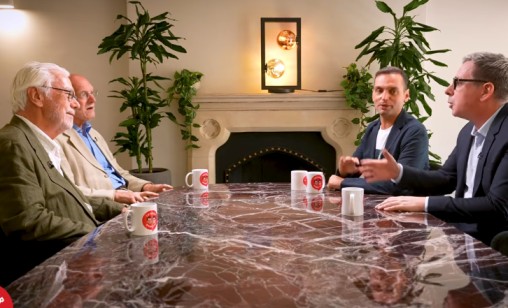
EDITOR’S NOTE: In this TRIGGERnometry interview (Aug 29, 2026), Konstantin Kisin and Francis Foster speak with historians Nigel Biggar and Robert Tombs about what they see as the ideological capture of history teaching. The guests argue that British schools now offer fragmented, morally loaded episodes instead of a coherent national story, and they defend a more evidence-based account of empire that includes both its violence and its stabilizing, anti-slavery, and infrastructural effects. The conversation ranges from curriculum design and the meaning of “empire” to colonial India, Partition, and why they believe a one-sided narrative of unique British guilt distorts the past. Read the full transcript of this interview below:
Introductions
KONSTANTIN KISIN: (00:00:42 – 00:01:28): Robert Tombs, Nigel Biggar, what a pleasure to have you both on the show together. 2 of the most eminent historians in this country. We wanted to talk about many different things, but the first one is history itself. And the way it’s being taught is something you’ve covered in a recent book. Remind everybody the title.
NIGEL BIGGAR: (00:01:32 – 00:01:39): Well, Colonialism: A Moral Reckoning would be the earliest one. And then the latest one on the culture wars is The New Dark Age.
KONSTANTIN KISIN: (00:01:39 – 00:01:39): Yes.
NIGEL BIGGAR: (00:01:40 – 00:01:50): Why Liberals Must Win the Culture Wars. And then the next one with Robert is Our Island Story. A better story about Britain.
KONSTANTIN KISIN: (00:01:50 – 00:01:58): That’s right. And we will cover actually all of that. We had you on to talk about the first of those books a couple of years back now.
NIGEL BIGGAR: (00:01:58 – 00:01:59): I keep forgetting which was my last book.
KONSTANTIN KISIN: (00:01:59 – 00:02:21): That’s right. That’s why I was like, why is he looking so puzzled about the title of his book? But one of the things you talk about is the way that history is being taught and more importantly, not taught. And we wanted to hear both of your thoughts about the way people now are taught to understand the history of not just our society, not just of our country, but actually of our species.
Fragmented History Teaching
NIGEL BIGGAR: (00:02:23 – 00:04:21): So I think there are 2 problems, and Robert can contradict me if he wants.
One problem is, when I went to school a long time ago in the ’60s and ’70s, I somehow came up with a sense of the development of Britain from Roman times to the present. I had a sense of the whole and of how we got to where we are. And there was a Whiggish story of development and increasingly liberal politics, but it was a good story.
My sense is now that kids in primary, secondary school, they don’t get the whole story. They get blobs. What was it like to be in the trenches in the First World War? What was it like to be a slave? Lots about the Nazis, but no coherent sense of the whole story of the country. So 10 years ago, a young man who came from one of our best private schools and was thinking about wanting to read history in Oxford, and we had a conversation until I heard the sound of my jaw hitting the floor. When I realized this intelligent, well-educated young man did not know when the English Civil War happened, because he had no sense of the whole. So that’s one problem, I think. And that’s one problem I want our book to address or remedy.
And the other is my worry, and I’m sure it varies from school to school. My worry is that the currently fashionable story about Britain’s past as being a litany of racism and oppression and exploitation is being fed to kids. I’m sure it won’t happen in every school, but I’m sure in some schools it will be the case. So it’s not just a matter of giving them the whole story and of the development of the country, but feeding them a particularly ideologically partisan story. That really worries me.
FRANCIS FOSTER: (00:04:22 – 00:04:44): And what’s interesting is how accurate you are, because as somebody who used to teach — that’s essentially all we did. We just jumped from period of time to period of time to period of time. And they found out what happened, but more importantly, they didn’t find out why it happened. And to me, that’s the more important aspect of the whole subject.
NIGEL BIGGAR: (00:04:44 – 00:04:46): So I didn’t know you taught history.
FRANCIS FOSTER: (00:04:47 – 00:04:47): No, I teach—
KONSTANTIN KISIN: (00:04:47 – 00:04:49): You’re literally— oh, history.
FRANCIS FOSTER: (00:04:49 – 00:04:49): Okay, sorry.
KONSTANTIN KISIN: (00:04:49 – 00:04:54): I was about to say, you’re literally the only person in the world who doesn’t know that Francis used to be a teacher.
FRANCIS FOSTER: (00:04:55 – 00:04:58): That is true. No, I taught history as part of primary.
NIGEL BIGGAR: (00:04:58 – 00:04:58): Okay.
FRANCIS FOSTER: (00:04:58 – 00:05:11): So I taught in year 4, year 5, and year 6. So I taught the history of England essentially to children, but if you actually ask them why these things happen, I don’t think they’d be able to explain it.
NIGEL BIGGAR: (00:05:11 – 00:05:18): But Francis, when you were in secondary school, did you grow up with a sense of the whole history of the country?
FRANCIS FOSTER: (00:05:19 – 00:05:28): No, the only reason why I understood what happened in our country was because my grandfather, who was from South America, was a historian, so he actually explained to me.
NIGEL BIGGAR: (00:05:29 – 00:05:30): You’re right.
FRANCIS FOSTER: (00:05:30 – 00:05:48): Yeah, exactly. But if I had relied on what I had been taught in school, there’s no way. Because what happens is — and it’s rather like watching the news where they’ll be like, there’s a war in Darfur, and you go, okay, and it’s between the X and Y.
NIGEL BIGGAR: (00:05:48 – 00:05:48): Yeah.
FRANCIS FOSTER: (00:05:49 – 00:05:52): And that’s kind of what we’re left with. Really, and what children are left with.
NIGEL BIGGAR: (00:05:53 – 00:06:26): So I think for me, the worst effect of that is that kids now, they grow up in this environment, which actually is highly privileged. I think people who live in this country are highly privileged, certainly relative to our past, but also to lots of other people’s present. But they have no idea of what it took to build this. It’s as if it’s just there. And if they don’t have a sense of the fragility and the cost of what it took to build, they won’t care for it in the way they should. That’s my concern.
The Fashion for One-Sided History
KONSTANTIN KISIN: (00:06:26 – 00:07:23): And Robert, one of the things that I think comes out of what Nigel is saying — you know, I remember reading A People’s History of Britain, a really good book. I really enjoyed it. I think I’ve told the story on the show before, and I was blown away because it was really informative and it gave me a sense of this country’s history. Someone who comes from outside, it was very helpful to kind of ground myself in the country I was living in. And then I went and I thought, well, there must be other books about other countries that I find fascinating. So I went and I got A People’s History of America, of the United States by Howard Zinn. And I opened it and within about 3 pages I was just like, what is this horrific— look, you give balance to history, but to present something as so one-sided and so decontextualized and just to say this society, all this society is, is just evil. Here’s loads of examples of how evil it is. The impact that must have on people’s view of themselves, of their society, and of history more broadly has got to be terrible.
ROBERT TOMBS: (00:07:24 – 00:09:09): Yeah. Well, I think there have been a number of things.
When you say teaching history, of course, it depends on the level we’re talking about. So in school history, I think first of all, we teach very little history in British schools compared with most other countries, certainly compared with European countries. In France, as I know, history is a compulsory subject at school right through, right to the end. Here it’s actually very little. So if the kids do half an hour a week, that’s often as much as they will get. And they will stop when they’re in Year 9. So when they’ve— they’ll stop before GCSE. In France, you would carry on until the equivalent of A-level. So that’s one thing. We don’t really care much about teaching history because I think we thought it was never really necessary because we knew who we were. We knew all these basics. I think that’s one thing.
Another thing is, some years ago, many teachers, many educationalists decided that the only way you could justify the teaching of history was because it taught certain skills. So it wasn’t about learning about the history of Britain or indeed the history about anything. It was about learning how to criticise sources, deconstruct arguments and so on, in a very crude way, that in fact historians would never actually do. You can’t just do it without knowing what you’re talking about. Without knowing the basics, you can’t do anything like this. But it was assumed that this was all about skills, and therefore these would be the sort of skills you could then go and get a job with. I can write an essay, I can read a document, and therefore I can get a job.
And another damaging thing was, well, okay, the ideological use of history. I think we can probably take for granted that that was undesirable. Or, well, we might talk about that.
KONSTANTIN KISIN: (00:09:09 – 00:09:11): Say a bit more. What do you mean by the ideological use of history?
ROBERT TOMBS: (00:09:11 – 00:10:02): Well, okay, deciding that the reason for teaching history was to teach children certain messages about things that were good, things that were bad, maybe things that were bad in our own history, but also in some ways avoiding things that were bad if they were not part of the story that you preferred. So, for example, most children in Britain will learn something about the Nazis, but they won’t learn anything about Stalin. So if you have no knowledge other than that, you will think, gosh, isn’t fascism terrible? But you won’t think this was part of a whole totalitarian phenomenon in which socialism, communism, Marxism killed millions of people. You’ll never come across that. You’ll only learn about Hitler. And so you’ve got disjointed chunks of things because—
FRANCIS FOSTER: (00:10:02 – 00:10:04): Can I just pause you there? Sorry, Robert.
ROBERT TOMBS: (00:10:04 – 00:10:04): Sorry.
FRANCIS FOSTER: (00:10:05 – 00:10:09): And this is a question that I really want answered. Why don’t we teach about communism?
ROBERT TOMBS: (00:10:10 – 00:10:13): I don’t know. Well, I’m— if you allow me to say something about it later.
FRANCIS FOSTER: (00:10:14 – 00:10:14): Yeah, of course.
ROBERT TOMBS: (00:10:14 – 00:12:03): I’m actually working on a revised history curriculum for schools in which there will be this, because I think it’s terribly important that children should know this.
But so, if you’re doing skills — well, why? You can do anything you like. You can do the Wild West, you can do Henry VIII, you can do Hitler. There’s no reason to connect these things up. Because any bit can be used to teach a skill. And also it was easier for the teachers, I think, and they thought it would be more attractive to the kids. Henry VIII, Hitler, good stuff. Gladstone’s Irish policy, the Third Reform Act, perhaps not so immediately accessible. So I think that was another thing.
And then, of course, backing this up intellectually was the postmodernist view that there is nothing that’s really true. History is therefore just a lot of stories. And so we’re not really interested in telling people how to understand the development of our country because you might like that story, but I don’t really like that story, and a lot of the kids won’t like that story. Therefore, we’ll do some other stories. And if it means saying that, for example, a lot of the soldiers on Hadrian’s Wall were African, i.e., Black, well, that’s a nice story. It makes some of the kids feel happy, and it may help to promote a sense of belonging. Therefore, let’s teach that. And if some boring pedant comes along and says, actually, soldiers on Hadrian’s Wall were all Greco-Romans — well, why do you want to upset people by saying that? You say it’s true and that’s what the evidence says, but we all know that this is just a lot of stories anyway. So let’s tell the stories we like.
Is History Just Stories?
KONSTANTIN KISIN: (00:12:03 – 00:12:51): Well, just on that, let me pose this point to you. Let me do my best impression of a deconstructionist and say, hold on a second, and a relativist as well. But isn’t that true? I mean, look at our own time, right? The history books will have a view on Brexit and they will have a view on Trump and they will have a view on COVID. And we all who lived through that time know that there was no one view on COVID, no one view. Some people hated Trump and some people thought he was the best thing since sliced bread. And some people thought that COVID came from a lab in China and other people said it didn’t, and all these other things. But whoever ends up having the power to write the history books will impose their political and ideological worldview on those events so that our descendants are given a worldview that says X or says Y.
ROBERT TOMBS: (00:12:51 – 00:12:52): Yes.
KONSTANTIN KISIN: (00:12:52 – 00:12:53): What do you say to those? To that?
ROBERT TOMBS: (00:12:53 – 00:12:55): That’s what Orwell wrote, isn’t it?
KONSTANTIN KISIN: (00:12:55 – 00:12:55): Yes.
ROBERT TOMBS: (00:12:56 – 00:12:59): He who controls the past controls the future.
KONSTANTIN KISIN: (00:12:59 – 00:12:59): Isn’t it true?
ROBERT TOMBS: (00:13:01 – 00:14:50): Well, it’s if you can get away with it. If you have an intellectual authority that can impose a certain view of the past, then well, yes, you can do that. But many people would say the purpose of studying history is precisely to be able to say that this— what you’re saying is not right. I think that’s part of the answer.
Another thing I would say — Nigel and I have talked about this. A lot of what is history, isn’t it, is perfectly well known. It’s not just a matter of opinion. You can’t deny that there was a Second World War. You can’t deny who fought in it or who won it. You can’t deny that there was a Holocaust. And this is true of so much of history. The idea that you can just pick the bits you like and ignore the bits you don’t like is simply not true. And I’m not sure if I say it in our book, but we know much more about William Gladstone than we know about Andy Burnham, for example. And much of this is completely incontrovertible. These are things that we know. And the things that we don’t know are often fairly trivial, or at least are questions that we would say are legitimate questions of doubt.
I sometimes feel, if this is a rather homespun example, history is a bit like writing about a football match. You might say, well, the important things are, where was it played? When was it played? Who won? Who scored the goals? Then you might say, well, yes, but why did Arsenal beat Aston Villa? Then that’s a matter of opinion. You might say, well, that can never be proved. But the fact is, you can’t just say, well, to say that Arsenal beat Aston Villa, that’s just your story. I’ve got a different story, which is the other way around. That just cannot be intellectually honest. And yet that’s what sometimes you get in quite serious historical debate.
NIGEL BIGGAR: (00:14:51 – 00:16:44): Yeah. So the issue of imposing a particular version of history on the rest of us is one. But the other issue about there being plural views — I mean, there are always different views of the past, always been controversy about how to interpret the past. But I think whatever our view, if we’re honest, our view needs to be accountable to reason and evidence. Right? So the data might allow a variety of interpretations, some of which fit better than others, but you’ve got to allow the data to control you. Otherwise it’s a complete free-for-all. You believe whatever you want.
And I think the problem with a lot of the ideological history is its refusal to take into account certain data. So, for example, I referred earlier to my book on colonialism, which an academic at Sussex University, Alan Lester, spent 15,000 words taking down. And in this 15,000 words, Alan Lester could find nothing absolutely nothing good to say about the British Empire. Now, whatever overall judgment we come to about whether the empire was good or bad, no one can deny, it seems to me, that it was good that the British Empire abolished slavery and slave trading and suppressed it worldwide, nor that it was good that the British Empire decided to fight Hitler in 1939. So in other words, no one, as it were, accountable to all the data can deny that the British Empire did some things good. But there’s Alan Lester, in 15,000 words, cannot recognize a single positive facet. And so that’s the problem with ideological views of history. It simply refuses to accept all the data or to be challenged by data it hadn’t taken into account.
The Wider Iceberg
KONSTANTIN KISIN: (00:16:45 – 00:17:41): What I suppose, as a total layman and outsider, I am seeing is, I think inevitably with all of this stuff that we’ve seen, we all know it’s representative of a much massive underlying iceberg. This is the tip, right? Underneath this sits an entire remaking of what we think about when we think about the social sciences and the way that they’re taught and the way that they’re practiced and the way the research is done and what we are ultimately told about what the truth is about economics, about psychology, about social psychology, about anthropology. We were talking over lunch about anthropologists who look at bones now not allowed to work on this because it’s insensitive to the feelings of the indigenous population of this and all this stuff. And I imagine that, you know, the two of you being historians, is it being affected by this? Your fields being affected by this as well? And people now questioning, well, are we being told the truth when we’re told?
ROBERT TOMBS: (00:17:42 – 00:19:17): I can give you an example of this affecting history because a friend of mine did this, Lawrence Goldman. He wanted to look at some documents held by the State Library of New South Wales, written by a chap called Eyre in the 1830s, who traveled a lot in Australia and observed and wrote about indigenous culture. Very sensitively, though he came to a sticky end later, but that’s another matter.
And he was told that they were no longer available online, at least, because they concerned 19th century descriptions of indigenous cultures, which were not to be seen by the prying eyes of 21st century Westerners. So here are historical documents which cannot be consulted by historians because long dead people — there’s no evidence that they disliked it because after all he traveled among them and they allowed him to do so. But this might upset the spirits of the ancestors, therefore you cannot do historical research on this person.
Now this I think would have been utterly unimaginable until— unless of course you were talking about working on Stalinist Russia and they wouldn’t allow you into the archives because it contained undesirable truths. But that this should be true of a Western democracy, a liberal Western democracy, would until very recently have been quite unthinkable.
White Guilt and Ways of Knowing
KONSTANTIN KISIN: (00:20:51 – 00:20:58): Well, actually, you make the point about Russia under Stalin and now under Putin. It’s the same that a lot of stuff is kept from the public and kept from historians.
FRANCIS FOSTER: (00:20:59 – 00:20:59): Yes.
KONSTANTIN KISIN: (00:20:59 – 00:21:18): But that to me is far more understandable why a dictator may wish to prevent the crimes of him and his predecessors being exposed. I don’t agree with it, but I understand. Not offending the spirits of people who lived 200 years ago, that to me— how did we get here?
NIGEL BIGGAR: (00:21:18 – 00:21:34): Oh, because we white people are the oppressors, the indigenous peoples are the victims. And whatever they want, we must defer to them. That we owe them. That’s how it’s— the narrative that’s played.
KONSTANTIN KISIN: (00:21:35 – 00:21:37): And their spirits too? We owe their spirits as well?
NIGEL BIGGAR: (00:21:37 – 00:22:46): Well, apparently we do. Apparently we believe in their spirits. But it’s like when— I quoted this in my last book, the story of Frances Widdowson, a political scientist in Canada, who got fired from her job partly because she challenged an indigenous Native American who was talking about traditional Native American views of the stars. And she said, well, that’s all very interesting and it’s interesting to know how they saw the world, but you’re not really telling us, are you, this is equivalent to modern astronomical science, are you? Well, that’s what he was saying. And partly as a result of that, she lost her job. In other words, we’re not allowed to say that indigenous ways of knowing were not as good as modern ways of knowing.
FRANCIS FOSTER: (00:22:47 – 00:22:49): And that’s— sorry, you were going to say— what were you going to say?
ROBERT TOMBS: (00:22:49 – 00:23:20): Well, I was only going to say it’s interesting in a way, because of course we would— we’re perfectly at liberty to question the ways our ancestors saw the world. If you were to say, well, 17th century Welshmen thought that the sun went around the Earth or something, but we’re not allowed to say— and we think, well, that was an interesting view of things, but we know this is now not true. But we can’t say that of other cultures because we are their oppressors, or at least that’s what has been— this is a colonialist view of—
NIGEL BIGGAR: (00:23:21 – 00:23:31): So white guilt means that people of ethnic minorities who wish to exploit white guilt, not all do, can do so with impunity?
FRANCIS FOSTER: (00:23:32 – 00:23:49): And that’s a real issue because if you essentially tell a whole country that their history is evil, and they are uniquely evil people, then why would you feel any pride? Why would you feel that you want to belong to this society?
Why the Whole Truth Matters
NIGEL BIGGAR: (00:23:49 – 00:25:14): So glad you made that point because I wanted to get back to that about why telling the whole truth about the story of Britain is important. And the whole truth, yes, it involves moments and episodes of failure and of injustice. But it also involves stories of heroic humanitarian and liberal achievement. So we want the whole truth. That’s really important because, as you say, if British kids are taught that the history of Britain is nothing but a litany of racism, oppression, and exploitation in which all our institutions were involved, why would you believe in the country? Why wouldn’t you vote when you’re asked? Why wouldn’t you tell a pollster when he asks, would you fight for Britain? No, I wouldn’t fight for it, as a very large number of youngsters have recently done. Why wouldn’t you, next time there’s a referendum on Scottish independence, which would lead to the disintegration of the UK, why wouldn’t you vote to disintegrate the UK, much to the glee of Russia? Because it would call into question our nuclear deterrent. It would make patrolling the North Atlantic by the Royal Navy far harder. So in other words, the story we tell ourselves about our past has really important political implications. And that’s—
KONSTANTIN KISIN: (00:25:14 – 00:25:17): And that’s why it’s being done. Let’s be honest, right?
NIGEL BIGGAR: (00:25:17 – 00:25:17): Yeah, I think it is.
KONSTANTIN KISIN: (00:25:17 – 00:25:18): That’s why it’s being done.
NIGEL BIGGAR: (00:25:18 – 00:25:18): I think it is.
KONSTANTIN KISIN: (00:25:18 – 00:25:19): Let’s be honest about that.
ROBERT TOMBS: (00:25:19 – 00:26:18): That’s certainly why it’s being done by some people. Yes. There’s an oddity, isn’t there, a pretty obvious one, in that the left, if we can call it that, demands very high levels of solidarity. They want us to pay more and more taxes to help our fellow citizens who are unwilling or unable to work, for example. And yet at the same time they tell us that our country as a community is worth very little. Now why should I not say in that case, well, in that case, why should I pay any taxes? Why should I not cheat? Why should I not steal? Why should I not do everything I can to exploit my opportunities? Because after all, I don’t care about this country and therefore I don’t care about the people who claim to have some — that I owe them some moral obligation. I can’t see it. I can’t see how the left can square the circle, how they can insist on our obligations to our fellow citizens while trashing the whole history on which these obligations are based.
What Is an Empire?
KONSTANTIN KISIN: (00:26:19 – 00:26:43): What I was going to ask is, the latest book is about this country’s history, and I think it’s really important we tell the full story. But Nigel, you’ve obviously worked on empire a lot, and something you talked about — before we talk collectively about the British Empire, can you just— when we had Dominic Sandbrook on recently, I think he talked about empires being the natural unit of history, or maybe that was you, I can’t remember.
NIGEL BIGGAR: (00:26:43 – 00:26:46): I could have said it, I’m not sure I did, but I could have.
KONSTANTIN KISIN: (00:26:46 – 00:26:50): But presumably you agree with it then. What is an empire?
NIGEL BIGGAR: (00:26:52 – 00:27:56): Okay, I think an empire is a people that expanded. Lots of nations were empires. Think of England in the Anglo-Saxon period. You’ve got little Wessex down there, you’ve got the Danes, you’ve got different Anglo-Saxon kingdoms. Gradually Wessex expands, and eventually by the 10th century, 11th century, you have something like the state of England now. But in a sense, the formation of England as a state was through imperial expansion of a particular part. And lots of nations have begun that way. So really, empire is an expanding people. And lots of peoples in the world have done that, not just Europeans. The Zulus did it in the 1820s. The Iroquois did it in the 1640s in North America. Empires are a very common political form. Someone said that in most of history, people have lived under empires.
KONSTANTIN KISIN: (00:27:57 – 00:28:13): And would one defining difference between, say, a nation-state as we think about it today and an empire be that an empire necessarily is a state that controls territory that’s inhabited by different groups of people? Is that an important addition?
NIGEL BIGGAR: (00:28:13 – 00:28:45): Yeah, so presumably, what became England started off as a group of tribes. With West Saxons dominating Mercians, whatever. So there’s a moment of dominance, but then eventually the peoples merged. And so you will find empires where you have dominant people and they impose their ways on other peoples, but over a long period of time, they merge so that we no longer distinguish among ourselves between those who are Norman and those who are Anglo-Saxon. We’re a mixture now.
ROBERT TOMBS: (00:28:46 – 00:29:53): And yeah, go ahead. I suppose there’s a paradox here too, in that an empire might begin, as let’s say the Roman Empire did, by one city conquering and imposing its power. But what an empire does is, the interests of the empire then become more important often than the interests of its core component. So, if you’re Roman, you are actually thinking an awful lot about what is happening on the frontiers in Gaul or on the frontiers of the Persian Empire or in North Africa. As is the case of the British Empire. Did England benefit very much from having the British Empire? It cost an awful lot of money. It required a huge amount of effort to maintain it. And what you end up having to do if you’re a politician in Westminster is thinking, we’ve really got to do something about what’s happening in North India, or we’ve got to do something about what’s happening in South Africa, and it may not actually benefit the core country. But the fact is that the empire imposes its own priorities and you get absorbed into your empire. I think that probably happens in all empires, doesn’t it?
NIGEL BIGGAR: (00:29:53 – 00:30:01): I think that’s right. But it occurs to me to just make clear, empires don’t always expand through conquest.
ROBERT TOMBS: (00:30:01 – 00:30:02): No, that’s true.
NIGEL BIGGAR: (00:30:02 – 00:30:09): Sometimes peoples join an empire, perhaps because it offers them protection.
KONSTANTIN KISIN: (00:30:10 – 00:30:11): Can you give some examples?
ROBERT TOMBS: (00:30:12 – 00:30:16): Fiji, New Zealand, Malta.
NIGEL BIGGAR: (00:30:16 – 00:30:18): Tell me about Fiji. What was Fiji’s—
ROBERT TOMBS: (00:30:18 – 00:32:40): Oh, well, they were being— and this was quite common in the South Pacific. Actually, Hawaii wanted to join the British Empire, wasn’t able to. There were quite a few countries that wanted to join and couldn’t. But Fiji was being the victim of predatory slave trading and by people selling guns, selling alcohol and so on. And they wanted to be protected against these unscrupulous people who were coming in from the outside and they wanted the protection of a more powerful state, which in this case was Britain.
And this was certainly not the— New Zealand was very similar. New Zealand was becoming the victim of unscrupulous business interests. You can easily imagine how this happens. So again, they’re selling guns. Lots of Māoris getting killed in inter-tribal wars with guns sold to them by Western gunrunners. The ravages of alcohol and so on. They want somebody who can control this. They can’t do it themselves, and so they want the British government to do it, which with more or less success it does.
And I think if I were to say what was the British Empire in the 19th century, I would say something like it was an effort to manage the unprecedented contacts that were being made between developed Western states and undeveloped, what we would later call Third World, but African, Asian, and Pacific states in order to try to prevent a chaotic and violent free-for-all. And in many cases, as you well know, there was very little desire in London to take over more territory. There was pressure from missionaries, there was pressure from public opinion, from the nonconformist conscience to say you have to do something about the slave trade in East Africa or in Zanzibar. And politicians in Westminster say, well, we really have enough to do. And they’re told, this is your moral duty. You have to do something because you are, after all, a powerful state. You have a big navy. You’ve got to do something to help these people.
NIGEL BIGGAR: (00:32:41 – 00:34:06): Yes, I think your account covers a lot of the truth. Of course, there were occasions when the British had strategic reasons for acquiring bits of territory. So end of the Napoleonic Wars, we acquired Simon’s Town in what became Cape Colony in South Africa for reasons of a naval base there. Similarly, I think on the east coast of Africa. So there were strategic reasons.
On the other hand, you’re quite right. A lot of the time empire began with traders. East India Company going to India, getting involved in local politics, acquiring territory. Initially it failed to govern very well. Government has to intervene. Similarly, in South Africa, the British South Africa Company, Rhodes’s company, expands into Rhodesia. And government reluctantly has to intervene. So a lot of the time, London government, then as now the Treasury, did not want to spend money on having to control overseas territories. The case of North America, Canada, and Australia was a bit different. But the idea that empire is all about one people deciding they want to go and conquer another is far too simplistic. I can’t think of many instances in the British case when that was so.
Was the Empire Wanted?
FRANCIS FOSTER: (00:36:18 – 00:38:04): One of the things you actually talk about in the book which I found very interesting is that a lot of people, a lot of the subjects of the British Empire were actually quite happy being part of the British Empire. And when they were asked if— and this, there was a stat that you quoted in the book about India— when they asked if they wanted to govern themselves, quite a lot of people went, no, we prefer the Brits.
NIGEL BIGGAR: (00:36:18 – 00:38:04): Yeah, the one story I tell was published in the Tablet magazine, I don’t know, 20-plus years ago, a letter from an American, an Irish-American from Boston, right? So Irish-Americans are not famous for being Anglophiles. So this guy had gone to Pakistan shortly after independence in the 1950s, I think, with the Peace Corps. And he was working in rural Pakistan. And he asked the local people, you must be glad to see the back of the English. They said, no, no, we’re not. And he says, the moment he was proudest of in the time he spent in rural Pakistan was when the locals referred to him as an Ingresi sahib. You’re an English, you’re an English sahib. So it’s quite clear that, on many occasions, most people in the empire, like most people now, they’re not interested in politics. They’re interested in getting on with their lives. And if they’re at peace to get on with their lives, uninterfered with, they’re happy with it.
So another case I mention is in the 1950s and ’60s, unknown millions of Chinese left war-torn Communist China and entered the non-democratic colony of British colony of Hong Kong. Why? Because Hong Kong offered them stability. It offered them a stable environment in which they could build their lives and get on with them. And so relative to what was on offer outside the British Empire, the Empire offered them something that was really attractive and they volunteered to enter it.
FRANCIS FOSTER: (00:38:04 – 00:38:25): So how do we balance the positives of the Empire, which there were numerous, and we need to be honest about that, and I think we can all agree that we’re not being honest that the Empire had many positives, with the things that went wrong, the undoubted negatives? How do we have that conversation and actually come to an answer that is balanced and fair?
NIGEL BIGGAR: (00:38:26 – 00:38:57): I just think people seem shocked about British slavery, for example, or shocked about the bad stuff that happened in the past. I’m kind of bewildered as to why people are shocked. I mean, don’t they understand that the world was run in the past by human beings. Some are bad, some are good, some try their best and fail. I mean, failure and bad stuff and good stuff — that’s what history is about. Are we really any different from that?
KONSTANTIN KISIN: (00:38:57 – 00:39:10): So I think we think we are. Yeah, I think we think we are. I think we do. And I think that’s why a lot of we think we would never put down a rebellion brutally, or we’d never do this and we’d never do that. And maybe it’s because— I mean, we don’t.
ROBERT TOMBS: (00:39:10 – 00:39:46): But we do it all the time, don’t we? We did it in Iraq. We’re quite happy for the Americans and sometimes ourselves to go and bomb people. And yet we get terribly upset, which may be justified in certain cases. Yet we get terribly upset when General Kitchener defeats the Mahdists at Omdurman. We think, gosh, this was terrible slaughter. And yet we’re happy to go and bomb. We bombed ISIS. Is that any different? I don’t think it’s any different at all. So we excuse ourselves, but we like to pile guilt onto—
KONSTANTIN KISIN: (00:39:48 – 00:39:50): We do live by a slightly different moral standard today, don’t we?
NIGEL BIGGAR: (00:39:51 – 00:41:17): Yeah, but it’s a better one, I’m sure. We do, but I think it’s partly because we’ve forgotten history. Even today’s school kids should remember the Second World War. Most people, I think, even youngsters would think that beating the Nazis was a good thing, wouldn’t they? Do they not know what it cost? Up to 80 million people killed, most of them civilians. And the Allies, in the course of winning that war, killing 70,000 French civilians, hundreds of thousands of Italian civilians, 500,000 German civilians. And do people not know a lot of that was unavoidable?
So I think it’s partly because we’ve forgotten history. We don’t understand how privileged — and I come back to the word privilege again — right now, whatever our woes in Britain, and whatever the threats, we are the healthiest, wealthiest on average, most secure we’ve ever been in our history. We don’t know how privileged we are. My father lived through 2 world wars. Thank God I’ve never been asked to fight in one. But it’s fragile and it’s contingent. I think we’ve lost that sense of contingency, so we just take it for granted that people in the past did bad things because they were bad, not because they were being existentially threatened and because they had no choice.
Not Just White People
FRANCIS FOSTER: (00:41:18 – 00:41:29): And I also think when we talk about empires, we just see the British Empire, and that’s pretty much it. We don’t actually look at the Ottomans, for example. We don’t look at the Saharan slave trade.
KONSTANTIN KISIN: (00:41:29 – 00:41:30): They were very progressive.
FRANCIS FOSTER: (00:41:30 – 00:41:34): Yeah, they were. I mean, but they were also brown, so they were oppressed, so we have to factor that in.
NIGEL BIGGAR: (00:41:34 – 00:41:35): And the Russian Empire.
KONSTANTIN KISIN: (00:41:35 – 00:41:41): Yeah, your boys. It was wonderful. Everybody very happy. If not happy, dead.
FRANCIS FOSTER: (00:41:41 – 00:41:51): But even, we’re talking about the Russians, but even the Spanish. The Spanish occupation of South America was objectively horrific. Yeah.
NIGEL BIGGAR: (00:41:51 – 00:42:25): Well, and let’s not forget the Aztecs with human sacrifices and the Incas and the Iroquois, who, when they expanded north of the Great Lakes in the 1640s, they absorbed the Huron by adopting their— or rather kidnapping their women and children. And the men they ate. And when the Maori invaded the Chatham Islands in 1835, what did they do? They slaughtered 10% of the population and enslaved the rest. So it’s not just white people who do empire.
KONSTANTIN KISIN: (00:42:25 – 00:42:40): Well, my favorite meme on X that pops up every now and again, it’s basically a bunch of Aztecs cutting the heart out of a small child. And then they look over at their rivals from Europe and they go, look at these evil oppressors, who’ve arrived now.
NIGEL BIGGAR: (00:42:40 – 00:42:42): Yes, I’ve seen that. That’s great. Yeah. That’s fantastic.
KONSTANTIN KISIN: (00:42:43 – 00:43:42): Well, but I was going to say, I mean, I think it’s super important to address the one-sided teaching of this. But nonetheless, if you read a book about any empire, it’s inevitably punctuated by, and then we had to suppress the XY rebellion over there, and then there was an uprising and blah, blah, blah. And then we had to bomb the— these people over here because they were— The fact is that maintaining these large, stable entities requires force. Now, you could say, well, any state requires force, which it does. Factually correct, like it or not. But in the maintenance of a large empire, even the Ottomans, who we’ve just mentioned briefly, some of what they did was because they could and because they could be cruel and because whatever. But a lot of it they did because there was necessity to maintaining the state. And I suppose every empire has to have a measure of force and sometimes cruelty in it.
NIGEL BIGGAR: (00:43:42 – 00:44:53): Yeah. And I think 2 things about certainly European empires, probably others too, is colonial governments had very few resources. They were quite weak states. And secondly, if you have a rebellion, then what are you supposed to do? Let it run? And violent rebellions are not always nice to people. I’m thinking of sort of tribes in northwest India who, from time to time, would come raiding down from their valleys and sack villages and rape women and kill people. Rape women, whatever. Policing is a serious business. And how do you stop them doing that? Because they’re not going to be persuaded not to do it. You could pay them a lot of money, and sometimes they did. But essentially, we live in a world where the use of force is very rare because we have a strong state, because we’re healthy and wealthy and secure.
A Higher Moral Standard?
KONSTANTIN KISIN: (00:44:55 – 00:45:27): I guess the counterargument might be, Robert, well, if we talked about Scottish independence, and whether it happens or not, whatever. But we kind of all accept that ultimately, if the Scottish people wanted to leave, they could. They could vote for independence through the democratic process. And we wouldn’t treat that as the Scottish uprising and go and crush it as we might have done 200 years ago. And I think that’s what I meant earlier when I said we do hold ourselves to a somewhat higher moral standard. And you said, do we?
ROBERT TOMBS: (00:45:27 – 00:46:40): Don’t we? Don’t we? Well, if we do, when does this begin? I’ve been reading, perhaps we all have, or watching the film at least, The Odyssey, in which there is absolute glorification of violence. Odysseus is called raider of cities, raiding cities, enslaving people and killing their men. Was not regarded as in any way wrong in that culture. In fact, it was a sign that you were a great warrior. I don’t think the Romans had a great sense of conscience about this either.
When is it that people stop thinking that conquering other people and exploiting them is somehow bad, or at least something that you should think of in moral terms? I doubt if it’s before the 18th century. But I think the British Empire in the 19th century, and not only the British, some others too, did begin to think that they had obligations, that you could not just say, we’re going to conquer this people, enslave them, steal all their money, and so what? Because we can, so we will. They didn’t. They stopped doing that. I think that’s true. And I think—
KONSTANTIN KISIN: (00:46:40 – 00:46:43): Why did people stop doing it? Sorry? Why did people stop doing it?
ROBERT TOMBS: (00:46:43 – 00:48:14): Well, in a way, because — now, this is going to sound a terribly colonialist way of thinking, I think — but the Enlightenment, evangelical Christianity did change the way people thought about relations between human beings. Christianity certainly did. And also the idea that human beings were all basically equal, that you could not regard other people as inferior species. It’s often said that in slavery, people regarded — and in some cases they were — you could enslave other people because they were an inferior species. That was not — from the 18th century, certainly — and indeed, for if you’re a Christian, you could not really think that. A few Christians did, but I think fewer and fewer did. And therefore, you had to accept that whatever you were doing in the world, you were doing it to people who essentially were of the same nature as yourself. And as I think was said by Sir Joseph Banks to Captain Cook, he said, you’re going to be meeting people whose right to their territory is as good as ours and who may be regarded by the Almighty as being morally superior to us. Not quite in those words, but in 18th century language. And I think that probably could not have been thought a couple of hundred years earlier. Is that right?
NIGEL BIGGAR: (00:48:14 – 00:49:36): Yes, I think you’re right. The 18th century seems to have been a kind of pivot point. And I do associate it to a large extent with the growth of the movement for the abolition of slavery, which was at the popular level, and it was highly popular, this movement, in Britain, entirely evangelical Christianity, whether Quaker or Methodist or evangelical Anglican. At the elite level, there was Montesquieu and Adam Smith, the philosophers. But the idea that all people are basically equal and that race is literally skin deep, in other words, it’s no deeper than skin, was the premise of stopping the enslavement of Africans. And then when that was done, that movement achieved its success in 1833 with the abolition of slavery. Shortly afterwards, there was the foundation of the Society for the Protection of Aboriginal Peoples because humanitarian concern had moved on to what was happening to Aborigines in Australia under the impact of European settlement and the sense that we need somehow to control this or to ameliorate it, or at least to try and make up for its ill effects. They recognized and were horrified, actually, about the way in which native peoples were suffering.
Technology, Culture, and Motive
KONSTANTIN KISIN: (00:51:35 – 00:52:50): Would there also be some far more pragmatic reasons as well? I think of— often people think about culture being the sort of the driver of things, but I often think that technology creates culture, which then creates politics. So it’s kind of a trajectory. And I imagine once territories to be colonized have run out, number one, and you have the Industrial Revolution, now if you want to create wealth, you don’t need to— the easiest way to create wealth is no longer to go and conquer other people who have wealth and take their wealth, but it’s now to build a factory and produce wealth. Because if you look at the curve of wealth creation, it’s sort of flat for about X thousand years and then it explodes in the 18th century. You no longer need to conquer anywhere and you no longer can conquer anywhere because there’s nowhere else to conquer. At that point, these ideas which were always there about people being equal and equal human dignity and so on, then they can flourish because it’s no longer economically necessary for you to have a kind of more warrior conquering mindset. Am I just imagining? Yes, you’re just being cynical. I may be both. I just thought it’s worth exploring.
ROBERT TOMBS: (00:52:50 – 00:52:54): Yes, it is. Do you want to debunk me, please, Robert?
NIGEL BIGGAR: (00:52:54 – 00:53:08): Go for it. Initially, I mean, first of all, I think most things happen from a multiplicity of motives. Of course. And if there was a kind of economic interest element, I wouldn’t discount it. But it doesn’t mean there wasn’t also a humanitarian—
KONSTANTIN KISIN: (00:53:09 – 00:53:20): No, I’m not disputing that part of it. I’m just saying it’s easier for ideas that are already there to become dominant when the practical rationale for the ideas that are being replaced is no longer there.
NIGEL BIGGAR: (00:53:20 – 00:53:33): That’s what I’m saying. Well, in the case of the abolition of slavery, what you’ve just said now could be an expression of the argument that the British only abolished slavery because it was becoming uneconomic.
KONSTANTIN KISIN: (00:53:34 – 00:53:35): I’m not saying that.
NIGEL BIGGAR: (00:53:35 – 00:53:52): No, you’re not. But I’m saying — people make that argument. To take that as an instance of what you’re saying, the data says not. That in fact there were genuine humanitarian reasons and in fact the abolition cost Britain, or at least cost some Britons.
ROBERT TOMBS: (00:53:52 – 00:55:07): And slavery was still very profitable till the 1880s, after all, in Brazil and Cuba. And indeed, one historian, a distinguished historian of slavery, says the British missed out on the great coffee boom. They could have been selling slaves to the coffee plantations of Brazil, but they didn’t.
But I think the thing is, if you build a factory, you want raw materials and you want markets. So in fact, this could have been, and indeed to some extent was, and particularly for some countries, a motive for imperialism. This is in a way the classic Marxist explanation. Your imperialism is about securing raw materials. Could be gold, it could be iron, it could be whatever. And also protected markets. And keeping others out. And there was a thing called, which used to be called the imperialism of free trade, which is a sort of paradox. But you need to occupy territories because otherwise other countries will take them and exclude your products. So the sort of universality almost of empires in the late 19th century seems not— seems to be directly connected with the growth of industrial societies.
NIGEL BIGGAR: (00:55:08 – 00:56:02): But just in terms of reasons of occupying territory, I’m thinking in the late 19th century, 1870s, ’80s, that’s when the so-called Scramble for Africa happened and lots of territories, particularly in Africa, were carved up between France and Britain and Italy and Belgium. And the motive for that, I’ve just finished reading a biography of Lord Salisbury, who dominated British government toward the end of the 1800s. The motive for that wasn’t economic. The main concern, Salisbury’s main concern, was to prevent a clash between Britain, France, and Germany in the colonies that would result in continental war in Europe, which of course happened in 1914. But the motive wasn’t economic at all. It was actually just creating boundaries so that the European powers are not going to clash.
The Extractive Theory of Colonialism
FRANCIS FOSTER: (00:56:03 – 00:56:21): So one of the topics that you address really eloquently in the book is this idea that the British Empire was essentially this kind of parasitic institution that drained resources and money from its colonies, particularly India. And what do you say to that?
NIGEL BIGGAR: (00:56:22 – 00:59:32): So that’s the extractive theory of colonialism, and the word extraction is used a lot by people who don’t really explain what they mean by it. In the case of India, the argument is, I think partly that British industry, particularly textile industry, was able to export cheap cloth to India and put all sorts of artisans out of business. So Brits were extracting profits from India and putting poor Indians onto the unemployment market. And then also partly that the Indian taxpayers paid for the Indian Army, which the British employed all around the world. And again, this extracted wealth from India. And so India was impoverished. A popular claim made is that India in 1700 produced 25% of world GDP. By 1900, it was about 4%. Therefore, the British drained India.
So what’s wrong with that story? Well, take the last point first. According to Tirthankar Roy, and I quote him because he’s an economic historian, which I’m not. He’s also Bengali born. He’s not a Brit. At least, he may be now, but he was born in Bengal. No, what happened was between 1700 and 1900 that Britain and Germany and other European countries, their industrial economies expanded hugely and therefore they acquired a larger proportion of world GDP. India’s declined relatively. And the same happened to China, which wasn’t colonized. So this wasn’t a measure of the Brits draining wealth from India. It was just a measure of the growth, the relative growth of industrial economy. So that was that.
In terms of— yes, Indian taxpayers may have paid something toward the costs of the Indian Army. On the other hand, the Royal Navy, which was paid for by the British, patrolled the seas, kept the seas free of pirates, which enabled Indian merchants to trade from Hong Kong to East Africa and make profits. What’s more, by providing stable government in India, India was able to attract British investment. Yes, it made profits for British investors. Investors make profits. Why wouldn’t they invest otherwise? But the investment also built railways and canals, both of which helped to relieve famine. So they benefited Indians too. So the idea that the colonial relationship with India was a process of one-way extraction of profit, it’s a theory whose assumptions are widely accepted, but it doesn’t really add up when faced with the data.
ROBERT TOMBS: (00:59:33 – 01:00:58): I would add a couple of things to that too. First of all, India did have to be defended. It had been repeatedly invaded from Afghanistan in the 18th century. Indeed, one Mughal emperor was blinded and his court massacred by Afghan invaders in the 18th century. So India had to be defended anyway, and it was defended by the British Indian Army.
And the other thing is that, and I read this quite recently, it’s been calculated how much the Indian government — okay, the British Raj, but the British government of India — was paying for its loans. It was paying a much lower rate of interest on its loans than the general world level of interest because it was regarded by investors as safer. And hence the relative gain of paying much less for the money that you invest was equal to a very major amount of money. Now, I should— if I’d known we were going to talk about this, I’d have checked. But it meant that they were paying 3% or 4% lower interest on their loans than were independent countries or other European countries. And that was directly a consequence of being part of the British Empire and hence being regarded as international investors as a safe place to put your money.
Colonization of India
KONSTANTIN KISIN: (01:00:59 – 01:01:27): Well, let me ask just one thing. I think it’s worth — when we talk about India, actually, you used the word colonisation to describe what happened there. And I think the ordinary person is very well acquainted with the story about the colonisation of North America, maybe less so of South America. But what happened in India was so different to what happened there. And yet the same word is used. And I think the average person has absolutely no idea what happened to India. It’d be worth setting that out before we get into—
NIGEL BIGGAR: (01:01:27 – 01:03:03): Yeah, it goes back, Konstantin, to the issue of what an empire is. So you do have parts of the British Empire, North America and Australia, where there is large-scale European settlement and where European colonists did, in both places, displace natives. That didn’t happen in— didn’t happen on a large scale in Africa, partly because Europeans tend to die there, which is a bit discouraging. But it didn’t happen really at all in India. In 1900, after 150 years of British occupation of India, there were about 300 million Indians. How many Brits? 164,000. The population of Oxford now, total. So no, there wasn’t widespread settlement.
And why not? Partly I think because the India Brits came across when they first landed there in the late 1600s, 1700s, it was a much more advanced civilization. There were states. And there were cities. Whereas in Australia and North America, there were vast tracts of what appeared to be unoccupied territory. That was a main reason. Also, I think the British were aware that if you tried to introduce British settlement into India, into a highly densely populated, already somewhat urbanized India, you’re going to get trouble.
ROBERT TOMBS: (01:03:05 – 01:03:11): So there was some legal obstacle, wasn’t there, for outsiders to buy land? I can’t—
NIGEL BIGGAR: (01:03:12 – 01:03:23): I think that’s right. I think actually outsiders were forbidden to buy land. So the British presence there was political, it was commercial, and it was military, but it wasn’t actually large-scale settlement.
KONSTANTIN KISIN: (01:03:23 – 01:03:31): And how did Britain come to control India, having, from the first boat arriving to Britain running India? How did that happen?
NIGEL BIGGAR: (01:03:31 – 01:05:03): So, I mean, the story told it was by conquest. That’s more untrue than true. So what happens is early 1600s, East India Company pitches up. What does it want to do? It wants to set up trading posts on the northwest coast of India. It gets permission to do so. It does so. It trades. What it discovers is that inland, away from the coast, there’s a collapse of imperial authority. Lots of civil war. War is bad for trade. The company builds up its own military force for defensive purposes. Then along comes an Indian ruler and says, would you help us beat that lot? And so the company, for whatever reason, says yes. And it succeeds. And as a result, it is given territory, sometimes even ports. So the acquisition of territory was, in the 1700s, not by conquest, except in alliance with Indian rulers, and the territory was ceded as part of the reward. Later on in the 19th century, there were periods when the British conquered territories for various reasons. But conquest wasn’t the primary means by which the British came to occupy parts of India.
ROBERT TOMBS: (01:05:03 – 01:05:06): I think we can blame it on the French too. Excellent.
KONSTANTIN KISIN: (01:05:06 – 01:05:08): Yes, please. What a relief.
NIGEL BIGGAR: (01:05:09 – 01:05:48): Because the French, of course, were also a major presence in India. And they were the ones who first started raising troops and getting involved in Indian politics with the intention of kicking out the Brits. So the British responded by raising their own— the East India Company responded by raising its own forces and in the end defeated the French simply because of its superior British naval power, which meant that the French had far fewer resources. And in the Seven Years’ War, the French were finally excluded from India as a major power and only allowed to keep a few enclaves such as famously Pondicherry as trading posts. Isn’t that—
ROBERT TOMBS: (01:05:49 – 01:05:51): I didn’t know the French started it. That’s great.
NIGEL BIGGAR: (01:05:51 – 01:06:37): Yeah, they started it. How convenient. But both countries, or at least their businessmen and their governments, were very much against this. It was the men on the spot, wasn’t it, who were so keen? And they said, well, we want trade, we want profit, we don’t want to spend all this money on wars. And in the end, the East India Company itself pretty well went bankrupt and needed bailing out. But then the British government said, in that case, we’re taking over. We are going to appoint the governors. And in effect, the East India Company became an arm of the British government and lost its trading privileges, its monopoly privileges. As for the French, their company did go bankrupt and simply withdrew.
FRANCIS FOSTER: (01:06:38 – 01:06:42): It’s a recurring theme with the French, Robert, I’ve noticed. Yes, I do remember.
ROBERT TOMBS: (01:06:44 – 01:06:49): But the police in Pondicherry still wear kepis, which they don’t do even in Paris now.
NIGEL BIGGAR: (01:06:50 – 01:07:52): Oh, how quaint. Just one more thing on India and territory. So yeah, the East India Company did acquire territory in the later 1700s. But in the 1820s, all 3 of the major trading ports of Madras, Calcutta, and Bombay were governed by Scotsmen. Ah, yes. And every one of them in the 1820s can be found to have written, we Brits, we cannot expect to rule in India forever. All we can hope to do is establish sufficient stability and sufficiently decent government and then leave with grace. Now, that was the 1820s. It wasn’t until 130 years later that that actually happened. But there was a sense even in the early period that British rule over territory in that far-flung part of the world was not forever.
Partition
FRANCIS FOSTER: (01:07:53 – 01:08:16): But, and it’s important that we raise this before we end the episode, because you talk about it in your book, which is, some of the more unfortunate incidents, shall we say, in India, particularly the partition. And we’re talking about leaving with grace. I think we can say that was not well executed when you look at the amount of people who died. I think it was 1.5 million off the top of my head.
NIGEL BIGGAR: (01:08:17 – 01:09:25): That could well be. Yeah, that was tragic. But I’m pretty defensive of the British there because I make — one is, can we please remember, the number of people killed was dreadful. The people doing the killing were Indians, not Brits. Secondly, the reason that the killing took place was because law and order collapsed. And that was partly because Indian leaders couldn’t agree on how to divide India. And, yes, part of the problem was the British had brought forward the date for leaving, partly in order to concentrate minds. But the responsibility for the massacres needs to be spread about there. Not just British failure. The fact that Indians did the killing, and the British failed to stop them. The difficulty Indian leaders had on coming to an agreement as to how to carve up the country.
ROBERT TOMBS: (01:09:25 – 01:10:04): I mean, the only way you can sort of blame it on Britain is to say, well, India should never have been united at all. It was because the British created an India and it then split. That was the cause of the killing. But then the alternative would have been to have an India of many conflicting states, as it was in the 18th century, in which there was also plenty of killing. A more peaceful — a basis for more peaceful existence than even the partition. So I think the partition was, as you say, a tragedy, but one which the British did try to avoid.
NIGEL BIGGAR: (01:10:06 – 01:10:37): It didn’t help that there was a kind of transitional government responsible for managing partition, and one of the Congress members, one of the two, I think, Congress members on that government was closely connected with Hindu militia. In other words, closely connected with the people, some of the people who did the killing. So I think some Indians bear a high responsibility for what happened.
FRANCIS FOSTER: (01:10:39 – 01:10:39): Gentlemen.
KONSTANTIN KISIN: (01:10:39 – 01:10:47): All right, so it’s the fault of the French, the Scottish, and the Indians. Yeah, exactly. We’ve got a clean bill of health there, lads. Time to end the episode.
NIGEL BIGGAR: (01:10:49 – 01:10:52): Yeah, yeah, they’re going to love this.
FRANCIS FOSTER: (01:10:52 – 01:10:57): I mean, our audience will, yeah, but some other people might not.
ROBERT TOMBS: (01:10:57 – 01:11:01): Joking aside, Lord Salisbury said, no one ever believes in our good intentions.
Closing
KONSTANTIN KISIN: (01:11:02 – 01:11:21): No. It’s absolutely wonderful to have you both on. It’s a real treat for us to speak with you and people like you on our show. So thank you so much for making time. Not at all. And Nigel, in your case, returning. And Robert, we’ve recorded a separate episode with you about the England and French rivalry and lots of other things.
ROBERT TOMBS: (01:11:22 – 01:11:32): Well, if you’re ever interested, yes, as I may have mentioned earlier, I am working on revising the school curriculum in history. If you ever want to talk about that, it would be very helpful.
KONSTANTIN KISIN: (01:11:33 – 01:11:41): Fantastic. Fantastic. When the time comes. Thank you both. I hope everybody gets your new book. Remind everybody again what it’s called and when it’s available.
NIGEL BIGGAR: (01:11:41 – 01:12:00): It’s called Our Island Story with the apostrophe after the S. There was a book in the 1950s with that same title with the apostrophe before the S, but we wanted to make clear this is about not just about England, it’s Scotland, Ireland, and Wales as well. And the subtitle is A Better Story About Britain, and it comes out in October, and Swift Press are publishing it.
KONSTANTIN KISIN: (01:12:01 – 01:12:11): Fantastic. And actually, very quickly, as you know, our last question is always the same. Feel free to — one of you can answer, both of you can answer, whatever. What’s the one thing we’re not talking about that we should be?
FRANCIS FOSTER: (01:12:11 – 01:12:19): Before Robert and Nigel answer the final question at the end of the interview, make sure to head over to our Substack. The link is in the description where you’ll be able to see this.
KONSTANTIN KISIN: (01:12:20 – 01:12:24): Is peace among nations and neighbors historically normal, or is it exceptional?
FRANCIS FOSTER: (01:12:25 – 01:12:30): Is the historian’s job to provide a better national story or to make national stories impossible?
KONSTANTIN KISIN: (01:12:31 – 01:12:41): What is the strongest argument you’ve heard that does not invoke religion in favor of human life having inherent value? What’s the one thing we’re not talking about that we should be?
NIGEL BIGGAR: (01:12:41 – 01:13:08): Patriotism. We’re not talking about why it is, correct me if I’m wrong, Robert, when people like me now say I’m a British patriot, all of my right-thinking, university-educated friends suck their teeth as if I’ve just said I’m a fascist. Why is that? In this country, if you’re a Scottish nationalist, Welsh nationalist, or Irish nationalist, it’s kind of cool. If you’re a British patriot, it’s suspect. Why is that?
ROBERT TOMBS: (01:13:11 – 01:13:26): Okay, well, in that case, I would say we don’t talk about gratitude. The benefits that we have are very rarely due to our own efforts. They’re due to the efforts of many generations before us, and we should be aware of this.
KONSTANTIN KISIN: (01:13:27 – 01:13:34): Absolutely. Thank you both very much. Head on over to triggerpod.co.uk where both Robert and Nigel can answer your questions.
Related Posts
- Stephen Semler Interview: Poverty and Inflation Crush Americans – Tucker Carlson Show
- Transcript of President Zelenskyy Interview: Diary Of A CEO Podcast
- Transcript of Megyn Kelly Interview: Cornell 7 Case on Tucker Carlson Show
- Transcript: Suhel Seth Interview – WTF Is Going On With India? – Azzallure Podcast
- Transcript: TRIGGERnometry Interview w/ Historian Andrew Roberts on Napoleon