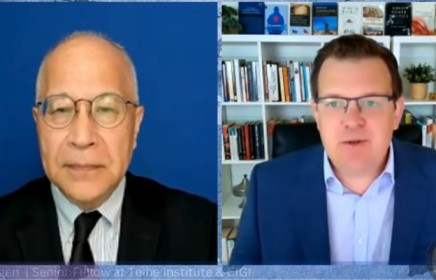
The following is the full transcript of political analyst Einar Tangen’s interview on Greater Eurasia Podcast, July 8, 2026.
Editor’s Note: In this insightful discussion, host Glenn Diesen sits down with political analyst and Senior Fellow Einar Tangen to explore the evolving landscape of global finance. The conversation delves into the complexities of China’s digital currency and the strategic factors driving the nation’s cautious approach toward internationalizing the Yuan. Together, they examine the broader implications of de-dollarization and what these shifts signal for the future of the global economic order.
Introduction
GLENN DIESEN: Welcome back. We are joined today by Einar Tangen, a senior fellow at the Taihe Institute and a senior fellow at the Center for International Governance Innovation, who also runs a Substack, by the way, Asia Narratives, which I highly recommend and have left the link in the description. So thank you for coming back on, Einar. It’s good to see you.
EINAR TANGEN: It is a pleasure, Glenn, always to be with you. I apologize I was a little late today. Too much, too much watching World Cup.
GLENN DIESEN: Yeah, it’s, no, I’ve been watching it myself.
EINAR TANGEN: It’s, yeah, sorry about Norway.
China’s Approach to Global Power: Not Seeking Hegemony
GLENN DIESEN: Well, today I wanted to ask you about the concerns in the US and, I guess, among its allies, that is, it tends to be that China seeks to replace the position of the US as the hegemon. However, it doesn’t seem like we’re going from one hegemon to another global hegemon. Rather, the world is shifting from a unipolar system, that is with one center of power, previously the US, to a multipolar system with many centers of power.
Now, from what I understand, you’re arguing now that in the financial world, how to interpret China’s actions is not that it’s seeking to take over the role held by the United States, that is this hegemonic financial role, but rather to create alternatives to have, I guess, manage this several center of financial powers. I was wondering if you could unpack what the Chinese are doing, especially in terms of their goal now of seeking to internationalize the yuan.
China’s Financial Strategy and the Belt and Road Initiative
EINAR TANGEN: Okay, so let’s put this in context. When we start talking about hegemony, yes, there’s the financial side, and I’ll get to that in a second. Politically, China is — they invested $1.4 billion in the Belt and Road Initiative. They’ve talked about coloring in, they’ve talked about having security, development, sovereignty, and a means of settling matters without going to tanks. So China on all fronts is very different from the United States, but Washington cannot leave the idea that other countries would act the exact same way that Washington does.
And this is part of the problem. It’s very difficult to deal with Washington because they always assume they understand exactly what you’re going to do. And what is that? Exactly what they have done or intend to do in the same circumstances. So they’re trying to wrap their head around this idea that there could be a powerful nation that does not want to take over the world, does not see it as economically or politically or militarily feasible. So that’s where we are.
So when we start talking about the financial side, please remember that the political and military side is there as well. So financially, what is China doing? They have said that they want to do more trade. Obviously, their investments in the Belt and Road Initiative are part of that, and it has been very successful. You look at countries in the Belt and Road Initiative, and they are in fact above the world median in terms of growth. When you look at the developed nations in terms of actual growth, percentage growth, they’re below the median. So for those countries, it makes a lot of sense. And so does the political and the military side, stressing defensive, keeping regimes intact, no meddling in the affairs of other countries. This resonates very much with the Global South.
Why China Does Not Want a Hegemonic Currency
Now, financially, China has no interest in replicating the US model. Why? Well, looking at a country that is divided economically, where the economic disparities are huge, where it has this massive debt that was accumulated. Why? Because having the US dollar as the hegemonic currency made it cheap in terms of borrowing. It also had the unwanted effect of making American goods more expensive and therefore less competitive internationally. This hollowed out the US economy. And it creates a lot of hot money flows that are coming in and out of the United States.
So from China’s perspective, being a hegemonic, having a hegemonic currency is not good, not desirable at all. The issue is how do you do trade? So China has put together a system which, like the US, encourages trade, and they’ve now extended it so that it’s easier to do trade. They’ve increased the volume of trade that can be done by allowing more bonds to be sold. You sell more bonds, there’s more liquidity in the market.
They’ve also created systems and products that allow you to borrow on a short-term basis against the bonds that you are holding. Why are you holding the bonds? Because you were trading with China. So that means you don’t have to sell your bonds. It makes it a lot easier to figure out how to manage your trade responsibilities in terms of somebody wants to get paid in renminbi, you have to give them renminbi. How do you do that? Well, this is the system that allows you to do that. So China has created these, increased the liquidity. Obviously has created more opportunities and tools to do so.
Capital Controls and the Digital Yuan
But it has not opened up its internal account, what they call the capital account.
Now, where is this all going? A lot of people ask. Well, eventually China is going to have a digital currency. And I mean literally. I haven’t used cash in many, many years. The only times I’ve done it is when I go to birthday parties or to weddings and I slip crisp 100 yuan notes into a red packet and therefore give them out.
So where is this all heading towards? A lot of people ask that question. I point out that China has been working slowly but steadily towards an electronic currency, in essence, doing away with cash. Now, this would have huge repercussions in terms of the way that people do business because cash would not be acceptable. There would be a means of turning an electronic yuan into a US dollar or whatever. That would not change.
The Economic Implications of a Digital Currency
Internally though, within China, imagine a world where you know where everything comes from or goes to. If there is in fact a transaction, you as the government, and there are taxes to be paid, you can in essence tax at the point of the transaction. That makes it a lot easier. You don’t need auditing anymore. Everything is in essence recorded and it’s there and you could look on your dashboard and you can make analysis and figure out what’s going on, but you don’t need to have an accountant. This obviously is not good news for most of the accountants.
It also, in terms of tax collection, tells you exactly where your economy is. You’re not waiting 2, 3, 4, 6 months to figure out what people are doing on any given moment in time. You have a big dashboard which tells you exactly how the economy is running. Reports can be put out much more quickly and the markets can react much more quickly as well. So that will change the way that people do their investing and how they measure the markets.
But it also helps in terms of internationally, because then the yuan can be convertible in certain circumstances. There will be no fear that illicit money is flowing out of the United States, at least through electronic means. And any money that’s flowing back to individuals will obviously have to be explained where it came from. And if they’re putting it into an electronic system, it’s going to be very difficult.
A Global Shift Toward Digital Currencies
So the world is going to change. And this is not just China. Every country is going to do, in essence, the same thing. And why? For the reasons I just stated. You could run your economy better, you can collect more taxes, and you can avoid a lot of the dark money that goes unnoticed in so many economies. It could help with corruption. Obviously, it makes things a lot cheaper and a lot faster.
For instance, the system that China has put out, and they announced a second part in Hong Kong yesterday, was in essence saying that we can cut the cost of transactions between a third and 50%. Well, it’s not a lot, but if you start adding that up on a global basis, you’re talking about hundreds of billions of dollars.
So these types of efficiencies which are driving China are, unsurprisingly, the same kinds of things they’re doing with their manufacturing. They’re trying to make things create less friction during the process, whether it’s logistics, manufacturing, or finance. And this combination is continuing to help China remain competitive. It can produce goods cheaply, it can get them to you cheaply, and it makes payment, receiving payment or making payment cheaper and faster.
So this is what China is trying to do. We’ll have to see how it works out, but if it’s successful, as I said, be prepared, it’s going to be a different world.
De-Dollarization: Side Effect or Inevitable Outcome?
GLENN DIESEN: What this implies though is, by having this digital yuan which is internationalized, what we’re talking about then is also de-dollarization as a side effect, at least. That is, the US dollar will be less appealing, I guess, in international trade. But as we said before, it’s not as if everyone’s going to shift to the Chinese currency, but how do you see this working? Will they work side by side, or do you think that once the American dollar begins to be used less, the bubble will burst? And I mean, how do you see the money markets working like this?
China’s Role in De-Dollarization
Einar Tangen: Okay, so a nice way of just saying, “Hey, Einar, what’s going to happen when everything falls down?” Yeah. Hælsa. Okay, so let’s put it this way. China is not, as I said earlier, trying to replace the US dollar. It doesn’t want that place. It thinks it’s dangerous, so obviously they’re going in a different direction.
What is happening there? Well, China has about 140 out of 195 countries that are registered in the world. 140 of those, about 70%, are in fact— China and that country are the number one trade partners. So obviously there’s a need to cut the risk between trades between these countries. So that is what really China is doing.
The US dollar is used in international transactions. It’s used in a lot of financialization. This is the kind of making bets, turning the world into a giant casino, not betting on putting money into companies, but betting on what will happen in the future. So China is just simply trying to make things more efficient. Therefore it is not a comp— it is a competitor in the sense that it’s an alternative to the US dollar, but it does not wish to supplant it.
The Dollar’s True Weakness
So where is the dollar’s true weakness? The dollar’s true weakness has nothing to do with China. It has to do with the fact that it has this massive $40 trillion and growing debt, which it has no intention or ability to repay, or even a plan to repay it. And the fact that the digital systems that are coming up, and China won’t be the only one. There’ll be others as well. Europe has their ideas. Obviously the Middle East could do something. You could have different continents trying to create digital markets for trade. Why? It’s cheaper.
This is about the market. If I’m a business and it’s going to take me $100 to make a transaction versus $20, guess what? I’m going to go for the $20 solution as long as it’s secure and safe. And this is really where the dollar is very weak. The existing systems protect a lot of enfranchised players in terms of the banks, credit cards, rating agencies. They want to hang on to the system as long as possible. Why? Because they collect fees from it and those fees power their businesses and their bonuses and things like this. And coincidentally, they have a lot of clout in Washington.
But this is an international issue. And no matter what they do with the US dollar, they cannot make other countries adopt it as their trade system. Donald Trump has made all sorts of threats. “If you do anything this way, 100%, 10,000%,” whatever — I’m exaggerating — tariffs, he’s going to make you adhere to the American system. But we all know that that doesn’t work, and that’s why smuggling began. Even if you make it illegal, people will find other ways, especially if it’s a lot cheaper.
But in this particular case, they can choose legal means to settle their trade, and China’s a big part of that trade internationally, with alternatives. And China, as I said, is just going to be one of them.
So right now it would be nice if the US Treasury, instead of trying to protect Donald Trump, would be laying plans for its own digital currency. And then also how the US deficit can be dealt with, not only the deficit, but the huge debt pile as well. Because right now the US is sailing along basically on about $2 trillion a year of yearly deficit. That means every year the US borrows about $2 trillion, sometimes it’s going to be a little bit more, in order just to pay its bills. So that money is piled on top of the debt pile.
And as I said, you have to deal with the deficit and you also have to deal with the debt pile while still growing the economy. And yet I hear very little about this other than “we’re going to make America great again,” which is a slogan, not a plan.
Can the US Reverse Its Economic Decline?
Glenn Diesen: Ja, on datto, because you are correct, it is a slogan, but I think many people were attracted to that slogan because they recognized that the US is becoming less and less competitive vis-à-vis China. They have, of course, the domestic problems building up as well.
But what is it if the Americans would translate this slogan into economic policies? What do you think they would look like? I guess you can go two paths. One would be seek to revive the American economy, but what would be required in a strategy to reverse the decline we’re seeing? Because they are now $39.5 trillion in debt, and yes, it’s going to pass into $40 trillion, which is quite dramatic. Servicing those debts are very difficult. How can the US turn this around, given the lack of economic competitiveness?
And the second will be, what can we expect from the US in terms of how it would counter China? Not in the market, but I expect some containment policies — that is more attacks on the Chinese tech, sever, maybe blockade some transportation corridors as it did with Iranian oil going to China. Can it block any financial aspects of the Chinese economy, that is access to banks or currencies? How do you see how the Americans will essentially play this? Okay, a lot of questions there. I went for a big question there, so.
Einar Tangen: Okay, do you want me to answer the first question or the second question first?
Glenn Diesen: I will leave that to you.
The U.S. Containment Policy and China’s Response
EINAR TANGEN: Okay, all right, so I’m going to start with the second question, and that is what is the United States doing right now. It is doing all the things you just said. It has a containment policy which it’s pursuing. It believes, and this isn’t me saying this, if you get on, J.D. Vance has been crying this, talking about the red threat to communism taking over the world, things like this. It just sounds a little silly since communism is engaged in capitalism. And so how can they really be communists? And the fact is that they’re outdoing the United States.
So the US is going to continue despite this kind of trade. I shouldn’t say it’s not even a truce, it’s just an arrangement. There’s a recognition that the economies are intertwined, especially in very sensitive areas like defense, the rare earths. China has about 70% of all the critical elements that are doing, but the real bottleneck in terms of their production. The real bottleneck that China controls is based on technology.
China’s Dominance in Rare Earths and Critical Materials
For many, many years, other countries did not want to mine and refine rare earths. It’s very dirty business, very expensive, and they basically abandoned it because China was developing a market. And as with most things that China does, their bet was, “We will take lower margin in terms of our profits, but we will try to have a larger presence in the market.” And they achieved this.
And where they’ve achieved it is not so much just having all the rare earths. There’s actually quite a few, quite a bit all around the world. The issue is the refining. In order to make these gallium and all the rest of these rare earths usable, they have to be of very high purity. In order to get to that purity, you need to have processes. So it involves not only how you extract them, chemical processes, then obviously you have environmental ones. So this all combined represents a 10 to 15 year advance on current technology from other places in the world and a huge advance in terms of the cost. For instance, Chinese made rare earth elements in certain categories will be 20 times more expensive than something made in Japan. So let that sink in. Even if you can make it, you are going to expend huge amounts in order to do that. So cost is a factor.
But this isn’t the only area. I mean, there are so many areas where China has become the largest supplier and the manufacturer of so many elements, whether you’re talking about vitamin C, or the elements of gunpowder and propellants and things like this, to intermediate goods. You need certain types of screws that are made of certain types of materials. Guess where it comes from? It comes from China.
They, as I will keep repeating, the Chinese model is about going into mature areas where there is maybe a 5% return on value on your capital. And what they do is they say, “We’ll take 3.5%.” And so they are able to capture the market, but their plan is to capture 3.5% of a very large market, which makes it doable. So this is what China has done, and this is what the U.S. confronts now.
U.S. Strategies to Counter China
Now the question is, what can the U.S. do? Yes, they’ve done the blacklisting. They have indicated, and we talked about this before, in terms of the gentleman at the War Department who says that the plan is to interrupt China’s energy flows. Venezuela, Nigeria, Iran — what do they have in common? They all sell oil to China. And in terms of interfering with them, the idea is you’ve cut off energy to China, somehow you’ll starve it.
Well, that hasn’t quite worked out as planned. China is actually still sitting on the vast majority of its reserves, the prices of energy have gone up very, very small amount in China, and it still is the low-cost provider of electricity across the board. So it hasn’t affected China in that way, because China has done what they call a lot of demand destruction, and that means that they have shifted to alternates instead of using oil and gas.
Now, there are certain areas. As I said before, 40% of all the oil and gas that is produced in the world does not go into any kind of engine. What it does is it goes into products, whether it’s chemicals or perfumes, plastics, clothing. The long-form carbon, hydrogen carbons, hydrogens are very useful, especially in certain types of chemistry and certain types of products. And that will continue. So there are also moves to do away with that, finding substitutes for oil and gas in that area, but it’s going to take time.
Time is not what everyone has, and this is my main point here — the US is trying all these things, but it doesn’t have a lot of time. China is reacting faster than the US has expected.
Controlling Trade Choke Points
The second weapon of choice is of course interfering with Chinese goods. Obviously, China imports a lot of raw materials, they add value to them, and then they sell those value-added products around the world. You’ve heard Eldridge Colby, who was referred to earlier, saying that the U.S. needs to control the choke points where that trade goes through. Obviously, why would you need to control choke points unless you intend to use them?
And this idea is that you can prevent resources coming into China, and you can prevent value-added goods from leaving China, and therefore that would hurt China. And that is true, but China is non-sedentary. They developed the Belt and Road Initiative, which includes land-based bridges that allow them to get to Europe, Africa, the Middle East, etc., to avoid these choke points. There’s also the possibility of a northern corridor that would go basically through Russian-controlled waters through the northern end, which would allow them to get into the Atlantic.
So there’s this kind of cat and mouse, or checkers versus go, that is being played between the U.S. and China. Washington seeks to contain China. China seeks to maintain its ability to rise. The difference is the U.S. says that China is somehow evil because it is rising, and China says, “Look, we can all work together.”
How Can the U.S. Find a Path Forward?
That gets me to the first question that you asked — how does the U.S. get out of this? Because unless there’s a path for the U.S., it could turn into a situation where the Pentagon wins and they start throwing bombs around. And of course, it’s not good for anybody, but desperation can lead to strange situations.
My take on that is that the U.S. should work on its natural strengths. Its natural strengths are not its wages, which are very high, and make it very prohibitively difficult to manufacture in the US. It certainly isn’t regulations — despite many regulations being taken away, some that I think ill-considered in terms of their protection of individuals, consumers, etc. It’s still very difficult because you have local, state, and zoning laws and national standards and things like this. So that’s more expensive. The US does have resources, but because of the preceding items — high wages and regulation — it is also sometimes expensive to extract them.
Attracting Global Talent and Innovation
But what does the US actually have? It used to have the ability to attract great minds from all over the world, and they would come to the US seeking opportunity. “This is the land of freedom. This is where they could, with hard work, rise to whatever level they were capable of.” But that has changed.
The anti-immigrant situation, together with suspicions of anybody foreign, especially anybody who’s Asian looking — and it doesn’t have to be Chinese, because frankly Americans cannot tell the difference. And I know that very well. I’m half Korean, but I’ve been called Chinese all my life. It’s not a slur, it’s just simply ignorance. We had people from Southeast Asia, Hmong — they don’t look at all Chinese to me, but they were all described as Chinese. So there’s a certain amount of going back to the Chinese Exclusion Law, this idea that anybody who looks a little Asiatic is somehow suspicious or uncivilized, etc. So racism is alive and well.
This pushes out people who otherwise might be attracted to living in the United States, trying to pursue the American dream. And they have been leaving almost on a weekly basis. One or two people who’ve won Nobel Prizes or are esteemed in their field at prominent universities are leaving, and many of them are coming to China. Others are going to Europe. This does not help the US.
The US needs to turn that around. They need to stop pushing people out and start welcoming them in. With these assembled minds, what you do is you try to develop the science and then apply that science to goods and services that can be used across the world. If you are in the top echelon and you’re creating solutions first, that is where you have the most opportunity to earn, because what you’re offering is a unique value that adds productivity. And that’s why people will buy these goods and services — it adds productivity. And as a result, they can pay more. So that means you’re earning higher margins. Those higher margins can therefore pay the higher amounts needed to retain people who are very specialized.
The Threat to the Middle Class and the Need for Reskilling
It’s a little bit difficult for perhaps the rest of the United States who are not in demand, facing competition from artificial intelligence — in some cases, especially white-collar workers in law and accounting and those areas where you’re creating, gathering, collating, and summarizing large amounts of information. That can obviously be done by an AI much more quickly, efficiently, and probably more accurately. It doesn’t give you accurate judgments, and there are dangers in that. But the fact is, many of those people will lose jobs.
And this is the first time in our history that you have had a concerted trend which is attacking the middle class, the white-collar worker. Before, it was always blue-collar. Ironically, the blue-collar is doing well. If you study plumbing instead of sociology, you’re probably in demand, you’re able to get work, and there’s a steady supply of money that is well above what a social worker would earn. Doesn’t mean that we have to shift that way. My point is that societies change their dynamic and the component pieces of it change.
And this is one of the things that people and countries have to adapt to — as the countries change, as the dynamics of the markets change, you need to reeducate. You have places like Finland, which has a law that says every 9 years you’re entitled to retrain yourself to get additional education. I think this is actually quite smart, because people are not — basically if you don’t have any skills, what are you going to do? You want government assistance, and that is not a good road.
People who are on government assistance for long periods of time face a lot of problems with drug use, all sorts of social issues with families and things like this. It is not good. People want to work. If they are in fact working, they have pride. If they have pride, and they have suitable wages and a good living, they’re more invested in society than somebody who has none of that.
The U.S. Trapped in a Bubble of Its Own Making
So it’s very, very important for the US to acknowledge that it’s on the front end of the economy and to continue developing that so it can pay higher wages, the higher costs of bureaucracy, etc. Because that stuff isn’t going to go away — despite Donald Trump saying it, it’ll be back. The next generation of leaders will bring it back for various reasons.
So at this point, the US is kind of trapped in a bubble of its own making. It wants to maintain hegemony, but it wants to do it by going back to the old days. Well, you can never really swim in the same river twice. The river moves on. And in this particular case, the idea that Donald Trump had of re-industrializing America has so many problems and quite frankly hasn’t worked. No one is rushing into that area because quite frankly, there is no money to be made.
If you add industrial capacity in the US, that means that you’re going to be in competition with existing industrial capacity elsewhere. You’re probably going to have to invest more money. You’re going to have to pay more wages. You’re going to have higher costs of compliance. The logistics are not as good. How are you going to compete? Well, you’re not, and that’s the conundrum. It’s a nice fantasy to say we’ll go back to the old days, but the reality is you can’t.
Europe’s Strategic Dilemma: Between the US and China
GLENN DIESEN: About your comments on Colby’s comments about the need to have these choke points to strangle the Chinese economy. Throughout history we see that maritime powers have historically had stronger incentives to pursue hegemonic international order because the seas function as the global commons, but also you have those strategic bottlenecks. So the world oceans are therefore less accommodating of multipolarity. That is, if you control the Panama Canal, you control the Suez Canal, then essentially this allows a hegemonic position to be established. Any country who then wants to be able to prosper through trade or move troops around, they all have to, to some extent, adjust to this status quo that there is a hegemon and they have to follow the rules.
So there probably is something to this, especially from the British to the Americans, that they kind of follow the same impulses. And I think that is different now if you see China and the Eurasian continent, that is that you have these land corridors you refer to, which allows countries to diversify more.
I did want to ask about Europe though, that is China and Europe, to what extent do you see development of ties there? Because it’s quite a difficult relationship, as we know the Europeans have locked themselves in under US leadership for the past 80 years. It’s starting to look a bit like Stockholm syndrome.
But the US now is in relative decline, and as a result, they’re deprioritising Europe and also becoming more aggressive. As a declining power, they’re also cannibalising European industries. So it’s not the Cold War relationship or even the post-Cold War relationship which Europeans remember quite fondly.
Given that you have this reduced or decline of the US, which will now focus more on the Western Hemisphere and Asia, and it’s going to be a bit more hostile or at least strong-armed Europeans, the Europeans seem to have two possible pathways.
Option one is to try to restore the political West, that is, win over the loyalty or friendship of the United States. This seems to be translated in terms of policies into complete and total subordination. That is, blindly follow all US policies, accept any horrible trade deals the Americans put in front of the Europeans. But it also entails following the US position on China. That is, warn about the China threat, de-risk or decouple.
The second pathway for the Europeans is recognizing that the US hegemon is gone. It’s not a benign hegemon either. And the other solution is to adjust to new realities, that is, to diversify economic ties. Why put all your eggs in the American basket if they are in decline and becoming more hostile? And if you follow this logic, you should link yourself closer to China.
The problem, I think, for the Europeans is they never chose yet. They haven’t chosen. They attempt to sit on both chairs.
The Three-Cornered Game: US, Europe, and China
EINAR TANGEN: Okay. So the three-cornered game between the US, Europe, and China. I think we have to acknowledge that there was a period of empire that lasted for, you can say, 1,000 years since the start of the Crusades. Where you had a very aggressive Europe, then followed by the US, which had this model that if you want something, if you want to go forward, if you want your economy to do well, you just simply go and take it from somebody else.
Now, this is not new. There have been periods of empire in the world since recorded history began. The difference today is that China brings what it says is a civilization model, and that means that they’ve studied and they’ve gone through empire periods. They’ve studied the current empire period and they think, well, this doesn’t work well. It’s not a way of a sustainable situation, especially given the way that the world has developed.
So from their perspective, it’s much better to say, look, we don’t need to tell everybody what to do. What we need to do is have mutual respect. Countries need to be secure. They need to have a path to development. They need, as I said, their sovereignty not to be interfered with. And there has to be some mechanism for solving the frictions that inevitably come up when you have different countries. So they’re saying we don’t need a hegemon. We don’t need an empire period. What we need is a collective world, where it’s multipolar, multilateral, where trade is something that lifts the world, doesn’t restrict it.
Now, this of course is antithetical, it’s the exact opposite of what the US believes, that it’s a zero-sum game. And the trick to being in the world — it’s a horrible world, as I say — and in order to get ahead in a horrible world, you have to be more horrible than everybody else. Now, this is a mindset, something that I always attributed to Dick Cheney when I watched him. He passed himself off as a realist, but really he was trapped in this own kind of negative belief that you have to take things from others. You cannot grow things together. China believes you can.
The Digital Revolution and the End of Empire
So at the same time that we’re going through all sorts of threats with global warming and such like stuff like that, we’re also in the digital revolution, we’re also going through what could be the end of this kind of empire period, and the US is having a difficult time, as I’ve described and we’ve talked about, adjusting to that.
Europe’s Dilemma
Well, where is Europe? Well, Europe was the original progenitor of the US. It taught the US everything it knows about going in and taking things from other people to build wealth and power. Now they’re stuck in this situation where they have a lot of regrets, or they’re supposed to have a lot of regrets about the terrible things that they did, you know, cutting off people’s hands and sending them to European countries so they can be displayed in a museum. Not because the people did anything wrong, just simply because wouldn’t it be cool to have a collection of hands? Right hands or left hands, it doesn’t really matter which, I guess, if you’re into collecting them. I just don’t know why they needed so many or I don’t know why they didn’t think of the people who are missing their hands because of this brutal practice.
So you have Europe in a situation where they want to be moral, but they have gained their money immorally, and they’re trying to say that they have values and that the US and Europe stand for values. It’s hard to see those values right now, but it’s trapped. And increasingly there’s a large division between the people who simply want their governments to find them opportunities to keep them employed, to keep their standard of living as high as possible, to solve the economic issues. And in the capitals, you have politicians who have no idea of how to actually help their people. So they turn to international issues and start blaming other people for all the problems that they cannot solve.
So this has been going on for quite some time, but we’re starting to run to the end of the string. Europe has serious problems. It’s lost its cheap energy when it fell asleep, walked into this war involving Ukraine and Russia, and now they’re facing the consequences. They don’t know where to turn. They’re divided. They’re easily picked off by larger powers who come in and say, “Hey, be our friend.” Talking about the US, not China.
China’s Approach to Europe and the Belt and Road Initiative
China has tried to befriend it, but they realize that dealing with a particular government is not useful. They learned this through the Belt and Road Initiative, because when you side with a government, as soon as that government is out of power, you’re going to be blamed by the new government for colluding with the old government. And there’ll be allegations of corruption, et cetera, and there’ll be no thanks involved, no matter whether the project you did was good or bad.
They’ve now switched to a system where they just approach it like a bank. Is this project feasible? Can we get the money back? If so, we’ll invest. And that means that it’s independent of any kind of politics. And this is probably going to be the way that China continues to offer its aid.
Europe’s Ideological Trap and NATO
So where does that leave Europe? They seem ideologically wedded to a hypocrisy about values that they didn’t use when they were gathering money. They’re clinging to the US on this theory that they need the US to protect them. Protect them from what? That is always a question. It was the question that was germane when the fall of the Berlin Wall made NATO useless. The Warsaw Pact was dissolved. Why do you need something that was created to answer the Warsaw Pact if the Warsaw Pact is gone?
Well, people ask the question, but inertia is a powerful thing. All the people at NATO certainly didn’t want to go out and find new jobs. Might not be jobs for them. So they said, oh yes, no, no, we have a use. And they found — who founded it? The United States. The United States decided that they did not want Russia and Europe coming together because of Russian resources and European manufacturing. And at the time of the fall of the wall, Europe was America’s greatest competitor. And therefore we did not want it to rise. We did not want it to have cheap resources. And it seems that whether it was directed or whether it was the result, the fact is today Russia and Europe are completely divided and will be for quite some time.
So we’ve accomplished our things. We like to make sure that we have no competitor. That’s part of our hegemonic strategy. So when Japan was threatening to be a more powerful nation, even though it was not possible given the size of their markets and what they produced and everything like this, we in essence forced them into signing the Plaza Accords. And since that time, their economy is less worth today than it was when they signed the Plaza Accords, meaning that they have gone completely sideways since that period of time. In essence, making sure that they’re subservient to us.
Europe’s Military Dependency and the Arms Industry Problem
But here’s the problem. If Europe continues as they are — the recent NATO meeting was a complete example of this — Europe buys 60% of its military hardware and ammunition from the United States. That’s its total purchasing. They only develop 20% of their own technology and buying. Only 20% comes from within Europe. That’s just not going to work well.
Then you have the issue of rare earths. Where are you going to get the rare earths? China is not going to sell Europe rare earths that can be used to make weapons that can be used to threaten China. They’re very logical in this way. I think most countries would be if the shoe was reversed. I think it would be the same thing that the US and of course Europe would do.
So they have this thing where they want to buy weapons from the US. The US cannot provide them. To give you a perfectly good example of that, the US is now supplying F-35s to India. The only problem is they don’t have any radar. Well, in a supersonic jet that is supposed to be able to see all threats, having radar is, let us say, a big issue. Indians are not happy. They purchased the world’s most expensive and supposedly advanced jet to find out that it doesn’t have headlights. And they’re kind of wondering, why did they pay the money? Why buy this thing in the first place if it’s not going to actually work?
Plus the fact that they’re now saying only 20% of their F-35s are actually combat ready at any given time. That’s a very low number for a very expensive piece of equipment. They’re also not happy at the very expensive routine maintenance and operational costs that are associated with these pieces of high tech. So the US is in essence pricing itself out of the market, but the Europeans feel that there is nowhere else for them to go.
The problem is it will take conservatively between 10 and 15 years for Europe to develop its own armaments industries. These are not things that you snap up, put up a cardboard box and start producing propellant for a rocket. These things take a lot of time, they take a lot of money, and you’re adding additional capacity. So you get back to this kind of industrialization model where you’re building something that’s going to cost more to build, it will cost more to produce, than somebody else who’s using what is currently available.
The Changing Nature of Warfare
Why is this important? Well, as we have learned in Russia, Ukraine, in Iran and in many other places, the nature of warfare has changed. A $5,000 drone has to be shot down with a $2 to $6 million missile. You can figure out the math. They’ve also discovered that production and logistics are just as important as technology. Having all the technology in the world does not produce a rocket. It produces the capability to build the rocket, but then you have to actually build it. Europe lacks much of that ability. The US is crippled in that because their actual production capabilities are antiquated.
Our family was involved in submarines, but we got out of making submarines after World War II. Why? Because there was no more demand for it. We had to listen to the market. So we went into other things, but this is the point. In order to set up one of these industries, you’re going to have to find somebody who’s willing to put the time and effort in, to invest into it. And given the political situations in both Europe and America where things can change based on the votes of the people, it’s very hard to take the political risk that you’re going to make a multi-billion dollar investment based on policies of one administration, which may not in fact be in effect 3, 4, 5 years down the line.
What Europe Should Do
So these are the problems that Europe faces. I always like to say, well, what can Europe do about it? Well, my advice to Europe is to stop spending money on arms and start spending it on their people. I know this might sound strange, but I think your people are more important than their ability to destroy other people.
I think a country is strongest when its people are behind it, when they will fight for its existence because its existence is seen as good, as moral, as an entity that is protecting its people, and therefore the people will protect its government. Somebody called me irrational for saying that, that I have had some sort of idealistic notion. But I can definitely say that Chinese people aren’t always happy with specifics of what the Chinese government does. But if you ask them, well over almost 90% say they support the government as it is.
GLENN DIESEN: Why?
Europe’s Path Forward: Small Business, Digital Tools, and Economic Mindset
Einar Tangen: Because it has been able to produce changes that have been positive in their life. Strange how that works, isn’t it? That somehow governments need to justify their existence to their people by actually delivering what the people need.
So I think Europe should be taking a page out of China, not ideologically, and not saying get rid of elections, we become communists or whatever. Europe is already a socialist, they’re all socialist nations. It’s just a question of how they’re going to organize themselves and put aside their petty differences and start concentrating on what is real and necessary, which is the viability of their people.
Like the United States, Europe has tremendous resources, academic institutions, people like yourself to enlighten them. The question is, how are you using those assets? Are you actually, have you retooled them so that they’re preparing people for the world? And I don’t mean just in terms of technology. I’m a firm believer in the liberal arts, understanding history, philosophy, understanding your culture so you can understand other cultures. Why? Because if I want to trade with another culture, I need to know more than the language. I need to know what they want. The only way I’m going to know that is if I understand them, and I mean understand their history and how their politics and structure of their government, even what is popular in terms of songs and tastes and food and things like this.
This is a great opportunity, and I think Europe doesn’t have the big, well, they have some, but it doesn’t have the big companies that in essence control markets. They do control markets, it’s generally with the acquiescence of the government, like Deutsche Telekom, which has been delivering the worst internet speeds consistently for many, many years despite being this kind of German technological powerhouse. Why? Because they have a monopoly. And they said, “Well, we’ll just skip this generation of 5G because, wow, who needs it?” I think it was 4G actually they skipped. Anyways, the long and short of it is that Europe has a great opportunity now.
They have extremely good small, medium-sized enterprises that are very specialized, had to be key to survive. But with the digital tools that are taking away jobs, they’re also offering opportunities. It is now much easier to market using the internet to find those entities that would be interested in your products or services. Also, with logistics, it’s much easier whether you’re having to send somebody — there’s lots of airplanes around and plenty of airports — or if you’re sending goods, there’s ships, trains, and planes that can get them there.
Smart Contracts and the Future of Trade
And the last part, of course, is payment. And you’re now seeing the beginnings of what I call smart contracts. They’ve been around for a while, but in essence, what they do is they make two parties answer all of the questions necessary to make a full agreement. And they can agree that it’s my responsibility, or it’s your responsibility, or we agree that we’re going to pay somebody else to take the responsibility. And assuming there’s somebody willing to do that, you have a complete contract.
What does that do? First off, it simplifies everything because everything is known. You say there’s going to be an inspection at a certain point, and it’s the responsibility of Party A or Party B. They take the responsibility. And based on that finding, a finding of fact, then payment can be arranged or not arranged.
There are smart agents now. People talk about having a smart agent control my calendar, set up meetings for me, remind me to call my grandmother on her birthday. Well, they can also do things like make sure that a contract is in fact going along, that the person who said that they’re going to make me 10,000 widgets has actually purchased the materials that will allow them to make those 10,000 widgets in a time period where their throughput would allow them to do that. And it’ll tell me that that’s happening or not happening.
And if it’s not happening, I can say to the guy, “Hey, listen, you’re not making it. I’m going to take my business elsewhere, or you’re going to have to make arrangements. And by the way, you’re going to have to pay the extra amount because I’m not going to lose the benefit of our bargain.” Well, if I know that this is going to happen, probably I don’t let it happen and I make sure that I do buy things on time and that I have enough time to make it.
And on the other side, if I’m the one making it, I want to make sure I get paid and I want to get paid on time. Wouldn’t that be nice? What a novel idea. So I have my agent checking to make sure that there is money in the accounts and that there’s enough there so that when I deliver, the money can be paid to me.
This makes things greatly simplified. I have less banking fees. I don’t have to set up letters of credit. I don’t have to engage expensive lawyers or have accountants go over the deal. And I don’t get into as many squabbles because it’s much more clear exactly what has happened and who was at fault.
The New Blue Ocean: Small and Medium-Sized Enterprises
So these are areas where, with these types of digital tools and the fact that Europe has so many specialized entities, they should be understanding the world, learning about the world, learning what the world needs. Maybe they have to adjust their service or their product. But there are always smaller entities like themselves who are in need of what they can produce. The question is, how do you get to them? And now we have those tools.
So I think the next great thing in the world in terms of economics going forward, the kind of new blue ocean, is in fact small and medium-sized business entities. They are, after all, where all large entities come from in the beginning. And they’re the ones that are most nimble. They can respond to markets. They can fill niches very, very quickly. There’s a lot of competition to keep them honest and keep the prices lower. They’re not like these big behemoths that can fail many, many times simply because they own the market.
So this is an area where I think that Europe could do very well. And in addition to sciences where they’re understanding and creating things, whether it’s new materials, whether it’s AI, they have to make up the deficits there. They can’t leave it to others. There’s no reason why European institutes shouldn’t be producing world-leading technology and IP that can be used in products and services.
So, despite all the things that I say, that things aren’t great, I think a lot of it is just how you approach the issues today, whether you see it as zero-sum, in which case you’re locking yourself into a world where you’re probably going to have conflict, or you see it as “we can make the pie bigger,” which invariably locks you into this idea that you want to have more peace. Why? Because making it bigger does not involve war. If you have war, you make the pie smaller.
So different attitudes. At some point, let’s hope that the politicians in their various capitals will realize that it’s a lot about attitude and the kind of world you believe in, not the kind of world you think you’re trapped in.
Militarism as a False Solution
Glenn Diesen: Well, I’ve been a bit hopeful. Perhaps not a lot of hope, but that there are some stronger economic ties between Europe and China that could assist the Europeans in developing an economic model to find a new place in the new world. Because at the moment it seems like the European leaders, at least, they see militarism now as being the solution to all.
That is, they have weak economies — well, militarism and economic, the militarism can support both economic and technological development by, you know, let’s do military Keynesianism, let’s just build a lot of weapons instead of cars, as the Germans say. Also, it resolves the political legitimacy crisis. That is, as our leaders ignore basic national and economic interests, their popularity drops. Well, a lot of dissent can be crushed if you just dismiss them as siding with the enemy. Everyone these days is a Chinese puppet or a Kremlin puppet.
And of course, the fragmentation of the West as well — that is, they made fighting the Russians a unifying idea. So all the answers always become militarism now, but that only bleeds further money, which makes the situation worse. And it creates also security problems, which makes the Europeans more dependent on the US, which the Americans are very good at converting into political and economic obedience. So the Europeans are then forced to subordinate their political interest, their economic interest, and you continue this downward spiral and things get just worse and worse.
Einar, do you have any final thoughts before we finish?
Bombs vs. Cars: A Final Thought
Einar Tangen: I like your point. I completely agree with it. I just want people to think that if they think that maybe making a bomb and making a car are the same thing, I want them to think about this. In a car, I can get to work. That makes me productive. And the people who produce it will produce parts and things like that. And there can be other cars and there can be an upward journey, not only for myself, but all those people involved.
If you make a bomb, it does not improve productivity. All you’re going to do is destroy people and things. And so it’s the reverse. So anybody who thinks that it doesn’t matter whether I produce a bomb or a car is economically deluded.
Glenn Diesen: I very much agree to that. So thank you very much for taking time and hope to see you soon.
Einar Tangen: Thank you, Glenn. You too. All the best.
Related Posts
- Scott Ritter: Trump vs. Zelensky – End of Ukraine, NATO & EU (Transcript)
- Seyed M. Marandi: Egypt Joins Saudi War – A Wider War Is Coming (Transcript)
- Joe Kent: Why the U.S. Proxy War in Ukraine Must End Now (Transcript)
- John Mearsheimer: Russia’s Existential War & the Rise of a Post-Western World (Transcript)
- Transcript: Western Dominance Ended 25 Years Ago – Jeffery Sachs