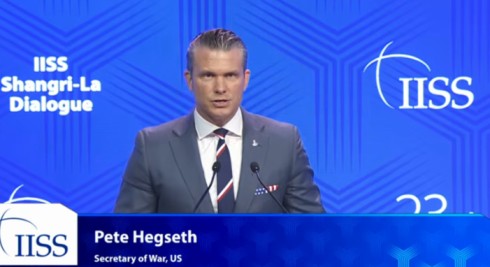
Read the full transcript of U.S. Secretary of War Pete Hegseth’s keynote speech at 23rd ISS Shangri-La Dialogue, May 30, 2026.
Editor’s Note: This event features the 23rd ISS Shangri-La Dialogue, an international security summit held in Singapore that serves as a vital forum for discussing defense and stability in the Asia-Pacific region. During this session, U.S. Secretary of War Pete Hegseth delivers a keynote address outlining the Trump administration’s return to “flexible practical realism”. His speech emphasizes moving away from dependent alliances toward true partnerships grounded in shared national interests, burden-sharing, and military strength to counter regional threats.
Opening Remarks
PETE HEGSETH: Well, Doctor, thank you very much. Good morning. It’s great to be back in Singapore and at the Shangri-La Dialogue to speak about the future of this vital Pacific region. It’s not a future based on wishful thinking or utopian idealism, but a future that will be defined by our collective efforts to safeguard and secure our most vital national interests.
Under the leadership of President Trump, who has over the past year shown repeatedly what it means to defend American national interests from Nicolas Maduro in Venezuela to Midnight Hammer to cartel drug boats to epic fury, we have restored a proactive and realistic approach to our own national defense, reestablishing deterrence.
Now when I was in the United States Army as a young lieutenant, the motto of my first rifle platoon was, “those who long for peace must prepare for war.” It’s a simple truth that makes as much sense tactically as it does strategically. But today I want to lay out what this return to realism means for the most consequential region in the world, the Pacific. And as the 2026 U.S. National Defense Strategy makes clear, we are charting a new course for our alliances and partnerships, one that is grounded in the realities of power and interests.
It is a course that will leave America stronger, our allies and partners more capable, and the Pacific region more stable and secure.
A New Model: From Dependency to True Partnership
The foundation of this new approach is moving away from a model of dependency and toward one of true partnership, embracing a perspective that our partners in Asia have understood for decades. Now, perhaps because of distance or perhaps because of the hard learned lessons of history, the default Asian lens on America has been clearer and far more pragmatic than in other regions. Our partners in Asia have long understood that the bedrock of a durable partnership is not based on idealistic values but on the concrete alignment of national interests.
There is undeniable strength in this clarity, and it’s what makes our Pacific allies and partners such reliable counterweights in the face of regional threats. When our interests align, we act together with focused resolve. When our interests diverge, we adjust pragmatically without the drama or the moralizing. I think Western Europe might take note.
This is a mindset we fully embrace. The era of the United States subsidizing the defense of wealthy nations is over. We need partners, not protectorates. We seek alliances built on shared responsibility, not dependency. This is the maturation of our alliances in a new era. It’s a vision that puts our alliances on a sustainable footing, ensuring they are fit for the challenges of this century, not the last. This shift is not a matter of choice, it is a matter of strategic prudence.
The National Defense Strategy makes clear that the old course of toothless, utopian, and globalist course of foreign policy was headed for a disaster — that all changes under President Trump. Our approach is one of flexible, practical realism that looks at the world with a clear-eyed perspective that is essential for serving vital interests. And nowhere is this clarity more important than the Pacific.
The Pacific: America’s Strategic Priority
This region has profound implications for U.S. security and prosperity. It’s the world’s largest and most dynamic market area. It’s why our national defense strategy directs the Department of War to set the military conditions required to achieve a lasting and favorable balance of power in the Pacific region.
When we look across the region today, there is rightful alarm regarding China’s historic military buildup and the expansion of its military activities in the region and beyond. We share a clear-eyed assessment of that security environment and a mutual understanding that a Pacific dominated by any hegemon would unravel the regional balance of power and undermine the equilibrium we all seek to preserve. The Department of War is working with the utmost focus to prevent any such unraveling.
We do not approach this challenge with needless confrontation, but with a posture of measured and deliberate strength. Our focus is strong, quiet and clear — strong, quiet, clear. Clear about our intentions, our priorities, and our ability to deliver on the administration’s goals. This is a model our Asian partners vastly prefer and have long followed.
Our allies across Asia do not seek constant escalation, rhetorical theatrics, or a region defined by public confrontation. What they want and what the United States delivers is strength that is disciplined, resolve that is steady, and leadership that is confident enough to speak and walk softly while carrying a big stick.
What we seek and what the president has constantly articulated is a genuinely stable equilibrium that works for Americans as well as our allies. It’s a favorable but durable balance of power in which no state, including China, can impose its hegemony and hold the security or prosperity of our nation and our allies in question.
The United States seeks to preserve the conditions that have long underwritten peace and prosperity in this region. We are the power working to sustain equilibrium — not to disrupt it — plain and simple. We defend the status quo that has enabled extraordinary growth and opportunity across the region. Our interests in the Pacific are significant, but they are also scoped and reasonable, defined by a favorable balance of power in which sovereignty is respected, commerce flows freely, and nations retain the freedom to make their own choices.
U.S.-China Relations: Stability Through Strength
Under President Trump’s leadership, relations between the United States and China are better than they’ve been in many years. President Trump and this administration seek a stable peace, fair trade, and respectful relations with China. It’s not a coincidence that this has happened. Strong, quiet, but clear is the right recipe for stability.
Just two weeks ago, President Trump and President Xi engaged in direct discussions in Beijing that reinforced this very foundation. I bore witness to their hours of candid conversations. It was truly historic. They agreed that the United States and China should build a constructive relationship of strategic stability based on fairness and reciprocity. We’re affirming that while our nations will vigorously protect our respective interests, we can secure practical, mutually beneficial agreements where our interests align.
Now all of that said, my job at the United States Department of War is to provide the military strength to support President Trump’s visionary and realistic diplomacy. It’s our essential responsibility at the department to ensure that the president is always negotiating from a position of unquestionable strength in order to sustain peace here in the Pacific and around the globe.
To ensure our military might preserve stability, we will pair it with a clarity of intent, which is why we are meeting more frequently with our Chinese counterparts. By maintaining open lines of military-to-military communication, we can coordinate, de-conflict, and reduce the risk of miscalculation. This dialogue is not a sign of capitulation in either direction, but a practical guardrail ensuring the relationship our leaders seek at the top is preserved at every level.
And while a decent peace is our goal, make no mistake — America is a Pacific nation. And we insist that China respect our longstanding position in the region, and not just insist, but maintain the manifest military strength to underwrite it.
Changing the Playbook: Actions Over Rhetoric
Now to get that job done, we are changing the playbook. The era of performative outrage is over — where Washington issues loud diplomatic protests that signal virtue but do not project capabilities. Going forward, we will be intentional about how and when we communicate. And we will lead first and foremost with actions.
As I said, strong but quiet. Big stick, speak softly. We will prioritize lethal capabilities, strategic discipline, and business-like cooperation over empty rhetoric and peacocking. Any potential opponent will be forced to judge us by our hard power, collective readiness, and steadfast resolve.
As the national security strategy and the national defense strategy direct, our approach in the Pacific centers on deterrence by denial along the first island chain. Now we are reestablishing the Monroe Doctrine — the Don Row Doctrine, as I like to call it — in the Western Hemisphere, aggressively defending our homeland and our hemisphere. We will protect our people. But if you look at our department’s planning guidance and our budget, we’re building a team capable of projecting power, a country capable of projecting power anywhere in the world, most especially here.
We will build and sustain a strong denial defense in the Western Pacific that ensures aggression is infeasible, escalation unattractive, and war deemed irrational. Our military posture will be resilient, distributed, and optimized to deny quick, decisive gains through military force. This is the logic of strategy. And it’s the essence of peace through strength, and the foundation of a durable peace in the Pacific that benefits all of us.
Burden Sharing: No More Freeloading
We all benefit from such a policy because our quiet but clear strength will lead to stability and peace. But this is not a burden America can or should carry alone. A favorable balance of power requires capable allies with real military strength, real industrial capacity, and real political resolve.
For too long, the security of this region has rested disproportionately on American military power, while many of our allies and partners allowed their own defense capabilities to atrophy. That’s a bad deal for the American taxpayer, and it’s an unsustainable crutch for our allies and partners. Instead, we are all best off when, based on our comparative advantages, we all contribute to the shared goal of peace and stability.
This is not a my way or the highway approach. We are ready to work with all of you, where you are, based on your own situation, your own geography, and your own cultural, political, and economic realities, to ensure that a Pacific free of any dominant hegemon is secured. And that’s why a core line of effort in our national defense strategy is to increase burden sharing with U.S. allies and partners and simultaneously empower them to contribute to our collective defense. This is no longer an afterthought. It’s an essential ingredient of our strategy.
President Trump has been crystal clear about this from day one in his first administration and now in his second. Alliances only work when they are true partnerships. It is a two-way street. You don’t have a strong alliance unless everyone has skin in the game. No freeloading.
History is not over. Alliances are not judged by the number of flags, but by the number of formations. We don’t need more conferences. We need more combat power. I’m sorry to say this here. Less Shangri-La, more ships, more subs.
For too long, polite pleas from our European allies to spend more on their own defense fell on deaf ears. They’re finally playing catch-up, and we let ourselves get distracted by empty globalist rhetoric about the rules-based international order while European capitals threw open their borders and hollowed out their militaries. You can have all the rules you want — and rules are great — but if you can’t back them up with hard power, the rules are not worth the paper they are written on. Europe and NATO have some big decisions to make, and more on that soon.
Allied Progress Across the Indo-Pacific
These same principles apply in the Pacific, albeit, of course, in different circumstances. In this region, I’m optimistic that our allies, driven by our shared national interests and the unprecedented threat environment, will step up and step up for real. In fact, we’re already seeing progress.
If you want to see what burden sharing looks like, consider the Republic of Korea. South Korea has invested consistently in its own defense, not because it does not have the luxury of treating war like an academic exercise. They live on the front lines, and so they build real combat power. President Lee’s decision to increase defense spending to the new global standard of 3.5% and to assume greater responsibility for its conventional defense reflects simply a clear-eyed understanding of the threat environment. It won’t be easy, but it’s necessary for the security and prosperity of his country. This was a hard-nosed decision because they see the world as it actually is. We applaud the pragmatism and leadership demonstrated by Seoul. The region will be far more stable and more secure when other allies and partners follow that path.
We see this same realist mindset from the Philippines. Manila is shifting its focus to external defense and enhancing interoperability with U.S. forces. And it’s not just talk. Earlier this month, we concluded the largest ever Balikatan, which featured joint training and exercises involving the most advanced U.S. capabilities. The Philippines is also investing more to modernize its military and its Coast Guard, with President Marcos signing a budget this year that includes a 12 percent increase in defense spending. This spending increase will fund the Philippines’ multi-year effort to develop a modern, technologically advanced, and interoperable force that can plug in and fight alongside American warfighters.
We’re seeing a similar and critical shift in Tokyo. Japan is taking concrete steps to accelerate its defense transformation. Together, we are enhancing our force posture and investing in the right capabilities. We’re not at the finish line yet and there’s still some heavy lifting ahead, but the momentum is headed in the right direction. We have high expectations of our Japanese allies, and together we can and must each pull our weight to strengthen the U.S.-Japan alliance. Strong, quiet, clear.
Australia is stepping up. Together we are expanding the rotational presence of U.S. forces and collaborating to ensure our defense industrial base builds and sustains weapons required for a high-end fight. We appreciate Australia’s investment in real combat power and the commitment to integrate more deeply with the U.S. Joint Force.
Across Southeast Asia, we’re seeing our partners step up also. Our hosts, Singapore, consistently punch above their weight by investing heavily in their military and serving as a vital hub for U.S. logistics activities and rotational deployments, strengthening our shared regional posture. Indonesia, too, is making important strides as it modernizes its armed forces and expands the scale of military exercises with us and our partners, strengthening interoperability and reinforcing regional stability.
I also want to recognize Malaysia’s leadership in rapidly deploying ASEAN observer teams to monitor the Thai-Cambodia border. That is burden sharing in action. Nations in the region stepping forward to preserve peace, reduce tensions, and support diplomacy with credible capability. I commend Malaysia and ASEAN for their efforts in support of President Trump’s historic peace deal.
On the mainland, Thailand continues to deepen military cooperation with the United States to enhance interoperability and develop necessary readiness. Thailand, a long-time U.S. partner, investing even more.
India as a Strategic Anchor
We’re also seeing the same seriousness of purpose from Vietnam. Hanoi is diligently modernizing its maritime capabilities while expanding pragmatic defense cooperation with the United States. Vietnam is a great example of how nations with distinct histories and different political systems can work together in practical ways, advancing discrete efforts where our interests align to maintain a stable regional balance. And in South Asia, India is a critical anchor to hold the line. A powerful India acting in its own self-interest advances our shared goal of maintaining a balance of power across the region.
India is modernizing its military to carry its share of the security burden, particularly in the Indian Ocean. It’s building out the heavy industrial and logistics capacity to sustain high-end military operations, including the ability to repair and maintain our shared platforms and support US Navy vessels operating forward in the theater. We’ve also committed to pursuing co-production with India to advance capabilities like Javelin anti-tank guided munitions. Real tangible steps to improve the collective readiness of our forces. This kind of industrial muscle isn’t just a long-term goal, it’s an immediate operational imperative.
America’s Defense Industrial Mobilization
And the United States Department of War is leading the way. America is undergoing a historic national manufacturing mobilization of our defense industrial base. We will produce the best weaponry in the world at scale, at speed, and at a reasonable price. This is my personal commitment to all of you, and it is our president’s demand. And it’s why President Trump, after spending $1 trillion on defense last year, plans to make a generational investment of $1.5 trillion on defense this year to unleash America’s arsenal of freedom and expand America’s military dominance for decades to come.
A generational investment. President Trump is setting the gold standard. We demand 3.5% from our allies and partners and we are going well beyond that number. We expect every single ally and partner to match that kind of resolve. For those nations that rise to this challenge, that embrace responsibility as true partners, the benefits will be clear.
As our strategy states, we will prioritize working with model allies. Those nations who are most capable, clear-eyed, and ready to defend their national interests. For those nations, we are moving them to the front of the line. Expedited arms sales, deep industrial-based collaboration, expanded intelligence sharing, the list goes on, the benefits many. But for those who believe they can continue to free ride on the generosity of the American taxpayer, hear us now.
Those days are over. Allies who refuse to step up and carry their own weight for our collective defense will face a clear shift in how we do business. President Trump believes in helping countries that help themselves. And the United States Department of War feels the exact same way. That is the nature of burden sharing.
It’s what we owe each other and most importantly what I owe the American people and my troops. The most precious asset we have. The world today is unforgiving. And that’s why this bold path is a matter of strategic necessity. We have a responsibility to our people to shape the world that comes next.
America First: Peace Through Strength
And under President Trump’s leadership, that is exactly what the United States of America is doing. The U.S. War Department is advancing an America First, peace through strength, common sense agenda. We are reviving our warrior ethos inside our ranks. We are rebuilding our great military.
And we are reestablishing the deterrence that was so dangerously allowed to erode under the Biden administration. Under President Trump, we have the most powerful and capable military in the history of the world. But our approach is not one of isolation. America First does not mean America alone, but it means realist engagement with a clear eye toward defending our most vital national interests. It’s an approach that values actions over words and sees alliances as true partnerships measured by the sovereign strength and capabilities brought to bear by each member.
Practical, interest-driven models of partnership is not a cynical compromise, but instead the most realistic and reliable foundation for enduring peace in the Pacific. Our approach asks Pacific nations to do what many are already eager to do — invest seriously in their own defense, contribute more to collective security, and work with the United States in pragmatic ways that advance our shared interests.
Closing Remarks
If there was a thesis statement for my remarks this morning, it would be this. Join us in embracing this vision, in building a team of strong, self-reliant nations fully capable of defending their own sovereignty while contributing to our collective security. In preserving the favorable balance of power that benefits all of us. Strong, quiet, clear.
I’ve said this before but it bears repeating again and again. Those who long for peace must prepare for war. From my first platoon to the first island chain. Let that remain at the forefront of our minds because we all long for peace. That time is now. The challenges we face are real, but so is the opportunity before us.
We must meet that moment. And may Almighty God bless all of our troops in harm’s way. Thank you very much.
Q&A Session
UNIDENTIFIED SPEAKER: Thank you so much. Secretary Hegseth, thank you so much for your remarks and great clarity of your message. And if you allow me one comment, we are the Shangri-La wish-ships, searching for wisdom but with a very clear sense that one needs to invest in combat power and capability as you so eloquently underlined. We’ve got about 30 minutes for conversation now, and we’ll collect a few questions.
But I see actually that the Minister of Japan, Koizumi-san, would like to intervene. So I might turn to him first, actually, and get him to make his comment. Your microphone is live now. Minister.
Japan’s Defense Cooperation and U.S. Commitment to the Region
MINISTER KOIZUMI: Thank you very much, Pete, Secretary Hegseth. Thank you for your remarks and very powerful speech, which was strong, not quiet, not clear. I appreciate I have been in close communication with you. I certainly feel the unwavering commitment by the U.S., but sometimes I feel some countries might underestimate the U.S. commitment. Can you give us the message to assure the region?
And also, when tensions occur between allies and like-minded states, even tensions are slight, there will be someone attempting to drive a wedge between us. I feel the U.S. commitment is unwavering, which might be underestimated by some countries, but you are here with us today. That speaks the strong message. Japan has recently revised its policy on the transfer of defense equipment and technology.
I have been advancing defense equipment cooperation with Australia, the Philippines, and New Zealand, and Indonesia too. We are making those efforts to establish resilient supply chain so the countries in the region can help each other in case of crisis. I believe this initiative is aligned with the arsenal of freedom. Is my understanding correct? Thank you very much.
UNIDENTIFIED SPEAKER: Thank you very much, Minister Koizumi. Maybe Mr. Secretary, if that’s okay, if I can invite you to respond to the minister straight away and then we group a few questions together. Is that okay?
PETE HEGSETH: Absolutely.
Well, Minister Koizumi, thank you for the question, for your friendship, for your engagement. I think our countries and our personal engagement is demonstrative of the kind of commitment the United States has to allies and partners. And we appreciate the extent to which you and your government have stepped up. And I think there’s sort of two real ways when I look at how the world may view our commitment to this region.
First is through our national defense strategy. And we very clearly listed four pillars. It was the homeland and the hemisphere, deterring China in the Indo-Pacific, burden sharing, and then supercharging our defense industrial base. Those were the four. And I think too many people were focused on the fact that number one is homeland and hemisphere. For us, that was a reorientation toward a forgotten aspect of our defense strategy.
We had a wide open southwest border that allowed 20 million illegals to pour across our borders, that the Department of War was focused on securing. We’ve got a cartel problem of foreign terrorist organizations where we can’t just defend at the border, but we need to defend in depth. So we’ve created the America’s Counter Cartel Coalition, working with allies and partners in Central and South America to holistically get at the counter cartel challenge. Key terrain like the Panama Canal is something we lost focus on, we’re refocused on, and Venezuela’s seen a complete change, which creates complications for our adversaries. So staying focused and bringing renewed energy to Southern Command, which had been kind of a sleepy backwater command and now is a war fighting command in our own home hemisphere, was something we had to do institutionally.
But if you look at our defense planning guidance or our national defense strategy, we are funding toward, exercising toward and planning toward the most difficult problem set, which is power projection into this region and working with our allies and partners. So there’s a refocus in what we do in our own neighborhood, but in understanding that a $1.5 trillion investment from CIS lunar to subsea is what’s required in order to deter the next conflict.
And then I think the second aspect is that people want to conflate that we have global obligations with turning of our backs to this region. And that’s why I’ve made more trips here than anywhere else and have met and will continue to meet with individual countries and in collective settings like this to demonstrate we are quietly but very strongly working by, with and through allies based on our mutual commitments to strengthen our capabilities out here. We still have global obligations to ensure that say Iran doesn’t get a nuclear weapon. We’re focused on that. We can do two things at one time. We’re supercharging our defense industrial base so that we’re building 2x, 3x, 4x the munitions very soon to ensure that all of our O-plans are properly funded throughout the world.
So I think because there’s been a lot of talk previously in the U.S. government about pivots that were never real, there’s an instinct to want to look at this and say that it is not. And I think it’s the exact opposite. Underneath our entire approach is a substantive, serious approach to the Pacific, while also ensuring we maintain our obligations around the world. So thank you for your question.
Audience Questions
UNIDENTIFIED SPEAKER: Excellent. Thank you very much. We’ll group a few questions together now. The list is extremely long already, so I’ll pull out a few. And first, in this round, please, from Korea, Dr. Jung Min Lee.
AUDIENCE QUESTION: Thank you, Bastian. Mr. Secretary, thank you for your positive remarks on the ROK-U.S. Alliance. South Korea’s defense spending this year increased 8.2 percent, and we are fully committed to every single matrix you mentioned on a self-reliant defense posture. In this regard, my question to you, sir, is twofold.
Number one, President Trump said yes to President Lee’s request for American support in building nuclear-powered submarines for the ROK Navy for larger deterrence missions. And number two, wartime op-con transfer to the ROK within the next couple of years. Could you please enlighten the audience on these two aspects of the strong and stronger U.S.-ROK alliance? Thank you.
UNIDENTIFIED SPEAKER: Thank you very much, [Chengmin]. We’ll take one or two more in this round. And next, please, from China, Zhao Wei-bing. Your microphone is on.
AUDIENCE QUESTION: Thank you, Chairman. I’m Senior Colonel Zhao Wei-bing from China. You just mentioned in your speech that during President Trump’s historic visit to China, the two countries have agreed upon a new definition of China-U.S. relations, which is constructive strategic stability. So what’s the implication of this new definition for US-China military-to-military relations in particular? As the head of the US Department, how would you implement the consensus reached by the two heads of states in real tangible steps rather than peacocking. So how would you bring cooperation in and confrontation out? Thank you.
UNIDENTIFIED SPEAKER: Thank you very much. And we’ll take from the United States, Douglas Greenlaw.
AUDIENCE QUESTION: Secretary Hegseth, thank you for your principled leadership of the Department of War. Under your leadership, the Pentagon has placed a major emphasis on the key core principles, like lethality, reconstruction of the defense industrial base, including accelerating innovation by leveraging private capital and commercial technology. What would you like to see from private capital to help scale these innovations, including internationally, so they can be useful not just to the US, but to the defense posture of the Indo-Pacific? Thank you very much.
UNIDENTIFIED SPEAKER: I see that we have a young leaders group here as well and I want to get in one of the younger voices in the room as well. So if we can please get from Pakistan, Tanzeela Khalil, your microphone is on. And then we’ll return to the Secretary.
AUDIENCE QUESTION: Thank you, Mr. Secretary. Recently, it was identified by the Director of National Intelligence, Tulsi Gabbard, that Pakistan’s potential ICBM capability as a future threat for the US. I wanted to seek your comment on how do you assess India’s long-range missile capability, particularly in terms of the recent test of Agni 6 ICBM with a range of approximately 12,000 kilometers, which could potentially place some parts of Europe and America within reach. Thank you, sir.
UNIDENTIFIED SPEAKER: Thank you very much. So we’ve got a summary of the themes there as well. So Mr. Secretary, can I invite you to weave your way through these various comments?
Secretary Hegseth Responds to Audience Questions
PETE HEGSETH: I can’t weave as well as my boss can. Not possible.
First on Korea, I see General Brunson is here, our commander, who does a phenomenal job there ensuring that partnership is realized and deepened every single day. And I think it really does exemplify the kind of partnership, and that’s why I led with the remarks about what South Korea has done. Were allies willing to expand subsea capabilities that produce real dilemmas? And I think that’s what we recognize — that our undersea warfare capabilities are unmatched, substantially unmatched, and creates a lot of strategic dilemmas for potential adversaries wondering where we are and what our capabilities may be. Allies and partners seeking similar capabilities in their own defense and in regional stability makes a lot of sense to us. So I think when you’re working with and talking to President Trump, someone who’s willing to think outside the box and shake up sort of a stale view of what may or may not be possible, expand the Overton window.
Q&A Session Continues
PETE HEGSETH: Asks like that are important, and I think you’ll see an acceleration in our willingness to come alongside countries that want to run quickly. Now there’s challenges, and how we get past them will require collaboration, but we’re very much committed to that.
And then as far as wartime op-con transfer, the general and I have spent a good chunk of time recently talking about that. We met recently in the Pentagon with your Minister of Defense on that very topic, and frankly it’s a breath of fresh air for an ally to want to take more control more quickly. And that is an instinct we want to continue to incentivize.
And I think we have to find the balance of where our military O-plans and the responsibilities that U.S. Uniform members have had for decades now is honored as we phase over to wartime op-con transfer for the Republic of Korea, which we welcome the fact that they want that. And I think it provides even more optionality for both the Koreans and the United States there in the peninsula going forward, which is a very good thing. So I appreciate that question.
The second question was from Colonel in the Chinese military.
Thank you for that question. And I think I was there when the conversations were had about constructive strategic stability. I think that was a great framing from both leaders about what they want from that relationship. And I think it’s hard to understate the importance of the books have been written about the importance of interpersonal diplomacy and how strong it can be. I think in this particular case, it’s quite meaningful.
I think there is a mutual respect, a recognition of capabilities and power and how that could be most usefully leveraged in the world today with both powers that I want to reassure this audience — I think it’s real, I think it’s substantive and I think it’s meaningful for the history of peace in the region and the world. What he has communicated to me is that that manifest in middle to middle cooperation. That in forums like this we maximize the opportunities to confer.
I wish my counterpart was here at this conference but I look forward to other options when we can cross paths and communicate, talk about things where often actions at sea or actions in the air are perceived differently when there’s no communication than when there’s an opportunity at the more tactical or operational level to talk about what de-confliction looks like. And I think what you’ll get from the United States is good faith engagement. Clear-eyed but good faith engagement. I understand commander’s intent, and President Trump has said we’re going to establish this type of framework and I think it’s important for peace in the world.
Defense Innovation and Private Capital
PETE HEGSETH: The third question was about defense innovation and private capital’s role. The static model of how the United States of America procured weapons and acquired weapons was insufficient for the modern age. You effectively had five prime contractors who were, in some cases — not all cases, but in too many cases — appendages of the Pentagon bureaucracy and had been grown accustomed to meeting the cost overruns, the time overruns, and the Congressional annual system that gave everyone excuses to perpetuate that. Didn’t give us enough fast enough, always seeking the 100% solution that arrived a decade later as opposed to the 90% solution that we get in the hands of war fighters two years from now.
And so I think one of the unsung heroes of our department is my deputy secretary of war, Steve Feinberg. He’s our secret weapon. He came from the business, truly. If you don’t know him, you should get to know him. He came from the business world and has taken that very same business mindset — I think for the first time ever inside the Pentagon — and has effectively said, and there’s a lot of micro aspects to this macro approach, but if you want to do business with the Department of War, we’ll make a trade with you.
We will give you long lead times on critical munitions that we’re clearly going to be purchasing for five to seven years, or platforms. We’re going to move into platforms, we’re going to move into ships, we’re going to move into airframes, you name it. You know we’re going to be buying these and Congress has been willing to move into multi-year procurement for us, which is a statutory requirement eager committees have given us and we have to be responsible with.
But in exchange for five to seven years of orders, we’re demanding that those companies invest in their own infrastructure. So these companies are paying for new factories, new lines, new production facilities, to the tune of $50 billion of capitalization. $50 billion is not coming from U.S. taxpayers. It’s coming from companies who would otherwise, in a world of private incentives, made those investments, but it’s become cozy and easy to get the taxpayers to pay for that and then pay for the munitions as well. And we’ve just done it the same way.
So over the next two or three years, we’re going to see hundreds of production lines coming online for critical munitions so that if we need more Patriots or THAADs or SM-3s or Tomahawks, or our partners do, it’s not add another shift to try to eke out another 100 — it’s build three more plants so that we can 3X, 4X, and 5X the amount of those munitions that we are creating, which gets skin in the game for those companies as well.
And through doing that and opening up our bureaucracy — which we go to war with our bureaucracy every single day — our job is to make sure we don’t have five prime contractors by the time I’m done, but we’ve got 10, 15, or 20 who are able to compete on an equal footing. And now you really are building an arsenal. And then if you add on top of that co-production with partners around the world who want to do the same, now you’re building a global arsenal of freedom that we require. We take very seriously our responsibilities as the foundation for Western defense. But the more rich countries who have robust manufacturing capabilities get into the defense business, because of the reality of the moment, the more options we’re all going to have.
And so we welcome that and want to be a leader there.
India-Pakistan and Regional Stability
PETE HEGSETH: The final question was about India-Pakistan. And I mentioned India here, but I very easily could have mentioned Pakistan and the role that the Field Marshal and the Prime Minister are playing in peace negotiations. I think an unexpected development and a true friendship developing there, which I think is important. And you saw that in the ability of the President to come together on brokering a peace between India and Pakistan, two nuclear-capable countries.
I think both sides there are going to see understandable threats coming from the other, maybe some of which we see differently, and countries are going to want to develop ICBM threats, but we’re not pointing a finger — at least from our view, right now — at either country and calling them a threat to us. And we’re grateful for, in each of their lanes, the benefits they’ve given to peace around the world.
MODERATOR: Excellent. Let us get one more round of comments and questions in. And if I can ask for crisp short questions so that we can get to answers. First one in this round from the United Kingdom, Tom Beckett.
Second Round of Questions
AUDIENCE QUESTION: Mr. Secretary, thank you very much. Noting the — applauding the defence procurement changes that you’re making in the Pentagon — on the 22nd of May the acting Secretary of the Navy said that the $14 billion FMS to Taiwan had been paused to preserve stocks for Epic Fury. Looking to the future, that’s fine, and the here and now, how do you reconcile that with expedited arms sales for partners?
MODERATOR: Thank you very much, Tom. We take another question from China, Dong Wang. Your microphone is on.
AUDIENCE QUESTION: Thank you for your speech, Secretary Hegseth. Most recently, US Forces Korea commander General Xavier Brunson made a striking remark in a public interview stating that South Korea is “a dagger in the heart of Asia aimed at China.” This comment stands in stark contradiction to the spirit of a constructive China-U.S. relationship of strategic stability, which our two presidents agreed to build during President Trump’s most recent visit to China, which you also just referred to in your speech.
President Trump, in particular, has also repeatedly emphasized his desire to forge the best possible relationship with China. My question is simple. Does General Brunson’s statement represent the official position of the Trump administration and its characterization of South Korea’s role as “a dagger aimed at China” — authorized or endorsed by the Pentagon? Thank you.
MODERATOR: Thank you very much. The General is in the room, so he has an opportunity to perhaps follow up with you on the coffee break. But let me get one or two more questions in for this round, and we’ll next turn from India to Vikram Chowdhury.
AUDIENCE QUESTION: Thank you, Bastian. Secretary Hegseth, how does the Department of War expect to establish equitable cybersecurity partnerships with allies who may lack the domestic intelligence and technical capabilities? Is there a risk that this may create an over-dependence on the U.S. private sector, which might further perpetuate a protection-based model for cybersecurity in the region? Thank you very much.
MODERATOR: And we take from New Zealand. Anna, if you feel — Anna.
AUDIENCE QUESTION: Thank you, Mr. Secretary. I couldn’t help but notice that New Zealand was missing from your list of countries there. They have recently outlined a plan to get from 1% to 2% of GDP — a long way from 3.5%. Would you consider New Zealand to be a free rider? Thank you.
MODERATOR: Certainly sharp and clear question. We will take from Australia, which I think was mentioned, and our young leader group, Lee Sun. Over to you.
AUDIENCE QUESTION: Thank you. By order of risk to strategic equilibrium, what issues or conflicts in the region is the US most concerned about?
MODERATOR: Okay, thank you very much. And I’ll just lob in one final one from Thailand. Pani Tan Watan Yagoporn, your mic as well.
AUDIENCE QUESTION: Thank you. Thank you, Mr. Secretary, for your remarks. Very strong, loud, and super clear. In Thailand, I think Thai public opinion about the U.S. is not good, given the fact that we are one of the oldest allies and benefited a lot more from trade, surprisingly. On the other hand, public opinion about China is not that bad, still very good, given the fact that the Chinese scammers are doing a lot of damages to Thai public and a lot of Chinese weapons on Thai-Cambodian borders. Under your leadership, what can you do about it? And if I may, what can Thailand do more about it, in your opinion? Thank you.
MODERATOR: Thank you very much. So again, a very rich set of themes to choose from. Perhaps, Mr. Secretary, I’ll invite you to address that first point on Taiwan arms sales, and then we’ll get through the other questions.
Taiwan Arms Sales and Iran
PETE HEGSETH: Yeah, on the Taiwan arms sales, I would very much decouple the two, and we feel very good about our stockpiles, both how we use them and in Epic Fury in this historic moment. And I don’t think enough credit has been given to President Trump for his willingness to take on this global threat and do so through Admiral Cooper and our CENTCOM commander in a devastatingly effective way.
And status as of right now is that any deal will be a good deal. And I had a chance to talk to President Trump this morning. He wanted me to reiterate how patient he is in ensuring that with America undertaking this kind of historic endeavor, any deal will be a good one, a great one, and he’s patient in the pursuit of that because of the implications of how that sorts out.
And certainly our department — we were in a cabinet meeting just a couple of days ago and the president said, “Hey, it will be a great deal. And if Iran doesn’t want to make a great deal that ensures they don’t get a nuclear weapon, they can deal with the guy on my left.” That was the only time I’ve ever been accused of being on the left. And he was pointed at the War Department. And we’re serious about that.
Our ability to recommence if necessary — we are more than capable. Our stockpiles are more than suited for that, both there and around the globe, because of how we balance exquisite and more plentiful munitions. So we’re in a very good place. And I wouldn’t — Hongkou is fantastic, but I would not couple the two in any way at all. And I feel good about not only where we are, but where we are in future production rates as well.
And I think there’s been a lot of false reporting with the wrong motives about where we might be, the United States of America, and we’re in a very, very strong position and feel only better about where we’re going in the future. Any decision about future Taiwan arms sales, as the President said, will rest with him, and is a nature of that relationship. And certainly having been there for those meetings in Beijing, there’s no change in our status there.
General Brunson on South Korea
PETE HEGSETH: So just to clarify, since the good general was name-checked, I don’t know if he wants to say anything — I would always give the floor to an esteemed American general. General Brunson on South Korea, and then I’ll take it from there if you want. I don’t know if you can turn this mic on or not. Yeah, can we turn on General Brunson’s mic, please? Can you press the button on the — I think, if we can get some support here please? We need to insert the badge probably. Okay, yeah, there we go. General.
GENERAL BRUNSON: Thank you. Mr. Secretary, thank you so much for that.
Q&A Session Continues
UNIDENTIFIED SPEAKER: Gentlemen, if you could please raise your hand, the gentleman who asked the question, that I might look at you directly.
PETE HEGSETH: What I said was trying to describe the operating environment, because what’s incredibly important in being strong and quiet is about being able to describe the environment wherein we’re working. If you remember the Prussian philosopher, military philosopher Clemens talked about Korea being a dagger pointed at Japan. The difference is is we have to change our perspective, which is why the East Up map is important. By changing our perspective, we take into account how others might see us in the region.
We’ve got to be strong. We’ve got to have the right capabilities within the Republic of Korea. But we have to understand that those things still exist. You have to combat those things every day. What I was trying to do in a place of learning was talk to war college students about how we have to change our perspective and think about where we are.
Then I can advise not only my service secretary, but then my secretary, my boss in the Department of War, on what things we might do. The secretary also mentioned op-con transfer. The position that we have within the peninsula based on our great allies represented by a minister of defense, Hong Yu-bak, who’s right here in the front row, is important. But what’s also important is that we have the right capabilities at the right place in the right time, but also take into account our perspectives. I’m encouraged by the fact that my president and my secretary went to China.
That is tremendous and that we might have increased relationships where we might talk. And we have to remember that when we’re talking to students, we want them to understand and appreciate other perspectives other than our own. So many times over the course of my career and the secretary’s career, we’ve thought blue and red. Well, now there’s a green there where we might have in this green space the opportunity to talk and to have military thought. The only way there will be philosophers in the future wearing uniforms like myself will be that we enter into the field of ideas and we challenge ideas. And I’m okay with the challenge of ideas. But we have to remember that context will always be king, and we have to take remarks contextually. And I would encourage that you listen to the entire podcast, as well as the speech that I gave to the War College students, which was pretty good.
Closing Remarks and Final Questions
UNIDENTIFIED SPEAKER: Thank you. Thank you very much for that. That’s why we gave him the mic. Very good. We’ve got two, three minutes left to get to — I’d like to give the remainder of my time to the general. New Zealand, defence spending. We’ve got that question on prioritising regional challenges and conflicts. And then there was a question from Thailand as well. There was a question on cyber security as well.
PETE HEGSETH: I think what you’ve seen from our operations is how central we’ve made that capability, how important it is, how decisive it can be. And now that we’re moving into the brave new world of AI and what it enables, the United States has incredible private sector advantages there that we intend to responsibly harness, which would require understanding how they work and how they can be utilized offensively or defensively but responsibly. And working with partners on cyber and those cyber relationships is going to be a huge part of how we enable partners, whether it’s AI or not.
New Zealand — I appreciate the question. I mean, if I’m being honest, 2% is not enough, and so 2% is freeloading. But I don’t have anything against New Zealand. I want partners to step up. I didn’t intentionally leave it off of my list. I look forward to working with the new defense minister there and enhancing those capabilities. I think that relationship has been a very fruitful one for a very long time. But I think as my friends Richard Morales and John Healy know, I’m probably the most blunt with our closest friends about what our capabilities are and where they need to be to ensure that we’re locking arms and shields considering the threats of the world. And can’t just say, “Oh, we’ve been friends for a long time, so let’s work together.”
We’ve been friends for a long time. So you better have the same capabilities we do, because if we don’t, our alliance is meaningless. And that’s the kind of realism President Trump has asked me to inject into all relationships.
I can’t remember the last question.
UNIDENTIFIED SPEAKER: There was a question on Thailand.
PETE HEGSETH: Yeah, I had a great meeting with one of our oldest allies, almost 200 years, and I think played a very constructive role and has continued to try to play a constructive role in how that conflict gets resolved. Had a great meeting yesterday with the Minister of Defense and I think we found some public ways and some private ways that we can deepen our partnership meaningfully. So certainly very committed to that relationship.
UNIDENTIFIED SPEAKER: Fantastic. Secretary Hegseth, thank you so much for being at the Shangri-La Dialogue. It’s a real pleasure.
PETE HEGSETH: Thank you.
Related Posts
- John Mearsheimer: Ukraine May Cease to Exist – The Coming Ugly Victory (Transcript)
- Richard Wolff: U.S.-Israel Divorce as U.S. Economy is on the Brink of Collapse (Transcript)
- Yanis Varoufakis: EU Is Finished & China Can Now Pull the Plug on the U.S. Economy (Transcript)
- Douglas Macgregor: Ukraine Endgame Is Here — West Will Fragment (Transcript)
- Jeffrey Sachs: BRICS Builds a New World – Without the West (Transcript)