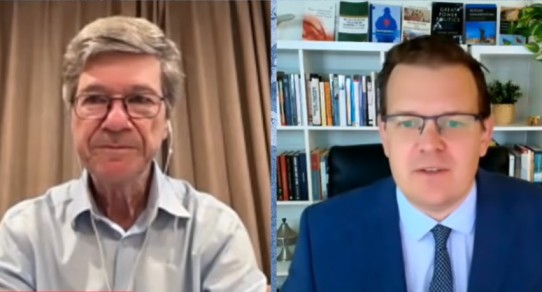
EDITOR’S NOTE: In this episode of Glenn Diesen’s podcast, world-renowned economist and Columbia University Professor Jeffrey Sachs joins host Glenn Diesen to discuss the significance of BRICS in reshaping global governance. Recorded on September 16th, 2026 — just days after the conclusion of the 18th BRICS Summit in New Delhi — the conversation explores how the rise of multipolarity is challenging the long-standing dominance of the United States across military, economic, and political spheres. Professor Sachs offers his perspective on what a BRICS-led international order might look like and how it differs fundamentally from the unipolar structures of the past.
TRANSCRIPT:
Introduction: The BRICS Summit and the Shifting World Order
GLENN DIESEN (00:00:00 – 00:00:08): Today is September 16th, 2026, and we have the great pleasure of being joined by Professor Jeffrey Sachs. Thank you for coming on the program.
JEFFREY SACHS (00:00:09 – 00:00:11): Great to be with you. Thank you.
GLENN DIESEN (00:00:12 – 00:01:35): We just had the BRICS summit, which finished off at the end of last week, and I wanted to ask what BRICS essentially means for global governance, because the world that we have grown up in has been dominated by the United States due to the extreme concentration of power.
That is the military power, which meant that much of the world outsourced its security to US-led alliance systems. We see it in the dominance of economic power, which allowed the US to large extent write the trade rules. It led the banks. It could use the dollar as the international reserve currency.
The US, as you saw, also had a dominant role in managing political institutions, even civil society of other states through its army of NGOs, and even to some extent to redefining international law in terms of this liberal international order.
So I guess my question is, as the world has shifted towards a multipolar distribution of power, all of this seemingly begins to unravel. However, my question is therefore, how do you see BRICS organizing international governance? Because BRICS isn’t simply a new America that will kind of organize everything through centralized commands or structures.
Jeffrey Sachs 00:01:36 We’re seeing obviously big shifts, historic-scale shifts in the way the world is organized and the way that people view the world. And I think the main dates that we should start with are around 1750 to 1950, and then around 2000 and today. And let me explain briefly.
The Rise of European Imperial Dominance
Starting around 1750, a very unusual thing happened in history, and that is that Europe and European imperial powers started to gain a global ascendancy. Europe is not a big part of the world. It was just the western edge of Eurasia, and it was always a rather modest part of the world population. Today, Europe in the European Union is 450 million people approximately. You can add in another 50-some million plus in the UK and you’re around 500 million of the world’s 8.2 to 8.3 billion people. So this is far less than 10% of the world population, something closer to about 6% of the world population today.
It was a bit larger in the past, but the fact of the matter is Europe is a relatively small part of the world population and not especially distinguished economically for millennia. Around 1750, gained a global ascendancy that lasted for about 200 years. And that was the age of high European imperialism. It would take us probably a bit far afield to go into all of the reasons for that ascendancy, but one can name a couple that I think are very significant.
One was the fact that it was European countries that came to the Americas — I meant to say, with Columbus’s voyage. When they came, they carried Old World pathogens that in the course of the next 100 years basically wiped out most of the native populations combined with the conquests and repression of European powers that colonized the Americas. So by 1600 or so, the European powers that were colonizing North America and South America suddenly had 2 giant continents at their disposal, if I could put it that way. And they did dispose of it. It gave them the wealth of so-called primitive capitalist accumulation. It gave them a tremendous power. It was kind of a slingshot for what would come in the following centuries, which was European dominance over Asia, a completely different story because most of the world population lived in Asia.
And even as late as 1700 or 1750, Europe was by no means the dominant force in the world. China and India were the world leaders in population and in manufacturing, and certainly could hold their own against Europe and had basically been the largest polities and the most populous places in the world for millennia before that.
The Baconian Vision and the Scientific Revolution
Well, the second factor was the mobilization of technology, almost a kind of miracle. But Francis Bacon, an English thinker, I think one of the most consequential thinkers in all of human history, at the beginning of the 17th century, wrote about the idea that through scientific experimentation, new technologies would arise that could strengthen human society and improve it. It was an absolutely stunning vision. It’s been called the Baconian Plan or the Baconian Vision that a science-based and technology-based society would transform itself. And this, in fact, I think, is a description of what happened not uniquely in Europe, but distinctly in Europe in the 1600s and the 1700s.
Isaac Newton and what he represents, the Scientific Revolution, was complemented by and gave impetus to a profound technological acceleration and the idea of organized research for technological advance and for economic benefit. And so there has been great science in all parts of the world, but the idea of organized research to develop new technologies and improve the economy was a conceptual breakthrough and an organizational and institutional breakthrough in which Europe had the lead, especially in the 17th and 18th centuries.
So in almost every realm of economic life, in mobilizing energy, in mechanization of industry, in inventing large-scale industry, Europe took the lead.
And within Europe it was Britain, and within Britain it was England. And so the Industrial Revolution, so-called, which I think is a true concept, though it’s a debated one, got underway in the 18th century. And by the end of the 18th century, there was already a remarkable economic transformation uniquely taking place in Britain and in small parts of Western Europe.
The Napoleonic Wars and Britain’s Transformation
The full meaning of that was delayed by a European civil war, by the Napoleonic Wars that took place from the 1790s until Napoleon’s ultimate defeat in 1815. But by the time the Napoleonic Wars were over, Britain was now a transformed society. It was increasingly factory-based, increasingly urban, increasingly non-agricultural in the workforce because advances in farming freed up, or let’s say displaced, workers who had been in farming, and they became the entry workforce for new industry.
And this enabled Britain to project power. And it was in the 19th century that Britain became not only Europe’s leading empire, but the biggest empire in terms of population and span that the world has ever known. The biggest contiguous empire was the Mongol Empire, but the British Empire spanned the whole world, and especially with this crown jewel of the conquest of India during the 19th century.
The United States Enters the Imperial Stage
So by the end of the 19th century, Europe was dominant. Asia was in significant decline of a kind that had not been seen, certainly never at Europe’s hands. For centuries, millennia, ever in history. The world was turned upside down by historical standards with European imperial dominance, and within that, Britain as the world’s hegemonic power.
At the end of the 19th century, the United States finished its own imperial expansion across North America. Usually dated to have been completed around 1890. And almost like clockwork, as soon as the US completed its imperial expansion across its own continent, it said, okay, it’s time for us to have our place in the sun with our own global empire. And it started concocting wars to take its place alongside the European empires.
The first of these was the toppling of the Kingdom of Hawaii in the 1890s, expanding the United States’ reach into the Pacific on its way to Asia. And then in 1898, in a concocted war, not unlike the war with Iran, let’s say, a war of aggression with great American patriotism, the United States took the low-hanging fruits of the fading, disappearing Spanish Empire. And that included in the Western Hemisphere Cuba and Puerto Rico. Puerto Rico is still a colony of the United States in effect, though it’s given different terms and legal status. And Cuba has been viewed as essentially a colony until Fidel Castro’s revolution in 1959, 1960. And the United States has never forgiven it until this day and is aiming to topple the government of Cuba at any moment, in fact.
Now, on the other side of the planet, the United States took the Philippines and became an Asian imperial power as well and joined Britain and France, Germany, and other European powers in this claim of global dominance.
The Colonization of Africa
And by this time, at the end of the 19th century, Europe had almost totally colonized Africa. That late imperialism in Africa, which came only at the end of the 19th century, had been delayed by the disease barrier, especially malaria. And so it was only when the British basically created quinine as a medicinal antimalarial out of a traditional Peruvian cure for fever that Britain was able to expand its colonies to the interior of Africa. And with gin and tonic, that is with quinine in hand, the European powers almost totally overran Africa at the end of the 19th century.
So the point, Glenn, that I’m making is that by 1900, Europe and increasingly a rising, huge United States claimed to run the world. And claiming to run the world is therefore centuries in the making and reached a kind of apogee for Europe in, let’s say, July 1914, because it was in that month that the events that created World War I began.
Europe’s Self-Destruction and the End of Imperial Dominance
Europe had 2 essentially civil wars. 1914 to 1918 and 1939 to 1945. And the period between those 2 wars was not a pleasant or an easy one. It was the era of the Great Depression and the rise of Hitler. And by 1945, Europe, which had dominated the world, and Britain which had dominated the European empires, had exhausted itself in 2 of the most brutal wars of all of human history. And that was the opening for former colonies in Asia and in Africa to gain independence on the basis of local independence movements, the creation of the United Nations, and the utter exhaustion and actually financial bankruptcy as well as moral bankruptcy of the European imperial powers.
2 powers remained in the non-Asian African world. And one, of course, was the United States, which had become tremendously more powerful in the context of these 2 wars because both World War I and World War II were opportunities to build a continental-scale industry on a scale never before seen in human history. And the second was the Soviet Union, the successor of the Russian Empire, the union which spanned 11 time zones, taking almost all of northern Eurasia.
And while the Soviet Union had borne the full brunt of the war against Hitler and had lost 27 million people in the process and had faced unbelievable devastation in the cause of defeating Hitler. At the end of World War II, it was able to reorganize, rebuild, by 1949 join the United States as only the second country with the atomic bomb, and to become one of the two great powers.
The Cold War and the Birth of Global Institutions
And while the United States was technologically, economically, financially dominant after 1945, the Soviet Union gave it its run in many challenges and many technological breakthroughs, most famously in 1957 launching the first satellite from Earth, Sputnik. And showing this great prowess in advanced technology.
So you had the 2 major superpowers and you had the rest of the world. And the world was divided into 3 at that point, the US-led world, including its new allies in this new organization NATO created in 1949 to oppose the Soviet Union. You had the Soviet Union and its allies, and the countries that it was occupying after World War II because there was no peace agreement reached, no peace treaty after World War II, and the Soviet Union was demanding its security in some way, which it never found through an agreement diplomatically with the US after World War II.
So you had 2 blocs, and then you had the vast majority of the world, which were much poorer, former colonies only regaining their footing.
China’s Century of Imperial Humiliation
China was a distinctive case, the world’s most populous place, the most populous polity, but weakened after more than a century, not of direct imperial rule, but of direct imperial impunity that is traditionally dated from 1839 when Britain launched a war against China for the shocking but true reason, to force China to open trade to British opium so the Brits could earn enough funds to buy the Chinese tea to which they have devoted their afternoons ever since.
And 2 opium wars, so-called, ensued, 1839 to 1842 and 1856 to 1860. And China went into its own internal civil war that killed tens of millions, the Taiping Rebellion, and then faced massive imperial pressures from Europe and the United States at the end of the 19th century. And then with Japan becoming the one early industrializer in Asia, Japan’s invasion of China beginning in 1894, and then followed in the next century in 1931 with Japan’s takeover of Manchuria and its invasion of mainland China in 1937.
A World Remade: The Post-War Order
All of this means that we had a world that was essentially European and US-led. The rest of the world, at best vassals, but really colonies that were exploited for raw materials that found themselves in 1950 impoverished, mostly illiterate, without modern industry, without modern technology. But suddenly the overlords disappeared because they had destroyed themselves in civil war. And so newly independent Asia and Africa embarked on the beginnings of industrialization, or maybe not the very beginnings, but the process systematically under their own sovereignty.
And it’s in this context, Glenn, that one could say the US led the world in 1945 with this competition from the Soviet Union. But it was the United States that created most of the institutions today we know as the global institutions. The United Nations, founded in 1945, the so-called Bretton Woods institutions set at a conference in Bretton Woods, New Hampshire, in 1944 and becoming the International Monetary Fund and the World Bank in 1945, a nascent trade organization which didn’t take off but became the General Agreement on Tariffs and Trade, the GATT, and then later the World Trade Organization, led by the United States.
So the US built an institutional framework with itself at the core, often with unique privileges such as being the only country in the IMF that has a veto power. And so the country that can set the course of an organization which is 190 members, 190 or 191, I don’t remember the current membership exactly, but around 190 members, but the United States is the only one with the veto power, which gives it tremendous sway inside the organization, which we’ve seen used, by the way, in recent weeks.
So this US-led world was created. If you looked at the world in 1950, well, there were the stirrings of independence of the former colonies. There was the fact that Europe had beaten the hell out of itself for the first half of the 20th century. But the dominance of the West in every meaningful statistic, in literacy, in urbanization, in industry, in mobilization of energy, in power, in weaponry, in military bases, of course, which the United States had an archipelago already around the world at that point, seemed to say, yes, you’re independent, but believe me, we lead the world. And the United States leads the world on behalf of Europe.
Europe will have a little bit of a say here and there. The utter weakness and end of Europe’s international power was not really felt immediately. France still had its empire. Britain would have its nuclear weapons. Both were permanent members of the UN Security Council. Both were still occupying powers in Hitler’s defeated realm. So Europe didn’t quite seem totally bereft of power after 1950, but U.S. dominance was clear. And I think the U.S.
The Soviet Union’s Collapse and the Rise of American Unilateralism
Jeffrey Sachs: dominance was pretty widely acknowledged for decades other than the drama of the competition with the Soviet Union, which by the 1960s was pretty clear that the United States was really the dominant of the two, though the Soviet Union was a formidable power.
Just to finish this, I hope not too long, little run through history, the Soviet Union faced growing internal economic, financial, social, and ethnic crises in the 1970s and the 1980s. And it embarked on reform in the mid-1980s when Mikhail Gorbachev became the leader of the Soviet Communist Party and then president of the Soviet Union. And he was a great reformer and a great maker of peace, and he wanted a democratic, reformed Soviet Union and an end to the Cold War divisions in Europe and helped to bring that about.
But in the process, he and the Soviet Union repeated Tocqueville’s most— one of his most famous warnings, the great French aristocratic social theorist of the middle of the 19th century. Tocqueville famously said that the most dangerous time for a government is when it tries to reform. And he was speaking of the French, where the French reforms of the 1780s led on to the French Revolution of 1789. But he spoke exactly of what happened in the Soviet Union in the 1980s.
So 200 years later, when the Soviet Union earnestly tried to reform, and I for one believe Gorbachev was a very great man and a great statesman and a great peacemaker of the world, but reform destabilized the Soviet Union and the United States saw it as the moment. Now we finish the Cold War, not in magnanimity, but in victory.
And so I date our current era to December 1991, the month when the Soviet Union was formally dissolved into 15 successor states. Of which Russia was the dominant true successor state, even so dominant it’s known technically as the continuation state of the Soviet Union in terms of treaty obligations and also the responsibilities of other countries towards what was then the Soviet Union and towards Russia today.
But in December 1991, the U.S. self-esteem went into overdrive, into an orbit far higher than Sputnik ever reached. The United States suddenly said, “We are alone in running the world. We are the greatest colossus in the history of the world. We make the Roman Empire look like a little runt power. We will dominate the world. We’ll run it for our sake, but our sake is the world’s sake. We are the end of history. We now will call the shots, choose the wars, overturn the regimes we don’t like, and we’ll do it as the unchallenged sole superpower.”
This is almost a comic book view of the world, but I think it’s an accurate description of the way that American leaders and strategists viewed the world after December 1991. And while we have a kind of clown as president right now and an absolutely incompetent and ignorant man as president. This is how he views the world and why he thinks you can launch a war against Iran and the next day choose their leaders. That’s not just totally out of his wild, delusional imagination. That is American foreign policy since December 1991.
Asia’s Rise and the Return to Center Stage
Jeffrey Sachs: Now, just to finish on this, Glenn, these people are very bad at economics in Washington and they’re very bad at dynamics. So they take snapshots of the world and believe that that’s the permanent story for the world. But the world doesn’t sit still.
And the most important thing to understand is that with sovereignty after 1950 in Asia, and in Africa came the chance for economic development for the first time. When you’re a colony of an empire, you’re not allowed to develop. Your responsibility as a colony is to produce raw materials for the metropole. You don’t need to be educated for that. You just need to be enslaved, basically.
And so with 1950, with the independence that came with India, with the establishment of the People’s Republic of China after that century of humiliation, as they call it, with the emergence of independent Indonesia, with these countries now saying also, “We want to be non-aligned because we want to develop. We don’t want to choose sides between 2 rival camps. We want economic development.”
What essentially transpired after the 1950s was a profound, deep period of recovery, I would say, of Asia’s place in the world. If you look at all of history from as early as we can gather, up until 1800 or so, Asia was always 60 to 70% of the world population and 60 to 70% of the world economy, GDP measured in international prices. Then it had declined to something like 15 to 20% by 1950. It had been crushed. Its living standards were a third or fourth of the world level and a tenth or less of that of the advanced Western economies and the United States.
But it started to close the gap because sovereignty is what enabled development to take hold. And China in particular, after more decades of some turmoil and missteps starting in the late 1970s, achieved the fastest economic recovery, I would call it, in all of human history. It had 4 decades of roughly 10% per year economic growth. When you grow at 10% per year, you double the economy every 7 years. And that means that in a 35-year span, you’ve doubled the economy 5 times, which means 2 times 2 times 2 times 2 times 2, which is 32 times increase. Actually, China’s economy expanded 40 times and it did it the real way. Massive investments, massive savings, incredible hard work.
I got to watch all of that in my professional career, visiting China perhaps 100 times or more since 1981 and watching China rise from impoverishment.
The BRICS and the New Multipolar World
Jeffrey Sachs: Well, Glenn, this rise and recovery of Asia, which I call the return of Asia to center stage, means that as of today, Asia is again half or more of the world economy, and China is now 30% larger than the United States in properly measured output, measured at what we call international prices or purchasing power parity prices.
So this idea of the Western-led world which the United States has until today— excuse me, this idea of the US-led world, which the United States has until today, and the European idea, “We’ll pull along on the coattails, we’ll ride along with the United States. We are still empire, we’re still family, we’re still the West. We will continue to dominate.” That is what is passé. History has passed that by.
The United States has been overtaken in economic size by China, and despite all of the protestations, overtaken by China in most of industry, not all of it, and is a peer at the cutting edge in artificial intelligence and the latest advances. And this is the BRICS.
Now, what the BRICS means is that this is the grouping of countries that has found its footing again in the world that was once colonized or battered by the Western world, but now has found its footing again. It is led in magnitude economically and technologically by China, but India is not so far behind. And the 2, China and India together, are 37% of the world population. And now China is around 19 to 20% of world output compared to 14 to 15% of world output found in the United States. And India is the 3rd largest economy in the world, which may surprise people. It’s not Japan, it’s not Germany, it’s India. And India, in my estimation, will become the 2nd largest economy in the world by the middle of this century. So you’ll have China as the top giant and India at number 2. The United States number 3 as the most likely scenario.
BRICS Membership and Economic Weight
Jeffrey Sachs: If you take the BRICS now, the meeting that just took place, there were 5 original BRICS members: Brazil, Russia, India, China, South Africa, which gave the name, and then 5 and a half more joined. The 5 certainly are Ethiopia, Egypt, United Arab Emirates, Iran, and Indonesia. And the half that sits on the fence is Saudi Arabia, which was at the meeting in New Delhi last week, had its foreign minister there, but doesn’t call itself a full BRICS member. It’s trying to straddle still between the United States, its old protector, though not much of a protector anymore, and the BRICS. So that’s 10 and a half. And then there are another 10 that are BRICS associate members.
Well, if you add up the core 10 BRICS, they’re almost 50% of the world population. They are about 41% of the world output. And if you compare that with the G7 countries, that’s the US big bloc, the United States, Canada, which is now, we’re in a war with Canada according to Donald Trump. But US, Canada, Britain, France, Italy, Germany, and Japan. Well, that is about 29% of world output or 28% compared to the BRICS’ 41%. The BRICS are simply a larger economic bloc.
And in population, as I said, you take all of Europe, 450 million in the European Union, add in Britain, add in the United States and Canada, add in Japan, Korea, Australia, New Zealand, the Western world, so-called, with its Eastern members, put them all together, it’s 1 billion people as opposed to the BRICS, which is 4 billion people. So the billion people in the West, that’s 12% of the world population. So this is, this is the reality of the world.
American Hegemony and Its Limits
Jeffrey Sachs: Not that the US runs the show, but institutionally, the US keeps its claws on these international institutions. It demands its veto. It uses its prerogatives as host of the United Nations. The IMF, the World Bank, to say, “Yeah, we’re still the world’s lead.” Trump calls himself the world’s boss, and he means it, by the way. It’s a special kind of ignorance and delusion, but he’s not joking. He means it. And that’s the American political class. They mean it too.
Oh, they know they have competition now. But they mean to take it on, maybe even to have war. “We got to protect our hegemony.” And so we have wars raging in Ukraine, which is a war of US expansion invented by these neocons or these hegemonists in the 1990s saying we can expand NATO to Ukraine or to Georgia or to anywhere. “We run the world.” This is why we have the war in Iran. This is why we use Israel as our military blocker to try to maintain hegemony in the Middle East. It’s all falling apart. It’s all violence. It’s all war. It’s all loss of global support.
Today, by the way, just as we’re speaking, I guess it may have been released yesterday, but the Rockefeller Foundation released a survey that they commissioned that covered countries all over the world showing the United States has plummeting support around the world for its leadership and saying the world doesn’t want to be led by the United States. It wants to be led, actually, interestingly, something I strongly support, by the United Nations, by global cooperation, by a rule of law, not by a hegemon.
The BRICS Declaration and a Post-Hegemonic Vision
Jeffrey Sachs: And so this is what the BRICS signifies, and they said so. They said, “We represent the emerging and developing countries,” a term people should know, EMDC. It means everyone but that list of high-income US allies, essentially, and it’s about 85% of the world population. “We represent them. We want our voice. We want our say. We want our place because we’re done with the US calling the shots,” though they didn’t name the US. “We’re done with the West calling the shots. Those were interesting historical anomalies. They lasted from 1750 to maybe to the year 2000 or so, maybe 250 years. But that time is past. We are now truly in a multipolar world and we need to live peacefully within it.”
And the BRICS declaration, the New Delhi declaration that was signed, supports the multilateral order, calls for the rejuvenation or regeneration of the world trade order, which the United States has unilaterally gone out to break at the World Trade Organization. Says, “No, no, we want global rules.” It defends the United Nations.
Interestingly, one of the points was to say that they take note that there has never been a woman Secretary-General or— and a woman from Latin America. And that is what’s in the cards right now. So just as we speak, we’ll have another turn of the selection process for the next Secretary-General. And they really tipped their support to a Latin American woman, I would say, in this declaration. And there are several in the race for Secretary-General.
But the point is, they said, “We are speaking for the part of the world that was not the imperial powers that dominated the world in the last 250 years. We’re speaking for a world past empire. We’re speaking for a multipolar world. We’re certainly speaking for ourselves because we represent half of humanity.” And they pulled that off.
And Glenn, probably a very significant aspect of this year’s meeting is that the next presidency is China. And China absolutely means business of creating this new post-hegemonic world. And so I think what the BRICS did this year is going to be amplified next year.
The West’s Blind Spot: Refusing to Accept a Multipolar World
GLENN DIESEN (00:44:59 – 00:46:38): Well, I appreciate the long timeframe. I think that also helps to explain, I guess, some of the mentality we have in the West, why the normal situation would be, yeah, our perpetual dominance, that this is how the natural condition of things are seen. And also, I guess, why it’s difficult to accept new realities. So what we’re actually observing is still somehow unthinkable.
It just, it made me think a bit about the meeting in March between Xi Jinping and Vladimir Putin, where Xi said that, “we’re watching things happen now, which hasn’t happened in 100 years. And if we stand together, we can drive these changes.” I feel that applies to the wider BRICS. But again, they have a lot of tasks ahead of them, though, the security, economy, dealing with diversifying the technologies, the transportation corridors, the financial powers. And it’s not even hegemonic, it’s a multilateral system with the wider world. So it is going to be complicated.
And at the same time, we see the US lashing out, using its military alliances to strike against its rivals, its economic architecture to weaponize it against adversaries. And the Europeans, of course, which recognize that the US world order is going down while they don’t want to embrace what the BRICS is suggesting. So they’re kind of stuck in a vacuum.
And well, I guess my point is, as you said before, reforming our political system is dangerous. And I think reforming the international system will probably be quite a turbulent time ahead of us as well. Anyway, so I’m not sure if you have any final thoughts.
Sachs Reflects: Decades of Warning, Decades of Denial
JEFFREY SACHS (00:46:38 – 00:53:10): Yeah, it reminds me, I’ve been at this business for a while. And I began as a young economist in the 1980s working in Latin America, then in Eastern Europe, then as an economic advisor in the Soviet Union, former Soviet Union, Ukraine, Russia, and many, many other countries and China. For decades.
And so I’ve watched this taking shape. And I wrote a book in 1997 called Emerging Asia, where I used good but rather normal economic approaches to say that Asia’s share of the world economy will rise by 20 percentage points between 1995 and 2025. And I hit it almost exactly right. It happened in terms of the arithmetic rise.
But I remember thinking this was a completely natural process, this kind of closing of the gap. We actually have just a normal term for it in economics called convergence or conditional convergence of economies, that they come together in income levels and technology over time. Unless that process is blocked by imperialism and war.
And I thought back in the 1990s, if the United States is smart, it will start laying the foundations for the kind of world it wants to live in when the world is actually multipolar. And so I did have that idea already decades ago that the world’s going to have a different shape. That’s natural. And what we could do with our power in the 1990s was help shape not a permanent US hegemony, but rather a decent world of peace that would accommodate the new, much more equal conditions of technology and economy that would likely ensue in the 21st century. And that seemed to be the normal prudent case.
Well, putting it that way, for me, we just lost 35 years of that. We did exactly the opposite. We didn’t do any building of what a comfortable, peaceful, multilateral order would be. We doubled down on US hegemony.
The Pervasive Delusion Within the American Security State
And all through the last 35 years, as I’d done my work in development and viewed the United States from the outside, I kept saying, come on, get your head around this reality. China’s rise is not only not bad and dangerous, it’s natural. Understand where China was for 2,000 years and stop your fantasies that you’re going to contain China, run China, anything like that. Well, none of that preaching has worked at all. Not that I would be the determinant of it. We haven’t changed the mindset.
And until today, Glenn, if you look at the recent issues of Foreign Affairs magazine, which I take as not only something to read, but as a Rorschach test of what is the American security state mentality. The articles till today are about, “we’re going to dominate, we can do it, the West still is in control, all we need to do is strengthen our alliances. Yes, we must prepare for the coming war,” and so forth. In other words, until today, there is not the idea in the United States that live normally with other powers. Till today, there still is this idea that leadership, dominance, benevolent hegemony, that’s the normal state of affairs.
China’s way behind. I read in an article a couple of days ago in Foreign Affairs that I could not believe my eyes. First, they use every wrong indicator, every wrong measure, pathetically ignorant economically. But the idea was to say, “no, we’re not behind. We’re way, way ahead. Look at our stock market. Look at this. Look at that. We dominate.”
So this is why it’s so dangerous, in my view, right now, which is that the history that I recounted, I regard as rather straightforward, a rather proper reading of the data and the history, and with an understanding of how politics and economics is intertwined. But in the United States, in the big circle of US leadership, which includes the universities, which includes the think tanks, which includes the core security state — “oh, we’re in the running. We’re still going to control things. China’s falling apart. China’s in financial crisis. The BRICS is a fleeting thing. Russia’s at the edge of collapse.” This kind of thinking is absolutely pervasive and the lack of any perspective is really stunning.
That’s how we hit disaster if we do. And when all of that circle is — this broad vision is as it is, the core is militarized, and the leader of this is an octogenarian ignorant, delusional figure added up. Boy, this is why it’s not exactly a stable scene right now.
GLENN DIESEN (00:53:12 – 00:53:15): Professor Sachs, thank you. It’s always a great pleasure.
JEFFREY SACHS (00:53:16 – 00:53:17): Great to be with you. Thanks a lot.
Related Posts