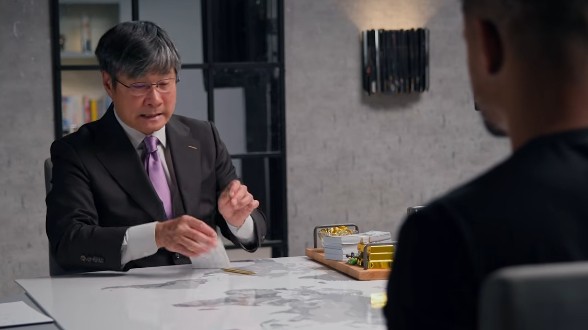
EDITOR’S NOTE: In this conversation with Steven Bartlett on the DOAC podcast, Professor Jiang Xueqin argues that the post-World War II global order — built on the petrodollar system, globalization, and American military hegemony — is collapsing. Drawing a parallel to the Bronze Age collapse, he walks through the widening war in the Middle East, tensions between China and Japan, the war in Ukraine, and a set of predictions for the years ahead, before turning to questions of faith, family, and what advice he’d give the average person navigating an uncertain world. This interview episode was premiered September 14, 2026.
TRANSCRIPT:
“The World Is Collapsing”
STEVEN BARTLETT (00:01:45 – 00:02:19): Professor Jiang, what is front of mind for you at the moment? Your energy is giving me something’s on my mind. What is that?
JIANG XUEQIN (00:02:20 – 00:04:44): I think that we are living in a time when the world is collapsing. And so what I want to explain to you today, Steven, is how we got to the world that we are in and why it is collapsing.
So first thing I want to explain to you is the petrodollar system, which is the basis for the global economy. So let’s go back to the year 1945, and this is the end of World War II. And the United States is dominant. The United States will manufacture goods for Europe and for Japan, which were destroyed in World War II. So what the United States said is, we will lend you the US dollars in order to purchase the goods that we will export to you, but you have to promise to pay us back in gold.
And the United States became complacent. They were spending money they shouldn’t have been spending. The United States went from a creditor nation to a debtor nation. So in the year 1971, Richard Nixon said that the US dollar would no longer be pegged to the gold. And so the question now was, if the US dollar is no longer pegged to gold, then what is the value of the US dollar? So Richard Nixon had to create demand for the US dollar.
And so 3 things happened after something called the Nixon Shock, 1971 Nixon Shock. So the first was the creation of the petrodollar. So Saudi Arabia and other countries in the Middle East agreed to sell their oil only in US dollars. So if you want to buy oil, energy, you need US dollars. Late ’70s, early ’80s, China said the same thing. If you want our cheap manufactured goods, you have to pay in US dollars. Mid-’80s was something called the Plaza Accord, where Japan agreed to take all its savings and buy US Treasuries.
STEVEN BARTLETT (00:04:45 – 00:04:50): So it’s essentially they’re buying a promise from the US.
JIANG XUEQIN (00:04:51 – 00:08:19): All this is based on promises, right? The US dollar is a contract. It’s a promise. China promises to give you manufactured goods, and Saudi Arabia promises to give you oil. This system, the petrodollar system, creates the world that we live in today. So let me explain why.
Semiconductors and the Global Supply Chain
All right, so this is a semiconductor, all right? And it’s the basis of all technology, of all computer. And there are 3 critical elements in a semiconductor: silicon, gallium, and germanium. Okay, there are many more elements, but these are the 3 most critical. And these 3 together allow semiconductors to achieve almost impossible technology. For example, precision missiles, satellite communication are all based on these 3 elements working together.
Why we have these 3 elements in place is because of this global system. Because silicon is mainly manufactured in China. About 60-70% of the world’s silicon comes from China. 70% of gallium comes from China. 90% of the world’s germanium comes from China.
Now, for semiconductors to work, the process is this: the United States, mainly in California, Nvidia or Apple, they will design very advanced semiconductor chips to power the iPhone, to power your video games. Then the United States will send this chip design over to Taiwan and Malaysia for the manufacture of these chips. The Netherlands and Japan will create machines to print out these semiconductors. So a company in the Netherlands called ASML, they manufacture lithography machines that are worth $400 million each. Then these lithography machines and the chip design go to Taiwan, primarily Taiwan, but also Malaysia as well, in order to manufacture these chips. And then these chips are then sent to China to be put into appliances.
So when you see this semiconductor, you’re not just seeing a piece of metal and plastic, you’re really seeing the world converging together. So I want you to remember this formula, and this will help us explain how the world works. This formula is very simple:
“Technological progress is correlated with specialization times globalization.”
This is the formula. Okay? So it’s very simple. Our technological progress is premised on more countries being able to specialize and these countries being able to trade freely with each other. And what makes this all possible is global trade that is supported by 2 things. The first, of course, is the US dollar. The second thing that’s most important is the US military hegemony.
STEVEN BARTLETT (00:08:20 – 00:08:20): Hegemony meaning?
JIANG XUEQIN (00:08:21 – 00:08:29): Meaning they have no peer competitor. There is no one who can challenge the United States in control of the seas.
STEVEN BARTLETT (00:08:29 – 00:08:35): So you’re coming now to the point of why you think — because the claim at the top was that the world is collapsing.
JIANG XUEQIN (00:08:36 – 00:09:43): Exactly. I bring this all up because we need to appreciate what technological innovation is. If technological innovation is specialization times globalization, then we are living in a time of not just war, but also the regression of civilization.
In other words, my argument to you today is we’ve basically hit the apex, the height of technological advancement.
STEVEN BARTLETT (00:09:43 – 00:09:46): The word collapse you use, though, is a strong word.
JIANG XUEQIN (00:09:46 – 00:09:46): Yes.
STEVEN BARTLETT (00:09:48 – 00:09:49): Is that the word you meant?
JIANG XUEQIN (00:09:49 – 00:10:04): That’s exactly the word I meant. We are living not through World War III. We are not living through a shifting of the global order. We will live through, over the next 20 years, the collapse of civilization itself.
STEVEN BARTLETT (00:10:05 – 00:10:09): The collapse of civilization itself. Are you sure?
JIANG XUEQIN (00:10:10 – 00:10:14): I am positive that we are seeing the collapse of civilization.
STEVEN BARTLETT (00:10:15 – 00:10:25): Give me some definition around the collapse of civilization, because people could infer that as, oh, the dollar’s not going to be as strong, or they could say, okay, we’re not going to innovate as much, or fuel prices are going to go up — but the collapse of civilization?
The Bronze Age Collapse
JIANG XUEQIN (00:10:26 – 00:12:15): Yes. So let’s go back to World War II. Okay? If you lived in Europe or Asia, it really seemed like the end of the world. Tens of millions of people died in that war. But at the same time, you had a superpower that was emerging, the United States of America. So at the end of World War II, America was so powerful that it was able to create a new world order and basically finance and defend this new world order called Pax Americana.
And we are seeing the last days of Pax Americana. And then you ask yourself, well, then let China emerge, or maybe Russia will emerge, or maybe Israel will emerge to replace Pax Americana. And unfortunately, what we know is that systems in decline, empires in decline do not go willingly.
So the historical analogy I would use is the Bronze Age collapse, because the Bronze Age was very similar to this period in our history when the entire world was globalized. Because in order to make bronze, you needed both copper and tin, and these places were found in different places of the world, and that allowed for global integration. But because of global integration over time, that led to massive inequality, debt, and polarization. And so when the system collapsed, the entire world collapsed. So I would argue the closest historical analogy that we have to today is the Bronze Age collapse.
STEVEN BARTLETT (00:12:16 – 00:12:22): What was life like in the Bronze Age collapse, or how was it different pre-Bronze Age collapse versus post-Bronze Age collapse?
JIANG XUEQIN (00:12:22 – 00:14:01): So during the Bronze Age collapse, what happened was there was a perfect series of crises that caused systematic collapse. The first was change in weather patterns — climate changed, which led to famine, primarily in Europe. We have famine and people are starving. What do people do? They migrate. They migrate to areas that have food, and this place is primarily going to be Anatolia and Egypt.
These migrants overwhelm the systems of Egypt and Anatolia, and this would cause a cascading effect where the entire world lost order. These migrants were called the Sea Peoples, and they were destroying traditional hierarchies and authorities. And once that happened, the very fundamental elements of civilization disappeared.
So if we apply this analogy to today, then I’m going to paint for you a scenario of what might happen. All right, so we have this war in the Middle East that is only expanding. It’s bringing in more and more countries. So as you may know, since we last spoke, basically all of Iran’s proxies have been brought into the war. This includes the Houthis, which occupies this part of Yemen.
The Widening War in the Middle East
STEVEN BARTLETT (00:14:01 – 00:14:06): So the Houthis are a group of military that are in favor of Iran?
JIANG XUEQIN (00:14:06 – 00:16:39): The Houthis are an ethnic group in Yemen. And Yemen is a country that is divided according to tribes. The thing about the Houthis is, first of all, they live in the mountains, so it’s almost impossible to dislodge the Houthis. Saudi Arabia tried for 5 years. It didn’t work.
The other thing about the Houthis is they are a Shia tribe people. Now, there’s Shia Muslim and there’s Sunni Muslim. The vast majority of Muslims in the world are Sunni, about 90% of the entire global Muslim population. The Shia are about 10%. And as a result, because they’re the minority, the Shia are much more fanatical than the Sunni. And this has always been historically true. They believe in martyrdom. So in other words, the Houthis will fight to the death. They’re not afraid of death.
And the third thing about the Houthis that we need to appreciate is they control this critical choke point called the Bab el-Mandeb Strait. This is the Red Sea. So a lot of trade has to go through the Red Sea. Now what we know is Iran has already closed off the Strait of Hormuz, and the easiest and cheapest way for Saudi Arabia to get its oil to East Asia and South Asia is by the sea. So Saudi Arabia cannot actually transport its oil.
So that’s the first group that is now involved in this war — the Houthis. Then you have Hezbollah, which is in Lebanon, and they are now fighting Israel. Hezbollah is also a Shia group, so they are also very fanatical. And then you also have Iraq, the Shia militias that are basically their own independent militaries. So all 4 have been brought into the war now: Iran, the Houthis, Hezbollah, the Shia militia in Iraq. Why is this important? Because they span the entire Middle East. And so we are now seeing expansion of the war. And over time, what might happen is more and more nations have to be brought into the war to protect their own interests.
STEVEN BARTLETT (00:16:40 – 00:17:03): How is this different from — I grew up with the Iraq War, and there was lots of conflict in the Middle East, there was always fighting going on. And it feels like it’s been a function of my childhood, that the Middle East are always fighting in some capacity somewhere. And eventually there’s a peace in Iraq and the war kind of stops and ISIS is decapitated or whatever, and it just kind of moves around a little bit.
JIANG XUEQIN (00:17:04 – 00:19:43): Great question. But what’s happening today is very different from 2003. In 2003, the United States went in to decapitate Saddam Hussein and his government. And that was easy to do because you had a government that was not very popular amongst the people. So America specializes in shock and awe military tactics.
The problem today is you have 4 different groups. You have the IRGC in Iran. You have the Houthis in Yemen. You have Hezbollah in Lebanon. You have the Shia militia in Iraq. They are decentralized. They are fanatical. And they share a similar eschatology, a similar religious framework. And as a result, what we know is the United States military is not very good at fighting guerrilla insurgents. We know because of what happened in Afghanistan as well as Iraq. These 2 are what is often referred to as forever wars, where the United States spent trillions of dollars over 20 years to try to squash insurgents, and they failed miserably.
So because these 4 groups are coordinating, but they’re decentralized, this means that this war can only expand over time. Now, Saudi Arabia feels threatened by the Houthis. So what Saudi Arabia has done is most recently it signed something called the Mecca Accords with Turkey and Pakistan. So Turkey and Pakistan and Saudi Arabia now must come to each other’s defense. And it seems to me of these 3 countries, Saudi Arabia will be the first to invoke this mutual defense pact against the Houthis. So you can see a situation where Pakistan, Turkey, and Saudi Arabia is brought into war to try to dislodge the Houthis.
But we know that the Houthis in their mountain retreat are almost invincible. So this war can only expand, and the Houthis in response, what they can do is destroy the energy infrastructure of Saudi Arabia. The Houthis have ballistic missiles, they have drones, and Saudi Arabia is this giant lake of gasoline ready to be blown up or lit up by the Houthis at any time.
STEVEN BARTLETT (00:19:44 – 00:19:55): Back in the early 2000s, there was al-Qaeda, there was ISIS, there was still Hezbollah and Hamas. So how is this different? Because there was lots of military militant groups.
JIANG XUEQIN (00:19:55 – 00:21:40): Great question. Why this is different is there is active coordination amongst these groups. Al-Qaeda, ISIS, they were working separately. But these 3 proxies — you have the Houthis, you have Hezbollah in Lebanon, you have the Shia militia — they all report back to the IRGC in Iran.
And here’s the kicker. This is really important: both China and Russia are supporting Iran in this conflict. China is supporting Iran through the Belt and Road Initiative, basically transporting goods to Iran through this corridor. And Russia is supporting Iran through the Caspian Sea. As a result, Iran in theory could fight this war indefinitely. That’s one thing that we have to appreciate. There’s a clear alliance in place to make sure that Iran and its proxies can withstand this war.
The other thing that’s really important for us to appreciate is that the Middle East is the heart and center of the petrodollar system. It takes all these barrels of oil in the GCC countries and transports them to India, Pakistan, China, Japan. And what then happens is East Asia takes these barrels of oil energy — could you put the figures in Japan?
STEVEN BARTLETT (00:21:41 – 00:21:43): What are these little figurines you’re asking me to put on Japan?
JIANG XUEQIN (00:21:43 – 00:23:08): So this represents Japan’s contribution to the global economy. It takes energy from the Middle East and turns it into manufactured products, consumer electronic products for the world to consume. It makes these in US dollars, and China, Japan, and the GCC all invest their excess savings in the United States, which allows the United States to focus on innovation, to create places like New York City. New York City is also a very specialized area because it basically is the financial center of the world.
So all this is the petrodollar system. As you can see, this system is dependent on free trade. But once the oil stops flowing, then what happens is China and Japan are no longer able to make the manufactured goods they need to export, and the United States loses all these recycled US dollars. So the 3 biggest buyers of US Treasuries — basically the 3 biggest financiers of the US economy, basically the AI bubble — are Japan, the GCC, and China. So we will see a cascading effect where maybe in a few months’ time, the system collapses.
“It Seems All Too Charmed to Believe”
STEVEN BARTLETT (00:23:08 – 00:24:41): Do you know what, Professor? One of the reasons why I think it’s quite hard — and I’m just going to be completely honest, people can take this as they take it, but it’s just me being honest — one of the reasons why it’s quite hard to believe that the world is going to collapse and that this is going to be like the Bronze Age collapse: I was actually reading about the Bronze Age collapse, and what I pulled up here says:
“The Late Bronze Age collapse was a rapid, violent, and widespread societal breakdown that occurred in the Eastern Mediterranean between approximately 1200 and 1150 BCE. Before the collapse, the region was heavily globalized. Major superpowers like the Egyptians, et cetera, were deeply interconnected through diplomacy, royal marriages, and complex international trade networks.”
But within a span of just 50 years, almost every significant city in the Eastern Mediterranean was destroyed and many were never rebuilt. And there’s a map which I’ll throw up on the screen which shows this breakdown.
Here’s my honesty. As a 34-year-old, I have lived a very charmed life, as it relates to history and the things that happened in history. So when we hear these things — that society will break down, there’ll be civil collapse — we don’t really have a reference point as Gen Zs and millennials. Really our parents and their parents, they have reference points from World War II in the 1940s, but we don’t really have them. So it seems all too charmed — that can’t happen to us.
JIANG XUEQIN (00:24:42 – 00:26:17): You’re absolutely right. And I think a lot of the issue is the world has been constructed in a way to maintain the privileges of the Western populations. An example I use is, you say that we’ve lived a charmed life. Well, if you lived in Iraq, Afghanistan — these places, you did not live a charmed life, because the United States came and attacked you for no particular reason and destroyed the very infrastructure of your society. Even today, Iraq and Afghanistan are engulfed in political violence and war and political assassinations.
So if you were a child in Iraq or Afghanistan, and even in Africa, you’ve never known peace, stability, and prosperity. So the inequality in the world is stark, and we in the West have been extremely privileged to be sheltered from a lot of the chaos in the world. In fact, the US empire is designed to ensure the populations never have to suffer the tragedy and suffering of other people. And what I’m trying to say is this US empire is breaking down, and there’s nothing that we can do to stop it. So all the suffering that we might have seen on television — it is coming to us in our lives, and we need to be aware of it.
STEVEN BARTLETT (00:26:17 – 00:26:21): When you say it’s coming to us in our lives, what’s coming to us in our lives?
JIANG XUEQIN (00:26:22 – 00:26:32): The same political violence, the same chaos, the same political polarization that has infested the rest of the world.
STEVEN BARTLETT (00:26:32 – 00:26:43): Do you think war is coming to our shores? Because we now live in a post-nuclear bomb era, and that seems to have created, in a weird way, a bit of peace between superpowers.
JIANG XUEQIN (00:26:44 – 00:27:07): So I’m going to go to the screen and I’m going to paint you a picture of our global supply chains and what it means for global supply chains to break down, using a few maps. And these maps, I hope, will paint a clear and simple picture of what is about to come.
STEVEN BARTLETT (00:27:07 – 00:27:15): Can I ask you a question just before we go to the screen? Have you always been pessimistic about the future? When did you become pessimistic about the future?
Becoming Pessimistic: Brexit and Trump
JIANG XUEQIN (00:27:16 – 00:29:52): I became very pessimistic about the future after Brexit and the election of Donald Trump, because I was an immigrant who grew up in a very poor family. My father was a dishwasher, and he was a dishwasher for 30 years before he retired. We were so poor, we couldn’t even afford a car. We never took any vacations, but I worked hard. I got into Yale University, one of the best colleges in the world, and not only that, but I went there on a full scholarship.
So from my perspective, the world was perfect. It was a meritocracy. It was a place that rewarded talent and hard work. So I believed that the world was governed by reason, by logic, by science, by truth, by good people. And when Brexit and the election of Donald Trump happened, I was traumatized. Brexit was the British people turning away from globalization. The election of Donald Trump, from my perspective, was the American rejection of meritocracy, of reason, of truth, of order.
And when that happened, it sort of told me what I believe about the world didn’t really work. And those events forced me to reflect deeply on why the world was breaking down, and those events led me to today, because what I’m trying to do is I’m trying to figure out patterns of history, principles of society that allow us to better understand ourselves. And that’s why I drew you this formula. Because traditionally we understood innovation as maybe coming from universities. And having studied history, having studied global supply chains, I now recognize that no, technology just comes from specialization and globalization. And this not only is an analysis of the current world, but it also gives us a framework to predict the future. So if in the time of war, specialization and globalization break down, then in theory, technology should break down as well. And that’s what I’m trying to do. I’m trying to figure out how and why we are where we are today.
STEVEN BARTLETT (00:29:52 – 00:29:54): So you wanted to draw something on the whiteboard?
JIANG XUEQIN (00:29:54 – 00:29:55): Okay, right.
Mapping the Global Supply Chain
JIANG XUEQIN (00:32:00 – 00:36:59): So this is a summary of the global supply chain network, and we can see how it involves the entire world. You are not able to build semiconductors unless you have a globalized economy.
So there’s been a lot of talk about China controlling the elements. China manufactures about 70% of the world’s silicon and rare earths. China controls about 70% of rare earths. What people don’t appreciate is it works both ways. China does export a lot of silicon and rare earths, but it also needs to import a lot of helium in order to sustain its semiconductor manufacturing process. The reason why is helium cools the semiconductors in a way to allow for it to be manufactured, so helium is a cooling agent.
Another thing that people don’t appreciate: people think that China has a monopoly on rare earths, but America, in a place called Spruce Pine, North Carolina, has a monopoly on high-quality quartz. It controls about 90% of the world’s high-quality quartz, which you need in the silicon manufacturing process as well. So if these nations start to stop trading with each other, technology would cease to progress.
Now, something to keep in mind is it’s not just semiconductors that are dependent on the global supply chain. Food is also very dependent on the global supply chain. So what we’re seeing is a stark contrast between the North and the South. The North produces most of the world’s fertilizer, and the South, primarily Africa, the Middle East, and South America, imports a lot of the fertilizer. Ammonia is a very important component of fertilizer, and most of the ammonia production plants are actually in the North of the world — Canada, United States, Europe, China, Russia. So the Global South is dependent on the North for food. In a time of war, when global supply chains break down, the North might lose access to fancy wireless smartphones. The South will face famine.
Water, Migration, and the Next Flashpoints
Why is this important? Because the world is rife with conflict. The main issue that we will face in the next 20 years is not oil, it’s actually water. This map that we’re seeing right now is actually telling us where the next major geopolitical flashpoints are. So basically, if you see red on the map, it means this place has water scarcity issues, and the red issues tell us exactly where wars will erupt.
Even in the United States, if you look at the Western part of the United States, they do have water scarcity issues. If you go to the Western United States — Colorado, California, Arizona — these places are fighting over the Colorado River, because the Colorado River is what supplies most of their water. You go to the Middle East, and it’s almost like dynamite ready to explode, and what this war will do is aggravate all the tensions in the Middle East. India itself is facing water shortages, which brings it into conflict with China.
So this one map basically tells you where the next geopolitical flashpoints will be — a place that is most likely to go to war or have conflict or political violence over the next 20 years. Northeast Asia is another major flashpoint, with Japan and North Korea. But what’s important to appreciate is once war breaks out, there are third-order effects causing conflict to spread around the world.
This map tells us fertility rates around the world. As you can see, Africa has the world’s highest fertility rate, followed by the Middle East.
STEVEN BARTLETT (00:36:59 – 00:37:03): Okay, so they’re having the most children per couple.
JIANG XUEQIN (00:37:03 – 00:38:41): That’s right. Why is this a problem? Because if you go back to the previous map, this area is also where there is the most geopolitical tension. And so if there are more and more children, young people being born here, they have no choice but to migrate. And where will they migrate? Probably to Europe. And you’re like, well, okay, well then what Europe should do is turtle up — Europe should build walls and prevent these migrants from reaching Europe.
But Europe has its own problem, which is the aging crisis. Look at what’s happening: the fastest aging populations are in fact in the most developed nations, including Japan, Europe, and North America. So if you have an aging population, you need to provide cheap healthcare, nursing. What does that mean? It means you have to let in more immigrants in order to service the aging population. And what will happen then is domestic conflict, where you have more migration into Western societies, which brings them into conflict with the native populations. And therefore it is possible you have civil war as well as political violence and even the possibility of revolution. So these maps collectively paint a very grim picture of the world that we’re living in.
STEVEN BARTLETT (00:38:41 – 00:39:05): On this page here about immigration causing civil war, political violence, revolution — won’t it just be the case, as we’re seeing, that these Western societies will increasingly elect right-wing political parties? Which is kind of what we’re seeing. We’re seeing parties in the UK like Reform surge. I think there was news yesterday in Germany of the political party there. We’re seeing the same in the United States as well.
JIANG XUEQIN (00:39:06 – 00:39:28): That’s a fantastic point. That’s exactly what we’re seeing. We’re seeing the AfD surge in Germany, MAGA being very dominant in the United States. We’re seeing Vox in Spain. So in theory, what’s going to happen is these countries become much more right-wing, and then they block out immigration, because that is their main policy platform.
STEVEN BARTLETT (00:39:29 – 00:39:30): And that should stop the civil war.
Robots vs. Immigration
JIANG XUEQIN (00:39:31 – 00:41:32): The problem is, what do you do about your aging population? Robots — exactly right, that’s what you would think. But what we’re seeing is a breakdown in global supply chains. Robots depend on copper, which you get from Chile, Peru, China, Australia — pretty faraway places from Europe and the United States. You also need lithium, which you get from the lithium triangle, again pretty far away. You also need silicon, which is mainly manufactured in China. You need rare earths, which again is really manufactured in China.
So you have this huge issue where, in theory, you could use robots, but when global supply chains break down, you have to figure out the cheapest way to resolve the labor issue. And the cheapest solution is immigration. People, I hate to say this, but people are much cheaper and much more expendable than robots.
I know this is a bit scary, I know this is really depressing. But what if the United States were able to win this war in Iran and conduct regime change? Then our problems are solved right now. Iran is under control of the United States, and we’re back to globalization, where oil is able to flow to South Asia, to East Asia, and then they manufacture goods and recycle their profits into the economy. And with all this money, AI is able to innovate to a point where we achieve AGI, and then we solve all the world’s problems.
What Happens Next With Iran
STEVEN BARTLETT (00:41:32 – 00:41:37): Okay, so what happens next with this whole Iran situation?
JIANG XUEQIN (00:41:37 – 00:43:48): So unfortunately, it has now developed its own momentum. Let me explain what is most likely to happen. So you have Iran, and it is now controlling the Strait of Hormuz. You have the Houthis, and they control the Bab el-Mandeb Strait. You have Hezbollah, which can threaten the Suez Canal. You have the Shia militias that can also threaten the Mediterranean.
From a game theory perspective, what Iran should do next is take the initiative and disrupt all global trade. And the reason why is the US empire is based on the petrodollar, it’s based on global trade. When you disrupt global trade at the same time, there’s no way for the United States to respond. How could they disrupt global trade? They could start to attack randomly — Iraq can attack Saudi Arabia, sorry, and attack Israel. Iran can attack the Strait of Hormuz. Hezbollah can attack the Suez Canal. And why you do that is you’re creating uncertainty and chaos in the global trade system.
Why is that important? Because the global trade system is built on confidence, and that’s what drives insurance. So if you’re an insurance company, you’re like, oh my God, these actors are completely out of control, the United States has lost control over the situation — you can no longer insure global shipping. If you can’t insure global shipping, global shipping ceases to work. All right, so this is the Madman Theory, and this is Iran’s best play moving forward. And the reason why is the United States does not have the military capacity to respond to a coordinated random strike across the Middle East.
STEVEN BARTLETT (00:43:48 – 00:43:51): So is this your prediction? Is this what happens next?
JIANG XUEQIN (00:43:51 – 00:44:16): I don’t want to make this prediction, just because there are lots of factors I do not know. First of all, I don’t know politically what the situation is in Iran. Certainly the IRGC would want to do this, but there are political factions within Iran who would think this is too provocative, and it’s possible the entire world would unite against Iran if Iran were to do this.
STEVEN BARTLETT (00:44:17 – 00:44:20): So what is your prediction in terms of Iran and what happens next?
JIANG XUEQIN (00:44:20 – 00:45:10): My prediction is this will only escalate. How it will escalate, I don’t know. But the trump card, to use a pun, for Iran is to start to disrupt global trade. But the United States has a response, and this response is to attack Iran’s critical civilian infrastructure, which includes desalination plants and power plants. And this would be worse than using a nuclear weapon on Iran, because without power plants, the people in Tehran, a city of about 10 million people, face starvation because a lot of this food is refrigerated. This is how the war becomes almost civilization destroying.
STEVEN BARTLETT (00:45:11 – 00:45:27): If Iran were to completely disrupt global trade, and if the United States were to destroy the power plants of Iran, obviously that would be horrific and sort of inconceivably horrifying for the innocent people that are caught in the middle of this. You don’t think that the US would actually do that though, right?
JIANG XUEQIN (00:45:28 – 00:46:10): I think the United States will be forced to do it. According to game theory, they will be forced to behave like this, because we need to appreciate this formula: the more power you have, the less imagination and empathy you have. You don’t think killing millions of Iranians is too heavy a price. It’s all worth it if you can maintain the empire. The hubris leads you to believe that the gods favor you, and you ultimately win and triumph in this great struggle.
STEVEN BARTLETT (00:46:10 – 00:46:20): Don’t you create a huge migration crisis where people start fleeing from Iran up into Europe because they are starving?
JIANG XUEQIN (00:46:20 – 00:47:08): Exactly right. Not just Iran, but Africa as well, because they’ve lost access to cheap energy and fertilizer. So you have all this migration into Europe, which would overwhelm the European social fabric, which would overwhelm the European state. But unfortunately, this has been happening at a much slower pace ever since 2014, when for whatever reason the United States chose to destroy Libya and cause a civil war in Syria, which caused millions to migrate into Europe. And as you remember, the Europeans, in their generosity, accepted all these migrants, which has led to tremendous social friction and political tension in Europe today.
STEVEN BARTLETT (00:47:09 – 00:47:21): So your prediction here, if we conclude, is that the US won’t win this “war” in the Middle East, because they can’t defeat Iran and its proxies, but also your conclusion is that this is going to continue to escalate in the Middle East.
JIANG XUEQIN (00:47:21 – 00:47:34): Yes. And already what we’re seeing are other actors being drawn into the war. The most recent news is South Korea has authorized a naval contingent to go and try to secure the Strait of Hormuz.
STEVEN BARTLETT (00:47:34 – 00:47:36): What would you do if you were Donald Trump?
JIANG XUEQIN (00:47:39 – 00:48:10): What would I do if I were Donald Trump? I would push all in. I would start attacking power plants in Iran, because if I take any half measures, I would just look weak, and I’m only going to create more problems. I would only incentivize Iran and its allies to be more provocative, to be more aggressive. So if I’m Donald Trump and I’m in this situation, I would just push all in.
STEVEN BARTLETT (00:48:10 – 00:48:13): But you’d end up killing millions of Iranians, theoretically.
JIANG XUEQIN (00:48:14 – 00:48:46): Well, I start this war, right? Then I have to win this war, because I can’t lose this war. I refuse to lose this war. I understand the concerns, okay, but if you want to understand how these leaders think, this formula gives you the best window into their psychology, which is because of so much power, they lose the capacity to imagine different possibilities and have empathy for the suffering of the people in the world.
STEVEN BARTLETT (00:48:46 – 00:48:56): Couldn’t they just back out? Couldn’t Donald Trump just do a big press conference where he says, we won this war in Iran, we’ve destroyed their military, their naval bases, it’s done, and Iran will no longer have nuclear weapons?
JIANG XUEQIN (00:48:57 – 00:49:11): The entire petrodollar system is premised on 2 things: the US dollar as the world reserve currency, and the aura of inevitability and invincibility of the US military.
STEVEN BARTLETT (00:49:11 – 00:49:23): If they look like they are beatable, then the US — as its image is sufficiently tarnished. What are your predictions? I’ve been dying to know.
Three Predictions
JIANG XUEQIN (00:49:23 – 00:50:20): So I brought to you 3 predictions, and because we are so close to the anniversary of 9/11 in New York City, I structured these predictions around the anniversary. These will be 3 fun but horrifying predictions.
So my prediction number 1 is there will be a siege of New York City. Let me explain my logic. I was here last time, and I said that Donald Trump will get a 3rd term, and he’s been joking about it, he’s been talking a lot about it, he’s been social truthing about it. So let’s imagine what happens if Trump gets a third term. Well, you would have a lot of pissed-off people, especially in the major cities of Los Angeles, San Francisco, Boston, Chicago, and New York City.
STEVEN BARTLETT (00:50:21 – 00:50:47): We should probably just pause there, because there is a constitutional ban on serving 3 terms. The primary barrier being the 22nd Amendment, which was ratified in 1951, after Franklin D. Roosevelt, who won 4 elections. It establishes a strict term limit for the presidency, and the text in this 22nd Amendment explicitly says:
“No person shall be elected to the office of the president more than twice.”
So how could that happen?
JIANG XUEQIN (00:50:48 – 00:51:29): Well, let’s just say there is a national emergency and the president is forced to suspend the Constitution — then he could theoretically have his third term. It’s also possible that in 2028 he decides to run as the vice president and have his son, Don Jr., run at the top of the ticket. And then once the election is over, Don Jr. would resign and then Donald Trump would become the president. There’s nothing in the Constitution that prevents him from doing that. So there are 2 possibilities.
STEVEN BARTLETT (00:51:30 – 00:51:36): There isn’t anything in the Constitution that allows the US president to suspend the Constitution in a time of a national emergency.
JIANG XUEQIN (00:51:37 – 00:53:21): It’s precedent. For example, during the American Civil War, Abraham Lincoln was able to suspend habeas corpus, which is a constitutional right in the US Constitution. And during World War II, Franklin Delano Roosevelt also did many unconstitutional things — for example, interning the Japanese population in camps. There’s nothing the Supreme Court could do against this, because a lot of US politics is convention, agreed-upon norms. But if a US president says, well, screw these conventions, there’s nothing anyone else can do about it.
So let’s imagine, just for the sake of this argument, Trump gets a third term. What will happen is these cities that are Democratic will be in open revolt, meaning they will refuse to pay taxes to the federal government, but they will also not welcome ICE federal agents into their cities, which creates conflict between local law enforcement and federal law enforcement. And historically, if that were to happen, the US president usually thinks that he has a responsibility to quash this insurrection. And so this would over time lead to the siege of New York City, where maybe federal forces, along with possibly militias from other states, possibly red states that favor Trump, would try to besiege New York City by cutting off the food supply and water supply to New York City. And this would be a conflict that could go on for years and years.
STEVEN BARTLETT (00:53:21 – 00:53:25): And what year would that take place? 2028?
JIANG XUEQIN (00:53:25 – 00:53:29): It could happen right after Trump secures his third term.
STEVEN BARTLETT (00:53:29 – 00:53:31): Do you think Trump is going to have a third term?
JIANG XUEQIN (00:53:32 – 00:53:35): Do you want to bet? I think he’ll get a third term.
STEVEN BARTLETT (00:53:35 – 00:53:36): How much do you want to bet?
JIANG XUEQIN (00:53:37 – 00:53:40): Let’s take a friendly bet and say $100. $100 US dollars.
STEVEN BARTLETT (00:53:40 – 00:54:17): I don’t know if I’ve said this before, but I actually did have a bet with 2 random guys on Facebook a couple of years ago. They told me that after Donald Trump had lost the election to Joe Biden, he was going to stay in power. And I said, there’s no way he stays in power. And they said, no, he will. And then they offered me a bet: £1,000 each, we bet you he’s going to stay in power. And I said, fine. And they actually did pay me when he came out of power — they transferred me $1,000 each. I gave it to charity. So I’m more than happy to make another bet if you want to make a bet. $100. And you’re betting that Trump gets a third term?
JIANG XUEQIN (00:54:17 – 00:54:31): Yes, I think he’ll be in power after 2028. Is that fair — he’ll be in power after 2028? When’s the election? Well, the election should be November 4th, 2028, but I didn’t say he would win the election. I just said he’ll get a third term.
STEVEN BARTLETT (00:54:31 – 00:54:41): So you’re saying that he will refuse to leave office or find another way to remain president beyond the date of the inauguration.
JIANG XUEQIN (00:54:41 – 00:54:48): Yes, I’m saying that on January 21st, 2029, Trump will still be in the White House. Okay, I’ll take that bet.
STEVEN BARTLETT (00:54:48 – 00:54:53): Okay. For everyone’s clear, and please do remind me to cash in, lads.
JIANG XUEQIN (00:54:53 – 00:56:53): $100. $100 may not be worth anything at that time, but it’s $100. All right, so again, we are just assuming for the sake of argument that Trump is in office in his third term. There will be political violence across the United States, primarily in New York City. And if the federal authority is being challenged by a city or local state authority, then the president will take this very seriously and send in forces to quash this insurrection.
Maybe other cities will be much more compliant, but New York City has a very charismatic mayor in Zohran Mamdani, and New Yorkers — you don’t want to mess with New Yorkers, when they get angry, they get really, really angry. So I think this is very likely: if Trump gets a third term, there’ll be a siege of New York City. He would almost be 83 years old. I mean, we say that, but the amount of energy he has — the fact of the matter is the guy eats cheeseburgers every day. He gives a press conference almost every day. He’s always on social media tweeting out something stupid. For example, he’s tweeted out that all of North America is now the USA. I’m not sure if you’ve seen that yet. And he’s talking about taking over Canada and Greenland and Cuba. So I don’t know where he gets his energy, but he seems really energetic.
I’m not sure if you’ve ever interviewed Michelle Obama, but if you just looked at the picture of Obama in 2008, he was a really handsome, really young, very vibrant man. You fast forward 8 years and he came out just decrepit — he had aged like at least 20 years in office. Donald Trump, for whatever reason, has not aged that much.
STEVEN BARTLETT (00:56:54 – 00:56:55): Hair dye and fake tan?
JIANG XUEQIN (00:56:58 – 00:58:35): So there’s something really weird about Donald Trump, which is a lot of US journalists in Washington, DC have his direct personal cell phone number, and they can call him and they will talk for an hour. The guy is the president of the United States. And if you are just an average Washington journalist, you can call him and talk to him for an hour a day. There are journalists who go to the White House to interview him and say, we tried to leave an hour ago, but he made us stay and talk to him some more, he wouldn’t let us leave. So I don’t know where he gets his energy from, but he’s extremely energetic and he loves that attention.
What’s prediction number 2? So again, we are approaching the anniversary of 9/11, and there are a lot of people who fear there will be another 9/11 attack on the United States, just because you have a lot of actors that are very angry at the United States and who may want to seek vengeance against the American people. In that case, if there is another 9/11 attack on the United States, I believe it’ll be an attack on the US financial infrastructure. Let me explain my reasoning. What was 9/11? 9/11 was an act committed by terrorists in order to traumatize the population into self-destructive violence. Is that a fair statement? I don’t really know.
STEVEN BARTLETT (00:58:35 – 00:58:36): Was that the—
JIANG XUEQIN (00:58:36 – 01:01:15): So let’s parse the statement: 9/11 was an attempt to traumatize the American population into self-destructive violence. What I mean by that is you’re taking the symbols of American power — these airplanes as well as the Twin Towers, these are symbols of American power, and the Pentagon, and the White House — and you’re destroying them. And for the longest time, American people believed that these are symbols of American invincibility. Our planes, the Pentagon, the Twin Towers. And to see them destroyed like that would traumatize the population. In fact, it did traumatize many, many people. And the idea is you traumatize them into self-destructive violence, which means they want vengeance.
And so what did they do? They went to the Middle East, fought against the Taliban in Afghanistan, then went to attack Iraq, then this war spread to Syria, Libya. And we can say that these 20 years of forever wars in the Middle East have been very destructive for the United States. It’s caused a huge fiscal deficit. It’s caused the American military to lose a lot of prestige. It’s caused a lot of corruption in Washington, DC. It’s been very bad for the United States.
All right, so if you’re the terrorist and you look at 9/11, you’re like, okay, well, I want to do the same thing, which is, I want to traumatize people into self-destructive violence. How can I do so? Well, I need to traumatize them, right? Me flying planes into the new Twin Towers doesn’t do that, because people are now used to — they’ve been normalized into this sort of violence. So how can I induce trauma into people? Well, there are different possibilities you can use. So let’s do a thought experiment. What would happen if one day you open your iPhone and you’re looking to buy a coffee? Well, you scan your iPhone and it doesn’t read. And you’re like, well, there might be a problem with the bank. You call the bank, you can’t get through to the bank. And after hours and hours of frantic anxiety, you finally recognize that there was an attack on critical US financial data servers. And so all the money in your bank account has been wiped out, and they don’t know when or how long it will take them to retrieve it. How would you feel?
STEVEN BARTLETT (01:01:17 – 01:01:17): Concerned?
JIANG XUEQIN (01:01:19 – 01:01:25): I would say you would feel more than concerned. I would say you would feel a lot of anger and anxiety and frustration.
STEVEN BARTLETT (01:01:26 – 01:01:33): But that must be hard to do — surely taking out the financial infrastructure for everybody for a long enough period of time where they start to feel real-world consequences.
JIANG XUEQIN (01:01:33 – 01:02:08): Would you say 9/11 was hard to do? I would say so as well. I can’t possibly imagine them doing this. So there is certain creativity to these people, and I would not rule that out. But I’m just saying, if another 9/11 happens, it is possible what we’ll see is the destruction of the US financial infrastructure, which would drive millions of people into a mad frenzy. You’ve worked your entire life to save up $2 million. That $2 million is your retirement.
Trouble Returning to the United States
STEVEN BARTLETT (01:02:10 – 01:03:24): You said to me at the top of the conversation you’re having difficulty getting back into the United States recently. What do you mean by that?
JIANG XUEQIN (01:03:24 – 01:07:45): So I think there are a lot of people who do not like what I’m saying. I would say I am one of the most polarizing figures in the world right now. So the story is that the Iran War happened in March and it made me famous. And I was really afraid that this fame would annoy and frustrate a lot of Americans. And so I decided that I should not actually go to the United States at this point, because it’s most likely that I come here and I could be held in detention by customs, I could be deported. And so that time period was extremely scary for me, and I refused all offers to come to the United States. There were quite a few people who wanted me to fly to the United States to be interviewed.
Then over the summer, the war started to die down. I thought, okay, let me fly to Canada where my family is — I’m in Toronto — and I’m going to try to enter the United States by air from Toronto. So on August 5th, I went to Toronto Pearson airport, it was like 7 o’clock in the morning because I had an early flight to Los Angeles. I told them that I was going to go on The Theo Von Show, and I’ll be in the United States for 2 weeks, which was all true.
So when I’m at customs, the immigration officer asked me a lot of questions, but I handled all these questions pretty smoothly. Then he asked me, do you have a travel letter for your son? Because my son, Chris, who’s 8 years old, is traveling with me. And I’m like, what is a travel letter? And again, this is like 7 o’clock in the morning, so my brain’s not working. He’s like, call your wife. I’m like, okay. So I try to call my wife — my wife is in the shower. And so then the immigration officer says, okay, you have to go into secondary to be interrogated to make sure that your son Chris is traveling with you willingly.
So we go into secondary, and it’s like 7 o’clock in the morning and my flight’s at 8:30, and we’re waiting for like an hour, and I’m freaking out because it seems like we’ll miss our flight. And during this hour, I’m texting my wife, and she’s giving me the birth certificate, she’s giving me all the materials I need to prove that Chris is my son. And then at the very last minute, we get called, and I’m able to resolve the issue. And I tell him I’m going to go on The Theo Von Show and I’ll be there for 2 weeks.
So I’m in the United States, and I get contact from other podcasts to do interviews, and I travel around the United States, and I forget about the 2-week promise to the immigration authorities. Because I’m not sure if you know the law, but I’m a Canadian citizen, and therefore I don’t need a visa to come to the United States. If you say I’m coming for 2 weeks but you stay a month, it’s usually not an issue. I go back to Toronto and I come back to do this podcast.
So yesterday, I have my travel letter, I have my son’s birth certificate, and I go to the immigration officer, and they still put me in secondary. But basically, I think what happened was I said certain things during my podcast interviews that piss off some really powerful people in the United States. A lot of things that I said were related to something called the Clean Break Memo, which you have.
The Clean Break Memo was published in 1996, and it laid out a plan for how Israel can become the dominant hegemon in the Middle East. It was written by a study group, and part of the study group were 2 individuals: Richard Perle and Douglas Feith. These 2 would, in the George W. Bush administration, go work in the Pentagon. And these 2, along with Paul Wolfowitz, were the chief architects of the Iraq War. So I named these people, and I explained how this war in Iran follows from the Clean Break Memo. And the goal is to establish Israel as the regional hegemon. And I think this is what got me into a lot of trouble.
STEVEN BARTLETT (01:07:45 – 01:07:47): Why do you think that got you into a lot of trouble?
JIANG XUEQIN (01:07:47 – 01:12:35): Because I’m Canadian, when I come into the country, they usually don’t bother me. And so for them to question me, I think it was because some top officials basically requested that I be put in secondary every time I come to the United States. And I also believe this because I have a friend, Max Blumenthal, who is a very good US journalist, and he was in Iran covering Khamenei’s funeral. In response, a social media influencer named Laura Loomer demanded his arrest. And so when Max Blumenthal came into the country, and he is a US citizen, by the way, his devices were confiscated. And now Max Blumenthal is suing the Department of Homeland Security for illegally confiscating his devices.
And so I think that we live in a time when, unfortunately, the empire is in decline, and because of hubris and arrogance, they are trying to silence their critics rather than accept our constructive criticisms. So it’s a theory — actually, they never told me why I was put in secondary, but he hinted at me that every time I come to the United States, I will be put into secondary to make sure that I’m coming to the United States for legitimate reasons. Also, he hinted at me that it is possible that once my I-94 expires in 6 months, they will not renew it, meaning they will not allow me in the country anymore.
I hope I come back to the United States. I have the deepest admiration for the American people. I think that the Americans are the most open and generous people in the world. But at the same time, I do appreciate that we are living in very interesting times.
Prediction 3: Messi for President
Prediction 3. I wanted 3 new predictions that were fun and interesting for us to discuss. My third prediction is that Lionel Messi will become president of Argentina.
STEVEN BARTLETT: Oh, wow. I wasn’t expecting that.
JIANG XUEQIN: Yeah. So why I make this prediction is that Argentina is working very closely with the United States and Israel at this moment. You are a British citizen, so you will appreciate that Argentina has recently demanded the return of the Falklands, and Donald Trump has voiced support to Argentina. So I’m asking myself, why are they so concerned about the Falklands? And not only that, but if you’ve been following the news, Javier Milei has become very close with Benjamin Netanyahu. Argentina and Israel have very strong relations. In fact, Argentina is welcoming Israeli investment and immigration into Argentina. And apparently, if you are an Israeli citizen and you go into Argentina — again, you can fact-check this, but from what I understand — you have immediate access to healthcare as well as pension, which makes absolutely no sense because they’re not Argentina citizens.
So it seems very much that Argentina is working very close with Israel and the United States. And the reason why I think that Israel and Argentina are working very close together is right now there’s almost a civil war in Israel between Messianic Jews who believe this war in the Middle East will usher in the end times and the coming of the Messiah, and secular Jews who are like, these people are insane. And so the only way to resolve this conflict is by exporting secular Jews elsewhere. And it seems to me Argentina is a very good place to export them.
But then you’re like, okay, how do you get the people of Argentina to accept this massive immigration into Argentina from Israel? Because Israel is not very popular in Argentina. I think the best way is to make Lionel Messi the president of Argentina, and his popularity will be enough to let all these Israelis into the country. Him, as well as the reclaiming of the Falkland Islands — the god of Argentina becomes president, and Argentina reclaims the Falklands from the British. And I apologize to you as a British citizen.
STEVEN BARTLETT (01:12:35 – 01:12:44): It’s okay, I like Messi. You also mentioned to me that you think Japan is going to go to war with China — China’s going to go to war with Japan. What makes you think that?
China and Japan: Why Conflict Is “Inevitable”
JIANG XUEQIN (01:12:44 – 01:13:41): Well, because every Chinese believes this. It’s the funniest thing, but for the longest time, people believed China will eventually invade Taiwan. This is what’s very commonly accepted in the West. But if you actually go to China, no Chinese actually believes this, and no Taiwanese actually believes this, because this is not the way that China actually goes about its foreign policy. It does not go and invade other countries, or in its most recent history, it has not been that aggressive. The last war that China fought was in Vietnam — this was in the mid-early ’80s. So it’s a long time.
But if you go to China today, everyone believes that China and Japan will go to war. And to appreciate this, you have to understand the geography of Southeast Asia.
STEVEN BARTLETT (01:13:42 – 01:13:43): Should you try to throw something up on the screen?
JIANG XUEQIN (01:13:43 – 01:16:41): Yeah. Okay, so what I want to do is use geography to explain why conflict between China and Japan is inevitable at this point. So you have Japan and you have China. The first thing to appreciate is that these are 2 very different countries. China is a land power that is self-sufficient. Japan is a sea power that is dependent on resources from abroad. So historically, China was primarily an agricultural nation. Japan, in order to survive, engaged in piracy. So the Japanese have always been pretty militaristic. They had a samurai culture for the longest time. They were always at war with each other. And the Japanese people are extremely resilient and cohesive because the geography of Japan is very unstable — there’s lots of earthquakes, there’s lots of tsunamis, so they have to work together as a people in order to survive.
This is important because this war in Iran is affecting both China and Japan. China will probably have to deindustrialize, but if Japan doesn’t do anything, then it’s possible in the next 50 years Japan ceases to exist, because not only is Japan dependent on energy and imports and resources from overseas, but it has an aging population — it has the most elderly population in the world. So in a time of war, when the United States is no longer able to give you protection, Japan needs to create resource colonies. And historically, Southeast Asia has been the main resource colony of Japan.
If it does not have Southeast Asia, the United States now becomes the main benefactor of Japan. And Japan doesn’t want to be in that position, because that’s what happened in World War II — when Japan got most of its energy from the United States, and when the United States embargoed Japan, Japan was forced to declare war on the United States. So the United States can provide Japan with all its energy needs, but that would make Japan completely subservient. So Japan wants to basically access the resources of Southeast Asia.
There’s a problem, though, and that problem is called Taiwan. Taiwan is right in the middle of the South China Sea. And if China and Taiwan were to reunify, what China could do now is embargo Japan. I’m not saying China will do so, but I’m saying that China has the option of doing so. And Japan sees that as a threat to its existence. What does embargo mean?
STEVEN BARTLETT (01:16:41 – 01:16:51): Embargo means you blockade. Okay, but if they did this, wouldn’t all hell break loose? Japan are going to attack China, Taiwan — it’s going to get messy.
JIANG XUEQIN (01:16:52 – 01:16:57): It’s going to impact — I’m not saying that China would embargo Japan, but I’m saying it has the option of doing so.
STEVEN BARTLETT (01:16:57 – 01:16:59): But you are saying that China is going to attack Japan?
JIANG XUEQIN (01:17:00 – 01:17:03): No, no, no, no. I’m saying there’s a conflict between these 2 nations.
STEVEN BARTLETT (01:17:03 – 01:17:04): Okay, I thought you said it was inevitable.
JIANG XUEQIN (01:17:05 – 01:20:48): Yes, so let me explain how this would draw out, how this will play out. So Japan sees the Taiwan issue as vital to its national security interests, and that’s exactly what Prime Minister Takaichi said a few months ago. And when she made that statement, China overreacted. So before, you had millions of tourists from China visiting Japan a year — now most of them are not allowed to go to Japan. And it’s very likely that China and Japan will have a conflict over Taiwan.
Now, the thing to remember is it does not benefit any nation here to go to war, because, as you point out, all chaos would break out. What you need to do is create leverage to negotiate better terms. So what Japan is doing is saying, okay, look, we can’t take on China directly because China is too powerful, but what we can do is build alliances to possibly challenge, and if we have to, embargo China. So what Japan is doing is building alliances with the Philippines and Australia and India. Together, these 4 nations, even without the United States, could in theory choose to embargo China. What Japan needs is access to Southeast Asia, because that will be the main source of its resources going into the future. So that is a scenario being played out.
Now, China does not want to come into a conflict with Japan. Why? Because China is seen as the big bad dragon in this area, and if China is seen as too provocative, that would basically incentivize all of Southeast Asia to gang up on China. So you can see an alliance between India, Southeast Asia, Taiwan, the Philippines, Australia, South Korea, North Korea, Japan versus China. So the way to resolve this issue is to use a proxy in order to threaten Japan, in order to develop more leverage over Japan in negotiations. And that proxy, of course, is North Korea.
North Korea has the potential to shell South Korea, because most of the population of South Korea lives within 20 minutes of North Korea. So in theory, North Korea could flatten Seoul in just a day. Most of North Korean artillery is actually by the border. What North Korea could also do is lob missiles into the Sea of Japan and rattle the Japanese. So this is the dynamic being played out, where Japan, through its proxies, primarily the Philippines, is challenging Chinese naval dominance in the South China Sea. And China will use North Korea as a proxy to threaten South Korea and Japan.
Over time, as the United States retreats from the Asia-Pacific, this conflict between China and Japan will get worse and worse. And the main reason why is it is in the strategic best interest of the United States to foment as much tension between China and Japan as possible. But it could compromise Taiwan, no?
STEVEN BARTLETT (01:20:49 – 01:20:52): Who cares? The US cares about Taiwan.
JIANG XUEQIN (01:20:52 – 01:20:53): No, it doesn’t.
STEVEN BARTLETT (01:20:53 – 01:20:55): I thought that’s who we get all of our semiconductors from.
JIANG XUEQIN (01:20:56 – 01:21:30): But what does Trump want to do? He wants Taiwanese to move their semiconductor industry to the United States. And that’s already happening, where TSMC, the main semiconductor company in Taiwan, has opened a, I believe it’s $20 billion new factory in Arizona. So if there’s a conflict between China and Japan, the tension becomes worse and worse. The Taiwanese semiconductor industry would be forced to relocate to the United States, which would be in the best interests of the Americans.
Russia and the Baltics
STEVEN BARTLETT (01:21:32 – 01:21:37): You also think that Russia are going to invade the Baltics?
JIANG XUEQIN (01:21:37 – 01:21:45): Yeah. Okay, so now we’ll shift focus and go into Europe. But is this pretty clear?
STEVEN BARTLETT (01:21:45 – 01:21:46): Yes, it is clear.
JIANG XUEQIN (01:21:46 – 01:22:13): Okay. Right now you have NATO, or Europe, supporting Ukraine in its war against Russia. And most of this war is actually happening in eastern Ukraine, and Russia seems to be winning a lot of territory in eastern Ukraine.
STEVEN BARTLETT (01:22:13 – 01:22:16): But everybody’s saying that Ukraine are fighting back really, really well.
JIANG XUEQIN (01:22:17 – 01:22:28): The reason why is what Ukraine has chosen to do in these past few months, which has changed the contours of the war — Ukraine is using drones to attack Russia’s energy infrastructure.
STEVEN BARTLETT (01:22:29 – 01:22:32): And just hitting Russia in general is making the people of Russia change their perception.
JIANG XUEQIN (01:22:32 – 01:25:21): Exactly right. So before, this conflict was contained to eastern Ukraine — it didn’t affect the people of Russia. In fact, it really was helping the economy of Russia, because Russia could still export its oil around the world. Now, Ukraine is using drones to attack the oil refineries of Russia, which is causing economic pain on the Russian people. And this is making Putin increasingly unpopular. So the contour of the war has changed.
So if you’re Russia and you’re looking at this, you think your enemy is not Ukraine, you think your enemy is NATO Europe. Why? Because the drones are being manufactured in Germany and the UK and other places as well. So in theory, Ukraine could fight this war to infinity, because its manufacturing hub is in Europe. Europe is also providing Ukraine with infinite financing as well as intelligence. So if you’re Russia, you’re like, wait a minute, over time we can’t possibly win this war of attrition, because we’re fighting Europe, and Europe’s manufacturing capacity is well protected behind the NATO alliance.
So what I need to do is provoke NATO Europe into coming into Ukraine — basically force them out of their shell. And so what’s been happening is Germany and Russia have been in conflict these past few months. In early August, there was a drone attack on Leipzig Airport, and the Germans blamed the Russians. In response, the Germans closed down the Russian consulate in Bonn, as well as removed certain Russians from Germany. Russia is retaliating by closing the German consulate in Saint Petersburg, and the Russian Foreign Minister Sergei Lavrov has said we are in a similar situation to 1941. What happened in 1941? The Germans invaded Russia. So in other words, Russia recognizes that if they just leave Europe alone and just fight this war in Ukraine, they will lose in the end. So they must force and provoke Europe into mass mobilization to defend Ukraine. And one way to do that is by hitting critical manufacturing infrastructure within Europe.
STEVEN BARTLETT (01:25:21 – 01:25:28): Do you think Russia’s next move is to attack within NATO — Germany, the UK, etc.?
JIANG XUEQIN (01:25:28 – 01:25:29): It has no choice. It has to do this.
STEVEN BARTLETT (01:25:30 – 01:25:37): Can’t they just do a deal with Trump? They’re trying to do a deal at the moment, aren’t they? Jared Kushner’s apparently trying to get a deal done between Ukraine and Russia.
JIANG XUEQIN (01:25:37 – 01:26:02): And so if the United States — do you want peace between Europe and Russia, or do you want war between Europe and Russia? Well, from a game theory perspective, you’re better off with war. Why? Because if there’s war, Russia can’t sell its energy overseas. United States has monopoly over energy now. This causes global instability, though.
STEVEN BARTLETT (01:26:03 – 01:26:06): If there’s a war here, then it’s going to impact the US in a big way.
JIANG XUEQIN (01:26:06 – 01:26:09): Well, then why did the United States invade Iran?
STEVEN BARTLETT (01:26:09 – 01:26:18): Because they thought it would be an overnight Venezuela situation, where you decapitate the leadership, everyone rises up, and you have a favorable leader in the country that is subservient to you.
JIANG XUEQIN (01:26:19 – 01:26:46): Exactly. And this is exactly how the empire thinks. We already used this formula, right? Now, if we apply this formula to Europe’s situation, then the thinking is, well, Putin is a paper tiger, he is very unpopular at home. If we just force this war for another 2 months, if we continue to attack the energy infrastructure of Russia, then eventually people will rise up and overthrow Putin.
STEVEN BARTLETT (01:26:46 – 01:26:54): The same logic. So therefore, Trump wants Ukraine to win, or he wants Ukraine to keep doing what they’re doing?
JIANG XUEQIN (01:26:55 – 01:28:51): Well, Trump personally doesn’t care, because the more war there is, the more the Europeans are forced to rely on American energy. So if you’re Putin, what you need to do is force the Europeans into war in Ukraine. Why? Because there’s really only one path to victory in this scenario, and the path to victory is to cause instability and violence in Europe. The idea is, if you force Europe to mass mobilize, the people would rather overthrow the government than agree to take up arms against Russia. That’s a theory. But Russia has exactly one path to victory, and that is to cause as much instability and violence as possible within Europe. And the best way to do that is by forcing the Europeans to mass mobilize their population.
But for that to happen, what Russia needs to do first is declare total war. What total war means is the mass mobilization of your society. So what’s important for us to appreciate is so far Russia has not declared war on Ukraine — it is a special military operation, which means that Russia is relying on volunteers to fight this war. In the time of total war, Russia could mobilize its adult population, and we estimate there are at least 3 million reservists in Russia ready to be called up to arms. Mass mobilization in Russia would force mass mobilization in Europe. And this is how the war will most likely turn out.
STEVEN BARTLETT (01:28:53 – 01:28:59): I mean, listen, Professor, sounds like there’s a lot of conflict on the way.
JIANG XUEQIN (01:29:00 – 01:29:02): There’s an acceleration underway.
STEVEN BARTLETT (01:29:02 – 01:29:18): What would have to be true for us to sit here in 2036 and for there not to have been a conflict between China and Japan, for the Iran situation to have cooled off, the Ukraine war is either where it is now or it’s regressed?
The Clean Break Memo
JIANG XUEQIN (01:29:19 – 01:29:22): The Clean Break Memo. Let’s change history.
STEVEN BARTLETT (01:29:22 – 01:29:28): So what are you saying specifically? What would have to be the case for none of these catastrophic things to take place?
JIANG XUEQIN (01:29:28 – 01:31:25): Okay, in the year 1995 — this memo was published in 1996, Netanyahu came to power in Israel in 1996 — in 1995, we lived in a world of neoliberalism, something called the Washington Consensus. And the idea is we had developed a new model of history: if people just traded with each other and consumers just bought goods, we would have peace forever. This is what we call neoliberalism, the Washington Consensus. And Bill Clinton was the main proponent of this idea.
And in order to achieve this vision for global peace, what he did was promote the Oslo Peace Process, which sought to create a 2-state solution and bring peace in the Middle East. The 2-state solution is the Palestinians and Israelis agreed to live side by side. And at that time, the main thinking was that once peace happened in the Middle East, once a 2-state solution was created, then they would start to trade with each other. Israel and Palestine were brought into the GCC, and they would be part of the global supply chain. And once prosperity comes to Israel and Palestine, they would have no need to ever hate each other again. This is called the Oslo Peace Process. And again, at that time, this was just how policymakers in Washington understood the world. It worked in China, it worked in Japan, it worked in Germany. Japan and Germany were these really militant nation-states, but then we allowed them to trade, we allowed their consumers to have air conditioning, SUVs, and now they’re just really peaceful people. So why can’t we do the same thing in Israel and Palestine?
STEVEN BARTLETT (01:31:25 – 01:31:27): So what is the Clean Break Theory? In a sentence.
JIANG XUEQIN (01:31:29 – 01:32:40): The Clean Break Theory is this: Netanyahu came into power, and basically his argument is, we can never ever trust the Arabs not to hate us. We are Israelis, we have been promised this land by God, and the Arabs see us as enemies, and whatever we do, they will always hate us. So screw peace, screw compromise, let us become the regional hegemon, because that is our Manifest Destiny. That is what God told us to do. That is what is written in the Bible, and that’s what we were born to do.
And this is something called the Clean Break Memo. The Clean Break Memo had 3 major pillars that have all been achieved today. The first pillar is stop the Oslo Peace Process — do not give more land to the Palestinians, because the Palestinians are animals, and the way to treat animals is by beating the crap out of them. Do not treat them nicely, they will hate you.
STEVEN BARTLETT (01:32:40 – 01:32:48): So wait, are you saying that the way to stop all of the pessimism that we talked about happening is by the Clean Break Theory succeeding?
JIANG XUEQIN (01:32:49 – 01:33:06): No, no, no, no. What I said was, in 1985 — sorry, in 1995 — there was already a theory in place called neoliberalism that offered a solution to the Israel-Palestine issue that has been plaguing the Middle East for the past few decades. And if they had followed that through, then we would live in a very different time.
STEVEN BARTLETT (01:33:06 – 01:33:15): Okay, so to my question — what would have to be the case for all the things you’ve described, the wars and the conflict, not to happen?
JIANG XUEQIN (01:33:15 – 01:33:22): Right. What would have happened is the United States had pressured Israel into seeking peace with the Arab nations.
STEVEN BARTLETT (01:33:23 – 01:33:29): Okay, so the US needed to get Israel to be friends with the Arab nations.
JIANG XUEQIN (01:33:29 – 01:33:43): Yes, you force it, because Israel is simply dependent on you for technology, for financing, for arms. Israel is the biggest recipient of American foreign policy aid.
STEVEN BARTLETT (01:33:44 – 01:34:43): So just for those that want to know what the Clean Break Theory is, it’s called A Clean Break: A New Strategy for Securing the Realm. It refers to a prominent 1996 policy document prepared for Benjamin Netanyahu by a study group led by American neoconservative strategists. Did he read this memo?
JIANG XUEQIN: He commissioned it.
STEVEN BARTLETT: He commissioned it. Okay. And the key objectives of the Clean Break are, as you said — the first one, abandoning land for peace, which advocated for moving away from the Oslo Accords framework, shifting to a posture of peace through strength and peace for peace without giving up any territory. Number 2, regional dominance — a recommendation to transcend the Israel-Palestine conflict by focusing on weakening regional adversaries, specifically advocating for the containment or removal of hostile regimes in Iraq and Syria and dismantling the Iraq-Syria-Hezbollah axis. And lastly, preemptive action — it urged Israel to abandon defensive containment policies in favor of proactive offensive strategies.
JIANG XUEQIN (01:34:44 – 01:34:54): And that’s exactly what Israel is doing today. This is what Israel has done for the past 30 years — it has promoted regime change in Syria, in Iraq.
STEVEN BARTLETT (01:34:54 – 01:35:01): And so the conclusion here is, to stop this conflict escalating, they have to reverse course with this strategy.
JIANG XUEQIN (01:35:01 – 01:35:03): The US needs to contain Israel, yes.
STEVEN BARTLETT (01:35:03 – 01:35:04): Okay.
JIANG XUEQIN (01:35:06 – 01:35:32): But what I’m arguing is it’s too late, because you’ve already unleashed these structural forces that will collapse the global trade system, in which case it’s every nation for itself. You’ve already created the conditions for Japan and China to go to war. You’ve already created conditions for Germany and Russia to go to war. It’s no longer — you can’t put the genie back in the bottle again. What does this mean?
Advice for the Average Person
STEVEN BARTLETT (01:35:32 – 01:35:48): A lot of us aren’t involved in politics, so we just kind of watch this stuff and we have to figure out what to do with our families and our lives in spite of this craziness that we see in the news and the global conflicts and all that stuff. What is the advice that you have for the average person?
JIANG XUEQIN (01:35:49 – 01:37:20): The best advice I can give to the average person is believe in God. I am a product of the meritocracy. I received the best education in the world, and I feel the best education in the world makes you think the world is materialistic, God doesn’t exist. And as a result, in my 20s and 30s and 40s, I was a deeply angry, depressed, frustrated person, because if God doesn’t exist, there’s no order and structure to what’s going on, and it’s just complete chaos, and there can be no hope or light in chaos.
And because I married a wonderful woman who I think is really an angel, because I have 3 beautiful children, I do believe there’s a plan and a structure and order and reason to the world. And I’ve come, in the past 2 years — it’s only been recent — to a true belief in God.
STEVEN BARTLETT: So it’s all going to be okay?
JIANG XUEQIN: Yes. But you need to believe in God and you need to focus on your family. Then it will be all right.
STEVEN BARTLETT (01:37:20 – 01:37:25): So don’t focus on protesting in the streets or elections or any of those things?
JIANG XUEQIN (01:37:27 – 01:38:43): If you believe in God and you focus on your family, sometimes you’re compelled to take action. Because I believe in God, I live a life following one simple principle, which is speak the truth. Why am I on your show? Why did I spend the past month going on so many different podcasts? Because it’s important people know the truth. If you really believe in God, if you really focus on your family, you have a personal and moral responsibility to speak the truth. If you know what’s going to happen, then speak it. Why are you doing this? What good will it do? It doesn’t matter. It’s just like your faith in God compels you to live the truth and to speak the truth and to spread the truth. So just because you believe in God doesn’t mean, okay, now I believe in God and now I can just sit back and hide in my room and play computer games all day. It doesn’t mean that. It means if you truly believe in God and you believe there’s a plan, then you have to take action and you have to participate in the world, because why else would God create you?
STEVEN BARTLETT (01:38:44 – 01:38:55): So why is God letting all of this stuff happen? When I look around the world, I see lots of wars and conflict — Russia, Ukraine, the Middle East, lots of other things breaking out at the moment. Why would God let this happen?
JIANG XUEQIN (01:38:56 – 01:38:57): What is the path to wisdom?
STEVEN BARTLETT (01:39:01 – 01:39:05): Struggle, pain, failure. Can we just have the wisdom without the—
JIANG XUEQIN (01:39:07 – 01:39:07): Well, could you?
STEVEN BARTLETT (01:39:10 – 01:39:11): So we’ve got a lesson to learn.
JIANG XUEQIN (01:39:11 – 01:40:39): We have many lessons to learn. But if you are truly a spiritual person, you’re thankful for this time, because this struggle, this suffering, will allow us to transcend ourselves. Are we here to make a lot of money and drive fast cars? Are we here to learn what it means to be truly human, to learn what love is, to develop a deeper connection with God? I think we’re here first and foremost to be truly human, and that means living a life of love, empathy, and imagination.
And so we go back to that formula, where if you have too much wealth, too much fame, too much power, it’s impossible for you to truly have imagination, empathy, and love. So how do you correct this? Well, you create a world of crises, because in a world of crises, everyone — you and me — we’re forced to look deep down and ask ourselves, what is truly important to me? What gives me happiness? What is meaning and purpose in my life? And I think the answer is, it’s my love for the people around me. And that’s the answer that we’ll all come to. And once we come to this answer, then I think that is the great spiritual awakening that could possibly redeem all of humanity.
Closing Thoughts
STEVEN BARTLETT (01:40:41 – 01:40:45): Professor, what’s the most pertinent thing that’s front of mind for you at the moment that we haven’t talked about?
JIANG XUEQIN (01:40:46 – 01:40:52): Well, we did talk about the coming conflict between China and Japan, and I worry a lot about that.
STEVEN BARTLETT (01:40:52 – 01:41:02): What about AI? We didn’t talk about that, and that’s kind of overlaid on all of the stories we’ve talked about, because it’s to do with robotics, it’s energy, it’s semiconductors, chips, it’s US-China.
JIANG XUEQIN (01:41:03 – 01:41:51): Yeah, that’s a great question. So if we go back and talk about global supply chains, this formula is very important to understand: technology equals specialization times globalization. So in a time when global supply chains are breaking down, in a time of war, AI cannot make that leap into AGI. So what will happen is AI will be repurposed as a control grid, rather than AI developing the intelligence necessary to reduce scarcity, to solve the most pressing medical problems of humanity, to solve climate change. AI will be repurposed to monitor and surveil all of us.
STEVEN BARTLETT (01:41:52 – 01:42:14): I think that’s going to happen irrespective, because I think governments are going to be increasingly interested in and capable of monitoring all of us all the time. We have cameras — we’re here in New York City at the moment, there’s cameras everywhere. They’re just a little bit dumb, they don’t really talk to each other. With AI, they can all talk to each other. And they can say, the Professor’s walking down the street and he’s on his way to his hotel, and now he’s in a hotel.
JIANG XUEQIN (01:42:15 – 01:42:34): I agree that is the most likely trend. But what I’m saying is all these crises will accelerate this trend, because let’s just say you have a siege of New York City. Well, Palantir will use this opportunity to develop autonomous drone warfare that is controlled by AI.
STEVEN BARTLETT (01:42:35 – 01:42:37): So is that your big concern with AI? Is it surveillance?
JIANG XUEQIN (01:42:37 – 01:43:29): That’s not the big risk I see. The big risk I see is how AI can cheapen the human experience, how AI is almost dehumanizing. Because what people like Elon Musk and Peter Thiel and Sam Altman are saying is computers are so much smarter than us. And it could be true that AI will eventually be able to do mathematics, do medical diagnostics much more efficiently than we are. But ultimately, we as humans, we’re here to love, imagine, and be kind to other people. And that is what the human experience is. And if we focus too much on AI, that diverts and distracts us from our true mission, which is one of spiritual growth.
STEVEN BARTLETT (01:43:32 – 01:43:38): Our true mission is spiritual growth. What gives you hope?
JIANG XUEQIN (01:43:40 – 01:44:37): Well, the only thing that gives me hope is my children. You met Chris, but I’m here because of Chris. Honestly, if I didn’t have children, first of all, I don’t think I would be this successful, because I wouldn’t have much purpose and meaning in my life. But honestly, at the same time, I think that without children, if I was suddenly this famous, I would become very corrupted very fast. I would just focus on the fame. I would try to make as much money as possible, because without children, the only purpose in life is competition against others — to prove that I am materially more successful than other people. And so I would just try to make as much money as possible for myself in my 15 minutes of fame. But now that I have children, I’m much more concerned about building a legacy for them and setting a good example.
STEVEN BARTLETT (01:44:38 – 01:44:40): Are you worried about Chris’s future?
JIANG XUEQIN (01:44:40 – 01:45:01): I’m not at all worried about his future. Why? Because my wife and I have loved him to the best of our ability, and the fact that we love him gives him the confidence to live his life to the fullest. We see every day Chris as a gift from God.
STEVEN BARTLETT (01:45:02 – 01:45:07): But if the world is collapsing, in your words, and Chris is in that world, are you not concerned?
JIANG XUEQIN (01:45:07 – 01:46:21): I’m not at all concerned, because we are here in order to have a spiritual awakening, and all the crises will induce deep reflection in order for us to fulfill our purpose. I don’t know why Chris is here. When Chris was 2 years old, he literally told us, “Mom, Dad, I’m from another world,” and he named that world, “and I’m just an alien visiting you guys.” And my wife and I, we weren’t surprised. We’re like, we knew this, we knew you were an alien, we knew you came from another world. And we knew that you came here to experience humanity, for all our faults and for all our problems. And we see you, we love you, but we will do whatever we can to empower you on your mission. And we’re going to try our best, because ultimately it’s your life, it’s your mission, and we cannot ever control you. Love is about trust. Love is about liberation — liberation from your own anxieties and liberation from the need to control others.
STEVEN BARTLETT (01:46:22 – 01:46:33): Professor, we have a closing tradition where the last guest leaves a question for the next, not knowing who they’re leaving it for. The question left for you is, what is your biggest challenge and how are you working on fixing it?
JIANG XUEQIN (01:46:34 – 01:47:20): My biggest challenge is my fear, my doubt, my paralysis. I went to the US border yesterday, and now I’m afraid that I will never be allowed back in the United States after I leave. I’m afraid that I might get banned from a lot of countries, because all I do is talk trash about different countries. I’ve talked trash about China, I’ve talked trash about Canada, I’ve talked trash about the United States. If I get banned from all 3 countries, I’d be in a lot of trouble. And so my constant challenge is to maintain my faith in God, maintain my faith in my family, maintain my faith in my purpose. I hope you do.
STEVEN BARTLETT (01:47:20 – 01:48:01): And you have a wonderful son. He’s so curious — that’s the vibe that I got from him. I just met him in the green room, and he was playing with some Play-Doh and lots of toys and stuff like that, and I’m not surprised that he is your son from the 15 seconds I spent with him, because he’s very, very curious and clearly going to be a very smart young man. Congratulations.
JIANG XUEQIN: Thank you.
Related Posts
- Lawrence Wilkerson: America’s Retreat From Europe & Middle East (Transcript)
- DOAC Podcast: Geopolitical Strategist Dr. Sarah Paine (Transcript)
- Prof John Mearsheimer: America’s Addiction to War (Transcript)
- 4 Point Peace Plan That Could End the Ukraine Conflict w/ Jeffrey Sachs (Transcript)
- Yanis Varoufakis: US-Russia Reconciliation & European Vassalage (Transcript)