Share & Care!
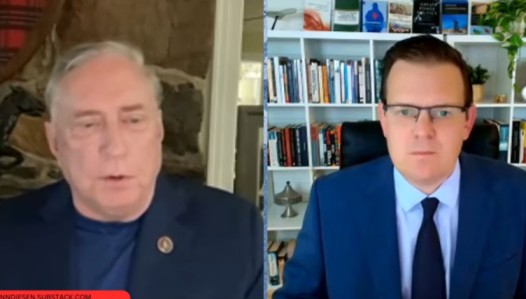
EDITOR’S NOTE: In this wide-ranging conversation, Colonel Douglas Macgregor joins host Glenn Diesen to assess the deteriorating situation in Ukraine, the growing desperation among Western elites, and what Russia’s next strategic moves might be. Macgregor argues that Ukraine’s defeat is all but sealed, and that economic collapse across Europe and the United States will soon extinguish whatever political will remains to sustain the war effort. This interview episode was premiered September 16, 2026.
TRANSCRIPT:
Introduction and Opening Remarks
GLENN DIESEN (00:00:00 – 00:00:13): Welcome back, everyone. We are joined today by Colonel Douglas Macgregor, the former advisor to the US Secretary of Defense, as well as a decorated combat veteran and a prolific author. So thank you, Colonel, for coming back on the program.
DOUGLAS MACGREGOR (00:00:14 – 00:00:15): Sure, happy to be with you.
Reality Sets In: Ukraine’s Worsening Position
GLENN DIESEN (00:00:16 – 00:00:25): So it looks as if reality is starting to set in, that is in Ukraine. The former Defense Minister, Fedorov—
DOUGLAS MACGREGOR (00:00:25 – 00:00:33): I almost thought you were going to say Washington. I couldn’t believe that. There’s no reality going to intrude in Washington. Okay, so reality may be in Ukraine. All right.
GLENN DIESEN (00:00:34 – 00:01:45): Yeah, well, in Washington, the lies from Trump keeps getting crazier and crazier. But at least in Ukraine, they do appear to recognize it’s getting worse and worse.
Again, Fedorov, the former defense minister, as well as the current head of Zelensky’s office, Kyrylo Budanov — they both have expressed some pessimism about where this war is going. And at the same time, we see a bit of panic, I guess, in Europe.
Well, only today we had some developments. Poland’s Foreign Minister Sikorski made the point that Poland has military superiority over Russia, while Denmark has argued that the Russian Navy frigate fired some warning shots on a Danish patrol helicopter in the Baltic Sea. I guess the Russians are getting fed up with having their ships either seized or harassed, so they are responding.
But how do you see this? Is this a critical phase where NATO and Russia might start to clash to rescue the situation?
Macgregor on Sikorski, Poland, and Western Delusion
DOUGLAS MACGREGOR (00:01:46 – 00:08:42): Well, I must admit that the combination of the Danish Navy with the Polish Army should be more than enough to conquer Russia. So, whatever.
I’m surprised that the visit of Boris Johnson the Clown with David Petraeus did not infuse the Ukrainians with great confidence and certainty of their inevitable victory, but I guess it didn’t turn out that way. I did find it entertaining that they were both in a hurry to get out of the country to avoid being shot at. So that was kind of interesting.
Look, I really don’t understand Sikorski at all, except that I attribute much of what he says to the influence of his wife. She’s — what’s her name — Anne Applebaum, who is the president of the Rosa Luxemburg chapter of old-line anti-Russians that live in Poland. I think the man is not really in touch with reality, and that’s not unusual.
The chief of staff of the Polish army, at least last year, whoever the chief was, made it abundantly clear that the Russian military is highly capable. The soldiers are excellent. They’re well trained. All this nonsense about how stupid and incompetent the Russians are should be treated with complete contempt. And the Polish army is in no position to go to war with Russia. So unless Sikorski can point to some transformative miracle that occurred over the last 12 months, I think that Polish Chief of Staff is telling the truth.
The Globalist Endgame: Dragging NATO Into the War
This sounds to me — and you would be in a better position to know this than I am — there’s a last ditch attempt to try and drag us in. How do you drag the United States in? Well, in theory, you drag in NATO. And that’s basically Zelensky and his globalist elite friends in the West. That’s their only hope. The world is crumbling. It’s falling apart for them. I think Zelensky knows that and he’s becoming more and more desperate.
And much of the assistance, cash and materiel, has not shown up. I don’t think it will show up. There was a recent congressional hearing where — I think it was Senator Shaheen — questioned Hegseth on what had happened to vast quantities of dollars of material that were supposed to have been made available to the Ukrainians. All of this was legislated in January and nothing has yet arrived.
I think we’re very far behind in terms of our production capability for military equipment, number one, whether it’s missiles or anything else. And then secondly, I think there’s a growing awareness that the level of corruption and theft inside Ukraine is something that everyone would rather not talk about. And certainly sending cash is considered to be very stupid because 50% of it disappears immediately into other people’s bank accounts over there.
Russia’s Strategic Options: Slow Grind or Bold Move?
So yeah, I think this is all true. Now the real question at this stage is Russia. The war is being won, or in some respects, I think it’s been won a long time ago. The question is, what are the Russians going to do to secure the victory and consolidate it? And that’s what everybody wants to know. It’s unclear.
Now we have elections coming up, I think, over the next few days that I’m told — and you would, again, know better than I do — I’m told will consolidate power under the United Russia Party that already controls more than a third of the seats in the Duma, and that that will set the stage for presumably President Putin to take bolder action if he deems it necessary.
And there are two schools of thought.
Now everybody’s money is on the slow, methodical, deliberate, painfully obvious approach that has been taken thus far. But I think there is a chance that President Putin will move sooner. We’ll see. Either way, Ukraine is doomed. It’s had it. I don’t even know what will remain on the map when all is said and done.
Economic Collapse: Europe and America’s Coming Depression
And I think Europe is descending into a very serious recession and beyond that — we’ll go, I think next year — into a depression, much as we will. Once the economic hardship inside places like Germany, France, Great Britain, the United States becomes acute, people will lose complete interest, if not total interest, in what happens in Ukraine or anywhere else. Everyone will focus inwardly. People will want answers.
Today, I guess the cost of a gallon of diesel has risen to $6.49. I think we’re going to see those prices continue to rise. The problem is not so much today a shortage of oil as it is both a shortage of crude that’s not showing up and the absence of products of crude oil that we can’t get our hands on. People are rushing to stores to buy all the oil they can for their automobiles and their trucks and so forth. Anything that contains petroleum — right now people are saying we better go out and get it. Plastics, you name it.
So I think the handwriting is on the wall. And the experience that we’ve had in the United States is once the economic condition at home becomes serious, whatever happens beyond our borders is irrelevant. So my assumption is that over the next 12 months, maybe sooner, things really will collapse in Ukraine. It’ll be a messy situation, but things will collapse in Western Europe. And as they do, there will be very little interest in the plight of Ukraine.
The question is, what do the Russians do? Do they cross the Dnieper? Do they stay east of the Dnieper? Do they table something? Do they try to come up with an alternative spokesman to talk to them from Kyiv? I don’t know. But clearly, the status quo that we have right now is unstable. It’s not going to last.
Russia’s Military Strategy: Isolation, Deep Strikes, and What Comes Next
GLENN DIESEN (00:08:44 – 00:09:58): Well, I think it seems very correct that, as you said, Ukraine is on the ropes. But if these dominoes are beginning to fall — that is the economic problems, the political problems, the problems on the front lines, the social upheaval as well — one would think that the Russian strategy is to help this along, or to step it up and not go for the kill.
But you see the effects on the naval blockade and these deep strikes. It seems like this is what they’re going for, to speed it forward. I was wondering how you assess their strategy, though, in terms of striking the trains and the railway stations altogether. As you said, they hit the Ukrainian border crossing with Poland right after the Western delegation left. And again, is this a warning to the West or are the efforts now to isolate Kyiv before some offensive? It just seems like something’s changing fundamentally on the Russian side. Based on your military background, what is it that you think they’re going for here?
Russia’s Endgame: Territory, Control, and the Dnieper Line
DOUGLAS MACGREGOR (00:09:58 – 00:16:36): Well, the answer to your question is all of the above. Everything that you described, I think, is part of the larger picture. The real question again is, so what about the military dimension? Are you going to sweep forward and essentially assert control over everything east of the Dnieper River?
I mean, the question you have to ask the Kremlin, and in this case that means President Putin and his inner circle, what do you want everything to look like when the war ends? Now, if I were a Russian, I would not want to give up control of anything east of the Dnieper River. That doesn’t mean you have to occupy all of it. It doesn’t mean it all has to be annexed and part of Russia. But why would you allow any future Ukrainian government to potentially place any capability at all east of the Dnieper River on the ground? I don’t think I would want that.
So how, what do you do? Do you draw Novorossiya, which I suspect is probably the long-term goal? And you control Novorossiya from Kharkiv all the way down to Odessa. And then what do you do about the rest of that territory? Well, you make it abundantly clear that other than the local police in any of the Ukrainian-held areas, there will be nothing else. In other words, no military power or military presence of any kind.
Then the question is, what about the rest of Ukraine? And I think if things fall apart, I’m sure that the Hungarians will be interested in bringing the Hungarians who are now part of Ukraine as a result of bad decisions over the last 100-plus years back into Hungary. There may be some interest in Poland in looking at some alternatives, some border adjustments. Certainly there will be with Romania. I’m certain of that.
The point is that if you look at European history, when these kinds of conflicts end, and they end in a way that’s messy, there is inevitably some sort of real estate action that goes on. I think we would see something like that. So you could have a Ukraine that is in the middle of Ukraine that is neutral and independent, but then what about the far west of Ukraine? Who is going to manage it? Who’s going to control it? Because the far west of Ukraine is populated with the people who are the most incurably anti-Russian, the most difficult to deal with. Who’s going to take responsibility for them?
Now, I don’t know that the Poles are interested in that, but I’m sure that it will come up with the Russians in Moscow because the Russians don’t want to go there. I mean, this is the thing that we don’t understand as Americans, and a lot of historians don’t get it. Occupation is very expensive and problematic when you’re dealing with a population that is hostile to you. For reasons of culture, religion, language, ethnicity, you name it. Russians don’t want to have to occupy and administer anything west of the Dnieper River. They don’t. I mean, they just don’t.
That’s why this whole lie that’s perpetrated on restarting or rekindling the Soviet Union is just that, a gargantuan fiction. It’s a lot of trouble. It’s very expensive. There is no strategic benefit whatsoever to the Russians to do such a thing.
So the question is then what, what are Russia’s minimal requirements? We’re back to what does the end state look like from Moscow’s standpoint? And I think Moscow would like to minimize the requirement to extend itself, its military reach, its political reach. It wants a settlement. But you can’t get it with the people in power now. It brings us back to Europe. You’ve got to get everyone in London out. You’ve got to get everybody in Paris out, everybody in Berlin out. These people are not going to help you. They’re not going to support you. They’re not going to do anything that promotes peace.
So if that’s the case, you can go to the Dnieper River, I suppose, and then pause. And wait to see what happens. And the Russians could certainly do that. Now, the other thing that several Russians have told me through various sources, that after the election is over, they anticipate some form of mobilization that would lead to a larger and more capable Russian force. That may be true. I don’t know. Some of these people are actual reservists themselves, and they expect to be called up after the election once Putin’s power is reassured and consolidated.
So maybe you get some combination of everything we’ve discussed, more forward movement, more acquisition of permanent control over certain areas, but it’ll still be modest. It’ll still be slower than everyone in Russia would like, I’m sure. And in the meantime, there’ll be this tendency to watch carefully for what else they can do economically to undermine the West and weaken us. Of course, we’re doing a really good job of that on our own without much help, but I’m sure that’s on their minds, and why wouldn’t it be?
Look, we’ve done everything we possibly can to destroy Russia. How many Bill Browders do we have inside our government right now running things? They would love to destroy Russia, get in and rape it. I think that’s obvious. So I would expect them to do whatever they can to undermine and weaken the hand that we hold. And that shouldn’t be too difficult because of what’s happening in the Middle East.
And we just saw BRICS. BRICS represents half the world’s population, probably a third of its gross domestic product, and maybe more. And what is it all about? It’s all about getting out from under us, under our oppressive financial system, our ability to sanction and harm people. To take advantage of them financially in material terms. That’s what it’s about. It’s not yet a military alliance, but it wouldn’t be very difficult over the next few years to make it a more closely aligned military organization if they chose to do it. They’ve got a long way to go to come up with the institutions to really replace us. But let’s face it, that’s the path they’re on. And if I were in their shoes, knowing what we’ve done to the world, certainly since 1991, you can go back further, but certainly since ’91, that’s what I would do.
Zelensky’s Legitimacy and the Role of MI6
GLENN DIESEN (00:16:38 – 00:18:27): Yeah, I noticed the language in Moscow changed significantly though. Lavrov made this comment that when Russia recognized independence of Ukraine after the Soviet Union dissolved, this was based on the principle that it would be a neutral state that treated its Russian population fairly. And he’s made the point this is no longer the case, which can only be interpreted in so many ways.
But again, it is essentially contesting the entire legitimacy of the Ukrainian state. And the way they see it, they invited NATO in, making their country a frontline against Russia. Millions of Russian speakers, ethnic Russians there, they essentially, well, from Lavrov’s perspective then, lost the legitimacy to rule over them as well as the historical territory. So Odessa, as you mentioned before, which is a Russian city. I’m just making the point that the language has shifted dramatically on the Russian side, from doing this special military operation to contesting the legitimacy now of the Ukrainian state.
But I did want to ask how you see the possibility of regime change now in Ukraine, because there is a lot of social upheaval. The state and society appears to be drifting apart, especially fuelled by this territorial — the military recruiters. And they’re even talking about recruiting women now. And advertisements are already up for the voluntary recruitment. But, as Keith Kellogg said when he went to Kyiv, “your women can fight just as well as men.” So, put them in uniform. If they do this, it looks as if something can crack though, because what is the legitimacy of the state?
Washington’s Dysfunction and Europe’s Tolerance of Failed Leadership
DOUGLAS MACGREGOR (00:18:28 – 00:22:41): Well, I don’t think the state has much legitimacy inside Ukraine, but in the West, if you say that, you’re immediately condemned as a Putin agent and spreading lies and so forth. I think MI6, with help from us and CIA, is really instrumental in holding this government together. You take MI6 in London out of the equation and that government falls pretty quickly.
Now, the question is, in London, are they putting together some alternative to Zelensky? I don’t know. And they may not be comfortable removing him just yet until they think they’ve got someone who will perform as a reliable puppet. That may be difficult because the Ukrainian leadership right now probably anticipates ending up in the same condition that Mussolini did at the end of the Second World War. Or like Ceaușescu. I’m sure these things are on their minds.
Zelensky is by no means the man of the people that everyone rushes out to hug and kiss and “thanks so much for all you’ve done.” I mean, it’s a very ugly picture right now inside Ukraine.
So I guess the real question is, what will MI6 do or not do? We don’t seem to really be in charge. I mean, Donald Trump has been unable to do anything. I know the Russians took him seriously at Anchorage. That was very foolish of them. They were naive. You had Witkoff and Kushner and Trump and others and Rubio all shake hands and smile and so forth. And I think the Russians, for reasons that I don’t understand, but I think they were naive and believed half of what they heard. And they were lied to. I think they’ve begun to figure this out.
And that’s why I think the last visit was very short, very polite, but short. What did it last, 3 hours on the ground or something? And then this man Ratcliffe, who went over there ostensibly to bully the Russians, was invited to go home. And we thanked him for his interest in Russian national security, as they say, and said, “Goodbye.”
I think the Russians have turned the corner where they finally realized anything coming out of Washington is just unserious crap. They have to go on their own. They have to deal with the Europeans on their own. How do you do that? Well, you build up a force that is so large and so capable that you would have to be on your way to a mental hospital to even think about going to war. I think that’s what the Russians are doing. I think that’s what they’ve done.
Then you hope that the people in Europe themselves will get rid of these people. Finally, these globalists have done so much damage to them, their standard of living, their way of life. And I think they’re right to wait. And I’ve always felt strongly that they were right to wait. I’m just surprised as they are that the British, the French, the Germans, the Dutch and others, have tolerated this leadership in their countries for so long.
You know, it’s like Angela Merkel, who says she’s crying, she’s so upset about what’s happened with AfD. I’m surprised the Germans haven’t hanged the woman. I mean, she’s done more to destroy Germany than Adolf Hitler, in my judgment. You bring in millions of people that nobody wants, nobody asked for from the Middle East and North Africa and elsewhere. And this is a good thing? No, it’s a very bad thing. Then you essentially deindustrialize the place, you shut down every potential source of energy, and everything falls apart economically, and you continue to print money and put yourself in the same sort of disastrous position that we are in. I don’t understand how these people have lasted as long as they have. And I think the Russians are puzzled by that as well.
Narrative Control, Zelensky’s Strikes, and the Role of the CIA
GLENN DIESEN (00:22:44 – 00:23:55): I think most of it’s narrative control. As you said before on the Ukraine issue, these people who, if you want to be pro-Ukrainian in Europe, you have to advocate essentially for fighting to the last Ukrainian man in a war that can’t be won and soon fight to the last Ukrainian woman probably, as they run out of Ukrainian men. And in contrast, if you argue in favour of restoring neutrality and end this carnage, then, well, that’s, you know, then you’re repeating Kremlin talking points. So this is kind of where the debates in Europe are at the moment.
But on the topic you mentioned, well, direct quote on “unserious crap” from Washington about the diplomacy with the Russians. We saw Trump though criticise Zelensky for striking Russian oil facilities, especially the diesel, because he’s blaming — well, more than once now blamed Zelensky for the high prices in the United States. God forbid he took credit for this. But could these strikes be done without U.S. support? Because it seems very strange. I thought the Ratcliffe, the CIA, had a very key role in these attacks on Russia.
Washington’s Two Universes: Self-Delusion and Domestic Denial
DOUGLAS MACGREGOR (00:23:57 – 00:31:15): Well, I think he has a role. As I said before, I think MI6 has the lead. But we provide enormously valuable intelligence, whether it’s space-based or from the reconnaissance flights that we conduct routinely from the Finnish border all the way down to the Black Sea. You can go on and look at the flight paths of the various military aircraft that belong to the Army and the Air Force and how they fly up and down these areas, and they report all of the information they gather in great detail. They shared with MI6, they shared with the Mossad, and they ultimately shared with the Ukrainians.
Again, Trump doesn’t really seem to be in control of anything. I think he just stands up there and bloviates, and I wouldn’t take seriously any of his comments about the striking refineries or diesel production or anything else in Russia. Look, I don’t think Trump really knew what was going on when they destroyed one of Putin’s personal homes up in northern Russia. I don’t think he knew what was going on. I don’t think he knows now.
I think he’s sort of presiding. He’s on the— imagine you’ve got a giant battleship called the United States and the battleship has a rudder that’s stuck. And so the battleship just goes around and around and around in circles. And the captain of the ship is Trump. And he walks onto the bridge and says, “Well, men, how’s it going?” And they tell him, “Well, sir, this and this.” He says, “Well, that’s great. That’s super.” “Well, sir, we almost had an accident the other day because the rudder’s broken and we keep going in circles.” “Well, that’s all right. You tell them to get out of the way. This is our ocean.” I mean, that’s what you’re dealing with.
So I think Washington lives in 2 sort of universes. One is the sort of self-delusional one where we’re the great superpower, no one can really challenge us. And if you don’t think that’s true, you just have to sit down with people on the Hill in the United States. “Oh, well, we haven’t lost the war with Iran. We can destroy them. We can win anytime we want.” Really? “We have the most powerful Navy in the world. With the Navy and the Marines and the Army, we can go in there anytime with the Air Force.” Well, then why haven’t we done that? “Well, you have to understand, these are delicate matters.” That’s what people in Washington think. It’s almost everybody’s on drugs of some kind and they don’t, they’re out of touch with reality.
Then the other universe is the domestic one. Things here really aren’t that bad. Just listen to Trump. “Oh, things here aren’t bad. Yeah, we’ve had some rises in prices, but after the election’s over, the midterms, the war will end and everything will go back to normal.” No, it won’t. It’s going to get a hell of a lot worse from here.
You cannot reverse the damage that we’ve done in the Strait of Hormuz for years, based upon what I’m hearing from everyone who’s an engineer or involved in any way in the Middle East with oil. Then you look at the people like Jeff Currie and others who know the oil business backwards and forwards, and they’ll tell you, “This is going to take many, many years to come out of this.” So you just have to sort of take whatever you hear in Washington and ignore it.
The 10-Year Bond, National Debt, and America’s Declining Collateral
Now, at some point, Americans will grow tired of this, and I’m not sure when that will happen, but I suspect the rising prices, the rise in inflation— you know, I’ve talked about the 10-year bond. When it breaks the 5% ceiling, we’re in a lot of trouble because we just can’t service the national sovereign debt. Well, then we’ll turn to our creditors and say, “Well, we want to restructure the debt.” What are the creditors going to say? “Well, what have you done to deal with this issue? Have you cut any spending? No. Are you going to cut any spending? No. What’s your collateral? What do you have to offer?”
See, when we defaulted twice, we called it restructuring the debt in the 1930s under FDR, in 1934 and again in ’36. We couldn’t pay what we owed our creditors. But the creditors knew certain things. First of all, we were sitting on top of a mountain of gold, literally. And we were demanding that the French and the British allies who’d fought with us— we fought with them in World War I, and who had borrowed heavily from us to sustain themselves in the war against Germany, they had to pay us back in gold, not paper, gold. So we had all of this gold pouring into the United States.
Then they looked at the manufacturing base. It was huge. We had the largest manufacturing base in the world. Biggest shipyards, you name it. Look at the natural resources, our access to oil, and what about our agricultural sector, our ability to grow food and so forth. And then they looked at the workforce. We had this huge workforce of trained, skilled labor. And so they said, “Well, the Americans are going to come back from this. So of course we’ll restructure the debt.”
Now you come to the United States and what do you see? What have we got? We no longer have the largest manufacturing base. Our manufacturing base is pitifully small. We’ve screwed it up badly, to put it bluntly. Our agricultural sector is a shadow of what it should be. We’ve been harming our own farmers, our own cattlemen, the people that grow the beef, bringing in Argentinian beef at the expense of our own cattlemen. Doesn’t make any sense at all. I could go down the list. All of this has been disastrous for us.
But if you’re a creditor and you look at the mess we’re in and you say, “What confidence do we have that a competent government will come to power in the United States and deal forthrightly with the crises inside the country?” The answer is there’s none. So if you’re Putin, if you’re sitting in Tehran, you want to exercise a certain amount of patience because we’re going to fall apart. We’re in trouble socially, politically, economically. And militarily, we’ve got the wrong force for the wrong war at the wrong time of history.
America as the Soviet Union Under Brezhnev: System Maintainers in Power
If I were going to compare us to anything, I would compare us to the Soviet Union under Brezhnev and Chernenko. You’ve got Brezhnev in the White House. You’ve got Chernenko, multiple versions of him sitting on the Hill. They look out of the window and they say, “We’re the greatest country in the world.” What did Brezhnev say? He looked out on Red Square and said, “We’re powerful, we’re great, we’ve been successful.” And everybody else that was living in the Soviet Union said, “This place is a disaster.” So eventually you get Gorbachev, but he comes in too late. Sound familiar? He couldn’t arrest the decline and the descent into hell. We may face something very similar as a result.
But my point is, we have a group of people— in fact, I’ve been working on something, you’re probably familiar with the man’s work, you’re familiar with Professor Alfred G. Meyer.
GLENN DIESEN (00:31:16 – 00:31:16): No.
Alfred G. Meyer’s Typology of Soviet Leadership
DOUGLAS MACGREGOR (00:31:17 – 00:38:21): Well, he was a professor of Soviet studies that deserves a lot more credit than he gets. Meyer was another one who escaped the Holocaust in the 1930s and came to the West. But unlike most of his peers that were in a similar position, he enlisted in the US Army and actually fought. He understood Europe very, very well. He understood the Germans, understood the Russians, spoke multiple languages.
He came up later on in his life with a typology of Soviet leadership. He talked about 3 classes of leaders, generations, if you will, of leaders. The first generation, he called it the revolutionary generation. You know, you had these highly educated, certifiable maniacs, but nevertheless highly educated, very effective, knew what they wanted, ruthless— use all the adjectives you like, but they were smart.
Eventually, they give way to a new generation of what he called nation builders or system builders. These are the people that they didn’t really understand the complexities of the ideology. They didn’t understand all the motivating forces in the minds of people like Lenin and Trotsky and Zinoviev and so forth. But they did understand that they had to build this thing and make it work, even if it didn’t. And so they are Stalin’s men. And these people build the Soviet Union. They build the system, the powerful totalitarian state, into what it becomes when it fights the Second World War.
By the time they get to the ’50s, people are exhausted. They’re worn out. And that included the people in the Communist Party of the Soviet Union. So then you get a new generation, and he called them the system maintainers. So now the system maintainers aren’t very bright. They’re not necessarily well educated. But they’re tired of all the death and destruction wrought by the system builders. They just want to maintain what they’ve got. And that’s Brezhnev.
As Brezhnev told Dubček when he met with him, he said, “You must understand something. What we have, we hold. We give up nothing. The gains of socialism are irreversible.” Those were the system maintainers.
The West’s System Maintainers and the Boogeyman Strategy
What we have in the West today, in the United States, in Great Britain, France, Germany, are system maintainers. That’s the problem. They’re just holding on to power. They’re holding on to the bureaucratic apparatus, clinging to it tenaciously in the hopes that they can stay forever. How do you stay forever? Well, you create a boogeyman called Russia. Divert everybody’s attention. It’s the old story of, “Don’t see this hand, watch this hand, don’t watch the other one.” So what they do internally to their own populations is destructive, but don’t worry about that. We have to focus on Russia.
We have the same thing in the United States right now. For the moment, the boogeyman is really Iran. We talk about Russia, but we’ve kind of drifted away from that, to be blunt. And so we really focus on the new boogeyman, which is Iran. How much longer that can last is anybody’s guess.
But we too have system maintainers. And the man who wanted to be a revolutionary, who said he was a revolutionary, has turned out to be a Brezhnevian system maintainer. His name is Trump. People say, “Oh, well, he’s destroying everything.” Well, it’s not much difference between what Trump is doing now and what began after 1991.
You’ve got to go back. It’s a continuum. Why did we march into the Balkans in 1995? Why did we go back in again in 1998, ’99 with Kosovo? Why did we try to drag all of the Europeans and NATO into these things with us? Remember, “You’re either out of area or NATO’s out of business.” So we were maintaining our grip, maintaining the old structures, the old alliances, come hell or high water, for our own interests and benefits.
So that’s where we are. We’re still doing the same thing that happened after 2001. We’ve been driven out of Iraq several times. We left in 2011, and we’ve gone back in again at the first opportunity. We’ve tried to expand our control and influence there. It’s all failed.
The Middle East Endgame: Iran’s Strategy and America’s Shrinking Footprint
So now what are we doing? This is the final hour. And if you look at the Iranians, they’re being very smart because what they want when the war ends is a Middle East without us. Now, how do you get that? Well, you bring in all the representatives of the states on the Arabian Peninsula, Saudis and the other statelets, and say, “Look, if you want to survive, throw the Americans out. That’s how you end this war. Get rid of the Americans, number one. Number two, sign up for the Omani-Iranian control of the Strait of Hormuz. You do those things, we’ll find a way out of this. It’ll all end and you’ll survive.”
In the meantime, what does that do to us militarily? It herds us into little Israel. Suddenly the only place we can maintain military power is little Israel, and that is ideal, ideal for the Iranians or any future adversary, because you present a wonderful target array. You concentrate all your forces in one area, and you can fight and lose a war very quickly. So that’s where we’re headed in the Middle East.
Now, I’m sure that that is understood by several people, so we’re trying to find ways around it, but we’ve lost the initial battle to stay in the region beyond Israel. That’s a problem. Our military has been identified, revealed as not the powerful, invincible force that everyone thought it was. That’s not a comment on the people doing the fighting. That’s a comment on the structure and the tools available. It’s also a comment on the stupidity of ordering people to do things they couldn’t do.
You can’t do everything. Remember Hitler’s famous stupid remark? When German generals in 1942, they were trying to make a decision what to do next. And he said, “Don’t worry about that. Der deutsche Lanzer kann alles.” No, the German soldier cannot do everything. Nobody can do everything. We can’t do everything. It’s just stupidity. But that’s what’s brought us to where we are. And we’re going to lose everything that we thought we had as a result.
Now, in my judgment, that’s all for the best because we need to come home. We have problems at home. We should not be meddling in other people’s societies. But I hold the minority opinion. And in Washington, everybody sees meddling in other people’s societies as the right answer. So that’s where we are.
The Decline of Western Institutions and the Rise of New World Order
GLENN DIESEN (00:38:23 – 00:39:17): What you described though, it’s a common theme in for scholars researching civilizations, they always make the point that when civilizations rise and become more powerful, institutions are created to improve the governance, the economy, and improve order overall. But then they become very institutionalized, and as they stagnate, the focus shifts on preserving these institutions. So that is, systems no longer fit for purpose, keeping them alive as opposed to adjusting to new realities.
This is kind of the — they didn’t renew focus. I guess that’s the maintainers you refer to, but that’s also referred to as decadence though, when you hold on to a rotten system based on a status quo, which is already gone. And instead of adjusting to these new realities and reforming, I can’t just help this. This feels very much like what we’re going through now. But yeah, sorry.
DOUGLAS MACGREGOR (00:39:17 – 00:41:28): Well, I would add one thing, one point for consideration of your audience, and particularly for the Europeans that are listening. I think we are increasingly Austria-Hungary.
Now Austria took its first serious chest wound, if you want to call it something, from Napoleon Bonaparte when he effectively declared the Holy Roman Empire of the German nation as defunct, gone, done. So then instead of being the Holy Roman Empire, it just became Austria. Then after 1848, you dealt with the forces of the French Revolution that had been successfully suppressed in the past. You managed to suppress them enough to hold on to power, but by 1866, it becomes clear you can’t, and so you make a deal, as Donald Trump would like to say. So you end up with Austria-Hungary, and then you get to 1914, and you go to war for all the wrong reasons in the wrong place. Because you think this is somehow or another going to rescue you from disaster. And the opposite occurs.
And we’re very much like Austria-Hungary. Remember, by the time World War I breaks out, only 20% of the soldiers in the Austro-Hungarian forces were German. In other words, Austrian Germans. That’s astonishing. You stop and think about it. I don’t know what the percentage was of officers and enlisted. There, I imagine you had a disproportionate number of German-speaking Austrians in charge with large numbers of people who were not German or Austrian in the enlisted ranks. And surprisingly, that army fought better than everyone else, anybody that had seen it before the war thought it would.
But my point is, in each case, Austria is reactionary. From the Napoleonic Wars forward, it’s reacting, reacting, reacting, reacting. What are we doing? We’re reacting and we’re reactionary because we’re trying to stop change. You cannot stop change. That’s the problem. And that was Brezhnev’s problem. That’s our problem.
BRICS, SCO, and the Fracturing of Western-Led Global Order
GLENN DIESEN (00:41:30 – 00:42:43): Well, it does look like much of the world though is looking to embrace this change. I mean, you mentioned the US and the political West overall going through a lot of problems. You can point to the $40 trillion debt, oil prices going up. Likely, we were going to see Western governments turn on the printing press again. Both US allies and adversaries stopped buying the bonds. So the domestic problems are there, but you get the impression that the ability to govern the world also diminishes in terms of organizing the security, the economy, politics. I often make the point, even civil society through all these NGOs.
But you mentioned before SCO and BRICS. I guess it’s a very brief question. What is the significance of this? Because the way I interpret it is that they see what is coming, that the former world has already come to an end and they’re looking for new frameworks to — how will we govern? How will we ensure security, economic growth, political cooperation, civil society in this post-Western world? But yeah, I guess, yeah. How do you see this changing the world or influencing the decisions of these BRICS countries?
DOUGLAS MACGREGOR (00:42:43 – 00:47:46): Well, if you go to a conference in Washington, D.C. at any of the main major think tanks, of course, think tank is an oxymoron. There’s a lot of tanking, but not much thinking. And then, or you go on the Hill to the Senate or the House or something, and they’re going to say, well, it’s obvious that the security architecture of the Middle East and Europe, this is collapsing. Okay. And what we have to do now is build a new security architecture. And you say, well, what’s that look like? Well, it looks a lot like the old one. That’s the problem.
In other words, there’s no willingness to say, wait a minute, none of that matters anymore. BRICS, instead of looking at BRICS as some sort of dangerous animal, which it isn’t at this point, it could be in the future, unfortunately, because of us, but it isn’t really. We need to understand that people are tired of being bullied by us financially. I mean, why do you want to end up like the Russians with billions of rubles in banks that you can’t reach? Why would you put your money into a country that says, “Sorry, I’ve decided that your account is no longer accessible to you?” I mean, that seems like a minor thing, but it’s not. It’s a very big thing.
And you got to remember that all the institutions that began during the Cold War that people liked because they did good things, the World Bank, the International Monetary Fund, everybody knew that we were rushing in to fill the vacuum left by the destruction of German and Japanese power and ultimately the destruction of the British Empire. And we were kind of moving in a direction of global hegemony, but it was seen as — I wouldn’t necessarily say benign, but certainly benevolent because we lived in the Cold War and people did not want Soviet communism on their doorstep.
All of that went away in 1991, but the old institutions didn’t, and we weaponized those. And then we called it the “rules-based liberal international order.” It’s sort of like the Holy Roman Empire that was neither Roman nor holy. Well, you have a similar situation with the liberal international order and the rules-based part. Whose rules? Ours. We set the rules. You do as you’re told. Liberal? What’s liberal mean? Well, it’s whatever you want to mean, as long as you do what we tell you to do. We’ll discern, we’ll determine whether or not you’re sufficiently liberal. And international? Well, it’s international because you’re all vassals of the greater United States global financial system and military power. And order, well, it’s our order. What we say is order, not what you say is order.
So it’s just like the Holy Roman Empire went away. The “rules-based liberal international order” is going away. And I think what we’re going to see in the future — and this makes sense in Hedley Bull, I’m sure you’re familiar with him and his work when he was at Oxford — he predicted that the world would eventually end up with regional powers, regional power concentrations, regional alliances, and you would have at the center of each region at least one or two dominant powers. And that’s where the world was headed, which is probably a natural development.
And we don’t really fit in that picture unless you come to the Western Hemisphere. And in the Western Hemisphere, we are the dominant power. We were from the beginning. We still are. And that’s not likely to change, nor does it need to. But we don’t need to be all over Eurasia. We don’t need to be in the Middle East. We don’t need to be in Africa. We don’t need to be — you name it. We need to really focus on ourselves here at home.
And people reject that because they have been propagandized to believe that the moment you leave an area, some new evil will take root, metastasize, build ICBMs, and threaten you. I once had a conversation with a 4-star who will — is now retired, but will remain nameless. Tried to tell me that if we left Anbar Province in Iraq, that it would become a platform for the projection of terrorism all over the world. And I looked at him like — what are you doing? He’s obviously been to Anbar Province. There’s nothing in Anbar Province. What are you talking about?
But this is the mentality. So don’t leave anywhere. Anywhere you leave becomes instantaneously, by definition, no longer governable. It becomes ungovernable space because it doesn’t meet your standard for liberal democracy or some other nonsense. So you have to go back in with military power. This is ending. BRICS is a reaction to everything I just mentioned. And if we don’t like BRICS, then the easy thing is stop doing what we’re doing.
Closing Thoughts: Europe’s Delusions and the Risk of a Wider War
GLENN DIESEN (00:47:49 – 00:48:26): Well, we’re no different in Europe, I think. Well, our rulers recognize that the US is losing interest in Europe and that NATO may collapse, most likely collapse. But what’s the solution? Shall we end the dividing lines in Europe and make Russia a partner instead of an enemy? No, we want to build a replica of NATO, but without the United States, the muscle. So this is kind of the plan. This is how they view the future. So there’s no interest in adjusting to reality. So I think this is the source of our decadence though. Anyways, Colonel, thank you very much. Unless you have some final thoughts you want to share.
DOUGLAS MACGREGOR (00:48:27 – 00:49:07): No, no. I listen. I sincerely hope that we can get through the next 6 to 12 months without embroiling ourselves in a larger war. That’s my greatest concern because of the thinking that I see persist in Washington, D.C. I wish I could offer some optimism, but I just don’t hear much common sense.
And that’s because most Americans just don’t know much about the world beyond their borders. And that’s okay if you live in Kansas City. It’s okay if you live out in Seattle, Washington. But that’s not okay if you’re expected to govern from Washington, D.C., and you’re going to be a world power, which we are. So I don’t know how we fix that.
Related Posts
- Jeffrey Sachs: BRICS Builds a New World – Without the West (Transcript)
- Lawrence Wilkerson: Saudi Arabia & Israel Could Disappear Soon (Transcript)
- Chas Freeman: U.S. Alliances Collapse & Israel Commits Suicide (Transcript)
- Seyed M. Marandi: Houthis Expanding Fast & Iran Set to Escalate Big (Transcript)
- Professor Jiang: A Financial 9/11 Is Coming – DOAC Podcast (Transcript)