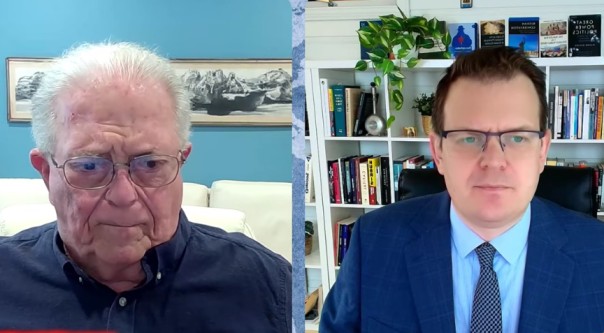
On the day of the 2026 US midterm elections, former US Ambassador to Saudi Arabia and former Assistant Secretary of Defense Chas Freeman joins Glenn Diesen to discuss America’s deepening political crisis and Donald Trump’s talk of a nuclear strike on Iran. Freeman covers the risks of the two-month interregnum before the new Congress, Israel’s post-election politics, the Abu Dhabi talks between Russia and Ukraine, the Democrats’ foreign policy, and the warning signs in the US economy. Read the full transcript of this episode which was premiered on November 3, 2026 below:
GLENN DIESEN: (00:00:01 – 00:00:14) Welcome back, everyone. We are joined today by Ambassador Chas Freeman, a former US ambassador to Saudi Arabia and also former US Assistant Secretary of Defense. Thank you for coming back on.
CHAS FREEMAN: (00:00:15 – 00:00:16) Very glad to be with you.
The Midterms as a Referendum on Trump
GLENN DIESEN: (00:00:18 – 00:01:16) I wanted to ask you today about the midterms and also the significance now as we seem to be facing a bit of crisis of American power. Again, there’s many things you can point to. That is the failed war against Iran and Russia. We see U.S. allies becoming weakened and alienated, often unnecessarily so.
Also there’s a political— well, I would argue political legitimacy crisis in which institutions and moral principles which, well, used to lay the foundation for stability have, well, seemed to be shaken. And all of these crises, of course, are interconnected.
And now we have the midterm. Many people would interpret this as a referendum on Trump as well. And again, we don’t know the results, but the Democrats will likely come out strengthened. So, I guess the big question is, what is the significance of these midterms?
CHAS FREEMAN: (00:01:18 – 00:09:03) Well, you’re right, they are a referendum on Donald Trump and his stewardship of the country. The country is in a state of dysphoria. That is the opposite of euphoria. And people are very upset about the direction of events. So the common expectation is, and the polling data supports the thesis, that there will be a Democratic blue wave.
And I’m not sure about that. I mean, at this point, we don’t know. The polls are open. My wife and I have voted. We voted by mail. We’re not sure the post office actually delivered our ballots given the Trump administration’s efforts to stop that.
But it is now, what is it, a little after 1 o’clock in the afternoon in Eastern Time, U.S. And we are off daylight savings. So we’re 5 hours off GMT. And the polls will not close at our time until 1 o’clock in the morning tomorrow in Alaska. I think Hawaii closes 10 or 11 o’clock. So, but Alaska is a crucial state in this election for many reasons.
I think there’s a consensus that the Democrats will have at least a 20-seat majority in the House of Representatives, but the Senate is less certain. The polls show victories for Democrats in many contested states, but we’ve just seen in the case of the Israeli elections that the polls were not accurate.
That was a referendum on the leadership of Prime Minister Benjamin Netanyahu. He won a majority of the Jewish voters. He clearly does not consider the 19 seats held by the Palestinian Arabs in the Knesset as legitimate or worthy of consideration.
A Two-Month Interregnum
But we face very likely in the United States an interregnum of November 3rd today, is 2 months away from January 3rd when the members, newly elected members of the House and Senate will take their seats. In those 2 months, all sorts of things could happen. The Republicans will still have a majority.
We don’t know to what extent, if there is the sort of political defeat that is projected, those Republicans will retain their loyalty to Donald Trump. They may well break with him. Some have already on many, on a variety of issues. But we’re all going to watch this with great interest.
Trump’s Nuclear Threats Against Iran
I think one factor that needs to be mentioned up front is that Donald Trump is talking very much as though he wants to use nuclear weapons against Iran. He has, we’ve heard from Tucker Carlson and others that there is a basis for fearing that he might do that.
When he says, “I can solve this problem, stop this war in an hour,” what he’s talking about is clearly a nuclear strike on the mountain where the major concealed Iranian nuclear facilities are supposedly in place.
He’s also quite delusionally, in the same vein, talked about said, “If I had been in charge, I could have ended the war in Vietnam in a week,” which is very offensive to people who were involved with the Vietnam War. I don’t imagine they enjoyed hearing that in Hanoi. But a lot of Americans served in that war and understand very clearly how delusional such a statement is.
I don’t believe that a nuclear strike on Pickaxe Mountain, as it’s called in English, would bring Iran to its knees, but it would eliminate the nuclear taboo and produce a raft of new nuclear states through accelerated proliferation, and it would certainly end any restraint on Iranian development of a nuclear weapon.
Netanyahu’s Push for War and the Israeli Military’s Resistance
President Trump is apparently receiving phone calls on a daily basis from Prime Minister Netanyahu, arguing for the use of a nuclear weapon against Iran. Interestingly, Prime Minister Netanyahu’s own military, whose moral sense leaves something to be desired, but whose professionalism is undoubted, are resisting Netanyahu’s efforts to embroil them in a war with Iran again for 2 reasons.
One, they understand very well that Israel does not have the capacity to intercept Iranian missiles and that there would be a rain of fire on Israel that would be quite devastating. And second, they don’t want to be embroiled in Israeli politics, which are entering a prolonged phase of bargaining over the formation of a new government.
Prime Minister Netanyahu is a past master of bribery, blackmail, and other, and incentivizing other politicians to join him, and he will be trying very hard, having written off the Palestinian Arab 19 seats in the 120-member Knesset, he will be trying very hard to subvert the coalition that was led by Gadi Eisenkot and to recruit its members to his own cause.
He’s desperate to stay in office, and that has a lot to do with why he is advocating renewed war with Iran and renewed attacks on Iran because he would then be able to claim the title of wartime prime minister and make a serious case for a government of national unity, which he otherwise will be denied.
So there’s a lot going on and the midterm elections have, as you said, are connected to all of this.
The authority of Benjamin Netanyahu has clearly been degraded as his military and intelligence agencies’ resistance to him illustrates. Donald Trump’s authority will be eroded very likely in these elections we’re having today. And he’s already said that he plans to veto everything that is tossed his way for the next 2 years. So this is indeed a moment pregnant with uncertainty.
Limited Nuclear War and the Democrats
GLENN DIESEN: (00:09:06 – 00:10:33) Yeah, I know Trump is, well, he throws out a lot of words and threats, but what is concerning is that you also find people like Elbridge Colby, the Undersecretary of War Policy, who also seems to advocate for a limited nuclear war as an option at least. So the fact that this is a thing now advocating for the use of nuclear weapons, it is, yes, it’s quite troublesome. And I guess these are the kind of scenarios he had envisioned possibly to use nuclear weapons.
But I did want to ask about the Democrats though. I mean, ’cause on one hand, what does it mean, this likely victory they will take? Because they seem that they would like to restrain Trump in his war against Iran. Again, I’m not sure if they’re able to. They do control the money, I guess, but also they want to escalate, I think, the war against Russia. Again, I’m not sure what tools they have at their disposal.
But when you add, as you mentioned, this 2-month period between the election and when the new government takes office, it leaves, yeah, quite a few weeks for Trump to settle some scores. I was just wondering, how do you see this impacting the American wars?
CHAS FREEMAN: (00:10:34 – 00:18:45) Well, I think we will see some contested constituencies in the United States subjected to a claim by the Trump administration that the elections were stolen. And this means in our system that many issues will go to the courts. That will add further uncertainty to the government between now and January 3rd.
Donald Trump is, as you suggested, not alone in his disdain for the nuclear taboo. And the United States is spending an enormous amount of money on modernizing its nuclear weapons, including the development of yields on those warheads that are adjustable, enabling a tactical use of weapons that otherwise would be strategic rather than simply tactical. And I don’t think, therefore, that one can discount the danger here.
My own hope is that just as the Israeli military has resisted the Prime Minister Netanyahu in his advocacy of a war they regard as potentially disastrous for Israel. And of course, they don’t object to the violations of international law that are implied in striking civilian infrastructure, because they are not at all observant of international law or normal standards of morality.
But I’m hoping that the American military will demonstrate a comparable degree of principled objection to orders that are contrary to international law, set a terrible precedent, degrade the United States’ security rather than enhance it, and probably result in a widespread proliferation of nuclear weapons and a more complex security environment for everyone.
But I don’t know that that will be the case, if that. And I do know that political appointees like Elbridge Colby, as you mentioned, not to mention Pete Hegseth, are advocates of getting away with, doing away with the nuclear taboo. So I think this is a very dangerous moment.
How the Democrats Became the Party of War
As for the Democrats, there’s quite a good book out by James Carden, whom you may know from the context of the Russian issues, about how the Democrats became the party of war. And they are very ideological.
And Stephen Kinzer, who’s a friend of mine of some years, has just written a very good book about the Ukraine war and how we stumbled into it. And the level of the vituperation that he’s suffered from critics on the left primarily, it’s quite extraordinary.
I mean, it wouldn’t surprise you because you have been subjected to similar slanders in your own country, but it is an indication that the Democrats are not ready for prime time in terms of realistic conduct of foreign policy. They remain very ideological. And the unrealism of many of their positions is quite extraordinary.
Signs of a Breakthrough on Ukraine
There is, I should say, on the Ukraine issue, there are some interesting developments. We have Vladimir Putin saying obliquely, not directly, but reportedly, “Look, I never said I wouldn’t talk to Zelensky. He’s welcome to come to Moscow if he wants, and we can talk about an end to the war.”
And you also have what is called a technical meeting, which is an interesting way to describe it when it involves probably the national intelligence chiefs and national security officers of both Russia and Ukraine meeting in Abu Dhabi under the somewhat questionable mediation by Donald Trump’s 2 special envoys, his son-in-law and his crony in real estate practice in New York, Witkoff and Kushner. So this is to happen in a week, and it is a bit of a breakthrough.
Diplomacy for Private Benefit
And here I just want to say that there is apparently one of the issues that is floating out there with Witkoff and Kushner, which illustrates some of the problems with their conduct of American international relations, is the proposal to restore gas supplies to Europe through Ukraine using an American vehicle. Open to investors by the United States and its citizens to manage this transfer of gas.
Well, one can imagine who the investors might be, and I think Mr. Witkoff and his son and Mr. Kushner are probably first in line for this. So once again, we have an example of an effort to conduct diplomacy in large measure for the private benefit of those conducting it.
If you’re in Norway, which our president has just gratuitously insulted, I suppose you must be concerned about competition in the supply of gas, but maybe not. There is every possibility, and I believe that Kushner and Witkoff earlier discussed this, of repairing the Nord Stream 2 pipeline and reactivating it.
A Government That Doesn’t Coordinate
This is a nice example of cognitive dissonance and lack of coordination in the United States government. There are many such examples. Marco Rubio, who is simultaneously the National Archivist, the head of the residual U.S. Agency for International Development, the Secretary of State, and the National Security Advisor, is not coordinating policy.
So we have the interesting spectacle in Ukraine, with Ukraine, of the CIA and MI6 working together to assist the Ukrainians in destroying refineries that produce diesel fuel. While the United States is begging the Russian government to supply diesel. The one hand not apparently knowing what the other is doing.
And we have an intelligence apparatus in the United States where the practitioners of covert action are having an ideological orgasm. They’re just having a wonderful time. Whereas the analysts on whom we depend for understanding foreign cultures, politics, and possibilities are demoralized, depressed, and as I said, dysphoric.
So the level of coordination in policy has come to a very strange pass indeed. Everything seems to depend on Donald Trump, but it’s not clear that Donald Trump is in full command of his government.
Is the US Negotiating With Itself?
GLENN DIESEN: (00:18:48 – 00:19:44) Not being in, yeah, full control seems like an understatement. It reminds me a bit like what happened in Syria where we had different US intelligence agencies working for different sides, which were actually fighting. But this political crisis though, it’s, I mean, when you have the CIA managing the Ukraine war. And then to a large extent, and then Trump being the mediator, or at least trying to position himself in this way.
It’s very strange to see these 2 roles because, “Oh, we’re going to put pressure on Zelensky, he’s going to have to accept compromises.” But again, they can’t fight the war without the US intelligence services. So all the tools for pressure is there. I’m just wondering, is the US negotiating with itself at the moment? Because they have the means to pressure, but it doesn’t seem like, as you said, they speak with one voice here.
CHAS FREEMAN: (00:19:45 – 00:24:42) Well, we did see the dialing down of the, or the throttling down of the speed of Starshield communications. And because the Ukrainians were mounting these systems on top of drones and using them to intercept Russian jet-powered drones, and now they can’t do that. And it appears that was an uncoordinated decision. It’s not clear who’s in charge there.
We had Donald Trump say, “I didn’t do it.” We had Elon Musk say, “I didn’t do it.” Then Elon Musk finally did admit he had done it. And I’m not sure where that stands, but this is an example of a persistent lack of coordination.
You have to ask yourself, if indeed we are talking about either a negotiated settlement with Iran or annihilating it, as the president has declared, why the U.S. Navy bombed Qeshm Island yesterday. That seems guaranteed to increase Iranian intransigence rather than flexibility, and to drive home to the Iranians once again the essential correctness of their view that a ceasefire or some short-term arrangement is not acceptable. It does— they need to have permanent assurances of their security that the United States and Israel are not prepared to provide.
So there’s a great deal of confusion. And we have, it’s not just on these issues. I think the lesson, the signals are done to Mr. Zelensky, which he apparently has received, is that he does not have American support to continue in office, and that the one way to end the war would be for him to step aside and for someone more inclined to negotiate seriously to take his place.
Unused Leverage Over Ukraine and Israel
That is a kind of leverage. But the real leverage, as the Elon Musk Starshield incident demonstrated, which is on the intelligence side. And we’re apparently not using that. Similarly, we have complete ability to shut down Israeli transgressions against international law by shutting down the supply of weapons and supplies. And we’re not doing that.
Donald Trump, interestingly, just announced with Prime Minister Netanyahu that effective in January, we will not be providing Israel with the $4 billion in cash that we have committed to provide it through 2028. And somehow that will stop, even though it’s a matter of law.
And we assume, must assume, that it is to be replaced by this welding together of the Israeli military and the American military, so that the net effect is that the appearance of aid to Israel disappears, but the aid continues on a frankly fairly parasitic basis. But we don’t know there either what is really going on.
And we have no effective understanding at this point of either the plans for the post-midterm strikes on Iran, which Donald Trump says will be brief, again, raising the problem, the question of nuclear attack, I’m afraid. The Iranians are not going to accept a brief set of strikes.
And if the purpose of bandying a nuclear attack about is to intimidate the Iranians, I don’t think that will work. I think it will convince them that if they have not already built a nuclear weapon, they need to do so forthwith.
So this is all very confused. There’s no strategy. It does all seem to be related to domestic political posturing, performative stances other than substantive ones. We’ll see. I think it is positive that the meeting in Abu Dhabi will take place between Ukrainians and Russians, and I assume it will. I hope that is not another deception for an attack on Iran, but we’ll see.
Hopes for Abu Dhabi and a Trump–Xi–Putin Meeting
GLENN DIESEN: (00:24:43 – 00:25:55) It’s this deception which makes it so hard to assess, because sometimes one isn’t sure if the US is merely unable to control Ukraine and Israel as proxies, or if the US is just kind of hiding behind them, pretending that they’re working autonomously, and instead of washing its hands of the whole thing.
But we do see some indication of serious diplomatic efforts, be it next week, the US, Ukraine, and Russia are, as you said, expected to meet. And then, not sooner or after, but at the end of November, we’re going to see possibly Xi Jinping, Vladimir Putin, and Donald Trump meet in China.
So how much do you— I mean, how much hope do you have for these diplomatic efforts? Because even if they’re being genuine and honest, it seems like all the different parties in both these meetings have very different agendas and even, yeah, things they want to prioritize.
CHAS FREEMAN: (00:25:56 – 00:29:45) Well, there is to be a meeting, I gather, between Mr. Witkoff and European representatives to consult prior to the Abu Dhabi meeting, but I’m very uncertain what will come from that because I hear no positive noises from Europeans, and Europeans all seem to have different agendas.
The French have always sought to keep a channel of communication open to Moscow. The Germans have been adamantly against that, other than your friend Alice Weidel, who argues for it. But it is, and the Italians are somewhere in the middle. The British are fiercely Russophobic and committed to the war. The Baltic states, although they don’t have much heft, behave as though they do. And Hungary has somewhat modified its stance, but not completely.
So what are the Europeans going to tell Mr. Witkoff? Is there Europe to tell them anything, or are we watching the disintegration of the European project as nationalist perspectives take over? It was the Alternative für Deutschland in Germany and in the Rassemblement National in France, and now this the government of under Giorgia Meloni with who it’s which has its roots in Italian fascism. What is it, where is the cohesion?
And as far as the Ukrainians and Russians are concerned, I think it’s been very clear from the very beginning what the Russian position and demands were. It’s been very unclear how willing Ukraine is to accommodate any of those demands. So we’ll see what happens in Abu Dhabi.
Qatar, Saudi Arabia, and the Mecca Alliance
As far as Iran is concerned, there is a frantic effort underway by Qatar to produce a diplomatic process of some sort. I don’t hold out much hope for that. It’s not clear to me or anyone else how much protection Saudi Arabia earned and gained from Iran with its meeting in Tehran.
Alongside Asim Munir of Pakistan and the head of MIT, the Turkish intelligence service, the Mecca Alliance Group, talking in a positive way to the Iranian security establishment, presumably largely focused on soliciting Iran’s help in ending the conflict with Ansar Allah, but also gaining assurances against the destruction of more of Saudi Arabia’s infrastructure when and if the Israelis and Americans resume active attacks on Iran.
As finally, of course, they also apparently discussed the possible incorporation of Iran in some manner into the tripartite entente of the Mecca Alliance. So, it’s very uncertain what is happening. Uncertainty seems to be a constant condition of life these days, along with erratic performance and deception and dishonesty and false narratives and slanderous attacks on anyone who objects to any of this.
Israel After Its Election
GLENN DIESEN: (00:29:49 – 00:30:44) Well, on that, and actually related to it, you mentioned Israel before. As you said, they also had a— well, let’s call it a referendum on Netanyahu. Where do you see them headed here? Because this impacts the United States to a large extent.
That is, they not only had their own elections, but we all see that the interest of the US and Israel keeps, well, drifting further away from each other. This is being expressed, of course, not just from the public but increasingly the politicians.
And we also see top Israeli politicians speaking quite openly about requiring a strategy to essentially live without the United States. If the US either plays a minor role or larger decoupling, well, what will they do? So where are the Israelis going? And I guess, hey, I’m making the question a bit bigger. What’s the significance for the United States?
CHAS FREEMAN: (00:30:45 – 00:36:49) Well, I think the Israeli elections resulted in the following. First, a landslide in favor of a genocide. The Jewish voters in Israel all voted for the continuation of the destruction of the Palestinians in Gaza. Both the coalitions that contested these elections support the increasingly vicious pogroms in the West Bank. Both support the reduction of southern Lebanon to the condition of Gaza. And both support ongoing warfare.
We have the paper now from Tamir Hayman, the retired Israeli general who says openly that continuous warfare is essential to the perpetuation of the Israeli state, that this is a requirement ideologically for unity as well as a strategic imperative, that Israel’s neighbors are all illegitimate, false states, which Israel should feel free to dismantle.
And basically, this seems to represent 2/3 of the Israeli population, that is, the Jewish population. And so what the result of the election was, was a confirmation of Israeli policy, but not a confirmation of esteem for Benjamin Netanyahu. Enough respect for him so that he gained 53 seats compared to Eisenkot’s 48.
In a sense, he won the election. The referendum on him did not result in a decisive repudiation of him, although it certainly resulted in diminishing his authority, as the arguments with the intelligence and military currently happening also illustrate. But there is no change in Israeli policy. And Israel seems to be continuing in the hope that it can hold on to its international support, even as that international support, as you mentioned, in the United States and elsewhere, continues to erode.
The Democratic Socialists and a Reconfigured Democratic Party
In the United States, if indeed there is a Democratic wave in this election, we will see in power a party that is aware that the public is very negative about Israel and does not want continued arms sales to Israel or other support. Even the Republicans have begun to express less support for the Israelis.
We have the interesting phenomenon in the United States of the so-called socialist, Democratic Socialists of America, who are more European in their espousal of political ideas than has been the case in the United States. They don’t seem to be fearful of the word socialism. They are avowedly anti-Israeli, not anti-Semitic in my view, but critical of Israeli behavior and policies. And they will play an important role in the reconfiguration of the Democratic Party.
Periodically in the United States, we have seen the readjustment, reconfiguration, revival, and revitalization of political parties from within. The Democrats, who have their roots in Thomas Jefferson’s party, became the party of segregation and the dominant party in the Confederacy during our Civil War. In the 1930s, under Franklin Delano Roosevelt, it became a grand coalition of the left. And they may well be reverting to that set of policies.
The Party of Roosevelt vs. the Party of Acheson
But they also have a tradition, and this may explain some of the reason that one should not put too much weight on their saving the situation. After all, it was Harry Truman, the successor to Franklin Roosevelt, who used nuclear weapons against Japan, who founded the CIA only later in life to condemn it for having gone out of control. He saw it as an analytical arm and it became the principal arm for covert action in the U.S. government.
We have in the James Carden book that I mentioned, he posits, he sets up 2 alternatives in the Democratic Party, one being the party of Roosevelt, a sort of anti-fascist, social, quasi-socialist policy, and the other being the party of Acheson. The party of Acheson being, and Paul Nitze being, Russophobic, interventionist, hardline rather than diplomatic, despite Acheson’s gifts as a diplomat.
So I think we’re in a very uncertain period, and the beginnings of what happens in this period before January 3rd will tell us a lot about the question of where we’re headed, which we can’t really answer now. I don’t think the election will produce a decisive turn one way or the other, but it will certainly produce indicators.
The Economy on the Edge
GLENN DIESEN: (00:36:52 – 00:37:55) Yeah, well, there would be minor changes, I guess, unavoidably. But a lot of the big issues, it seems to be now beyond the ballot box. That is, the economic situation is getting quite dire, it seems. And yeah, it’s just going to get worse, especially with, if the Middle Eastern war now blows up.
It appears that the Israelis are now having some open discussions about the fear that Trump might think about ending the war early, which they don’t care for. In Europe, they have a great fear that Trump might end the war in Ukraine early. So for all the horrible things Trump is doing, there’s someone worse standing next to him pressuring him.
And all of this is of course going to push the global economy over an edge. I was wondering, yeah, how you see this, how long, or what are the main indicators in the economy that you might be looking at? Because,
CHAS FREEMAN: (00:37:56 – 00:45:07) Well, before we get to that, let me, you reminded me that you asked about the suggestion by Vladimir Putin that Trump and he meet together with Xi Jinping in Guangzhou during the APEC meeting, and this is a controversial meeting, but I have to laugh when I hear the Europeans express grave misgivings and fear about this, as though these 3 men are going to agree on everything and impose something on Europe. I suppose they might make progress toward ending the war in Ukraine, that is conceivable, but I don’t think that is going to be the main topic of discussion.
The Crossbow, the Pope, and the Plutocracy
Anyway, the economy. I’m reminded of, there are real people and people you can ignore. And I first became aware of this when I was studying medieval history. And I don’t remember, I think it was around 1112, but it might have been later that, it was during the period when there were 2 popes, one in Avignon and one in Rome. And the pope in Avignon became very alarmed because real people were getting killed for the first time.
Why? Because the hand— the cranked crossbow, which the Chinese had invented in the 4th century before the Common Era, but cleverly, through export controls, declined to export, had finally reached Europe. And unlike the regular bow and arrow, this could pierce heavy armor, and therefore it could kill the nobility in their heavy armor on their armored horses, which was clearly an inhumane situation that couldn’t be allowed to continue.
So the Pope called the world’s first disarmament conference, and 52 princes, prelates, and other figures turned up for it, and they spent 2 weeks, at the end of which they solemnly agreed to ban the research and development, manufacture, or export of the crossbow. And the rest is history. Gunpowder came along, and it was even better than the crossbow at killing real people.
That is, so now we have in the United States, we have the plutocracy, which has benefited greatly from an explosion and ascension of the stock market to unparalleled heights. The value of shares has grown enormously. Donald Trump’s economic policies have siphoned wealth out of the poor and redistributed it to the wealthy, which is not popular among any people, I should say, but it has benefited the plutocracy, and they’ve been doing just great.
The stock market has been going up. That’s what they care about. And profits, corporate profits are up, and everything is wonderful. But suddenly now, we’re having a stock market correction. The AI bubble appears to have burst to some extent. And the plutocracy are becoming worried. And so I don’t know whether Donald Trump will emulate the Pope and call some sort of conference to deal with this tragic situation where the wealthy are being threatened, but it’s possible.
Unsustainable Debt and Fading Confidence in the Dollar
We have an economy that’s moving in several directions. Clearly the level of debt is unsustainable. Lack of confidence in the fiscal integrity of the United States is growing. We see this reflected in accumulated reserves of gold in places like China, but elsewhere as well.
The removal of French and Dutch gold from the vaults in the Federal Reserve in New York and its repatriation is an indication of lack of confidence. The fact that the Chinese have sold down most of their dollar holdings and the Japanese appear to be reducing theirs is another indication of a problem.
And that problem has practical effects because it affects interest rates, which affect people’s mortgages. That affects the housing market, which reflects people’s jobs, impacts people’s jobs. People lose employment. The labor participation rate goes down, and meanwhile, inflation sets in for many reasons, but some of them have to do with domestic political decisions. For example, on tariffs, which are now widely recognized, I think, by ordinary Americans to be hurting them with inflation.
So dysphoria, again, I think is the correct word, the opposite of euphoria, to describe the mood at the moment. And I don’t think this election, even if it does produce some corrective to the Trump policies that have caused the problems, I don’t think this election is going to solve any of these issues.
Prestige Is the Shadow That Power Casts
So people talk about the decline of American power. Well, that begins with the decline of prestige. Prestige is the shadow that power casts on the world, and that shadow is shrinking. And the retention of unparalleled military power by the United States is not a cure for that. And yet that is the only answer that people seem to come up with.
We have domestic issues which get in the way of the passage of the $1.5 trillion inflated defense budget that Donald Trump has proposed. And I don’t know how that’s going to work out, but I think we’re in the middle of a fiscal crisis. And the Federal Reserve is under tremendous political pressure from the White House, which has had its effect.
I mean, normally I think they would have raised rates at their last meeting, but they didn’t. I think because of the election and deference to Donald Trump. We’ll see. But again, domestically as well as internationally, there is a state of confusion and not a little bit of despair about the way things are going.
More Restrained or More Unhinged?
GLENN DIESEN: (00:45:11 – 00:45:52) Yeah, well, I think that’s confusion. Exist everywhere in the world now. But of course, whatever happens in the US, the rest of the world feels it. So, no, it’s going to be very interesting to see the election outcomes. But also, yes, difficult to predict how it will impact the US policies.
I was interviewed earlier today on the Indian TV channel. I was making the point that if the Democrats sweeps, takes this election in a landslide, what does it mean? Trump could become more restrained or he could be more unhinged. I mean, it can go either way. So I think
CHAS FREEMAN: (00:45:52 – 00:47:26) it’s, yeah, bet on more unhinged. I would bet on more unhinged, but I think this is a real problem. There is what is called an ebbing red tide. That is to say, support for the Republicans is receding. Republicans have— Real Republicans don’t like the cult that their party has become, and they’re beginning to separate themselves from it.
But the surge of support for the Democrats is really just a reaction to the Republican policy failures. It’s not because anybody likes the Democrats. Nobody knows what they stand for. So, except that they’re against Trump. So, that’s good enough for most voters. They will vote against Trump. And then what?
As I, again, I come back to the Israeli election. People were against Netanyahu in large numbers according to the polls, but when they went to the ballot box, they voted for the same policies that Netanyahu has espoused.
So where, yeah, I’m sure I’ve told you before, one of my favorite observations by the late president of Tanzania, Julius Nyerere, who, when he was criticized for having a one-party government by Americans, said, “Well, the United States has a one-party government too, but with typical American extravagance, you divide it into 2.”
GLENN DIESEN: (00:47:27 – 00:47:31) I’ve seen that quote. That’s a great quote though. Yeah.
CHAS FREEMAN: (00:47:31 – 00:47:39) Yeah. Anyway, always fun talking with you even though the subjects are grim. Yeah. And,
GLENN DIESEN: (00:47:39 – 00:47:44) yeah, they tend to be these days, age. So yeah, thank you so much for taking time. Always a pleasure.
CHAS FREEMAN: (00:47:46 – 00:47:49) I’m glad to be with you when I can be. Keep well.
Related Posts