Share & Care!
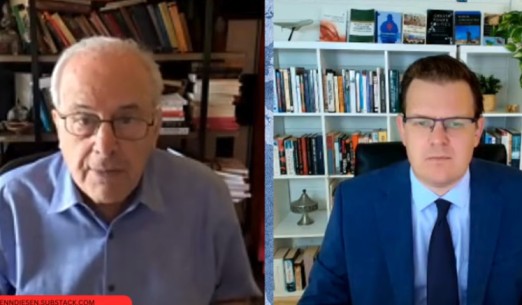
EDITOR’S NOTE: In this episode of the Glenn Diesen Greater Eurasia Podcast, Professor Glenn Diesen sits down with renowned Marxist economist Professor Richard Wolff to examine the deepening cracks in the U.S. economy and its geopolitical consequences. They explore how rising oil and diesel prices, worsening inequality, and America’s overextended military commitments are accelerating the decline of U.S. imperial power. The conversation also turns to the future of Israel and the broader reorganization of Western Asia as U.S. influence continues to wane. This episode was premiered September 18, 2026.
TRANSCRIPT:
The U.S. Economy and the Impact of Rising Oil Prices
GLENN DIESEN (00:00:00 – 00:00:08): Welcome back. We are joined today by Professor Richard Wolff to discuss what is happening in the world economy. So thank you for coming back on.
RICHARD WOLFF (00:00:10 – 00:00:11): Glad to be here, Glenn.
GLENN DIESEN (00:00:12 – 00:00:41): So it seems to me that the United States was able to keep the oil prices down during this war with Iran, at least to some extent, to make sure that it didn’t go, well, too high. But now that we see the war being expanded to Yemen, it all looks a bit different. That is, Yemen was able to shut down the Red Sea. And I was wondering, how do you assess this, the significance to the US economy?
RICHARD WOLFF (00:00:43 – 00:09:09): Well, much of this turns on the degree to which people do or do not believe that rising oil prices, rising diesel oil more in particular, is going to affect people’s voting. Frankly, I’m a little skeptical about the fascination with a very mechanical link that people will not be happy about paying extra for oil and diesel and will therefore vote against Trump. Will there be some such people? No doubt. But whether this is a significant part of what is unfolding here, I’m very dubious about it.
Having said that, the impact is very, very noticeable. For your audience that is not American, I should stress that the United States heavily underinvests in public transportation. Our rail system, our bus systems are very, very poor. They don’t even exist in large parts of the country. But even in the cities where you find them, they are the transportation of poor people mostly, nobody else.
Everybody uses the automobile, the private automobile is dominant. There are famous researches that were done that showed somewhere between the ’30s and the ’50s of the last century, the leading American automobile companies— Ford, General Motors, Chrysler— literally favored, sponsored, subsidized the tearing up of street railways, which had been a popular method of transportation in the United States. If you’re ever interested, the city of Boston and the city of San Francisco have maintained their street railways. In San Francisco, they became a tourist attraction. In Boston, they remain a major part of the larger urban area’s transport. But those are wild exceptions.
Most American cities and their suburbs are creatures of the automobile, which means that most American cities— for myself, I grew up in a suburb of New York City. My mother and father, when we had to go shopping, got in the car to go to the place where you do the shopping. Separately, they took automobiles to go to their jobs. And if we went to a restaurant or a movie in the evening, we got in our car and went to that place. That was how people moved around. When I was 16 years of age, the most important thing for me was to get a driver license because we were able to do that once we were 16.
Long story short, everybody has to fill up their car, at least those who don’t yet have electric vehicles. And the power of the automobile company and the oil companies has been such as to keep subsidies for transition to electric car very depressed. Elon Musk may have had a lot of influence on Mr. Trump, but compared to the influence going the other way, he lost. He had to switch to space exploration to stop being stymied by the economic powerhouses arrayed against him.
So it is a very big problem for all the people that depend on the car. Suburbs are the place where most Americans live, and suburbs are the most auto-dependent of the auto-dependent country. So it’s something you feel every time you go and fill up the gas. You’re departing, you know, you’re saying goodbye to more money than you used to have to pay to do this. So yes, it’ll have some impact.
Diesel, Farming, and the Pressure on American Agriculture
It’s actually having more impact on diesel. And the way that works is diesel, which is a refined version of oil, you have to put it through a refinery procedure to get diesel out of barrels of oil. Diesel is important in 3 areas. Farming where it powers the tractor. Farming in the United States is highly mechanized. Therefore, it’s terribly dependent on diesel fuel to operate most farm machinery.
Because the profit margins in farming have been affected by a number of things. Number one, the problem of the diesel oil operating the machines, but more, it also uses oil, as people know, to make fertilizer, and that’s driven up the price of the fertilizer. And there is pressure from the wholesale grocery stores that handle food not to have to raise the prices as they face their rising prices, so they keep the pressure on the farmer.
You put these together, the diesel, the fertilizer, and the pressure from the monopsony buyers of agricultural output, and the farm states, which loom very large because of the 50-state arrangement. You can win major electoral votes in this country off of a very small part of the population. If you damage farming. Farming has had a stranglehold on the Congress for most of the last century.
Inflation, Inequality, and the Housing Crisis
And given the fact that promises were made to offset the inflation that took place in 2021, 2022, and so on, that never happened. The prices stopped rising so quickly. That was achieved. But they didn’t ever go back to where they were before. They kept on rising at a slower rate. For the mass of the people, this seemed to be, as it does as I’m speaking, a kind of endless rising of the food prices.
And lastly, because of the changing distribution of wealth in the United States. And I should underscore the single most important vulnerability of American capitalism now is the uninterrupted 50 years, 40 to 50 years of worsening inequality. And what that did is destroy the building of homes for middle and lower-income people, because that’s a private enterprise in our country. All the building went to the upper end where the wealth is concentrated. So you have multi-million-dollar apartments exploding everywhere in the United States. But for the mass of people, rents are exploding because the population is growing but not met by more affordable housing.
You put all that together, then you get a danger for Mr. Trump and the Republicans at the midterm election. But I wouldn’t put it all or disproportionately on oil and gas.
The Gulf States and the Geopolitics of the Middle East
GLENN DIESEN (00:09:11 – 00:10:10): But in the wider geopolitical system, though, this is— how will the region respond to this? Because all of the Gulf allies, they are very closely tied to the United States. From what I understand, you know, the war between Yemen and Saudi Arabia, the Saudis requested some assistance from the United States. I think for good reasons, the US declined. But again, it seems to mimic the situation in Europe. That is, the United States was the principal actor in terms of triggering this war in Europe, and then it pushes it aside on the Europeans. And now we see something similar in the Middle East. The US started the war in the Middle East, it spreads to Yemen, and now it’s essentially dumped upon the Saudis themselves. I mean, what would be the economic consequences if the Gulf states are pushed too far away?
RICHARD WOLFF (00:10:11 – 00:16:54): Well, as you know, because you and I have just been discussing this for a while now, in my judgment, we are only witnessing the particularities of the decline of the American empire. It cannot do what it used to do. It doesn’t want to face it. It has enacted a political leader whose whole job 24/7 is a theatric of the power he doesn’t have, to put on a show which he can’t deliver. And he does that domestically. He does it in foreign affairs.
He’s about to agree to send a shipment of super big bombs to Israel for $40,000 worth of $2,000 bombs. For what? For Israel to go crazy in Lebanon? Maybe to do something even stupider? What is he doing? The same Secretary of Defense who tells him to do that just faced, starting yesterday, an impeachment inquiry in the Congress against him. And the hostility against the defense minister is at a level it has not been in my memory here in the United States. I don’t know how far this will get, probably not very far because of the dependence on what happens in November. But nonetheless, everything is very, very shaky.
And so is the Middle East. If I understand, there’s a meeting today in which, if the news is correct, the Iraqi foreign minister will be explaining to the assembled Gulf state leaders, including a representative from Saudi Arabia and a representative from Iran, as well as the other 6 or 7 countries, I’m basically saying we need to work out an arrangement to stop the destruction, hopefully. And that includes, quote, “the removal of the United States from its positions in the Middle East.” Okay, that’s now on the table. And the Iranians, together with the Houthis, are in a position to enforce this.
This is a very good idea, but if the idea goes nowhere, everybody knows what comes next in this process. And nothing that you can give to the Israelis, no matter how horrible the Israelis are, they can’t much change this either. Because if they move, the ability of the Iranians to damage Israel is now established. Very well established. I’m very dubious that the Israelis have the ability to survive much further given what the position they’ve walked themselves into. So I think this is going to be a radical reorganization of Western Asia and its relationships with everything else in the world.
Supply Chain Shifts and the Fog of U.S. Propaganda
I do believe that you are already— we are already seeing country after country, firm after firm, making the adjustments. The war in Iran is now not over. It’s not going to stop anytime soon. Even if it stops, it will only stop because the Iranians agree, and they will only agree if— and so, for example, people are switching from ocean transport to rail transport to truck transport all over Asia and elsewhere to get around needing the ships. The ships are navigating in new ways. There are new tensions in the Arctic because it is an alternative route if the ice continues to melt for shipping to go on and on. So we’re going to see adjustments in the supply of oil, but also in the demand for oil. And I haven’t even brought up what this all may do to climate mentalities and the speed with which fossil fuels are pushed out of the story.
So everywhere, I’m sure in the headquarters of ExxonMobil or Chevron, they are busily working out their adjustments as it becomes clear. And you have to remember, I’m speaking to you from the United States where the mentality is retarded, and I mean that literally, slowed down because of the blizzard of propaganda, which is all the government is doing. No one really understands very clearly where anything is. Where exactly is the war? How much of our munitions really are in inadequate supply? We get bits and pieces, and the minute there’s any kind of information, there is a load of nonsense pumped out by various agencies of the government to make it all murky, to make it uncertain.
You know, I have friends of mine who are not socially critically oriented but who come and listen to your show and to Mercouris’s show and others because it’s one of the few ways that Americans who know that it’s propaganda try by piecing bits and pieces together to have a sense of what’s actually going on. So the reactions are delayed here. They’re happening sooner. When you read, you know, we don’t read any statements here, for example, that this winter is going to be very difficult because we’re low on oil and gas. We don’t hear that. Europe is full of that kind of worry and that kind of comment. And so I can see people in Europe figuring out what to do. But we’re not there yet. There’s a delay. It’s like having a conversation between London and California. You always have to take into effect the many hours that are different in the 2 places.
Is Israel’s Survival at Risk?
GLENN DIESEN (00:16:56 – 00:17:25): You mentioned with the reorganization of West Asia that it could be without Israel, well, essentially the demise of Israel. Do you— how likely do you see something happening? Because I keep hearing that as well. It’s becoming a common theme that Israel has, well, overextended itself at a time when the US might not be able to back it up anymore. Do you see a likely pathway to Israel actually going under?
The Shifting Tide of American Public Opinion on Israel
RICHARD WOLFF (00:17:26 – 00:21:53): Yes. I didn’t until recently, but I am taken with the speed and the extent of the shift in American public opinion from pretty massively pro-Israel to now pretty massively pro-Palestinian. It is becoming a major problem for political leaders who for the first time are learning bitterly that while they control the government and they control much of the mass media to continue to be pro-Israel, it is costing them in elections.
The Democrat El-Sayed in Michigan, I mean, it’s incredible. In Chicago, it’s a watershed moment that a person like that could make a central issue out of Palestine. And I think what you’re seeing is a radical reorganization of American politics.
When Tucker Carlson and Marjorie Taylor Greene chime in, that means you’re pulling part of what used to be a fairly solid MAGA base out of the pro-Israel and because they are associated with fundamental Christians, and the fundamental Christians developed their own ideological reason to be pro-Israel, that’s now disintegrating.
I think the real discussion in Washington, and I’m speculating here, I’m not part of that community and I don’t claim to be, but if I’m reading the signals right, we’re not having a discussion anymore, how do we protect Israel? That’s over. The discussion now isn’t that different from the discussion about Iran, which is, what is the best way to extract ourselves from this mess?
And that it still means, because of the importance of AIPAC, because of the domestic importance of the financial support that goes to pro-Israel movements and activities, that nobody wants to lose that. The Republican leadership doesn’t want to lose that money, and the Democratic Party doesn’t. AIPAC has long ago been very successful in funding both.
So you have the people at the top don’t want to give up the money, but they have to give up the actual support because it’s costing them and it’s putting into power very important politicians in a country whose point of view public opinion is shifting and shows no sign of unshifting. All the politicians have to pay.
So solution. There has to be a way to arrange for Israel to either fundamentally change or disappear while it appears that the United States is helping them not to do that. That’s the theater that is being debated. How do we appear to help in such a way that makes them disappear.
The parallel with Iran: how can we appear to be the powerful America bombing them while what we’re really trying to do is figure out how to get out of there with the least damage to our imperial status? Very similar struggles being waged by the same people at the top. And that, I think, if I’m not mistaken, they have persuaded Mr. Trump, or at least some of them around him, that those are their twin problems: how to appear to be supporting the people you’re actually burying.
GLENN DIESEN (00:21:56 – 00:22:02): So Trump has already moved towards accepting the defeat of Israel then, more or less.
Netanyahu, Gaza, and the Strategic Retreat
RICHARD WOLFF (00:22:04 – 00:26:42): He’s being persuaded that— he wouldn’t put it that way. The way that it’ll be put here is Mr. Netanyahu has been inadequately grateful for the enormous assistance that he has been given for decades by the United States and asked to behave in certain ways, which he has refused to do. He shouldn’t have done that. He didn’t have to do it. And it has cost him. The Americans will continue to support Israel because it’s the right thing to do or language like that. But the underlying message is unmistakable: you’re not playing ball.
And by the way, there’s, as always in these things, there is the grain of truth. They didn’t want the slaughter in Gaza. They didn’t want that. That’s not good for the United States, and they know it. But Netanyahu wanted to do it. And they weren’t ready and didn’t see the political need to do much about that. Okay, let him go ahead. And they let him go ahead using American weapons and American money to sustain a genocide in Gaza. That’s what they did. And they’re stuck with the blame for that.
But that’s a price they’re willing to pay now that they have a, I dare to say, strategic idea that Israel is to be quietly shunted away. By the way, it’s partly a recognition of something. If the United States leaves the Middle East, if Iran is persuasive and the United States leaves, closes its bases, and then what? Israel is going to be left on its own? That’s not a survival strategy. That’s a self-destruction strategy.
And the more that’s the case, the more you can’t disguise shipments of American military to our base in Bahrain or Kuwait or somewhere else. And it has to be exposed like this latest bomb shipment. We’re paying for, giving bombs to Israel so it can do a genocide. This is not a sustainable way.
The American Congress will stop Mr. Trump if the election goes badly for him in a few weeks. It’ll happen already. They’ll stop it. They’re getting close to it already now, and we haven’t even had the election yet. Republicans are standing up against Trump in a wide variety of areas who dared not do it before. And I think you’re going to see more and more of that.
As far as I can see, maybe the Israelis don’t see it. If so, they are playing a dangerous game of denial. In my judgment, they’re in the worst position I have ever seen them in. I mean, this is — nobody is supporting them anymore.
Most of the governments of Europe, I believe, have now at least said something about settlements on the West Bank and that that must stop. Or what did England do? Sanctions. We won’t trade with somebody who’s on the West Bank settler. I mean, okay, these are theatrics. They’re not very real. They probably won’t be enforced. But the direction of change is unmistakable, and each government that does it strengthens the movement across Europe to do more of that.
It’ll be very easy for the Arab countries to show that the theater so far enacted is mostly theater, and that will be a goad to a stronger-than-ever movement to get more than theater. And that’s what politicians understand. They put their finger in the air and they see which way the wind is blowing. You’d have to be dead not to get which way that wind is blowing now. And Mr. Trump, he knows it too.
GLENN DIESEN (00:26:45 – 00:27:25): So as the US economy begins to falter, it’s facing defeat by Iran, I guess, yeah, the US would have to pull out to some extent out of the region. Simply, that’s the cost of losing this war. And well, I can see why that could become an existential threat for the Israelis. But again, I always make the point, I have a hard time seeing them going down quietly. That is, a nuclear-armed, somewhat radical state. It just, it looks like that would be a very messy demise.
Israel’s Nuclear Threat and the Logic of Isolation
RICHARD WOLFF (00:27:28 – 00:37:41): But yeah. It would, but take the same logic the next step. If their backs are to the wall, I have had Israeli people who work in the Israeli government tell me that, their concept of their right is to take the whole world down with us if we go down. That’s a quote from an official of the Israeli government told to me some years ago, but from everything I can tell, a very alive way of thinking.
Okay, but if there is one thing in the world that will unite the entire world against Israel, it would be its use of nuclear weapons. No one is going to be impressed by giving them a pass because they were in trouble, especially now given their reputation for the genocide they performed that they didn’t have to. They have lost every chance of getting away with a use of nuclear weapons.
So what are they going to do if the United States and China and Russia and Pakistan and India, all, and whoever else has nuclear weapons, decide to punish Israel for being the first one to use them? It’s finished. And Israel is a very small place. Will not be much effort needed to do to Israel what the United States did to Hiroshima and Nagasaki.
So, I mean, well, that’s no solution for them either. It just isn’t. And it will make them a pariah even more than they have already become. The irony of this, the total absurdity of the victims of a Holocaust being the ones least able to learn the lesson. Spectacular. But it isolates them. It’s not a question of will they be isolated. They are isolated.
The whole world would at this point, I think, vote overwhelmingly almost any program of punishment of Israel the minute the United States says it’s okay to do that. Look at the UN votes. You get 150 countries to 1 or 2 or 3 little islands in the Pacific and Israel and the United States. Okay, remove the United States and you’re done. Drop a nuclear bomb somewhere, you lose the United States. That I would assure you, you’d lose it in a moment. You’re losing it now without that.
I don’t think that’s an option for them unless you really have, and maybe you do. I mean, I don’t go to Israel. I don’t have a — I don’t know anything about it, but I find it hard to imagine an entire population ready to self-destroy on that scale. Given all that they’ve been willing to do to other people to survive, the survival instinct seems very uppermost in their minds. And this would be a survival negation that is so obvious that even they, I think, would see it.
So that’s a long answer. Short answer is it is now on the agenda — whatever you and I decide, it is on the agenda that the United States — to say something like the Iranians now say, and they say it often, that one of their goals — it’s not just that because they won the war the way you put it. I would put it differently.
If you want to reopen the Strait of Hormuz, and now the Red Sea, you got to get out of there. In other words, you will benefit, the strait will be open, you can withdraw your armada, your blockade, you’ll save a lot of money, you’ll have an open passage, but you got to get out of here. You’re not welcome. Nobody wants you.
And, wow. That leaves Israel, because Israel is going to be the one place that has nothing to lose if the American military are there. They are already a target, and they will be a target when the Americans leave and when they don’t leave.
So you may get some accommodation there, but maybe Israel will offer itself as a hostage. They’ll say, station 10,000 American Marines permanently in Israel, spread them all over so that any Iranian attack on Israel will kill Americans. And then they can hope — which I don’t think is reasonable either — but then they can hope that if something happens, the Americans will have to enter in because Americans have been killed in some sort of struggle. Maybe they’ll come up with that.
But these are stretches, stretches of credulity, stretches of effectiveness. And it’s not at all clear to me that that will work. But that’s all that’s left.
Europe’s Strategic Dependency and the Absurdity of Anti-Russia Posturing
Israel is all by itself. It put all its eggs — look, it’s a little bit like a conversation you and I have had about Europe. At the end of World War II, for perfectly understandable reasons, Europe hitches its wagon to the United States. It has seen the most powerful European military, Hitler’s Germany, run up against the Russians and be defeated. And they know how much of their military power was expended finishing up World War II.
At that point, the Red Army marching into Berlin, you could have a credible notion, oh boy. And when you remember how many of the resistance organizations were full of communists and socialists and the possibility of something changing in the rest of Europe was real, was real. And they looked to the United States to save them. The United States wanted a buffer zone to save itself. Okay, a deal was made, but the Europeans have kept hold of that deal long after it didn’t make much sense anymore. But they weren’t willing to question it. The Americans weren’t willing. All European politicians who wanted to succeed clumped under the umbrella of the United States to do that.
That’s why you have the likes of Merz and Macron and Burnham and wow, nothing at all but an American frontman. And even when the Americans kicked them away, say, we don’t need you, we don’t want you, you’re a burden, we don’t want to have anything to do with you. Even then they can’t let go.
Instead of confronting the real danger, which is that their patron withdraws, they invent another danger, Russia, to justify remaining subordinate to the patron. I mean, a psychologist has a field day with this kind of behavior. This is a bizarre way of holding on to what you should let go by creating an even worse danger for yourself.
Really, after doing nothing significant militarily for 75 years, you’re going to go up against a Russia which has just shown what it’s capable of and is allied to the number one manufacturing power in the world. This is a moment you’re going to fight with Russia? What? The very preposterousness of what they’re doing.
And then to have — I mean, it’s becoming ludicrous. Yesterday, if I read correctly, please correct me if I’m wrong, if I read correctly, a leading official in Poland proudly explains how they would — they, the Polish army — would defeat Russia in a couple of weeks. Okay, I’m no military expert at all, but I know junk when I hear it. That’s junk.
That’s exactly what Mr. Trump said about the war in Iran, it would be over in a couple of weeks because Israel and America are so powerful. Nobody I know thinks that the Polish military are so powerful. But even if they measure up to their own standards, really, against Russia allied to China, you, the Polish people, will find it is crazy, and it makes you wonder what’s going on in Europe that makes this kind of blather work as a political argument.
The Geopolitical Landscape: NATO Rhetoric and the “Middle Countries”
GLENN DIESEN (00:37:43 – 00:39:04): Yeah, no, he’s— that’s Sikorski. He’s the foreign minister of Poland, and he made that statement that, yeah, Poland had overwhelming military superiority over Russia. So it’s— and you saw other people on the podium looking a bit baffled by this statement.
But you have other comments which are even crazier. I forgot what position he had. It was an Estonian politician, was on a similar panel making the argument that, you know, we have to send a clear signal to Russia that we can take Kaliningrad if we want to. This is the, yeah, landlocked part of Russia in old Kaliningrad. Sorry, in Kaliningrad. Yeah, it’s been cut off from the Russian Federation, so it’s surrounded by NATO countries.
And the whole idea— but they don’t seem to recognize that there’s a million Russians living there. If they take Kaliningrad, what would Russia do? They also forget that Kaliningrad has nuclear weapons, plenty of them, on its own territory. So if you try to take it, those will go off. I mean, it’s just, it’s mad.
RICHARD WOLFF (00:39:05 – 00:39:15): The mentality also, I mean, Estonia, Estonia, it’s like the rising of New Jersey or something. Rhode Island.
GLENN DIESEN (00:39:15 – 00:39:15): What?
RICHARD WOLFF (00:39:16 – 00:39:26): You know, you realize people have lost. Listen, when here in the United States, when we read statements by, what’s her first name? Kallas.
GLENN DIESEN (00:39:27 – 00:39:27): Kallas, yeah.
RICHARD WOLFF (00:39:28 – 00:40:21): It’s the same thing. I mean, everyone scratches their head and what planet exactly are you living on? Although, you know, I’m grateful to her because when she talked about the need to fight Russia in order to defeat Russia, and the need to defeat Russia in order to carve it up into a whole group of small countries that could then each become colonies of Western Europe, then you understood, oh, there is a strategic vision buried in this.
Now, you know, it’s so crusted over with craziness that you have a hard time getting to it, but there is something there, just as there is with Mr. Trump and Greenland and Panama and Canada and all the rest of it.
GLENN DIESEN (00:40:22 – 00:42:40): Yeah, should we point out Estonia has a population of 1.3 million and the Russian Federation next to them has 145 million and they’re the world’s largest nuclear power, right? And this is how they talk about their neighbor, this kind of warmongering.
And the rest of the Europeans, they saw these Estonians and thought, wow, these are some clever people. Let’s give them the keys to the car. And Kaja Kallas, also an Estonian, failed Estonian politician, and they made her the foreign policy chief of the EU. So she’s representing the Europeans now. It’s, again, it is mad, but that’s kind of where we are.
And it’s a bit of a mass psychosis though, because when they say these crazy things, no one will object. Well, no one pushes back because to push back would mean to be an apologist for Russia. So you can say any crazy things that comes to your mind. You know, Putin eats children. I mean, one of our newspapers in this country I saw the other day, right? Oh, well, we saw some extra killing on the day of Putin’s birthday because Putin likes to see people get killed on his birthdays. This doesn’t make any sense. Who’s your source? I mean, this is mad. But you don’t need any source because there will be no pushback. Any pushback is seen as being an apologist for Russia, and you can’t be that. So any craziness is always welcomed with open arms.
I did want to ask though, because a lot of this is about not the US dropping the ball, but in the Middle East, the US is pulling away. I mean, the discussions they’re having now in the Middle East, much like in Europe, they will soon have those discussions if they don’t already do so in East Asia. And I’m curious about the vacuum being left behind, just because we now saw recently the meeting of the Shanghai Cooperation Organization and then BRICS. To what extent do you think their format for governance is able to fill the vacuum being left by the, you know, by declining US?
Well, I think everything hangs on what I would call, for lack of a better term for the moment, the middle countries.
The “Middle Countries” and the Shifting Global Order
RICHARD WOLFF (00:42:40 – 00:47:56): And here’s what I mean. I think the Chinese with the Russians and so on are more than willing and more than able to step right in and fill whatever these vacuums are. I believe that in these countries in Western Asia and others, many of the smaller, weaker, middle countries, there is considerable tension.
On the one hand, they want out from under the United States, and the more they witness the United States as at best a mixed blessing with very heavy dangers and costs associated with it, the more they are interested in an alternative. But they also worry, and we can argue whether it’s reasonable or not, but I believe they worry, are they leaving one dependency and exchanging it for another one, and they will come to regret that? A normal worry. If you’re trying to escape from a relationship that you thought was in your interest but turned out to be an albatross around your neck, you’re going to be very nervous about it.
And for me, that’s how I understand the largest country in the world, but I would put it in the middle, India. India, for me, in recent years is trying to figure out where, how it’s going to maneuver between China-Russia on one hand, with its complicated relationships, and the United States and Western Europe and Japan on the other side.
And, you know, let’s remember at the beginning of this year, Mr. Modi went to Israel, was invited to address the Knesset, their parliament, and did not criticize anything about the United States. And when the United States and Israel, days after I believe he gave his talk, invaded Iran, he was silent. He didn’t say anything. He didn’t say it was outrageous. He didn’t say it was wrong. He talked about the need to find peaceful solutions.
At this latest SCO, 8 months, 9 months later, he signed the joint statement. The joint statement expressed grief at the killing of the Ayatollah and denounced the war, put the blame squarely on the United States. And wow. Now, you can handle this as, look at Mr. Modi, he’s one and all these the other, and he’s wobbling around. And that’s true. But he was very pro-American, and much more recently, he was very not so pro-American. That’s my answer to your question.
I think all these countries are doing something like what Mr. Modi is doing. They don’t have the attention because they’re not the head of the biggest country in the world now. Well, India is a colossus. But I bet you they’re all doing it. The people in Indonesia are doing it. The people in Pakistan are doing it. They’re all doing it one way or another. You know, each has their own particular angles, but that’s going to be the outcome.
If that middle group decides not only that they have to leave the United States, but that the cost of doing so is making a deal with the Chinese, and they’re going to have to make that deal. They will, and then it’ll become suddenly very clear which way the world is going.
And by the way, I think the Israelis understand that. Recent Israeli political, foreign policy initiatives are with other little countries like Tajikistan and things like that. So the Israelis are cutting the deal to use an old Volkswagen factory that is now closed because Volkswagen can’t exist anymore. They’re going to make bombs and missiles for Israel. Okay. Israel is trying to make deals with private enterprises and in these middle countries, perhaps hoping at least to slow down what is happening.
And my guess is it won’t work. And that’s because Israel is too little, too small. Doesn’t matter. There’s not enough money there to change most of these other— it can be a godsend for a particular empty factory someplace, but beyond that, no, it’s not going to change German policy either.
The U.S. Bond Market and the Long-Term Debt Crisis
GLENN DIESEN (00:47:59 – 00:48:21): Last question I just have though is, well, not completely unrelated, but the bond market in the United States, a lot of discussions around this at the moment. Some believe that, yeah, it’s exaggerated. Others see this as being the time bomb that has been waiting for decades to go off. How are you seeing it?
RICHARD WOLFF (00:48:22 – 00:55:22): A little bit of both. I think there are immediate reasons that are easy to identify. If you do an analysis of the bond market, you know where the money comes in to borrow and where the money comes in to lend, then you’ll know that there’s an explosion of investment in data centers, and in electricity generation construction to service the AI colossus that is being invested in.
And those people don’t want to risk their own money, and they don’t have to because they have names like Amazon or Apple or Microsoft, etc., etc. So they just have to announce, “We want to borrow $50 billion,” and the money that wants to be lent out rushes to— because it’s almost as secure as lending to the US government. So you have a competitor of the US government coming in and saying, “Lend to us.” Normally, that would only get you a certain response. Now there’s a rush there to take advantage of this moment and to lock in a nice long-term commitment so that Microsoft, as it changes the world with AI, gives you, the bank, a piece of that activity. So that’s causing interest rates in the short run to go up.
The American government is running deficits, big ones, trillion-dollar deficits. Not only that, it insists, because of the theatrical mentality of the leader, in suggesting things that only make the government deficit worse. Trump has found no new sources of revenue that are significant. Meanwhile, he announces one largesse after another that he can’t afford.
The most recent being this offer, which is illegal under American law, that if the people of America vote for his Republican Party in the midterms in November, he will give every adult $5,000. Okay, well, if you do the math, we have 200 million-odd adults. That’s $1.3 trillion. What? We already have trillion-dollar deficits. He’s going to add another trillion. Paid for how? There is no way to pay for that. That’s just going to be borrowed money. Well, the government already in debt $40 trillion. People are worried about that.
And now we come to the long term. The long term is very unambiguous. The level of debt keeps rising very quickly. And the economic strength and wealth of the United States is not growing comparably at all. We are a poor performer. We’re going to get 2.1% GDP growth this year. China is going to have 2 to 3 times our rate of growth, which is what they normally have. So a declining relative wealth situation supporting a rapidly growing debt situation. Every bank that ever sent any of its officials through a course says, “Don’t lend to such a person or entity, or make sure you get higher interest rates to compensate for the risks.”
Now, what would set off the United States would be if the mass of people were to say to the government, “We are not going to allow you, you politicians, president, treasury secretary, Fed bank, the Federal Reserve chair, and so on, we’re not going to let you take $1, $2 trillion out of the annual budget simply to pay interest.” Why? Because we have politicians, and Glenn, I’m one of them, in this country who will be screaming out loud, “You are— the national debt is a way of scooping money from everybody and shoveling it to the richest people among us because nobody else but the rich lend to the government.”
So let’s keep in mind what we are, and that’ll make it impossible. The people won’t allow it. You’re going to have demonstrations where old people are having a pension cut in order to fund the national debt. This is impossible. And you’ll have a politician begin to suggest, and wait till that day comes, that we have to suspend the repayment of the debt. “Oh, only for a year. We’ll get our house in order.” Whoa. You know, when that happens, you have to have an international conference to discuss how you manage a default when it’s the richest country. The most indebted country on the planet can’t make its debts. It becomes an allowance for the lesser countries to do this. This should keep a banker up at night. This is a dangerous— we’re not there yet. That’s true. Can they get away with doing even this crazy thing with the $5,000? Yes, they can. But they are inexorably leading us ever closer to the moment when this doesn’t work.
And I want to remind you, because you were probably paying attention when I was. You remember Liz Truss in Great Britain? She’s the prime minister. One of her first acts is a new budget. She announces the deficit and how much they’re going to borrow. And in 24 hours, the City of London says to her, “No way is that going to happen. We are not going to buy the government debt. You’re not going to be the prime minister.” And in a week she was gone. Her total time in office, I believe, was a matter of weeks, 3 or 4 weeks, and she was out of there.
So it is a— and that’s a very few years ago. So this is a modern event. England is a declining empire, don’t we know, further along in its decline than we are. But that’s the long-term problem. That has not been solved here and therefore only gets worse.
Trump’s Stock Trading and the Woody Allen Punchline
GLENN DIESEN (00:55:24 – 00:55:48): Yeah. Well, Trump and the $5,000, it was an interesting pitch because his whole argument is that the country’s hotter than ever. We’re making so much money and I will share it with you as if it was his pocketbook. But of course they’re not making money. So as you said, this is going to have to be borrowing. Oh yeah, sorry, he’s making money, but the country—
RICHARD WOLFF (00:55:48 – 00:58:18): Yes, you’re absolutely right. But he is— I don’t know if you caught it, but yesterday there was a government agency, they calculated the number of stock trades done in his name with his money, Trump’s, compared to the number of stock trades undertaken by all 100 senators in the US Senate and all 453 members of the House of Representatives.
And Mr. Trump did more buying and selling of stock than all of the others combined did. The man was busy. Trading stocks every day. And he’s made apparently $1 or $2 billion and no one can say a word, even though the one man who knows when to buy oil company stocks because the bombing of Iran has resumed and when to sell oil stocks when a ceasefire is about to be announced. He knows, and his children know, and his foundation knows.
So he’s making lots of money. It’s wonderful. And the leaders, and Mr. Musk is about to become the first trillionaire. I mean, the news, if you collect it, remember him being inaugurated, in January of 2025. And sitting on the platform behind him were Elon Musk and Mark Zuckerberg and Jeffrey Bezos and all the other oligarchs in this country. They’re all making a lot of money, no question.
As people who study the stock market point out, the so-called Magnificent Seven are what keep the stock market up. The average medium and small company is having all kinds of trouble. Nvidia, Anthropic, these are the companies that keep the stock market high and the oil companies. Other than that, no, no.
GLENN DIESEN (00:58:19 – 00:58:36): It’s incredible. The world is in one of the biggest transitions in history in terms of world order. A transition which could destroy the world, and you have the president of the United States trying to score some cheap bucks on the stock market.
RICHARD WOLFF (00:58:36 – 00:59:19): There’s a wonderful film by Woody Allen that begins or has in it the following. We close with this passage. He’s talking to someone who says, “Wow, that’s a beautiful watch that you are wearing, Mr. Allen.” Ah, he says with that Woody Allen smile, “This is so important to me. It’s from my grandfather. He was on his deathbed when he sold it to me.”
Yeah, you have to add that Mr. Trump is making money hand over fist. He may not be able to stand up. But he’s making the money.
GLENN DIESEN (00:59:22 – 00:59:26): Well, thank you very much for taking the time. And yeah, I have to watch that movie now.
RICHARD WOLFF (00:59:27 – 00:59:32): So catch that scene, it’s priceless. Take care. Bye.
Related Posts
- John Mearsheimer: Ukraine May Cease to Exist – The Coming Ugly Victory (Transcript)
- Yanis Varoufakis: EU Is Finished & China Can Now Pull the Plug on the U.S. Economy (Transcript)
- Douglas Macgregor: Ukraine Endgame Is Here — West Will Fragment (Transcript)
- Jeffrey Sachs: BRICS Builds a New World – Without the West (Transcript)
- Lawrence Wilkerson: Saudi Arabia & Israel Could Disappear Soon (Transcript)