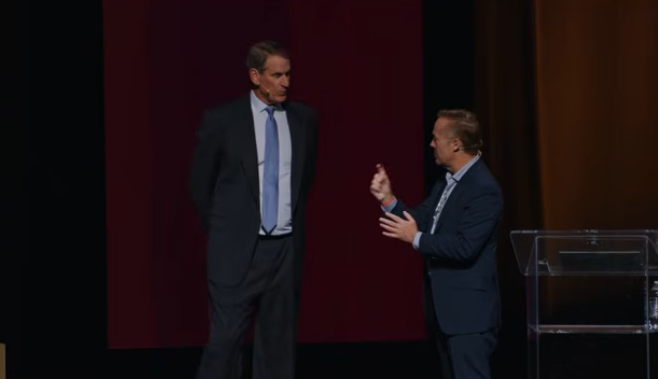
EDITOR’S NOTE: In this talk from the All-In Summit 2026, legendary venture capitalist Bill Gurley delivers a thought-provoking presentation on institutional failure, investigative accountability, and the importance of root cause analysis. Drawing on major disasters like the Surfside collapse, Boeing 737 MAX crashes, Hurricane Katrina, and Fukushima, Gurley explores how societies respond — and sometimes fail to respond — when catastrophe strikes. This is a must-watch for anyone interested in how systems fail and how they can be fixed.
TRANSCRIPT:
BILL GURLEY: It’s good to be here again. 3 years ago, I gave a talk on regulatory capture, and this group was quite kind in how they reacted and how that video was promoted. And I’m very happy we got that word out into the public discourse. Obviously, today you hear it quite a bit.
I have a different topic I’m going to talk to you about today. It’s not — I’m not going to talk about AI. It’s a serious topic, and so there might not be as many fun joke parts in it, but it’s something that’s been weighing on my mind for the past 5 or 6 years, and I’m thankful that the team here allowed me to come to talk to you about it, and I’m hopeful that we can have an impact by getting the word out on this as well.
How Humans Respond to Catastrophe
I’m going to start by talking to you about some catastrophes that have happened in the world and how humans normally respond to them.
The Surfside Collapse
This is the Champlain Towers in Surfside, Florida. You may remember in June of 2021 when the building suddenly collapsed. 98 people died. What happened? There were design errors from the very beginning. There was poor maintenance schedule. And then the board of the condominium did not listen to an inspection report that said they needed to take care of this. 3 different things. That’s kind of the institutional failure.
The technical failure was different, and you can see it here. This is a New York Times article. Hopefully they can push play so you can see. It’s a 3D article. If they can’t make it play, you’ll have to watch it on your own. Here we go.
But the reason I want you to see this isn’t to talk about the details of exactly how this collapsed. It turned out the pool deck was exposed to saltwater air, corroded. The pool deck collapsed into the basement, which took out the structural columns, and the building came down.
But what I want you to take away from this is the New York Times and its investigative team had excruciating detail about how this happened, which comes from doing primary investigative work.
There were 4 other parallel investigations that happened. The NIST is the National Institute of Standards and Technology. After 9/11, they were assigned as a federal agency to go investigate what happened in a building collapse. These 2 individuals, Matarini-Reisner and Bell, would spend 5 years on this. Alan Kilsheimer is the wolf of building collapses. He’s who you call when you want to figure out what happened. The town of Surfside hired him. Judge Randall would convene a grand jury in the state of Florida to investigate this, and there were 17 victim lawsuits which got put under a single class. Tropin was the defender or the litigant, and Hansman was the judge that did that.
All of these different groups were doing investigations on their own, sometimes running into each other, sometimes helping each other out, but all trying to get at what caused the failure.
One particularly heroic group was the Miami Herald. They had just gone through bankruptcy. They had a new executive editor named Monica Richardson, but they went after this hard. The beat reporter, Alan Leibowitz, was on the scene within 2 hours. Sarah Blaski would lead an investigative team. They would eventually find Dawn Lehman, who was a professor at the University of Washington. She would join the team. They would staff up to 37 people on this. They have a 3D model that’s equally impressive to the New York Times one, and they would deservedly win a Pulitzer Prize for the work that they did.
When they won it, Monica Richardson, the executive editor, who also won an award for executive editor of the year from her peers, said, “We will continue to investigate the collapse to find answers to how this happened to ensure a tragedy like this never happens again.”
Now, finding the failure cause doesn’t help if you don’t prevent. This is a list of some of the changes that went into all the condominium rules in Florida, and thankfully multiple other states, especially coastal states, adopted them. So you have change that causes prevention. That’s what you want to have happen when these things happen.
The Boeing 737 MAX Crashes
737 MAX crash. Unfortunately, there were 2 crashes, October 2018 and March 2019. For those of you who don’t know what happened, let me give you the really short version.
Airbus had come out with a plane that was incredibly fuel efficient, and they were starting to take share from Boeing. Boeing wanted to respond. If they built a new plane, it required tons of hours of teaching and training, and that makes it harder to sell. So they decided they would attach a fuel-efficient engine to an old plane, the 737. That’s how you get the name 737 MAX.
The problem is the engine was too big and they had to move it forward on the wing. When you move it forward on the wing, the plane is imbalanced. And they had this problem during test flights when it would occasionally tip up. So they wrote a piece of software, secret software called MCAS. And they put it in there without telling anybody. And if the sensor went off and told them the plane was tipping up, the autopilot would push it down.
The poor pilot that was flying the Ethiopian Airways flight, his sensor malfunctioned.
The software thought that the plane was tilting up and it pushed it into the ground. That’s what happened.
# The Six Searchers
There were many people that investigated this. I call them the 6 searchers. The US government did a Senate commission, a House commission, and the DOJ went after it. KNKT is the Indonesian agency that had the right to inspect the black boxes. They could tell very quickly the pilot was fighting the autopilot.
The press played a key role. Dominic Gates had followed Boeing for the Seattle Times for 16 years. He would win a Pulitzer for his work here. Peter Robison wrote a book called Flying Blind. You can tell why it would have that title. 57 whistleblowers sent letters into the Senate to tell on Boeing.
The victims’ families showed up and were ever-present and put pressure on Congress to make sure something happened. And the head of the pilots union was very upset that they had put this piece of software in there and not told the pilots. Boeing tried to come have a sit-down with the pilots union, and they secretly recorded what Boeing said and gave it to the press. And then when they wouldn’t respond to Boeing’s request, the pilots union issued FOIA requests against Boeing. It’s unheard of.
# Blockers and Institutional Resistance
Now, in these situations where you have 6 searchers, you also have blockers. And unfortunately, in this case, both Boeing and the FAA were being unhelpful in trying to find out what happened. Boeing initially accused the pilots of not being trained well enough. The FAA refused document requests to the Senate panel.
And one thing I would tell you about these big organizations, when you put a spotlight on them, they can feel the weight of that spotlight and they circle the wagons. I think part of it’s institutional. I don’t think they’re necessarily evil. They’re just, they have a sixth sense about how to respond when they’re put on the spot like that.
The other thing that’s interesting here is a lot of people came to think that Boeing and the FAA were working as one. Senator Ted Cruz, when he had the head of the FAA in front of the Senate, literally accused him of being captured. There’s our favorite word again. And he even said to him, “Sir, do you know you don’t work for Boeing?”
One of the real failures here in this case, 45 days after the first crash, almost everyone knew the MCAS software was at fault. And no one grounded the plane. Boeing didn’t ground the plane. The FAA didn’t ground the plane. And the second crash — I mean, the first crash should have never happened because that piece of software should have been identified, which would have required retraining. But the second crash should have really never happened.
I wanted to share with you — I don’t want to go through this in detail, but these are the 2 different committees in the House and the Senate. And I just want to highlight that they were decidedly bipartisan. DeFazio was the head of the House committee, very active. Ted Cruz and Wicker were super active. No one thought this was anything that should be partisan, nor should it be.
The CAPA Framework: A Scientific Approach to Failure Analysis
It turns out the scientific community has a process they use when they want to do failure analysis. It’s called CAPA, Corrective and Preventive Action. There are 5 steps: you detect, you investigate, confirm root cause, correct, and prevent. It’s all about prevention. You want to stop this from happening again. But you can’t skip root cause. That’s a requirement. You don’t know how to fix it if you don’t know actually what happened.
CAPA is required by law by the FDA in pharmaceuticals and medical device. The aerospace industry has regulations that require this type of process if you have a failure.
Hurricane Katrina
Now let’s move on. Hurricane Katrina, 2005. Look at these stats. They’re horrible. 1,800 deaths, 400,000 people displaced, damage $125 billion.
What happened here? Well, the Army Corps of Engineers that built the levee want you to believe that the water went over the levees, but that’s an act of God, natural disaster. But this was only a Category 3 level hurricane. What in fact happened was the levees gave way from underneath. They washed under. And that’s what’s unfortunate — this was a preventable accident as well.
# Searchers and Blockers
As with these others, you have searchers and blockers. The House had a commission. The Senate had a commission. The press played a key role. Mark Schleifstein and John McQuaid had written a series 3 years earlier about how this could happen. They would win 2 Pulitzers. I actually had a chance to talk with John about it.
The NSF, the National Science Foundation, cared so much about this they did a bake-off for it to have another team doing investigation, and these 2 professors from the University of California led that. And then the state of Louisiana hired a team out of LSU, and they all investigated. And I talked to John — sometimes once again running into each other, sometimes blocking, sometimes sharing notes, but all — and they all came to the exact same conclusion, that this was a man-made error.
The U.S. Corps of Engineers is the one that built the levees, and they naturally, as I talked about, are going to act as blockers. What’s weird here is they asked the American Society of Civil Engineers if they would join the investigation, join the internal investigation. They paid them $1 million, and over time, they would just get encapsulated inside the Army Corps and become blockers themselves.
When this dust all settled, Raymond Seed, the professor from UC, he wrote a 42-page report to the ASCE explaining all the times that they blocked. That document’s on the internet, you can go see it. 42 pages, that’s a lot of blocking.
The other thing that happened here that’s great is prevention. These different investigations led to 90 recommendations. Those changes were made, and the seawalls have held. It was $15 billion. Seawalls have held now for 20 years, which is great.
Fukushima
Let me move through a couple more real quickly. This is Fukushima. 2,200 deaths, 154,000 displaced, $200 billion in cleanup.
What happened here is pretty simple. The seawall in front of the nuclear plant was 5.7 meters. The water went over the wall, took out the generators, the cores started to melt down, there was no way to cool them. And the disaster happened.
There were internal documents that showed they expected tsunamis in a 30-year window to be in the 10 to 15 meter range, and they buried the report. So if you had simply raised the wall, this never happens, but it didn’t happen. And in a lot of these cases, there’s a combination of a technical failure and an institutional failure. The technical failure is what happens to the product or the surface of the building or the seawall. The institutional failure — why did the humans let that become a weak point here?
# Searchers, Blockers, and a Hero
As with the others, there’s searchers and blockers. The press played a role. Martin Fackler, at the New York Times, spent 20 years in the Tokyo bureau. He would be a Pulitzer finalist. Mr. Yorimitsu took a third-place paper and added 20 investigators to his staff to go after this. Had a huge impact, won 2 awards. The Japanese citizens were out in force, both protesting and filing claims.
And just like the FAA and Boeing, TEPCO was the company running the power plant, NISA was the regulator, and they blocked. And they blocked and they got in the way. And in fact, the failure was partially just a result of regulatory capture once again, that they weren’t playing the right role of regulator and regulatee. They had almost become friends.
Now, the real hero of this story is a guy named Kiyoshi Kurokawa. He was asked by the Japanese Parliament to lead the first-ever private investigation they’ve ever had in their country’s history. And they had a lot of power. They were told that no one on the committee could have any institutional connection to the regulator or the power company. They had the full authority to go after anybody in any way. And they had a ton of meetings.
Here are some of the stats. Kurokawa, when he kicked this off, said he had 3 mandates that he wanted to adhere to. One, he cared about human safety. He didn’t want it to be a battle about nuclear energy. Two, he said the investigation should definitely result in recommendations.
The Fukushima Commission and the Weight of Transparency
BILL GURLEY: And 3rd, he knew the weight of this because of Three Mile Island and Chernobyl from a global perspective, and he cared about that. Now, interestingly, he’s a medical doctor. He’s not a nuclear physicist, but he led this commission with a level of grace and professionalism that makes him a hero from my perspective. All these searchers are heroes from my perspective.
He would publish a report 7 months later. Interestingly, they chose to publish it in English first because they were worried about global transparency and how they were perceived. And in the first sentence, he says, “the accident at the power plant cannot be regarded as a natural disaster. It was profoundly man-made, and it could have and should have been prevented.” Powerful.
The Challenger Disaster and Richard Feynman
One last one. This is the Challenger shuttle disaster, January 1986. I remember where I was. It was a Tuesday. I was in college. It was a long time ago. Everyone, if you’ve seen the documentaries, you know what happened here. The O-rings on the solid rocket boosters weren’t designed for cold. Turns out it was cold that morning in Florida, and that flaw caused a problem. Unfortunately, the subcontractor that had worked on that piece tried to object the night before that they shouldn’t launch, and he got shut down. So you have a technical failure and institutional failure once again.
Now, I could talk about a lot of searchers and blockers, but I’m just going to talk about one, Richard Feynman, who was already mentioned during the All-In conference this week. Richard Feynman was a professor at Caltech. When the shuttle Challenger blew up, Ronald Reagan created the Rogers Commission, and they added mostly insiders. Neil Armstrong, they had astronauts, they had generals, they had people from Washington, people from NASA executives, but someone had the idea that they should put Feynman on there. And I think they wanted like a stamp of approval from a physicist.
The good news is it made a lot of sense. He’s one of the most famous scientists of all time. He won a Nobel Prize and he worked on the Manhattan Project. So he had a lot of credibility. What they didn’t know is he’s fiercely independent, he’s highly truth-seeking, and he has zero time for unnecessary diplomacy. They didn’t know that was coming.
He didn’t want to do it. He said he hated Washington. I kind of get that. His wife talked him into it, but once he did it, he cleared his schedule. He took everything off his calendar for 6 months into the future. None of the other commission members did that. And he started doing investigation on his own before he ever went to Washington. He’s like showing up at NASA facilities and asking to meet with people. And when he got to Washington, none of the other members wanted to act that way. In fact, Neil Armstrong told him, “we just evaluate, we don’t investigate.” It was too late, he was already doing it.
Now, 3 fun facts about this. First of all, there’s a famous story if you watch any of the documentaries where Rogers runs into Neil Armstrong in the bathroom and says, “Feynman’s being a real pain in the ass.” The second thing is he staged a stunt on live television. He found some material that was similar to the O-ring, and in front of everybody, he dipped it in his cold ice water in front of him and pulled it out and cracked it to show the failure. It infuriated the rest of the commission.
And then lastly, when he submitted all his notes to the commission, they wrote a final report. They really kind of smoothed over everything, and he was pissed. And so he called Rogers and said, “you know what, take my name off of it.” Of course, he’d already done the thing on TV. There was no way they could take their name off of it. They caved. Appendix F to the report is all of his notes included in their entirety.
COVID-19: The Catastrophe Without an Answer
Now, why am I talking to you about all these catastrophes and searchers and blockers and heroes like Kurokawa and Feynman? Because I want to talk to you about COVID-19. In December of 2019, COVID-19 caused 15 million deaths, disrupted every life on the planet and cost our globe $45 trillion. It was particularly hard on children. You’ve read about learning loss. My kids were in high school and college and missed 3 years of the most formative years of your life. I never want to live through this thing again in my life.
But guess what? For all the other catastrophes, I told you what root cause is. 6 years later, we don’t know. So forgive me if I’m unafraid of what some AI guy’s chatbot is going to do to humanity when you can’t tell me what this thing already did. My P-second-COVID is way higher than my P-doom. And if their models are so fucking smart, tell me what happened here. Let’s get them working on this problem.
I want to put this in perspective. I’ve added up all the deaths and costs of the 5 catastrophes I walked through with you. And you get to 5,000 deaths and $349 billion. COVID is 3,000 times bigger than that.
Feynman, in one of the documentaries, said someone was telling him he needed to be nicer, and he said, “but 7 people died.” If you have to get through niceties and seek truth when 7 people died, how are you supposed to behave when 15 million people die? I can take it even further. I add up all plane accidents, all hurricanes, all nuclear accidents, all building collapses, all space accidents. You still only get one-third of the way to what happened with COVID.
We should want to know what happened here so we can stop this from happening again.
What Didn’t Happen: The Missing Investigation
Here’s what didn’t happen, and this is shocking because all these wonderful people, all these well-intended people did this. In the other cases, which were much smaller, and they did it in a purposeful and meaningful way. There’s no committed newsroom with over 30 investigators on COVID. None of the major papers did that. There was no Gates or Schlesinger or Flackard, like a dogged investigative reporter that had the backing of his newsroom going after this. No bipartisan Senate congressional committees like you had in Katrina and 737 MAX. You didn’t have a standalone investigation with someone like Feynman or Kurokawa. There was no science-funded investigation. The NIST and the NSF launched them in these other 2 cases. NIH didn’t fund a third-party investigation here, and no massive victims lawsuit to figure out what happened.
The Blockers: Five Experts Who Stopped the Search
So what went wrong? I’m going to share some thoughts with you, and I want you to be aware of a couple pieces of information that I think are kind of new or new to be understood. And I want to make one qualification. This has been bothering me for a long time. I’ve read a ton. I’m sure there are people that are smarter than me on this, but I’ve got to be top 1% in terms of how much information I’ve consumed.
The first thing I would tell you is these 5 people were relied on as experts. You know the first 2, Francis Collins, Anthony Fauci. Peter Daszak runs something called the EcoHealth Alliance. It’s a nonprofit that did virology research. Jeremy Farrar was the head of the Wellcome Trust that funded a lot of this stuff and went on to work at the WHO. And then Ralph Baric is the top virologist in the US at the University of North Carolina.
What I’m here to tell you is they weren’t experts, they were blockers. They acted exactly like FAA and Boeing and NASA did in these other situations. And I’m going to give you 4 reasons why I know they’re blockers.
First, they’re virology insiders. So as I said, there’s going to be a natural instinct to circle the wagon when someone shines a spotlight on you. 2, they led a misinformation campaign to take us off the lead and to tell us not to search. I’m going to tell you about that in a second. 3, they were all outspoken gain-of-function advocates prior to COVID coming along. And if you don’t know what gain-of-function is, it’s when you take a virus and you make it intentionally more dangerous to animals or humans. They felt that that was smart to do. Obama had outlawed it. They were constantly promoting to try and make it happen more often.
Fauci in 2011 wrote an article in the Washington Post, an editorial, where he said the pros outweigh the cons. Now, if you talk to any behavioral psychologist, if you’ve told the world we should definitely do this and the pros outweigh the cons, there’s zero chance you can be impartial when it comes to figuring out what happened, because to go home at night and think that something you did contributed to the death of 15 million people would be impossible to go to bed. Your brain’s much more likely to trick you into just thinking it didn’t happen. You wouldn’t be allowed on a jury if you had that kind of bias.
And the 4th reason, and the most important reason I know they’re blockers, is because they didn’t search. I tell you they stopped searching, but they never started searching. And they should have been searching. They should still be searching.
The Heroes: Five Women Who Did Search
There are people that did search. They’re not at large institutions. The 2 on the bottom, DRASTIC is a loosely affiliated group of scientists that come together and share information. They have a website. You should follow them. It’s like 20 Nick Shirleys that are all virologists or scientists. US Right to Know is a nonprofit that’s filed the majority of the FOIA claims here. And you can donate to them. I have.
But I want to tell you about these 5 heroes. They’re heroes of mine that have been actively trying to find out what happened from the very beginning.
Alina Chan was one of the first molecular biologists that realized that the virus looks like it was designed for humans. She wrote a book with Matt Ridley. And here’s some really good news. In the past couple of years, the New York Times has published 2 of her op-eds. I would rather it be the investigative team at the New York Times, but it’s a start. They’re really good. Read both of them.
Katherine Eban was the first person to really stick their neck out and say, we’re not looking at this the right way. She published an article, oddly in Vanity Fair, titled “The Fight to Discover COVID Origins.” And I think the title is important because the fight was about the discovery process.
Emily Kopp worked for U.S. Right to Know. She may know more than anybody. She’s been the one uncovering all of these documents, and we’ve been getting more and more documents each and every day, so we’re learning more.
Zeynep Tufekci is a professor at Princeton who also writes sometimes for the New York Times. I’m going to tell you something she did recently that I think is super important.
And then Alison Young wrote a book called Pandora’s Gamble that looks at all of the lab leak failures that have happened prior to COVID, which is an interesting and relevant data point to study if you want to consider whether or not that was part of the problem.
These 5 women have been attacked for sticking their neck out, some of them directly by the men on the previous slide. And I think that’s completely unreasonable. I think they’re heroes.
The Misinformation Campaign and the DEFUSE Proposal
Now, there’s 2 things I want to tell you about, and then I’ll wrap it up. There’s 2 pieces of information you should know about. I said earlier that the 5 experts/blockers had created a misinformation campaign to take us off the lead. I think that’s an understatement almost. They created a highly successful misinformation campaign to convince everyone that animal spillover was the decidedly determined cause of this and that anyone that considered a lab leak, even thought about it or asked a single question, was a conspiracy theorist. And they were successful at it.
They leveraged the scientific journal community, which they understood. The Proximal Origins paper went out. This thing was written in like a week. There’s no way you did an investigation. They just wanted to get it out there. And then The Lancet had a similar one. These papers have been cited over and over and over again. If you try and go through Wikipedia, you just always end up going back to them. So they were highly successful.
They also somehow made this thing partisan using the word conspiracy theory with Trump. I don’t know how it happened, but they were able to get people in their surveys and polls — people, what do you think caused COVID? And if you’re Democrat or Republican, you have a different answer. That’s nuts. There’s no way that should be relevant in this discussion.
Recently more and more of this information’s come out, and so you have more understanding of how they came to write these papers. And you can see inconsistencies between what they think and what they wrote.
Zeynep put this on Twitter 45 days ago, and I think she chose her words very carefully. She said, “incontrovertible proof of a conspiracy to cover up and deny the possibility it well may be a lab mishap orchestrated from the highest levels of the scientific establishment and a self-serving group of scientists who deliberately misled the public.” Those are strong words. She put that up 45 days ago. It has 400,000 views and zero community notes, at least today. Maybe tomorrow it will have some.
Katherine Eban was more terse but equally opinionated. She calls it “manufactured consensus.” If you feel strongly you think you know what happened in COVID, you need to understand that this happened. It took people off the scent.
3 years after COVID, the DRASTIC team uncovered this document. It’s called the DEFUSE proposal. Who’s heard of the DEFUSE proposal? Raise your hand. This is nuts. It’s like 3 people. No major journals ever covered the DEFUSE proposal. There was a survey of scientists who they said, what do you think caused it? If they said animal spillover, they said, have you heard of DEFUSE? Only 22% had. 78% said they’d never heard of it.
What’s the DEFUSE proposal? 3 years after COVID, DRASTIC uncovered this document.
BILL GURLEY: You can go download it. It’s real. It was a proposal by EcoHealth Alliance, Peter Daszak’s company, that connects the top virologist at Duke in North Carolina with the top virologist at Wuhan, the bat lady, Shi Zhengli. There’s a proposal that they’re going to insert a furin cleavage site at the S1-S2 junction of a bat coronavirus because they think it’ll make it more viral in animals. And it’s in a document.
I went to AI. I said, let’s do a clean session AI. That means don’t look at anything I’ve ever told you before. If I were interested in helping to solve the origin of COVID and I was using the scientific principles of CAPA to guide me, how would I react to finding the DEFUSE proposal? Look at these answers. Direct investigational lead, highly critical, major investigative lead. Yes, that would be a high priority piece of evidence. Primary document evidence, highest tier evidence class.
Most people don’t know about this thing. And I would make an assertion, had this document been exposed in January of 2020, we would have had a very different conversation back then. But it wasn’t. The searchers are aware of the document. Rand Paul’s aware of the document. Hopefully now you’re all aware of the document.
One other thing I think I need to say, if you ask these AI bots what would you do next in your CAPA process, they say you would go after documents at Duke University and the University of North Carolina. And the searchers have been doing that. Unfortunately, the University of North Carolina and the state of North Carolina are blockers. They’re refusing to deliver the documents. And I would encourage, if any of you have connections to UNC or know anyone on the board, I would encourage you to make them think about whatever they’re protecting and whether that’s more important than preventing the next one of these.
If you want to learn more about this, Matt Ridley just did an interview last March with Jay Bhattacharya at NIH. It’s a great way to catch up on everything people have been learning.
A Call to Action
And as we look forward, and this is where I’d love your help, let’s support the searchers. We have to find the root cause to this thing. We don’t want this to happen again. I can’t tell you that I speak for science like Anthony Fauci did, but I can tell you I speak for scientific inquiry. There’s no one that should be telling you you can’t search. That makes no sense whatsoever. You’re not a bad person if you search. You’re a good person if you search.
You have to move through and around the blockers. I don’t think you want to attack the blockers. I think Rand Paul is making a mistake making it about prosecution. We should make it about root cause and prevention. This isn’t partisan and should have never been. If your view on what caused COVID is because of who you vote for, please reconsider that.
I would ask the newsrooms to dive in, be like Monica Richardson, and then let’s put a truly independent commission together. Let’s find our Kira Kauer or Feynman. I’m going to leave you with a quote. I’m way over time. I’m going to leave you with a quote that’s attributed to Plato that sums up what I’ve been thinking here.
“We can easily forgive a child who’s afraid of the dark. The real tragedy in life is when men are afraid of the light.”
Thank you.
Q&A: The Personal and the Political
JASON CALACANIS: Wow. I gotta ask you a question. Stay out here. No, no, stay out here, stay out here. I’m going to do a question. Another standing ovation here, Bill. Wow. You put a tremendous amount of effort into this. We’ve known each other for 30 years. I’ve seen you emotional, I think, 2 other times. One was the Jason Isbell concert. Another time, your top set got counterfeited or something. But this is emotional and this is personal for you. What they did to our kids really clearly impacted you. Maybe you could talk about why it’s so important that we consider the damage that was done to this generation.
BILL GURLEY: Well, I mean, for me, it’s all back to prevention. You have to stop it from happening again. I have zero confidence right now that if another pandemic started tomorrow, we’d have any better way to navigate it. I think we might do worse because the misinformation campaigns cause a lack of trust. Next time, you’re not going to listen to them. There’s not going to be ability for anybody to lead.
I’m struck, as you can tell by the presentation, by the difference between the attitude of the people that searched in these other catastrophes, how they were viewed as heroes, and what happened to the people that were looking here.
JASON CALACANIS: Yes. You repeatedly talk about the power of journalism, Pulitzers, and investigative journalism specifically, which is different than clickbait journalism. There is something very virtuous about investigative journalism and those type of journalists. Maybe you could speak to that and then explain to us why people didn’t go after the Pulitzer here, why they didn’t put a large amount of resources to, because that seems incredibly suspicious. And I seem to have a recollection of Fauci getting a pardon, which also seems to be a red flag that you didn’t bring up. So yeah, take those 2 issues.
BILL GURLEY: Well, yeah, so on the investigative part, I mean, one of the reasons I mentioned all the Pulitzers was just to highlight that fact. There’s a wonderful video on YouTube if you’re interested in this topic at the Brookings Institute. 3 or 4 of the ladies that I showed led a panel to talk about why the press missed this. Both Katherine and Emily Kopp pointed back to the misinformation campaign by the virology experts and how they kind of made it like a faux pas to actually ask questions. Considering the scale of the outcome, it’s just horrible that that happened. And I would, once again, I would encourage them, like, there’s still work to do. There’s still information coming out. We’re getting closer. Like, come on in.
JASON CALACANIS: Yeah. And there’s something really tragic here in that if you asked questions this time, you were put into a conspiracy theorist who didn’t trust the experts and you were the damage. Yeah. For asking questions. This is pure evil. It’s crazy. I mean, it’s pure evil to take the people who just say, hey, is it possible this came out of the Wuhan? You guys have — you in fact funded gain of research. Why is that such a hard question for them to answer?
BILL GURLEY: Well, I said, I think a behavioral psychologist would tell you, you’re able to fool yourself to keep your own sanity.
What Bill Gurley Believes
JASON CALACANIS: Yeah. Now, I’ll just end with this. Knowing what you’ve known, you’ve put thousands of hours into this. You and I have been talking about this for 3 or 4 years now, and this has been a passion project of yours, and I really appreciate you sharing it with the audience. What do you believe, based on what you know now, is the most likely scenario of how COVID originated and what we can learn from it, just based on you being in the 0.1%?
BILL GURLEY: I would tell you I intentionally didn’t take a side on that here, and because we haven’t found root cause, and I would celebrate anyone that’s 100% convinced it’s animal spillover to do research there. I funded US Right to Know. If you want to go search for the animals, I’ll fund that too. You should know China has tested 80,000 animals and not found a single crossover, and they have a huge incentive to find one if they could.
JASON CALACANIS: Yes. The wet market theory would absolutely free them from having fingerprints. Right. There’s a massive incentive. Why hasn’t it? But if you want to keep looking, go look.
BILL GURLEY: Fauci, in these documents that have been uncovered, admitted there were multiple cases prior to this spreader event at the wet market, which also is another problem you have to deal with.
JASON CALACANIS: Yeah. Listen, Bill, I think this could wind up being the most important work of your life. And as your friend, I’m just in awe of your passion and your doggedness. And any way we can support it, I think everybody here and in the audience at All-In would love to donate. To more research being done. So we’ll tweet that in the future. Let’s give it up one more time for Bill Gurley.
BILL GURLEY: Thank you. Thank you, brother. You crushed it.
Related Posts