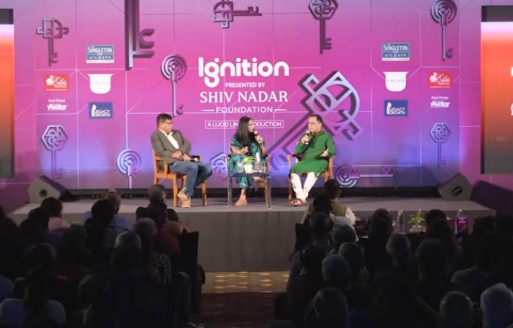
EDITOR’S NOTE: In a searching conversation hosted by Shoma Chaudhury, constitutional lawyers Saurabh Kirpal and Arghya Sengupta confront a core question for any democracy: do citizens truly have the power to protest, or is that right quietly constrained by the State? They examine the gap between constitutional promises and lived reality—colonial-era laws, self-censorship, digital controls, judicial delays, and the coming fight over delimitation—asking what it takes to keep dissent alive rather than merely permitted.
TRANSCRIPT:
Introductions
SHOMA CHAUDHURY: (00:00:56 – 00:01:56) We have today 2 of the top legal minds in India. Both of them engage very deeply with the Constitution.
We have Saurabh Kirpal, who’s an advocate, who’s written many books. He was up for judgeship himself, and he’s written very interestingly, his latest book is Who Is Equal?
We also have Arghya Sengupta, who’s the founder of Vidhi Centre for Legal Policy. And he’s written a book called The Colonial Constitution.
As I said, both of them engage very deeply with the ideas of citizenship and constitution, and we are delighted to have them here today. Ladies and gentlemen, please join me in welcoming them on stage. Such subtle acts of rebellion is citizenship made of.
SAURABH KIRPAL: (00:01:57 – 00:01:59) All I can say is I’m thanking Singleton as well.
The Cockroach Janta Party and the Meaning of Citizenship
SHOMA CHAUDHURY: (00:02:01 – 00:02:40) So, as I said, the core thing we’d like to discuss today is the whole idea of citizenship and relationship with state.
In many ways, the perfect entry into that is the Cockroach Janta Party and the protests that we’ve all seen recently. They variously, depending on which end of the spectrum one stands on, one sees them as a breath of air, really reinvigorating democracy. Others call them anarchists. They’ve been called anti-nationals, supported by China, US, AAP, the narratives swirl around.
How do you see it, Saurabh? What is the lens that you would put on the young people of the Cockroach Janta Party?
SAURABH KIRPAL: (00:02:42 – 00:04:37) I think the young have shown us how the mundane has become exceptional in our country. It shouldn’t be difficult to stand up and say what you think. You shouldn’t have to protest for basic decent schools and expect to be beaten up because you’ve said something.
But over the last howsoever many years, we’ve become this country where raising your voice is seen as an anti-national act. Where demanding your rights is seen as asking a government who is meant to do charity by giving you rights, instead of demanding accountability.
So I think that’s really important what this Cockroach Janta Party has done. It’s shown us that it is possible, desirable even, to question the government and not face a consequence of immediately being labeled anti-national.
While there will be a small section of people, and it’s happening, that you call demagogic, Naxal, anti-national, but by and large you will not see in the government today a reaction that, oh, the youth are anti-national. They’re slightly scared as well. To the extent you’ve had a few discordant voices within the government initially calling these anti-nationals, that’s all disappeared.
And what that shows me is what it means to be a citizen in India. We all are citizens. What is a citizen is quite a simple question. You are born here, you have citizenship, Indian passport, though of course there’s doubt about that as well, whether passport is citizenship. But to be a citizen in a democracy means more than just being able to vote every 5 years. It means the ability to interact with the state as a stakeholder. Ask your rights, demand answers.
ARGHYA SENGUPTA: (00:04:39 – 00:04:40) These are—
SAURABH KIRPAL: (00:04:41 – 00:05:20) live in a democracy where you can breathe freely. I’m not just talking about the pollution, which we all can’t breathe freely. But there has been an atmosphere of oppression. How many of us now self-censor our social media content? We all know what has happened with the press and the media. Calls go out, don’t do this. So there is this atmosphere of not speaking out so as not to offend. That is not citizenship, that is slavery.
So I think the Cockroach Janta Party has shown us the art of what is possible. That’s what I’d say.
SHOMA CHAUDHURY: (00:05:21 – 00:06:13) It’s interesting you said that because recently one of them used this phrase that “The India Against Corruption” was a movement against corruption. They’re framing themselves as a movement against suffocation. So it’s interesting that you said that.
Vis-à-vis the demagogic Naxal comment, it’s not a small section. It’s some of the leaders themselves of government, the highest officers that have used the phrase. So it’s very important really to analyze that and where that’s coming from as well.
So I’ll come back to that, but Arghya, I wanted to bring you in. Again, just to understand first the initial frameworks, like I said, there’s a large section or a voluble section of the media and government that have positioned the Cockroach Janta Party as anarchists and anti-nationals, and others who see, like Saurabh, as a breath of air. How do you position it and what lens would you bring to these protests?
ARGHYA SENGUPTA: (00:06:14 – 00:06:36) I think before I answer that question, I saw that the last time you had Saurabh on Ignition, you had J Sai Deepak as his sparring partner. So I was just telling Saurabh that I’m going to disappoint the audience here today, because I’m not going to disagree with most of the things that Saurabh says. I also don’t have that social media following that he does. But I have written a better book, which you can buy outside.
SHOMA CHAUDHURY: (00:06:36 – 00:07:02) But since you’re giving these caveats, I do want to say that if they happen to get very synergistic, that was not the design or intention.
ARGHYA SENGUPTA: (00:07:02 – 00:07:29) Well, at least I promise you an exciting discussion, because I can speak freely about what Saurabh just said. And I think, despite the caveats, actions speak louder than words. So while, of course, there have been people who have said, as far as the Cockroach Janta Party is concerned, that this is anarchists, this is the deep state, this is Pakistan, and so on and so forth. But the fact is that I think the reaction to the Cockroach Janta Party and the resignation of the education minister does show fundamentally—
SHOMA CHAUDHURY: (00:07:29 – 00:07:30) Can you speak into the mic?
ARGHYA SENGUPTA: (00:07:31 – 00:09:41) Does show fundamentally that democracy is alive and well in India, okay? That at its fundamental underlying level, there is a small movement which is on Instagram, which becomes a Jan Andolan over a period of time, where very close to the Prime Minister’s residence, there is an open protest that happens against the government.
Now whether you agree with them or you disagree with them, whether you like the language they use or you disagree with that, the fact of the matter is that it shows that this — and as Saurabh said — is a country that fundamentally still values free speech, the right to protest, and that it does have positive outcomes.
I think the second thing that it has shown is actually the old-school power of pure political activism. Both of us go to court and are very familiar with the legal system, and whenever there are issues of this nature, people usually go and file PILs in court. And the fact is that in this situation we find that the court played a completely different role, completely innocuously, with the Chief Justice of India saying what he did and then clarifying it. But the fact is that the cat was out of the bag, and it showed that once you go to old-school political protest and it reaches people and strikes a chord and has a certain traction, then governments do listen.
Because at the end of the day, what is the one concrete outcome that you have seen after that? One is that the Education Minister has resigned. That’s the first immediate outcome. And what is the long-term outcome? The long-term outcome is that every minister in government is now on Instagram making reels.
So the fact is that this is something that is working, okay? And because people realize that actions speak louder than words, you’ll hear these comments of anti-national and demagogic, Naxal, and so on. But the fact is, where the rubber hits the road, people are serious that this is the youth of the country. There is disaffection amongst the youth of the country, and they need to be taken seriously.
Who Gets to Protest?
SHOMA CHAUDHURY: (00:09:42 – 00:10:53) Maybe I’m not as optimistic as both of you on this, because yes, it’s had wonderful outcomes, both not just in the resignation, but the fact that even the RSS chief said that engage with the young. And it’s not just stopped there, they’ve started the “School Theek Karo” campaign. And again, what they’re saying is that they don’t want to be the one-stop shop. They’re saying every citizen stand up and ask for accountability. So all of that is great.
But I would pull you back to the role of the courts, and I want both of you to comment on that. But secondly, Saurabh, do you think that there was something unique about this protest, which is that if it had remained a particular constituency — say Muslims or farmers or tribals or Dalits or any particular identifiable constituency — do you think the results would have been different?
What was unique about this was that it was children across the board, right from Arunachal to South Bombay. It was cross-strata, cross-economic strata, cross-geographic strata. So it quickly became something that you could not outlaw with phrases. But is really the principle of free speech available to everybody, the principle of protest available to everybody?
SAURABH KIRPAL: (00:10:54 – 00:12:30) Well, to the question as to whether it’s available to everybody, simply yes in theory, but almost never in practice. It’s all well and good to say that the Constitution protects your right to free speech. But if you say something and you’re afraid you’re going to be arrested the next day, that’s not free speech. You can go to court and get a judgment in your favor, but that judgment will come after 5, 10 years, by which time you’ve spent months in prison. No one wants to go to prison. They’ll self-censor.
But your earlier point about the nature of the protest and the distinction between the Cockroach Janta Party protests and the CAA/NRC farmer protest is that this was — sadly, or happily — a protest by the majority community. All other protests have been very easy to frame because it dehumanized the person as the other. You’re a Muslim, you’re not part of us. You’re a farmer, I have nothing to do with farms. So it was very easy for the government to run this divide-and-rule policy that has been going on. But when it becomes part of the majority community, the community from whom you expect votes, that’s when accountability happens suddenly.
This government has not become accountable because of the voice of the people. They become accountable because they fear the electoral impact of what will happen if they do not address these issues.
SHOMA CHAUDHURY: (00:12:31 – 00:12:31) Issues.
SAURABH KIRPAL: (00:12:32 – 00:14:25) So, to Arghya’s point, free speech is really meaningless if you use only the courts, the Constitution, and the statute book to protect free speech. You need to fight for it daily. You might need to go to Jantar Mantar. You might need to have the courage to speak out and say, come arrest me. All of us start tweeting, they’ll take down some tweets. But how many people can the government really come after? They can’t come after everybody.
As a collective conscience of our country, we become weak, we become scared, we’ve almost given up, thinking change is not possible because there’s fear everywhere. We’re always looking over our shoulder. I think that’s what the Cockroach Janta Party has done, is to show us that you don’t need to be scared, and if you are, deal with it. Every time you try to deal with oppression, you will be met with pushback. Tyrants do not just keel over and die. You have to push them.
So that’s also one of the lessons that I think Arghya so rightly pointed out, is don’t expect change and optimism that somehow social media will continue and there’ll be a change in the next 5, 10 years. There’s a beautiful saying that liberty is something you have to constantly fight for, to be free once you’ve tasted it, but it can be so easily taken away.
If you can’t even be bothered to send a different opinion in a WhatsApp group of which you’re all part of, because you’ll say, who can bother? Then what hope do we have for change? Unless we all wake up and fight, change would happen.
Protest and the Letter of the Law
SHOMA CHAUDHURY: (00:14:25 – 00:15:16) So, I want to come to both of you about the letter of the law, because, like we said, the other very unique aspect of the Cockroach Janta Party was the humor, the satire. It wasn’t an ideological battle, it was a lot of children really poking fun at the normal structures of power. That had its own resonance for people.
But as I said, the issue of protest itself — people who don’t agree with it would say that they did break the law, because by law you’re only allowed to protest by permission of the police or by permission of the government. And you’re only allowed to have 5,000 people at Jantar Mantar. So they broke the law, so police action was justified. So if you were now interpreting the letter of the law, what would you say to that argument? Are these restrictions themselves something that we now need to debate?
ARGHYA SENGUPTA: (00:15:16 – 00:15:19) Yeah, so there is something to that argument.
SHOMA CHAUDHURY: (00:15:19 – 00:15:24) May I just ask the consul for my phone because I can’t keep track of time, I left it there.
ARGHYA SENGUPTA: (00:15:24 – 00:15:41) Yeah, so I think there is something in that argument, that according to the letter of the law, there might be some violations. But I think according to the letter of the law, maybe even having this event here in Gurgaon with 500 people, there might be some violation because there might be some fire safety norm that has been violated.
SHOMA CHAUDHURY: (00:15:41 – 00:15:43) It’s all observed.
ARGHYA SENGUPTA: (00:15:43 – 00:15:47) I’m not sure, Saurabh might look into that. Yeah, because see, the thing is—
SHOMA CHAUDHURY: (00:15:47 – 00:15:49) Saurabh, you Trojan horse.
ARGHYA SENGUPTA: (00:15:50 – 00:20:05) So while this may appear like a facetious point, the fact is that in India, the law has always been an instrument to oppress. It is not an instrument to serve. And I think that fundamentally is because of the fact that we have what I, in my book, call a colonial state. Gandhiji had said a long time back that yes, you may get the English out, but what you will have is Englishstan and not Hindustan, brown sahibs and not white ones, if you don’t change the fundamental architecture of the law. But the fact is that we haven’t changed the fundamental architecture of the law. The law is essentially meant to ensure that citizens stay in their place, okay?
So as far as the argument is concerned, I’m sure there is a legal violation if there was an order that said that only 5,000 people can protest at Jantar Mantar. I don’t know about the basics of that order, but if there was, yes, there was a violation. But the fact is, I think we need to look at that law itself, and we need to look at whether that law is in consonance with the democracy that we want to be. And I think there the answer to me is a firm no.
Because the fact is that the Cockroach Janta Party came and started protesting. If you saw the first few days, and then Sonam Wangchuk came on, but by the end of it, it was not as if the Cockroach Janta Party was anchoring that protest. And I think that is why some people actually had some fears that this may be taken over and it may become anarchic. Maybe. And maybe the government had those fears too, which is why you saw the action that the government took. But the fact remains that it had become what we would colloquially call a Jan Andolan at the end of it. Everyone was there for some cause or the other. It may have nothing to do with education, it may have nothing to do with corruption or suffocation or anything else.
So the fact is, these are moments when we have to fundamentally question what is the law for. And if the law is not meant to make our lives easier, if the law is not meant to order society, then we need to rethink those parts of the law. So something that I always say is that when you are looking at law reform, don’t look at enacting new laws, look equally at repealing laws. Because we’ve got this whole set of laws that exist right from colonial times which continue to exist today, and they are actually seized upon by governments across political parties.
We always see a lot of hue and cry around sedition. There’s a lot of hue and cry around preventive detention. Where are these laws coming from? These laws are coming from the colonial times. If we look at the preventive detention law, which is essentially the law by which a person can be put behind bars without any FIR, any arrest, any questions asked — the police can just pick up a person and put them in prison — where does that law originate? That law originates in the famous Rowlatt Act, which Gandhiji had termed a Black Act, and had started the non-cooperation movement.
But what happened when we became independent? We said, no, we actually need this law. We found some justifications. And what happens today? Every state in the country has its own version of a preventive detention law called the Goondas Act.
So I’ll give you a real statistic. The total number of people arrested in India every year is about 61 to 62 lakhs. This is on the basis of NCRB data. The total number of people who are just picked up and put behind bars under preventive detention is 88 lakhs. So there are more people who are picked up, thrown without any reason for 2 days, 3 days, a week, sometimes a month, up to a year without any reason whatsoever, in comparison to the people who are actually charged of offenses.
So I think there is a fundamental reason for us to think about these laws and why they exist. And this is not a question about the BJP or the Congress or anyone else. This is a fundamental question of citizens versus the state. And I think as citizens, we need to ensure that laws work for us and not the other way around.
A Colonial Constitution?
SHOMA CHAUDHURY: (00:20:06 – 00:20:20) So do you agree with Arghya on the fact that we are a colonial constitution — I’ll come back to this specific thing of protests, but first do take that on. Do you think that we are a colonial constitution in itself?
SAURABH KIRPAL: (00:20:21 – 00:20:30) I’m not a fan of absolutes. It’s easy to have striking titles of books and then proceed to sell a lot of them.
SHOMA CHAUDHURY: (00:20:30 – 00:20:35) You can see there’s a marketing war going on here. Both their books are for sale outside.
SAURABH KIRPAL: (00:20:37 – 00:22:47) You should read Arghya’s just to know why you should read mine instead. But yes, there are certain elements of a colonial hangover. I wouldn’t go so far as to call the Constitution a colonial Constitution. It has been transformative, it’s been revolutionary, it’s brought change, it’s promised change. Whether it has brought change or not depends on the actors implementing that.
The point of agreement that I have with Arghya is that we live in a society which is hierarchical and all about control. The grandfather will control the family, the husband will control the wife, the parents will control the children, the rulers will rule. It’s a bit bizarre when you think why we call our rulers rulers. They’re not kings, but we accept that. We think that somehow they have the divine right and we don’t. We have to go and beg them for rights that should just come to you within any other country.
It’s this hierarchy, this looking up to something who’s superior, and it’s very convenient for any government. It’s not just a question of colonial or whatever else. All governments intend and like control. We just have adopted a mindset, internalized it, where we started believing in these structures of power. And that’s unfortunately also filtered into the courts. When you go to court, sometimes, when they’re giving you rights and ruling in your favor, it’s not as though you’re a citizen and you deserve those rights. It’s almost with an intention that, all right, you can have this just now. There’s a negotiation that happens, that you take this right but you give this away.
Rather than allowing rights their full freedom, allowing individuals to live to the fullest extent possible, we’ve become a society which is completely controlled at every level. And that’s why this rebellion by the Cockroach Janta Party is even more important. This is a generation of people who are not so willing to accept control.
ARGHYA SENGUPTA: (00:22:47 – 00:22:48) That’s—
SAURABH KIRPAL: (00:22:48 – 00:23:30) That we can discuss, that’s a matter for politicians and other analysts rather than for lawyers to discuss as to why this generation has done that. But I can assure you, when you go to court, coming back to the point of control, judges don’t see rights as something that inheres in a person. It’s very much a matter for discussion about how do we control, how do you have — you can’t have unrestricted rights, there must be a balancing. Why all this talk about balancing? Balancing is an exception. The first role of the court is to protect the right.
But coming back then to the transformative constitution, as you asked, my disagreement with Arghya, because we must have some fun.
SHOMA CHAUDHURY: (00:23:31 – 00:23:51) No, no, this is not a TV debate. No disagreement for fun. It’s just — I find it an appalling construct really that you can watch these kind of gladiatorial battles on television where the speculative journey to non-truth becomes national television. I don’t agree with that.
SAURABH KIRPAL: (00:23:51 – 00:24:34) Just one point and I’ll leave it at that. This Constitution does contain the preventive detention provisions that you’re talking of, but for that one bad part of the Constitution, we have a host of promises of equality, of freedoms, of life, liberty, justice. We have a commitment to secularism. In a country that was ravaged by partition, when it was so easy to hate the other, our lawmakers saw promise and hope. So the Constitution is transformative, but the problem is in its working by people who are less than the giants who framed the Constitution.
SHOMA CHAUDHURY: (00:24:36 – 00:24:36) It’s—
SAURABH KIRPAL: (00:24:36 – 00:25:03) Some people say it’s a government of the uncles, by the uncles, for the uncles. Apologies to all the uncles here, including myself. But I think sadly, in courts and in politics, it’s become of the pygmies, for the pygmies, by the pygmies. No one has the imagination. And this desire to just control is always the mindset of a terrified and a small person.
Restrictions on the Right to Protest
SHOMA CHAUDHURY: (00:25:04 – 00:26:35) So, to both of you — and I would agree, because if we speak of the Constitution as a colonial document, there’ll be a great impulse to throw it out now, given that there are impulses to rewrite the Constitution, I think we should remember what is wonderful and glorious about it. You mentioned some. I would say, Arghya, our Constitution also gave universal adult suffrage overnight, with no caveats, and that’s not something either the US or UK did till much later into their life. So there are many aspects of it which are wonderful.
But I want to narrow this down to protests, because that’s the fundamental relationship that citizens have — how do you articulate dissent. And today both of you agree, but I would like one of you to wear the hat that if someone from a government or from a different perspective to yours was sitting here, what would they say about the fact that the protest itself, the right to protest, is restricted by the Constitution? Article 19(2) has all these restrictions which are part of the Constitution. Also, they’ll say that if you allow everybody to protest, then it will veer to anarchy. This one worked out well, they were speaking about education, it’s not something you can argue about. But what if everybody took to the streets? So there will be those who’ll say it’s anarchic and that there are restrictions by the Constitution on protest. So what do you say about that? Do we need to relook at Article 19(2) and the right to freedom of speech and protest?
SAURABH KIRPAL: (00:26:37 – 00:28:51) No, look, we don’t have rights in the absolute. We live in a community. You can’t have the right to free speech, you can’t go to a cinema hall and shout fire and say it’s my free speech. You can’t have a protest and become cowboys and break cars and — oh, sorry, you can do that. Protest is a fundamental right of everybody, but it has to be regulated.
My concern is that in the garb of regulation, you’re indulging in prohibition. It is the responsibility of the state to ensure that the movement and the protest stays peaceful. You do that by allowing the protest to happen. When it veers towards disorder, you intervene. You don’t have an anticipatory belief that this will become a violent protest and stop anything in any case. That’s just a convenient cop-out of oppressing people and stopping democratic dissent.
There are means and ways of controlling. The Constitution does recognize morality, public order as reasons and manner for which you can control protests. You don’t have an absolute right. I can’t just block a road tomorrow and just say I’m protesting here. You don’t have that right. Public order is also needed.
But I think when you go to court — again, I’m a lawyer, so I’ll keep on thinking about that — the intention often of judges, rather than focusing on the right that is being curtailed, is on these exceptions. They’re trying to see where is the public interest, what does morality say, rather than limiting the right and recognizing the right first, then recognizing that’s a limitation. The limitation becomes a talking point.
How many protests have we had in India which have turned so violent? Not many. And yet protests happened all the time under the British, which were probably not stopped. Are we saying that the British Raj was more democratic than what we have become today? When did the Salt March happen? When did the greatest non-cooperation battles happen? We could protest then. Why can’t we do it now?
SHOMA CHAUDHURY: (00:28:52 – 00:29:31) So, Arghya, coming back to this issue of protests, would you agree — I’ve heard BJP youngsters say that the very purpose of protest is to cause inconvenience. Those who oppose them will say that, but you’re supposed to protest without affecting the civic life of others. You shouldn’t block roads, metros shouldn’t be stopped, you shouldn’t inconvenience others. And their point is that we can’t ask for permission from the government whom we are protesting against. And if protest is not theater, if it does not catch attention, then it’s no protest at all. So what do you think about that?
ARGHYA SENGUPTA: (00:29:31 – 00:32:41) Yeah, 2 points to that. I think that the Supreme Court gave a fairly balanced judgment in relation to the Shaheen Bagh protests, because you remember that unlike the Jantar Mantar protests, which were in a designated site, there were more people than perhaps that site could contain. But Shaheen Bagh was on a public road, and that protest had gone on for a considerable period of time. And the Supreme Court recognized the right of the protesters to protest there, but said that it must be done in a fashion that does not unduly inconvenience the public and cannot go on indefinitely.
Now, my point is that there is something to that, because this is a case where there has to be some amount of balancing, because we can’t get carried away in the romanticization of a protest as being the thing that will save India. But there has to be some element of balance that has to be brought in. Now, the point is, where is that balance drawn?
As far as Article 19 of the Constitution is concerned, which has the restrictions on free speech and protest, those exceptions are very wide. And there is a reason why it’s wide, which I think is a design flaw in the Constitution, because the framers of the Constitution believed that the judges of the Supreme Court and high courts will uphold the right and not the exception. And that is what Saurabh has said has turned on its head over a period of time. Not always, but over a period of time, judges are unfortunately looking into reading the exceptions widely and the rights quite narrowly. And I think that is why the Constitution’s design flaw is becoming quite apparent. So I think there is a need to reconsider that.
So to your initial question to Saurabh, that if someone were to come and say that this is in violation of Article 19 and the right to protest, perhaps I would agree with them that it is perhaps not entirely valid. But I think that really misses the wood for the trees, because this is a country, as Saurabh was saying, that if we had so much fear of anarchy we wouldn’t have been an independent republic, because the only thing that made us an independent republic was anarchic action, a completely anarchic idea.
And whatever else you may think of Gandhiji, the fact is that over a period of time, his faith in the law reduced significantly. And if you look at it from Hind Swaraj right up to the Constructive Program, he was really speaking a language that was much more anarchical. And the fact is, what was that anarchy about? It was not only about protest against colonial rule, it was protest against injustice. And I think if we see injustice today, whether it is in folks not getting jobs, whether it is in NEET exams not happening properly, wherever we see injustice, I don’t think it is just the fact of whether we have a right to protest. I think it is our duty to stand up.
Peaceful Protest and the Duty to Act
SHOMA CHAUDHURY: (00:32:42 – 00:33:30) I just want to play out some of the antithetical arguments to this, because we don’t have that voice here. So I want to play out the voices that I hear otherwise. And that is that many people who do not agree with this, or who are very aligned with the government’s culture of democracy, say that this is not a colonial state, so they’re very anti even the peaceful fast.
Say Sonam Wangchuk was picked up by the NSA — the Cockroach Janta Party was protesting very peacefully, but they’d gone on a hunger strike, and they said that that moral device could be used against a colonial state, but this is an elected state, and so it is not the correct form of protest. What would you say if there was someone like that sitting here today?
ARGHYA SENGUPTA: (00:33:30 – 00:35:45) Well, if it’s an elected state, then I have even more right to do it, because that is why you are an elected state, that you are a democracy. So in that sense, we are citizens. And what is citizenship? Citizenship fundamentally is the right to have rights. So I can do and say what I please because we are a free country. I don’t have to wait for 5 years for the elections to do that.
Of course someone can say that, but that is on the basis of a number of factors. So are you saying that if I see injustice in front of me, if I see a young woman being hauled away or being paraded naked in front of me, you’re going to tell me, no, wait for the elections 5 years later and then get this MLA voted out? The fact is, I think it’s a very simple point here — this is not about — and I think people who support this government have arguments here, but I always believe that actions speak louder than words.
And I think the Government of India understood this very well, which is why you find that the protests were handled in a very statesmanlike manner. The protest came to an end, a resolution was reached, the education minister resigned, a reform committee was announced, and some further steps are awaited. So actions speak louder than words, that’s point number one.
And point number 2, which I think is equally critical, is that in a free country, I think it’s important to double down on this idea of duties. This is an idea that governments have liked very much. Indira Gandhi, in her famous 42nd Amendment, introduced a set of fundamental duties in the Constitution. Prime Minister Modi talks about duties constantly. But I think there is something fundamental to the idea of duties which can be incredibly powerful for citizens. It’s currently seen as, oh, duties in the Constitution mean citizens have to stand up when there’s the national anthem, or the national song, and make sure that you don’t disrespect the flag, and so on and so forth.
But duties don’t have to be like that. The duty is, at the end of the day, as Swami Vivekananda said, the duty to follow your conscience. And I think there is something to that idea which the Cockroach Janta Party showed all of us — that in our small ways, whether it is in our WhatsApp groups or whether it is at Ignition, we must do that.
Big Tech, Safe Harbor, and Sovereignty
SHOMA CHAUDHURY: (00:35:49 – 00:37:18) I want to take — before we go to delimitation and this whole idea of who is a citizen, since none of us are sure anymore in terms of documentation and counting — I want to approach 2 or 3 more facets of this. One is that online, and you focus very deeply on the digital economy and digital laws as well.
Right now, all the intermediaries — Meta and Twitter and all of that — they have a clause called safe harbor, which protects them from what any of us are posting. The companies are not liable. But even that safe harbor has become very narrow. And to my knowledge, and correct me if I’m wrong, the government has a website called Sahyog. And there are thousands of takedown requests that the government sends to the companies.
Earlier, the government had to articulate what is the show cause, what is the reason, the company would analyze it, there’d be a discussion, the person whose post is being taken down would be intimated, and then it would be taken down. But now, because the requests are so many, there’s actually an algorithm. It’s a machine-to-machine discussion, and because the government has brought it down to 2 hours — you have to take it down within 2 or 3 hours — the companies are not bothering. It’s just a machine demands it, a machine answers, and your citizenship is eroded. What do you have to say about this, and how can it be averted?
ARGHYA SENGUPTA: (00:37:19 – 00:41:27) Well, not just your citizenship, but Prime Minister Modi’s own Facebook post on the protest was deleted, supposedly accidentally, by Facebook. Because that’s what happens when you have an algorithm that decides whether something should stay or not.
So I have a slightly different view on this matter. The reason why the safe harbor exception came into being in the ’90s in the US was that there was a tiny little company which wanted to post some videos. And the videos were not created by themselves, they were created by other people. And the moment you have a platform which posts things created by other people, people can be not nice to each other, they can defame each other, they can be abusive to each other, they can circulate things which shouldn’t be circulated. So they said, we can’t be held liable for what these people are doing, we will not be able to survive as a company.
So the American government had some sympathy for that point and said, okay, you’re going to get a safe harbor — you’re a small company, you’re not going to be responsible for what people do on your platform. That company was then a startup called YouTube. Today, of course, it’s a completely different story. But the safe harbor still exists, and it’s made use of by the largest of corporations with the largest of legal teams, because now they don’t want to comply.
So if you were to take a simple example — why do newspapers have editors? Because newspapers are responsible for what they publish. And at the end of the day, the editor can be held liable for something that gets published in the newspaper. And the fact is that this is essentially the same rule, in my view, now that the platforms have reached the scale where they are the newspapers of the digital realm. The same rule must apply.
So platforms can’t have it both ways. Either, one, they are responsible for the content that they produce, so they need to ensure that there are some rules of the game, just like newspapers — you can’t say whatever you want in a newspaper. Or two, they say that we do absolutely no moderation, no filtration whatsoever of that content, which everyone in this room knows is not true. Everyone knows that there are algorithms that are pushing certain content towards you because it is looking at your feed. So there is a very active role that platforms play.
So I have 2 points. One, I think that as far as the question of safe harbor is concerned, we really need to have a debate as to whether the safe harbor principle needs to stay at a time when it is benefiting the largest corporations, which are global Silicon Valley corporations. That’s point number one.
Point number 2, as far as your takedown requests are concerned, I’m not commenting on any specific request. There could be some requests which are out of line and some which are not. But fundamentally, the issue between government and big tech platforms I see as an issue of sovereignty. Now, the 5 largest tech corporations in Silicon Valley have a bigger market capitalization each than all but 11 countries in the world. So they are essentially nothing but fairly large nation states. And they are choosing to comply with your rules at this point of time because it is of benefit to them.
Go and ask a government in Ghana — and I’m giving Ghana as an example because their rules were recently not followed. Go and ask a government in Myanmar. It’s Facebook that calls the shots, and it’s not the other way around. So the fact is that this is fundamentally a question of national sovereignty, which is who gets to lay down the rules. And as a citizen of India, and as a user of WhatsApp, I think that it should be the Government of India that lays down the rule. So there may be abuse, there will be some abuse, and we must ensure that those are checked and balanced. But fundamentally, the rules of the game must be laid down by elected governments and not unelected corporations that sit in Silicon Valley.
SAURABH KIRPAL: (00:41:28 – 00:41:28) Can I just—
SHOMA CHAUDHURY: (00:41:29 – 00:41:35) Do you agree with that? Because it’s such a complex terrain in terms of — yeah, why don’t you take that on?
SAURABH KIRPAL: (00:41:35 – 00:43:26) In an ideal world, what you’re saying may make sense, Arghya. But speaking of private entities — newspapers are privately owned with editors, our television channels are privately owned with editors. We’ve seen what has become of them. Just because you have an editor doesn’t mean the speech that is being broadcast on that particular channel or organization has any merit whatsoever.
There’s a democratization that has happened because of social media. There’s a freedom that has come in opposition to editorially controlled content. So to say that there will be another editor, and this time the editor will not be a person hired by a private company but will be the state, is far too dangerous. Because if that power lies within the hand of the state to censor, it’s never going to be used for the public good. You can be fairly certain it’ll be used to curtail voices of dissent, to the extent that there would be mayhem.
That is why you have defamation. If someone feels that they have been defamed, then please file a case against that person. Why do you need to go against YouTube? You can find the person. People go after these media companies because they have deep pockets, not because they are to blame. You can get money from YouTube, you’ll not get it from the actual defendant, so you go after YouTube. YouTube is really not to blame for the content that’s coming up. If some content comes which is going to inflame passions, use the criminal law and stop that. You don’t pre-censor or give the power to the most unreliable organization, namely the state, to control the citizen. I think that’s the problem I have.
SHOMA CHAUDHURY: (00:43:26 – 00:43:57) Again, we could really debate this a lot more, because you’re right — like the Cockroach Janta Party protests itself, the memes by children, would not have been allowed to — the thousand blossoms would not have blossomed if it was the government. Or indeed, if you look at even national television, they weren’t even covering the protests for many days till the sheer force of the children’s memes and posts. It was a raw, unfiltered sort of information about what was happening. So, I agree with Saurabh that—
ARGHYA SENGUPTA: (00:43:58 – 00:46:09) So I think I should clarify my point. My point is not that the government sits and decides in terms of what content should go up or not go up. Not at all. That is basically censorship, I’m not arguing for that. What I’m saying is that as far as the media platforms are concerned, they are in a position of great responsibility. And they are certainly the facilitators of freedom. And I think he’s absolutely right to say that there is a certain democratization that has happened, which wouldn’t have happened only with the news media, with private editors. And I’m all for that.
But the fact remains that this is a dangerous and slippery slope, because at the end of the day, these are unaccountable corporations. And you’re absolutely right in saying that today the government shouldn’t call the shots, the government shouldn’t say what you get to see and what you don’t get to see, I’m not saying that. I’m simply saying that the government should be in a position to send takedown notices which must be complied with quickly, even if it is with AI-assisted software, to ensure that it is the government which ultimately is the protector and guarantor of citizens’ rights.
Because there are 2 things that are different between the government and a tech corporation. The first is that a tech corporation is sitting in the United States or in China, it is not in your jurisdiction. There is no education minister who can resign, no CEO will be made to resign because of a protest. That’s point number 1.
Point number 2 is that we have to realize that life is a bit cyclical, and with President Trump, we have gone back to a situation of geopolitics where countries are looking out for themselves. I’m just going to quickly stop in 20 seconds — the fact is, you saw with Anthropic that one export control order from the United States meant that no user here could use a certain AI model. So the fact is, we must realize that at this point of time, countries have to lay down the rules for tech cooperation.
Free Speech, Media Accountability, and Fast-Track Courts
SHOMA CHAUDHURY: (00:46:09 – 00:47:35) We have only 10 minutes, and we haven’t even started on delimitation. But I think the point that both of you brought up — can we then come back to the point I made right at the beginning, which is a much more thought-through definition of the grounds on which your free speech or your protest can be restricted?
This is where I don’t agree with how the Constitution has framed it either, because, to your point, the government can ask you to take down things if you’re inciting violence. That incitement to violence should be very clear — what is incitement to violence. Again, with you, I don’t agree that defamation is enough, Saurabh. I think that we want a very free press, but what if the press itself has become oppressive? Ask Aarushi Talwar’s parents, ask Rhea Chakraborty, who went to jail because of the way she was vilified on national television. Not everybody has the resources to fight a 10-year battle on defamation.
So I think, whether it’s television media, a newspaper, or YouTube, if they are allowing content that is a direct incitement to hatred and violence, or someone demonstrates to you that this is false and is empirically false, then there should be recourse. Justice Shah had had the Media Commission. I think today the mainstream media in India themselves have a lot to answer for in terms of what constitutes freedom. So what is your take on that?
SAURABH KIRPAL: (00:47:36 – 00:48:21) Well, I mean, I just say — if you want to control, look at the US. There’s far less control there of the media and social media than exists in India. There aren’t multiple takedown orders. That’s not a society that’s descended into chaos with defamatory statements being made left, right and center. You need to reform your legal system so that defamation is quick, remedy is effective. That requires effort.
Now, just because it’s tough to reform the legal system doesn’t mean I’m going to oppress your rights because it’s too tough to go to court for defamation. I’m sorry, you fix the courts. That’s the answer. We in India have become too used to easy solutions to very complex problems without investing in the things that need to be invested in.
SHOMA CHAUDHURY: (00:48:22 – 00:49:25) I’ll shift gear now, because like I said, there were so many issues we haven’t even started on, but this is a good moment to segue into that. You said fix the courts. I’d like to share with the audience that on the SIR in Bengal, more than 34 lakh people have been disenfranchised. Now, not only are they not allowed to vote, they’ve also, to my knowledge, been denied — the welfare benefits are not going to be available to them. And the courts themselves said that it’s going to take 21 years to adjudicate on all the petitions that there are.
So, when you’re saying reform the courts — even when Prime Minister Modi said we’ll set up fast-track courts — I think the argument was that fast-track courts means what? We have a backlog of millions of cases. So I do think that we needed a new recourse for those who are harmed by the media, whether on social media or on mainstream media, and we need deeper thought around this. It can’t be the courts only.
SAURABH KIRPAL: (00:49:26 – 00:50:22) How many wheels are you going to invent? Every time there’s a rape in India, you have a law which makes rape tougher. Every time there’s a problem with education or paper leaks, you make a law for fast-track courts for NEET. You need to spend money on education. You need to spend money on health. You also need money to fix your legal system. You just need to increase the GDP, set up far more courts. The judge-to-population ratio in India is abysmal.
There’s something odd that we’ve just accepted the fact that we think courts will take their own time to deliver justice. Why is it that we are in protest over everything else about inefficient services — there’s lack of electricity, there’s sewage in our — but why are we not complaining about courts not giving us justice? Because that will solve a lot of problems.
Terror Laws and Judicial Appointments
SHOMA CHAUDHURY: (00:50:23 – 00:51:37) No, I’m saying about reform of the courts, but I want to bring up delimitation because it’s such a huge issue. Before that, just — the National Security Act and the UAPA, which are terror laws. I wanted your perspective on this. Recently the NSA and UAPA are being invoked on ordinary citizens. They were meant to be anti-terror laws.
It terrifies me that Section 15 of the UAPA now defines terror as, if you’re restricting supplies or services, essential services, or if you are disturbing the civic life or social life of the nation. This is such a broad statement — an individual can be called a terrorist, it no longer has to be an organization. And this is the description of what terror might be, and there’s another clause, “or any other manner.” That’s like an open book. Any one of us could be called a terrorist. So what is the court’s position on this? Is this being discussed? And what’s your own opinion on it?
ARGHYA SENGUPTA: (00:51:39 – 00:53:38) Well, my own opinion on this is that the Congress enacts and the BJP implements, right? So these are all Congress-enacted statutes. The PMLA also is another example. The UAPA, the UAPA Amendment, and the PMLA — all of them are Congress-enacted statutes which the BJP has now considered an important part of their toolbox.
And the fact remains that this is where — apart from everything else — these are not complex legal cases. These are extremely straightforward, that you cannot use words which are of such wide import in a criminal statute. This is something that any first-year law student knows: a criminal statute must be read very narrowly because it is the life and liberty of individuals at stake. So the fundamental question is that this is the failing, the complete and utter failing of our Supreme Court and high courts in regard to these terror statutes.
And do I see hope? I’m always an optimist, and there is a 3-judge judgment in Vijay Madanlal Choudhary, which was one of the judgments from the Supreme Court, which the less said about it the better. But I think the Supreme Court itself knows how wrong that judgment was, and I believe — Saurabh may correct me — that there was going to be a review of that judgment. I don’t know what’s going to happen as far as that is concerned, but I think, to Saurabh’s point, we need to think about who our judges are.
In the last 2 months, there are 5 people, and I’ll give you their names — I sometimes forget them myself. I know you’re rushed for time. Thirty seconds. Five people, their names are Mohana, Paldi, Sachdeva. Help me out with the other two.
SAURABH KIRPAL: (00:53:39 – 00:53:39) What point are you making?
ARGHYA SENGUPTA: (00:53:39 – 00:53:42) Okay, see, he doesn’t even know who I’m talking about.
SHOMA CHAUDHURY: (00:53:42 – 00:53:44) He’s asking what point you’re making.
ARGHYA SENGUPTA: (00:53:44 – 00:54:03) Yeah, but he also doesn’t know what I’m talking about, because these are three people who have been appointed to the Supreme Court as judges in the last month, and there are two others whose names I’ve forgotten and whose names Saurabh has also not recollected. But the fact is, I may have made my point, but the fact is we don’t know who these people are.
SHOMA CHAUDHURY: (00:54:04 – 00:54:09) What do you mean by that, Arghya? I don’t think any of us are getting the point. Are you saying that they don’t deserve to be judges?
ARGHYA SENGUPTA: (00:54:09 – 00:55:14) I don’t know who they are. I don’t know who they are either, but they are going to be judges of your Supreme Court. The fact is everyone in the room here who is well read should know what their judicial record is, what kind of cases have they argued, what does their record look like, what have they won, what have they lost, which high courts are they coming from? What is the reason that they are there and why some other people like Saurabh Kirpal are not there? These are all questions that need to be asked. We don’t know who these people are, we don’t know how people are getting selected.
And I think the most important reason is the fact that today I’m calling him Saurabh and I’m not calling him Justice Kirpal is because of a complete failure of our Supreme Court. They have a situation where they have reiterated a recommendation of Saurabh to become a judge of the Delhi High Court. According to the law of the land, the government must appoint him as a judge of the Delhi High Court. The government has not said yes, not said no, and has sat on it. But the fact is that the Supreme Court is sitting and seeing this violation of law happen constantly, Chief Justice after Chief Justice. I still get to call him Saurabh, which is the only silver lining here. But this is the failure of our Supreme Court.
SAURABH KIRPAL: (00:55:16 – 00:55:17) And I still get to earn money.
Delimitation and Federalism
SHOMA CHAUDHURY: (00:55:19 – 00:56:26) Right, so I just want to shift to the delimitation bill, and now I’m going to ask you both for very concise answers. The delimitation bill, just to share very quickly, is a really big issue because at the heart of it are 2 constitutional principles — the individual vote and the representation of the state. Both are up in contention, and the delimitation commission doesn’t even come under the courts, it’s going to be an independent authority on its own.
For the time being, the bill has been defeated, but for 50 years there was a freeze on it, and now that is going to get unfrozen automatically. So this is an issue now where the southern states could lose their seats in Parliament because they observed population control, they have been progressive, they’re contributing more to the GDP. So there’s a citizen issue, there’s a federal issue, and there’s a fiscal issue, because they are contributing more to the country and getting back less. So it’s a very, very big issue that is coming towards us. What’s your take on what would be the creative response on this?
SAURABH KIRPAL: (00:56:26 – 00:57:48) I think this has become even more relevant because of the systemic undermining of the federal state over the last 80 years. If we were a truly federal state, with the powers which should really vest in the provinces, in the states, then representation in Parliament would matter a little less. If you had complete control of your own finance, your own law and order, your own — you were a mini state as it was originally intended — then who you send to Parliament, those numbers coming down, wouldn’t matter, because that state is self-governing.
But over the last 80 years, we’ve seen a kind of creeping acquisition of authority by a very strong center. So now the PMLA has effectively meant that all matters of law and order which were otherwise handled by states are now handled by the Enforcement Directorate, the central government. All taxes and entry taxes which a state used to generate revenue now go into the GST. Other taxes go to a Finance Commission which will decide how much the state will get. The state is now a vassal of the center.
So then representation becomes very important. You cannot at that point say that I’ve been effective in — I’ve had far more people, therefore I deserve an equal vote. There should not be proportional representation that way.
SHOMA CHAUDHURY: (00:57:49 – 00:58:05) Because these states which are economically otherwise very powerful — and I’ll wrap up quickly. No, I just wanted to check with the audience how many are familiar with the issue of delimitation. Would you put up your hand? Okay, so everybody knows about it. Yes, please continue.
SAURABH KIRPAL: (00:58:05 – 00:59:29) So of course the states in the South which have been very effective in family planning, and have a consequent bump-up in economic growth as a result, will now be underrepresented in Parliament. Not underrepresented — they will still be represented in terms of the proportion of the population, but they’ll have less political power. And that political power is necessary if they want to ensure that there is future fiscal growth in their state.
Now we need to just remove this from the equation. We need to ensure that we go back to a system where states are autonomous, self-governing, have substantial powers, are more responsive to the needs of its citizens, rather than someone sitting in Kerala or in Assam thinking that there’ll now be 900 members of parliament — 850, and then with the Rajya Sabha there’ll be even more, there’ll be over 1,100 members of parliament, none of whom listen to you in any case. How many of you have written a letter to your member of parliament and expect a response? So if 545 don’t respond, 850 will not respond. The government is not going to get more responsive. What will become more responsive? A stronger panchayat, a stronger municipality, and a stronger state. That’s what needs to happen. These are just diversionary topics.
SHOMA CHAUDHURY: (00:59:30 – 01:00:32) But Arghya, would you — again, from the point of view of constitutional law, there’s a suggestion I thought which is a very creative suggestion, similar to what Saurabh is saying — which is to freeze the number of seats in Parliament proportionately as it exists right now. The Home Minister had promised a 50% increase for everybody, but they said it verbally when they gave the bill, it was not in writing. So obviously there’s a lot of worry and fear around it.
But a creative idea was to freeze the number of seats in the Lok Sabha but increase the number of seats in the state assemblies, because there are 2 principles of the Constitution here — federal, as well as individual weightage of a vote. And the third was that women’s reservation should come in automatically, as it already is. And fourth was that, like America, there should be 2 seats given to every state in the Rajya Sabha. Do you think this is a workable formula? Because, like we said, the bill is defeated, but it’s going to come up again.
ARGHYA SENGUPTA: (01:00:32 – 01:00:44) Yeah, so I think as far as delimitation is concerned, it’s a really complex issue. This is really not one for cocktails, it’s one for many single malts deep into the night. So maybe more Singleton, many more nights.
SHOMA CHAUDHURY: (01:00:44 – 01:00:47) But I’m very glad you’re giving them more of a plug than they asked for.
ARGHYA SENGUPTA: (01:00:47 – 01:03:34) Well, great. But I think the point is that delimitation is an issue that requires a political solution. And I completely agree with what the Home Minister had said in the House, and I don’t know why it was not moved as a bill — that increase everybody’s seats by 50% of what they are at this point of time in the Lok Sabha. I think it was a solution that was acceptable across the board.
I noticed that you do events in Gurgaon and Chennai, but perhaps this is one issue that both Gurgaon and Chennai would have said, okay, let it continue the way it is, because then the southern states don’t lose because of how this debate has been framed. And also, the northern states do not gain excessively. And we could look at a Rajya Sabha on the lines of the US Senate, and increase across the board in panchayats and state legislative assemblies.
But I think there is a fundamental point here — the nature of the public debate has failed, because the nature of the public debate has been largely around population control and states in the South doing well vis-à-vis states in the North not doing well. I think the fundamental question is, what do MPs do? The fact is that as taxpayers, as citizens, we spend 29 crores on each individual MP. Now, if you are going to increase it by whatever number — 50%, 30%, whatever — so if it goes up from 545 to 850, which is 300 more, 300 into 30 is what — 9,000 crores. 9,000 crores is what this is going to cost the exchequer. Why are we not talking about that? What is it that these people will do?
And as he rightly said, maybe they listen, maybe they don’t listen to letters that you write or may not write. But the fundamental point is that the House doesn’t function with 545 people. You look at the last session of the House, it functioned for 15% of its time. So if it’s got now 900 people, how do you expect this House to function?
And I think there is another structural issue. MPs are not individuals who are voting on the basis of their conscience. They are voting on the basis of a party whip that gets issued. They have to follow that whip because otherwise they can be guilty of defection. So the fact is, if they are going to follow the party line anyway, if you are increasing a few people, how does it lead to greater debate? How does it lead to better policymaking? What does that greater representation achieve?
And I think as citizens, and particularly as citizens in Gurgaon and Chennai, who are heavy taxpayers, I think this is the question that we should be asking: should we be spending ₹9,000 crores on delimitation?
Closing
SHOMA CHAUDHURY: (01:03:36 – 01:03:54) Thank you very much, both of you. I’m going to end it on that note. I had wanted to discuss Vande Mataram, but we’ll leave that for another day. But thank you very, very much for your insightful comments, and join us outside for cocktails and snacks. And we’ll come back for 2 more riveting sessions in completely different domains.
SAURABH KIRPAL: (01:03:55 – 01:03:58) Only after Shoma recites all 6 stanzas of the Vande Mataram.
SHOMA CHAUDHURY: (01:04:01 – 01:04:06) I can sing them for you. All 6? Yes. Thank you very much.
Related Posts
- Transcript: How Does Your Brain Know Where You Are? w/ Edvard Moser – World Science Festival
- Transcript: Sebastian Kurz Interview on Figuring Out With Raj Shamani
- Transcript: ‘China’s AI Revolution under Xi Jinping’ – Kevin Rudd’s ANU CIW Lecture, 2026
- Transcript: True History of the Middle East w/ Simon Sebag Montefiore on TRIGGERnometry
- Transcript: Abdul El-Sayed’s 2019 Commencement Address At The University Of Michigan