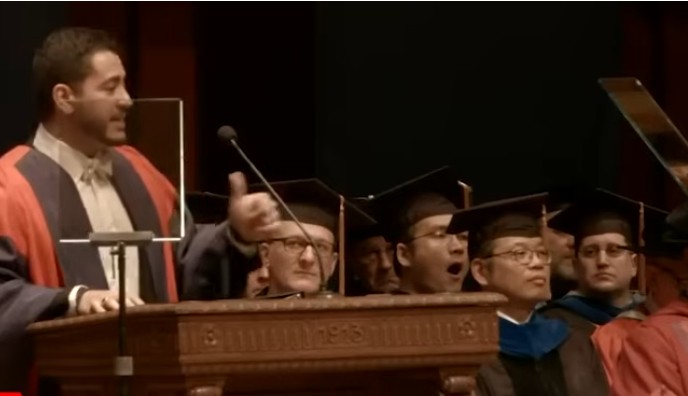
Here is the full transcript of Abdul El-Sayed’s address at the 2019 University of Michigan School of Public Health Graduation ceremony held on May 2, 2019 at Hill Auditorium.
EDITOR’S NOTE: In this powerful University of Michigan commencement address, physician and former Detroit Health Director Abdul El-Sayed draws on his Egyptian immigrant family’s story and his work fighting health inequities to deliver a stirring call to action. He challenges the next generation of public health graduates to reject institutional pressures, confront systemic racism and inequality, and prioritize moral purpose in service of the most vulnerable. The speech has gone viral for its raw honesty about what true public service demands.
INTRODUCTION
ABDUL EL-SAYED: Thank you so much, Dean Bowman, and welcome back to the University of Michigan. I am deeply honored to have been invited here to celebrate this incredible moment with you and your supporters. And the fact that this is a packed house suggests that everybody knows just how important this moment is, not just for you, but for the future you will build for us. But here’s the question.
Why Public Health?
By show of hands of the graduates, how many of you, when you were little and you were asked what you wanted to do, said “public health professional”? Me neither. After all, who wants a job where you almost never get credit for the stuff that you do, and you always get blamed when things go wrong? And it’s usually because the people who blamed you cut your funding in the first place. My sisters and brothers, welcome to the often exciting, sometimes weird, rarely appreciated, but always important world of public health.
You have chosen to be here today because you are called to serve, to dignify the lives of people you’ve never even met — you may never ever meet. There are few callings that can be more noble. But let me tell you today why I became a public health professional.
I grew up not too far from here in a suburb of Detroit, but that suburb wasn’t my only home. Like Lelo, our incredible speaker today — one more hand, please.
Teta
I spent many of my summers growing up just up the Nile there, in Egypt, where my parents immigrated from. And I’d spend most of my time on those trips with my grandmother, my Teta. Now she was the wisest, most intelligent person I have ever met in my life, but she never got to go to school. Experiencing something like this would have been so distant from anything she’d ever thought she might experience. She raised six kids in a one-bedroom apartment in Alexandria overlooking a fish market, where my grandfather, with an eighth-grade education, sold vegetables.
Now, my father was her eldest son, and for that reason, she really wanted him to be a doctor. My grandmother gave birth to eight kids. Two of them died before their first birthday. As a working-class family in Egypt in the 1950s, Teta’s family couldn’t really afford medical care.
But when a few of her other kids got sick, doctors were there to stand up for them, to save their lives. To her, doctors worked miracles. So she wanted my dad to be a doctor, but there was a bit of a problem there. My dad hates the sight of blood. So he’d eventually go on to be a sort of doctor.
Don’t tell him I said that. Just not the kind that my Teta was expecting. He became a doctor of engineering. Gears don’t have blood.
Now, my grandmother’s wisdom, it was the stuff of generations. She didn’t have to be taught right from wrong. She watched those things play out every day on the streets from her perch in Alexandria. The street became her schoolyard. And Teta couldn’t read a book, but she could read a person better than anyone I have ever met. She wasn’t the person who’d be invited to come and give a speech at a university commencement.
She was the person always in the back of the room who had the right thing to say just when you needed to hear it. She’d lift you up when you were down, and just as quick, she’d bring you right back down to earth when you got ahead of yourself. And I got ahead of myself. Those summers when I’d be spending time with my aunts and uncles, my cousins, my grandmother would pull me aside.
She’d sit me down, she’d look me right in the eye, and she’d say, “Don’t you ever believe that you are any better than these other kids.” She was talking about the advantages that I had growing up a world away, and it was true. My cousins are just as smart, just as capable, taller, better-looking than I am. But she’d tell me, “You owe a whole lot more.” And she was right. See, the only difference between my cousins and I was that I had opportunities they could never dream of.
An Accident of Birth
I grew up in a place that gave me a birth certificate when I was born. A place that made sure I was vaccinated against diseases that killed my would-be aunts and uncle. A place that protected me from drinking contaminated water, breathing polluted air, eating poison food. My home nurtured my mind. Public schools that I had access to, like this one.
My cousins didn’t have those opportunities. I went on, I got to earn two doctorates, teach at a university, make my mark on my home city, even run for the highest office in my state — all opportunities that I was afforded because I grew up here. Some of my cousins, 6,000 miles away in Cairo, drive cabs. About two years ago, one of them died in an accident. He was driving a cab.
That’s not my life. Here’s the remarkable thing, though.
See, I didn’t have to go 6,000 miles across two legs on an airplane to find circumstances my cousins face. No — I could go 20 miles down I-75 from where I grew up to Detroit and meet children whose circumstances looked a lot more like my cousins’ than they did like mine.
In fact, every time I’d get on one of those airplanes, I’d travel ten years’ difference in life expectancy in twelve hours. I could travel that same ten years driving those twenty minutes down I-75 to any neighborhood in Detroit. Why? Detroiters are poor. 85% Black, in a city, in a state, in a country that has baked racism into its foundation, been directly and purposely marginalized by every level of government intended to serve them.
Medicine vs. Public Health
Now, I did end up going to medical school. Like my Teta, I always wished that my father would have. And I did it to do something about those circumstances, be they in Alexandria or Detroit. But while I was learning, just a few miles away, to auscultate or read an X-ray, I also was learning just how limited the practice of medicine would be to address the inequities that had brought me to this place in the first place — particularly in a society where our medical system is built to profiteer off of people’s ill bodies, built to ignore people who most need the care and cannot pay. Medicine is the art and science of diagnosing and treating disease in individuals.
Rather than meet our patients where they are and keep them healthy, we wait for them to come to us only after they’ve gotten sick. Public health — it’s the opposite. It’s what we as a society do collectively to assure conditions for people to be healthy. It’s what we do to empower people in their lives to live their healthiest future in the communities where they live and learn and work and pray and play. I’ll tell you this: if we are going, as a society, to address the deep inequities in this America of ours, we don’t need more health care. We need more public health. We need you.
So in those moments, as I was learning the art and science of diagnosing and treating disease in patients, I realized that the miracle worker my Teta wanted my father to be, I didn’t need to be a doctor. I needed to be a public health professional.
Rebuilding Detroit’s Health Department
A few years ago, I got the opportunity to do something about that ten-year gap when I was appointed health director in the city of Detroit. My job: rebuild Detroit’s health department — a 185-year-old health department that had been shut down when the city was facing municipal bankruptcy. Someone decided to shut down a storied health department in a city with a higher infant mortality rate than my father’s native Egypt, where our children face threefold the probability of asthma hospitalizations, fourfold the probability of being exposed to lead.
Now, we built our department around kids, because we knew that our kids were living in those communities where the prison industrial complex had robbed them of fathers and brothers, where mothers have to work two or three jobs to make ends meet — a community where even if mom or dad have a car, the cost of car insurance is fivefold the national average, so you can’t even afford to drive it.
The fact that in the city that put GM and Ford on the map, there’s no reliable public transit. And structural racism has decimated city schools.
I want you to imagine something. You’re walking into a first-grade classroom. It’s 11:00 on a Monday morning in January. Kids are bundled up in their coats. Why? The boiler in the building doesn’t work. You look around the room and you see a dead mouse in the corner. And it didn’t just die — it’s been there for days. The smell of the mold growing underneath the floorboards permeates your nostrils, the place where those kids are supposed to be able to go and play.
At the health department, we wanted to break down the barriers that our kids had to learning and earning, like we want for any kid anywhere. It meant thinking outside the box, putting ourselves in their little shoes. We made sure every kid had a free pair of glasses in school. We stood up to some of the biggest corporate polluters in the state. We made sure that every school, day care, and Head Start program was tested for lead in the water.
Teta wanted me to be a doctor because she watched doctors stand up for the lives of people like her. She watched them save lives. But I became a public health doctor because I came to appreciate that public health is where we stand up for people in communities like Alexandria, like Detroit. It is where we truly do the work of saving lives.
What She Would Have Said
Now, I often reflect on what might have become of her had she had even a smidge of the opportunities that I did. I reflect on what she would have said about the kind of doctor I ultimately became. But she was never allowed to walk into a place like this, let alone graduate from one. Rather, she got a very different education.
But here’s the thing — and I want to give you a quick warning. The fact that she never went to school means that while she never had the benefits of an education, she also never bore the costs. And yes, while the benefits of your education far outweigh the costs — and I’m not just talking about the student debt — this education does come with some real costs.
See, I almost never became a public health professional. The institutions that trained me, that I trusted to teach me, to lead me in the direction I needed to go — they weren’t all that supportive. When I decided not to pursue a clinical residency, I had a medical school professor sit me down. He said, “You’re throwing away your career, son. Stop thinking about this so much,” he told me. “Just do your job as a doctor. That’s all you really have to do.”
Skills vs. Morals
Institutions like these, and the institutions in which you will work, they emphasize your skills. But in emphasizing your skills, they implicitly sometimes deemphasize the morals that should guide those skills. They ask, “How good are you at doing what you do?” rather than asking, “Why are you doing what you do?”
We’re taught to subjugate those morals for the morals of the institutions that we often serve. And they validate us. Those grades, those awards, those promotions — they feel good. And in a generation like ours — I’ll be clear with you, I’m just about to leave that generation, so let me just speak like this for a minute — anybody here on Instagram? Raise your hands.
So when you take that selfie on Instagram, you just leave it there? No — you check it again. For what? For the likes. Why? Instant validation. We crave that in our generation. And we have to ask ourselves what the moral consequences of that craving might be over the long term.
For me, I had to ask that question about my career in medicine. And I had to ask those same questions again in my role in Detroit. I watched as our city shut off water on thousands of homes a year, in a state that’s defined by its fresh water, demolishing homes at a faster clip than any other municipal government in the country. And when we analyzed those demolitions, we found that kids living close to them were being exposed to lead that was coming out of the dust of those houses. Nobody wanted to do anything about it.
Meanwhile, I’m watching this state poison the city of Flint, unfolding right before my eyes, and I’m watching our politics revert to a strain of white supremacy and racism I never thought we’d go back to. And I again had to ask myself, what are your responsibilities? After all, as my Teta would have said, “You owe a lot more.”
Your Commitment
Today, you all will walk out of this hallowed space as public health professionals you never thought you’d be — your epidemiologists, health behavioralists, policy experts. This institution, it has validated you. It has told you that you know the skills and the work of public health.
But your commitment today, it has to be far bigger than any institution. It has to be bigger than you. Today, you’re making a commitment to the work of public health — a commitment to assure the conditions for people to be healthy. By and large, you’re going to go off and you’re going to work in institutions, even lead institutions, that are consistent with that calling. But maybe, maybe you’ll find yourself in an institution in conflict with that.
And if you find yourself there, I want you to remember the commitment that you made today. I want you to remember that it’s not just what you’re doing, it’s not how well you’re doing it, but what moral purpose you’re doing it for. Because you owe a lot more.
That may mean standing up to powerful people in powerful institutions. But in those moments, don’t forget that it doesn’t matter who you’re standing up to. It matters who you’re standing up for.
That’s the hard-won lesson I think my Teta would have wanted me to pass on — a lesson that you don’t always learn in school. And when you face that challenge, I know, we know, that you’ll be up to it, because we’re counting on you.
Related Posts