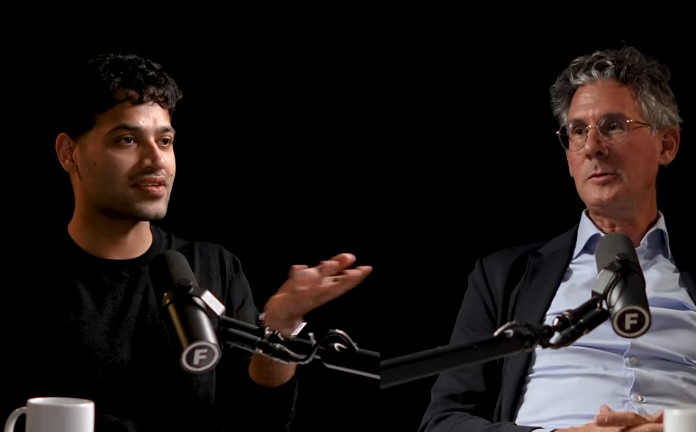
Read the full transcript of Bentley Motors CEO Dr. Frank-Steffen Walliser’s interview on Figuring Out With Raj Shamani, August 20, 2026.
EDITOR’S NOTE: In this episode of Figuring Out, host Raj Shamani sits down with Dr. Frank-Steffen Walliser, Chairman and CEO of Bentley Motors, to explore the meticulous craftsmanship and engineering that go into building one of the world’s most exclusive luxury cars. From pencil sketches and clay models that still define the design process, to hand-stitched details and the engineered “thud” of a closing door that machines can’t replicate, Walliser reveals why Bentley prioritizes human artistry over pure automation. The conversation also delves into performance engineering, electric vehicle experiences, and the unique mindset of Bentley’s ultra-wealthy clientele.
Introduction
RAJ SHAMANI: Dr. Frank-Steffen Walliser. CEO of Bentley Motors and the engineer behind some of the world’s most incredible performance cars. If you love cars, engineering, luxury, or just want to know what really goes into building a Bentley, this episode is for you.
You know, I was reading about making a car. And what I was fascinated that even today, a lot of people, a lot of car manufacturers, the first thought that they have, they use pencil sketch to make the car’s first vision or concept. In the world of AI and supercomputers and all of that, what is about pencil sketching that we needed that an AI can’t do?
Why AI Can’t Replace Design
FRANK-STEFFEN WALLISER: Because AI uses a lot of the existing knowledge. And if you ask AI to draw a car, it will use a lot of images of existing cars and then generate something new, but where’s the creativity? Again, it comes to the brand — understand the brand, understand your heritage, and being creative.
Second, it’s very quick. We sometimes also discuss with designers, “Look, I made a nice AI sketch.” And then the designer looks at it and says, “Yeah, but it’s wrong here, here, here.” So you cannot replace the imagination and the skill of people that fully compute your brand, the creativity, and everything. You can use it in many other processes and topics. In design, I would be careful.
RAJ SHAMANI: Just because of imagination?
FRANK-STEFFEN WALLISER: I think it’s imagination. It’s also skill set. I think the biggest difference between a manager and a designer is a designer has to come with skills and with talent. Either you have it or you don’t have it. Yes, you can train and you can learn, but you have to bring talent to the table.
RAJ SHAMANI: And then after the design, the first thing which is made, once it’s approved by all of you — the first thing is not a 3D model, it’s not anything. It’s made out of clay. The clay model is the first thing.
FRANK-STEFFEN WALLISER: 3D clay model.
RAJ SHAMANI: Why? What’s about clay that every car is made as a clay model first?
The Clay Model Tradition
FRANK-STEFFEN WALLISER: It’s quick. You can modify the clay very, very quick without — for sure, you generate data, and then you mill it, and then you look at your clay model. Through so many projects, having seen it — 2D ideation, sketches, Photoshop, very first data, volume models — and then you see the 3D model, and then we, as human beings, we can really only judge the form and everything if we see it in 3D. And honestly, you need a little bit of sunlight to see highlights, form language, and the quality of the surfaces.
RAJ SHAMANI: And it can only be done through clay. It was built 100 years ago, right? Since then, it’s just clay models still now.
FRANK-STEFFEN WALLISER: I’ve followed for 30 years, or even a little bit more than 30 years, the discussion that we shouldn’t have clay models, but they’re still there. They are quick. They help you in visualization, and visualization is extremely important. Everything is, for sure — the surfaces, everything — in computers, but at the end of the day, you have a real object. It would always be good to have the real object also to judge it and to release it, because the moment you release it, you kickstart €200 million in tools. So you should be better safe.
RAJ SHAMANI: Yes, clay is a better option.
FRANK-STEFFEN WALLISER: Clay is a relatively cheap option, and a quick option. The designers are working in the surfaces, and if you have a good modeler, they have this feeling of how it has to look, how the radius has to go in the surface, how to make a sharp line or not-so-sharp line. This is sometimes handcrafted, and if you see what is generated in computer surfaces versus what is sometimes hand-modeled, it’s astonishing what the craftsmen can do. You need talented modelers.
Aerodynamics and the Invisible Enemy
RAJ SHAMANI: And after that — because you’re talking about the thin lines and craftsmanship — there’s usually always a thing that in a car, the invisible enemy is air, because just a few millimeters here and there can completely change the wind tunnel and the speed of the car, right? Explain, if somebody doesn’t know, what a wind tunnel is.
FRANK-STEFFEN WALLISER: Well, cars are very complex products, and they’re moving, so they’re using energy, and aerodynamics is very important for a car. Besides, for sure, the design, you have also aerodynamic requirements on surfaces, and this is mainly drag and downforce. The rolling resistance of a car has to be as low as possible, and the wind drag has a big impact on it. If you’re a little bit more sporty, you’re also looking for downforce, or to reduce lift.
This is the more common piece. To really get downforce, you need wings and more aerodynamic things that you normally only see on a race car. But to reduce lift, for stable driving — it starts at speeds of 50, 60, 70 kilometers per hour, where you already start feeling the impact of aerodynamics, and then it goes up.
The better your drag, the lower your rolling resistance, the quicker your car. And you’re right — you have some millimeters or some edges or some air streams that don’t properly flow over the car, and you create turbulence, then your drag goes up, your car slows down. This is done in parallel. Interestingly, AI has sometimes very good proposals for how it could look to be more efficient. We do this constantly in the background, and aerodynamics gives constant feedback to design about what they would expect, because you have also a target frame set on your drag numbers and on your downforce or lift numbers needed for the car.
What Makes a Car Fast
RAJ SHAMANI: So what makes a car fast? Sometimes cars can have the same engine, or the same horsepower of engine — same power of engine — and then still some cars can be faster than others, right? How?
FRANK-STEFFEN WALLISER: For both, you need engine power, because this defines ultimately what you have in your pocket. And then you optimize for top speed — mainly rolling resistance, what is drag, but it’s also tires. The gearbox is important. All the power goes through the gearbox. It has to be cooled. There’s resistance in it. So this is a very important part of it.
Your tires are important, and the rolling resistance of the tires has an impact, for sure, on the top speed. With that comes the tire pressure. Then you drill down, and it comes down to the weight of your wheels and how quickly you can accelerate. I would say top speed is the easy category. It gets way more advanced if you’re talking about lap time, because lap time is then power, weight distribution, tires, tires, tires, the grip level, the downforce level, the drivability of the car, the feedback of the car. Then it gets way more sophisticated and elaborate.
To have a fast car in terms of top speed, I would say manageable, as long as it’s stable. To have a fast car around the track for a lap record — completely different league. Way, way more complicated, way more things to be considered.
Breaking the Nürburgring Lap Record
RAJ SHAMANI: So you broke a record, right, when you were at Porsche? You built one of the fastest cars and broke a lap record. What changes did you make which helped you break that record, and the top speed was maintained throughout?
FRANK-STEFFEN WALLISER: Until that time, no car had gone around the Nürburgring — a very, very demanding, very long track in Germany, more than 20 kilometers — no fully homologated car had ever been quicker than 7 minutes. It was 7:12, 7:05, but no car was quicker than 7 minutes.
When we started the project — it was a hybrid, and it was for the very first time a hybrid sports car. And hybrids, when we started the project — a hybrid was honestly a reliable Japanese product that was pretty boring to drive from A to B. That was a hybrid. It was not sporty. It was nothing. It was just related to fuel efficiency and everything, but no emotions at all. We said, “Okay, if we bring hybrid technology now to a sports car, it has to be emotional, and we have to prove that it’s quick.”
So we targeted a lap time around the Nürburgring, and the car should be faster than its predecessor. That was a 7:32, back in the days with the Carrera GT. I would say the potential of that car was maybe a little bit higher — not everything was squeezed out, so maybe it was 7, 8 seconds even faster. So we said, “Okay, we should be quicker than this car.”
Then we developed this hybrid technology, and we saw all the potential of it — of 4-wheel drive, of lowering the center of gravity — and we worked on every parameter: aerodynamics, weight distribution, center of gravity, tire performance, drivability, overall performance, and so on. Then you run the simulations, and you see, “Ah, it could be way quicker, the car.” But we did not really set the target to be quicker than 7 minutes.
We went there in September 2013, and everyone on the team knew maybe it’s possible. The drivers knew, because you need very brave drivers, very experienced drivers, around the Nürburgring who understand how to keep a car safe on one hand — because you want your car and your driver back — and quick on the other. Marc Lieb did it, back in the days. You can imagine there was a lot of tension, because we also had only a very small window where the racetrack was available.
It was a Wednesday morning, I think. We had a free slot. It was perfect temperature — cold in the morning, but dry. Perfect conditions on the track. And we did the lap below 7 minutes. For a team that had worked nearly 3 years very hard to get everything done, it was a big relief and a lot of joy and fun. Everyone was incredibly proud of what had been achieved.
At the end of the day, we proved a hybrid can be quick — very quick — and also emotional. It was proven that it’s suitable for a sports car. That was the whole story behind that. There was the Holy Trinity — others also tried it, but they could not give evidence that they’d been quicker than 7 minutes, despite some videos that are around. You should not run out of tape if you go around the Nürburgring.
RAJ SHAMANI: And this was the 918?
FRANK-STEFFEN WALLISER: It was the 918, yes.
RAJ SHAMANI: And if you had to point to one factor, out of thousands of factors that were maybe contributing to the speed of the car, what made it the fastest?
FRANK-STEFFEN WALLISER: I think the magic is it’s not one factor. It’s not a single thing you can optimize. A car works perfectly only if all components, if everything, is in a kind of perfection. I would not say harmony — harmony does not really underline what this is about. Bring everything to perfection. It will only be quick if everything works nicely together — the engine, the tires, the gearbox, the shifting program. You have to optimize everything.
If you are operating at the total limit — and this was, back in the days, the total limit — then you cannot say, “I don’t care too much about the rolling resistance of the tires, or the grip level, or the feeling of the car.” You find a lot of cars that are quick, but they are very difficult to drive. My theory is always: if a car is difficult to drive, your driver will not squeeze out everything, because if he or she feels unsafe, they will not go to the limit. If you know the car is exactly doing what you want — steering, braking, trail braking, all the things you do as a race driver — and it gives you very good feedback and a lot of confidence, then you will be quicker.
RAJ SHAMANI: What I’m guessing is you’re saying that the confidence that the car is safe, and it’s doing what I want — the control — is actually the differentiating factor. Because I’m sure all the other companies must have tried to put all the pieces together and their cars are perfectly fine. But those one or two seconds — that comes from confidence?
FRANK-STEFFEN WALLISER: It’s definitely confidence, but it’s also preparation. We put a lot of effort into being just ready to go to the track, unpack your car, test it, and then drive it. You see a lot of companies arriving at a racetrack and then they start to build their car, change parts and everything, because they haven’t been prepared. Go to the racetrack and be ready, then unpack it — fresh set of tires — off you go. This is how it should work. It should not be, “Oh, we have to change this, and we have to change this, and we have new software here, and we have something here.” This is not what is expected.
If you’re looking for perfection, it’s the product, it’s the process, it’s the people. Everything has to be perfect. I spent some time of my life in racing. It’s the same — if you arrive at the racetrack and start to change parts on the car, your preparation was not good. You have to be prepared, go to the track, put the car on wheels, go out, and then you should be good.
Shared Platforms: Bentley and Porsche
RAJ SHAMANI: Interesting. You know, another fascinating thing — because you were at Porsche and now you’re at Bentley — every car, okay, has a skeleton, and there are a few cars which are completely different but have the same skeleton, which is the case with Bentley and Porsche, right? Can you explain, for at least one specific car, how Bentley and Porsche are just different cousins under the skin?
FRANK-STEFFEN WALLISER: There’s a lot of discussion, also amongst fans and car enthusiasts, about sharing parts and platforms. These days — and I think that makes a big difference, and not a lot of people are aware of it — the software in the car defines sometimes way more than just the hardware. Because with today’s software and the adaptability we have built into these platforms, you can really show a range between — and Porsche and Bentley are definitely the bookends — a lot is driven by software, by calibration.
For sure, you make some tiny adjustments in your suspension, your setup, roll bars, and damper settings, but these are not the big changes. If you look at the past, they look pretty much the same, so it’s tiny adjustment. Within Bentley — and this is honestly a tradition in the company now for 80 years — it’s to make this refinement. There are given platforms. There is, for sure, in the Volkswagen Group, a lot of very, very capable high-end technology. To properly make the decisions of what fits a Bentley, what we leave out, what does not fit a Bentley — like a passenger display. We made a conscious decision that a passenger display does not fit Bentley.
RAJ SHAMANI: Why?
FRANK-STEFFEN WALLISER: We have wonderful veneer. Why a passenger display? The question is, if you have a luxury product, do you really need more screen time? Don’t we think we look at screens enough already? I’ve seen a lot of passengers, for sure, with a passenger display — no one uses it. Why? And then it’s just black, and it’s not nice. So these are decisions you have to make. For sure, in drivetrains and engines, there’s a benefit to taking this over, because the engineering capabilities — and also in electronic platforms and computers you’re using — you don’t see where this comes from, whatever car it comes from. What you see, as the owner or as a driver, is everything on the surface. You see content, you see screen content. For sure, you have an instrument cluster. The philosophy is that everything you see is Bentley-specific.
From Accelerator to Combustion
RAJ SHAMANI: Once the skeleton is done, once the body is done, now the car needs the heart — now the car needs the engine. Tell me, as the engineer that you are, what happens the moment the engine goes in and then I press the accelerator? How does that accelerator become movement? What is the combustion happening? Fuel? What’s going on?
FRANK-STEFFEN WALLISER: Well, there’s the combustion engine, hybrids, plug-in hybrids, electric cars. If I take the plug-in hybrid, it’s the electric car and the combustion engine car — this is maybe the best example. The accelerator, in the past, was a cable to a throttle. The throttle opened the airflow, you injected the fuel, you had ignition, and that moved the piston. It looked simple.
Today, for sure, you don’t have a cable anymore. You have a computer in the background. The pedal is more or less a sensor. You give an angle, you have wiring, and then you transfer this information to an ECU that checks a lot of things about the gear and the clutch, and whether the car is moving or not. Today we don’t call it the accelerator — it’s a torque wish. How much torque do you want to apply to the wheels? This is then converted, either in a combustion engine, where a throttle still opens and fuel is injected —
RAJ SHAMANI: But in the combustion engine, when you open the throttle and then there’s ignition happening, that’s like a tiny explosion.
FRANK-STEFFEN WALLISER: Tiny explosions, yes. And then, depending on if you have an 8-cylinder, like in the Bentley case —
RAJ SHAMANI: So it’s like hundreds of tiny explosions happening constantly.
FRANK-STEFFEN WALLISER: Yes.
RAJ SHAMANI: For how long? Just forever?
FRANK-STEFFEN WALLISER: Forever, for as long as the car runs. It happens many times — you open the valves, the crankshaft is rotating, and you get the fuel in. Everything today, for emissions reasons, we have the cleanest combustion engines ever built. You control exactly the amount of fuel you burn — you know how much air, how much fuel. You have catalytic converters. You look for the particles. There’s a lot of emission control behind that. Around one-third of the compute capacity just checks the conditions of the engine for emissions.
In an electric motor, it’s a little different — again, you ask for torque, and then the power converter defines the amount of current supplied to the electric motor, and the electric motor converts it also to torque. And you need the idea of torque demand, as with 4-wheel drive, sometimes the four wheels are not connected. If you have an independent front axle and the combustion engine in the back, you need an understanding of how much torque goes to each wheel. We make a difference between front and rear, left and right — this is torque vectoring. So a lot of computers are doing a lot of things in the background, but you cannot imagine it. At the end of the day, as a consumer, as a driver, you go in, you press the throttle, and the car moves. And if you steer, it steers.
Electric Cars and the Question of Emotion
RAJ SHAMANI: But then you explained combustion and electric — does it change my experience? Because electric cars are not fun to drive. Now that you’re moving completely to electric, what happens when I buy a Bentley that’s electric?
FRANK-STEFFEN WALLISER: I think that’s maybe part of the learning journey in the introduction of electric cars versus combustion cars. I would also say it depends a little on the generation — how did you grow up, with combustion engines, or more electric, or hybrids? What is your knowledge, and what is your interest also in cars?
In general, I would say the electric motor is way better suited to drive a car, or to drive anything. There’s a good reason why all trains and trams are driven by electric motors. Even a diesel engine is an electric motor and a generator. So this is very, very capable. The problem in the electric car is more the energy storage, which is very easy in the combustion engine, but the drivetrain is complicated.
About the emotions — and I think that’s some of the findings — obviously cars are emotional. People are asking for an emotional experience. It’s not just moving from A to B. It’s a lot about emotions. This is why we look at colors, form, leather, the interior, the smell of the car, everything.
RAJ SHAMANI: And the sound of the car.
FRANK-STEFFEN WALLISER: The sound of the car is also important, because we, as human beings, our emotions come with all our senses. If we go to an open-air concert, it’s the vibration, the heat, the sound. The more of our senses are activated, the more emotional we get. If someone touches us, it feels completely different than if we’re only talking. This is human nature, and we should not deny that it also exists when we’re driving a car. We are touching a steering wheel — it must be gentle, and leather tells you something. Already the diameter of the steering wheel tells you something. How do you feel in your seat? Is it comfortable? Is it sporty? Is it high, is it low? Do you get back pain from driving for an hour?
So emotions — that drives your feeling about the car. As Bentley, we are selling emotions. We are not selling cars just to run from A to B.
RAJ SHAMANI: Exactly.
FRANK-STEFFEN WALLISER: To be very honest, there’s no reason to spend that amount of money to drive from A to B. But to get an emotional link, it’s very important that we speak to all the senses. Now it comes to the sound. If you would just skip that in an electric car and say silence is very nice — because engineers spent many, many years to get the sound out of the car, to have the perfectly silent car. Now we have the perfectly silent car, and we think, “Oh, something is missing.” If you, as a human, go into a dead room, complete sonic isolation, it doesn’t feel natural.
RAJ SHAMANI: It feels weird a little.
The Secret of Bentley’s Electric Sound
FRANK-STEFFEN WALLISER: You have pressure on your ears. Sound is very important. Now it’s a big debate — is it artificial? Is it not artificial? Where does it come from? We made a decision to say Bentley is very traditional in V8, but just to record a V8 and bring it into the car would feel wrong. So we had another idea. I cannot tell it at the moment — it will come. You don’t have to wait too long. Within the next two and a half months, we will reveal what we’ve done on the sound.
My experience was, because I was driving cars with and without sound — with the sound, you have the emotional connection to the car again. It even helps you. I did some winter testing, ice driving with the car with and without sound. With the sound, you know better what your car is doing. You know where you are on the throttle. It helps you control the car. You drive more naturally. Sure, I’m also trained for many, many years on this — maybe the next generation will see it differently.
But again, to us as humans, our ears are working all the time. Even if we’re sleeping, we can hear, because it’s a warning system. It’s a very quick connection in our brain, because from our true nature, if it’s a warning signal, we have to react immediately. So technically speaking, the ears are directly wired to the brain, so we can react quicker. This makes it more natural if you connect your drivetrain to a sound that fits the brand and the car and the movement — your driving is just more natural.
What was important for us was to offer something that’s not just computer-generated — it’s crafted. Music is also very important to our customers, and music is part of emotions. So it would be very natural to think about music — crafted music, not coming from a computer, from an orchestra, and then think about what could fit it. But I can’t say more.
RAJ SHAMANI: That’s enough. That’s a good sneak peek.
FRANK-STEFFEN WALLISER: Yeah, I would say yes.
RAJ SHAMANI: But when you design a car, do you think about — you obviously think about experience — but do you think about how you’re tapping on all five senses? Is that a constant, conscious question while designing the experience of driving?
FRANK-STEFFEN WALLISER: I think it’s totally embedded in our processes, but the electric car changed so many things. You had to step back again and rethink how we do it. Even the shake of the car and the swinging of the car is all of a sudden different, and it’s hard to understand when the car is ready to go. When is the engine fired up? Because there is no engine, and it’s definitely not “fired up.” How do you give feedback that the car is running?
This is a small thing we struggle with in daily life — and if you observe people driving cars, especially if they switch from one brand to another, they struggle. All of a sudden, they don’t know if it’s on or off. That forced us to step back and rethink how to use a car, because a lot of things that were naturally given have disappeared or are now different. We have to give something subtle, easy to understand, easy to digest, easy to process as a human being, and bring that back into the car. These may be some of the learnings that will come with the next generation of cars — make them feel natural.
It’s not about — and this is maybe often misunderstood — it’s not that there can only be combustion engine cars and electric cars will not be good. This is not true. It’s not that we are always oriented to the past. That’s not the thing. If you listen to modern phones and their sounds, interestingly, a lot — you hear music, but you also hear a typical bell of a phone, and you have these swelling moments, because this is trained, and it has worked for many, many years. Why should we skip something like that?
Wiring and the Electric Architecture
RAJ SHAMANI: And now that the car’s gone electric, does it have more wires or less? Because in every car, there are probably more than 1,500 wires that go in. Does it have more wires now?
FRANK-STEFFEN WALLISER: I think we have to split this into two things. One is the development of the electronic architecture in general — what is a software-defined vehicle, and so on — that has an impact on the wiring and everything. Then you have the electric drivetrain itself. For sure, you have the high-voltage, high-power cables — they come in additionally — but the rest of the architecture is more or less the same. It’s a little less, because you have less temperature, easier or different cooling. Some aspects you add, some are off, but this doesn’t really depend on whether it’s electric or combustion. The general network is pretty much the same.
Fuel Storage and Crash Safety
RAJ SHAMANI: It doesn’t make a big difference. I was seeing — I had a question. I saw the factory today, and I saw that under our seats is where the fuel is stored. Right?
FRANK-STEFFEN WALLISER: Yeah.
RAJ SHAMANI: Fuel storage is right under the seats. Isn’t it dangerous?
FRANK-STEFFEN WALLISER: No, I would say it’s the safest place you can find, because it’s between the axles.
RAJ SHAMANI: Like I’m sitting on 50 liters of petrol.
FRANK-STEFFEN WALLISER: If you’re sitting in a plane, you’re sitting on tons of fuel. The crash configuration is always to find the safest place in the car. This is the passengers, inside the axles. You have the front and rear crash absorption zones outside the axles for crash impact, and then you have side protection. So your cabin is the safest space — this is why we put the people there, and this is also why we put the fuel there, because it’s the safest place you can find in a car.
RAJ SHAMANI: Interesting. And once the car is made, to make it safe, it goes through crumple zone testing. What is that? How many times is a car crashed before it reaches us?
FRANK-STEFFEN WALLISER: That depends a lot on the countries and so on, but I would assume it’s more than 40 real crashes.
RAJ SHAMANI: 40?
FRANK-STEFFEN WALLISER: You have different crash configurations, and there’s a lot involved — 40 times you have to build, rebuild. Sometimes you crash the front, then you crash the rear. It depends a little on the speed — if you crash at 56 kph, there’s no repair anymore, it’s done. Then you have offset configurations and a lot of different rollover tests, and so on.
Handcraft vs. Automation
RAJ SHAMANI: When I was in the factory, what I saw was that Bentley makes about 10,000 cars a year.
FRANK-STEFFEN WALLISER: I never talk about the volume, because it’s not so important for us. We look to fulfill customer wishes.
RAJ SHAMANI: Fair. But there are 5,000 people. Why do we need so many people in today’s world? What is it about human hands that a robot can’t do?
FRANK-STEFFEN WALLISER: If you look at the stitching, the cross-stitching of leather parts, it cannot be done by a robot — not today — and it will take a lot of time, because it’s not a rigid material, it’s leather. It’s fluffy. It’s really difficult for any machine to handle fluffy materials and stitch it. Also, consider that you have to program and prepare everything, but we’re doing a lot of one-offs — the color combination is only wanted by a single customer. To program a robot for that would take way more time and cost more than having highly skilled workers, our employees, do it.
It’s not that everyone is building cars — we have around 4,500 on-site, but manufacturing the cars is maybe 1,500 to 1,700. So we have a lot of people in engineering, some in procurement, marketing, after-sales — all the functions are on-site. It’s true, the majority is not making cars or producing cars — it’s a smaller group producing cars. The bigger group thinks about what to engineer, design, sell, produce, procure, plan. You also need a planning department behind all these workers, and logistics behind it, to get the parts in time to the line, and so on. It’s a complex operation.
RAJ SHAMANI: But even polishing — that could be handled by a machine, right? Why do we need manual polishing?
FRANK-STEFFEN WALLISER: You will see more polishing in the new paint shop done by machines, on the original sanding. For the final polishing, again, can a robot really do it in every detail? A hand has a good feeling for that — it’s something valuable.
RAJ SHAMANI: But do your customers — people who are buying Bentleys — do they care more about handcrafted or handmade things?
FRANK-STEFFEN WALLISER: Yes.
RAJ SHAMANI: Why does an end customer care about handmade things and not robot-made?
FRANK-STEFFEN WALLISER: It gives you a better feeling that the car is made for you — it’s very specific. I’ve had the chance to walk the factory with customers coming from everywhere in the world. When you walk through and see all our people working there — cross-stitching, polishing the cars, doing the assembly — after going through the factory, no one asks why the price of a Bentley is what it is. No one asks. They all see the handwork, they see the passion. Again, we are talking emotions.
This gives a different understanding of how these cars are built and the care we take — you can really see how the leather is built on the seats, and people are looking for every little detail that makes the difference. That gives you a more personal connection. I would say it’s true of every product you own — you have an idea of how it was built, and it connects you differently than if it’s just something you buy off a shelf.
The Cost of Paint
RAJ SHAMANI: Another thing which blew me away — actually three things, and I want to point them out one by one, because you already pointed out it’s one-of-one paint. What is it about paint in a luxury car that makes it extremely expensive?
FRANK-STEFFEN WALLISER: I think paint, in a car, is an extremely complex process. If you look, the majority of cars in the world are white. The other part is black. But this is not the expression — this is just very functional. White is easy to paint.
RAJ SHAMANI: Okay.
FRANK-STEFFEN WALLISER: And as there are a lot of hot countries, white helps you a little in protecting against temperature. If you climb the automotive ladder to more expensive, sportier cars, it’s about expression again. You’re looking for something special, and you want to show that. Paint quality is a subject everyone can see on a car — if you look at the surface, how polished it is, and see the reflection of the sunlight, I think it’s just an amazing experience. Again, our senses — the visual, what we see — it’s just great.
RAJ SHAMANI: But what makes it expensive? Why is it so expensive?
FRANK-STEFFEN WALLISER: There’s a development process behind it, so you cannot just take any color. You have to test it — you make a climate test, a stone chip test, a cutting test, you look for corrosion, and so on. There’s a lot of technology behind it. If you go down to hand spray, you need people with an application skill that requires a lot of experience to get it homogeneous, with no variation in thickness, because we have hard requirements that the thickness of paint should not vary over the body.
If you go into things like our ombré paint, where you have five to six different tones over a body, it is pure craftsmanship. If you talk to the people doing this, it’s really art. You either have the talent or you don’t. If we went out there and tried to spray and paint a car ourselves, it would look horrible. We’d have the same paint, the same machine, the same body — everything the same. But you need that feeling. That’s craftsmanship — people who can apply it, who have the experience, who have done it for years. Interestingly, you find people in our paint shop who have been painting cars for 25, 30 years, and they have joy every morning coming in and saying, “Look at the result, look what I can do.” It’s really unique. I’m very fascinated by what our people can do there.
Engineering the Sound of a Door
RAJ SHAMANI: And then the second thing was the sound of a door. That tells you whether the car is cheap or expensive. How do people engineer the sound of a door?
FRANK-STEFFEN WALLISER: That’s really engineering. It’s a lot about seals, rigidity, sound deadening, stiffness of panels, and everything. You can engineer that, but it needs a lot of passion. It’s the latch, everything. We have acoustic cameras that show you where something is swinging. It’s engineering knowledge, but it’s attention to detail.
RAJ SHAMANI: So what’s the difference between a cheap sound and an expensive sound? When you close the door, the sound is different.
FRANK-STEFFEN WALLISER: You don’t hear secondary effects. You don’t hear anything swinging. It gives you a deeper frequency, which comes with higher weight. This is why closing a carbon door sounds completely different than closing a steel door. Today we have aluminum doors. The question is the secret sauce — how should it sound? It’s difficult to define, but I can tell you if I slam a door, I can say, “This is not how it should sound.” But what is really good? That’s difficult.
RAJ SHAMANI: But then does Bentley —
FRANK-STEFFEN WALLISER: Customers have a feeling for that. Interestingly, part of buying a new car is opening the door and slamming it.
RAJ SHAMANI: And they can tell?
FRANK-STEFFEN WALLISER: Yeah. “Sounds good, sounds solid.” I think for Bentley, it should sound solid.
RAJ SHAMANI: But does Bentley have a specific sound — like, “This is how the door slamming should sound”?
FRANK-STEFFEN WALLISER: I don’t think — or maybe I should ask our engineers if they have a reference door. I’m sure we have a reference door.
RAJ SHAMANI: Maybe they’re all so experienced, they’re like, “This is Bentley sound, this is not.”
FRANK-STEFFEN WALLISER: Yeah.
RAJ SHAMANI: Can you make it out — a Bentley sound?
FRANK-STEFFEN WALLISER: The question is, if we had separate cars and just heard them without seeing them, could we find the Bentley? For me, maybe hard. For others — the more experienced experts — I would say they can do it.
RAJ SHAMANI: But it’s engineered. That was fascinating engineering.
FRANK-STEFFEN WALLISER: That’s engineering, but it’s a lot of attention to detail.
RAJ SHAMANI: And sometimes you spend months on just the closing of the door.
FRANK-STEFFEN WALLISER: Yeah, yeah, yeah.
RAJ SHAMANI: Engineering that sound.
FRANK-STEFFEN WALLISER: Yes.
The Wood Room
RAJ SHAMANI: And then there was wood.
FRANK-STEFFEN WALLISER: Yeah, that’s also fascinating.
RAJ SHAMANI: Yeah, they told me there was this small room, probably smaller than this, with millions of dollars of wood, which looked like this — just a thin slice. What’s about wood?
FRANK-STEFFEN WALLISER: Again, and you see it also in the leather — we’re talking natural material. We look very often, even though we engineer a car and it’s a piece of art, we look very often to nature. What inspires us from nature in colors, materials, leather, wool, color schemes? If you look at your ambient light in cars, sometimes it looks like the Pearl Tower in Shanghai — everything is very bright. Is this what we want to look at, or do we look for a sunset, for the light that comes through a forest, or the blue water at sea? Are we looking for these natural themes? We strongly believe yes. We’re looking for nature because it calms us down a little.
Wood is maybe the material mankind has used the longest, because it’s easy to work with and it’s available. Wood in cars has a long, long story — it was a material available, easy to use, so it was used in cars. Today, from a functional perspective, you don’t need it, but we also look at decoration and a feeling that gives you a nice, luxurious feeling, and wood is still associated with a luxurious feeling. If you have a table, and this is the one here, I would say it’s not overly luxurious.
RAJ SHAMANI: Yeah, it’s functional.
FRANK-STEFFEN WALLISER: It is very functional. If it had a wooden surface, we would say, “Oh, look at this, this is nice.” Same in the car, in the decoration. This is why wood is very traditional in Bentley. We have a lot of knowledge there — you’ve seen all the different materials. But again, it comes to the craftsmanship. If you know the pattern left and right is the same — it’s mirrored, you have a center line, and you find the patterns on both sides of the car — there’s a lot of knowledge behind that.
I had the chance to do a little bit of an internship, or a couple of hours, to work — not really work, but I was shown what to do and could try it myself. Then you find, “Oh, it’s not so easy to get it perfectly matched.” You don’t want to see, if you stitch two pieces of wood together, that all the fine lines still align — you shouldn’t be able to spot where the joint is. Believe it or not, every morning I run my fingers over this wooden surface, and it just gives you a very good feeling. Again, I come back to the senses — this is touching. You connect differently to a part because you go over the surface, you feel it, and you can really see the craftsmanship. That’s the story behind it, and it pleases you every morning.
The Value of Storytelling
RAJ SHAMANI: We spoke about art and passion, and craftsmanship. I want to speak to you logically. Do you think the end consumer really cares that you’re sourcing wood, let’s say, from Japan, sending it to Valencia, bringing it here, matching this perfect thing, and not using anything else? Like, everything is natural. If you don’t tell this story, and you still put in wood that probably looks the same — because you could recreate the same look by cheaper means, right?
FRANK-STEFFEN WALLISER: Yeah, it could maybe be done.
RAJ SHAMANI: Yeah. So if you just do that and don’t tell the story of where you’re sourcing it and how, would it matter to a customer?
FRANK-STEFFEN WALLISER: I think, yes. Part of a luxury product is understanding where the material comes from, and the storytelling is extremely important. It’s not telling a story with no content — it’s telling the content and the story behind it, and that creates the value. This gives a deeper understanding to the customer of what we’re doing, but it also lifts your product in value, because you understand all the effort behind it.
If you have a silk scarf and you understand where it comes from, what it takes to get the silk, the weaving, the printing, everything — it gives you a different link to the product, and it also justifies the price sometimes. You see — well, with the silk scarf, it’s not just machined somewhere, it’s people, it’s handcrafted, it’s thoughtful, it’s sustainable, and you consider the price differently.
What Makes Bentley Unmatched
RAJ SHAMANI: So if I removed the Bentley badge from this car, what would be something in a Bentley, without the logo, that would be difficult for a competitor to replicate?
FRANK-STEFFEN WALLISER: I think the interior quality we offer is unmatched. There’s no car in the world that shows this level of detailing. Second is — and this is maybe not so well known — the quality of the drive, how the car handles, and how it finds the perfect balance. You can go really quick with a Bentley, but the level of comfort we offer, while still having the capability of being quick and being a real driver’s car, is also very unique. I think you can feel that.
RAJ SHAMANI: Who would be a competitor?
FRANK-STEFFEN WALLISER: For sure, I would say we have no competitor offering exactly the same. This is very specific to the Bentley brand, and very unique in the world — Bentley may be the only brand that can cover a very luxurious car, the 8-liter, or a Flying Spur today, or the Bentayga EWB — which, by the way, is the number-one choice in India, the extended wheelbase Bentayga — down to a Continental Supersports, a very sporty, extreme car, both under the same brand.
You cannot imagine — if you look at the luxury segments, you have names from car companies in the UK, in Italy, but you cannot imagine the cars coming from Italy being a luxurious limousine or sedan driven by a king. Hard to imagine. You also cannot imagine other companies offering luxurious limousines also making proper sports cars. Hard to imagine. Bentley can do it. Bentley has the history. Bentley has the biggest breadth of cars that can be offered, just from our heritage and what we’ve delivered over the past — from very luxurious to very, very sporty. I think we can even stretch it more, getting more luxurious and also way more sporty. It’s all in, and it’s not a stretch of the brand — it fits perfectly to the Bentley brand. That’s very unique in the world.
Understanding the Ultra-Rich Customer
RAJ SHAMANI: But usually, when a customer buys their first car, they’re comparing an SUV with another SUV — they don’t usually think, “Oh, can I get all three?” No — they’re comparing a sports car with another sports car. There have been so many luxury car companies in the last 80 years that have probably now disappeared, or become part of a larger group and are now sold under someone else. Independently, I think Bentley is one of the only ones. So what does Bentley get right that other luxury car companies have never gotten right? What do you understand about the mindset of ultra-rich people?
FRANK-STEFFEN WALLISER: I think we stay true to our brand. We don’t try to be someone else — we try to be Bentley only. Again, it comes to the pride you mentioned. Stay to the core of our brand. Don’t try to copy. Don’t try to follow trends. Be your own character and don’t step away from this.
It’s very important to understand the heritage — our own heritage, to learn. This is honestly where I started the job — I was driving the old cars to learn about them. I’ve driven cars that fascinated me, and cars I did not like so much. But you have to understand there’s a heritage in that, and you can build on it. As a company, it’s very important to understand what you delivered in the past, what you can be proud of, what achievements have been made. In every company there have been achievements — sometimes successful in the market, sometimes not. Maybe sometimes too modern, too early, too quick, too late — there are many reasons — but there’s always something you can be proud of, because people worked on it, people thought about it, people produced it. Look at it, learn it, respect it. This is very important.
Marketing Across Regions
RAJ SHAMANI: Do you market the same story differently in different regions? Because one of your largest markets is America —
FRANK-STEFFEN WALLISER: Yeah.
RAJ SHAMANI: — and then there’s Europe. In Europe, whoever’s buying a Bentley is probably a family legacy person, a kid who has inherited wealth and is now coming to your showroom to buy one. In America, most buyers would be tech, finance, or crypto billionaires and multimillionaires who come and buy a Bentley. Do you market in both regions differently, because the buyer is completely different?
FRANK-STEFFEN WALLISER: No, not from a central perspective, because we would dilute our brand. We have to stick to the core and be consistent everywhere in the world, because you can’t separate the markets anymore. With social media, you cannot say, “This will only be shown in the US, this is for the UK, this is for Spain, this will happen in Austria” — this doesn’t happen anymore, or in India. The world is global, and it’s immediately global. Once we post something or use social media channels, it will be everywhere in seconds.
It depends sometimes a little on the retailers and their approach when they talk to customers. But even if we sometimes consider the stereotypes of what we’d expect a Bentley customer to be, we are always wrong. There are no stereotypes. As broad as the Bentley brand is, as broad are our customers. We find people who have inherited wealth, but we also find a lot of people who have built up their businesses, successful in business — very, very interesting people. I have the chance, from time to time, to talk to our customers, and we always talk about what their business is, what they work in — it’s really interesting. It’s a lot of people.
RAJ SHAMANI: But when you talk to an American new-tech multimillionaire who’s a first-generation founder, and when you talk to a European family-legacy, inherited-wealth person — do they talk about different things? Is the mindset different?
FRANK-STEFFEN WALLISER: Honestly, they have a different source of their wealth and their income. It could also be vice versa, by the way.
RAJ SHAMANI: Fair enough.
FRANK-STEFFEN WALLISER: They have a different source, but what unites them is that they’re all car enthusiasts. They’re passionate about cars. They’re ready to spend the amount of money needed for a Bentley — this unites them. Sometimes our customers know way more details than I know. It’s always a challenge.
Marketing Spend: Print, Social Media, and Events
RAJ SHAMANI: How do you market? Where do you spend most of your marketing money? What marketing medium? Because traditional advertising is not very effective for you guys — it probably doesn’t even work.
FRANK-STEFFEN WALLISER: Yeah, I would even say it comes back. Even print advertising, because print stays.
RAJ SHAMANI: You do print?
FRANK-STEFFEN WALLISER: Social media is one channel, and we’re reshuffling a little bit of money back to print advertising, because it gives you a lot of value. It just feels different.
RAJ SHAMANI: Interesting.
FRANK-STEFFEN WALLISER: If you have a page, a book — for sure, we look at high-end magazines. A high-end car magazine with good content, good photos, good paper — that’s something you keep. Your social media posts stay for two seconds, then you scroll through — attention span is 8 seconds, then it’s gone. The magazine comes back, stays on the table, you hand it over to a customer — it makes something different.
RAJ SHAMANI: Where’s the maximum amount spent — print, creating experiences, or social media?
FRANK-STEFFEN WALLISER: I would say social media and events.
RAJ SHAMANI: Events and social media.
FRANK-STEFFEN WALLISER: And again, it’s also events.
RAJ SHAMANI: What kind of events? Give me an example — the most expensive event by Bentley.
FRANK-STEFFEN WALLISER: I would say Pebble Beach is maybe our biggest — it’s also the biggest group we have.
RAJ SHAMANI: Okay, what is it? I don’t know.
FRANK-STEFFEN WALLISER: Pebble Beach is part of Monterey Car Week, one week in California, where car enthusiasts from all over the world come. You have auctions, a lot of cars in the region — it’s a festival of great cars, I have to say, only expensive cars. It’s amazing what you see — all centuries, all ages, all brands, dead or alive. It’s a big gathering. A lot of things take place. We have a villa, we invite our customers, give them a good weekend, a good experience, some drives, some extraordinary events we create there, some surprises.
Goodwood is definitely another one — it’s also a big gathering, 250,000 people celebrating across all generations. This is, by the way, the interesting part — you cannot say it’s only for old people. It’s not. It’s for everyone — families, all generations. The enthusiasm for cars hasn’t gone away. Sometimes it’s discussed — are cars still interesting? Is the next generation all about iPhones or phones? It’s not. Cars are fascinating, and they stay fascinating.
Building Cars for Royalty
RAJ SHAMANI: I have two last questions for you. One is, you build cars for the king and the queen, right? Do you do anything differently in those cars? Is there some specification only a king gets?
FRANK-STEFFEN WALLISER: By nature, the figure on the front of the Bentley — the “Flying B” — is specific, as it comes with a specific requirement. Also, the stickers on the door under the lacquer are specific to the King. Besides that, it gets some special treatment from signaling and some special lights needed for traffic. But besides that, it’s a regular car. It does not get more power, different brakes, a special engine, or a special gearbox. It’s a regular Bentley.
The Pride of the Bentley Workforce
RAJ SHAMANI: Interesting. When I was getting a tour of the factory — I’ve done so many factory tours all around the world, in incredible companies, and I respect them a lot — I have never seen the kind of pride which every individual had here.
FRANK-STEFFEN WALLISER: Yeah, I can confirm this. This makes a big difference.
RAJ SHAMANI: From the person who was stitching, to someone who was using sandpaper, to probably someone giving the whole tour — each and every individual had this pride in what they were doing here at Bentley. I think that stood out. I told our host that they need to come and train us in our company to have this kind of pride.
There must be something, right, that you, from a CEO perspective, are seeing go right in the company. Because when I met a young girl who was just two or three years into the company, an apprentice about to get a job, she was so excited and proud to be getting a job here — understandable, when you’re young and passionate. Then I met somebody who had been at the company for 15 years, middle-aged. Mostly people at that stage are angry and not happy about wherever they are — but he was so proud. And then I met somebody who had been at the company for more than 40 years — that person was equally proud. And then I met his wife — she was incredibly proud too, about stitching a steering wheel. I was fascinated — across different ages, everybody. And they weren’t planted. I could just randomly —
FRANK-STEFFEN WALLISER: Oh, you could.
RAJ SHAMANI: Yeah, I randomly met people.
FRANK-STEFFEN WALLISER: You can go everywhere. This is good. And honestly —
RAJ SHAMANI: What is that? What makes it?
FRANK-STEFFEN WALLISER: I’m also kind of a newcomer — I’ve been here for two years. But you can immediately feel this is different.
RAJ SHAMANI: And what do you think is the reason? What’s the secret sauce?
FRANK-STEFFEN WALLISER: I would say it’s the history and the consistency — making cars here for more than 80 years. It all builds up, and the product is more important than the people. It’s not — sometimes you have companies that are driven very much by their founders and by the people in management driving the company. At Bentley, I would say it’s all about the customer and the product. I think this is common sense, though people are sometimes controversial — products could also be controversial — but at Bentley, that unites everyone. It’s about the product and the customer.
The good thing is our people on the line see customers every day walking through — they see the glance in their eyes, the smiles, the passion of the customers. I would say this is a big difference — if you know your customer, if you’ve seen them, if you see the world traveling to Crewe, which is now, we know, not the center of the world — people take their journey, they come, and you see that, and you get the connection. You know who will get the result of what you’re working on. It’s also transparency — if I fail in my doing today, one of these guys will get a product that’s maybe not perfect. So it’s also motivation. That’s kind of self-propelling. If you asked me how to engineer something like that, honestly, I don’t have an answer.
RAJ SHAMANI: But do you teach everybody who’s young and joins the company these values? Do you tell them about it — what drives it, what you deliver?
FRANK-STEFFEN WALLISER: We have very good communication about our values, about belonging, and we support people in that. But the best is leading by example. If people have been in the company for 40 years, as I said, you cannot stage this — they’re there, and they tell their story. If they’ve been in the company for 40 years, they don’t care who the CEO is. And that’s a fair point — they’ve contributed for 40 years. I’m very proud of these people. We celebrate — we have recognition and celebrate people who are 25 and 40 years in, with a big party. It’s part of this culture to say thank you: “You’ve been here for 40 years.” I hand over a nice certificate, and we have some fun and a nice dinner together, a nice summer party. It’s important to celebrate this and give recognition to people who are contributing and working here.
Priyanka Chopra Jonas as Global Brand Ambassador
RAJ SHAMANI: Now you just announced a global brand ambassador — Priyanka Chopra Jonas. Why her specifically?
FRANK-STEFFEN WALLISER: I think, like so often, sometimes it’s coincidence. She was looking for something that could fit her. She’s not a rising star — she’s a star, with a very wide following. I think what she represents fits very well with our brand. There was a connection, and sometimes these are the coincidences where people connect and say, “Oh, this could fit, this is an opportunity.” It was done relatively quickly, and that’s always a good sign — it wasn’t a lengthy negotiation between agencies. It was, I would say, a natural fit. When we saw the first results of the shooting, I would say it was very convincing.
RAJ SHAMANI: Did you go to her, or did the agency come to you?
FRANK-STEFFEN WALLISER: No, I think there was a connection through our photographer, and then it connected relatively quickly. It was very well received — we see it globally in media, and I think this is maybe the most exciting part: it covers East and West. That’s great, and that’s what you’re always looking for. You don’t want to split the world and say we have cars for here and cars for there. This is globally accepted, and it’s perfect. If you have an ambassador like her, and a natural fit, and we don’t try to play something — and she very obviously doesn’t try to play something either — it’s very natural. That’s the link we’re looking for. We’re more than happy with that connection.
The Personal Cost of Leadership
RAJ SHAMANI: Interesting. Well, this is the last question we ask everybody at the end, and it’s personal to you — because we believe that in order to take power over your own life, make your own decisions, and rise to the top to win, you need to sacrifice a lot of things. So what cost did you pay to become the CEO of Bentley, Frank?
FRANK-STEFFEN WALLISER: It’s definitely the time I’ve contributed to my career. This is not working 35 hours a week — it’s working 35 hours from Monday to Wednesday. This is definitely something I did, and you need a family background that gives you the freedom to do so. I’m very lucky that my family accepted that — my wife, my kids — and that’s what you have to sacrifice. You have just less time. That’s it.
RAJ SHAMANI: What did you miss out on?
FRANK-STEFFEN WALLISER: Very clear — I’m not sure if I missed something, because what I definitely learned, over time, was that if you’re spending time with the family, it’s always quality time — it’s more quality time. As always, if you’re short on time, you take more care in where you spend your time and what you’re doing. You’re not just sitting around.
RAJ SHAMANI: Thank you so much. Thank you for explaining to us about Bentley and what it takes to build a car.
Closing
RAJ SHAMANI: Thank you so much for watching this episode till the end. We would love to know what you liked or disliked about this episode, and which guest you would like to see again on this show, or which new guests you want to see. Let us know in the comments. Your feedback helps us improve and make every episode a little better. I’ll see you next time. Until then, keep figuring out.
Related Posts
- AI Debate on Modern Wisdom: w/ Zack Kass, Liv Boeree & Aric Floyd (Transcript)
- Transcript: All-In Interview with Flock CEO Garrett Langley
- Transcript: Jeff Dean Interview on The 1% Rule for Building in AI with Diana Hu
- Transcript of Dr. Fei-Fei Li Interview on Huberman Lab
- Transcript of Kim Dotcom Interview on Surveillance: Tucker Carlson Show