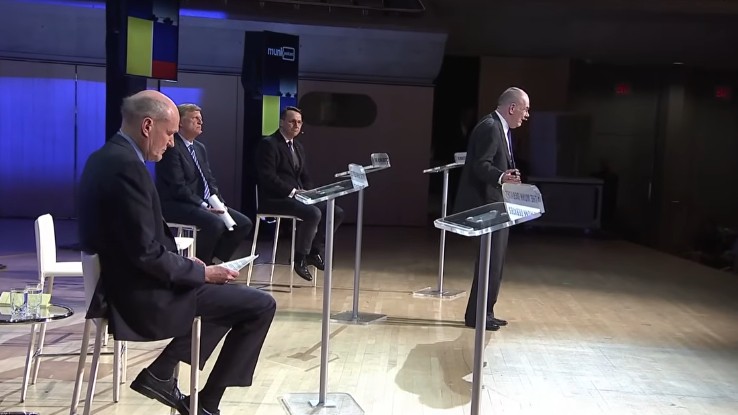
EDITOR’S NOTE: In this high-stakes Munk Debate, leading realists John Mearsheimer and Stephen Walt face off against Michael McFaul and Radosław Sikorski over how best to end the Russia-Ukraine war. The resolution centers on whether acknowledging Russia’s security interests is the essential first step toward de-escalation, or whether that approach risks rewarding aggression and prolonging the conflict. The discussion probes the roots of the crisis, the role of NATO, and the risks of great-power confrontation. The debate happened on May 12, 2022. READ THE FULL TRANSCRIPT BELOW:
Opening Statement: John Mearsheimer
MODERATOR: Okay. The time has come to enjoin the debate. There we go. Thank you. John Mearsheimer, you’re up first with your opening statement. Take us away.
MEARSHEIMER: Thank you very much. It’s a great pleasure to be here this evening, and I appreciate the organizers inviting me to this debate. The motion that Steve and I are defending is that to best bring the Ukraine crisis, this geopolitical crisis, to an end, it’s important to first start by acknowledging Russia’s interests. So what we’re talking about here tonight is how best to end this crisis.
We’re not talking about who started it, who should be blamed. We’re not talking about whether Vladimir Putin is a good guy or a bad guy. The question here is how best to end it. Now, this is referred to as a geopolitical crisis in the motion. My view is that it’s much more than a geopolitical crisis. This is a geopolitical disaster.
First of all, look at what’s happening to Ukraine. This country is in the process of being destroyed. The war is only seventy-eight days old. If this war goes on and on, you can only imagine what’s going to happen to Ukraine. Estimates are by the World Bank that over $60 billion worth of damage has been inflicted on Ukraine.
Some people say that it will take $600 billion to rebuild the country. Thousands of people have been killed. Cities have been destroyed. 5 million people have left the country. 6 million people are internally displaced.
13 million people are living in combat zones. For the sake of the Ukrainian people, it’s essential to bring this to an end. Furthermore, we run the risk here that this war, which is now between Ukraine and Russia, is going to turn into a war between Ukraine and the United States. It’s going to turn into a great power war. This is a really scary thought.
We know very well that when wars become long wars, they tend to escalate, and the last thing we want is a war between the United States and Russia. And the reason is because the threat of nuclear war is on the table. Now, many of you might think this is not a serious possibility, but that would be a fundamental mistake. You should understand what America’s goal is in this war. America’s goal is to inflict a decisive defeat on Russia, number one, and number two, to bring the Russian economy to its knees with economic sanctions.
If you listen to General Austin, who is the secretary of defense, he’s basically talking about knocking Russia out of the ranks of the great powers. This is another way of saying we are presenting Russia with an existential threat. Now, does that mean that they will use nuclear weapons? Nobody can say for sure, but there is a serious possibility. Avril Haines, who’s the director of national intelligence, said on Tuesday, when appearing on Capitol Hill, that one of the two scenarios in which Russia will use nuclear weapons is if it is being defeated in Ukraine.
Well, our basic goal is to defeat Russia in Ukraine. So we have a very perverse paradox here. The paradox is that the better the United States does on the battlefield — with the Ukrainians doing the fighting, of course — the more likely it is that Russia will turn to nuclear weapons, and we might end up in a general thermonuclear war. We have to end this war to make sure that doesn’t happen.
Now the motion says that we start by taking into account Russia’s interests. This does not mean that we don’t consider the interests of Ukraine, the interests of the United States, the interests of NATO. Of course we take into account their interests. But we start with the Russians, and the reason we start with the Russians is very simple: they started the war. And what we have to do is figure out what their interests are, because if we don’t know what their interests are, there’s no way we can shut this one down.
So we’re starting with Russia’s interests. Now the question is, what are Russia’s interests? The conventional wisdom, which I’m sure all of you have heard ad nauseam, is that Vladimir Putin is responsible for this war. Vladimir Putin is an imperialist. He’s either trying to create a greater Russia, or he’s trying to recreate the Soviet Union.
And what’s going on here is that Ukraine is a country that he wants to conquer and incorporate into Russia. He wants to absorb it. There is absolutely no evidence to support that argument. There is no evidence that he thinks that’s desirable. There’s no evidence that he thinks that’s feasible, and there’s no evidence in the public record that he’s ever said that that’s what he intends to do.
This is a crisis that is all about the West’s efforts to turn Ukraine into a western bulwark on Russia’s border. It involves a three-pronged strategy: bringing Ukraine into the EU, turning Ukraine into a pro-Western liberal democracy, and number three — and most importantly — bringing Ukraine into NATO. If you listen to Putin’s speeches and you read his writings, he has made it unequivocally clear that this is the principal problem: Ukraine joining NATO. And what has to be done here to solve this problem is Ukraine has to become a neutral country.
You may not like that outcome, and I fully understand that. But if you are interested in preventing Ukraine from being completely destroyed, and you are interested in avoiding a nuclear war, you should be in favor of the motion. Thank you.
MODERATOR: Thank you, John. Right on time, down to the final seconds there. Well done. Radosław Sikorski, you’re up next with your opening statement.
Opening Statement: Radosław Sikorski
SIKORSKI: Thank you. It is indeed wonderful to be able to debate in person, physically — much better than on a Zoom call from a washroom. Some of you may not know that Professor Mearsheimer is, in Europe, in my country, Poland, regarded as the pope of realist theory.
But you know, the principle of papal infallibility is one of the victims of this Ukraine war, so I beg to disagree with the professor. First of all, he says there is no evidence that Putin wants Ukraine. Professor, where have you been? Haven’t you read Putin’s manifesto of last year, in which he tried to prove, from doctored or misunderstood or willfully misunderstood tsarist and Soviet documents, that Ukraine is part of Russia? He doesn’t just want Ukraine — he denies Ukraine’s separate existence.
He is conducting your classic imperialist narrative: “Are peasants wanting a separate state? What do you mean?” So he’s invaded Ukraine because he wants Ukraine. Now, NATO — you say that was Putin’s interest.
Well, President Zelenskyy has already conceded that Ukraine doesn’t need to join NATO. Ukraine can become a neutral country, at which point President Putin should have said, “Right, I’ve won my war, I can go home.” And yet nothing like that has happened.
He tried to take Kyiv. He tried to do regime change. The problem with the so-called realist theory is that it’s not very realistic, because it allows Russia to define what its security interests are. And if you allow that, then I have to tell you a joke from the Soviet period. With whom does the Soviet Union want to have borders?
With whomever it pleases. And with whom does it please? With nobody. So on that theory, great powers could invade whoever they pleased. Also, Putin is not just reacting to what we do.
He has agency himself. He started as a reformer, and he ended up as a traditional Russian tsar who is taking his country backward. It was his decision to stop the modernization of Russia and to try to gather together the former republics of the Soviet Union. He already has troops in Armenia, in Moldova. He had a foray into Kazakhstan.
He’s in Belarus. He’s in Georgia. He’s running out of countries to invade. Also, the so-called realist theory underappreciates the importance of ideology. It creates a kind of fake moral equivalence between great powers.
Whether they are democracies or autocracies, they have interests and therefore have to be respected. Well, I tell you: tsarist Russia wanted to take Constantinople. Soviet Russia wanted to create, to foment, global revolution. Putin wants to recreate the Soviet Union. This same country behaves differently depending on its ideology, just like Iran defined its interests differently under the Shah and differently under the Ayatollahs.
So I have to say, I respect the attempt to create a theory that would predict reality, that would make it possible for us to predict what would happen. But the test of a theory should be its predictive power. So according to the realist theory, Russia cannot stand more NATO members on its borders. Well, guess what — thanks to Putin’s aggression against Ukraine, two new countries want to join: Finland and Sweden.
If Finland joins NATO, Russia will have a 1,340-kilometer longer border with NATO. That surely will affect its security. It will have to put new troops along the Finnish border. If Sweden joins, the Baltic Sea will become almost a NATO sea. That will affect Russia’s security.
On your theory, if they join NATO, Russia will have to invade them, right? Well, I tell you what — I think it’s the Finns and the Swedes who are the realists here, because I think that if they apply and join NATO now, Russia will not invade them. Instead, NATO will be enhanced. So, ladies and gentlemen, I think that yes, we all recognize that Russia has security interests, but what it would take to end this very dangerous conflict is for Russia to acknowledge that other countries — including smaller countries, and in particular Ukraine — also have security interests: the right to exist, the right to be a democracy, the right to integrate with the West if they so wish.
So, ladies and gentlemen, I beg to oppose.
MODERATOR: Stephen Walt, we’ll put six minutes on the clock and turn the stage over to you.
Opening Statement: Stephen Walt
WALT: Thank you. It is a great pleasure to be here and speaking on this important issue. The motion states, “Ending the world’s worst geopolitical crisis in a generation starts with acknowledging Russia’s security interests.” It focuses our attention on security because that’s the issue driving Russia’s behavior, and it’s that behavior we have to change to bring this tragedy to an end.
John has explained why Russia saw efforts to bring Ukraine into the West as an existential threat, which led them to launch a brutal and illegal invasion. I want to drive this point home by pointing out that major powers, including democracies, often act in brutal and dangerous ways when they believe their security is at risk. Consider China in 1950. China was very weak at the time, but when US forces in Korea approached their border, Mao Zedong ordered his army to cross the Yalu River and attack them.
We had no intention of invading China, but Mao didn’t know that, and he thought the survival of his regime was at risk. The Korean War lasted two more years; thousands of additional lives were lost. We don’t like to admit it, but democracies act this way too. During the 1960s, the United States was so worried that South Vietnam would become part of the communist world that it sent nearly half a million troops across the ocean to fight there, and 58,000 of them didn’t come back. We used napalm and Agent Orange, and dropped more than 6 million tons of ordnance.
When that didn’t work, we invaded Cambodia, which unwittingly helped the Khmer Rouge gain power. Millions of people died because American leaders believed losing South Vietnam might undermine our security. And Vietnam wasn’t on our border — it was more than 8,000 miles from the continental United States. In the 1980s, a popular uprising in Nicaragua toppled a pro-American dictator, much as the Maidan uprising toppled Ukrainian president Viktor Yanukovych. In response, we organized and armed a rebel army, the Contras, much as Russia has backed separatist movements in Ukraine.
Nicaragua was a poor country whose population was only 4 million people, but the Reagan administration saw it as a serious threat. 30,000 Nicaraguans died in that war. As a percentage of population, it would be like Canada losing 300,000 people, or the United States losing two and a half million. Finally, let’s not forget that the United States invaded Iraq in 2003 because the Bush administration thought Saddam Hussein was a mortal danger. That war, which Professor McFaul supported and John and I opposed, killed thousands of Iraqis, did enormous damage to the country, and led to the emergence of ISIS.
The Bush administration chose to launch an illegal war because it felt threatened, and just like Putin, President Bush thought the war would be easy. None of this excuses what Russia is doing today — not in the slightest. All these actions should be roundly condemned. But my point is that when powerful states think their security’s threatened, they’ll go to great lengths to try and deal with the danger, and they’ll do great harm in the process. If they face setbacks, they’re more likely to double down than reverse course. The lesson is that threatening a great power’s security is a very risky business, especially in the nuclear age.
Now today, many people want to ignore the security fears that led to this war and simply punish Putin. They want to inflict a decisive defeat on his army, collapse the Russian economy, get him removed from power, and put him on trial. Those desires are completely understandable, but this approach is morally questionable and dangerous. It’s questionable because prolonging the war means more Ukrainians will die, and the country will suffer even more destruction. It’s dangerous because the prospect of a catastrophic defeat could lead Russia to escalate, including the possible use of a nuclear weapon.
And as John said — the director of national intelligence, Avril Haines, said two days ago to the Senate Armed Services Committee, President Putin would only authorize the use of nuclear weapons if he perceived an existential threat to the Russian state or his regime. When she was asked what he would regard as an existential threat, she said, quote, “Believing he might be about to lose in Ukraine.”
It is in everyone’s interest to minimize these risks. Our goal should be to bring this war to a close as quickly as possible. We need a political settlement that both sides can live with and that neither side will want to overturn in the future. That settlement must provide security for Ukraine, but also for Russia, because — again — it was Russia’s security concerns that caused the war. That’s why ending this crisis must start by acknowledging Russia’s security interests. Any other course of action will do more damage to Ukraine, cause additional suffering in countries that depend on Russia and Ukraine for food — 30% of the world’s supply of wheat — and increase the risk of nuclear war. That’s why I support the resolution. Thank you.
MODERATOR: Thank you, Stephen Walt. Michael McFaul, you’re going to have the opportunity to give our last opening statement.
Opening Statement: Michael McFaul
MCFAUL: Thank you. So I have 88 arguments I want to make in six minutes, and I’m not a professional debater. If I was, I could talk really fast and get them all. Instead, I’m going to focus on three — four if the clock doesn’t run out on me.
First, the US, NATO, and the West have recognized Russia’s security interests for three decades, and yet that did not prevent Putin from invading Ukraine. So the assumption in this debate — that somehow NATO has been marching, marching, marching toward Russia, and finally Putin was cornered and he just had to invade Ukraine — is cherry-picking thirty years of history. I think that’s important to understand before we talk about how to resolve it.
One, NATO’s never attacked the Soviet Union, never attacked Russia, and never will. That would be crazy. Second, until Putin invaded Ukraine in 2014 — remember, this war started in 2014, not this year — the US and NATO were actually cooperating on Russia’s security interests as defined by them. In Afghanistan, the New START treaty, WTO accession — even on Georgia and Ukraine, where those countries wanted to join NATO, their accession has been frozen since 2008. It’s not gone anywhere, and that’s because American and NATO leaders and Canadian leaders were listening and recognizing Russia’s national interest.
Just weeks before this latest invasion started, my government, the Biden administration, listened closely to Russia’s security interest, to Putin’s security interest, and they made proposals. They said, “Let’s sit down and negotiate.” I talked to the president right before Putin invaded. They were talking about a Helsinki 2.0.
Is that not listening to Russia’s national interest? But no — it was not about NATO. It was not about security arrangements in Europe. It was about something else, and that’s the part we have to bring into this debate. NATO has not been expanded — it’s been twenty years since the last big-bang of NATO — and so you have to ask yourself, what changed? What changed after the big bang in 2002? What changed after the Bucharest summit in 2008, when I think things were basically frozen? I was in the government for five years. The issue of NATO expansion did not come up once. So what changed? It wasn’t NATO expanding — it was democracy expanding.
Russia — Putin invaded Ukraine in 2014 because of the Revolution of Dignity in Ukraine. That’s what changed, not NATO policy, and not us not paying attention to their security interests.
Second, security interests don’t come from heaven. They aren’t defined by the balance of power in the international system, no disrespect. They’re defined by individuals; they’re defined by leaders. When I showed up at the White House, nobody handed me some blue book and said, “Mike, this is the American national interest.” And so we have to ask ourselves this question: why is it that Putin gets to define the interest that he sees fit? Because Putin today — he’s a very different person than twenty-two years ago, or thirty years ago when I first met him in 1991 — but today Putin defines Russia’s security interest in imperial terms, in anti-democratic terms. He believes it’s in Russia’s national interest to annex Crimea. Are we just supposed to go along with that? He believes it’s in Russia’s national interest to declare Donbas independent countries, and he’ll soon annex them as well.
Are we just supposed to go along with that? He believes it’s in Russia’s national interest to slaughter civilians in Mariupol, in the name of — and he says it, I’m sorry, Professor Mearsheimer, he says it very clearly in his speeches — “liberating Russians from the neo-Nazis” that are subjugating them. In fact, in his speech before he invaded Ukraine — a 7,000-word speech — the first 4,628 of them he spoke before he ever mentioned the word NATO once. That’s what he’s trying to do there, and my question is, where does it stop? So Donbas — is that enough? Does he get to have all of Ukraine? I think if you just allow him to define it as he sees fit, you’re down a very, very slippery slope.
The other thing I want to remind you of in this debate: other Russians disagree with Putin. Alexei Navalny is sitting in jail right now — they tried to kill him, and then they arrested him in preparation for this invasion. I just got a letter from him. He radically disagrees with Putin’s definition of Russia’s security interest, and therefore, just to assume that if we just listen to Putin and sue for peace, you’ll have peace, I think is naive. I actually think it’s naive. Eventually there has to be a negotiated settlement — we all agree with that — but to presume that we just have to accept whatever Putin says is in Russia’s national interest, and that will be peace, I think is misguided and ahistorical, especially in that part of the world.
Finally, maybe it’s the opposite. Maybe too much concern for Putin’s definition of Russia’s security interest actually caused this war. And let me quote one more security expert about this very issue, about appeasement:
“If we just give him what he wants, everything will be fine. Appeasement contradicts the dictates of offensive realism, and therefore is a fanciful and dangerous strategy. In short, appeasement is likely to make dangerous rival states more, not less, dangerous.”
That was John Mearsheimer. Thank you.
MODERATOR: I always appreciate some good opposition research in these debates, when people dig into each other’s quotes. Okay — John Mearsheimer, rebuttals. Three minutes on the clock, gentlemen. We’re going to go in the same order as the opening statements.
Rebuttals
MEARSHEIMER: I want to make three sets of points, and they all have to do with data. Mike makes the argument that Putin alone, or just Putin and a few Russian leaders, are interested in Ukraine and the whole subject of NATO. This is what one of Mike’s predecessors, Bill Burns, said in 2008 in a memo to Condi Rice: “Ukrainian entry into NATO is the brightest of all red lines for the Russians” — not just Putin. “In more than two and a half years of conversations with knuckle-draggers in the dark recesses of the Kremlin and Putin’s sharpest liberal critics, I have never met anyone who thinks that Ukraine in NATO is acceptable.”
Second — to go to Radek this time — he made the argument that Putin, in his famous July 12, 2021 essay, made it clear that what he was interested in doing was conquering Ukraine and absorbing it into a greater Russia. This is what he actually wrote — this is in the July 12, 2021 article: “What Ukraine will be, it is up to its citizens to decide.” He also said, “You want to establish a state of your own, you are welcome” — talking to the Ukrainians. In the February 24 speech, where he announced that he was invading Ukraine, he said, “Accept these new geopolitical realities.” He said, “We, Russia, accept the new geopolitical realities after the collapse of the Soviet Union in 1991.” He said, regarding Ukraine, “We respect and will respect their sovereignty.” There is no evidence in that talk — no evidence in that talk on February 24, or in his speech — that he was interested in conquering Ukraine and integrating it into Russia.
And then finally, with regard to Radek’s argument that NATO was a dead issue in 2021: at the June 14, 2021 NATO summit in Brussels, we issued a communiqué that said, “We reiterate the decision made at the 2008 [summit] that Ukraine will become a member of the alliance. We reaffirm all the elements of that decision.” That argument was repeated on November 10, 2021. Thank you.
MODERATOR: Okay. Radek, your opportunity for a rebuttal also.
SIKORSKI: Professor, you can’t pretend that somehow, mystically, Ukraine was or was about to become a NATO member because we denied them the Membership Action Plan. More than that, the chancellor of Germany, in trying to prevent the war, spoke to Putin, and in private and in public said, “I give you my word that as chancellor of Germany, Ukraine will not join NATO on my watch.” So he was giving Putin a moratorium of at least five, maybe ten, maybe even more years on Ukraine joining, because, as you know, it requires unanimity.
So what you’re saying is that Putin had to invade Ukraine on the hypothetical possibility that in a decade or so Ukraine will apply again and might be accepted. That’s unserious. You don’t start a war on that basis.
You say that Putin had to react to the coup in Kyiv — that’s in 2014. Look, again, I was there. I was one of the three ministers of the European Union who witnessed, who brought about the agreement between Yanukovych and the Maidan. In fact, I led that delegation. It wasn’t a coup. Yanukovych fled the capital because he lost the support of his own party, and this is just a Russian lie that you shouldn’t be repeating.
And Putin respecting Ukraine’s sovereignty? Could he possibly be saying it in the same faith as — remember the “little green men” in Crimea? “These are not my soldiers.” This is a man we just cannot trust.
And is Russia driven by security in Ukraine? I don’t think so. I mean, would Ukraine attack Russia? Ukraine is not a member of NATO. If it were, the 82nd Airborne would now be in Ukraine and not in Poland, because we would have to be defending a member. In fact, what happened is US troops withdrew from Ukraine in anticipation of the Russian attack.
So this is not about NATO. This is about Putin, in charge of a kleptocracy, being afraid of Ukraine becoming a successful democracy. Ukraine was beginning to succeed. And Putin is right that a thousand years ago they were the same people — the languages are similar, there is a certain affinity. And what Putin feared was that if Ukraine succeeds, the people of Russia will want the same, and that cannot be allowed, can it?
MODERATOR: Stephen Walt, you’re up next for the second-to-last rebuttal.
WALT: Like Mike, I have 88 crushing points I could make in only three minutes to do them. As I made clear in my remarks, great powers, when they feel threatened, often do horrible things. They do very bad things to weak countries when they feel threatened. And yes, great powers tend to define what they see as their vital interests for themselves. That’s what all great powers do. That’s what all countries do. That’s what sovereignty is all about.
The issue is not, in fact, whether we thought expanding NATO was a threat to Russia. We told them repeatedly that it wasn’t a threat to Russia. The issue on the table was whether Russia thought it was a threat. And as Bill Burns reported back, all of the people he spoke to in Russia thought that the incorporation of Ukraine was a threat to Russia’s vital security interests.
Now, Mike will tell you it was all about democracy, as if there was no connection between moving democracies closer to Russia and possibly having that be contagious. Again, as we made clear, that was exactly what Russia was worried about — partly NATO enlargement, partly EU accession, and partly the spread of democracy.
Finally, since opposition research is legitimate here, let me read you some quotations from former Ambassador McFaul: “The central purpose of American foreign policy is to defend against, and where possible, destroy tyranny.” Notice the word “destroy” there. “To promote liberty requires the elimination of those forces opposed to liberty, be they individuals, movements, or regimes. Thus, this should be the lofty and broad goal that organizes American foreign policy for the coming decades.”
And this was the man whom the United States sent as its ambassador to Russia. Now, if you’re Russia, having been invaded multiple times from the West, and you’re seeing the world’s most powerful alliance, led by the world’s most powerful country, steadily moving closer, and every time you protest they offer you a bunch of pablum but they never take these issues off the table, you might have a reason to be concerned when prominent American officials are saying that our goal is to promote liberty by destroying opposing forces — and that means destroying your regime, maybe not now, maybe not next week, but eventually, if we ever get the chance, one way or another. Russia had reasons to be concerned, they had reasons to be fearful. We don’t have to think we were a threat — the question is if they saw us as a threat. And until we acknowledge their security concerns, the war will continue.
MCFAUL: Steve, I apologize — did I interrupt you? If you want to take some of my time, feel free. Seriously.
WALT: No, I’m more polite.
MCFAUL: Okay. One footnote on what he quoted me on — and I stand by those words. I wrote those words right in the wake of September 11, when my country was attacked by people who did not believe in liberty, and that may have colored some of the emotion. I did not support the Iraq War. But I don’t want to play the “whataboutism” game — that’s not interesting, that’s not the resolution.
I want to make two points. One, I worked in the US government — it’s not an abstraction to me. We worked with the Russians to listen to their security interests, and to emphasize what Radek said, there was no imminent threat. If it was a threat, I don’t believe NATO is a threat to Russia, and I have millions of Russians who are on my side with that. And the president who almost became president, but for Putin, back in 2000 — Boris Nemtsov — radically agreed with me too. So please stop saying “Russia believes this, Russia believes that.” I was the ambassador to Russia — I never met “Mister Russia” or “Miss Russia.” There’s Putin, and there are interest groups, and there’s ideology, and you guys believe that about America — why is it so hard to think that other countries might have those factors too?
But number two, we didn’t do it. That’s the whole point. It was frozen after Bucharest. It didn’t expand. And when I hosted President Zelensky the day after he saw Biden last September, he said, “Mike, you guys play this game, don’t you — you have this strategic ambiguity stuff.” And he said, “I don’t understand it.” He was a new guy. But the truth was, when I was in the government, Tbilisi knew that they weren’t getting into NATO, Kyiv knew, Washington knew, Brussels knew, and Putin knew. I met with him — that was not on the table.
What was on the table is the thing that our opponents don’t like to think about — that there might be independent actors. I said Putin is an independent actor. Well, guess what — the United States doesn’t control the world. We don’t get to tell Ukrainians, “Hey, Ukrainians, you don’t get to protest because that’s not in Putin’s interest, don’t go on to Maidan.” Remember in 2013 what happened there? Yanukovych decided not to sign an agreement with the EU, and a guy named Mustafa Nayyem said, “That’s outrageous, we deserve to be in Europe.” He didn’t get a phone call from me, he didn’t get a phone call from Barack Obama — he got on Facebook. So maybe the Americans are helping with Facebook. But he said, “If you believe that we should be part of Europe, come to the square,” and that’s what they did. And I don’t understand why Putin gets a veto on what Mustafa Nayyem wants for his country.
MODERATOR: Thank you, Michael. Thank you, gentlemen — a terrific debate, a lot of back-and-forth here. Let’s start digging deeper into the key issues and ideas that our debaters have so eloquently raised. It gives me great pleasure right now to welcome onto the Munk Debate stage the cohost that I have the pleasure each week of moderating the Munk Members Podcast with. We know her as the founding director of the Munk School of Global Affairs, internationally renowned author and scholar. Please welcome Janice Gross Stein.
Moderated Discussion
STEIN: Thank you, Rudyard, for that warm welcome, and what a great debate. I hate debates, just for the record. But it’s still a really good debate that we are having about what I think we all know is one of the most important issues of our time — one that is changing the shape of our world in real time.
John, let me start with you, following on some of the comments that Mike has just made. You have written that this war is a result of arrogant liberals who don’t know any history, or choose to ignore it. It sounds a little bit like great powers have their special rights and can do what they want, and smaller states don’t have that right at all. Is that what you really mean? Is the liberal world order worth defending, and should we be trying to weaken autocrats like Putin?
MEARSHEIMER: Well, I’ll make a couple of points. First of all, I think the liberal world order is in tatters at this point in time. I mean, not only do you have a serious conflict between the United States and Russia, but you have a serious conflict, or competition, brewing in East Asia between the United States and China. The unipolar world, where the United States pursued liberal hegemony, is gone, and we’re now in a multipolar world where security competition among great powers is back on the table — which leads me to the heart of your question.
The sad fact is that in international politics, minor powers have to pay really serious attention to what great powers think, and what great powers believe their interests are. Steve has made this point at great length — that a great power, whether it’s the United States or Russia, will behave in a brutal fashion if it thinks its interests are being threatened. And the Russians believe that their interests are being threatened in Ukraine — that if Ukraine becomes a western bulwark on their border, that is, in effect, an existential threat to them. Mike and Radek can disagree with that, but that’s what the Russians think.
And when great powers think like that, they behave in brutal ways. And my view — and I’ve long said this about Ukraine — is that it is in Ukraine’s national interest to act smartly with regard to Russia, and not poke the Russian bear in the eye with a stick, because it will lead to a situation like the one that you now face. Am I happy about the fact that this is the way the world works? Absolutely not. But I am a realist, and I think Ukraine would be much better off today if it had acted according to the dictates of realism.
STEIN: So, Radek, over to you on that one. As a former foreign minister, defense minister of Poland, you have a deep sense of history and the real fear that Poland has of Russia, given the history of Poland. But do you agree with John that Poland and the border states would be safer if Russia were part of a broader security conversation? And if you do, what would you have to do to bring Putin back in?
SIKORSKI: I actually do, and I’ve been criticized in my own country for saying, when I was foreign minister, that we should not exclude the possibility of Russia joining NATO, provided she fulfills the criteria — which are to be a democracy, and to withdraw from occupying other people’s land. And you know what? We have Putin on tape in 2000 saying that he might be interested. The deal would be: if you drop autocracy and if you drop conquering your neighbors, we will help you secure Siberia. It’s a good deal. And if Russia one day becomes less oppressive, we might go back to that discussion, because yes — for Poland, it would be much better to be in the center of a greater peace sphere of cooperation than to be on the front line.
STEIN: So just to make sure that we’re clarifying the issues in the debate — Russia can join the security framework within Europe when it becomes a democracy. Are those the formal conditions of applying to the North Atlantic Treaty Organization?
SIKORSKI: There’s one more — you have to have civilian control of the armed forces. But that’s an easy one.
STEIN: Stephen, you must have an answer along the same lines here?
WALT: Let’s deal with the point that Radek just brought up — that Russia would have to be a democracy before it could be invited into the security architecture of Europe. Well, I don’t think Russia has to be a democracy to be part of a larger security conversation in Europe. It’s been part of things like the Organization for Security and Cooperation in Europe back in the communist days. To be a member of NATO, yes, it would have to be a democracy, because at least that’s the nominal criteria — although there are some NATO members throughout the history of NATO that haven’t been quite kosher as democracies at various points.
But the point I’d go back to is that people, way back in the 1990s, when the idea of enlarging NATO first got proposed, pointed out immediately that this was going to poison the relationship with Russia. People like George Kennan, people like former Secretary of Defense William Perry, who opposed NATO enlargement — he liked Partnership for Peace because it didn’t exclude Russia. Tom Friedman of the New York Times, Robert Gates, deputy director of the Central Intelligence Agency — these are people who all warned where this might lead. And of course, the United States and its European allies continued to advance this prospect, and they finally crossed the real red line at the Bucharest summit when they proposed Ukraine and Georgia for membership. And as John and I have already said, that was very different in the Russian mind than the other cases as well.
STEIN: And Michael, over to you. You have had a seat at the table through much of this. You have met Putin many times.
MCFAUL: I’ve read 60 articles about him.
STEIN: And you’ve read many — not all 60, but many — and you have seen a change in Putin over time, and you just argued that Putin is not Russia, that there are different ways of thinking. But if you were asked to define Russia’s security interests, how would you define those interests?
MCFAUL: Just — can I respond to other things? I just want to be clear. If you remember only one thing I say, I really want to radically disagree with this idea that you can just pull off the shelf “America’s security interest,” “Canada’s security interest,” “Russia’s security interest,” and that they’re static over time. Okay? We just talked about the Bucharest summit in 2008, right, that was just invoked, where we crossed the red line. Let me quote you a Russian security expert. 2010. This is what he said:
“The period of distance in our relations, and claims against each other, is now over. We view the future with optimism, and we’ll work on developing relations between Russia and NATO in all areas as they progress towards a full-fledged partnership.”
You know who that is? That’s President Medvedev at the Lisbon summit in 2010. Two years after this supposed red line we crossed. So I just want to underscore that when conflict happens, leaders — including American leaders — tend to pull back into history and connect dots about things like liberty, right, like the way you do that, and most certainly Putin has done that in his speeches. But to say that it’s all been a straight line, I just want to radically disagree with. That’s the first thing.
The second thing I want to agree with — Professor Walt and the honorable minister, his excellency Sikorski.
SIKORSKI: His excellency.
MCFAUL: They used to call me that too, by the way. Not at Stanford. Two things I want to say. I wrote articles about why Russia should join NATO in the 1990s. I wrote them — I’m happy to put them out on Twitter later — because I believe, like you, there’s — Russia’s a European country. Putin doesn’t, though, and I want to get to that.
But I also believe that there are other security arrangements, irrespective of becoming a democracy — before they become a democracy — that would be useful in acknowledging security interests, and that’s what I was talking about when I referred to Helsinki 2.0. There was a big discussion about those issues right before the war. But guess what — Putin wasn’t interested in Helsinki 2.0. He was interested, as he said in his speech the night before he invaded, in “liberating Donbas” from the “neo-Nazis” that are ruling in Kyiv. And so how do you reconcile that? If you don’t think there are neo-Nazis there — Zelenskyy is not a neo-Nazi, he’s actually Jewish, elected in a free and fair election. Nazis don’t believe in free and fair elections. So if you’re dealing with somebody that’s making up what is in his interest, how do you negotiate with him?
Final thing, if I can — you asked me in the room, Putin doesn’t want you to believe what I just said. He doesn’t want you to believe that Russia’s a European country. He wants you to believe they’re different, and that’s part of his argument for why they don’t have to put up with the messy things of democracy and rule of law. And I was in the room with him — you asked me in the room — I was in the room with him, with the vice president, in 2011, Vice President Biden. And we were arguing over — if you can imagine this — Russian support for our use of military force in Libya. And by the way, President Medvedev gave us that support. The night before we met with Putin, he agreed with us. So this notion that they’re all fixed and finite and come from a blue book — no.
WALT: But in the middle of that —
MCFAUL: Conversation —
WALT: — and what happened? They abstained on the UN resolution.
MCFAUL: Yes, that’s right.
WALT: And then what happened? The UN resolution was about protecting civilian life, and we went and did regime change and overthrew Gaddafi. And you know what Bob Gates said about that? Bob Gates, former director of the CIA, former secretary of defense, said the Russians felt they were played for suckers. That’s why there’s no trust — one of the many reasons why there’s no trust.
MCFAUL: Do you want me to debate that? But I want — this point is really important —
WALT: Wait — now listen — did you see that? He interrupted me.
MCFAUL: Let me just — can I make one point?
STEIN: Wait — before I get back to — one point.
MCFAUL: That is an important — it’s a reunion, right?
STEIN: That is an important point that Steven is making.
MCFAUL: Okay — they did not sign up the Russians. They’ve said that repeatedly for the killing of Gaddafi.
WALT: Neither did we, though — that’s the —
MCFAUL: Please —
WALT: We didn’t —
MCFAUL: Does this happen? We didn’t kill him —
WALT: No, no — alright, A, we didn’t kill him — that’s an important point. B, I was there.
MCFAUL: Yes, I was there. I believed — and I do — and I’ve thought retrospectively about these ideas, and I think one needs to think about when your ideas — in my case, about liberalism — have a negative impact on outcomes, one should think about them. And I hope our colleagues will think about the negative implications of their realist ideas for the war in Ukraine today.
I admit things happen that we did not want to have happen. When wars happen, things are out of control, but we did not start that bombing campaign to do regime change. That is just incorrect. But I really want to get back to this point, because it’s about the resolution.
WALT: We’re now doing whataboutism.
MCFAUL: Mike, Mike, you’ve got to let other people get a word in here.
STEIN: Okay, great. So, Sean — let’s go to John for a minute. Do you agree with Mike on this?
MEARSHEIMER: Well, I wanted to actually ask Mike a question, but I’m afraid to ask him a question because he’ll go on for another twenty minutes. Look — you just want to keep in mind here what the issue on the table is. We’re talking about how to end this war. We’re not talking about what happened in Libya in 2011 — really, who cares? The question is, how do we end this war? And it really matters because of what’s happening to the Ukrainian people, and because of the threat of nuclear war.
And the argument on the table is that you have to pay serious attention to Russian interests. And when you talk about Russian interests, it’s what they think their interests are. Now, Mike and Radek go to great lengths to try and describe what they think Russia’s interests should be. And I think the Bill Burns quote is very important here, because Bill Burns, unlike you, said that NATO expansion is the brightest —
MCFAUL: It didn’t happen.
MEARSHEIMER: — He —
MCFAUL: Well, Putin already has Ukraine’s neutrality.
STEIN: Now, for a minute — let’s go to Radek for a minute, we’ll come back to you, John. Radek, over to you — Putin has already got what you wanted, Ukraine’s neutrality. So how much Ukrainian land are you willing to give him for peace, and how do you sell it to the Ukrainians?
MCFAUL: And that does raise the issue —
STEIN: That’s a great question.
MCFAUL: Yeah, that’s a good one.
SIKORSKI: So, wait one minute, John — let’s just talk about this issue. How do smaller states have voice in this discussion, especially when a bigger power moves in with force, with no provocation from the smaller power?
MEARSHEIMER: Well, they have lots of voice. There’s no question that the Ukrainians have voice, and there’s no question that the Ukrainians have agency. But the problem is, when you live next door to a gorilla, if you do certain things that antagonize the gorilla, the gorilla’s going to come after you and do horrible things to you. You might not like this, but this is the way —
MCFAUL: In living next to the United States?
MEARSHEIMER: I’m sorry — I was going to say, Canadians should understand this.
MCFAUL: Yeah.
MEARSHEIMER: Just on this point, I want to ask all the Canadians in the audience a very simple question. If in twenty years, Canada formed a military alliance with China and invited China to put military forces in Canada — what do you think the United States would do? I guarantee you the United States would behave towards Canada in very similar ways to how Russia is behaving towards Ukraine. We have the Monroe Doctrine, and we would never tolerate Chinese forces in Canada. We would never tolerate Canada forming a military alliance with China. You might not like this, but this is the way the world works, and I believe Canadians are sophisticated enough to know that this is a bad idea.
MCFAUL: I need to respond to this, because I think this is relevant. Under what conditions would Canadians seek a Chinese alliance? Only if there was an American president who announced that, to make America great again, he needs to reunite with what was once the same country — and they speak English too, don’t they?
MEARSHEIMER: Actually, for the historical record, we tried this once, in 1812. It did not go well — the White House got burned down, and we learned our lesson. We now love our Canadian neighbors.
STEIN: Okay, we’re going to come back to the resolution here, which is that we need to acknowledge Russia’s security interest in order to end the war. So, Mike, we started that conversation about three minutes ago — what are Russia’s security interests? Not Putin’s, but what are Russia’s security interests? Helsinki 2.0 is a conference to talk, but let’s talk in detail about what Russia’s security interests are.
MCFAUL: Well, if you believe Alexei Navalny — and I think he’s a great leader — he thinks Russia’s national security interests are for Russia to have a democratic society that will integrate into Europe. And that, I think, would make Russia really secure. That would make them more prosperous. That would make them more secure. And the idea that you have to take Donbas, and you have to go back to Novorossiya 1775 and do what Catherine the Great did to advance Russia’s security interest — I think that’s just incorrect.
I think we need to, as realists — I can invoke that word too — if Putin is a realist, is Russia more secure today than when they invaded Ukraine? No — their forces have been destroyed. Do they have more allies around the world supporting them? No. Are they more prosperous because of this invasion? No — they’re going to be living with sanctions for a long time. GDP, the standard of living in Russia on 2/23/2022 — it’s going to take them a decade to get back to that.
Oh, by the way — other countries — NATO was, before 2014, people, you need to remember, NATO was fading. They weren’t spending any money —
SIKORSKI: Brain dead, I think.
MCFAUL: Yeah, that’s President Macron’s words. It was fading, it was not a threat to Russia — it was on its last legs, and what reinvigorated NATO was Putin’s invasion of Ukraine.
MEARSHEIMER: And the last thing I — well, no, never mind, I want to get back to my other point.
MCFAUL: Alright — see, I have some points — please let me make my last point.
MEARSHEIMER: Okay — the argument that NATO was fading in 2021, I —
MCFAUL: I said ’14 — I said 2014.
MEARSHEIMER: I said NATO was fading in 2014. It wasn’t fading in 2014, and it certainly is not fading in 2021. Have you ever asked yourself why the Ukrainians are doing so well against the Russians? It’s not simply because of Russian military incompetence — it’s because we have been arming the Ukrainians, we have been training the Ukrainians, we have been including them in military exercises like Operation Sea Breeze. We have been integrating them in very subtle ways into NATO. And furthermore, as I said before in my rebuttal, we have made a series of declarations over the course of 2021 where we made it clear that the declaration we made at the Bucharest Summit in 2008 was alive and well.
This is why the Russians were scared stiff that Ukraine was going to become part of NATO. This is why, in mid-December of 2021, the Russians made it very clear they wanted a written guarantee from the United States and from NATO that said Ukraine would not become part of that alliance. They were scared, and they were scared because Ukraine was becoming a de facto member of the alliance.
STEIN: Steve, let me go to you for a minute here. Let’s talk for a moment — Mike brought him up — about President Macron, who is pushing really hard now for a dialogue with Russia.
WALT: You’re not going to end this without a dialogue. You can believe in a deus ex machina miracle solution, but ultimately the war will end when the various parties recognize they are not going to be able to achieve their aims — not going to be able to get all of what they want. They may get some of what they want. What you have to do is craft an agreement that everyone is willing to live with — not for the next two weeks, not for a six-month ceasefire, but ultimately a set of political arrangements that satisfies everyone’s interests. And as the resolution states, that starts with satisfying Russia’s security fears, Russia’s security interests — not just their interests, of course; the interests of Ukraine, the interests of others as well. That’s only going to get worked out through a dialogue.
John and I believe that one of the features of that is going to have to be an official declaration that Ukraine will remain a neutral country. It will not be part of NATO, it will not be part of an alliance with Russia. It will be free to trade with whatever countries it wants to, free to get investment from wherever it wants to. It will not be disarmed — it will be able to arm itself so it can defend its interests. And there are many other details that would have to be worked out as part of a peace settlement, and you’re not going to get that settlement if you don’t have a dialogue between the warring parties and the other interested parties as well.
By the way, I wanted to add just quickly today that Ukraine may not join the EU either — this is something you would obviously want to negotiate as part of this agreement. Maybe that would be part of the settlement, maybe it wouldn’t. None of us can say what the actual terms would be when we get to that point.
STEIN: So can I ask the question — do you want to respond to your very good point about how Russia is going to be worse off as a result of this?
WALT: I do believe this was a strategic blunder on Putin’s part. That doesn’t mean he wasn’t motivated by security concerns. I think Russia is going to end up worse off, in the same way that the United States was worse off after it made a few catastrophic strategic blunders, like invading Iraq or fighting a war in Vietnam for ten years or more. Sometimes great powers, when they’re scared, do really stupid things, and they pay a price for it. Russia has already paid a considerable price for this, they’re going to continue to pay a price, but great powers also don’t back down when things go bad — they double down, which is what I fear we are seeing happen, and the victims of that process, first and foremost, are going to be Ukrainians.
STEIN: So let me go to Radek for one minute — I’m just going to ask a question — we’re coming right back to you after, John — but Radek, to you now: do you agree with the concept that Ukraine, and Zelensky, has signaled that he is willing to do this — that Ukraine should declare itself a neutral country and foreswear any ambition to join NATO? Is that a route to ending this war?
SIKORSKI: I think it’s a sign of realism on the part of President Zelensky. He has heard that he is not going to be admitted into NATO, because we respect Russia’s security interests. So there was no need — according to the realist theory, this war has been completely pointless.
MCFAUL: You keep saying —
SIKORSKI: Because NATO membership is just not on the cards. What the real reason for this war is, is that Putin wants Ukraine. And the reason why I think there will not be a diplomatic settlement is that if you are the leader of a democracy, you have politics too, and you can’t concede territory. How much territory of your own country could you concede and remain in power? You have rivals who will eat you alive if you do that. So I think this is going to be a frozen conflict writ large, for many years, for as long as Putin is in power.
MCFAUL: So I have a question —
STEIN: Okay, then I get to ask you one in a second, but I’d like to hear you first —
MCFAUL: Ask questions about — you guys keep using this phrase “Russia’s security interests,” right? So I want you to tell us which security interests are legitimate and illegitimate — because I listed them. Putin has spoken about NATO, he said a lot of other things. He said the purpose of this war is denazification — so is that a legitimate interest? So we have to overthrow the Zelensky government to acknowledge Russia’s interest?
He said the purpose of this war — it’s all in his speech, you can find it, I’ll show it to you, I’ve got it on my phone right now — he said it was demilitarization, so do we have to acknowledge that? We have to wipe out the Ukrainian military. He said it was to recognize the Donbas republics as independent countries — he said that’s in Russia’s national security interest. He said, just on May 9, just two days ago, that Russians are now fighting on their own territory in Kherson and Mariupol. So do we have to recognize that too, as Russia’s national security interest? And when does it stop?
Because I don’t think wars — wars do not end. You didn’t get to hear the quotation I said about appeasement — that was John Mearsheimer warning about why appeasement is folly if you think in terms of offensive realism — because wars do not end when you just say, “Oh, you want that, you want that, you want that, sure.” They end in two ways: either one side wins, or there’s a stalemate on the battlefield. And until those conditions are met, we will not have peace. And the idea that we’re going to tell the democratically elected government of Ukraine to capitulate because Putin wants Mariupol — it’s not only immoral, but it hasn’t worked in history, folks. This notion that great powers take care of that part of the world has not worked out well in history. It won’t work out well now.
STEIN: John, over to you.
MEARSHEIMER: Okay, but Mike’s argument is that we don’t work out a settlement, because that involves appeasing Putin. That involves turning Ukraine into a neutral buffer state. We don’t do that. So instead, what we do is we continue to arm Ukraine, we continue to get more deeply involved, and we try to help the Ukrainians decisively defeat the Russians in Ukraine. And furthermore, with our sanctions, we bring the Russians to their knees, and we ultimately, as I said in my opening comments —
MCFAUL: They are in the room.
MEARSHEIMER: We knock them out of the balance of power. Okay? The question you want to ask yourself — and this is the question all of you want to ask yourselves — is, where does this lead? Just think about what Ukraine is going to look like. Just think about the threat of nuclear escalation. The longer this war goes on, the more likely it is the Americans will become involved. The more likely it is that the war will turn nuclear. This would be a disaster of the first order. We have a deep-seated interest in shutting this one down now, and that means paying serious attention to what the Russians consider to be their interests, and their main interest is to make Ukraine a neutral state.
STEIN: Wait — answer this question, John: does that mean recognizing the territory that Russia has occupied in Ukraine?
MEARSHEIMER: I think, as Steve said before, that has to be decided in the final peace agreement.
MCFAUL: “Russia’s national security interest” — the only thing — to point out, that’s a disagreement between our colleagues and Putin. You keep saying “Russia’s interest,” but that’s what he said — he said it very clearly, that that’s in his interest.
MEARSHEIMER: To answer Janice’s question, my personal view is that if you got a deal that created a really truly neutral Ukraine, you could get the Russians to give up everything except Crimea.
MCFAUL: How do you know that?
MEARSHEIMER: I said that’s my opinion.
MCFAUL: How do you know that Putin doesn’t redefine his interests further? You know, Finland used to be a Russian colony, Poland used to be a Russian colony — what if Putin decides that he wants those countries back too?
MEARSHEIMER: In case you haven’t noticed, Putin is not even capable of conquering Ukraine. The idea that he’s going to conquer Poland is laughable in the extreme.
MCFAUL: Did so many times in the past.
MEARSHEIMER: The past is the past. There’s a new balance of power in Europe.
SIKORSKI: Well — and by the way, Radek — if you’re — I prefer the Ukrainians and the Finns in the trench beside me than some people who are current members. Okay?
STEIN: Steve?
WALT: Radek, if you’re worried about a Russian invasion of Poland based on history, you might understand why Russia might be worried about a western invasion based on history. Every time that the West invaded Russia — Russia invaded 50 times. You both have reasons to be concerned, right?
MEARSHEIMER: I do think John’s point is true — no one is going to worry about Russia trying to conquer anybody else for a good long time.
WALT: And Russia, given the — nobody’s worried about Russia —
SIKORSKI: I wanted to answer Mike’s question, and then pose one to the two of you.
To answer my question — legitimate security interests, I believe the number-one issue is, of course, the neutrality of Ukraine, and the other things would have to be negotiated. Just let me —
MCFAUL: Can we converse, or do we —
SIKORSKI: We can converse if I can finish the sentence.
MCFAUL: Alright, I was told —
SIKORSKI: I was told I’m paying attention to the Canadian rules — I was told we’re supposed to interrupt.
MCFAUL: Was told that?
SIKORSKI: I was told that by — I’m gonna get him on the stage. I’m just paying attention to the rules I was told here — to just have a lively conversation. But never mind. So I think that would be the first step, and there’s obvious reasons why the Russians want this guaranteed by the United States. Radek keeps saying that this was impossible, it was never going to happen, it was off the table.
MCFAUL: You have already guaranteed Ukraine’s security.
SIKORSKI: You’re picking up Mike’s habits.
MCFAUL: Alright?
SIKORSKI: That in 2021, we kept reiterating that Ukraine was going to join — we kept saying that over and over again.
MCFAUL: Did you keep that? So our diplomats are lying?
SIKORSKI: Yes.
MCFAUL: So —
SIKORSKI: Yes, that’s the real world, guys. Come on.
MCFAUL: But you could — that’s the real world?
SIKORSKI: Wait a sec.
MCFAUL: Our diplomats are lying all the time, yet the Russians should trust them when they offer assurances?
SIKORSKI: No, no, no, no.
MCFAUL: And we shouldn’t —
SIKORSKI: Please, not — but here’s my question. If Ukraine membership in NATO is really, realistically off the table — just not going to happen, nothing for Russia to worry about — why shouldn’t NATO take it back? Say, “We’ve rethought the matter, we no longer want to consider Ukraine for NATO membership.” If it’s never going to happen, why not do a very simple thing that might help unwind this?
MCFAUL: Because that would be an invitation for Russia to invade. And as you know — I mean, that’s already happened — the United States, Britain, and France guaranteed Ukraine’s security and borders in return for Ukraine giving up what was then the third-largest nuclear stockpile in the world, back in 1994.
SIKORSKI: So you have a duty to Ukraine to help them defend their liberty now.
MCFAUL: That is correct, that there was such a guarantee.
STEIN: So let me ask you a question for one moment, because we are talking about ending this war — are you worried about escalation, Mike?
MCFAUL: So I want to be crystal clear — I’m sure I speak for Radek, who doesn’t want to end this war? Of course we all want to end this war, and it is the policy of the Biden administration — I disagree with Secretary Austin’s comments that you keep referring to, I think that was a mistake, personally — that was a mistake. That is not the policy of the United States of America. The policy of the United States of America is to try to end this war as fast as possible, and their theory of the case is that by giving Ukrainians the ability to fight, as opposed to capitulation, and putting pressure on Russia with sanctions, that will speed up the process of ending the war. So we all agree that ending the war is the goal — I just think we disagree about how we get there.
Second thing I want to say — I am worried about escalation, of course. You should always be worried about escalation and nuclear escalation. But the Russians have been very clear — after Putin said some things at the beginning of the war, he rolled out Peskov, he rolled out Medvedev to say, “We’ll only use nuclear weapons in the case of an existential threat to Russia.” And this is something really clear that we need to be precise about — no one is talking about invading Russia today.
SIKORSKI: I’m sorry, but Hitler, Napoleon, and the United States, NATO, are just — this is the problem with realism, they just treat all countries the same, they don’t distinguish between dictatorships and democracies.
MCFAUL: Who in this room thinks that NATO would invade Russia? Raise your hand. I rest my case.
SIKORSKI: No.
MCFAUL: Putin knows that. Putin knows that NATO is not going —
SIKORSKI: That would be suicidal, that would be ridiculous —
MCFAUL: Nobody’s going to invade Russia, and therefore we should all relax about the threat — the Armageddon threat of a nuclear conflict — because they’ve said very clearly that’s the only time they’ll use weapons. I don’t think that will happen.
STEIN: You don’t have a lot of time left. I want to go to Radek — are you worried about escalation?
SIKORSKI: Yes, I am, and I want to give credit where credit is due. Professor Mearsheimer, in 1994, did advise Ukraine to keep their nuclear weapons — and whether that, or the hypothetical possibility of joining NATO, would be a bigger threat to Russia, make your own judgment.
But he is now saying that if Putin were about to lose, he might nuke western Ukraine, and I actually fear that you might be right — that he would calculate that nuking Ukraine would not actually lead to a nuclear exchange with NATO, because Ukraine is not a member. And it would cut the supply routes of western equipment to the rest of Ukraine. And they talk about, and they exercise, their very nasty doctrine of “escalate to de-escalate” — which means use nukes, stun everybody into paralysis, and in that time achieve your military and political aims. I think the likelihood of this is not high, but it’s not zero either.
This would be the most dangerous point for the world — but also for Putin — because if he gives such an order, his generals will have the choice either to commit genocide or to take him out.
STEIN: Janice, can I just respond? Final comments from John and then from Steven.
MEARSHEIMER: Yeah, I just want to build on what Radek said — that I wrote in 1993, I was probably the only person in the West who said that Ukraine should not give up its nuclear arsenal, and my argument was that someday the Russians may threaten to invade Ukraine, and Ukraine should have nuclear weapons. The vast majority of people in the West, and many Ukrainians, said at the time that Ukrainians and Russians are basically blood brothers and blood sisters, and that’s inconceivable — and therefore John Mearsheimer’s views are out of touch with reality.
In a way, Mike, people were arguing at the time views similar to what Putin said in his July 12, 2021 article. Anyway, we took away their nuclear weapons, then we encouraged them to join NATO. We said they were going to join NATO. We, in effect, poked the Russian bear in the eye, and we left them defenseless. We, in effect, have led the Ukrainians down the primrose path.
MCFAUL: What’s the poking of the bear that the Ukrainians did? What can you define that? How did they poke them? Very concretely, what’s the evidence of poking them?
STEIN: Now —
MCFAUL: No, just — got to have a little bit of data — a thirty-second answer.
MEARSHEIMER: Yeah, we poked —
MCFAUL: When did they poke them?
MEARSHEIMER: We poked them in the eye.
MCFAUL: No, no — when did the Ukrainians poke the bear, that’s why they had to invade Ukraine?
MEARSHEIMER: By going along with NATO expansion.
MCFAUL: Just to be clear, it hasn’t happened.
MEARSHEIMER: So it’s such a weird debate —
MCFAUL: Of course.
MEARSHEIMER: Ukraine’s not in NATO. Of course it hasn’t happened, and the Russians are bent on making sure that —
SIKORSKI: They’re this close to seeing it — Germany and France vetoed it — it’s lost, somehow, to Steven, at which I was present.
STEIN: Steven?
WALT: I confess I may be in the same position as most of the audience, which is I’ve kind of lost the thread of the conversation. It’s exactly what we’re arguing about here, but I’ll go back to the resolution, which is how to try and end this thing. And the basic difference between us is that we want to try and get this to a diplomatic solution as quickly as possible, and that means we think you have to acknowledge Russia’s security interest first and foremost — convincing Russia that Ukraine will be a neutral country in perpetuity.
If they’ve continued to believe that — maybe not now, maybe not this year, but eventually, because NATO hasn’t taken it off the table, and in fact the United States and its NATO allies were pulling Ukraine closer and closer, beginning to cooperate in a variety of different ways, arming it in ways that Russia regarded as inimical to its interests as it defined them — if you don’t address this, you’re not going to shut this one down.
Our respected opponents believe the only way to shut this down is to basically give Ukraine the capability to defeat Russia there, and at the same time weaken Russia as much as possible — basically drive it out of the ranks of the major powers so it can never threaten anyone near it again.
MCFAUL: I didn’t say that.
WALT: Our point is that that’s a very risky thing to do. When major powers are confronted with that possibility, even if it’s partly the result of their own mistakes, they don’t just run up the white flag and say they’re sorry.
STEIN: Okay, Steven, one quick question for you, and it’s a one-sentence answer, and we’re going around one-sentence answers because we’re out of time. What will this conflict look like two years from now? One sentence — we’re going to go around.
WALT: None of us know. I hope it’s over, but it could well be continuing. If so, it will be a tragedy first and foremost for Ukraine, and it will create a grave risk of continued escalation, or even expansion.
STEIN: John — what will this conflict look like?
MEARSHEIMER: I have no idea. I think that we are living in a world of radical uncertainty when it comes to what this is going to end up looking like, and I think there is a real possibility — I’m not saying it’s likely, but there’s a real possibility — of nuclear use, and I think that should scare the living daylights out of all of us, and that should create an imperative to shut this one down.
STEIN: Mike, what is it going to look like?
MCFAUL: I don’t know. Can I get the rest of my time back to say something interesting?
STEIN: No.
MCFAUL: Can I say one thing? I’ve been waiting — we keep talking about neutrality — I just want to point out, President Zelensky has said he’s willing to declare neutrality several times. The last time he said it was March 27th. Google it — “Zelensky March 27 neutrality,” it’ll come up. The notion that we’re not talking about that is just not factually true. We all want to end the war — that’s not the question. The framing of the question is how do you do it, and you don’t do it just by giving Putin everything he wants. The other side’s interests have to be part of the equation.
Radek, you said it’s going to be a frozen conflict. My preferred solution would be for Ukraine to chase out the invaders, and then Russia, as is its tradition, to reform itself after a lost war, to become a democracy, and to join the family of freedom-loving people. But I fear that a stalemate is more likely.
STEIN: So we are finished with the round discussion, and I’m going to hand this back to Rudyard now for the final statements. Big round of applause for Janice Stein.
MODERATOR: Thank you, Janice. Wow — I think I’m officially out of a job. That’s fantastic. Thank you again, Janice.
Closing Statements
MODERATOR: Okay, closing statements. Again, gentlemen, you’re really getting this down to a science. We’ve got three minutes, and we’re going to do this in the reverse order. So, Michael, you are going to have the opportunity now to give us your closing statement, uninterrupted by the rest of your panel. What are the key points or issues that you want to bring home for this audience in your final words?
MCFAUL: Well, I do feel like I’ve spoken too much, so I’ll try to take just one minute. And you’re laughing — you know I’m not going to.
So just — I mean, the obvious reason why you can’t support this resolution is it has to be amended. I kind of felt like our colleagues wrote it. Of course we need to have Russia’s security interests in mind and then talk about them. I’ve argued why, when we did that, it didn’t work — and you didn’t get to hear, but the quote from appeasement, and why that doesn’t work — that was John Mearsheimer I was quoting, by the way, when you were applauding — and I just fear, I just don’t know, the slippery slope — when does it end? “You want this, you want this, you want this.”
And I think you have to ask the counterfactual. What if NATO never expanded? What if we just said, well, that’s their sphere of influence, Russia’s sphere of influence, great power politics, that’s what they do, weak powers just have to submit, they have to accept whatever other great powers tell them. Imagine that world. Imagine how many other countries might be facing war with Russia today. Imagine if we just said, “Oh, Russia’s invading — oh, we’re not going to help the Ukrainians defend themselves, let’s just wait until it gets to a point where Putin is satiated.” Imagine that world. That’s a world where Russia is occupying lots of Ukraine. That’s a world where Zelensky is probably killed. That’s a world where way more people would have died than what is happening now.
Is that really a way to end the war, by just recognizing Russia’s national interest? And I want to keep reminding you — it’s Putin’s national interest, because not all Russians agree with it.
And the second thing I want to say in closing is — you know, you keep hearing this, “This is the way great powers behave, this is how great powers behave, and little powers just have to do what they must.” And I want to admit — power matters, everything starts with power. When I teach at Stanford, I show a map of Europe over a thousand years in five minutes, and what you see — rising powers, declining powers, borders changing. Yes, that’s a thousand years of history. But do we really want to keep living that way? Is that really the best option? Because if you think about the last hundred years, it didn’t lead to peace and stability — it led to war, folks. It led to annexation, it led to millions of people dying between Germany and Russia, and Germany and the Soviet Union. I was reading Bloodlands on the ride up here, by Tim Snyder.
Is that really a world we want to go back to, where we just let Putin do whatever he wants? That’s not — it’s immoral, of course, but our colleagues don’t care about morality, I do — I think we should care —
MEARSHEIMER: No, no, no, realism is as is —
MCFAUL: If I’m misrepresenting your arguments, I apologize. But I don’t think the idea that might makes right, and power should dominate, I don’t think is moral, and I also don’t think it leads to peace. Thank you.
MODERATOR: Thank you, Michael McFaul, for that closing statement. Stephen Walt, your opportunity now — three minutes on the clock.
WALT: Okay, thank you. War is always a horrible thing to behold, and what’s happening in Ukraine is no exception to that. The second problem is that wars have a natural tendency to expand and to escalate. The protagonists don’t want to lose — if they’re doing well, their war aims expand; if they’re doing badly, sometimes their war aims expand to make up for it, so they are tempted to expand or escalate the war. Outsiders sometimes get involved or try and take advantage in other ways. And the longer a war goes on, and the more people die, and the more sacrifices occur, the greater these dangers are. So you really want to try and bring this to an end as quickly as possible.
I don’t think anyone should underestimate the risk of escalation here. First, as Radek pointed out, that’s built into Russian military doctrine — this idea of escalating to end a war. Second, as Avril Haines warned, if Russia believes that its vital interests are really being threatened, and an existential threat, including a catastrophic defeat in Ukraine, is on the table, they may consider doing this as well. And they have threatened this in veiled ways, and I would think, after the last decade or so, one might want to take some of Vladimir Putin’s threats seriously. He got into a war in Georgia because he didn’t want Georgia to move towards NATO. He intervened and took Crimea in 2014. He mobilized forces on the border and said that he was going to do something about this if he didn’t think his security interests were realized. And maybe we ought to take the possibility that this could get much, much worse quite seriously as well.
Nobody thinks we should give Vladimir Putin everything he wants. Mike is completely wrong here — none of us think you just give him more and more and more and more. The question is, do you have to recognize some of Russia’s legitimate interests in order to bring this to an end? It makes us all somewhat uncomfortable here. In a perfect world, we would like to think that people who committed great crimes, and people who made catastrophic policy errors, whether in the West or in the East, would be held to account. In a perfect world, that would be wonderful, but we don’t live in that world.
We live in a world that does have powerful states, that do defend their security jealously, sometimes exaggerate the threat they face — something that certainly my country is not immune to, exaggerating threats and thinking it has to intervene in places for reasons that look absurd much later. But the point is, if you want to bring this to an end as quickly as possible, you have to start by recognizing Russia’s security interests, the reasons they went to war. You don’t stop there — you’ve got to think about Ukraine’s interests too, and the interests of the wider world — but that’s where you have to start, as uncomfortable as that may be.
MODERATOR: Radek, you’re up next.
SIKORSKI: I think we are all ready to recognize Russia’s legitimate security interests, and Russia is entitled not to be invaded — but we’ve already established that nobody has any intention of doing that. If you allow Russia to unilaterally define what its security interests are, then you are on a very slippery slope.
I was born in communist Poland. We had 80,000 Soviet troops, against our will, on our territory, maintaining communism for forty-five years. We didn’t like it. We also had a joke: what is a secure border of the Soviet Union? A secure border of the Soviet Union is a border that has Soviet soldiers on both sides of it. And this is what Putin is doing again — in Belarus, in Ukraine, in all those other places.
This is not a war about NATO membership, which is a hypothetical possibility. This is the last gasp of Russian imperialism. This is Russia’s Algeria, Russia’s Angola. When an empire weakens and subject peoples want their liberty, it’s always a very complicated and usually bloody process. Britain gave up its dominions, then colonies, in a more graceful manner than most European empires did. It usually is very difficult for the metropole to even acknowledge the otherness of the colony. As I mentioned — “Are peasants wanting a state? What’s that about?” This is about Russia’s definition of itself, and it would be good for Russia to acknowledge that Ukraine is separate, because only then does Russia have a chance to become a normal nation-state rather than an empire, even theoretically speaking.
So the Ukrainians are now telling the Russians, “Look, we are willing to die for our otherness — how many of us do you have to kill for you to acknowledge that?” And the sooner the Russians admit that the price for maintaining empire is not worth it, the sooner this conflict will end. So we should acknowledge Russia’s legitimate security interests, but Russia has to acknowledge the right of its neighbors to exist and to have security interests as well. Thank you.
MCFAUL: He just agreed with us. He just agreed with us.
MODERATOR: Terrific closing statements, everyone. John Mearsheimer, we’re going to give you the last word in this debate. Three minutes on the clock — bring it home for us.
MEARSHEIMER: Thank you. I want to make it clear, I disagree completely with Radek on the point that Russia is an imperial great power, and that Ukraine is the first train station on the line, and when they’re done conquering and incorporating Ukraine, there’ll be additional countries. There is no evidence to support that. It’s true if you look at the July 12, 2021 talk. It’s true if you look at Putin’s February 21 and February 24 talks this year. This is all about the West’s effort to make Ukraine a western bulwark on Russia’s border, and the key prong in our strategy is NATO expansion. If you just go look at the documentation, you’ll see an abundance of evidence of that, and you can find no evidence that Putin is an imperialist.
What we have here is a choice between two bad alternatives. One alternative is we can reach an accommodation with the Russians, and through diplomacy create a neutral Ukraine. That’s one alternative, and it’s the alternative that Steve and I favor. The other alternative — and this is the Biden administration’s policy — is to double down and to try to defeat the Russians in Ukraine, to bring the Russian economy down through comprehensive sanctions, and, as I said on a number of occasions, to knock the Russians out of the ranks of the great powers. That’s the alternative — you have to choose between those two.
Our argument is that the second alternative is extremely dangerous, and it’s going to be terribly damaging for the Ukrainians. It makes more sense to cut a deal here. And what you really want to think about is the one crisis before this that looks a lot like the situation we’re in today, and that’s the Cuban Missile Crisis. We now know that when the United States got involved in the Cuban Missile Crisis, what President Kennedy did was he went to enormous lengths to shut the crisis down. He cut a deal with Khrushchev — he cut a deal with Khrushchev that he thought was so objectionable to the American people that he told Khrushchev he was going to have to lie about the Jupiter missiles in Turkey, which he was going to take out.
Kennedy understood — we were talking back then about the threat of nuclear war — and Kennedy understood that you definitely wanted to do everything you can to avoid that. So what I’m saying to all you folks in the audience is, you want to think like John F. Kennedy in this crisis, not like Joe Biden.
Closing and Results
MODERATOR: Wow. Thank you, debaters, for a terrific debate — so many issues covered. And now we get to turn it back to the audience, to see how public opinion has changed over the course of this terrific hour-and-a-half-long conversation.
So let’s begin by pulling out that QR code, if you need to, or if you’ve got the URL still on your phone, on your browser, you can open it up. And you’ll see our debate resolution again for you to vote on: “Be it resolved, ending the world’s worst geopolitical crisis in generations starts with acknowledging Russia’s security interests.”
Let’s just remind ourselves, as those results build, how this audience went into tonight’s debate. If I remember correctly, public opinion was pretty evenly divided, with roughly 53% in favor, 47% opposed to the motion. That was the original —
Fifty-three, forty-seven. And then we asked how many of you could change your mind, and that was — we got a really big number there — 86% said, “Yes, I could potentially change my mind.”
So, was your mind changed? Did you move from pro to con, or con to pro, back again? Okay, let’s have the reveal — let’s see the screen here. We’re going to get our pre-debate numbers up, and then our post-debate numbers.
The con surges to sixty — sixty-three. So I am going to declare a technical victory for Radosław Sikorski and Michael McFaul, and a very well-fought, hard contest for these two gentlemen here. Let’s give them a big round of applause for a terrific debate from our debaters.
Let me just end by saying there’s a reception, popcorn outside — enjoy, converse, connect. That’s why we’re here. That’s why it’s so great to be back in person with you. And if the stars align, we’ll be back at this hall this fall for yet another Munk debate.
Everyone, good night, enjoy your evening. Thank you.
[Applause and informal closing remarks]
Related Posts
- Geopolitics, Iran and the World: Jeffrey Sachs with Karim Bettache & Peter Beattie (Transcript)
- Transcript: ‘A Man Like This Should Not Be President’: Jeffrey Sachs
- Transcript of John Mearsheimer Interview: Is Putin’s Patience Paying Off?
- Transcript: Dr Shashi Tharoor on India-China Relations – The Return of Chindia
- Douglas Macgregor: Russia’s Patience Is Over – NATO & Ukraine Face New Reality (Transcript)