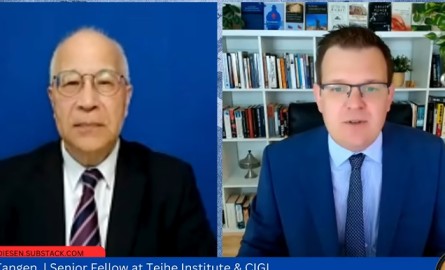
The following is the full transcript of CIGI senior fellow Einar Tangen’s interview on Greater Eurasia Podcast, June 21, 2026.
Editor’s Note: In this episode of Glenn Diesen’s podcast, political economist Einar Tangen joins Prof. Glenn Diesen for a wide‑ranging conversation on whether China can rise as a great power without repeating the imperial path of past empires like Britain and the United States. In this episode, they dig into Chinanomics 3.0, the Belt and Road, China’s industrial and financial strategy, and how Beijing’s long-term planning contrasts with Washington’s nostalgia-driven politics and oligarchic capitalism.
China’s Economic Strategy: A Single Strategic Vision
GLENN DIESEN: Welcome back. We are joined today by Einar Tangen, a senior fellow at the Taihe Institute in Beijing and also a senior fellow at the Center for International Governance Innovation. So yeah, thank you for coming back. I’ve been reading your articles with great interest, especially the one on China, China-nomics 3.0.
Yeah, no, I was hoping you can lay out some of this argument in terms of the reforms of China not being a part of a, well, single strategic vision, but rather, well, it should be viewed as a single strategic vision instead of all these separate policies.
I was just wondering, how do you assess the economics of China? Because, you know, as we’re all distracted by wars breaking out between, you know, large powers, we we kind of lose focus on the main driving force, and that is economics. And well, I guess the main freight train moving forward would be China.
The Lewis Powell Memo and the Blueprint for American Oligarchy
EINAR TANGEN: Well, yes. I mean, there’s always a problem, there’s always headwinds. When you become too dominant, people become concerned that you’re going to use your power the way that colonial powers did, which was basically to enforce a kind of Hunger Games scenario where you’re completely dependent upon them, either through manipulation of countries by creating artificial borders that pitted minorities against majorities, just out-and-out theft, use of gunboat diplomacy, et cetera.
So this is one of the reasons I wrote the essay is that to try to help people understand that China’s view of things is very different from the colonial view. Under a colonial view, you go in, you rape, rob, take, and you justify it that you’re bringing civilization and God to the godless and the uncivilized. Civilized, despite the fact that the countries they were actually, quote, civilizing had civilizations that were thousands of years older than the civilizations of the West.
So I want to begin a little bit before we get into Chinaonomics 3.0, and that is, where is the United States today? And this goes back to about 4 essays that I described them, and I selected these 4 essays simply because they laid out blueprints which have subsequently been followed.
The first one was written by Lewis Powell, 6 months before he joined the U.S. Supreme Court, arguably one of the most powerful individual positions, because once on, you serve for life and your views are going to be reflected in the cases that are decided. He wrote a memo that basically said to the American Chamber of Commerce— it was a secret memo— where he said that because of the defeat in 1964, when Lyndon Johnson was elected president, who he considered basically a communist, it was time for the industrial families of America to unite and to take over government, to take over the media, to take over universities, to take over think tanks, and basically create an oligarchy.
Now, if you have any questions about this, you should go to the Lewis Powell memo and you should read it yourself and read the original. It has footnotes and everything, and you can follow it along and you’ll see clearly that this was the blueprint for America.
The one part that didn’t quite go to plan was this idea of having these blue blood families continue their rule, because what happened is the generations that followed were not interested in running the companies that their forefathers built. So they left it to professionals, accountants, business majors, consultants, who told them what they should be doing, and then eventually started running the companies themselves. And as a result, what started out with this idea that you were establishing oligarchy has in essence become a headless horseman.
Because the professionals have been given very strict orders: maximize shareholder value. And that generally means on a very short term. Why? Because that’s how they get their bonus. It’s the rat and cheese. I say if you maximize the value this quarter or this year, I’m going to give you a big bonus. Of course you’re going to do everything you can.
What’s different about these families and these professionals that they hired is the families actually lived where their factories were. Or at least some of them. They started out somewhere. They were connected to the community. They might have been good or bad. They might have done things, but they were part of the community and they were connected to it and they had a proprietary interest. But as soon as you bring in professionals, they have absolutely no connection. They can shut down a factory which is profitable simply because they say, well, it would be more profitable if we located it somewhere else. In Mexico or in Canada, somewhere else where it’s cheaper or they have less environmental compliance, whatever, maximize short-term values.
So as a result, you saw the hollowing out of America industry because the people who would’ve cared don’t care anymore because all they care about is their dividends. And the people in charge don’t care because all they care about is their bonus. And that was the system that we have today. It’s completely disconnected from the people that actually work for these companies. And you could see it in the disregard and the massive layoffs that are across the board.
The Wolfowitz Doctrine, Clean Break, and Colby’s Hemispheric Vision
The second thing I point to is Wolfowitz’s doctrine in 1992.
Here he lays out this kind of American exceptionalist idea that America has to be on top, that will brook no opposition from anybody and will do whatever is necessary to enforce our will. And we will use whatever means necessary in order to do that.
It’s followed in 1996 by a similar memo, but this memo is meant for Netanyahu. He had just come into power. A gentleman called Richard Perle, he wrote Clean Break. And in this document, it echoes Wolfowitz’s idea that you do not try to work with the world. You don’t try to negotiate peace. You impose your values, your peace, and your economic interests on it. But in this case, it was advice to Israel that they did not need to negotiate peace with their neighbors. They needed either to dominate the neighbors or destroy them. And this has become, in essence, the blueprint for what you see today. And if you read that document, you’ll see very clearly that this was, although somewhat repudiated by Netanyahu at the time, has in fact become a type of blueprint.
The last document I point to is one that was written by Eldridge Colby in 2021. And this represented a slightly different approach to Wolfowitz. It’s still in that same realist vein, this idea that it’s a horrible world and in order to succeed, you just have to be more horrible than everybody else. And his idea is that, yes, the global dominance thing isn’t working, so therefore what we’ll go for is hemispheric dominance. I’ll reassert the Monroe Doctrine. We will take South America, we will claim rights to Canada, Greenland, etc. Complete hemispheric domination, and that we will fortify the home base.
And then the other thing that he talks about is containing China. And his idea of containing China is about controlling oil inflows, exactly what we see today happening with Iran and with Nigeria before that when they were bombing that, and then also what we saw in Venezuela. But he also has one more card which is still yet to be played, and that is to interfere with China’s access to these choke points of trade that exist in the world, especially the Straits of Malacca, because they feel that if they can control the energy going into China, they can control China’s ability to manufacture. And if they can control the choke points where all this cargo goes through, they can control China’s ability to trade.
So this is the grand plan that we see, and we can see in each one of those cases that they are in fact following the blueprint that has been laid out. Elbridge Colby currently is the Undersecretary for the Secretary of War Policy. So he’s actively pushing this, and we can see his fingerprints on a number of these efforts that were made in Venezuela. It’s about getting hemispheric dominance and then also interfering with energy and also these choke points.
The US and China: Nostalgia vs. Progress
So where does that lead us? What I’ve told people is that the US is going in a certain direction. It’s driven by nostalgia, the idea that we were— let’s make America great again, we need to return to the past, to our past glories. But as they say, it’s impossible to swim in the same river. Once time passes, so does the water. But as I said, that’s sort of nostalgia.
On the Chinese side, you’ve seen an amazing 40 years, 45 years of progress. They started out with no real money, hard money reserves. They’re desperately poor. They didn’t have large enough resources that they could export to the rest of the world. They needed food. They needed everything. But somehow they were able to go forward and become the second largest economy in the world. First, if you consider purchasing power parity, which is the idea of economics really is about the way I live, it’s not comparable to the way people live in other places. I want to know, I buy milk and I have an apartment and I pay my bills. What does that really mean?
So China, how does it do this? Well, since it doesn’t have cash, it started doing PPPs. No, I’m sorry, this idea that you allow companies to come in, they invest in roads, sewer systems, water systems, the kind of infrastructure is necessary to organize your areas so that they can start producing. So if I can produce something, but I can’t get materials that I need to start the process and therefore cannot get out the finished products, it’s useless. So infrastructure became very, very important to China.
And in order to do that, they said build, own, turnover — BOTs. So somebody goes in, they negotiate: we will build it, we will own it for a period of time. That period of time will allow us to get all of our money back plus our profit. And once that happens, we turn it back to the government. And in those cases, there are many, many people who got very, very, very wealthy. Why? Because every time they completed one of these, they took their money and their profit and did another BOT. So that was very helpful in establishing infrastructure at a time when they didn’t have hard currency reserves. And that started this kind of renaissance.
China had a huge labor dividend. People were organized and they started to manufacture, especially at the low end. And that was one period of time. Subsequently, China started investing more in their infrastructure. This led to a system that we see today.
And now China’s in this kind of third phase. They’re trying to develop high-value outputs. Why? Because high value carries higher margin. A lot of the business that China was doing before and continues to do is low margin. That means they rely on economies of scale. I was shocked when I came here about 23 years ago, and I went to a factory that was producing vitamin C, and it was the size of 6 football fields. And I said, my goodness, “Who do you manufacture this amount of vitamin C for?” They said, “Well, them and two competitors basically controlled 98% of the vitamin C production in the world.” And what it was is that they were willing to accept a very low margin on very large amounts, and this is how they approached a lot of their businesses.
Today, China is interested in bringing up their economy, and they do so by saying, we’re going to invest in high-end, higher-end goods, tertiary goods, where we are leading in terms of new technologies. We see this in 5G, 6G, and electric vehicles and batteries, and the list goes on and on. So they said, why? Because then people who are working at these companies get more disposable income. Disposable income allows China to drive its consumer-led economy. And this is really where they are today.
The Decline of America’s Middle Class
So how did China organize these ideas? And why has the last 45 years for the US been kind of cataclysmic? In 1971, you have basically 61% of the people in the United States are middle class. You take the same measure, you go to 2024, it’s only 40%. Yes, there was an increase in upper middle class category, but it did not offset that 21% even remotely. So only about a third of that.
So you saw a decline in America’s middle class, and the middle class is the bulwark of American democracy, is their ability to say, I will refrain from my own needs in order to invest in the needs of society. And the needs of my children and my grandchildren. That is now pretty much gone. People feel so defensive. So many people are living paycheck to paycheck. They just don’t have that luxury.
So the US is going in one direction, driven by this idea of nostalgia. China is going in another direction, driven by this desire for progress, to try to create a better society. But what is that society? Many people ask me. I said, society different from the United States. We believe ideologically that we have the best system, that liberal democratic capitalism is the only answer, not an answer, the only one. And therefore it needs to be imposed on the world in order for the world to be peaceful. And this has been our mantra, what we’ve been telling people for many, many, many years. If you just adopt and do as we say, everything will be fine.
But at the same time, countries have realized that the ideology sounds okay, but the reality is that American companies and the government are basically— it comes with a price tag. They’re taking goods and services and they’re dominating these economies, sometimes directly through military gunboat diplomacy, sometimes through political interference, sometimes through just sheer power of their ability to control the financial networks and the movement of money and the dollar hegemony.
So the US is going that way. China says, no, we have a different idea. Our idea is that we can grow the pie bigger, not try to figure out who gets the biggest slice of pie, but how the pie gets bigger. And their reasons for that are simple. They say, well, if the world pie grows and we are part of the manufacturing end of it, we’re going to have bigger markets. Our bigger markets are complementary to these other countries because we want them to succeed. We’re helping them build infrastructure, not just to get resources out, but also to be able to buy goods. And when those goods are bought, some of them are going to be made in China, continue to be, but many of them are going to be made in those countries.
Now, why would China have an interest in exporting jobs to other countries? Well, when people have jobs, they have disposable income. They have disposable income, they buy things. So that’s how China really sees the world.
Wang Huning and the Intellectual Architecture of China’s Development
So ideologically, how does this all work for China? How is it, since Deng and then Jiang Zemin and Hu Jintao and now Xi Jinping, have they been able to consider this line? One of the people I looked at was a gentleman called Wang Huning. He is remarkable in that he was a university professor, so he didn’t follow the normal course of Chinese government, which is you join the party, you’re sent out to some remote village, and then you try to work your way up. Remember, you’ll go there somewhere between 20 and 22, maybe 24 years old. And then between that time and about your mid-50s, you have to show the kind of accomplishment necessary to go to the top of this pyramid. It’s a brutal process, but it’s one they all go through. And it’s kind of the litmus test of determining whether somebody is able to govern because they’ve started at the very bottom and have to quickly go up through the ranks showing their abilities.
So Wang Huning is a little bit different. He’s on the Standing Committee, the most powerful group in China. It’s one of 7 members. But he’s purely about planning and about ideas. He joins Jiang Zemin as one of his chief advisors, and it’s through him that you start to see these policies kind of coalesce. And I’m saying that he alone was part of three generations of leadership, and has been obviously instrumental given that he’s on the Standing Committee as we speak today.
So what are his ideas? His ideas is that to marry both East and West. He’s interesting because he went to America and he spent about 6 months there and he traveled. And he was kind of like the gentleman from France who came to America during the just after the revolutionary period and watched it. Forgetting his name. I keep thinking Lafayette, but that’s not the right name. He wrote a seminal book on the US and its attitudes. A lot of it was good. A lot of it was questioning things like this, but it was a good way of looking at America. And I think if you are interested, you should read America on America by Wang Huning. And in there, he’s complimentary about many aspects of the United States, but he also sees some problems. He sees this kind of idea that greed is good and that the magic of the markets can somehow solve everything. I don’t think he really saw that there.
So his idea— at the end of that, he comes back and he writes this book, and then he goes forward and he starts coming up with these ideas. You can divide China’s development into— first it was kind of export-oriented economy. And then it was infrastructure-led, a lot of investments, the fast rail, everything, the airports, the ports and bridges, everything like this. And then now it’s this third phase where it’s high-quality development.
Where does that lead? He came up with this idea that American modernity, as expressed by a number of intellectuals in the US, was not what China wanted in terms of modernity. And by modernity, I mean, what is the definition of the future and the direction that you’re going in? So he saw development— very important to have development without dependence. He wanted to have growth and national resilience, but the growth would help national resilience so that China would not be dependent on others. And this is not about de-risking. This is simply about making sure, for instance, in terms of food, food security is a huge issue in China. Why? Because people have to eat. You have to take care of the necessities of people’s lives, and they cannot be dependent on the whims or will of other nations. And that’s very, very basic.
And in terms of modernization, he wanted modernization without fragmentation. And this was one of the issues he saw in America, that there was a tremendous amount of fragmentation. It was kind of
The Lure of Empire and China’s Path Forward
GLENN DIESEN: Well, when you talk about how the economy should serve society, I can’t help but to think about Karl Polanyi. He wrote some of the best literature on this after the Second World War. He was essentially making the point that after the Industrial Revolution, the key challenge in capitalism was that if you only left everything to the market, it would essentially decouple from society and society would simply become an appendage. Wherever market efficiency goes, that’s where society has to adjust. And it was exactly this inability to manage the force of capitalism in a responsible way which gave rise to radical alternatives. So he was pointing to Hitler, Stalin.
It feels like that’s the direction we went though. That is, we were supposed to have nations with economies. In other words, here’s our society and let’s organize the economy in a way for efficiency, serving, of course, also serving society. But instead, by having this neoliberal economics where the market cannot be interfered with, this has become almost religion. We gradually became economies with a nation.
Especially the United States have stood out. A lot of red flags should have gone off, for example, after some of the period of globalization and when they saw a lot of the jobs being exported and they had all these places, cities, towns in the middle of America who were dying out. So the jobs were leaving, the drugs were coming out. So instead of, you know, how could we improve society to make this better for everyone, you had articles popping up in newspapers such as, “Oh, the solution is U-Hauls.” That is, “You’re not adjusting to the market. Get a U-Haul,” which is this van they rent, “and move. Get out of there.” I mean, this is just depopulate the area.
But this is, for me, when I read those articles, I thought, well, this is what Karl Polanyi was writing about. That is, you allow society to be ravaged because it’s not serving the economy in a proper way. His point though was if you just go for the economic efficiency, at some point you build up the oligarchy, you dismantle society, and at some point the consequences will come.
But I had a last question for you though about how do you see, how optimistic are you that China can avoid the lure of empire? Because, you know, political realists, we often tend to see that power will impact intentions. That is, again, as you and I have spoken about before, my favorite political economist would be Friedrich List, who in the first half of the 19th century made the point that he made a big difference between the British and Americans. He said the British were able to build an empire essentially standing on three legs. That is, they began to dominate the technology and industry. The second was they then controlled all of the world’s oceans, that is the physical connectivity of the world. And last was the financial connectivity. They had the main banks’ currency being used.
And Friedrich List was making the point that with the American system in the early 19th century, the United States had a completely different system. I mean, it stood on the same three legs, but it would pursue freedom and sovereignty. So he contrasted it with the British. He said the Americans were pursuing their manufacturing base, they were developing the ports and the roads, they were developing a national bank. So this would then be the sovereignty, the anti-hegemonic force essentially.
And when you read it today, the reason I ask is it sounds a bit like the way we often talk about China. But by 1898, you could put a date on it almost, when the Americans won the war against the Spaniards, you saw then that they acquired all these colonial possessions and suddenly controlling the Pacific wasn’t the objective. Suddenly they had to control, dominate foreign markets, and this meant also territorial acquisitions. And again, all of the same three legs which had been for anti-hegemony gradually became instruments of hegemony, especially after World War II when the US had to control all the seas, dominate the tech industries, and of course monopolize on the world currencies and development banks. So at this point in time, the US had been a complete copy, in my opinion, of the British Empire.
So the reason I ask now is because China, we see it also pursuing, I would argue, the same three legs of the American system and the British before them. That is, it has that first leg, the industrial and technological leadership. It has the connecting the world with the Belt and Road Initiative. And the last leg, of course, the financial aspect. It develops the national banks, currency, payment systems. And again, if it’s anti-hegemonic, but if the distribution of power impacts intentions, well, what happens after hegemony?
Because the examples you gave with Clean Break and the Wolfowitz Doctrine, it’s not an accident that they popped up in the 1990s immediately after the Soviet Union was gone, which was the balance. So again, when America’s unbalanced, then suddenly all these ideas of dominating the world for the benefit of all of humanity, for some reason, all of this — it sounds like a joke today, but in the ’90s, this is what most people subscribed to. That was before they called for destroying entire civilizations and backing all these genocides.
But I guess, yeah, the core of my question is, how do you see — well, what gives you optimism about China’s ability to resist this, the appeal of empire? Because the Mearsheimer argument would be that this will be the ultimate security. If you dominate the world, you’re completely safe. As you suggest, of course, it does — empire corrupts, as you say. If your empire is broad, good governance at home is a dream. It’s going to fall apart. So I don’t think empire is a good path for China, but it has a big appeal to it. So again, very long question. How can China essentially resist this?
China’s Governance Model and the Future of Global Change
EINAR TANGEN: I think it’s absolutely topical. The funny thing about it is I moved to China in 2005 because I said, well, if there’s a renaissance in my lifetime, it’ll be here. I have not been disappointed.
But I also had the opportunity — I was chairman of my state’s international trade council and I had the chance to meet some fairly high people in the government. And the one thing I said to him, I said, well, you seem to be on the right track in terms of your economics and things like that. Your system is different, but it seems to suit you. There are rough edges and things like that, but I do see China rising. And this is in 2006, ’07, ’08, that type of period.
But I said, I hope you’ll study history to the extent of — and not, because it’s not just Great Britain. You go back over all of these empires, it was always the same. They started out with trade and then all of a sudden it became a force to get trade. And then of course it becomes justifying it with either God or gold or whatever comes to hand. I said, I hope you don’t become like us.
China’s Relationship with History and Ideology
Now, there are a couple of things about China which are noteworthy. First off, as I said, we’re driven by nostalgia. You would think that China is in part driven, because they’ve said this rejuvenation, this idea that we want to reinvigorate our economy, but that’s not nostalgia necessarily. What it means is it’s the recognition that we have to do new things in order to advance, and it’s all about history.
So for instance, if I talk to somebody in the government at a fairly high level, they are classically trained in the sense that they know all the poets, they know the literature, their history. They are continually going to what they call the party school. They have to take courses there mandatory every year. And as part of that, they are taught about their history. Of course, it’s the interpretation that they put on it, but they do learn about China’s — they are not only learned, but they’re fully cognizant of the power of history, especially as you get into higher levels. And they use that as a guide to the future.
For instance, in dealing with Donald Trump, they understand he’s transactional. They thought long and hard about how to handle him, and they found examples of people like him in their history. And that makes them a little bit unique because, as a history professor, you know, you’re less likely to repeat the mistakes of history if you actually study it and learn from it. So I think they continue to learn from that, and as long as they’re willing to teach that and that is central to their understanding of the world, I think they’ll do well.
Second, they don’t push ideology. We do. And part of it is we push the ideology because it’s a way — it’s a defensive nature. Why have we done all these terrible things? Well, we’re actually doing it for the right reason, as you pointed out, for the greater good. Every omelet, you have to break eggs. So if you want an omelet, you have to be willing to do what’s necessary. But I think that has become hollow.
But China doesn’t do that. They don’t say you should follow our example. They say, sure, if you think we have something to offer from the way that we have developed and it works in your country, feel free. We don’t have any intellectual property claims on it. You do what is necessary. Their idea about sovereignty is that every country, because it’s a complex mosaic of cultures, history, different people, often different languages, has to have its own path. It’s not a cookie cutter. This is not one size fits all.
So that is a little bit different. If you’re not looking to push your ideology on people, that means you have no reason to run in there with your warships and beat them bloody so that they do the right thing.
China’s Professional Bureaucracy vs. Western Leadership Preparation
And the last part is China’s system so far has a professional class of bureaucrats that lead up to leadership. Now, I’m not a big fan of bureaucracies and they need to be watched very carefully. But those who come through the bureaucracy — as I said, you start when you’re 22 to 24 and then by 54 it’s going to be decided whether you continue or whether you basically retire. And on the way up, it’s brutal. It’s a pyramid. I start out with millions and you end up with 1 and then 7 and then 25, etc. So there’s not a lot of room at the top. That means that those who come up are generally extremely capable.
But in any kind of system, you have to acknowledge the stronger the leader, the weaker the government. And I don’t mean that in their things. It’s just that new ideas find it harder to express themselves when you have a very strong government. And these are things that the Chinese government is well aware of — also transition and all of these things. So they’re thinking about these things. They’re not putting their head in the sand and saying it’ll go away. No, this is the natural way of things.
And this is a long-winded way of saying that China has a system that on average produces better people who are more interested in serving the people than most of the nations that I know of. And I want you to think about that. How does America prepare its leaders? You could be unemployed, unemployable, and you run for dog catcher, and then you run for mayor, and then you run for the Senate, and then you’re president. And it sounds like a great story.
You obviously had Clinton, who rose from very humble beginnings to be president of the United States. It sounds great, the Horatio Alger story. But were they really prepared? In Clinton’s case, better prepared than most because he had been a governor. But Obama, despite the fact that I think he’s a very moral, very good guy, great speaker — never really ran anything before he became president, and that became a problem for him. He was not prepared to be president.
The irony is he’d be a great president today because he has the experience, right? And he understands how the bureaucracy works and how it kind of befuddled him, especially on military matters. When you’re sitting there in the Oval Office every day and the people with big stars on their chest and lots of degrees — these are very smart people — come in and they basically brainwash you over a period of time about the security threats facing America. And you believe them because you don’t have an independent sense of reference, especially somebody who was an organizer and then a state senator and then moved up to the US Congress and then became president. Meteoric rise, but that didn’t necessarily prepare him for the most complex position in America.
Whereas in China, if you’re going to reach that position, you have been through the wringer many, many, many times. You know exactly how China works, you know how its systems work, you know the limits and benefits of the bureaucracy and things like that. And because it’s a system where, contrary to things, Xi Jinping isn’t going to nominate everybody who’s going to be in power in the future. It is a collective decision-making process and it’s very complex and there is lobbying amongst the people there. But you cannot be a jerk and be elevated because no one likes you if you’re a jerk.
I mean, Ted Cruz — everybody who’s ever met Ted Cruz dislikes him. They say, oh yeah, he’s a smart guy, but he’s just not very likable. In China, there’s no way he would have ever been in the situation he’s in — A, because he doesn’t have the experience really to do what he’s doing. He’s not well-informed, as we saw with his interview with Tucker Carlson. Didn’t know that there are 92 million people in Iran. He just says, “Let’s attack it.” “I’m the senator for Israel,” things like that. I can’t even imagine somebody in China saying even a tenth of the things he’s saying and being in any position of power.
The Dangers of Hawkishness and Populism
So they have a different system. There are limits to it. But at the same time, there’s always that constant warning. And that’s the thing — the power of human nature. And what I see sometimes today, not in the top end, but in the middle end, I see these people who had nothing to do with China’s successes. I mean, in the hard parts and going through the Cultural Revolution, things like that. They somehow take on the mantle of China’s successes and they try to take it very personally and they become in many cases very hawkish saying, “We need to teach everybody a lesson. We’re strong. You have to know who China is.” And that kind of talk worries me.
But as I said, the people at the top who continually go up do not generally reflect these views. They tend to be, as I said, very historically based. They’re very certain that a good future does not involve conflict. As you know, China continues to try to tamp down all the nonsense that’s going on in the world started by other nations.
So yeah, I do think there’s that constant danger. And if you ignore it, you’re really in trouble. You can’t do that. We see across Europe Alternative für Deutschland, AfD. You see the right-wing parties who are in essence have fascistic tendencies rising on populist programs and things like that. Are there leaders capable of governing? Have they ever done any governing? No. They’ll make promises to get into power, but they will have no idea how to keep them.
And you can see that with Milei in Argentina. You can see that across the board, including Donald Trump. He has no idea how to follow through on all the promises he’s made. In fact, he’s now at the position where he is actually going in the opposite direction of everything he’s promised. Healthcare is more expensive, the prices are up, gasoline is up, forever wars continue to go on. And he’s paying no attention to bringing real jobs back to America. That whole thing has failed.
Confidence vs. Superiority, and China’s Long-Term Outlook
So yeah, that’s the danger there. But then, how does China react to that? Do they think, “Oh, we’re superior?” I think adopting an air of superiority is the greatest weakness. I know very few people who are truly confident who act superior. People who are trying to convince you they’re superior — I always suspect have self-worth issues that they’re trying to cover up their inadequacies by convincing you that they’re strong. If you’re truly strong, you rely on your arguments, you give examples, you do things, you don’t talk about it as much.
So I do think Chinese have a much longer shelf life in terms of how they deal with things. But the future is unknown. And as I said, it’s a continual battle. The only thing we know for certain is there’s going to be more change. And when those changes come, you have to have a system that’s dynamic enough to respond to it.
I think China’s is responding to the dynamics of the world economy and the direction in terms of both society and politics, as opposed to the US who, as I said, this nostalgia stands in the way of them confronting not only internal realities of a failing society and these massive debts that they have no talk right now about ever paying back. I mean, that worries me because by the end of this year they will be well over $40 trillion and no one seems to be batting an eye, except a few people on ideological lines who continue to vote for the very things that they say they’re against. That’s the politics of it.
The Digital Revolution and the Future of Work
So yeah, we’re in the midst of a period of change, not only politically because of the US and China, but also in terms of the technology. I mean, the digital revolution is as great in my mind as the Industrial Revolution in terms of how it affects regular people. And there have to be new ideas about how to accommodate that, how to train people so they can be part of this new economy, and how the economy is going to work.
Do we have some new system where we employ people 3.5 days a week, but you run a 7-day a week economy? You have 3 shifts and it doesn’t matter when you go to sleep or wake — basically all the services are available so that you’re spreading out your economic activity. There’s less and less going to be necessary to provide the essentials of people’s needs. I mean, food, assuming there’s enough arable land, can be done with a fraction of the number of people it was done before.
In China, you still have around a little over 30% of the people involved in agriculture. In the US, it’s less than 2%. It’s highly automated and things like that. But that opportunity is there. The labor from that can be spread to elsewhere, but they have to be trained. You have to start thinking about what they can do and then showing them how to do it.
There are many other areas where we’re essential. I mean, building — if I print a building and I don’t need masons and all of these types of things, what do we do with them? I think China is being very forward-looking. They don’t talk a lot about it, but they’ve been investing more and diverting more people into areas where there are going to be future opportunities. They’re making sure that they have college graduates, but they’re also overhauling the academic programs so that these people are more in tune and have, once they graduate, good job prospects.
So government is not only responsible for creating safety, but for preparing people to be productive parts of society — not interchangeable, but simply trying to match people and their interests and abilities to areas where they can have a fulfilling life. That’s just as important. It’s not just “I have extra income,” but “I go to work and I see value in what I do and others see value.” And that value transforms to me in terms of payment.
So governments who are able to adjust and provide for their people and their future, I think do very well. It’s not about giving people stuff. That’s not productive. You’re transferring wealth. If there’s enough wealth to transfer, fine. And people need — in some cases, all you can do is transfer. If they’re quadriplegic and they can’t work or they need extra assistance, yes, it’s going to be a little bit of a drag on society, but you can’t just abandon them.
Closing Remarks
GLENN DIESEN: Maybe I think that’s, no, I was going to say, I think that’s a key challenge for all societies now moving forward, creative destruction from the new economies emerging. Anyways, I wanted to thank you for coming on so early on the weekend. Long-winded. Yeah. I very much appreciate it. Thank you.
EINAR TANGEN: Yeah, thank you. All the best to you.
Related Posts