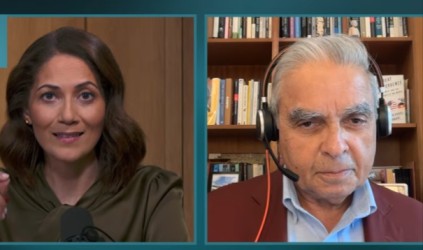
Read the full transcript of former diplomat Kishore Mahbubani’s interview on The Mishal Husain Show, May 15, 2026.
Editor’s Notes: In this episode of The Mishal Husain Show, esteemed academic and former diplomat Kishore Mahbubani joins the program to dissect the unprecedented geopolitical rivalry between the United States and China. Mahbubani shares his unique perspective from Singapore, reflecting on how the shift from a “cat” to a “tiger” in China’s power necessitates a new global strategy beyond a zero-sum game. He also offers a deeply personal look into his own life story, from growing up in a poor, “third-world” Singapore to witnessing the country’s miraculous economic transformation into a global leader. Finally, Mahbubani provides critical insights into the long-term strategic differences between American and Chinese leadership, urging both powers to focus on internal flourishing rather than external confrontation.
INTRODUCTION
MISHAL HUSAIN: From Bloomberg Weekend, this is The Mishal Husain Show. By now, you’ve probably seen a fair amount of news emerging from Beijing, where President Trump has been meeting China’s Xi Jinping. One-to-one, face-to-face meetings of this kind don’t come around often, but there is a much bigger story to tell than that of these two men, or any two leaders of these countries, actually.
The real story is an epic tale that has been unfolding for about 30 years, and it’s about supremacy, the battle to be the world’s number one power. That’s what we wanted to dive into this weekend, the story beyond the handshake, the readout, the Truth Social posts. And we wanted to do it from the perspective of someone who is neither American nor Chinese, but has witnessed the rise of China from his own country, which is tiny in comparison, Singapore.
Kishore Mahbubani was for 3 decades a Singaporean diplomat, rising to become its ambassador at the United Nations. He’s from Singapore’s minority Indian community. And although I’ve known him for years, I only recently understood the circumstances, the tough circumstances in which he grew up in the 1950s and ’60s. He’s written many books. His most recent is called Living the Asian Century, and it’s also his most personal.
As ever, for the context beyond the conversation, for more on the people, the places we talk about, have a look at bloomberg.com/mishal. That is where you’ll find the written version of this with my reflections and pictures which add to the story. But here’s Kishore Mahbubani in his own words, talking first about why the US and China matters so much right now.
The Most Important Contest of Our Time
KISHORE MAHBUBANI: It is by far the most important contest of our time. And I think what most people don’t realise is that never before in human history have we had two powers of the size, the scale, and reach of United States and China confronting each other in the way that they are today. Because the United States is a remarkably powerful country, much more powerful than any other great power has been in human history.
And of course, when the Soviet Union collapsed, the United States was left alone as the sole superpower in the world, and few expected China to come up so quickly. But now China has clearly achieved near parity with the United States in the scope and scale of its power too. And therefore, you notice when President Trump launched his tariff wars on all the countries in the world, only one country stood up to the United States, and that was China.
Power Beyond Economics
MISHAL HUSAIN: In this contest then, do you see it as bigger than the economics of it, the desire on the part of the United States to maintain its position as the world’s biggest economy? Are you talking about power as something broader than that, a quest to become the world’s only superpower?
KISHORE MAHBUBANI: Geopolitics has been around for about 2,000 years or so. And so there are certain habits of behaviour that all great powers share in common. And the number one power of the time always wants to preserve its number one position and not give it up gracefully and say, “Okay, my turn is up. Why don’t you take over?” It’s not like in the world of business where IBM will give way to another company, for example.
But in geopolitics, it’s a zero-sum game, sadly. And so even though Washington, D.C. today is a very badly divided capital politically, but when it comes to China, there’s a near-universal consensus that it is in the interest of the United States to stop the rise of China. And that’s why the actions against China remain consistent whether or not you have President Trump or President Joe Biden. It makes no difference. It’s not about personalities, it’s about the logic of geopolitics.
Can China’s Rise Be Stopped?
MISHAL HUSAIN: And would you say that that is a foolish desire to stop the rise of China because this is the way the world is going, that China is on a path to become the dominant economic power and the demography is on its side?
KISHORE MAHBUBANI: Well, no, I would say it’s not wise policy of the United States to stop the rise of China because China can no longer be stopped. And the only way to stop China is to ask the Chinese government to stop improving the livelihood of its own people. If you want China to — that’s the only way that China will stop growing. But China still has a long way to go. Its per capita income is way behind that of the United States. It has a long way to go. So clearly, the Chinese people want to improve their lives, and the Chinese economy will keep growing. Of course, there will be ups and downs like in any other economy.
But equally importantly, and this is the key point: we live now today in a small, interdependent, fragile planet Earth.
And our overall priority as humanity should be to try and preserve planet Earth before we lose it to climate change and other forces. So there is therefore a larger imperative need for the US and China to collaborate to deal with many common challenges in the world rather than to engage in a zero-sum game with each other.
And by the way, I’ve used a different analogy in a former book of mine, The Great Convergence, saying that the world has shrunk. The 193 countries are no longer 193 separate boats. The 193 countries are 193 separate cabins on the same boat. And if you’re a cabin on the same boat, there’s no point protecting your cabin if the boat is sinking. So therefore, there’s a common interest for US and China to come together and take care of planet Earth, because that’s far more important than whatever you gain to make in this geopolitical game of one-upmanship.
A Defining Moment: The 1993 APEC Summit
MISHAL HUSAIN: Take me back to 1993 and a moment between the two countries that you saw for yourself as a Singaporean diplomat at the APEC summit of that year. What did you see and why did it matter?
KISHORE MAHBUBANI: Well, this was the first meeting ever between the new President of the United States then, Bill Clinton, and the leader of China, Jiang Zemin. And you may recall that in the 1992 election, Bill Clinton famously stood out from George H.W. Bush by saying, “Unlike President Bush, I will not coddle the butchers of Beijing.” So there was a lot of tension in the air, wondering whether or not Bill Clinton would launch an attack on President Jiang Zemin.
And indeed, President Jiang Zemin himself was a bit nervous because when he read out his own speech, he read it so fast that the Taiwanese delegate said to him, “Slow down, the interpreters cannot follow you.” So there was a lot of nervousness in the air. And amidst all this nervousness, when we had a short break for coffee, the first person President Bill Clinton approached was President Jiang Zemin. And I saw with my own eyes Bill Clinton coddling Jiang Zemin, in a way that he said that he would never do.
So it was quite remarkable, and everyone in the room noticed it, was watching with incredible sort of relief and happiness that what could have been a painful confrontational meeting turned out to be a really remarkable breakthrough in US-China relations.
MISHAL HUSAIN: And the “butchers of Beijing” reference was one to Tiananmen Square a few years before.
KISHORE MAHBUBANI: Exactly, he was referring to what happened in Tiananmen Square in 1989.
MISHAL HUSAIN: And what did that moment, which you witnessed, then lead to? What did it unlock in the years ahead?
KISHORE MAHBUBANI: Well, I think it enabled the renormalisation of US-China relations because, as you know, Tiananmen set the US-China relationship back quite badly. And as you know, before then, of course, during the Cold War, because the United States needed China as a counterweight against the Soviet Union, the United States would always bend over backwards to accommodate China.
And I can tell you an even more horrifying story. In 1981, there was something called the International Conference on Cambodia, where there was a disagreement between China and the ASEAN countries about whether or not the government of Pol Pot should be allowed to go back to Phnom Penh after the Vietnamese troops left Cambodia. And China took the correct position under international law, which is that when a foreign invader leaves, Pol Pot comes back. But ASEAN countries said, no, this cannot happen because no country will accept the return of Pol Pot.
And fortunately, the United States intervened. So we thought the United States would of course side with the ASEAN countries who were calling for free elections. Instead, to our absolute horror, the United States said, “Don’t stand up to China, we need China for our standing up to Soviet Union.” So that was one of the most amazing things I saw in my life. But that showed you how far we had come between 1981, where China was being accommodated all the time, to the end of the Cold War, and then China was suddenly an irrelevant partner then.
America Behaving Like the Soviet Union?
MISHAL HUSAIN: But while saying that neither country should be treating it as the contest that they are, I think overall you’re much more critical of US policy towards China than the other way around, aren’t you? I read that you said that this, what’s happening now is like the Cold War, only America now is behaving as the Soviet Union was during the Cold War, that when the Soviet Union behaved unilaterally, ignored international opinion, and that was a time when America acted multilaterally and marshalled global opinion to its side. It’s a very unflattering comparison.
KISHORE MAHBUBANI: Well, that comparison has been made by other scholars too, that in the contest between United States and Soviet Union, American society was flourishing, but Soviet society wasn’t flourishing. But today in the contest between United States and China, the bottom 50% of the American population haven’t seen their standard of living improve in several decades. And indeed, the indicators of people at the bottom are very bad in the United States.
And therefore, the logical thing for United States to do is to first focus on uplifting its people rather than to try to engage in a zero-sum geopolitical contest with China. But I can tell you, in geopolitics, unfortunately, common sense doesn’t work. Because this desire to be number one is somehow so deeply ingrained into the human brain, that it’s very hard to persuade the policymakers, “Hey, step back and think, what is a better approach to take?”
And the goal of my writings is not to say that China should win or United States should win. The goal of my writings is to say that China and US should step back and reflect whether it is in their larger long-term interests to engage in such a zero-sum contest.
Rights, Freedoms, and China’s Political DNA
MISHAL HUSAIN: And the standard of living of the Chinese population has risen immeasurably in recent decades. There are, of course, though, rights that they do not enjoy compared to Americans: freedom of expression, the right to choose their own leaders.
KISHORE MAHBUBANI: Well, you’re right. China has rescued 800 million people out of poverty. That’s 2.5 to 3 times the population of United States. And that’s an amazing achievement. But you’re right, the Chinese don’t enjoy many of the rights that Americans enjoy.
But Chinese society has got its own political DNA, which has been embedded in Chinese society for 3,000 years. And over 3,000 years, the big lesson that the Chinese people have learnt is that when there is chaos in the centre, in the capital, the people suffer. But when there is political stability and control in the centre, the people prosper and flourish.
And when people say that the Chinese people are not free, I ask a very simple question: if the Chinese people are not free, why is it over 130 million Chinese people leave China each year? And then, amazingly, using their own two feet, return to China every year. Now, if China was this harsh, dark communist gulag that is portrayed in the Anglo-Saxon media, the Chinese people are irrational, they shouldn’t be returning to China. But the Chinese who are returning to China are the ones who have experienced life overseas.
To put it simply, China is a different civilisation from Western civilisation. So the kinds of society that the Chinese people want at the end of the day will be different from Western society. And that’s something that we got to learn to live with in the new multi-civilisational world.
Xinjiang and the Question of Muslim Rights
MISHAL HUSAIN: I hear what you’re saying, and I’m also at the same time thinking of the evidence that emerged a few years ago about those re-education camps in western China, in Xinjiang Province, where Chinese Muslims were detained, some as young as in their teens, right up to people in their 70s, because the state felt they needed re-educating about their beliefs.
KISHORE MAHBUBANI: Well, there’s no question that China’s internal arrangements are not the same as those of Western society. But when the West raises concerns about the Muslims in China, the one comment that the rest of the world makes is that in general, the West doesn’t like Muslims, in general, the West doesn’t like Chinese, but for some strange reason, they love Chinese Muslims. And it’s because it’s a political tool to be used to embarrass China.
Unfortunately, that political tool no longer works because the whole world is saying, if you in the West are so concerned about the conditions of Muslims who are oppressed, what have you said about Gaza? What have you done about Gaza?
Growing Up in a Poor Third World Society
MISHAL HUSAIN: You have seen international relations through your work as a Singaporean diplomat over many years. But I want to ask you about your life story too, because I think you have lived history in a really interesting way, in that you came of age in Singapore just at the moment as it was getting its independence from Malaysia after British colonial rule had come to an end. And when I read your book, “Living the Asian Century,” I was really struck by the hardship that your family experienced and that you experienced, that when you started school in 1954, you were seriously underweight and you had to be put on a special feeding program in school.
KISHORE MAHBUBANI: Well, looking back now, this is a strange thing to say. I feel that it was almost a privilege to have grown up in a poor Third World society. And you’re right, I was put in a special feeding programme at the age of 6, because I was technically undernourished. And I lived in a house with no flush toilet until I was 13 years old. And frankly, I found that one of the biggest changes in my life was when the flush toilet appeared, because I felt that my sense of dignity improved dramatically.
And also, my family was very poor. My father went to jail. The debt collectors came to our house to try and auction off the furniture in our house. So I went through a very rough Third World childhood. My mother was the one who took the brunt of all this pain and difficulties. And not once did she crack. And every time in my life I go through a difficult patch, and when I feel depressed, I just think of my mother and I say, “My mother never cracked under much greater pressure. How can I ever crack?” So that resilience that my mother gave me was an amazing gift in my life.
MISHAL HUSAIN: She had had a narrow escape from communal violence in what is now Pakistan at the independence of India, 1947. Your father had obviously had a very difficult early life, sent from what was then British India to Singapore and starting to work manual labor at the age of 13.
KISHORE MAHBUBANI: Yes, both my parents never went to university, not even to high school or even secondary school. And my father unfortunately was orphaned at a very young age and at the age of 13 was sent to the British colony in Singapore and ended up quite naturally without adult supervision, engaged in several bad habits like smoking and drinking and gambling. And so my mother, who had an arranged marriage, had no idea that she was marrying an alcoholic gambler. And that, of course, was the root of our problems.
And my mother too, as you said, had a close shave, because she was in a train leaving Pakistan in the middle of the night in the desert when her last compartment got decoupled. And if a mob had come along, she would have been killed. But she survived. So I guess our family has had lots of close shaves.
Singapore’s Remarkable Transformation
MISHAL HUSAIN: But as you say, in Singapore too, when you were growing up, it was a poor neighbourhood. Few of your peers even finished school, let alone went to university. And that description in your book of living without a toilet — it’s so striking compared to what Singapore is today — that each morning the night soil men went around the neighborhood. They opened a small door in the wall of every house, pulled out a metal can filled with 24 hours’ worth of feces and urine from the occupants of the house.
KISHORE MAHBUBANI: The sights and smells of that experience never go away. But what’s amazing is that Singapore’s per capita income at independence was around $500, the same as Ghana in West Africa. But today, Singapore’s per capita income is $94,000, among the highest in the world. And no country in the world has gone from $500 per capita to $94,000 per capita in 60 years, or less than one human lifetime. Now that’s one of the most remarkable stories of human history. And again, that’s been one of my great privileges, to travel this remarkable journey upwards with my fellow Singaporeans.
MISHAL HUSAIN: It didn’t feel that way in 1965, did it? I think you were 17, still in school. Singapore left the federation it was in with Malaysia, and there’s a sense of despondency everywhere about how it can possibly survive on its own.
KISHORE MAHBUBANI: Well, I remember the day vividly, August 9th, 1965, when Singapore was expelled from the Malaysian Federation. And no one in Singapore celebrated our independence because we thought Singapore was doomed. And there was a simple reason why Singapore was doomed, because Singapore was a city, and when a city is cut off from its hinterland — which Malaysia was the hinterland for Singapore — it can die. It’s like taking a heart out of a body and expecting the heart to survive without the supply of blood and other materials to the heart.
So it was a very difficult time, and no one expected Singapore to succeed in the way that it did. But of course, this success was due to three remarkable geopolitical geniuses: Lee Kuan Yew, Goh Keng Swee, and Rajaratnam. And I had one of the greatest privileges in my life, in that I got to work with all three of them. And they were probably the three best tutors I ever had in my life.
MISHAL HUSAIN: Not just in diplomacy, broader than that?
KISHORE MAHBUBANI: Much, much broader. I mean, they were big deep thinkers, and all three of them could take a long-range view of history. So the reason why Singapore was economically successful — of course Mr. Lee Kuan Yew played a very important role — but the economic architect of Singapore’s miracle was Dr. Goh Keng Swee. And when I sat with him, he would tell me about how the Japanese succeeded, what happened in the Meiji Reformation, the lessons the Japanese learned from the rest of the world, and how Singapore must try to emulate Japan and therefore succeed. So his understanding of history was amazing.
MISHAL HUSAIN: I interviewed Lee Kuan Yew once. I was really early in my career. I was in Singapore and the BBC sent me to interview him. And he was perfectly civil, but I think he probably felt quite insulted that someone so junior had been sent to talk to him, the senior minister and founding father of Singapore.
KISHORE MAHBUBANI: But Mr. Lee Kuan Yew was acutely aware that you were with BBC, and he knew that by talking to you, that he would get his views and opinions to a very large section of the human population. And so he would have been happy to talk to you.
China’s Rise and the Regional Order
MISHAL HUSAIN: Tell me then, in this picture that you’ve painted of rising China, a rise that can’t be stopped — it is a country that in its own way has these moments where it destabilizes neighbors. For example, closing airspace around South Korea’s borders, as has been the case recently, doing things that upset or worry the Philippines or Taiwan, of course, Japan at times. How do these states in the region, including Singapore, fare in that Asian order?
KISHORE MAHBUBANI: Well, I think we have to understand that China’s rise has been remarkable and dramatic. And to explain how dramatic it is, just imagine when you and I began this conversation a few minutes ago, there was a cat sitting next to me. And suddenly, after 15 or 20 minutes, I turned around and I noticed the cat has become a tiger. Now, I was very comfortable sitting next to a cat. I’m very uncomfortable sitting next to a tiger. Now, China has become a tiger. You have to accept that it is now the second most powerful country in the world, and still rising strongly. And so we have to learn to live with a much stronger power in our neighbourhood.
And the idea that any power can be benevolent — the term “benevolent great power” is an oxymoron. All great powers will protect their interests. So the neighbours of China, therefore, have to adjust to Chinese power, but this doesn’t mean you kowtow to Chinese power — you learn to manage it.
The neighbours of China also have long histories. And to give you an example, the last country with whom China had a major war was Vietnam. And in 1979, about a million soldiers were fighting each other in that war. And the Vietnamese were occupied by China for 1,000 years. But the Vietnamese have an expression, a very important expression. They say that to become a leader of Vietnam, you must be able to stand up to China, and you must be able to get along with China. And if you cannot do both, you cannot be a leader of Vietnam.
So countries in this region, therefore, are pragmatically adjusting to the emergence of China. But in our private conversations, we do tell the Chinese quite frankly what our concerns are, and they do listen. But the important thing is, remember that we are in Asia. In Asia, you must always save the face of the person you’re talking to. Please don’t insult China publicly in the way that European leaders do, in the way that American leaders do, because that’s not how you get to work with China.
MISHAL HUSAIN: Well, many countries, many leaders are learning that that’s also the way you work with President Trump.
KISHORE MAHBUBANI: Well, I think President Trump is definitely different from his predecessors. But I also have to emphasize that all American presidents put American interests first over the interests of other countries. That’s just a fact of life. And for example, when I was in the UN in 2003, so many countries advised President George W. Bush not to go to war in Iraq — so many countries, including some of the best friends of the United States, including France, including Germany, including Egypt, including Saudi Arabia. And the United States didn’t listen. So it is not the case that you had American presidents in the past who would sacrifice American interests. No, they won’t. And this is a reality when dealing with great powers.
Every War in the Middle East Is a Gift to China
MISHAL HUSAIN: So what do you think are the implications of these weeks of war with Iran? What do you think is the effect of this on China? And is there a reshaping that is taking place or is now going to take place because of the war with Iran?
KISHORE MAHBUBANI: Well, I’ve said this to my American friends several times, and it’s also the theme of my book, “Has China Won?” — every war that the United States fights, especially in the Middle East, is a gift to China. So in the 10 years when the United States was bogged in Iraq after the illegal invasion of Iraq by President George W. Bush, China had its fastest growing years. It was left to grow peacefully from 2003 to 2013. So in the same way, if the United States gets bogged down in another war in Iran, again it buys time for China.
And the difference between Chinese leaders and American leaders is that Chinese leaders, as Henry Kissinger told me, always work out a comprehensive long-term strategy before embarking on a venture. And the Chinese do have a comprehensive long-term strategy for managing the challenge that the United States is posing to China. By contrast, the leaders of the United States — and I don’t mean Republicans only, by the way, it’s both Democrats and Republicans — have not worked out an equally comprehensive long-term strategy for managing the return of China as a great power.
And I try to be helpful to both sides by saying, why don’t you take a step back and understand the other side? Because as Sun Tzu, the Chinese strategist, said, “Know thine self, know thine enemy, fight a thousand battles, win a thousand battles.”
But Chinese leaders can act that way because they don’t have to ever deal with an election. That’s true, but in the Cold War, a democratic United States that had elections every four years defeated the authoritarian Soviet Union. So the constant elections in America were in no way a handicap. In fact, the architect of the success of the United States in the Cold War was a man called George Kennan, whom I met once. And George Kennan said way back in 1949 that the outcome of the Cold War would be determined not by the number of bullets or warships or aircraft carriers or jet fighters you have. It’ll depend at the end of the day on which society creates a spiritual vitality that leads to its people flourishing and growing.
So if George Kennan were alive today, he would advise the United States, “Don’t try to get more aircraft carriers. Try to focus on improving the livelihood of the bottom 50% of American people. And if you succeed in doing that, that’s how you win the long-term contest against China.”
MISHAL HUSAIN: Professor Kishore Mahbubani, thank you so much.
KISHORE MAHBUBANI: My pleasure. Thank you for having me.
Related Posts