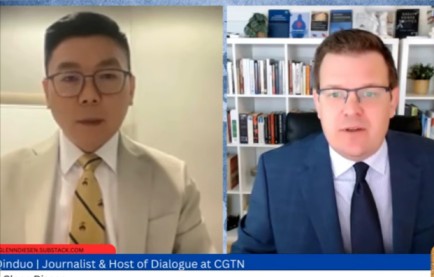
Read the full transcript of CGTN’s Dialogue host Xu Qinduo’s interview on Greater Eurasia Podcast, May 14, 2026.
Editor’s Notes: In this episode, host Glenn Diesen is joined by CGTN’s Xu Qinduo to provide an in-depth analysis of the historic May 2026 summit between President Donald Trump and President Xi Jinping in Beijing. The discussion explores the potential for a “constructive strategic stability” as the two leaders address critical global issues like the economic trade war and the sensitive status of Taiwan. They also delve into the strategic complexities of the Iranian crisis and shared interests in maintaining energy security within the Strait of Hormuz. Ultimately, the dialogue assesses whether this high-stakes meeting marks a genuine shift toward cooperation and if 2026 will be a milestone year for resetting U.S.-China relations.
Introduction
GLENN DIESEN: Welcome back. Today is May 14th, 2026, and we are joined by Xu Qinduo, who is the host of Dialogue at CGTN, to discuss what is happening now at the meeting in Beijing. As we know, Donald Trump is currently meeting with Xi Jinping in Beijing. So thank you very much for coming on the program.
XU QINDUO: Thank you for having me, Glenn.
The Trump-Xi Meeting: Atmosphere and Early Signals
GLENN DIESEN: So again, I think most of the world now is looking at this meeting. Often there’s a lot of superficial theatrics, often when we deal with Trump, but at the same time, there’s a lot of issues which has to be solved by these two giants, the two largest powers in the world, the US and China. So what do we know so far about how this meeting has gone? What are essentially the main objectives of each side, and is there any common meeting points?
XU QINDUO: Yeah, I can share with you what happened today. I would say in general, the atmosphere has been very positive. Mr. Trump obviously is impressed with the welcoming ceremony, for example, and the reviewing of the ceremonial guards together with President Xi Jinping, the visit to the Temple of Heaven, and then the state banquet.
So the two leaders, they spend the morning talking to each other with their own teams, and then the two of them were in the Temple of Heaven, and then that’s in the afternoon. And then in the evening, I think they are still ongoing, they have a state banquet, hosted by President Xi. He gave a speech, very warm. He talked about China and the US should be partners rather than rivals.
And President Trump also responded in his speech, a brief speech, but very warm. He talked about both Chinese people and Americans taking care of their families, working hard. They share a lot in common in terms of their values. He talked about over the past 250 years almost, the engagement of the people between the two countries. He talked about the first US ship arriving in China in 1784. At that time, Chinese people called them “new people from a new country.” And then he talked about Chinese workers helping build the rail link between Pacific and Atlantic Ocean across the Continental Railroad. He talked about the establishment of Tsinghua University, one of the top universities in China. He also talked about China and the US were allies during the Second World War. Confucius was also well-respected in the US, etc.
So both sides agreed upon a vision which is called “constructive strategic stability” that will guide the bilateral relationship for the next 3 years or even beyond that. So that’s very impressive, I would say.
Overcoming the Thucydides Trap and the Economic War
GLENN DIESEN: Well, yeah, those are some good signs. However, ever since Trump’s first administration, we know that China was often in the spotlight in his administration, but also more generally within the US now, given that China is seen as the main peer rival. And indeed, I saw Xi Jinping even makes a reference to the need to essentially overcome what is often referred to as the Thucydides trap. That is, that we had one hegemon before, and now it’s, if not being replaced, at least it no longer enjoys a hegemonic position. And often this results in conflicts between the two great powers.
So given that there will be, at least, a need to harmonize relations or manage the competition, how do you see the prospect of overcoming this economic war? Because that’s something that really shaped US-China relations over the past decade.
XU QINDUO: That’s a good question, Glenn. You mentioned about the Thucydides trap. President Xi also mentioned this phrase, but what he meant is that we should overcome this idea of the Thucydides trap. We should overcome this trap and then we should set a new model probably for major power-to-power relationship. I think he referred to China-US, both basically being peers in a sense, in terms of economy, in terms of high-tech development, innovation, or military capabilities.
So right now they are at a critical juncture. How they handle each other, how they handle their relationship, is not only of consequence for the two peoples, the two countries, but also for the stability of the entire world. President Xi mentioned that this is something beyond this bilateral relationship.
So of course, when it comes to the relationship itself, you mentioned about trade, for example. That’s a very important part of this relationship. And it used to be the ballast, we call it, which is a stabilizer of this relationship, because there’s so much investment from the US in China, so much export from China to the US. Somehow it brings the two people, the two nations together. At the peak time, I would say every 15 minutes there is a plane taking off or coming down in either China or the United States. So the two countries used to be very closely connected.
But of course, we know what happened later on.
And right now, again, it is at another challenging time. And looking at what kind of relationship we want to have after this fight, the trade war, the tech war, the tariff war — do we want to continue? Is that in our interests? Is there any possibility of a new model of living together, of coexisting peacefully for the benefits of the two countries?
So that’s why at the very beginning I mentioned Xi Jinping mentioned that we should help each other succeed, to overcome this mentality we call a zero-sum mentality. I think on his way to China, US Secretary of State Marco Rubio — remember he talked about China is rising, China is continuing to grow. But something like that, rising cannot be achieved at the expense of the US. So it’s a bit unclear, like how to handle that. What is “the expense of the US”? But obviously, as you said, I think there’s still this mentality, there’s still this questioning, all this unclear state of what we are going to do to achieve that kind of ideal state. Maybe both states help each other succeed. And it’s quite ideal, but probably the right way to do it, the right way to go.
Specifics of Resolution: Tariffs, Chips, Rare Earths, and Trade
GLENN DIESEN: Yeah, that’s what I want to ask. What specific issues have to be resolved? Because I know initially the objective was to roll back the technological development of China and stop its economic rise. But as we saw when the US put all these tariffs on China, China was able to push back essentially with the threats against the rare earths and others. So essentially the US had to back down and not go after China.
But if this is not just a temporary pause and there’s a genuine interest in resolving the economic war with China, what is it that actually has to be fixed? Is it the tariffs? Is it the limitations on exports of chips to China? Is it China’s openness to export rare earths? What is it that each side wants from the other? Because I’ve seen the US, for example, wants the Chinese to buy more US energy and agriculture. This seems to fit that pattern around the world, actually, to reorganize the energy trade. So what do you think has to be resolved in terms of specifics?
XU QINDUO: I think right now, they are talking about building a board of trade and also a board of investment between the two countries. So this is kind of like an institutionalized dialogue, the communications between the two sides to deal with probably individual issues. But at the same time, it is good for them to talk to each other on regular terms rather than having a dialogue that’s kind of isolated for an isolated case. So that’s helpful.
But at the same time, I think from the Chinese point of view, we have gone through this trade war and the US suffers and the US is not really winning. The Chinese side, of course, suffers because we used to export a lot to the US, but now we have to export to other places of the world. But China is not losing its export. Chinese export continues to grow. And that means the US effort through tariff to stop the Chinese export is not working or has failed.
And also, they are trying to be pragmatic. They are talking about having this board of trade, meaning that we can do more trade as long as they are not sensitive — if it’s not high-tech, for example, advanced chips. So like a Chinese purchase of US oil, Chinese purchase of US agricultural products, soybeans, beef, or Boeing airplanes — the Americans would be more than happy to sell them to the Chinese side. So I think for the Chinese side, they are also kind of warming to such an idea. Yes, we can do more where we can trade. We can talk more where we think it’s sensitive technology, it’s a sensitive area, it’s probably related to our national security.
At the same time, the idea of “constructive strategic stability” — the Chinese idea is that it should focus on cooperation. The theme should be cooperation, and competition should be limited. And we should also communicate with each other in different areas — military areas, trade, tech, etc. — not limited to only trade, for example.
So I think that might work out. If that works out, then it means gradually they will build this kind of confidence, and the US would have a reliance on the Chinese market because they sell a lot to the Chinese market. Similarly, the Chinese side would rely on the US import-export of agricultural products or airplanes.
My idea is that trade itself is mutually beneficial. Trade itself is not anything wrong. If you trade, nobody suffers from doing trade. It’s like between us, Glenn — you know, I buy something from you. Yes, I suffer from deficit, but I bought something, right? And there’s no suffering at all. So imbalance itself is kind of not the real issue. It’s about the long-term challenge of the economic structure or the US position being the supplier of the major reserve currency of the US dollar. So that’s why you can print US dollars. Of course, usually you are having a deficit in terms of trade.
But gradually, hopefully, more and more people will come to this understanding, and then we can continue to do trade, at the same time gradually focusing on expanding the trade into different areas between the two countries. And then we can build on that momentum to increase our understanding, and then we become less sensitive in terms of what they call the “China threat” or threat to national security. And a lot of that, to a high degree, comes from this ideological idea, or this kind of lack of trust, I would say.
Energy Dependence and China’s Strategic Vulnerabilities
GLENN DIESEN: Yeah, well, the spectacular rise of China has put the world in a very unique situation. That is, to have suddenly China come almost out of nowhere in 40 years and become the leading economy — it does put a shock to the system. And I guess that can stir up some unhealthy stereotypes and demonization, vilification of China.
But in international trade, we often see that great powers are not only looking for positive sum gain where both sides gain. They’re also often concerned about the balance of dependence. That is, great powers would like others to be dependent on them, but they want to reduce dependence on others. And it’s this asymmetrical interdependence where they often see they get both economic and power and political influence.
But if we focus on specifics of energy, it looks like the United States has a very specific energy plan. At least it seems there’s been some objectives to reduce the export of key energy exporters — Venezuela, Russia, Iran — and often they seem to try to replace this with US supplies. So if you look at the case in Europe, after the destruction of Nord Stream, likely the Americans, we see that the US now apparently is pushing for the US to take over the energy infrastructure. That is, they should manage the gas exports, the transit from Russia to Europe, but also in trade. They want to buy cheap energy from Russia and they want to sell their own expensive energy to Europe. So it looks like the US is trying to make itself more central in the energy trade.
How do you see this with China though? Is this a vulnerability if China makes itself too dependent on US energy, or has China already diversified sufficiently to avoid any vulnerability in terms of excessive dependence?
China’s Energy Security and Diversification Strategy
XU QINDUO: Well, I think yes, there is concern from the Chinese side about overrelying on the US for oil export, for example, LNG, liquefied natural gas. Natural gas, for example, from the US. If you buy too much from the US and gradually you form this kind of reliance on the US market, and then, as you said, big powers, they have this sense of insecurity, especially if there’s a lack of trust, especially in the situation.
If you watch the US media, read the US media, it’s wall-to-wall coverage, negative coverage about China. This whole public sentiment is strongly against China. And of course, you have this worry about whether that’s sustainable, relying on the US. And that’s why I think China overall has diversified away from the US to a large extent in terms of export. And they have been successful in doing so, increasing their volume of export to ASEAN countries, Southeast Asia, African countries, Latin American countries, Europeans very successfully.
Secondly, I would say Chinese diversification in terms of energy. China, I think, is being very cautious in avoiding reliance on a single source. If you look at their source of imports of oil and gas, the reliance on a single source usually is not over 20%. They import oil from Russia, gas from Russia, from Iran, from Saudi Arabia, from Brazil, from Ghana. So it’s multiple sources of the same.
At the same time, China is rapidly developing renewable energy. We know China is in the leading position in terms of EV, solar panels and wind turbines, etc. China is also investing heavily in nuclear power plants. The projects under construction, the total number of that is almost the combined number of the rest of the world. And also China is rich in coal. China has the technology to transform coal into gas — a rather mature technology. So in a crisis, in the worst scenario, China can rely on coal to provide electricity, for example. Yes, there’s a climate concern, but we are talking about a survival problem. So that’s the worst scenario.
So in that sense, I would say China has been fully aware of its energy security issue. It’s not only about whether you have enough supply, because China is used to be called the factory of the world — it consumes a lot of power. At the same time, it’s about security, whether you have enough access to the resources of energy around the world.
So I think, for the Chinese point of view, yes, the US control of Venezuela, for example, their energy resources — some people would say that the US attempt to control Iran to control their oil and gas. Of course, it’s not a successful attempt. And warming up to Russia, for example, has also their own consideration.
So far, I think what we are seeing is like a revolutionary transformation — it’s about EVs, including the trucks. They are having these electric trucks, which in terms of cost effectiveness are comparable with diesel-based trucks. So that’s the strong incentive there is for the consumers to go electric right now. So hopefully as time goes on, China will not see a threat from the US control, a growing control of energies around the world.
The Taiwan Question: Red Lines and Regional Stability
GLENN DIESEN: Well, if you shift towards security though, we know that a key issue is of course Taiwan. Taiwan is considered by the US to be an important part of this dual island chain to contain China. And of course, since the US and China restored relations in the ’70s, it was founded on the One China policy, in which the US recognized that Taiwan is a part of China.
However, we’ve seen over the decades now that the US has been pursuing this incrementalism, chipping a little bit away at China’s sovereignty. And I often remind people that President Carter in his days defined the One China policy as limiting US ties to Taiwan as being organised around cultural ties and economic ties — so no political or military. But as we’ve seen, something I think has been intensifying over the years is, of course, moving into political and military ties as well, and also not so subtly backing secessionist movements.
So how central do you think the Taiwan issue has been in these talks? And I guess the same question: do you think there’s a possibility for a common meeting point, something at least to reduce the tensions, or do you think each side is locked in its own positions?
XU QINDUO: In his discussion with President Trump, Xi Jinping mentioned the Taiwan question as expected. He said this is the most important issue between China and the US. He talked about how, if mishandled, the entire China-US relationship could be put in jeopardy. So in my impression, this is probably the strongest rhetoric used by the Chinese top leader in exchange with his counterpart from the US. I think this is the warning the Chinese side is basically increasing the volume and the severity to help the Americans understand that this is what we used to say — this is the reddest of the red line of the Chinese side.
On the Chinese side, he mentioned about this separatist activity being the danger to peace and stability in the region. So Americans should be aware of that. Their arms sale will embolden those secessionists, especially those in power, and that will create this security risk or danger to peace and stability in the region.
The US, in the past years, in particular in the past 8 or 9 years, the One China principle has been hollowed out in a sense by the American administration. You mentioned about no more ties beyond economic and trade and cultural relationship, but what we are seeing is there are even a small group of American soldiers based in Taiwan. They are proposing the largest package of weapon sale to Taiwan. They’re increasing arms sale to Taiwan.
If you look at one of the three communiqués which serves as the foundation of China-US relationship, the one signed in 1982, it says basically the US will reduce arms sale to Taiwan until it becomes zero. Instead, they are not keeping their promise. They are increasing arms sale to Taiwan. How can you say sending more weapons to a certain region is a gesture of peace, a gesture of contribution to peace?
No — if Washington really cares about peace and stability in this region, they would make it clear to the separatists in Taiwan that they oppose Taiwan independence, and they can go further and express, such as, “We support the Chinese efforts of a peaceful reunification of Taiwan.” That would be even better. I think by doing that, they will be able to rein in the separatist activities in Taiwan, which is a source of threat to stability in this region. So that will also help the bilateral relationship to a great deal, because basically you are taking out this constant irritant in the bilateral relationship, so they can focus on what they can cooperate with each other. They can focus on their common interests beyond this bilateral relationship, such as AI governance or crisis in the Strait of Hormuz or in Ukraine.
But if you look at this change of, let’s say, military or defense capability between the mainland and Taiwan, obviously the mainland side is way ahead of Taiwan. However, whatever amount of arms purchased by the Taiwan authorities, they will not be a match for the Chinese mainland. So that’s basically pointless for the purchase of arms from the US. Of course, for those separatists, they want to — that’s a way of being loyal to Washington. So the military-industrial complex in Washington can benefit, can profit from this kind of situation.
And also, if you look at some military experts who have done this kind of board game, the conclusion is even with US participation and intervention, in the worst scenario, the US will not win the war against China. So I think that’s the reality, an increasingly true reality. And also, if the US is not able to defeat Iran, what makes them believe they can defeat China in a region where China enjoys home advantage?
So I think if they are realistic, they should give up this idea of supporting the separatists in Taiwan by arming them — the idea that somehow that will slow down Chinese growth, somehow it will sabotage the Chinese modernization drive. No, that will only bring about a disaster nobody likes to see, in particular countries in this region.
US Intentions: Status Quo Power or Revisionist Force?
GLENN DIESEN: Yeah, sometimes I wonder if the US in its relationship with China — if the conflict over Taiwan is emerging as the US being a status quo power or revisionist, because I think both could be true. That is, if the US is a status quo power, you can argue that China and the US are trying to deter two different things. That is, the US is trying to deter China from taking back Taiwan by force — this is why they send weapons — while China wants to deter the US from backing secessionism.
And as you suggested, one could argue that a status quo conflict might emerge because if the US hands weapons to Taiwanese authorities to deter taking it back by military force, it can embolden them to push towards secessionism, which then would actually trigger the use of force on the side of the mainland. So that would be the status quo scenario.
But if the US is a revisionist, then sending all these weapons has an explicit purpose — that is to actually push for secession. That is the goal, simply because time is not on America’s side. As you said, every day that passes, China grows stronger, and the relative power not just vis-à-vis Taiwan, but also with the United States. In other words, if you want to weaken China, break apart Taiwan from the mainland, then it’s better to do it today than wait 10 years. So they essentially have this incentive to escalate now.
Which is why I’m curious — where do you think the US is going? Especially as I listen to these warm words by President Trump in Beijing, I can’t help but wonder if it’s genuine diplomacy or not, because what we saw with Iran was they were saying the same things like, “Oh, we’re getting along well with Iranians, we’re close to a deal.” And they said this twice while launching a surprise attack. And even now that they’re negotiating, they initially agreed on this 10-point plan of the Iranians, and now they just abandoned it altogether.
So often one is not sure how genuine it is. One can also extend the same to Russia — that is, they had this spirit of Alaska, they had some agreements, nothing has happened. The Russians more or less reached the conclusion that they’re not negotiating in good faith. They’re still sending money, sending weapons, CIA is still there picking targets, they’re killing Russians every day, and there’s nothing moving forward.
So I was wondering, how do you see this — the intentions of the United States? Are they a revisionist hostile power, or is this a status quo power which is simply locked in an unfavorable mutual deterrent?
Iran, the Strait of Hormuz, and China’s Strategic Position
XU QINDUO: Well, I think from some of the conservative institutes in Washington, like the Hudson Institute, there are scholars calling for the Iran War as it’s all about China. So it’s simply, Iran is one of the goalposts to the final realization of defeating China by Washington. That could be true. I think for the Chinese side, there was not much discussion about that. But I think for decision makers, probably you need to prepare for the worst, right? What if that’s true? That’s Washington’s true face. That is to defeat China, to slow down China.
Well, that’s already a public statement by the previous Secretary of Commerce. We know that from the Biden administration — to slow down Chinese innovation. In public remarks, she talked about Europeans needing to work with the US against Chinese innovation.
But I think China is in a position that, if forced to retaliate, to resort to countermeasures, that can also do harm to Washington if they don’t play fair. Just like what happened with the 145% tariffs — on the Chinese side, China resorted to rare earth against the Americans. I know inside Washington there is a debate about whether Washington will be capable, will be able to produce and manufacture their own rare earth within 1 year or 2 years, so they can get rid of the reliance on Chinese rare earths, so they can be more self-reliant, and somehow impose probably more restrictions or more tariffs on the Chinese side.
I think the Chinese side is fully aware of that, and they know better about the processing of rare earths, from exploration to the processing to the manufactured product. The whole process takes probably more than 1 year or even more than 2 years.
And also, I would say China has this position — you can call it a position of strength. China’s manufacturing capability, for example, is probably the largest in the world. It is even larger, much larger than the US. It amounts to the combined manufacturing output of the US, Japan, and Germany. If you look at history in a warring situation, you don’t fight a manufacturing giant. They can produce weaponry and ammunition endlessly. And in that situation, if you challenge such a country, usually you are in a weaker position and you will be on the losing end.
So I think for the Chinese side, they are really focusing on the defense. They are not trying to offend the Americans or attack the Americans, because for the Chinese, there’s no idea of replacing the US to be the prime power, or to be the global hegemon, to achieve global dominance. No, this is not the Chinese strategic goal. If you look at the Chinese strategic goal, it’s very clear in its 5-year plan, its long-term plan. It’s about the revitalization of the Chinese nation. Basically, they want to build a nation which is better than yesterday, or better tomorrow than today. That’s the Chinese goal.
So they are focusing on defense. If you have a strong defense and you have the resources, you have the power to defeat the attacker, defeat the party which initiated the war, and probably you will be in a safer position. I think generally that’s the philosophy I would use to describe the Chinese idea in terms of this geopolitical situation with the US.
GLENN DIESEN: Yeah, well, you mentioned Iran, and again, I’ve heard the same from many Americans, that a key target in this blockade on Iranian ports is China, as it is, overwhelmingly so, the main export destination for Iranian oil. And Scott Bessent also made a comment towards this end, arguing that China shouldn’t have bought Iranian oil.
But this must have also been a key focus of discussions between Xi Jinping and Donald Trump — this massive war now going on in the Middle East. And one of the key focuses on trying to resolve the Iran War is the Strait of Hormuz. Of course, it didn’t go as it was expected for the Americans. I think when the meeting was initially set up with Xi Jinping, the idea was that Donald Trump would show up in Beijing having just defeated Iran, and he would come from a position of strength and be able to — well, not dictate terms, but at least have some benefit in negotiations.
But instead, we see the US is more or less trapped. There’s no pathway to victory. And also, it can’t leave because the Iranians can hold on to the Strait of Hormuz — this will decouple the US from the region if they do. So how central has this issue been in the discussions between the two leaders?
XU QINDUO: Their discussion certainly covers the topic of the Iranian crisis, let’s say. Before the trip takes place, there was media coverage in Washington claiming that Trump should apply pressure on the Chinese side so they can pressure the Iranians to give up their demand, to give up their efforts to close the Strait of Hormuz.
Personally, obviously that’s the wrong approach. Some people would say you should come to China to ask for help if you are sincere in addressing this crisis, because China has nothing to do with this crisis in the first place. It’s a war launched by Washington and by the Israelis without UN authorization, without a proper explanation, without legitimacy. It’s an illegal war. It’s an unprovoked war against Iran.
So in that sense, I would just say the Chinese side probably would ask the Americans, or urge the Americans, to finish their business as soon as possible, because the crisis and the energy shortage is causing big troubles for countries, in particular in Asia, and also threatens global economic growth. So that’s the US mess, the mess created by the US. They should solve that problem as soon as possible. Instead of receiving pressure from Washington, Beijing should apply more pressure on Washington.
With that said, I would say China and the US do share some common interests in this situation — basically, the opening of the Strait of Hormuz. Because it’s not simply a matter between Iran and Washington. For example, Gulf nations’ exports of oil and gas and other products rely on this waterway heavily. China purchases, I think, 40-50% of its energy from this region, and also relies heavily on this international waterway.
So I think the Iranians understand this. Washington probably will have to restrain their demands and also respect the fact that it’s them that launched the war and they are failing to achieve any goal at all. So they have to accept this reality. And the Chinese side should help them probably have a better understanding of the situation and be ready to restrain their demands, be ready to make compromise with the Iranians. So we can have a proper deal that will be implemented faithfully and that will provide a long-term solution, long-term stability for this region, and a long-term stable relationship probably between the US and Iran.
But so far we haven’t seen the US side being earnest, not to mention being faithful, in resolving that problem. Some US media said that Trump himself said, “I don’t need help from President Xi.” But they did talk about this topic. So far, we don’t have enough details about how they managed this topic. But I guess we are aware of where they are in terms of their positions and the differences in how to approach this topic.
Iran’s Nuclear Status and the Strait of Hormuz
GLENN DIESEN: Yeah, well, I saw a common statement that both China and the United States agreed, for example, that Iran shouldn’t have nuclear weapons. And this seems somewhat uncontroversial because the Iranians also say they’re not going to get nuclear weapons.
XU QINDUO: Exactly.
GLENN DIESEN: Where it could be tension is the common stance on the Strait of Hormuz — that the Iranians should not have essentially this toll booth. I was wondering how that fits in, if that puts China in a clash with the Iranians, because from the Iranian perspective, they can’t go back to the old status quo where they live under perpetual crippling sanctions and perpetual threats from the US and Israel.
So from the Iranian perspective, given that there’s no diplomatic path, there’s no deal the Americans will follow from their view, which essentially removes this threat, they see controlling the Strait of Hormuz as kind of the ticket. That is, they get the reparations from the attack. Also, they can organise the toll, if you will, or fee based on who is threatening Iran. If they put sanctions on Iran, it’s a higher fee. If they’re threatening Iran by, for example, hosting US bases, there can be a fee. If they trade their oil in US dollars, there can be a fee. So they have all these ways they can essentially shore up their own security and create incentives for putting an end to all these sanctions and the military threats. I was wondering, how do you see any tensions there coming between China and Iran due to this stance?
XU QINDUO: No, I don’t see tensions upcoming between China and Iran. For China, for example, there are at least 3 oil tankers already navigating through the Strait of Hormuz without much disruption, I would say. Given this stable, consistent, and strong relationship between Beijing and Tehran, obviously, 90% of the Iranian export of oil goes to China. So there’s no point probably of asking for a toll for any oil tankers if the destination is China. So they can also, if they are sophisticated enough, say the Chinese oil tankers are exempt from paying a fee, and that will reduce any source of tensions between China and Tehran, or potential tensions anyway.
So the Chinese side would love to see the reopening of the Strait of Hormuz or a return to the previous status quo. But I think people are also realistic and people understand why Iran is doing this, because they have been under crippling sanctions for decades and they need development. They need breathing room. And this is what they can do to protect themselves, to defend themselves. I think the Chinese side fully understands that.
So if we end up in some form of control by the Iranian side, I wouldn’t be surprised. And the Chinese side wouldn’t oppose that kind of situation either, because if the US refused to make a compromise, refused to lift the sanctions, refused to allow Iran to conduct normal business with other countries — I mean, probably that’s the right response from the Iranians against Washington. And Washington has to understand that you cannot impose your will on other countries, in particular countries like Iran and China. They have a long history. They are civilizations. To somehow accept unilateral sanctions and unilateral moves — I don’t think that will go far if the US continues to follow that kind of practice.
So it’s really about the acceptance, for the rest of the world, of some form of Iranian control, even some form of collecting tolls when crossing the Strait of Hormuz. What we are seeing is that many of the oil tankers don’t see a problem. It’s like paying probably more insurance fees going through the Strait of Hormuz.
Now, I think it’s really about the US. They have to find a face-saving approach to solve this dilemma, this problem. They are imposing their own blockade against the Iranian blockade. The stalemate will continue. It’s about how long the US will tolerate it — in particular, how long US consumers will tolerate the inflationary pressure which is rising. If you look at the latest figures, when people go to the pump station, they will not be happy with that.
Prospects for a Grand Bargain Between China and the US
GLENN DIESEN: Well, just my last question, I guess, is — what are your thoughts on the overall outcome? Again, we don’t know it yet, but do you assume there will be a great grand bargain in terms of China and the US essentially resetting relations? Or do you think there are going to be minor tweaks to attempting to resolve, for example, trade disputes? How significant do you think this is in terms of international diplomatic meetings?
A New Beginning for China-U.S. Relations
XU QINDUO: Well, I think so far we would say it’s a significant encounter between the two sides, not only between the two leaders. If you look at the pictures or the video clips of the two sides, for example, their top executives mingling with each other, talking to each other, I think that will increase the understanding of each other. Creates probably cooperation opportunities for them to have more engagement. This kind of engagement has been absent for like 9 years or even longer.
So we do need probably this kind of close engagement, face-to-face engagement, that will help broaden the mindset, to be more open-minded, to have a better understanding of each other or each other’s concerns, to build trust, based on individuals, individual top executives, individual officials. For some of the U.S. officials, they are here for the first time. Marco Rubio, right? Pete Hegseth, Stephen Miller. I think this is the first time for them to be in China, to see a different culture, different people, different system, equally working. A country equally innovative, industrious, increasing on par with the US comprehensively.
So I think we do need this kind of engagement. And if you look at the 26th, this is the first such a large-scale engagement with each other. Trump has issued his invitation to President Xi Jinping to visit the US in September, late September. And then they have two other opportunities for them to meet each other on the sidelines of the APEC summit in Shenzhen and the G20 summit in the U.S.
So, if you take these kind of intense, frequent engagement with each other in mind into consideration, I would call 2026 probably would be like a milestone year for China-U.S. relationship after so many years of clueless confrontation or conflicts. And now, probably after trying all the wrong approach, they have found this right approach. That is, to have a constructive strategic stability with a focus on cooperation. With limited competition, for example, they will do something that will basically help or benefit both sides instead of this zero-sum mentality.
As time goes on, maybe that’s a new beginning for this type of major power relationship. If that’s the case, that would be a blessing for the two coalitions, also would be a blessing probably for the entire world.
GLENN DIESEN: Yeah, no, I agree. Sometimes diplomacy in itself is quite an achievement, and especially from where I’m sitting in Europe where this diplomacy has been to a large extent vilified and even criminalized, as I’m thinking of European leaders boycotting diplomacy with the Russians for years now. So I think that in itself can be seen as a big plus to have the leader of China and the United States actually meeting there in Beijing. And it’s a required step to at least manage the competition and ideally push peace forward. So, yeah, overall good signs, I guess, from that perspective alone. So anyways, I want to thank you so much for taking the time. I’ve been on your program many times in China, so I appreciate you coming online.
XU QINDUO: It’s good to have this rather free exchange of ideas to share our observation and analysis of what’s going on in particular between these two largest economies.
GLENN DIESEN: Well thanks again.
XU QINDUO: Thank you, Glenn.
Related Posts