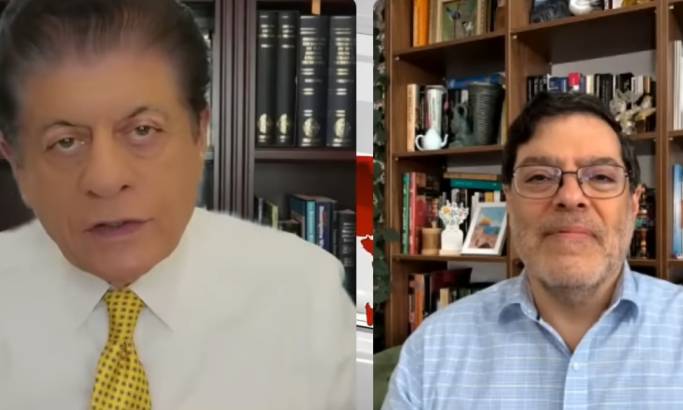
Editor’s Note: This Judging Freedom episode breaks down how Iran has used leverage in Gaza and Lebanon to corner President Donald Trump diplomatically, forcing Washington to pressure Israel even as the war escalates. From Tehran, Prof. Mohammad Marandi explains Iran’s nuclear posture, the politics of fatwas, media disinformation about Iran’s leadership, and why time and energy markets are now working against the White House.
TRANSCRIPT:
Opening: Life in Tehran
JUDGE ANDREW NAPOLITANO: Hi everyone, Judge Andrew Napolitano here for Judging Freedom. Today is Wednesday, June 3rd, 2026. My dear friend, Professor Mohammad Marandi, coming to us live from Tehran, Iran. Professor Marandi, always a pleasure. Before we get into the recent events and allegations, what is life like in Tehran today? Still normalcy?
PROF. MOHAMMAD MARANDI: Yes, things are very normal, Judge, and thank you very much for inviting me. The clashes last night in the Persian Gulf after the Americans attacked the Iranian tanker has been all over the news. But besides that, nothing really important is happening. The media here is saying that the Iranians have still refrained from continuing to send messages back and forth to the Americans. Trump, of course, denies this. I haven’t seen any Iranian official say anything about this, but the media is saying that messages are no longer going back and forth.
Iran’s Position on Negotiations
JUDGE ANDREW NAPOLITANO: Well, the Iranians did announce, didn’t they, that because the Israelis are continuing the slaughter in southern Lebanon and President Trump, notwithstanding rough language which was leaked to the press, has been unable to restrain Prime Minister Netanyahu, that they, the Iranians, would not participate in the negotiations. Is that an accurate understanding of the position of the Iran government vis-à-vis the negotiations?
PROF. MOHAMMAD MARANDI: Yes, that was exactly the position taken by the government because of the Israeli regime’s onslaught against civilian targets across Lebanon, but in particular when the Israeli regime said that they were going to begin to flatten southern Beirut, the capital, the Iranians said that if this happens — since this is being planned — they’re no longer going to take part in the, let’s say, indirect negotiations. It’s not really negotiations because written texts are being sent back and forth.
But since Trump and Netanyahu spoke, Netanyahu has not bombed Beirut, but he is bombing other civilian targets across the country, and cities are being flattened as we speak. So I don’t know if the Iranians will see that as enough to continue with the messages being sent back and forth for some sort of agreement, or whether the Iranians will continue to refrain from sending messages because of the ongoing onslaught. But Iranian media is insisting that Iran is not sending messages.
The Nuclear Question: Does Iran Have a Weapon?
JUDGE ANDREW NAPOLITANO: All right, let me get to the elephant in the room. Our two mutual friends whom we both know and have worked with and admire, Larry Johnson and Pepe Escobar, have said and will say again today — they’re both on this program — that Iran has a nuclear weapon, not that Iran developed, but that some other country gave to Iran.
I’m going to read what Chris has just posted. This is from Larry Johnson’s website called Sonar 21. “Pepe Escobar and I received clarification on how Iran obtained a functioning nuke. Functioning meaning it can be delivered. Iran’s objective is, with the backing of Pakistan, China, and Russia, to raise the risk to Israel of engaging in future attacks on Iran.”
I’ll ask Larry what he meant by that, but the plain meaning of the English language is that Iran doesn’t intend to use it offensively, but just to use it the way North Korea does — don’t come near us because we have the ability to destroy you. Is this credible, Muhammad? And I know you know these guys as well as I do, and you love them as I do.
PROF. MOHAMMAD MARANDI: Well, they’re both very, very good friends, and I’ll be watching both shows today to see what they have to say, because obviously there are so many things that I don’t know, and the very little that I do know, I try to inform your audience about that little bit of knowledge.
What I can say is that the Iranians have the ability to develop a nuclear weapon, and this is something that the former Iranian Foreign Minister, Mr. Khatami’s Foreign Minister, Dr. Kharrazi, said on multiple occasions. He was, of course, murdered by the Americans and the Israelis in this war, he and his wife. But he had said this on multiple occasions because during recent years, he was one of the two foreign policy advisors to the leader, and he ran an important think tank. He said that Iran can develop a nuclear weapon, and it was able to do so from years ago, but it refrained from doing so.
And so I would assume that Iran today — as Iran is much more technologically advanced than when he first said it — that Iran could develop its own nuclear weapon. And popular opinion, Judge, after the 12-day war — we’re almost on the anniversary of that war — public opinion, according to polls, seems to clearly indicate that people want a nuclear weapon. And I would imagine, I haven’t seen recent polls, but I would imagine that after this war, the public mood and sentiment would be even more pro-nuclear weapon.
But as far as I know, I don’t think that — I haven’t seen any sign of change in Iran’s nuclear posture. And I haven’t seen any indication through public discourse by the state or by senior figures in the government or in the state that Iran is even thinking about changing its nuclear posture. But again, I have no information. I saw Larry on your show when he first spoke of this, at least the first time I heard Larry say it, and I can’t say that Larry is wrong, but I have no evidence of this.
The Fatwa Against Weapons of Mass Destruction
JUDGE ANDREW NAPOLITANO: What a brilliant, gifted, and diplomatic answer, my dear friend.
Let me ask you a few more questions. Many years before he died, the Ayatollah that was murdered on February 28th issued a fatwa, a religious decree, that under Islamic moral teaching, weapons of mass destruction are immoral and impermissible. Is that fatwa still in effect?
PROF. MOHAMMAD MARANDI: My understanding is that that fatwa is still in effect, and no one has said anything to counter it.
You know, Judge, in the 1980s, when the United States helped Saddam invade Iran and supported and pushed him to invade the country, and these same Arab countries that supported this war, they gave Saddam Hussein hundreds of billions of dollars. The West gave Saddam Hussein chemical weapons too, to use extensively against his own people and against Iranians. I survived two chemical attacks during that war. The West tried to block Iran even from getting gas masks. So Iran had great trouble in not just dealing with the chemical weapons on the battlefield, but it had problems saving its own soldiers from even being able to protect themselves as individuals on the battlefield, because of a huge shortage of gas masks.
So at that time, people went to Ayatollah Khomeini, the first leader, Ayatollah Ruhollah Khomeini, and said that we need to produce chemical weapons. And he said, “No, it is banned, it is forbidden, it is inhumane, and you’ll just have to deal with it.” And so Iran did refrain from producing chemical weapons and it focused on defending itself against these chemical weapons being used by Saddam Hussein with the help of Germany and other European countries.
Then later, Ayatollah Khamenei, who was martyred in this war, gave a fatwa against nuclear weapons. So there is a very long history of opposition to weapons of mass destruction in Iran since the beginning of the revolution.
However, Dr. Larijani, before he was martyred in this war — he was the chair of the Supreme National Security Council — he too said that Iran does not want nuclear weapons, but he once did say that if Iran is facing an existential threat to its existence, then Iran’s nuclear posture would change. I don’t think that at the moment anyone here believes that Iran’s existence is being existentially threatened. So I would assume that the nuclear posture hasn’t changed.
But again, I will have to listen to what Larry has to say and what Pepe has to say, and take both of them seriously because both of them are very credible people, very knowledgeable people, and very good friends.
Can the New Supreme Leader Lift the Fatwa?
JUDGE ANDREW NAPOLITANO: And they have extraordinary contacts. I’m not going to jump the shark here, but I think they’ll tell us without specifically naming the contacts why they believe them and what work these contacts do. A question or two about fatwas. Can the present Supreme Leader, who is the son of the leader that was murdered on February 28th, lift the fatwa that his father imposed?
PROF. MOHAMMAD MARANDI: In Shia Islam, Judge, jurisprudence — the gate to jurisprudence is open. In Sunni Islam, it’s closed. But in Shia Islam, time and place have a very important impact on jurisprudence. So a senior figure, a high-ranking religious figure, his opinion on issues depends on circumstances. The 21st century is different from the 20th century. Iran is different from Brazil. So each has their own fatwas. They can change their own fatwas on different issues.
But Ayatollah, the leader now, Ayatollah Sayyid Musab al-Khamenei, cannot reverse the martyr Ayatollah Khamenei’s fatwa, but he can give his own fatwa, because Ayatollah Khamenei’s fatwa was his, and now he’s martyred, he is no longer the leader of the revolution or the Islamic Republic. So Ayatollah Sayyid Mojtaba Khamenei, based on the assessment of the Supreme National Security Council, based on think tanks and events that take place, will have to make his own decisions. But I have not seen any indication that there is any new fatwa on this issue.
Reports of President Pezeshkian’s Resignation
JUDGE ANDREW NAPOLITANO: Got it, got it. Two days ago, the West was reporting that Iranian President Pezeshkian had submitted his resignation, and then maybe 18 hours later President Pezeshkian’s office denied it. Do you know what this is all about?
PROF. MOHAMMAD MARANDI: From my understanding, the media outlet that put this out is called Iran International. Iran International is a Saudi-funded, or has been Saudi-funded. The Saudis are now saying they don’t fund it anymore, but someone is heavily funding it as we speak. It is a heavily funded media channel that is very hostile towards Iran, and it has no credibility. So I don’t follow it. I don’t listen to what they say. But they put out this story and then Western media repeated it. The president and his team and his media advisors, they’ve all denied it, and I see no reason to believe anything that comes from Iran International.
The Revolutionary Guard and Government Control
JUDGE ANDREW NAPOLITANO: Got it, got it. The press of course made a big deal out of it here in the West, and the implication was that the Revolutionary Guard has taken over the government. They’re not going to listen to the Supreme Leader. They’ve denigrated the president. They’re telling him what to do. And now you’re telling us that all of that is nonsense?
PROF. MOHAMMAD MARANDI: Yes, the Guards — and the armed forces in general, both the regular army and the Guards — they are answerable to the High Command of the Armed Forces, but also the Supreme National Security Council and the leader. And the Guards have no role to play in the decision-making process of the administration.
The government, President Pezeshkian’s administration — he has his, just like in the United States, the overwhelming amount of money that’s spent in the country is spent by government agencies, the Ministry of Health, the Ministry of Science, the Ministry of Roads and Telecommunications, and that sort of thing. So his job is different from that of the armed forces, and the Guards don’t have any role to play in dictating terms to the government on policymaking and pursuing policies.
How Iran Trapped Trump: The Negotiation Dilemma
JUDGE ANDREW NAPOLITANO: Back to the negotiations. It appears that Trump has painted himself into a corner since the Iranian government is not going to negotiate with the U.S. while the Israelis are slaughtering innocents in Lebanon, thus forcing Trump to attempt to restrain Netanyahu. Interesting how the Iranians have used the president who attacked them to restrain the prime minister who attacked them.
Where do you think this goes? You told me last time that the Iranians would never agree to a deal in principle that failed to restrain Israel from genocide in Gaza, from an invasion in Lebanon, from taking over the West Bank. But realistically, if not Trump, who or what can restrain Netanyahu?
Iran’s Leverage: Missiles, Negotiations, and the Gaza Ceasefire
PROF. MOHAMMAD MARANDI: That is a very difficult question to answer. The Iranians threatened Israelis when they decided to attack Beirut, and they also stopped the communications with the United States. That was declared by the Iranian government. And the following morning, early in the morning, the Iranians were going to fire a huge volley of missiles at northern Israel. And so Trump, of course, had that very now famous conversation with Netanyahu.
But also, and the Iranians have said that the slaughter in Gaza must end, and the genocidal onslaught against Lebanon must end as well. The Iranians are using two tools right now, or three. One is refraining from communicating because they know that Trump, that the United States needs a deal as soon as possible because the energy crisis is growing. And according to energy experts, according to oil experts, according to economists that are following the situation closely, the month of June is going to be very critical. And especially since the strategic reserves in the United States and other countries are being rapidly depleted, and June could be a turning point.
So the Iranians know that time is not on Trump’s side and that Trump needs a deal. So by refraining from sending messages, they’re putting one sort of pressure on Trump. On the other hand, the Iranians said that they’re going to strike the Israeli regime. Trump knows that if there is a war, another war, because the Israeli regime will start striking Iran and we’ll have another war. If there’s another war, that means that any negotiations will be stopped, at least for weeks.
And I think that there is a strong sense of urgency, even though he doesn’t want to say it, but I think among the people around him, there’s a great sense of urgency to get a deal done. So the Iranians are using both the threat of missiles against the Israeli regime, as well as the threat of discontinuing negotiations for an agreement to put pressure on Trump to end the genocidal attacks in Gaza and Lebanon.
Trump’s Confrontation with Netanyahu
JUDGE ANDREW NAPOLITANO: Here is Trump being asked yesterday if in fact he did use the F-word and other rather rough language with Prime Minister Netanyahu. And here’s his response.
VIDEO CLIP BEGINS:
UNIDENTIFIED SPEAKER: “Are you effing crazy? What are you effing doing? I helped you stay out of jail.” Is that true? Did you speak to him in those terms?
UNIDENTIFIED SPEAKER: I did. I wouldn’t say angry. I was a little bit perturbed at his constantly fighting with Lebanon. You know, at some point I said, maybe we gotta stop this. We gotta stop it.
VIDEO CLIP ENDS:
JUDGE ANDREW NAPOLITANO: Can Donald Trump stop Benjamin Netanyahu, or is that an American domestic political question?
Netanyahu’s Political Vulnerability and Speculation on His Future
PROF. MOHAMMAD MARANDI: I think, of course, hypothetically speaking, he can stop the Israeli regime today. That’s clear as day. Now, whether he’s compromised, or there’s something in the Epstein files that he’s hiding and they know about, that’s something that’s all speculation.
It is very odd, the degree to which he does whatever the Israeli regime wants and whatever the Zionist lobby wants, and he supports the people who hate Never Trumpers, and it supports them and has lost all his allies who were with him from the beginning, like Massey, like Candace Owens, Tucker Carlson, and the list goes on. All of this is very odd and bizarre.
But I do think that regardless of whether he actually said these or not, let’s assume that he did, but it doesn’t matter. The point, the fact that this was published, I think has damaged Netanyahu immensely. And if people, and I’m sure you do, but if people follow Conflict Forum, Alistair’s wife Aisling does a very good job on Hebrew media and what’s going on inside Israel, and Hebrew media is very different from the Israeli texts that are put out by the regime. Netanyahu has been attacked severely, even by his own political allies, let alone his opponents.
So I think that they’ve damaged him significantly. And for me, that raises questions. I’m not an expert, and I think I would rather hear your other guests speak about this. But I think that maybe there are forces in the United States in the Zionist lobby itself around Trump that may be saying that Netanyahu is, maybe it’s time for him to gradually be replaced. We are close to an election among the Israeli regime. And maybe there are people, I’m not sure Trump himself thinks this way. I’m not sure he even thinks that deeply or carefully. But maybe there are people who put this news out, maybe these people want to weaken Netanyahu in place. But again, that’s just speculation on my part.
Closing Remarks
JUDGE ANDREW NAPOLITANO: Fascinating conversation as always, Mohammad. Thank you very much. Be well. If there’s a dramatic turn one way or another in these events, of course, we’ll reach out to you immediately. For your time and thanks for your analysis. All the best.
PROF. MOHAMMAD MARANDI: Thank you, Judge. It’s always a great pleasure being on your show. Have a nice day.
JUDGE ANDREW NAPOLITANO: Sure. Coming up later today at 10 o’clock, Aaron Maté. Shortly thereafter, time to be announced, Pepe Escobar at 2 o’clock, Larry Johnson at 3 o’clock, the great Phil Giraldi. Judge Napolitano for Judging Freedom.
Related Posts