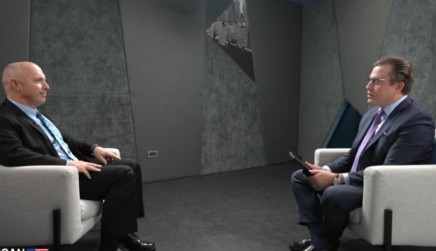
Read the full transcript of China researcher Guermantes Lailari’s interview on American Thought Leaders, July 13, 2026.
Editor’s Note: In this episode of American Thought Leaders, host Jan Jekielek sits down with Guermantes Lailari, a retired U.S. Air Force Lieutenant Colonel and specialist in asymmetrical warfare, to discuss the intensifying threat posed by the Chinese Communist Party (CCP). Lailari analyzes Beijing’s newly implemented “ethnic unity law” and its potential use as a mechanism for transnational repression, arguing that it represents a significant escalation in the CCP’s efforts to exert global control. The conversation explores the strategic importance of Taiwan, the rapid modernization of China’s military, and the urgent need for a more robust, multi-dimensional deterrence strategy from the U.S. and its allies to counter the CCP’s growing influence.
Introduction
JAN JEKIELEK: Guermantes Lailari, such a pleasure to have you on American Thought Leaders.
GUERMANTES LAILARI: Thank you very much for the honor.
JAN JEKIELEK: Your career was in the US Air Force. You’re a retired Lieutenant Colonel, worked in the Middle East quite a lot, a bit in Africa. You’re a specialist in asymmetrical warfare, but you ended up in Taiwan. You decided to retire here, and it doesn’t look like it was entirely retirement when I look at your productivity in terms of writing. Why did you decide to come here?
GUERMANTES LAILARI: I did spend a lot of time in the Middle East, and I understood that conflict is actually normal, and peace is abnormal. Unfortunately. And so I started thinking about the world and thinking about where is the next big problem for, let’s say, Western civilization. And I’ve been thinking about China for a long time, even during my military service. Actually, even before I joined the military, there was a China connection.
But after spending time during my active duty and also after my active duty, I did defense contracting work in Israel on missile defense. And I decided I needed to really think about the big picture. And I decided that China was going to be the big problem for the West. And I spent a year on my own studying China, and I applied for the Taiwan Fellowship through the Ministry of Foreign Affairs in Taiwan, and I was accepted. That was in 2022, and I’ve been in Taiwan for now 4 years just focusing on China. And the more I study it, the more I realize I made the right decision.
Why Taiwan?
JAN JEKIELEK: What is it that made you decide that China needed to be the focus? And also, why then, why Taiwan? Explain that.
GUERMANTES LAILARI: Because of my writings and what I write about, it’s not China communist friendly. And so the best place, in my opinion, to be is as close as possible to China without being in China. And so Taiwan is the great, great place because it actually is one of the primary targets of the Communist Party of China’s unrestricted warfare.
So this place is being attacked every day, whether it’s cyber, whether it’s cognitive warfare, media warfare, economic warfare, diplomatic warfare. It is the focus of a lot of energy by the CCP, and it is their most important of the most important issues for them. And so this is the place for me to be at so I can understand why they focus on Taiwan and what are their strategies, what are their tactics, and are they being successful? What are their strengths? What are their weaknesses? And exploring all this, it takes a lot of meticulous work. And so I think I’m getting there.
JAN JEKIELEK: Well, and what is it that made you realize after working in a kind of completely different area that China was the thing to focus on?
GUERMANTES LAILARI: Well, I’m Jewish. Part of my family stayed in Europe and suffered under the Nazi regime. And I think Jews in general understand, are sensitive to governments that are totalitarian and destructive. And I think through that tradition, I recognized early that China is going to be a real problem for everybody. And we can see that playing out not only in China but outside of China.
Totalitarianism vs. Authoritarianism
JAN JEKIELEK: A lot of people don’t understand the distinction between a totalitarian regime and an authoritarian one. Can you qualify that for me, please?
GUERMANTES LAILARI: Sure. An authoritarian regime is a regime where the people in power determine the rules. A totalitarian regime is a country that sets itself up so that everything about it is controlled by an ideology rather than the people. So for example, communism under the Communist Party of China is a totalitarian concept. In other words, it’s not just the people in charge, it’s the idea of communism that drives everything that they do. Whereas, let’s say, under Chiang Kai-shek here in Taiwan, it was an authoritarian regime, but it really didn’t have an ideology behind it other than the personality cult. And so that’s how I look at it.
JAN JEKIELEK: But people would say that most Chinese don’t believe in communism anymore, so how could it be a communist society?
GUERMANTES LAILARI: It doesn’t really matter what they think because the Communist Party of China tells you what to think. The regime is slowly but surely creating structures like law, for example, to force people into communist thinking and destroying anything that has to do with other than communism. For example, all religion is going to be eventually put down, and ethnic identity is going to be blended to get rid of all the differences.
And what the Chinese Communist Party is doing right now is they’re focusing on unity and trying to force people to focus on that and not focus on diversity, which is something that the West tends to focus on.
The Ethnic Unity Law
JAN JEKIELEK: Well, so let’s talk about the ethnic unity law.
GUERMANTES LAILARI: The law was passed in March of this year, and it’s going to be implemented on the 1st of July. And what it does is — it’s an activist law. What it means is you have to actively support the Communist Party of China. You can’t be passive. You can’t not do something. You have to show that you promote it. In fact, in the law it says the purpose of the law is to promote the love of the Communist Party of China.
And so anybody — for example, the Uyghurs or the Tibetans — some places were allowing them to teach their local language. Even in Mongolia, up until a year or so ago, the language of Mongolian was taught in Inner Mongolia, which is occupied by China. So all those differences are being phased out by this law. This law promotes simplified Chinese and it forces people to make sure that what they’re doing promotes the Communist Party of China.
For example, if there’s a request for everyone to put up a flag in front of their storefront, you can’t not do that. You have to do it. If you want to teach your child your family history and the ethnic origins or language, that is not promoting unity of China.
And really what this is doing is promoting the idea of Han supremacism — that the Han Chinese are the best and the brightest of China, and everyone should want to do that. So if you’re, for example, Tibetan, you should want to marry a Han Chinese. If you’re a Uyghur, you should want to marry a Han Chinese because by doing that, you unify the country. So this is basically providing justification for their forcing women in Tibet or in East Turkestan to marry Han Chinese. This is sort of retroactive.
JAN JEKIELEK: Which is something that they have been doing.
GUERMANTES LAILARI: Right, but this is the law now. This is the law that creates the justification for what they have been doing. And now I believe it’s going to go on steroids because now they have the law. Now they can just go full out if they want to.
JAN JEKIELEK: They can say, well, why aren’t you — this is the law now, why aren’t you applying that, right? It’s very interesting you describe it as an activist law. And the other thing that’s interesting, what you said is you don’t necessarily have to believe it, you just have to enact it, right?
The Criminal Code Connection and Transnational Repression
GUERMANTES LAILARI: And that’s the only way you can protest — by not saying that you disagree with it. You can’t externally show any kind of resistance to it because then you could be accused of promoting separatism. And according to the Chinese Criminal Code, specifically Article 103, it has a whole section on what the criminal prosecution can accuse you of if you are accused of separatism.
So this falls into the criminal code. So if you don’t follow the ethnic code, then they can push you into the criminal code, and with that criminal code, they actually updated it for Taiwan. Getting back to your question of how it applies to Taiwan — in 2024, 2 years ago, what they did was they added some amendments to that Article 103, and they specified that if you support Taiwan independence or separatists, you’re liable for this law. And it even goes to the point where if you are a leader of Taiwan independence, you can be given the death penalty for being a leader.
And also, the law is enhanced if you have a connection. Let’s say, if China were to occupy Taiwan, God forbid, and they implemented that law, and anyone here who had a connection with an outside agency or a person or country — in other words, let’s say you’re an academic and you were corresponding with an institution in Washington, D.C., and you were promoting Taiwan culture — that person in Taiwan, if China was occupying this land, would be more severely prosecuted under the criminal code than somebody who was just in Taiwan.
So they’re creating what I call the panopticon, which is, or as another colleague calls it, an omnipicon — basically a prison that’s all-seeing and any action that you do is being recorded. So what they’re doing is they’re also encouraging Chinese to report people who are, in this new ethnic law, not promoting unity.
And this law, which is even more scary, can be applied outside of China. And this is where China has actually passed a law that encourages transnational repression. So if you’re a Chinese person in the United States promoting Taiwan, they can prosecute you in absentia, and the court will have a ruling, and they can put out a red notice or an Interpol notice on that person who’s overseas. And if that person ever travels to a country that China has bilateral extradition laws with, that person can be detained and transferred to China because they violated the separatism law.
So this law has a huge amount of potential, and they can choose to do nothing for now, but in the future when they have more control, more coercive control over countries, this law has potential to drag in a lot of people who are exercising their freedom of speech, their freedom of thought that we in the West assume is sacrosanct, but in China it’s not.
JAN JEKIELEK: So I just want to clarify one thing. I think you’re talking about 2 different laws here, right? We started talking about this new ethnic unity law. But you’re basically saying that this is kind of working in conjunction with this anti-separatist law, under the criminal code. So can you just explain to me how these 2 things work together?
GUERMANTES LAILARI: So the ethnic law lays out what the Chinese Communist Party wants people to do. If you don’t do it, then the criminal code comes into play. Other aspects of Chinese society can also come into play. For example, the social credit score or your standing in the community — they can also name and shame you for not playing the game. But ultimately, if the party wants to prosecute you, they have the legal mechanism to connect the ethnic law to the criminal code and put you in jail.
JAN JEKIELEK: So basically, if you are not in standing within the ethnic unity law, you can be branded as a separatist. That’s the bottom line. And you can be branded as a separatist as a Chinese living in America or any other country — not just Chinese, anybody who promotes separatism in China.
GUERMANTES LAILARI: So I’m an American.
JAN JEKIELEK: But what is separatism in China? It could be anything, right?
Scope of the Law and Comparisons to the Nuremberg Laws
GUERMANTES LAILARI: If you promote Uyghurs, if you promote Tibet, if you’re a free Tibet person — the ethnic law identifies you as somebody who’s trying to separate China from its parts, and then they can prosecute you under their legal code in absentia. In other words, you can be prosecuted without your knowledge, and then when you show up in a country that has extradition law, you can suddenly be arrested and brought to China to face your prison term. That’s the connection.
And it’s not just ethnic Chinese, it’s anybody. You and I are eligible for this ethnic law because if you or I — which I do — promote the idea that Taiwan is a separate country—
JAN JEKIELEK: Well, it’s kind of obviously a separate— I don’t think—
GUERMANTES LAILARI: But I’m just saying the law allows them to have this legal justification for getting you under their thumb. It has a psychological effect because some people might feel, well, maybe I shouldn’t be doing this because I might get in trouble.
The other thing I want to point out is this law reminds me of the Nazi Nuremberg Laws that were used against Jews in the 1930s to start — it’s a reverse. In the Nuremberg Laws, they isolated the Jews and removed them from government, from academic institutions, from any kind of social support. But the idea is the same. In other words, the Nazis used the law to achieve their objectives. The Chinese Communists are doing the same thing. They’re using the law to create the world that they would like.
The Taiwan Question and China’s Military Ambitions
JAN JEKIELEK: This reminds me of the National Security Law in Hong Kong. I was there in 2019, not long before that law actually came down. And the way I read that law, by me interviewing some of the protest leaders, which are, by the way, now in jail, I myself could be subject to a decade in prison, possibly, just simply for doing that, because it’s a very broadly worded document. So it has that effect of making people say, hmm, maybe I should just be a little more careful here. So a lot of people will just kind of stay away from issues. And on the other hand, it could actually be used against, to create a few examples. Is there some kind of, is this analogous somehow? How’s this connected?
GUERMANTES LAILARI: Well, this is all connected under the rubric, you might say, of legal warfare that was institutionalized in 2003 by the People’s Liberation Army with their 3 warfares. But this is an extension outside of the PLA. This is into civil society, into other societies like you mentioned Hong Kong. So what China is doing is actually experimenting with the law and seeing how they can use the law to again achieve their objectives.
And using law in this way legitimizes their actions because we, the rest of the world, views laws inside countries as sort of legitimate. And as long as they don’t impose their laws outside of their country, that’s the whole United Nations framework, right? We don’t interfere in the internal affairs of other countries in general because the country is a legitimate, quote unquote, unit. And so what they do inside is kind of their business, except of course when there’s human rights abuses and all that.
But in general, we have this idea that a country has a legitimate right to have their own laws. But China is using this idea as a weapon. They’re weaponizing this idea to control people, and not just in action but in thought. And that’s the real power of what they’re doing.
JAN JEKIELEK: Why this incredible focus on Taiwan that you mentioned earlier?
GUERMANTES LAILARI: I think there’s several aspects to this. The simple aspect is the Chinese Communist Party views Taiwan as an unresolved part of the civil war. In other words, it’s land that they think that they should own because it’s where the KMT, the military they were fighting, Chiang Kai-shek’s team versus the communists. And so when Chiang Kai-shek and his followers retreated and occupied, or took or liberated, depending on how you want to look at it, Taiwan. Mao viewed Taiwan as sort of the last part of the puzzle that needed to be controlled. So that’s the framework.
I also think that Taiwan represents an ideological threat to the Communist Party of China because they promote the idea that Chinese people can only thrive under communism. And with a democratic country of Taiwan being very prosperous and successful, it is a huge problem for them ideologically to explain to their people why democracy also works for Chinese, ethnic Chinese people. And so ideologically, it’s a problem.
I think also there’s other dimensions such as the military. The military, the PLA Navy specifically, is locked in basically along the coastline, and they have to go through other countries’ territorial waters to get out into the Pacific. And Taiwan’s east coast is particularly useful if you have nuclear submarines. If you were to have a nuclear submarine base on the east side of Taiwan, the water drops several thousand meters. So there’s a military reason to grab Taiwan.
And I think politically and diplomatically, if China were to take Taiwan, it sort of breaks up the whole alliance that the U.S. has built up since World War II. In other words, South Korea, Japan, the Philippines, that whole first island chain is sort of broken up. And if China controls Taiwan, that means they control the Taiwan Strait, and that means the economy of South Korea and Japan — China has them, basically can control them economically by shutting down the Taiwan Strait, just like the Iranians did in the Strait of Hormuz. If they shut down this Taiwan Strait, Japan’s economy and the South Korean economy are gone.
JAN JEKIELEK: What about the Chinese economy though?
GUERMANTES LAILARI: So the Chinese have been developing alternate routes. They have a port in Pakistan that they’re promoting. They’ve built it up. They’ve put a lot of effort in Iran. They are also using overland routes from Russia. And also they are very interested in the Arctic because it’s slowly going away. So they are developing alternate routes to mitigate the issue of a blockade, let’s say, by the West.
And that’s why they’ve extended their control in the South Sea on those islands, those fake islands, and they want to control that so that the US or any other country can’t prevent them from getting their shipping from the Middle East or Europe, et cetera.
The First Island Treaty Organization (FITO)
JAN JEKIELEK: So you’ve promoted this idea of a First Island Treaty Organization, a FITO. Some people would describe that as a great kind of escalation of some sort. Explain to me this idea.
GUERMANTES LAILARI: Actually, it’s not a new idea. During the Eisenhower administration, NATO was created. Actually, NATO was created beforehand, but several other unifying defensive organizations were created: CENTO, SEATO, Southeast Asian Treaty Organization. All these organizations were created during the Eisenhower administration. NATO was created a little before, but he was the first NATO commander before he became president.
And one of the ideas was to create NITO, the Northeast Asian Treaty Organization, which was to include South Korea, Japan, Taiwan, and the US. And that idea kind of fell apart. It never got beyond just talking about it. And the reason why it didn’t work out is because at that time, obviously Japan and Korea, it was pretty close to World War II and there had been some bad things that the Japanese had done in South Korea. And so that didn’t work out.
But the idea is, in response to an aggressive aggressor such as China, if you have a unified front, it’s stronger than having each country trying to take care of itself by itself or with the US. So I think there are some fundamental underlying parts that already exist. All the weapons that the U.S. and Korea, Japan, Taiwan, and the Philippines use are designed to be NATO standard. Why is that? Because the U.S. has designated certain countries around the world as being major non-NATO allies. And South Korea, Japan, the Philippines, and Taiwan, according to the law, are considered major non-NATO allies. And by designating that, that means everything that the US sells to those countries is interoperable with the weapon systems that those countries build, because the idea is that if you create a standard, then the country that receives them also has to do the same.
The second thing is, on the operational level, Japan, for example, has several agreements between itself and the Philippines and India and Australia that are security agreements, so that if a ship needs to be repaired, reciprocal access agreements have been signed by many, many countries that are allies to the United States. And so what we have is an overlapping connectivity between these countries already.
So to me, just making it one step above that, actually connecting everything together formally, would be a very useful tool because that means that everybody starts working together and operating together as a unified team. Instead of having US and Korea and then US and Japan, then you have the trilateral, a quadrilateral, etc. And so I think it’s very possible, and I think what’s actually happening without naming it, it’s actually occurring.
JAN JEKIELEK: Well, and this creates a sort of deterrence, doesn’t it? Even psychologically.
GUERMANTES LAILARI: And I think it’s a good thing because China has been growing its military at such a rapid pace that now the U.S. is nowhere able to even maintain equal production level of ships, airplanes, tanks, all these different things.
JAN JEKIELEK: Can you just qualify that for me a little bit? Give me some sort of framework to understand how quick or how big that growth has been, military growth.
China’s Rapid Military Expansion
GUERMANTES LAILARI: So in the late 1990s, China’s military was no more capable than Taiwan’s military in the late 1990s. Today, China’s navy is larger than the U.S. Navy. China’s coast guard is bigger than any other coast guard combined. They’ve got so many ships, and the ships are retired Navy ships. They just painted them white instead of the gray color. Their budget for their military is, some estimate, between $300 billion to $700 billion. The U.S. is reaching a trillion roughly, but don’t forget things in China cost a lot cheaper. So the actual amount of weapon systems that are being built is incredible.
One statistic that probably will be very interesting to you: the capacity of China’s navy yards is 200 times more than the United States. 200 times more. If you were to combine Japan’s shipbuilding, commercial shipbuilding, and Korea’s shipbuilding, and every other country in the world’s shipbuilding, that would equal China, including the United States. The United States has really lost a lot of its shipbuilding capabilities.
JAN JEKIELEK: It’s reliant on Korea and Japan, in fact, on the commercial side.
GUERMANTES LAILARI: And now we’re looking at the military side too, but it’s a little bumpy. The idea is that they are building a military that’s global, not just local. And when a country does that, it’s messaging that its intentions are not local, its intentions are global.
Will China Take Taiwan by Force?
JAN JEKIELEK: Well, so let’s go back to Taiwan for a moment. There’s different opinions on this among people. It’s written into the Chinese military charter, I think, that they’re going to take. If I understand, it’s part of the whole ethos of the Chinese military that Taiwan will be taken.
GUERMANTES LAILARI: I think people learn that it’s in the Constitution, right? It’s in the PRC Constitution that Taiwan is part of China.
JAN JEKIELEK: One understanding is that they really want to take it without firing a shot, correct? But you seem to be convinced that they will do it kinetically, at least when I read your writing. And so maybe explain to me what you really think about that.
GUERMANTES LAILARI: Okay, so let me give you just a little background. In 2005, China passed the Anti-Succession Law, which says that Taiwan will be taken either through peaceful or non-peaceful means. And non-peaceful means is code word for war, but they don’t consider taking Taiwan a war because it’s a renegade province. They see it as part of internal China. A war can only be done between 2 countries, so they don’t accept Taiwan as being a country. So it’s a non-peaceful means. They laid it out in that law.
What they’re doing is they’re going in both directions. In other words, they’re trying to do peaceful means and non-peaceful means in parallel, and a huge amount of effort in both of them. Now, the reason I think that they are going to have to go kinetic is because over time, the people in Taiwan are identifying themselves more as Taiwanese than as Chinese.
A lot of the Chiang Kai-shek people that came and a lot of the education system that he developed promoted the idea of China as being — being ethnic Chinese is sort of like actually similar to what the Unity Law is in China today. During the White Terror period, if you spoke other than Mandarin, you were ridiculed and you were put down in a sense of humiliated. Democracy started in the early ’90s, and so since then, people in Taiwan have rediscovered their Taiwanese heritage and they’re more proud of it.
So roughly 60-70% of the people here identify themselves as Taiwanese. Another 10-15-20% identify themselves as Taiwanese and Chinese, and maybe the last 10-20% are Chinese. But a lot of those people who identify themselves as Chinese are also part of the older generation. So the trend line is going to more and more Taiwanese. So if the trend line is going in that direction, it’s a problem for China because it means that the non-peaceful means is not going to be successful.
JAN JEKIELEK: Just despite these massive efforts that they’ve had to make the non-peaceful means work, the cognitive warfare, the ideological subversion, the buying of media that kind of goes on and on.
GUERMANTES LAILARI: Right, so they’re still trying. What they’re finding is that they might not be able to convince people in Taiwan to be more Chinese, but what they are finding successful is that they can co-opt politicians, they can co-opt businesses, they can co-opt religions, they can co-opt the mafia. They can co-opt a lot of people, even in the military. Many of the spies that were caught in the last couple years were military members or retired military members. So they’re finding success in certain areas.
For example, when the leader of the KMT went to China and met with Xi Jinping, she is promoting sort of a more peaceful integration while maintaining independence, which is not going to work for China. But the fact is that she went to Xi Jinping and got that anointment of being in line with what they want, this is success for them. And if they were to win the next election in 2028, I believe that they will see that the peaceful means is more likely even though the people are not pro-China.
Or believing themselves to be Chinese, the politicians are willing to, if the KMT wins along with a coalition, let’s say, then they would see that as sort of like the time period of President Ma Ying-jeou, who for 8 years sort of built up the relationship between Taiwan and China, and then it broke when the people said, enough, we don’t want to be unified with China. And so I think that’s their hope, but they also want to leave the kinetic option open and available. And Xi Jinping has told his military to be ready by 2027 if he, and beyond, if he were to order them that they should be able to take Taiwan if he ordered them. So that’s the 2 tensions that are being promoted simultaneously, and neither of them—
JAN JEKIELEK: —the both of them are on overdrive.
Upheaval in the Chinese Military
JAN JEKIELEK: And this is also in the context of all this upheaval in the Chinese military though in the last year.
GUERMANTES LAILARI: Yeah, I would say that it’s okay. So the upheaval is at the senior levels, 2, 3, 4-star generals. I think it has to do with disappointment because I suspect that all those generals promised Xi Jinping to be at certain points along their journey to being prepared to take Taiwan capability-wise, and they’re not achieving it. And so he’s disappointed in them, he’s firing them or disappearing them depending on the case, and he’s using corruption as a means to get them out of his way.
There also might be some generals who are doubtful about the PLA’s ability to take Taiwan, so he also wants to get rid of those people. He wants yes-men around him and not only yes-men, but he wants people who are going to actually execute what he’s asked them to do. And so I think that’s why in the beginning, maybe 2 years ago, we saw the Rocket Forces commander and his replacement taken out. There’s other reasons people are talking about, but I think the overall issue is his goal and he needs to— and remember, the PLA is the People’s Liberation Army for the Communist Party of China. It’s not for the People’s Republic of China. It’s a party army. And so they have to do what he says. He’s head of the CMC, the Central Military Commission. So they have to follow his direction. And if they’re not able to do it, I think that’s why he’s firing them.
JAN JEKIELEK: But, against all odds, even if they’re advising him that he shouldn’t do it, they’re just— you think he’s just determined?
GUERMANTES LAILARI: Yes. I think that Xi Jinping would like to be added to the pantheon of the PRC gods, so to speak, in the communist world, right? They don’t have gods, but he wants to be compared to Mao, right?
JAN JEKIELEK: So his legacy wants to be in a mausoleum.
Xi Jinping’s Vision Beyond Taiwan
GUERMANTES LAILARI: Right, but he also wants to have the legacy of people looking up at him as being almost equivalent to or equal to Mao. And the only way he can achieve it is to finish the job that Mao didn’t finish, which is to take Taiwan. Now I think the vision is not just focused on Taiwan. I think China also claims the Senkaku Islands in southern Japan. They also have interest in taking control of the South Sea. They have interests in expanding their territory.
And like we had talked about Cleo Pascal, she’s talking about how China is actually leapfrogging beyond the first island chain to the second and third island chain to try to co-opt those countries. So it would be a synchronous thing. So if they took Taiwan and these other countries are already controlled by China, then the entire Pacific becomes sort of their forward basing where they can push back the United States with this— and democracy—
JAN JEKIELEK: —massively growing navy. Correct.
The United Front and Chinese Espionage
GUERMANTES LAILARI: But also their massively effective united front activities to co-opt politicians, businessmen all around the world. We’re seeing it in the United States, we’re seeing it in Canada. We see a lot of these activities are actually synchronous. They have a plan and they’re executing it. And in Taiwan, they’ve been doing it since the beginning. In the early ’50s, there was a spy that was caught and he actually gave up 1,000 spies in Taiwan. 1,000. A year or two ago, the head of the National Security Bureau testified in the Legislative Yuan, which is where you testified, that there were at least 5,000 Chinese spies in Taiwan. So it’s full-on what they’re doing, just like it’s full-on what they’re doing in the United States with spies being caught all the time.
JAN JEKIELEK: Right. Just to maybe remind us what the United Front is.
GUERMANTES LAILARI: United Front is a uniquely communist organization. First of all, it was one of the 3 secret weapons of Mao. The first secret weapon was the Communist Party, the second was the PLA, and the third was the United Front. And the reason why United Front is a secret weapon is because it operates both inside China and outside China. What it does is it’s public in the sense that the people promote China and externally, they infiltrate ethnic Chinese communities around the world, and what they try to do is push the idea that China is their homeland, motherland, and that they should help China. And it feeds into the Communist Party’s idea that they own those people and they should comply with whatever China wants.
So when Xi Jinping went to San Francisco to meet with President Biden, there were several thousand Chinese nationals and ethnic Chinese Americans who were asked to help with making sure that no one protested. There was no video of anybody protesting Xi Jinping’s visit to San Francisco, and this is well documented. So it’s a group of people that promote China, but they have operational aspects of it. If they want to achieve something unique, they’ll call upon them and these people will help them because they feel an obligation to support China. So this goes through businesses—
JAN JEKIELEK: —with the Chinese Communist Party’s vision of China, basically when you say China, that’s what you mean, right?
GUERMANTES LAILARI: Yeah, of course. And it’s a weapon for the Communist Party. And so what they do is they exploit it. They exploit relationships. They help people with business deals. So it’s a—
JAN JEKIELEK: —but this expands beyond just ethnic Chinese as well, right?
GUERMANTES LAILARI: Yes. We had the case where President Clinton received funding from a Buddhist temple in California that got the money from Communist China. So you’ve got this operation going on where there’s a lot of manipulation and a lot of coordination with not only United Front, but then you have the MSS, the Ministry of State Security, which is like the CIA and a little bit of the FBI combined. And so you have all these different things going on that are way beyond what a normal, say, Western country does in terms of its intelligence operations.
For example, stealing, doing economic espionage for the benefit of the state is not something that the Western governments typically are involved in. And the United Front working with the MSS will do actions that will promote that. You have people who benefit from their relationship with China. You have academics, you have businessmen who go to China and are self-limiting themselves in what they say because of their relationship with China. So they want to maintain that relationship with China, so you don’t see them talking about human rights abuses, because they wouldn’t be invited back to China. So they have their own self-interests, and that’s where things get interesting in terms of loyalties.
Taiwan’s Defense and the Taiwan Relations Act
JAN JEKIELEK: So you’ve just described this incredible growth of the PLA. Some people describe it as the quickest military growth in the history of the world.
GUERMANTES LAILARI: That’s right.
JAN JEKIELEK: And also the importance of Taiwan globally in terms of these highest-end chips that are used to drive AI development, both in the United States and China’s made it— Xi Jinping’s made it the centerpiece of his work. I’m kind of wondering to myself why there isn’t more of a focus on both from Taiwan’s own perspective defense, and you’ve shown me some interesting graphs which are kind of shocking, and the United States. And frankly, Western liberal democracies?
GUERMANTES LAILARI: From 1955-56 until 1979, the United States had a mutual defense treaty with Taiwan, and then President Carter annulled it by not renewing it. And then the Taiwan Relations Act came into effect, and that act lays out the responsibilities of the United States and Taiwan. It says that the United States will provide defense equipment and articles so that Taiwan can defend itself. In other words, Taiwan will purchase weapon systems that will be sufficient to defend itself. That worked until the late ’90s, as I mentioned before.
The other part of that Taiwan Relations Act says this, that the United States will maintain the capacity and the capability to maintain peace in the Western Pacific, including— it’s called the Taiwan Relations Act, so including regarding Taiwan and China. So up until the late 1990s, that was pretty much correct. There was a balance. But when China became an economic superpower and growing immensely from 2000 until today, the United States and Taiwan didn’t keep up their promise in that act. That act is a U.S. law. And so I blame Taiwan and the United States for not pursuing that with vigor based on the threat. It could have been for a lot of different reasons. Taiwan helped China get strong economically, and the United States and all these other countries did too. So that’s the framework that we’re operating under, and I think both sides need to do a lot, a lot, a lot of work to return deterrence back in favor of Taiwan.
JAN JEKIELEK: What does deterrence look like?
Deterrence and the Taiwan Strait: Historical and Modern Perspectives
GUERMANTES LAILARI: Deterrence, in the case of China, I’ll give you an example of how it worked against China. Of course, it’s changed since then, but in the 1950s, President Eisenhower deployed nuclear weapons to Taiwan to send a message to Mao to not plan — not to invade Taiwan. He was going to invade Taiwan in the ’50s. Actually, just before the Korean War, there was an opportunity that China was thinking about invading Taiwan.
But in the First Taiwan Strait Crisis and the Second Taiwan Strait Crisis, both of those timeframes, China was aggressively pursuing taking Taiwan’s islands and Taiwan itself. But the United States deterred China from doing that by threatening nuclear weapons. China did not have nuclear weapons until 1964 when they detonated their first nuclear weapon. So that’s how deterrence works.
The United States might not have used nuclear weapons, but China did a risk analysis and they decided not to push their luck because the Soviet Union at the time also did not promise to support them, being the only other country at the time that had nuclear weapons, even though they were friends.
So today what deterrence looks like is if Taiwan and the United States are going to return to something like that, Xi Jinping and his generals and his advisors need to believe that they won’t be successful in invading Taiwan and also controlling Taiwan. So there has to be sufficient capabilities for the Taiwanese to prevent an invasion, and if an invasion is successful from the Chinese point of view, that they can repel them off the island. That’s the kinetic side.
The problem is they’re also attacking them psychologically, economically, and all these other dimensions, diplomatically trying to restrict their visibility in the world. And so Taiwan needs to amp up everything in both areas and I think they are trying, but in my opinion, they’re not going fast enough and sufficiently enough.
On the United States side, we’re starting to increase the amount of weapons that we’re selling to Taiwan, but we’re also restricted because of our use of the weapons in the Middle East, for example. The missile defense systems have been depleted quite a bit. And so I think right now is a higher risk situation than we were, let’s say, last year or a couple years ago, because our supplies of these weapons that would be used in preventing China from invading Taiwan are pretty low.
So my point is that that’s the military side. But on the political side, the US Congress could also do something. For example, during the Eisenhower administration, the Congress, before the Mutual Defense Treaty was signed, authorized President Eisenhower the use of force in case China invaded Taiwan. So I think that that’s something that should be discussed to send a message to China that the United States is serious about defending Taiwan in case China wants to change the current situation, the status quo.
And that’s what the Taiwan Relations Act says, is that the United States promotes the status quo, which means China should not take Taiwan. And in the ’50s, Chiang Kai-shek wanted to take China, so the idea was that both sides should stay on their side of the Taiwan Strait. So that’s what I think should happen. There should be a multidimensional approach to this to counter China’s multidimensional approach to trying to subdue Taiwan.
Why Taiwan Matters to the United States
JAN JEKIELEK: There’s a lot of people asking questions about how, why is this important to us? There isn’t a lot of appetite for adventurism. Even this war in Iran, a lot of questions about its validity. There’s always this mass information warfare that’s happening. Everyone’s declaring victory, everyone’s declaring failure, etc. In the context of Taiwan, well, maybe unpack that for me.
GUERMANTES LAILARI: Okay. Polling in the United States says roughly 50 to 60% of the people support the idea that the United States would defend Taiwan. Boots on the ground, it goes lower than 50%. But just in general, the idea of supporting Taiwan against China, there is support. And if it goes below 50%, that’s what presidents are for, is to move the public in a positive way, to support an initiative that they want to do. So I think the support is there in Congress. It’s certainly there. There’s a lot of support for Taiwan in Congress.
There are several reasons why Taiwan’s important to the United States. As I mentioned before, if Taiwan were taken by China, our allies that we have actually treaties with — defense treaties — South Korea and Japan would be at great risk of being suffocated by Chinese obstructionism, slowing down shipping in the Taiwan Strait, affecting oil deliveries, all these different things that Japan and Korea certainly need. Even though they have nuclear power, it doesn’t mean that they don’t also need their industry to operate. So the loss of Taiwan would cause a huge economic problem for Japan and Korea, and those are countries that we have a lot of economic relationships with, so that would affect our economy. Taiwan, I think, is the 4th largest economic trading partner. So the loss of Taiwan would also be significant.
So the economic side is clear. The political and diplomatic side — Taiwan’s a democracy. Now we don’t have to defend every democracy in the world, but this democracy is also very special in the fact that we used to have a mutual defense treaty with this country and we helped this country develop. So we have sort of a latent connection with this country. I mean, the favorite sport in Taiwan is baseball. The electricity is 110 volts. There’s a lot of standardization similarities between Taiwan and the United States. If you come here on the 31st of October, a lot of kids are wearing Halloween costumes, and it’s not a normal Asian tradition to celebrate Halloween. So there is that connection.
There is also, I think, an important factor you mentioned is the chips. There was a study done — actually, it’s a very interesting study that came out — and said that if Taiwan’s chip manufacturing company, TSMC, let’s say, were blown up, most people think it would affect everybody. But according to this analysis, China actually has a large chip manufacturing capability, not at the 2-nanometer level, but it has the capacity to make a lot of its own chips. And so the theory is that actually the TSMC removal would affect the West more than it would affect China. So taking Taiwan and letting something happen to those chip plants would actually affect the West more than it would affect China.
And then I also mentioned, from the point of view of our historical connection to Taiwan, most people forget that the Republic of China, which is Taiwan, was one of the founding members of the UN, and also of the UN Security Council. ROC was in the Security Council, was a permanent member until 1971. It’s an interesting history that people can forget and connect different things about it.
And I think there’s a lot of personal connections with Taiwan as well. We have a huge Taiwanese expat community in the United States. People don’t know about that as much. And I think that Taiwan has a good reputation, but Taiwan also needs to do more internally.
What the U.S. and Taiwan Should Do Now
JAN JEKIELEK: So given everything we’ve just talked about, what do you think should be done right now on the side of the U.S., on the side of Taiwan?
GUERMANTES LAILARI: Taiwan needs to do a lot more in a lot of different areas. Let’s just talk about the military. Taiwan’s military is about 188,000 active duty volunteers, and every year there’s about 107,000 18-year-olds eligible for conscription. The problem is a lot of them use the law of going to college to avoid their conscription until after college. So for example, last year out of the 107,000 available, only 9,000 were conscripted. Everyone else went to college.
So I recommend changing that law, making it so that 18-year-olds, everybody goes in at the same time. Now you have 100,000 conscripts available for war. That sends a deterrent message to China that Taiwan is more serious and they’re going to make it more problematic for China to succeed.
Second thing is I recommend that the females in Taiwan also do 1 year of service, but they don’t have to do it in the military. They can do it in alternative areas such as hospitals, clinics, or other alternative methods of serving their country for a year. Same thing — 18-year-olds, everybody goes in.
Third thing is there are 2 million eligible males to be in the reserves, but Taiwan only classifies 700,000 of them as being available, and of those 700,000, they only train about 120,000 a year for either 1 week or 2 weeks. That’s insufficient. So I would amp up the numbers of trained reservists, not only in numbers but also in time. In the United States, we have around 38 days a year that reservists do their duty. Other countries like Israel have much more than that.
So that’s at the military level. I think that Taiwan’s laws need to be changed. The Legislative Yuan took away the military law — the United States, for example, has military law applying to our service members. In Taiwan, they took it away from the military because the military was abusing its power. But the problem is, if you’re a spy in the military, it goes to civilian court. It doesn’t go to military court. It should go to military court and it should be prosecuted in that way. So there are lots of laws that Taiwan should change, but unfortunately right now the Legislative Yuan is controlled by the opposition. So these laws aren’t going to be changed, but they need to be changed to make espionage more or less likely.
And you can go over a lot of other things in the economy that they need to readjust. For example, the training areas that they used to have for the military were sold off. They need to build up their capabilities. This sends a message that Taiwan is serious. And if Taiwan is more serious about its own defense, then other countries will be more willing to help them. But if Taiwan is not going to push itself to show that it’s willing to defend itself as a society — not just the military, but the society needs to be totally engaged — then a lot of countries and people will feel, “Well, why should I try to help Taiwan when their own people don’t do it?”
So that’s the Taiwan skepticism part that people promote — “Well, Taiwanese aren’t going to fight, they’re going to give up,” all this kind of stuff — but they need to promote this at a higher level. Politicians say, “Oh, we can’t do it, elections,” all this kind of stuff. But that’s excuses to me. I always say, don’t tell me what you can’t do, tell me what you can do.
And so these are suggestions that I’ve made. Obviously, some people don’t like it. 5% GDP should be invested in their defense. Israel has been doing it for over 45 years, 5% at a minimum, because they’re serious about their defense.
So on the U.S. side, we need to show Taiwan how to counter the PLA gray zone activities. I don’t see enough activity showing that we’re pushing back. We do freedom of navigation operations, ships going through or planes going through, but that doesn’t stop the PLA Navy or the Air Force from doing what they’re doing. They’re encroaching on Taiwan.
Pushing Back on China’s Gray Zone Activities
JAN JEKIELEK: Or the kind of merchant marine, right? The blue calls, right?
GUERMANTES LAILARI: There’s the Maritime Militia, there’s the Coast Guard. All these things are happening, and I don’t see the U.S. engaging anywhere in the sense of pushing back. For example, I would encourage the U.S. Coast Guard and the U.S. Navy to support the Philippine Coast Guard and the Philippine Navy in pushing back the Chinese Coast Guard’s encroachment on their exclusive economic zone. We don’t see that. It’s avoided. So there are a lot of things that can be done that are not being done.
The deterrence — we’re not pushing back. And there’s a famous quote, or misquote, from Lenin which says, “If you have a bayonet, you shove. If you meet mush, you keep on pushing. If you meet steel, you withdraw.” China is like that. If you don’t show steel, they’re going to keep on pushing. And the US, Taiwan, everybody needs to push back. And I don’t think they’re pushing back hard enough. And China is just keeping on pushing. And so the deterrence is lost.
The other aspect is the deterrence in the economic arena. We’re entangled. And so a lot of countries are afraid to push back on China because they’re afraid that it’s going to affect their economy.
JAN JEKIELEK: Well, and they’re afraid that they won’t get reelected if that economy — and they’re probably right to be — if the economic reality was shifted. So this is a big question.
GUERMANTES LAILARI: But ultimately, if you don’t push back, they’re going to keep on cooking the frog or eating the elephant bit by bit. And so when they show up at your door, it’s too late.
JAN JEKIELEK: It’s very interesting how you talk about deterrence because it says China has created a very powerful form of deterrence through this economic entanglement, as you call it. So we hear about decoupling, but you don’t see — you see Communist China decoupling on its own terms with the industries that it wants to have decoupled, as opposed to decoupling on terms which are favorable to the United States and free nations?
Disentanglement Strategy and Optimism for Taiwan’s Future
GUERMANTES LAILARI: So the United States is decoupling, or I like to say is disentangling itself, for example, in rare earth metals, right? They’re building up their capability not only internally to the United States, but as an alliance of countries, they’re starting to build up the mining and production and all this, this whole supply chain outside of China. So that’s an example of disentanglement.
But this disentanglement is strategic. There are certain things you don’t want a potential adversary or actual adversary to have control over, and one of them is rare earth. Another one is pharmaceuticals.
JAN JEKIELEK: Yeah.
GUERMANTES LAILARI: So as long as China has a huge market in the pharmaceuticals, we’re also kind of at a disadvantage. And so there, what we need to do is prioritize all the areas that China has monopolies on, or at least control over, and we need to figure out what’s the most important thing that we need to disentangle ourselves. Because if we don’t and there’s a conflict we’re going to find ourselves in a big problem. And that’s why a lot of these countries are afraid to do anything, because they know that China has control over their economy.
Strategic thinking has to be developed. You can’t disentangle from China overnight. It has to be strategically planned and executed. So that’s why the rare earth thing is really good. But no one’s talking about pharmaceuticals. They’re just as important.
JAN JEKIELEK: Guermantes, a quick thought as we finish?
GUERMANTES LAILARI: I’m optimistic that Taiwan, the United States, and Taiwan’s allies are going to step up to the problem. We see that in Japan. We see that in the leadership of Takeichi and Marcos in the Philippines. And we see it in President Lai Ching-te’s leadership here to try to get whole society involved. In preparing for disasters, including man-made disasters, i.e., war.
I’m more pushy because I can see the storm coming perhaps maybe clearer than other people. I just wish they could go faster and get ready quicker. But I’m optimistic. And in the process, I think we are learning a lot about ourselves and how we can adapt to dealing with an aggressive, totalitarian, authoritarian communist regime that has aspirations to take over the world. And if we see that and we understand it, then I think we will be able to figure out how to deal with it.
JAN JEKIELEK: Well, Guermantes Lailari, it’s such a pleasure to have had you on.
GUERMANTES LAILARI: Thank you very much. Again, thank you for the honor.
JAN JEKIELEK: Thank you all for joining Guermantes Lailari and me on this episode of American Thought Leaders. I’m your host, Jan Jekielek.
Related Posts
- Ambani vs Musk, Trump’s Hostility & India’s Foreign Policy w/ Meera Shankar & Zorawar Singh (Transcript)
- Scott Ritter: Trump vs. Zelensky – End of Ukraine, NATO & EU (Transcript)
- Seyed M. Marandi: Egypt Joins Saudi War – A Wider War Is Coming (Transcript)
- Joe Kent: Why the U.S. Proxy War in Ukraine Must End Now (Transcript)
- John Mearsheimer: Russia’s Existential War & the Rise of a Post-Western World (Transcript)