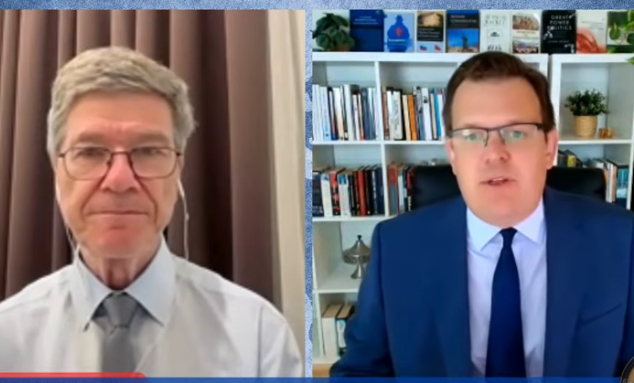
Read the full transcript of Professor Jeffrey Sachs’ interview on Greater Eurasia Podcast, July 10, 2026.
Editor’s Note: In this interview, host Glenn Diesen is joined by Professor Jeffrey Sachs to discuss the recent NATO summit and the broader state of Western foreign policy. The two analyze the lack of clear, serious strategy among current Western leaders, whom they describe as drifting toward dangerous conflicts without public support. Professor Sachs further emphasizes how powerful military-industrial interests often dictate these policies, arguing that a significant disconnect has emerged between the ruling political class and the citizenry.
INTRODUCTION
GLENN DIESEN: Welcome back. We have the great pleasure of being joined today by Professor Jeffrey Sachs. So thank you very much for joining in.
PROFESSOR JEFFREY SACHS: Of course, always great to be with you, Glenn. Thank you.
The NATO Summit in Ankara: A Meeting of Fools?
GLENN DIESEN: So the NATO summit in Ankara is over now, and, well, it’s been, let’s say, interesting. That is, the militarism and also the hostility against NATO’s enemies was seemingly dialed up, and even within NATO there were great tensions. Trump, which is also known as Mark Rutte’s daddy, turned out to be quite a deadbeat dad. He’s very abusive against his, well, so-called allies in Europe. Again, quite incredible to watch. I want to get your take though. What did you take away from this NATO summit?
PROFESSOR JEFFREY SACHS: I think basically the NATO alliance, as it were, is mostly in disarray. This is not a serious group, not seriously strategizing. It was 2 days of Trumpisms. He’s absolutely mentally unstable. We can normalize it, we can laugh about it. We can say that it’s a tactic. He’s really something awful. And everyone plays along with it. So you watch two days that are quite bizarre.
He says that Spain is awful. We should cut off all trade with Spain. Spain’s response is, “We have very nice relations with the United States. All is well.” Charming chat. The United States president says basically Greenland needs to be ours. Okay, that’s fine. No, it won’t be. This is not really an alliance right now, and these are not meetings of serious people, I’m sorry to say.
Of course, a lot of the talk was about military spending, and it’s a club to encourage everybody to spend more, especially on US weaponry, and to talk about war. But there used to be a time when great issues were discussed in a serious way, and that time is long over. The United States is, basically, without leadership, it flails around. Trump, as I said, is obviously the emperor without clothes.
I would say that this is just bizarre life. Every day is something bizarre, and that’s maybe Trump’s survival tactic. Every day crowds out the day before. And now we’re on to the renewed fighting with Iran, and the NATO meeting will soon be forgotten. That’s my basic take.
But it’s not harmless. It’s a whole Western world that is pretty much adrift without a strategy. Quite nasty, engaged in a lot of deadly war without anyone seemingly aware of the real risks of all of this. These people distinguish themselves by and large as being fools.
Normalizing the Abnormal: The Danger of Shrugging It Off
GLENN DIESEN: Yeah, well, for the US president to refer to the Iranian negotiators as scum, it’s quite extraordinary that this has become the new normal, if you will, but also the rhetoric against— yeah, sorry, go ahead.
PROFESSOR JEFFREY SACHS: I was just going to say that the fact that this is normalized, that we shrug and, well, that’s just Trump, is not an adequate response to this. We are in hot wars. They’re extremely dangerous. People are being killed in large numbers. Life is not a joke, but it’s treated as a shrug or a joke, and it is not.
So it’s on the one side quite serious. But the serious point is that nothing serious is actually discussed by these people. Nothing honest, nothing serious. And that is shocking. In a world at war.
Is the US Getting Deeper Into the War?
GLENN DIESEN: And, well, the European leaders, they continue to call for deeper strikes into Russia with, well, their own weapons based on their own intelligence and targeting. And the objective is apparently to force the Russians to the negotiation table. But this is by European leaders who still, after 4 and a half years, still boycott diplomacy. So it is quite strange, and no one seemingly can call them out because nobody wants to be seen as being pro-Russian by referring to objective reality.
But now we see the American side as well. Marco Rubio argued that attacking Russia will help to advance peace. Trump made a casual reference to imposing a no-fly zone. And also, of course, they will now allow the licensing of Patriot missiles to be manufactured in Ukraine. Is the US now getting into this war again, or deeper into this war? Because this is very different than the rhetoric we saw from Trump after his, well, taking over power the second time.
PROFESSOR JEFFREY SACHS: Trump campaigned on the basis of the end of these useless wars, but the American wars are driven by the military-industrial-digital complex. I think it’s important to add digital now because Big Tech is absolutely a party and a profit center of these wars.
When Trump would take any kind of move to find a diplomatic solution, most of the US political class, most of Washington, in both houses of Congress, and throughout the Pentagon— maybe not the generals so much, but a lot of former generals who are now in the military contracting companies— they strongly objected. And then Trump would change course because he’s a weakened foolish man to begin with, and he does not have a strategy, and he does not understand the job that he has almost at all.
So I would say, Glenn, that you could say that there was a change of rhetoric because Trump thought it’s just fine that the war is escalating.
Yes, Trump said, whether it’s meaningful or not, that Ukraine will be able to produce Patriot missile systems and so forth. But the truth is that rhetoric never went away in Washington. Trump seemed to be trying to chart a slightly different course, but it was always ineffectual. It was always bouncing around back to sanctions and deadlines and threats to Russia. So this latest round is not some kind of decisive turn of US policy.
Basically, the US government and I would say the governments of the major countries are driven by a profit-centered war machine. This is the dominant part of US politics. It would take a strong president with a clear vision and a capacity to talk to the American people other than in idiotic posts on Truth Social to be able to make a change, because the president would have to talk over this powerful lobby. Trump can’t do that. He doesn’t have much interest in doing it.
Silicon Valley, especially led by the likes of Palantir, but almost all of Big Tech right now, is making a lot of money putting its new models to work in these wars. They like these wars because they also get to test their weapon systems, they get to upgrade the systems, they get big military contracts and so forth.
So what happened in the last couple of days is, I would say, par for the course. And the fact that Trump failed to end the wars he promised he would, the war in Ukraine, with a phone call and within 24 hours, is a sign of the underlying dynamics of US politics on the one side and the sheer incompetence, ignorance, and foolishness of this man on the other side. He can’t really do anything that reaches a level of strategy as opposed to hourly tactics. Tactics he can do hour to hour, though not consistently, but strategy he’s unable to do.
NATO’s Support for the Iran War and Russia’s Response
GLENN DIESEN: Well, Mark Rutte, the NATO Secretary General, he seemingly threw NATO’s weight behind the US war on Iran by arguing that America’s decision to go back to war against Iran was totally justified and essentially giving his full support. However, it also sends a very direct signal to the Russians, that is that NATO is not talking about peace anymore, only war. And we saw now that the Kremlin spokesperson Dmitry Peskov was arguing that, well, before this summit as well, that the special military operation has now become a war because of NATO’s involvement. There doesn’t seem to be much effort anymore to prevent this march towards World War III.
But I did want to ask you though, how do you see this statement by the Russians? How will this change things? Have they simply given up on US diplomacy? Do they see it as a fraud like in Iran? Or how do you make sense of these new developments?
PROFESSOR JEFFREY SACHS: I don’t think anyone in the Russian leadership gives any heed whatsoever to the US or to US diplomacy. I think that they try not to antagonize Trump unnecessarily, but nobody in the Russian leadership is expecting Trump in any way to play a decisive or even an active role in stopping this war. That’s over.
I think they had some hope early on, but I think what’s happened proves Putin’s famous adage from a 2017 interview when he famously said that he had by then worked with several presidents. They come into office with ideas, but then men in dark suits and blue ties and briefcases come and explain how the world really is to these presidents. And you never hear of those ideas again.
So Putin had a lot of experience, and I’ve spoken to Russian leaders over the years. They have a lot of experience knowing that presidents come and go, but the US security state, the military-industrial-digital complex, is the deeper part of American policy. So I don’t think that they ever absolutely were betting on the US to resolve this conflict, but I think they were hoping that maybe Trump would do something, and I think that they put some effort into that the first year. But by already the end of 2025, I think they had really given up on this.
And the statements that they’re making now are basically, again, not to go out of their way to antagonize Trump, but on the other hand are very clear to say we’re basically at war. We don’t think diplomacy is going to solve anything. We’re going to win this war.
Russia’s Eurasian Future and the Risk of Nuclear War
PROFESSOR JEFFREY SACHS: And I think Russia has, largely already for years, but certainly now, given up on the West, so-called, meaning the European Union, Britain, and the United States and Canada, and it views its future basically as a Eurasian future and a future with other parts of the developing world as well. And my view is that that’s essentially China’s view. It’s essentially Iran’s view. It’s essentially the view of most of Eurasia outside of Europe.
And this is, I think, where we’re heading, which is a Western world which is dug in to try to protect ancient and disappearing prerogatives and advantages that they don’t have anymore. And the rest of the world saying, “We don’t expect anything from you. Except maybe war, and we’ll meet that if necessary.”
Of course, the disaster in all of this is that the war kills vast numbers of Ukrainians. It solves absolutely nothing. And there is no way possible for Russia to be defeated other than bringing us to nuclear war, because Russia is not going to surrender to strikes of Western support into deep Russia. It’s going to escalate, and if pushed hard enough and if those strikes were costly enough, it will escalate to nuclear war. And so the whole idea of these Western governments is a kind of profound ignorance and gratuitousness and recklessness that is astounding.
Public Opinion vs. Warmongering Leaders
PROFESSOR JEFFREY SACHS: Now, one thing that should give us some perspective and pause is that all of these governments— Trump, Macron, Merz— all of them are unpopular. The publics in the United States and Europe don’t want these wars. They don’t want the military escalation. The latest Gallup poll showed the Ukrainians want this war to end, even if it means the kinds of concessions that would end the war. This is very clear.
So what we have is a class of political leaders that operate in an anachronistic way, believing in Western dominance and Western power, not understanding the changes of the world and not following or understanding their own public opinion.
So there are, I suppose, three ways that all of this can break in the end. One is that Russia can outright achieve its military objectives. This is certainly quite possible. Some would say quite probable. The other is that this escalates to a nuclear war. I think that this is absolutely possible because we are led by the most incompetent people imaginable right now, from Trump and Merz and Macron and many others. And the third is that finally these warmongering governments and warmongering lobbies are thrown out by publics that are completely disgusted by them.
So Merz’s approval rating is at an all-time low for German chancellors. The same with President Macron. Trump’s approval rating somehow still is above 35%, but it’s under 40%, and his disapproval rating is around 60%. And we have an election coming up that, if it’s actually run fairly and counted fairly, is still, with all of the shenanigans going on— and there are many of them— and all of the Supreme Court rulings in Trump’s favor, still likely to put the opposition into a majority in at least one of the houses of Congress.
So maybe, just maybe, our very weak and seemingly failing democratic institutions could end up being a check on this quite miserable political class that we have. And that would be the peaceful way out in the end.
The War as a Tool to Suppress Dissent
GLENN DIESEN: Yeah, I would like to see that, but it appears that the worse the war goes, the more they rely on the war. That is, when the economies of Europe get weaker, they look towards more militarism for economic and technological development. When our leaders lose support from their public because of the war, they then use the war to crush dissent by essentially dismissing all opposition as being some pro-Kremlin conspiracy. And also when we see the West fragmenting, we hear that we essentially get the message that fighting Russia is the new unifying idea. So I don’t see the course correction just yet, but I hope—
The Public vs. The Political Class
PROFESSOR JEFFREY SACHS: Well, Glenn, I think all of that is exactly right, of course, except that the public is not being pulled along. In France, with Marine Le Pen now contesting the presidency next year, that will become France’s major political drama, not Ukraine. In Germany, with the AfD surging in the polls and saying that Germany needs a completely different approach based on diplomacy vis-à-vis Russia, that is a potential break. And in the United States, the overwhelming opposition of the public to Israel and what happened, the genocide in Gaza, and now to the war in Iran, is also potentially a change of direction in American politics.
I grant you, none of this is simple, because the deep military war machine is extremely powerful in the US and Europe, and these politicians are basically operating as mouthpieces for a much deeper set of narrow interests. But quite powerful narrow interests. But I think that it is encouraging that the public does not accept this. And that means that even with all of the absolutely clear resistance of the political class— and you’re completely right on it, there’s nothing that’s changing the dynamics within this group of politicians. But what might change it is political defeat by outside parties that are tapping into the true public opinion.
What Are the Real Objectives?
GLENN DIESEN: I know you have to run, so let me just ask a very quick, brief question. That is, the absence of strategy, as you said, is quite evident, but what do you think are the objectives now? Of the Americans versus the Europeans in terms of, well, their main rival, as we saw at the summit, which is Russia? What is it that they actually want to achieve here? Is it simply to bring the Americans deeper into the war, or how are you reading this? Because it doesn’t seem rational to push this hard for a war with the world’s largest nuclear power.
The Deep State’s Enduring Goal: Weakening Russia
PROFESSOR JEFFREY SACHS: We should, of course, start from the proposition that since 1945, and certainly since 1991, at the supposed end of the Cold War, the deep state, or military-industrial complex intention has been to weaken Russia in any opportunistic way possible, to support whatever insurgencies on Russia’s periphery, to surround Russia in the Black Sea with NATO enlargement. To try to create unrest by so-called economic tools, the unilateral sanctions, the confiscation of Russia’s money and so forth.
And I don’t think those goals have changed. Again, the basic driver of foreign policy in the United States, the CIA and the military contractors and now the Palantirs and others of the world — they don’t count lives, they don’t count money. They are out to sell their goods, and if the US goes broke in the process, that’s just fine. We’ve created a class of warmongering billionaires that speak publicly about how important these wars by the Western world are.
So this is really our ongoing situation, and it is the basic motivation that is either going to drive us to complete disaster, which is brewing right now, or to some kind of break in the politics because the public can finally use the tools of democracy to make their views heard. Admittedly, that hasn’t happened. And the United States, for decades, policed Western European politics to make sure that no anti-American politics could survive. And that kind of policing continues until today.
But I would say most of our Western countries are in political crisis right now because of the divergence of the dominant interests, class interests of this militarized state and the broader public opinion, which understands that this is a disaster. So I think we will continue to flounder. Don’t expect anything from Trump, anything sensible, any direction that is sustained. He becomes more and more incoherent and less and less relevant, actually, except that he loves to dominate the media and the media love to pay attention to every idiotic utterance of this man.
GLENN DIESEN: Well, Jeff, thank you so much for taking your time. I know you have a busy day there in Uzbekistan, so thanks again.
PROFESSOR JEFFREY SACHS: Great to be with you. Thanks.
Related Posts