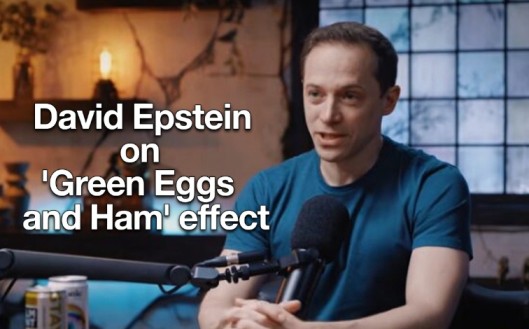
The following is the full transcript of author David Epstein’s interview: The Green Eggs and Ham Effect: Creativity, Constraints, and the Paradox of Choice on Modern Wisdom Podcast, July 9, 2026.
Editor’s Note: In this episode of Modern Wisdom, host Chris Williamson sits down with author David Epstein to explore the counterintuitive power of constraints in driving creativity, learning, and success. They dive into the “Green Eggs and Ham” effect, illustrating how limiting our options can force us out of the path of least resistance and unlock deeper problem-solving abilities. Drawing on diverse examples—from the history of artistic innovation to the cautionary tale of the company General Magic—Epstein explains why we are often overwhelmed by infinite choice and how intentional constraints can help us stop procrastinating and start producing meaningful work.
The Green Eggs and Ham Effect
CHRIS WILLIAMSON: What’s the Green Eggs and Ham effect?
DAVID EPSTEIN: That describes a finding in psychology that people become more creative when the easiest solution is taken away from them. So it is named after the Dr. Seuss book Green Eggs and Ham, which he wrote on a bet that he couldn’t write a children’s book using only 50 words. And that restriction forced him to experiment with his rollicking rhythm, right? Because he couldn’t experiment with vocabulary.
So it got that name in psychology because it represents this huge body of work that shows, as the cognitive scientist Daniel Willingham likes to say, you may think your brain is made for thinking, but it’s actually made for preventing you from having to think whenever possible because thinking is energetically costly. And so your brain wants to do the convenient thing, the easy thing, what neuroscientists call the path of least resistance. Just reach for stuff you’ve seen before. And so it actually becomes kind of impossible to be creative unless the easiest thing you would reach for is blocked.
So the thing that actually led to that bet with Theodor Geisel, aka Dr. Seuss, was before that, he was asked if he could write a children’s book using about 200 words from a vocabulary list for kids.
CHRIS WILLIAMSON: Is that so that most kids would have access to it, not be able to not comprehend?
DAVID EPSTEIN: That’s right. And there was a kind of visionary publisher who correctly deemed children’s literature at the time very boring. And so he wanted to — it was an assault on illiteracy. He said, look, kids are not learning to read in as big of numbers as they should. Why don’t we try making something interesting for them?
And Dr. Seuss takes this list, looks at it, realizes there are almost no adjectives, and starts complaining to his wife. He basically makes this very fine, I think, Seussian comment. He says, “It’s like trying to make a strudel without any strudels.” And then he just throws his hands up and says, “I’m just going to take the first two rhyming words on the list and write a book.” First two rhyming words, cat and hat, and the rest is history.
So that’s what forced him originally to develop that rollicking rhythm that he became known for, because the things he would’ve done otherwise were blocked. And so that Green Eggs and Ham effect that a psychologist named is summarizing this huge body of work that shows that the best way to prompt creativity is to pull away the path of least resistance, the convenient thing that people would look for otherwise.
CHRIS WILLIAMSON: What would be the convenient path of least resistance when it came to writing that book? Because what it sounds like is that it is more effort to work with fewer words.
DAVID EPSTEIN: Yes, definitely. It is more effort because the easy things — familiar phrases, right? Like one of the things that jumps out about Seuss’s work is the phrases are unfamiliar. Normally, if he’d been left to his own devices, he would’ve gone for more familiar phrasing, which is what all children’s literature did at the time. I mean, it was very literal — Johnny ties his shoes, walks to school, and all these things.
CHRIS WILLIAMSON: Not this sort of LSD absurdism that he ended up with.
DAVID EPSTEIN: Exactly. Well put. And he actually used this to co-found a whole book imprint that changed literature for kids and helped boost literacy, where he basically put constraints on the authors. It was vocabulary constraints. It was the pictures all have to be continuous across two pages. They can’t depict anything that isn’t described directly in the text, et cetera. And he said, if you don’t like those constraints — and some of them didn’t — then you’re just not one of our authors.
But they built the most successful children’s imprint ever made by restricting people from the things. Those who bought in said, “I’ll give it a try,” and found that they were able to do work that they never would have envisioned otherwise.
Why Constraints Feel Unsexy
CHRIS WILLIAMSON: Why do you think talking about constraints is so unsexy?
DAVID EPSTEIN: I think the word itself is, unfortunately, almost synonymous with something that’s frustrating. And so I think our brains are built to always overvalue freedom — complete freedom and choice in the abstract, right? And the theory for why this is, is that in our evolutionary history, we didn’t really have a problem with having too much of stuff or too much choice, but we did have a problem with having too little.
CHRIS WILLIAMSON: Issues of scarcity, not abundance.
DAVID EPSTEIN: That’s right. And so we evolved to always want more, to be programmed to want — I think of it as similar to the brain in the way that we are with sugar with our bodies, right? We evolved to like it because there was only a little bit available and it was useful when you found it.
And so you can see in all these surveys and things, people always say they want more choice, right? One of the things that jumps out — when psychologists did this international survey of known creativity myths, since we were talking about creativity, things that we know from research are not true — the top one was that people are most creative when they are most free. And we know this isn’t true.
CHRIS WILLIAMSON: So they surveyed people and said, what are your beliefs around creativity?
DAVID EPSTEIN: Yeah.
CHRIS WILLIAMSON: They came back and said, the more freedom equals more creativity.
DAVID EPSTEIN: Yeah, I mean, they offered them a huge list of statements and then people would say they agree with it or they don’t agree with it.
CHRIS WILLIAMSON: And so they could see what were myths.
DAVID EPSTEIN: Yeah, most agreed with that myth. Yes, it was tied with “group brainstorming is a good way to come up with lots of novel ideas.” That’s another one we can talk about.
But you also see people always say they want more options for consumer things, right? So consumer options have increased by about 100 million-fold compared to pre-industrial societies, which dwarfs the increase in wealth, which is only like 400-fold. And people always say they want it. Economic theory models us as if we’ll always be better off with more choice.
But then you look at things like — since the introduction of infinite scrolling, people have been getting progressively more bored, which makes no sense. And researchers who were trying to figure out how this could be, like how could more choice make us more bored in entertainment options, would run experiments where they would randomize some people to a group where they would have 20 videos that they could choose whatever they want to watch, or they were just given one from that same set of 20 and they have to watch it. And the people who had to watch the one are less bored than the people who have the 20.
The thinking is that because our brains are comparison engines, just the idea that there’s some other thing that you could be doing undermines the experience of the moment itself. And so it’s all this disconnect with how rational actor man is modeled in economics and what’s real in our psychology where the rubber meets the road.
Maximizers vs. Satisficers
CHRIS WILLIAMSON: Is this similar to Barry Schwartz’s stuff?
DAVID EPSTEIN: Some of it is, yeah. Barry Schwartz was one of the pioneers of showing that the economic models of what should make us happy and satisfied and lead to good decisions are not the case. And one of the places that he was really impactful had to do with the affective consequences — the consequences on our psyche — of too much choice.
He and his colleagues built this thing called the maximization scale. So this is how much of a satisficer on one end — satisficer is a term coined by Nobel laureate Herbert Simon. That’s a combination of satisfy and suffice. So it basically means setting good enough rules for decisions and taking it — on one end — versus how much of a maximizer are you on the other end. Maybe we would call that an optimizer now, but it basically means you will explore all of the possible options looking for the best thing.
And it turns out that there’s not a lot of evidence that maximizers actually make better decisions, even though they spend a lot more time making decisions and they are less happy with their choices. They’re more prone to regret. They are less happy with their lives. They’re much more likely to opt for reversible decisions, even though that typically prevents them from committing one way or the other.
And so the people who are more satisfied tend to be these people who say, “Here’s what good enough looks like. And once I get to it, I’m going to take it and move on.” Because we can’t actually maximize anyway because we’re not good at predicting the consequences of our choices. We can’t evaluate infinite options. And so if you counted the cost of agonizing over decisions, I think people would see that satisficing is actually the maximizing strategy in the long run.
The Paradox of Choice
CHRIS WILLIAMSON: It’s so interesting. I think when people consider, do you want to go into the jeans store and see one pair of jeans, or do you want to see 20 pairs of jeans? And you go, I want to see more because I’m going to be able to get closer to my fully maximized, optimized utility function to derive the most value from the jeans that I’m going to buy. But for all of those reasons, people seem less happy.
Something would tell me that if you couldn’t return jeans — if there was no refund option and no returns, no exchanges — that people would probably be happy with their jeans as well.
DAVID EPSTEIN: Probably.
CHRIS WILLIAMSON: But certainly actually no exchanges, because that would be the most direct one-to-one.
DAVID EPSTEIN: You know, this is basically directly tested in some studies, not with jeans, but with other objects where people are either allowed to exchange it or not.
CHRIS WILLIAMSON: Okay.
DAVID EPSTEIN: And the people who are not end up happier with what they have.
CHRIS WILLIAMSON: So it’s kind of like, despite the fact that they could have chosen wrong and been unable to switch it.
DAVID EPSTEIN: That’s right. But they’re committed. And so they don’t end up regretting. This is like Ellen Langer famously said, “Don’t make the right decision, make the decision and then make it right.” You can’t know what the perfect thing is anyway. So I think it’s sort of more important what you do with it after you’ve made the choice than agonizing on the front end.
CHRIS WILLIAMSON: It’s the thing that’s interesting — we’re very bad at rationally assessing how a decision will make us feel.
DAVID EPSTEIN: Yes.
CHRIS WILLIAMSON: What we do in advance is look at this perfect, sterile, hermetically sealed environment where we would be rational actors and we would be able to derive the maximum amount of affective satisfaction from the decision that we made. But we aren’t able to discount for the paralysis analysis, the regret minimization concern, the “I’m going to go back, I’m going to take them back, I’ll do the thing.”
I mean, how many times — I remember when I was a kid, when Nokia was still sort of the phone on the market and there was lots to choose from. Do I want the one that’s sideways? Do I want the one that slides up? And I would spend — it was kind of interesting to me. It’s the same as people with cars to a degree. What level of trim do I want? What sort of interior do I want? What particular type of alloys do I want? And actually, if I get the 2024 or 2023 model instead of the 2022, they upgraded this thing on the interior. But a lot of the time I probably wasn’t all that satisfied with my decision. But in advance, do you want to have that choice restricted?
DAVID EPSTEIN: No, absolutely not.
CHRIS WILLIAMSON: So we have this inability to predict how unsatisfied we will be with the maximum amount of the thing that we think that we want, which is freedom.
DAVID EPSTEIN: And this runs into all sorts of consequential things. Like if you survey people and say, “If you got cancer, would you want to be involved in choosing your treatment?” Something like 2/3 of people say, “Yes, absolutely, I would want that agency.” And then among people who actually get cancer, it’s like 10%, right? Like once that actually comes, they want somebody taking that burden off of them.
CHRIS WILLIAMSON: That’s interesting.
The Psychology of Choice and Complexity
DAVID EPSTEIN: And some of it has to do with complexity too. So more choice is good to an extent. It’s just that we’ve usually blown way past that extent. So if you look at things like people’s retirement plans, you know, 401s, if they have a company match, once the choice sets get increasingly complex, they’re more likely to make no decision at all, even if that means foregoing free money from the company, right?
And so at a certain level of complexity, it makes no sense that you wouldn’t want more choices, right? But human psychology does not behave according to the rational actor model of neoclassical economics.
CHRIS WILLIAMSON: What is going on in human psychology that means that we don’t like it? Why would that be the case? Why would choice be overwhelming? I’m trying to work out what the source code is or what the particular bug that’s been hacked here is.
DAVID EPSTEIN: Yeah, I think some of it in that case, like with the retirement plans, is anticipated regret, basically. I think that’s fear of making the wrong decision.
CHRIS WILLIAMSON: Because it is on your shoulders.
DAVID EPSTEIN: Yeah, the fear of having made the wrong decision, that you get so obsessed it becomes, it feels so bad, the idea that you might make the wrong decision, that you end up making no decision, basically. And people stall and stall and stall.
So we are comparison engines, right? The ability for us to feel bad about what other thing we could have done, it’s kind of a bedeviling aspect of psychology, right? In all things, to go back to maximizing, there’s evidence from these international surveys that some aspects of maximizing tendencies are actually on the rise. Nobody’s a maximizer or satisficer in all things, but some people are much more of a maximizer or satisficer. And there’s evidence that the maximizing tendency is on the rise, particularly in the richest parts of the world.
And that includes things like socially prescribed perfectionism, right? People feeling like they’re never good enough, their life should always be doing something better. And of course, the theory is that it’s the ability to compare yourself infinitely to what other people are doing, like on social media and all these things. And we’re not built for that, right? We are comparison engines. We compare our status, all these things. But in our history, that was to the people in your immediate vicinity, to the people on your block, not to the entire world. And so I think it’s just a poor fit for how our brains work.
Herbert Simon and the Art of Satisficing
CHRIS WILLIAMSON: Herbert Simon wore the same socks, ate the same breakfast, lived in the same house for 46 years, and won the Nobel Prize.
DAVID EPSTEIN: Yeah, you’d almost accuse the guy of having low ambitions for some of the things that he did if he hadn’t won both the Nobel Prize in economics, the Turing Award — so the highest prize in computer science, because he was a founder of AI — and then he won the highest award in psychology.
And his feeling, so he coined satisficing because he said humans do not behave according to these economic models. We can’t, we’re not equipped to evaluate infinite options. We have all these other motivations that aren’t just maximizing utility, and we can’t predict the consequences of our choices. And so his feeling was that we should proactively satisfice in areas of our life where we can. So the reason he had one beret, one pair of socks — he told his daughter, “One only needs three sets of clothing, one on one’s back, one in the closet ready to wear, and one in the wash.” And so he sounds kind of lame, except he was preserving cognitive bandwidth for the things that he found most meaningful, which were his work.
Keeping Your Options Open as Self-Harm
CHRIS WILLIAMSON: Yeah, so there’s research that shows people are more satisfied with irreversible decisions than reversible ones. And yet, modern optimization culture, decision theory, a lot of the time, if it doesn’t have a psychologically informed view, will specifically seek reversible decisions. Does that mean that keeping your options open is a form of self-harm?
DAVID EPSTEIN: I think it often can be, especially when it becomes an end in itself. I can’t tell you how many people, including my peers, who will be talking about a decision and they’ll start talking about optionality and which one preserves optionality. And I’m like, that makes a lot of sense at a certain point in your career for that to be a certain value. But at a certain point, you don’t want preserving optionality to be the end in itself, right? There’s this—
CHRIS WILLIAMSON: You’ve preserved optionality to preserve optionality to preserve—
DAVID EPSTEIN: Exactly. Turtles all the way down, optionality. And then there’s this interesting research by this guy Scott Stanley on relationships that’s finding increasingly younger people are doing what he calls sliding versus deciding in relationships, where in the interest of keeping their options open, they’ll say, “I’m just going to keep seeing how it goes. I’m not really committed.” And then their options are closing whether they like it or not if they stay in, right?
So they kind of sleepwalk into this escalating commitment. And if they end up getting married, they’re more likely to get divorced, they’re less likely to be happy. So compared to people who say, “I’m in or I’m out,” and that’s the decision. So sliding in the interest of feeling like you’re keeping your options open actually leads to these bad outcomes. And you don’t do the hard work of saying, “Am I in or am I out?”
CHRIS WILLIAMSON: Yeah, I mean, how many people — she’s kind of hot and, you know, we’ll hang out. She seems quite nice. And well, she’s coming over a good bit, so I’ll give her a drawer and she can have a toothbrush holder. And well, I mean, you know, her lease is up, so we — well, cool, like, she can move in or whatever.
DAVID EPSTEIN: That’s one of the ones he mentions in the research. It’s like someone’s lease is up, so they’re like, “Well, it’d be easier just to move in.” But they didn’t really make a commitment to each other. That one comes up a bunch in that research.
CHRIS WILLIAMSON: I bet it does. Well, I was going to get a dog anyway, so why don’t we buy a dog? And we’ve been together for a couple of years, so I suppose it’s the thing that you do is to get engaged. Now you’re engaged, it’s like, well, I’m off the pill, so maybe we didn’t fully plan to have it. You can fall backward through your entire life.
DAVID EPSTEIN: Yeah.
CHRIS WILLIAMSON: Relationally and in terms of career. Like, well, you know, I’m here. I did the thing at uni and it was sort of the first guy that I spoke to at the graduate fair. And he just seemed nice and convenient.
DAVID EPSTEIN: And I think taking data, right, whether it’s dating or with your career, is really important. In fact, I think if we treated careers like dating, we’d never force people to settle down so quickly, right? You want them to take data, but you want this to be intentional. What am I doing here? What did I learn about myself? How does that inform the pivot? Whether it’s a relationship or not, just am I keeping my options open and seeing what comes around?
Learning Through Experience and Updating Your Model
CHRIS WILLIAMSON: Interesting that if somebody’s CV looked like their dating history, they would look like an incredibly unreliable employee. But if somebody’s dating history looked like their CV, they would look like someone that didn’t have an awful lot of experience, depending on what it was that you did. But yeah, learning can only be done through updating. So there is a tension here, right? There is a tension between the desire for freedom and the need for constraint, because in order to update your model, you need to expose yourself to as much as possible. So it feels like these two things are in tension.
DAVID EPSTEIN: Yeah, absolutely. And I mean, my previous book was about expanding your experiences.
CHRIS WILLIAMSON: Do you know what episode that was on the show?
DAVID EPSTEIN: I don’t know what episode. I mean, it must have been 7 years ago, basically.
CHRIS WILLIAMSON: 84.
DAVID EPSTEIN: 84?
CHRIS WILLIAMSON: This will be like—
DAVID EPSTEIN: I want like an 84 out of 20-something.
CHRIS WILLIAMSON: You should be 1180-something this maybe. 1180. I was 84. 84.
DAVID EPSTEIN: I would not have guessed double digits.
CHRIS WILLIAMSON: 84, dude. Crazy. F*ing crazy.
DAVID EPSTEIN: That’s pretty cool.
CHRIS WILLIAMSON: That was one of the — the one that we did on Range was one of the highest played that I’d ever — it was the first time that we ever hit the charts on Apple in 2019. It was the episode that put us onto the charts. Yeah, it was like the middle of the year in 2019. I remember because I’d just started doing 2 a week, a couple of months before, and I’d started the year with Rory Sutherland and he was insane and it was brilliant. And I was like, I should do this twice a week. And then yeah, partway through the year, episode 84, that was us.
DAVID EPSTEIN: Who was episode 1?
The Arc of the Show
CHRIS WILLIAMSON: Stuart Morton. He is a guy that I trained with at the gym and he was going to row the Atlantic solo. It was 14 million oar strokes across the course of a few months. And every single expedition, this is before he went out, every single expedition that he tried to do there was some huge meteorological catastrophe or the boat got hit by something, and every single time — he may have done it now. I kept an eye on him for a good while because it’s a compelling story. Really cool. But yeah, I just found some dude in the gym. He’s like, “Hey, you, sit down.”
DAVID EPSTEIN: That’s amazing.
CHRIS WILLIAMSON: I want to ask you about this thing.
DAVID EPSTEIN: Banger way to start.
CHRIS WILLIAMSON: And you were ready for it.
DAVID EPSTEIN: How many people in the top 100 have been repeat guests?
CHRIS WILLIAMSON: In the first 100? A good few.
DAVID EPSTEIN: Okay.
CHRIS WILLIAMSON: Robert Greene, James Clear, Rory Sutherland’s been on 8 times, a bunch of my other friends including George Mack, yourself. F* me.
DAVID EPSTEIN: We have to figure out some way to slice and dice this data for me to have a record of some type. I’m sure we can do it if we try.
CHRIS WILLIAMSON: Very easy. Yeah, the earliest — I mean, you’ll be in, in terms of book sales over the last 5 years, you will certainly be up there with Range because that absolutely smashed it. So yeah, it’s cool, dude. Seeing the full arc of people.
I had Robert Wright, who wrote The Moral Animal and Why Buddhism Is True, had him on for his new AI book this week or last week. And we haven’t spoken for 5 years. That was the most — The Moral Animal was the single most influential book in my intellectual journey. I got to sit down, have a chat with him again. He’s like, “Chris, it’s been so great to see you. I love your Substack. I subscribe.” It’s cool. It’s like a little professional — you’re in different universes. It’s great. There’s a Christopher Hitchens line. He says, “It’s a melancholy lesson of old age that you cannot make old friends.” Interesting.
DAVID EPSTEIN: Oh wow. What a beautiful quote.
CHRIS WILLIAMSON: Isn’t that great? Yeah. I think about that a lot, especially with the show, that I get to watch — like, I don’t know who I’ll have had someone on the show that’s died. I’ll have had someone on the show that’s gone to prison. I’ll have had someone on the show who’s been in a car wreck, who’s maybe gone to jail for something like a heinous crime or some false accusation crime or whatever. Like 1,000 people. It’s a big—
DAVID EPSTEIN: I think you should have a family reunion of guests.
General Magic: The Most Important Company Nobody’s Ever Heard Of
CHRIS WILLIAMSON: F* me. Could you imagine that? I think there’s probably quite a lot of beef in between some of the guests that I’m not aware of.
DAVID EPSTEIN: Exciting. What family reunion doesn’t have some beef with some of the people coming?
CHRIS WILLIAMSON: I can make it into a Hunger Games thing and the one that is left over. All right. What was General Magic? Because this was a company that I feel like I should have heard of. But I haven’t.
DAVID EPSTEIN: I like to call it the most important company nobody’s ever heard of. Yes. Not important because of what they accomplished because they went down in flames, but because of the people that came out of it. So this is a story about the danger of having too few constraints.
So this was a company that was so visionary in the early ’90s that Goldman Sachs took them public in the first so-called concept IPO in Silicon Valley history. They went public just with an idea, right? Not with a product. Founded by 3 former Apple employees, 2 of whom designed the original Mac. The 3rd guy, his job inside of Apple was seeing what’s the next frontier after personal computing, named Marc Porat. Absolute visionary. He was the CEO.
I was reading his PhD dissertation during book reporting, 1976 at Stanford. He coins the term “information economy” on the first page, and this thing is eerie to read. He saw the future in a way that I certainly never have, and not just the promise of technology, but the dangers with automation, with misinformation, et cetera, et cetera.
CHRIS WILLIAMSON: Mm-hmm.
DAVID EPSTEIN: And in 1989, in a big red leather notebook, he draws a thin glass rectangle with no protruding buttons and a touchscreen with rectangular apps on it. That’s going to be a phone and a computer and a fax machine and ATM and video games and messaging and everything else.
CHRIS WILLIAMSON: Mm-hmm.
DAVID EPSTEIN: The web didn’t exist yet, right? 15% of American households had computers, but this thing is so visionary that money pours in, talent pours in. They form this 17-member alliance of international telecom companies so big that their meetings have to start with an antitrust lawyer listing all the things they’re not allowed to discuss, right?
And they can do anything. They have unlimited money, they have unlimited talent. And so they frequently do do anything. Any good idea, they’re making this personal communicator. Any good idea that somebody has, they basically do it. They define their customers, Joe Sixpack, which is as good as no definition at all because nobody has met that guy.
And so they’re doing this incredible innovation, precursors to USB, the precursors to emojis, all these things. But it just keeps growing and growing and growing until it starts to collapse under its own weight because they have no focus whatsoever. This incredible amount of resources obviates the need to decide what they should actually be doing.
So I interviewed dozens of former employees and I’d say three quarters of them said something to the effect of, “I just couldn’t figure out what not to do.”
The emblematic interview was with this engineer named Steve Perlman, who was writing a calendar function for the communicator. And he writes it to go from 1904 to 2096, checks it in, thinks he’s done. Then a team leader comes to him and says, “Steve, someone might write historical apps. You have to make this thing go back farther.” So he opens it up and writes it to go from year 1 to the future. Done.
Then another team comes to him and says, “Steve, why are you tying it into this arbitrary religious context? You should make it go back to the beginning of astronomical time.” So he opens the calendar function up and writes it to go from the Big Bang to the future. And it takes months when it would’ve been 4 lines of code if they stuck to 1904 to 2096. This is how everything happened at General Magic.
They go public in the mid-’90s. Marc Porat said he raised so much money because he wanted to create heaven for engineers, right? Where they were free to create and limited only by their imagination. He said, “What more could anyone ask for?” I think the answer was less freedom because they could not figure out what not to do. So it totally imploded. Stock price doubles first day. Worthless 2 years later.
CHRIS WILLIAMSON: Wow.
DAVID EPSTEIN: But the people that came out of it, especially the young people, were scarred by this and took these lessons about the importance of putting limits in place. And they co-founded LinkedIn and eBay and Nest and created Android and iPod and iPhone and Google Maps, Safari, all these other things. And so I think it became important in that way because the lessons that these other founders took about the need for constraints became incredibly important.
One of the important characters in the book, this guy Tony Fadell, was like the most scarred because it was his first job out of college. And these were his rock star heroes and it goes down in flames and it was like a trauma for him. He goes on to lead the design of the iPod. And then he co-founds Nest, the smart thermostat company, where he, when I first interviewed him, by the way, I was like, I’m interested in constraints. And Bill Gurley, the venture capitalist, had connected me with him.
CHRIS WILLIAMSON: He’s been on the show, friend of the show.
DAVID EPSTEIN: And Bill had told me when I said I was interested in constraints that he said, “We have a saying in venture that more startups die of indigestion than starvation.” He says, “You’ve got to talk to my friend Tony.” I talked to Tony. Tony says, “That’s my saying. I say that.”
Churchillian Drift and Unattributed Quotes
CHRIS WILLIAMSON: And I’ve got to interject here. Do you know what Churchillian drift is?
DAVID EPSTEIN: No.
CHRIS WILLIAMSON: So any unattributed quote over time is more likely to be attributed to Churchill. But it’s kind of, if nobody can define who said it first, it’s almost everybody’s. I think dogs are sort of like that. If you’ve got a child with you, I can’t go up and pet your child. If you’ve got a dog with you, that is a gift to humanity. An unattributed quote is kind of the same thing, but for public intellectuals.
DAVID EPSTEIN: That’s fair.
CHRIS WILLIAMSON: Okay.
DAVID EPSTEIN: I would’ve thought, see, my first thoughts would’ve been you attribute either Yogi Berra or Mark Twain.
CHRIS WILLIAMSON: Mark Twain. There’s definitely a Twainian dress code.
DAVID EPSTEIN: I don’t think he said almost any of the things that he has actually said.
CHRIS WILLIAMSON: That’s the position you need to get into though.
DAVID EPSTEIN: Okay.
CHRIS WILLIAMSON: One of my favorite things is to be accused of having said great quotes that I didn’t. I’m like, this is the freest plagiarism that I can ever do. Like, I’m culpably deniable.
DAVID EPSTEIN: Are they good quotes though?
CHRIS WILLIAMSON: The ones that are bad, I mean, that is the entire, he said this thing and I didn’t, and now I’m getting castigated for it. A lot of the time they’re pretty good. A lot of the time they’re not sloppy.
DAVID EPSTEIN: That’s nice. I have a quote, so I have a different quote problem with this one quote where I gave it for an article once and I thought I was taking it from someone else. And I sort of told the reporter, like, I can’t remember who said this, but the quote was, I was talking about how expert performers often don’t know how they do what they do. Like they’ll give an explanation, but they actually often don’t know.
CHRIS WILLIAMSON: Don’t tell me that you quoted yourself and forgot.
DAVID EPSTEIN: So I said the quote was, “Just because you’re a bird doesn’t mean you’re an ornithologist. Seeing fly doesn’t mean you know how you’re doing it.” And neither she nor I have ever been able to find another source. I swear I was taking it from somewhere, but I’ve never been able to find another source. So she ended up attributing it to me and I still am skeptical, but—
CHRIS WILLIAMSON: Well, that’s okay. I feel like originality is just undetected plagiarism. And if it wasn’t detected, then it means that you got away with it.
DAVID EPSTEIN: Okay. I’ve never been able to find it.
CHRIS WILLIAMSON: However, if you forget— someone watching this is going to find it now.
DAVID EPSTEIN: Someone watching this is going to find it now.
CHRIS WILLIAMSON: It’ll be funny. Yeah, the internet’s going to get it. Yeah, yeah. Find out who it is. If you say, “I can’t remember who said this quote, but this, this, this thing,” and it later turns out that you said it, that’s an additional level of embarrassment. Not knowing who said it is moderately embarrassing, especially if you say it a lot. But not knowing who said it and finding out that it was you is a sort of dementia that should be reserved for old days.
DAVID EPSTEIN: Doesn’t bode well.
CHRIS WILLIAMSON: Yeah. Yeah, yeah, yeah, yeah. Bill Gurley. Indigestion.
The Power of Constraints: Lessons from Tony Fadell and Nest
DAVID EPSTEIN: Tony Fadell. Okay. So at Nest, he, this was kind of the apotheosis of his fervor for constraints where he forced the team to work inside a literal box where he made them prototype the packaging before the product because he said, “This is what the end user is going to see on a shelf. If we can’t fit it here, this thing that we’re trying to tell them, it’s not a priority and we’re putting it on the back burner.” And so I think that’s what useful constraints can often do is force you to clarify your priorities in a way you wouldn’t otherwise.
How Limits Power Learning
CHRIS WILLIAMSON: How do limits power learning?
DAVID EPSTEIN: This is a kind of complicated part of the book where I write about the so-called replication crisis in science, the fact that most published research is not true. And the reason it’s not true is because people haven’t had enough limits in how they go about discerning the truth.
So before I got into writing, I was training to be a scientist and I should just say, since I’m going to accuse scientists in a way, I made these same exact mistakes when I was a grad student. The issue is we gather data, whether we’re doing it like scientists or we’re just doing it in our own life or we’re doing market research or whatever it is we’re doing. What we should be doing first is making predictions about what do we think? What is our theory of the world? What is our theory of this drug we’re testing? What is our theory of our product and its value add in the market or whatever it is that we think we’re doing? And then you gather the data and you look to see if that prediction was correct.
But that’s not really how people have been doing it. They’ve been sometimes making a prediction, sometimes not, gathering data and then retrospectively looking for associations in the data.
CHRIS WILLIAMSON: It’s called post-hoc guess or something.
DAVID EPSTEIN: HARKing is one of those.
CHRIS WILLIAMSON: HARKing, that’s it.
The Problem with HARKing: How Retrospective Hypothesizing Corrupts Science
DAVID EPSTEIN: Hypothesizing after the results are known. So it’s like a sharpshooter firing randomly at a wall and then drawing a bullseye around some clump. And someone who comes later will say, “Oh, they’re a really good shooter,” but really they just circled retrospectively. And that’s what a lot of scientists have been doing.
So there’s this interesting point in the year 2000 where, in the decades leading up to 2000, there are all these big trials for medications and supplements to improve cardiovascular health. And most of them were positive. And then in 2000, all of a sudden, almost all of them are negative from 2000 on. And there was this question of what the heck is going on? Medicines stopped working at the millennium.
But in fact, it was because a funding agency decided, for these trials, you have to record your prediction of what’s going to happen ahead of time. And so they put more constraints on the people doing the work. And suddenly they saw that their predictions were not right. And what they had actually been doing all along was retrospectively making predictions by sifting all the data. So they just said, “Well, we’ve got all this data. Let’s go find something else that pops out.”
It seems like you should be able to do that. You have a bunch of data. Why can’t you draw a conclusion? But it turns out that for statistical reasons, that’s actually like running an infinite number of tests. You’re saying, “What’s here that I can find?” And so it might pinpoint something for you to then test, but to say you can draw true conclusions from that, you can’t.
And so some of this thinking was applied to businesses in a study where businesses were randomized to different types of training for market research. And some of them were trained in the scientific method where they said, “Come up with your hypothesis of how your product fits the market. Come up with a way to test it. These have to be specific predictions of what you think people will value in your product or whatever it is, and then test it and see what happens.”
And most of the companies that did that, that got that training, found that something about their theory was wrong about the value they thought they were adding, what people would want and all those things, and they would pivot. And those companies were much more likely to succeed and start making money than the ones who really didn’t make a strong prediction, didn’t test it, and ended up not pivoting. So they really didn’t learn.
So you want to learn whatever it is — your own exercise, something you’re improving at work — make a prediction for what you think about something you’re going to try, whether it’ll work or not, and then test it. And then you tweak your beliefs slowly according to that. We should all be making a lot more predictions about what we think is going to happen whenever we make a decision. And then you update little by little by little.
Brian Wansink and the Collapse of Nutrition Research
CHRIS WILLIAMSON: Who’s that guy with the soup bowl?
DAVID EPSTEIN: Brian Wansink was the soup bowl guy, and he’s kind of a poster child for non-replication science. So the soup bowl was this famous study where people were given bowls of soup and just told, “Eat until you’re full and then stop.” And some of those people secretly had a tube under the table that was filling the soup bowl while they were eating slowly. And the finding was that those people ate much more, even though they were told to just stop eating when you’re full — the people who had the secretly refilling bowl ate way more than the people who didn’t.
And so the conclusion was we don’t have a good visual mechanism, we don’t have a good mechanism for deciding when we’re full. It actually depends on this visual aspect. Whether that’s true or not, I don’t know. But basically his entire life’s work has been retracted.
Wansink was the most famous nutrition researcher in the world. Nutrition research is a friggin mess. There’s a sadly humorous paper that sometimes people call the “Everything in Your Fridge Causes and Prevents Cancer” paper, where it gathered up all these different studies of different foods and plotted them, and you could see literally every food had been found to cause and prevent cancer multiple times — except bacon, which was found only to cause cancer, which is sad.
CHRIS WILLIAMSON: Real shame.
DAVID EPSTEIN: But for mental health, you’ve got to keep your mental health in mind.
CHRIS WILLIAMSON: Cracked my tooth on a piece of bacon recently. My sole takeaway from that — piece of bacon. Wait, yeah, bite down and pull. My sole takeaway from that wasn’t anything to do with nutrition. It was just that the Muslims were right. Like, that was Allah getting me back.
DAVID EPSTEIN: Yeah.
CHRIS WILLIAMSON: Or maybe the Jews as well. Like, both of them actually — finally something they can agree on.
DAVID EPSTEIN: Diplomacy. We can use that. That’s something we can build on.
CHRIS WILLIAMSON: Come together, guys. No pigs.
DAVID EPSTEIN: The one thing.
So the way Wansink’s career came down — he was one of the people in charge of making recommendations for dietary guidelines to Americans. And at the time when his career came down, he was a superstar. He wrote a blog post talking about how he does research. And he basically said — the blog post, I believe, was titled “The Grad Student Who Never Says No.” And he was writing this praiseworthy account of this grad student where he said they would test something like, “Did the price you paid for pizza affect how much satisfaction you had from it?” And they would find out, “No, it doesn’t matter.” Or, “Does watching a talk show versus sports matter for how many pretzels you’ll eat?” And they would make some prediction and find out, “Oh, it didn’t pan out.”
And so he said, “But we have all this data.” So he would tell the grad student, “Go and find something in there that’s true.” And he says she never says no — she always goes through the data and finds something. Exactly the problem. So other scientists immediately jumped on this and said that’s a textbook way of how to get false positives. And ultimately, about 18 of his famous papers were retracted. Nutrition research is a mess like that.
Cognitive Misers: Why Constraints Spark Creativity
CHRIS WILLIAMSON: It feels like our brains are sort of cognitive misers. Just want to default to familiar things.
DAVID EPSTEIN: Definitely.
CHRIS WILLIAMSON: Just want to default to familiar things.
DAVID EPSTEIN: Yes.
CHRIS WILLIAMSON: That’s the path of least resistance, leaning into past habits. Why would it be the case then that it takes more cognitive effort given that decision-making is such a huge burden? Why does it feel more effortful when there are fewer choices?
DAVID EPSTEIN: Because we think harder, we think deeper. Psychologists call it desirable difficulty. So when there are fewer choices, you don’t survey as much. And it sort of depends — if you’re talking about a consumer decision, it won’t necessarily feel more effortful when there are fewer choices. But if you’re talking about a creative decision, it will. And it’s in large part because you explore the possibilities of this limited space in much more depth than you would if you were just given open possibilities.
CHRIS WILLIAMSON: Do you know if people spend more time assessing the entire set of options when there’s more or less?
DAVID EPSTEIN: I don’t know if they spend more or less time.
CHRIS WILLIAMSON: You know what I mean? Not the size of the pie.
DAVID EPSTEIN: They might be thinner over the — that’s a good question. I think it probably depends on the context. For consumer options, they do spend more time when there are more options. Like if it’s, “What’s the thing that you’re going to buy at the store?”
CHRIS WILLIAMSON: Which is where the paralysis by analysis happens — exactly why it happens. You go into the store that’s got every type of jeans on the planet and you walk out with no jeans.
DAVID EPSTEIN: That’s right. That’s right. Or you walk out with jeans and you’re just thinking if you should have gotten something else. So then there’s the regret aspect. I think it’s probably context dependent. But for consumer decisions, people spend more time.
CHRIS WILLIAMSON: Okay, so constraints force us beyond those defaults, rather than being in freedom. So having constraints pushes you off the path of least resistance, which is typically leaning on what you’ve done previously. So actually a pivot from freedom to constraint must be a unique situation for humans to go through if it’s within the same sort of decision-making criteria. Like if previously you had all of the options in the world and now those have been constrained, especially including the one that you used to resort to an awful lot.
DAVID EPSTEIN: Right.
CHRIS WILLIAMSON: That must really generate creativity. My favorite example of this — when I found out what your book was about — you have more stories per page than I think any other author. It’s f*ing insane.
I only ever had one example of this. Jack Butcher, who does Visualize Value, graphic designer, worked with huge companies for a long time, left to go and do things on the internet, very influenced by Naval’s work, came up sort of the same time as me and George Mack. He decided to restrict himself to one font, one colorway, one style of design, geometric shape. And it meant that all of the — hey dude, you’re a graphic artist. The clue is in the name. It’s about the graphics. It’s about the font and the drop shadow and how well this thing’s rendered and the color gradient. No, he didn’t want to do that. All he wanted to do was focus on the two things that matter most, which is what is the quote that he’s choosing to represent, or the idea that he’s choosing to represent, and the way that he’s representing it. That’s it. So he only had two things, and he blew the f* up.
DAVID EPSTEIN: And I bet he thought really hard about those two things.
CHRIS WILLIAMSON: He blew the — and yeah, so he was choosing the best ideas and representing them in the best way.
The Constraints-Led Approach and Artistic Innovation
DAVID EPSTEIN: This is, so that’s fascinating. So one, he limits, he explores the space more readily once he limits those, what’s there. And this happens in all sorts of things. Like there’s this approach in sport learning called the Constraints-Led Approach or CLA that’s been around for decades, but it’s having a moment right now because Victor Wembanyama and Shohei Ohtani have publicly associated with it, where instead of sort of teaching someone a repetitive motion, the coach is like an environment architect where they try to set up just restrictions that force the person to find their own best solution.
The key thing of it, so it’s like Kyrie Irving, you know, he has all these weird spins and angles and he grew up with a backboard that was missing a chunk. And so he had to like reach under and do all these sorts of things. And you see in these studies that you put like, you know, 4-on-4 soccer in a small space and people start exploring what’s available. There’s less available, but they explore what is available in this much more vigorous way and try all sorts of new and different things.
So there’s that aspect of it where he would explore the space more actively and vigorously because he limited it. But it’s also in a way sort of textbook of artistic innovation. I mean, there’s the history of artistic innovation. There’s this woman who studied it named Patricia Stokes, a psychologist and creativity researcher, and the theme that she identified in artistic innovation was this process that she called paired constraints. Paired because it’s two steps.
The first is what she called a preclude constraint, which means blocking the familiar thing, like identifying the status quo and then block it. And then the next step is called a promote constraint. You take, just like you were talking, you take this thing that you do want to do, you say, “I must use this.”
So the classic example is Claude Monet, who said, “All right, painters are using light and dark shades to portray light. I’m not going to use light and dark shades. I’m not going to use black at all. I’m not going to mix anything with black. No black.” He banished black so thoroughly that at his funeral, when someone draped a black shroud over his coffin, one of his friends freaked out and started yelling, “No black for Monet!” And went and got a floral tablecloth and put it over his coffin.
And Monet said, “Instead of using light and dark, I’m just going to use only pure color, and I’m just going to put pure color next to each other in sort of a mosaic and see if I can give off any impression of light that someone could see.” And that was the birth of Impressionism.
But that’s kind of the pattern that she identified in artistic innovation. You say, here’s the status quo, I’m blocking that, and here’s this thing I’m forcing myself to use in its place, which sounds quite similar to what you were describing.
CHRIS WILLIAMSON: Now, presumably you can force a constraint that it turns out makes the work worse.
DAVID EPSTEIN: Definitely. No question. This is a messy— as Stokes would document, often these innovators would do this repeatedly and they would have, one of the things about these successful innovators, and this is true, not just in art, is that they have more, they just have more failures than other people do. Like they have, you know, it’s like Thomas Edison’s like over 1,000 patents. Most of them are stinkers, right? Don’t lead to anything. And then a few are world-changing.
CHRIS WILLIAMSON: Does this suggest then that if you’re going to take a constraint-focused approach, you need to have a degree of longevity? Resilience and a sufficiently broad enough set? Because the likelihood, if you’re going heavy on constraint, you may end up with some of the winners. You may invent the light bulb, but you may also fall way worse than sort of the middle of the bell curve, which is typically where most people are going to, given all of the options. Does that make sense?
DAVID EPSTEIN: Yeah, yeah. I guess it depends.
CHRIS WILLIAMSON: You need to roll the dice a bunch of times.
DAVID EPSTEIN: Yeah, I guess it depends what you’re going for, right? The easiest thing to do is to just look at what everyone else is doing and do that, and you probably kind of end up somewhere in the middle, if you can do that competently, right? If you’re trying to do something—
CHRIS WILLIAMSON: That’s AI.
DAVID EPSTEIN: That’s AI.
CHRIS WILLIAMSON: That is AI.
DAVID EPSTEIN: Yeah, so you may not want to be there much longer. But if you’re trying to do something different or something new, then you have to come up with some way to force yourself to try something new. And what Stokes was arguing was this is the structured way that these people do it. It doesn’t guarantee success, but this gives you a structure to try to get somewhere new.
Applying Constraints in Podcasting
CHRIS WILLIAMSON: I’ve been trying to think about things that I’ve done through the podcast, 1,100 episodes, about 400 episodes in, we stopped using smash cut trailers at the start. So we never did the full-on Hollywood-style trailer thing, but we did used to just take episode 88 for you, or 84, we’ll probably have 15 seconds or 25 seconds of a good bit from the middle of the episode. We got rid of that and now the episode always just launches with a question that I’m really interested in or a comment about something that I’m really interested in.
That’s constrained me down that I only have whatever, 5 seconds to try and say something good that’s as engaging or more engaging, hopefully, than a fully edited trailer with all of the movement and all of the, this is the bit that’s going to come up later on and the open loop and the Zeigarnik effect that kicks in. But what it means is it’s focused my attention on what’s the most compelling and interesting thing that sets the tone for the rest of the conversation that I want to ask.
DAVID EPSTEIN: That’s fantastic. It forces you to clarify your priority. And by the way, I’ve never heard someone use the Zeigarnik effect that fluently in a sentence. So congratulations on that. Unless they were describing the Zeigarnik effect.
CHRIS WILLIAMSON: Yeah, I think I’ve red-pilled everybody on this enough. It’s one of my favorites. James, I was in Austin downtown and this was 4 years ago. James, my business partner in Nutonic, was sat next to me at a bar and I just farted out the story about the Zeigarnik effect. 6 months later it was in his bestselling book. And he said—
DAVID EPSTEIN: That’s a good magpie writer right there.
CHRIS WILLIAMSON: Absolutely. Yeah, yeah, yeah. So you said this there about originality.
DAVID EPSTEIN: Yeah.
CHRIS WILLIAMSON: How do you come to think about creativity and originality? Is there anything that’s truly original?
Creativity, Originality, and the Myth of the Lone Genius
DAVID EPSTEIN: Only if it’s not going to be that useful. So things that are truly original usually don’t really connect with people in any particular way. So the idea that creativity and originality were synonymous wasn’t even really a thing until the late 18th century Romantic period, which was a reaction against the Enlightenment basically with its emphasis on logic and science and all this stuff. So there was this group that wanted to build what they called the cult of the hero, like these creators that were just struck by divine lightning and just ideas came out of nowhere. But that’s not the reality of how creativity works.
I mean, before that, creativity was more associated with taking something that people generally understood, and your skill was in showing that you could make it different.
CHRIS WILLIAMSON: So Shakespeare, for example, I mean, he didn’t write Romeo and Juliet, or he didn’t come up with the idea.
DAVID EPSTEIN: No, not even close. No, he adapted it from Arthur Brooke, who had his countrymen who had adapted it from other people. I mean, by the time Arthur Brooke was writing it, he had in the introduction, “You’ll recognize this play, people, because they’ve already seen it somewhere else.” I mean, there are lines in Romeo and Juliet that today you would probably call close enough to plagiarism. They were changed, you know, Shakespeare put a spin on them, but they were like very unique words that he would use in the same lines.
But that wasn’t a problem because it was about him taking the hits like a musician and putting his spin on it. And that was seen as what you do because people understand the story. And so now they get to really focus in on what is this person doing differently with this thing that I understand?
And that’s the case for artistic creatives. It’s like, to go back to Edison, he didn’t invent the light bulb. He wasn’t even close to inventing the light bulb, but he made it. He got people to accept it because he did things like keeping the wattage low and keeping lampshades, even though you didn’t need them for gas because he didn’t have gas lamps anymore, because it gave this sense of familiarity. What modern designers call skeuomorphism, where you give a new thing characteristics of the old thing, so that people understand what they’re supposed to do with it. That’s why you have folders on your computer, or why the first electric cars had a thing that looked like a gas nozzle that plugged into where the non-existent gas tank is, right?
And so any idea, the more radical an idea is, the more important it actually is to ground it in something that people already understand. So I think this is also a more democratic view of creativity because you don’t need to just come up with this bolt of lightning. It’s like, take something that’s there and start tweaking.
AI, Music, and the Ethics of Originality
CHRIS WILLIAMSON: There is a, how do you say, judgmentalness, and understandably, if you’ve spent a long time coming up with an idea and somebody else comes along and takes it, probably likely to get pretty pissy, right? I think that’s the typical way that people approach idea ownership in the modern world. But yeah, that line, originality is just undetected plagiarism. That’s why I’ve been thinking a lot about Suno, this AI music thing. Have you tried it?
DAVID EPSTEIN: I have not tried it, no.
CHRIS WILLIAMSON: It is f*ing terrifying how good it is.
DAVID EPSTEIN: I mean, I saw there was just like some huge hit, right?
CHRIS WILLIAMSON: There was just like a number of artists are over half a million plays a month on Spotify, which is a big band. And they don’t exist. It’s all silicon. I’ve been thinking about that. And obviously there’s an awful lot of pushback from musicians. That this is turning a much more sacred industry than content creation, which I don’t think anybody thought was that sacred to start with. Instagram newsfeed hasn’t been the birthplace of sort of the highest good in terms of artists, artism.
However, they have been getting increasingly unhappy and saying this should be stopped or this should be banned or it should have some sort of label on it. And I understand why, because if you’ve spent a decade or two decades learning to play the guitar, that feels like a high cost that some guy that’s able to just prompt an app on his phone has slipstreamed, being able to speedrun this thing that you’re supposed to put your time in.
DAVID EPSTEIN: Yeah.
CHRIS WILLIAMSON: Not at the same level that starting a podcast does. Podcasters also are going to get pissy about NotebookLM and other services similar to that taking our jobs. But broadly, a podcast is just a good dinner. Like, and everybody’s had a good dinner. So the skill gap seems to be less. Like, we’ve put less in on the front end, even though when you get to the top, like, hopefully you develop some skills. But no one has spent 20 years podcasting in their bedroom to finally go out onto the stage to play the main gig that they’ve always wanted to with the equivalent of their guitar.
But the ethics of it sort of fall apart a little bit when you realize that every musical movement has just built on the ones that came before.
DAVID EPSTEIN: Yeah.
CHRIS WILLIAMSON: And every great musician has taken something that they loved from their inspo and just tweaked it a little bit because my guitar only had 4 strings, so I had to do it, or my guitar only had 1 string. So I had this particular constraint. Well, the corpus that you have taken your inspiration from, your originality is just undetected plagiarism there. This is just easier to detect because the corpus that it’s learning from has been literally taken from everyone, as opposed to an elevator jingle that you were listening to in the airport and you realize, that’s an interesting chord progression. I hadn’t really thought about using a, you know, 3 over 4 as opposed to a 4 over, whatever the f*. Like, it’s more obvious when we see that plagiarism now. And I think that’s why people are getting increasingly territorial about their ideas.
The Philosophy of Human Creativity and AI
DAVID EPSTEIN: Yeah. I mean, there are a lot of deep philosophical questions embedded in that. How much does the human involvement matter, right? Does it matter? Do people only care about the product? I mean, look, I’m a book author. My work’s pirated the day it comes out, right? But I’m not territorial about ideas. It’s a tough one.
And I think there’s a bit of a golden age for in-person events, like in-person podcasts, in-person concerts, because people do want that humanness to it. But for the things that are going to play on Spotify a million times, do they care about that? I’m not so sure.
And I think that’s one of the legal arguments that gets made. I mean, I’ve gotten notices when AI has digested my books for class action suits and all that stuff. And those notices, my understanding is that they’re primarily because they pirated them, not because they were using them, but because they got them in a pirated method. But had they just bought them and digested it into the model, is that tantamount to a person who could just read a ton?
CHRIS WILLIAMSON: Yeah. And now it’s a part of my inspiration soup.
DAVID EPSTEIN: Yeah, maybe.
Breaking with Convention to Innovate
CHRIS WILLIAMSON: How do you break with habit and convention that’s come before then? In this way?
DAVID EPSTEIN: Break instead of embedding in it? Like if you want to get somewhere new?
CHRIS WILLIAMSON: Yes.
DAVID EPSTEIN: I think first identifying what it is, what do you want to break with, right? So there are some of the innovators in the book that I write about, like for example, Virginia Woolf, who’s one of the — I’m a big fiction reader, because I think you have to read, if you want to be a great writer, fiction has much more structural diversity. So I think it’s important to read for someone who cares about their writing craft. I care about writing craft a lot, even though maybe it’s getting commodified. Even when AI turns out my lights, I’m going to be doing it because I just find it very engaging.
But she was writing these — she’s written 3 of the 100 best books ever written, probably. But before that, she was writing these conventional books and she wasn’t happy with them, but she couldn’t get out of that mode. And so she took this time to start writing essays about what the conventional status quo of the time was, reading all these books, defining it. And saying, look, these modern novels at the time, they’re out of step. Like, life has become more complex than these things reflect.
And so she really defined what the status quo was and then literally said, now I’m blocking this. Here are these techniques of writing that every popular writer is using, including me, and I’m not allowed to do this anymore. For example, a narrator that knows everything about the characters — I’m not allowed to do it anymore. And that’s how she came up with what we now call stream of consciousness, basically by really working hard to define what is the status quo, and then saying, I’m not allowed to do it.
And then she launched into these short stories, each one of which was a single experiment in a different form of narration. And then one of those experiments, she was like, this is the thing. And then she took off and her next 3 books were 3 of the greatest ever written.
CHRIS WILLIAMSON: Didn’t Stan Lee use this as well?
DAVID EPSTEIN: Stan Lee had some constraints forced on him where he was the editor at a comic company, Atlas Comics, and their whole business strategy was to pump out a huge volume of comics. They were a volume shop, a fire hose of content. And then their rivals, DC, became their distributor and limited them to only about 8 titles a month. So they kneecapped their business strategy basically.
And so Stan Lee said, okay, we only get 8 titles. Then we have to make long-running stories with characters that people are going to engage with on a long-term basis. And that’s when they came up with superheroes with character flaws, teen angst, anger problems, all these things. And that was the birth —
CHRIS WILLIAMSON: More complex.
DAVID EPSTEIN: That was the birth of Marvel. That’s where they rebranded as Marvel. They were forced into that. If they were allowed to keep — there would be no Marvel if they hadn’t been limited by their own rival to a small number of titles a month and had to figure out how to make longer stories that had narrative development.
Designing with Constraints in Mind
CHRIS WILLIAMSON: So cool. Okay, so do you think that designing with constraints in mind leads to better designs then? Like this principle of universal design?
DAVID EPSTEIN: In many cases. Some people find this controversial, but the idea of universal design came out of the disability rights movement in the 1960s. But the idea was that if you design for people, the most constrained users — let’s say those are people who are young or old or big or small or have disabilities — you’ll often be identifying user problems that are just extreme versions of problems that many more users have. And so it can show you where to focus your design efforts.
Some of the simple things in the world, like curb cuts — the reason that curbs have a part that’s level with the street — those were originally made for wheelchairs, but it turns out they’re better for everybody, right? Or web pages that work on mobile have these hierarchical, logically structured menus. But that really came out of making websites that could be read by screen readers for people with visual impairment. But that led to the need to hierarchically organize these menus on websites, which turns out to be beneficial for everybody.
Or one of the examples I use in the book — I gained about 12 pounds to research one chapter because I had to do an army obstacle course wearing body armor from Vietnam to the present. And I’m not a big guy. And so some of this stuff outweighed me once I had water and batteries and all this stuff. And I was there because I was learning about the design of modern body armor and what had happened since about Vietnam. It had just gotten heavier and heavier and heavier, especially in Iraq when people could be hit by shrapnel from any standpoint. They just covered, turned soldiers into turtles and they were protected, but they couldn’t move. And that caused all these other dangers.
And then about 10 years ago when women were first allowed into the close combat force in the military for the first time, they realized the body armor was way too heavy. And so the Army had to design body armor specifically for women. So it had to be smaller, more mobile. You could mix and match parts, and they made it much lighter. And it turned out that it was better for a huge portion of the force.
They had things like a notch in the back for a hair bun, but it turns out everyone wants to be able to raise their head when they’re lying prone on the ground. Or to be able to shoulder a rifle, things like that. And so this armor that was designed specifically with women in mind, who were only like 1 to 2% of the close combat force, ended up being used by a ton of the men. So the Army actually had to rebrand it as unisex just to get all the guys who it would be good for to use it. So it came out of studying these very specific mobility problems and ended up building something better for everyone.
CHRIS WILLIAMSON: What was that story about? Was it the F-16 seat?
DAVID EPSTEIN: Oh yeah. This was pre-F-16, I believe, where when jets were proliferating, there were a whole bunch of accidents in the Air Force. There was one weekend where there were like 17 different accidents. Not all deaths, but accidents. And at first the Air Force thought it was pilot error. And then they commissioned a young lieutenant to study — these cockpits had been created based on the average measurements of a whole bunch of pilots. And this young lieutenant that they commissioned to study it went and started taking body measurements and realized there is no such thing as the average pilot.
Like, if you took even 3 measurements on someone — arm length, thigh circumference, and height — it was like 3% of people who would even be in the middle 30 percentiles just with those 3 measures.
CHRIS WILLIAMSON: Yeah.
DAVID EPSTEIN: So in designing this cockpit for the average pilot, they had actually designed it for no one. And so the answer was adjustable cockpits, and they started having a lot fewer accidents.
The Myth of Multitasking
CHRIS WILLIAMSON: So does all of this mean that doing one thing at a time is crucial? I have to assume that multitasking is basically the anathema of being able to do this well.
DAVID EPSTEIN: Multitasking is worse than I thought it would be. First of all, it’s not really possible. There are some types of multitasking that are possible. We can walk and talk at the same time. When we’re combining it with a function that’s basically automatic, we can do things and breathe — then multitasking is possible. But the way that people generally think about it, two different cognitively engaged tasks, it’s not possible.
CHRIS WILLIAMSON: You think about parallel processing when in fact it’s task switching.
DAVID EPSTEIN: That’s right. You have to drop one set of rules and activate another one, and there’s always a cost when you do that. So as Gloria Mark, a psychologist who studies people at work, says, your brain’s like a whiteboard. And you erase when you switch, but there’s that residue left for the next thing and it interferes with the next thing, and that builds up over the day until you sleep, basically.
She’s been studying people at work since about 2000. And when she started, she would sit behind people with a stopwatch. These days it would be keyloggers and cameras and everything. People were switching tasks about every 3 minutes on average. Then by 2012, it was every 75 seconds. Then by 2022, it was every 45 seconds. That’s where it’s stuck for a few years. And that’s terrible for your ability to get anything done.
The more switches someone does a day, the lower their end of day productivity and the higher their end of day stress — measured by things like heart rate variability and immune function. Like you can see this huge impact on stress. And the scariest thing is she found that your attention gets trained such that if you’re interrupted by notifications or other people or whatever all day, and then you suddenly say, I’m putting this away, it’s time to focus, you will self-interrupt with intrusive thoughts at the rate to which you’ve become accustomed.
CHRIS WILLIAMSON: Wow.
DAVID EPSTEIN: As if we have this internal distraction barometer that wants to keep a certain cadence going. And so the ways to combat this are to try to work in blocks. She found that people a few years ago were doing about 77 different email checks — so in and out of the inbox about 77 times a day on average, which actually sounds really low to me.
CHRIS WILLIAMSON: Yeah.
The Hemingway Principle and Locking In
DAVID EPSTEIN: But if you have to answer all those emails, can you do it in 1 or 3 or 5 or 7 blocks where you’re just doing email and then you’re not doing email, and have a block of other things, and you can start to regain some of your ability to pay attention.
One thing I find for me — this isn’t from Dr. Marks’ work — keep a pad next to yourself, by the way. So when those intrusive thoughts pop in, you write it down, cognitive outsourcing. One thing that I’ve found useful is what I call the Hemingway principle, where Ernest Hemingway would stop his workday in the middle of a sentence.
CHRIS WILLIAMSON: Yep.
DAVID EPSTEIN: Because then the next morning he knows an important thing that he is starting with is this sentence. So I try to make the last thing I do in every workday defining what is the important thing I’m going to start in the morning, because it kind of saves me from two possible problems. One, getting lost in feeds, mindless stuff, or two, getting lost in my inbox or falling prey to this thing called the mere urgency effect, where people prioritize things that feel urgent over things that are important, even if it’s a worse use of time.
CHRIS WILLIAMSON: Yeah, you got the Eisenhower matrix upside down. It’s a little Zygonicky as well with that open loop overnight thing. Yeah, very cool. Who are your favorite examples of people who locked in singularly very well?
Isabel Allende: A Life Built on Ritual
DAVID EPSTEIN: My favorite examples. It’s a good question. I mean, I love the example of — I write a lot about Isabel Allende, but I would say that because I’m a writer, again, I strongly identify as a writer, as a craftsman in that way. And for this book, I got to shadow one of the greatest living writers, Isabel Allende, who didn’t start publishing books until she was about 40.
She started her first book on January 8th, has started a new book every January 8th, assuming the previous one is done, since the age of 40. It’s been 44 years now. She’s produced a bestseller about every 18 months on average for 44 years, 80 million copies sold. And she organized her life around ritual. And again, this started just before she was 40.
Every book, January 8th. She clears out this room, but before she had all these resources, she did it in a closet, right? Wherever she could, she makes a quiet space, designates certain time. She lights a candle to start her workday, blows it out at the end, closes the door. And she implemented all of these rituals. She puts a certain book of Pablo Neruda poems under her computer just for inspiration. But really all this stuff is a cue, like a basketball player who takes 3 dribbles and claps before they shoot a free throw. You start to associate these rituals with how you get into your headspace for performance.
And so, as she said, when I was around her, her family would say, “If you want anything from her, she has this big foundation she’s given $20 million of her book proceeds to, you have to get it by January 7th, because then her life turned outward,” as she calls it, is disappearing. And everyone around her knows that and respects that. And so it was just amazing to see that and think about what could I take for myself, but just to be around someone like that.
I will say, though, I offered to send her an advance copy of the book because she’s in the book and it was like April. And so I thought, she probably just started a novel, she can’t read it. And so she emails back, “Yes, send me a copy. As you know, I just — it was January, it was recently. So I started another book. I can’t read it, but send it. Thanks. Bye.” Great, perfect answer. I know she’s locked in.
And then just a few weeks ago, I get a message from her saying, “I’m loving the book,” all this stuff. And I thought, what are you doing? You’re supposed to be writing and not reading anything. And she sends me this email. Can I read this email?
CHRIS WILLIAMSON: Yeah, yeah, yeah, please.
DAVID EPSTEIN: She said she said I could share this. She says, “I started a novel on January 8th and gave myself a deadline to finish a first manuscript by the end of March,” which is crazy. She says, “The reason for this short deadline is not important.” So whatever it is, she doesn’t want to tell me. She said, “My agent, my brother read it and liked it a lot. It still needs polishing, but it’s May and I find myself without work until next January 8th. I’m going crazy. I’m getting rid of my clothes, replacing the furniture, walking in circles, reading compulsively, etc. Your book’s been an inspiration. I need to give myself a task with boundaries. For example, write a novel set in Lima in the year 1610 about a cowardly Spanish soldier, an Inca maid, and the Inquisition. Or a story set in 1810 Ireland about a girl/witch expelled from her village who seeks revenge. You get the idea. I can’t start writing until January 8th, but I can start researching and planning. I have total freedom to do whatever I want, and at my age, 84, I have no obligation to keep writing. This freedom is lethal. Help!!! Love, your pen pal.”
Then an hour later, she sends another email that says, “Have any ideas for me? Not the Inquisition or the Irish Witch.”
CHRIS WILLIAMSON: “This freedom is lethal.”
DAVID EPSTEIN: Because her whole life has been this cycle, this ritual, and all of a sudden she decided to give herself this ridiculously short deadline for reasons I don’t know, and has suddenly found herself without that structure that gave meaning and pace and seasonality to her life.
The Era of the Optimizer
CHRIS WILLIAMSON: There’s an interesting trend that’s going on at the moment. You interchangeably used the word maximizer with optimizer earlier on. And I do think that kind of era of the optimizer — maybe we’re toward the tail end of it now, but it has certainly been around.
DAVID EPSTEIN: Oh, you think? Yeah. Tell me more.
CHRIS WILLIAMSON: This is me licking my finger and putting it in the air. There is a big pushback at the moment against over-optimization, against what people see as an unnecessary obsession with tracking metrics, with restricting life, especially what’s seen as being associated with fun — not drinking alcohol, not staying up late, not cheating on your diet, not training, et cetera, et cetera. And I get it. I do understand. And I’ve certainly gone through my era of David Allen’s Getting Things Done and Pomodoro timers and Cal Newport. I think everybody kind of goes through that and squeezes themselves out of the aperture of the anus on the other side of it, which is pretty important.
What’s fascinating to me though is what people see routine as, when they can’t understand why the routine is there, is something much closer to superstition than preparedness. Why are you doing all of this stuff? Like it doesn’t relate to your performance in any case. And why are you lighting the candle? Like the candle doesn’t matter.
I think baseball is probably the canonical example of this, where it’s a sport that’s very iterative, that success and failure in each of those iterations is very tightly defined. You either got on base or you didn’t get on base. And you see the players, in between every pitch — one glove, other glove, tap, tap, helmet, stand, wiggle, bat. Everybody has their ritual. I mean, there are stories of baseball players who didn’t clean the helmet for their entire career because they thought it had become imbued with some special sacred quality, and if I change this thing, that is the reason. It becomes way closer to a rain dance than it does to a routine, and you kind of slippery slope your way down.
I think the era of the optimizer is having a huge wobble. If there was a VIX index for optimizers at the moment, it would be fing through the roof. And I think that this is because people feel like they’re overwhelmed. I think it is due to massive amounts of optionality, chaos, unpredictability about the future. Is AI going to take my job? Is Iran going to come and fing blow everything up? In that, I just want a little bit of simplicity. I want to do something that feels like fun, and I don’t want the rest of my life to feel like homework.
DAVID EPSTEIN: That makes sense. I mean, I’m a self-improver, so I’ve felt those things sometimes. I kind of like experimenting on myself. At the same time, I was a Division 1 800-meter runner, right? And the better I got, actually, the less I used certain — like, eventually I said, I don’t need a watch anymore. I can go by feel because I understand this well enough. And I thought that was sort of freeing.
On the other hand, I try to think of this because I do have some maximizing tendencies myself, and I have a tendency to get overwhelmed when I see some of these optimization things. That’s the thing, it’s going to be the answer. But then if you have enough of them, it’s like, okay, I have to write 5 pages in the morning and then I have to do this kind of exercise, right? And so I try to ask myself sometimes, “If there were one behavior I wanted more of right now, if I could only pick one behavior that I wanted more of right now for myself, what would it be?” And I find that it’s just a helpful thought exercise for me to say, I’m just going to do this one.
Single Ordinating Principles
CHRIS WILLIAMSON: I don’t know if it’s true, but I’ve heard this story a bunch of times that for a very long time — and maybe even still now — every decision that Elon made, Tesla, SpaceX, was run through the same single ordinating principle, which was, “Does this get us closer to Mars?” No, it’s definitely changed, at least because he’s bothered with the moon more than he is with Mars at the moment. And that Bezos had the same thing at Amazon, which was, “Does this improve customer experience?”
If you have a single ordinating principle, one thing that everything else gets squeezed through, it’s pretty easy to understand whether this thing contributes to that goal or not.
DAVID EPSTEIN: Yeah.
CHRIS WILLIAMSON: As soon as you have 2 or 3 or 4 different conflicting goals, well, this one’s going to improve goal A, but actually take a little bit of a hit on goal B, and it’s going to make goal C neutral, but it’s going to make goal D a little bit easier. So, but I value goal B a little bit more than C and A. So it’s really, really hard to work out. But if you squeeze that down — and I think this is one of the unseen benefits of doing macro multitasking too, from a life direction perspective, not just within the day, but across periods of time.
DAVID EPSTEIN: Absolutely pro macro multitasking over — yeah, go ahead. Sorry, continue.
CHRIS WILLIAMSON: Yeah, just the periodization of goals, right? Like, you will lose more fat in 6 months if all you’re doing is fat loss, and you will gain more muscle in 6 months if all you’re doing is muscle building, which means that across a year you can lose more fat and gain more muscle if you do them separately than if you try and do 12 months of them together.
DAVID EPSTEIN: Absolutely. And I think you’ll do those things better, right? Yeah. You’ll bring clarity to it.
CHRIS WILLIAMSON: Yes, it’ll be easier. You’ll be less conflicted.
DAVID EPSTEIN: You’ll probably like it more. Yeah, totally agree.
CHRIS WILLIAMSON: What about avoiding constraints becoming too constraining? How do you know when the problem is too much freedom or too much constraint?
Applying Structure to Your Own Life
DAVID EPSTEIN: Yeah, I think there’s an art to that, right? I think you can see in studies, for example, of problem solving, when people are basically told not only what they have to do, but how they have to do it, that’s too much constraint. Their ingenuity, their creativity goes way down.
So you’ll see it in these studies of mechanical inventions. Like if people are given 100 pieces and told to make anything, they make less creative inventions than if they’re given only 20 pieces and said, you have to make a piece of furniture. But if they’re given only 20 pieces and told that they have to make a chair, then it goes the other way. Like the creativity totally drops.
So if there’s no, if you say, could I still surprise myself? And the answer is no, then you’re way too constrained. So I think the point is to leave that wiggle room where you’re forced to explore.
CHRIS WILLIAMSON: That’s fascinating. What have you applied to your own life beyond the dance halls and the pickleball and the turning up at the same time?
DAVID EPSTEIN: Oh yeah. I mean, I totally, I do my work completely in blocks now, which requires a little more pre-planning, right? So this is a block where I’m going to be doing email. This is a block where I’m going to be doing research or writing or whatever it is. And again, the last thing I do at the end of every workday is to say, what is the important thing I’m going to start with tomorrow? So I’m not making any decisions when I wake up. I’ve already designated this important thing.
I set decision rules for things that I do. I mean, my newsletter— this isn’t going to make anybody want to read it, but it’s a satisfying exercise for me because I have these optimizing, maximizing tendencies. So if a book, say, has to be like a 9 or 10, the newsletter, if I reach 6.5, I send it out, right?
CHRIS WILLIAMSON: Again, how do you make that judgment?
DAVID EPSTEIN: Just my own quality judgment. I mean, obviously subjective, but I always have these other things in my head every time I send it out where I’m thinking, ah, here’s 3 more, here’s something else I should put in there. But if I feel like it’s a 6.5 out of 10 already, I send it. And that’s been a very important, satisfying exercise for me to actually ship, to actually get things out the door. Because otherwise I can kind of feel that paralysis at anything short of a book, basically.
The True Meaning of The Road Less Traveled
CHRIS WILLIAMSON: What’s the true meaning of the road less traveled?
DAVID EPSTEIN: It’s funny that you should ask that. It is not the way that people usually often quote it in graduation season, which is that it’s this ode to rugged individualism, the poem saying that you take the road that less people have trod, and therefore that’s what led to your success.
What Robert Frost was actually doing was sort of criticizing Edward Thomas, his walking partner, who would, when they would come to two roads that looked the same, would agonize over which one to take. And then no matter which one they take, when they were done, he would say, we should have taken the other one.
So if you look at that poem, The Road Less Traveled, closely, Frost says both roads were just as fair. He says neither had footprints in it from that morning. So he was actually criticizing the drive to think about what else you could have been doing. So I think the rugged individualism, like zigging when other people are zagging, I think that’s an important message also, but it’s not the one he intended. And I think the one he intended is actually even more important for our modern condition.
Conscience, Courage, and the Cost of Self-Awareness
CHRIS WILLIAMSON: I’ve got an essay that I wrote a little while ago. “Thus conscience does make cowards of us all.” The line comes from Hamlet, and it’s usually misheard as an insult, as if Shakespeare is sneering at morality, like ethics often soften us, or thought drains courage from the body.
That’s not what’s happening. Shakespeare isn’t attacking goodness, he’s pointing at self-awareness and naming its cost. In the ‘to be or not to be’ soliloquy, Hamlet isn’t really weighing life versus death. He’s circling a more practical question: why do humans hesitate to act even when action would clearly relieve suffering? Why do we endure situations we don’t want, and why do we tolerate lives that we could, in theory, change?
Well, pain isn’t the only obstacle—imagination is. By ‘conscience,’ Shakespeare means something closer to consciousness—the ability to think ahead, judge ourselves, and simulate futures before they arrive, to see consequences coming and experience them emotionally in advance. And unfortunately, that ability cuts both ways. The very capacity that makes us reflective, ethical, and intelligent also makes us hesitate. We imagine worst-case futures so vividly that we treat them as already real. So courage isn’t defeated by fear, it’s defeated by simulation.
Fascinating. That’s beautiful.
DAVID EPSTEIN: Pass it.
CHRIS WILLIAMSON: Isn’t it cool? Isn’t it cool?
DAVID EPSTEIN: Fantastic. No, our ability to think about those counterfactuals, which I think is also unique as far as we can tell, among life, a blessing and a curse.
Closing Remarks
CHRIS WILLIAMSON: David Epstein, ladies and gentlemen. Dude, you rule. From episode 84 to episode 1,100 and whatever the hell this is. Where should people go to keep up to date with everything you’re doing?
DAVID EPSTEIN: DavidEpstein.com. They can find my stuff there, my newsletter, which is free, some tips from Inside the Box and info about my books.
CHRIS WILLIAMSON: Heck yeah. David, I appreciate you. All right. See you next time, my beauties. Dude. Thank you very much for tuning in. If you enjoyed that episode, YouTube knows who you are deeply. It thinks you’re going to like this one even more. Go on, press it.
Related Posts
- Transcript of Communication Coach Vinh Giang Interview: On Purpose Podcast
- Transcript of Seth Godin Interview: Diary Of A CEO Podcast
- Transcript of David Senra Interview: 14 Patterns Behind the World’s Greatest Minds
- Transcript: Dr. Marc Brackett Interview on Emotional Mastery – Mel Robbins Podcast
- Transcript of Seth Godin Interview: Mel Robbins Podcast