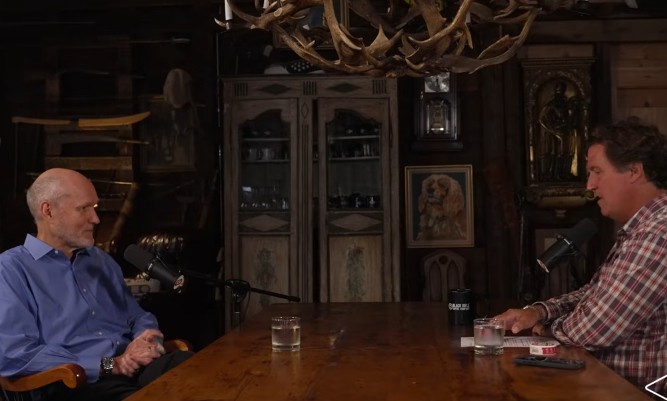
Read the full transcript of Harvard professor Stephen M. Walt’s interview on The Tucker Carlson Show, August 24, 2026.
EDITOR’S NOTE: In this interview, Tucker Carlson sits down with Harvard professor and international relations expert Stephen M. Walt to examine the escalating risks in a post-war world shaped by conflicts with Iran and Russia. Walt, a longtime critic of U.S. interventionism and author of The Hell of Good Intentions, analyzes the forces driving America’s involvement in the Middle East, the rise of China, the potential for nuclear escalation, and the broader challenges to global stability and American democracy.
Opening
TUCKER CARLSON (00:00:04 – 00:00:05): First of all, thanks so much for doing this.
STEPHEN M. WALT (00:00:06 – 00:00:06): Nice to be here.
A More Dangerous World Ahead
TUCKER CARLSON (00:00:06 – 00:00:18): So let’s start at the end, the anticipated end, when and if the United States resolves its role in these 2 wars against Russia and against Iran. What does the world look like, do you think?
STEPHEN M. WALT (00:00:18 – 00:00:25): I think it looks like a substantially more dangerous world actually than we’ve seen for, say, most of my—
TUCKER CARLSON (00:00:25 – 00:00:26): After the wars?
STEPHEN M. WALT (00:00:26 – 00:02:58): Yeah, after the wars.
Well, it’s going to leave the world in a, I think, a more precarious condition and for sort of larger, more enduring reasons than just these conflicts. I mean, the relationship with Russia is not going to improve for a while, even if the war formally comes to an end. There’s lots of suspiciousness on both sides now, so that’s going to be a problem. China is going to continue to improve its military power. It’s going to continue to grow economically. It’s going to continue to challenge the United States and others for influence around the world. So that’s going to be a source of tension.
We have, I think, in the world today, you’re seeing other powers, lesser powers being more active and not always constructively. Think of the role that the UAE has played in the civil war in Sudan. So they’re involved in fueling conflicts in a variety of other places. So you’re going to see a tripolar world, Russia, China, the United States as the 3 main powers with some unresolved tensions among them continued, I think, concerns about what’s going on in Asia and what China’s ambitions might be there. And in a situation where no one really trusts America’s judgment anymore. And that’s, I think, an artifact of the war, especially the war in Iran.
Let me point to one other thing that I think people sometimes forget about, and that’s that we’ve seen, I think, a pretty dramatic erosion in the normative environment surrounding the use of force. And I’m a good realist, so I don’t think norms in international law are everything, but they’re not irrelevant. So one of the things we’ve seen is essentially a collapse of the norm against assassination. For a long time in world history, governments didn’t try to assassinate each other. Leaders of other countries didn’t try and kill each other in conflicts. This was a common practice 500 years ago, and it gradually fell from favor and a norm emerged against it. You can understand why. It was in everybody’s self-interest if you were a king, if you were a prime minister, not to be trying to kill each other. Moreover, great powers liked this norm because it meant that conflicts would be decided on the battlefield where they had all the soldiers and all the wealth and could win. Assassination is a tool of weaker powers.
TUCKER CARLSON (00:02:58 – 00:03:00): Right. It’s asymmetrical. Of course.
STEPHEN M. WALT (00:03:00 – 00:03:32): Right. And beginning at the end of World War II, when the Allies began to hold leaders accountable, Nuremberg Trials, the Tokyo War Crimes Trials, this idea that what you did as a statesman was sort of separate began to erode. Once that began to erode, then going after a leader, going after Muammar Gaddafi, going after Saddam Hussein begins to look morally preferable. Why not just take out this troublesome leader as opposed to fighting?
TUCKER CARLSON (00:03:32 – 00:03:33): Spare the population.
STEPHEN M. WALT (00:03:33 – 00:04:53): Yeah, spare the population. You could make this argument. Of course, this is a very dangerous road to go down because now it’s becoming a much more common practice. Look at what the United States and Israel do at the beginning of the Iran War. They take out all of Iran’s senior leaders. There’s at least 2 problems here. First of all, you don’t know who’s going to replace them. And of course, we’re now having trouble with a more hardline faction in Iran. It also erodes any possibility of trust. I mean, how can you sit down and negotiate a agreement with a regime that has killed your senior leaders and might do something again subsequently. And then finally, as that norm begins to erode, others are going to use it too. Others will start using similar tactics, and leaders, including American presidents, are going to have to worry much more about this than they did necessarily in the past.
All right, you put all of those things together, continued great power competition, eroding norms against the use of violence in a variety of different ways. I think you end up with a much more dangerous world. And I think unfortunately the world agrees with that. Because if you look at the last 20 years or so, in constant dollars, defense expenditures have basically doubled in the world over the last 20 years because—
TUCKER CARLSON (00:04:53 – 00:04:54): Not just in the US.
STEPHEN M. WALT (00:04:54 – 00:05:10): Not just in the United States. You see this happening in Asia. You see this happening in Europe now. Belatedly, but finally happening.
The Myth of Trade-Driven Peace
TUCKER CARLSON (00:05:10 – 00:05:25): Not what we were promised. We were promised by certain factions in American politics, peace based on global trade. Globalizing the economy was supposed to guarantee stability because you don’t go to war with your trading partners. That’s what they told us.
STEPHEN M. WALT (00:05:25 – 00:06:19): Right. And I should have mentioned that. I mean, the other thing that’s happening is we’re seeing the onset of not an end to global trade, not even a complete end to globalization, but certainly a retreat back from it, raising of trade barriers, increased protectionism, particularly in high technology and things like that. And I don’t think that’s going to go away anytime soon. You’re going to see a much more competitive economic environment and what has been called weaponized interdependence, people trying to gain political advantage by using others’ vulnerabilities or others’ dependence. The way the United States has weaponized the role of the dollar in the international financial system, imposing sanctions. The way Iran has weaponized everyone’s dependence on the Strait of Hormuz to advance political agendas. So all of that’s going to contribute to this.
TUCKER CARLSON (00:06:19 – 00:06:28): But can we put those clichés to bed that democracies don’t go to war against their neighbors, that trading partners don’t have wars? None of that’s true.
STEPHEN M. WALT (00:06:29 – 00:07:23): You want to be careful here. There is some evidence that democracies are less likely to fight each other. It’s soft evidence. I wouldn’t want to base my entire foreign policy around that assumption, but you don’t want to completely throw it out. And secondly, again, big macro studies will show you that in fact, high levels of economic interdependence do make international conflict between the partners less likely. That is to say, there’s a statistical relationship there. It is not, however, an absolute guarantee. The fact that you have an extensive economic relationship with someone doesn’t mean you won’t fight them. It just makes it somewhat less likely. Also, you can make the reverse argument arguably even more powerfully. It’s not so much that interdependence causes peace. It’s rather that peace causes interdependence.
TUCKER CARLSON (00:07:23 – 00:07:24): Yes, exactly.
STEPHEN M. WALT (00:07:24 – 00:07:26): When you have a stable political environment—
TUCKER CARLSON (00:07:26 – 00:07:27): Thank you for saying that.
STEPHEN M. WALT (00:07:27 – 00:08:24): No, when you have a stable political environment, people don’t think war is very likely. Then they’re willing to trade with someone else much more readily. They’re willing to invest in a foreign economy without worrying that somehow that’s going to get nationalized or seized because a conflict emerges. And once people begin to see that conflict is likely, they quite— and I’m talking about investors here, they quite naturally begin to pull back. And governments encourage them to pull back because they’re worried about what the balance of power is going to be, et cetera.
The optimism of the, say, early 1990s that we were going to head into this wonderful Fukuyama and Friedman-esque world of globalization and peace and harmony, there was a grain of truth in that. If the world had remained peaceful and tranquil, then interdependence looks more attractive. But once the world starts to look more dangerous, people begin to worry more about security than they do about wealth.
Why America Misjudged China’s Rise
TUCKER CARLSON (00:08:24 – 00:09:50): Why have American policymakers been unwilling to be realistic about the rise of China? It seems like everything in the last 20 years, the subtext of a lot of it is like a total unwillingness to deal with the fact that we’re not in charge of everything because China has this enormous economy.
STEPHEN M. WALT (00:09:50 – 00:13:15): Yeah, I think there’s a lot of factors that went into this. I mean, first, there was a certain degree of just general American hubris, particularly post–Cold War. We’ve won the Cold War. We have the magic formula. We have the model for how you organize a modern society. It’s got to be a market-based economy. It’s got to be based on rule of law. It’s got to be opened to trading with others. That’s the modern world. And this is what you get when you read Frank Fukuyama, who is in my view a fine scholar, but was wrong about that, and some others in the 1990s.
That’s what we generally believed. And it was bipartisan. Republicans and Democrats largely all subscribed to this idea. And a key part of that was because we had found the magic formula. This was the answer. China had finally embraced markets and would inevitably become democratic because its citizens would get wealthier, there would be a middle class, that middle class would want freedom and political rights, and it would insist upon being able to express itself, etc., etc., etc. You could tell yourself a pretty good story for how this is all going to work out. And then once China’s a liberal democracy and all engaged with everyone and a member of all these international institutions like the World Trade Organization, we’re going to have — not a perfect world, but the best world we’ve ever had. Again, nice story, and there was a coherent logic to it. It turned out to be wrong. The Chinese Communist Party was not about to liberalize. They put a premium on political control and had lots of ways of doing it. And we were too eager and too hasty to bring them into all of these institutions, to engage them and help them grow.
So one factor was just hubris on our part and overconfidence that we really had the answer and they would inevitably adopt our system or something like our system. The second part was, of course, the short-term interests of American corporations who could make lots of money by shifting production to China and were, in my view, so eager to do that that they were willing to accept terms that they probably shouldn’t have about technology sharing, about letting the Chinese basically learn to do what we had learned to do.
And I should be clear here, I don’t think the United States should have tried to strangle Chinese economic development. We shouldn’t have tried to encourage it as much, but that would have had costs for us. We all benefited from embracing China the way we did. You and I got cheaper goods than we would have had otherwise. Some Americans, a minority of Americans, were really badly hurt by this, the so-called China shock. So there were industries, there were communities that were decimated, but the vast majority of Americans ultimately benefited economically.
What those— all those Americans, including you and me, forgot was that this was also going to ultimately begin to shift the balance of economic power in ways that were more beneficial to China than they ultimately were to us. And that was going to have consequences down the road. China was going to grow once China embraced markets, once China got rid of Maoism and got serious about — they were going to catch up. But it would have been better for us, and I think probably better for everyone, if it had happened— or at least for most of us— if this had happened more slowly, more gradually than it did.
TUCKER CARLSON (00:13:16 – 00:13:34): But once it happened— oh yeah, and you know, you look up and China is a bigger— by some measures, a bigger economy than the United States, vastly bigger population. You’re going to have to deal with China. You can’t continue to tell yourself it’s unipolar in any sense. This is— why wouldn’t they have a sphere of influence?
STEPHEN M. WALT (00:13:35 – 00:14:57): Well, there’s 2 points here. One, let’s get to the sphere of influence point in a second. But, to me, one of the great— call it tragedies— is that beginning in the Bush administration, there’s a real recognition that China is now emerging as a potential peer competitor. You see this in the national security strategies written in the Bush administration. And I know inside the Pentagon, there were real serious efforts made to start preparing for this. The problem is that 9/11 came along and completely blew the Bush administration’s agenda. Instead of focusing on great power relations and on China, they focused on the Global War on Terror, right? And ever since then, you’ve had every single American president saying they were going to focus laser-like on China. We’re going to pivot to Asia. We’re going to focus on China. We’re going to crack down on China. These practices. And every one of those presidents, I think this is true of Bush, this is true of Obama, this is true of Trump 1, this is true of Biden, they get blown off course by events elsewhere, usually in the Middle East. And trouble in the Middle East and America’s inability to stay out of that trouble has been a great benefit because it’s never allowed the United States—
TUCKER CARLSON (00:14:57 – 00:14:58): Benefit to China.
STEPHEN M. WALT (00:14:58 – 00:17:41): Benefit to China, sorry. Because it’s never allowed the United States to do what serious people in the government wanted to do, which was to focus a lot more attention on that problem.
Second question is the sphere of influence issue. So if I were the Chinese, I would like to have a sphere of influence in Asia. I would like to have the United States out. Who wants the world’s most powerful country, or arguably the world’s most powerful country, allied with all of your neighbors and with substantial military forces nearby? If I were China, I would prefer a situation where the United States is essentially out of Asia. And I don’t want to conquer Japan. I don’t want to conquer Korea. I don’t want to conquer Vietnam. That’s not necessary, too much work. I just want relations of deference. I want those countries to not be a security threat to me. I want them to pay close attention to my wishes. In other words, I would like a relationship with most of my neighbors in Asia similar to the relationship the United States has with most countries in the Western Hemisphere, where they’re very careful how they interact with the United States because we tend to be pretty heavy-handed in dealing with them for all those reasons. That’s what I would like if I were China.
Now, if you’re the United States, the question is, is that something you should be happy with? And my view is no, that a China that was as secure in Asia as we are in the Western Hemisphere— we face no serious rivals in the Western Hemisphere, there’s no enemy armies about to invade the United States from anywhere in the Western Hemisphere. We can run around the world getting into trouble in lots of places because we don’t have to worry about defending our borders. A China that was in a similar position would suddenly be much freer to roam around the world getting into trouble in lots of places. Maybe the Chinese are smarter than we are, maybe they wouldn’t do that, but the possibility would become much more viable. And that might even include starting to form strategic partnerships with countries in the Western Hemisphere, not just economic partnerships, but strategic partnerships. If China depends on economic resources, maybe it would like to have a military role here. Maybe it would like to form an alliance with Brazil. This is not something the United States has ever really wanted. That’s what the Monroe Doctrine was all about, and it’s been a great benefit to American security. So I think the United States should do what it can to prevent China from dominating Asia the way we dominate the Western Hemisphere. I think that’s possible to do, but I worry that we’re doing all of the things that you shouldn’t do if that was your goal.
TUCKER CARLSON (00:17:42 – 00:18:01): Well, decisions made in Washington have done a lot to tank the Japanese economy. I think that’s my read. And the president’s recent comments about the South Korean president suggest in both countries, which are the key countries that you’re talking about, like a withdrawal of American support to some extent.
STEPHEN M. WALT (00:18:01 – 00:18:11): Yeah, it’s quite remarkable. I mean, the business with North Korea is— or North Korea and South Korea is truly baffling, and we can get into that in some—
TUCKER CARLSON (00:18:11 – 00:18:14): Summarize your view of it, if you don’t mind, because I’m confused.
STEPHEN M. WALT (00:18:14 – 00:19:34): Yeah, I don’t get it at all. I mean, it’s— I mean, South Korea is, first of all, been a very stalwart ally for the United States for a long time, 75 years. And moreover, South Korea is a great success story when you think about it from broader American interests. This is a country that when we allied with them initially, it was a military dictatorship under Syngman Rhee and not a very nice military dictatorship, but for strategic reasons, we backed them in the Korean War and subsequently. And then over time, South Korea becomes a quite successful democracy. And it does this, by the way, not because we send the 82nd Airborne to do a regime change, but because the South Koreans, as they developed economically, decided they wanted to become democratic. They were also, many of them had been to the United States, they’d studied here, they liked what they saw, et cetera. And so South Korea on its own initiative becomes a democracy with some encouragement from the United States, but not with us telling them what to do or anything like that.
So it’s a great success story for the United States. And now to suddenly say, well, “I’ve got a great relationship with Kim Jong-un,” a truly odious dictator, “and that’s the reason why I want to suspend military exercises with South Korea.” This is nuts. This is—
TUCKER CARLSON (00:19:35 – 00:19:37): What is it though? What’s driving this?
STEPHEN M. WALT (00:19:39 – 00:21:22): Partly I think it’s a perennial Trump tendency to want to distract people from whatever the problem is that he’s caused. And he’s a genius at this, at always changing the subject, getting us talking about something else instead of whatever’s going wrong. I think he still wants to go down in history being remembered as some kind of peacemaker, and he still believes maybe he can pull off some miracle with North Korea, alter that relationship. I think that’s fanciful.
And third, and this I think has been a problem throughout Trump’s presidency, is he has this exaggerated view of his own personal qualities as a negotiator and dealmaker. That if he can just get in a room with people, somehow the force of personality will turn the tide. And this didn’t work in his first term. Kim Jong-un picked his pocket in his first term. Kim Jong-un got something that’s worth something in world politics. He got a state visit. He got several of them. Not a state visit. He got a personal one-on-one visit with the US president. Nothing he’d ever— no North Korean leader had ever gotten anything like that before. And what did he give up in order to get that? What concessions did he make in order to get that one-on-one meeting with the US president? Zero, absolutely nothing. He didn’t compromise on his nuclear program, didn’t compromise on his attitudes towards South Korea, didn’t do any of those things. He got the meeting and walked away, right? And so Trump, having gotten his pocket picked by Kim the first time around, now wants to go back and do this again, I can’t put a rational explanation behind it.
The Road to War with Iran
TUCKER CARLSON (00:21:22 – 00:22:48): Why do you think we’re at war with Iran? I mean, there are the reasons, you know, there are many layers and levels on which we could say true things, but what is the— what’s the bait? What’s the bedrock here?
STEPHEN M. WALT (00:22:52 – 00:27:05): I’ll just go through my laundry list. I mean, there has been a bad relationship between the United States and Iran for 40-plus years. We all know that. In my view, Iran has on a number of occasions in the past tried to improve that relationship. They’ve made the initiative. They did so in the ’90s. They did so in the early aughts after 9/11. And each time, ultimately, they get the back of our hand. We sometimes have flirted with it, but never did anything substantial and eventually rejected their overtures.
I think most of that is a function of the US commitment to Israel, the fact that Israel and Iran are deeply at odds with each other for various reasons, and therefore the political price in the United States has been pretty high. And not all, but some parts of what I have called the Israel lobby have been pushing for military action against Iran for a long time. Again, it’s important to say not all parts. For example, J Street condemned the war when it began this time around. And that’s terrific. Good for them. So that’s part of it. There’s been a sort of thumb on the scale pushing for it.
Now, why are we at war with Iran now? It’s not because Iran was about to get a nuclear weapon. It’s not because Iran was suddenly about to launch some military operation that was a great danger. The proximate cause, I think, was, first of all, Benjamin Netanyahu’s visit to the White House, which he came and gave this elaborate briefing about how Iran was teetering on the edge and, you know, sort of all it would take would be a sharp rap. The regime would collapse and we’d have a new day, new opportunities to have a different relationship with Iran, get rid of whatever’s left of its nuclear program, et cetera. And he was able to persuade Donald Trump that this was correct. First time he’s successful. Netanyahu’s made similar pitches in the past to Biden, to Obama, to Trump in the first term, et cetera. And all prior American presidents had said, no, this is a bad idea. This time around, Trump did it.
Now, why he did it, I’m not inside his head, so I don’t know. But I think part of it was the success of the Venezuela operation, the kidnapping of Maduro. A very different operation, of course, special forces just snatching someone and removing them, etc. But he began to believe that he really had great judgment and that the American military could accomplish wonderful purposes. There was no, as near as I can tell, no strong dissent within the administration, in part because it is an administration made up mostly of yes-men who will tell the president what he wants to hear. There may have been some mild “well, are you sure” kind of comments.
And then finally, I think this is Trump at the end of his political career, we think, and near the end of his life, who’s playing for the history books. And I think he saw this as possibly a way to kind of run the table. “I’ve gotten rid of Maduro in Venezuela. That was always a headache. I’m working on Cuba. I’ll probably get that one. I’ll get Greenland sooner or later. So that’ll be terrific. And Iran’s been a problem for 40 years, and I will be the president that has solved it and bring wonderful new opportunities to the Middle East.” Put all that together, and because he believed, again, this is where Netanyahu helped persuade him, that it was going to be cheap, quick, fast, a few days of bombing, regime collapses, get some new people in there, everybody fine. I don’t think Trump, if Trump had had any clear idea that he would be where he is today when he started it, I don’t think he would’ve done it. But he persuaded himself or was persuaded that this would be just like other operations he has authorized. Short, quick, discreet, cheap. And he turned out to be badly wrong.
TUCKER CARLSON (00:27:07 – 00:27:14): Yeah, I don’t know the answer. I think that Trump understood fully well the consequences, but whatever the cause—
STEPHEN M. WALT (00:27:15 – 00:27:17): I’m sorry, you think he understood that?
TUCKER CARLSON (00:27:17 – 00:27:56): I know. Yeah, I know he did. He understood the consequences. Yeah, of course. The potential consequences. Oh, for sure he did. Yeah, no, he was told and he agreed that those were real risks. And the risks so far outweighed the potential upside that it does make you wonder. But I don’t have the answer.
But we do know it wasn’t just Trump. There have been no anti-war protests. So what does that tell you? It tells you that Trump’s organized opponents— they don’t like the way it’s going. Nobody does. But they were not against regime change in Iran. So why is everybody in the political establishment— Chuck Schumer’s for it. He may have done it better than Trump or whatever, but conceptually they’re on the same page.
STEPHEN M. WALT (00:27:56 – 00:29:45): Why? Yeah, you want to be clear here, not everybody in the political establishment. And I think for Democrats, this puts Democrats in an interesting position. A number of them have been, of course, outspoken saying this is a crazy idea, condemning the president, etc. Whether— again, I’m not inside their heads— whether they would love the war to be over because that would be good. I think that’s where Bernie Sanders is. If you gave Bernie Sanders a button and said, “You can press this button and the war would stop tomorrow,” he would press it immediately. I think there are plenty of Democrats and a few Republicans who would do that now. But there may be a few Democrats who also say, well, if this sort of drags on into the fall, that looks good for us. So there may be some ambivalence and you want to criticize the president, but—
But why there haven’t been protests, I think this gets back at something that’s been true now for a long time. I think relying on the all-volunteer force has made it easier for presidents to get us into military operations because everyone is doing it, volunteered for service. No one’s being drafted, no one’s being hauled out of it. And in the forever wars in Iraq and Afghanistan, you did start to get pushback from military families, particularly people in the reserves who really didn’t expect to suddenly be doing repeated deployments overseas as well. It is also true that the casualty figures have been relatively low, so you don’t see people concerned about that. And most of the consequences have been economic, and I think we are going to see those play themselves out in elections. That’s where people don’t have to necessarily go protest the war. They’re going to vote people out of office.
TUCKER CARLSON (00:29:46 – 00:29:56): But very quickly after the March 2003 invasion of Iraq, there were protests and there were organized protests against that war, I think.
STEPHEN M. WALT (00:29:56 – 00:30:06): Yeah, there were some. And there have been some protests. I don’t think they’ve been in large scale. And I don’t know, again, I don’t know if there’s been a certain amount of battle fatigue almost.
TUCKER CARLSON (00:30:06 – 00:30:07): Maybe that’s right.
STEPHEN M. WALT (00:30:07 – 00:30:31): We’ve had a series of the so-called No Kings rallies, which were quite substantial, quite large, and are sort of across the horizon, protests against where the administration is going, whether or not this is just one more thing, and maybe some of that energy has been sapped or some of that energy is going into gearing up for the midterms. I just don’t have a good sense of why that might be the case.
Ending the Russia-Ukraine War
TUCKER CARLSON (00:30:32 – 00:32:17): I also think it’s interesting that the president ran on— explicitly ran on a promise to end the war between Russia and Ukraine, which we were then saying was between Russia and Ukraine. It’s not, but whatever. He said, “I’m going to fix this, I can fix this.” And he didn’t.
STEPHEN M. WALT (00:32:17 – 00:34:16): So why didn’t he fix it? Well, first of all, it was laughable to think he was saying, “I can solve it in 24 hours.” And this is just part of the Trump mystique, this, that he’s this magical person with these amazing deal-making qualities. And I fully concede the guy is an absolute genius at persuading people of things that are not true. There was no evidence of this from his business career, and there was no evidence of this from his political career, that he was this sort of master manipulator, master diplomat who could pull these things off.
So maybe you could get a peace deal in Ukraine, but it wasn’t going to be 24 hours because there are really serious various issues here and really difficult problems to resolve. And there’s lots of stakeholders and lots of parties in there, and getting them all to agree when they’re as far apart as they are was never going to be easy. It’s possible if Trump had put a really good team together and put a sophisticated plan in place to pressure both sides, get the Ukrainians to back off some of the things they wanted, get the Russians to back off some of what they were doing, you might have been able to pressure them to a deal. But you were never going to be able to do this by sending Steve Witkoff and Jared Kushner off to talk to Putin and think you could get a deal that way. You were never going to do this by getting Zelensky into the Oval Office and sort of putting a gun to his head and saying, “you have to concede.” It was never going to be that easy. Zelensky wasn’t in a position to do that. If he’d gone back to Kyiv and said, “we’re going to have to run up the white flag and cut a deal,” he would’ve been deposed. He would’ve been removed from power. The Ukrainians would not have gone along with that. So it was completely unrealistic for Trump to promise any such deal. And if that’s what he wanted to do, he was going to have to get serious, put the right people in charge, and be somewhat more patient than he’s able to be.
TUCKER CARLSON (00:34:17 – 00:34:19): What would it take to resolve it now?
STEPHEN M. WALT (00:34:20 – 00:35:16): I don’t know. My take on where we are now is, and there are some parallels, by the way, with the war in Iran, which we may get to, we’re in what I would call a hurting stalemate. Ukraine is suffering both from missile strikes and continued losses along the front, and Russia is suffering from losses along the front and the Ukrainian retaliation. And both of them are, I think, paying a substantial price. My guess is that the price is worse for the Ukrainians. And Russia’s continuing to make at very high costs some incremental advances in the Donbas. When you’re in a hurting stalemate, both sides are basically betting that they can last longer, that they’re going to outweigh the other side. And I think from a macro point of view, you’d say, well, Russia’s probably got the advantage there because its resources are still substantially greater.
TUCKER CARLSON (00:35:16 – 00:35:17): Much bigger population.
STEPHEN M. WALT (00:35:17 – 00:37:05): Much bigger population, et cetera. But you don’t know. Nationalism’s a very powerful force. I think the Ukrainians care more about fighting for what they regard as their country than the Russians care about taking the next 50 kilometers of Donbas. Putin may care, but I’m not sure the Russian population does.
So if it were up to me, and I assure you it’s not, I think the United States should be continuing to back Ukraine while saying that there are real limits to what we’re willing to support. You have to explain to the Ukrainians, no, you’re not going to get Crimea back. No, you’re not going to get most of the Donbas back, at least not anytime soon. Maybe in the fullness of time, maybe at some point, but you don’t have the military capabilities of pushing Russia out and we’re not going to give them to you. Even if we gave you more stuff, you would be able to do it for a variety of reasons, and the risks of doing that are too great for us. So, but I would keep Ukraine in the game, and then I would also go to Russia. And that’s the leverage you have with Russia, that you can continue to help Ukraine. And the leverage you have with Ukraine is that they’re going to have to lower their ambitions, and the Russians have to get some of what they want too. And that’s the part that sticks in the Western craw. And my terms would be roughly that Ukraine has to become a neutral country. It’s not going to join NATO. It drops any insistence on that. The trickiest part, and that’s, I think, again, was the precipitating cause, was the belief that Ukraine was drifting into NATO over time.
TUCKER CARLSON (00:37:05 – 00:37:08): And that’s the core Russian demand from what I can tell.
STEPHEN M. WALT (00:37:08 – 00:38:01): I think that’s the most important thing. It’s not the only thing. There’s some other issues about rights of minorities in Russia, and those can, I think, be addressed. The trickiest part, at least as I look at this, is what’s the security arrangement going forward for Ukraine? It’s not acceptable to Ukraine, understandably, to be disarmed or to be allowed only a minimal amount of defense forces. It’s going to be a sovereign country. It should be able to defend itself as well. So if NATO membership is off the table, that’s gone, it’s going to be a neutral country. It’s going to have a military. Can it buy weapons from other countries? I would think so, as a sovereign nation. If it buys weapons, say from Sweden, can the Swedes send some people to help train the Ukrainians on how to use those weapons? How many? How long can they stay?
TUCKER CARLSON (00:38:01 – 00:38:02): And what kind of weapons?
STEPHEN M. WALT (00:38:02 – 00:38:47): And what kind of weapons, maybe. So— and of course, there’s a point at which that starts to look like you’re becoming a de facto member of NATO, even if you’re not a formal member, if it gets too far. That’s a very tricky negotiation. So zero is not acceptable to Ukraine, and too much wouldn’t be acceptable to Russia, and you start the war again, right? That’s a long and complicated negotiation. Another reason why Trump was blowing smoke when he said he could end this thing— there’s some serious security issues that have to be worked out there, and you’d need really good people taking some time and care to do that kind of a negotiation in order to make it work and to have it be something where it might last.
European Fears of Russia
TUCKER CARLSON (00:38:48 – 00:39:11): If you speak to European politicians or well-educated Europeans, a lot of them in Spain, Germany, certainly the UK, they seem convinced that Russia has plans to invade them. From my perspective, that’s insane, but I want to run it by you.
STEPHEN M. WALT (00:39:11 – 00:39:16): Yeah, no, I think that’s— I’m not sure I’d use the word insane, but I think it’s completely wrong.
TUCKER CARLSON (00:39:16 – 00:39:19): It’s so implausible. They can’t take all of Donbas.
STEPHEN M. WALT (00:39:19 – 00:39:34): So yeah, exactly. The idea that Russia has had so much trouble dealing just with Ukraine is going to launch some kind of major assault on Europe, there’s no incentive for them to do so, and I think there’s no possibility they could pull that off.
TUCKER CARLSON (00:39:34 – 00:39:36): Why do Europeans seem to really think that though?
STEPHEN M. WALT (00:39:37 – 00:40:38): Well, I do think there’s a history that people still to some degree invoke. I think that they are legitimately concerned by, let’s call it, gray area hybrid warfare things that Russia has been doing for a variety of reasons for quite some time and are, you know, a violation of all sorts of international legal rules and a worrisome indication of maligned intent, let’s call it that way. So if I were Swedish, if I were in the Baltic States and I’m seeing this kind of interference on a constant basis, if I am observing some of the sabotage, I think credibly linked to Russian intelligence that have taken place in other parts of Europe, I would say, “how can you expect us to trust you and not worry about what you might try to do if you keep doing this sort of stuff? We’re not doing that back in Russia. We’re not setting fire to things in St. Petersburg. So why are you doing that to us?”
TUCKER CARLSON (00:40:39 – 00:40:41): Well, they are setting things on fire in St. Petersburg.
STEPHEN M. WALT (00:40:41 – 00:40:45): Not the Ukrainians are setting fire on things in NATO drones.
TUCKER CARLSON (00:40:48 – 00:40:56): Yeah, I mean, the drones that just hit a school in Russia were made in Germany.
STEPHEN M. WALT (00:40:56 – 00:40:59): Okay, maybe, but they were not fired by Germans.
TUCKER CARLSON (00:41:00 – 00:41:04): No, but I mean the whole war, it’s targeted by the CIA and it’s run by other countries.
STEPHEN M. WALT (00:41:04 – 00:42:35): Yeah. Okay. But, but again, if country A sells to country B and country B then shoots it, there is some responsibility there, but I would put the principal blame on country B that is actually firing it.
In any event, there are reasons for Europeans, I think, to be concerned about Russian intentions. And most people in the military business do a lot of worst-case planning. If you saw— I mean, for example, I didn’t think Putin was going to invade Ukraine the way he did because I thought it was going to be the kind of disaster he’s ended up with for Russia, by the way. So I didn’t think he would do that. So I think it’d be crazy for him to launch an assault on NATO countries. I think it would fail. But can I be totally confident that he wouldn’t do something that stupid? I’d at least think about it. And if I were a European, I would start hedging against the possibility while also asking myself with some frequency over time, what can we do to try and improve this situation? Because it gets back to our first question, where’s the world headed? It’s not good to have this many points of friction and this many points of conflict between major power centers. And if we can resolve as many of them as possible, or at least lower the temperature in a useful way without sacrificing our security, we should explore that.
Global Trade in a More Dangerous World
TUCKER CARLSON (00:42:36 – 00:44:55): If the world shakes out as you have predicted, where it’s more volatile and there are more tensions and we’re ever closer to the use of non-conventional weapons and it just gets continuously crazier, how can you sustain the global network of our economy?
STEPHEN M. WALT (00:44:56 – 00:45:48): It becomes harder. It’s not impossible. I mean, states sometimes even trade with each other in wartime when they’re both dependent on the relationship as well. And I think the sinews of international trade are going to continue. We’re not going to go back to autarky or anything like that. You, I think, may see a lot more regional concentration. You’re certainly already seeing trends towards so-called friendshoring, trying to do more economic deals with states that you think are friendly and more or less aligned with you as well. So the sort of wide-open globalization of the ’90s and early aughts may be over, but I don’t think we’re going back to a world where states are not going to trade with each other substantially. The cost to that would be so great that I think people will try to stay away from that.
How the War with Iran Ends
TUCKER CARLSON (00:45:48 – 00:45:53): I think that sounds right. How is the war with Iran resolved? And when?
STEPHEN M. WALT (00:45:57 – 00:47:34): Well, I wish I knew. I don’t see a solution to that that doesn’t ultimately involve a tacit admission on the United States that this was a huge mistake. We made a mistake. We shouldn’t have done it. And you don’t make mistakes without paying a price for it. And obviously, you know, the administration will spin whatever end to the war is as a victory of some kind, but it’s not. It’s likely to be a defeat. I believe they are still flailing around for some formula that will put sufficient pressure on Iran that Iran will then give them something so big and tangible they can claim, “this is our great victory.” And I don’t think they’re going to get that.
And the central problem is political. The motivation of the 2 sides is totally different. This was a war of choice for the United States. There was no imminent need to do this. This was not a vital interest we were defending. It’s one of the reasons why Trump was willing to do a very short, quick, cheap war, why nobody seriously contemplated sending ground troops to invade it, anything that would be really expensive because it wasn’t a vital interest. An optional war. For the Iranian regime, this is a war of survival. This is absolutely existential because our stated goal at the very beginning was to topple them. We’re trying to get rid of them.
TUCKER CARLSON (00:47:34 – 00:47:37): He demanded, quote, “unconditional surrender” in the first week.
STEPHEN M. WALT (00:47:37 – 00:51:06): Right. So their resolve, their willingness to suffer in order to win or at least to come out of this intact is much greater than ours. And I think you see that in the fact that they’re willing to do all sorts of things, including things that involve real price for the Iranian people and for themselves, risks to the regime, risks to the leaders of the regime, because for them, this is an absolutely existential affair and it’s not for us. And that’s the central problem that we face here.
And secondly, compounding that is the fact it turned out they had real options. They’re much weaker than us. They have much less global influence than the United States. We’ve done enormous amounts of damage to them. We’ve significantly hurt their military capability the way Secretary of Defense Hegseth likes to boast all the time. But the fact is they could close the Strait of Hormuz or effectively close it, and they could do significant damage to American military facilities in the region and to other American partners in the region, the Gulf states, Saudi Arabia, conceivably also even Israel as well. So suddenly they have escalatory potential. And when you’re dealing with an adversary who cares more than you do, is willing to bear greater costs, run greater risks than you are, you have to worry that they might start exercising some of those options. And so every time Trump has threatened them, the Iranians can basically say, “you do this to us, we’ll do something back to your side and you won’t like it.” And each time so far, Trump has backed off. I’m glad he did because the consequences of escalating this further would be quite severe.
So, we had a deal of sorts in June, the Memorandum of Understanding. It was badly constructed, badly negotiated by some people who didn’t know what they were doing, but it was basically a surrender. It was the United States saying, “this was a mistake, we shouldn’t have done it, and we’re going to agree to a set of terms that are actually pretty favorable to you.” Trump is immediately pilloried by the supporters of the war and some others for negotiating a bad deal. And the United States pretty quickly begins to try and skirt around it in various ways over access in the Strait of Hormuz, and the Iranians see what he’s doing and they go back to war, essentially, because they believe he’s trying to evade the terms as they understood them in the agreement.
There’s one final point I need to make here though. I said a while back that there’s zero trust between the United States and Iran at this point. And therefore, a peace arrangement with someone you don’t trust is really hard to pull off because you’re always assuming they’re going to renege on it. And that’s especially true for the Iranians. What the Iranians have to worry about is what the Israelis would call the “mowing the grass” phenomenon. That, all right, we bombed Iran last summer, then we started a war with them in 2026. So we get a deal of some kind and we agree to some negotiations on their nuclear stuff. What’s to stop the United States from bringing its ships home, refitting them, rearming them, sending them back and starting this up again in a year? If you’re the Iranians, you would think long and hard about this.
TUCKER CARLSON (00:51:06 – 00:51:06): Yes, you would.
STEPHEN M. WALT (00:51:09 – 00:51:56): How do we agree to end a war with the United States and be confident that the United States won’t start this again at some convenient point down the road? And my reasoning is, if I were Iran, I’d be saying, I need to make sure the United States pays a significantly large price for this. That they learn not to do it again. I can’t trust their promises, but I can hope that I can trust that they might be able to learn that this was a huge mistake. And that means an incentive to actually make sure that we all pay a sufficiently large price that the next president, Democratic or Republican, or Trump in his last term, decides that starting something like this again is a bad idea. All of those things I think is extremely difficult to solve.
TUCKER CARLSON (00:51:57 – 00:52:00): And the Iranians, if you watch their media, are saying that.
STEPHEN M. WALT (00:52:01 – 00:52:01): Right.
TUCKER CARLSON (00:52:01 – 00:52:06): I mean, they’re saying that. They don’t trust that a peace agreement won’t become just a pause.
STEPHEN M. WALT (00:52:06 – 00:52:15): Well, remember, we were negotiating with Iran on its nuclear program when the war started. And here we have some negotiations.
TUCKER CARLSON (00:52:15 – 00:52:16): When we murdered their head of state. Yeah, I do remember that.
STEPHEN M. WALT (00:52:16 – 00:52:24): Exactly. This is not exactly the way you instill confidence in your adversary that maybe diplomacy is the way to go here.
TUCKER CARLSON (00:52:24 – 00:52:27): This is what you do when your goal is unconditional surrender.
STEPHEN M. WALT (00:52:27 – 00:52:27): Right.
TUCKER CARLSON (00:52:28 – 00:52:44): But what happens when you can’t achieve unconditional surrender? Where does that leave you? But my question to you is, how does Iran provide those incentives to the United States? How does it extract— what kind of cost does it need to extract in order to get this not to happen again?
STEPHEN M. WALT (00:52:44 – 00:53:45): I’m not sure. I mean, I think that I don’t know how the Iranians are thinking about this, but certainly anything that imposes significant costs on the American economy, which of course we’ve already seen, I think the Iranians would be delighted if the midterm elections go south from Trump’s point of view. They may do that for multiple reasons, of course, not just the Iran war, but that would be a lesson to future American presidents. “Don’t do things like this.” Obviously, the more pressure that is placed on the United States by others in the region. And we’ve seen that happen now on a number of occasions. That’s, again, all of this feeds back into the American political system and foreign policy machinery. “Don’t do this kind of thing again.” One final aspect to this, again, I’ve not thought long and hard about, but I mean, there is a danger on the Iranian side of overplaying their hand too.
TUCKER CARLSON (00:53:46 – 00:53:46): Yes.
STEPHEN M. WALT (00:53:46 – 00:54:52): And one could make the argument that we have a situation in the world today, gets back to your first question, where lots of countries are overplaying their hands, trying for more than they’re really going to be able to grab. But the circumstances that allowed Iran to do what it did in response are likely to fade over time. The rest of the world is going to diversify away from fossil fuels. People are going to build more pipelines so that they can get oil and gas out of the Middle East without using the Strait of Hormuz. We were already seeing people re-engineer energy markets in a variety of ways to try and deal with this. So Iran’s leverage here is, in my view, likely to be less 5 years from now, 6 years from now. That doesn’t mean they don’t have the leverage now, and I think they’re using it, but if I were Iran, I would be careful not to sort of drag this out too long in the sense that at some point we will begin to adapt.
TUCKER CARLSON (00:54:52 – 00:55:05): There’s also only so much humiliation the US can sustain. I mean, at some point, every embarrassment to the United States is by definition like a reduction in its power, right?
STEPHEN M. WALT (00:55:06 – 00:55:20): Yeah, but you can sometimes make the— in other words, if you’re so worried about, “oh, I can’t be humiliated, I’ve got to do something,” right, you better make damn sure that that next thing you do actually works, or then your humiliation is compounded and it gets worse and worse and worse and worse.
Endorsement Break
TUCKER CARLSON (00:55:20 – 00:55:24): But I’m saying if US policymakers decide, “we actually can’t lose this or we’re going to lose the dollar”—
STEPHEN M. WALT (00:55:25 – 00:55:28): Yeah, then I don’t think we’re anywhere near there though.
TUCKER CARLSON (00:55:28 – 00:55:32): But I’m just saying if people start to think like that, you could see incentives to do something crazy.
STEPHEN M. WALT (00:55:32 – 00:56:27): Yeah, you could. I still cling to the hope, I guess, that some of the crazier things you occasionally hear about, that we might use a nuclear weapon or something like that, that at that point sensible people will stand up and say, “are you kidding? Over this? This is not worth crossing that particular threshold,” becoming the now the only country in history to use nuclear weapons, and we’ve done it twice, against non-nuclear powers. This is not a good look for the United States at a moment where America’s image around the world is tanking anyway. This seems to me would be a huge mistake, and I would expect a lot of pushback if anybody seriously went beyond the sort of contemplating stage.
TUCKER CARLSON (00:56:27 – 00:56:28): I hope so.
STEPHEN M. WALT (00:56:28 – 00:56:28): Yeah.
TUCKER CARLSON (00:56:28 – 00:56:36): But I would think even at the stage of contemplation, someone would say, “what did you just say? That’s not nuts.” But that hasn’t happened because this has been discussed at the Pentagon.
STEPHEN M. WALT (00:56:36 – 00:57:19): Yeah. But again, I think you look at the history of both nuclear powers and other major powers, and if you get at the number of things people have talked about at various points, but without serious consideration, there’s a lot of crazy stuff that gets talked about as, “let’s think this through for a second.” And then some of that’s undoubtedly useful if you’ve thought about it, “okay, no, that’s a crazy idea. Here’s why.” And then you can dismiss it. So I don’t want to sort of self-censor the consideration of various options. I just want smart enough people with good enough judgment that when they hear something crazy, to know that it’s crazy.
TUCKER CARLSON (00:57:19 – 00:57:22): Yeah. I’ve always had confidence there would be people like that.
STEPHEN M. WALT (00:57:22 – 00:57:24): I have less confidence. I’m with you there.
The US Footprint in the Middle East
TUCKER CARLSON (00:57:25 – 00:57:40): So it does seem like no matter what happens, no matter how this is resolved, there will be a reduction in the US presence in the Gulf because I just think that’s for a bunch of reasons, but it seems inevitable that there will be fewer US forces in the Gulf.
STEPHEN M. WALT (00:57:40 – 00:57:40): Right.
TUCKER CARLSON (00:57:41 – 00:57:46): What effect will that— I mean, because there’ll be a lot of politicians who say, “why are we there at all?”
STEPHEN M. WALT (00:57:46 – 00:57:46): Right.
TUCKER CARLSON (00:57:47 – 00:57:48): Why are we there at all?
STEPHEN M. WALT (00:57:51 – 01:02:00): Well, there are a variety of reasons why we’ve ended up there. And I think actually historical experience, historical perspective here is quite useful. So we didn’t care very much about the Middle East until the end of World War II. And at the end of World War II, we began to take a more serious interest in the Middle East because people began to realize there was a lot of oil there, that there was energy resources. It was not yet a vital interest because we didn’t need those resources at that point. We were still producing enormous amounts of oil and gas here in the United States, but we began to take an interest.
And for the rest of the Cold War, the Middle East was a battleground in the Cold War where we were competing with the Soviet Union for influence. We had our friends, the Saudis, the Israelis, the Jordanians, others. The Soviets had Egypt, Syria, Iraq eventually as well. And our allies turned out to be better than their allies, which was useful. But very interestingly, in that whole period, the United States didn’t really have much military presence there. We had an air base or two. We had a small flotilla that went in and out. But we didn’t think of it as an area where we were going to get actively involved militarily. Yes, we were playing basically a balance of power game. We didn’t want anybody to control the region. We didn’t have to control it ourselves. We just wanted to make sure the Soviet Union didn’t and nobody else was able to dominate the region as well. Very much a balance of power game.
This changes at the first Gulf War in 1991. We had created the Rapid Deployment Force back in 1979 after the Iranian Revolution. Created the Rapid Deployment Force, but we didn’t park it in the Middle East. We kept it here in the United States. We had prepositioned equipment, I think, in Diego Garcia, et cetera. But we were not a big footprint in the Middle East.
Then comes the First Gulf War. Suddenly we’ve got several hundred thousand troops in there throwing Iraq out of Kuwait. And we brought most of them home, but we didn’t bring all of them home, right? And in the Clinton administration, we adopted a policy known as dual containment, where we were going to contain Iraq and Iran simultaneously, even though Iraq and Iran were mortal enemies at that point, right? And to do that, we had to keep troops in Kuwait, and we had to keep troops in Saudi Arabia. This is early to mid-1990s. And dual containment was the brainchild of, I think, mostly Martin Indyk. And it was partly intended, not entirely, but partly intended to reassure Israel and make Israel more compliant in the Oslo process. The theory was that Israel’s insecure, always worried, always worried about security. So if we say we’re going to deal with Iran and Iraq, we’ll keep track of them, you guys should make some concessions in the Oslo process towards the Palestinians. Didn’t work, right? But that was the logic.
But the problem was by keeping all those troops in Saudi Arabia, it became one of the things that Osama bin Laden famously didn’t like and justified his declaring jihad against the United States. So one of the reasons we end up in trouble with al-Qaeda is the fact that we’ve adopted a policy of keeping a lot of troops now in the Middle East. That’s where it starts. And then of course, we get 9/11. And then we get the war in Iraq, 2003 war in Iraq. And now we have a very large presence in the Middle East and it takes more than a decade to start bringing that back down. And we basically have never gotten out of now either trying to provide order in the Middle East ourselves or more accurately providing a lot of disorder in the Middle East, trying to reshape it to our liking by toppling governments of various kinds, and no president has ever been able to fully extract themselves from doing that. So if—
TUCKER CARLSON (01:02:00 – 01:02:02): Well, we’re further enmeshed than we have been.
STEPHEN M. WALT (01:02:02 – 01:02:53): That’s right. And now if the end result of this conflict is for the United States to be less physically present in the Middle East, less directly involved in trying to manage the local politics of the region, telling different governments how to behave and what to do, I think that’d be a good thing, right? That might permit the United States to then start focusing its attention on bigger problems, problems in Asia and elsewhere.
Last point, the other thing that’s characterized American policy from the mid-’60s on, I’d say, is we’ve had special relations with some countries in the Middle East, Israel, to some degree Saudi Arabia, after ’75, also Egypt, and no relationship whatsoever with one country in the Middle East, Iran.
TUCKER CARLSON (01:02:53 – 01:02:53): Yes.
STEPHEN M. WALT (01:02:54 – 01:03:25): Right? You contrast that with Russia, China, everybody else in the world who has relations with everybody in the region. Doesn’t mean they like them necessarily. Doesn’t mean they’re not pushing back or objecting or doing various things, but they talk all the time. They deal with them. They understand that they’re there. We’ve had relations where we give some governments almost unconditional support, and we don’t even deal on a direct basis with the others. And this is crazy. My dream—
TUCKER CARLSON (01:03:25 – 01:03:29): Why do we do that? We’re unique among countries in doing that, I think.
STEPHEN M. WALT (01:03:30 – 01:04:37): We’re more likely than others. There’s proximate causes and permissive cause. The permissive cause is the fact that the United States has been so secure and so wealthy and powerful for so long, which gives us the luxury of pretending other governments don’t exist, it doesn’t matter, we don’t have to talk to them, et cetera. It’s not a luxury you can afford if your security is more precarious. So that’s, I think, the permissive cause. And then the proximate causes have been, in the case of Israel, obviously the special relationship there is mostly driven by American domestic politics. Not the only example of that in the world, but it’s the most obvious and most important. And to some degree, I think, the connections between the Saudi royal family, American elites, American oil interests, things like that. And then Egypt was partly because of the Egypt-Israeli peace treaty and sort of keeping Egypt on board and then part of that relationship. Most of it though, I think ultimately stems on Israel.
TUCKER CARLSON (01:04:39 – 01:04:47): So if we were to do what you hope happens, which is withdraw substantially or completely, what are the risks of that?
STEPHEN M. WALT (01:04:48 – 01:06:38): Well, so there are several. The biggest one that people point to is a proliferation risk. To the extent that the American security umbrella has discouraged or deterred countries like Saudi Arabia from pursuing nuclear weapons, then if you suddenly said, “we’re no longer doing that, we’re not in that business any longer,” it’d be more likely, not certain, but it’d be more likely that some of those countries, maybe not just Saudi Arabia, would decide, “okay, well, in order to be secure — dangerous neighborhood, Israel has nuclear weapons, maybe Turkey will get them, who knows? Iran might someday get them. I need them too.” And so you could imagine a sort of gradual spread of nuclear weapons in the region.
Even that argument, which I don’t reject out of hand, has to be qualified. Because American activities in the region have also given countries reasons to pursue nuclear weapons in the past. Why does Iran want to have a nuclear program? Why has Iran wanted to be close to the nuclear threshold but not over it? Because it was worried about the United States. It was worried that we were going to try to do what we’ve just tried to do. And so some American activities and involvement in the region is a spur to proliferation, even though you have to be honest, disengagement might encourage it. It’s also possible that that will happen anyway. We’ve just reached some kind of nuclear arrangement with Saudi Arabia as well, which is going to— it’s not supposed to lead them to get a bomb, but it’s not going to make it harder as well. So there’s long been speculation. That’s one of the concerns we have. And I should be very clear.
TUCKER CARLSON (01:06:39 – 01:06:51): Is that a concern? I mean, is it not possible that if more nations in the region had nuclear weapons that you would have a more peaceful region?
STEPHEN M. WALT (01:06:53 – 01:08:14): This is a longstanding argument that a number of people, my dissertation advisor Kenneth Waltz made this argument in both a famous paper back in 1981 arguing that the gradual spread of nuclear weapons would actually be stabilizing and better than going to enormous lengths to try and prevent it from happening. Very controversial, got lots of criticism. And then in his very last published article, a few months before he died, he published an article in Foreign Affairs. I think the title was “Why Iran Should Get the Bomb.” And he made exactly this argument, that in fact, if Iran were to get nuclear weapons, it would be relatively secure. It would no longer have much incentive to meddle around with other countries, and it would actually have stabilizing effects. Again, very controversial, got lots of criticism. The logic behind that position is a powerful logic about— that using nuclear weapons is completely irrational for Iran. Using a nuclear weapon against Israel or anybody else might invite its own destruction. They’re useful only for deterring major attacks on your own soil, and therefore a nuclear Middle East might actually be more—
TUCKER CARLSON (01:08:15 – 01:08:22): Have there been more or fewer wars per decade between India and Pakistan before Pakistan got the bomb or after?
STEPHEN M. WALT (01:08:22 – 01:08:41): That’s a famous illustration of exactly this argument. There are also cogent counterarguments. I agree. On the other side that, you do have to, the more hands that have — the more people who have their fingers on the trigger, it only takes one.
TUCKER CARLSON (01:08:41 – 01:08:41): Right.
STEPHEN M. WALT (01:08:41 – 01:10:24): And fine, we might say, great, we’ve had 30 years of relative, not complete, but relative peace between India and Pakistan. They have fought each other a few times, but it would only take one nuclear exchange to really alter that equation. So I don’t think one ought to be sanguine about this possibility, but one should not reject it out of hand. And one should also always ask the sort of opportunity cost or counterfactual question, what do you have to do to prevent it from happening? What are the costs of doing what you’re going to do to prevent it from happening?
I wanted to go back to one other thing though, which is that I’m not arguing for the United States to disengage from the Middle East, either economically or diplomatically or necessarily militarily. I like the idea of a balance of power in the region. I don’t want any country to try and dominate the place, try and control it, partly because they could manipulate energy supplies in kind of the way Iran is trying to do now. And therefore, I think the United States should be ready if you see something like the invasion of Kuwait in 1991 happening, a major potential shift in the balance of power, the United States should be ready to weigh in and try to stop that, as we did in 1991. But that’s not going to happen very often, right? And it doesn’t require the United States to be physically present and trying to dictate the local politics and topple regimes and things like that. So it’s not like the Middle East is irrelevant and I want the United States never to have a military role there. I just want to be very selective in when we go and for what purposes.
TUCKER CARLSON (01:10:24 – 01:10:38): I think you’re in the center of the mainstream on that question. But back to the original question, how do you get this war resolved and when will that happen? I mean, what’s your best guess?
STEPHEN M. WALT (01:10:41 – 01:11:47): This is the kind of thing, because in a sense, the critical decision rests with one person, is at this point, I think it rests with Donald Trump. And until he says, “okay, it’s over,” right, no matter how he dresses it up, it will be in a state of war, whether they’re actually shooting at each other or not. And I can’t forecast at what point he will decide that he needs to end this and be done with it.
I do think, I wrote this a few weeks ago, that of all the presidents I have observed, he’s probably the one who’s best able to sort of declare victory and get out, pretend it was a victory and then move on, change the subject, do something else somewhere, build a second ballroom, just get everybody talking about something else. He’s brilliant at that and he should take advantage of that ability. It’ll be harder this time around. This is a little bit too obvious a failure, but that’s what I would’ve told Israel.
TUCKER CARLSON (01:11:47 – 01:11:49): Well, the MOU was an effort to do that, I think.
STEPHEN M. WALT (01:11:49 – 01:11:50): I think it was.
TUCKER CARLSON (01:11:50 – 01:12:05): And one of the reasons it didn’t work is because the first line of that agreement or framework of an agreement promised that hostilities in Lebanon would stop. And the Israelis totally ignored that and doubled down. So we’re not in this alone.
STEPHEN M. WALT (01:12:05 – 01:12:50): No, that’s true. And we’ve seen occasional signs of fissures or cracks with— I think that I would be shocked if Trump doesn’t have his moments where he’s enraged at Prime Minister Netanyahu for getting him into this.
TUCKER CARLSON (01:12:51 – 01:12:51): Why haven’t you seen that?
STEPHEN M. WALT (01:12:53 – 01:14:15): I think that first of all, Trump is still— I mean, I think he has advisors around him, Kushner, Witkoff, others who are deeply engaged in this, who are pushing him the other way. I think certainly some of his donor base have weighed in in various ways, not just now, but previously. So I think he’s mindful of the political consequences of that, even though the public is pushed away. The donor base on which a lot of Republican politicians depend is still heavily, “you got to back Israel no matter what.” I think that probably is influencing him as well. The rest of it though, is I think his own inability to admit even to himself that he made a mistake here and that whatever comes out of it is going to look to most observers like an American retreat. And that’s not part of his brand, if you will.
TUCKER CARLSON (01:14:15 – 01:14:18): Yeah, it has massive consequences too, by the way, does it not?
STEPHEN M. WALT (01:14:19 – 01:15:20): I’m not sure. I mean, Reagan didn’t face any real consequences for pulling out of Lebanon. Yes, that was the smart thing to do. Nixon and Kissinger thought that getting out of Vietnam and having Vietnam fall to the communists would have catastrophic effects on America’s position in the world. They were wrong. It actually improved our position both in Asia and especially in other parts of the world. So I think we are very good at exaggerating the negative consequences of cutting losses. You don’t want to have to do it. You don’t want to have to make mistakes that force you to do these things. But in some cases, you probably know this, in your own life, there are times if you make a mistake and you admit it and you tell everybody you’re sorry, you’ve learned from it, sometimes you actually benefit. Sometimes people get credit for good judgment in having made a mistake, being able to recognize it and own up to it.
TUCKER CARLSON (01:15:20 – 01:15:21): It’s the biggest win.
STEPHEN M. WALT (01:15:21 – 01:15:54): Right. And so there would be some, I think, benefits. There’ll be carping from critics, folks who supported the war and continued to support the war will undoubtedly attack him. But I think in a weird way, Trump would get some credit if he just said, “this was a mistake.” He can blame it on whoever he wants to blame it on. “I was misled by my advisors.” Fire Pete Hegseth. He’d make him the fall guy or whoever and move on. You’d be better off for doing that. But whether he will, I don’t know.
TUCKER CARLSON (01:15:55 – 01:16:05): My own read is that he would’ve done that already if it weren’t for the Israelis. It’s hard to do with them for many reasons. But I think he’d be happy to fire Hegseth and blame Hegseth for the whole thing.
STEPHEN M. WALT (01:16:06 – 01:16:08): Well, the option is always there.
Can American Democracy Learn Its Lesson?
TUCKER CARLSON (01:16:11 – 01:16:32): Interesting. Do you think that there will be— because the public so profoundly opposes this war according to public opinion polling, how can the next administration or the second half of this administration, how can we have more conflicts like this after 25 years of the public just saying resoundingly, “we’re not for this kind of thing”?
STEPHEN M. WALT (01:16:32 – 01:16:41): Well, that’s a great question. I mean, I have thought mistakenly that this time we’ve really learned and we won’t do this again.
TUCKER CARLSON (01:16:41 – 01:16:42): The public has learned.
STEPHEN M. WALT (01:16:42 – 01:17:06): Yeah, no, I think the public has learned. And there’s a telling little statistic or observation that goes way back here. Virtually every president since the end of the Cold War has run for president on a platform of, “I’m going to do more at home and less abroad.” What was Bill Clinton’s mantra?
TUCKER CARLSON (01:17:06 – 01:17:10): Well, it’s not just the Cold War. I mean, Woodrow Wilson ran on that.
STEPHEN M. WALT (01:17:10 – 01:18:05): Yeah, but Cold War, being a responsible internationalist, right? McGovern got hammered for being seen as— So you wanted to be a responsible internationalist, Eisenhower, Kennedy, Johnson, et cetera. That was pretty constant. Jimmy Carter was not a dove, right? He did plenty of hawkish things. But what’s Bill Clinton’s mantra? “It’s the economy, stupid.” He has no foreign policy credentials. He’s not interested in it. He runs against a very successful foreign policy president, George H. W. Bush, and beats him, right? Get to 2000, right? What’s Bush’s — “I’m going to give a humble foreign policy.” Our foreign policy would be strong but humble. And he criticizes the Clinton-Gore administration for too much nation building, too much foreign policy as social work, et cetera. We’re too activist out there.
TUCKER CARLSON (01:18:05 – 01:18:06): The Balkans.
STEPHEN M. WALT (01:18:06 – 01:18:16): Right, the Balkans, et cetera. So he runs for office saying, “I’m going to do more at home. I’m going to give you a strong but humble foreign policy.” That’s not the foreign policy he ended up giving us.
TUCKER CARLSON (01:18:18 – 01:18:21): The Axis of Evil and remaking the world in our image, that wasn’t humility?
STEPHEN M. WALT (01:18:21 – 01:19:36): No, exactly. Barack Obama, he becomes president because he’s one of the few Democrats who had publicly opposed the Iraq War. And so he’s going to do nation building at home. That was one of his lines. That’s not exactly what he does either. Tries to move in that direction, but he does Libya, he does a lot of involvement, et cetera. Then it brings us to Donald Trump, right? Opponent to the forever wars, very critical of the foreign policy establishment in 2016. That distinguishes him not only from the Democrats, but all of the Republicans that he’s running against who are basically interventionists, neocons, and whatever. And he wins. And then of course, in his first term, he doesn’t do half of the things that he says he’s going to do. We’re still in Afghanistan when his term ends. He actually does a little surge, just like Obama did in his first year. So he doesn’t change either. Then you get Biden, of course, and Biden is critical of Trump, et cetera, but Biden was part of the old order anyway. So all of these presidents intuited that the American people wanted to hear that there was going to be some more attention paid to them at home, right? And less of this craziness abroad.
Is America Still a Democracy?
TUCKER CARLSON (01:19:36 – 01:19:38): So why do we use the term democracy to describe our system?
STEPHEN M. WALT (01:19:38 – 01:20:21): Well, because I think it is still fundamentally a democracy, but it’s a democracy mediated through institutions, which is what a democracy is. And some of those institutions are committed to certain ways of doing business. Also, most Americans, most of the time, almost all the time, don’t think of foreign policy as very important. It’s always way down there about 10, 11 in the list of things you worry about, right? When you show polls, people worry about cost of living. They worry about healthcare. They worry about education. And foreign policy, except in rare circumstances like right after September 11th, doesn’t loom that large in the political calculations of most Americans most of the time.
TUCKER CARLSON (01:20:21 – 01:20:36): But if you’re spending the overwhelming majority of the discretionary budget, $1.5 trillion, just on the Pentagon, not including all kinds of other national security–related expenses, I mean, the economy is directly linked to your foreign policy. In fact, it’s driven by your foreign policy.
STEPHEN M. WALT (01:20:36 – 01:20:45): Well, and there’s a reason why there’s Pentagon spending in every congressional district in the country.
TUCKER CARLSON (01:20:45 – 01:20:46): Of course.
STEPHEN M. WALT (01:20:46 – 01:21:20): Right. And why weapons manufacturing gets distributed very broadly as well. So yes, that money is coming out of all of our pockets, but it’s also going to keep people employed. And that will keep, you know, local congressmen in District X in State Z voting for the budget because there’s 6,000 jobs dependent upon that going through as well. So some of it is structural in the way our system works, but I wouldn’t say it’s not democratic for that reason.
TUCKER CARLSON (01:21:20 – 01:21:39): Well, I’m just saying if the big things that government does, like, I don’t know, writes the tax code, sends the troops, are inconsistent with what the public wants over generations, it’s not a democracy in any recognizable way. I mean, the system, you may have what we’ve got — bicameral chambers and all this, but it’s like, so?
STEPHEN M. WALT (01:21:39 – 01:22:03): No, but that’s true. I mean, public opinion polls would’ve— if public opinion were driving public policy in every conceivable way, you’d probably have Medicare for All. You’d probably have really significant changes in gun control. There’s all sorts of issues where the public is at odds with what the political system produces, but I wouldn’t say it’s not democratic.
TUCKER CARLSON (01:22:04 – 01:22:21): But in what sense is it democratic? I mean, I thought the definition of democracy was ownership of the state by the people, and the governance of the state is mediated by the people they elect. But ultimately, it’s the— what the state does reflects what the people want to do because they own it.
STEPHEN M. WALT (01:22:21 – 01:22:31): Yeah. And I think to a first approximation, that is still true. I think that we got Donald Trump because the American people were unhappy with what the political system was trying to do.
TUCKER CARLSON (01:22:31 – 01:22:33): Then Trump did exactly what we’ve been doing.
STEPHEN M. WALT (01:22:33 – 01:23:02): Yes. I know. I understand this. And Lord knows there are reasons why people think American democracy has gone by the wayside in a variety of different ways. I’m still, I guess, reluctant to declare the United States is not a democracy because the decisions made by people in government are not a perfect reflection of what the voter preferences are at a particular point in time.
TUCKER CARLSON (01:23:02 – 01:23:19): But if on the biggest issues, and we measure that by how much we spend on those questions — that’s just one measure, but I think it’s a pretty good one — what percentage of the budget goes to initiative X? If the biggest ones are in direct opposition to what the public wants, then I don’t really know how we’re defining the term, I guess.
STEPHEN M. WALT (01:23:19 – 01:23:48): Well, I think this is a complicated picture. So there’s also a difference between do you want a strong defense? Do you support the troops? Do you want us to be secure versus how do you want those resources to be used? So there’s less support for, say, cutting the defense budget than there is for not invading other countries. Those are 2 different things. So most Americans want a strong defense, but they want that to be used differently than we have been using it.
TUCKER CARLSON (01:23:48 – 01:23:52): Fort defense, for example. Right?
STEPHEN M. WALT (01:23:52 – 01:23:53): I mean, right.
TUCKER CARLSON (01:23:54 – 01:24:10): But yeah, I mean, I don’t know. This is my personal view. I’m not sure of the answers to most of these questions, including the one I just posed to you, is it a democracy? But I do think we would benefit from a more open and persistent discussion about what are these terms, what do the terms mean? That would be helpful.
STEPHEN M. WALT (01:24:10 – 01:26:36): Yeah, no, I think that’s right. And the questions that are being raised now— I should caveat this by saying I’ve never considered myself really a student of American politics. I do international relations. But I think the questions that have arisen now across the board about certainly the role that money plays in American politics now, which it’s all— it’s not like it’s never played a role in the past. It’s always been influential. And there are periods of American history where it waxed and waned in its influence, but it really is extraordinary now, the amount of money that gets poured into politics and how it’s concentrated in various places and clearly shapes outcomes in a variety of ways and shapes the way members of Congress and others behave. That’s important.
I think we are still wrestling with the impact of social media and the explosion of the media environment. It’s no longer the 3 channels that you can listen to. It’s no longer, do you like Huntley and Brinkley or Walter Cronkite? You’ve got as many different voices as you want to. And what effect that ultimately has on politics, I think we all kind of intuit that the effect has probably not been good, but that’s even there— it’s not entirely true. It’s clear I think it’s shaping our politics in a variety of ways that it didn’t before, probably in some beneficial ways and probably in some ways that are quite pernicious.
So there’s a lot going on with American democracy and I think democracies in other parts of the world. And one of our major challenges is figuring out ways where we’re more likely to get responsible and accountable politicians. I would like responsible, knowledgeable, and accountable politicians and have them be rewarded for that behavior as opposed to grandstanders, liars, grifters, people who have managed to achieve a following because they were good at basically attracting attention. And we have an awful lot of that in our politics and in our punditry, if you will, or our commentariat. And I think it’s deeply unhealthy.
Parallels to the French Revolution
TUCKER CARLSON (01:26:37 – 01:27:00): Well, it’s obviously deeply unhealthy, but it’s unhealthy in— I think the more imminent problem is that it’s instability producing. That’s what worries me. So you wrote a book once in which you described sort of the groundwork that allowed the French Revolution, 1789, to happen. What did France look like the week before the mob stormed the Bastille?
STEPHEN M. WALT (01:27:06 – 01:27:14): France, there’s some— I don’t want to overstate these parallels. Historical analogies should always be used somewhat carefully.
TUCKER CARLSON (01:27:14 – 01:27:17): You just state what France was like and then let the viewer draw his own conclusions.
STEPHEN M. WALT (01:27:17 – 01:27:52): No. So you have a highly unequal system, right? But all the political power’s reserved in the aristocracy and the king. There is an Estates General, but it doesn’t have particular powers, et cetera. Although that plays a role in the story. Highly unequal. All the wealth’s held by the crown, all the wealth’s held by the aristocracy and the church. And moreover, the system is rigged in such a way that those institutions that have all the resources really don’t pay very much in taxes. You have a very large peasantry that has relatively little, lives hand to mouth, etc.
TUCKER CARLSON (01:27:52 – 01:27:55): They don’t have economic power, they don’t have political power as well.
STEPHEN M. WALT (01:27:56 – 01:29:12): A highly unequal situation. And because the people with the money aren’t willing to spend any money in taxes, the state is chronically broke. And every time they fight a foreign war, which, you know, they do — helping the American Revolution, for example — they end up in more trouble financially. So they’re constantly, constantly in financial trouble. Does this sound— begin to sound familiar? And, oh, final thing, of course, is literacy is gradually spreading. You have the printing press, you’re getting an explosion in the media environment. Suddenly pamphleteers can put out various political tracts, and the coffeehouses in Paris, lots of ideas are being swapped around. You do have some intellectuals who are starting to write about democracy. Famous things that get circulated. People begin to talk about this, maybe rights of man, stuff like this. And so you have a lot fermenting below the surface here. And then finally the fiscal crisis becomes so significant that Louis has to call the Estates General, this quasi-parliament, to come in and authorize some new financial measures. And that’s the thing that begins to generate a genuine sort of, call it grassroots movement within the political elite or whatever for change.
TUCKER CARLSON (01:29:12 – 01:29:13): A debt crisis.
STEPHEN M. WALT (01:29:13 – 01:29:33): Yeah. And the change then spins completely out of control in a variety of different ways. And there’s, of course, huge contingencies in all of this. You can imagine ways this bounces differently and people in the right place, wrong time, et cetera. But the end result here is the collapse of the French aristocracy, the rise of Napoleon.
TUCKER CARLSON (01:29:33 – 01:29:34): Beheading nuns. Yeah.
STEPHEN M. WALT (01:29:35 – 01:29:54): 25 years of war. Yeah. All sorts of bad consequences. And to some degree you can trace it to horrible wealth inequality, denial of political agency to lower classes, spread of information in ways that are no longer mediated or controlled, et cetera.
TUCKER CARLSON (01:29:54 – 01:29:56): And a debt crisis driven by pointless foreign wars.
STEPHEN M. WALT (01:29:56 – 01:29:58): Yeah. Exacerbated, I would say.
TUCKER CARLSON (01:29:59 – 01:30:04): Exacerbated. Okay. So I’m not drawing any parallels at all, but I’m just kind of throwing it out there.
STEPHEN M. WALT (01:30:04 – 01:31:17): Well, as I said to you before, if I were a really wealthy person, I would worry about this. One of the things back in the age of robber barons — and not just here, but in other countries, Great Britain, where there was enormous income inequality, end of the 19th century — I think one of the things that saved capitalism in the 20th century from Bolshevism and other things was the development of the modern welfare state, essentially income redistribution. “You wealthy people are going to live really great lives. Good for you. Congratulations. Thank you for all your contributions, but you’re going to have to give a bit larger share here. You can’t run the laboring classes like serfs,” et cetera. Lots of different arrangements. And this happened across many countries, especially here in the United States with the New Deal. And I think it was, again, a remarkable success overall and prevented the kind of lower-class upheavals that you saw in some other societies as well. So if I were a wealthy oligarch today, I would have that in mind.
Wealth, Responsibility, and Accountability
TUCKER CARLSON (01:31:17 – 01:31:33): You know what I would do is say, “against your will, we’re going to develop a new technology that you’re going to subsidize through your tax dollars in the form of, I don’t know, data centers that is going to eliminate your jobs and none of your kids are going to be employed and there’s nothing you can do about it.”
STEPHEN M. WALT (01:31:35 – 01:31:37): Yeah, but their kids don’t need to be employed.
TUCKER CARLSON (01:31:37 – 01:31:52): No, but I’m just saying, rather than respond in a sensible way that preserves the system, what’s good about the system, it does seem like the people in charge of the system are making it worse almost on purpose. And I don’t understand the thinking there.
STEPHEN M. WALT (01:31:52 – 01:32:15): Yeah, I think that— what’s interesting, I think, about previous wealthy elites in the United States is not all by any means, but many of them also had, along with the usual drive and ambition and you could even argue greed, also did have a certain public-mindedness.
TUCKER CARLSON (01:32:16 – 01:32:17): It was called Christianity.
STEPHEN M. WALT (01:32:17 – 01:33:00): Well, no, it wasn’t just Christianity. I think some of them were obviously devout and faithful in their own fashion. That may have played a role in it. But even those that weren’t, or didn’t wear their religion on their sleeve, there was a general sense that they were part of a larger society and that they owed— they had to sort of give back in some respects. And that appears to be largely absent in the wealthiest people I could name right now. You don’t get the impression that they care very much about the collectivity. And that’s not healthy. That’s not a good situation.
TUCKER CARLSON (01:33:01 – 01:33:05): Well, it’s evil, but also dangerous. As you just pointed out.
STEPHEN M. WALT (01:33:06 – 01:33:10): Yeah, I’m more worried about the danger part than the evil part, but that’s just me.
TUCKER CARLSON (01:33:11 – 01:33:38): No, I think one leads to the next. So last question, do you think— I mean, and it’s related to that. You wrote one of the most famous books about— it was in some sense an autopsy of the Iraq War. I don’t think it was billed as that, but that was my take on it. And so you’ve followed wars like the one we’re in for a long time. And you just said, “I keep expecting a correction and it never comes.”
STEPHEN M. WALT (01:33:40 – 01:33:40): Yeah.
TUCKER CARLSON (01:33:40 – 01:33:46): This one, if you could make a prediction, does this change our politics? Is this kind of the last thing like this?
The Last Word on Trump’s Legacy
STEPHEN M. WALT (01:33:49 – 01:34:47): So I think it might be, but for reasons that are not really about the Iran war per se. I mean, I think that the sea change actually began a while back, and it’s maybe the one positive contribution I’d give credit to Donald Trump for, who I believe will eventually be remembered by Americans and by others as the most disastrous president we have ever had and will be remembered by America’s adversaries as the greatest thing that ever happened to them. That’s just my view. Anyway, I think what Trump did in 2016 was he so challenged the prevailing consensus on American foreign policy, bipartisan consensus, and he did it in a way that was very dismissive of the foreign policy leadership of both parties.
TUCKER CARLSON (01:34:47 – 01:34:49): Literally back of the hand dismissive.
STEPHEN M. WALT (01:34:49 – 01:35:03): To the extent that, as you will probably remember, there were open letters signed by former Republican national security officials, dozens of them, published open letters denouncing Trump’s presidency.
TUCKER CARLSON (01:35:03 – 01:35:03): Oh, I was there.
STEPHEN M. WALT (01:35:03 – 01:37:26): Yeah. Oh yeah. And by doing that, what Trump did was he opened up in some respects a broader discussion. He made it possible or easier to talk about that. Now, some others had already started to do that, had written things that were starting to open that up. Organizations like the Quincy Institute, where I’m on the board, were not yet in existence, but getting formed in the process of being established. So the cracks were beginning to form in the edifice after 25 or so years of failure.
But having a presidential candidate and then a president who openly proclaimed some of these ideas, or at least ideas that were adjacent, and certainly questioned the consensus, made it possible to start having a broader discussion. I think that was very healthy. Now, just because things are bad doesn’t mean they can’t get worse. And I think some of the other things that Trump has done did not fulfill the promises that he made, and we’re seeing that come to fruition now. But I do think that we are in the process of seeing not just a sea change in public attitudes, which you do see on a variety of different issues, but also a change in the intellectual landscape in Washington. I think it is a broader conversation now, splits within the Democratic Party on a lot of these questions, splits within the Republican Party on a lot of these questions. Some of the think tanks that you used to think of as almost indistinguishable from each other, AEI and Heritage on the right, are now kind of at odds or moving in opposite directions, some internal splits within them. And on the one hand, that’s— you could argue that that’s sort of worrisome, uh-oh, chaos. But on the other hand, if we’ve been suffering from an excessive consensus and an inability to ask questions, an inability to criticize, and very importantly, a steadfast refusal to hold anybody accountable for mistakes, this is probably a good thing.
TUCKER CARLSON (01:37:27 – 01:37:31): You think people will be held— I mean, that’s the one thing that never happens in the American system.
STEPHEN M. WALT (01:37:31 – 01:37:36): Yeah, it’s a fascinating question. And it’s a huge problem.
TUCKER CARLSON (01:37:36 – 01:37:42): I mean, the people who complain get held accountable, I notice, but not the people who made the bad decisions.
STEPHEN M. WALT (01:37:42 – 01:38:18): So I think this has been a big problem. But it’s a tricky one. So one of the issues— there’s a chapter in my book, Hell of Good Intentions, on this where I basically make this argument that if you look across the foreign policy elite, hardly anybody pays a price for screwing up. And in fact, the more common pattern is you go into government, you screw up, and you may go out of power for a while. You land a safe sinecure at a think tank or whatever, and then when the stars line up properly, you go back in and make the same mistakes.
TUCKER CARLSON (01:38:18 – 01:38:20): You join a consulting firm and get rich.
STEPHEN M. WALT (01:38:20 – 01:39:51): Oh, well, along the way you may make a bunch of money too. And when people are really guilty of various forms of malfeasance and are exposed to that, they sometimes pay a modest price for it, public embarrassment, et cetera. In case of crimes, maybe pay a fine. But notice that usually the system rallies around such people, protects them, and they’re fine. Think of examples. Or a similar thing, the same people keep getting reappointed to the same jobs and keep doing the same bad job. This is the history of American peace negotiations in the Middle East.
The reason it’s tricky is the following, that everybody makes mistakes. Doing public policy is hard. Doing foreign policy is hard. No one’s going to get everything right all the time. And you wouldn’t want to rule someone completely out of public service because they made one screw up, or they got something badly wrong when it was not clear what the right answer was, etc. You wouldn’t want to end somebody’s career at 33 because they made a mistake. So you have to exercise a certain amount of judgment here, and my criteria tend to be the following. First of all, if somebody keeps making the same argument over and over and over again and it never works, at some point you really should stop giving them jobs or you should stop listening to them. The system— they shouldn’t necessarily be given a prime spot in the New York Times.
TUCKER CARLSON (01:39:51 – 01:39:53): That’s not a radical demand, Professor.
STEPHEN M. WALT (01:39:53 – 01:42:39): No, no, no. At some point we ought to see that. And secondly, if people are utterly unrepentant, right? I have good friends, and some people I don’t even know, who were vocal supporters of the Iraq War. And some of them have never recanted. Some of them still think it was the right thing to do. Others have said, “my head was in the clouds. I wasn’t thinking clearly. I believed X, Y, or Z. I was wrong.” And when you make a mistake, if you can admit it, you can acknowledge that, “yeah, I got that one completely wrong. And here’s why. Here’s what I missed. Here’s what I was misled by. Here’s what I should have thought harder about.” I have a lot of respect for that. And I’m much more inclined to say, okay, that’s someone I’m willing to either maybe reappoint or someone I’m willing to listen to because they’ve shown a capacity for judgment, a capacity for learning.
What I kept seeing throughout the foreign policy elite was a lot of people who really had trouble admitting they’d made mistakes, were very good at defending every decision they’d ever made, and somehow kept finding the same answer to the question, even when the conditions had changed. Even when the circumstances were different, they still had the same answer. And as you indicated, it was also quite, to me, quite telling that the people whose careers got ended were often people who turned out to be right. Whistleblowers, or who just took an unpopular position and were vindicated 5 years later, or 6 years later, but by then things had moved on. They’d already been moved out.
And finding the right balance between respectful dissent, principled dissent, and the right balance between— you’re not going to get everything right, but we need accountability without a sort of grim trigger that penalizes people instantaneously, simultaneously. Last point I’ll make about this gets back to— I do also worry that the way the media environment operates and our discourse operates now, people can get pilloried for things that are essentially irrelevant because it becomes a social media thing as well. And unless they’re protected, unless they have a lot of internal resources to deal with that kind of firestorm, it can be really, really difficult. And I think that’s unfortunate too.
TUCKER CARLSON (01:42:40 – 01:42:41): Well, it discourages telling the truth.
STEPHEN M. WALT (01:42:41 – 01:42:42): Right.
TUCKER CARLSON (01:42:42 – 01:42:44): People are afraid. I felt it. I mean, who hasn’t?
STEPHEN M. WALT (01:42:45 – 01:42:45): Yeah.
TUCKER CARLSON (01:42:46 – 01:42:48): You haven’t apparently, because you did it anyway. So thank you.
STEPHEN M. WALT (01:42:48 – 01:42:52): No, you never— you do it, but it doesn’t mean you’re not nervous about it.
TUCKER CARLSON (01:42:52 – 01:42:56): Yeah. Professor Walt, thank you very much for doing this.
STEPHEN M. WALT (01:42:56 – 01:42:57): Oh, nice talking with you.
Related Posts
- Ivana Nikolić Hughes: AI Meets Nuclear Weapons (Transcript)
- Douglas Macgregor: Russia Destroys Bridges and Will Take Kiev (Transcript)
- Roger Köppel: The New European: Moralism & Militarism? (Transcript)
- Trancript: Secretary Rubio Delivers Remarks from the Acropolis in Athens
- Jiang Xueqin: A World in Revolution – Globalism vs Nationalism (Transcript)