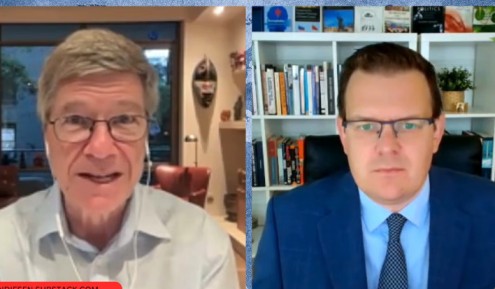
Read the full transcript of economist Professor Jeffrey Sachs’ interview on Greater Eurasia Podcast, August 24, 2026.
EDITOR’S NOTE: In this compelling interview, economist Professor Jeffrey Sachs joins Professor Glenn Diesen to analyze how Western conflicts with Russia and Iran are eroding the economic foundations and strategic mindset of the United States and Europe. Sachs argues that these wars—driven by a outdated hegemonic worldview—have triggered soaring energy prices, massive fiscal costs, and self-inflicted stagnation, while the rest of the world advances in a multipolar order. The discussion offers a sharp critique of current policies and explores paths toward greater realism and autonomy.
Introduction
GLENN DIESEN (00:00:00 – 00:00:11): Hi everyone, and welcome back. Today is August 24th, 2026, and we have the great pleasure of being joined by Professor Jeffrey Sachs. So, well, let me first thank you for coming back on the program.
JEFFREY SACHS (00:00:11 – 00:00:12): Of course.
The Economic Cost of the Wars
GLENN DIESEN (00:00:12 – 00:00:40): And I’ve been wanting to ask you that, well, we know that the United States and Europe are already burdened with troubled economies and also a weakening financial system. I wanted to ask to what extent the wars, primarily against the wars, well, with Russia and Iran, which has now widened, of course, are accelerating this economic decline of the West?
JEFFREY SACHS (00:00:41 – 00:06:18): Well, I think that the wars and the mindset behind these wars definitely is leading to a kind of economic dead end that neither the United States nor Europe appreciates or really understands what they’re getting into.
Europe sees it more immediately because Europe is clearly in an economic crisis right now. The United States is still somehow in a bubble floating above the immediate economic crisis, but it’s in no better shape in the longer term.
The wars themselves, of course, have direct consequences. Oil prices went from the mid-$60s per barrel before the February 28th attack on Iran by the United States and Israel to someplace in the $90s today for the Brent benchmark. And those prices could go much higher. That signals a great difficulty for the whole world economy, even for oil-exporting countries which use oil in their own production and therefore are facing great threats in agriculture, in soaring fertilizer prices, in soaring prices for petrol at the gas pump, for electricity, for all parts of the economy and the household sector. So the scarcity that has been created by the war cutting off the Strait of Hormuz, reducing production in the oil-rich Middle East, has very serious immediate consequences.
The war is extremely costly. How costly it is in direct outlays is much debated, but it’s certainly going to run into the high tens of billions and probably the hundreds of billions of dollars for the United States alone, not to mention the catastrophic damage that is being incurred in the fighting in the region. So the direct consequences of the war are very serious, but the mindset that I referred to, I think, is even more serious.
The Hegemonic Mindset
The reason we’re in these wars is basically because the United States and Europe are determined to maintain their hegemonic prerogatives. For centuries, the West, so-called, mainly the empires of Europe and from the late 19th century, the United States, judged that they effectively run the world.
Mr. Bessent, our Treasury Secretary, who is a sheer vulgarian, the worst imaginable that we’ve ever had, basically says in the Financial Times today, “We run the world, we determine who does what, we determine who trades, we will destroy whichever countries we want.” That’s the mindset. That mindset is at work in Ukraine. It’s at work in the genocide in Gaza. It’s at work in the war against Iran. It was at work, of course, in the kidnapping and confiscation of Venezuela’s oil revenues earlier this year.
The mindset is we run the world. Yes, it’s a little bit nasty because there are these pesky wannabe challengers like Russia, Iran, or China that don’t want us to run the world. But effectively, we run the world and we’re going to tell the world what to do. That’s the mindset. It’s so out of date, so absurd, so delusional that it drives a set of policies, not only the war, but trade measures, protectionism, and so forth that are leading the West into not only relative decline as these other places rise, but perhaps serious absolute decline at some point, because all of the claims that are made for hegemony and all of the overreach are leading to a buildup of burdens fiscally in terms of debt, in terms of claims on trade, in terms of cutting off economic linkages around the world, including now the trade war between the United States and Canada, for God’s sake, which is launched just 2 days ago, that I think will put both Europe and the United States into a very serious economic crisis in the coming years.
Again, Europe is in a crisis right now. The United States is in what I would regard as a massive financial bubble due to the AI valuations in the stock market, which keep things afloat for the moment, but it’s a bubble that I think is going to burst.
Europe’s Strategic Confusion
GLENN DIESEN (00:06:20 – 00:07:17): Well, it’s kind of strange, the commitment to this, well, hegemonic mindset, as you say, because for so long, the Europeans, or the EU that is, had the objective of pursuing strategic autonomy, that is, have more independence from the US. But you would think with the rise of all these other centers of power, the EU has that possibility that it could diversify its foreign partnerships as a path towards having more autonomy. But it instead appears that they’re quite panicked about the whole traditional relationship with the US falling apart, that there’s no economic model, no geopolitical model.
So many now look towards optimism for this military Keynesianism, and I guess they call it geopolitical EU. Do you see any future in this, or is it a temporary solution? Or it’s just, it is, again, I may often point out I’m European. I still, I find it very difficult to understand the strategic thinking.
JEFFREY SACHS (00:07:19 – 00:16:53): Europe is making the greatest blunders of all, although I think the blunder that it’s making fundamentally is that eventually the US will come around, be its best friend, and that together they will ride off into the sunset as the world hegemon.
So I think that Europe is dreaming of the past with a crop of politicians who are either those who were cultivated by the US for decades because it was very hard to rise in Europe as a truly independent voice for Europe, or those who are, like you say, just scared of the Russian bear and so have thrown everything in their lot with the United States, even though the US is now as much or more of an enemy of Europe in practical dealings as Russia would ever be, since Russia’s actually a European power and has natural affinities to normal relations with Europe, if Europe would understand that.
So Europe, I think we all puzzle. We’ve never seen a period of such incoherent and weak leadership. I puzzle because I know some of the leaders. I know Prime Minister of Norway for decades. I don’t understand what he says or believes now for Norway’s interest. It’s all NATO from morning till night. It’s all pro-Trump. It’s all pro-United States. How can this be? Such an intelligent individual, someone that I’ve liked for a long time, but it makes no sense what is being said right now.
In Poland, well, I know I dealt with Poland for a long time at an intensive level, helping them in their economic transformation in the 1990s. They’re Russophobic to the core, over several centuries. Yes, but get over it and understand your realities right now. The Baltics, even worse.
What’s the puzzle of Europe is, frankly, the core of Europe. Germany has reverted to militarism. France is under the weakest and most incoherent leadership in modern times. Italy doesn’t even act as a major strategic thinker in all of this. So there’s no core in Europe that is guiding Europe in a sensible direction. The frontline states to Russia are just one and all purely Russophobic and have no sense of the wider world at all.
The Case of Pedro Sánchez
And when it’s true, when a brave politician stands up and tries to say, could we get our act together, like Pedro Sánchez of Spain, whom I admire very much, immediately the US deep state turns the screws on and suddenly his wife is under investigation for corruption. His political advisors are suddenly under investigation. These are games. This is not some serious independent judicial process. These are games played by the American CIA, by the deep state, if you will, against politicians that step out of line.
But the point is, Europe should understand this. It’s 450 million people. Europe’s interests are completely different from the United States. Europe lives with Russia, so it needs to understand that Europe actually thrived after 1991 with the economic relationship between Western Europe and Russia. Indeed, the facts are overwhelming that the United States feared the deepening relations between Germany and Russia and viewed it as a strategic matter, to make sure those relations did not warm up so much because that would leave the United States out in the cold.
Well, why don’t the European leaders understand this most basic reality? Why don’t the European leaders understand the most basic reality that their home is actually in Eurasia, the giant landmass that connects them with China? And so to follow the US lead in some anti-China rant and rhetoric is absurd. Every leading European business understands that, but in Brussels, they don’t. And the political leadership in Europe is incoherent.
America’s Own Delusions
I understand my own country better. The United States is just throwing everything into the ultimate failure of being the hegemon. The United States has bet on being the world’s hegemon basically since the end of World War II. It felt at the end of the Cold War that it was confirmed in that role as the indisputable world leader. All of this was hubris to the nth degree. These people don’t get out and actually see the world, understand what’s happening. And certainly they had no understanding of China. It’s just a remarkable civilization that rebounded after a little more than a century of imperial depredation starting from Europe, the United States, and Japan. So they didn’t understand China’s recovery to its normal place in the world scene from a world historical perspective.
And now they’re flailing around, hey, we’re supposed to be number one. We’re launching economic D-Day. We tell countries what to do. We bomb Iran to the Stone Age if we want. We do whatever we want. Well, these people are, sorry, they’re so foolish. They’re so ignorant that they’re driving the United States in the longer term into the ditch or over the cliff the same way. So I kind of understand what’s happening in the United States. It’s just the delusion that came from an extraordinary arrogance, especially at the end of the Soviet period.
Europe Knew Better
Europe knew better. This is what’s surprising to me. European leaders, if you canvassed them in 2000 or 2005 or on the first day of the Bucharest NATO summit in 2008, they understood what was happening. The United States is trying to drive them into conflict with Russia. This isn’t good for Europe. Europe wants Nord Stream. Europe wants the economic connections with Russia. They knew all of this. I knew these leaders. We talked about this. Now you don’t hear a word about this. And if you say what I’m saying or what you say, we know, oh, you’re branded as a Putin apologist. You’re branded as, you know, somehow saying something bizarre.
But what we say every day, Glenn, was said by Merkel up to the first day of the NATO Bucharest Summit. Ah, this US approach is going to lead us to war. Your prime minister today knew how dangerous this approach was back in 2008. They knew these things. I spoke to these leaders. They understood Europe was different from the United States. They thought the war in Iraq was a disaster made on propaganda and lies, which it was. So they could react. You could have French leaders saying, no, we’re not going to do this. You could have German leaders saying, we’re not going to do this. You had Schröder, you had Kohl, you had Merkel, up to a point, with a European line.
Now what do we have? Nothing. Incoherence. And of course, the result is a growing economic crisis and a growing geopolitical crisis because, honest to God, Europe is almost deliberately talking itself into open warfare now, total suicide, but using this language every day.
The 2008 Warnings Nobody Heeded
GLENN DIESEN (00:16:56 – 00:17:38): Yeah, I always find it interesting how they ended up with this shift, because as you said, what you’re saying now was well, common sense. You had, remember, up to 2008, as the WikiLeaks file showed as well, the French ambassador, German ambassador, they warned, well, this could push Ukraine into a civil war. This does not have support by the public. The Russians might intervene. I mean, for God’s sake, the next US CIA Director Burns, he put this in writing why this would happen. And you heard the same rhetoric from the political leaders, that is, the state leaders. And suddenly now it’s treated as crazy talk or, again, Russian propaganda.
JEFFREY SACHS (00:17:39 – 00:22:19): And I would say the same with Iran. Of course, the European leaders knew in the early 2010s, we can negotiate peacefully with Iran. The European leaders pressed for the Joint Comprehensive Plan of Action, the JCPOA, which became a treaty between Iran and the P5 countries of the Security Council, plus Germany, and European leaders understood all of this, and they wanted the United States to engage in diplomacy, and they cheered Obama when he did so.
The JCPOA Betrayal
What’s incredible, Glenn, is that when the United States ripped up this agreement brazenly in 2018, the Europeans said nothing. The European leaders didn’t say, what is the United States doing? We continue. Iran is in compliance with the International Atomic Energy Agency. This is unjustified. European leaders just went silent, bowing down to daddy, as Mark Rutte has immemorably called him now.
In other words, the European leaders were absolutely unwilling to speak a word of the truth. And they have known the United States broke the agreements, not Iran. The JCPOA would have stopped what Iran said it didn’t want anyway, but it would have stopped any potential towards nuclear arms, which by fatwa Iran had already ruled out and did not want to create a mess in its own region with that. And the European leaders knew that.
But when the United States reverted to this attempt to crush Iran, first economically, then by bombs, and then in the economic D-Day launched today by Bessent — where are the European leaders? Where’s one of them other than Pedro Sánchez saying to the United States, are you kidding? Are you kidding? Not one of them. So these are not even leaders. This is just so peculiar.
Mockery in the Financial Times
But I’ll tell you one thing that’s interesting. If readers look at the Financial Times today, if they can one way or another get behind the paywall to look at Scott Bessent’s absurd column, if you look at the comments section of the Financial Times, it’s quite stunning. Generally, the Financial Times comment section is pretty jingoistic, pretty hardline. This day, it is mockery of the United States, mockery of Bessent, mockery of the economic D-Day. It’s not even saying it’s wrong or it’s misguided or there’s a different approach. It’s just sheer mockery. “Bessent, go back to your hedge fund. You’re in way over your head. You’re completely incompetent. Scotty boy, you don’t know what you’re doing.” And it’s one after another.
So it’s an absurdity. But where is one European leader standing up and saying, no, the United States cannot announce an economic D-Day to crush another country because that’s illegal. It doesn’t work. It will bring the whole world economy into further disarray. I’m waiting for one European leader. How about your prime minister? The Norwegian prime minister, a very rational man. Why doesn’t he stand up and say, no, we don’t talk this way, we don’t operate this way in the international scene, because that actually will bring us to doom?
But so far, I haven’t heard one leader. But I take some solace in the comments section of the Financial Times, where I took this article to be horrendous, they take it to be sheer farce. So maybe that’s a little bit of relief.
Political Incentives and Removing Dissenters
GLENN DIESEN (00:22:19 – 00:22:44): Yeah, I often speak with Colonel Lawrence Wilkerson, who reflects on his time in the White House when, and he explains how they worked very hard to, you know, push the well the right European leaders into position, and whoever would speak against Washington or, you know, grow a spine, they would be removed fairly quickly. So they had a big system working with political incentives, NGOs, think tanks.
JEFFREY SACHS (00:22:46 – 00:25:33): But yeah, regarding Bessent, I, he’s just to say, by the way, you know, I asked a prime minister of one of the major countries back in 2023, I said, you know, the Ukraine war is absurd. You know, it’s a dead end. Why don’t you say something in Washington? And he said to me, “Jeffrey, they treat us like children in Washington.” And then we were in a room, suddenly the meeting started, so I didn’t get a follow-up. But I have thought ever since, 3 years onward, how could a leader of a major country of Europe allow himself and his colleagues to be treated as children? And that taking that as an explanation why you don’t speak up in Washington, it’s stuck with me very, very painfully, that remark.
But I think it is basically what we see right now. We can’t hear a coherent thought.
The UN Security Council Meeting on Iran
And I was going to mention, I think we may have discussed it, the day that Iran was attacked, there was an emergency UN Security Council meeting in which the Iranians, the Chinese, the Russians, among others, asked me to testify. The British were in the chair. They ruled, they ruled me out of order. So I was not allowed to testify that day, but I sat in the chamber. And the day that the US and Israel bombed Iran, every one of the European ambassadors, the French, the British, the Greek, others attacked Iran. “How dare you do this? How dare you strike back?” At Bahrain and so forth. Not one of them dared to have the gumption to say that a blatant war of aggression and assassination of the leadership of a country of nearly 100 million people, and a religious leader at that, is not part of our international law. And this was in the chamber of the UN Security Council.
So we’re in this absolutely remarkable parallel universe where we do not hear an honest utterance by the European political leaders. And by the United States, we know that every utterance is not only irrational and maybe farcical, but is a lie on top of it.
A Graceful Exit From Hegemony?
GLENN DIESEN (00:25:35 – 00:26:01): I wish that, well, now that the hegemonic era come to an end, that our leaders would have been able to exit a bit more gracefully and sought to transition into some more stable multipolar system where they at least preserve the rules of international law, of international finance, of trade. But it appears that everything is burned down upon their exit, which is kind of my concern.
JEFFREY SACHS (00:26:01 – 00:29:45): But I think, though, that it’s, it’s very interesting because there, there are several ways that things can unfold.
Three Possible Futures
You know, one is complete disaster, a World War III. It’s not impossible. Some say it’s already started. We have absolutely the psychologically most unstable leadership in the United States that we’ve ever had in our history. We have the fewer, fewest real checks and balances that we’ve ever had in our history. So this is one possibility.
A second possibility that we should not rule out, though it’s not happening, is that Europe, European leaders, even one or two in major countries, wake up and say, we have to do something different. Now, it’s probably not going to happen under the current personalities of von der Leyen, of Merz, and Macron. But maybe in a year, there’s different leadership. And they say, come on, this is not the way, we don’t actually want to go to war. We don’t want to be nuked. We understand the deeper history of this conflict, which shows that there is a mutually satisfactory way out based on Ukraine’s neutrality, by the way, which was the available solution for more than 30 years and the one that was on the table for more than 30 years and the one that the US rejected during this whole period. So a second possibility is that.
A third possibility that I regard as quite perhaps most likely is that we avoid the worst of world war. We don’t have any kind of European Renaissance, which I deeply hope for, but that the rest of the world, the so-called, say, the emerging and developing economies, as we economists call them, the EMDEs, which is 85% of the world population, which includes China and India and Russia and Brazil, the BRICS countries and the African Union countries, the 54 nations with 1.5 billion people and so forth, that that part of the world, which is the non-hegemonic part of the world, which is the world that was subject to the Western hegemony for 250 or 300 years, that they go on peacefully.
And that what happens is the West, well, it’s ungraceful, it’s undignified, it’s embarrassing, it’s revolting, it’s sad, it’s unnecessary, but the West actually paralyzes itself, protects itself into stagnation or decline. But the rest of the world goes forward. And that, I think, is really a possible scenario. And it’s a kind of a more hopeful, rather practical scenario.
It’s not the optimum. The optimum is Europe wakes up, the United States wakes up out of its 30-some-year delusion, and we actually get on with multipolarity and with decency and peace, because not one of these wars in any sense had the slightest merit or was even difficult to avoid or difficult to stop. And that’s true of every single one of the wars that we have raging right now.
Bessent’s Dollar Claims and the Coming Reversal
GLENN DIESEN (00:29:47 – 00:31:25): Well, I think sometimes at some point change would be forced upon the Europeans because you can only have so expensive energy, you can only have so much deindustrialization, so much more debt coming on. Meanwhile, if you look in other parts of the world, they’re having like robotic Olympics now in China. I mean, the contrast is becoming so great that you can’t keep this going for so long. At some point, reality have to inform your policies.
I want to ask about Bessent though, because you mentioned him before. He recently stated that he can’t understand why oil prices are going up. He made this comment after Trump announced this economic D-Day against Iran, which would essentially shut down all energy in that part of the world, and also his response to the $40 trillion debt the USA is now in is not cutting a cost, but he will, the US will grow its way out of this. It doesn’t give a lot of room for confidence, so and or competency for that matter.
But I was wondering where do you see all of this headed now? Because you know you can say yeah higher oil prices, yeah the US can make some more money. But if the Gulf states are going into deep problems or any other, and they have to start selling US bonds, things can go south very, very quickly. And that made me think about what Trump said, that he said, you know, how would you intervene in a bond market? And he included the military as an instrument. I was, I really wanted to know what he meant by this. And I was just, where’s this going? Because I feel like things are being put into motion which are beyond our control now.
JEFFREY SACHS (00:31:26 – 00:39:48): Yeah. First, with Bessent. Bessent is a hedge fund manager whose claim to fame was the attack on the British pound. He is not in any remote way qualified to be the guide of a $30 trillion economy. He shows no interest whatsoever and no knowledge whatsoever of the U.S. economy, certainly of the real economy, where people work, how they live, what the economic needs are.
He is by far the weakest Secretary of Treasury in modern history. He’s there as an enforcer. He’s a kind of a gangster mentality to enforce Trump’s thuggery. His main rhetoric since becoming Treasury Secretary is which economies he will destroy, how to make an economic D-Day, how to break the Iranian currency, how to crash the Venezuelan economy. He’s an enforcer, a kind of gangster. He may know a little bit about that, but I don’t see any awareness, knowledge, and I may emphasize interest, in the actual American economy, jobs, productivity, well-being of the American people, cost of living, or anything like that. So he’s what he is, a gangster in a gangster administration. And as I say, at least he’s become an object of mirth and derision in the financial community. If you read the comments of the Financial Times today, not of fear and trembling, not of indignation or support, but of derision. Nothing else than that. It’s one derisive comment after another.
A Bifurcated American Economy
Now, when it comes to the more general situation of the US in all of this, I think the — there are several underlying realities that we should just keep in mind to try to add up the overall picture.
First, the US economy itself is a kind of bifurcated economy. There is a cutting-edge, high-tech, AI digital economy which commands vast market valuations, induces a lot of capital investment in data centers and so forth. And then there is the rest of the US economy, the manufacturing sector, which Trump featured so much in his claims about what he would rebuild, has lost around 80,000 jobs since Trump came into office. There’s no life there. And the US auto industry is basically going into senescence because it’s an old internal combustion engine industry in the age of electric vehicles. And it will survive, if it survives, only based on sheer protectionism.
So the economy has some dynamic cutting edge, no doubt, but it has a vast part of the economy which does not function at all well. The infrastructure’s broken down. Our rail system barely functions anymore, at least for passenger rail. The lives of average Americans, very difficult and being squeezed more — not difficult on a global scale, difficult relative to their expectations and even to their recent past. Nothing, zero, that the Trump administration is doing has any positive bearing on any of that reality for the majority of Americans. That’s number one.
Debt, Diversification, and the Bubble
Second, fiscal policy. We have been in the era of tax cuts since the 1980s. Ronald Reagan, going back a long time ago, 46 years ago, showed that it was politically successful to promise tax cuts. Since that time, both parties have basically been on a tax cut binge, and this has led to a US debt which is now $40 trillion, is now well above 100% of GDP. The part of that that’s publicly owned rather than intragovernmental is at about 100% of GDP. And the interest costs are rising because interest rates are rising.
Third reality: the rest of the world understands this, so they are diversifying out of the US dollar and out of dollar foreign exchange reserves. Our interest rates are rising. Our 30-year bond rates, which have reached about 5.3 percentage points, is now at a high for the last 20 years. And those interest rates will continue to rise.
Final point, the stock market has soared in the last 10 years, basically on the AI valuations, the so-called Magnificent 7. The US stock market valuation is around 240% of US GDP. That’s not impossible if the US were to have super fast future growth and huge profits and all the rest. But it is historically completely out of line with any kind of historical norm. To my mind, it adds up to a mega financial bubble.
I add one more point. This massive AI valuation, which is like the dot-com bubble that we had before and other bubbles that we had before, is not only so out of line with historical norms, but is predicated on the idea that it’s America’s Magnificent Seven that will rule the world. Whereas I was just in China 2 weeks ago — sorry, boys, but China is matching you and advancing you in most areas and doing it open source and undercutting you. And there was a story yesterday about how Anthropic, with its excellent version 5 models, can’t get customers now because they’re turning to free open weight Chinese models.
So all of this, Glenn, to my mind, points to a massive financial revaluation sometime in the next few years, a very serious one, a very serious retrenchment that could come in a long period of stock market decline, or it could come in a crash, depending. But I think one of the things that Trump has done is to stoke the bubble. He’s basically a bubble maker. He’s a showman. He wants the whole government apparatus to raise financial wealth. That’s his metric. He wants the Fed to do that. He wants Bessent to do that by these bizarre Treasury interventions in the bond market. And he wants to do that through his showmanship and his bravado.
And I think a lot of the bravado that we run the world is basically the bravado to underpin a financial bubble. And as that bravado increasingly is met with derision in the rest of the world, the United States is setting itself up for a massive financial reversal and it won’t be pretty.
The Dollar and Oil Sales
GLENN DIESEN (00:39:50 – 00:40:15): Well, just very briefly, I see that Scott Bessent, he made the comment also that now Venezuela will sell its oil in dollars. After the Iran war, the Iranians will also be forced to sell their oil in dollars. And even Russia after the war now will likely return to selling it in dollars. None of this, well, except for Venezuela, appears to be going, well, going to play out. But I guess there—
JEFFREY SACHS (00:40:15 – 00:41:05): By the way, I’m a monetary economist. That’s my training and my practice for 46 years. That claim is absurd because there’s nothing that keeps the world stuck to the dollar. And that’s increasingly true because the technology, the means of alternative payment systems, the actual implementation of alternative payment systems like the Chinese interbank payment system, the CIPS, absolutely mean that what Bessent says is preposterous. And so that’s just another point of they’re talking, they’re talking their bubble and the bubble’s going to burst.
Closing
GLENN DIESEN (00:41:07 – 00:41:14): Well, thank you so much for taking the time. I know you’ve been away for a while and you have a lot of full days ahead of you, so thank you for the time.
JEFFREY SACHS (00:41:15 – 00:41:16): Great to be with you. Thanks so much.
Related Posts