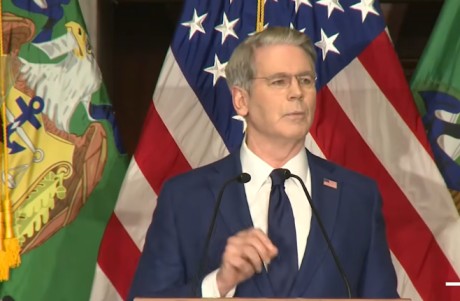
EDITOR’S NOTE: In this press briefing from August 24, 2026, U.S. Treasury Secretary Scott Bessent announces the launch of Operation Economic Outcast—an unprecedented campaign he describes as an “Economic D-Day”—aimed at isolating Iran and its global enablers. Directed by President Trump, the initiative seeks to sever Iran’s financial lifelines through sweeping sanctions on oil revenues, digital assets, shipping, and other key sectors, while threatening secondary measures against any country or entity that continues to support the regime. The full event outlines enforcement strategies, early results, and a path for Iran to rejoin the global economy or face complete economic isolation. Read the full transcript of the press briefing below:
INTRODUCTION
SECRETARY BESSENT: Good afternoon. Today, at President Trump’s direction, the United States Treasury has begun Operation Economic Outcast, an unprecedented campaign against the Islamic Republic of Iran and its enablers. In the Second World War, D-Day marked the historic beginning of a campaign with our allies to target and drive the enemy from its positions, including those in third countries. Today, in that same spirit, we are launching an economic onslaught against Iran’s financial connections around the globe. Around the globe.
Our objective is to sever every economic lifeline that sustains this tyrannical regime until Tehran stands alone. Iran’s fanatics devote themselves to death to America and seek nuclear weapons to do just that. They have murdered and maimed more of our citizens and service members than any other terrorist regime on Earth. And they have been at war against America, their neighbors in the Gulf, and much of the world for 47 years. President Trump has taken action that his predecessors have long deferred.
And under his leadership, America is no longer managing the Iranian threat. We are ending it. Our great armed forces have laid the groundwork for achieving the president’s objective of preventing Iran from ever obtaining nuclear weapons. They have shown America’s resolve to finally end this threat. And the strength of America’s economy under President Trump allows us to wage this sustained financial operation alongside the might of our military.
Operation Economic Outcast
Iran now faces a very clear choice, with only two paths before them: complete global isolation and a subsistence economy or a path back to normalcy with an opportunity to rejoin the global economy. Today, we are launching Operation Economic Outcast to foreclose every other option available to the Iranian regime. Treasury has mapped every node, every facilitator, and every network that Iran has used to smuggle oil and evade sanctions. Beginning today, the actions of Treasury and other agencies will tighten the noose and block every potential source of revenue that funds the IRGC and the evil Iranian regime. We are enforcing a zero leakage approach.
There will be no minimal breathing space for the regime to rebuild its capacity to inflict terror against America and the world. The final refuge of this regime is a mistaken conclusion of nations that still finance the Iranian threat in the hopes of evading it. It is no longer acceptable to operate in the gray spaces of this conflict. Countries cannot claim they are blind to enabling this activity. Iran’s enablers purchase, transport its petroleum.
They facilitate the flow of its finances through exchange houses and free trade zones. They welcome Iran’s flights and maintain registries on its behalf. They turn a blind eye to seaborne fuel transfers and overland transits. They condone illicit use of their banks, all the while concealing the extent of their complicity. The president is making phone calls to world leaders with specific requests to cease their interactions with the regime.
We are already seeing results. Over the weekend, comments from Iranian leadership clearly acknowledged the effect of this campaign, and nations that facilitate any interactions with the regime should quickly heed our message. Those who stand with the United States will reap the rewards of our partnership. Those who tether themselves to the Iranian regime should expect to share in the isolation of a withering regime. Teams from Treasury, State, and the US military are now meeting with their global counterparts to tell them that the United States expects action.
Timelines and Sanctions
Every country has a defined timeline to shut down activities we have identified. If they do not take action, we will do so unilaterally through Treasury authorities. For example, every branch of Bank Melli must be shuttered and dark. And let me be clear, any entity that facilitates money laundering on behalf of Iran will be removed from the US dollar system. The clock just started ticking.
The new sectoral sanctions determinations issued today target five of Iran’s most vital lifelines that it exploits in other countries: digital assets, technology, gold, aviation, and shipping. These measures broaden secondary sanctions risk for anyone foolish enough to continue conducting business with this regime and will accelerate the speed with which we pursue them. As I speak, Treasury’s Office of Foreign Assets Control is also sanctioning over 60 entities, individuals, and vessels around the world that enable the Iranian regime to procure illicit nuclear and missile technology, conduct cyber operations, and generate oil revenue. This is a sustained campaign to collapse every last option for Iran. Let there be no ambiguity as to the position of the United States, and economic engagement of any kind with this murderous regime will expose those responsible to the full reach of American power.
For decades, this regime has drawn strength from a calculus that regards Iranian retaliation as certain and American enforcement as negotiable. Under President Trump, that era is over. To the ordinary soldiers supporting this regime, as more and more of your paychecks stop or are supposedly just delayed, ask whether your commanders are leading your country to triumph or to ruin, and recall that the Berlin Wall fell when ordinary soldiers decided not to shoot at their own people. And to those who enable Tehran, do not discount the cost of testing Washington’s resolve.
No nation should expect to enjoy the rewards of our system while helping those who seek to destroy it.
It is now a time for world leaders to make a decision between prosperity and isolation, peace and terror, America and Iran. The campaign we begin today will gather force with every day that follows, and it will not end until this regime stands alone. With that, I welcome your questions. David from Reuters.
Q&A With Reporters
REPORTER: Thanks, Secretary. One of the most powerful tools you have at your disposal is the ability to impose secondary sanctions on banks and financial institutions that facilitate transactions for Iran. Chinese banks have often been talked about being targeted, but we don’t see any of those institutions targeted here. Is that something that is coming in this campaign or is the very delicate trade truce with China something that could prohibit you from, you know, going that far and taking that very big step?
SECRETARY BESSENT: We want to make clear here today that no one is above the reach of US sanctions, that if they facilitate transactions and are part of the ecosystem that turns Iranian oil into money, into repression, they will be targeted.
We find that the best way to engage with countries is through quiet diplomacy, and we are level setting with every country to tell them our expectations. We know who they are. They know who they are. So when the hammer of US Treasury actions falls upon them, they will have no one to blame but themselves. Richard from CBS.
REPORTER: Thank you, sir. Thank you. You said the president is calling world leaders with specific asks, and that there’s a defined timeline. Who is he calling, and what are the asks?
SECRETARY BESSENT: We’re not gonna name names, that we’ve already seen some results, and that I I am confident the president, as you all know, is quite persuasive, and we are following his calls up with calls from visits and calls from the State Department and from the US Treasury expecting them or telling the leaders, the countries, and the entities exactly what we expect and the timelines, and I would expect that very quickly, if they do not respond, then you will see the ramifications of their actions.
REPORTER: Can you say how far the timelines are?
SECRETARY BESSENT: Again, I’m not going to set timelines, but we do not have infinite patience here. Jennifer.
REPORTER: Thank you so much, Mr. Secretary. Jennifer Schonberger with Yahoo Finance. You just said moments ago that no one is above US sanctions. What specific secondary sanctions or penalties is Treasury prepared to levy against Chinese banks and shipping firms if they do not comply? And then secondly, as you look to take these unprecedented sanctions, you’ve also said that the Iran as the Iran conflict fades and oil prices recede, that will help bring down long term bond yields. In the meantime, you have mentioned your toolkit, and I’m curious if you are looking at reducing auction sizes for longer term dated treasury debt going forward and what other actions you may consider from that toolkit?
SECRETARY BESSENT: Yeah. Why don’t we work backwards? We we issued the the quarterly refunding announcement two and a half weeks ago. We are going to continue with our regular program of auctions. So you will be hearing from us again.
At the beginning of next quarter. In terms of, as I said, every country, every entity should know that they should be prepared to face U.S. sanctions. And no one is above this.
We are going to hold everyone accountable, and this is economic asphyxiation of this regime. And, Jennifer, as I said, no one should test our resolve. Josh from the New York Post.
REPORTER: You said you weren’t going to name names, but there’s been some reports that the United Arab Emirates is among some of the first nations to take seriously these words from the United States to cut off all business interactions with Iran? Is UAE leading the way in this respect?
SECRETARY BESSENT: I would think that the actions that they took last week were not coincident, but likely causal. And I would expect that we would see a broad array of countries taking similar actions as we continue our engagement. The UAE have been very good partners and have taken the brunt of the Iranian attacks in the Gulf. And what have these countries gotten over the years from appeasing Iran? They were subject to violent attacks.
While we were bombing Iran, they were bombing them. So it shows that with this regime, appeasement does not work. And on the other side, with this regime, trying to buy appeasement will no longer work in the eyes of the United States of America. And I want to emphasize that we are spreading out across the world as we speak, that you will see a wave of sanctions when you leave this meeting today, and you should expect that cadence to continue. And I would expect that you will see a major announcement of a financial institution being sanctioned by the end of this week.
Samira from Sky.
REPORTER: Mr. Secretary?
SECRETARY BESSENT: Yep.
No. No, I’m waiting for Samira from Sky. No.
REPORTER: Hi. Does the United States and President Trump still want Canada to become a state? He did say that they’re getting all the benefits of being a state without being one.
SECRETARY BESSENT: I think he would like Canada to come to the table and negotiate in good faith. They were offered quite a good deal last week. They chose to reject it. Unfortunately, Prime Minister Carney rose to power on an anti American, anti Trump platform. I believe he was more than 20 points behind, and, you know, he seems to have gone back to his old playbook.
And I think one has to ask oneself, is he trying to benefit himself, the Liberal Party, or the Canadian people, because they were offered a very good job. So, yep, you.
REPORTER: Thank you to Secretary — if I could shift to bond yields quickly. We saw them tick down today after some turbulence and going up last week. Can you tell us if there’s any possibility that there will be more bond buybacks anytime soon?
SECRETARY BESSENT: Again, we haven’t bought a single bond yet. The next time we have an operation is September 9, so we will see on September 9. All right. One more. Let’s see.
REPORTER: You in the front. You described this as an economic D-Day, but D-Day wasn’t a threat of an invasion, and the US didn’t give a timeline to Germany. So, why not impose the sanctions today?
SECRETARY BESSENT: Well, we are giving everyone the opportunity to remedy bad behavior. Why would I want to blow up the global financial system?
We believe that it is important to level set and give people a cure period, but they should know that that will move very quickly, and that we are serious. Secondary sanctions are a very powerful tool, and we here at Treasury — this is Gene Wang, the acting undersecretary for terrorism finance.
GENE WANG: In the Terrorism Finance Department and at OFAC, the reason we are able to use secondary sanctions is because we do not take their use lightly. So we believe that a warning shot and a level set of expectations is appropriate. And if people do not want to meet our expectations, then we expect, and they should expect, that they should — will leave the dollar system.
SECRETARY BESSENT: Okay? Thank you all.
Related Posts