EDITOR’S NOTE: In this episode of The Diary of a CEO, host Steven Bartlett interviews psychologist and neuroscience researcher Dr. Darby Saxbe about the profound ways fatherhood reshapes a man’s brain, hormones, and body. Drawing on her pioneering studies, she explains why testosterone drops, why the “dad bod” may signal a more attentive parent, and how these biological shifts influence bonding, relationships, and even mental health. The conversation offers surprising, science-backed insights into what it really means to become a dad. Read the full transcript of this interview below:
The Shrinking Father Brain
STEVEN BARTLETT: (00:01:33 – 00:02:52) Dr. Darby Saxbe, you’ve discovered something that I think is quite surprising to a lot of men and women as it relates to what happens to a man’s brain when they become a father.
And I’ve got the report here in front of me, but I have a model brain over there. Could you explain to me what exactly it is that you discovered?
DR. DARBY SAXBE: (00:02:52 – 00:04:19) Yes. So we found that in fathers, and this is similar to what’s been observed in mothers, the brain is actually losing grey matter volume. So it is shrinking. So if I had stronger hands, I could probably squish this brain and make it look tinier.
But the parts of the brain that are shrinking the most are in what we call the mentalizing network. And that’s a part of the brain that helps us understand other people’s feelings and intentions. Those areas are kind of concentrated around the midline of the cortex, which is kind of what we’re seeing here.
And then you also see volume reduction in the visual areas, which is the back of the brain, which is really important for understanding when you look at an infant’s face, what kinds of emotions it’s trying to tell you. And so we see changes to those parts of the brain in new dads.
In moms, we see changes to these same parts of the brain. We also see changes in moms to what’s called the subcortex, which is this part of the brain that kind of controls our gut feelings and our sense of reward and is really strongly linked with our hormones. So moms are kind of changing all across the brain. Dads are mostly changing in this top layer, the cortex, which kind of controls our higher-order thinking, reasoning, and executive functioning.
And that tells us something about fatherhood, which is that fathers choose to engage in parenting. It’s a sort of cognitively mediated investment that dads are making.
STEVEN BARTLETT: (00:04:19 – 00:04:20) What does that mean?
DR. DARBY SAXBE: (00:04:20 – 00:05:06) So if you think about a mom who’s been through 9 months of pregnancy, she is flooded with hormones when her baby is born, and she has a really high investment in the baby’s survival. Just thinking about the number of calories that it takes to sustain a pregnancy, it’s thousands. And so there’s a very high floor for maternal investment, and moms are undergoing plasticity all across the brain that reflects that.
In dads, there’s a tremendous amount of cross-cultural variability. So there are cultures in which dads participate in childcare and are very hands-on with babies from the moment of birth. There are cultures in which there are prohibitions against men picking babies up.
STEVEN BARTLETT: (00:05:06 – 00:05:08) You don’t pick babies up in the first year in some cultures?
DR. DARBY SAXBE: (00:05:08 – 00:05:11) You don’t pick babies up because it’s considered unmanly.
STEVEN BARTLETT: (00:05:11 – 00:05:12) Okay.
DR. DARBY SAXBE: (00:05:12 – 00:06:08) So there’s a tremendous amount of variability, and dads calibrate their investment according to what the culture says and what the context looks like. If mom becomes unavailable, dad is often needed to step in and provide more of the care.
And so this sort of top layer of brain changes reflects that. You know, dads are modulating their investment depending on what they’re learning from the environment. And the word that biologists use for this is facultative. So a facultative adaptation is an adaptation that is optional but extremely useful.
You could think about an animal that walks on 4 legs suddenly having something really important to grab, and switching to walk on 2 legs so that it can use its hands. Hands are really useful for that animal. Fathers are really useful for humanity.
STEVEN BARTLETT: (00:06:09 – 00:06:10) But are you saying they’re optional?
DR. DARBY SAXBE: (00:06:10 – 00:06:30) But they vary depending on situation. And I don’t want to say that fathers aren’t important. They’re incredibly important. There are dads who are primary caregivers and even sole caregivers of children. But dads vary and they vary depending on what is needed for children to thrive in their specific local context.
STEVEN BARTLETT: (00:06:30 – 00:06:33) And a woman’s brain shrinks as well, but it shrinks a little bit more.
DR. DARBY SAXBE: (00:06:34 – 00:07:00) Yes, it covers more of the brain, and it also shows a larger across-the-board volume reduction. And I should explain volume reduction. We often think about deficit, mommy brain, you’re forgetting things. Volume reduction is not a bad thing. What it means is that the brain is actually working more efficiently because it’s building better connected pathways and better channels for communicating information.
STEVEN BARTLETT: (00:07:00 – 00:07:03) Is it accurate to say that the brain is focusing?
DR. DARBY SAXBE: (00:07:04 – 00:07:28) Yes, exactly. So it’s reshaping in a way that enables more efficient communication. It’s learning, it’s consolidating. So it’s kind of like if you think about the director’s cut of a movie that has lots of interesting extra scenes and characters, and then you watch it in the theater and it’s like this lean, mean, 2-hour cut, right? Like, many of us prefer the theatrical release because it’s easier to follow.
STEVEN BARTLETT: (00:07:30 – 00:07:37) And by getting rid of certain parts of the brain, that means more energy can be used in the other parts of the brain.
DR. DARBY SAXBE: (00:07:37 – 00:07:47) Exactly. So that we’re better able to focus on what matters. And when we become parents, what matters is our children and the inputs they’re giving us.
STEVEN BARTLETT: (00:07:47 – 00:07:56) The interesting thing is the way that you described the part of the brain that the man loses when they become a father made it seem like they’re losing empathy.
DR. DARBY SAXBE: (00:07:56 – 00:08:21) No, they’re actually improving in their empathy because they’re becoming more efficient processors of social information. So the fact that where we see the biggest changes are in these, what we call mentalising social cognition networks, tells us that those networks are really important for dads to use when they become parents. And they’re getting a lot of practice putting those networks into use.
STEVEN BARTLETT: (00:08:21 – 00:08:23) I thought you said that section of the brain shrunk.
DR. DARBY SAXBE: (00:08:23 – 00:08:35) Yes, because the brain is becoming more efficient, so it’s losing all the extra pathways, and you’re sort of building a superhighway for that specific social information.
STEVEN BARTLETT: (00:08:35 – 00:08:40) Sounds a bit counterintuitive because I imagined that my brain would grow when I get better at something.
DR. DARBY SAXBE: (00:08:40 – 00:08:51) You would, but in this case, the brain is actually shrinking. And I know it sort of feels like a puzzle to wrap your head around, but it actually does reflect that the brain is working better.
STEVEN BARTLETT: (00:08:52 – 00:08:59) And is there a relationship between how hands-on the father is and the amount of shrinkage that happens in their brain?
DR. DARBY SAXBE: (00:08:59 – 00:09:28) Yeah, and my lab found that relationship. So when dads told us before birth that they felt more bonded to their unborn baby, when they wanted to take more time off after work, and when they told us 3 months after birth that they enjoyed their babies more, they felt more connected and bonded to them, and they were spending more time taking care of their babies, they had more profound brain shrinkage. All of this seems to support the contention that the shrinkage is really adaptive and it’s enabling men’s adjustment to parenthood.
Testosterone, Hormones, and Fatherhood
STEVEN BARTLETT: (00:09:30 – 00:09:34) Is there any other biological changes that take place when someone becomes a father?
DR. DARBY SAXBE: (00:09:34 – 00:09:36) So we also see changes to men’s hormones.
STEVEN BARTLETT: (00:09:37 – 00:09:37) Okay.
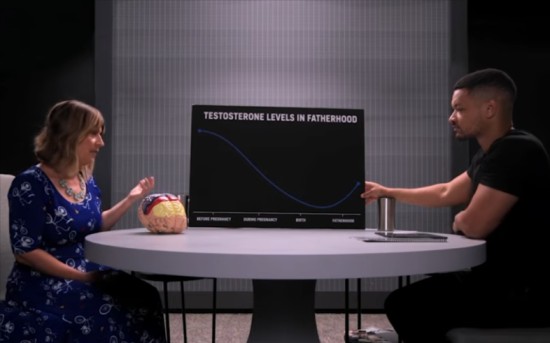
DR. DARBY SAXBE: (00:09:37 – 00:09:42) I talk about this in the book. Men typically show a drop in testosterone.
STEVEN BARTLETT: (00:09:43 – 00:09:44) And I’ve got a big thing here.
DR. DARBY SAXBE: (00:09:44 – 00:11:15) Yeah, let’s talk about testosterone. So typically men, when they’re hands-on as fathers, show about a 25% drop in testosterone. And some of the best studies of this have been done longitudinally in the Philippines.
Before we had longitudinal studies, people said, well, maybe lower testosterone men are just choosing to become fathers. And so looking across time lets us tease that out and see, is there something about fatherhood that’s actually changing testosterone?
And so when you look across decades, you find that testosterone is typically pretty high before pregnancy happens. And it’s adaptive to have high testosterone. You know, testosterone’s been studied a lot in birds. It’s also been studied in rodents and in other mammals. You want high testosterone at the start of breeding season when it’s time to maximize your chances of producing offspring. You want to compete, you want to build status, you want to fight off your rivals, high testosterone is your friend.
Once you’ve accomplished your reproductive goal and you’ve caused a pregnancy and you want your offspring to survive, you want to be investing and nurturing that new baby. And this is what we saw in the men in the Philippines, that as they were spending more time taking care of kids, they showed a sharper drop. And then you typically see some rebound when the baby is getting older. And again, this is not unique to humans. We see it all over the animal kingdom.
STEVEN BARTLETT: (00:11:16 – 00:11:24) So during the pregnancy, something, some chemical tells my body that I need to make less testosterone, even though the baby’s not here yet.
DR. DARBY SAXBE: (00:11:24 – 00:11:27) Yeah, it might just be your proximity to your pregnant partner.
STEVEN BARTLETT: (00:11:27 – 00:11:28) Interesting.
DR. DARBY SAXBE: (00:11:28 – 00:12:28) Yeah. Our lab found expectant dads and expectant moms had correlated levels of testosterone during pregnancy. And the more strong that relationship was, the more dads showed a drop in testosterone after birth.
But I want to caveat because I think a lot of men are really concerned about the idea that testosterone might drop. And I think we have a really strong narrative right now that testosterone sort of like equals successful masculinity. And masculinity is not about a particular hormone. It is about a body that is responsive to our goals. And that sets us up to meet the demands of our environment.
And so having a biology that fluctuates across the lifespan as our reproductive strategy shifts is really adaptive. We want to be flexible, and that doesn’t always mean maxed-out testosterone. So high levels of testosterone actually decrease our sperm count, and they are bad for our immune system.
STEVEN BARTLETT: (00:12:29 – 00:12:39) I think some men might be concerned that dropping testosterone might make them worse in the gym, or it might make them less ambitious or less able to pursue their goals in life. Is there any truth to that?
DR. DARBY SAXBE: (00:12:39 – 00:14:10) There’s definitely a link between testosterone and men’s, you know, muscle mass and their motivation, their drives, but these are not one-to-one relationships. So the human hormone literature is messy, and a lot of these are weak correlations. So testosterone doesn’t necessarily equal success at work, for example.
And high testosterone can get in men’s way in multiple ways. So there are links between men’s testosterone levels and relationship satisfaction in the couple relationship. So my lab did a study where we found that men who had relatively higher testosterone after their baby’s birth had partners who were more dissatisfied in the relationship and reported more intimate partner aggression. So the dads themselves reported more parenting stress.
So there’s a little bit of a mixed bag of high testosterone, and what it looks like you want is to hit a sweet spot. You don’t want testosterone levels that totally crash. My lab has also found that when testosterone is really low after a birth, men have higher postpartum depression symptoms. You don’t necessarily want testosterone levels that are sky high either, because that can cause problems in your intimate relationship and it can make it hard for you to switch into nurturing and parenting mode. So the men who seem most successful in our study were men who had mid-range testosterone levels that could be flexible and that could adapt to different life changes.
STEVEN BARTLETT: (00:14:11 – 00:14:20) And am I right in thinking that the more time you spend hands-on as a father in those studies that they did on men, the lower your testosterone will go?
DR. DARBY SAXBE: (00:14:20 – 00:14:51) Yeah. So the longitudinal work in the Philippines found that when men spent more time changing babies, doing hands-on care, sharing a sleeping surface with babies, they had more of a testosterone drop. So the hormones are responsive to the context and to what we’re doing. But testosterone does rebound after birth. So it’s not necessarily the case that testosterone is going to bottom out and it’s going to stay low forever.
STEVEN BARTLETT: (00:14:52 – 00:15:12) You said a second ago that men that had crashes to their testosterone during the pregnancy and thereafter had a higher likelihood of experiencing postpartum depression themselves. Are you implying that that means that there’s an ideal amount of time and hands-onness that a father can spend with their child to make sure their testosterone hits that mid-range point?
DR. DARBY SAXBE: (00:15:12 – 00:15:59) Yeah, it’s a really good question. I mean, I don’t know that we know for sure if there’s like a dose of parenting involvement that sort of lends itself to an ideal amount of testosterone. It’s hard to optimize your way out of these natural changes.
I don’t want to discourage dads from being hands-on with their kids because they’re worried they’re going to pay some kind of physiological tax. I think it’s more like, make sure you’re protecting your sleep, which we know is linked with overall health. Make sure you’re getting time to exercise and to socialize, you know, to participate in activities that bring you joy. Like, those are ways to help mitigate your risk that I think will be more successful than trying to hit a particular hormone level.
A Brother’s Transformation
STEVEN BARTLETT: (00:16:00 – 00:16:14) My brother is a year older than me and he has 3 young kids under the age of 7 now. They were actually just here. They’ve just left. But I noticed a remarkable difference in him when his wife, Julia, got pregnant.
DR. DARBY SAXBE: (00:16:15 – 00:16:16) What’d you notice?
STEVEN BARTLETT: (00:16:16 – 00:17:15) Just a total shift in what he wanted out of life. And so before, growing up, I remember one day seeing him on the computer figuring out which job would pay the most money. And he was very, very smart. He is very, very smart. And he sort of orientated his career towards the job that would make the most money. And then he was successful. He went to LSE, got the job. And then shortly after graduating university, met someone, they got pregnant unexpectedly.
And I watched my brother go from someone who was really striving for material goals to someone who suddenly placed the material goal immediately after, how do I retire and spend the maximum amount of my time with my kids? His kids are number one above all anything else. And it’s something I admire a lot about him.
But the most remarkable thing, as someone that’s not gone through that transition, because I’ve not had kids yet, is just watching how profound the change was in him in terms of his stated goals and ambitions. What is this?
DR. DARBY SAXBE: (00:17:15 – 00:19:19) I’m so glad you said that, because that’s something I heard from so many of the fathers that I interviewed for the book, is that you experience this profound shift in your values and your priorities. And a lot of men, if you survey parents, you say, what are the most meaningful priorities in your life? Men are just as likely as women to say, my kids.
And I think fathers increasingly are recognizing that the parenting role is really central to their self-concept. And we’re in a culture where I think it can be hard for men to find a sense of meaning and purpose and connection to other people. Being a parent can give you that sense of meaning and purpose.
And so, you know, I think that’s a really important framing around, you know, your testosterone level might change or your brain might shrink, like things that maybe sound a little scary and negative, but they’re in the service of this larger goal, which is building a more meaningful life. And I think, you know, like a message to men and also to women, to moms and to dads, is anything that’s worth doing is hard. Being a parent is really hard. You are sacrificing yourself, you’re losing your sleep, you are getting extra wrinkles, ask me how I know, but you are benefiting from this sense of connection and purpose that it sounds like your brother has been totally transformed by.
And I think we’re in a lot of ways selling young men on this message that you should be optimizing your bank account and your body fat percentage, and you should be out there hustling as much as possible. And I think that can be a little bit of a hollow message because what we keep learning again and again from the longevity studies is that the quality of men’s relationships is the best predictor of their wellbeing in old age. So men with healthy marriages, men who have positive relationships with their kids, those are the men who age well, not necessarily the men who’ve maxed out on, you know, riches or the perfect body fat score.
STEVEN BARTLETT: (00:19:20 – 00:19:59) It’s really a remarkable thing because as you look forward into becoming a parent, you often see the sacrifices you’ll have to make. You hear about, okay, you’re not going to sleep as much as you used to. You’ll hear about the anxieties of being a parent and loving something so much more than yourself and all these things.
But that sort of profound psychological, biological, hormonal shift, you kind of just have to believe in it. People tell you about it as if it’s almost like a religion. I say that because you have to have faith that the profound upside will be worth the very obvious cost that you see parents, the sacrifices they have to make.
DR. DARBY SAXBE: (00:19:59 – 00:20:49) Yeah, I think that’s exactly right, because I think a lot of the downsides are really visible. We’ve all been on a plane with a crying kid, and we’ve seen the frantic parent trying to calm them down. We’ve all seen a tantrum in the grocery store, right? That stuff is right in your face.
But the upsides are sort of invisible, just like the joy of seeing your child’s face as they discover something new, or getting to snuggle late at night and feeling this sense of closeness that you’ve never had, that love that’s bigger than yourself. And I think it’s important to speak about the benefits as well as the downsides because we humans crave connection and we crave care. And I think becoming a parent is an opportunity to provide care on a scale that’s hard to find in other ways.
How the Mother’s Brain Changes
STEVEN BARTLETT: (00:20:50 – 00:21:29) I also want to hear from you about how the mother’s brain changes through pregnancy and beyond. Because Julia, so my brother’s wife, she was here as well, and she’s remarkably different now that she’s had these 3 beautiful children. And I was asking her last night, because she was in the corporate world before, and I was saying, when they grow up and they leave home, which again is probably the worst thing you could probably say to a mother who has 3 young, beautiful children and who’s already anxious that someday they’re going to fly the nest, I was like, what will then be in the place of these 3 kids in your life? Would you want to go back to the corporate world? Would you want to do something else? And how has it reordered your sense of meaning?
But tell me, how does the mother’s brain change?
DR. DARBY SAXBE: (00:21:29 – 00:21:50) Yeah, the mother’s brain changes really profoundly as well. Moms are losing about 2.5% of their brain volume from before pregnancy to after birth. Dads in our studies, we found they lose about 1% of their brain volume. So similar pattern in similar parts of the brain, but the magnitude is different and there’s more variability in the dads.
STEVEN BARTLETT: (00:21:50 – 00:21:53) And how did you conduct these studies? What was the methodology?
DR. DARBY SAXBE: (00:21:53 – 00:22:41) So we recruited a bunch of first-time parents. These were all couples that we recruited during pregnancy. Our only rule was that you had to be cohabiting, and you had to be planning to continue cohabiting after the birth, because we really wanted to capture the dads and get their experience, you know, being in proximity to their babies.
And so we brought them into the lab. We asked them every question we could think of. We sampled their blood, their saliva, their hair. We had them fight with each other on camera. We scanned the men’s brains. And then about 6 months after their baby was born, we brought them back into the lab, blood, saliva, hair. This time we got a breast milk sample, we got a sample of baby poop, and we had them fight again, and we scanned the dads’ brains again.
STEVEN BARTLETT: (00:22:41 – 00:22:42) You had them fight again?
DR. DARBY SAXBE: (00:22:42 – 00:22:58) We had them fight again. We wanted to see how do couples communicate with each other, and does that change across the transition to parenthood? And also, what communication styles are going to predict better couple-level adaptation to becoming parents?
STEVEN BARTLETT: (00:22:59 – 00:23:01) How did you get them to fight? I need to make sure I don’t do that.
DR. DARBY SAXBE: (00:23:01 – 00:23:38) So we gave them a whole list of different topics. Said these are topics that couples commonly argue about, which are hot button issues for you and your partner. And so we had both the mom and the dad fill these out independently, and then we went through and we saw what are the issues that both people are endorsing. And we said, we want you to talk about this issue. Don’t hold back. We’re going to give you 15 minutes, sit in this room, and we, you know, watch them talk through it. They weren’t, you know, like punching each other, but the conversations were often contentious because they were talking about issues that were frequently objects of conflict.
STEVEN BARTLETT: (00:23:39 – 00:23:40) Okay. And what did you discover?
DR. DARBY SAXBE: (00:23:41 – 00:24:08) So we discovered that when couples fought more negatively with each other, they subsequently reported more difficult birth experiences. And it’s interesting because birth is a time in which moms need a lot of support, and the partner’s often a primary person who’s in the room providing that support. So when couples have, you know, sort of like a toxic, difficult relationship, that can really color mom’s experience of the birth.
STEVEN BARTLETT: (00:24:10 – 00:24:26) Are you saying that because the person that they fought with and don’t have a good conflict resolution strategy with, it was in the room they had a bad birth experience, or did something actually happen in the birth experience? Did the husband make a comment?
DR. DARBY SAXBE: (00:24:27 – 00:24:45) Yeah, no, I mean, we didn’t record their conversations during the birth, but we actually did get the charts from the hospital or the birth center after the baby delivered, and we looked at complications. We looked at how medically complex the birth was. And we found that when couples fought more negatively and less positively during pregnancy—
STEVEN BARTLETT: (00:24:45 – 00:24:46) During pregnancy?
DR. DARBY SAXBE: (00:24:46 – 00:26:03) During pregnancy. So they’re about 6 months into pregnancy. A few months later, when it’s time to deliver the infant, they had more medically complex births. And they also appraised the births as more stressful.
So the conclusion is thinking about the couple relationship is actually important when we think about birth. There’s been a huge sea change about how we deliver babies. You know, like it used to be that men were never in the birthing room. So babies were typically delivered with the assistance of a female midwife and female relatives. And it really wasn’t until birth moved into hospitals in, you know, the late 19th century, suddenly you had a male physician who’s presiding over the birth. And then really it wasn’t until the ’60s and ’70s that dads started to advocate for their inclusion in the birth room. They said, we don’t want to miss this, we want to be present.
But because historically dads have really not been part of the birth experience, we haven’t necessarily thought about the couple relationship as a place to intervene. If we want to make birth go more smoothly, we actually want to be thinking about dad’s mental health, and we want to be thinking about couples’ relationship functioning because those things might actually affect mom’s psychological experience of birth.
STEVEN BARTLETT: (00:26:04 – 00:26:06) So you’re saying don’t fight during pregnancy?
DR. DARBY SAXBE: (00:26:06 – 00:26:20) Yeah. Well, or just find more effective ways to fight. You want to figure out ways to calm each other down, validate each other, not necessarily amp each other up and get into these really negative spirals.
STEVEN BARTLETT: (00:26:20 – 00:26:36) I guess I want to push on a point of nuance here because I’m concerned that expectant parents might be looking at each other right now as they listen to this episode. I imagine we’ve got a lot of expectant parents listening and they’re thinking, f*, we had a fight last week and we’ve got the birth coming up in a couple of months.
DR. DARBY SAXBE: (00:26:36 – 00:27:43) Yeah. There’s nothing wrong with fighting. In fact, I’m a big believer that it’s good to air out your concerns and grievances. What we were looking at specifically were negative conflict behaviors. Things like criticizing, showing contempt, stonewalling, so like refusing to listen to see the other person’s perspective.
Actually, one of my really smart grad students is working on a project right now where he looks, he’s looking at like, what is kind of like a magic ingredient that helps couples shift from being negative with each other to being positive with each other during these conflict tasks? He’s like literally looking at the same task and he’s finding the ingredient is validation. So just conveying to your partner, I understand what you’re saying, I see where you’re coming from, I’m right here with you, I get it. Like those kinds of behaviors make a huge difference because they sort of take a lot of the tension and frustration out of the conversation. As soon as you feel really heard by your partner, you know, the wind is a little bit out of your sails for being furious.
Is There Ever a “Right Time” to Have Kids?
STEVEN BARTLETT: (00:27:44 – 00:28:04) I sometimes worry that a lot of people are waiting for perfection before they step into the next season of parenthood. Maybe I’m guilty of this myself, to some degree. I think me and my partner talk about this sometimes, me and my fiancée, about like, it doesn’t feel like there’s ever going to be a perfect time to have kids.
DR. DARBY SAXBE: (00:28:04 – 00:28:04) No.
STEVEN BARTLETT: (00:28:05 – 00:28:45) When you look at the nature of my life and her life, you go, look, crazy, crazy schedules. There really is no time right now. But I reflect and go, well, everything that I do now, including this podcast, at the time that I did the first episode, there was no time. But I made the time.
And I sometimes worry that as young people, we are in a culture that is waiting for more perfection than is coming in terms of our romantic partner or our circumstances. And of course, there is a fundamental sort of basis of security that everybody needs to be able to bring a life into the world. And often people don’t have that. But I’m wondering what your thoughts are on that.
DR. DARBY SAXBE: (00:28:46 – 00:29:09) Yeah. I mean, I had this conversation with my grad school advisor. I said, I would love to have kids. What do you recommend? When is the right time? And she laughed and she said, there is no right time. You just have to do it. You just have to make it work because once the baby shows up, you’ll figure it out. And that was tremendously good advice and led me to start having kids within the next few years after that conversation.
STEVEN BARTLETT: (00:29:10 – 00:29:10) Really?
DR. DARBY SAXBE: (00:29:10 – 00:31:03) Yeah. Yeah. I was like, okay, I guess it’s time. I’m just going to go for it. I’m going to make it work. And it was hard, but we did in fact figure it out.
And I think when you optimize everything and you feel like you need the perfect conditions, I need to own a house that has to be this many bedrooms, I need this level of stability, yes, all those things are terrific. But historically, you know, people had kids young and, you know, often they found that having kids gave them a really strong impetus to get those things together.
We used to think about having kids as like a cornerstone of a life. It’s like a foundation. You know, you do that and then you sort of build your career and everything else. Now we kind of think of it as like a capstone. It’s like your crowning achievement. You’ve got everything perfectly set and now it’s time to have kids.
And I think the problem with that is, first of all, our biology doesn’t always agree. We can sort of lose our best window in which to have kids. And I also think having kids isn’t just an individual responsibility. We need to be thinking about it as it’s a collective responsibility. It’s societal. We are an alloparenting species. So what that means, we’re cooperative breeders. We raise our kids in community. That’s how we evolved. That’s if you look at hunter-gatherers, that’s how they raise their kids. We are not designed to do this in isolation.
And I think when you think about what does a healthy society provide for parents to reduce stress, right? Generous maternity and paternity leaves, job protections, childcare. I’m a big believer in having strong policies that make it easier to have kids because I think in the absence of those policies, you feel like it’s your job to get everything completely lined up. And that time might never come, especially not in a tempestuous economy.
The Global Fertility Crisis
STEVEN BARTLETT: (00:31:04 – 00:32:30) And I think we’re seeing some of the symptoms of exactly what you’ve described there. A landmark 2024 study published in The Lancet projects that by the year 2100, 97% of all countries and territories will have fertility rates too low to sustain their populations. The global fertility rate has plummeted from an average of 5 children per woman in 1950 to just 2.2 today.
According to the CDC and Pew Research data, the US total fertility rate just hit an all-time recorded low of 1.6. This is far below the replacement rate of 2.1 children per couple, I guess. Yeah, required to keep the population stable without immigration.
CDC data shows total US birth rates dropped yet again by 1% in 2025, falling to roughly 3.6 million babies, continuing a nearly 2-decade downfall slide since the Great Recession. And lastly, because the fertility rate is crashing in high-income nations but remaining comparatively high in specific low-income regions, it is predicted a massive shift in human demographics will take place. And by 2100, 1 in every 2 children born on the planet will be born in sub-Saharan Africa.
It’s all quite shocking to hear, isn’t it? I think, well, I mean, it’s inconceivable. I thought growing up everyone was talking about too many people being on the planet. Right.
DR. DARBY SAXBE: (00:32:30 – 00:33:35) There was this narrative of the population bomb, which was this really popular theory in the ’60s that we had too many children and we needed to adopt contraception and we needed to prevent too many children from being born. We all took that too literally and maybe overcorrected. Because now you have this population drop.
And it’s concerning because what you don’t want is a society with what’s called an inverse age curve, which means that you have many more old people than young people. Because then you don’t have enough caregivers for the older people. You don’t have enough people to sustain the economy. You don’t have innovators. You don’t have the folks who are sort of building your future. You’ve depopulated that and you have a very aging population, and that can create a lot of instability. So I think we need to be thinking about how do we make parenting easier and more desirable for young people? Because I think that we’ve managed to market it as an undesirable choice.
STEVEN BARTLETT: (00:33:36 – 00:33:38) How do we make it easier and more desirable for young people?
DR. DARBY SAXBE: (00:33:39 – 00:34:23) So I think part of it is the conversation we’re having right now where we’re talking about the meaning, the purpose, the benefits that you can get from your relationships with others. I think that we need a cultural reframe around care to raise the value of care. One of the reasons I’m interested in fatherhood is because I think seeing men as talented caregivers kind of unlocks this appreciation we have for the importance of care. The shift you described your brother undergoing, where he went from transactional, how can I make the most money, to my kids matter, how can I spend the most time with them, I think is a really valuable shift in purpose that at scale would make societies healthier and more empathetic.
STEVEN BARTLETT: (00:34:24 – 00:35:17) So there’s 2 things I think are worth saying here from my perspective. The first is I think it’s important that we express the fact that A, not everybody can have kids because of reasons beyond their control. I think the second thing is, not everybody wants or should want to have kids depending on their circumstance. And the third thing is that I do feel in my personal circumstances, when I think about what I want from my life, again, this is about me, I do feel tremendously positively jealous of his life. And that’s a strange thing because he has a couple more gray hairs than me, even though he’s only a year older. So everything in life is a trade-off.
But the deep sense of meaning and purpose that even I experience when those kids are here, they were at my house for the last couple of weeks and everything seems incomparable in terms of meaning to these beautiful children.
DR. DARBY SAXBE: (00:35:18 – 00:35:32) Yeah, they’re just endlessly curious and fascinating. And there’s very little you can get from scrolling on a screen that to me is as fulfilling as what you can get from watching a baby learn something.
Neuroprotection: How Parenting Changes the Aging Brain
STEVEN BARTLETT: (00:38:05) Am I right in thinking that parents have different brains as it relates to the brain being protected?
DR. DARBY SAXBE: (00:38:05 – 00:39:09) Yeah. So there’s this really interesting emerging body of research suggesting that being a parent is neuroprotective in late life. So there are studies, the UK Biobank is the biggest, big repository of brain scans from people in their 50s and 60s. And they find that both men and women who report having had more kids have markers of a younger-looking brain age. So if you do a machine learning algorithm that adjusts for your chronological age and then, you know, takes what the scans look like and uses that to estimate what they think your brain age is, you look relatively younger when you report having had more kids.
It seems like the greatest benefit is at 2 or 3 kids. After that, it kind of levels off. You don’t necessarily get a big benefit from having had 6 kids compared to having had 2, but it suggests that there is something about the practice that you get to your social brain and to your empathetic brain that is really beneficial to your brain plasticity and functioning later in life.
STEVEN BARTLETT: (00:39:10 – 00:39:22) That’s quite surprising because you’d think parents go through a lot of stress having lots of kids. So you’d assume that they’d be sleeping less. You’d assume that would be bad for the brain. But you’re telling me there’s evidence that it’s actually protective to be a parent of 2 or 3 kids?
DR. DARBY SAXBE: (00:39:22 – 00:40:12) Yeah, I think it’s healthy to think about the short-term cost and then the long-term benefit. So there are plenty of studies that have found that moment to moment, parents of young kids say that they’re less happy. They’re more tired, they’re more stressed, they have more going on. We’ve talked about the brain changes, hormone changes.
But then if you look longer in later life, people will report more fulfillment. So it’s like you’re doing something that’s not very fun. It’s taxing. It can be very isolating. And yet you’re kind of reaping this longer-term benefit in terms of the power of those relationships and that sense of connection with other people, that social integration and that practice trying to understand others that is really beneficial. It’s a glue for creating good relationships.
STEVEN BARTLETT: (00:40:13 – 00:40:43) What is it exactly about being a parent though that’s going to make my brain more protected when I get older? One of the theories I had was that because when those 3 kids were here, they had me playing all kinds of bloody games. They wanted to play hide and seek for 7 hours. And it is somewhat actually picking them up all the bloody time because there’s 3 of them and one of them’s 8. I can’t really pick her up easily. The other 2, I can get them up. And then she starts complaining that I’ve not picked her up, so I have to pick her up. And I’m like, wow, what a workout. It is both a cognitive and a physical workout when they’re around.
DR. DARBY SAXBE: (00:40:43 – 00:40:43) Yeah.
STEVEN BARTLETT: (00:40:44 – 00:40:52) Is it that, like, I’m building up brain reserve because they’re challenging me and having tantrums and they’re wanting to play and they’re engaging me all the time? Is that why it’s protective?
DR. DARBY SAXBE: (00:40:52 – 00:41:24) I think it’s like Sudoku for your social cognition, right? It’s like you’re doing crossword puzzles, but instead of, like, you know, the sort of practice that you’re getting for putting words together, you’re getting practice understanding people’s minds and intentions and communicating and responding to them and being sensitive to them. And all of that is putting you through a workout, and it’s also a full-body workout because kids are really embodied. And there’s actually interesting research that dads especially play in these physically demanding, kind of vigorous ways with young kids.
STEVEN BARTLETT: (00:41:24 – 00:41:27) That was my job. My job was to pick them up and throw them as high as I possibly can.
DR. DARBY SAXBE: (00:41:27 – 00:41:28) Yeah. And kids love that.
STEVEN BARTLETT: (00:41:29 – 00:41:37) Yeah. And then, me now. And then I threw that and then it’s like, me now. And then I was like, I’m going to lose weeks throwing these kids in the air, but also I’m going to break something.
DR. DARBY SAXBE: (00:41:37 – 00:42:11) Yeah, I mean, I think my husband never had to see the chiropractor until he became a dad, and all of a sudden you’re throwing them up in the air all the time. But that kind of play is really good for kids because it’s testing their limits, it’s challenging them, and it’s actually helping them build their risk tolerance. So think about the moment of fear that you have when you’re thrown up in the air, and then the relief when you’re caught. You’re basically practicing your emotion regulation skills on a small scale so that when you’re thrown into a scary situation at school, you have a stronger sense of confidence.
Oxytocin, Bonding, and Longevity
STEVEN BARTLETT: (00:42:11 – 00:42:42) My other theory around why having children would be neuroprotective for the brain was around oxytocin. And I say that because I sat with Robert Waldinger, who’s done that long Harvard study on human happiness. And the conclusion is that one of the single biggest predictors of longevity is whether you have strong relationships. And again, I had another scientist say to me that oxytocin, the bonding chemical, is neuroprotective. So I imagine having 3 children is going to equal a lot of oxytocin, which is going to equal some neuroprotectiveness.
DR. DARBY SAXBE: (00:42:43 – 00:44:01) I mean, we are social animals. We are designed to bond with each other. We pair bond, we bond with our kids. That’s really healthy. I love Waldinger’s studies. I cite those in the book when I talk about, if you really want to think about what creates longevity and wellbeing late in life, look at your relationships. And, you know, I feel like he shows that really well with this 80-year study that he’s been doing.
There are all these like brain changes and hormone changes that are designed to facilitate, to help us build those bonds. And that’s a lot of what is sort of going off in early parenthood, is like, we are sort of reorganizing to become more sensitive, more attentive caregivers. It’s not like, you know, some people are just destined to be great parents and some people aren’t. It’s like, as we put in the experience, as we get the practice, we put in the reps, we’re building that brain and body that helps make us really great sensitive caregivers. And then that I think can transfer over to our other relationships too. If you’ve learned how to calm a kid down from a tantrum, you are probably going to be a very effective manager at work. If you have, you know, negotiated with 3 kids who all want to pick you up at different times, you’re probably going to be a better problem solver in your couple relationship. Those are just skills that you’re building that can cross domains.
STEVEN BARTLETT: (00:44:02 – 00:44:47) I was just looking at some of the research on this, and it says that research shows that oxytocin actively downregulates harmful pro-inflammatory cytokines in the brain. It acts on the brain’s immune cells, making toxic inflammatory responses lower. And studies on aging mice demonstrated that long-term oxytocin treatment concurrently enhanced the brain’s plasticity, which directly improved learning and made them better with memory as they aged. And in terms of Alzheimer’s, in animal models of Alzheimer’s, oxytocin has been shown to reduce the toxicity of amyloid beta plaques, the toxic protein clumps that are the hallmark of Alzheimer’s disease, which is fascinating. And that’s the chemical that is produced from bonding.
DR. DARBY SAXBE: (00:44:47 – 00:44:54) Yeah, that’s a pair bonding chemical. It’s an affiliative neuropeptide. So it sort of helps us shore up our social bonds.
STEVEN BARTLETT: (00:44:54 – 00:44:55) Touch is really important, isn’t it?
DR. DARBY SAXBE: (00:44:56 – 00:44:56) Yeah.
STEVEN BARTLETT: (00:44:56 – 00:44:57) You know, such an important thing.
DR. DARBY SAXBE: (00:44:57 – 00:45:22) Yeah, my lab found actually that when dads engaged in more physical touch, there’s a type of touch that’s called proprioceptive touch, which is exactly what you were just describing, like picking babies up, moving them around, playing with them, like in space. It’s that sort of like vigorous touch that we often associate with fathers. When dads did more of that, they subsequently had higher oxytocin levels when we did a blood draw in our lab. And that’s been found in some other labs as well.
The Daycare Debate
STEVEN BARTLETT: (00:45:23 – 00:45:24) Do you know Erica Komisar? She’s been on my show.
DR. DARBY SAXBE: (00:45:24 – 00:45:25) I do.
STEVEN BARTLETT: (00:45:25 – 00:45:38) One of the things she says, which has been a little bit controversial, is that she’s argued that placing children under the age of 3 in daycare causes profound separation trauma and elevates cortisol to dangerous levels. So she’s quite against daycare.
DR. DARBY SAXBE: (00:45:38 – 00:47:37) So I politely disagree. Both my kids went to daycare where they thrived. And I am a big believer in this idea of alloparenting, which is this idea that we collectively raise kids. We are designed to help each other out and share care. And so the model of single parent, single child isolated in a suburban home is a very weird model in the context of human history. And so I think this idea that we can’t participate in shared care, that kids can’t do well in group care settings, to me is a little exaggerated.
I do think it’s very true that it’s about timing and when is the right window to, you know, put kids in group care settings. It’s, you know, ideally when kids can benefit from some social interaction, which is usually a little older in toddlerhood. So, you know, 18 months and beyond. Very young babies often do better when they have a single caregiver. They have a more stable attachment figure that they can bond with, but babies can form really strong attachments with their dads, with a caregiver. It doesn’t necessarily have to be the case that mom is the only person that needs to be present for every moment of an infant’s life, because I think that model is not terribly sustainable for parents, and parenting stress is really bad for kids.
You know, and this goes back to the birth rate conversation. I think we need to be thinking about parenting in ways that are sustainable, that allow us to get help. And we also, you know, if we really think that we don’t want kids in a lot of early childcare, we need to support that with universal paid parental leave, which is not available for most parents in the United States. So a lot of moms are coming up against a reality that doesn’t fit with what some of the parenting gurus are telling them is the only way to raise their kids. And I think that’s creates a lot of anxiety.
Do Dads and Moms Play Different Roles?
STEVEN BARTLETT: (00:47:37 – 00:47:46) If you think about the early phases of a child coming into the world, like year 1, year 2, year 3, is there any differences in when either parent plays a different type of role?
DR. DARBY SAXBE: (00:47:47 – 00:49:30) There’s a little bit of difference and it sort of depends on what the parent styles are and what the kid’s situation is. But there’s a chapter in my book where I talked with Richard Reeves, who’s done a lot of great work on masculinity and manhood. And he says he thinks dads should be able to get paternity leave up to their kid’s 18th birthday because a lot of the time dads find that their sort of best relationship with their kid happens later in childhood, even in adolescence. You know, he talked about taking his kids on trips, teaching his sons how to drive.
And so I think like dads can kind of come in at different points along a kid’s development and provide a lot of value. I think early in infancy, if mom is breastfeeding, it’s important for the baby to get that sort of regular access to milk. You know, of course, moms can pump, dads can do feeding, but it is often a source of challenge for couples when a baby’s first born and dads feel like mom has a really big biological head start. You know, she has had the pregnancy, she’s been able to build a bond with the child, breastfeeding is like this magical formula that she can give the baby to help soothe.
And so I think a lot of dads struggle to find their place in early parenthood in the first year or two because they’re like, what am I supposed to do? I, you know, it takes a little while for dads to kind of come online as parents. You know, dads need, I think, some space and opportunity to figure things out. And you often get into this dynamic where mom is kind of the default parent in the early years and dads are waiting for their instructions.
Maternal Gatekeeping and “Husbandly Malingering”
STEVEN BARTLETT: (00:49:31 – 00:49:38) When you’ve gone out on the book tour and you’ve spoken to both fathers and mothers, what is the central point of contention that you discover?
DR. DARBY SAXBE: (00:49:38 – 00:52:23) It’s funny, I was just at a friend’s book club meeting and it was a mix of couples. It was moms and dads. And the thing that they all got into was this concept of maternal gatekeeping and sort of male malingering, which is this like double-edged kind of sword.
And so maternal gatekeeping, it’s a somewhat controversial term, but it just refers to anytime a mom consciously or unconsciously sort of puts up a roadblock to dads fully participating in parenting. And it could be as simple as the baby’s fussy and crying, a mom says, hand him to me, you know, I know what to do. But over time, that kind of spirals into a pattern of mom becomes the authority figure, dad is seen as like the bumbling, hapless kind of appendage. And dads ultimately feel like their contributions aren’t valued, or, you know, mom doesn’t really want them to have a lot of independent time. Maybe it’s because mom doesn’t trust the dad, right? Which is an area where I think having communication and making sure there’s trust before the birth is really important.
But, you know, the flip side of maternal gatekeeping is what’s called weaponized incompetence, or husbandly malingering, which is when, you know, dad, who’s a totally competent, let’s say, project manager at work who can handle lots of different spreadsheets and a whole workflow, suddenly doesn’t know what to put in the diaper bag. Or, you know, when we were at the book club meeting, one of the moms was saying their baby was a couple days old, there was a giant diaper blowout, and she had gone out for a 10-minute walk and her husband called to be like, what do I do? She’s like, I’ve been a parent for exactly 2 days. That’s exactly as long as you. I have no idea. You gotta figure it out. He’s like, but the poop’s on the wall. She’s like, I’m sorry, you can use the wipes. You know, that same husband, she told me later, was in charge of packing lunches. And at a certain point he said, do you give the kids anything but chicken nuggets? She said, well, there’s fruit. You can cut up some avocado, you know, like throw stuff in.
So I think that is sort of like when dads act like they just have no idea and it’s mom’s job to solve the problem. And so I think a lot of moms are sort of frustrated with what they see as that dynamic happening. At the same time, I’ve talked to a lot of dads who said, I would love to have done more, but my wife insisted on organizing everything, scheduling everything, telling me what to do. I never felt like I got an opportunity to fully step up. So I think that’s an area where couples really need to iron some of this out even before the baby comes. Who’s going to do what and how are we going to balance it in a way that we both get some ownership, we both have some opportunity, and we can trust each other?
Relationship and Intimacy After Birth
STEVEN BARTLETT: (00:52:24 – 00:52:33) Talking about that, parents often report is that post-pregnancy, there is a change in their relationship and intimacy. Have you done any studies on that?
DR. DARBY SAXBE: (00:52:33 – 00:53:22) Yes. And that is one of the most robust findings in transition to parenthood research is that there is a drop in couple relationship satisfaction often around the birth of a new baby. And it’s not surprising. You take 2 people who are having fun together, you sleep deprive them, you give them a lot of extra responsibility, and then a baby who’s crying and demanding that they get out of bed multiple times during the night. So you often get a lot of conflict around who’s going to do what, who’s more connected to the baby. And I think it’s one of those things where forewarned is forearmed. If couples know that this is going to be a risky time for their relationship, they can do more to shore up their communication before a baby’s born.
STEVEN BARTLETT: (00:53:22 – 00:53:26) Have you ever quantified how different the relationship is on the other side of giving birth?
DR. DARBY SAXBE: (00:53:27 – 00:53:39) We have definitely given lots of different couple relationship questionnaires and we’ve measured them and we’ve looked at that dip and we’ve seen that there is in fact a statistically significant drop in relationship quality.
STEVEN BARTLETT: (00:53:40 – 00:53:40) And sex life.
DR. DARBY SAXBE: (00:53:41 – 00:54:00) And sex life. Yeah. I mean, because of course, right? You’ve got an extra person in your bed a lot of the time or near your bed. And if you have delivered the baby vaginally, there’s also a lot of stuff that’s sore and might need to get stitched up, and even more so if it was a C-section birth.
STEVEN BARTLETT: (00:54:01 – 00:54:06) And does that at some point go back to pre-birth levels in terms of relationship satisfaction?
DR. DARBY SAXBE: (00:54:07 – 00:54:46) Yeah, so there is a lot of variability in couples’ relationship trajectories. So there are some couples for whom relationship quality continues to dip, and often the relationship dissolves. There are also couples who report they have a better quality relationship after having parented together. There’s a richer relationship. I feel that with my husband, I appreciate him so much because I’ve seen him negotiate with terrorists in the form of our young children. So I think how well couples fare is going to diverge depending on how well they can kind of muscle through some of those early years.
Postpartum Depression in Fathers
STEVEN BARTLETT: (00:54:47 – 00:55:08) Earlier on, you said that men experience postpartum depression after the birth of their child sometimes. And that’s quite an unconventional thing to hear. When we think about postpartum depression, typically it’s in the context of what the woman is experiencing. So it’s quite interesting to hear that that is a big issue for men as well.
DR. DARBY SAXBE: (00:55:08 – 00:57:05) So technically postpartum depression just means depression that occurs after the birth of a baby. That’s what postpartum means. So that term postpartum doesn’t necessarily mean that it’s the person that’s delivered the baby. It just means this is the time period after birth.
And there’s some evidence that dads’ prevalence rate for depression, so in new dads, it’s about twice that of the general population. So if you look at non-fathering men, they have about half the risk of depression as new dads. So there’s a big uptick in depression risk. That doesn’t mean that every new dad is depressed, and new dads have lower depression rates than new moms, just to be clear. But it’s also not a competition. It’s not a zero-sum game.
And I think there can be a lot of consternation, understandably, from moms who feel like we have fought for the term postpartum depression to be widely recognized by the medical community. We’ve advocated for this. Now that we’ve succeeded, men are sort of trying to take it over. And I’m sympathetic to that argument. And a lot of moms have said, why don’t we call it perinatal depression? Fine. I think that’s totally okay. Perinatal just means around the birth of a baby. And that’s legitimate too.
But if you think about what are the risk factors for depression, either in moms or in dads, like in, you know, the period following a baby’s birth, it’s a combination of factors. It’s multi-determined. It’s hormone changes. It’s sleep changes. It’s identity changes. It’s relationship changes, like relationship conflict, changes to, you know, how you show up at work, to your extended family. It can reawaken childhood traumas that were unresolved about how you yourself were parented. So all of those things are coming to the fore, and you’re preoccupied by what can be very isolating and repetitive care for a young baby. And it creates kind of a perfect storm of mental health risk.
Cortisol Synchrony and Divorce Prediction
STEVEN BARTLETT: (00:57:06 – 00:57:26) You’ve studied cortisol changes in couples, right? And how their cortisol interacts with each other. Is there a biological divorce predictor in terms of a specific way a couple’s cortisol syncs up or clashes in that sort of first year of parenting that tells you if their marriage is going to fail before they realize it themselves?
DR. DARBY SAXBE: (00:57:27 – 00:58:08) Yeah. So I have looked at cortisol interconnection in my lab between couples. So how cortisol levels become correlated over time. I found that when couples had really strongly linked levels of cortisol, they reported lower marital satisfaction. And you’d think like, okay, they’ve got more similar hormones, that’s probably a good thing. We found the opposite in our lab. And I think it’s because you don’t actually want to be contagious to other people’s stress. When one person is really stressed, it’s helpful to have a partner who can modulate that, who can calm you down. So you don’t necessarily want to be exacerbating, like amplifying the stress state.
STEVEN BARTLETT: (00:58:08 – 00:58:10) Interesting. This is fascinating.
DR. DARBY SAXBE: (00:58:11 – 00:58:22) There are some other labs that have found that, especially in a transition to parenthood context, more synchrony in cortisol can actually be a good thing if you’re looking from prenatal to postpartum.
STEVEN BARTLETT: (00:58:23 – 00:58:25) But outside of childbirth?
DR. DARBY SAXBE: (00:58:25 – 00:58:25) Yes.
STEVEN BARTLETT: (00:58:26 – 00:58:36) So this is interesting for me because I was having a conversation with someone the other day, and she was telling me that she emotionally is a little bit more variant than her partner.
DR. DARBY SAXBE: (00:58:36 – 00:58:36) Yeah.
STEVEN BARTLETT: (00:58:37 – 01:00:04) And I was expressing a similar sentiment saying that I think actually the reason why my relationship works with my fiancée, Melanie, is because Mel is a little bit emotionally variant and I’m kind of the prefrontal cortex sounding board that kind of brings us back down. So her emotional variance is super useful because she’s almost like a threat detector in every regard. So if our relationship is drifting a little bit or if we’re disconnected, she’ll know first. Whereas I take a little bit more time to have empathy to these kinds of shifts in our relationship. She’s very in tune. It’s like a 6th sense she has.
However, sometimes that can mean some things are harder to deal with, and maybe she’s more prone to worry sometimes. And I’ve often felt, actually, because she’s expressed this to me, she’s expressed the gratitude of me being able to bring her back to a place of calm. I’ve often felt that that’s kind of like my job. And I’ve often thought that our relationship works because you do have 2 different types of people.
And actually, this is not a plug, but I’m an investor in a company called Whoop. And on there they have the stress measure. Again, it’s not a perfect measure and nothing is a perfect measure. But I was looking at our differences in the stress response according to Whoop on the devices. And mine is very stable and hers is much more unstable. But I imagine that opposites attracted in this regard.
DR. DARBY SAXBE: (01:00:05 – 01:00:55) Yeah. I mean, it’s interesting because you could think if you were paired with somebody who was super stable, life might feel boring. If she was paired with somebody who was really volatile, life might feel too chaotic. So we frequently are drawn to people who complement something about ourselves and who are sort of different enough that it can sort of expand our worldview.
And I worked with a couples therapist, this is sort of his theory, that it’s often the differences that drive us together that can ultimately polarize us when things go awry. So you can imagine a future where she’s always the emotional one and you’re always the calm one and nobody gets a chance to break out of that. And that becomes really entrenched in a way that pulls you apart. But you could also imagine a future where you meet in the middle.
STEVEN BARTLETT: (01:00:55 – 01:00:55) Yeah.
DR. DARBY SAXBE: (01:00:55 – 01:00:57) Like you become more emotionally attuned.
STEVEN BARTLETT: (01:00:58 – 01:00:58) Yeah.
DR. DARBY SAXBE: (01:00:58 – 01:01:01) And she becomes calmer and more stable.
STEVEN BARTLETT: (01:01:01 – 01:01:01) Yeah.
DR. DARBY SAXBE: (01:01:01 – 01:01:07) And that’s sort of the ideal, right? That’s what you want is you want to be joining around those differences.
STEVEN BARTLETT: (01:01:07 – 01:01:08) I would say that’s definitely what’s happened.
DR. DARBY SAXBE: (01:01:08 – 01:01:11) Yeah. So that’s good. That’s a good sign for your relationship.
STEVEN BARTLETT: (01:01:11 – 01:01:11) Yeah.
DR. DARBY SAXBE: (01:01:11 – 01:01:12) Time to have a kid.
STEVEN BARTLETT: (01:01:13 – 01:01:13) I think so.
DR. DARBY SAXBE: (01:01:14 – 01:01:14) Yeah.
STEVEN BARTLETT: (01:01:14 – 01:01:17) I’m trying. Good. We froze our embryos.
DR. DARBY SAXBE: (01:01:17 – 01:01:18) Excellent.
STEVEN BARTLETT: (01:01:18 – 01:01:19) So we’ve got them in the freezer.
DR. DARBY SAXBE: (01:01:20 – 01:01:21) Fantastic.
STEVEN BARTLETT: (01:01:21 – 01:01:36) Which was a really interesting process. I think this is probably worth spending some time on because I think I was living under the assumption that in my early 30s, I could just sort of decide when to have a kid and I could just have sex during that little window they talk about where she’s ovulating and the kids would appear. It’s not necessarily how it works, turns out.
DR. DARBY SAXBE: (01:01:36 – 01:01:37) No, it’s actually a little trickier.
STEVEN BARTLETT: (01:01:38 – 01:01:38) It’s trickier than I expected.
Concealed Ovulation and Paternity Uncertainty
DR. DARBY SAXBE: (01:01:39 – 01:03:26) There’s actually a chapter in the book where I talk about paternity uncertainty. One of the things that’s really unique and interesting about humans is we conceal our ovulation. So that makes us different from a lot of other animals where when a female is fertile, you know, because she changes color, she starts dancing in a certain way, she smells different, right? Like, there are all these really obvious cues. And as a result, males sort of know exactly what window to jump in on.
And because we conceal our ovulation as humans, it’s always a little bit murky. Why do we do that? For one thing, it encourages pair bonding because you can’t just as a man, like, just show up like the one day that it’s time to cause a pregnancy and then take off. So you have to court a woman. You need a lot of repeated opportunities. So if a man actually wants to cause pregnancy, he’s much better off sticking with one woman and really investing in that relationship than he is like going out every night to find a different lady.
We form stable monogamous relationships because that’s actually adaptive for spreading our genetic material. And it also reduces aggression. So there’s one theory that it reduces rivalry between women. If you know that one of the ladies in your group is fertile and you have it out for her, you want to take her out during her fertile period, right? So concealing ovulation actually reduces that rivalry, that aggression. It also makes everybody a little bit more invested in babies because no man knows exactly who’s caused which pregnancies. And as a result, everybody has a little bit of an altruistic stake in the future of our children.
STEVEN BARTLETT: (01:03:27 – 01:03:32) I’m not sure if this is an area of research you’ve covered, but, and maybe I’m asking for a friend here.
DR. DARBY SAXBE: (01:03:32 – 01:03:33) Yeah.
STEVEN BARTLETT: (01:03:33 – 01:03:45) Do you know what increases the probability of conceiving a child? Because I think about this a lot in terms of stress and feeling comfortable and all these kinds of things. I’m often thinking about, don’t argue with her, keep her safe, make her feel really secure.
DR. DARBY SAXBE: (01:03:45 – 01:03:47) Yeah. I mean, I think those are all good instincts.
STEVEN BARTLETT: (01:03:48 – 01:03:48) Is there research on this?
DR. DARBY SAXBE: (01:03:49 – 01:04:23) There is research on reducing stress for sure. We know that stress makes it harder to conceive. Of course, the last thing you want to tell someone who’s struggling to conceive is reduce stress because that’s so invalidating, because you’re like, I’m stressed about how hard it is to conceive. Like, don’t, you know, telling somebody be less stressed is frequently not that helpful. But I think your intuition is right that you probably want to make the environment calmer and safer. And, you know, like you can optimize nutrition. There’s a lot you can do, but there’s also a lot that is, you know, not up to you. And sometimes more intervention is needed.
Advice for New Fathers
STEVEN BARTLETT: (01:04:24 – 01:04:26) What advice would you have for new fathers?
DR. DARBY SAXBE: (01:04:27 – 01:05:10) This is kind of like one of the themes of my book, great fathers are made, not born. You might feel like you don’t have the qualities to become an amazing dad, but it’s really about your time, your investment, the practice that you get, and the extent that you care that is going to shape you. It’s going to build a brain and it’s going to build a body that will make you a tuned-in parent. You know, give yourself grace. Like, the transition to parenthood can be really challenging, but you can become an expert in your own child, and there is a reward there. You will find enrichment, you will find meaning, you will rediscover your priorities in a way that will ultimately bring a lot of value.
Studies That Stood Out Most
STEVEN BARTLETT: (01:06:04) Well, you’ve done so many studies.
DR. DARBY SAXBE: (01:06:31 – 01:06:32) Yeah, probably too many.
STEVEN BARTLETT: (01:06:33 – 01:06:39) What are the studies that we haven’t talked about that were most formative or surprising for you?
DR. DARBY SAXBE: (01:06:40 – 01:08:31) We did a study where we looked at couples’ plans for how they wanted to divide up baby care. So we gave them this questionnaire that we called a Who Does What, where they were given 10 common baby care tasks like changing diapers, feeding a bottle, and they indicated on a slider how much mom was going to do and how much dad was going to do. And then we brought them back into the lab about 6 months after birth. We had them do the same scale.
And it was really interesting because couples weren’t actually great predictors of how much dad was going to do. So every single couple expected dad would do more before birth than dad was actually doing after birth. And there are a lot of reasons for that. That doesn’t mean that anybody’s a villain. It just means maybe mom got more time off from work, maybe she was breastfeeding. And so the baby, you know, she was with the baby more, right? Like there are a lot of reasons why that is the case. But we found that when dads were doing more, they reported that they were happier in their couple relationship.
But one thing we looked at actually was how moms and dads talked about how they wanted to divvy up baby care. We measured how many times did they say the pronoun we compared to when you use the pronoun I, where you’re talking about yourself. When you’re using we, you’re talking about, you know, you and your partner. The more we-ness the dads were showing, the more happy they were in their relationship after birth. So their investment, their willingness to chip in, even if they didn’t totally realize all their plans, was still linked with their satisfaction. And that was controlling for how they felt about their partner before birth. And it’s a little counterintuitive because you might think, you know, if you get to sit back and relax and your partner is doing more, that’s a winning strategy. But it was actually the dads that did more who’s told us they were happier.
Advice for Steven
STEVEN BARTLETT: (01:08:31 – 01:08:34) If all goes well, next year I will be a dad.
DR. DARBY SAXBE: (01:08:35 – 01:08:35) I hope so.
STEVEN BARTLETT: (01:08:36 – 01:08:36) I hope so too.
DR. DARBY SAXBE: (01:08:36 – 01:08:37) Yeah.
STEVEN BARTLETT: (01:08:37 – 01:08:51) So I’ve written on this sort of slide in front of me here, advice for Steven. And I would like you to give me some advice, some actionable advice on becoming a father, what I need to do pre, post, during, based on all the research that you have.
DR. DARBY SAXBE: (01:08:51 – 01:08:51) Love it.
STEVEN BARTLETT: (01:08:51 – 01:08:52) And I’m going to write it down. Okay.
DR. DARBY SAXBE: (01:08:52 – 01:09:13) So first, take advantage of the window before birth to work on your communication with your partner. Think about how you want to divide up baby care. A lot of the time people say, we’ll just wing it once the baby comes, and that can be a recipe for frustration because moms feel like they’re doing everything, dads feel like they’re shut out from care. So have those conversations sooner.
STEVEN BARTLETT: (01:09:14 – 01:09:19) So before the baby comes, have a conversation about how we’re going to divvy up responsibilities and make sure both people are clear.
DR. DARBY SAXBE: (01:09:19 – 01:09:31) Exactly. And think about too, what are we going to do about our extended families? What religion do we want to raise our kids in? What do we think about education? If you haven’t had those conversations about values, have them now.
STEVEN BARTLETT: (01:09:31 – 01:09:32) Before.
DR. DARBY SAXBE: (01:09:32 – 01:10:23) Because then I think you’re going to ward off conflict that is going to crop up later on. The other thing is, and I would do this before birth too, build up your social support network. A lot of men’s primary confidant, their primary intimate relationship is with their partner. After the baby comes, mom is really preoccupied and dads are like, what about me? So, you know, we know when we look at depression research that having a strong social support network is one of the best buffers. So you want to be thinking, what are my friendships that I can count on and who can help me? We really need community support. So think about how can my mom help? How can my friend help? And maybe like, you know, your brother’s got his own kids, he’s too busy to take yours, but he can help in some other way, right? Like, how do you plug the people into your life, into what your social support needs might be?
Building Community and Combating Isolation
STEVEN BARTLETT: (01:10:24 – 01:10:32) I think a lot of people would cite this as being one of the reasons why they haven’t had kids yet. Now more so than ever, we don’t live in communities.
DR. DARBY SAXBE: (01:10:32 – 01:10:32) Yes.
STEVEN BARTLETT: (01:10:32 – 01:10:40) Now more so than ever, we are lonely, isolated, living in 4 small white walls in a city where we can barely pay our rent and we’re struggling enough to take care of ourselves.
DR. DARBY SAXBE: (01:10:41 – 01:10:41) Yeah.
STEVEN BARTLETT: (01:10:41 – 01:10:55) Our parents often live far away now because we’re living in such a globalized world. So feeling like you don’t have the support around you to give birth when you’re scraping through in a job, it does make a lot of logical sense as to why people won’t choose to have children.
DR. DARBY SAXBE: (01:10:55 – 01:12:27) Yeah, it’s a huge problem. And I think a lot of parents really struggle with feeling lonely and isolated. And so when I say take the time before birth to build up your social support network, that doesn’t just mean with your existing friendships and family, right? Like sometimes we end up far away from those people. It also means build community with other expectant parents, with your neighbors, right? Like we thrive when we build community.
One nice thing about becoming a parent is there are a lot of mechanisms for doing that. There are many more for moms than there are for dads. So when I became a mom, I could go to breastfeeding support group. I could go to baby wearing support group. I could go walk around the park with the Silver Lake Moms Club. I had all these things to plug into. Dads did not have as many of those organic kind of community-building structures available. So take advantage of the ones that are there. I just talked to these guys that founded the Daddy Stroller Social Club. They’ve got chapters all over the country. They just meet up and they go for stroller walks with their kids. And it’s like an amazing way for dads to connect with each other.
So build that as much as you can. So what did we say? So build your friends, work on your couple relationship, think about how you want to balance things out. When the baby does come, first of all, protect your sleep. That’s really hard. Everyone says sleep when the baby sleeps. Your sleep is going to be totally scrambled. But when you have healthy routines and good sleep hygiene even before birth, you’re going to fare better after birth.
STEVEN BARTLETT: (01:12:28 – 01:12:32) I can hear parents screaming through the cameras saying, easier said than done.
DR. DARBY SAXBE: (01:12:32 – 01:12:51) Yeah, I’m not trying to gaslight any parents, but I think when you have a good foundation of healthy sleep hygiene, you’re probably going to—so things like really obvious things like don’t be on devices right before it’s time to go to bed, dim the lights, make sure your room is the right temperature, try to dial in your sleeping environment because the sleep is going to be the hardest thing, the first thing to go.
STEVEN BARTLETT: (01:12:52 – 01:13:04) Bit of a paradox here that when you’re stressed or sleep deprived, we often reach for things that are dopamine—dopaminergic, I think the term is, which is like foods that maybe are a little bit higher in not the good stuff.
DR. DARBY SAXBE: (01:13:05 – 01:13:05) Yeah.
STEVEN BARTLETT: (01:13:05 – 01:13:07) And there’s almost a paradox there.
DR. DARBY SAXBE: (01:13:07 – 01:14:03) Yeah, it’s a total vicious cycle for sure. And I would say, think about becoming a parent like you’re preparing to run a marathon, not to the point that you become totally neurotic about it, but think about being healthy, having things that are going to prepare your body for this big shakeup that you’re going to undergo.
And then once the baby comes, like, take any opportunity to bond. Like, I think a lot of men feel like, I’m going to avoid as many diapers as possible. Changing diapers seems gross, but it’s also a chance to make eye contact with your baby and like really get to know them in a different way. So, you know, jump into those baby care opportunities, like find your own style. And make sure the more windows you have to bond, the better you’re going to feel like you know your baby and the more confident you’re going to be. And then I would say, give yourself grace. Know that this is hard, know that it’s temporary, and know that you are sacrificing in the short term for a lot of long-term benefit.
STEVEN BARTLETT: (01:14:04 – 01:14:13) One of the things that might be a little bit absent from this list is an effort towards holding my relationship together with my fiancée.
DR. DARBY SAXBE: (01:14:13 – 01:14:21) Also important. I mean, that’s part of what you want to do before the baby’s born, right? You want to be shoring up the communication and having those hard conversations.
STEVEN BARTLETT: (01:14:21 – 01:14:22) With the date night thing, you know?
DR. DARBY SAXBE: (01:14:22 – 01:14:22) Yeah, yeah.
STEVEN BARTLETT: (01:14:22 – 01:14:24) Date night’s probably going to be the first thing out the window.
DR. DARBY SAXBE: (01:14:24 – 01:14:52) Yeah, that is a thing that goes out the window. But you know what? One nice thing about newborns is they’ll sleep pretty much anywhere. So, you know, when our babies were little, my husband and I would just like put the baby in a car seat and go eat at a nice restaurant. It was like the last time we got to do that for a few years because once they start walking around, they’re much less portable. So take advantage of some of the early baby stuff that you can do to travel and to make sure that you get out.
Advice for Expectant Mothers
STEVEN BARTLETT: (01:14:52 – 01:14:59) That advice was all advice for me, for Steven. Would there be any different advice if my fiancée was sat here and you were advising her?
DR. DARBY SAXBE: (01:14:59 – 01:15:59) Oh, that would be fun. Yeah. I mean, I would say that sort of giving yourself grace thing would go double. Know that Steven is going through a lot, and then you need to know that she’s going through a lot. Like, her whole sense of self is going to be in upheaval because, like, we go through this thing, it’s called matrescence. There’s also patrescence, which is just the idea that becoming a parent kind of, you know, changes your priorities. It changes your sense of who you are. So she’s going to go through a lot of transformation, as you will. And so sort of like hanging in with each other during that period of transformation is really fundamental. Like sometimes couples can grow apart or dads are jealous that the baby’s getting all the attention. He feels left out. Moms are frustrated that dad isn’t doing more to help. Like all of those things can lead to conflict, and you can know that those are going to be hotspots for conflict and try to talk your way through them even ahead of birth.
The Dad Bod
STEVEN BARTLETT: (01:16:00 – 01:16:09) Darby, what’s the most important thing we haven’t talked about that we should have talked about as it relates to your work? For all the people that are listening now that have gotten this far in the conversation.
DR. DARBY SAXBE: (01:16:09 – 01:16:12) Yeah. Let’s see. We didn’t talk about dad bod.
STEVEN BARTLETT: (01:16:13 – 01:16:13) Dad bod.
DR. DARBY SAXBE: (01:16:13 – 01:16:14) That’s a fun topic.
STEVEN BARTLETT: (01:16:15 – 01:16:15) Okay.
DR. DARBY SAXBE: (01:16:15 – 01:16:25) Something we frequently joke about. We think about Homer Simpson, but it’s been found across both animal and human studies that males tend to gain weight when they become fathers.
STEVEN BARTLETT: (01:16:26 – 01:16:27) Is that just the cortisol and the lack of sleep?
DR. DARBY SAXBE: (01:16:28 – 01:17:04) So it’s a mix of all the hormones. It’s prolactin is a hormone we haven’t talked much about, but that is rising. Sleep deprivation, changes in physical activity, changes in our diet, right? Because of stress and some of the dietary choices that we’re making. I joke in the book, my husband and I basically ate peanut butter pretzels from Trader Joe’s every day that our kids were babies. So, you know, a lot of stuff is happening all at once. It’s kind of a perfect storm. And yet, you know, there’s evidence even from animal models that you see weight changes around the transition to fatherhood.
STEVEN BARTLETT: (01:17:05 – 01:17:05) These ones here?
DR. DARBY SAXBE: (01:17:05 – 01:17:38) Yeah. Yeah. These are the tamarin monkeys. So there was a study that looked at tamarin monkeys that were expecting offspring, and it fed them a standardized diet, and it compared them to tamarin monkeys who didn’t have partners that were expecting offspring. And they found that the expectant dads actually gained more weight, even though they were eating the same diet as the comparison monkeys who weren’t about to have a baby. And so there were these, like, body changes that happened even before birth in the male monkeys.
STEVEN BARTLETT: (01:17:38 – 01:17:39) Why would that be?
DR. DARBY SAXBE: (01:17:40 – 01:18:24) It’s probably adaptive. Like, if you think about increasing your body size to be more imposing, and to better ward off attacks from rivals. And you also want a buffer in case there’s scarcity, right? Like you want extra fat. It looks less adaptive in a kind of modern context when we have a very obesogenic environment. And, you know, you can start to see more cardiometabolic risk.
But one thing I talk about in the book is women actually like a dad bod. Studies of single women have found that, you know, if you show them a series of body types, the dad bod is the most popular. Sort of like a mildly, kind of lightly marbled male torso.
STEVEN BARTLETT: (01:18:24 – 01:18:25) Lightly marbled torso.
DR. DARBY SAXBE: (01:18:25 – 01:18:41) I don’t know if you remember Ollie Murs, the British singer who did a big tone-up at the gym and posted selfies. He had a 12-pack or something. And all these women online were saying, we liked the before picture. So there’s something to be said for—
STEVEN BARTLETT: (01:18:41 – 01:18:41) Can’t f*ing win.
DR. DARBY SAXBE: (01:18:41 – 01:19:01) The reproductive signal of a dad bod. But part of it is if you show women torsos of different kinds of male body types, the sort of dad bod is one that women say he’s more likely to be a hands-on father. He’s probably going to be more attentive. He’s going to be more caring. And those are things that are really attractive to women.
STEVEN BARTLETT: (01:19:02 – 01:19:07) And that’s proven by science. So if I go out and get a dad bod, you’re telling me the science says I’m going to be more attractive?
DR. DARBY SAXBE: (01:19:07 – 01:19:10) Yeah, go for it. Yeah. Yeah. Worth a shot.
STEVEN BARTLETT: (01:19:11 – 01:19:12) See what my fiancé says.
DR. DARBY SAXBE: (01:19:12 – 01:19:13) Yeah.
Darby’s Father and Her Path Into This Work
STEVEN BARTLETT: (01:19:14 – 01:19:18) How much of your work has been influenced by this?
DR. DARBY SAXBE: (01:19:20 – 01:20:05) Oh, this is my dad. So much of my work. My parents got divorced when I was 9, and my dad became a solo parent to me and my brothers. My parents ultimately worked out a joint custody schedule, so we were one week with my dad, one week with my mom. We switched off every week as I was growing up. And he became a really great dad. Like, he had a major learning curve. He wasn’t a hands-on dad. He was like an ’80s dad who, you know, showed up for the big stuff. But when he was alone with the 4 of us, he suddenly had to be the guy making our meals, the guy helping us with our homework, the guy driving us to sports practice, he really rose to the occasion and I’m still really close with him.
STEVEN BARTLETT: (01:20:05 – 01:20:10) How do you think that’s influenced your overarching mission and your focus on dads and parenting?
DR. DARBY SAXBE: (01:20:10 – 01:20:42) Yeah, so I’ve always been really interested in families and they say psychologists are always trying to fix the thing that went wrong in their lives. So I’m probably, as someone who’s interested in couples and families, wanting to reverse my own parents’ divorce. But I also like seeing my dad be a great caregiver and then realizing how much parenting research is solely focused on moms makes me realize there’s a real gap in the literature. Men play a really important role in parenting, and I think deserve a lot of recognition and respect for that.
STEVEN BARTLETT: (01:20:42 – 01:20:51) It’s interesting that I’d never heard before that there’s really any changes that took place in a man’s brain when a man becomes a father.
DR. DARBY SAXBE: (01:20:52 – 01:21:08) I mean, I think it’s not something that gets talked about a lot, which is why I wanted to write about it. But we are dynamic, we’re plastic, we humans adapt, and becoming a parent is one of the biggest transformations that you can experience.
STEVEN BARTLETT: (01:21:08 – 01:21:12) Have you ever done any research on the impact that divorce has on children?
DR. DARBY SAXBE: (01:21:12 – 01:21:24) Not a lot, no, which is ironic because I am a child of divorce, but there is some research about it and there’s definitely some evidence that it can create some challenges for kids.
Monogamy and Human Mating
STEVEN BARTLETT: (01:21:25 – 01:21:30) And have you ever done any research on, or do you have a view on whether humans are supposed to be monogamous?
DR. DARBY SAXBE: (01:21:31 – 01:22:46) Well, okay, so the best way to describe humans is we’re sort of monogamous with benefits. And you can see that if you look at the difference in our body size. So male humans are a little bit bigger than female humans, but they’re not twice as big. So gorillas, male gorillas are way bigger than female gorillas. There’s, like, a huge size differential. And, you know, that says that, you know, like, the male gorilla model is one of, like, harem dominance, right? Fully monogamous animals are exactly the same size. Like, prairie vole males and females are almost exactly the same size as each other. They have, like, no size differential. So that’s, like, real pair bonding.
So we’re sort of, like, somewhere in between. There are a lot of societies with different models. You have polygamy, which is one man with lots of women. You have polyandry, which is more rare. That’s one woman with lots of men. Only a few societies that have that model. But monogamy is actually the most common across lots of different cultures and societies. And I think it, because it’s, it brings us some benefits in part because of the concealed ovulation piece that helps motivate men to be more invested in a single partner, but also because it generally is good for kids.
Concerns for the Future
STEVEN BARTLETT: (01:22:47 – 01:22:49) What are you concerned about?
DR. DARBY SAXBE: (01:22:50 – 01:22:53) I mean, our future as a planet.
STEVEN BARTLETT: (01:22:54 – 01:22:55) Which part of our future as a planet?
DR. DARBY SAXBE: (01:22:55 – 01:24:05) So I definitely am concerned about what we’ve been talking about, the declining birth rate. I’m concerned not just because it portends problems in our future societies, but because of what it signals, I think, about young people’s hopefulness for the future, right? I think when you look at the world and you say, I don’t want to reproduce, I don’t want to bring children into this world, it to me suggests like a nihilism and a darkness that concerns me. Like marriage rates are dropping, like young men and young women seem to be on different paths. Part of that is like we’re in these algorithmic echo chambers where the kind of content that we’re absorbing is really different. So you see increasing political polarization, not just in the US, but in other countries too. It’s like there’s more adversarial kind of interaction. And I don’t think that’s good. You know, going back to the idea that having a healthy late life is about building strong relationships and that that’s a good predictor of our longevity. I want us to be in a world where we see ourselves as being on the same team as each other.
STEVEN BARTLETT: (01:24:05 – 01:24:07) Are you hopeful?
DR. DARBY SAXBE: (01:24:07 – 01:24:10) Yeah, I’m super hopeful. I’m a very optimistic person.
STEVEN BARTLETT: (01:24:10 – 01:24:12) What would have to happen for that to be the case?
DR. DARBY SAXBE: (01:24:12 – 01:24:24) I’m hopeful. I have teenagers. I’m hopeful for them. I think they’re going to take over and hopefully they’ll be wiser than my generation has been. That’s them with my husband. That’s from a few years ago.
STEVEN BARTLETT: (01:24:24 – 01:24:27) I was going to say this. Your boy’s a bit older now, right?
DR. DARBY SAXBE: (01:24:27 – 01:24:28) Yeah, he’s 14 now.
STEVEN BARTLETT: (01:24:28 – 01:24:29) 14. Okay.
DR. DARBY SAXBE: (01:24:29 – 01:24:29) Yeah.
Closing Question and Parental Leave Policy
STEVEN BARTLETT: (01:24:30 – 01:24:32) Dr. Darby Saxbe, PhD.
DR. DARBY SAXBE: (01:24:32 – 01:24:33) Yep, that’s me.
STEVEN BARTLETT: (01:24:33 – 01:24:38) We have a closing tradition on this podcast where the last guest leaves a question for the next guest, not knowing who they’re leaving it for.
DR. DARBY SAXBE: (01:24:38 – 01:24:38) Ooh.
STEVEN BARTLETT: (01:24:39 – 01:24:51) Question left for you is, people are increasingly distrustful and lonely. If you could flip a switch and make one systemic change to turn the tide, what would it be?
DR. DARBY SAXBE: (01:24:52 – 01:25:10) To make people more socially connected? Well, I think building a better policy environment around parenting. So I’m a big advocate parental leave to protect time and space to bond. I think that would be a really positive change for a lot of parents in the US who don’t get access to leave.
STEVEN BARTLETT: (01:25:11 – 01:25:26) Well, as a Brit, I’ve moved over here and we’re hiring a big workforce here in Los Angeles, New York, and around the United States. But hearing about the parental leave policies here is mind-blowing. What is the current parental leave policy in the United States?
DR. DARBY SAXBE: (01:25:26 – 01:26:09) Yeah, so we are a huge outlier compared to the rest of the world. So we do not have a universal paid leave policy for parents that’s at the federal level. There are some different policies at the state level, so every state has slightly different policies, but frequently what’s most available to parents is unpaid disability leave that’s provided by the state. It’s not available to every parent. If you’re a shift worker, if you’re a gig worker, if you’re at Walmart, you probably don’t have access to that paid leave. And as a result, a lot of new moms in the US are back to work within a couple of weeks of birth, which I think is totally bonkers when you think about what does it take to build a healthy society.
STEVEN BARTLETT: (01:26:09 – 01:26:23) The baseline federal protection is the Family Medical Leave Act. It guarantees up to 12 weeks of unpaid leave. Your employer must also maintain your group health insurance during this time. So they don’t pay you.
DR. DARBY SAXBE: (01:26:24 – 01:26:30) Yeah. Yeah. And that’s a big problem because it’s expensive. Really expensive to raise kids.
STEVEN BARTLETT: (01:26:31 – 01:26:36) It’s so surprising that they haven’t passed law in this direction because it’s not a partisan dispute.
DR. DARBY SAXBE: (01:26:37 – 01:26:54) No, that’s what’s so surprising is that it’s one of the best polling issues. It’s bipartisan, right? Both Republicans and Democrats say they support leave. I think it’s something like 80% of Americans are in favor of it. Yet we haven’t found the political will to make it happen.
STEVEN BARTLETT: (01:26:54 – 01:26:57) Well, maybe we need a woman in an office.
DR. DARBY SAXBE: (01:26:58 – 01:26:59) Well said.
STEVEN BARTLETT: (01:27:00 – 01:27:01) Or just a man, which—
DR. DARBY SAXBE: (01:27:01 – 01:27:08) Or just an empathetic man. Let’s get hands-on dads to rise to power and moms.
Closing Remarks
STEVEN BARTLETT: (01:27:09 – 01:28:36) Thank you so much for writing this book because you’re shining a light on so many issues that have been mystified through, I guess, pop culture in a way, but you’re bringing to light the reality that men are both important in the raising of children, but also you’re doing it through a lens of storytelling, through adjacencies and different animals, and through science in such a rigorous way. And I think it starts a conversation about the upsides of being a parent. And those are, as we said, they’re less obvious than the pain of being a parent. And I think the more we can sort of rebalance that equation, the more likely we are to raise a healthy generation of kids.
And again, I do pause a lot because I realize I’ve got friends close to me that both either don’t want to have kids for whatever reasons or just can’t have kids. So there’s often the sort of stigma can go both ways in some regard. But I’m someone that wants to have kids and it was fascinating learning about your work and it helps me to prepare for what I hope will be the most fulfilling journey of my life. So Dr. Darby Saxbe, thank you so much for your work. If everyone wants to go get your book, I have 2 versions here. I have the UK version and I have the US version. I’m going to hold both of them up here and I’ll link it below for anyone that wants to have a read. Absolutely fascinating. And the great thing about your work is you do the sort of first-party research yourself and you’re at the very forefront of what we know about what it is to have a dad brain, but also more broadly about couples, how they interact and where they can sometimes go wrong. Thank you.
DR. DARBY SAXBE: (01:28:37 – 01:28:39) Thank you so much for having me. This was a delight.
STEVEN BARTLETT: (01:28:39 – 01:28:57) It’s been a pleasure.
Related Posts
- Child Development in the Digital Age: Dr. Sarah Domoff (Transcript)
- Dr. Becky Kennedy Interview: Parenting 101 on Call Her Daddy Podcast (Transcript)
- On Purpose: Dr. Becky Kennedy Interview (Transcript)
- Transcript of Jo Frost Interview: We Need To Talk Podcast
- Tucker Carlson Show: w/ Terry Schilling on Family and Fatherhood (Transcript)