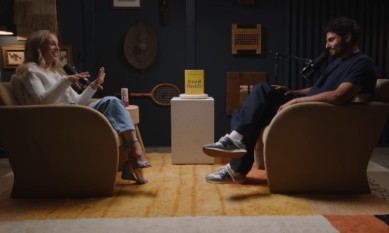
The following is the full transcript of clinical psychologist Dr. Becky Kennedy’s interview on On Purpose Podcast, August 11, 2025.
Editor’s Note: In this episode of On Purpose, Jay Shetty sits down with Dr. Becky Kennedy, the renowned clinical psychologist and author of Good Inside, to rethink modern parenting strategies. They explore how parents can move away from prioritizing superficial happiness toward building resilience and emotional regulation in their children. Throughout the conversation, Dr. Becky emphasizes that parenting is a skill to be learned rather than an innate instinct, offering practical tools to set healthy boundaries while maintaining a deep, compassionate connection with your child.
Introduction
JAY SHETTY: Hey everyone, welcome back to On Purpose, the place you come to become happier, healthier, and more healed. I’m so grateful that I get to talk to today’s thought leaders and experts about the things that matter, that make a difference in our daily lives. And today’s topic is something I’m fascinated by. It’s something I talk to my wife Radhi about a lot, and it’s something that takes a lot of my mind space, even though I’m not one of these yet.
But today’s topic is parenting, and today’s guest is Dr. Becky Kennedy, clinical psychologist, bestselling author, and founder of Good Inside, a global parenting and mental health platform. Named by Time as the Millennial Parent Whisperer, Dr. Becky is known for bringing practical, compassionate tools that help families and individuals thrive. Dr. Becky’s bestselling book, Good Inside, has helped over a million people feel seen and supported through life’s toughest moments.
And in today’s episode, we dive into how to honor hard emotions, set healthy boundaries, and grow through the everyday challenges of parenting and connection. In all honesty, I’ve sparked so many of the best conversations I’ve had around becoming a parent because of Dr. Becky Kennedy’s work. So I’m so excited to have her on the show today. Becky, welcome to On Purpose.
DR. BECKY KENNEDY: Thank you. I’m so excited to be here.
From Ignoring Kids’ Feelings to Letting Them Run the Show
JAY SHETTY: It’s so great to have you here. I want to start off by diving into just things that you say that really stick with me. And I go, oh, yes, I feel like that resonates. You said we’ve gone from not caring about kids’ feelings to letting kids’ feelings dictate what we do as parents. And when you said that, of course, I’m looking at this as someone who wants to be a parent, but I’m looking at parents around me. That idea that we all feel we grew up at a time when our parents didn’t care, they weren’t present, they didn’t know what was going on with our feelings and emotions. We’ve now gone to a place of our kids’ feelings dictating what we do. Talk to me about that.
DR. BECKY KENNEDY: Yeah, I think naming this overcorrection is really helpful because, yes, decades ago, and probably still some families now, it’s some version of, “I don’t want to go to Aunt Sally’s house.” “I don’t care if you want to go to Aunt Sally’s house. Put on a smile, put on your shoes or else,” and then some consequence. That would be, I don’t care about your feelings. I’m not listening. I’m not really connecting. I am telling you what to do. I’m leading with control.
And I think there’s a generation of people who are like, that didn’t feel good. And we also know that emotions and learning how to understand your emotions, how to manage your emotions — you can’t learn to manage emotions if you feel like you’re not allowed to have disappointment. As a kid, how could you ever manage disappointment as an adult? So it’s not really the pathway to strength and resilience.
But yes, what I’ve noticed is something completely overcorrected that I would say is equally as bad for kids. Same situation. “I don’t want to go to Aunt Sally’s today. It’s so boring. I want to hang out with my friends.” “Okay, you know what?” And then fill in the blank. “I’ll get a sitter. I’ll stay home. Let me call three different people and see what you can do.” And there’s so many examples of this. “I don’t want to leave the playground.” “Okay, well, I guess we’ll stay at the playground longer.”
It’s not to say I’m against parent flexibility. Sometimes, of course, we can be flexible. But we’ve gone from not caring about kids’ emotions to being scared of kids’ emotions. That’s why we let them run the show. That’s why we give our kids’ emotions the steering wheel.
And I think what we stand for at Good Inside is something remarkably in the middle. It is very important to see your kids’ feelings as real. That’s really what it is. That’s what validation is. It’s a process of saying to someone else, “I might not be feeling what you’re feeling, but what you are feeling is real and I am interested in learning about it.”
I think that’s very important. “You don’t want to go to Sally’s house. I get it. You’d rather be sitting home and watching the basketball game on TV. Totally hear you.” And then I think there’s a well-placed “and,” because that is part of our job. Empathizing with a kid’s feelings is only half of your job as a parent. The other half is setting a true boundary. It’s what I think of as authority without aggression, which is rarely modeled but is important, which is some version of, “We committed to going to Aunt Sally’s as a family. And the truth is there’s a good amount of things we all have to do that aren’t number one on our agenda, that are even a little bit boring. This is one of those things. It’s okay if you whine on the way there. I know when we get there, you’re going to be able to pull it together.
Why Holding Boundaries Is So Hard for Parents
JAY SHETTY: Yeah, why do we find that so tough? Why is that so hard to do as a parent?
DR. BECKY KENNEDY: I think there are so many factors. Part of it is actually just a lack of teaching. Parenting is the last job in the world where we glorify instinct alone. We haven’t been taught, well, how do I connect to my kid but also hold a boundary? It would be like telling a surgeon to do surgery without medical school. That’s kind of what we do to parents. So it’s really hard.
JAY SHETTY: Send them home with a baby.
DR. BECKY KENNEDY: Yeah, literally. And I remember going home with a baby. I looked around — just a car seat. I remember looking around and no one was coming. I was like, “Guess I’m good. Okay.” That’s what we do and it’s the hardest job in the world. So I think part of it is, how can you employ a skill in a difficult situation when you’ve never been taught that skill and that skill wasn’t modeled in your own childhood? So I think that’s number one.
Number two, and this is a really big one for why right now this is so powerful — so much of parenting is inconvenient. It’s just a word that’s not talked about enough in parenting. When you have to get out your door to go to Aunt Sally’s 50th luncheon, which my guess is maybe you’re not really even dying to do either, there’s a lot of frustration. Your kid is whining, your kid is saying why they shouldn’t go.
And if I think about where parenting is today versus decades ago, I think we adults have become less and less tolerant of frustration. We have our phones, we have our dopamine, we have so much more ease in our life. And one of the things I always think about is our kids can’t learn to tolerate feelings we don’t tolerate in them. So if I have an increasingly lowered frustration tolerance because of all of the ease and dopamine hits in my life, I am inherently less tolerant of my kids whining.
And then the reason I let my kids’ whining take the driver’s seat and I say, “Fine, you know what, just go to your friend’s house” — I actually think it doesn’t even have to do with making our kid happy, which I don’t think is good as a predominant philosophy either. I actually just want to stop feeling frustrated myself. I just don’t want to deal with it. So if we can’t tolerate our kids’ disappointment or frustration, they’re not learning to, which is why then it looks like their emotions are making all the decisions.
Building Emotional Resilience in Children
JAY SHETTY: Wow, that’s extremely powerful. Which is why, because they can’t tolerate their feelings because of our reaction to their feelings, they now don’t actually develop resilience, or grit, or all the things we want them to develop — because tolerance and knowing how to accept and sit in the feeling is such an important skill set.
DR. BECKY KENNEDY: I mean, this is everything. I think I’m a visual person, so I’ve done this before, but I think it matters. If we think about kids, they’re born into the world with all the feelings and none of the skills to manage feelings. There’s a gap. All the feelings, none of the skills.
Bad behavior — whether it’s a four-year-old hitting their sister, whether it’s your teenager saying, “I’m not going to Aunt Sally’s,” whether a kid is saying, “I hate you, you’re the worst mom, I don’t want to be in this family,” lying to your face — every single acting out behavior is a sign that feelings are greater than skills. But the problem isn’t the feelings. The problem is the lack of skills.
So the answer to over time having a lot better behavior, or something more powerful than behavior, is building skills — building emotion regulation skills. Kids are not born with those skills. And we as parents are kind of the coaches.
But I think as our life gets so busy, as we’re more distracted — and just to be clear, let me say right away, I’m not above this. I’m not like, “You should all watch me. I’m a perfectly present parent all the time.” No. Modern life is so hard. But yes, if we can’t tolerate the challenging feelings our kids have and we look for a quick distraction or a quick exit for them right away, then what they learn is something really interesting.
What they learn is, “I’m a kid and I find my feelings overwhelming, but my parent finds my feelings overwhelming too. The things that feel scary and toxic to me, maybe they really are scary and toxic.” And then things can kind of go from there.
Overcoming Mom Guilt
JAY SHETTY: Yeah. And I think one of the challenges with that is that not only do the kids not have the skills, we potentially as adults have never had time to develop the skills ourselves and no one taught us. And so that pattern continues. How do you overcome mom guilt?
DR. BECKY KENNEDY: Such a good question. So let me paint a scenario because I want to know if we’re talking about the same thing. I’ll hear what I kind of referred to before as a situation like — I’m going out to dinner with my friends, and it’s often I haven’t seen a group of my friends without kids around in, I don’t know, a long time. But then I have my daughter, my son clinging to my leg, “Mom, you never put me to bed.” Meanwhile, in this situation, if it’s like my house, I’ve put my kid to bed for the last 37 nights. But still in that moment, it’s, “You never put me to bed.” And then what a mom will often say to me is, “I feel so guilty. It’s not even worth going out to dinner. It’s not even worth it.” Is that kind of along the lines?
JAY SHETTY: Okay.
Understanding Guilt vs. Emotional Confusion
DR. BECKY KENNEDY: That’s spot on. Okay. So the way I see this, I actually don’t think we’re talking about guilt here. I don’t. I think this is a misunderstanding of what guilt is. So we’ll start with that. To me, guilt is a feeling you have when you act out of alignment with your values. And in that way, it’s a very important feeling. Like all of our feelings are important for information, because it helps you have enough discomfort to reflect on, like, well, what are my values? Like if I no-showed to this podcast and didn’t even text you, I’d feel guilty. It is not within my value system to no-show on people, right? That would be helpful. And I think, why did I do that? Right?
But what I hear all the time from moms is going out to dinner, my kid’s clinging, I feel guilty. So I’ll say, okay, really, is it within your value system? And only you would know this. While you’re a mother, to see your friends some of the time? 100% of moms say yeah. So I say, okay, so this is interesting. This is definitely a painful experience, but this is not guilt. This literally isn’t guilt.
And here’s what I think it is. I think as women especially, but it’s not only for women, going back to that good girl idea, we’ve developed the tendency to scan our environment and see other people who are upset with us. And we kind of do this. We’re like, you’re feeling uncomfortable. I will take that feeling out of your body. I will take it into my body and I will call it guilt. And I will change something I’m doing so you don’t have to feel that way. That’s not guilt. That’s actually emotional confusion.
The Tennis Court Visual
And I find visuals helpful. So to me, if you picture yourself on a tennis court, let’s say I’m on one side, and my daughter who’s clinging to me is on the other side. But instead of a tennis net, let’s say there’s a glass wall. What will happen is I’m like, okay, I’m on my side. I know I want to go to dinner with my friends. I haven’t seen them. It’s important. It’s within my value system. I’m grounded in that. Over there is my daughter who’s upset.
Two things are true can help here. Two things are true. I’m allowed to go out to dinner. My daughter’s allowed to be upset, period. But if I picture that tennis court, the reason it’s helpful is I now picture my kid — oh, she never put me to bed, I’m so upset. It’s actually really powerful how many people have told me it’s true. It’s like somehow those feelings in her body start to come out and start to come to my side of the court, and all of a sudden they’re on my side, and I’m saying things like, “Don’t you want me to be happy?” Or, “Fine, I’ll cancel.” And actually, the interesting thing is I’m not even doing that for my daughter at this point. That’s why it’s not guilt. I’m doing that to rid myself of this feeling that wasn’t even mine in the first place. And you can’t even empathize because you can only empathize with someone’s feeling when it’s their feeling. As soon as you’ve made it your own, you’re playing your own game.
So if we go through this scenario — and I do this with so many women — I’m like, okay, so you’re on this court. I want you to literally imagine doing this. And if anyone’s listening and can’t see me, I’m putting my hands by my chest and I’m pushing it out. The visual matters. My kids’ sadness — I am pushing it out of my body and I’m giving it back to them. I’m not pushing it away and I’m not doing it violently. I’m just kind of giving it back to its rightful owner.
Because then I can actually empathize. Because once it’s back in her body, I can say, “Oh, you really wish it was me putting you to bed and not Daddy. I get that. Yeah, I really wish it was you. Listen, this is one of those nights I’m going to dinner with my friends. It’s okay if it feels hard. You’re safe with Dad. You’re allowed to be upset. I will see you in the morning.”
Now, when I do that, again, my child has never said to me, “Have a great dinner, Mom,” or “That was sturdy leadership,” or “You used that guilt tennis image, didn’t you?” That never happened. They keep crying. Again, our good interventions are simply not rewarded by kids’ calm behavior. And the sooner we realize that, the better, even though we keep wanting it to be true.
And now I go out and the truth is, on my walk to dinner, I feel a little uneasy. I’m like, “I’m so guilty.” But I say, “Becky, that’s not guilt. It’s actually literally not guilt.” I’m acting in alignment with my values. That is my daughter’s distress. And actually my job is to help her build tolerance for distress. And I actually just did that while I kept my dinner plan, because I know if I canceled, I’d be resentful of my daughter and screaming at her the moment she asked for a second book at bedtime, because I wish I was at dinner with my friend in the first place.
Gazing In vs. Gazing Out
We use our kids’ behavior or their reactions as a barometer of whether we’re a good parent, and we lose ourselves in the process because we’re so busy gazing out versus gazing in. What’s a version of gazing in? Is this a decision I believe in? Do I feel like I’m actually being a good leader? Do I feel like this is a decision — maybe not only for today, but for every once in a while when we have the energy — a decision that really helps our kid become the kind of teen and adult we’d want them to be?
When we call the school, when we do the puzzle, when we fix the friendship issue — assuming it’s not some really intense, abusive bullying — we might end up feeling capable, but we steal our kids’ capability. To me, the biggest wins we have in parenting, and so in parts of life, are when we shift from “my job is to avoid all turbulence” to “I actually know exactly what to do in the turbulence.” And when you know what to do in the turbulence, which takes practice and learning and support and never being perfect, you actually feel stronger.
Parenting as a Skill, Not Just an Instinct
JAY SHETTY: And I know you’ve also said that women in particular feel a pressure because there’s always been this idea that women should have a maternal instinct. And you talk about parenting being a skill as much as the kids needing these skills as they’re growing up. And women have this unfair pressure of, well, it’s natural to you.
DR. BECKY KENNEDY: I mean, I think that’s the thing. When I became a mom, that was so personally striking. This idea of maternal instinct, I think, has had a profound impact on our culture, right? Because I’m not saying there’s nothing about parenting that’s instinctual. I think we instinctually love our kid, or there are certain moments that come naturally.
But when your kid is having a grocery store meltdown and the mom you’re trying to become friends with is kind of watching you in the store, right? When your kid says, “I hate you, you’re the worst parent in the world.” When your kid is delaying bedtime or brushing their teeth. When your kid lies to your face, “I didn’t take money,” and you see the Nest Cam of them taking money. We’re saying we think our instinct is going to lead to good decisions. Now, most people I know would say, “My instinct is telling me to scream in my child’s face.” You know why? Because your parent probably screamed in your face because they didn’t have the resources they needed, right?
And over and over I’d be meeting parents. It was so interesting. It was mostly moms who would tell me always some version of the same story. They’d come to a live event, they’d say something nice, and then they would unload. And it was kind of some version of, “I go to bed feeling awful about myself. I don’t know what I’m doing. I’m yelling at my kids all the time. I feel like I’m a monster. I feel like I’m messing my kids up forever.” And then I would kind of contain the situation. I’d listen, and then I’d dig in, because I always want to know when someone’s struggling so much, what resources do they have? And I always hear the same thing: “It shouldn’t be this hard. It shouldn’t be this hard. I should be able to figure this out on my own.”
Coaching Is Not a Weakness
If I think about the best athletes in the world, even the ones who have amazing athletic instinct — Steph Curry, LeBron James — I’m pretty sure they had a lot of coaching. I’m pretty sure they weren’t like, “Coaching’s not for me. I should be able to figure out this basketball thing on my own.” It’s really interesting. I think people in almost every other field take pride in coaching. I even think the best CEOs now — it’s almost embarrassing if you don’t have an executive coach. And you don’t just get your advice on Instagram. You really have knowledge and learning and you dig in and you feel good about it.
And so if something is supposed to be done by pure instinct, then the only explanation for why you’re struggling is that you’re broken. And I feel very passionately about changing that narrative.
The Power of Repair in Parenting
JAY SHETTY: And I believe you are. And to that point that you’re saying — I had the fortune of interviewing Kobe Bryant before he tragically passed away, around 3 months before. And he was so clear about the fact that he just put in more time. So he was exactly what you’re saying. It’s reaffirming your point. He was actually doing double the coaching that everyone else was. He was in the gym before everyone got in the gym. Then he did what everyone else was doing in the gym, and then he’d go home and work out again. And so you’ve got this person investing in and doubling down on coaching as opposed to saying, “Oh, I’m actually naturally gifted and I don’t really need that,” even after winning 2, 3, 4, and then eventually 5 championships.
I wanted to ask you about that point because you talk about this idea of parents not being perfect, but being good at repairing. Which I really, really value as an idea. Because I do think we all want to get it perfect the first time, and that’s our instinct. And like you said, the natural instinct — even though we want to get it perfect as a desire — the natural instinct in any of those circumstances is to act out, is to shout, scream, yell, instruct, direct, dictate.
You gave a few really great anecdotal examples there, but very real ones as well. Talk to me about what parents instinctually do, so that we just normalize the fact that it’s okay, because no one’s going to get it right the first time. And then talk to me about how you’ve repaired that, given one of those types of scenarios — of going to Aunt Sally’s, or screaming in the playground.
The Power of Repair in Parenting and Relationships
DR. BECKY KENNEDY: Repair, without a doubt, is the most important parenting strategy. I would say repair is the most important relationship strategy because I think everything we talk about at Good Inside is as relevant in a partnership or at work with yourself. Any relationship.
So let’s start with this desire to be perfect. I think this is especially true with moms. I don’t hear it as much from dads, honestly. And I think this goes back to a lot of gender roles. I think a lot of us were socialized to be “good girls,” because I realize being a good girl just means being trained to gaze out and notice what everyone in the world wants from you and to become as distant as possible from gazing in and noticing what you might want for yourself. That’s really what it means.
How can I please you? How could I meet your need before you even have a need? I notice you’re twitching, you’re about to get mad. I also know you kind of like this kind of drink, so I’m going to go make you an iced tea and bring it to you, right? You’re looking everywhere and meeting everyone’s needs all the time. And I think a lot of girls learned that that’s where their value was, and therefore they feel safest when they’re getting it right for everyone else.
So now we have parenting. People often ask me, is there a perfect parent? Are you a perfect parent? I am definitely not a perfect parent. There’s no such thing as a perfect parent. And I don’t even think it would be a good thing for a kid to have a perfect parent, because the dynamic you establish with your kid, the relationship with your kid, is the foundation for every relationship they’ll have after that. And I know it’s heavy, but it’s true, so I’ll say it.
The nature of the relationship you develop with your kid is also going to impact who they’re even attracted to in adulthood, because we’re attracted to what feels like home, right? For better or for worse, as a natural attraction. So I don’t think any of us think it’s adaptive for a kid to go into the teen and adult years like, “Who is that person out there who’s perfectly attuned to my needs all the time?” I’m sure you and your wife, that’s not the way your relationship works. It’s definitely not me and my husband either.
The best it gets is someone attunes to your needs a lot of the time, and they take ownership when they don’t, and don’t gaslight you, and don’t throw you under the bus or blame you for their reaction, and they repair.
Understanding Rupture Moments
And so if we play that out — yes, we are humans, not robots. We have our own emotional life, our own triggers. And whether it’s Aunt Sally’s party or being lied to, or even at the end of the night — and I know this happens for me — the classic one: “Oh, chicken for dinner? This is disgusting.” And it’s like everything you’ve done for the day, all the moments when you felt invisible, and the other things that happen that have nothing to do with your kid, it all completely overflows in your bucket of difficult moments you’ve had to hold together. And you explode at your kid. “You’re so ungrateful. Kids around the world would be—” whatever we say. We lecture. “You’re spoiled.” And it comes out often in a voice that’s legitimately scary. And it’s scary in part because our kids need us to survive. So they’re like, “Wait, the parent I need for survival just became the scary parent I’m distant from.” That’s a lot to manage.
That is what I would call the rupture moment. And I know this is the moment people listening are like, “Yep, that’s it. I’m a monster. I’ve messed up my kid forever.” But those are two different things. Having a rupture moment is not who you are. And it’s not your future. And it does not dictate your entire relationship.
Yelling at kids messes kids up far less than yelling at kids and not repairing after you’ve yelled. It’s actually the not repairing that’s really hard, because then kids are left alone with this intense set of feelings. They’re confused and they have to figure out, “How do I feel safe again? What do I do to move on?” And if kids aren’t given a story by us to repair, they often make up a story. And it’s often a story of self-blame, because that’s the only thing they have. “I’m a bad kid. It must be my fault.”
Rewriting the Ending of the Chapter
When you repair with your kid, you actually get to do something magical. I always tell parents, you actually get to rewrite the ending of that chapter. Because instead of that one chapter of your kid’s book being, “I complained about dinner and unleashed the scary voice from my parent, and I went to my room and I felt alone and I felt really shaky” — if you picture that as the ending of a chapter, you then get to go in and write: “And then my mom came in and she said, ‘I’m sorry I yelled. It’s never your fault when I yell. I’m working on managing my feelings so I respond more calmly even when I’m frustrated. I love you.'”
It actually changes the way the memory lives in their body.
JAY SHETTY: Those simple words, that approach.
DR. BECKY KENNEDY: Memory is an event, and every other time you’ve remembered that event — which is why something like therapy is helpful. Why is therapy helpful? My childhood didn’t change, but remembering certain things in the context of a new relationship changes the way the original memory lives in your body. You change the story around the memory.
And so every time you repair — whether it was a quick, “Hey, I’m sorry, let me try that again. I’m sorry for yelling at you earlier.” Or, “Hey, I listened to this podcast. I heard a couple of things, and I think there were a lot of years I just sent you to your room. I think there were a lot of years I never heard your side of the story, and I’m guessing that just felt really bad. I’m sorry. And look, we definitely might need time to cool off when things are hot, but I’m going to really try to come to you and better understand instead of judge, and I want you to know I care about that.”
The way that lands in someone’s body — to reopen a file and give it a different ending — I believe it’s the most powerful thing we can do. Even if they don’t react well in the moment.
JAY SHETTY: Yes.
DR. BECKY KENNEDY: And this is what I want to undo — the fantasy. Like, I go to my teenage son and I’m so prepared, and I picture my teenage son saying, “Mom, I’ve been waiting for you to say this—” No. My teenage son is going to roll his eyes and be like, “You’re being so weird, get out of my room.”
But in a way, a lot of us, when we hear something emotionally resonant, in our best moments we say to someone else, “I just need to digest this.” That’s what most kids are saying, whether it’s a toddler saying, “I need a snack,” or it’s my teenager saying, “You’re being weird. Get out of my room.” I really think they’re saying, “That was a lot, and I actually just need to push it away for a moment so I can ingest it in my own time.”
So I would say, don’t take the bait. Trust that it mattered. Move on. Don’t force the conversation. And I have a feeling you’ll see evidence of the impact later.
The Driving Metaphor: Accidents and Repair
JAY SHETTY: Yeah, the point about repairing really lands well because I was thinking about when we were all learning how to drive — it was inevitable that at some point we’d have an accident. So you wanted to be mindful. You didn’t want to be neglectful when you were a driver and when you were trained. I’ve had car accidents and I think I’m a pretty good driver. I’m assuming with your nodding, you’re right there with me — you’ve had a car accident. My wife’s had car accidents. Thankfully, nothing too dangerous for any of us and anyone I know.
But the reality is you’re going to have some sort of an accident. And the biggest mistake you can make is to not repair your car when you have an accident and just keep driving that car around and getting into more accidents. That lands really, really well, because it would be really strange if someone had told me that I was never allowed to scratch my alloys or a rim or a hubcap or a side of my car, and I had to drive with that level of — I would probably have an accident simply because I was overthinking the whole thing.
DR. BECKY KENNEDY: That’s right. Or stay in your room all day. You wouldn’t even go out. A life worth living has inherent risk. And I think that’s a really good metaphor. You’re going to make mistakes as a parent, and if you see that as a feature, not a bug, then you can change the focus to, “Okay, what now?”
Separating Identity from Behavior
And while we’re talking about repair, I think it’s important to address one of the biggest things that gets in our way of repairing with our kid — most of us haven’t learned to repair with ourselves.
Because what happens is, I yell at my kid, I say they’re a spoiled brat, whatever happens in the kitchen when my son simply says, “Chicken for dinner again?” — but it’s just enough to feel like he’s telling me I’m a bad mom. So I’ve done this thing, and for so many people, they might have someone in their life where they say, “This person is so stubborn, they never apologize, they’re so cold-hearted.”
I see it a little differently. I tend to use what I call the most generous interpretation — MGI perspective. I think people who really don’t apologize have a really hard time separating identity from behavior. And that idea of separating who we are from what we do — identity from behavior — is a core principle of Good Inside and a core way we teach parents to see themselves and their kids.
It’s the difference between “I yelled and I’m a monster” versus “I am a good parent who had a moment I’m really not proud of.” And I actually find doing that with our hands really powerful, because you can see the difference. “I’m a good parent” — one hand — “who did something I’m not proud of” — another hand — versus, “I yelled, I’m a monster, something’s wrong with me.” There’s no separation. We can’t repair from this place. We can’t even function from this place. And the saddest thing is, we can’t learn from this place.
It’s shame. Shame is an animal defense freeze response. When you are frozen, you can’t make movement. And so people who don’t apologize usually have to hold this thing they did so far away from them that they can’t even look at it, because it feels so eviscerating to their identity.
A Practical Path to Self-Repair
So I actually think a first step for repair — if I’ve just yelled at my kid and I’m in some shame spiral — I sit somewhere quiet. It’s often my bathroom. I close the door, I sit on the toilet, I put my hand on my heart, put my feet on the ground, and I say to myself, sometimes 5, 10, even 20 times: “Okay, Becky, I made a mistake. I’m a good parent who did something I’m not proud of.” Even, “I’m a good parent who yelled” — because that sentence structure forces us to separate those two things.
And then I’m in a place where I can think about it more. Even before I repair with my kid, I can ask: What was going on? I had a really bad day. I honestly haven’t worked out in a while, and I know that’s something I need to do for myself. I was really frustrated from work. And I honestly just did not take a moment to sit down and talk to myself about it. I was probably just a ticking time bomb.
I need to look at my calendar and do something for me. I need to take some deep breaths in the middle of the day. I need to sit in my lobby before I go upstairs and say, “What was the most stressful part of my day? Let me write about it.” The only reason I can go through that learning process is because I’ve been able to separate what I did from who I am.
And now I can go to my son or my daughter, whoever it is, and actually give them a real repair.
What a Real Repair Looks Like
The other thing is, when we don’t repair with ourselves, we do weird repairs with our kids — and they’re not repairs. They’re either, “I’m sorry I yelled, but if you didn’t complain about dinner, it wouldn’t have happened.” That is not a repair. Or we say something like, “I’m sorry I yelled. It’s okay, right? You forgive me?” We ask our kid to do our job for us.
I picture a 5-year-old kid thinking, “You’re asking me to take care of your emotions after you yelled at me?” That is not a relationship pattern we want to establish.
Repairing Without Blame and the Power of Being on the Same Team
JAY SHETTY: That resonates so strongly. I feel like if you don’t go back and do the separation of the identity and behavior on your own, the kid actually just goes, “I’m just not going to say how I feel around mom or dad,” or “Mom’s just angry,” or “Dad’s just mad,” or whatever. And then that becomes the label.
Whereas when you actually get to go up to them and say, “Hey, I had a really tough day at work today. That is not an excuse for how I behaved with you. I’m really sorry about it.” And that kind of ability to even get them to have some context without making it their fault — that’s exactly what you’re saying.
When we repair wrongly, we may give them the context but make it their fault. Like, “Hey, I had a really tough day today, so if you didn’t say chicken wasn’t terrible, I would have been fine, right? So I hope you understand I had a bad day.” And it’s like, oh, well, wait a minute. That’s too much for me to handle right now.
DR. BECKY KENNEDY: That’s exactly right. And the thing that always creeps me out in a good way, because it makes me not do this, is I picture my son. Now he’s 30, 40. Let’s say he’s partnered and I’m at his house visiting and he screams at his partner in a nasty way. And then I hear him say, “Look, I’m sorry I yelled, but if you had remembered toilet paper like I asked you, I wouldn’t have yelled.” I’d be like, ooh, this feels like I don’t want to be here. This is a bad situation.
But if I’ve always repaired in his childhood by saying, “I’m sorry I did a bad thing, but look, at the end of the day, your behavior caused me to do that thing” — why would I be surprised that that’s what he takes into the world?
And I want to answer a question that I know is not actively being asked, but it comes up every time. Parents are like, “But can’t my kid ask if we could have a different dinner in a nicer way?” Or, “Okay, maybe I didn’t yell because my kid didn’t listen about putting on his shoes, but if my kid put on his shoes, it wouldn’t have happened. Help me reconcile.”
Separate the two things. I would say do a real repair and then give yourself very practically, like 24 hours, and have a very different conversation, which might be, “Look, there are going to be some days you don’t like dinner. Is there a way you could tell me you don’t like dinner that’s equally as true for you as it is respectful for someone else?” Or, my 4-year-old won’t put on his or her shoes — 24 hours later, after I say sorry, “Hey, mornings have been really tough for both of us. I wonder if there’s anything we can think about together that would make putting on shoes easier.” I totally understand. That’s realistic.
JAY SHETTY: But just don’t collapse them together. That’s the point. Usually, again, we do extremes. We either disappear and hope that tomorrow is a new day, which doesn’t work, it sounds like. Or we try and do everything in that first go at it, and then it collapses too.
What’s been the hardest? You’ve said this before, which I really like — this idea of “they’re not giving me a hard time, they’re having a hard time.” And that differentiator is really powerful because I think our language is, “They’re giving me a hard time.”
“They’re Not Giving Me a Hard Time, They’re Having a Hard Time”
DR. BECKY KENNEDY: I mean, I’m sure you think about this in so many other contexts, and it’s the same as parenting. But to me, when you’re in conflict with anybody, you have one of two mindsets.
The first mindset — let’s say it’s us — is where I’m on one side of the table and Jay is on the other side of the table, and I’m just looking at you like you are the problem, and we wouldn’t have a problem if you just came to my side and did something more like me.
The other mindset is different. Instead of me against you, where you’re the problem, it’s me and you on the same side of the table against a problem. I actually think in business, in marriage, with your in-laws, definitely with your kids, you literally shouldn’t have a conversation about something conflictual until you can get yourself into the “me and this person against a problem” mindset.
“My kid is giving me a hard time” is such a good example of me against you. “My kid is having a hard time” is me and you against a problem.
I love strategies and scripts — I’m sure we’ll get into more of them — but they all fall flat at the end of the day if you’re not operating in an effective mindset. And to me, the most important thing a parent can do when they’re in a tricky situation with their kid — “Oh, mornings are so tough, my kid is giving me a hard time, they won’t get out the door” — when I hear that phrase, “giving me a hard time,” how can I get into a “me and my kid against a problem,” “me and my kid on the same team” perspective? Because then I can think about it very differently.
What might be getting in the way of my kid getting out the door? They’re going to school. They’re a smart kid. They kind of know that as soon as they put their shoes on, they’re saying bye to daddy. Maybe that’s it.
And all of a sudden something happens when you get into the same team mindset. I think we always love our kids. But when we’re in an opposite team mindset — nobody likes to say this — we stop liking them in the moment. And there is nothing, no strategy, that will matter more than the fact that your kid just feels that from you.
When we’re on the same team, something amazing happens. You start liking your kid again. Now it’s like a problem to solve together, and everything becomes more effective from there.
JAY SHETTY: What’s been the hardest personal situation for you where you feel like you’ve just been in that zone where you yelled, or you didn’t like them, or you were just not present? What was the hardest for you personally that took you the most time to get back to this?
Parenting as a Practice, Not a Destination
DR. BECKY KENNEDY: It happens. I just want to say, I feel like parenting is more like yoga than anything else. People who are really into yoga — it’s the practice. There’s no destination. So I’m happy to share some stories, and I will, but I don’t want anyone to think, “Oh, that was then and this is now.” This is a constantly evolving muscle, and our kids are always changing.
One of my kids — my deeply feeling kid — she feels things more intensely. The explosions are more intense, and there can be huge reactions to things that seem small on the surface: going to a birthday party, not having the chair she wants, not watching a family movie that everyone else wants to watch. And it can feel in the moment like, “Why are you being so difficult?” versus, “Hold on, she’s having a hard time with something.”
By the way, I want to say that doesn’t mean I need to cater to that. It’s not like she doesn’t want to sit in this chair, so, “Hey everyone, get up so your sister can always have the chair she wants,” or, “We’re going to watch the movie she wants.” I actually don’t believe in that. But again, if that’s the boundary part, what can be hard is getting back to, “Hold on, she’s a good kid who’s having a hard time.”
I think that phrase — “I have a good kid who’s having a hard time” — is one of the most important phrases just to practice at random times in your head. It becomes like a little song.
JAY SHETTY: In the same way as “I’m a good parent who’s having a hard time.”
DR. BECKY KENNEDY: Hard time, exactly. And then I have a kid who’s getting older, who’s a teen. It’s tricky. You feel rejected. It feels like everything is on their time schedule. I want to talk to my kid all day, and he doesn’t — he’s doing his things, he’s with his friends. And then it’s 9:45, I’m actually tired, maybe I’ll get to bed early. And he’s like, “Mom, I want to talk.”
My first reaction is a little like, “I’ve been around all day. Now that you want to talk?” And I kind of want to retaliate or something. And then I try to take a deep breath on my good days and say, “This is adolescence. His job is to separate from me. He’s trying to figure that out. It’s messy. He is supposed to be exploring the world.”
But I always think with adolescents — they need to be explorers, not nomads. When we take them so personally and then refuse to connect, we’re actually just leaving them as nomads, which is someone without a home base. It’s like, “Great, he’s a teen, he’s doing his job. Let me take a deep breath. I have 5 minutes. Let me go to his room.” I think that’s what it kind of looks like in real life.
Boundaries and Empathy Are Not Either/Or
JAY SHETTY: Yeah. If I, as a dad, when I have a child, if they came up to me and they were really excited about something they wanted to share and I was busy with work, and I said, “Hey, I just can’t talk about that right now” — what impact does that have?
DR. BECKY KENNEDY: First of all, I think there’s some narrative out there that as a parent, we should always be some type of martyr. Like, you’re in the middle of a project — I’m making this up — you’re creating something, you’re working on something, and a good parent is someone who drops that at every second to look at my kid’s art project. I don’t buy it.
Now, do I think a good parent is someone who would never do that? Obviously not. Again, there’s a middle ground. I think, like most relationships, it’s about the how.
“Can’t you see I’m working? This is ridiculous. This is a Lego tower. It’s kind of stupid. I have a big job.” I wouldn’t recommend that. That’s not going to feel good. But if that’s one extreme, and dropping everything all the time is the other, I think what’s in the middle — the sturdiness we talk about — is:
“Wow, it looks like you’re working on something really interesting. I really want to see it. You know what’s crazy? I’m working on something really interesting too, and I need 5 minutes to finish it. I’m going to need those 5 minutes actually in silence, which is going to be a little annoying. I’m going to ask you to leave my office and close the door, and I promise you right after that, I’m going to come and I’m not going to have my phone, and I want to see this thing you built and hear all about it.”
There’s this almost wash, rinse, repeat in these moments where boundaries and empathy and connection — they’re really not an either/or. So many models of parenting have been one or the other. And I think at Good Inside, we bring them together.
I think about people who work in an office and they want to talk to their CEO. You don’t want a CEO who is always like, “I’m going to drop everything, of course.” Or, you’re on a plane with your kid and you want to visit the pilot, and they’re getting the plane ready. You don’t want a pilot who says, “Sure, come on in.” You’re like, “Were you just fixing that engine?” You want, “Hey, I’m in the middle of something. This is really important. I see your interest — that’s awesome. I’ll let you know when it’s ready and then we’ll do that.”
That combination — boundaries and empathy — to me, that’s always magic.
JAY SHETTY: Yeah, it was funny. I was thinking, my kid coming running up to me and I’d be like, “Go away, I’ve got to interview Dr. Becky Kennedy on the podcast about how to be a good parent.” Like, that’s the — no, and I appreciate that because that to me is just — that’s really reaffirming to hear, because I feel like that’s just having good, healthy adult conversations. That’s what it is. It’s giving context and providing a perspective on why and what and where we’re at. It’s not just, “Hey, I don’t have time right now, I’m doing something really important.” There’s a validation of them, but there’s a validation of yourself.
And again, they may not react well to that. When you come back downstairs, they might be like, “I’m not doing it anymore. I don’t care anymore. It’s done. It’s broken.”
Setting True Boundaries
DR. BECKY KENNEDY: That’s right. That might— Or again, when I set some of the boundaries I feel really proud of with my kid, take a different example. Right? My kid is watching TV and the show is over and I told them they could watch that one episode and it’s over and I have the remote. Because that’s the thing. It’s like we leave our kid with the remote and we’re surprised we have power struggles. They shouldn’t have the remote, right? Because of course they’re going to want to watch more. They’re good kids who are addicted to TV like the rest of us.
But let’s say it’s at the end and my kid’s like, one more, one more. Maybe for whatever reason I’ve decided it’s really over tonight. Okay. This is like sturdy leadership in action. I might say, “Look, I get it. It’s so hard to stop watching TV. Honestly, it’s hard for me too. It’s kind of designed to feel like it’s not enough. You want to watch the next episode,” something like that. Or, “Hey, you wish you could watch another one.” Keep it simple. Next part: “And TV time is over. I actually have the remote. I’m going to turn it off. I get it, that’s annoying.”
If I do that in my house, I fear— and it’s a fear— that people hearing me think I do that and my kids like stand up and applaud and they’re like, “That was A+ parenting, Mom. I’m so lucky to have you. You’re keeping me safe from technology and you’re validating my feelings.” That has never happened one time.
Actually, what’s important for parents to know, when you set a true boundary— I’m happy to talk about this because I think people get boundaries all wrong, what they are— but when you set a true boundary, especially if your kid isn’t used to it, your kid always responds in the same way. A tantrum. Every time. That is your big reward as a parent. Like, you’re like, I just did the thing and this is the next thing. Like, where is the confetti? There’s no confetti.
Okay, but if you actually know that your kid’s tantrum is a sign that you did actually set a true boundary, you become a lot less reactive to it because unconsciously we think our kid’s tantrum is a sign we’re doing a bad job as a parent. Our kid’s tantrum is often a sign we set a boundary and they’re upset about it, which then means we can just do the next part of our job. We can validate, “Oh, I know you wish you were an adult and could decide whatever number of TV shows you wanted to watch.” But you better bet, even as I’m saying that, I’m not turning on the TV again. I’m not. That’s not happening. Boundary. They get upset. We can validate. We hold the boundary kind of over and over.
JAY SHETTY: And where’s like any emotional— is there any hugging? Is there like affection? Like, or is it—
DR. BECKY KENNEDY: I think everyone’s kid is different. One of my kids might really want that. “Oh, I know it stinks. Come here.” And I’m hugging, right? Because that’s what happens in the best relationships, right? Where if I don’t know if I was making not so good decisions for myself even as an adult. I don’t know. I’m at a party and I’m like seeing you and I’m like, “Jay, I hate you. Your podcast stinks.” And my husband was there. I would hope he’d like pick me up and carry me out and sit with me in a room. Not because that’s something he did to me, because it was something he would do for me. And then maybe even there I’d be like, “I had a bad day.” And he’d be like, “I know. You had a rough time at Jay’s party. I was not your best,” right?
So yeah, maybe I’m hugging. Another one of my kids would be like, “Get away from me!” And I might just kind of stay where I am and say nothing because my calm presence is the version of connection she might want, right? So I think that’s where— what I really love about Good Inside and what I see from our members is they’re like, I love that they’ve taken the principles and then they take their unique knowledge, their unique values, their unique awareness of what’s happening, and they apply it in a way that feels totally them.
JAY SHETTY: I agree. I think the challenge we’ve created is that we think effective communication is when you get the perfect reaction. And I don’t think that’s true as a parent or as an adult or in any capacity, because you could communicate something really exceptionally effectively and the reaction is not the direct response to whether you communicated effectively or not. We think if the kid did applaud or there was confetti or they turned and said, “Okay, Mom, I’ll go to bed.” We think that’s a good day, right? So it’s almost this idea of— and this again applies to marriage too— you almost feel like when the person’s just responding to you saying, “You’re amazing, well done.” Or even if it’s not that forward, the idea of “I’m doing everything you tell me to,” we see as a sign of good communication.
Using Kids’ Behavior as a Barometer
DR. BECKY KENNEDY: I see something very similar with so many parents, and I think this is maybe the biggest thing we love to help shift. We use our kids’ behavior or their reactions as a barometer of whether we’re a good parent, and we lose ourselves in the process because we’re so busy gazing out versus gazing in. What’s a version of gazing in? Is this a decision I believe in? Do I feel like I’m actually being a good leader? Do I feel like this is a decision maybe not only for today, but every once in a while when we have the energy, a decision that really helps our kid become the kind teen and adult we’d want them to be?
So I heard this story from a parent the other day. It was really interesting. It was kind of this classic public meltdown, right? Birthday party. Her kid only wanted to sit next to the birthday party kid. I get this. It’s a big thing. Sitting next to the birthday party kid is a big deal. Pizza time came because everyone has pizza at their birthday parties. Her kid had to go to the bathroom and she’s like, “This is not going to be good because I know after the bathroom, that seat next to my kid with elbow, that’s going to be gone.” It was gone. Okay. Major public meltdown. “Oh, I had to have that seat. I need that seat.” Meanwhile, it’s like this kid’s birthday party.
So many times I see this lack of sturdiness. I see— I’m making up this name— Nora. “Nora, we don’t yell at other people’s birthday parties.” It is actually so sad to witness because kids need us to embody our authority. I would say it’s authority without aggression, which almost feels like an oxymoron these days. It’s rarely modeled, but it’s authority without aggression.
Now, this mom was telling me this story and she goes, “You know, it’s interesting. A number of months ago I had a family dinner. My child had this major meltdown. It was the worst day of my week. Like I felt like it was my biggest parenting fail. Here’s what’s crazy. I knew exactly what to do.” So she pulled her to the side and said, “Oh, this is a hard time. Look, this is a birthday party. That seat’s not available. These others are.” It just escalated further and further. And as a parent, sometimes you know this is past the point of no return. This is not going to be a good situation.
So she knew what to do. She picked her up and said, “Nora, I’m picking you up. I’m carrying you to the car. We’re just not going to be able to finish this birthday party today. You’re a good kid having a hard time. You’re not in trouble. I’m going to help you through this.” Her kid said, “No, give me another chance.” But she was far gone. She carried her to the car, they drove away, they got home. And she said to me, “Is it weird that that was my parenting win? I just thought it was so beautiful.”
I don’t think that’s weird at all. To me, the biggest wins we have in parenting and in so many parts of life are when we shift from “my job is to avoid all turbulence” to “I actually know exactly what to do in the turbulence.” And when you know what to do in the turbulence, which takes practice and learning and support and never being perfect, you actually feel stronger having piloted a plane through that storm and safely gotten to ground rather than the anxiety of like, I just need to avoid.
JAY SHETTY: Yeah, that’s so—
DR. BECKY KENNEDY: We feel so fragile when we’re doing that.
A Parent’s Job Is Not to Make Kids Happy
JAY SHETTY: You’ve said before that it’s not your job to make your kids happy. Which applies to what you’re saying right now. And what is a parent’s job?
DR. BECKY KENNEDY: So I think I want to talk about both those things. Let’s start with the parent’s job and then why not only isn’t our job to make our kids happy, but why it’s actually a really bad thing for them.
The idea of a parent’s job has actually come up for me because over and over I’d see people in my private practice and now through Instagram, different things, and they’d be like, “My kid is having a tantrum. My kid is so mean to her brother. My kid won’t do his homework,” whatever the situation was. And I’d say, “Okay, look, all parents want to do a good job. I know that.” But I’d always say to a parent, “Just tell me, what is your job? Forget if you can perform it well. What is your job?” Every parent would look at me like, “I have no idea.”
And then I think about just offices. Like, I picture someone coming to their job the first day and their boss saying, “Do a good job.” And the person saying, “But I don’t have a job description. By the way, I also don’t even know what that dude does over there. I kind of need to know what that person’s lane is. I definitely need to know what my job is if I’m going to do it well.”
So I think any parent listening who’s like, “It’s true, what is my job?” — if you don’t know, then there’s immense clarity. Forget trying to do it well, we just have to have the clarity and the foundation.
So I think a parent always has two jobs. It’s almost every situation, and I’ll define one of them, which we didn’t get to yet. Setting boundaries and validating your kids’ emotions, and they go hand in hand.
Setting boundaries is widely misunderstood. I’ll share what my definition of boundaries are, which is as applicable to adults as it is to kids. Boundaries are something you tell someone you will do, and they require the other person to do nothing. We often say, “This person doesn’t respect my boundaries.” To me, with respect, it’s often a sign that someone has an inaccurate definition of a boundary. Because you’re giving all your power to the other person.
So I often ask a parent, “Well, what do you mean your kid isn’t listening?” I live in New York City. This is like my kid. And I always say when we go into the elevator, “Don’t press the buttons, don’t press all the buttons.” And then my kid goes and presses all the buttons. “He does not respect my boundaries. He has a listening problem.”
Now, if you have a kid like one of my kids who is 0% people pleasing, it’s going to take a little bit longer than other kids to manage urges. Okay? A boundary isn’t “don’t press the button.” Is that something I’m telling my kid I will do? No. Does it require my kid to do nothing? No. I’m giving all of my power to my 4-year-old.
A boundary would be saying, “Hey, when we go into the elevator, I’m going to be between you and the buttons. I know it’s fun to press the button, sweetie. It’s just not something I’m going to allow. And even if you lunge for it, I’m going to block you.” That’s true. It’s like, you’ve got to get like your karate— there’s some moves. I’ll teach you them. Remarkably, there’s some interesting dance moves going on. But that’s a boundary. It’s not something I’m doing to my kid. I’m doing it for him so I don’t let him feel like an out-of-control kid. And this is important, so I don’t let myself get so frustrated that I end up yelling random punishments I have no intention of keeping anyway. “No dessert tonight.” And then I’m like, “Actually, you can have dessert. I don’t even care. I don’t want you to have a tantrum.” Like, this is what we do.
So that’s part of our job, setting true boundaries. Another great example of this: my kid takes the iPad when it’s not iPad time. First thing I ask is, “How?” They’re like, “What do you mean how? He just takes it.” If it’s not iPad time, why does your kid even have access to where the iPad is? A boundary without words would be what I do. It’s not, “Hey, don’t touch the iPad in the kitchen.” I’m sorry, I’m just going to speak for myself. If my phone is in a room and someone tells me not to look at it—
JAY SHETTY: Yeah. I’m just not that—
The Two Jobs of Parenting: Boundaries and Validation
DR. BECKY KENNEDY: I don’t have a great hit rate there. Those things are very addictive. And I have more self-control than my 5-year-old, right? A boundary would be saying, “Hey, from now on, just so you know, the iPad is going to be completely out of reach, out of sight. It’s not because I don’t trust you. It’s because those things are actually built to draw your whole body to them. It really wasn’t fair for me to put it somewhere and ask you not to get it. So it’s just going to be away until it’s iPad time. When it’s over, it will shut off and then I’ll put it back in that place.”
Done. That’s part of our job.
The other part of our job is connecting to our kids’ feelings, is seeing our kids’ feelings as real while not allowing those feelings to overpower us. That is so important. People think validating a kid’s emotions means agreeing with their emotions. It does not.
My kid is having a grilled cheese. They always like it cut into rectangles. These things matter. And I cut into rectangles. And today is the day, it’s like, “I need it in triangles,” right? Whatever it is. Now, to me, I know intellectually, I’m like, this feels crazy. I actually thought about how to cut it. I cut it in a rectangle. That’s how you usually like it. But I don’t have to agree. Who knows what this is really about?
Validation would just be, “You really wish it was in a triangle today.” Or, “Oh, this feels really bad. Oh, it feels like the grilled cheese isn’t even going to be yummy when it’s cut this way.” People often think if I do that, that means I’m making a new grilled cheese. Depending on the day, if I want to, maybe I will, but maybe I won’t because I’m holding the boundary.
But validation is simply seeing someone else’s experience as real for them.
And I think when you think about those two jobs, boundaries and validation, the reason they’re so important is I kind of profoundly believe that kids are always asking two questions: “Am I safe?” And our boundaries answer that. And “Am I real?” Because kids have such intense feelings. I mean, you and I have intense feelings.
And the thing about feelings that’s so fascinating is when you fall and skin your knee, you see blood. So you’re like, “Ow, that’s painful.” But then you often have some representation of how it’s real. “Oh, well, I’m bleeding,” or “I have a black and blue.” Feelings are very unique. They are such visceral sensations coursing through your body, without any external manifestation. And there’s no blood test to tell you you’re having anger.
So that’s very confusing for kids. And so part of what happens for kids when they’re feeling intense emotions is we sometimes take the bait too much about the concrete thing they’re upset about. What they’re really trying to figure out, which is really the basis of confidence, is: are the things that I am perceiving, feeling in my body, are those things real? Because I have to know if they’re real before I can learn how to manage them.
JAY SHETTY: I feel like a lot of people think that their job is to make their kids good people, or to be successful, or to do well, or be able to survive the real world when they grow up. Would you say that “Am I Safe” and “Am I Real,” which I love those questions, would you say that boundaries and validation almost will help do all those things?
DR. BECKY KENNEDY: I think that’s a beautiful question because I guess I’m zoomed in to often, like, well, what is my job in the moment? And I think what you’re saying is, what is my goal for my kid?
I have those goals for my kids. I want them to be resilient, which really means I want them to be able to handle challenges and know that they can bounce back from hard things. I want them to be able to tolerate discomfort, not avoid it or look for the quickest exit from it. I want my kid to feel really at home in their body. I want my kid to feel confident, which to me has nothing to do with feeling good about yourself. It’s actually about self-trust, which is why it goes back to feeling like your feelings are real and feeling like you are a better perceiver of your feelings than other people are for you.
Yes, I do believe — of course there’s a lot more nuance, but in general, setting boundaries, staying connected to your kid by validating their emotions — there’s other things too, right? Supporting them in their struggle, not rescuing, asking yourself pretty often, “Am I still doing things for my kid that they can start to learn how to do for themselves? And how can I slowly back away? How can I set my kid up for capability, not fragility?”
There’s other things, but in general, yes, I think boundaries and validation, when paired together, they do. That’s what makes for really resilient adults.
Kindness Without Boundaries Is Not Kindness
JAY SHETTY: I would agree with you, and I’ve never heard it that way before. And I really like that because I think sometimes when we think, “Well, I want to have kind kids,” and then we’re trying to model kindness for them. But the problem is if kindness is free of boundary and free of validation, or kindness looks like validation with no boundaries — to us. That’s right. And then they’re not getting kindness because they don’t know what self-kindness looks like. And they only see the martyr or the self-sacrifice version of kindness, quote unquote.
And then that isn’t an accurate form of kindness. Now they think kindness means I’ll do things for people even if they exploit, abuse, or don’t have any set of understanding with me. So they don’t become a kind person. They become someone that people take advantage of.
DR. BECKY KENNEDY: I think that’s really poignant. And look, it’s true. I think this thing people say flippantly — like I’ll be at a dinner or something, and someone’s like, “Don’t you just want your kids to be happy?” And I always picture my husband being like, “Becky, please don’t ruin — that was just a throwaway comment.”
JAY SHETTY: This is amazing — don’t be a bummer, you know?
Why Optimizing for Happiness Can Wire Kids for Anxiety
DR. BECKY KENNEDY: And then half the time I listen, half the time I’m like, “Actually, it’s not what you want.” Everyone’s like, “What?” I’m like, “Sorry, I just can’t help myself.” But, and again, as humans, we hear someone say no, that’s not true, and then people will say to me, “You want your kids to be unhappy?” Obviously not. There’s again so much in between two extremes.
But here’s the thing about optimizing for happiness in childhood. I firmly believe, and I’ve seen it over and over, that the more you optimize for happiness in childhood, the more you actually wire for anxiety in adulthood.
Let’s take a situation that happens often, and then I’ll zoom out, but I think the stories matter. “I’m the only one in my class who can’t read.” My kid comes home and says this. This is, first of all, let me just say this is so painful. Seeing your kid in pain as a parent, it’s so painful. I think a lot of our instinct is, let me make my kid happy. And we all — me too — I will say the craziest things. I’m like, “Well, Bobby isn’t even good at lacrosse. At least you’re good at lacrosse. That’s going to matter more.” And I’m like, why am I throwing Bobby under the bus? What did Bobby do? He’s a totally nice kid. Whatever it is. Nasty things, right?
So, “I’m the only one in class who can’t read,” right? And I think an image helps here a lot because it explains why we don’t want to make them happy and it explains resilience and anxiety all at once.
The way I think about it — I want someone to imagine your kid is kind of wandering around a garden and there’s benches in this garden, a lot of them. And right now they’re on the bench of, “I’m the only one who can’t read.” But I think you and I, Jay, we know that’s not really the bench. The bench is, “I see people who are able to do things I can’t do,” or “I feel jealous,” or “I feel less than.” And the truth is, that is a bench you will sit on at various times for the rest of your life.
JAY SHETTY: Yeah, that feeling of “everyone else can read better than me” is something you’re going to feel at college, at work.
The Feelings Bench: Sitting With Your Child’s Emotions
DR. BECKY KENNEDY: Yeah. Or maybe it’s, I wasn’t invited to, you know, whoever’s birthday party. You know what, you’re going to— I’m not included in something. I don’t have that popular belong the rest of your life. So if I picture my kid on this bench, I think as parents we often have two instincts.
Number one, we try to convince our kid that their bench isn’t their bench. That can’t be true. You can’t be the only one not reading yet. Even though our kid is kind of like telling us, right? Which over time, if that’s the pattern, creates a ton of self-distrust. Oh, maybe other people know how to perceive my world better than I know how to perceive this world. All in the name of trying to not make my kid uncomfortable.
Or we see a sunny bench on that side of the garden and we’re kind of like, just come, you’re an amazing lacrosse player, you’re the fastest kid, but you’re an amazing artist. And all of that can be true.
But if you think about, to me, what anxiety is, I don’t think anxiety is a feeling as much as it’s a running away from a feeling. It’s kind of the experience of, I don’t want to be feeling the way I am right now. So a kid is wiring up their body, they’re understanding how the world works, and they’re understanding in childhood what feelings and experiences are tolerable and what feelings and experiences are intolerable. The latter become anxiety.
So, Mom, I’m the only one who can’t read. And I’m like, oh, that’s not true. Or I just kind of fix it right away, or I throw them a party to make them distracted. So what does my kid learn in their body? I was feeling disappointed. Less than. And what kids wire next is our response. And what comes next is escape into happiness, escape into distraction.
And if we think about this bench, my kid is sitting on this bench, and I think we’re all in those moments just looking for someone to sit down next to us. Because the thing is, if my parent can sit on this bench with me, it can’t be as awful as I think it is. It literally can’t. If they yank me from it or try to convince me it’s not true, what they’re really saying is, you’re feeling upset, but I can’t really connect to the part of you that feels this way. I can’t do that. That is so scary for a kid because they’re like, I guess this really is bad.
And so in the name of kind of making our kid happy, what we really do is we develop a whole range of emotions our kids learn are intolerable. And if we think about what anxiety is later on, okay, so let’s say this kid later on, and again, this is not one intervention, this would be many, many patterns, right? But whenever a kid is upset, optimize for happiness, optimize for happiness.
I think the thing we realize at a certain age, it’s different for everyone, 14, 18, 30, 50, whatever it is, is when I’m really upset about something and something doesn’t go my way, there actually isn’t always an off-ramp to happy. Like when I get fired from my job, I’m not going to be happy in an hour. I mean, maybe if I go to drugs, I’ll be happy right away. Maybe if I have something else, but feelings don’t work that way.
And there’s no one, I don’t think, who’s just giving me a new job. And so by the time I get to those hard moments in adult life, either I’ve developed the ability to cope with feelings, or I’m so accustomed to always expecting happiness that ironically, the way I feel my distress is even more intense because the gap is so big, right? It’s kind of like the light goes on of distress, and I’ve always expected it to go totally off. I don’t even have a dimmer switch anymore. It’s just on is horrible and I need it to go off.
The Three Lines: A Script for Sitting on the Bench
DR. BECKY KENNEDY: When I think about what that means, I like to give parents an alternative. My kid says, I’m the only one in my class who can’t read. I actually think there are 3 lines. I like to give a script that can really embody the idea of what I say. Like we always say at Good Inside, the feelings bench, sit on the bench, sit on the bench and you become a benchwarmer.
So the first one is just, “I’m so glad you’re talking to me about this.” This is so powerful in marriage too, or work. Hey, I feel like you’ve been on your phone a lot and I feel really disconnected. Imagine if the first thing your partner says back is, “I’m so glad you’re talking to me about this.” What you’re actually saying in a deep attachment way is the part of you who feels this way is attachable to me. I’m sitting with you.
“I’m so glad you’re talking to me about this.” Yeah, they were handing out books and everyone got chapter books and I got a baby picture book.
The second line, ultimate confidence builder, is just, “I believe you.” We can talk more about that. I think those are the 3 most important lines in parenting, often just, “I believe you.”
And then the third is going to feel remarkably unsophisticated, but it’s so powerful. It’s just, “Tell me more. Tell me more.” “Oh yeah, and then it was like me in a reading group of one and my friends were in this other reading group.”
And the amazing thing that happens 99% of the time — “I’m so glad you’re talking to me about this. I believe you. Tell me more.” — your kid then tells you the story. What you’re really saying is, I’m on the bench with you. I’m not afraid of this bench. I don’t need to take you to a sunny bench. I’m here. How bad could a bench be if I’m willing to sit on it? I’m not going to let us both self-destruct. I am here.
And then what happens 99% of the time, truly, in this visual, is your kid gets off the bench before you do. I’ve seen this a million times. My kids are like, oh, can I have that snack now? And I’m like, I’m sorry, what? Like, you just wanted to know that I could tolerate this, that I could be with you in this.
And then what we do in their body is not with a story, because the story is just a representation of a feeling. Disappointment, jealousy, embarrassment, whatever it is, has a little bit more of a container and a home. So the next time a kid feels that feeling, it’s not as panicky. It has a home. And if you think about your body as all these jars of feelings, this is the irony about happiness — the more jars we have to contain different parts of our distress, the more space there is for happiness anyway.
JAY SHETTY: Yeah, that’s a beautiful visual as well. It’s a really nice thing to think about. Is there a part of that — do you then address the reading challenge, or what do you do from a practical standpoint on that after that moment?
Taking Action From a Sturdier Place
DR. BECKY KENNEDY: Love it. So let’s say this is happening, and then you’re thinking, does my kid need a reading tutor? Do I just need to spend— all of that can happen. Now, I think what kids really feel in our first response — oh, I’m the only one in class who can’t read. Okay, one second, I’m calling the reading tutor right now. In a way, the visual again is like, my kid is still alone on the bench. Like, where’d my mom go? Where’d my dad go?
So I would say again, just stay for a bit. I think one of the most underutilized things in parenting is time. Or maybe we do have time, and I can call that tutor. Why don’t I just give myself to the night? Let me sleep on it, because my kid is going to pick up on my panic and my own anxiety around it.
So absolutely, if that was me, I might think, ooh, maybe I need to sit with my kid. Maybe I need to teach them some phonics. Does it have anything to do with phonics? Are they a kid who’s perfectionistic and they’re just not willing to try because they’re failing? Do they have a sibling who’s really gifted and so they’ve labeled themselves as the not smart kid? Again, there could be a million things. It might not even be an academic tutor.
But I think when you sit on the bench, you give yourself also a little bit more time to tolerate it. You can access your curious mind and then absolutely, of course, I love taking action, but it would be from a sturdier place and in a way that’s actually going to be more helpful to your kid.
Sitting With Enthusiasm: A Lesson From Marriage
JAY SHETTY: Yeah, I couldn’t agree more. I know when I’ve done the healthy thing or the unhealthy thing in my marriage. It’s really common. I remember the other day my wife approached me and she had this new business idea that she just shared with me randomly in a moment. I was like, yeah, we can’t do that right now because we’re doing this thing over here. We’re already building this and that’s going to— And she was like, just give me an opportunity to just tell you about it.
She called me out in a nice way. She was just like, I literally just wanted to share something I was really enthusiastic about. And I was like, oh God, I’m doing this. She’s like, sit on my enthusiasm. That is all she wanted me to do. She was more than willing to hear my logical reason as to why it is not the right time, or maybe it was, or maybe I— Again, it was a complete reflection of my own insecurity or anxiety I was having around something else. I was reflecting that and projecting that onto her, and she was kind enough to call it out to me in a way that did not lead to an argument, which it may have in the past. We have been together for 12 years. 5 years ago, maybe we would have dealt with that very differently.
But her being able to say that to me, I was like, yeah, you’re right, actually. You just were excited to share something with me. And I had the time. I was there with you. I just wasn’t even listening.
DR. BECKY KENNEDY: I wasn’t present. And I just want to be clear, I talk a really good game. This whole sitting on the bench thing, it’s hard. Of course, I don’t do that all the time.
JAY SHETTY: We’re all in a rush.
DR. BECKY KENNEDY: We just want to fix and move on. But these ideas and doing them a little bit more often, or trying them one time — it’s really cool to see what happens.
JAY SHETTY: Well, I think you hit the nail on it. The fix and move on. We want to remove the pain of the people we love, right? We want to be able to extract the pain in that moment, and we see that as success for us. Healthy parenting or healthy relating is — if you share a pain with me, if I can take it away right now like magic, then I’ve done my job. And therefore we call the tutor. I say, oh, here are all the logical, realistic reasons. Don’t worry about it. It’s this fix and move on.
And what you’re asking us to do is not fix until later. It’s almost like, don’t move, sit right here. And then think about fixing it maybe in 24 hours, 48 hours, and trying to figure out what the problem is. But it’s completely the opposite of what we think success is.
The Power of Reframing Difficult Moments
DR. BECKY KENNEDY: It is. And I think kind of having that idea in your mind really matters to start the different actions. Like, we all have to try on ideas before we believe them. It’s not my job to remove my kid’s distress. It’s not my job to make my kid happy. If my kid has a really hard day, that is not a sign I have failed.
Now, I like to take hard ideas and turn them so far on their head that they become hyperbolic. And so I’ll share here because it might be useful. Because now that I work the amount I do, I think about the time that I have with my kids. I’m like, I really want to make the most out of it. And there was this period when my kids were younger where I was like, man, I come home, it’s just like a tantrum and whining. And it’s really easy. I hear this from friends too. Like, that’s what I come home to. I bust my butt to leave work early to come home to the tantrum, to the whining.
But here’s the way to shift it, or to hear about my kid being left out, these painful things. I know a lot of people, and I definitely would put you in this category, who are driven by impact. And I actually think as humans we have a lot of needs. I actually think impact is a need. Like, I think we need to feel impactful in the world.
When our kids are perfectly happy — “Oh, Mom, you came home from work, thank you! Also, I got 100 on my test, and 3 of my friends are planning parties, I was invited to all of them, and in general just feeling 10 out of 10.” Okay, that’s never happened, but let’s just say that I would love to witness that moment, but I promise you I’m not impactful in my kid’s life in that moment. My kid’s fine. Moving on. I don’t even know how many of us need anybody when that’s happening.
But I started to do this reframe to myself and it was very extreme because that’s the only way it caught for me. Where I was coming home, my kid was having that tantrum about whatever it is, the blue cup wasn’t blue enough today. I don’t know, something like that. And I started to say to myself, “Becky, this is my bang for my buck moment.” Literally, this is the moment if I’m driven by impact that I want to be home for, because my kid is probably just releasing the stress of their day. Or the blue cup is too blue as a way of saying, “There’s so many little things in my day, Mom, that didn’t go the way I wanted and I haven’t released it until now.” And if I can be there in that moment — don’t get me wrong, I’m not going to say it’s purely enjoyable — but oh my goodness, is it impactful. And that really, really matters down the road.
JAY SHETTY: And it motivates you too in the moment.
Sick Joy: Finding Meaning in Your Child’s Struggles
DR. BECKY KENNEDY: It kind of does motivate me. The other thing that motivates me too is, I think about this thing that happened with one of my kids. They have these projects in his school and some of the projects for this week are really good. They’re like amazing. We live in New York. They’re like these amazing opportunities. And I’d say 3 or 4 of them are like, everyone’s like, those are the bad ones. So there’s how good of a project you get, and then also they split up kids into groups, so kids want to be with their friends. So there’s always factors. How many of my friends am I with? Did I get the good project?
First project week came out, my son got — and it just was the worst project with not a soul he knew. So this is the moment. My son, obviously, was really upset. He was like, “Why is this the case?” Okay, so the phrase I’ve developed that I do think is powerful, just because it gets me a different mindset, is “sick joy.” And I’ll explain what I mean.
I know what really matters in life going forward is being able to stay grounded when things don’t go your way. He might not get into his college of first choice, he might not get the job he wants, he might go buy a car and he thinks he’s getting a certain car and they don’t have that one in stock. Not getting the thing you want — I don’t know, it happens every day in adult life. And I think you and I know adults who are no more prepared to deal with those situations well than they were when they were 2. It’s just adult versions of tantrums. We can’t build skills for experiences we don’t have. We can’t buy that skill. We can’t verbalize it. We can’t lecture it. You have to feel it. It’s just the unfortunate truth.
And I think especially if you live a life where there’s a decent amount of privilege, which my kids have, there’s a lot of “in” moments. So I did not say to my son — because I’m not going to walk myself into a bomb — “This is a good situation.” No, I’m not going to say that. But in my head, I really mean this. Instead of being like, my urge is to take that away, I’m like, you know what? I have a little sick joy. This is not going to be fun for the next 3 days.
First of all, he needs to borrow my belief in him. If I can’t believe he can get through this, if I’m like calling the school right away, “You need to change” — what I’m really saying to him is, “I see you as a very fragile human.” And kids form their identity through us. We are their mirror. We show them who they are. I’m basically saying, “You are fragile. You can only operate successfully when things go your way.” Entitlement. All the things we don’t want.
And so a part of me is like, this is so good for him. It’s actually funny. There are — this is a dynamic you’ll see when you have kids — where people call the school a lot and they’re like, “I need my kid to be with this teacher and these 3 best friends.” I was telling the story to one of my friends about the middle school project, and my friend who knows me well goes, “Did you call the school and ask him to get the worst project with no friends?” And I was like, so good.
JAY SHETTY: No, I didn’t go that far. Joy.
DR. BECKY KENNEDY: But that is like, if you really totally shift your mindset, because how we respond, as you know, is mindset. It’s our framework. The events are the same, but when your framework changes, everything changes. So if you’re like, “My kid didn’t make the soccer team” — holy moly. Not enjoyable, painful for both of us, but I can really have an impact that probably when he’s 25 he’s not going to thank me for, but I know he’s going to function better because this happened and how I showed up. And I think that’s so amazing to hold on to.
Care vs. Capability: What We Steal From Our Kids
JAY SHETTY: I love that for two reasons. The first is that I think we have a warped view of what care is. So we think care means let me call, let me figure it out, let me get you a better friend group, let me get you a better project. So we’re thinking that that’s what care looks like, and now my kid knows I care for them. But actually what you’re saying in your words is, “I don’t believe in you, I’m not sure you can get through this, and I can fix everything.” And so instead of them thinking, “Oh, Mom cares about me,” it’s “Mom or Dad or whoever it may be can fix everything because they don’t trust in me.”
And then the other part why I love that answer is because you’re also not doing what I think we often do with our family and friends. Because I’m not a parent, I’ve not done it with a child, but you’re trying to teach the lesson before living the lesson. So you’re trying to teach the lesson where it’s like, “This is a good thing,” and your kids are like, “No, it’s not, Mom, I hate this.” And you’re like, “No, it’s a really good thing. You’ll learn in the long term that this is the best thing that ever happened to you.” And the kid’s like, “What are you talking about?” And so rather than that, let’s just do it for 3 days.
DR. BECKY KENNEDY: That’s exactly right. I’m not a marathon runner. I’m not in terribly good shape, but if I was and I was running a marathon and someone’s like, “This is an amazing thing. Are you loving every —” I’d be like, I’m sorry, I’m going to feel really good about myself the day after the marathon. No one feels great during it. I don’t think climbing Mount Everest — you do it for an experience. You bear down, you know it’s going to be really hard, and at some point you look back and you’re like, “That was good for me.”
So I think that, and what you said also just made me have a new thought. When we call the school, when we do the puzzle, when we fix the friendship issue — assuming it’s not some really intense abusive bullying — we might end up feeling capable, but we steal our kids’ capability. We steal it from them. I called the school, I fixed it. My kid is now deprived of an opportunity to watch themselves do something they thought they couldn’t do. I don’t think we want to take that away from our kids.
JAY SHETTY: Yeah, my wife talks about that all the time. She talks about when she was a kid, if she wanted to not go to the dentist or not go to the doctor, whatever it was — or even as a teenager at this point — she’d get her older sister to make the call, and she wouldn’t want to make the call herself. And so as she got older, it got harder and harder and harder for her to make these calls or to cancel something or whatever it may have been.
And it took us so long, even probably through to when we first started dating, because then she’d ask my opinion or ask me to do it, and I’d be like, “No, you do it.” Because I grew up the other way where I always did everything — paid for my car insurance, paid for my first car, my phone bill. So I was very comfortable doing those things. And I was like, “No, I don’t want to be seen as a savior in this situation. I also don’t want to be seen as the hero of this scenario because I don’t want to make you dependent on me for those things.”
And it was really interesting for her. And now she’d look back and she’d be like, “Oh my gosh, I was just never given the opportunity.” And I’m not going to — those things feel hard at the time, and so I don’t want to take that away. But yeah, if you’re never given the ability and the opportunity, later on it’s going to make you really unstable.
Teaching Kids Life Skills Through Scaffolding
DR. BECKY KENNEDY: And I’m really big on helping parents teach these kids because again, I think there’s a lot between two extremes. One extreme is, well, think about it, okay, like your kid can’t make their sports practice and they have access to a computer for an email to their coach. It’s so easy, just write the email, right? Okay, so one extreme is write the email to your coach and your kid might be like, I can’t do it, right? It’s not a big deal, write it. And over here is, I’ll write it for you.
I really believe in a middle ground. Your kid is nervous, right? But there’s a lot between “it’s not a big deal, do it yourself” and “I’ll do it for you.” And I think that can start with, “Look, I get it. It’s a new thing to write your own email. Here’s what I can do. Give me a couple minutes. I need to finish this work project, then I’m going to give you my full attention. Let’s sit at your computer together and let’s start writing the email together.” Scaffolding.
Just like we— kids don’t go from not knowing how to swim to swimming in the ocean. There’s scaffolding. Okay, well, how could you start? Okay, well, I’ll teach you. You often start with “Dear,” what’s your coach’s name? Coach. Okay. Oh yeah, dear. Okay. And then you do a comma. Do you see where the comma is right there? But I make my kid press it. Then you press return. What is something you could do? You can lead your kid to the water. How could you tell Coach Mike something like, “I’m not able to go to practice today?” And your kid’s going to say, “I guess I could say I’m not able to go to practice.” Yes. Great. But let them have the win. Help them type it. Next time you check in on them. That’s, I think, the middle ground.
And if we think again, kids aren’t born with the skills. And then you think about yourself as a coach. Good coaches in any sport don’t usually say “this isn’t a big deal.” But they also don’t make the layup for someone.
Finding the Middle Ground in Parenting
JAY SHETTY: Right. It’s such a great way of putting it. And I like the whole— how Good Inside is based on this middle ground. Because we all get lost in the edges and on the corners and the extremes. We keep oscillating between these two ways of being rather than realizing, well, it’s a bit of this and a bit of that and probably not all the way on either side.
It’s so much more easier to think about it like that because I think our brain does this thing where it goes, “Well, should I be assertive or should I be affectionate?” It’s like, well, be assertively affectionate rather than— “Do I be kind or do I challenge them?” It’s like, well, figure out a way to kindly challenge them, which is what you just did in this email writing, which was like, it was a challenge, but you were kind about it. And all of a sudden, it’s so real that that’s what we all want.
If I think about anything my parents failed at teaching me, it was because it was just expected that I should know how to do it. And anything they wanted teaching me was because they sat down and did it with me or someone did. And I remember I worked at a company where I learned how to cold call when I was like 15 years old. Probably one of the best lessons I’ve ever learned in my entire life. But it only worked because this guy called Joel sat next to me who was a pro at it. And he sat next to me for my first like 10 calls and would write out the words for me and script and coach for me. And then I did 290 phone calls after that without him.
It was just those 10 calls that made me feel so confident. I didn’t know what cold calling was. And now everyone’s listening going, “What the hell is cold calling?” But it was when you were trying to sell stuff over the phone to people you didn’t know. Back in the day. And it was just that kind of an experience of having someone hold my hand and have a script and kind of could see me stress out on the phone when someone said something I didn’t expect and kind of put a word in front of me. And it was like, oh, okay, that’s how you do it.
The Towel on the Floor: A Lesson in Building Skills
DR. BECKY KENNEDY: Yeah. And look, I think this stuff, it’s so old in our body, right? Like, I think about an issue I was having with one of my kids a year or two ago. It’s a small issue, just like, why is his towel on the floor? Why is it always on the floor? I actually am not someone who cares about my kids having a very neat room. I don’t know why. I’ll look into it in therapy. But the wet towel on the floor is just a thing my kids know I care about and there’s not that many things like that.
So it’s on the floor and every time, “How hard is it? How hard is it to take your towel and put it on the hook?” And if we go back and you think about your equivalent in your childhood of towel on the floor, I think that’s what a lot of us were met with — just our parents’ frustration. Again, they were doing the best they could with the resources they had. But the best bosses in the world, if they get a report from someone that’s not good, I can’t imagine they’re like, “How did you do it like this?” Like, “Well, I don’t know how to do it differently then.”
And so I thought about this and I find a helpful question with your kid to start with, be like, okay, wait, I have a good kid. Let me remind myself, I like my kid. I have a good kid. What is a skill my kid would need to develop to be better able to even pick up the towel on the floor? And when I asked myself that question, something crazy happened. I had a thought I’d never had before because of the mindset shift. I said, “I wonder if he notices it.” Like, when I look in his room and the towel is on the floor, I don’t notice anything in the room except that towel. But there are so many times that me and my husband, where he’s like, “Did you not see this?” And I was like, “Oh, it just wasn’t capturing my attention.”
So I realized that. And then I realized he probably walks by it, he goes out, it’s not on his mind. So I talked to him about this. I said, “Hey, this has become a thing. If you want to keep fighting, what would you need to do to remember to pick up your towel?” And at first he’s like, “I don’t know.” And I was like, “Well, where do you walk in your room before you go out?” He’s like, “I always go by my door.” “So, well, what would you need to do or even put around your door to remember?” And literally he goes, “I don’t know, like a Post-it note.”
It was so simple. My heart’s racing. It felt so deep because of the process. And I was like, “What would the Post-it note say?” And he’s like, “I don’t know, towel.” And then this was an interesting moment. He goes, “Could you write it for me?” I was like, “No, I’m not going to do it because I know that’s something you could do for yourself and I think it will be more meaningful if you do. And in our family, we take care of our things and this is one small thing I ask. We’re together. You have Post-it notes right where you work. It would be great if that’s something you could do now or if you want to do it at your own schedule, maybe at some point before tomorrow.”
And then I do the thing where I think this really matters — I walk away. Nobody likes to listen or do something someone asks when you’re breathing over their throat. So there’s an element of trust. And truly the next day I saw a note. And I would say after that it was like a maybe 50% hit rate with the towel. 50 was better than zero.
I learned so much in this process. I use it with so many other things for my kids. Like, “Oh, you always forget to take your water bottle.” I can get frustrated about that or I could help them build a new skill. Because again, what’s going to transfer is when my kids are in college, there’s going to be something that happens. “Oh, I keep forgetting to study for my test on time, or I’m late to class.” Either they’ll hear my voice saying, “What’s wrong with you? This isn’t that hard.” Or they’ll hear, “Hold on a second. I’m a good person. What’s going on? What would I need to do to be better able to do this thing I want to accomplish?” That’s the process you’re really modeling. That process into adulthood, as we know, that’s a winning process.
JAY SHETTY: Yeah, it’s going to pay off. Big, and even if it takes time.
DR. BECKY KENNEDY: That’s right. And you know what I don’t want when my kid’s in college? I always say, there’s certain jobs I always want. My kid’s going through a hard time, something tricky, always happy for them to call me. Like water bottle rememberer, alarm clock setter — I don’t need my kid in college to be calling me that they forgot their water bottle, or that they don’t know how to pick up their towel, or that they forgot to set their alarm clock. So if I’m not helping them scaffold those skills, I shouldn’t be surprised when they kind of still lean on me for them.
The Value of Chores and Doing Things You Hate
JAY SHETTY: Yeah, at that later age. I wonder whether it’s— I felt like my parents felt very comfortable getting us to do chores early on in our life. And so I remember ironing my shirts for school since I was probably like 13, maybe. And then my sister and I had a routine after dinner where one of us would wash the dishes and the other would clean the table. And I felt like those were healthy routines that we just knew were locked in, and we hated doing. I never liked doing it. Ironing, I got some pride in. I’m still a very proud— we used to iron, not steam, and now I’ve learned how to steam since moving to this country.
But this idea of I didn’t like washing up the dishes or cleaning the table, it was just part of our routine. What is the value of discipline even when you hate it? And what early chores are healthy and useful?
DR. BECKY KENNEDY: I think this is such an important conversation. And you actually said something that I often say. You beat me to the punch. Which, first of all, there is just immense value to kids spending time doing things that are unenjoyable. I think especially now — and I’m not trying to say I’m always above this — but we’ve somehow moved to this world where we’re always optimizing for each kid.
It’s really interesting, even like the weekends are split, like “I’m taking this kid here, this kid here.” We do that sometimes too, it’s necessary, but almost unconsciously we don’t realize I’m always optimizing for my kids’ pleasure. I remember the time that when my kid’s like, “What, I have to go to my sibling’s soccer? He’s not even good at soccer,” which was true, it wasn’t that good, right? And it was the moment where I was like, “That’s actually exactly why you’re going to go. The weekend is not about optimizing your personal pleasure at every second. It’s good for you to go and be bored. It’s good for you, even if you could have a playdate, to sit and watch. That is such an important thing to be a good human.”
And it reminds me of the time that my kid is like, “Folding clothes is boring, why do we have to do this?” And I found myself saying, “You know what, to be a good human, you just have to do things that are boring and unenjoyable sometimes.” I don’t know, but I think it’s true.
JAY SHETTY: It’s true, it’s true.
The Importance of Chores and Real-World Experience
DR. BECKY KENNEDY: I don’t have a better way of saying it. Just, and my kid was like, oh, it kind of struck him, like, no one had ever just said that. Yeah, that’s like, so the fact that you had a childhood where there was this built-in routine of things that were mundane. Yeah. Largely unenjoyable. You could make them enjoyable, put on the music, do things. We try to do that in our house, but actually I think that’s relieving for a parent. Oh, I don’t have to make my kid’s life amazing at every moment.
Going back to entitlement, like what an individualist, relatively entitled view of the world to go forward. Like I should spend 99% of my waking hours doing things that I want to do and bring me pleasure. Now, do I think you should spend some amount of time? Yes, a lot. But the idea that some of your childhood is doing things that are good for the family, that are more about being there for your sister, right? I think that is so important. But what it means is tolerating distress and tolerating pushback and tolerating whining. There’s so much whining.
Now, the other reason though, I think chores are really important — they’re a way to feel impactful. It’s one of the biggest things we take for our kids is when they’re only spending time doing the things they want to do, they’re not really having an impact in the real world. Like, clearing your plate and learning how to wash it off and putting it in the dishwasher — how concrete that is and how visual. All the plates were there, then they got clean-ish, then they went to the dishwasher. Pressure, then someone wipe them down. Like, you are watching yourself have purpose and impact in the world.
Your kids will not say thank you for that when they’re younger, but I promise you that’s critical to their mental health. They don’t want to live in their own world where they’re just spinning and thinking and optimizing. They actually do have a need to feel like they’re a part of something. And I actually think chores, again, if done right — so many times chores are almost given as punishment. Yeah. Not it. I think it’s a really important structure for that. Yeah.
JAY SHETTY: And I love the way you broke down that process, like seeing yourself do something from start to finish and complete something and have to do it as a routine. That is so much of adult life. Yes. And it’s hard. It was one of the mistakes I made. So I started working when I was like 14. I used to deliver newspapers, then I worked at a grocery store. And so I’ve been working for a long time.
And I have a younger sister who’s 4 and a half years younger than me, and I never wanted her to work because I just wanted her to be protected in my naivety of being a teenager myself at the time. Of course, out of love. Out of love. But we talk about it all the time now where I started working since I was 14, so work is very normal to me. I get it. I know what it takes. It’s a part of my life. I’ve always had to pay my way.
And for my sister, it’s like she didn’t start working until she graduated. And she likes to get away from work as much as she can because she didn’t have that routine and rhythm from that early age. And there was so much growth at that time that you made socially by having a job and being around people of different backgrounds and different ages. My boss was 50, and there was a 60-year-old person at the checkout and a 20-year-old person and just generational experience and exposure. And so much I gained from working in a grocery store that I could never have learned at home.
DR. BECKY KENNEDY: And I think about that word capability. I bet you built a ton. Absolutely. I’m a person who can do hard things. I’m a person who can go into a situation that’s totally new. Yeah. Nuanced, has ups and downs, and no matter what, I finish the day — just the best it often is, is knowing I can get through it. That’s so important.
Letting Kids Experience the Real World
DR. BECKY KENNEDY: It’s the other thing that it’s kind of different than chores, but having our kids do real things in the real world, right? I think it’s something that we need to put a lot more attention to. I know Jon Haidt talks about this a lot, right? We kind of overprotect kids online — or we underprotect kids online and overprotect them in the real world. And he and I talk about this a lot.
I think I’ve watched my kids, right? We live in Manhattan, right? And so mobility for kids is maybe a little easier. They don’t need to ride somewhere, but when I see my kid who can go get bagels for the family on their own, right? Take public transportation on their own. The pride and capability they feel — I promise you, I mean, I think academics and school and all those things in sports are really important, don’t get me wrong. I just literally don’t see this visceral feeling in any other place than when they’re in the real world feeling like a capable person who’s operating like everyone else.
And so I think that, and everyone can ease that in their own way, right? It might be you go to the doctor with your kid and you let them check in. It might be you let them tell their pediatrician, “Hey, how’s she doing this year?” Let her answer first, right? It’s emailing the coach instead of you doing it. It’s maybe you don’t live in a city where a kid can walk to the grocery store, but maybe you hang back and let them check out. I mean, there are so many situations, but that communication of trust and capability, if you reflect that to your kid, and then they start to experiment with that — it’s so critical.
The Pressure of Modern Parenting
JAY SHETTY: Yeah, I think a lot of pressure that parents are feeling right now about that overprotection is also feeling that they have to be available and monitoring and be around and entertain all the time. And it goes back to this point that you’ve spoken about the whole time, this dichotomy of we didn’t get a lot of time from our parents growing up. For a lot of people, parents weren’t around because they had to pay the bills and take care of stuff. And now it’s the opposite, where parents feel like, well, I have to work from home, I have to be completely flexible, I have to be there all the time.
And I feel like that’s a lot of pressure for two reasons. One is you now feel like every waking moment has to be spent entertaining a kid, which is exhausting. But we all feel the pressure societally and culturally of, if you don’t, your kids can have trauma. And then the other side of it is we talk about what it means to be a good parent because it makes us feel good about ourselves, but not about what kids actually need. So if I think about the difference between what makes me feel like a good husband versus what does my wife actually need — like, what makes me feel like a good husband is a long list of things that my wife would pick up on, be like, “Yeah, but I don’t need any of that stuff.” Do you feel like kids might do the same?
DR. BECKY KENNEDY: I think that’s really smart. I haven’t thought about it that way, but yeah, I think we should dive into that. I mean, I think we have an idea. What makes me feel good is if, yes, I’m always available, always watching. I’m always making sure they don’t slip off the ladder of the playground, right? What does my kid feel? “Nobody trusts me. I don’t have any space. I don’t even know anymore what’s me and what’s my parent.” Like, it’s like we live in this enmeshed world. I don’t think a kid could ever articulate, right? Again, we’re not going to hear from our 8-year-old, “I’d love a little more space.” It’s just not going to happen, right?
JAY SHETTY: Yeah, until they’re teenagers.
DR. BECKY KENNEDY: But they might say it in other ways, right? And I really don’t think it’s just me. I think The Good Inside really is this movement. It’s ignited something in people. I think there’s a lot of us who are like, yeah, this whole always being there, always fixing, right? Always witnessing, this kind of way we’ve confused emotional safety with emotional comfort. Those are very different things.
I think there’s like a new wave, right? I mean, I think one of the reasons why we’re so resentful, we’re so reactive, we can be so rageful, we’re on our phones all the time around our kids, is because we rarely have time without our kids, right? And it’s actually important for everyone. And again, people hear that and they go to these awful extreme places. “So you’re just going to slam your door and tell your kids you can’t hang out with them?” No, nobody said that. I’m definitely not saying that. That would not be a good way to operationalize this concept.
But helping your kids learn how to play independently. If you live in a neighborhood with other kids, helping them figure out that they can play on that neighbor’s lawn and you don’t have to be there. Maybe you’re nervous, but maybe we have to fake it till you make it. You’re like, “Yeah, I totally trust you.” And then you turn, you’re like texting your friend like, “Oh my goodness, help me through this.” Okay. I have one window up top that actually is blocking from the outside so they can’t see I’m watching them. But then maybe after a week you’re not doing that, right?
Or for me too, letting our kids go to the grocery store without them. It is a leap of faith and we all have different levels of anxiety to manage. But I think that’s right. Kids need space. Of course kids need attention. They like to be witnessed. But I mean, imagine your wife following you around at every moment. Beyond probably on some level feeling annoying, there’s a message like, “I actually don’t trust you. And I also don’t trust our relationship enough to feel like we could have that be strong if you are also your own person.” And I think, yeah, I think we really need to redefine parenthood around those lines.
What Children Actually Need
JAY SHETTY: Yeah, no, I was just thinking about it. I was just like, when you think about any other space, it’s almost like if I serve burgers at McDonald’s, my worth is not calculated by if I feel good doing that, it’s calculated by what the customer needs and wants. So if the customer orders a cheeseburger and I serve them a Coke and fries because that makes me feel better, that’s not accurate. It’s about — and so I’m not saying we have to do what our kids want. Totally. It’s probably a bad example, actually. I take that back. But there’s a sense of like, am I aware of what children actually need? I think — what do children actually need is a — that’s a bad metaphor. But yeah, it’s like, what do children actually need versus what makes me feel good in the moment?
DR. BECKY KENNEDY: I think that’s right. And look, there’s this dance, the dance between independence and dependence — it’s constant, right? Independence grows from the safety of dependence. It’s true for us too. I’m sure in part you feel like you can try all these new things and be honest and vulnerable, in part maybe because you feel like at the end of the day, I have my wife I can come home to. Like, I have a secure base, which means I can go explore. That’s really important. So yes, the time we spend with our kids, the way we connect with them. But the truth is, after those stages of intense kind of connection or dependence, the way kids actually grow is from the safety of dependence. They do things that are new.
The Value of Time Apart
DR. BECKY KENNEDY: It’s when so many parents say like, “I feel so guilty I’m going on a trip away from my kid, my kid’s upset,” right? And I often ask, “Well, who are they staying with?” “I don’t know, they’re staying with Grandma.” It’s someone who — they’re like, or they’re staying with their partner or someone who they’re perfectly safe with. And they’re like, “Is this so bad for them?” And I always say the same thing. I mean it. Not only do I think it’s good for them, I think your kid is going to consolidate all of the skills you’ve been working on them with.
Right. It’s kind of like if you are a basketball player and you have a coach and they’re watching and they’re watching and they’re working on this thing, you need time in the gym without that coach to then kind of go do the thing. And then you know what, you’re going to get back with a coach and work on the next thing. But I just want parents to hear that. Yes, be there. That connection, that validation. And then the periods where either you’re traveling or you’re not there, that is actually probably the time your kid can bring it all together and not only consolidate skills — that’s when you know it’s yours. Yeah. If I’m only able to do a good presentation when my boss is in the room, a part of me always wonders like, is it my —
JAY SHETTY: Yeah. Wow. That’s a great point. Right?
DR. BECKY KENNEDY: My boss is sick and I go to my boss — I crushed it. I feel like it’s me now. I’m like, “That was me.” So yeah, we really want to give our kids that opportunity.
JAY SHETTY: That’s such a great point. I love that. Better than the McDonald’s? Definitely better than my McDonald’s.
DR. BECKY KENNEDY: We were trying to get there together.
JAY SHETTY: I was trying to get there. I was like, no, that’s not working. Backtrack before you—
DR. BECKY KENNEDY: It’s the thing with metaphors. You never know. But I’m like, actually, it’s not working.
JAY SHETTY: I was like, I’ve never said that before, so let’s backtrack. But no, that resonates strongly.
My tour manager is from London. He was traveling with me. We just finished North America and Canada tour. We did like 15 cities. And he’s toured with me twice. We did a world tour 2 years ago. So he comes from London. He has 2 little boys. And he was saying that the last time he left, he only had one, but he was telling his kid, he was like, oh, I’m really sorry I have to go away.
And this time he said he was changing it where he’s like, I’m really excited to go away. I’m going to miss you, but I’m really excited. I’m doing this show and we’re going live and we’re doing this thing. And he was saying how he wanted his kid to, A, feel excited for him rather than feel like, oh, Dad hates going to work and he’s sorry and he’s feeling bad about it. And at the same time, feeling like his kid had space to grow and feel that confidence.
And yes, of course, his kid FaceTimed him every day and missed him and whatever it was. But there was that sense that he was like, no, I want him to feel positive about the fact that I’m going away. I don’t want him to feel like I’m nervous that I’m going away and I’m going to be away from him. And now he’s taking on that anxiety as well, that dad’s scared that he’s leaving me behind without him, with mom, who obviously is there too, the main carer, and loves me, and is always around there for me.
And so he was like, no, I want him to leave feeling good. And I think really sturdy leaders do that.
Holding Two Truths at Once
DR. BECKY KENNEDY: My language for that is two things are true, right? So going back to boundaries and validation, two things are true. I can set a boundary, you can be upset. Two things are true, I’m excited about going on tour with Jay, and I’m going to miss you. Or two things are true: I’m excited for this next step, and I get that you wish I was staying home.
I actually think that phrase, “two things are true,” it trains our mind to then say the things. And then the thing that’s a small shift but makes a huge difference is kind of upgrading the “but” to an “and.” “I’m excited, but I’m going to miss you.” “I’m excited, and I’m going to miss you,” right?
And look, I think in the world we see this collapse of our ability to hold two things as true. It’s in every small and big way, which again is why I think Good Inside is really so important. I think one of the most powerful ways we can change the world is how we raise the next generation of kids who will become adults.
And to me, that idea of holding oppositional truths at once — and maybe this relates to what people say is mom guilt. Two things are true. I’m going to dinner with my friends tonight. So person X, your dad, my mom, whoever it is, is going to put you to bed. Two things are true. I’m excited to see my friends and I understand you’re going to be upset.
I don’t have to fix the upset. I don’t have to change my plans. I don’t need to get my 5-year-old to understand, “But don’t you understand? It’s really good for me to go out with my friends. I’m a better mom.” Again, what’s happening there? No, they can just both be true. And when we become better able to verbalize that, we actually teach our kids to be able to tolerate those two things at once as well.
JAY SHETTY: I’m so glad you raised that. It’s probably the thing I’ve been focused on the most right now because I love what F. Scott Fitzgerald wrote, which was, “The test of a first-rate intelligence is the ability to hold two opposing ideas at the same time and retain the ability to function.” And it’s just so well said. And then he goes on to say that one should therefore be able to see that things are hard, but that there is the possibility to change them.
So real. And I’m so glad that you’ve taken it from parenting into parenting. Because that is the ability that none of us have today in any capacity. And I think this is the stuff.
DR. BECKY KENNEDY: It drives us parents crazy. So just to model how you can go from these singular truths to this duality — I love the heck out of my kids, and many days I miss so many of the moments before I had kids. I am so grateful for my kids, and I feel exhausted.
And I think what’s important is one doesn’t have to be more true than the other. They can just both be there. They’re like two boxes sitting on a shelf. And it’s powerful to start to watch your mind try to collapse them, right? “Oh, good parents don’t feel that way.” Wait, this might just be a two things are true situation. Maybe I’m allowed to love being a mother and miss my life before I am a mother. And maybe there is no resolution. Maybe I just — going back to the bench — maybe I just have to sit with that.
Breaking the Cycle: Not Becoming Your Parents
JAY SHETTY: Yeah, exactly. I am thinking back to all the times I did that to my parents because we forget. We forget that we did the same things. I find it really funny when I was speaking to a friend or someone and they are like, “Yeah, my teenager just does not get me right now.” I am like, did you get your parents when you were a teenager? I am like, I was the worst.
And I think about even being a kid. I remember my mom had to go out to work in the evening, so she couldn’t put me to bed a lot of the time. And I remember crying until she left. I’d hold on to her foot until she walked to the door, and she’d walk out to go to work, and then Dad would put me to bed. And I still remember it.
It’s just so interesting that we forget that we did all of those things because it feels like such a long time ago. But the reality is that children haven’t changed that much. They just have different ways. They might have an iPad instead of PlayStation versus the TV or whatever it may have been.
And it’s just when you remember that, you can actually empathize with it better and realize your parents also had to do things. That wasn’t the reason you end up feeling neglected. That wasn’t it. I don’t look back at that memory with my mom and go, I felt neglected when she left for work, because she explained it to me. I knew where she was going.
And of course, there are people who have very opposite experiences where there could have been neglect and trauma. And I think that’s what I wanted to ask you about — if someone’s listening going, look, I love my parents, they weren’t perfect, but I love them. Or maybe they actually caused me a lot of pain, but it is what it is. How do I not be like them? Because that’s what I’m most scared of. Because I am probably carrying some trauma, and maybe I feel positively toward them, but maybe there’s one of them that I never want to talk to again and I’m scared of becoming them.
DR. BECKY KENNEDY: I totally understand that fear. And what I’d say to that person first is, I hope you give yourself a lot of credit for even just naming that and letting yourself see that there are things in my parents I love and I appreciate, and there are things I want to do really differently. I’m so scared of repeating that pattern. I would say that’s kind of amazing and brave to even just name that. That’s step one.
Step two — I actually just want to learn more. Tell me more. What don’t you want to be like? “Well, I would’ve never talked to my parent when I was in a tricky situation. I felt like my parents were just controlling, judgmental.” I’d want to get more specific, right?
What I think is helpful to know again is parenting is like a language, right? And if you were brought up in English, and you want to speak a little English but also Mandarin, your first instinct with your kid, even as you’re learning Mandarin, is going to be English. It just is, especially in stressful moments. And that’s okay. That doesn’t mean you’re failing. It just means probably you’ve got to go back to those Mandarin lessons and you go repair and you keep going.
I just also want people to know that’s what change looks like. No one goes and does a complete 180. But people underestimate — if you think about your family lineage like a ship and it’s going toward a certain destination, you’re like, I don’t want to go there. Where even a small shift in the ocean leads to a dramatically different destination, right? And that’s what cycle breaking is.
And then I think we work on one thing at a time. Let’s say it’s, “I really want my kid to be the kind of kid who can come to me.” Stakes are even higher now. There’s stuff on TikTok, it’s sex, drugs. I want my kid to come to me. I would’ve never with my parent. It still haunts me, things that happened because I didn’t, or they yelled at me.
I’d be like, okay, well, how old is your kid now? 5. Okay, let’s start building that. Because I think that’s a topic that comes up a lot — the idea that whether or not our teen comes to us in tricky moments is something that magically starts in the teenage years, as if there’s no history to it.
So let’s think about how you respond when your kid hits. Let’s think about what happens. You just got an email from school that your kid stole a truck from his friend’s cubby. These things seem very small compared to sex and drugs and rock and roll, but in a way they’re the same circuit. “I did something I know you’re not going to approve of. Frankly, I did something even I feel shameful about. How do we deal with that in this family?” Now, what do I think that parent’s first instinct is going to be? What do you think?
JAY SHETTY: Yeah, like, “Oh my God, I can’t believe you stole the truck. What’s wrong with you?”
DR. BECKY KENNEDY: Like, what exactly? What’s wrong with you? Go to your room. By the way, when you go to your room, I took away all your trucks. Like, I don’t know. By the way, I guess it’s just what we like just come up with this stuff because it’s been so many generations, even though it’s laughable. Like, why would that help my kid? But we all have that instinct. I do too. But if you know you’re going to have that instinct, you’re more prepared.
And this is where I would tell parents, like, if you thought of it like a new language, you would never expect yourself to learn Mandarin just because you wanted to learn Mandarin. You’d probably just download Duolingo. I’m going to practice as many days as I can. If I miss my streak, it’s okay, I’m going to get back on. And that’s what I feel like good insight is. It is a new language.
So what does that mean? First, you have to learn how to regulate your own emotions. You’re probably telling yourself the story, my kid’s stealing trucks at age 4, they’re going to be in jail by age 19, I have a sociopath. That is what you do as a parent. The number of times you start thinking your kid’s a sociopath when really they’re just a good kid having a hard time is way too many to count.
So what do I say to myself? What is the mantra? Where do I go? Do I have a support group? Do I have a friend to text? Do I have a little chatbot that helps me these day and age, right? Okay, there’s that. Then I’m going to remember we’re on the same team. Then I’m going to remember a little of that sick joy, which is true there too.
Hold on a second. If I know my kid sees things that they want and doesn’t yet have the impulse control to not take them, if I can help my kid with that at age 4, do you know how much better that is than learning at age—
JAY SHETTY: Absolutely.
DR. BECKY KENNEDY: 14? Absolutely. Or 44. Like, then things get bad.
JAY SHETTY: Yeah.
DR. BECKY KENNEDY: We all have an urge to take things that we want, right? So you can actually— okay, this is a good thing, same team. And then there’s something— maybe I’m going to get curious. Yeah, that would have been nice if my parents were curious.
And this is just a rule I have for any relationship — don’t ask anybody a question you know the answer to. It’s not a question, that’s an accusation with a question mark. “Did you take anything from the cubby today?” You’re just setting yourself up to be an adversary. Say the truth. “I heard what happened.” This is a good line, right? “You’re a good kid, made a bad decision. That’s okay, you’re not in trouble. My job is to help understand and help you through it.”
This actually happened with my kid, okay? One of my kids, he saw something he wanted. And a lot of us, when we see things we want, we wish it was ours. And so we talked about it, we did this, and then we did a lot of other things.
I really do take coaching, I think, to the next level. If you are a basketball coach, you can sit down some kids and teach them how to make a layup. But we all know you then actually have to get in the gym and do it. You can’t just mentally learn it. The body movements matter.
So one of the things I did with my son in this example is, after — not all on the same day — I said, “We’re going to play a game. I’m going to have a truck and I’m going to put it somewhere and I’m going to walk away and I want you to see it. And let’s practice this. You’re going to say to yourself, I really want that. And then we’re going to practice the thing we just talked about. This stinks, but it’s not mine.” Some little mini mantra, literally a tool.
And some kids are resistant, so I’ll reverse it. “Okay, I’ll be you.” “Oh, I want that truck. Maybe if I take it, nobody will notice. And then it’ll be mine and then it’ll just be my little truck and it’s all going to be okay.” “Wait, Becky, I want it.” “This stinks, but I can deal with it.”
It’s actually amazing when you give kids little mantras, little alternative behaviors. And I know it sounds — I hear a parent’s voice being like, that takes a lot of time. Yeah. I hear that. But in life, I think we either spend time preparing or reacting.
The Time We Spend Preparing vs. Reacting
JAY SHETTY: Oh yeah.
DR. BECKY KENNEDY: And however you spend time naturally, you just don’t account for it as time. You know how much time it takes to be mad at your kid all day? How much time it takes when you stay up at night feeling so kind of ashamed of how the day went? Those things take time too.
I promise you these little interventions — sometimes it can take 45 seconds. Again, my son, we’re not having some in-depth conversation. It’s just a thing and we move on. And then they ask you, “Can I have a snack?” And then they literally always end with, “Can I have pretzels now?” And you’re like, “I guess they’re saturated.”
But regulate your own emotions. Remember you’re on the same team. It’s good news when you see bad behavior when they’re young because they’re always younger than they are tomorrow. And if you see it again as a feeling and urge gap with the skills, the answer becomes, I can be a coach, teach skills, practice skills here and there.
And then often what’s amazing is not only does behavior change, it doesn’t change from fear. Because when behavior changes from fear — I’m just so scared of my parent — that then leads to becoming a teen. When you’re a teen, you don’t care about the timeouts, you don’t care about your parents’ stickers. You’re just not really having a relationship with them and you’re hiding things from them.
Closing Thoughts and Gratitude
JAY SHETTY: Yeah, well said. Becky, you were very clear that there’s no such thing as a perfect parent, but you are a perfect coach. And your advice and insight — this has been by far my favorite conversation on parenting. And I’ve had such a great time learning from you today. I feel like I’ve had mind-blowing moments. I’ve had affirmations on things that I already believed were true. I’ve had clarifications. I’ve had extensions of things that I thought I understood, but you’ve expanded my mind.
And I think everyone at home who’s listening and watching or on the road would feel the same way. And so I hope everyone who’s listening or watching, I hope you go and check out the app Good Inside, check out the platform, go and grab a copy of the book, follow Becky online if you don’t already. Her Instagram and social media is full of great insights that are really simply and succinctly put for you to start making real change.
And at the same time, I really hope that you’ll tag both of us and share the insights and the thoughts that have resonated with you today that you’re putting into action, that you’re trying out. And whether you got the reaction you wanted or not, the win that you had of actually communicating effectively, of following some of these scripts and making them your own and putting them into your own language and words with your kids, I really hope this helps you build the child and the life and the relationship that you’re looking for with them. And Becky, I’m just so grateful to you for having your time and energy to do this with me.
DR. BECKY KENNEDY: Thank you. Thank you.
JAY SHETTY: I had such a great time.
DR. BECKY KENNEDY: Truly. I had such a great time too. Hope it’s not too long till I see you again.
JAY SHETTY: Yeah, you have to come back. I have so much more I need to talk to you about. We just spoke for 2 hours. Was it? And I could literally talk to you for another 2 hours, but I’m being mindful of time. But I would love for you to come back because I feel like there’s so much more for us to uncover. I am all in. I’m so grateful. Thank you so much.
If you love this episode, you’ll love my interview with Dr. Gabor Maté on understanding trauma and how to heal emotional wounds to start moving on from the past.
Related Posts
- Transcript of Jo Frost Interview: We Need To Talk Podcast
- Tucker Carlson Show: w/ Terry Schilling on Family and Fatherhood (Transcript)
- Transcript: How I Parent Around Smartphones—As A Psychologist: Martha Deiros Collado
- A Surprising Way To Boost Your Child’s Confidence: Kathryn Hecht (Transcript)
- What Kids Know About Motivation (And We Don’t): Betsy Blackard (Transcript)