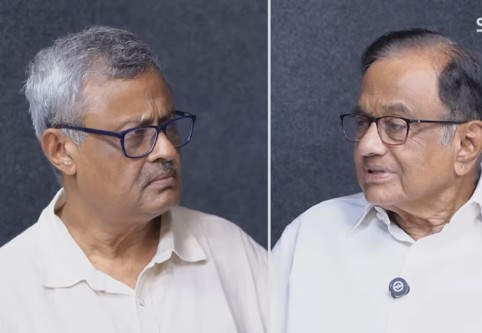
Read the full transcript of senior Congress leader P. Chidambaram’s interview on SpeakEasy with host Amit Baruah, August 12, 2026.
EDITOR’S NOTE: In this episode of SpeakEasy, senior Congress leader P. Chidambaram joins host Amit Baruah for a wide-ranging conversation on the growing political alienation of India’s Gen Z, the surge in student protests, and the deeper crisis of faith in established parties. He also unpacks critical challenges facing Indian democracy, from the declining relevance of Parliament and heavy-handed police responses to protests, to the contentious issues of delimitation and the creation of “non-voting citizens.”
Introduction
AMIT BARUAH (00:00:01 – 00:00:55): Hello and welcome to Speakeasy. My guest today is 4-time Finance Minister, Home Minister after the Mumbai attacks. When I knew him, Minister of State for Internal Security in Rajiv Gandhi’s Council of Ministers. Senior Advocate, also has, as I discovered on his Wikipedia page, a Master’s in Business Administration from Harvard. So he’s one of the best-known faces in Indian politics — administrator, politician, stalwart from the South, many descriptions. So I guess you all know I’m talking about Mr. P. Chidambaram. Welcome to Speakeasy, Mr. Chidambaram.
P. CHIDAMBARAM (00:00:55 – 00:00:56): Thank you. Good morning.
Gen Z’s Loss of Faith in the Political System
AMIT BARUAH (00:00:57 – 00:01:21): Mr. Chidambaram, what I’d like to ask you first is that I’ve been seeing your X posts now. We don’t call them tweets anymore. X posts on, you know, the protests that rocked Jantar Mantar, the protests in Jharkhand also, which you tweeted about a few hours ago. So I just want to know from you, what does this signify, these protests, this obvious unrest among young people?
P. CHIDAMBARAM (00:01:21 – 00:02:43): To be brutally frank, it signifies Gen Z’s lack of faith or diminution of faith in the established political parties.
They have no faith in the political parties can reform the political system. They are looking for other leaders, other alternatives, other methods.
For example, in Jharkhand, I have read a report that says for the last 26 years, exams have been leaked. Now, there have been successive governments in Jharkhand. Of all parties, all party hues. Nevertheless, after 26 years, they can’t stop an examination question paper leaking.
Why would the young people keep faith in the system? They have no faith in the system. They have no faith in the political parties. They have no faith in the political leaders.
AMIT BARUAH (00:02:45 – 00:02:48): That’s quite a damning indictment coming from you.
P. CHIDAMBARAM (00:02:48 – 00:04:26): It is. But then I have been persuading political parties to change their way of thinking.
Look at Vijay in Tamil Nadu. He’s outside the present political establishment. He had no party. He had no organization. He had no executive council or working committee or parliamentary party. He had no general counsel. Yet he won an election with 35% of the vote. Therefore, young people seem to have faith in a complete outsider like Mr. Vijay.
We have to rekindle faith in the established political parties. It’s the same in America. Most people, most young people don’t have faith in either party. That’s why the turnout turns out to be 40 to 50%. In the by-election in which Mr. Prashant Kishore won, the turnout was only 35%. Therefore, most people must be attracted to keep faith in the political system.
Connecting With Young Voters
AMIT BARUAH (00:04:27 – 00:04:56): So how do we do this? You’ve been in public life for maybe 6 decades, if I’m not wrong, you know, something like that. And we do see, you know, Rahul Gandhi connecting much better with Gen Z than, say, Prime Minister Modi, you know, who’s been quite desperate to, you know, put out his reels and so on and so forth. So what is the way? I mean, one is, of course, being able to communicate to young people, you know, the method of communication, the message itself. But how do we rekindle this faith of the young in our political system?
P. CHIDAMBARAM (00:04:57 – 00:06:08): See, Mr. Rahul Gandhi connected with the youths and the neglected people in Bharat Jodo Yatra. That gave us rich dividends in the 2024 parliamentary election. We got about 100 seats. He is reconnected again with the Gen Z.
I agree there are gaps in the connection between political leaders and the Gen Z, political leaders and the farmers, political leaders and industrial workers, political leaders and the completely neglected small communities. I agree. But I’m glad at least Mr. Rahul Gandhi is able to connect in the last 20 days with the Gen Z. Mr. Modi has not connected, that’s obvious, and I don’t think he will be able to connect.
AMIT BARUAH (00:06:08 – 00:06:19): Do you think that, you know, this obvious unrest, does this in some senses mean that the BJP is in political trouble and there’s an opportunity for the Congress?
P. CHIDAMBARAM (00:06:20 – 00:06:22): No, that’s a facile conclusion.
AMIT BARUAH (00:06:23 – 00:06:26): No, because you mentioned Vijay, so I, I’m just going by that.
P. CHIDAMBARAM (00:06:26 – 00:08:14): But there’s no Vijay at an all-India level. There must be several Vijays in every state, and they must connect to the youth, connect to the electorate. I’m making a distinction between youth and electorate because sometimes they do overlap. Because even when the youth vote, the others don’t vote. The Bihar by-election is the classic example. He won 50% of the votes polled, but the votes polled are only 35-36%.
That’s the problem. It’s not only Gen Z. Several sections have opted out of the political system. So we have to connect with the Gen Z, we have to connect with the farmers, we have to connect with the industrial workers, we have to connect with every section. But that requires a special talent.
Mahatma Gandhi connected with every section at one point of time.
Jayaprakash Narayan ji connected with the youths and unemployed. There are different times when different leaders connected with the people. MGR connected with the very poor people, but times have changed. It’s 50 years now. Therefore, we have to find ways, multiple ways in which to connect with different sections of the people. And I think all political parties are struggling to find that connection.
Policing the Protests: Jantar Mantar and Ranchi
AMIT BARUAH (00:08:16 – 00:08:57): Mr. Chidambaram, you have been quite vocal in your criticism on the manner in which the police handled the protests at Jantar Mantar. You’ve also been critical of the police for the lathi charge in Ranchi. I just want to know from you, you know, you were, I mean, Maybe Gen Z has forgotten that you were MOS, you know, looking after internal security in the ’80s, troubled times themselves. And then you were Home Minister after Mr. Shivraj Patil resigned post the Mumbai attacks. I mean, as someone who’s seen the system through and through, do you think — what do you think of how the Delhi Police and the RAF handled the protests first in Jantar Mantar?
P. CHIDAMBARAM (00:08:58 – 00:11:13): See, we have to go back behind the specific incident. That is the nature of the police. The nature of the police is you have to assert your authority and enforce law and order. That is the nature. Unless you place restraints on the police action, they will behave according to their nature.
This has happened several times. Even in my tenure, it has happened. Unless you place restraints on them, and not all are able always to place restraints. Some can place restraints some of the time.
When they are restrained, for example, in Jammu and Kashmir, we placed severe restraints on the Jammu and Kashmir Police, and things dramatically improved between 2004 and 2007. We even removed the barriers on roads, the bunkers, barriers and bunkers. For the first time, I was visiting Srinagar when we were standing on the banks of the Dal Lake, and at 11 o’clock people were congregating. But then the situation reverts to the bad position earlier.
Unless you place restraints, severe restraints, on every incident, this will happen. So every incident is a challenge to the administrator. The administrator is not only the Home Minister. The administrator has several layers: the Home Minister, the LG in Delhi, the Commissioner of Police, the Home Secretary, the Special Secretary Internal Security. There were several layers, but they should collectively ponder over the situation and place restraints.
AMIT BARUAH (00:11:15 – 00:11:26): It would appear that the police commissioner was changed, you know, while looking at some saplings, you know, because he probably was not willing to do what was expected of him from Mr. Amit Shah.
P. CHIDAMBARAM (00:11:26 – 00:12:37): I don’t know whether Mr. Amit Shah goaded him to take severe action or restrained him from taking using excessive force. I don’t know. I don’t know the man. I don’t know the person. I can’t say.
But unless in every situation those who are responsible for giving orders place restraints — if no restraint is placed, the police will act according to its nature. That’s the nature. That’s the training they get. I have impressed upon them that the Sardar Patel Academy, that you have to change the training. They’ve — some changes were made in the training, but every batch has to be trained accordingly. If the training is relaxed, if the training is not as rigorous, the next batch, the next batch, and the next batch will revert to the old ways.
The Pellet Gun Controversy
AMIT BARUAH (00:12:37 – 00:12:55): Because it took a report in The Hindu, you know, to suggest that pellet guns were used because the government was in denial. I mean, in a sense, you know, the pellet guns that were used in Kashmir have been brought to Delhi. And, you know, the way it — the government went about denying it, it shows that there’s something to hide.
P. CHIDAMBARAM (00:12:55 – 00:13:00): The SOP for India is different from the SOP for J&K.
AMIT BARUAH (00:13:01 – 00:13:06): But now 370 is gone, everything has gone. You know, the government claims we are, you know—
P. CHIDAMBARAM (00:13:07 – 00:14:12): No, no, they are making false and loud claims. That’s not true. The SOP for J&K is different. For the rest of India, there is an SOP which says pellet guns are to be used at the last resort. There are several non-lethal measures which have to be taken, and the last non-lethal method is a pellet gun. There was no occasion in Delhi to use pellet guns.
For example, in Jharkhand, Ranchi, there was no pellet guns. There were few people were injured. The government says five or six. The students say more. They were injured. That itself is excessive use of lathi. But no pellet guns were used. So that is in contrast to Delhi. Pellet guns is a no-no according to me.
AMIT BARUAH (00:14:13 – 00:14:26): But in Jharkhand, Mr. Chidambaram, the Congress Party is an alliance partner. I mean, is it something that, you know, you look at? Because you all have been critical, so has Mr. Rahul Gandhi. But what about — I mean, will you pull out of the government if this continues?
P. CHIDAMBARAM (00:14:26 – 00:15:47): No, no, you don’t pull out of government for one incident. Cumulative incidents may ask us to — may goad us to rethink. One incident is a failure. It’s not as bad a failure as Delhi. It’s a failure and we have condemned it.
Hopefully, the state government will correct its ways and restrain its police if such a situation should arise. I’m not wishing such a situation should arise, but apparently the students are not pacified. The students may intensify the agitation, and then you’ll have to be careful. It’s a walking on a knife’s edge. Any police officer, any minister of home walks on a knife’s edge every day. Any incident may arise, and you will have to restrain the police from using anything, any force excessive to the situation.
Parliament’s Irrelevance
AMIT BARUAH (00:15:49 – 00:15:53): Mr. Chidambaram, you kindly agreed to come for this interview, taking a break from Parliament.
P. CHIDAMBARAM (00:15:54 – 00:16:00): I just want to know from you, why do you take a break from Parliament? Because there’s Parliament, Parliament took a break.
AMIT BARUAH (00:16:01 – 00:16:19): So what I want to ask you is that, you know, these repeated adjournments, you know, pushing through bills without discussion in the din, as happened in the Lok Sabha yesterday. So, I mean, what does this mean? And, you know, this sort of tallies with what you said in the beginning about the loss of faith in a system.
P. CHIDAMBARAM (00:16:19 – 00:20:27): Who pays attention to Parliament? I go to my constituency at least twice a month. Nobody pays attention to Parliament. Journalists pay attention and report it. Nobody cares what the Parliament does. If you ask common people, 100 people selected at random, what happened in Parliament, they wouldn’t know. What bill was passed in Parliament, they will not know. That bill is the law of the land. It will affect every citizen of India. They don’t care. They don’t know because Parliament, I’m afraid, is reducing itself to irrelevance.
Sometimes Parliament comes to life when there is a debate on women’s reservation, a debate on a constitutional amendment. But most of the time, Parliament is reducing itself to irrelevance. Last 15 days, I’ve been going to Parliament every time it’s adjourned, and I go home and do my work.
What do I do? The point is, 15 days later, the Home Minister says, or the Parliamentary Affairs Minister says on behalf of the Home Minister, that the Home Minister is inclined to make a statement. Now there are two versions: he will make a statement and a debate will start, or there will be a debate, debate, and he will answer questions. I don’t know which is true.
But why could he not make the statement on day one? Remember Mumbai attack. Mumbai attack was over. On November 30th, 2008, I took over on a Sunday, December 1st. I took over reluctantly, but that’s a different story. But the moment Parliament was convened, I made a statement on the first day. On the basis of all the information that you had at that time, whatever information I could collect in the 2-3 days, I made a statement and I said it’s a long road, we’ll have to walk on the road, and I will bring bills.
But all the agenda that I had set for myself with the approval of Dr. Manmohan Singh, the Prime Minister, and the cabinet on the Cabinet Committee on Security was fulfilled by December 31st. We passed the new law. We set up the — we passed the new law on NIA. We set up institutions in the police, including the famous multi-agency center. So we — if you are determined, you can do it.
This government does not lack determination. It uses determination for the wrong purposes. For example, 7 years ago, they used their determination to pass — to rush through on August 5th, 2019, the J&K bills. So this government, if it decides, will act, but it acts for the wrong reasons. It summons its determination and ability for the wrong reasons, for the wrong causes. That’s my complaint.
Farmers’ Agitation and the Delimitation Bill
AMIT BARUAH (00:20:28 – 00:20:42): So do you feel that, you know, we saw the farmers’ agitation, you know, one year long, and then finally the government was forced to withdraw the legislation? We saw the resignation of Dharmendra Pradhan that came, you know, much quicker than the withdrawal of the agriculture bill.
P. CHIDAMBARAM (00:20:42 – 00:20:48): You say much quicker, I say it was 10 days later. 10 days late.
AMIT BARUAH (00:20:48 – 00:20:50): I mean, I’m saying in comparison.
P. CHIDAMBARAM (00:20:50 – 00:20:51): Comparison?
AMIT BARUAH (00:20:51 – 00:21:07): In comparison. So I mean, you also saw a combined and united opposition, you know, ensured that, uh, they didn’t bring the Constitution amendment bills because they didn’t have the numbers. Do you think that they will reintroduce the delimitation bill?
P. CHIDAMBARAM (00:21:08 – 00:24:49): I don’t know what form the delimitation bill will take place. You see, if they are increasing the strength of the Lok Sabha by 50%, that has other consequences, which I will explain. It will make the Lok Sabha an unwieldy chamber. We call it the Chinese Parliament. Everybody will dutifully sit and clap on the table. That’s all. Thump on the table. It has other consequences.
But if they don’t address the problem of Article 81, Sub-article 2, Clause A — 81 is the instrument by which they can delimit the constituencies on the basis of one person, one vote. In which event, South India, which has 130 seats, 5 states, 130 seats, I’m leaving out Puducherry and Lakshadweep, 130 seats will come down to 110. That’s the fear. That’s the apprehension. That’s the objection.
Because we have implemented family planning faithfully. See, India’s TFR has come down to 1.9, below the replacement rate. Tamil Nadu’s TFR has come down to 1.3. If this TFR stabilizes at 1.9, I expect it to decline further. It may go down, according to me, to 1.6. Then in 25 years, let’s say in 25 years, then you can do a delimitation given the population, the migration, internal migration, etc.
If you do a delimitation now, the worst sufferers will be the southern states. The gainers will be Rajasthan, Bihar, Uttar Pradesh, Madhya Pradesh, and one other state, I think Jharkhand or Chhattisgarh. They will gain. Other states will be marginally more or marginally less by one seat plus or one seat minus. But Tamil Nadu will lose 7 seats. Kerala, from 20, it will go to 12.
That’s the objection. They are not addressing that. They are creating an illusion by increasing 50%. You will be more than 39 to Tamil Nadu, but you will be more than 39 for a short period of time. Once Article 81 kicks in, which will kick in after the next census, this 39 becomes 59, will come down to 48, whereas UP will go from 80 to 120 and further increase to 128.
AMIT BARUAH (00:24:49 – 00:24:55): So do you think that there is any workable solution? Is there — is that like some people say that there should be a freeze on the number of seats.
P. CHIDAMBARAM (00:24:56 – 00:25:33): That is the fair delimitation. The freeze on the 1971 census is the fair delimitation. In 1971, every state lost a couple of seats or gained a couple of seats because the decline in population was more or less uniform throughout the states. It’s after 1971, the decline in population in the southern states gathered pace.
AMIT BARUAH (00:25:34 – 00:25:35): Freeze for another 25 years. Yeah.
P. CHIDAMBARAM (00:25:35 – 00:26:35): See, Indira Gandhi froze the distribution of seats in 1971. Vajpayee ji froze it for another 25 years. They are wise people. They knew that we are inviting trouble by doing a delimitation every election when the decline in population, the rate of decline in population is very different. If the rate of decline in population has been uniform throughout India, then there’s no problem. But South India’s population, southern states’ population declined rapidly. Whereas the Hindi heartland states showed the results of family planning only for the last 4 or 5 years.
AMIT BARUAH (00:26:35 – 00:26:43): So what you’re saying is that you freeze it for maybe another 25, and then when it’s more uniform, the decline in the fertility rate, and then go for—
P. CHIDAMBARAM (00:26:43 – 00:26:49): then we can consider, we can consider according to the political situation on that day.
AMIT BARUAH (00:26:50 – 00:27:02): Well, I know this government is quite intolerant of the opposition, but has there been any effort on behalf of the government to reach out to the Congress Party or other opposition parties to have a sane and sensible discussion on this matter?
P. CHIDAMBARAM (00:27:02 – 00:28:14): They are having, according to newspaper reports and anecdotal evidence, they are having secret parleys with one or two regional parties. Including the DMK, maybe the DMK, but the DMK members are clear. As long as Article 81 is in force, merely increasing by 50% is an illusion. It’s not a solution. It’s an illusion. They’ll have to address the — the elephant in the room is Article 81. You will have to address that, and the DMK members will agree to a freeze, according to me.
But to the best of my knowledge, no government spokesman or representative has officially reached out to the Congress Party on the proposed delimitation bill. It is a threatened delimitation bill. We defeated it only in April 2026. What has changed between April and August?
AMIT BARUAH (00:28:15 – 00:28:19): The breakup, the breakup of the Trinamool Congress, the creation of this NCPM.
P. CHIDAMBARAM (00:28:19 – 00:28:48): That gives us some comfort. Yeah, but it’ll be a double betrayal by the TMC MPs. They have betrayed the TMC and their leader Mamata Banerjee ji, there’ll be a double betrayal if they go along with the government and pass the delimitation bill. Even with the TMC support, they can’t pass the bill.
AMIT BARUAH (00:28:49 – 00:28:51): With the DMK, they might be able to?
P. CHIDAMBARAM (00:28:52 – 00:29:18): Marginally, they’ll be on the edge, but I don’t think they will cross that two-third. If all members are present and voting, if 543 members are present and voting, even the DMK — I’ve not done the math yet, to the last digit, but even if the DMK votes, they may not be able to pass the bill.
The SIR Exercise and “Non-Voting Citizens”
AMIT BARUAH (00:29:19 – 00:29:34): I know you have, you know, other work lined up, so I’m not going to detain you further, but I want to ask you one last question. What does the SIR exercise mean for the country as a whole? We have a lot of exclusions of people.
P. CHIDAMBARAM (00:29:34 – 00:29:47): It means, yeah, bluntly, there are non-voting citizens in this country. We are both citizens if you are a voter.
AMIT BARUAH (00:29:48 – 00:29:52): But if we carry a passport, it’s not necessarily we are citizens anymore. That’s what the government says.
P. CHIDAMBARAM (00:29:52 – 00:31:09): No, no, no. Forget the passport. We are citizens by birth. You were born in India. I was born in India. We are citizens by birth. That’s the Citizenship Act, first provision, citizenship by birth. Then there are other ways to acquire citizenship. All over the world, citizenship by birth is an immutable principle.
Now we are both citizens by birth. You are a voter citizen, I’m a non-voter citizen. One day I’m sure the Supreme Court will strike it down. How can you create 2 classes of citizens — voting citizen and non-voting citizen? What am I if I am removed from the electoral roll? What am I? I want to know. Am I a citizen or not? If I’m a citizen, why don’t I vote? Because the article says everyone above the age of 18 years is entitled to vote.
There’s a proverb in Tamil, if you hide the comb, the marriage will not take place.
AMIT BARUAH (00:31:11 – 00:31:13): Please explain that literally.
P. CHIDAMBARAM (00:31:13 – 00:31:14): Yeah, literally.
AMIT BARUAH (00:31:15 – 00:31:17): Please say it in Tamil also.
P. CHIDAMBARAM (00:31:18 – 00:32:04): See, because the bride has to comb her hair. If you hide the comb, the marriage will not take place. By removing me from the electoral roll, how do you remove me from citizenship? And this is directly contrary to the Constitution, which says every citizen over the age of 18 years is entitled to vote. Somebody must tell Mr. Gyanesh Kumar and his colleagues this fundamental principle of citizenship all over the world. In 178 to 190 countries, citizenship by birth is an immutable principle.
AMIT BARUAH (00:32:05 – 00:32:12): But Mr. Chidambaram, in Assam they created this category of the D-voter. Of course. So they want to create D-voters nationally?
P. CHIDAMBARAM (00:32:13 – 00:32:59): That’s what they will do. In Telangana or some state, I am told one-fourth of the names are being removed from the electoral roll. Are you seriously saying — anybody in his senses seriously say that one-fourth of the electoral roll migrated from Bangladesh? And this is laughable. This is worse than laughable. This is despicable. I’m sorry I’m using strong words, but you are creating 2 categories of citizens. When the Constitution of India says there’s only one category of citizens.
AMIT BARUAH (00:33:00 – 00:33:03): My last question, and I’ll end there: Why are they doing this?
P. CHIDAMBARAM (00:33:04 – 00:33:23): They are doing it to gerrymander. Once the electoral roll is quote unquote cleaned up, they are targeting some constituencies for cleaning up, so-called cleaning up. Then they will gerrymander like they did in Assam.
AMIT BARUAH (00:33:25 – 00:33:27): So that, that seems to be the objective.
P. CHIDAMBARAM (00:33:27 – 00:33:35): That seems to be the agenda, hidden agenda. But I can’t think as deviously as the BJP thinks.
Closing
AMIT BARUAH (00:33:37 – 00:33:43): Well, on that note, Mr. P. Chidambaram, thank you so much for talking to Frontline and SpeakEasy.
Related Posts