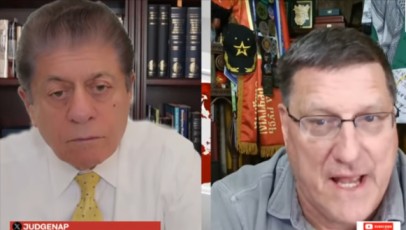
Editor’s Notes: In this episode of Judging Freedom, Judge Andrew Napolitano hosts former UN weapons inspector Scott Ritter to analyze the escalating geopolitical tensions involving Russia, Ukraine, Iran, and the United States. Ritter provides a critical perspective on the strategic “long war” being played by Vladimir Putin and the potential for a “quick defeat” for the Trump administration due to failing military strategies and economic isolation. The discussion delves into the impact of Ukrainian drone strikes on Russian infrastructure and the severe global consequences of a potential renewed conflict in the Middle East. (May 4, 2026)
TRANSCRIPT:
JUDGE ANDREW NAPOLITANO: Hi everyone, Judge Andrew Napolitano here for Judging Freedom. Today is Monday, May 4th, 2026. Scott Ritter will be with us in just a minute on Putin’s long game and Trump’s quick defeat.
Iran Fires Missiles at U.S. Naval Vessel
JUDGE ANDREW NAPOLITANO: Scott Ritter, welcome here. Congratulations on the birth of your granddaughter.
SCOTT RITTER: Thank you.
JUDGE ANDREW NAPOLITANO: Many people are writing to us to express their joy at that event. Did Iran just fire missiles at a U.S. naval vessel?
SCOTT RITTER: The reports are that they have. The U.S. Navy— the Iranians claim they hit a U.S. vessel. The Central Command is saying no U.S. ship was hit, but they aren’t denying that missiles were fired at a U.S. vessel.
We know that missiles were fired at other ships and have hit them, and those ships have either diverted or are dead in the water burning right now. We also know that Iran has fired missiles and drones into energy infrastructure inside the United Arab Emirates, and that we have Bahrain declaring a state of emergency, Kuwait declaring a state of emergency, Iran ordering its southern energy fields evacuated. So there’s a lot going on right now.
Ukrainian Drones Strike Moscow
JUDGE ANDREW NAPOLITANO: All right, I have to jump to Ukraine to ask you a couple of questions. Recently the Iranians have struck Moscow, even a residential neighborhood, for 3 nights in a row. Does that surprise you that they were able to reach into the residential areas of Moscow where you and I have visited?
SCOTT RITTER: Yeah, I think you meant the Ukrainians, not the Iranians.
JUDGE ANDREW NAPOLITANO: Yeah, I meant to say Ukrainians, hence the look on your face. Yes, thank you.
SCOTT RITTER: I do this all the time myself, so it’s okay, because we have 2 conflicts going on that are both very serious conflicts.
I was just in Moscow last month. I had asked people there about Ukrainian drone attacks, and they said that Moscow had built up a fairly decent defense and that it was very difficult for drones to get through. But it doesn’t surprise me that drones are able to get through.
I’ve been following Russian developments in drone technologies, and drones, of course, are guided. There are standard technologies that drones can use. They can upload to Starlink, which is something they use. They also tap into a local cell phone infrastructure to communicate and to receive guidance. And then there’s a blending of the two.
The Russians have done something pretty neat where they have sort of their own neural network of drones, and the drones can adapt. So you can send a swarm of drones in, and as they get shot down or nullified, the drones sort of learn in the process and adapt and make adjustments. I think the Ukrainians, who are literally right behind the Russians — or in parallel with, and in some cases ahead of the Russians — have similar technology. So it doesn’t surprise me that if you fire enough drones into a problem set, they’re going to get through. We’ve seen this in their strikes in Tuapse. We’ve seen that in their strikes in Primorsky and other areas.
So no, it doesn’t surprise me that the Ukrainians were able to leak drones through. What surprises me is the lack of decisive response on the part of Russia. We’re getting to the point right now where this is almost becoming embarrassing for Russia. I mean, it is embarrassing for Russia. Normally Russia can point to the scoreboard and say, “We’re doing well,” but trick plays don’t win a game, you know that. You can be behind, you do the hook and ladder, and everybody goes, “Wow, that was cool,” but can you do 6 more in a row?
The Ukrainians now are doing significant harm to Russian energy infrastructure. At a time when Russia should be able to maximize export capabilities to earn money at this point of highest earning potential, the Ukrainians are throttling this down. It’s not permanent damage, but it’s damage nonetheless.
And you combine this also with the fact that these Ukrainian drone swarms — the Russians have tracked it — are flying through Poland and the Baltic States to strike Saint Petersburg. They’re going through Turkey into Georgia, through Azerbaijan and up the Caspian Sea through Kazakhstan to strike the interior of Russia. They’re bypassing standard air defense concentrations. This is an act of war for nations to allow their airspace to be used in this manner, and yet the Russians to date have done nothing.
I understand that the Russians want to avoid escalation and are conducting escalation management, but at some point in time the Russians are going to have to do something to stop this, or else they run the risk of altering the strategic balance. I’m not going to say it’s going to shift in Ukraine’s favor, but this is a time when Europe is rattled, is shaken. The United States is indicating that we’re not there behind them, and the last thing you need, if you’re Russia, is to have the Europeans saying, “Hey, this is working. This strategy of ours is working. We can double down on this.”
This is the time when you need Europe to disengage and say, “No, we need to bring an end to this conflict.” But instead, Ukraine’s successes are being used to solidify European resolve, and that’s just not the direction I believe Russia should be going in.
Does Putin Have the Will to Win?
JUDGE ANDREW NAPOLITANO: The special military operation has been going on for 4+ years.
Does President Putin have the will to win?
SCOTT RITTER: Of course he does. Of course he has the will to win. It’s absurd to suggest otherwise. The people who say that — I think I know where you’re coming from, Judge, because those aren’t your words, those are other people’s words — that means they don’t have a clue about what’s happening.
First of all, if you focus on what’s happening on the battlefield, you understand that Russia is completely committed to winning a war of attrition. A war of attrition that isn’t designed to have the Russians sacrifice everything — this isn’t the Yankees versus the Confederacy where the Union is willing to lose everybody. This would be a war of attrition with the Russians saying, “We want to minimize casualties while we maximize enemy casualties.” That’s the Russian approach.
Why does Russia need to do that? Because Russia isn’t going to sacrifice its economy. People tend to forget that Russia was subjected to stringent sanctions that were designed to buckle the Russian economy. The goal of the U.S.-European sanctions program was to terminate the viability of Russia’s economy. Russia has done the exact opposite. Russia has not only stabilized their economy — their economy is thriving — but they only thrive because you’re not sacrificing all of your manpower in Ukraine, because you are allocating significant resources to sustaining civilian commerce. It’s the genius of the Russian system.
So those people who say Russia’s not fully focused haven’t a clue what’s going on, because if Russia had done what everybody said they should have done, their economy wouldn’t be doing what it’s doing today, which is succeeding.
And it’s not just the civilian side of the economy. Russia is outperforming the world in defense industry. The Russians have taken a defense industry that was largely dormant and have activated it, brought it up to wartime functioning, and are pumping out missiles and tanks and everything else in numbers that people can’t even imagine.
It’s not just about supporting what’s going on in the special military operation. This is about Russia rebuilding their military, going from 900,000 to 1.6 million to over 2 million. When you increase the numbers of troops that way, they need equipment. Where’s that equipment coming from? From the factories that are not only supplying the war — a war of attrition, which means you’re taking casualties — but building new formations, not just with the first frontline order, but to sustain combat.
Russia knows what it means. Once you engage, you have to have the missiles, the artillery shells, the fuel, and everything stockpiled to keep the war going. Russia is doing this. We’re the side that has nothing left. We’re the side that has our armories emptied. The Russians know what they’re doing.
So when people say, “Does Putin have the commitment to do this?” — you don’t know what you’re talking about.
JUDGE ANDREW NAPOLITANO: Gilbert Doctorow. I knew you were going to throw that in there.
Trump’s Call to Putin: “Don’t Restart That War”
JUDGE ANDREW NAPOLITANO: What do you think President Putin said on the phone to President Trump last week when, according to the Russian readout and the American reports, he said, “Don’t restart that war”?
SCOTT RITTER: Well, remember that what precipitated this was a visit by Foreign Minister Arakchi, the Iranian foreign minister, who was received by President Putin himself. And they had a conversation. Arakchi is a foreign minister and is in no position to come and dictate anything to a Russian president. So Arakchi wasn’t going there threatening the Russian president. He was going there to offer insight into the Iranian thinking and to talk to the Russian president about strategic geopolitical realities.
Iran has made it clear that there is no alternative for victory on their terms. People need to realize that when the United States and Israel began this conflict back on February 28th with a surprise attack — while negotiations were taking place that would have resolved the nuclear issue, an act of perfidy, a war crime — we launched this not to punish Iran, but to destroy Iran.
One interesting thing came out in the past week. We now know that Israel took air defense systems from Israel and deployed them to the United Arab Emirates. Not just the systems, but Israeli troops. So Israeli troops on the ground defending a Gulf Arab nation from Iran. They were part of the offensive against Iran, which is why the UAE is being hit today, by the way. Everybody’s like, “They’re victims.” They’re not victims. They participated in the surprise attack against Iran.
But this is not a war that Iran can walk away from or give the United States something. This is existential survival, and it’s linked to the existential survival of Russia and China as well. The Russians know this — that if Iran goes, they will go, China will go. That’s just the way it is.
So the Iranians said, “This is what we have to do. We have to maintain some sort of deterrent value, which is to put the United States on notice that if you resume military operations, we will terminate the ability of the Gulf Arab states to not just produce energy, but to exist. They will die.”
“And that’s hyperbole, Scott.” I don’t know. Go to Kuwait City, shut down all the desalination plants. Tell me what happens in the weeks to follow when there’s no fresh water.
JUDGE ANDREW NAPOLITANO: Well, there’ll be no people.
The Economic Fallout: Energy, Fertilizer, and Aviation
SCOTT RITTER: Bingo. But it’s not just this, what’s happening in the world today. Everybody’s focused on oil. Of course, oil is a big deal. But a large part of the world’s fertilizers come from the Middle East and they’re not getting out. This is springtime. My grandfather, Marina’s father, was a great gardener. He’s passed, but we still have the remnants of his garden. This is the planting season. You go out, you sow the fields. And if you’re doing mass production of food, which we have to do in order to feed the global population, you need mass amounts of fertilizer, which is not available now thanks to Donald Trump.
So we’re facing a famine. We’re facing energy supply issues. We’re facing problems with advanced industries that need, for instance, helium. A large amount of helium production coming out of Qatar— not anymore. So there’s a helium shortage. That’s the end of that.
This summer is going to be a very, very difficult summer. Lufthansa, major European airline, 20,000 flights canceled. They are going to run out of aviation fuel in a matter of weeks. And when that happens, it’s not just that the airplanes will be grounded, that businesses will go out of business. Several major European air companies right now are no longer training flight attendants and pilots. And if you’ve ever run a business, you know you never stop the training. Even when the U.S. military was reducing their forces, we always recruited new people because if you’re not inserting new blood, it’s the end, it’s over.
So basically, Donald Trump is killing European aviation. He could be killing American aviation. It’s not just Spirit that’s going under. A lot of these airlines are operating on razor-thin margins right now, and now he’s going to screw them up by jacking up— already fuel prices are through the roof. You see Delta Airlines canceling flights because they can’t afford the fuel right now. That’s a major airline canceling flights because they can’t afford fuel. That’s here in the United States.
Iran’s Warning and Putin’s Phone Call
So this is what Arakchi told Putin: “We’re going to do this, we have to, we have to have this nuclear bomb, this economic nuclear bomb, to deter American irresponsibility.” And Putin made the phone call. He made the phone call, which is rare, and he only does that to make certain points. And this point he made is, “Do not do this because the consequences will be mind-blowing.”
But the problem is Vladimir Putin is speaking to an insane individual, and we have to call it as we see it, Judge. The President of the United States is not a rational human being right now. He is a man who suffers from extreme narcissistic personality disorder.
“Scott, you have Trump derangement syndrome.” I don’t know what you call it when the guy illegally renames the Kennedy Center the Trump Kennedy. You can’t do it by law, but he did it. This is a man who’s building monuments to himself. He fantasized about having his head on Mount Rushmore. I just came from Washington, D.C. They have banners with his stupid face staring down at you throughout Washington, D.C. This has never happened before in American history.
A Fantasy World of Sycophants and Bad Intelligence
And we have this narcissist out there who has populated a world that doesn’t exist. He has Scott Bessant receiving information from the Foundation for the Defense of Democracy, which is an adjunct of the Israeli Foreign Ministry, getting advice about Iranian energy realities that don’t exist. “Iran is about to run out of storage capacity.” No, they’re not. Not even close. “Iran can’t earn any money. They can’t pay their—”
So if you go to the Pakistani border, Scott Bessant, let me tell you, call up the geospatial imagery people and say, “Give me satellite imagery of the Pakistani-Iranian border and count the trucks that are going in and out, and then calculate the amount of fuel that’s going back and forth.” Understand that all of it’s being paid for in hard currency that’s going to the Iranians. We live in a fantasy world. “Our blockade is very successful.” Our blockade hasn’t been successful at all. Iran is pumping ships out and those ships are going off and they’re making hard currency.
Scott Bessant lives in a fantasy world. Pete Hegseth is saying, “We can do this.” We can’t do anything. We lost the 40-day war. There’s no way we can win the next war.
Dark Eagle, that new hypersonic missile that we got out there, every game changer— we got one battery, 8 missiles at $41 million each. There aren’t going to be any more than that, and they don’t work. We don’t even know what the lethality of these are because we’ve never tested them against hardened targets. So all the people saying, “We’ve got Dark Eagle going to reach in and touch and take out the Iranian ballistic missile cities”— dude, we got 8 missiles that don’t work. We’re going to destroy nothing.
Connecting the Dots in an Irrational Washington
Trump lives in a fantasy world of his own creation. I’m an analyst who spent my entire life connecting the dots. Sometimes I get it wrong, I’ll admit it. A lot of times I get it right, and I’ve gotten it right in a lot of high-profile, high-pressure situations.
But it’s very difficult right now to sit here and try and figure out what’s going on in Washington, D.C., because the map that I use and the dots I use don’t exist in Donald Trump’s brain. He lives in a fantasy world populated by dots that are just figments of his own imagination or whispered suggestions from sycophants who are there to stroke the ego of this extreme narcissist, which is the last thing you need to be doing with a narcissist.
The Iranians may have done him a favor today because they’ve punched him in the nose, and hopefully it broke the nose, and Donald Trump’s bleeding from the nose, figuratively of course, and he’s going to snap out of it and go, “Whoa, whoa, we have to stop this right now. Vladimir Putin told me what the consequences of this will be, and the consequences will be dire.” Not just for Trump— he’s politically dead.
Two Phone Calls: Putin and Miriam Adelson
JUDGE ANDREW NAPOLITANO: So we got two phone calls last week, one from Vladimir Putin and one from Miriam Adelson.
SCOTT RITTER: Yeah, well, Miriam, she needs to run to Israel and hide, because Trump’s going to lose the midterm elections. He can’t win. He had a chance, he blew it. And so it’s over for him. Now the question is, is he going to be more than just impeached, or is he going to be convicted? And if he keeps doing this stupidity, he’ll be convicted because he’ll lose the Senate by margins that are capable of achieving conviction. And that’s the end of it.
He got off the helicopter with Donald Trump Jr., one of the most corrupt individuals in the world. People need to understand how these people are playing the market, how what they’re doing here is designed to make people millions of dollars, not by building things that make America great again, but by cheating, insider trading, market manipulation. We suffer. Our 401(k) plans go away. Our retirement goes away. They make money.
Miriam Adelson needs to understand that she’s going to be blamed for this, as she should be, and she needs to get the hell out of Dodge. MAGA is finished. This is the reality of it. We’re going to be looking at a political— revolution isn’t the right word, but it’s going to be political calamity as America tries to understand how to move forward, but it’s not going to be with Donald Trump as a viable president. He may serve another 2 years if he doesn’t get convicted, but his presidency is over and he knows it now, which means this insane individual now is going to be even more desperate to try and do something radical to change the direction that we’re on.
What Happens If Bombing Resumes?
JUDGE ANDREW NAPOLITANO: Well, what happens if he listens to Miriam Adelson and Netanyahu and Pete Hegseth, and resumes a heavy-duty bombing campaign?
SCOTT RITTER: The American economy collapses totally in the summer of 2026 for the reasons you’ve just articulated.
JUDGE ANDREW NAPOLITANO: Can the Iranians withstand another 40 days of bombing?
SCOTT RITTER: They already withstood the first 40 days. Did we get any better? Normally if you’re fighting a 15-round match and you’ve gone in and you’ve punched yourself out in 7 rounds, do you expect suddenly to be able to punch even harder in the last 7 rounds? No, you’re exhausted, your body’s spent. The Iranians weren’t hurt in this 40 days. Again, I just want to point out the reality that we did no damage to Iran. None.
When I was a weapons inspector in Iraq, General al-Ubaidi was the oil minister. He was also the head of defense industry. He ordered a study done on battle damage assessment— basically from the Iraqi perspective, what damage was done during Desert Storm, which was one of the greatest strategic air campaigns ever. It turns out we did no damage. We blew up a lot of buildings, empty buildings, but the strategic infrastructure, the production capacity that we were trying to destroy, had all been evacuated and hidden. And it was the weapons inspectors that were able to go in, find it, and destroy it. But the bombing campaign did nothing.
The Iranians learned from that, and they learned because, remember, June gave them a run-up on what could happen. So by the time we came rolling back in on February 28th, there was nothing of substance to be bombed. We spent 40 days basically emptying our arsenals, and we accomplished absolutely nothing. So why does anybody believe that we can suddenly get it right this time around? We don’t know what we’re bombing. We don’t know where things are.
Pete Hegseth is in the business of just making things go boom and declaring victory. Remember, this is a president who was shown war porn every night as an intelligence briefing. That’s it. Hegseth went in and got the best things that went boom and put them in front of the president. But it turns out half the stuff that he was watching going boom were decoys. The other half were empty buildings. And that’s all we accomplished— nothing.
Putin’s Call to Netanyahu and the Naughty List
JUDGE ANDREW NAPOLITANO: Let me get back to President Putin. He also had a phone call with Israeli Prime Minister Netanyahu. What did he say to him?
SCOTT RITTER: I don’t know. Putin here— you have to remember that I think 20% of the Israeli population are Russian citizens, and Putin has said, when we speak of the Russian nation, not Russia, but Russiyny, the larger nation, Israel factors into it because it has a large percentage of Russian Jews living in Israel.
But I also think that he was putting the Israelis on notice that there will be consequences to resuming the conflict. I also believe that he was putting them on notice for helping the Ukrainians strike Russia. I think Russia is putting together the naughty list, and at some point in time, as I said, they can’t continue to allow these drones to strike with impunity. And there will be—
JUDGE ANDREW NAPOLITANO: The Israelis helped the Ukrainians strike Russia?
SCOTT RITTER: Yeah, Mossad, AMAN, the Israeli government— technologies are being provided to the Ukrainians to facilitate the operation of their drones.
Who Wins the Waiting Game?
JUDGE ANDREW NAPOLITANO: Well, who wins the waiting game? I’m talking about the US and Iran.
SCOTT RITTER: Iran. Iran has all the cards. I mean, there’s a perfect meme, Donald Trump going, “I got all the cards,” except they were Uno cards, and the purpose of Uno is not to have all the cards. And then the Iranians are showing their hand and they say, “Yeah, you’ve got all the cards because we’re winning.” Iran wins this. Iran easily wins this.
When this war started, the Middle East produces 20%, 22% of the world’s energy. Kuwait in the month of April exported zero. Bahrain’s in a similar position. None of that energy, 22%, made it out. Very small amounts of it. That means— and if you know anything about energy, once things get flowing, it takes time. It’s not instant. We don’t open the Strait of Hormuz today and tomorrow have gasoline in the gas station. It has to flow. It takes weeks, if not months, to get to destination. It gets stored. It then gets processed. It gets out, enters the manufacturing process, turned into gas, plastics, whatever, and then it has to make its way to market. So by the time it gets to market, we are literally talking several months after it entered the pipeline.
So we today are sitting there going, “Well, it’s not that bad. I mean, we’re paying a little bit more at the gas pump, but that’s because of traders and market manipulation. But everything’s working out. We still got stuff.” Guys, it’s over. The last stuff that went in on February 28th has reached the end. It’s reached market. Nothing’s come in the pipeline since then. Nothing. And so we are going to be looking at a total collapse. Who wins the waiting game? Iran.
Closing Remarks and Upcoming Schedule
JUDGE ANDREW NAPOLITANO: Scott Ritter, thank you very much, my dear friend. Great, great, great analysis from Moscow to Tel Aviv to Tehran. Thank you, my dear friend. Congratulations on the beautiful addition to your family. And Scott, if Larry Johnson is right and Trump is foolish enough to resume a war in the next 2 or 3 days, we’ll call on you.
SCOTT RITTER: Okay.
JUDGE ANDREW NAPOLITANO: All right. Thank you, Scotty. All the best, my friend.
SCOTT RITTER: Thank you.
JUDGE ANDREW NAPOLITANO: Coming up tomorrow — what a great, great, fearless, courageous analysis as Scott always gives us. Coming up tomorrow, Tuesday at 8 in the morning, Ambassador Chas Freeman. At 9 in the morning, Professor John Mearsheimer. At 10 in the morning, Aaron Mate. At 2 in the afternoon, Matt Ho. At 3 in the afternoon, Colonel Karen Kwiatkowski. Judge Napolitano for Judging Freedom.
Related Posts