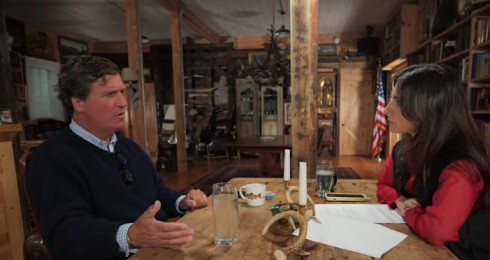
The following is the full transcript of Tucker Carlson’s interview on The World with Yalda Hakim, June 24, 2026.
Editor’s Note: In this wide-ranging and contentious interview, Yalda Hakim sits down with conservative commentator Tucker Carlson to dissect the current state of the MAGA movement and its relationship with Donald Trump. Carlson offers a stark assessment of the Trump administration’s recent foreign policy decisions, particularly regarding the war in Iran, which he describes as a profound failure and a betrayal of the America First agenda. Throughout the discussion, the two also delve into Carlson’s critical views on the war in Gaza, his complex stance on international relations, and his perspectives on democracy, both in the United States and the United Kingdom.
Tucker Carlson on Trump, Iran, and the End of MAGA
YALDA HAKIM: Good evening and welcome to a special edition of The World, live from New York. I’m Yalda Hakim. We’ll spend tonight’s program gaining a window into Donald Trump’s world from someone who knows it inside out, Tucker Carlson.
Over the past decade, the conservative political commentator became one of the most influential figures in the MAGA movement, helping to popularize the America First agenda. But he’s since fallen out with the president he once championed, saying Trump broke a fundamental promise when he dragged America into war with Iran. And he believes it’ll destroy not only Trump’s presidency, but MAGA as well.
Do you think this war is the beginning of the end of Donald Trump?
TUCKER CARLSON: Of course it’s the end. Of course. Of course it’s the end. And he— and I said this to him in February. I said what he already knew.
YALDA HAKIM: Tucker Carlson also offered me his contentious views on the war in Gaza. We debated the influence that Elon Musk seeks over UK politics. And I pressed Carlson on his own presidential ambitions. But we’ll begin with Iran. I sat down with Tucker Carlson shortly after the US and Iran signed their memorandum of understanding or interim agreement. Have a listen.
The Iran Deal: “An Admission of Defeat”
TUCKER CARLSON: Well, I’m amazed by the new treaty at Versailles that was signed yesterday. I’m just amazed by it. In fact, when I first saw it, I thought it was fake. There’s so much lying going on, as there is in any war, but particularly this one, that I just didn’t believe it could be true for a bunch of different reasons.
Obviously, it’s an admission of failure, of defeat of the United States by Iran, which is the world’s 34th largest economy. So it’s just a remarkable admission. It signifies a movement of power from one sphere to another, but it also signifies a profound and I think permanent change in the relationship between the United States and Israel, which is something that I was never that interested in. But the last couple of years, and particularly since this war began in February, has been the focus of my attention, because it’s been the defining fact of America. And I think with this, that changes in ways that are very hard to predict, but the outlines are pretty obvious. Like, there’s no going back to where we were after this, for a bunch of different reasons.
After the president made a series of statements which were just shocking to me — hilarious because they’re true, but amazing — I mean, the President of the United States stood up, I think in Europe at the G7, two days ago and said, “You know what, I like Bibi, nice guy, good partner,” you know, the caveats, “but what he’s doing in Lebanon is just brutal. It’s just brutal. Blowing up apartment buildings because of drones. I mean, come on.”
I don’t think it’s all Netanyahu at all. But I think someone like Ben-Gvir or Smotrich or a number of different cabinet ministers are, of course, bloodthirsty, but don’t consider non-Israeli lives fully human. I mean, it’s obvious by what they say. They’ve said that and their laws now reflect it within the state. I grieve over that as someone who’s liked Israel for a long time and been there a lot and has a number of Israeli friends who are totally reasonable, decent, good people. I grieve over what’s happened to that country, but it’s a stain on the conscience of the world. And so when Trump says that, he’s absolutely right.
Trump’s Evolution on Netanyahu
YALDA HAKIM: And I want to talk to you about Gaza, Lebanon, you know, go into more detail on these issues. But you’ve said a couple of things there that I want to sort of talk about a little bit more. You said that the idea that Donald Trump four months ago went into a war partnering with Benjamin Netanyahu, and he’s now criticizing him in the way that he is. Why do you think, and how do you think this evolution happened over the course of the last—
TUCKER CARLSON: Well, I don’t— I mean, it’s something that I’ve really meditated on for the past 110 days since it started, because I was so close to the process. I mean, I was talking to Trump all the time. I was in Washington three times in the last month talking to Trump about this, trying to argue against it. I was very anti a regime change effort in Iran because I thought it would be terrible for the United States. I thought it would be the end of American empire. I thought the United States would wind up retreating from the Middle East. And those may be good things, by the way. I don’t, you know, who knows? But I thought that it would be terrible for the US dollar and I thought Americans would die. And I told him all of those things.
And he knew that those were risks, realistic risks, and he did it anyway. So I don’t know why.
I think Trump was sincerely— he allowed himself to convince himself that killing the Ayatollah, the head of Shia Islam, would somehow collapse the country. Our various intel agencies told him that wasn’t true. The Israelis told him it was true, and a couple of days in, it turned out to be totally false. I think he was enraged. He knew he was trapped. He knew that the American economy was at stake. The global economy was at stake. And I think he immediately blamed Netanyahu for it.
YALDA HAKIM: Do you think then ultimately the last four months has made the United States weaker?
TUCKER CARLSON: Much weaker. Of course, much weaker. Now, my view — and this is a view that I have come to in the last couple of years, just from traveling a lot, and it’s an evolving view, so who knows how I’ll feel when the facts come in a year from now — but I think we had an unsustainable empire that was not serving the interests of the republic, the country itself, and it cost too much. I think it degraded our politics. I think it sucked up the attention of our leaders, much more interested in defeating Islamic Jihad than in ending homelessness. Like, that’s a misalignment of goals and values. Like, that can’t continue.
“Why Did It Fall to Me?”
YALDA HAKIM: But you spent a lot of time telling him this stuff.
TUCKER CARLSON: But my point is, like, why did it fall to me? You know what I mean? Like, there are people paid to give this advice. And there are some good people there for sure, some smart, well-meaning people, but there weren’t a ton of people who were willing to march in there and say, “This is nuts, man. This is nuts. And you’re being sold a story that’s not true.”
And not hate against Israel. Like, I understand they’ve got a different perspective from ours. They have different goals from ours because they’re a different country. But if you follow this path, you will be entrapped. This is a trap. I did tell him that. He didn’t like it at all, but it was true. And it wasn’t just true. It was obviously true.
YALDA HAKIM: Well, the person who did make the case was Benjamin Netanyahu, and he advocated for this. But he hasn’t advocated just to Donald Trump for 25 years, for 30 years. He’s been advocating to president after president. I mean, why Trump?
TUCKER CARLSON: You’re absolutely right. The core premise of your question is undeniable. Many presidents have faced this pressure. Only Trump caved. That’s just a fact. So as I said, I don’t know why. There are, I mean, famous—
YALDA HAKIM: I mean, he wasn’t hypnotized. He just swallowed it.
TUCKER CARLSON: He may have been hypnotized. That’s real. People are absolutely hypnotized. I know a lot of people have been hypnotized. I have been hypnotized. I mean, of course people are hypnotized all the time. But on an issue like this—
YALDA HAKIM: But on an issue like this—
TUCKER CARLSON: Of course. We’re all hypnotized from time to time. Words have power. Words change reality.
YALDA HAKIM: But this is a president who—
TUCKER CARLSON: We hypnotize ourselves all the time.
YALDA HAKIM: But you supported him so many times.
TUCKER CARLSON: I didn’t just support him. I campaigned for him.
YALDA HAKIM: I mean, I was — by the way, and we’ll talk about this — I was at the RNC when you spoke.
TUCKER CARLSON: No way!
YALDA HAKIM: I was. And you spoke and, you know, you were convincing and compelling.
TUCKER CARLSON: I had no notes. I meant it.
YALDA HAKIM: But, you know, to come out to campaign for him, to support him in the way that you did, and then for him to campaign on a no war, no forever wars, and for it to end up like this.
TUCKER CARLSON: No one was as shocked as I was.
YALDA HAKIM: Yeah.
“I Was Wrong”
TUCKER CARLSON: So my calcula— First of all, I would just say, as I try to force myself to say always, I was wrong. I’ve been wrong about a lot of other things, including the Iraq War, so I am capable of being not just wrong, but very embarrassingly wrong. So that’s just a fact.
Why was I wrong? It’s not like I didn’t know Trump had flaws. I know Trump intimately. I know Trump really, really well and I’ve always liked him, but I know what he’s like. And so I was eyes wide open in some ways, but my calculation was — and it seemed obvious — that if, I mean, from my perspective, what the country needs is a choice, and the Republican Party and the Democratic Party are identical in their core assumptions about the economy and foreign policy, which is what matters. And I thought Trump was an option.
YALDA HAKIM: Are you talking to Trump at the moment?
TUCKER CARLSON: No.
YALDA HAKIM: You haven’t spoken to him since?
TUCKER CARLSON: February 28th. I spoke to him the 27th. I haven’t talked to him since. I don’t hate him. I feel sorry for him. What he did is a catastrophe. He knew it would be. He did it anyway. So the question is why?
“The People You Elect Aren’t Even in Charge”
YALDA HAKIM: I want to quote you because you say, “The war in Iran has taught us that the people you elect aren’t even in charge.”
TUCKER CARLSON: Of course.
YALDA HAKIM: Someone else is. In this case, Benjamin Netanyahu.
TUCKER CARLSON: Yes.
YALDA HAKIM: What are the long-term effects of a population understanding that voting doesn’t make a difference?
TUCKER CARLSON: Exactly.
YALDA HAKIM: I mean, I guess—
TUCKER CARLSON: Scary.
YALDA HAKIM: But I ask because Donald Trump has stopped this war now. And Benjamin Netanyahu — you have said in this interview this is a dangerous moment for Israel.
TUCKER CARLSON: Big time.
YALDA HAKIM: Benjamin Netanyahu is concerned. He has said, “This is not my deal. This is not my ceasefire. I reserve the right to defy it if I need to.” But that is Donald Trump in charge, right?
TUCKER CARLSON: I don’t know if it’s Trump in charge. I mean, he’s certainly taking a different course than he did 110 days ago, for sure. Radically different. And he’s blaming his failures on Netanyahu, which is predictable and well-deserved. Like, I’m not mad about it.
And I think Netanyahu is obviously a criminal, and I don’t feel sympathy for him after all the innocents he’s murdered. But I do feel sympathy for Israel just because there are a lot of nice people in Israel and they don’t deserve this. Nobody deserves this. And as I said, I think this is — I want to be honest enough to admit — I think this is a very, an actually threatening, not a fake theatrical threatening, but actually threatening moment for Israel. So I feel bad about that.
But all I know is what I saw. Trump was not enthusiastic about doing this. He knew the risks. He thought the risks were real. He told me that. And he did it anyway, and he did it against the advice of his own intelligence agencies and against the wishes and maybe in some mild cases the advice of his own advisors. So why did he do that? At whose behest did he do that?
He wasn’t enthusiastic about it. He’d said for ten years he wasn’t going to do it. He thought it was a bad idea. He campaigned against regime change wars in the Middle East a lot, not just parenthetically, but it was a central position. And so far as I could tell, having talked to him about it many, many, many times, I think it was heartfelt.
“The Beginning of the End of Donald Trump”
YALDA HAKIM: And I guess another US president dragged into a war in the Middle East that they say they either didn’t want to start or move away from. And for me, it’s quite personal what happened in Afghanistan with Joe Biden and the way that they — the shambolic way that they withdrew. And that for me was a defining moment for Joe Biden’s presidency. It felt like the beginning of the end of his presidency. Do you think this war is the beginning of the end of Donald Trump?
TUCKER CARLSON: Oh, yeah.
The End of MAGA? Tucker Carlson on Iran, Gaza, and the Trump Presidency
TUCKER CARLSON: Of course it’s the end. Of course. Of course it’s the end. And he— and I said this to him in February. I said what he already knew.
YALDA HAKIM: But do you think the lines are being drawn right now? Because we’re seeing a lot of the vice president now coming out defending this deal. He said, “Fundamentally, it was worth it.” That’s what he said yesterday or the day before to Megyn Kelly.
TUCKER CARLSON: And then— And what was worth it, the deal?
YALDA HAKIM: The war, the deal, it was worth it.
TUCKER CARLSON: Well, what are you going to say? It wasn’t worth it. I mean, all these Americans died. It cost us tens, maybe hundreds of billions of dollars and will cost more going forward. So it’s a tough pill to say it wasn’t worth it. I mean, this was all pointless. No one wants to hear that. No one wants to say that. No one wants to believe that. So I certainly give him a pass on that.
But no, JD, I think the Vice President has been very clear about his views. I don’t think there’s any world in which President J.D. Vance would’ve done this. I mean, there’s literally no chance of that, I think. But he’s the Vice President. So one of his jobs is to support the President. And he’s done, I think, a very good job of that. It’s tough. Who’d want that assignment?
But from what I know of J.D. Vance, and I know J.D. Vance is a really decent man, I will just say that, and I know that to be true. His view is rather than throwing up your hands and saying, “I can’t deal with this, I’m out, you violated my principles.” His view is if you’re in a position of authority, you do your best to make the best of a bad situation. And he has done that.
Analysis: Is the Trump Presidency Really Over?
YALDA HAKIM: Tucker Carlson, and we’ll come back to more of that interview in a moment. But let’s just bring in our US correspondent, David Blevins. David, good to see you. Listening there to Tucker Carlson describing this deal as a failed deal, capitulation, surrender. Obviously, the White House is not saying that that’s what this deal is.
DAVID BLEVINS: Yeah, obviously, Yalda, there are many people who believe Tucker Carlson has an agenda. But in your interview with him, I think he doesn’t just come across as angry but genuinely disappointed in President Trump, a man in whom he expressed so much faith. But his suggestion that the war in Iran was a catastrophe and marks the end of the Trump presidency and the end of MAGA, I think ignores several important factors.
Firstly, that the political coalition around Donald Trump has endured worse shocks. The outcome of the 2020 election, for example, the January 6th raid on the Capitol, all of those criminal indictments and also the civil judgments. I think it’s also worth remembering that while many Republicans did vote for Donald Trump on that campaign pledge not to bring them back into a foreign war, they do distinguish between a short-term military intervention— and remember, that’s what they have repeatedly been told this is— and another Iraq, if we can put it like that. To them, the outcome of all of this matters much more than the decision taken to go to war or to go into a military intervention in the first place. And they now have this 14-point memorandum of understanding that despite what other people think of it, they’re being told illustrates that America has met its various objectives.
And I think there are another couple of things worth thinking about as well. The Republican base tends to be more hawkish than Tucker Carlson’s audience. They are open to the idea of military intervention when it is framed as preventing Iran from having a nuclear weapon. And then MAGA, well, MAGA is bigger than just foreign policy. You and I know that. Think about the trade wars. Think about the immigration issue. Think about the culture wars. And I think when you bring all of those factors into play, Tucker Carlson may be just a little premature in suggesting that the Iran war signals the end of the Trump presidency.
YALDA HAKIM: David, the Trump administration has about 60 days before the nuclear talks begin. And those 60 days will be crucial. And there are concerns that perhaps the United States might get dragged back into this war, something that I discussed with Tucker Carlson as well. Is that something that Donald Trump’s base, or even wider than that, Americans in general, are worried about?
DAVID BLEVINS: Well, it’s really interesting, Yalda. We will hear again from the president this evening, the first event marking the 250th anniversary of America. We heard from him last night in the battleground state of Pennsylvania. I expected to hear him say much more about Iran. He didn’t really talk about the issue. He simply said, “They’re never going to have a nuclear weapon.” And to me, that suggests that he knows that this is just parked right now rather than over, because they might claim in the memorandum of understanding that they have dealt with the issue of Iran’s nuclear capability. But as you point out, the only thing they have agreed is that they are going to talk for another 60 days in an attempt to find an agreement. And we’re getting a completely different version of that memorandum of understanding from Iran.
And therefore, I think the base know that Donald Trump is trying to bring this to an end. They probably recognize that he needs to find that off-ramp because that’s the only way we’re going to see petrol prices come down and grocery prices come down. And those things are really going to matter now that we are just months away from the midterm elections.
Tucker Carlson on Gaza: “The United States Made This Possible”
YALDA HAKIM: David, I’m going to keep you there for the moment and we’re going to take our viewers to the next part of this interview on Gaza. Tucker Carlson’s strident condemnation of Israel’s conduct in the war has made him enemies on the left and the right of the political spectrum. But it’s significant for such a prominent conservative to take this stance. I asked him about the United States’ responsibility for what’s happened in Gaza. Have a listen.
TUCKER CARLSON: It’s profound. The last administration, this administration, both of them allowed this, paid for it. Ran cover for it. Israel’s been criticized throughout Europe, throughout the world really for its behavior fairly. And the United States has attacked any country in any international body, including the United Nations, who stands up and says, “Well, what is this? This is a genocide.” And we attack them. No, no, no, we’ve made this, the United States made this possible.
And that’s one of the reasons that the idea that criticizing Israel’s behavior is antisemitism is insane. I’m not playing along with it. That position actually creates antisemitism, which I oppose. But it’s also— the truth is, and I just said it, I’ll say it again, this is largely the fault, big picture, of the US government. The US government has paid for this and allowed it, encouraged it for generations. And we should not be surprised that the end result is genocide. We shouldn’t be surprised. This has been coming for a long time. Israel has completely changed. I feel sorry for Israel, but the Israel that I first visited decades ago bears no resemblance to modern Israel.
YALDA HAKIM: Is the United States complicit?
TUCKER CARLSON: Of course, we paid for it. We made excuses for it. We made it possible. And there are weapons, obviously. Of course we’re complicit. That’s one of the reasons I’m upset by it. That’s my country. These are my tax dollars. This is my reputation. This is the moral authority of the nation that my ancestors built. So yes, I feel very implicated in this and enraged by it.
And not primarily enraged at the Israelis, who I think are delusional for a bunch of different reasons. I don’t think that’s an Israeli-specific phenomenon. We felt a little bit of that after 9/11 when people bought the lies about 9/11. There were many lies about 9/11, but the net result was to convince Americans that they were under siege from global Islam, that there were a billion people trying to kill them. I felt this way myself. And many times I said on television, “The problem is Islam, the problem is Muslims. They all want to kill us, they’re all crazy, they’re all in this lunatic suicide cult created by Muhammad in the 7th century.” And I believed that. I was hysterical. I believed that. Now that’s not true, nothing about that is true, but I believed it.
So it’s a little harder for me to judge Israelis when they’re like, “Every Arab, Christian or Muslim, it doesn’t matter, Arabs are by definition committed to the extermination of Jews and we must kill them before they kill us.” They believe that. I think people are capable— I know because I have felt it myself— are capable of believing things like that, but they’re deranged. And when you do believe something like that, what you need is a clear-thinking adult to correct you, just as your children need it when they go crazy, which they do. And your job as the parent is to be like, “Nope, that’s actually not real, settle down. There are universal standards that apply to everybody. Some people are bad, some people are good, that’s true of all people, including you. So settle down.”
I’ve had this talk with my own children, I’m sure you have too. And we should have that talk with Israel, but we haven’t. Because of blackmail and threats and weakness, there are a lot of reasons why Israel has been able to control the United States for decades. But it almost doesn’t matter what they are. It’s ending. And I hope that we can restore— I mean, I hope that the people responsible for the genocide in the US and Israel are punished. They will be, I’m confident of that. After that, I think, I hope that we can have a normal relationship with Israel. An allied relationship with Israel, a happy, normal, healthy relationship with Israel, not a master-slave relationship with Israel. That doesn’t work.
YALDA HAKIM: I mean, this is all very bleak.
TUCKER CARLSON: It’s not bleak. It’s good. It’s good. No, it’s good. Look, crimes will be punished in this life or the next. But the one thing we know is that justice exists. It’s a physical, it’s a natural reality that we have no control over. When you do something, all is revealed in the end, period. And so the people responsible for killing innocents will be punished for that, as they should be.
Accountability and the Broken System
YALDA HAKIM: You’ve spoken about justice and punishment and those who have either been complicit or funded the situation, the war in Gaza. Does that include seeing Joe Biden punished? Donald Trump punished?
TUCKER CARLSON: Of course. Of course. And punishment, there’s no—
YALDA HAKIM: In what way?
TUCKER CARLSON: Well, there’d be no formal punishment for the leaders of anything in the United States because our leaders are exempt from punishment formally. I mean, you mentioned the Afghan withdrawal. The only person punished for that debacle was Stu Scheller, who was a Marine colonel who complained about it, and they put him in jail for complaining about it. But the people who planned it and executed it, which resulted in the deaths of a dozen Americans and God knows how many Afghans, they were rewarded for it. So our system is broken in the most basic sense. People who tell the truth are punished. People who lie and kill are rewarded.
Is MAGA Over?
YALDA HAKIM: I wonder, Tucker, where this leaves the future of the MAGA movement.
TUCKER CARLSON: I mean, the future of the MAGA— well, that’s over. There’s no future of the MAGA movement. Obviously, we’re done.
YALDA HAKIM: This war caused the end.
TUCKER CARLSON: Yeah, it does. I mean, what is the MAGA movement? Trump has defined it as whatever he wants. Well, that’s not a movement. That’s a tick. That’s a preference. It’s like, what do I feel like having for breakfast this morning? Well, today it’s the pancake movement. It’ll be the eggs Benedict movement tomorrow. It’s not a movement. It’s just a desire.
YALDA HAKIM: But you believed in it.
Tucker Carlson on America First and the War in Iran
TUCKER CARLSON: Well, I never understood what it was. No, I never believed in MAGA. I believe in making America great again. I certainly believe in its literal definition. But its operational definition was never clear.
What I believe in is putting your country first. If you’re leading your country, of course its concerns are at the top of your list of concerns, in the same way that your children’s concerns are more important, your children’s needs are more important to you as a parent than your neighbor’s kids’ needs and concerns. You’re the parent. That’s nature. Again, that’s just natural. There’s nothing crazy or fascistic about that. In fact, any other form of government is crazy and fascistic. Every other form of government is tyranny.
That’s the only legitimate form of government where the leaders put, not to the exclusion of everyone else’s concerns, like you don’t have to hate your neighbor’s kids to love your own, you can love all kids. But if it comes down to it, you put your kids first because you’re their parent. And that same worldview has to be the way the US government operates in order to be legitimate. And that’s what America First means. And so I will never stop believing that. I think every other American believes that too.
The phrase America First scares people because it’s like Nazi or something, but in real life, there’s no other way to run a government. And I still believe that. And this war was the most obvious betrayal of that. We didn’t go to war to protect our own interests. We went to war to serve Israel’s interests. They’ve said that out loud. So this is not a conspiracy theory. That’s contemptible, that’s wrong.
Analysis from Washington
YALDA HAKIM: Let’s go back to our David Blevins, who joins me live from Washington. And David, we were hearing there from Tucker Carlson talking about the responsibility of the US president when it came to the war in Iran. And then, of course, the responsibility that the United States needs to take in its role in Gaza. I asked him there whether the United States is complicit and he said yes. I wonder how the White House would react to that.
David Blevins: I think the administration would argue that Israel acts alone and they would point to recent spats, Yalda, between President Trump and Prime Minister Netanyahu. Not very long ago, Trump described Netanyahu as “effing crazy,” for example, for continuing to bomb southern Lebanon while he was trying to negotiate a deal with Iran. And just last week, we had Vice President Vance in the briefing room at the White House very publicly rebuking the Israeli cabinet. That’s unheard of from a US administration, Republican or Democrat. He effectively said to them, “You shouldn’t criticize Trump’s deal with Iran because we’re the only ally you have in the world right now.”
I think they would also argue that support from the US for an ally, whether that is in military aid or intelligence sharing or diplomatic cover, whatever it happens to be, does not amount to an endorsement of every action by that ally. And then I think also they would argue that, despite the fact that there are many people around the world who would believe that Israel’s occupation of Gaza has gone way beyond international war crimes or disproportionate use of force, it has not been adjudicated a genocide by an international court.
And then I think it’s worth also adding the strategic argument that the administration makes, that they only got involved in this because they wanted to bring the war in Gaza to an end and to see the Israeli hostages come home. And to a very large extent, President Trump did achieve that.
Tucker Carlson’s Ideological Evolution
YALDA HAKIM: David, thank you so much for joining us. Now let’s go to Jason Zengerle, a political reporter at The New Yorker who’s written about Tucker Carlson. Thank you, Jason, for joining us here on the program. I spent over an hour talking with Tucker Carlson and I could see even within the interview his evolution ideologically. This is something you’ve documented, you’ve tracked over many years, you’ve written a book about it. Just talk me through that, how he sort of went from this preppy conservative Bush-Reagan conservative to what he became in terms of being so vocal within the MAGA movement and now a massive critic of the president.
JASON ZENGERLE: Well, he started out on the neoconservative right when he wrote for a magazine called The Weekly Standard. And as he said in your interview, he was a sort of supporter of the Iraq War. But when the Iraq War went bad, he was really one of the first prominent conservative supporters of the war to disavow his support. It was about 9 months in and he said it was a terrible mistake and he regretted supporting it. And he had had private doubts that he pushed aside. And it was a huge regret that he had.
But in addition to announcing his lack of support for the war, he actually really started to reevaluate his own views. And it led him down this road that we’ve seen for probably the past 20 years or so, where he became a critic of interventionist foreign policy, became a critic of free trade deals. He became a critic of more immigration. He really started to follow the views of Pat Buchanan, and that eventually led him to being open to someone like Donald Trump.
And when Donald Trump came into office the first time, Tucker was then at Fox News and he was supportive of Trump’s policies. He wasn’t necessarily supportive of Trump the person, and he actually kept a little bit of distance from Trump personally. But he was very supportive of Trump’s policies. And when he thought Trump was wavering on policies that Tucker himself believed in, he would be willing to criticize Trump, including when Trump attacked Iran during his first term with some missile strikes. Tucker was very critical of that.
The thing that’s different this time is when Trump ran for president the second time, Tucker threw in with him entirely. As he mentioned in your interview, he campaigned for him. He spoke at the RNC. And he really identified himself with Trump. And the thing I think that he most identified himself with Trump on is this idea about America First foreign policy, non-interventionism. So the fact that Trump has now gone to war in Iran, for Tucker, is the ultimate betrayal. And that’s led him to this position now where he’s denouncing Trump, where he’s saying he’s not going to be a Republican anymore. That’s the journey that he’s been on.
Tucker Carlson’s Relationship with Trump
YALDA HAKIM: We saw that even within the interview where he talks about where he was 20 years ago at Fox, where he was a few months ago, even a strident sort of supporter of Donald Trump, and where he is today. That relationship with Donald Trump is incredibly complicated. We’ve seen that through text messages that were leaked during his first presidency where he sort of openly talks about his disdain for Donald Trump and then the huge amount of support he’s given Trump over the course of the last few years. Do you think that that relationship is likely to be repaired, given that both men are also quite pragmatic?
JASON ZENGERLE: Yes, I think that’s a nice term for it. You’re never fully out of Trump world. You can always be welcome back in, especially if you submit, which is what Tucker did to get back in after the first falling out after January 6th. Tucker says that he feels disappointed in Trump and he’s sad that this has happened. But he’s always been very clear-eyed about Trump and he knew what he was getting himself into this time.
He made, I think, a cynical bargain to attach himself to Trump because he needed to attach himself to Trump because he had lost his job at Fox and he wanted to stay in the public eye. And so therefore, he needed to be with Trump to stay relevant. And at the same time he did that, he did achieve a lot of influence in the Trump administration. And I think he thought that he would be able to talk Trump out of this war in Iran. He had certainly been able to wield his influence in lots of other ways in the administration. I think he assumed that he would be able to do so this time. And then when he didn’t, he had to obviously break things off.
I thought the most interesting part of your interview, actually, or at least the parts that I saw, was what he said about J.D. Vance and the idea that President Vance would not have done this. And I think that’s been one of the big questions about where Tucker Carlson goes from here. J.D. Vance is obviously going to be running for president in 2028. Once upon a time, it seemed like certainly Tucker would support J.D. Vance, as would Donald Trump. It’ll be really interesting to see if Tucker finds his way back in, maybe through Vance, because he seems to be absolving Vance of this decision to go to war on Iran and not hanging it on him. And I think that’s fairly significant.
Tucker Carlson’s Political Ambitions
YALDA HAKIM: Yeah, very much so. I mean, when I sort of put it to him that J.D. Vance had become almost like the face of this deal, he said, “I’ll give him a pass on some of those things because obviously he’s got to” — his whole job is to support the president. I put his own political ambitions, or whether there are any, to him, whether we’re likely to ever see a President Tucker or a running mate with J.D. Vance. Do you think that those ambitions are there? Because everything I’ve read and seen, many people who say they know Tucker Carlson very well say he doesn’t have those ambitions. He himself said to me, “I’m not the kind of person who hides how I feel. If that’s what I want to do, I’d come out and say it.” But do you think that beneath the surface, he has his own political ambitions?
JASON ZENGERLE: I don’t think he has personal political ambitions. I don’t think he’s someone who has wanted to run for president since he was a kid or has a burning desire to be president or vice president or anything like that. I do think he has a very strong political project that he wants to see accomplished. And I think if he decides that the only way it can be accomplished would be to run for office himself, either at the top of the ticket or maybe as a vice president, I think he would go ahead and do that.
I think he is very interested in achieving certain political outcomes. For the past 10 years or so, he’s been able to use Trump as a vehicle, or for a while, J.D. Vance as a vehicle. If he comes to the conclusion that he himself needs to get into the arena to achieve these things, I think he would do it. But I think his friends who say he doesn’t have this personal desire, I think that’s true. I don’t think this is something he wants to do just for the sake of doing it. But I do think that he is sincere in his political beliefs and what he wants America to be. And I think that he will do what he has to do to see if he can accomplish this.
YALDA HAKIM: Jason Zengerle, thank you very much for joining us here on the program.
JASON ZENGERLE: Thanks for having me.
Tucker Carlson on Gaza: Reaction from a Former State Department Negotiator
YALDA HAKIM: Well, let’s get the thoughts now of Aaron David Miller. He’s a former U.S. State Department Middle East negotiator, now senior fellow at the Carnegie Endowment for International Peace. Thank you so much, Aaron, for joining us again on the program. As you know and are aware, I’ve done this extensive, wide-ranging interview with Tucker Carlson. He’s spoken about a range of issues from the war in Iran, the war in Gaza, his views on what’s happening in the Middle East, obviously Donald Trump, the future of MAGA. But if I can take you back to some of the things that he was saying about Gaza, for example, the majority of Democrats and Republicans wouldn’t agree with how Tucker Carlson has categorized the war. But are you surprised when you hear someone like Tucker Carlson, someone who’s so close to Donald Trump, the MAGA movement, the Republican Party, come out and say the sorts of things he is now saying about Gaza?
The U.S.-Israel Relationship and Tucker Carlson’s Influence
AARON DAVID MILLER: Thanks so much. I’m sorry I didn’t get to listen to the interview. I’m sure it was extremely revealing. Look, I can’t analyze— I’m not a Tucker Carlson expert. I think the issue here to me, putting aside Tucker Carlson’s influence, is what is the state of the U.S.-Israeli relationship? And has Tucker Carlson’s views on this relationship fundamentally moved the ball to a point where the tough and unprecedented rhetoric that both Donald Trump has used and J.D. Vance has now joined in— that’s extraordinary.
No American president or vice president has ever said publicly what Donald Trump has said about Benjamin Netanyahu, let alone leaked the profanity-laced toings and froings of cell phone conversations with the prime minister, where he’s questioned the prime minister’s judgment and mocked him. The question is, as the question always is, in the real world, that is the world of policy, has anything happened or occurred that would fundamentally move Donald Trump from tough words and rhetoric to the actual imposition of costs and consequences on Israel?
And that, by the way, goes for the Democrats as well. That party is now deeply divided. You have a minority of progressives that want to impose severe sanctions and costs and consequences on the Netanyahu government. You have other more mainstream Democrats, the three Chrises, Chris Holland, Murphy and Coons, who talk about conditioning military assistance. And you have most Democrats who were not elected to debate U.S.-Israeli relationship policy in Washington, who by and large, I think, are still quite supportive of the idea of Israel, the security of Israel, the people of Israel, obviously not so much Donald Trump.
So that to me is the relevant issue. The question that you should be asking is, is Carlson’s rhetoric and the sort of moving of the MAGA base away from Israel, is it going to have an impact on policy? And let me be very clear what I mean. Is the president of the United States going to condition, restrict, or end U.S. military assistance to Israel? Is the president of the United States going to withdraw the United States from intimate security and intelligence sharing with the Israelis? Is the president of the United States going to abandon Israel in international fora, introduce their own Security Council resolutions at the UN, or vote for someone else’s?
Those are the core questions that will determine whether or not what we’re watching— your interview with Tucker Carlson and many of the other interviews he’s already given and others as well— would have an impact. That to me is the central question. I’m not sure the answer is—
YALDA HAKIM: That’s where— I’ve just got a couple of minutes, but that’s what I wanted to ask you. In terms of public opinion in the United States shifting, the sorts of things the vice president is saying and the president, which we’ve not ever heard before from American leaders and politicians— if it doesn’t happen under a Trump presidency, should an Israel of today be concerned that after Trump, given public opinion is shifting in the United States, that relationship and policy is likely to change as well towards Israel?
AARON DAVID MILLER: 100%. Without a new Israeli prime minister— and Israel is a right-of-center country— without a new American president, I think this relationship is going to continue to be under severe stress. Because the three foundational supports are under stress: the value affinity, that we share common values with the Israelis; high coincidence of interests— we depart on significant issues, particularly the Palestinian issue; and then finally, the erosion of a strong, sustainable bipartisan support for Israel.
Donald Trump and Benjamin Netanyahu single-handedly have undermined the notion of bipartisanship, which was taken for granted. Israeli behavior, Israeli policies, and Donald Trump’s trying to turn the Republican Party into the go-to party, the only party that really supports Israel— that’s what Trump believes. That’s been incredibly destructive. You get a new Israeli prime minister and a new American president committed to something quite different. And I suspect that much, much— not all, Israel is a center-right country and moving rightward— much of the tension, the toxicity may actually—
YALDA HAKIM: Aaron, we’re going to have to leave it there. But thank you so much for joining us here on the program.
AARON DAVID MILLER: Thanks for having me.
Will There Ever Be a President Tucker Carlson?
YALDA HAKIM: The UK has been another country frequently in Tucker Carlson’s sights for criticism, but it appears he could be changing his tune. Before we go on to that, I put another key question to him. Will we ever see a President Tucker? Have a listen.
TUCKER CARLSON: That’s literally the last thing I think I would want to do that I’m suited for. I just don’t think I’m a natural politician.
YALDA HAKIM: Donald Trump wasn’t.
TUCKER CARLSON: Yeah. Trump had a couple of qualities I don’t know that I have. I mean, there’s a lot of qualities I don’t think I have, but one in particular— man, that guy’s tough. He’s really tough. In a true— I mean, he’s weak on the other hand, obviously, he got pushed into a ridiculous war. But on another level, he’s really a tough man.
Whatever you think about what happened at Butler, he really was shot in the ear. The man behind him was killed by the bullet, so that actually happened. You get shot and you stand up and do that— that can’t be rehearsed. I know there’s a lot of theories about how it’s all a setup. Come on now. I talked to him that night. I called him that night that he was shot and he was fine. I mean, he’s tough and you have to be tough.
They go after your family. They’ve already gone after my family in a very big way and I find it so upsetting I can barely focus. I love my family. They didn’t sign up for this. So the idea that you could take that level— that your children could be targeted, and his have been targeted with potential prison sentences on fake charges— and then keep going, I mean, I don’t know, man.
YALDA HAKIM: But it’s not a hard no.
TUCKER CARLSON: Well, it’s a hard no as of now, yeah. I mean, I don’t have any desire. I don’t know that I would be willing to trade the safety and happiness of my family for that.
Tucker Carlson on Elon Musk and Britain
YALDA HAKIM: Can we take a moment to talk about Elon Musk? Because there are many in Britain who are concerned that he is trying to undermine Britain’s democracy, that he’s—
TUCKER CARLSON: Britain’s what?
YALDA HAKIM: Democracy.
TUCKER CARLSON: You guys don’t have a democracy. What are you talking about?
YALDA HAKIM: We do, we do, we do, we do, we do have a democracy, and we can talk about all of those issues. We can talk about all the issues that you’re concerned about, including free speech.
TUCKER CARLSON: I just love George Galloway. I just want to say that.
YALDA HAKIM: I’m sure he’ll be very happy to hear that.
TUCKER CARLSON: He knows. I’ve told him many times. He’s living in exile. He can’t even go back to the UK where he’s from.
YALDA HAKIM: But there are concerns that Elon Musk is amplifying falsehoods. This is—
TUCKER CARLSON: What kind of falsehoods?
YALDA HAKIM: Well, I mean, I can—
TUCKER CARLSON: Everyone in the media is amplifying falsehoods. Like, what?
YALDA HAKIM: Yeah, but he’s got— he’s the richest man in human history and incredibly powerful and 200 million followers on a platform that he owns. And he says things like, “Civil war is inevitable,” in Britain. It’s just not.
TUCKER CARLSON: I don’t want civil war in Britain or anywhere else.
YALDA HAKIM: But it’s just not going to happen.
TUCKER CARLSON: Well, we’ll see. I mean—
YALDA HAKIM: I’ve spent the bulk of my adult life covering civil wars in Iraq and Yemen and Afghanistan and Syria. They’re awful. They’re awful. It’s just not what’s happening in Britain right now.
TUCKER CARLSON: Then— I mean, I just want to be clear. I don’t know where Elon said that or what his views on that are. But I definitely am opposed to civil war because I’ve seen them also. And they’re generational too. They don’t just stop. Their effects are felt for generations. So yeah, no, I’m totally opposed to civil war. I don’t want that.
Which is one of the reasons— the main reason— why I think we need to rebalance the system to give people a little bit more power, a little bit more control over their lives. That’s it. And the problem with Britain— and we were talking about this before we went on the air— I often beat up on Britain. I’m half English, so I feel like I have a right to do that. I have family there, so I’m entitled to criticize Britain. But honestly, the criticisms that I level against Britain are probably even truer in the United States. It’s just Britain is smaller, less than a third the size, so it’s like a dollhouse version of the United States, and you can sort of see all of your problems reflected in Britain.
So I’m sorry if I’m too mean to Britain. But I don’t think you have a democracy because, here’s the measure: the big things the government is doing, does the majority want them? The answer is no.
YALDA HAKIM: The idea that illegal immigrants are overrunning the country is just not true.
TUCKER CARLSON: We’re arguing past each other. You’re making an argument that’s not related to what I’m saying.
YALDA HAKIM: You’re saying, are people wanting this or not?
TUCKER CARLSON: I’m saying they never wanted it. There’s no evidence that people ever— the people who were born in Britain did not want this level of demographic change. There’s no evidence that they did, and there’s a massive amount of evidence that they never did want it. And that’s— let’s get off Britain, because you’re from there. I’ll talk about my country, because it’s identical.
YALDA HAKIM: No, but what I wanted to get—
TUCKER CARLSON: That’s not democracy. If you keep getting something you didn’t want, you’re not in control.
YALDA HAKIM: But democracy is then having some time with a government that you didn’t want the policies of, and then you wait, and then you vote again for the next.
TUCKER CARLSON: This is generational. This is generational. It’s been going on since the end of the Second World War. The big questions, the population gets the opposite of what it wants, no matter who it votes for. And the Iran war is the ur-example. It’s the perfect example. People literally voted against an Iran war when they voted for Trump.
YALDA HAKIM: We’ve spoken so much about foreign interference in the sort of system of the United States and the concerns you have around sovereignty and democracy. That is the feeling that people have with Elon Musk’s interference. They feel that he’s encouraging violence.
TUCKER CARLSON: I think it’s a smart point. I don’t know specifically about Elon, but I do think when you have an economic system in which the overwhelming majority of the rewards go to a small group of people, that puts that group in charge by definition. And so I’m not a traditional leftist— maybe I’m a traditional leftist, but I’m not a leftist. Down with white colonialism or whatever they’re into, up with the trans movement and all this nonsense. But I agree with the traditional left on this one point. If you have this concentration of wealth in this few hands, it’s very hard for anyone else to have any power at all. So you can’t by definition have democracy. I do think that that’s true.
And I would say the idea that Elon is the threat when Elon owns one social media platform—
YALDA HAKIM: He’s an incredibly powerful guy.
TUCKER CARLSON: I guess he’s providing an alternative. He’s like Trump in that sense. He’s providing an alternative. So there’s him and you can say, well, I agree or disagree, or he’s done something that’s reckless or I think is bad, got it. But compared to what? Like every other media organization in the United States is saying one thing. They’re for neoconservative foreign policy and neoliberal economic policy. And then there’s Elon who’s like, well, he’s got his views, but then he opens it up to other people’s views. And some of those people are for neoconservative foreign policy and neoliberal economic policy, and some of them aren’t.
So okay, yeah, it’s not a defense of Elon to say I’m glad that we have an alternative to CBS News and Fox News and NBC and CNN and MSNBC and the New York Times, the Washington Post, and the Economist and every other news organization in the world that has one position. And Elon has a kind of buffet style setup where you can kind of pick and choose what you want.
YALDA HAKIM: The concern that many have is that when he says things like, “Violence is coming for you,” at a massive rally of a far-right activist, Tommy Robinson, and—
TUCKER CARLSON: Tommy Robinson’s not far-right.
YALDA HAKIM: Well, I mean—
TUCKER CARLSON: Tommy Robinson? Tommy Robinson’s a total fraud. Like, an utter fraud.
YALDA HAKIM: But at one of those rallies— Elon Musk did say—
Rory Stewart on Tucker Carlson and Elon Musk’s Influence on British Politics
TUCKER CARLSON: That’s not even his name! The whole thing is fake, dude. No, I don’t care about Tommy Robinson, who’s literally like, whatever, the Nick Fuentes of Britain. It’s fake, it’s made up. What I care about are ordinary Britons of all colors who see their country becoming something that they didn’t sign up for, that they don’t want, and they have no way to change the outcome.
YALDA HAKIM: I spoke to Rory Stewart, the former Conservative MP who is co-host of The Rest Is Politics podcast. I asked his take on the way Elon Musk has intervened in British politics.
RORY STEWART: It’s amazing because what you have is Elon Musk appearing on huge screens in Trafalgar Square backing Tommy Robinson, who’s a convicted criminal. You have Elon Musk putting the whole social media engine of X behind a man called Rupert Lowe.
And what we’re seeing there is the wealthiest man in the world with an extraordinary social media platform deliberately promoting elements of the far right. But it’s not just true in Britain. This is a much wider phenomenon. It’s also true of backing, for example, the Alternative für Deutschland in Germany and generally leaning in behind groups who drift around ideas that Elon Musk and Tucker Carlson and the far right share about immigration.
YALDA HAKIM: What was extraordinary, we had quite an exchange about this. And there was one moment where he concedes that perhaps he himself went too far and he apologizes to Britain. But at the same time, when we talk about Elon Musk saying things like civil war is inevitable in Britain, he sort of says, well, I don’t want to see civil war in Britain, but concedes that perhaps some of these statements and arguments have gone too far. What do you think all of this is about?
Projection and the Far Right’s Rhetoric About Britain
RORY STEWART: Well, fundamentally, these kinds of characters are dishonest. Tucker Carlson is very good at being homely, and sometimes, obviously, in the interview he’ll concede that he’s got things wrong. But you’ll notice that he’s got a base and he’s got backers, and there’s people he’s not going to turn about. So he’s not really prepared to come out firmly against Elon again.
Around this issue of civil war, I presume Tucker Carlson knows that this is absurd, that actually, as he acknowledges in the interview with you, if there’s any country that’s close to a civil war of this sort, the kind he’s talking about, it’s probably the United States. And that’s kind of weird projection. Almost everything that he and Elon Musk say about Britain are really statements about the United States. They don’t really map onto Britain very well at all.
But he can’t quite concede that. And why can’t he quite concede that? Because — and I found this when I was a politician in the Conservative Party — people on the right can’t ever quite bear, if you’re on the far right, to be honest, because it might be conceding a little bit too much to the center ground and it might not pump up your core supporters in the way that you want, even if it involves saying ludicrous things like Britain’s on the verge of civil war.
YALDA HAKIM: Yeah, I talked to him about that. Projection. I said to him, are you projecting your own anxieties about your own country and your own society onto Britain? We went through some of those census facts and stats, things like life expectancy, for example, things like immigration, crime rates, infant mortality rates.
It was an interesting moment, Rory, because on the one hand, you’re saying they can’t quite concede that they’re wrong because they want to continue to pump their base. But on the other hand, he did sort of concede that, yeah, on many levels, Britain is doing much better than most American cities. So perhaps we are almost projecting the anxieties of our own country onto you.
RORY STEWART: Well, look, Tucker Carlson is a complicated, interesting guy. And he will occasionally say things which are true. He’ll occasionally say things which are brave. And different factions, including people from the progressive left, can get excited by Tucker Carlson from time to time when he’s on their side.
But the fundamental thing remains. What you’ve pointed to is the statistics show immigration is coming down in Britain. Violent crime is reducing. Britain is a safer society than it was five years ago. And yet Tucker and Elon Musk and others are trying to portray Britain as though it’s a kind of mad — London in particular — kind of mad land occupied by jihadis wielding knives.
And it really gets through. I mean, I get a number of Americans saying, are you safe? Are you sure you’re okay in Britain? And when something’s that off beam, so far from reality, there’s something psychological going on. And part of it is projection. But the other thing, which is even more disturbing, is it’s sometimes wish fulfillment. You get the idea that Elon Musk is saying there’s a civil war in Britain because he wants there to be a civil war. And in fact, in that famous appearance in Trafalgar Square, he’s saying, “Fight, fight, fight.”
The Shifting Alignments of Left and Right
YALDA HAKIM: When you say that sometimes the left get excited about some of the things that Tucker Carlson says, is it because perhaps the right and the left are aligned when it comes to things like the war in Iran, for example, the war in Gaza, what’s happening there as well? And we see both sides of the spectrum agreeing, even though they come from those sort of extreme positions. They agree on some of these fundamental issues when it comes to the war in Iran, for example. Do you think that’s an overall shift with the MAGA movement and the right, or do you think this is just the views of one individual who has an incredibly powerful platform and base?
RORY STEWART: I think Tucker Carlson and some of the right are shifting, and definitely they’re very disappointed that a Donald Trump who they thought was going to keep them out of war has taken them into yet another disastrous failure in the Middle East. I mean, it’s sort of bewildering for them. But still, a very, very large number of Republicans and MAGA voters continue to support Trump and continue to support him in his interventions in Iran.
In the background though, there is a massive shift happening in American politics in relation to particularly Israel. You can see this in the new type of Democratic candidates emerging. You can see that the cross-party consensus in the United States around Israel, of support for Israel, is beginning to crumble. People are more reluctant to take funding from groups linked to Israel.
So there is something very interesting happening both on the progressive left and, as you say, on the right, represented by people like Tucker Carlson. But they’re about quite different things. I think when the Republican right is usually criticizing Iran, it’s criticizing it on the grounds that they think it’s a poor strategy that isn’t winning. They don’t have much sympathy, I don’t think, for Iran. The left may be more inclined to look at the issues of humanitarian suffering, the killing that’s going on, the school children, for example, that were killed on the second day of the intervention.
Closing Remarks
YALDA HAKIM: That’s Rory Stewart, the host of The Rest Is Politics podcast, giving me his views on Tucker Carlson, Elon Musk, and what they have been saying about Britain and Britain’s democracy. Extraordinary admission there from Tucker Carlson about his attitudes towards Britain, saying that he admits that he has been mean when it has come to Britain.
You can watch more of my interview on Sky platforms and on our YouTube channel. Sky’s YouTube channel will be platforming more of that Tucker Carlson interview. But for me and the team here in New York, The World returns tomorrow night from 9 p.m. The Wrap is next, and I will be back tomorrow night. For now, good night.
Related Posts
- Alex Bruesewitz Interview: Tucker Carlson Show (Transcript)
- Transcript: Trump Remarks at the Faith & Freedom Coalition’s 2026 Policy Conference
- Modern Wisdom: Ezra Klein Interview – Collapse of American Politics (Transcript)
- Transcript: President Trump Signs Executive Orders – Jun. 22, 2026
- Don Lemon Show: Kamala Harris Interview (Transcript)