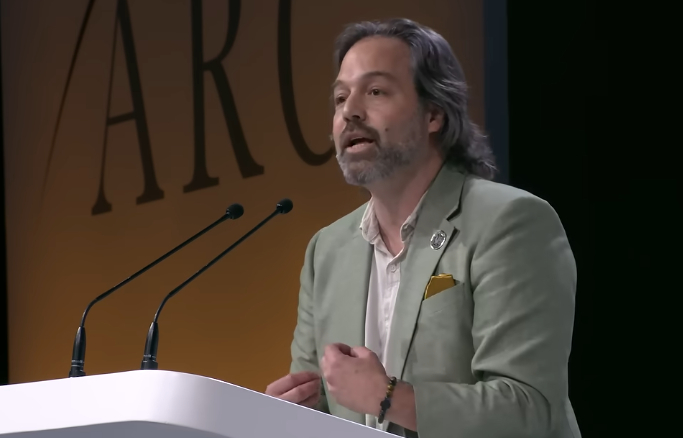
Read the full transcript of YouTuber Jonathan Pageau’s keynote speech at ARC 2026, June 25, 2026.
Editor’s Note: In this provocative speech, Jonathan Pageau examines the rapid rise of AI through the lens of ancient storytelling, warning that our obsession with technological efficiency and power threatens to turn our society into a “wasteland”. Drawing a parallel to the legend of the Grail Castle, he argues that we are mindlessly pursuing technological abundance while failing to ask the vital question: whom does this technology serve? Ultimately, Pageau suggests that the only way to retain our humanity and survive the digital age is by intentionally fostering virtue, wisdom, and genuine human connections rather than succumbing to the machine’s influence.
Old Stories and the Challenge of the New
JONATHAN PAGEAU: I love old stories and we’re sometimes told that old stories have little to offer in finding solutions to the challenges we face because our problems are so novel. This I believe is unwise. It’s true that in the Middle Ages we did not have Claude or ChatGPT, but we hear that Albert the Great created a bronze head that could answer any question. And even later legends recount that his student, a certain Thomas Aquinas, who you might have heard of, annoyed with the head’s constant yapping, smashed it to bits. And this is the first known reaction to AI slop that we have in history.
The ancient wisdom often contains gold so pure, its brightness can reflect on situations even the ancients could not imagine.
The Story of Balin and the Grail Castle
So I want to tell you a story. It’s a very important story, especially as we are here in Great Britain. Long ago, in the Grail Castle, where both the Holy Grail and the Holy Lance of Longinus were kept in a chapel, a knight named Balin entered this castle. He entered in hospitality, but he was secretly there to kill one of the guests and therefore betraying the ancient code that has held civilization together for millennia.
After the murder, Balin was chased through the halls of the castle until he found himself in the Grail Chapel. So seeing the lance that had pierced the side of Christ and the cup that had received his blood, he was too blinded by his rage to discern the deepest purpose of these objects. Balin grabbed the lance and dealt a blow to the groin of the Grail King, making the king impotent and reducing the entire kingdom to a wasteland.
The Holy Grail and the Lance as Technology
We often think of the Holy Grail and the Holy Lance as these mystical objects, but there is a way, and a very important way, in which they are examples of technology. The Grail Cup was a vessel constantly filled with all that one could desire to eat and drink. It was the generator of abundance. And the lance, of course, was the weapon that had dealt the ultimate blow, piercing the God-Man himself.
These two objects contain the limit cases of technology, that towards which all technology leans. One side moves inward to the increase of abundance, and the other moves outward to the battles necessary to gain or protect that abundance. And from the dawn of time, these have been two main purposes of technology. The same piece of sharpened flint could kill the soil or could kill my enemy.
The Most Important Question: Whom Does the Grail Serve?
After the murder in the chapel, the Holy Grail was lost, and King Arthur’s knights went on a quest to find it. We usually focus on the quest to find the Grail, but we often forget the most important part of the quest. The knight who finds the Holy Grail must ask a question: “Whom does the Grail serve?” The question is more important than the finding. The question and its answer is what will heal the wasteland.
It is precisely this question that Balin forgot to ask when he grabbed the lance in his desire for power. He forgot to ask the question, “Whom does the Grail and the lance serve?”
Today, our world has come to celebrate those who find the Grail. The tech miracle, the new, the faster, the stronger thing. These discoveries make us more powerful, more efficient in generating abundance, and more efficient and powerful in killing our enemies. So we celebrate those who find the Grail. But who today is asking the Grail question?
Those Who Are Asking the Grail Question
There are a few who ask the question. When Ross Douthat, who was here this morning, asked Dario Amodei, the CEO of Anthropic, why he named his hopeful tech essay Machines of Loving Grace — named after a poem in which humans lose their sovereignty and become like animals ruled over by machines — I think Ross was asking the Grail question. When Jonathan Haidt wrote The Anxious Generation, documenting our children’s screen addictions and its effect on their health, he was asking the Grail question.
Who Does the Palantir Serve?
But what is strange is that often the people who develop these new technologies are the same people telling us that it might just as well bring about a wasteland, warning us of how it might kill us as they themselves reach for the Lance. How is it that Elon Musk warns that AI is more dangerous than nukes, first begs everyone to stop developing it, and finally starts his own AI company?
Are you not all eager to ask who the Palantir serves? Who does it serve? I mean, we’re not fools. We know that in the story from which the name Palantir was taken, in The Lord of the Rings, this technology came to serve only the Dark Lord Sauron. When the tech oligarchs are building bunkers on islands and prepping for doomsday, we should all be screaming, whom does this serve? Who is this for?
The Moloch Trap
There has been a lot of talk in the past decade about game theory escalation traps, where for reason of competition, certain technologies and systems, no matter how dangerous they might be, must be implemented.
And not only implemented, but we race to implement them, for fear of losing the competition. Of course, this was true of the nuclear arms race. It’s what many now famously call the Moloch trap. And suddenly we’re back in ancient stories. Stories that are far older than the story of the Grail.
Moloch, as many of you probably know, is an ancient Canaanite deity that demanded that people sacrifice their children in exchange for power. And the Moloch trap is when escalation to maintain power, through competition, causes us to sacrifice what is most precious, even when it is ultimately against our interests. So out of fear of China beating us at implementing AI, we sacrifice the millions of jobs, our water, our energy, our children’s minds. In fact, we sacrifice the very capacity to distinguish what is real from what is false, just so we can win the competition.
Now of course, the game theorists, most of them, they don’t believe that Moloch has any kind of independent existence. It’s more like a mechanism. But even the game theorists can see that Moloch is moving, that it wants something. And as we compete with each other, we become its legs, we become its hands. And despite ourselves, we march this beast to our possible destruction.
As finally everyone is finally regretting giving their children tablets and phones, making them dumb, depressed, and addicted, we turn around and we rush to integrate AI into absolutely everything. So whether we believe in the Canaanite god or not, we find ourselves sacrificing our children to it nonetheless. As Jordan Peterson has often said, we act as if it is real. And that is enough for the beast to keep moving.
Are We Building a God?
And what we see happen is that as AI rushes through all our systems, we have this intuition that instead of a tool serving us, maybe we are becoming the one serving the tool. And we find, as Marshall McLuhan famously predicted in the 1960s, that we are being reduced to becoming the reproductive organs of the machine.
Are we building a god? Are we? Some people think we are. Some people making it think we are. If so, what god are we building? If an out-of-control Moloch trap and possibly the worship of Mammon are leading its development, what do we do?
We are in the trap. The trap is real. I’m not pretending it’s not real. But I don’t know. I don’t know what to do. You don’t know what to do. No one knows what to do. At the system level, we don’t know, we’re trapped. The cat, or rather the snake, is out of the bag. Can’t put it back now. Balan has already dealt the dolorous stroke in a frenzy of power and greed and competition. And we wait and we’re told we will face now an upheaval so great it will rival anything humans have ever experienced since the beginning of time. So just buckle up, right?
The only solution, the only real solution I can think of is the personal solution.
Becoming More Human Than Before
The solution is similar to how Jordan Peterson told us to make your bed. I have a slightly different version of the statement. I say, go to church. So I mean, obviously what I mean by go to church is, yeah, you should go to church, definitely go to church. But the larger question is that if we cannot get an answer of who these technologies serve, please know who and what you serve. Do you serve Mammon? Do I serve Moloch? Who do we serve?
If we cannot stop the machine from devouring everything, then you, then I, must become truly human, more human than before, so that we can remain at least in our life the master of the machine and not the slave of the machine. And we’re in the right place because we must become responsible citizens. That’s what we’re here for. But also responsible parents, responsible teachers, responsible students. For our own sake, but really for the sake of all of us.
Back to the Humanities
You know, since the Industrial Revolution, people increasingly treated education as something like learning a skill so you can get a job. I think you’ve all realized that those days are over. I say back to the humanities. They will become the most important. Make humans. Become fully human. Become the best human you can be.
You know, when we teach our children to dance or to play music or to play sports, most of us aren’t doing it so that our children will become professionals. We teach them these skills so they become more human. And now that’s what we’re going to have to do with everything. If AI pushes us to place memory and skill and knowledge out there, we will have to deliberately foster memory, skill, and knowledge in here.
Learn poems, read fairy tales, go camping, grow a garden, be involved in your community, your family, your relationships, and don’t forget to pray. This is of course existentially obvious, and it might sound a little sappy when I say it. I get it. But I think it’s actually technically the solution to the problem we’re facing.
The Danger of Becoming Vassals
These technologies are making us dumber. They’re making us vassals. This young generation is the first in recorded history that has a lower average IQ than their parents. So I don’t think the solution is going to Mars, folks, or even going to Alpha Centauri. And I’m sorry, Eric Weinstein, if you’re here. If we send TikTok-addicted, AI-slopped minds to Mars, it won’t change a single one of our problems.
And it’s the same. It’s not merging with the machine or having chips in our brain, Elon. None of this will make you virtuous. And what we’ll just end up with is very powerful, broken people. Those who have made themselves completely dependent in mind and habit to these technologies will become vassals of the monster.
Shining Souls Will Survive and Thrive
And I really believe that it’s only those who have shining souls, who have fostered wisdom and virtue, who have practiced truth and love, they’re the ones who will survive and thrive in the incoming AI apocalypse. Personally, communally, and I think even professionally. Whether things work out and AI becomes ubiquitous and is just there to help us, or whether it leads to the wasteland, I think there’s still only one solution. Become fully human.
The kind of humans we admire from our great stories. The kind of humans who serve more than their greed and their power. And then, then, if we build, when we build, what we build will be in that image. And when we are faced with the grail, we’ll have the wherewithal to ask the question, whom does the grail serve? And ultimately, we’ll have the presence of mind to ask and answer what I think is the most crucial question of all, which is, whom do I serve? Thank you.
Related Posts