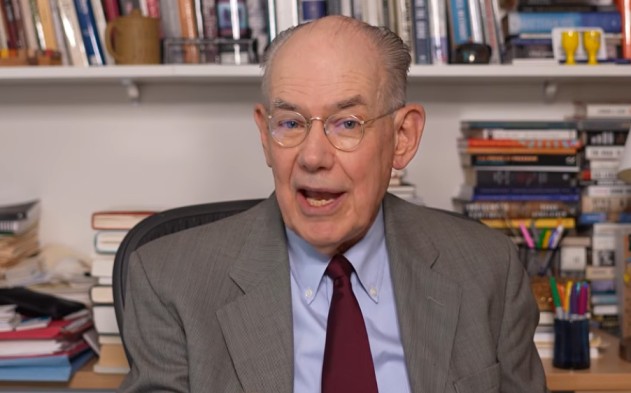
EDITOR’S NOTE: In this episode, political scientist John Mearsheimer analyzes the expiration of the June 17, 2026, Memorandum of Understanding between the United States and Iran, and evaluates whether a renewed U.S. naval blockade can force the reopening of the Strait of Hormuz. He reviews the failed original American war aims, the four phases of the ongoing conflict, the severe constraints facing the U.S. Navy and economy, and Iran’s strengthened position under hardline leadership. Mearsheimer concludes that the blockade is unlikely to succeed and that escalation offers no viable path forward.
JOHN MEARSHEIMER: And if the first blockade failed, why should we expect the second blockade to succeed? What’s changed here? The West is leading Ukraine down the primrose path. I mean, the Israelis are executing a genocide in Gaza. It’s not China’s fault that it wants to be powerful.
So if you get into trouble and you dial 911, there’s nobody at the other end.
Hi. This is John Mearsheimer. Today is 08/17/2026, and today is the day that the memorandum of understanding that was signed by Iran and the United States on June 17 expires. The original memorandum of understanding called for sixty days of negotiation, and it was assumed that at the end of those sixty days, there would be an agreement.
And at that point, the memorandum would expire. Well, sixty days have gone by, and there’s obviously been no agreement. But the memorandum of understanding has definitely expired, and there’s no effort being made to extend it. So the question is, where are we today in the absence of the Memorandum of Understanding?
The Shift to a Naval Blockade
And it seems quite clear that what has happened is that the United States has decided that it’s going to depend on its naval blockade of Iran to achieve its goals. So what I’d like to do today is just talk about what a naval blockade today is likely to be able to achieve for the United States, given that we don’t have any prospect of a new memorandum of understanding. What can a blockade do for the United States? Is it a viable alternative for getting our way?
Now, the best way to start is just to talk about what our goals are, and then talk about what Iran’s goals are. And you want to remember that when we talk about Iran’s goals, we want to talk about the United States thwarting Iran’s goals.
So the United States, in a very important way, has two sets of goals here. One is to achieve its own goals, and number two, to thwart Iran from achieving its goals. So let me start by talking about what America’s goals are and then look at Iran’s goals. And then we can talk about how well suited a blockade is at this point in time for us, the United States, to achieve its goals.
America’s Original Goals
When the war started back on February 28, the United States had four goals.
Number one was regime change. Number two was to put an end to Iran’s nuclear enrichment capability. Number three was to put an end to Iran’s long-range missile capability. And number four was to end Iranian support for the Houthis, Hezbollah, and Hamas. Those were the big four goals.
The United States, of course, has achieved none of those goals. None of them have been achieved, and there is no chance that any of the four are going to be achieved. So the question we then have to ask ourselves is, what are America’s goals at this point in time? Vice President Vance said last week very clearly that we have two goals. He said that the first and most important goal is to open the strait.
He said the second goal is to get a nuclear deal. This is actually quite remarkable, because when we went into the war, what mattered more than anything else was the nuclear issue. And, of course, the strait was opened on February 27, so the whole idea of opening the strait was not even on the table right before the war started. It was the nuclear issue that really mattered. So here’s Vice President Vance saying that our principal goal is to open the strait, and our secondary goal is to get a nuclear deal.
By the way, President Trump’s spokesperson has said that as far as President Trump is concerned, those two goals are coequal. So he has a slightly different view of things than Vice President Vance’s. But nevertheless, you can see how important it is for us to open the strait as soon as possible, and that is obviously for economic reasons.
Iran’s Goals and Demands
Now, what we want to do is switch gears, and we want to talk about what Iran’s goals are. And you want to keep in mind that what the United States wants to do is make sure that Iran does not achieve any of its goals, if that’s possible, or that all of its goals are denied.
Let me put it differently: that we want to make sure that Iran doesn’t achieve all of its goals, and in the best case, minimize the number of goals that Iran achieves. The Iranians do want to open the strait.
There’s no question about that. Like us, they want to open the strait. Like us, they understand it’s in their economic interest to open the strait. But the Iranians say that they won’t open the strait unless the United States meets a number of other demands — not through negotiation, but right away. In other words, the Iranians say, we’ll open the strait if you agree to lift all sanctions on Iran.
If you agree to unfreeze all of our frozen assets, if you agree to pay reparations, if you agree that we control the strait, if you agree that we can collect fees, if you agree to remove American military forces from the Gulf region — these are the demands that the Iranians have.
And the Iranians are saying the United States has to meet all those demands before they will open the strait. Now, obviously, the United States is not interested in accepting all of those demands. But the Iranians have made it clear that the United States has no choice. What we want to do is minimize the number of demands that we are forced to accept.
The Iranians say there will be no minimization. You have to accept all of those demands before we will agree to open the strait. And again, you want to remember that America’s principal goal is to open the strait. So the question is, how can we achieve our goals? And blockade is the strategy of the day.
A Timeline of the War
But I want to say a few words about what our strategy has been in the entire war, so that we can put where we are today with the blockade into a broader context. As you remember, the war started on February 28, and we started with a major strategic bombing campaign, an air campaign that lasted for forty days, from February 28 to April 8. Then there was a ceasefire on April 8. There were some negotiations that went nowhere. And then on April 13, the United States moved to a naval blockade.
So you see, this is the first time we tried a blockade, and the blockade that is now in place is the second instance of a blockade. So we went from an air war in the first forty days of the war, up until April 8. Then, on April 13, we moved to the first blockade. And that first blockade lasted from April 13 up until June 17, when the memorandum of understanding was signed. So that’s a way of saying that the first blockade lasted about two-plus months, and it did not work.
We ended up signing a memorandum of understanding on June 17, and that MOU, of course, is what put an end to the first blockade. But that memorandum of understanding was extremely favorable to the Iranians. It was a memorandum of understanding that the United States did not like, because the United States understood it was a surrender document. But nevertheless, the United States signed it. And the United States signed it because the blockade did not work.
And before that, the air war did not work. Then, what happens in early July is that the United States and Iran get involved in a tit-for-tat strategy. This starts on July 7, and it lasts until about July 31. And it basically involves the United States and Iran engaging in a limited air war, where they bomb specific targets on each side.
In other words, the United States bombs targets in Iran, and the Iranians bomb targets in Kuwait, Saudi Arabia, and so on. And this lasts, again, from July 7 to July 31. Then the tit-for-tat campaign comes to an end, and the United States moves to the second blockade. The second blockade actually starts on July 14, which is in the middle of the tit-for-tat campaign.
So there’s a period where you have the tit-for-tat campaign taking place, and you have the second blockade. But as I said before, on July 31, the tit-for-tat campaign comes to an end. The United States has basically had enough. So all that’s left is the blockade — the second blockade — and that’s where we are today.
Assessing the Second Blockade
Now, the question we have to ask ourselves is, given that the memorandum of understanding has expired and there’s no prospect of a new memorandum of understanding, and given that we’ve given up on tit-for-tat, given up on a major bombing campaign, given that there’s not going to be a land option — what will a blockade do for the United States in terms of achieving its objectives?
Now, we know that the first blockade didn’t work. So the question is, what about the second blockade? Now, it’s important to start by saying that at the end of last week, the Secretary of the Treasury, Scott Bessent, said that this week, starting today, we are going to inflict unprecedented economic hurt on the Iranian economy. So, in effect, what he was saying is that in addition to the blockade — and this naval blockade is designed to inflict economic hurt on the Iranian economy — we’re going to do something special this week, and we’re going to deliver unprecedented economic hurt. Now, let’s evaluate how well this is all likely to work.
First of all, it’s hard to believe that there’s more economic hurt that we can inflict on Iran. We’ve really maxed out at this point. What is the United States going to do to further damage the Iranian economy that it hasn’t already done? Bessent hasn’t told us — he’s made this vague claim, but he hasn’t told us how this process works. I would argue that there’s virtually nothing the United States can do to create unprecedented economic hurt.
So this brings us back to the question of the blockade. What is the likelihood that this blockade is going to produce a favorable outcome for the United States? In other words, what is the likelihood that this blockade is going to allow us to achieve our own goals and limit the number of goals that Iran can achieve? Well, the first point you want to keep in mind is that the first blockade failed. And if the first blockade failed, why should we expect the second blockade to succeed?
What’s changed here? And, by the way, you want to remember that the first blockade, as I said, lasted a little over two months, from April 13 to June 17 — and it didn’t work. Again, we signed the memorandum of understanding, which is basically a surrender document. Well, the present blockade has been going on since July 14.
It’s a little over one month, so we haven’t even reached the two-month period here. And you want to keep in mind, as I talk here, that blockades only work over a long period of time. Almost everybody agrees that blockades do not produce instant results. So for this blockade to work, it’s going to have to be in place for a long period of time. We’re not going to get instant results.
The Weakened State of the US Navy
Now, there are very good reasons to think that we, the United States, are in a worse position today in terms of implementing this blockade than we were when we started the first blockade on April 13. Now, why is that the case? One reason is the state of the US Navy. It’s quite clear that the US Navy is suffering in significant ways from the wear and tear of being deployed to the Gulf for a long period of time. And we see this with the case of the USS Abraham Lincoln.
This is the large aircraft carrier where there has been huge dissatisfaction among the crew members. Because of the demands of this naval campaign against Iran, the United States has been forced to deploy ships like this carrier, the Lincoln, and destroyers and other ships as well, for extended periods of time in the waters around Iran. And the troops on these ships have not been getting proper food, and they have not been in very good living conditions, and all sorts of trouble has broken out on the Lincoln. There’s evidence that some of the sailors were thinking about jumping off the side of the carrier. There’s evidence that fights had been breaking out, and so on.
So, actually, what’s happened is that the Lincoln has been taken off station, and it’s being replaced by another carrier, the USS George Washington. Now, it’s very important to emphasize that it’s not only the Lincoln that is suffering from these problems — destroyers and other ships that have been deployed for extended periods of time are also having all sorts of logistical problems. So my point here is that for purposes of implementing a protracted blockade — and blockades, by definition, are protracted — the US Navy is in terrible shape to accomplish that mission. There’s just been so much wear and tear on the US Navy that it’s not clear it can keep a successful blockade in place for many more months.
There’s an additional issue at play here, and that is that the Navy, at this point in time, is small enough that it’s only capable of focusing on one theater of operations at a time in a major way.
Consequences for East Asia
And what this means is that because we are focusing laser-like on the Middle East, or on the Persian Gulf, or on Iran, what we are doing is weakening ourselves in East Asia. And you want to remember that in East Asia, where the United States is interested in containing China, naval forces matter greatly. Naval and air forces matter much more than land forces in East Asia when you talk about containing China. But what’s happening here is that the United States is being forced to pull forces out of East Asia and send them to the Persian Gulf, and this is true with regard to naval forces. As I said before, given the consequences of the logistical problems that the Abraham Lincoln faces, it’s being taken off station, and it’s being replaced, as I said, by the USS George Washington.
The question you want to ask yourself is, where is the George Washington coming from? And the fact is, it’s coming from East Asia. It’s normally stationed in Japan. This means there’s going to be no aircraft carrier in East Asia. This is not good from a strategic point of view when you think about containing China.
Oil, Sanctions, and the Wider Economic Toll
So not only is the wear and tear on the US Navy limiting its overall capabilities, but the focus on Iran and keeping a blockade on Iran is also weakening America’s position in East Asia vis-à-vis its most important threat, which is China. There are additional problems with the blockade. One is that as long as we keep the blockade on and the Iranians keep the blockade on, what we are doing is greatly limiting the amount of oil that comes out of the Persian Gulf, because both sides are, in effect, blockading the Strait of Hormuz. This means that there’s less oil to appear in global markets. Furthermore, because there has been a huge conflict between the Houthis and the Saudis, and the Houthis have basically shut off the Bab-el-Mandeb Strait, which is where Saudi oil comes out of the Red Sea.
Saudi oil is now not only reduced coming out of the Persian Gulf through the Strait of Hormuz — it’s also not coming out of the Red Sea through Bab-el-Mandeb. And it is imperative to have lots of Saudi oil on global markets. But that’s no longer the case. This is not to deny, of course, that some ships do get through, either through the Strait of Hormuz or the Bab-el-Mandeb Strait. Some Saudi ships do, but not many.
So the amount of Saudi oil that was coming out of the Gulf on February 27 has been greatly reduced. And this is a huge problem for the international economy. So there are all sorts of economic incentives to open the strait. I might also note that if you look at the Strategic Petroleum Reserve in the United States, and the strategic petroleum reserves in other countries, it’s quite clear that we have significantly drawn down those reserves to make up for the fact that so much oil is now not coming out of the Gulf. And the question is, how long can we depend on drawing down oil from those strategic petroleum reserves in places like the United States to deal with this problem of missing oil from the Persian Gulf?
Hardliners in Control in Iran
Now, another very important dimension to this is that if you look at what’s happened inside of Iran, the hardliners are now in control. And the hardliners are not interested in reaching any kind of accommodation with the United States. They are interested in driving a hard bargain. They are interested in telling the United States that it has to meet all of Iran’s demands, which I described before, before Iran will agree to open the Strait of Hormuz. And, in addition to that, these hardliners who are in charge inside of Iran are making it perfectly clear that they want to initiate military action against the United States and its allies in the Persian Gulf.
They believe that the best defense is a good offense. So if you look at the hardliners who are now in control in Iran, they are bent on causing the United States more trouble than ever. They are interested in taking the initiative. They are interested in being proactive. So the United States now faces a more dangerous adversary in Iran, in addition to the fact that the economic situation is deteriorating for the reasons I just described, and in addition to the fact that the US Navy is in bad shape for purposes of implementing a protracted naval blockade of Iran.
Why There Is No Escalation Option
So the situation does not look good at all. Now, one might say, “Okay, you’ve convinced me that the blockade is not likely to work, but maybe what the United States can do here is go back to a tit-for-tat strategy, or maybe the United States can go back to a major bombing campaign like we saw in the first forty days.” In other words, we do have an escalation option. But this is not true.
We don’t have an escalation option. In fact, we don’t even want to go back to a tit-for-tat strategy. And there are basically three reasons for that. One, we have a significant shortage of munitions. And the last thing we want to do is get involved in a tit-for-tat campaign where we have to use up even more of those precious munitions.
Furthermore, our Gulf allies have zero interest in seeing the war start back up again, because they understand full well that they will be targeted. The Iranians have made that clear. And, of course, in the past, the Iranians have targeted our Gulf allies. So our Gulf allies are saying no more escalation. And then, finally, there’s the economic consequences.
At this point in time, President Trump cannot afford to restart the forty-day bombing campaign, or even engage in a tit-for-tat campaign. He has got to open the strait. That’s why Vice President Vance said our principal goal is to open the strait. We have to open that strait for economic reasons. So tit-for-tat is not even a viable option for the United States, much less starting the forty-day campaign.
The Omani Channel Incident
And to drive that point home, let me tell you a story that shows you how little interest we have even in escalating to a tit-for-tat campaign. As I said before, the tit-for-tat campaign started on July 7, and it lasted until July 31. Remember, we had first the strategic bombing campaign, then we had the first naval blockade, then we had the tit-for-tat campaign. It started on July 7. Now, why did it start?
How did the tit-for-tat campaign begin? On July 6, the Iranians attacked three cargo vessels that were trying to come out of the Strait of Hormuz through the Omani Channel — the channel close to Oman that the United States, in effect, helped control. The Iranians made it clear to us that that was unacceptable. No ships coming out of the Gulf could go through the Omani Channel, said the Iranians.
Well, on July 6, there were three ships coming through the Omani Channel in the Strait of Hormuz, and the Iranians opened fire on all three of those ships. This is July 6. The next day, the United States started the tit-for-tat campaign by attacking targets inside of Iran. The Iranians, of course, retaliated, we retaliated, and so on. And this tit-for-tat campaign lasted from July 7 to July 31.
The key point I want to make here is that what started it was that the Iranians attacked cargo ships going through the Strait of Hormuz, and the United States said that is categorically unacceptable, and therefore we went to the tit-for-tat campaign. Well, if you look at what’s happening today, the Iranians are attacking cargo ships in the Strait of Hormuz on an almost daily basis. They make no bones about it. And the question you want to ask yourself is, what is the United States doing? Is the United States retaliating?
Is the United States showing any interest in going back to a tit-for-tat strategy? The answer is no. And the reason is that the United States has zero interest in escalating to a tit-for-tat strategy. So what we have here is a very interesting situation, if you think about it. If escalation does take place in the Gulf, it’s not the United States that is likely to initiate that escalation.
It is the Iranians who are likely to initiate that escalation, because the leadership in Iran, very clearly now, is interested in playing hardball with the United States from a military perspective. As I said before, from an Iranian point of view, they believe that the best defense is a good offense. So they are willing to escalate because they believe that the United States will not retaliate. Now, it is possible the United States will retaliate at some point, but that will not solve our problem.
Conclusion: A Weak American Hand
So you see what’s happened here is that, over time, the United States has failed to achieve any of its objectives — whether we’re talking about the four big objectives it started the war with, or opening the strait and getting a nuclear deal, which are its two objectives today. And at the same time, it’s in a situation where it looks like it has little choice but to cave in to Iran’s major demands, because the United States has no strategy. It has no military option for achieving its goals and preventing Iran from gaining its goals. It’s been forced into a situation where it has to rely on the blockade. And, as I said before, the blockade didn’t work the first time, and there’s no reason to think it’s going to work this time, because the situation for the United States in terms of implementing a blockade now is worse than it was between April 13 and June 17.
And if you think about it, what’s happened here is that the Iranians have really turned the tables. The Iranians are now the party in this conflict that is most likely to cause escalation. In the beginning, that obviously looked like the United States. It looked, in the very beginning, like the United States held all the cards. But as this conflict has worn on, and as we’ve come to understand here on August 17, we have no military option.
Escalation would be disastrous for us. And if anything, it’s the Iranians who believe they have a military option, and they believe they can escalate. All of this is to say that it’s hard to see how the United States can achieve even a limited victory in this conflict with Iran. It looks to me, here on August 17, like the United States has little choice but to surrender to virtually all of Iran’s demands if it hopes to open the strait and avoid an economic catastrophe. That concludes my video for today.
Thank you all for listening, and I look forward to the next time that we talk.
Related Posts