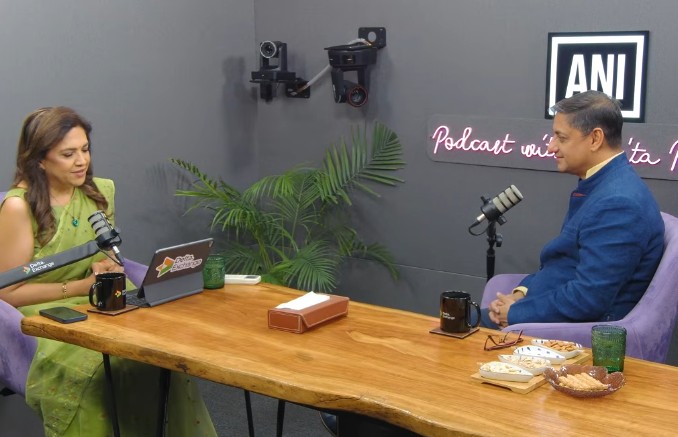
Read the full transcript of Economist Sanjeev Sanyal’s interview on ANI Podcast with host Smita Prakash, August 19, 2026.
EDITOR’S NOTE: In this episode of the ANI Podcast hosted by Smita Prakash, economist, historian, and member of the Prime Minister’s Economic Advisory Council Sanjeev Sanyal examines India’s education crisis, the coaching industry, and rising youth unemployment amid a mismatch between degrees and real-world skills. He also discusses the country’s economic resilience, taxation levels, the role of AI, demographic shifts, and initiatives to revive India’s forgotten maritime heritage, including the voyage of INSV Kaundinya. The conversation offers a wide-ranging perspective on the reforms needed to prepare India’s youth for the future while rebuilding civilizational confidence.
Opening
SMITA PRAKASH: Namaste, Jai Hind. You’re watching or listening to another edition of the ANI Podcast with Smita Prakash. My guest today is author, historian, and economist Sanjeev Sanyal. He’s a member of the Economic Advisory Council to the Prime Minister of India. Sanjeev Sanyal is not just a government economist — he’s one of India’s most prolific thinkers on economics, history, and civilizational issues. Whether it’s growth, urbanization, climate change, or India’s place in the world, he’s rarely shied away from challenging conventional wisdom.
Thank you, Sanjeev, for coming on the podcast. Looking forward to this conversation. Last time you were here, you were about to set sail, and then you had this successful voyage. I’ve heard all your podcasts after that about the experience. I’ve heard you on stage at the Raisina Dialogue talking about that experience too. So we’ll get to that towards the end of the podcast.
But I have to begin with the news, of course, about the youth protests, the paper leak, and the education system. I can well understand that you don’t want to speak about the protest as in the protest and the street anger. But what is the way forward for our youth, as per what you think should happen to the education system? Do you think the NEP is enough? Is it anger against the NEP, or is it just NEET? What do you think?
Is the NEP Enough?
SANJEEV SANYAL: No, I think there are a lot of things that need to be done about the education system. And in some ways, we have to understand that the NEP was written in a pre-AI world. So in some ways, we need to now begin to enhance it and move on. There are some very good things in the NEP, but we do need to realise that the world we are now entering is already a very different one from the one in which the NEP was written.
So first of all, let’s just talk about the NEET issue. Don’t forget what the world was like before it existed — it was a world of multiple exams with capitation fees and so on. So let’s not throw the baby out with the bathwater. The whole reason you wanted this was to create a standardized system where you take one exam, and hopefully young men and women can prove themselves in that field.
Now, I understand that any single exam you create will have its own issues, and I’m not getting into how the exam should be run and so on. Of course, there’s no excuse for paper leaks and so on, and we are fixing that. But let’s go one step back to the whole theory of why we have them at all. The earlier system was a riddled and complex system that was extremely leaky. It’s the same thing with GST — you can complain all you want about how the GST system should work better, but to say that the NEET system is not an improvement on the previous system is simply missing the point. After all, what is the other system?
So yes, we need to make this one work. But let’s not let the debate be about whether NEET is a bad system — let it be about how to make it work. I’m sorry, the alternatives are much, much worse.
SMITA PRAKASH: Okay, it needs tweaking.
SANJEEV SANYAL: Yes, we need to do — there can be other things.
SMITA PRAKASH: I mean, there can be remedial measures.
SANJEEV SANYAL: Absolutely. And there’s a whole committee that’s been set up now. So I can’t speak for them, but there are options, and others have spoken about it, and I can speak about some of them. You can have this exam multiple times a year — that’s one thing people have talked about. It could be done much more purely, using an online-type system with a question bank that gets randomly thrown up at the examinee.
SMITA PRAKASH: Technology.
SANJEEV SANYAL: Technology is one way of doing it.
SMITA PRAKASH: Sure.
SANJEEV SANYAL: The other thing we need to think about is how do we stretch this out. For example, there are other things happening at the same time. This is one — fixing the current system. But I have on other occasions talked about the fact that we are now entering a world where the way of providing tertiary education may itself fundamentally change.
Lessons from China’s Examination System
SMITA PRAKASH: Hold that thought — I will come to you on the larger picture. But there’s an article by Pallavi Aiyar that talks about China and India and the entire examination machinery in China. She says there is extraordinary attention to getting it right, and China realises that you can’t go wrong. There’s a gaokao method of examination, and nobody objects to it. They already had a street protest in 1989 over grievances with the system, they got it corrected, and now they have this meticulous way of doing it — even the place where the papers are printed, the wastage, the garbage — all of it is tracked. So, first of all, just as a matter of history, this system of using nationwide exams as a means of recruitment is essentially a Chinese invention.
SANJEEV SANYAL: They have been doing this for thousands of years.
My own view, as far as India is concerned — yes, we do need a good, well-oiled machine. There’s the integrity of the examination system itself: how the questions are set, making sure those questions are not leaked, and making sure the results are commensurate with the performance of the student.
SMITA PRAKASH: Because she says the exam papers travel and are stored like state secrets — GPS-tracked vehicles, police escort, teachers with facial recognition.
SANJEEV SANYAL: That could be done. We may not need to do it quite in that way because, as I said, there are now technological ways of doing it.
SMITA PRAKASH: No, but making sure there’s no cheating —
SANJEEV SANYAL: Absolutely.
SMITA PRAKASH: — and it’s not just NEET, it’s every exam.
SANJEEV SANYAL: And that’s why I’m saying I agree. We used to have a major problem with cheating — we still do in some places. UP used to have a serious cheating problem.
SMITA PRAKASH: Bihar and UP.
SANJEEV SANYAL: Then there used to be problems with examiners and how they marked papers. So there was a whole bunch of things. And by the way, we are making changes — in transition, there will be some problems. But, for example, the CBSE providing mark sheets online is a huge step forward in terms of transparency in how the whole thing works.
SMITA PRAKASH: And not just examining once — in case there’s a problem, you have a headache, you have — you know, getting that right.
SANJEEV SANYAL: Absolutely. Getting the exam system right is absolutely critical. There’s a lot to be learned from the Chinese, but the Americans also run the SAT/GRE system.
SMITA PRAKASH: Yeah.
SANJEEV SANYAL: So there are many things to learn, and I’m not making excuses about whether or not this has to be got right — it’s an important —
SMITA PRAKASH: The SATs do have issues too. I want to bring this up —
SANJEEV SANYAL: Any system will have issues.
SMITA PRAKASH: We’ll have issues.
SANJEEV SANYAL: So the point is, can you run this as well as reasonably possible and try to keep improving it? Now, there is, by the way, a side issue that isn’t part of the exam system itself but needs to be part of this conversation — the coaching class system. Much of the subversion of the exam system, even in China, used to happen through coaching classes. You should read about how they cut down on the coaching classes there by improving the public school system. Not just that — they have cracked down directly on the coaching class system. In any case, whether they do it or not, the fact is that the way our system works, a lot of the deliberate subversion of it — which is done by what I would even go as far as to call a mafia — needs to be properly looked into.
SMITA PRAKASH: So when Pallavi’s article came out and the India-China comparison came up, Shashi Shekhar said that running the planet’s only billion-people democracy has neither a parallel in geography nor a precedent in history, and that those who want China-style economic opportunity with Western European-style liberalism need to ponder that. Do we have to choose between one and the other?
SANJEEV SANYAL: No, I don’t think so, not in this particular space, because this isn’t about personal rights and freedoms. This is about running an exam system. It’s a system the Chinese do a good job of. There are many other countries that do a good job of it too, and there’s something we can learn from the Chinese — we should.
SMITA PRAKASH: And historically, you said they cracked down on the coaching systems.
SANJEEV SANYAL: In any case, even if the Chinese hadn’t, so what? We have a problem — we should do something about it.
The Employability Problem
SMITA PRAKASH: There is also anger among the youth. What I’m getting to is a study by Azim Premji University, which says that 1.1 crore — 11 million — graduates aged between 20 and 29 were unemployed in 2023. Out of that, roughly 6.3 [million] graduates in that age group — they are angry because they don’t have jobs. So I want to know from you: is the anger on the streets also about all these people who have graduate degrees and no jobs?
SANJEEV SANYAL: How do you see this? So, obviously, India has had for a while — and many countries have this — people in their twenties doing various things and being effectively unemployed in some fashion. Either because they are preparing for exams, as happens very often in India — if you ask people what they do, they’ll tell you, “We are aspirants.” They’re usually preparing for the UPSC or something like that. Now, is that unemployment? I would argue not — this is clearly an optional thing they are doing. Similarly, there are other forms of this — people doing things on the side, gig-type jobs, for example. So it is not the case that everybody classified in that report is actually unemployed in that sense. They are doing something, and they are doing it voluntarily.
Now, having said that, there is one significant issue we need to pay attention to: a lot of the graduates coming out of our system are not adequately trained in the areas where jobs are being generated. If you talk to companies — even large companies, but particularly SMEs — they will tell you they actually have a shortage of people; they can’t hire enough people with the right mix of skills, but also the right kind of motivation to work.
So on one hand, we have an economic system, industries, etc., telling us they are unable to hire the right kind of people. And on the other, people like Azim Premji [University researchers] saying there are people who can’t find jobs. So there is, rather than an unemployment problem, an employability problem that needs to be thought about rather seriously.
Now, in this context, let me say I think we do need to begin directing our education system much more clearly towards careers, jobs, and skills than we have in the past. A lot of the problem comes from liberal arts degrees that no longer give usable skills. This happens for many reasons, but one of the major reasons is a serious social and cultural problem about what we consider to be employable skills — how we accept certain kinds of skills, vocational skills, for example, as being actual education.
SMITA PRAKASH: They’re not considered quality jobs. So you come out with a sociology major, and you don’t want to become a foreman —
SANJEEV SANYAL: Yes. So, in fact, let me take your exact example. Let’s say there’s a young man who went to work in a factory at 18, and by the time that 18-year-old becomes 28, he’s worked for 10 years on the factory floor at, let’s say, a Maruti or Hyundai plant. Ten years later, he’s probably a reasonably senior person in that system. Earns a good salary. Probably has very high skills — maybe fixing robots and doing a pretty complex job — and has good prospects because he’s now at the cutting edge of that field as it becomes even more automated. He will probably do well.
Now let’s say this same person goes into the marriage market, and let’s say the person he wants to marry — his girlfriend — is a sociology major from, say, St. Stephen’s College. I can assure you that the girl’s family will think she is marrying down.
SMITA PRAKASH: Yes.
SANJEEV SANYAL: Whereas it is not at all the case, if you look at the skill levels of the two people. I mean, English honours — what is the skill? That skill is something an artificial intelligence system, an LLM, can do much better than any human being.
SMITA PRAKASH: But even in the skilled job — for example, you spend three years, say, selling food or driving a car for an app-based service, and for three years you’re doing that, maybe you’ve paid back your student loan by doing that — but even economists say they don’t classify that as secure and productive employment.
SANJEEV SANYAL: So I think here we have to get a little away from that framing. What is “secure and productive”? I don’t think any economist would be able to remotely tell you what is secure and productive. Is a bureaucrat’s job productive? It is usually secure.
SMITA PRAKASH: For middle-class growth, you need secure and productive [jobs].
SANJEEV SANYAL: So the question I’m asking is, what do you mean by productive? Is the person driving your car not productive? I don’t think any economist has ever told you that secure and productive jobs are the aim of any society. What a good society has is a labour market that is fluid. The economist’s view of a good labour market is not one of secure and so-called productive jobs — because who knows what’s “productive” — but whether the labour market is fluid and able to keep adjusting to the new requirements of the system. That is what constitutes a good labour market for an economist.
Universities in the Age of AI
SMITA PRAKASH: So what you’re saying is that India’s education system is not really relevant today because it’s not in tandem with the job market.
SANJEEV SANYAL: First of all, forget the education system — I think there’s a cultural problem here first. Then comes the education system itself. Now, the education system is largely set up around lecturing. And, by the way, for viewers, I’m talking here only of the tertiary system, to keep the argument tractable.
The old system of giving lectures has largely become obsolete. You can listen to a lecture on any subject from the top experts online. AI can ask you questions to test your comprehension. There is no real reason to go to a class for this anymore. Now, of course, there are certain skills you still need to learn in person — I certainly want my surgeons to have dissected cadavers and understood how to do that. But there are large numbers of subjects for which the lecturing part of university life is now irrelevant. People should be able to do it at home and then go to university.
My own view is that universities will ultimately have to transform into places where you do the following things: one, the practical, experiential part of your education; two, they expand knowledge — that is, research; and three, they do testing, capabilities, and certification — hence the earlier discussion on testing is important.
Now, when you unpack this — away from lecturing and the need for scheduling classes — it allows you to create a much more open and fluid system of tertiary education. For a large proportion of people, they should be able to go to work at 18 and do their course on the side. And, by the way, many people already do this — commerce students, for example, do their chartered accountancy on the side while they go to work and do apprenticeships. This should actually be the way much of education happens. You should basically begin some kind of work at 18. Now you’ll say, “Where are the jobs?” But I’m telling you that if we create an experiential way of doing this, those four years currently spent in university won’t be needed — people will already be sliding into the job market.
SMITA PRAKASH: Yeah, but that requires employers to be in step with that too.
SANJEEV SANYAL: No — so this is where, as I said, there has to be a wider conversation with employers. And some of the world’s top employers are already shifting to this.
SMITA PRAKASH: Yeah.
SANJEEV SANYAL: So whether it’s Elon Musk in the West or Sridhar Vembu here, there is no question in my mind that you can begin to deploy 18-year-olds into the workforce, and they can enhance their skills along the way.
SMITA PRAKASH: Sometimes it happens like that — nobody used to think about work from home, right? Employers didn’t encourage it, didn’t agree with it, didn’t use it. And COVID made us rethink that. Dr. V. Anantha Nageswaran was on the podcast, and he said we have to respect blue-collar jobs. You’ve also said that the old MBA style of functioning, and lectures — that era is over. I had Ronnie Screwvala on the podcast, and he said we have to look at “no-collar” jobs now — we can’t categorize things as blue-collar or white-collar anymore, and we need to move away from that. He was also talking about the China model, that we have to look beyond that at the stage of teaching, training, and the job market. Explain to me — how does an employer prepare for this? How does a student prepare for this? How do coaching centres, schools, colleges, universities [prepare]? How does everybody prepare for it together as a team, or separately?
SANJEEV SANYAL: I think, first of all, as I said, economics and politics are ultimately downstream of culture. This is true even in this space. We first have to get into this — there is no such thing as blue-collar, white-collar, and all of this. My own view is there never was. But today, certainly, in the way things are evolving, this is going to become a meaningless way of thinking about things.
So ultimately, what will happen — I can see that in 10 or 15 years’ time, it will be routine to begin working at 18. By the way, for most of human history, people used to begin working by 18. It’s only in the 20th century that a sizable proportion of the population began going to university. Before that, people were working — even people doing elite jobs used to work by the time they were 18.
SMITA PRAKASH: But that’s in Western countries, right?
SANJEEV SANYAL: Even here — people would be working on farms or in factories, etc. It was completely common.
SMITA PRAKASH: But all employers ask you to sign an agreement saying you’re neither taking an exam nor doing [something else]. So where is that?
SANJEEV SANYAL: So this is exactly the point I’m making — you’ve got to begin to get out of this. The employers need to get out of it, the education system needs to get out of it. And that’s why I said culture is very important; it’s a wider problem. Do you at ANI ask people to sign that they’re not doing any courses, that they are not taking —
SMITA PRAKASH: If they are taking the civil services exam, they need to be there at work. They can’t say “I’ve got this exam, so I’m taking a month off.”
SANJEEV SANYAL: No, no.
SMITA PRAKASH: So those kinds of things have to happen.
SANJEEV SANYAL: Yeah, but you cannot — do you stop them from taking other courses? No, no, no, you don’t, right?
SMITA PRAKASH: No, in fact, we encourage it — if you’re doing a language course or —
SANJEEV SANYAL: But would you take on an 18-year-old if he just happens to be talented?
SMITA PRAKASH: Oh yes, then you’re already part of the way down the path.
SANJEEV SANYAL: So that should happen much more. But, by the way, the government itself doesn’t take people in this way. So this is something the government needs to do, and large corporations need to do.
And, by the way, one of the reasons we went down this path in the first place has to do with how 20th-century industrial systems were set up. You have to understand how we ended up here to understand how the system is breaking down. Well into the 20th century, it was very common for people to join a company as an apprentice and work their way up. The railways used to do this.
SMITA PRAKASH: Sure.
SANJEEV SANYAL: So you joined, and then you could even become the chairman of the railway board having started in the system. Of course, the armed forces still function this way even today, because they didn’t change.
SMITA PRAKASH: Yeah.
SANJEEV SANYAL: So how did we end up with this? I’ll tell you how. We basically went down the path of Fordist factories first. We divided the process into parts, and after a few iterations, you ended up with large numbers of “boxes” in which people did their jobs. In addition, a huge number of labour laws, etc., began piling up through the course of the 20th century, adding to what companies had to do for compliance.
The combination of these two things meant that earlier, one unit of the production chain would hire its own people without having to worry about all these rules and regulations. Now you have large corporations dealing with all these laws to look after — so something called the HR department was invented. Initially, the HR department was fine, because a few people from the field were put into it. But over time, that became a job in its own right.
SMITA PRAKASH: Yeah.
SANJEEV SANYAL: Now, the people in the HR department have no idea what is needed on the shop floor. So what did they do? They began to essentially use degrees as a proxy for skill, because they themselves are in no position to tell you what the actual required skills are.
SMITA PRAKASH: Hmm. Okay.
SANJEEV SANYAL: So this is how you ended up with a system of credentialism. Now, what I’m trying to tell you is that system is breaking down.
SMITA PRAKASH: Breaking down — I agree.
SANJEEV SANYAL: Because multiple things are happening. AI itself is breaking it down. We’re getting all kinds of new companies emerging. Look at some of the world’s largest companies — they’re all currently run by people who started as startups: Google, Alphabet, Meta, etc. It’ll happen here as well at some point. When you have people on the ground, they will hire themselves, and the rules and regulations will also evolve to allow for this new environment.
IIT Madras and the New Idea of a University
SMITA PRAKASH: I’m going to come back to this later in the conversation, because I think it matters more than the [rest of the] economy that we’re going to talk about. I want to come to what you tweeted about your visit to IIT Madras. You travel a lot in the country and meet with young people during your work as well as in your role as a historian — you wear so many hats. Tell me about this. You said, “I had three amazing days at IIT Madras. The place is the most interesting intellectual cluster in India right now. Just amazing things are happening here. The brain mapping project just blew my mind.” And then there was the Agnikul space rockets, e-planes, drone taxis, and the first attempt to build an indigenous marine engine. “Well done, Professor Kamakoti, IIT Madras. You need to tell us the recipe so it can be replicated in other parts of the country.” You’d be well aware that when you tweeted this, just a few hours before that, Priyanka Gandhi in Parliament had referred to Professor Kamakoti as a “gau mutra expert” and nothing more than that.
SANJEEV SANYAL: And I think that’s entirely unfair, for two reasons. First of all, the gau mutra jibe is essentially directed at the Hindu community — it’s a commonly used jibe, and I think it is absolutely unpardonable. But as far as the jibe being directed at Professor Kamakoti, that’s completely ridiculous. He’s one of our best scientists, and right now he’s director of, as I’ve clearly stated, the best intellectual hub in the country. And I use the word “intellectual” as opposed to something more limited, like “academic.”
Why do I say that? Because I think essentially what they are doing is the future of how education will be — not just in India, worldwide. This is exactly the kind of education hub I was talking about earlier. What are they doing? They have created all these amazing startups and other projects right in the middle of the campus. Many of their best students are perhaps doing some of the lectures and other things, but then they’re surrounded by all these ideas, and at least a sizable number of them are getting their hands dirty. This is what a university should be. Many of these ventures are employing or taking on interns from that campus — they’re all getting their hands dirty. Meanwhile, they’re taking their exams.
And what is IIT Madras meanwhile doing? It is actually allowing you to do a course entirely online if you wish, and gives you an IIT degree at the end of it as well, because it sees that the real game isn’t the lectures you listen to, but the innovations you’re doing on the shop floor — the cutting-edge expansion of knowledge you are doing. It probably thinks of this as a way of sourcing talent: “If you can pass these tests and show us you’re good enough, please come here and be part of our ecosystem.”
This is an attitude towards building intellectual clusters that has to be adopted. And, by the way, some of the top institutions in the world do it too — MIT does it, Arizona State does it. You can go and do all the Arizona State courses online if you wish, because they understand that the cutting edge of all this is actually in the innovations you’re doing, the hands-on work, and the whole clustering effect you get. That is really the value.
SMITA PRAKASH: Maybe you should advise your fellow economist Kaushik Basu to visit IIT Madras, because he was in Delhi, and he said, “I’ve been in Delhi for over six weeks. I’ve been analysing India’s economy. It’s in poor shape, with youth unemployment sky high, education a mess, global confidence low, zero net FDI, pollution at record levels with no action. And the only hope — the only hope is the nation’s youth” — that has realised this. So he has hope in the nation’s youth, which he says realises that everything has gone to pieces.
SANJEEV SANYAL: Look, in a country like India, a democracy, you’ll get all kinds of protests. Some of it is good, too — some feedback loops are there. But to say this government is entirely hopeless is ridiculous. Just a few weeks before these protests, they had won major state elections. So when you do a formal election, they are able to win it — and this is, after all, a democratically elected government. So I don’t know where he’s coming from. I do wish he would try to fix all the amazing problems in his country of residence, where his descendants are citizens.
SMITA PRAKASH: Oh, okay, that’s a sharp jibe. But he doesn’t say that —
SANJEEV SANYAL: What is his skin in the game here? I live here, my kids are citizens of this country — you live here, so we have some stake here. I am willing to listen to suggestions if he has specific ones, but if it’s generic jibes, why should I care? In the end, what is his skin in the game? Nothing.
SMITA PRAKASH: Okay, but what he talks about is a loss of complete hope.
SANJEEV SANYAL: I mean, he’s a visiting tourist — many tourists have different views.
SMITA PRAKASH: There are many economists, including periodicals, who are —
SANJEEV SANYAL: No, no. There may be people who, if they give us something specific — “This rule should be changed and made X” — we can have a look at it. But generic ranting? I’m sorry, why should we take that seriously at all? And the reason I ask for specific policies is that then you can begin to criticize those policies and their downsides. Suppose those policies don’t work out — you can say, “You asked us to do this, and look what happened as a result.” So it is important to ask for specific policies. Anybody can stand on a street corner and make random allegations — I could also go to his country of residence and make all manner of comments. So what? The point is, if you give a specific policy, we can have a conversation about it — we can pick it apart. And if it happens to be a good idea, we are happy to even implement it.
Investment, Consumption, and the Public CapEx Debate
SMITA PRAKASH: So there are many economists and periodicals saying that the Indian government has bet extensively on public capital expenditure to spur private investment. You’ve also talked about this — that if the government spends, there will be a trickle-down effect and private investment will come in. Has that delivered?
SANJEEV SANYAL: Yes. And here, let me actually disagree with many of them. India has a gross domestic capital formation rate of about 32% of GDP. This happens to be a very high rate. It may not be at Chinese levels, but if you exclude China, it is a pretty high rate of investment compared to pretty much any country in the world.
SMITA PRAKASH: Okay.
SANJEEV SANYAL: In addition, let me also point out that the government’s part of that is only 4 or 5%. The rest is private sector anyway. Some of it gets classified as households, but that’s because small companies in India are classified as households — plus people building homes and other kinds of investments. To say the private sector isn’t investing at all is ridiculous. There are significant investments happening — look at the huge ports being built by, for example, the Adani Group, or the big foreign investments that have come into semiconductors. These are not minor.
SMITA PRAKASH: But are they broad-based? If it’s only Adanis, Ambanis, Tatas —
SANJEEV SANYAL: No, I’m just citing them because they’re headline names. At the same time, if you look, the single biggest category of investment in the country is households. If households are investing, those are effectively small companies.
SMITA PRAKASH: But you’re not talking about large capital — is there confidence there?
SANJEEV SANYAL: So you’d better decide. If it’s large capital, then I’ll have to give you large names — then you’ll say, “Oh, it’s not trickling down.”
SMITA PRAKASH: No, what I mean is that large capital investment is happening, but is it broad-based — that’s what I’m asking.
SANJEEV SANYAL: No, no — that’s the point I’m making to you. You’ve just contradicted yourself completely. I’ve just told you that a huge amount of the investment happening in India falls under the category of households. You can look up the statistics on this — that includes households, but also small companies investing in improving some small enterprise at the ground level. Now, obviously, those aren’t going to be marquee names by definition. So when we discuss it with marquee names, you’ll say, “Oh, but those aren’t big investments.” And when I talk about big investments, you’ll say, “Oh, there are only Adani, Ambani, and Tata.” These small investments are unnamed by definition, but they are happening. And if you look at lending data, you’ll see a lot of the lending is going to personal loans. Now, you’ll say all of it is consumption — it’s not. A lot of it is investment.
SMITA PRAKASH: So the investment you’re talking about — you’re saying it’s because of infrastructure that the government has [built]?
SANJEEV SANYAL: Yes. For example, when I build more infrastructure, the biggest beneficiary of public infrastructure is actually small enterprise, not big enterprise — because big enterprise can always create its own infrastructure if it’s really that big. But when you create public infrastructure that’s generally available to everybody, the biggest beneficiary is small industry or startups, who are unable to create their own infrastructure. Take the telecommunications revolution — everybody can have a cell phone. Now look at the number of small things that can happen as a result. Look at the startups that have emerged — some of them become big, a lot of them stay local — but it can only happen because you have this public infrastructure.
SMITA PRAKASH: One criticism is also that GDP is growing, but mass consumption, which was on an upward trajectory, has now weakened. Is it because India’s growth is unequal? What we thought would be —
SANJEEV SANYAL: Again, I cannot see how that is true.
SMITA PRAKASH: That rural consumption, which was supposed to be our boom period, isn’t happening.
SANJEEV SANYAL: Okay, let me show you how. All the things you said cannot simultaneously be true. Because the difference between your investment rate and your savings rate is your current account deficit. We have a current account deficit, so it must be the case that we are investing more than we are saving, by definition. Now, if you’re saying our consumption is also slowing down, that means our savings rate is going up — and therefore our current account deficit should disappear. But that’s not happening. So what you’re saying cannot possibly be true — the laws of economics wouldn’t even allow it. Either investment is slowing, or consumption is slowing — both cannot be true simultaneously, because then we’d end up with a current account surplus, whether we like it or not. It’s an identity. So those making the case that everything is down — not everything is down. Either investment is going up, or consumption is going up.
SMITA PRAKASH: “Unequal” is what’s being said.
SANJEEV SANYAL: That’s a different debate. But you cannot argue that all of these things are simultaneously true if your current account deficit isn’t moving into positive territory. First of all. Secondly, well, we can have a debate about inequality, but to say — Shamika Ravi has done a huge study on this, looking at all the latest available data, and one of the points she makes is that consumption levels at the bottom deciles have seen huge expansion over the last decade. There’s no doubt the bottom deciles are able to consume a lot more than they ever have.
SMITA PRAKASH: But it’s premium consumption, right?
SANJEEV SANYAL: No, no — the bottom level isn’t doing premium consumption, by definition.
SMITA PRAKASH: So premium consumption is doing well, but —
SANJEEV SANYAL: No, no. The point I’m making is the bottom is doing perfectly well. That’s the point being made — precisely the point made in Shamika’s report, and it’s based on large-scale consumption surveys. There is no better consumption survey that exists. So to say there’s no consumption at the bottom is factually incorrect.
SMITA PRAKASH: Okay, let’s get to economic reforms.
SANJEEV SANYAL: You see, there’s a certain line of thought that everything in India is going wrong, that the poor are getting poorer and the rich are getting richer. But all of this debate is conducted on Twitter without any hard evidence or policies being presented. This is precisely why I always say there are only two ways of judging these kinds of criticisms: one, you either bring your data to the table, or two, you have to have skin in the game.
SMITA PRAKASH: It’s not just on Twitter now — it’s foreign media talking about it too, periodicals and everything.
SANJEEV SANYAL: Yes, of course, foreign media will say many things about this. And I have, on many occasions, written about how there is an entire framework of discussion on India that always tilts in a particular way. And this is not new. Go back and look at how discussions about China were framed when China was rising since the ’90s. Or forget China — even Singapore. “Oh, it’s a very dictatorial place. It’s too clean.” Remember the discussions — “no chewing gum, no chewing gum.”
SMITA PRAKASH: I mean, what is this — “freedom”?
SANJEEV SANYAL: Yeah, what is this “freedom”? How many Singaporeans, how many Asians, chew gum? It was a non-issue in Singapore. I lived there for 17 years — nobody cared about this whole thing, and nobody in Singapore claims it’s “too clean.” Certainly in India, we would love to be as clean as Singapore.
At that time, in fact, quite interestingly, Singapore’s first Prime Minister, Lee Kuan Yew, had commented sometime in the ’80s that they do allow foreign journalists and media into Singapore to report on what’s going on, but they do not want them to be a participant in what goes on there — they can report it, but without being a participant.
And unfortunately, many of these debates very clearly show there’s a certain colonial view that foreign media has some role in “civilizing” us. That is my objection. I have repeatedly shown, whether it’s these indices on democracy and freedom and so on, that some of them are just blatantly one-sided. And why are they one-sided? Well, I think to some extent it’s a passage we have to go through to come of age — when you begin to emerge as a power, we should expect existing powers to behave in exactly this way. If we’re not a threat to them in any way, that means we’re not emerging. So far from seeing this as a problem, we should see it as a passage we have to go through.
After all, we were told for decades that all of China’s numbers were wrong, until it turned out that even if China was fudging things along the way, there was no doubt China emerged as a very serious power. And the fact is, in manufacturing and exports, it is now by far the largest player in the world.
Reversing the Gaze
SMITA PRAKASH: So how do you counter it? Do you counter it the Singaporean way, or the Chinese way?
SANJEEV SANYAL: So, one way is you counter it like I have.
SMITA PRAKASH: Or just ignore it?
SANJEEV SANYAL: Well, you cannot ignore it entirely.
SMITA PRAKASH: Yeah.
SANJEEV SANYAL: Because if you completely ignore it, it settles into the narrative, and there’s a price you pay for that.
SMITA PRAKASH: For example, it gets picked up by the LLMs, and it becomes the narrative.
SANJEEV SANYAL: Absolutely.
SMITA PRAKASH: Because of AI.
SANJEEV SANYAL: Yes. So, for example, if you have a whole bunch of people — V-Dem, Freedom House, etc. — continuously telling you that India isn’t a democracy but something absurd like an “electoral autocracy,” then what will happen? Your kids will one day Google, “Is India a democracy?” and these LLMs will tell them, “No, you don’t live in a democracy.” So there’s an important reason to push back against these things. This is one of the reasons I wrote a series of working papers and newspaper articles debunking some of the methodologies used to construct this narrative.
However, you won’t be able to do it entirely. So, one, you have to keep pushing back against it. Two, I think one way of doing it is to reverse the gaze. I don’t think enough people in India — not enough of our media and intellectual class — dissect events happening in other parts of the world. For example, we should go to the US and do podcasts with well-known intellectuals there, or go to London and discuss why they’ve had seven prime ministers in ten years. That’s an interesting thing to discuss.
SMITA PRAKASH: Democracy not working.
SANJEEV SANYAL: Democracy not working. “We are very concerned, sitting here in India, about how democracy in the UK is breaking down.” I think there’s an important role to be played in doing all of this, because it’s one way of pulling out the hypocrisy.
SMITA PRAKASH: I did speak about this at an event once, where I said it’s fantastic that India and the UK have a trade deal now, and this is despite your prime ministers changing so often, and despite the political upheaval in your country.
SANJEEV SANYAL: But why is it “continuity”? It’s not even clear that it is — you should investigate it with grave concern.
SMITA PRAKASH: It’s very easy to say there’s political instability in Britain compared to India, but you could say the same thing about America in multiple ways.
SANJEEV SANYAL: So the point I’m making is that one of the problems is that we Indians do not reverse the gaze — we need to look at the rest of the world and how they are running the show. Similarly, when we listen to NRIs based in Boston telling us how things should be run, we should ask them which particular place they approved of, all these years. Many of them are my fellow Bengalis, and all the problems they list out were, until this recent regime change, most acute in Bengal — and yet none of them have made any great effort to improve things in their home state. Why not? Surely, if they’re so concerned about it, that’s the one place they should try to improve. In fact, I know for a fact that most of them rather admire the derelict buildings in Kolkata — they see some sort of beauty in poverty.
SMITA PRAKASH: Close-ups of musty, mouldy walls.
SANJEEV SANYAL: Yes, the “poverty porn” that one gets to see.
SMITA PRAKASH: But they’d love the swanky airports — used to be swanky airports in America, no longer. I just feel Indian airports are similar to what I see [there now].
SANJEEV SANYAL: Yeah, that’s the point. Why don’t you go to the US and interview people about their airports, or large parts of their urban systems — in Philadelphia, entire neighbourhoods full of drug addicts lying on the streets, that sort of thing? We could also do it. The point is, we don’t.
SMITA PRAKASH: We don’t expend our energy on it.
SANJEEV SANYAL: No, no, we don’t. Because, as I said, as a country that has only very newly become a major player, we don’t have the confidence to do it. But you have to admit, the Chinese are ambitious — they have the gumption to do it. Even in the ’90s, when they were not much better off than we are now, they had the gumption to do it. And the Singaporeans only became a truly developed country in the late ’80s, but already in the ’70s, when they were just coming out of the ready-made garments phase of their development, they were already beginning to assert themselves.
SMITA PRAKASH: I think Kishore Mahbubani is doing a good job of putting across the American side of things.
SANJEEV SANYAL: I think we need to be willing to do that. This is a major problem with our intellectual class — that we are willing to listen to all this gyan from not only the West, but also our distant cousins who’ve gone off there and visit us over the winter vacation to lecture us about various things.
SMITA PRAKASH: The “Brown Sahibs.” Okay, speaking about America — since we’re talking so much about it — every economist worth their salt has said that unless we get the trade deal done with the US, our high economic growth cannot be sustained any longer. So when is the trade deal going to happen, and where does it stand?
The US Trade Deal and Tariffs
SANJEEV SANYAL: So we have made a lot of progress, and I think both sides have made that point. But, as I said, we will do it keeping our interests in mind. And if it requires a little more massaging and negotiation, we’ll do that — because once we lock it in, it will be there for a fairly long period, so it’s important that we don’t rush into it.
But yes, of course, trade deals are important in a world where multilateral systems have broken down — you need these bilateral systems. And we have made progress. In recent years, we’ve concluded something with Australia, something with the UK, we’re making very good progress with the European Union, and also with the US. I don’t think we should rush into it — we need to make sure the i’s are dotted and the t’s are crossed. But it is true that we do need good relations with the US, no doubt about it, and also with other countries, which we are pursuing.
SMITA PRAKASH: When it comes to the trade deal, having a political consensus is also important. If you remember, during the nuclear deal, there came a time when the government almost fell, and Dr. Manmohan Singh expended a lot of personal capital getting that political consensus. Now, here you have a hot potato — because when it comes to dairy, when it comes to agriculture, you could again have a street movement, like in Punjab.
SANJEEV SANYAL: So, of course, agriculture is a tricky issue, and I can assure you this government will make sure the interests of our agricultural community are looked after.
SMITA PRAKASH: Okay. And when it comes to tariffs, how is the government going to work with the US? Because Donald Trump — in a couple of months, he’s heading towards the midterms.
SANJEEV SANYAL: We have had a very disrupted conversation on this over the last year and a half. It hasn’t necessarily been directed at India — almost every other country in the world has faced some kind of disruption in its trade relations with the US over tariffs or other issues. So, in that sense, we’re not unique. But this repeated back-and-forth does cause a stop-go pattern in the flow of goods and services, and also in the relationship. So I do think that, at some point, the political leadership in the US will have to come to an understanding that they need a much more stable set of policies as far as the world is concerned, including India.
The Rupee and Monetary Policy
SMITA PRAKASH: Okay, West Asia — there’s still a problem, and it doesn’t seem to be ending, it’s escalating too. And the impact on the Indian rupee — everybody has a take on it. Is it good, bad? Is it a shock absorber? Should we just let it adjust on its own? What should be done — or should it be saved?
SANJEEV SANYAL: So I’ve been very clear on this — when we decided to create an inflation-targeting framework, we clearly opted for monetary policy over the exchange rate. Now, those of you who are economists and listening will know very well about something called the impossible trinity problem. The impossible trinity is this: once you have open capital accounts, you can either have domestic monetary policy, or you can control the exchange rate — you can’t do both.
For example, take a country like Hong Kong, which has decided to fix its exchange rate to the US dollar — it does not have an independent monetary policy. Whatever US monetary policy is, it translates directly through to Hong Kong’s monetary policy. We have actually opted the other way, which is the right thing to do for a large, internally oriented country — to target our inflation. Consequently, we do our monetary policy to target inflation, which means we have actually given up on the exchange rate.
Now, that doesn’t mean we don’t intervene at all — it just means we allow the exchange rate to adjust to the market-driven level. We can use reserves to soften the direction it moves in, but no more. So I don’t think we should interfere by holding the rupee at a fixed level — the inflation-targeting system has actually worked very well. You’ll remember inflation in India used to run in the 8 to 12% range. Today, inflation has been in the 2 to 6% range for the last decade — which is exceptional, because we have brought it down. So controlling inflation has done well.
If we’re able to control inflation, as we’ve demonstrated, the exchange rate will adjust for it in the long run. So, for example, if we control inflation at a decent level and the exchange rate weakens — well, many other countries in the world have exchange rates that move around quite a lot. The Japanese, for example, have had a strong exchange rate, a weak exchange rate, then back to strong. It doesn’t deeply matter to them, except that when it’s weak, it’s good for exporters, and when it’s strong, it’s not so good for them. So in India’s case, if the exchange rate has weakened a little and we’re holding the line on inflation, then our exporters have gained some room. Why is that a problem?
SMITA PRAKASH: Okay, but at what point does depreciation become a net negative?
SANJEEV SANYAL: At no point, if our inflation isn’t affected.
SMITA PRAKASH: Okay.
SANJEEV SANYAL: That’s the point being made. Shamika [Ravi] once said “100 is just a number,” and she was slammed for it — but this is where the thinking comes from.
SMITA PRAKASH: But [Arvind] Panagariya has said that too.
SANJEEV SANYAL: Yes. So let me tell you where the thinking comes from. The laws of economics don’t allow you to control monetary policy and the exchange rate at the same time. When we opted for inflation targeting ten years ago, we basically said we’re going to use monetary policy directly to control inflation — which, by definition, means we gave up on the exchange rate.
Now, in the long run, purchasing power parity begins to play a role. Suppose I’m controlling inflation, so each rupee buys a certain basket of goods — ₹100 buys a certain basket, and I’ve managed to more or less maintain the rupee’s value relative to that basket. Then, let’s say the rupee depreciates, but it’s still buying, roughly speaking, the same basket of goods. What you’ve effectively done is bought yourself export competitiveness. And that is basically what has happened — we are now much more competitive from an exporting perspective than before. If inflation spikes up, we will increase interest rates. Protecting the rupee directly is not the way to do it.
SMITA PRAKASH: So let me ask a very simplistic question — if the economy is doing well, why doesn’t the rupee do well?
SANJEEV SANYAL: Because they’re not necessarily directly related. Let me explain. The Japanese had a very weak yen until the Plaza Accord.
SMITA PRAKASH: When was that?
SANJEEV SANYAL: That was in 1984 or ’85.
SMITA PRAKASH: Okay.
SANJEEV SANYAL: Those were the boom years for Japan — through the 1960s, ’70s, and most of the ’80s. The Americans then asked them, under the Plaza Accord, to appreciate their currency, which they did through the late ’80s into the ’90s. The yen’s exchange rate went from somewhere around 250 to about 80 to the dollar. Now, by the logic of exchange rate strength, you’d think that would be fantastically good for the Japanese. In fact, no — the Japanese economy did not grow for 30 years, in part as a result of this exchange rate movement. There were other factors too, like demographics, but the exchange rate certainly played an important role.
Now let me flip it around. During the same period the Japanese were dramatically appreciating their currency, who was depreciating theirs? China. Go back to the ’90s — the Chinese dramatically depreciated their currency. But here’s the key part: they held inflation down. If your exchange rate halves but you’ve doubled inflation, there’s no benefit to you — you’ve just used it all up.
SMITA PRAKASH: Are we replicating the Chinese model?
SANJEEV SANYAL: Well, what we’re doing is allowing the exchange rate to move — the effect may be similar, but we’re not doing it the way the Chinese did. They deliberately depreciated their currency. In the Indian case, it’s organically depreciating. As long as we control inflation, it’s fine — what’s the problem?
Manufacturing: What China Did, and What India Can Do
SMITA PRAKASH: Okay. What has China done as far as manufacturing is concerned that India can also do?
SANJEEV SANYAL: Well, there are a large number of things we need to do, and I spend a lot of my time on this, but ease of doing business is an important part of it. And in this context, a large number of the problems now are different from those that existed a decade ago.
If we’d had this discussion a decade ago, here’s what you would have told me: the infrastructure sucks, we need to do something about it. You’d have told me we don’t have an internal market — every state is a market unto itself, look at the number of large trucks stuck at every state border, how can you leverage India’s internal market if there is no internal market? You’d have told me the banking system was basically bust, not lending — we had a crisis, the twin balance sheet problem. You’d have told me corporate profitability was a very serious problem — again, part of the twin balance sheet problem.
Those are the issues you would have raised a decade ago. Now, let me show you what’s happened to each one. Even the worst critics will agree infrastructure is now radically better than it was — intra-city infrastructure still needs to be boosted, but intercity infrastructure is radically better. Our highways are better, our airports are better, even our ports are better. Even electricity supply and telecommunications are radically better than a decade ago. Similarly, using GST, we’ve created an internal market that didn’t exist before. Third, the banks were cleaned up — it required bankrupting some of India’s largest companies.
SMITA PRAKASH: In fact, that’s not talked about as much as it should be — that we didn’t let our banks go under.
SANJEEV SANYAL: Absolutely. In fact, some of the bizarre criticism comes from people who don’t understand what actually happened — they criticize the Insolvency and Bankruptcy Code and say, “Oh, there were write-offs.” That’s the wrong way to think about it. It wasn’t that these debts were written off in the sense that nobody owes anything now — companies were taken over and liquidated. If you go back and look at the list of the “Dirty Dozen” companies from that time, 12 very large defaulters were liquidated. Then, of the next 38 of the top 50, something happened — either they paid back the money, or other resolutions occurred — and as a result, a rush of money came back into the banking system.
This is, incidentally, something I was personally involved in when I was Principal Economic Advisor. Because our banking system had this rush of liquidity coming back in 2019, we got it not a minute too soon. If we’d gone into the COVID crisis with the banking system of 2015–16 —
SMITA PRAKASH: Yes.
SANJEEV SANYAL: — we would have had a massive banking heart attack. But we didn’t. Our banking system actually came out of the COVID period healthier than it went in. And then, of course, there was the entire NBFC clean-up. So I’ve now given you a whole list of things.
SMITA PRAKASH: Corporate profitability.
SANJEEV SANYAL: And corporate profitability — corporates are a lot more profitable than they used to be. In 2023–24, and even into much of 2025, they raised a huge amount of capital. So a large number of them are massively cash-rich right now.
So there’s a big difference between where we were a decade ago and where we are now — much healthier systems. Even with all the shocks that have happened — COVID, of course, was an unprecedented shock, people have forgotten it wasn’t so long ago — then the oil price shock from the Russia-Ukraine conflict, then the tariff issues, and now the ongoing Iran war oil price shock. Imagine all of these things happening within a five-year period, and yet our economy is still growing at 7.8%, the latest numbers we have.
And it’s not a theoretical thing — just go and look at the kinds of new innovations happening. I talked about IIT Madras and the extraordinary things happening there. But even in daily life, there’s a lot happening — whether it’s Zomato, Blinkit, or Uber taxis —
SMITA PRAKASH: Quick commerce, yes.
SANJEEV SANYAL: Quick commerce is just one of these things — there are many other areas where things are happening. Meanwhile, other kinds of infrastructure are also improving — the old railway carriages are being replaced with Vande Bharat trains.
SMITA PRAKASH: Yeah.
SANJEEV SANYAL: You’re beginning to see railway stations in many parts of the country starting to look more like airports.
SMITA PRAKASH: Yeah.
SANJEEV SANYAL: New Delhi railway station is going to be massively upgraded. These are not theoretical things — you can go and touch and feel what we’re talking about.
Is India Overtaxed?
SMITA PRAKASH: I’m going to bring up a question — this is straight out of all the Instagram reels that are coming out, the conversation on the street. I want you to explain this to me, because some of the reels and soundbites circulating on Facebook, Instagram, and Twitter say: “We pay income tax on our salaries, capital gains tax on investments, GST on products, toll taxes on travel, and yet India is overtaxed.” Is that normal for a developing economy?
SANJEEV SANYAL: So I can sympathise with people having to pay tax, because you and I also —
SMITA PRAKASH: A few of us are doing it.
SANJEEV SANYAL: So, I mean, I pay taxes too, and of course — but I would also, at the same time, ask: okay, let’s lower the tax rates, which I’m always in favour of as a taxpayer. But then tell me, what exactly is it that you want me to cut back on? You can’t ask me to run eternally large deficits — that’s an arithmetic problem. So either you tell me to cut spending on certain things. Now you’ll say, “Oh, these are XYZ welfare schemes you should cut back on” — call them populist, fair enough. But do remember, we are a democracy. If a government has come to power having promised certain things, we have to accept that, in the logic of democracy, this is what the people want. And if that is what the people want spent, then that is indeed what the political system will deliver.
SMITA PRAKASH: Whether people want it or not — a lot of the talk is that this is direct benefit transfer, where money is being given to people in exchange for votes, and that is —
SANJEEV SANYAL: Well, if you’re in a democracy, that is what the people want. We can have a debate about whether it’s wasteful or not. But if the people of a country vote for something, and it’s a functioning democracy, then you have to accept that this is indeed what the democratic system has asked for. The political class cannot really be blamed in that sense — they are delivering what they were elected to do.
Now, it’s then incumbent on the intellectual class of the country to point out — assuming that particular spending is wasteful, which it isn’t always — but let’s assume it is — then it’s incumbent on the intellectual class to state that and make their case. And if they’re successful in making the case, then something else should be done.
SMITA PRAKASH: Okay.
SANJEEV SANYAL: And it needn’t be framed negatively, like “shut this down” — you can make the case that something else is better, and then resources will shift to that. That’s why the intellectual class of any society has a disproportionate responsibility to make the case for something better, rather than falling for every passing fad that comes by.
Population, Demographics, and Migration
SMITA PRAKASH: Another conversation economists are having, the political class is having, and many countries are having, is about large populations — are they an economic advantage or not? I had Shamika [Ravi] on the podcast, and she also said everybody is rethinking this now — whether encouraging higher birth rates is the right way to go.
SANJEEV SANYAL: So it’s not about large or small populations, obviously — it depends on resources, and, very importantly, on the shape of the demographic curve. What has happened is that, worldwide, birth rates have crashed. Much of the debate until very recently was, “Oh my God, populations around the world are going to spiral up, there’ll be a population explosion” — and, of course, large population countries like India were pointed to.
SMITA PRAKASH: “You eat too much food.”
SANJEEV SANYAL: Yeah, or whatever the case may be.
SMITA PRAKASH: Yes, that was said — India consumes a lot of food, as Churchill certainly made the point that “we breed like rabbits” and something should be done about us.
SANJEEV SANYAL: The fact of the matter is that birth rates, even in India, have dramatically come down. And this is not today’s news — the peak number of babies born in India happened 25 years ago. 29 million babies were born in the year 2001. Last year, the number of babies born was 22.5 million. So you can imagine — from 29 million to 22.5 million, a dramatic decline.
So, in the Indian context, when somebody says “boomers” — the Indian boomer is about 25 years old now. Our fertility rate has now come down to levels below the replacement rate. The only reason our population is still growing is because we’re also living longer — so while the inflow of population has slowed significantly, the outflow is also slowing because people are living longer. But, of course, we’re not all going to live forever, so at some point people will begin dying out. Somewhere in the 2050s or thereabouts, our population too will begin to shrink, and then we will also begin to age. This is what China is going through now.
Just to give some perspective on how rapidly these things happen — China, whose population until very recently was larger than ours, had only 8.5 million births last year, compared to 22.5 million in India. And China’s number of births is likely to spiral downwards from here, to somewhere in the range of 7 million in the next decade or so. This is a catastrophic reduction in population. This level of births implies China’s population will shrink by about 100 million per decade for the rest of the century — it’s almost a catastrophic decline.
SMITA PRAKASH: Despite the one-child policy being scrapped — in spite of that?
SANJEEV SANYAL: Yes, because the societal structure has by now changed. You now have two generations who have basically grown up without siblings, and the structure of that society has fundamentally changed. A person who’s not grown up with siblings may not even have cousins — for that person to marry is very different, because living with another person has already changed. The social structure has changed. Most of your friends don’t have siblings, and even if they do get married, they too tend to have only one or two children.
SMITA PRAKASH: It’s too late now, because the whole thing is about incentivization — like what Korea is doing — that’s not working, is it?
SANJEEV SANYAL: No, it hasn’t worked in any society. No society in the world where birth rates have significantly fallen below the replacement rate has been able to bring its birth rate back to replacement level. The Nordic countries, who’ve probably put in the greatest effort into this, managed to stabilize it at a very low level — it’s not falling anymore, but even there, it’s not at replacement rate. The Singaporeans have tried all manner of things — it hasn’t worked. The Koreans, of course, have a very difficult problem — their total fertility rate required to keep a developed country’s population stable is about 2.1, and their total fertility rate is now at 0.7, one-third of the required rate. If that continues for any length of time, you’ll reach a position where you’ll essentially have to begin shutting down universities. Schools are already shutting down. You will literally not have enough people to switch off the lights.
SMITA PRAKASH: Yeah.
SANJEEV SANYAL: This is something China will face in the not-too-distant future, because 100 million people disappearing per decade is a non-trivial situation.
SMITA PRAKASH: Yeah.
SANJEEV SANYAL: And when you face those kinds of population declines, which will happen to China in the 2050s, 2060s, 2070s, whole cities will have to be emptied out and people transferred to other cities just to keep them populated. Because once the population falls below a certain threshold, having robots doesn’t solve the problem — after all, what are those robots working for?
SMITA PRAKASH: Yeah. But Europe had immigrants coming in to run their institutions, their healthcare, their education, everything — they opened up.
SANJEEV SANYAL: So the question is, will China do that? But remember — is Japan doing that? Japan has done it to some extent and then stopped, because they concluded it was better to limit it. It’s not zero, but they do have limited migration.
SMITA PRAKASH: They don’t want demographic change.
SANJEEV SANYAL: They don’t want demographic change, because their view is: we’d rather be culturally sustainable, even in decline, than try to keep up appearances while seeing cultural dilution. It’s a choice that society has made.
SMITA PRAKASH: And what does India do?
SANJEEV SANYAL: Well, we don’t have that problem yet.
SMITA PRAKASH: Yet — but we have to think about it.
SANJEEV SANYAL: But we will, yeah. And also remember, we may one day have it too. But right now, our problem is that our population is already beginning to reach — we are now entering the demographic dividend phase, where a bulk of our population will be of working age, and we’ll be in that phase for about 25 to 30 years. This is a good phase for us — our problem will be job creation, not this problem of a shrinking population. But we do need to remember that this problem will come to us as well.
SMITA PRAKASH: We’ll have a more ageing population.
SANJEEV SANYAL: We will also have an ageing population, and some parts of the country are already there.
SMITA PRAKASH: Already there, yes.
SANJEEV SANYAL: So, while the overall number looks okay on the whole, that’s happening because of UP, Bihar, etc. But there are parts of the country — Kerala, Andhra Pradesh, and interestingly Bengal — where birth rates are far below the replacement rate. In these states, they will have to accept migrants from other parts of the country to keep the system going. Now, there will consequently be conversations about cultural continuity and so on.
SMITA PRAKASH: I’ve seen it in Karnataka, I’ve seen it in Kerala, I’d seen it in Maharashtra — in Mumbai, where the restaurant staff, your auto and taxi drivers, for the past 20-30 years were people from Bihar; your cooks and cleaners were from UP and Bihar. But now I’m seeing that happening in Kerala restaurants, Karnataka restaurants, and Tamil Nadu factories.
SANJEEV SANYAL: You cannot have very low birth rates and send off a large proportion of your population to work in the Gulf, and then say the systems have to keep running at the same time. Who’s going to keep those systems running? So you either have to shut those systems down and accept a lower level of functioning, which is what Japan is doing — they said, “We will age, but remain culturally pure.” That is one option. The other option is that you allow migrants to come in and do that. In that case, acculturation is part of the issue — language, and all these things have to be addressed — which is what Europe is now dealing with. These are very tricky things to navigate.
SMITA PRAKASH: Yeah. Europe — I don’t know, but I mean, in our country, because of our multiple language issues and cultural sensitivities, our societies will have to become less inward-looking.
SANJEEV SANYAL: Interestingly, our societies have dealt with this for thousands of years and have survived it. I would say the problems will be at a different level altogether in Europe. For example, they have very generous welfare states. Now, their indigenous population is going to age, and they’re going to replace them with younger people from other countries. It’s one thing to pay high taxes for your own grandfather — it’s quite a different thing when you have a population that has to pay taxes for somebody else’s grandfather. And it becomes even more complicated when those people become citizens and acquire voting rights.
SMITA PRAKASH: Yes.
SANJEEV SANYAL: Will they vote to keep generous old-age pensions running?
SMITA PRAKASH: Childcare?
SANJEEV SANYAL: Childcare — young people coming from another society, who become part of that society, may still vote for childcare because it’s their children. But will they pay for somebody else’s grandfather’s old-age pension? These are the kinds of things [Europe will have to grapple with].
SMITA PRAKASH: Even America is waking up to that.
SANJEEV SANYAL: So these are complications they will have. And, by the way, for all the criticism people level at Indian systems, remember — we are much less indebted, our economy is still growing rapidly, and we still have a certain level of social capital to deal with some of these issues.
SMITA PRAKASH: Okay, like looking after parents and so on.
SANJEEV SANYAL: Yeah. Now, what will happen in societies where the indigenous population is distinct and ageing, and they bring in a young population to work that has no attachment to the older population — and they already have an extremely indebted system? If you try to tax these younger people too much, the talented ones will get up and leave for another place, since they’re not rooted there anyway. And all you’ll be left with are people who won’t be taxed because they’re below the tax threshold — and some of them will be refugees you have to pay for, in addition to them not paying taxes.
SMITA PRAKASH: Will they become migrants?
SANJEEV SANYAL: Will they become expats?
SMITA PRAKASH: What will you call them then?
SANJEEV SANYAL: So this is much, much more tricky. Europe is going to discover that this will be the driving force of European politics for at least the next couple of decades, and we’ll see how that works out for them. But I hope Indian intellectuals, media, etc., will go to Europe and have conversations about the problems Europeans are facing. We are very concerned about this here in India.
Setting Sail: The Ocean of Churn Voyage
SMITA PRAKASH: Okay, got it. Let’s move on from this and talk about some fun things. Tell me — when are you sailing next? Where are you sailing next? What’s the plan?
SANJEEV SANYAL: Well, the voyage to Muscat worked out well. It took us 18 days and 17 nights to get from Porbandar to Muscat. It was quite an exciting experience — we had all kinds of weather, all kinds of experiences, but the ship worked out very, very well. It proved that the ancient Indian technology of stitching together planks is workable as a real maritime capability — something I think we don’t give enough credit to.
SMITA PRAKASH: I want to know about the bathroom situation, please — I’m dying to talk about it.
SANJEEV SANYAL: It’s basically two baskets strung off the side of the ship. Essentially, you have to jump off the ship into the basket, use the facility, and then —
SMITA PRAKASH: There’s no facility, just the water.
SANJEEV SANYAL: Well, there is a hole in the basket. And then you have to climb back in — heave yourself over the side back into the ship. And remember, all of this is happening while the ship is going back and forth in heavy seas, with waves splashing against the side. You might be getting wet while doing all of this, and it may be dark, because you have to go to the toilet at night as well.
SMITA PRAKASH: You didn’t shave the whole time, right?
SANJEEV SANYAL: No, that’s a waste of fresh water — remember, there’s only so much fresh water you can take with you.
SMITA PRAKASH: So your skin had become all swarthy —
SANJEEV SANYAL: Of course, because you’re out in the sun all day — and it’s not just the sun from above, it’s also bouncing off the waves and the water, so you’re getting the reflection too. Your skin gets completely burnt as a result.
SMITA PRAKASH: What did you eat?
SANJEEV SANYAL: So, you have to remember, other than communications and navigation equipment, there’s nothing modern on the ship except a stove for cooking. We didn’t attempt to use wood — we carried a gas stove. But there’s no refrigeration, which means that after five days, you no longer have fresh vegetables and fruit. For the first five days, we ate those. But after that, you go purely onto dry rations, which means a very limited number of things you can eat — basically stuff that doesn’t go bad. We had thepla with achar, which is Gujarati, and was probably developed in ancient times for precisely this reason.
SMITA PRAKASH: Salty?
SANJEEV SANYAL: It’s like a roti — a little bit salty.
SMITA PRAKASH: No, I get that — but why do you say it was developed for this?
SANJEEV SANYAL: Because many of these voyages were undertaken by Gujaratis, and thepla is a Gujarati dish, so it’s very likely that’s what they developed for precisely these kinds of voyages.
SMITA PRAKASH: Even now, people who travel carry thepla.
SANJEEV SANYAL: Thepla is one thing. But most of what we ate was actually khichdi — because it’s simple to make. You put some dal, some rice, and some spices. Onions last longer than other vegetables.
SMITA PRAKASH: You tweeted, and everybody got very worried that the food was running out — I mean, your mother must have got worried too.
SANJEEV SANYAL: No, no, no — that was India Today, for some reason, putting up a bizarre “food over” story. That was strange, because I’d clearly explained in my tweet that the fresh vegetables would finish in five days — that is exactly what you should expect to happen. We were prepared for it. The food after that was basically khichdi — dal chawal — and you could have some papad if you wanted.
SMITA PRAKASH: And this — obviously you’re wearing this attire — that means you had rough seas.
SANJEEV SANYAL: Yeah, you get rough seas.
SMITA PRAKASH: And then you roll over, and —
SANJEEV SANYAL: It rolls.
SMITA PRAKASH: How do you tie yourself up?
SANJEEV SANYAL: No, you don’t tie yourself up — that’s a bad idea. The ship rolls all the time.
SMITA PRAKASH: Okay.
SANJEEV SANYAL: In bad weather, it rolls quite a lot — it also pitches, which is front-to-back, while rolling is side-to-side. The ship does this continuously, day in and day out. In rough weather, obviously it does more of that, but that doesn’t mean you can stop sailing. You have to be out there on deck — sails are being raised, adjusted, brought down, depending on what you need to do. And, by the way, there are no cabins — there’s a hold downstairs, which is also quite damp and not very pleasant. So your best option is to wear waterproofs and stay on deck. Yes, you get wet, but that’s part of it — in fact, that’s the closest thing you have to a bath anyway, so it’s not so bad.
SMITA PRAKASH: Did you get scared at any point for your life?
SANJEEV SANYAL: No — look, I’d trained quite heavily. The entire team trained for many months before this. So when we set off on this voyage, we were mentally very clear about what we were doing.
SMITA PRAKASH: Okay, explain these two symbols — what do they mean?
SANJEEV SANYAL: So there are two symbols. The first is the Gandaberunda, a two-headed mythical bird, from my state — from your state too. It used to be a royal symbol across many parts of the country, including for the Kadambas, and for some of the dynasties of the Vijayanagara Empire. I believe it survives now as the state symbol of Karnataka.
SMITA PRAKASH: Yes.
SANJEEV SANYAL: So the Gandaberunda was put in there because it’s a symbol of ancient maritime empires. The other is a more common symbol — Surya, the sun.
SMITA PRAKASH: Yeah.
SANJEEV SANYAL: That’s there too. There are other Indian elements as well — for example, if you look right at the front, there’s an eye. That’s common on many ancient ships — it was standard practice to put an eye on the bow. By the way, if you go to coastal —
SMITA PRAKASH: I thought it was a conch shell.
SANJEEV SANYAL: No, it’s an eye.
SMITA PRAKASH: An eye — okay.
SANJEEV SANYAL: Yes, it’s there on both sides.
SMITA PRAKASH: Okay.
SANJEEV SANYAL: And if you look at fishing vessels even today, along both coasts, you’ll see this eye — it’s a very common motif in India, symbolizing that “we are awake, watching.” The ship is given a life of its own, in a sense — an eye on either side gives it the look of having its own eye. So there are many other elements that are very Indian in there.
SMITA PRAKASH: Okay. How many hours of sleep do you get when you’re [at sea]?
SANJEEV SANYAL: That, obviously, partly depends on the weather. If the ship is rolling around and you’re on deck working, you don’t get much sleep. It’s not like the usual eight hours of sleep at night and work during the day — the whole system works on a four-hour shift cycle. During your shift, you’re supposed to be awake; when you’re off, you can sleep if there’s no work. But if, for example, the sails have to be put up, then it’s all hands on deck. And there are meals too. So it doesn’t work in the usual pattern of eight hours of work, eight hours of sleep, eight hours of your own time — it works on this four-hour shift cycle, depending on whether sails need to be adjusted or some other work has to be done.
Rebuilding a Civilization
SMITA PRAKASH: Of course, everybody wants to know — you’ve been asked this before — why? You’re an economist, a historian, an author, you wear so many hats, and you do martial arts too, and now this sailing as well. How do you balance everything in your life?
SANJEEV SANYAL: So, I mean, I don’t know.
SMITA PRAKASH: I love asking this question, because usually these questions are asked of women — “How do you balance home life with work life?” I like asking this of a man.
SANJEEV SANYAL: Well, the first thing is that they’re not in very clean compartments in my head.
SMITA PRAKASH: Okay.
SANJEEV SANYAL: One of the things I’ve said very often is that, in the end, I’m not attempting to just rebuild an economy — I’m trying to rebuild a civilization. This is part of a wider agenda of mine: that Indians need to understand themselves first. Whether we’re trying to fix the education system, build the economy, or pursue any other endeavour, the first thing we need is a sense of ourselves — and that requires that we understand our history properly.
Unfortunately, the way our history is told to us, even today, is done in a way that only a colonial power would think of us. Because of this, we only understand our history as a sequence of invasions in which we Indians somehow survived, in some way, by basically accepting whatever was given to us, in a very meek way. Occasionally a few people stood up to it, but by and large, it’s framed as though we somehow survived it stoically and accepted all the “good civilizational things” that were given to us.
SMITA PRAKASH: We learn history from the battles we lost.
SANJEEV SANYAL: Exactly. Now, I have no problem learning about battles we lost, but we must have won some battles.
SMITA PRAKASH: As if that’s the only kind of battle.
SANJEEV SANYAL: Yes. After all, we are still around as a civilization.
SMITA PRAKASH: Yeah, there must be a reason.
SANJEEV SANYAL: But, you see, you’ll be taught about the Battles of Panipat, but you’ll be taught nothing about the 1971 war, which we won — just as one example. So this is very important, in my view — to begin changing our idea of history, and to understand that we Indians had agency. We built our own history. And one place this really stands out is in our maritime history. We went out, explored the Indian Ocean — went all the way through to Vietnam, Cambodia, and Indonesia, and even Japan and Korea, and on the other side traded with the Romans and others.
There, it’s much harder to simply sweep this history under the carpet. The world’s largest Hindu temple isn’t in India — it’s in Cambodia. There’s an entire country called Indonesia that has named itself after us. They even have a currency, the rupiah — and, in fact, they have the correct pronunciation, we don’t. Singapore —
SMITA PRAKASH: Simhapura.
SANJEEV SANYAL: Yeah. So you can clearly see we were a country with agency — our ancestors were sailing the oceans, they had a sense of adventure and exploration. I think the easiest pathway to redefining ourselves is simply to do it from the maritime point of view. And to that extent, about a decade ago, I wrote a book called The Ocean of Churn. You’ll remember that — it became quite a bestseller. Along the way, I decided that writing about it wasn’t enough — why not physically demonstrate it? So what better way than to build a ship the way they did in the 4th century — stitch it together using the technologies of that time, and go out there to show these ships were seaworthy? And so I got on it myself.
SMITA PRAKASH: You’ve done West Asia — will you be doing East Asia too?
SANJEEV SANYAL: So there’s a plan to do this, but it really depends on the Navy rather than on me, because they’ll have to see whether they can spare the mind space, given all the events currently unfolding in West Asia. Remember, the crew are people who have other jobs — they are trained submariners, missile experts, and so on. So it remains to be seen whether they can be spared for another voyage.
SMITA PRAKASH: Will it be a different type of vessel for the East Asia route?
SANJEEV SANYAL: No, we’ll do it with the same ship, because building one and learning how to sail it is hard, and we’ve already done that for this one. So the question is whether we use it again — my predisposition would be to do it with this ship, since we already took the trouble of building it.
SMITA PRAKASH: And what would be your favourite [part]?
SANJEEV SANYAL: Learning how to sail it.
SMITA PRAKASH: What would be the route you’d want to take?
SANJEEV SANYAL: There was a very famous route from Kalinga — what is now Odisha — called the Bali Yatra, the voyage to Bali, which was typically undertaken around Kartik Purnima in November. The sailors would set out and take at least a couple of months to cross to Bali — a very long voyage, much longer than the one I did to Muscat. It’s a different level of difficulty. Since it will take at least a couple of months to do, plus time to train for it — though that may be a lesser problem now, since we know how to sail the ship. We weren’t 100% sure when we set off to Oman, but now we’re quite confident.
But remember, we have to spare these people — the Navy has to pay attention and keep track of them. It’s not like you set the fellows off and they go off on their own. And on this particular voyage, we’ll have to figure out how to resupply along the way — two months of eating khichdi would drive anybody mad. Also remember, the ancients had the advantage of having organically built up knowledge of where the currents and winds are — we are inventing this. It’s manageable on a relatively short voyage from Gujarat to Oman, but on a very long journey, on an experimental ship and experimental routes, it’s quite possible we’ll end up taking a lot longer than the ancients did, because we haven’t done those routes — we don’t know the nuances of it. So, given all those factors, the Navy will at some point have to decide whether they can provide the mind space for this voyage.
SMITA PRAKASH: It will be fun to watch you all do it.
SANJEEV SANYAL: I don’t think I’ll be able to take two months off, but it was a privilege to be on the maiden voyage — it truly was a privilege.
Closing: Politics and What’s Next
SMITA PRAKASH: So, finally, the question everybody wants to know — are you going to be joining the BJP? Because there were lots of rumours during the Bengal election that you were going to contest. Then there was talk of the Rajya Sabha route, then that you’d become the Finance Minister of Bengal, then the Education Minister. So, what’s next?
SANJEEV SANYAL: So I don’t know — frankly, those who have such expectations of me should try and see.
SMITA PRAKASH: Because you look like a man who likes challenges, which is why I feel that —
SANJEEV SANYAL: Yeah, but I seem to be having a lot more fun. Why are you — why are you doing this to me?
SMITA PRAKASH: I’m straitjacketing you.
SANJEEV SANYAL: I’m straitjacketing myself. Okay.
SMITA PRAKASH: But it’s interesting to see which way your life moves in the next couple of months. All the best, Sanjeev, and thank you so much for coming on the podcast.
SANJEEV SANYAL: Thank you so much.
SMITA PRAKASH: Thank you for watching or listening to this edition of the ANI Podcast with Smita Prakash. Do like or subscribe on whichever channel you’ve seen or heard this. Namaste, Jai Hind.
Related Posts
- The First 20 Hours – How To Learn Anything – Josh Kaufman (Transcript)
- Cheap vs Premium Instagram Followers: Which Is Worth It
- Understanding VPNs in the Modern Internet: Privacy, Security, and Practical Use Cases
- Short Videos on Hanimax: A New Way to Enjoy Animated Stories
- How to Create a Deck That Truly Suits Your Clash Royale Playstyle