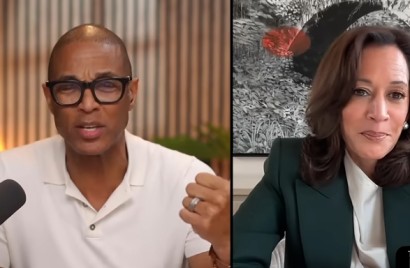
The following is the full transcript of former Vice President Kamala Harris’ interview on The Don Lemon Show, June 20, 2026.
Editor’s Note: In this exclusive episode of The Don Lemon Show, Kamala Harris joins Don Lemon for a wide-ranging conversation on the state of American democracy, the significance of Juneteenth, and the challenges facing the nation. The two discuss the urgent need to protect voting rights, the future of the Supreme Court, and the broader fight for equality in a polarized political climate. Harris also opens up about her vision for the future, the necessity of bold action, and why she believes community engagement is the key to reclaiming the American dream.
Juneteenth, Voting Rights, and the Fight for Freedom
DON LEMON: Madam Vice President, good to see you. Thank you so much for doing this.
KAMALA HARRIS: Thank you, Don Lemon. It’s good to be with you. Thank you.
Juneteenth: Celebration and Unfinished Business
DON LEMON: Let’s talk some Juneteenth because you helped to make Juneteenth a federal holiday. 5 years later, we are watching what’s happening. DEI programs are being dismantled. Voting rights are being challenged. Black history has become a political battleground once again.
KAMALA HARRIS: Where they’re not trying to erase it, by the way.
DON LEMON: Yeah. So what does Juneteenth mean in that moment?
KAMALA HARRIS: Juneteenth is— there are so many layers to it. Juneteenth is a day for celebration from its inception. It is a day to remember America’s history, and with all of the truths that must be spoken about the context in which Juneteenth occurred, which, of course, is that 2.5 years after the Emancipation Proclamation, the enslaved people of Texas only 2 and a half years later found out that they had in fact been free for over 2 years but didn’t know it.
Juneteenth is a day for us to not only reflect and remember history, but to then think about how that translates to where we each are in this moment, as part of that legacy. And part of the way I think about it is that Juneteenth, of course, was a day that there was a celebration of freedom. But the freedom that they celebrated was the promise of freedom in its full context, which includes the right to vote.
And when we look at being weeks after the Callais decision, we look at what’s happening across the country in terms of this attempt to cheat around what so many of these Republican governors started, which is redistricting. And then Democratic governors had to back it up. When you look at what’s happening in the South, where there is an attempt to really marginalize Black voters, Black and brown voters in many of those states, I think Juneteenth is a moment for us to remember that the fight for justice, for equality lives on, sadly.
And we who celebrate those wonderful moments that are part of the tradition of Juneteenth, must also dedicate ourselves to the action that we all have a duty to perform to make the promise of America real.
DON LEMON: So much you said there. I want to know, we’re going to talk about delayed freedom, right? But when you look at this moment, does Juneteenth feel like a victory lap? Does it feel like unfinished business? A reminder of how fragile progress can be? Combination? What does it look like?
KAMALA HARRIS: All of the above. Don, all of the above. It is a celebration of the traditions around Juneteenth, in particular the traditions that Texans, that those formerly enslaved folks in Texas created that are celebrated in terms of the Jubilee and all of the traditions around what Juneteenth is and what has been exported from Texas to the rest of the country.
But it is, yes, about the unfinished business for sure, because again, freedom in its full meaning includes the right of everyone and all citizens to have access to the ballot box and the opportunity to vote and decide what laws they want to have as part of the rules in their society. And also who their elected representatives will be.
You know, I’ve been spending a lot of time in the South, Don. And—
DON LEMON: I see. You’ve been everywhere. You’ve been everywhere, man. You’ve been everywhere.
Voting Rights Under Threat: The Story from North Carolina A&T
KAMALA HARRIS: I’ve been talking to folks. And mostly, I’ve been listening. And in fact, there is a group of young leaders, students, who have been doing extraordinary work at North Carolina A&T. And I’d been hearing about their work and they invited me to come meet with them. So I went down to North Carolina A&T, which is the largest HBCU in America, and I met with these students and they then shared with me that the reason they are organizing is because at their school— again, I’m going to say the largest HBCU in the country— the state officials in North Carolina took the polling place away from the school.
So these young leaders who are at a stage of life where they want to participate, they have so much at stake in terms of the future of our country, and so-called elected leaders took their polling place from them. So much so, and the outrage of it, so much so that these students then went to the state capitol to go protest.
You know what happened, Don? They’re in the state capitol. They’re in the chamber. The leaders of their legislature looked at them and said, “You have 5 minutes to leave.” Not 5 minutes to speak, 5 minutes to leave. To leave.
So look at what is happening in America in 2026. These young leaders are so frightening to the powers that be that they will remove their right to vote from their campus and then kick them out of a statehouse, a public statehouse, because they’re afraid that when those young leaders take the mic, they may have to hear things they don’t want to hear.
So the unfinished business is right in front of us.
And the work to be then done is on days like Juneteenth to celebrate and enjoy the traditions taught to us by so many who came through Juneteenth out of Texas. But it is also a day to recommit ourselves to the full meaning of freedom, which includes, given the most recent Supreme Court decision, the fight that we still have to ensure voting rights and voting access is real for all Americans.
The Civil Rights Movement and Its Broader Legacy
DON LEMON: So much of it is about delayed truth and delayed freedom. If you look at General Granger, right? I want to ask you about this because you mentioned that you went to an HBCU. And it made me think about what’s happening in the society right now. I’m not surprised, but you’re an Indian American, you’re a Black woman. When you see some Latino Americans, some Indian Americans, like Vivek Ramaswamy or Nikki Haley, or members of other minority communities dismiss racism, when they attack DEI, criticize Black Americans, do you ever think that they have forgotten who helped make many of their own opportunities possible?
So many opportunities were made possible for Black people who fought for freedom and the allies during the civil rights movement. Do you ever think that they have forgotten or just don’t know who helped to even make the opportunities they have possible in this country?
KAMALA HARRIS: Well, I can’t speak to their level of knowledge. I’m not sure what that might be. But I will say this, nor can I speak to their level of ignorance, which may be displayed through a lack of knowledge.
But the reality of it is that when we look at the fight for civil rights, of which my parents were actively involved in the ’60s, it was a fight that was for freedom for all people. And there is no question that the fight for civil rights in America, born out of the struggle of Black Americans, has benefited so many groups of people.
We’re now in the month of June, and it includes Pride Month. Well, the leaders for equality in that civil rights struggle will openly talk about the fact that the blueprint in that fight for equality was created in the civil rights movement.
DON LEMON: And in large part by Black gay men— Bayard Rustin, if you were talking about the March on Washington, right?
KAMALA HARRIS: Right. That’s exactly right. That’s exactly right. Bayard Rustin. So anyone who is familiar with America’s history would know that the rights of so many people, in particular those who have been deprived, marginalized, mostly for intentional reasons, should be thankful for those people who came before us and fought for civil rights and died for civil rights that benefit so many more than just themselves.
DON LEMON: You’re right, Madam Vice President, because the civil rights movement did transform life for Black Americans, expanded opportunities for women, for immigrants of all different backgrounds, religious minorities, people with disabilities, LGBTQ, and on and on. So to follow up on that, do you think that Americans in general fully understand that connection?
KAMALA HARRIS: I think a lot do, but we still have a lot of work that is about reminding people about the fathers and the mothers of the country in terms of those who fought for the promise of America. And among them, I count those leaders of the civil rights movement who help make real the promise, or get us closer to the promise, of America.
One of the heroes of our country and world includes Thurgood Marshall. That was one of the reasons I wanted to become a lawyer. And the fight that he and Charles Hamilton Houston, Constance Baker Motley waged through the courts was about making real the promise of America as written in the Constitution of the United States and making real what the Constitution purported to be able to do for its citizens.
But then you look at where we are with this Supreme Court, which again, with the now gutting of the Voting Rights Act— we know that fight is not over. We thought that fight was over to some extent in terms of at least making real the promise of the Constitution of America in certain ways. And it’s not. And it’s not. So there’s still more work to be done.
Reforming the Supreme Court and the Electoral College
DON LEMON: I just happened to interview Ro Khanna yesterday, and when you said that, it reminded me of what he said about the Supreme Court. He said, well, when there’s a Democrat back in office, whoever is the next president— we’ll talk about that later— he’s saying that he believes the court should be expanded to 13 justices because there are 13 circuits. Now, you are an attorney, you’re a former prosecutor, you know about these things. Does that sound like something that would be possible? And do you think that it should be expanded— he says 13 because of 13 circuits?
KAMALA HARRIS: I’ve been saying for quite some time, I think that we absolutely have to explore what we need to do because of the Supreme Court and what it has done to destroy so many of the elements of the Constitution that were designed to protect, in particular, the minority, those who were marginalized, including expansion of the Supreme Court. And yes, I absolutely believe that we should be exploring that. And the idea of 13, I agree, because there are 13 circuit courts, 13 justices.
I think that we should be looking at statehood for Puerto Rico and D.C. I think we should be looking at, when we win the majority in the House and in the Senate, for the Senate Judiciary to have and to create rules that include that if there is a nominee to the Supreme Court before them who is clearly lying, that there be some consequence. And that we say to Democrats, at the very least, who are members of Senate Judiciary, that you need to be prepared to actually put some rules in place and enforce them if people come before you and are breaking the ethical rules of responsibility around taking an oath and telling the truth to that committee.
I think there’s a lot of work that we need to do, including considering an expansion of the court.
DON LEMON: Well, since we’re there, what about the Electoral College?
KAMALA HARRIS: I think we need to look at that too. I think we need to look at that too. Yes. Yes, I do.
The Electoral College and Democratic Participation
DON LEMON: Because it’s clear to me— this is me, I don’t want to put words in your mouth— that we are being governed by a minority in this country because most people in this country aren’t as extreme as the folks who are. They’re not MAGA. They’re not extreme right. They believe that a woman should have a right to choose. But that’s not actually what we’re living under right now. They believe that there should be a separation of church and state, where you can worship whatever God you want, or you don’t have to at all. And it seems like we’re moving into, because of this minority, into Christian nationalism and into having the majority of Americans’ freedoms diminished or restricted because we’re being governed by the minority.
KAMALA HARRIS: Yes. And I think that there is some real shaking up that we have to do of the rules and the structure.
DON LEMON: And is that get rid of the Electoral College?
KAMALA HARRIS: I think we should— that should be a discussion that we should have. I don’t think we should eliminate that as a point of discussion for potential action.
But the work that we have before us, Don, also includes addressing why so many people who have everything at stake are not voting. And because when you talk about it being a minority of people who may be responsible for the things that are happening that are contrary to our democracy, I don’t disagree with that. But a parallel point has to be for all of us, how are we going to better engage a larger group of people to be active participants in our democracy?
And I truly believe that one of the challenges that we have is that we are not openly and honestly talking about the fact that the status quo has not been working for a lot of people for a long time. We can talk endlessly, and certainly I can, about the failings, the corruption, the incompetence, the callous nature of the current presidential administration. But the truth also remains that even though things may get worse before they get better, it will at some point— that term will end, and there’s going to be a whole lot of debris at the end of this.
And it will be a mistake for folks to just talk about how will we rebuild if they do it with any level of nostalgia about how things were before. Because the fact is, even before this, there was a whole lot that was not working for a lot of people. And it has resulted— a failure to perform has resulted for a lot of people in the feeling that they just won’t participate. And that’s righteous and that is fair. A feeling of distrust because the system just is not meeting their needs.
So there’s work to do in many directions and for many reasons. But if we want full participation and if we want the majority of folks who do love and care about our country, which they do, to actively participate, we’ve got to take a look in the mirror and also ask, what do we need to do better, especially those who have been in government, to actually perform in a way that meets the needs of the people?
Trump’s Use of the Justice Department
DON LEMON: Well, since we’re here and we’re talking and we’re speaking about politics, I want to ask you about— I don’t know if you saw the governor of California yesterday announcing that he believes that— well, not he believes that— the Trump administration is investigating him and his wife. What do you think of that? And how did we get to this moment where a president is using the Justice Department as his own personal law firm?
KAMALA HARRIS: We had an election in 2024, and he pretty much told us he was going to do it, and that’s what he’s doing.
DON LEMON: And this is the Kamala Harris I love. You told us. I’ve said that to you before, Madam Vice President.
KAMALA HARRIS: I’m not going to speak those words. But so many of us predicted it. And he told us. And it is clear every day that he meant what he said, whether it is the governor of California, whether it is Tish James, whether it is—
DON LEMON: Journalists.
KAMALA HARRIS: Journalists, right. And Don, you know, I say this— I led the second largest Department of Justice in America, the California Department of Justice. Using the Department of Justice as though it is his personal law firm. And by the way, putting in place to head that Department of Justice his personal lawyers.
He is treating the institutions that were designed to support and help the American people as though they were designed to help and support Donald Trump’s personal interests. He is using these agencies to implement self-indulgence on his part. He is engaged in pure self-indulgence across the board. Whatever will benefit himself and those close to him or those who facilitate his corruption. So, yeah.
Accountability and the 2028 Election
DON LEMON: Can that be reversed though? Let’s say whoever is in office in 2028, can this be reversed? The people who are being unfairly targeted, will they have any recourse, or will everybody just be pardoned? And do you think the next president should try to at least rectify some of that?
Because some folks are saying, I hear on the Democratic side, Madam Vice President, say, well, we need to focus on the business of the American people and not on fixing what Donald Trump broke, so to speak. I’m paraphrasing here, but I think we can do both. I’m not a politician, but I think that the people who deserve to be prosecuted, or whatever it is, for misusing the Justice Department and abusing American citizens and American politicians, or whatever you want to say, political rivals or whatever, I think that they should face some sort of justice.
KAMALA HARRIS: Oh, well, I absolutely believe that, and I believe that there should be accountability.
DON LEMON: But how does that look like in a legal realm?
KAMALA HARRIS: And especially for people in the highest roles of power and authority, those who abuse their power and authority should be held accountable, and there should be consequence.
DON LEMON: Like Pam Bondi, like Kristi Noem, like— I mean, if you look at what’s happening, I am heartbroken when I look at the Civil Rights Division of the Justice Department. That has just been—
KAMALA HARRIS: It is criminal. The Civil Rights Division. I mean, you can go across the board. Consumer protection, antitrust. You can go across the board. Not to mention the fact that there are people who have worked in that Department of Justice for years and are completely apolitical. But take seriously their oath to follow the law without fear or favor, and who have left or have been fired because they would not bend to the knee of a tyrant who expected nothing less than loyalty to himself, not the rule of law, not the Constitution of the United States.
DON LEMON: If you are president, let’s just say in 2028 you are elected, will you make sure that there’s accountability?
KAMALA HARRIS: Oh, I believe firmly in accountability.
DON LEMON: Yes. That’s your answer. So I’m going to ask you then. This is a perfect moment. Are you going to run for president in 2028?
KAMALA HARRIS: I have not decided, to be honest with you. But I’ve been spending a lot of time traveling the country, as we talked about earlier. And listening to folks.
I think that people want a leader who is willing to take risks, as opposed to just doing what is popular. I think people want to know that they are being seen and heard and that their leaders, whether they’re at a local, state, federal level or in the White House, are looking first at the people— not looking at themselves in the mirror, but looking at the people and listening.
And what I’m hearing is that people really want their first priorities to be the first priority of their president and their leaders. And that really does start with affordability. Regardless of the age of the person, whether you’re talking about Gen Z to seniors, affordability around housing, affordability around healthcare, affordability around childcare. That’s what people want. And I’m here, I’m at a conference I’ve been asked to keynote. Arnold Schwarzenegger, the former governor of California, asked me to be—
Closer to the Ground: Life After the Vice Presidency
DON LEMON: Madam Vice President, I want to talk to you about that. I want to talk to you because you met with more than 150 world leaders when you were vice president, but you’re also speaking and meeting with world leaders now. But just to put a pin in this and then we can move on and talk about what you’re doing with the former governor of California.
I think there’s something relatable between the two of us. When I was with CNN, I was sort of up here and I had producers on the ground and I wasn’t out sort of pressing the flesh as much as I would like to. Now I have the opportunity every single day. I go out and I talk to people, whether it’s with a camera or without a camera, with a microphone, without a microphone. And you are doing something that is very similar. You’re closer to the ground now.
So I’m wondering, there is a difference between being a senator, being a vice president. You’ve got the bubble around you. Now you’re out with the people. How is that different? Do you feel like you’re closer to the people now and you understand the issues better?
KAMALA HARRIS: You’re right. It’s not all of that whole apparatus that comes around being in office. For example, I was in Mississippi and I went grocery shopping with a woman who was a single mother of 3 children, spending time with her in the grocery store talking about her challenges, including the rising cost of food and the fact that she only has $150 a week as her budget for food for the 4 of them. And being able to spend the time talking with her about the details of her life and listening, most importantly. And it is very freeing.
And what I’m hearing, Don, is as much as anything, people are done with the status quo. Their distrust and their, frankly, annoyance with a system that is not meeting their everyday needs. And while people want to have conversations about what’s wrong with democracy, the rule of law, the United States Supreme Court, first and foremost, they want to talk about how am I going to get through the end of the week and pay for gas, the prices that are rising every day, the price of food rising every day. How am I going to go to work and also pay for childcare for my children? That’s what’s first and foremost on people’s minds.
And yes, they do care about these other issues. So I certainly don’t believe that anybody should oversimplify the challenges we face in the country or the world. But first order of business has to be about dealing with the details that folks deal with every day that keep them up at night.
Strained Alliances and America’s Standing in the World
DON LEMON: As we speak, as we’re taping this, you are meeting with world leaders now. You’re with the former governor of California. You met with more than 150 world leaders as vice president. When you watch this administration— because I’m sure you guys are going to discuss it where you are— now I know he’s on a foreign trip, but when you watch this administration strain alliances, launch a war with Iran, announce a peace deal almost in real time on social media, what do Americans not understand about what has been lost here?
America’s Standing in the World
KAMALA HARRIS: This president is making America weaker every day. So foreign relations, it’s not unlike in our personal lives, our friendships, in terms of relationships. And the strength of a relationship is going to require some level of respect for the history of the friendship. It requires that there is truth, that there is consistency in the relationship, that you’re present.
And what this president has done is to basically thumb his nose at so many of the relationships that we have had, have cultivated, or need to have around the world. And in so doing, he has caused the United States of America to be considered unreliable. Unreliable.
I was just speaking with a fellow from the World Bank who was talking with me about it and actually thanking me for a lot of the work I did as vice president to change the narrative around America’s relationship with the continent of Africa. Well, what has happened now, because this president has almost full-scale defunded USAID, through which we would give financial support to nations that were addressing, for example, pandemics, health scares, and pulling America out of a responsibility that it should have to help out countries that might need that kind of assistance, is going to have a lasting impact.
What has happened in terms of turning our back on the importance of fighting for international rules and norms has caused America to be more unreliable in the eyes of our allies and our adversaries, and has also, as a result, resulted in America having less influence. Now, as flawed and imperfect as we may be, we still had a certain level of credibility to speak on a world stage about the international rules and norms like sovereignty and territorial integrity. Look at Russia’s invasion of Ukraine. But his failure to stand on those kinds of issues is having an impact on America’s standing around the world and therefore our strength.
DON LEMON: Can our credibility— can America’s credibility be rebuilt?
KAMALA HARRIS: I believe it can be rebuilt. I believe it’s going to take a lot of work, but I absolutely believe it can be rebuilt. And I’m going to tell you one of the main reasons.
America’s relationship— I am convinced any relationships of strength with other nations, yes, it is a function of who the leaders happen to be and how they cultivate and maintain that relationship, but it is also because of the sense of connection that the people of nations have about each other. And having traveled the world, I will tell you that people in nations around the world have for a long time believed in the people of America. Have witnessed our struggles and our fight for things like civil rights and equality as a model of inspiration for themselves who are fighting the same kind of fight in their nation.
And I do believe that the American people are going to have a lot to do with resuming and hopefully reclaiming relationships that have been compromised, if not tattered, because of this administration.
The Austrian World Summit and the Case for Hope
DON LEMON: The theme of this year’s Austrian World Summit is “We are unstoppable.” But a lot of people don’t feel unstoppable right now. They feel exhausted. So as you are there and you are going to be— you’re going to be interviewing, the governor? Are you speaking with him, right?
KAMALA HARRIS: Yes.
DON LEMON: You guys are doing something together. So then what’s your case for hope then?
KAMALA HARRIS: I believe that when we feel powerless, we are powerless. And when we feel powerful, we are powerful. And I believe we are powerful. And I believe, Don, I really truly believe this, we each have light inside of us, and we need to know that that is what inspires our hope as much as anything external to ourselves.
And when we feel that and not allow an election or an individual to dampen that light, and instead let that light kind of carry us in particular through moments of darkness, that we not only act on that hope, but we inspire that hope in each other.
And in particular at this moment, it is so important that we not only have hope, but that we understand that that should be a verb, which means that hope has to go hand in hand with action. And that action includes overcoming the obstacles they’re trying to throw in front of us in terms of access to the ballot, that hope combined with the action will result in us winning the midterms, that hope combined with action will allow us to celebrate Juneteenth in all of the traditions that involve good food and dance and laughter and family and community. And that we will also understand that that hope is consistent with a commitment to the fight, the fight for equality and for freedom and for justice.
A Strategy Memo for the Democratic Party
DON LEMON: People are looking for the fight, and you have the fight in you. I want to ask you, if you were writing— and right now, the only people I believe fighting for our democracy in this country, I believe it’s the Democratic Party. So if you’re writing a strategy memo for the Democrats right now, based on what you just said, what would you tell them to stop doing immediately or start doing immediately?
KAMALA HARRIS: You got some time?
DON LEMON: Look, I have as much time as you have. I’m worried that I’ve gone over my time, but I love having these conversations with you. And there’s a certain, if I can be honest, there’s a certain freedom that you have now, like a weight has been lifted. Not that you didn’t tell your truth before, but in those 107 days, there was so much crammed into that. We can talk about that all day, but that’s a lot of pressure to be under.
And right now, I just feel that you have a freedom to be able to express yourself very similarly to the former Secretary of State Hillary Clinton. Because when people meet Hillary Clinton behind the scenes, they’re like— I say, well, where was that Hillary Clinton? Like, she’s so warm. And you’re so warm right now, but that warmth that you exude behind the scenes, I now see that when you’re on camera doing an interview.
And so that’s why I think, hey, go ahead and answer these questions for as long as you want, because I think that what you’re saying now, you’re speaking important truth. So what would you tell the Democratic Party to start doing, stop doing? Do they talk too much about Donald Trump?
KAMALA HARRIS: I’m not going to scold or anything like that. But listen, I think that what the American people want from their leaders— and I’ll speak as a Democrat about Democrats— is that we have an ability to have a vision in which everyone can see themselves. And that vision has to start with today and tomorrow. That vision has to be about what are we going to do and how are we going to implement a strategy that is about delivering for the people and not just about process all the time.
I think part of the problem is, and I say this as a lifelong public servant, I think part of the issue that we need to deal with is that we have gotten so caught up in process that we are not focused on progress. And that we need to admit that there are certain systems that have been failing for a long time, whether under Democratic or Republican leadership. And let’s just be honest with folks, because it’s not like we’re covering it up. People can see it.
And so let’s be honest and then start really thinking about how are we going to require ourselves to focus on getting stuff done, but with a certain level of speed, dare I say. And it has to be about also recognizing and all of us agreeing that we aren’t going to be able to solve all of the challenges that we have immediately. And we’re going to have to be, however, bold about being willing to maybe not be safe around what we need to do to change an aspect of the structure.
And that includes, for example, the conversation that we just had about the Supreme Court, the conversation that we just had about the Electoral College, about saying, how do we have a plan that’s about pushing for statehood for the people of Puerto Rico if they want it, for the people of D.C.? It means understanding that you’ve got to be sometimes willing to fight fire with fire. And that just might be something that makes you uncomfortable. And if you’re not comfortable with that, maybe you should look for another job for right now. Because this is the moment that is— it’s some bare-knuckle stuff happening right now.
Lessons from Losing the Presidential Election
DON LEMON: As I listen to you, I wonder, what did losing the presidential election teach you about that winning could not have?
KAMALA HARRIS: There’s so many lessons to be had. There’s so many lessons to be had. And it includes— I mean, there was so much about that election. I wrote a book about it. So we could spend some time on looking backward, but we’ve got to be able to communicate with people where they are and hopefully be able to do it in as direct a way as possible without the filters, without the gatekeepers. And that is a challenge, but we’ve got to fight through that because when it all comes down to it, I think the people want to hear directly from their leaders. And again, most importantly, they want to be heard.
Is There a Lane for Kamala Harris?
DON LEMON: The party is unsettled. I feel— maybe you disagree with that. Gavin Newsom is moving. AOC is building something. Is there a lane that belongs uniquely to Kamala Harris?
KAMALA HARRIS: I don’t exclude myself from any lane.
DON LEMON: I mean, there’s all the lanes, all the things.
KAMALA HARRIS: Well, I have never been one to believe I don’t belong somewhere. Let me just put it that way. And honestly, Don, for most of, I’d say almost my entire elected career, I’ve probably been as much as anything the outsider on the inside. And I don’t believe that there is, or anyone, much less myself, but that anyone should be limited by others’ ability or inability to see your capacity. Let that be their limitation, not yourself.
2028 and the Road Ahead
DON LEMON: Look, I don’t want to continue digging on this, but you told Reverend Sharpton that you might in 2028. You told me that you have thought about it, but you haven’t made a decision. But what is the deciding factor? Is there a point where you go, okay, yes, or okay, no? Do you know where that point is?
KAMALA HARRIS: I’ve run for president before, obviously, so I have a pretty good sense of what it requires, and it requires a lot. And not only of the principal, but of their family, their team, their supporters. And ultimately, I think when I make a decision that is going to weigh heavily for me on the decision. So I’ll keep you posted. I’ll keep you posted.
Joy, Pride, and the LGBTQ+ Community
DON LEMON: Thank you for answering that. You’ve talked a lot lately about joy. You showed up at The Abbey, which is in Los Angeles, which is a bar, an LGBTQ bar, during Pride Month. Why does joy matter so much to you right now? And that support that you have for members of the LGBTQ+ community— where does that come from?
KAMALA HARRIS: That’s longstanding. I mean, I was very proud on that Valentine’s weekend in 2004 to perform some of the first same-sex marriages in the country. And that was at a time when Democrats really didn’t want to be associated with the issue.
Where does it come from? It’s an extension of everything that my parents marched and shouted for. Which is equality and freedom. And when I think about the trajectory of the movement, including the great victories that we’ve had, such as the freedom to marry, and I look then at what’s happening now in terms of the fear that’s in the community and the hate— being at the Abbey and stopping by the Abbey just the other day was about just making clear that the community is not alone and that we’re all in this together.
And so that’s why I went by there. And I will always be a defender and a fighter for the freedoms and for the rights and for the dignity and for the safety of all people, including members of our LGBTQ community.
The Fight for Freedom: Every Generation’s Responsibility
DON LEMON: Now, back to where we started, because I want to make sure— this is important. Juneteenth is important. And so I want to end where I began. Juneteenth reminds us that freedom doesn’t protect itself, that every generation has to fight for it. And I wonder, are enough people fighting in this moment right now?
KAMALA HARRIS: I think that a lot of people after the 2024 election were devastated for a variety of reasons, including just what they have witnessed and experienced, many firsthand, in the last year and a half. And I think it’s important for all of us to remind each other of our power as individuals, and in particular our power as individuals in the context of community.
And this is a moment in time, especially as we approach the midterm elections, to be engaged in every and any way we can, whether it is attending a No Kings rally or whether it is volunteering for that nonprofit that is in your community that is probably strapped because this administration has been pulling the funding of so many organizations that do good work that is about supporting families and those who are homeless and those who are hungry.
The work that we can each do about just that the strength of neighbor to neighbor, you know, good old-fashioned, Don, neighbor to neighbor, right? Which includes, you know, if you’re going to go on that Costco run and you know you’ve got a neighbor, right? And maybe they’re a single father or mother and just saying, “Hey, I’m about to go to Costco. Can I pick anything up for you?”
The Power of Community and Civic Participation
KAMALA HARRIS: But, you know, reminding ourselves about the power of community and civic participation. I mean, I think there’s so much about this moment that has to be about what I’ve been calling for. I think we need a revival of the American dream, meaning we need to make real the promise of opportunity to folks. And in that way, encouraging that we are all engaged to make real that promise through a number of ways, including voting.
I think people are doing what they can though to get by on a daily basis, so many people. So I’m not here to judge, but instead to encourage. Encourage people to know their power and the power of their participation with whatever time they can spare.
A Moment of Reflection
DON LEMON: You know, I appreciate you doing this. And a large part of what I appreciate is that you did not call me an idiot or crazy or get up and take the microphone off and leave for a question that you may not have liked. And I see that so much. I find it so sickening to watch this president insult journalists and especially women journalists and Black women in this moment.
And so, you know, as you were sitting here, we were doing this interview, I have to tell you, that I got a little bit overwhelmed, which I don’t know where it came from because I’m sitting here with the first Black vice president of the United States, woman, first Black woman president. And, you know, we’re celebrating Juneteenth. And I never could have imagined that I would be sitting in this seat interviewing someone like you. So we have made progress.
KAMALA HARRIS: Yes, we have.
DON LEMON: But we’ve got to do a lot in order to keep that progress. And you are a part of that right now. So thank you for what you do. And thank you for doing this, Madam Vice President. And I really appreciate it.
Closing Remarks
KAMALA HARRIS: Thank you, Don Lemon. And thank you for continuing with your calling as a journalist and always speaking truth, even when it may be at great personal risk and sacrifice. And so, yes, we have a lot of work to do, but let us celebrate Juneteenth.
DON LEMON: Yes.
KAMALA HARRIS: And know that the struggle also requires that we allow ourselves those moments of celebration.
DON LEMON: Yeah, right. Look, thank you. And I feel comfortable doing this. I wouldn’t normally, but going through what I’ve gone through, transparency to me is, you know, and I like to live in the moment and recognize the moment, you know what I mean? Especially when there’s something positive there. So thank you. And say hello to your— I should say better half. I’m not so sure. No, he’s— I like that guy. Say hello to him and I’ll say hello to Terry as well.
KAMALA HARRIS: Please do. Please do. Okay. I’ll see you later. Okay.
DON LEMON: Take care.
Related Posts