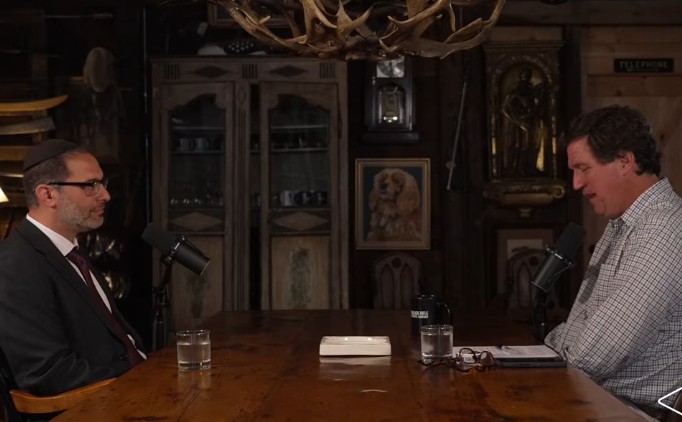
Former rabbi turned civil rights attorney Jonathan Gross joins Tucker Carlson to explain why he left his post as senior counsel in the DOJ Civil Rights Division under Harmeet Dhillon, and why he believes the Trump Justice Department abandoned its promise to end weaponization. Gross discusses January 6th defendants, coercive plea deals, the pardon “economy,” the terror watch list, and cases like Dr. Kirk Moore, Return to the Land and Shana Gaviola that he says show the system protecting itself instead of reforming. This interview was premiered on October 16, 2026. Read the full transcript of this interview below:
From Congregational Rabbi to Civil Rights Lawyer
TUCKER CARLSON (00:00:04 – 00:00:40): Jonathan Gross, thank you so much for doing this. So you’ve had this remarkable life, and I almost hesitate to ask you to start with your bio, but I just want you to explain one thing because I think it frames the conversation that will follow.
So you’re a congregational rabbi, meaning you have a congregation. You’re not just a symbolic rabbi. You’re actually running a synagogue. In Nebraska, in Omaha. And then the next thing you know, you’re a lawyer working at DOJ on civil rights cases. How did that happen? Those are totally separate worlds, I think.
JONATHAN GROSS (00:00:42 – 00:00:55): Yeah, I was a rabbi, and I followed in the footsteps of my grandfather, who was also a rabbi. And I did that for about 15 years, 10 years in Omaha, Nebraska. It was — Very proud of that career. And then— But that’s a full career.
TUCKER CARLSON (00:00:55 – 00:00:56): I mean, that’s like a full—
JONATHAN GROSS (00:00:56 – 00:00:56): Yeah, it was.
TUCKER CARLSON (00:00:57 – 00:00:57): You didn’t just dabble in it.
JONATHAN GROSS (00:00:58 – 00:02:34): No, no, no. It was a full career. Yeah, absolutely. That’s for sure. And yeah, so then we moved back to where my wife’s family lives in Baltimore, Maryland. And at that point, we decided that I wanted to move into something else. I’d always wanted to be a lawyer, I think, since I was in college. And I went back to law school at the age of, I think, 37 or 38 years old with 4 little kids. My wife encouraged me. And we made it work.
And I graduated, thankfully. And I went, did the clerkship making $40,000 a year working for a judge and filling up water pitchers for the litigants at 40 years old. And then, but thankfully I was able to move into a pretty good career. I was working at a civil rights firm that was, we were doing pretty high-level civil rights, religious liberties work.
Defending January 6th Defendants
And then January 6th happened, and I saw what the government was doing to January 6th defendants, and it distressed me and my wife greatly. And my wife doesn’t like me telling this story so much because she’s heard it so many times. But basically, we were sitting around one Friday night and we were just praying, and I said, “Why isn’t anybody doing anything?” And she said to me, “You have to do something.”
And she encouraged me to quit my job and figure out how to help January 6th defendants. And I didn’t know any January 6th defendants. I had never practiced criminal law a day in my life, but I knew that I had to help. So I just— me and my wife together.
TUCKER CARLSON (00:02:36 – 00:02:50): I mean, a mother of 4 small children. All your kids are at home, right, at this point? That’s not the person who typically encourages her husband to quit his job and go into something with no real prospects of getting paid. Why would she do that?
JONATHAN GROSS (00:02:50 – 00:02:55): Because she’s an extraordinary woman with a deep faith in God, and she encouraged me to do that.
TUCKER CARLSON (00:02:56 – 00:03:04): Yeah, that’s just wonderful. So I just— you told me that at breakfast. It made me emotional. I just wanted to get that on tape because that’s incredible. So what happened next?
JONATHAN GROSS (00:03:05 – 00:04:57): So I turned my eyes towards my Father in Heaven and I said, “I know you want me to do this. I don’t know what to do.” And it’s a long story. A few things led to the other, and ultimately it came because I met Marjorie Taylor Greene, who was one of the most unbelievable advocates for January 6th defendants. As a congresswoman, there wasn’t much that she could do, but whatever she could do, she did. And one of them was to introduce me to people. And she got me involved in J6. I got my first defendants through her.
And then I tried to help as many as I could, and they started calling me from all over the country. And I represented over 20, and I advised probably close to 100 of J6 defendants. I tried to help everybody that I could, and some people I charged nothing, some I charged a nominal fee, what they could afford. And I’m very proud that I did that.
And we did it all the way up until January. I had a trial scheduled for January 21st, 2025, which was canceled because President Trump pardoned people. But they were arresting people until December of 2025. They would’ve gone— I mean, December of 2024. They would’ve gone forever with arresting people.
Joining the DOJ
So then when President Trump was elected and I did everything that I could to try and get into the DOJ because President Trump had expressed that he wanted to get to the bottom of this weaponization that was going on. And through also a miracle of God, I was somehow appointed by President Trump to be senior counsel to Harmeet Dhillon, who was nominated and confirmed as the assistant attorney general for civil rights.
TUCKER CARLSON (00:04:57 – 00:04:57): Yes.
JONATHAN GROSS (00:04:58 – 00:05:00): And that was my position at DOJ.
TUCKER CARLSON (00:05:01 – 00:05:14): Amazing.
JONATHAN GROSS (00:05:14 – 00:05:14): Yeah.
TUCKER CARLSON (00:05:14 – 00:05:36): Who I should say at the outset, I’ve known for decades, who was our family lawyer. And I advocated strongly for her to get that job. Not that it made any difference, but I certainly wanted her to get that job. And so I should just say that upfront. I’ve always been very pro-Harmeet Dhillon. And so I’m glad that that’s where you wound up. So what happened then?
The Capitol Siege Unit
JONATHAN GROSS (00:05:37 – 00:06:49): So I had one agenda when I was in DOJ, and that was to get to the bottom of weaponization. And one of the things that I was trying to get into government, I thought that it would be great if President Trump would appoint me somewhere within the United States Attorney’s Office for the District of Columbia, and that way I could lead the Capitol Siege Unit. The Capitol Siege Unit was this special unit that they created to go after J6. J6ers for 4 years.
Now mind you, there was no BLM riot unit, there was no anti-ICE protester unit. They did this special for J6, and I could easily in my mind come up with at least $1 billion that this thing was funded to. And it drew resources from all over the country, all 50 states, from FBI to DOJ to US Marshals and local law enforcement and even media propaganda, the press releases. There were all over. Every local paper was tipped off to every misdemeanor grandma, to destroy their lives gratuitously.
So I said, “You know what, put me in charge of the Capitol Siege Unit. I’m the biggest expert on J6 in the DOJ, and let me open it up and let’s find out who gave the orders and let’s find out how this happened and make sure this never happens again.”
TUCKER CARLSON (00:06:49 – 00:06:49): Yes.
JONATHAN GROSS (00:06:49 – 00:06:51): Yeah, that would’ve been a great thing.
TUCKER CARLSON (00:06:51 – 00:06:52): You mean it didn’t happen?
JONATHAN GROSS (00:06:52 – 00:07:18): They closed the Capitol Siege Unit immediately and they buried all that stuff. And it’s like, I always say, like Indiana Jones and the Raiders of the Lost Ark at the end where they just kind of take the Ark and they put it into some warehouse. So that’s where all this stuff is. They hope to bury it and they just want to move on. So that wasn’t happening. So I was in DOJ and I got involved in different assignments.
TUCKER CARLSON (00:07:18 – 00:07:19): Were you surprised?
JONATHAN GROSS (00:07:19 – 00:07:28): I was shocked. I thought that President Trump, as a victim of this, would’ve made this a priority. And I was hoping that this would be something that—
TUCKER CARLSON (00:07:28 – 00:07:31): How long did it take for you to discover that it was not a priority?
JONATHAN GROSS (00:07:32 – 00:07:33): A couple days.
TUCKER CARLSON (00:07:33 – 00:07:34): A couple days?
JONATHAN GROSS (00:07:34 – 00:07:51): Yeah. There was nobody there who kind of shared my sense of urgency. I said, “Guys, we have only 4 years to do this. I mean, we have to do this.” And everybody— my wife and I always joke that we’re only invited to dinner parties once because—
TUCKER CARLSON (00:07:52 – 00:07:54): Oh, I’ve been there, Rabbi.
JONATHAN GROSS (00:07:56 – 00:11:08): You get me started on J6 and I’m never-ending. And even from the very beginning, “Hi, my name’s Jonathan Gross,” to my colleagues, “and J6, what are we doing about it?” But not just J6. Remember, my interest in J6 was because this could happen to anyone. This was just so bad.
So I said, while President Trump is in office, this is all we’ve got. And not only that, I assume that this is a priority because this is what he campaigned on, draining the swamp and ending this kind of weaponization. And this is what I would think his base would want, and to get to the bottom of it. Because ultimately, you look, the J6ers, in the end of the day, they went to DC and frankly went from the Ellipse to the Capitol because President Trump told them to. I mean, and President Trump himself is a January 6er. He was charged with one of the January 6 charges.
So I would have thought that this would have been a priority, number one, to find out what the hell happened and go after it. And just like I said, I’m not even interested about necessarily going after the bad guys. I just don’t want them to work there anymore. And should people go to jail or things like that? Look, that’s secondary. The first thing is to make sure that this cannot happen again, that you don’t have this unchecked power of federal prosecutors to be able to do something like this, to demonize a whole class of people and use the media to destroy their lives, to taint the jury pool, keep it in DC, to create all kinds of crazy precedential law that if this would be applied to anyone, they would say, “This is the most unfair process I’ve ever experienced.”
And the process itself destroys you so that even if you come out innocent on the other side, which is almost impossible, but to the extent that you do, Google your name forever and nobody believes you. And to the extent that you even were able to be that 1% who defeats the government in federal prosecution, then people just say you had a good lawyer or you got off on a technicality. Assume your guilt. There’s this presumption of goodwill that still exists for the federal government that if they go after you, then you are guilty.
And that goes from the minute they show up with the FBI with their guns and lasers and knock down your door, and then all the press releases come out, and the indictment is their side of the story, and your lawyer tells you you better not say a word to the media because if you do, then the government and the judge will punish you more.
Punished for Speaking Out
Which happens— just happened to a guy named Michael Castellara who— he’s the victim of weaponization, and he has to report to prison in only a few days. And he said, “I’m not going to go silently.” And he went on Diamond and Silk, of all people, who were President Trump’s earliest supporters. And he went on their show and he had the temerity to accuse the government of weaponization.
So the government wrote in the sentencing memo when deciding what his punishment would be, that he should get punished extra because he went on Diamond and Silk and he lied. And he said that this was a political hit job on him. And the judge agreed and gave him an extra year in prison, in prison that he’s going to have to serve.
TUCKER CARLSON (00:11:08 – 00:12:44): So, but it doesn’t even make internal sense. So in other words, the government’s saying, because you accused me of being corrupt, I’m going to act corruptly and punish you more.
JONATHAN GROSS (00:12:44 – 00:12:46): Correct. That—
TUCKER CARLSON (00:12:46 – 00:12:47): And then they hear themselves.
JONATHAN GROSS (00:12:48 – 00:13:14): It’s crazy that happened. I want to mention another case. There was a woman who I’ve never met. Her name is Tiawana Brown. She was a local councilperson in North Carolina who obviously must have gotten in some kind of dispute, is my guess. But basically they charged her with a common thing that they’re going after nowadays. It’s basically like opening up the doors on January 6th, letting the people in, and then charging them with terrorism. What they did was, is during COVID they gave out these PPP loans.
TUCKER CARLSON (00:13:14 – 00:13:14): Yeah.
JONATHAN GROSS (00:13:15 – 00:14:25): And President J.D. Vance (sic) just announced maybe a couple weeks ago that there are 870,000 people that they’re going to go after for fraud for these PPP loans. But basically the government shut down your business, made you stay at home, made it so you could not earn any money, and then said, “Oh, but here, we’ll give you money. Here are these PPP loans.” So people took advantage of it. And lo and behold, some of those people, they’re going to say now, “Well, that was fraud.”
So this woman, Tiawana Brown, they charged her federally for fraud for the PPP loans. And no jury is going to remember what the circumstances were from 2021. And they charged Tiawana Brown with only $20,000 of fraud for these PPP loans, which is ridiculous that the federal government even went after it. That alone should tip you off that, and the fact that she’s a political person should tip you off that there’s weaponization afoot.
And she went on TV and she said, “This is political.” So her daughters only got probation, but the judge and the prosecutor said she should get more because she had the temerity to say this is political. So she’s going to jail now. She has to report for 10 months in federal prison for $20,000 of alleged fraud on these PPP loans, which once again, it was basically a tripwire.
TUCKER CARLSON (00:14:25 – 00:14:27): Because she complained about it.
JONATHAN GROSS (00:14:27 – 00:14:29): Because she complained about the prosecution.
TUCKER CARLSON (00:14:29 – 00:14:29): Yeah.
Coercive Plea Deals and the Trial Penalty
JONATHAN GROSS (00:14:29 – 00:16:09): So they wanted to make her a felon, but then once she said this is a political hit job, then they said, “We’re going to give you extra penalty. We would have given you probation.” And I had J6ers, same thing. It’s called the trial penalty, is that they said, “Had you pled, we would have given you probation, but because you decided you had the temerity to exercise your constitutional right to a trial by jury, you caused more time for the court, more time for the prosecutor.” This is routine. “We’re giving you more jail time for that.”
And I have a lawsuit right now that is talking about how the— I’m suing Todd Blanche, and we could talk about that for the— these coercive plea deals specifically that they did to J6ers. But this is a Stalinist tactic that the government is using where they coerce plea deals out of people. It’s routine.
Every person who’s ever been indicted for a federal crime knows that your lawyer will say to you, “Hey, the government says if you don’t fight this and you don’t go to trial, you will get less time in jail or no time in jail. Maybe we’ll let you off and we’ll just charge you with a felony.” So you’ll be branded for life a felon. Well, you’ll have restitution, but maybe less restitution that you’ll have to pay money to like Wells Fargo or something for the rest of your life. But at least you won’t have to spend more time in prison.
And some people say, “No, I’m not going to do that. The truth is on my side.” And your lawyer said, “Well, good luck. Roll the dice with the DOJ.” So you say, “Fine, I’m going to do it anyway.” So then the government says, “Oh, yeah? Well, your wife worked for the business, didn’t she? Be a shame if she became a co-conspirator and your children were orphaned.” So then they get a lot of people to plea and they say—
TUCKER CARLSON (00:16:09 – 00:16:10): This is so evil.
The Lawsuit Against Todd Blanche
JONATHAN GROSS (00:16:10 – 00:18:48): It happens routinely. Nobody disputes this either. Okay, so I guess we’ll skip to this. President Trump was being interviewed, I think in June of this year, by MSNBC. It was right after that whole idea for one minute they said, “We’re going to try and compensate the J6ers,” and then everybody went crazy.
So then he was on MSNBC and they asked him about it and she said, “Why should these people get compensated?” So President Trump said, these people, these were his words, were destroyed by weaponization and dirty cops. So then she said, “Yeah, but they all pleaded guilty.” And what she means by that is they all signed a statement and swore under penalty of perjury that “I’m guilty of whatever the government says I’m guilty of.” And they signed those statements and went up in court and said, “Yes, I swear that that’s true.” So obviously they’re guilty.
So President Trump, who’s not an idiot, he said, “Of course they did. They were frightened. They were facing 50 years in prison for misdemeanor charges.” So that’s why obviously they pled guilty, not because they were actually guilty. And everybody should know that, especially liberals and leftists who claim that they believe in these things. So President Trump said, quote, “J6ers were destroyed by weaponization and dirty cops.”
So the next day I started a group with J6ers, and the group is called J6ers Were Destroyed by Weaponization. And we filed a lawsuit called J6ers Were Destroyed by Weaponization v. Blanche. And we are not asking for money in that lawsuit. All we are asking is that the government investigate those plea deals to the extent that any is found to be coercive, then they should void those plea deals. But basically we’ll just settle for an investigation.
And I listed in the lawsuit, it’s a 60-page lawsuit, and I listed all these different Stalinist tactics that they used on the J6ers that they routinely used on American citizens. The pre-dawn raids where they bring the press with them and they bring you out in front of your neighbors in handcuffs. You’re a law-abiding citizen who’s never even got a traffic ticket, and all of a sudden they break down your door, your kids are screaming, the guns and lasers pointed at you. They take you out in handcuffs, they rough you up, they throw you in a holding cell, and then a lawyer comes to you and says, “Whoa, I’ve never seen anything like this. You better plead fast if you want more of this.” They threw people in jail pretrial.
So we offered to settle for a 1-hour meeting. I said, “If Todd Blanche will meet with a group of J6ers for 1 hour, we will drop this lawsuit.” And they refused to drop the lawsuit, and they filed a motion to dismiss. I have to respond to that in a few days.
Who Is Todd Blanche?
TUCKER CARLSON (00:18:49 – 00:19:49): Who is Todd Blanche?
JONATHAN GROSS (00:19:50 – 00:21:14): Todd Blanche is the Attorney General of the United States. He was a lifelong Democrat. He was always a Democrat. I’ve never seen his voting record, but I assume based on his party affiliation that he probably voted for Barack Obama, Hillary Clinton, Joe Biden, maybe even Kamala Harris for all we know. I obviously have no way of knowing that, but I mean, he was a Democrat and he worked for the Southern District of New York as a prosecutor.
The Southern District of New York federal office is, in my opinion, the worst of all of the weaponized offices. They are terrifying. And he was there for all 8 years of President Obama. During his tenure there, they prosecuted Dinesh D’Souza, who I’m sure you know very well. I think you’ve even had him on your show.
Dinesh D’Souza, it was for like $15,000 that he allegedly gave to a lady who he knew long time who was running a doomed Republican congressional campaign in New York where she had no chance of winning. And she said to him, “Dinesh, come on, we’ve known each other a long time.” So he gave her $15,000 and he didn’t check with his attorneys to do it properly. So he was arrested for that. He was held on bond for $50,000, which was multiple times the amount even in question. There was no victim, could barely articulate the crime to the public. And President Trump pardoned him because President Trump—
TUCKER CARLSON (00:21:14 – 00:21:15): And then he was in jail.
JONATHAN GROSS (00:21:15 – 00:23:31): Yeah, he was in jail. He went to jail and he was a felon. And I’ll tell you, Ted Cruz wrote a book where he talks about weaponization. It’s a whole book. I forgot what it’s called. In the subtitle is weaponization. And he writes that Dinesh D’Souza, after he moved to Texas, he called Ted Cruz and Ted Cruz was very close with President Trump at the time. This was in his first term. And he said, “Please, Senator Cruz, could you please bring my case to President Trump and see if you can get me pardoned?” Ted Cruz writes this in a book.
And Ted Cruz writes, “Well, I was hesitant because a pardon is really an extreme remedy and you don’t give them out lightly. And Dinesh did break the law and I don’t know about it, but you know what? I decided I’ll bring it up to President Trump. So I was in the car with President Trump and his chief of staff,” and sheepishly, and this is all in Ted Cruz’s own words, you could read in the book. “Sheepishly, I said, ‘Ah, President Trump, Dinesh D’Souza. He’s been treated really badly.'” So President Trump, without missing a beat, basically says, “Yeah, you’re right.” He turns to Chief of Staff, “Pardon Dinesh.” And then he gets out of the car and that’s it. That was the whole thing.
And Ted Cruz said, “I was shocked. I can’t believe how quickly he did that.” And then the Chief of Staff turns to me and he says, “Who?” That’s in Ted Cruz’s book. So, I mean, so President Trump obviously is sympathetic to this, but Todd Blanche was there in the office. Now, was he the prosecutor? No, because frankly, I think he’s a mediocre lawyer and I don’t think he was trusted with things that high, but he was there prosecuting other people.
What else was going on in that office if they would go after a guy because he made a movie critical of Barack Obama and then all of a sudden, Stalinist, “Show me the man, find me the crime,” and he’s this high-level, very famous political personality and he’s thrown in jail? Shouldn’t we have an investigation into that office? Todd Blanche was in that office during that time period. Those are his friends.
It was when Barack Obama was there with a United States attorney that was Senate confirmed and appointed by Barack Obama and by the senators, right? Because you can’t become the head of one of these offices without the recommendation of the senators. So who was the senators when he was there? Hillary Clinton and whoever else at the time was the senator. So that’s Kirsten Gillibrand. I think she took over Clinton’s seat, didn’t she? Maybe I’m wrong. Schumer.
TUCKER CARLSON (00:23:31 – 00:23:33): And I’m so sorry. Exactly.
JONATHAN GROSS (00:23:33 – 00:25:51): Well, it doesn’t matter. But the point is, is that that’s who that office was. That’s what it was doing. That’s enough evidence that that should necessitate an audit into what the hell was going on there. And by the way, go back to the Barack Obama years because there are people today who, because of those offices and others, you are now branded a felon for life. You could still be in prison, by the way.
If you’re a felon for life, sometimes endless restitution is one of the other collateral consequences of this. I have a client in Montana, his name is Kevin Moore. Total political hit job, and we’re trying to deal with the whole thing now. They’ve destroyed him completely. He was a successful businessman, now he’s a senior citizen on Social Security, and they give him $900 a month. They’re taking $200 a month out of his Social Security for this man. And I’m trying to get through the whole thing to figure out what the heck is going on. But restitution is something that could destroy you for life.
And I can mention lots of other people that are in this situation, and it’s people who were making $1 million a year. I know one man in particular, I’ll even say his name. His name is Evan Greebel, and he’s in New York, and he was a lawyer, a phenomenal lawyer, and they needed him because his client was a political hit and they needed to go after— the client had an absolute defense of advice of counsel that “my lawyer said it was okay.” So the DOJ says, “No problem, we’ll just make your counsel a co-conspirator.” So they got him. His client, by the way, was acquitted of the very conspiracy that he was convicted of.
And the guy was a top lawyer. His dream was to be a Supreme Court justice, and he could have been. He was so smart. And he ended up paying restitution to not like grandmothers or anything like that, and he’s still paying it. They’re going after his 401k. They’ve made him destitute. And President Trump could get rid of this with the stroke of a pen. Please, God, if you would pardon him and others.
And once again, these are all things— if you looked into SDNY during those 8 years that Todd Blanche was there in Obama, but it didn’t change when President Trump became president, and it didn’t change when Biden— it’s all the same.
The Revolving Door Between Prosecutors and White-Collar Firms
TUCKER CARLSON (00:25:51 – 00:26:07): So how do you think, since you were there for it, you were at DOJ, how did a lifelong Democrat who worked in the most corrupt division in the country, SDNY, how did that guy become attorney general?
JONATHAN GROSS (00:26:07 – 00:27:54): Well, by the way, it gets worse because this is the way that it works. You’re in those offices and then you leave them and you go to white-collar defense at the high level. You see, white-collar defense at the high level, in my opinion, is just lobbying because they hire all of the former prosecutors, right? So then you hire the former prosecutors and then they know their friends, and then you could horse trade and help people.
So he left and he went to WilmerHale, which is a big law firm. Now WilmerHale, at the time he was there, he was a partner there, so was Robert Mueller. Robert Mueller and Todd Blanche were partners. And you could fact-check me if I’m wrong on that one, but they were both partners at WilmerHale, and I believe at the same time.
And WilmerHale, President Trump in this term, early in his, like in January or February of 2025, he put out an executive order about WilmerHale that says that their clearance is gone. They had clearance apparently, and they’re gone because they’re a weaponized, complete lawfare firm that is for all the stuff that we’re against, open borders and things like that. And that’s WilmerHale. So there’s an executive order that’s still issued today against them.
He left WilmerHale and he went to Cadwalader, which is no better. It’s just another one of these firms. And then eventually he left and he got the gig to represent President Trump in New York because he was charged with these 34 felonies in New York. Now you would think maybe if he did a great job, he got shut out 34 to 0. President Trump went down on every single one of those counts. But apparently he gained President Trump’s trust at that time, and he was appointed first.
TUCKER CARLSON (00:27:54 – 00:27:57): 34-0. So he didn’t succeed as Trump’s lawyer?
JONATHAN GROSS (00:27:57 – 00:28:03): No, he failed. He was shut out. Yeah, 34-0. Did nothing. But I mean, look, in his defense, I mean—
TUCKER CARLSON (00:28:03 – 00:28:05): Yeah, no, it’s impossible. But still.
JONATHAN GROSS (00:28:05 – 00:28:56): But I say whatever he charged, I could have done better for cheaper. That’s all I’m saying is that— I mean, but I’m saying all he did was profit from weaponization because he was a white-collar criminal attorney who profits from the weaponization. They don’t want anything to happen to the weaponization because it’s a revolving door.
You may get a prestigious, relatively high-paying job when it compares to the rest of the country, a job as a prosecutor. Then you’re making $250,000 a year maybe with all your benefits and all the prestige that goes along. Then that on your resume, you go to the white-collar firms and then you can work on the other side of that and you’re making millions of dollars from clients like President Trump and others and all these other people. And the more they weaponize, the better business is. So you’re not against weaponization. And you make money because— and you’re a prestigious firm because you’re able to get favorable plea deals for your client because you know the people involved. That’s why you hire those firms.
TUCKER CARLSON (00:28:56 – 00:28:56): Yes.
JONATHAN GROSS (00:28:57 – 00:30:20): And then you go from those jobs sometimes back to DOJ. Other times you get appointed to high-level positions like Todd Blanche. And that’s where he is and how he got to where he is. Now, I always said, “This is the best you could do? You couldn’t find anyone who was part of the program?”
And frankly, they should have hired somebody older who is at the end of their career, who’s not afraid of the Attorney Grievance Commission taking away their bar license, or is not afraid of getting smeared in the media, and is not afraid of what this will do to your career. Have somebody at the end of their career who’s been with you since day one, somebody who’s been with you since 2015 or earlier. Why would you take somebody who came on board literally at the last moment?
We think about that. Where was Todd Blanche on January 6th, 2021? Was he with President Trump in Washington, D.C.? Of course not. He was sitting in New York. He didn’t have anything to do with the people who actually supported President Trump, who would do anything for President Trump so he could fulfill his agenda.
And that’s routine. I would walk through the halls of DOJ and there are people there who worked for things like lawfare.com, which is a left-wing thing, the Brookings Institution, which is another left-wing thing. Imagine walking through Joe Biden or Kamala Harris DOJ and finding high-level attorneys from Turning Point USA who are— it would never happen, right?
The Weaponization Working Group
TUCKER CARLSON (00:30:21 – 00:31:38): So this is like, it’s within days of arriving at Main Justice in Washington that you realize that the swamp is not going to be drained.
JONATHAN GROSS (00:31:39 – 00:31:55): Well, I hoped it would, but yeah, I realized that I was a lone voice in there and nobody was doing it. Yeah, so I started, first of all, I volunteered to be the civil rights representative on what was supposed to be the Weaponization Working Group.
TUCKER CARLSON (00:31:56 – 00:31:57): Yeah, I remember that.
JONATHAN GROSS (00:31:58 – 00:33:22): Yeah. And now they’re claiming Emily Covington, who’s the head of the Office of Public Affairs, she just tweeted at me because I tweet about all these, a lot of criticism, and she just tweeted back at me that I was never on the Weaponization Working Group. I beg to differ. I think there’s a lot of evidence that’s in DOJ about it.
And also what happened was, and this was very strange, another thing that was weird about what was going on in there. In, I want to say July of 2025, I’d been at DOJ for a few months and I had been to a few Weaponization Working Group meetings to the extent there were any. And NPR started calling me and started calling DOJ asking about me. And I had no Twitter presence at the time. I didn’t basically tell anyone. I don’t even think I told my wife I was on the Weaponization Working Group. And I didn’t answer them at all. I don’t know if DOJ gave a statement or didn’t.
And I went to DOJ, I told them right away that NPR’s looking at me. They said, “Yeah, we’re aware, don’t worry about it.” And then NPR put out a hit piece about me in July of 2025, and they said I was on the Weaponization Working Group. I don’t know how they knew that. And I said that to DOJ at the time. I said, “How would they even know that? There must be a leak in this office.” And that’s not the only time that that happened. And there was no interest in finding out who leaked that. But if they want to claim I wasn’t on the Weaponization Working Group, then somebody ask NPR how they knew I was on the Weaponization Working Group.
TUCKER CARLSON (00:33:22 – 00:33:24): What did it do, the Weaponization Working Group?
JONATHAN GROSS (00:33:24 – 00:35:18): It didn’t do anything. To my memory, there were only a couple of meetings that I went to. They were canceled most of the time. I don’t remember any staff person who was, and this could all be confirmed by FOIA. Everything, if anybody wants to confirm this, it’s all by FOIA. So I’m not divulging any secrets.
If you want to ask, ask what the funding was for this. My suspicion is that $0 has been allocated towards this. Who are the staff people who are just assigned to it? My suspicion is zero. I certainly didn’t meet anybody, and I go on LinkedIn and try and search and see if there’s somebody who says that they’re the head of the Weaponization Working Group support staff or something. Mind you, for the Capitol Siege Unit, there was tons of staff, and it’s on everybody’s resume that they were on the Capitol Siege Unit.
So Weaponization Working Group, there was nothing. They were supposed to put out quarterly reports, including January 6th. No reports, to my knowledge, were ever put out on January 6th, and really very few reports at all were put out. And we could talk about that later because they just put one out a couple of days ago that’s complete window dressing.
“No January 6th Stuff”
But on this line, when I saw that nothing was happening, I started doing 2 things. Number one, I started writing reports and I was circulating them via the email so they could all be FOIA’d. Because I said we need to be looking into these things. And I would point out all of these stuff, nothing from anything sensitive or anything like that. Everything was from my own knowledge as a J6 attorney, about what we should be looking into.
And so I put out a couple, and I was told under no uncertain terms— I was called in somebody’s office and he said, “You need to pause.” That’s what he told me. And I said, “What are we doing? It’s weaponization.” He said, “We know, we’re aware.” And he even said, “I don’t even disagree with what you’re writing, just we need to pause.”
TUCKER CARLSON (00:35:18 – 00:35:18): Why?
JONATHAN GROSS (00:35:19 – 00:35:29): I don’t know. And I did not get an answer. It was also then kind of told, “Hey, you can’t— no January 6th stuff.” I was told that specifically. And I was like, “That’s crazy.”
TUCKER CARLSON (00:35:29 – 00:35:38): By which they meant what? No looking into the response to January 6th? No kind of helping the victims of it?
JONATHAN GROSS (00:35:38 – 00:35:51): They knew I was crazy about January 6th, and they said, “Look, it’s not what you’re here for. No January 6th. It’s not your job.” So I did that, the reports. And the other thing that I did—
TUCKER CARLSON (00:35:51 – 00:35:52): Were you surprised by this?
JONATHAN GROSS (00:35:52 – 00:36:24): Yes, I was very shocked and I told them that. I said, “I’m shocked. What are we here for?” And even later, as the story goes, you’ll see I expressed that. So I was shocked.
And then the other thing that I did was I started bringing victims of weaponization, including January 6thers, into the office. I had access to Main Justice, which is the main building, through Robert F. Kennedy Main Justice Building. And by the way, beautiful building. It’s like a palace. Have you been?
TUCKER CARLSON (00:36:24 – 00:36:25): Yeah.
JONATHAN GROSS (00:36:25 – 00:36:35): Beautiful courtyard. It literally looks like a palace and it’s locked off from the public. It’s only for the select few. And that should not be— that building should be open and the DOJ lawyers should be in some dungeon somewhere, frankly.
TUCKER CARLSON (00:36:35 – 00:36:38): Yeah. There are no people’s houses left in Washington.
JONATHAN GROSS (00:36:38 – 00:37:23): No, there are not. And this one, when I first went in, I was like, “I’m in the palace. This is crazy.” Beautiful artwork everywhere. The library, beautiful library, everything, and just not for the people, only for a select few. You have to get special permission. And I was very against that, so I said, “We’re bringing them in.”
So I would bring in victims of weaponization. And one of them, by the way, apparently they liked, and it became a very high-profile case that Harmeet did a big press release on. And it was one of their signature civil rights cases, but that’s because— That’s a different story. But it didn’t go after government. I wanted to go after the prosecutors in that case, but they said, “No, no, we don’t do prosecutors.” And we just went after other people.
TUCKER CARLSON (00:37:24 – 00:37:29): So that’s really it right there. What you just said is kind of the key to everything.
JONATHAN GROSS (00:37:29 – 00:37:29): Yeah.
TUCKER CARLSON (00:37:30 – 00:37:36): So in order to drain the swamp, you really have to oppose the swamp. You have to go against the people with power.
JONATHAN GROSS (00:37:37 – 00:37:37): Yeah.
TUCKER CARLSON (00:37:38 – 00:37:45): But the story that you’re telling suggests that the people who came in to reform the system immediately became part of the system and then decided to defend the system.
JONATHAN GROSS (00:37:45 – 00:38:20): They didn’t even become part of the system. They were the system. Todd Blanche and all of his deputies and everything like that are prosecutors. That’s where they drew them from. They brought them from different United States Attorney’s Offices from all over the country.
So it’s not like they, like me, that they came from defending J6ers and were private practice and supported President Trump and everything like that. No, these are federal prosecutors in different offices who were just either competent prosecutors who they figured, “This is a guy low in his career and we’ll give him a promotion.” And that’s who is running the show. It’s former prosecutors. That’s really what it is.
Prosecutors Who Were Never Held Accountable
TUCKER CARLSON (00:38:20 – 00:38:32): What could— I mean, this is way above my pay grade, but what could possibly motivate a new administration that had been the victim of those very same prosecutors to put those people in charge? What could that be?
JONATHAN GROSS (00:38:32 – 00:39:51): I cannot figure it out for the life of me. I don’t understand. President Trump, in his public statements, is very sympathetic to J6, to weaponization. And it’s not enough in my opinion, but he has dripped out some pardons to people.
So Henry Cuellar and his wife, he was a congressman and a Democrat, and President Trump said they went after him only because he broke with the Democrats on immigration. That’s what President Trump said. So President Trump pardoned Henry Cuellar, rightly in my opinion, but nobody in the Southern District of Texas got punished. Obviously, somebody in the Southern District of Texas or in Washington, D.C. gave the order to go after a congressman and his wife because they broke with the Democrats on immigration.
So good, President Trump, you pardoned him. Could we fire the people? It’s not a secret that you just go through the thing. One of them was promoted. I just looked on LinkedIn this morning just to make sure before I said it. One of the prosecutors of Henry Cuellar, who’s listed on the case, was promoted. We know that this was weaponization after a political candidate for breaking ranks with the Democrats on open borders. So what is going on? Why wouldn’t you— and that goes— let me tell you another story. I know I’m going all over the place, but hopefully your audience—
TUCKER CARLSON (00:39:51 – 00:39:52): No, but the theme is coherent.
The Case of Dr. Kirk Moore
JONATHAN GROSS (00:39:52 – 00:41:20): Okay, good. So what happened was when I was in DOJ, I’m going all over the place bringing cases of weaponization left and right. One case that I brought, and I sent emails about this, was percolating on social media. There was a doctor named Kirk Moore in Utah who was a hero, in my opinion.
During COVID in Salt Lake City, where his practice was, they were making everyone get the COVID vaccine, including children apparently. And you couldn’t go to school, your kids couldn’t, and all kinds of things. And there were parents who just didn’t want it. They didn’t want an experimental drug on their children. But they didn’t want to also not have them go to school.
So Kirk Moore heroically, in the spirit of the people who defied the Nazis, and I say that without hyperbole, the people who opposed the government and illegally hid people so that the Nazis wouldn’t get them, Kirk Moore said, “I’m not going to let them do this to your children. Come to my office.” And it was known you come to his office and instead of giving them a vaccine, he would squirt it out.
But he actually— the government said this as a bad thing. He gave the kids a placebo because he didn’t want the kids, God forbid, to go to school and somebody say, “Oh, were you vaccinated?” And they say, “No, I didn’t get a shot.” So he made sure that the kids thought that they got a shot. And that’s where we were at that time. It’s such a horrifying thought that we forget, right? That everybody was so scared that their kids would give them away and then they would be in trouble.
TUCKER CARLSON (00:41:21 – 00:41:24): He didn’t want the kids to be implicated in this at all. He didn’t want them to have to lie.
JONATHAN GROSS (00:41:24 – 00:42:20): He didn’t want the kids to have to lie or to have to worry about this. And he helped all these families. And somebody must have told somebody that it got to the government and they indicted him for— you want to know what they indicted him for? Destruction of government property. Because that so valuable vaccine that they had millions of things, he didn’t give it. He destroyed it instead of giving it to the person. So that’s destruction of government property because there was no law that they can get him on.
Which is— that’s the whole thing with weaponization. It’s “Show me the man, I’ll find you the crime.” “Let’s figure out how to get him.” So he was going to trial in the summer of 2025, 6 months into the Trump administration. Dr. Kirk Moore was being charged, led by federal prosecutor Todd Boughton, in federal court, and he was facing 35 years in prison.
TUCKER CARLSON (00:42:20 – 00:42:21): No way.
JONATHAN GROSS (00:42:21 – 00:44:59): Yes. And what happened was it was all over. There were protests every day outside the courthouse while the trial was going on. It was all over media. There was a bunch of podcasters. One of them, my friend Daniel Horowitz, was really all over the story. But many, many people were really trying to get the attention of everybody.
And I was sending emails because I said, “Hey, I’m hearing about this case, Kirk Moore.” I was telling people. This is one of many cases that I was telling about. Nothing, nothing, nothing. Then one day out of nowhere, Pam Bondi tweets, “I just found out about the case of Dr. Kirk Moore from Marjorie Taylor Greene,” who was still in the good graces at that time. “This is horrifying. It should never happen. I’m ordering the prosecution to dismiss the charges against him.”
They were in the middle of trial. It was going to be a 2-week trial. They had finished the first week. They were going to do a second week. They just came back to court the next day and they said, “Go home.” And that was the end of it. With the stroke of a pen, it was done.
And that story tells you so much. But one of the things it tells you is that so many people in this country can be freed from this political persecution with the stroke of a pen. They’ll tell you, “Oh, it’s a process. You need to go here, you need to fill out your pardon application, it needs to go through this office and that.” It is a lie. From the very top, either from the White House or from the top of DOJ, they could with a stroke of a pen end these things, and they’re not.
Pam Bondi, to her credit, ended that case when she heard about it from Marjorie Taylor Greene, and I applauded it. And I’ve spoken to Kirk Moore now, a great man, and Pam Bondi brought him to the Justice Department and spoke, and now he’s trying to advocate for other cases. But that was going on, and she’s saying as Attorney General that she had no idea about the case.
Now, Todd Boughton was the prosecutor in that case, okay? You think anything happened to him? He’s still there. And I looked at his other cases. There was an individual who I’ve never met, never spoken to. His name is Nick Sciotto. During that same period, Nick Sciotto was making very good vaccine passport cards, fake ones, yeah, that he was charging. He was making like $2 apiece on them or something like that. They found out about him, they charged him, and he didn’t break any law, and they charged him and they sentenced him. And I did the math on his time— he definitely reported to prison while President Trump was already president.
TUCKER CARLSON (00:44:59 – 00:45:00): To prison?
A Message to President Trump: “The Great Emancipator”
JONATHAN GROSS (00:45:00 – 00:46:57): He was sent to prison, and he has to pay some tens of thousands of dollars of restitution, which he’ll probably have to pay for the rest of his life. And now he’s a felon and he spent time in prison. He’s probably out now. And I read his probation. He’s still on probation. He’s on very, very strict probation conditions.
So now this poor man who under necessity created something and helped people essentially didn’t break any laws, was politically targeted under Biden, continued under Trump. Spent his time in prison and now is on probation and is paying restitution for what he did. President Trump could get rid of that with a stroke of a pen.
And I’ll usually say this at the end of interviews, I’ll say it right now. President Trump, if you’re watching this, you can be the great emancipator. If you look into these cases, you can save tens of thousands of Americans from prison, from being branded felons for life, from endless restitution from federal indictment. Just turn your eyes inward and look at the DOJ, start auditing office by office, and have outsiders independently review these cases. Tell the prosecutors hands off and audit them, and you will find tens of thousands of people like Dinesh D’Souza, like Henry Cuellar, like many of the people that you have said were a grave injustice and were indicted, and now their lives are destroyed. You can restore their lives.
And if you do that, even if you start now, you still have 2 years. Your second term will be known forever as the Great Emancipation. And 100 years from now, on top of everybody’s mantelpiece, of all the people and their families and descendants and communities that you have saved and redeemed from this prison, then they will look up to you like Abraham Lincoln and Moses. And it will be the best thing in your legacy, better than anything else that you could hope for. And you need to start now because we are running out of time.
The Pardon Economy
TUCKER CARLSON (00:46:57 – 00:49:09): Well, in order for that to work, there would need to be some systematic effort of the Department of Justice to identify weaponization, identify injustice, and bring those again in a systematic way to the White House so the president, who has the unique power to pardon, could do that.
Under the current arrangement, which I’ve heard about in great detail from a lot of people, it’s totally haphazard, and it relies on getting the president’s attention and convincing him to pardon. And that has allowed an entire economy to grow up where lawyers approach desperate families and say, “For this amount of money, $250,000, half a million dollars, $1 million, I will get you a pardon.” And that has allowed people like Alan Dershowitz and a bunch of others, Brett Tolman, to start this sideline business getting pardons and getting rich doing it. And I feel like that’s not a justice system.
JONATHAN GROSS (00:49:11 – 00:49:28): You said it. It’s created the economy. And by the way, so many people are implicated in this right now. And I don’t know what assurances they have that if when there’s a new administration, the DOJ is not going to turn around and indict all of those people. Exactly. But here’s the thing.
TUCKER CARLSON (00:49:28 – 00:49:30): But is that the system as it is now?
JONATHAN GROSS (00:49:30 – 00:50:19): That is 100% what’s going on right now. And I will tell you, yes, you can pay for access, but you can’t necessarily pay for results. Well, exactly. So usually, yeah, hundreds of thousands of dollars and you just hope. And there’s no invoice, there’s no bill. It’s just $100,000, $500,000. No, the less you charge, the less likely you are to get the gig. You have to charge $500,000 so they know the client, the desperate client thinks you’re serious. “I have Todd Blanche on my speed dial.”
I know clients— yeah, they’ve told me that they’ve hired people, not my clients, and they say, “I have Todd Blanche on my speed dial. Hire me. I’m going to get it right to his desk. Don’t worry about it. You’ll be fine.” They pay something like $300,000 to $500,000 with a $1 million or $2 million success fee if they get the charges dropped or they get the pardon. Now, if that allegation is out there, and I didn’t make that allegation, you didn’t make that allegation, that’s been in the New York Times. I mean, they’re—
TUCKER CARLSON (00:50:19 – 00:50:21): I know people who’ve paid the money.
JONATHAN GROSS (00:50:21 – 00:50:39): So do I. I know lots of them. But here’s the thing, President Trump could destroy all those. He could destroy the economy by just opening it up and letting even people who don’t have $500,000 get access. Do just inflation, supply and demand. If everybody has access, then nobody will pay for it.
TUCKER CARLSON (00:50:39 – 00:50:56): Access is something that’s impossible to quantify, and it’s impossible to— you say I have access. Well, how do I know if you do, right? So if you’re a famous person, and the people I know selling access are well known, then I’m a desperate family, I want my husband out of prison, I’ll pay you.
JONATHAN GROSS (00:50:57 – 00:50:57): That’s right.
TUCKER CARLSON (00:50:57 – 00:50:59): And so, but it’s so predatory.
Return to the Land and Disparate Treatment
JONATHAN GROSS (00:51:00 – 00:52:29): And I’ll tell you, it works the other way also because, and I wanted to get into this, so I represent a group that is being completely treated unfairly. They’re called Return to the Land, and we’ll talk about this more, I hope. Return to the Land is actually just an association of 1,000 people nationwide that it’s like an online community for people who identify with European heritage, right?
So a small group of them started an intentional community in rural Arkansas where they raise goats. It’s a few families, it’s a couple dozen people. And they’re struggling to raise money. They don’t have anything. And they’re just trying to raise their goats. And they do their podcast where they talk about their philosophy, which the Justice Department may or may not agree with or whatever, but you should have nothing to do with their activity.
And all of a sudden, out of nowhere, the Justice Department— it starts with the Arkansas government and then goes to the Justice Department and HUD. They hit them with 4 separate ongoing nebulous investigations. One of them is an Arkansas securities investigation where they’re not even a security, but it’s just an open-ended investigation forever. Now, it is impossible to do business if you are under the microscope of a state or federal agency for fraud, essentially. Now, they’ve done nothing, and they’ve never been accused of actually even doing anything, and that’s been ongoing for a long time.
TUCKER CARLSON (00:52:30 – 00:52:49): Now, I’m confused. So these are people who want to live near each other because they have something in common, which I think was allowed in the United States, and there are plenty of communities— in fact, honestly, some of the best communities of which I’m not a part and not allowed in, but some of our best communities are like that. And the government is going after them on what grounds?
JONATHAN GROSS (00:52:50 – 00:53:06): That’s the problem also. They’re claiming that there’s a Fair Housing Act violation, but they don’t sell housing. They don’t advertise for housing. And the government barely has even accused them. There’s not even been a complainant. And just to give you an idea, so there’s no—
TUCKER CARLSON (00:53:06 – 00:53:08): They’re not even identifying a victim of this?
JONATHAN GROSS (00:53:08 – 00:54:28): No, there’s no victim. There’s one civil lawsuit against them of a lady who tried to join the membership organization of 1,000 people, and she was a leftist activist, and they declined to let her in. She never approached the people who actually own the land, never approached them, doesn’t allege that she even approached them, and she’s suing them civilly.
So I’m representing them, I’m defending them in the civil lawsuit, but we’ve also sued Harmeet Dhillon and others because they’ve opened up all these open-ended investigations with no identifiable— Harmeet Dhillon, who they’re claiming that they’re solving all the DEI for all these activists and everything that have been inside the government for all these years.
And by the way, Craig Trainor, who we’re also suing, he’s the head of HUD. He wrote an article, “Make Fair Housing Fair Again,” or something of that nature. And he wrote that in April of 2025, around the time that we were also being investigated, that these guys were being investigated. And he said that it’s been a racial spoil system. It’s been operating like an NGO. It picks winners and losers. It goes after enemies for free speech. He said that. Meanwhile, his agency is going after them. 2 separate investigations from the federal government, DOJ Civil Rights and HUD. Harmeet Dhillon’s side, the one in HUD. In DOJ.
TUCKER CARLSON (00:54:29 – 00:54:32): On what grounds would Harmeet Dhillon go after these people in Arkansas?
JONATHAN GROSS (00:54:32 – 00:55:21): She probably doesn’t even know about it. It’s some deep stater who has an agenda. But at the same time, she goes on all these shows all the time and she’s saying that “We’re cleaning up all the anti-white discrimination.” This is absolutely anti-white discrimination.
You want to hear something? Their private membership organization, large one, is called Return to the Land. Now, that’s not what their intentional community is called. It’s a totally separate entity. There is a Black group called Black to the Land. Yeah, it’s almost identical. They’re not under Fair Housing Act. You have to be Black to be a part of it. It says on their website, “We’re for Black people to get away and to have safety and to have their own community,” which I support, and the same way I support my clients. But this only goes one way. There were complaints. There were actual complaints.
TUCKER CARLSON (00:55:21 – 00:55:22): And wait, Harmeet has not gone after them?
JONATHAN GROSS (00:55:23 – 00:56:07): To my knowledge, I haven’t seen anything about Black to the Land. There’s no case number that I can see. I mean, I’d be surprised. Maybe in discovery we’ll learn, “No, no, we’re doing this fairly.” But I suspect that they’re not.
I’m Jewish. There are Jewish communities that advertise in Jewish newspapers that say, “We want to start intentional communities in the— in North Carolina or wherever, and come and join us and it’ll be great and all the amenities that you would need.” There’s a community in Texas called EPIC. There were actual complaints against EPIC, real complaints. And Harmeet opened an investigation and 2 months later she closed it. Now EPIC is a massive development that’s like a $40 million project or it’s raised that much money and it’s hundreds and hundreds of actual units that they’re building and developing.
TUCKER CARLSON (00:56:07 – 00:56:08): Who’s it for?
JONATHAN GROSS (00:56:08 – 00:56:52): I’ve never heard of it. They say it’s for Muslims. It’s going to be surrounding a mosque and it’s very similar to, let’s say, to be a Jewish community and it’s for Muslims and it’s a big development that they’re doing. It’s called EPIC and it’s in Texas.
So DOJ got a complaint, an actual complaint. They opened up an investigation. They looked into the investigation and 2 months later, Harmeet said, “You know what? We don’t see anything here. We’re closing it.” Now, they are a massive project where there was an actual complaint. My clients are a small intentional community on an undeveloped piece of land. They haven’t gotten any permits. They’re just living in homestead. And they live in cabins and people come and the Civil Rights Division is pouncing on them.
JONATHAN GROSS (00:57:48 – 00:57:55): The Civil Rights Division is pouncing on them. They don’t advertise anything’s for sale. EPIC advertised they did for sale. And I’ll tell you what’s worse. Listen to this. This is crazy.
TUCKER CARLSON (00:57:55 – 00:57:55): This is really—
JONATHAN GROSS (00:57:55 – 00:59:32): This is all in the lawsuit. HUD, when they did their investigation, they sent us a letter and they accidentally put into our envelope a letter to EPIC that was supposed to go to EPIC, the Muslim community in Texas. Yeah. Now we’re in Arkansas. We got our letter that was dated the same day. We eventually got our letter.
Their letter is very apologetic. It says, “We’re so sorry, there’s a complaint. We have a statutory duty to investigate every complaint that comes against you, but here are all your rights, and it’s going to be a limited investigation. And if we don’t find anything after a certain time, we’re going to close the investigation. And if you want, we can conciliate,” which means that maybe we’ll come to some kind of agreement.
In the end, Harmeet dismissed the civil rights investigation against them because they— 3 things I think they said. They said they hadn’t gotten any permits, they’re still in the early stages of planning, and they’re going to amend their advertising to say it’s for everyone.
My clients got none of that. Their letter was accusatory from the start. It’s no victim at all. One of the things that they’re investigating, or 2 of the things that they’re investigating, are private solo-member LLCs. One’s a handyman business, the other’s an excavation company that just belonged to these people. And one of them was a fictional entity that doesn’t even exist. And it’s just like, “You did this wrong.” Not only that, and they got this all from activist journalists who sent this to them. It all came from activist journalists.
TUCKER CARLSON (00:59:32 – 00:59:33): Journalists?
JONATHAN GROSS (00:59:33 – 01:00:28): Activist journalists. They got screenshots from the Internet Archive that, in other words, they just were digging deep and saying, you one time on Return to the Land’s website, mind you, they’re an intentional community that has nothing to do with it. They have no website, they don’t do any advertising. Return to the Land is a private membership organization that’s totally First Amendment protected.
And so they say, “Oh, we found these screenshots where you said something that could be construed possibly as that you guys are somehow advertising for these guys.” And by the way, ignoring that there was a big legal disclaimer on the website that said “We are not for a sale of land.” Now, all of these investigations, 4 separate investigations, okay, 2 from Arkansas, one of them securities. Securities investigations are incredibly expensive because you need a very specialized attorney to deal with it.
TUCKER CARLSON (01:00:28 – 01:00:28): Yeah.
JONATHAN GROSS (01:00:28 – 01:00:56): And then 2 civil rights, one from HUD and one from civil rights, all still open right now, open-ended, have not found anything wrong. Zero. That’s undisputed. And they wouldn’t conciliate with us. They wrote us a letter to conciliate. They said, “We’ll let you out of this if you give $40,000 to a victim compensation fund that we get to decide who the victims are and give it out.” That’s the racial spoil system. What? That Craig Trainor— $40,000, $10,000.
TUCKER CARLSON (01:00:56 – 01:00:58): They’ve never been accused of victimizing anyone.
JONATHAN GROSS (01:00:58 – 01:01:43): Nobody. $40,000 to a victimization fund and a $10,000 fine. Now, who’s going to give out the money? Who’s going to administrate it? Where’s the money going to go? No information on that.
Craig Trainor, the head of HUD, President Trump’s appointee, he said this. He said that it’s a racial spoils system where essentially they go after these white people and they collect money from them, extract money at gunpoint, and then they just distribute it to whoever the heck they want to distribute it to, even though nobody ever complained. And they wanted $50,000 from these people who barely can raise any money at all, who have nothing. I mean, they are bleeding money for all these investigations.
And they called me up and they told me about their case. And I said, “Definitely, I want to be a part of this,” because I think that this is going to be one of the great civil rights cases of our generation because it’s horrifying.
TUCKER CARLSON (01:01:43 – 01:01:46): Has anyone taken your side in this? Anyone with power anywhere?
JONATHAN GROSS (01:01:46 – 01:02:21): No. And that’s what I’m getting back to, access. I know Harmeet Dhillon. I have her email address to DOJ. I know the people underneath her. I know who’s in charge of special litigation, who is the one signing off on all this stuff. I’ve emailed them and I said to them, “Hey guys, we need to do something about this case right now. This is horrifying. It’s a bad look for DOJ if you’re trying to say that you’re ending anti-white discrimination. I guess you could start first by ending it within the DOJ and getting rid of this.” So, no answer. Email before I filed the lawsuit, email after email after email, no answer.
TUCKER CARLSON (01:02:21 – 01:02:22): They just ignored you completely?
JONATHAN GROSS (01:02:22 – 01:02:26): They just completely ignored me because you know what, I don’t have access. So I can’t— so much—
TUCKER CARLSON (01:02:26 – 01:02:28): You just worked there this year.
JONATHAN GROSS (01:02:28 – 01:02:33): I know. Well, I’ve been a little critical of them. I don’t know if you know about that, but yeah, we’ll get to that.
Victoria White, Siaka Massaquoi and the FBI Field Offices
TUCKER CARLSON (01:02:33 – 01:02:42): But the point that you’re making is not related to anyone’s personal grudges or personalities. I mean, you’re describing a principle that Trump ran on.
JONATHAN GROSS (01:02:42 – 01:07:01): I mean, I would think it would be— President Trump himself said that J6ers, they were destroyed by weaponization and dirty cops. What does that mean? If he has any input into what the DOJ should look like, then that should be a priority. We should be looking it out and carving it out. And you know what? A lot of people would have to be fired from DOJ because hundreds and hundreds of lawyers were brought from all 50 states to be part of this Capitol Siege Unit.
The FBI agents, if I showed you what I know from the discovery of some of my clients, the amount of surveillance that they were subjected to by the FBI, the amount of agents that participated in predawn raids on people, not even for misdemeanors. Siaka Massaquoi, you know who he is? So Siaka was a J6er. He walked into the building for 30 seconds, a cop saw him, said, “Hey, you turn around.” He said, “Okay, no problem.” And he walked and he left and that was the end of it. And he didn’t know he wasn’t supposed to be there.
They got him on, before they even arrested him, on a search warrant and they were surveilling him. He was speaking at political events. They were surveilling him at political events. And so many people, and that was all the FBI field office in Los Angeles. And I could write out a 100-page report about the FBI field office in Los Angeles and why it should be shut down.
And on the same topic, the FBI field office in Minneapolis that allowed BLM, that allowed anti-ICE protests to attack federal officers, all these things, never went after people. And then when they wanted to go after Don Lemon because he walked into a church or something like that, so for that people left. They said, “Oh, I’m not going to take part in this,” right?
All of those people— there were J6ers including Victoria White. Victoria White was a single mom from Minnesota who went to Washington, D.C. She’s on video heroically. There were these Antifa-like guys in Black Bloc who were trying to smash a window, and nobody was doing anything because people were scared of a provocateur who was actually there to cause harm. That person was never arrested. Victoria, a small single mother with children at home, tackled the guy. And yes, it’s all on video. And starts screaming at him and pushed him away from the building.
Then she was caught up in the melee. She was punched in the face repeatedly by police officer Jason Bagshaw, on video. And she was dragged through within an inch of her life. She’ll never be the same. She was permanently injured from it. And Lara Logan did a whole piece on Victoria White. I encourage everybody to look at it.
She was forced to plead guilty because she had little children who would become orphans, and they got her on a felony, a ridiculous felony for— and she absolutely could have gone to trial. And I think that of all the J6ers, she could have been acquitted had the judge actually let her show the evidence. Didn’t matter. She pled guilty because her life was so destroyed by it and everything like that.
Then she sued the police for beating her up. And the DC court threw it out and said, “No, no, she pled.” And in her plea deal, she basically says that she’s an insurrectionist and a rioter and everything like that. So her lawsuit was thrown out.
So I’m saying she was arrested in Minneapolis. That field office that refuses to go after BLM, refuses to go after anti-ICE, this anarcho-tyranny that people talk about where it’s one standard of justice for one political group and another for another one, that all exists. And you could go office by office by office and show all of this. And that’s why J6 is such a bad topic for them because it involves every office.
I heard, and I don’t want to say this, but that there were a few people in a few offices, there were some brave people who said when it came to their desk, they said, “I’m not going to participate in this.” Okay, and that’s a very high level, I think. We don’t know of anybody who stood up and said, “Not only am I not going to participate, I’m going to go to the press and tell you about this.” That never happened.
So why can’t we start investigating it? We have the White House. The White House is our only chance of gaining the executive branch. And President Trump is the best possible candidate we could ever hope for because he was a victim of it. If we don’t go after it now in these next 2 years, we will probably never have another chance.
Inside the Civil Rights Division: Working Under Harmeet Dhillon
TUCKER CARLSON (01:07:03 – 01:07:34): So I just want to cycle back a little bit to your experience at DOJ. You come in, I think, with the purest motives. You come in because you’ve been so focused on the injustices done to the J6 defendants, and you find out in short order that there’s not going to be a real effort to help them. You’re working for another, I think, idealistic appointee, Harmeet Dhillon of the Civil Rights Division. Then you’re working directly for her, I think. What are your conversations like with her?
JONATHAN GROSS (01:07:35 – 01:07:49): So I was senior counsel, which I think sounds fancier than it is. Essentially, there were a lot of us, but essentially I really dealt with her through chief of staff and her deputies.
TUCKER CARLSON (01:07:49 – 01:07:50): Yeah.
JONATHAN GROSS (01:07:50 – 01:10:56): So I didn’t interact with Harmeet so much, although, like I think I said earlier, I definitely think that she liked me before she didn’t, because whenever I did interact with her, it was always positive. And I liked her, frankly. And she brought me as her plus one to the very select Hanukkah party at the White House. And that was in December. That was shortly before I left.
So what happened was I was going around the building and I wasn’t going directly to Harmeet, but I was going to anybody who would listen and I would bring in victims of weaponization. I brought in J6ers. I brought Enrique Tarrio into the building. Enrique Tarrio is a J6er who was charged without even being there. And he was sentenced to 22 years in prison for conspiracy to obstruct an official proceeding. And he wasn’t even there.
And his allegation, frankly, is horrifying. His allegation that he makes in a lawsuit, and he’s said this publicly many times, I think you should have him on your show because he has a very compelling story, was that he was basically thrown in prison pretrial. He was arrested very early, and a prosecutor said to him essentially that “All this can go away if you will just implicate President Trump,” and will basically say that President Trump put you up to this, which was absurd and it would’ve been a lie.
He did not do that. As a result, they held him pretrial for years. They shuttled him around the country, which is called diesel therapy, which is a horrible routine procedure that they do where they shuttle you from jail to jail because it’s very disruptive. But just when you get settled in one place, they move you to another and they do it to shake you up and shake you down essentially.
He wouldn’t falsely sign a plea deal. And they went to trial and he lost, obviously, in the D.C. court where nobody could possibly win. And the judge sentenced him to 22 years in prison. And it’s a horrible— 22 years he got. Thank God he’s out now. And he’s suing the federal government. He’s alleging this.
But what I brought him through the building with others who were also victims, other J6ers, other people who were indicted for other things, things that I learned about. And I would take them in. Some people were interested in the story, but they weren’t— “Not my problem. I’m not getting involved. I’m not on that.” And other people you could tell were just very nervous because they are prosecutors and they know, in my opinion, that these are routine tactics that are used.
Enrique’s story is not something that is difficult to prove. And it’s not like we don’t have thousands of people who can attest to it. Thousands of people. You fill a stadium with the people that could give testimony on the kind of things that he’s alleging. So I was bringing people like that around, and then one of them essentially, maybe I went into the wrong office or something and I got reported on.
TUCKER CARLSON (01:10:57 – 01:10:59): Got reported on? What does that mean?
“We Are the DOJ, We Protect the DOJ”
JONATHAN GROSS (01:10:59 – 01:11:39): So I got a call basically from Harmeet’s chief of staff, and Harmeet wanted to see me about it. And she said, “Why are we getting yelled at by the ODAG,” which is the Office of the Deputy Attorney General, which was Todd Blanche at the time? That office is telling us, “Why is one of your attorneys going around and doing this stuff,” whatever it was?
So I explained, I said, “These are victims of weaponization.” I had nothing to hide. It’s not like I snuck people into the building. I checked with security. Their names were— I didn’t give them fake names or anything. They had to give their IDs and clear. And I brought them in and I said, “These are victims of weaponization and we should bring them in.”
TUCKER CARLSON (01:11:40 – 01:11:41): Because we’re against weaponization, right?
JONATHAN GROSS (01:11:41 – 01:11:59): You would think. And then what happened was I was told by Harmeet in her office where she said, “The only reason somebody like that should be coming into the office is with their lawyer to basically give a proffer,” meaning they’re ready to plead guilty. “But what you’re doing is wrong.” And I said, “That’s—”
TUCKER CARLSON (01:11:59 – 01:12:00): Wait, what?
JONATHAN GROSS (01:12:01 – 01:12:56): I said that. I think I even said this to her. I said to her, “This is a civil rights issue, we’re civil rights attorneys.” I said, “This is absolutely weaponization.” So she said, “It doesn’t matter, we’re the DOJ now.” And I said, “But much of this happened under Biden.” She said, “It doesn’t matter, we are the DOJ, we protect the DOJ.” And she said that out loud, in front of other people, in front of her principal deputy and her chief of staff.
And I was shocked. I was stunned. And I said, “What is their recourse?” And she said to me, “They need to hire these people who have access.” And she didn’t say those words, but she said, you hired some person who has friends in the White House or otherwise, and then that’s how you deal with it. But if they’re going to come into the building, it’s only with a proffer to plead guilty. Are you kidding? That actually happens. It was shocking to me.
TUCKER CARLSON (01:12:57 – 01:13:12): So basically she’s saying that not only are we not going to make any effort to reform this corrupt system, our job is to defend the corrupt system. And if you want justice, you have to pay effectively a bribe. I mean, that’s basically what you’re paying a lobbyist.
JONATHAN GROSS (01:13:12 – 01:13:13): I would call it a ransom.
TUCKER CARLSON (01:13:13 – 01:13:14): A ransom.
JONATHAN GROSS (01:13:15 – 01:13:49): And I was very shocked by that. And she does interviews all the time. I hope that this interview gets enough attention. I would love to hear her. Oh, we definitely will. I would love to hear her side of the story.
I’ve been told that her side of the story is that I was fired for misconduct and unethical things. I have my report that when I eventually quit, and I got it, and it says there’s no disciplinary anything on it. It’s perfect. And it says at the bottom, “Thank you for your service to the Department of Justice is appreciated,” or something like that. At the—
TUCKER CARLSON (01:13:49 – 01:13:59): What would be the unethical— why would it be unethical to bring a victim of weaponization into an agency that had declared its opposition to weaponization?
JONATHAN GROSS (01:13:59 – 01:14:44): I think it would be unethical for me not to do that. I mean, I think that these people are victims. Their lives are destroyed. And like I said, they’re under indictment. What that does to your family, what that does to your community, their careers are destroyed forever. They can go to prison, they can pay endless restitution, they’re branded felons for life.
If I am aware of a case that I think— I look at the case, I review it, and I say, “Oh my gosh, this is absolutely weaponization. There’s no articulable crime, there’s no identifiable victim, and there’s a clear motive that there’s some political reason that is obvious on its face.” So when I see something like that, I would think that I would be morally obligated and ethically obligated to bring that to the attention of my superiors and to say, “We need to do something about it.”
TUCKER CARLSON (01:14:44 – 01:15:04): You could be celebrated and rewarded for doing that. That’s the whole reason people voted for Donald Trump, to drain the swamp and end corruption in Washington. And then you have the head of the Civil Rights Division, whom I’ve known for decades and I’ve always liked enormously, my personal lawyer, by the way, looking at you right in the face and saying, “We are the DOJ. Our job is to defend the DOJ.” That really happened?
The Case of Ken Ravenell
JONATHAN GROSS (01:15:05 – 01:18:06): Yes, that really happened. And there were 2 people in the room when it happened. And to the extent, if she denies it, that it didn’t happen, once again, what motive did I have? I was not taking money. I never took a penny from anybody for these kinds of things. Why would I bring these people into DOJ, bring them around from office to office? Let her produce the reports that I wrote and show the public what I was doing. I would love to see that.
I wrote reports and I sent them to Colin McDonald, who at the time was Todd Blanche’s right-hand deputy, who’s now been promoted to the assistant attorney general for fraud. And I sent these reports to him and I said, “I want you to look into these things.” And I told him orally also other things that I put in email.
I told him a case I’ll mention. I can mention 100 cases all day. There was a guy named Ken Ravenell, who by the way was a Democrat. He was a Black man who grew up in grinding poverty, the children of sharecroppers. He grew up to become one of the best criminal defense attorneys in all of Maryland, and he won. And the United States Attorney’s Office, in my opinion, did not like that.
So what they did was, is there was a foreign national international drug dealer who was doing 25 years in prison, who Ken had some relationship to his representation while he was a criminal defendant. They went to him serving 3 years or 4 years of his 25-year sentence, and they said, “How’d you like to get out?” And they made him the star witness against Ken Ravenell.
And they said essentially that, listen to this, this is what the indictment says. It’s so crazy. They said that Ken Ravenell was a conspirator because he told this criminal defendant that if he wanted to get away with his crimes, it would be better to use cash instead of other means of payment, and it would be better to meet in person than to talk on the phone. That’s what they allege was Ken Ravenell’s advice that made him a conspirator in his criminal defendant’s client’s crimes.
So they bring out the drug dealer who is now free. He was a foreign national. He was serving 25 years in prison and now he’s free. And they locked up Ken Ravenell. He beat all the charges except for one or two of the charges. And it didn’t matter because you beat most of the charges. That’s one of the tricks the government uses routinely where they charge you with 10 things and the jury says, “Well, I’m sure he did something.” So they charge you with one of them. You’re not 10% guilty, you’re 100% guilty.
He’s in federal prison right now. He’s a senior citizen, he has health problems, and he was a very respected person, a lawyer, a great lawyer who saved a lot of people, and now he’s in prison. That’s going on.
I was telling people about cases like that, and I was going through the building. People were sick of me, frankly, but I didn’t care. I said, “I’m here and this is my job to do this.” Any case that I found out about, I was trying to tell people orally, and some I put in writing. I sent them to Colin McDonald. I have those reports. If Harmeet Dhillon wants to respond to this and say that I was fired for some other reason, by the way, I was never fired, and I’ll get to that. Let her produce to the public my reports that I wrote. Let them see what I was reporting on.
The Pardon Application Problem
TUCKER CARLSON (01:18:06 – 01:18:32): May I ask? So I think a normal person, just a normal— me, I’m pretty normal. I hear that story about the lawyer, the Democrat lawyer, Black guy Ravenell from Maryland, and I instantly feel sympathy for the man. I think that’s such a normal response. I don’t think you need to be special to feel empathy at all. Did you ever get the sense that people in charge over there felt empathy for the lives being destroyed?
JONATHAN GROSS (01:18:32 – 01:19:28): No person in authority who could help these people, in my opinion, had empathy, because if they did, they could get rid of these cases with the stroke of a pen. Ken Ravenell could be sent home tomorrow, as can so many other people, just like Dr. Kirk Moore was. It’s the stroke of a pen to let these guys go. Look into the case. Have somebody independent look into the case. This case.
You know what happens with the stupid pardon applications? They tell you, “Oh, fill out your pardon application.” You don’t need the pardon application. No, you don’t need that at all. You think Darryl Strawberry filled out a pardon application? It’s not how it works. They tell you fill out the pardon application. You know what they do with that? The first thing they say, “Let’s call the prosecutor and ask them.”
The whole point of the pardon application is to say this is totally unfair. What are the prosecutors going to say? “Yeah, you’re right about that.” Of course not. Why should the prosecutor have any input? Not only do they have input, I think they have the most input. If the prosecutor says, “No, this was good, don’t even touch that one,” then that person rots in prison.
TUCKER CARLSON (01:19:29 – 01:19:33): And prosecutor is the one who did it in the first place, correct? Why would you solicit his opinion?
JONATHAN GROSS (01:19:34 – 01:19:38): Good question, especially if you’re President Trump, who these prosecutors went after. I—
TUCKER CARLSON (01:19:38 – 01:20:09): It baffles me. So I’ve had a bunch of people come to me before— no one comes to me now, but in the last year, “Can you call Trump because I need a pardon or my friend needs a pardon” or whatever? And I’m not against that, but I didn’t in this term because I felt it was getting so transparently sleazy that anybody connected to the pardon thing is going to be in trouble at some point. Just, ooh, my Spidey senses went off. It feels very corrupt the way this is working.
JONATHAN GROSS (01:20:10 – 01:20:25): I think I said this earlier in the interview, if they want to get rid of that specter and shadow of corruption, all they need to do is actually look into these cases and do them. They could be doing 100 a week, 1,000 a week. Just looking into these cases—
TUCKER CARLSON (01:20:25 – 01:20:30): Bringing justice, you mean real justice, saving people who shouldn’t be in prison in the first place.
JONATHAN GROSS (01:20:30 – 01:20:36): Let’s look. Is there any dispute? There was a book written by Harvey Silverglate called “Three Felonies a Day.” Did you ever read that? Yeah. Okay.
TUCKER CARLSON (01:20:36 – 01:20:37): No, but I remember the book.
JONATHAN GROSS (01:20:37 – 01:22:35): You don’t have to read it. Just the title, “Three Felonies a Day.” Essentially, if the government wants to go after you, every one of us is violating at least 3 felonies a day. It’s just a question of what Stalin said, “Show me the man, I’ll find you the crime.” So we all know this to be true. For some reason, the public still gives the presumption of good faith to the federal prosecutors. I don’t know why that is.
But that said, President Trump shouldn’t. Let him turn his eyes inward and look at office by office and appoint outside people like me, like others who have been critical. And let’s look at these cases. Let’s look for, once again, cases where there’s no articulable crime, some very complicated securities Ponzi-like scheme. That’s a big thing that they do. Let’s look for no identifiable victims. And number 3 is, is there some kind of circumstance of motive that this could have been political?
Dinesh D’Souza is the perfect example. You could give that easily. There’s no articulable crime. It’s a campaign finance violation. Campaign finance violations, we should get rid of it. It’s inherently political. It only targets politics. It’s selectively enforced. And essentially, George Soros can give $1 billion because he has the right lawyers to do it, and Dinesh D’Souza can’t give $15,000 because he’s basically— the people who are actually tampering with our elections are the ones who are getting away with it because they’re the best lawyers.
So it’s inherently political. There’s no identifiable victim. Who was the victim? The voters are the victim? There was no victim. $15,000 in a political campaign in New York City doesn’t even pay for one fundraiser. He committed no crime and he went to jail. So obviously that’s political weaponization. It’s not hard to identify. That’s what I’m saying. They’ve become so brazen about it because there’s been no oversight to this that I bet you there are probably even emails that implicate them. Smoking gun emails if there would be a real investigation of these people.
TUCKER CARLSON (01:22:35 – 01:23:06): So why not? I’m still confused by the motive. So Trump is the victim of weaponization of the justice system. There’s no question about that. It’s one of the reasons a lot of people supported Trump when they saw his wife’s underwear drawer get raided at Mar-a-Lago 3 summers ago. It was like, “This is ridiculous.” So why wouldn’t the administration do everything it could to expose the crimes of the previous administration and reform the system? I don’t get it.
JONATHAN GROSS (01:23:07 – 01:23:14): I’m going to go back to my earlier answer that the people that they put in charge of doing it are the very people who did it.
TUCKER CARLSON (01:23:14 – 01:23:14): Yeah.
JONATHAN GROSS (01:23:15 – 01:23:15): So why would you think that?
The Terror Watch List
TUCKER CARLSON (01:23:16 – 01:23:32): Why would you put them in charge? Okay, let’s specifically on January 6th. That is an absolute red line. There’s no question about it. You cannot push too hard on January 6th. That’s just— but it’s still an inflamed wound. What are they hiding from January 6th?
JONATHAN GROSS (01:23:33 – 01:24:25): They’re hiding everything. I mean, we can go into just the terror watch list. They were all put on the terror watch list. The terror watch list exists. It’s called the Terrorist Screening Center, and it’s a division of the FBI, which is under DOJ. FBI is under DOJ if people don’t know that.
And essentially, it’s a one-man show. Essentially, all you need is reasonable suspicion that somebody’s a terrorist, which is anything. Because any trespasser who was anywhere in the vicinity of the Capitol, that’s reasonable suspicion that they’re a terrorist. So they were all put on the terror watch list just to punish them. It was punishment.
You don’t have notice of it until you go to the airport to fly and you have 4 S’s on your thing, or until local law enforcement who it’s disseminated to pulls you over with guns drawn because you had a taillight and they get a thing that you’re a terrorist. And that’s happened to people, and I intend to file a lawsuit about that. That’s my next lawsuit that’s going to come out. And it still persists.
TUCKER CARLSON (01:24:25 – 01:24:30): So the terror watch list is this— it’s a database. Do we know who’s in it?
JONATHAN GROSS (01:24:31 – 01:25:13): No, it’s hidden from us. We don’t know anything about it, but it’s disseminated, as far as we know, to local law enforcement partners, to foreign governments. You could be detained. And I know a J6er who was. He traveled overseas, he was detained. He didn’t know why, but he knew why, obviously. But they don’t tell you, and they just detained him in a foreign country.
I know people have been pulled over and the cops actually admitted to them that, “Yes, you were labeled as terrorists.” These people could have been killed. If you think about that, you’re a local cop, you don’t know what’s the difference, and you get a flash that says you’re a terrorist. And by the way, you have no way to appeal it. There’s no one to turn to.
TUCKER CARLSON (01:25:13 – 01:25:13): Do you know that you’re on it?
JONATHAN GROSS (01:25:15 – 01:25:18): No, you don’t know that you’re on it until you kind of find out. But no.
TUCKER CARLSON (01:25:19 – 01:25:27): And so you don’t get notice that you’re on the terror watch list, but foreign governments and local police departments get notice, but you don’t know?
JONATHAN GROSS (01:25:27 – 01:25:28): No, you have no idea.
TUCKER CARLSON (01:25:28 – 01:25:34): And do you think that that information, the fact you’re on the terror watch list, is sent to non-governmental entities?
JONATHAN GROSS (01:25:34 – 01:26:24): It’s possible. Let’s find out, right? You would think that that’s what the Trump administration would go into. And that was one of the things that I wanted to talk about, and I believe it’s one of my reports that I hope gets released to the public, is that I talked about the terror watch list and I said, “What are we going to do about this? We’re the Weaponization Working Group. Can we look into the terror watch list?”
It’s the easiest low-hanging fruit in the entire world because if you break it open, it’s the most enormous civil rights violation that you could ever imagine. It basically creates a social credit score because essentially you’re put on a list that can affect you in a million different ways. And you’re put on just with the click of a button and you’re taken off by a click of a button.
And all the J6ers were put on it. And then there was no directive to do this. But when President Trump pardoned them, they were all taken off. Will they all be put on the minute there’s a new administration? Maybe. There’s nothing that prevents that. Are you on it? I don’t know. Am I on it? I have no idea.
TUCKER CARLSON (01:26:25 – 01:26:26): So why can’t we know who’s on it?
JONATHAN GROSS (01:26:27 – 01:26:30): Nobody’s even raising the question. I was in DOJ and I—
TUCKER CARLSON (01:26:30 – 01:26:33): Where’s Harmeet Dhillon, head of the Civil Rights Division, on this question?
The Case of Shana Gaviola
JONATHAN GROSS (01:26:33 – 01:28:16): You would think it’s— look, the federal government is by far and away without rival the largest violator of civil rights in the country. It is the biggest. There’s no local government that can violate your civil rights as well as the— there’s no intentional community in Arkansas that could. Yeah, exactly.
So you would think that the Civil Rights Division would be going after it. They’re going after, I’ll say this, they’re going after things like DEI and anti-white discrimination, so they say. But they’ll go to a few colleges and say, “Hey, your admissions are a little wrong,” so a few people in Harvard can get in who wouldn’t have gotten in. Oh good, shoot, we could rest peacefully at night. But then they’re targeting a small group of Arkansans who just want to move into a rural community and raise goats.
They are supposedly going after the trans agenda, we were told. Everybody’s applauding them. “Oh, the trans agenda, that’s wonderful, going after the trans agenda.” There’s a woman in California named Shana Gaviola. Shana Gaviola’s son in California was in a public school where in California they are secretly socially transitioning these kids and indoctrinating them into the cult of the LGBTQ transgender thing.
She learned about it too late. Unfortunately, they had already gotten the kid to move out of the home and they got a protective order. She was able to get him out and get him to a deprogramming school in Missouri. Well, she violated a protective order interstate. So the federal government arrested her and charged this single mother of trying to save her child from this cult that supposedly our federal government now is against. And she is now today in federal prison. She reported just a few weeks ago.
TUCKER CARLSON (01:28:16 – 01:28:16): What?
JONATHAN GROSS (01:28:16 – 01:28:19): Her name is Shana Gaviola. And it’s horrifying.
TUCKER CARLSON (01:28:20 – 01:28:22): And wait, this was her child?
JONATHAN GROSS (01:28:22 – 01:30:44): This was her child that was taken from her, and they got a protective order because the child was in high school and was indoctrinated into this cult, and she tried to rescue him from the cult and get him to a deprogramming school that was in a different state. And for doing that, she violated federal law by violating a protective order, a restraining order that was interstate. That’s a federal law. If you do that, then the FBI can come knocking down your doors, and a-knocking they did, and they arrested her.
They wanted to shut down the deprogramming school, so they arrested her and the headmaster. And the headmaster was acquitted, thankfully, but she was convicted of rescuing her own child from this cult. Now, our administration should look into that case.
At the very least, forget what you’re going to read from their press release, because people are like, “Well, I read the press release and it sounds terrible.” Yeah, of course, because it was written by the prosecution that wants to put her in jail. I ask anybody, think about that for a minute. You’re a single mom. Your child is indoctrinated into this cult. What wouldn’t you do? And she did it. And they acquitted the headmaster. They convicted her. She is in prison. She just reported.
I spoke to her right before she reported to prison. It was horrifying. Her children, she told me, they are being sent to Child Protective Services because now they have no mother. And you would think the judge would think about that for a minute. It’s like, “Oh, she’s a bad parent. So I have an idea. Let’s make these kids—” So she’s in federal prison right now.
Why wouldn’t the federal government— you think they’re even looking into her case? Not even looking into it. This was done by a line prosecutor in Sacramento area or something like that. Why shouldn’t the people at the top who reelected President Trump to put in people look into that? “See, maybe, you know what, prosecutor, we trust you, but trust and verify. Let’s get another set of eyes on this case and see if there was any political motive to put this poor single mother in jail and take her away from her children.” And nothing was done.
And going back to the question that you asked, the people of influence, the people who have the power, they don’t have the empathy. If you mention their case, “Yeah, we have other things to worry about. We’re not interested in Shana Gaviola.” But imagine having the power. What would it even cost? Do you think it would cost President Trump anything politically?
The Kyle Meany Case
I’ll tell you another case. You probably never even heard of it. Kyle Meany. Okay. You know who Breonna Taylor was?
TUCKER CARLSON (01:30:44 – 01:30:44): Yeah.
JONATHAN GROSS (01:30:44 – 01:30:50): Breonna Taylor was this woman, I think in, I want to say Kentucky. And there was a no-knock raid on her house.
TUCKER CARLSON (01:30:50 – 01:30:50): Yes.
JONATHAN GROSS (01:30:50 – 01:30:53): And tragedy happened. It’s very, very sad, right?
TUCKER CARLSON (01:30:53 – 01:30:56): But I think they were looking for her boyfriend or some man in the apartment.
JONATHAN GROSS (01:30:56 – 01:31:05): Something of that nature. Exactly right. And tragedy happened. Okay. Was there fault? Was there not? I don’t know. It became one of those Black Lives Matter, “Say her name.”
TUCKER CARLSON (01:31:05 – 01:31:05): Yeah.
JONATHAN GROSS (01:31:05 – 01:31:42): Okay. So the very politicized Biden administration said, “We’re going after everyone here.” It’s Civil Rights Division. This is Harmeet’s. So they charged every cop involved in that. So not only did they charge every cop involved in it, they charged every cop who was— not just who was there, but who had anything to do with it. So they charged the cop who wrote the search warrant, that applied for the search warrant, and they charged that police officer’s supervisor, Kyle Meany, for not supervising him enough. Now, Kyle Meany was not at the raid.
TUCKER CARLSON (01:31:42 – 01:31:42): Criminally charged him?
JONATHAN GROSS (01:31:43 – 01:32:23): Criminally charged him with 18 USC 241, which is deprivation of civil rights, which according to the statute, if it results in loss of life, this is in the statute, then the punishment can be life imprisonment or the death penalty.
So Kyle Meany supervised a guy who wrote a warrant, and then that went to the judge and the judge approved it. And then the raid happened. So the DOJ under Biden said that that guy who wrote the warrant, he wrote false information and his supervisor should have supervised him better. So Kyle Meany was facing life imprisonment or the death penalty.
TUCKER CARLSON (01:32:24 – 01:32:25): Okay, this is so bonkers.
JONATHAN GROSS (01:32:25 – 01:33:29): And that went into the Trump administration under Pam Bondi and Todd Blanche. And they knew about it. I mean, obviously, it’s under them. And that case was going on in Kentucky and was set for trial. Thank God, finally they dropped that case. That case was dropped. All the people who did it, nobody’s been punished, never made a statement about it. You would think the Trump administration would declare victory and say, “Look what happened to the Biden administration.”
By the way, remember all those people who they went after for reading Bibles in front of abortion clinics, and they charged them criminally with the same thing, 18 USC 241, deprivation of civil rights, civil rights cases. I was working in civil rights with people, high-level people with big responsibility who were career prosecutors and attorneys whose names were signed on those lawsuits. I mean, they’re still in DOJ. You would think to yourself, “Hey, President Trump has said those people were pardoned, but there’s no accountability.” The people are still there. They still have their jobs.
TUCKER CARLSON (01:33:31 – 01:33:32): But you don’t.
JONATHAN GROSS (01:33:32 – 01:33:33): But I do.
How Jonathan Gross Left the DOJ
TUCKER CARLSON (01:33:35 – 01:33:49): Okay. So by this point, I think anyone who’s watched this conversation until now is convinced of your sincerity. I don’t think you’ve gotten rich from this. You did it out of principle in the first place. How did you wind up getting separated from DOJ?
JONATHAN GROSS (01:33:50 – 01:34:03): So I was in the office and going back to the story that you said earlier, Harmeet Dhillon says to me, “What you did was wrong.” So I just said, “You know what, I have nothing to say. I take full responsibility.” I—
TUCKER CARLSON (01:34:03 – 01:34:07): And what you did was bring victims of weaponization into the building?
JONATHAN GROSS (01:34:08 – 01:34:08): Yes.
TUCKER CARLSON (01:34:09 – 01:34:12): In an administration that was dedicated to ending weaponization?
JONATHAN GROSS (01:34:12 – 01:34:16): And internally write reports that talked about weaponization.
TUCKER CARLSON (01:34:17 – 01:34:17): Yeah.
JONATHAN GROSS (01:34:17 – 01:34:17): And send them.
TUCKER CARLSON (01:34:18 – 01:34:19): So you did what you were hired to do.
JONATHAN GROSS (01:34:20 – 01:34:31): By the way, ironic, the first time I saw Harmeet Dhillon. I just saw this right now. First time I ever saw her was when you brought her on your show because of that guy James Broadmoor from Google.
TUCKER CARLSON (01:34:31 – 01:34:32): Yeah.
JONATHAN GROSS (01:34:32 – 01:34:32): Remember who?
TUCKER CARLSON (01:34:32 – 01:34:33): James Damore.
JONATHAN GROSS (01:34:33 – 01:34:40): Damore? Yeah. Damore. And he wrote internal things inside Google and he was fired for, remember that? So that’s what was going on.
TUCKER CARLSON (01:34:40 – 01:34:41): I had her on a million times.
JONATHAN GROSS (01:34:41 – 01:36:37): Yeah. So I was writing these internal memos. I didn’t do any media. I didn’t tweet or anything like that. It was all internal. And I brought people into the building who were victims of weaponization and told them to tell their stories. And I was told, “That’s unacceptable and we’re going to fire you.” So I said, “No.” Then they said, “We want you to resign.” And I said, “I’m not resigning. I’m not going to resign. That’s crazy.” So I refused. I said, “I’m just not going to resign.”
So they put me on 2 weeks paid leave and said, “While we figure out what to do with you.” And then I came back and they moved me out of the main building and they put me a mile plus away in some empty building with a few of the career people. They took me off of all of the cases that I was working on. I was supposed to testify at— she put me on antisemitism, ironically, or not ironically, but she put me on antisemitism. So I was supposed to testify at this civil rights hearing and other people were put on that, and basically I was in an empty office with no work and just sitting there.
And I was trying to figure out what to do. Am I going to stay? Am I going to leave? There’s nothing to do. And then I got an email, and this email you could get from FOIA, and all of a sudden it said, “Oh, on this date you missed a meeting, and on this date, you weren’t here on this date. You need to meet with this supervisor and talk about it.” And I wrote back, I said, “I’m here in my office. Meet with me anytime.” Because I didn’t miss any meetings or anything like that.
I saw the writing on the wall was going on. Anyway, they never met with me. They never responded to my email back. But I went home to my wife and I said, “Look, I see what’s going on here. I think it’s better if I resign at this point because otherwise they’ll generate some reason to get rid of me.”
TUCKER CARLSON (01:36:37 – 01:36:41): So you’re wasting your life sitting in their office with no work.
JONATHAN GROSS (01:36:41 – 01:36:56): Yeah. And I didn’t come there to just collect a paycheck and have the government benefits. I went to do something and I wasn’t going to do something. So I quit and then I opened up my own practice again and started from scratch. And now I’m just trying to fight the government.
TUCKER CARLSON (01:36:58 – 01:37:04): Have you talked to anyone at DOJ since you left? That was less than a year ago, right?
JONATHAN GROSS (01:37:04 – 01:37:34): Yeah, it was. I came on, I want to say in April of 2025, and I left in March of 2026. And like I said, I don’t have access. On behalf of Return to the Land, I wanted to work it out with the government. I thought that the government knew about that they had these investigations into these white people who were doing nothing. And meanwhile, at the same time, they’re closing investigations or not opening into all these other people. That’s civil rights. And our administration—
TUCKER CARLSON (01:37:34 – 01:37:36): Because it’s not equal application of the law.
JONATHAN GROSS (01:37:36 – 01:38:22): It’s not equal application. It’s disparate treatment. Exactly. So I thought that actually I was bringing this to their attention. Now, obviously I’ve been critical of them on X, and I went on Brandon Straka’s show and I did 2 interviews with him. So I mean, I didn’t think that they liked me for sure because I was trying to bring attention to this.
But at the same time, okay. But let’s separate that. And I’m bringing what I hope is oversight, is just, “You missed this, but one of the careers who was doing the same thing under Biden is still doing it under you and signing your name on it.” So I thought I was bringing that to her attention and maybe I would get some traction. They would say, “Oh my gosh, we’re really sorry and let’s see if we can work this out.” But I got silenced. So the only way to get their attention is to file a lawsuit.
How Reformers Get Captured by the System
TUCKER CARLSON (01:38:23 – 01:38:59): So let me ask, just kind of wrap it up on a philosophical question that maybe you can answer, which is, how do people go from opposing a system to defending it so quickly? Because it sounds like that is the core problem. Once you decide, “I’m here to defend the system in place,” if it’s a corrupt system, you’re corrupt the second you decide to do that.
And there are good people like Harmeet, who I just want to say for the third time, I’ve known all these years and really liked. And like. But how does someone like that make that decision? How does everyone get captured?
JONATHAN GROSS (01:39:00 – 01:39:38): I know. And just to end it also, to mention one more case, is that there’s a case right now, Ron Elfenbein, who’s a doctor from Maryland. It’s a whole story. I hope you have him on your show. And he’s going to trial in January, and it’s the most ridiculous case. People can look it up online.
And that one I know is in front of them right now because they have to decide, just I know as a lawyer, that they have to decide right now if they’re going to prepare for this man’s trial or if they’re going to drop it because it’s going to be a big trial and it’s their second go at it, which people can look at online. So right now they are making that decision. And he’s another one of these cases where he was a doctor and there’s—
TUCKER CARLSON (01:39:38 – 01:39:39): COVID doctor.
JONATHAN GROSS (01:39:39 – 01:39:48): COVID doctor, no articulable crime, no identifiable victim, and the clear political atmosphere. He opposed—
TUCKER CARLSON (01:39:48 – 01:39:57): And people can look up the details of this case, which is a fascinating case. It’s got a full read-in on it. But basically, he opposed the system in place. He went up against the COVID system.
JONATHAN GROSS (01:39:57 – 01:40:25): Yeah, he was going up against the COVID regime and actually presenting what could have been a cure, which was monoclonal antibodies, and they did not want that. Even though it cured President Trump and whatever it was. So he went on TV and spoke about it, and then 4 months later, they got him on some process crime unrelated from earlier. So there’s the atmosphere and everything like that. So now they won the trial, but an Obama judge overturned it with a 95-page opinion and said the government did not prove their case. The government appealed it.
TUCKER CARLSON (01:40:25 – 01:40:25): How often does that happen?
JONATHAN GROSS (01:40:25 – 01:40:39): Never, never ever happens. I mean, that’s what I’m saying. You have an opinion written by the chief judge of the District of Maryland who was appointed by Obama, who wrote a 95-page opinion going through detail why this is a terrible case.
TUCKER CARLSON (01:40:39 – 01:40:39): Overturning a jury decision.
JONATHAN GROSS (01:40:39 – 01:40:58): Overturning a jury decision saying that there’s no basis in law to convict this guy, which by the way tells you about a lot of these cases that the judges maybe don’t overturn it, but there’s no basis for the jury. So Ron is now facing trial in January. It’s now October, we’re getting into mid-October, so they’re going to have to start preparing for trial.
TUCKER CARLSON (01:40:58 – 01:41:16): The government, even after a judge overturned the jury’s verdict because it was inconsistent with the law, the government took up the case again? Yes. My guess is it’s because this guy gave the finger to the system. That’s always the real crime.
JONATHAN GROSS (01:41:17 – 01:44:13): It could be. It could also be because if they dismiss it, then it opens up why was this brought in the first place? And then maybe we’re going to find a smoking gun email that says Fox News, Ron Elfenbein in the same sentence through an easy search. And we’re going to find out somebody— maybe, I’m not alleging, but maybe somebody sent an email and said, “Hey, this guy on Fox News, here’s the link. We need to find a crime on him.” I would not doubt that if they did it, maybe they did it on Signal or whatever, but I would not doubt that they even sent it in the government emails. And I think that they have to get a conviction on him, and that’s why they’re committed to it.
But that’s the line prosecutors. What about the people at the top? What about those people? Where’s Colin McDonald, who’s now the head of fraud? This is under him. He is a Trump appointee to an assistant attorney general position. Let him look at this case and evaluate it in the context, not only the context of whether we can win or lose the case, but how about the context of maybe there’s something fishy going on here? Maybe it’s not worth destroying a doctor over this. Maybe there’s some other factor that makes this case a little bit unusual and we should just drop it.
So what I’m hoping, once again, and I thank you again for giving me this opportunity to talk about as many cases as I can, is that instead of doubling down because we don’t want to act under pressure because we don’t like that guy or that guy because they’re speaking out against us, let’s just take what they say at face value and let’s start being honest with the public. Let’s respond to these accusations of weaponization. Let’s maybe admit that we’re wrong. You find a million press releases by them that say that this person’s under indictment for, “Here’s our allegations against him.” You’ll never find a press release from the DOJ that says, “You know what? We got that one wrong.” Never happens.
So in answer to your question of why these people, they are married to this system. The people who are in these jobs, they, from the time they were kindergarten, wanted to go to Harvard and Yale and all the Ivy League schools and everything. So therefore they are conditioned from the youngest age to never move this way or that way outside of authority because you don’t get into Harvard and Yale if you did something here or here. So that is their conditioning, like Pavlovian instincts, that it’s just the authority system. Obedience to the system.
So by the time they get into these positions, their minds and their essence, their soul is so corrupted by the system that produced them that they’re not even capable of seeing it and they could have cognitive dissonance and they’re the wrong people to challenge the system because they’re not capable. They’re produced by it and they’re looking to move up in it because that’s all. It takes a great person to throw all of that away and to move on. So that’s—
TUCKER CARLSON (01:44:13 – 01:44:34): That’s about the nicest summary I’ve ever heard. My one editorial comment would be these are prizes that are not worth winning in the first place. And so that’s what they don’t understand, which is the whole secret to life, which is getting rewarded by a corrupt, silly system and getting your merit badges and your little ribbons and all that stuff. It doesn’t add up to anything, don’t you think?
JONATHAN GROSS (01:44:35 – 01:44:38): Yeah. Sad.
TUCKER CARLSON (01:44:38 – 01:44:56): Wow. You’re one of the very few remaining of a dying breed of civil rights lawyer who kept this country free, annoyed the hell out of a lot of people for 60 years, but kept the country free. And I’m just sad to see there aren’t more of you, but I hope you inspire more. So thank you for doing this. And thank you, Jonathan Gross.
Related Posts
- Tucker Carlson on Iran War, Trump’s Diesel Deal – Jimmy Dore Show (Transcript)
- Transcript: Jon Ossoff Remarks at Atlanta, GA Rally
- Transcript: Trump Delivers Remarks At Midterm Rally In Dalton, Georgia
- Transcript: Rory & Alastair Interview Prime Minister Andy Burnham
- Transcript: Trump Remarks at Syracuse, New York Rally – Oct 9, 2026