The following is the full transcript of podcaster Ezra Klein’s interview on Modern Wisdom podcast, June 22, 2026.
Editor’s Note: In this episode of Modern Wisdom Podcast, Chris is joined by journalist and podcaster Ezra Klein to discuss the current state of American politics and the broader degradation of public discourse. Throughout the conversation, the two explore the challenges of maintaining integrity in an attention-based media landscape and the importance of cultivating genuine emotional awareness in an increasingly digital world. They also touch upon the necessity of moving beyond surface-level reactions to develop deeper, more intentional perspectives on life and public affairs.
On Being an “Unlikely Thirst Trap”
CHRIS WILLIAMSON: Ezra Klein, so hot right now.
EZRA KLEIN: Oh no.
CHRIS WILLIAMSON: Did you ever expect to be referred to as an unlikely thirst trap?
EZRA KLEIN: I did not. And I try to ignore that it’s happening. It also has this funny quality, some of this coverage, of how now it’s like I took off my glasses and grew a beard, and it’s very She’s All That. It’s like, oh, like maybe he’s— I always look the same to me.
CHRIS WILLIAMSON: Well, “an unlikely thirst trap” feels like the most backhanded insult or compliment. It’s like a Rorschach test for whether or not you feel good about yourself. I don’t know what way that’s— is that supposed to be a nice thing? Unlikely thirst trap.
EZRA KLEIN: I don’t— when you are profiled, it is not supposed to be a nice thing.
CHRIS WILLIAMSON: Okay, so you’ll take unlikely thirst trap.
EZRA KLEIN: I think that’s also an important thing to know about just the whole genre of profiling. It’s never supposed to be a totally nice thing. Usually not supposed to be a totally mean thing. It’s trying to create energy.
CHRIS WILLIAMSON: That’s interesting. Yeah, there was a rumor in that that you’d had to adjust your lighting on your podcast set to make you look less attractive because it was distracting from the real substance of the—
EZRA KLEIN: It is a not true rumor. And it’s going to be an even weirder thing to discuss, like here while you’re sitting there like 3 times as ripped in front of me as we talk about whether or not I’m hot.
CHRIS WILLIAMSON: I know. I thought that was an interesting profile, but yeah. How do you feel about having a mini celebrity moment like that?
On Protecting the Backstage
EZRA KLEIN: You try to focus on the work. And I mean that really seriously. I think that if you start to see yourself in the third person, it is very, very dangerous for doing good work. It’s like the input of good work is independence of mind. And for me particularly, it’s a lot of time spent by myself reading books, thinking about things. Once the world’s idea of you gets into your head, it is poison.
And I think that’s true, by the way, for people who get profiled or have many moments. I think it’s also just naturally true for everybody now who has social media profiles and has this kind of constant front stage that they keep up. I always tell people who come to me for advice in journalism or who are having some kind of pop in the press that you really have to be intentional about maintaining as much of a backstage as you can.
And when I see people who aren’t having a pop destroying their backstage, I worry about them. The streamers worry me, in an almost paternalistic way. I watch the amount of their lives they’re putting online, they’re putting in front of a camera, how little is left for them. And psychologically, I think it is going to do a lot of people a lot of damage.
CHRIS WILLIAMSON: Everyone feels uncomfortable watching that.
EZRA KLEIN: You ever read Super Sad True Love Story by Gary Shteyngart?
CHRIS WILLIAMSON: No.
EZRA KLEIN: It’s an amazing, amazing book. It is as prophetic a book on this moment as anybody has ever done. It was probably done 10, 15 years ago. And everything in it— it’s all about a world of streamers and sort of America coming apart and people having everything around them rated in public. And everybody in it is looksmaxing. There’s a whole thing about how books smell bad. Like, it’s sort of déclassé to have physical books. So at least we haven’t done that yet.
But you can really have these moments right now where you realize we have built the dystopia. We have done the thing the sci-fi writers warned us against doing, just in all directions, all at once. And it’s just— hope it turns out well this time.
CHRIS WILLIAMSON: How do you think about protecting the backstage?
EZRA KLEIN: I keep a lot of time quiet. I don’t go to very much. Did you read Lena Dunham’s new book? It’s great. Famesick. And she talks a bunch about the way everything creates more of itself. Everything you do creates more of itself. And so if you get on different circuits, it just eats you, it eats the time.
So for me, it’s like the way I think about my work. Most weeks I bring out 3 things. I bring out 2 podcast episodes and 1 column, and the week is just very much organized around that. And I just more and more and more try to cut out everything that is not directly feeding into one of those 3 pieces of work or is not my children, my family, and deep friendships or personal care and time. And that’s already a lot. Like even as I say those 5-ish things to you, I feel—
CHRIS WILLIAMSON: It’s a pretty full list.
EZRA KLEIN: Tired.
On the Digital Hijab and Keeping Private Life Private
CHRIS WILLIAMSON: Yeah.
EZRA KLEIN: A digital hijab. That’s a great coinage.
CHRIS WILLIAMSON: She wears this thing. She told this story. She finished her first marathon or half marathon, something, some race. She’s into running. And she took a selfie at the end, because that’s what you do, right? I’m proud of this thing. And she went to post it and she sort of saw this universe split, which was how much of this is for me and how much of this is for the internet. And yeah, I mean, it is very easy to be distracted from doing work.
EZRA KLEIN: I’m curious how you handle this because you have a tougher job on this than I do. So my work, I can define it much more tightly. It’s primarily about politics, current affairs, geopolitics. I bring in some things I care about like meditation, but for the most part, I have to choose to let it colonize the things that are closer to my core. But yours, the topics you touch on the show, they’re very personal. So anything can become content for you.
CHRIS WILLIAMSON: It’s been purposeful. I think I’m quite, by disposition, quite a private person. My personal life’s always remained very private. And that’s been something that a bunch of friends gave me advice on early on. And I’m really glad that I followed it. Once you open that door, I think it’s very difficult to reverse it. People are interested in, oh, who are you dating now? And what does this mean? And who’s he aligning himself with? As soon as you open that door, the snowball continues to roll.
Mercifully for me, I think almost purposely trying to be as boring as possible with your personal life is a great prophylactic. People just get very, very— they’ll move on to what is more easily consumable. And for as long as Destiny exists, I am not going to be top of the list. Like there was a period where Destiny’s private life was just made the most public thing over and over and over again. And Hassan will get in bother over and over and over again, or Nick Fuentes will come through, or Huberman will come through. There’s a lot of people that would like easier access than me, and I think my biggest defense is purposefully making my private life very boring and not really talking about it all that much. And people just move on. And that for me is like— I’m completely fine with that as my strategy.
On Algorithms, Attention, and the Medium Changing the User
EZRA KLEIN: The other thing that I think is important is not exposing yourself to the algorithms all that much. So I don’t tweet. We’ve started putting clips up on Instagram and even doing a little bit more of that, and I feel the pull of it, the want of it.
So I’m a big fan of all these mid-century media theorists like Marshall McLuhan and Neil Postman and Walter Ong. And all of them basically have the same main idea: every medium changes the user. So we think what we’re doing when we turn on the television or turn on X or turn on Instagram or read a book, for that matter, is we are consuming content. We are choosing, and we can make better or worse decisions. We can read better or worse people, watch better or worse shows. And their whole view is no, it is always using and changing you.
There’s a great Marshall McLuhan quote where he says— I’ll butcher it a little bit from memory— but he says, “The content of a medium is the juicy steak thrown to distract the watchdog of the mind.” And his point is that while you’re sitting there getting mad at a tweet, what’s actually happening is that your sense of how ideas should feel and look, how long they should be— while you’re sitting there looking at Instagram, your sense of what everything should look like— it’s all changing. And as it changes, you change with it.
And particularly with these algorithms that create constant rankings— another Super Sad True Love Story thing— it creates a constant feeling of, well, shouldn’t I? Shouldn’t I be competing here too? And what you can do, and what I’ve seen a lot of people do, is they get into local maximums but long-term minimums or degradations, where you’re doing a lot to be as competitive on, say, Twitter or X as you can be. And you don’t realize that in the long run, the trade you’re making on that influence is that the way you think is degrading. And so the long-term work is going to be worse.
In the long run, it’s hard to maintain a career where you have to be interesting over an extended period of time. And I think people who are trying to do that need to be very, very, very intentional, in the same way that an athlete needs to be very intentional about avoiding injury and burnout.
CHRIS WILLIAMSON: Getting too captured by one black hole, being sucked into one particular medium. There’s this great story. I think it’s Dostoevsky or Nietzsche— in the first part of their career, they were writing by hand. In the second part of their career, they started writing on typewriter, and they explain there’s a difference between the first and the second. They say the sentences got shorter and punchier and their thoughts occurred in a different way. Their writing style changed because of the medium. And that’s them just being facilitated by a new output medium, not even absorbing things in a different manner. So when you’ve got it going both ways, this bidirectional thing— I’m going to be influenced by what I see on this particular platform— yeah, it’s going to be deranging.
On Attention as a Public Good
EZRA KLEIN: So one thing that I think about, and I’ve never quite been able to come up with a clean enough theory to start using, but we can work it out here together, is I think we need a better politics of attention. And one of the ideas that influenced me, which came from an academic paper that I don’t remember the authors to cite, is to think about attention as a public good or collective resource. And attention then is subject to tragedy of the commons problems.
A tragedy of the commons problem is when everybody has access to a grazing field. And so it then becomes very quickly a problem where people will begin trying to graze as much of the field as they can, and then everybody has to do more. And soon enough, you’ve exhausted this public good. And I think our attention is like that. We only have so much of it, and we have it as a collective, not just as individuals. And we are being attention-fracked. And the more competition there is for our attention, the more aggressive everybody is about trying to get it.
I don’t know if you get on as many political emails and text message things as I do.
CHRIS WILLIAMSON: Zero.
EZRA KLEIN: God bless.
CHRIS WILLIAMSON: Yeah.
The Medium Is the Message: Attention, Norms, and Political Communication
EZRA KLEIN: But they have gotten so loud. They come with all these siren emojis now, and it’s always like, it’s Chuck Schumer and Ezra, and I’m on my knees begging you, right? Everything is like the end of the world. Everything is an emergency.
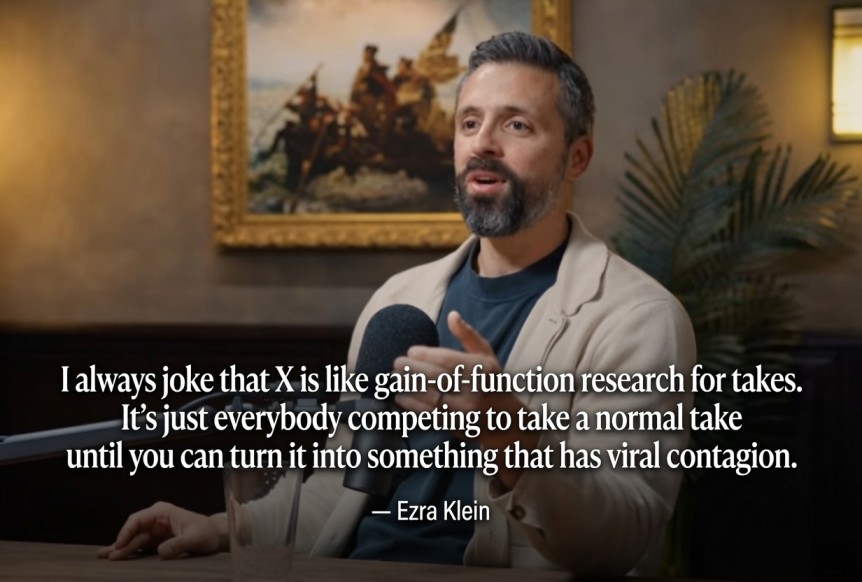
A lot of these places are like — I always joke that X is like gain-of-function research for takes. It’s just everybody competing to take a normal take until you can turn it into something that has viral contagion. And then occasionally they do it too well and it escapes contagion and destroys their lives. That’s how X works. But collectively, the effect is our collective attention is irritable, is short. It’s changing. The people we want are changing.
To again, just stay on the medium thing for a minute. There’s a great — it’s not a controversy, it’s a Neil Postman argument that he makes in Amusing Ourselves to Death, which is always one of my books I recommend to people. And he says that people often say to him, “How can you say television?” Because this guy’s writing around television is dreck. “Like, look at Sesame Street.” And he says, “I don’t worry about the dreck on television. I worry about Sesame Street,” because what Sesame Street is doing is teaching kids that education should actually be entertainment. He said the trash on television is no problem. Everybody knows it’s trash. It’s where you’re subtly changing —
CHRIS WILLIAMSON: Masquerading as something else.
EZRA KLEIN: It’s where you’re changing your expectations for what everything else should be. So right now we’re moving into a period in politics where I think in order to be a successful politician, you have to be attentionally capable. You have to be able to earn attention in a way you didn’t have to before. Zohran Mamdani, Spencer Pratt, Graham Plattner, Donald Trump, right? You can do it from different — James Talarico. You can do it in better or worse ways, but you can’t be in a competitive race any longer as a somewhat boring talker who’s just really good at delivering on the policy.
CHRIS WILLIAMSON: I understand the fundamental economics of this. I’m great with my constituents.
EZRA KLEIN: Yeah. How’s —
CHRIS WILLIAMSON: You need more aura.
EZRA KLEIN: How are things going for Keir Starmer?
CHRIS WILLIAMSON: I mean, yeah, a man that is the equivalent of a ham sandwich. Did you see this tweet? It’s at the very bottom. Did you see that tweet earlier on today? The very, very bottom. It’s hiding down there.
EZRA KLEIN: I did. Yes, I saw both of those.
CHRIS WILLIAMSON: Yeah. So I had to double check that @thedemocrats is the Democrats’ official proper —
EZRA KLEIN: Democratic National Committee.
“Shut Up, You Ugly F*”: The Democrats’ Twitter Moment
CHRIS WILLIAMSON: Correct. Yeah. And I’m like, is this a parody account? It’s got to be. So the Democrats tweet, “Fired up, ready to go. It’s time to take back Texas.” Stephen Miller replies and says, “The Democrats made history in Texas by nominating their first transgender Senate candidate.” And @thedemocrats reply, “Shut up, you ugly f.”*
And that reached at least 50 million people, it’s like 300,000 likes. I get it, the “he did it first” thing of pointing from one side to the other, but maybe this is just my sort of British properness coming through. The thought that the online representative account for one of the parties saying, “Shut up, you ugly f“* — is that not absurd? Like, that feels kind of deranged to me.
EZRA KLEIN: It is deranged. But this is a little bit what I mean about the whole medium, right? Because one thing that does, one thing that every movement like this does — and I take Donald Trump honestly as a bit of a first mover here — is it is shifting people’s sense of what political communication should sound like.
CHRIS WILLIAMSON: Agreed.
EZRA KLEIN: So that is the outcome, I would say, of a long process of learning that if you tweet like a normal, sober, stolid —
CHRIS WILLIAMSON: Boring.
EZRA KLEIN: — senior institution. Boring.
CHRIS WILLIAMSON: Boring.
EZRA KLEIN: Barack Obama is — I’m a big Barack Obama fan. That guy’s Twitter account, not great.
CHRIS WILLIAMSON: Not sexy enough.
EZRA KLEIN: Not sexy enough. No. And so this is the way everything changes. It changes the expectations, it changes the people, and it changes what can succeed.
Sometimes maybe they — I mean, I guess you can ask the Democrats if they went too far or not. Maybe to them it’s a huge success. But this is what I mean when you have to think about these mediums, you have to think about the attention, you have to think about the norms, you have to think about the discourse as a kind of public good. What that is doing — that right there is a tragedy of the commons problem. It’s very hard for @thedemocrats to be noticed. There’s a huge cacophony of voices. The voices that get noticed are extreme. So here’s the thing — you noticed them. We are here talking about @thedemocrats’ rejoinder to Stephen Miller.
CHRIS WILLIAMSON: I can’t remember the last time that I talked about @thedemocrats.
EZRA KLEIN: So they probably just succeeded. That’s a W. But it’s a tragedy of the commons. Stephen Miller, by the way, a deputy chief of staff to the president, is tweeting about James Talarico, who, whatever else you want to say about Talarico, is an incredibly decent person, an incredibly decent man in politics who tries very hard to treat people on both sides with respect. Stephen Miller, deputy chief of staff — his reaction to Ken Paxton, by the way, it wasn’t even like Talarico won the primary last night, or a couple nights ago, it was Paxton. Was first transgender candidate. So again, I don’t want to sit here and just tut-tut and chin stroke, but it is a degradation of the entire system. Sounds so uncool.
CHRIS WILLIAMSON: I can even feel my own sort of cringe-o-meter of being out of touch occurring as we’re talking about it. Yeah. Like, what do you mean? You’re both within a couple of years of each other. Are you really going to be the fuddy-duddies finger wagging at people, these kids on the internet having fun or whatever? And I don’t know, man, it feels like extracting from a system that it shouldn’t be. It feels like there’s something that’s going wrong with regards to that.
Did Independent Media Decide the 2024 Election?
I guess one of the other biggest talking points that we’ve had over the last couple of years was around what happened in the 2024 election, especially independent media sort of being involved in that. Do you think if the left had had its own version of Joe Rogan, that the last election would’ve really changed?
EZRA KLEIN: The election was close enough in the battleground states that I think you end up in a situation where you can change any variable and imagine moving. I don’t remember the exact number, but something like you would have needed, I think, 150,000 votes to switch. Those votes would have had to have been correctly apposited, but it was in just a handful of states.
So maybe not just Joe Rogan. I always say that the way to think about this is not a liberal or illiberal Joe Rogan. It’s candidates who are comfortable in the kinds of spaces that we mean when we talk about Rogan. The point is not getting one guy who is more on your side. The point is, you know, Harris Walz having been everywhere and having been capable of talking more effectively, comfortable of talking, of person.
Virtue, Self-Mastery, and the Masculinist Right
But let me pull back on something you said a second ago. I’ve been thinking a lot about virtue and politics. And virtue — I was going to say it’s not a word we use that much, but I actually think particularly in your corners of the podcastosphere — RIP blogs — it is something we talk about.
And I was just doing a show that’ll come out shortly about a bunch of the kind of more masculinist philosophies on the right, people like Bronze Age Pervert and Rog Nationalist. And one of the things I was thinking about is how much those visions of masculinity have a primitivism to them, right? It’s this desire to rediscover a stereotypically testosterone-soaked, much more competitive, dominance-oriented, aggressive — there’s a view that modern man has been warped into and constrained into this soft, cooperative, against-their-own-instincts shape.
The thing that I was noticing when I actually read what these guys were writing — so absent was the idea of self-mastery and self-discipline as a fundamental dimension, not just of manhood or masculinity, but just of humanity. In fact, a lot of these places seem to take self-discipline and self-mastery — with the exception maybe of a homo-social weightlifting component — as a negative, right? It was evidence of the way modernity had warped us into this attenuated shape that works for modern, feminizable democracy. That’s the argument.
And so you see — I think this is particularly true of Trump, and you see it with Stephen Miller — this gleeful rejection of norms of behavior that once reflected, I think, a kind of self-discipline. Politicians don’t talk the way Donald Trump talks, right? They are disciplined. They know not to just unleash on the people they don’t like in a way that is destructive, most of them. And it was this wiping away of that as a kind of show that you would not be held back by the system as it existed. So there’s a message in what Miller is saying. And then now you see the Democrats trying to ape it.
But what I do think it’s going to create — what it’s already creating — is going to be a swing back to a desire to see political virtue, to see social virtue demonstrated in leaders. Everything creates its opposite in politics always.
CHRIS WILLIAMSON: And so this — so the statesmanlike, bit more decorum.
EZRA KLEIN: Yeah, it’ll have to be a version that works for today.
CHRIS WILLIAMSON: It’ll still need to be sexy. You got to have aura. You need to have aura.
The Pendulum Swings Back: Virtue as Political Currency
EZRA KLEIN: You need to have aura. Correct. But Talarico — I mean, the reason Talarico is dangerous to them, and I’m not saying he’s going to win, Texas is a hard state for a Democrat to win in, but the reason Talarico popped in the first place, the reason he ended up on Joe Rogan in the first place, is he is able to talk through a kind of progressive Christianity in a language of morality and virtue that people found exciting and that you didn’t really hear from Democrats anymore.
And I think he was one of the first moments — and he’s raised more, I think, than any Senate candidate in the country based on this — and I think he’s one of the first moments where you really see where the pendulum is going to swing back to, because I think people are looking around and they’re seeing what it looks like when we unleash ourselves in a way that conforms to algorithmic media. And I’m not saying everybody dislikes it. Some people feel real excited by it, but I think most people dislike it. Even people I know who are Trump supporters, they don’t like the way this all feels.
The Democratic Civil War and the Abundance Debate
CHRIS WILLIAMSON: You like it in the way that you like having a McDonald’s, that at the time it’s kind of enticing, but afterward you feel a bit shitty. And if you have too many of them in a row, you actually start to reject the system a little bit.
It’s interesting, I was having this conversation with Arthur Brooks yesterday and he was saying the moment that you break any kind of addictive cycle, the first thing that you have to do, at least following evidence for a broad range of aggregated addictions, is you have to get mad. You have to be angry at the thing. Like, I’m sick of being at the mercy of this thing. I’m sick of being at the mercy of porn. I’m sick of being at the mercy of drugs. I’m sick of being at the mercy of alcohol, sick of being at the mercy of scrolling on my phone. Getting mad is a really effective first step.
And I wonder at what point people just get bored. Because this evolutionary arms race of bullshittery that keeps on happening online. Now, if the Democrats tweet, “shut up, you ugly f*” again, it gets a tenth as much attention. So we’ve already seen it. So unless you’re going to continue to play that game, okay, well, what’s new? Well, what’s new is the equivalent of a sundress and a cake, right? You know what I mean? Like, it’s something that feels a little bit more kind of vestigial.
EZRA KLEIN: I feel like there’s been a move. And again, you don’t see that tweet set where we’re using as our text here, a rich text, if spare. I already think there’s a move towards something sunnier. I mean, if you had to use one word to describe the aesthetic of Mamdani, it’s sunny. You can say a lot of other things about him, right? And people disagree with him. And everybody can have their arguments about what he believes. You never saw that guy without a smile.
I mean, if you ever just looked at the Mamdani smile, it’s like Trump had this scowl even in his second presidential portrait. This is not me ragging on him. He has a portrait in which he’s scowling. It’s a very unusual portrait. It’s this kind of like looking down. And Mamdani, the smile— and Angharad Addas had this great piece in his Substack, The Ink, about the Mamdani smile as rhetoric. And Talarico, Mamdani, you start to see something new working.
And of course, it will only work for so long, and we’ll see where it goes. It’s not the only thing working. But that Stephen Miller, the Democrats exchange, it sucks, right? Like, who wants to feel that way? No one. And so that’s a way in, not a way out. And I do think the winning move in politics in the next couple of years is going to be the way out, not the way in.
CHRIS WILLIAMSON: At best, it’s a sort of gleeful dancing over somebody else. They’ve done in the same way as two bullies fighting against each other kind of take a degree of satisfaction from having a pop. It’s not sunny. It’s performing sunniness, right? “I care less about what you think of me.” “Oh no, actually, we care even less about what you think of us than you think that we do.” Yeah, this arms race sucks.
I guess I’m kind of interested. Do you think that you are at the center of a Democrat civil war at the moment? At the center of a civil war?
EZRA KLEIN: I don’t know.
CHRIS WILLIAMSON: Do you think I am? Seems that way on the internet if you read the right pieces. There’s certainly an orbiting, and I wonder whether it’s because so few people are able to talk on many different sides.
Abundance and the Fault Lines Within the Democratic Party
EZRA KLEIN: That might be it. I think the Democratic Party is having a big debate over what it should be. And I think that the book that Derek Thompson and I released last year, Abundance, which— it was one of these things. I mean, I’ve released a book before. Things catch fire for their own reasons. And Abundance became, in a way that is remarkable, one of the texts that became the thing people used to have an argument they wanted to have, which is not necessarily the argument we’re actually having in the book. But Abundance sort of became at the center of this war between what I’d call the populist wing of the Democratic Party and the liberal wing of the Democratic Party.
And what was funny about that fight to me— so Abundance, the book we did, was about the way in which liberalism, Democrats of various stripes, left to center, have made it very hard to build where they govern. And so in places that tend to be blue, like New York or California, it’s been hard to build homes, hard to build clean energy. Texas, where you live, they build just more homes and more clean energy than blue states do. Not because they’re necessarily more pro-affordable housing and definitely not because they’re more politically pro-clean energy or worried about climate change. They just have created a structure in which it is easier to build things.
I’ve talked to climate tech entrepreneurs, not just doing sort of normal green energy, but doing things that are much more on the cusp, much bigger projects. And their politics are Californian. And they’re just like, “I can get things done in Texas and Arizona, and I can’t get them done here.”
And what was interesting about the fight that book kicked off then is the book was very much embraced by the people it was actually criticizing. So Gavin Newsom embraced that book, right? He talks all the time now about how Democrats need to be a party of abundance. He uses another term that I have called “a liberalism that builds.” And so did a lot of people from outside of the party. Obama’s talked about the book, right? The part of the party that was actually in power that we were criticizing kind of grabbed onto it. And the part of the party that is insurgent sort of reacted against that. It’s like, well, Abundance kind of became for them the face of the Obamaism, the sort of Obama side of the party keeping power. And they want sort of a more populist party.
Here’s the thing. I just think most of this fight is fake. Because Zohran Mamdani just this week released a big housing plan, and it’s a housing plan all about making it easier to build and all about cutting through bureaucracy and red tape and making it faster and cheaper. And in Los Angeles, Nithya Raman, Democratic socialist running against Karen Bass, who’s the Democratic mayor, is also running, taping things in overgrown fields that the LA city is suing to stop from becoming affordable housing. The New Democrats, the congressional caucus, released a thing about how to build more clean energy and create clean energy abundance.
So one of the hard things for me in judging this debate is that there’s an online discourse that, because of the nature of online discourse, becomes very, very factional and it becomes very angry. And people sort of create a fight in it that they’re used to. But to me, the whole thing Abundance is doing is cross-cutting divisions that exist not just inside the Democratic Party, but also between Democrats and Republicans, to sort of create new syntheses on things. And so I just don’t see the fights that people are scoring on Twitter there as being even the fights and the difficulties that our ideas really face, because in practice, it’s much more about how hard these things are to get done.
And I also think that there’s a whole technology side of abundance that has proven a much, much harder climb because of AI than it was when we were writing that book. So I’m always happy to be a character in various people’s discourse fights, but I tend to think that the particular one that has been present here has at this point been pretty belied by the reality of who is embracing these ideas.
Purity Tests: Left vs. Right
CHRIS WILLIAMSON: Well, you’re one of the few liberals that sort of openly critiquing liberal governance failures. Do you ever feel like you need to walk on eggshells a little because there is a degree of purity spiraling and othering on the left? The right seems to be prepared to welcome anybody with whatever history they’ve got with open arms.
EZRA KLEIN: Well, unless you say Joe Biden won the 2020 election, and then Donald Trump will primary your whole career into oblivion.
CHRIS WILLIAMSON: That is kind of “he who shall not be named” for joining the right. That’s the Voldemort of the right.
EZRA KLEIN: That’s correct. So I want to say something interesting about this, because I think this reflects a difference in the two parties right now. What Donald Trump did very effectively is he collapsed purity on the Republican Party down to a single dimensional point, which is loyalty to him. So he is willing to accept a tremendous amount of views so long as you are loyal to and say nice things about him personally.
CHRIS WILLIAMSON: There’s a single ordinating principle.
EZRA KLEIN: Exactly.
CHRIS WILLIAMSON: The left, which does not have a leader in that respect, has a plurality of ways that you can get in trouble.
EZRA KLEIN: Exactly.
CHRIS WILLIAMSON: Whereas there’s just a unity of ways that you can get in trouble on the right. That’s so interesting. So the right has—
EZRA KLEIN: It’s a little bit like the fox and hedgehog thing. So the right has this one big thing you have to accept— and not just lie, right? The 2020 election stuff is a lie. But the problem they’re about to have, the problem they’re having right now, is that what it means to be loyal to Trump is a more complicated thing than it was in the 2024 election, because he’s doing things, like the war in Iran. And so what it means to be loyal to him is not just you’re pro-Trump, but you can believe whatever on vaccines, you can believe whatever on— now you actually have to, as a member of the Republican Party, sign on to—
CHRIS WILLIAMSON: You can’t be on board with this. You got to be on board with this.
EZRA KLEIN: Right. You see this happening. And so you’ve had very MAGA people like Marjorie Taylor Greene and Thomas Massie, who 100% were on board with all kinds of election bullshit from Trump, but they got pushed out over other things now because they weren’t loyal on the current policy.
CHRIS WILLIAMSON: Single ordinating principle has fractured into the Democratic Party, the—
EZRA KLEIN: Or maybe I’ll call it the broad left. It’s not like it was 4 years ago, but what it has is an agenda and a set of different factions that have a platform and an orientation and a set of ideas you have to be loyal to, right? Do you believe in Medicare for All? Like, how do you feel about billionaires, or how do you feel about wokeness if you’re sort of more in the center, right? They’re trying to create a programmatic test. And that has a problem in that it keeps a more cohesive and coherent coalition if you’re able to do it, but it makes it much harder to welcome people into it.
Walking on Eggshells: Criticizing the Left from Within
CHRIS WILLIAMSON: What if we step outside of the more political dimension of this and we talk about the cultural left, the people that contribute to the discourse online, because at least with that, people can be dissenting of Trump, but broadly still be seen as part of the right. I’m not convinced that the same level of, the same amount of ballast is in the system for people that are on the left.
Now, maybe this is declining. I think that you’re right. It was significantly more pure 5 or 6 years ago. I’m just interested as somebody who seems to be departing, or at least criticizing in a manner that I wouldn’t have heard 5 years ago, whether that ever plays into the back of your mind where, “f*, I mean, I’m going to press post on this thing, but I know the subsequent nuclear fallout that’s going to occur once I do.”
The Cost of Twitter Dominance
EZRA KLEIN: I like to think that I have tried to hold this approach to my work. I’ve been in politics for a long time. The thing that led to the moment I’ve had over the past couple of years was a sort of early and pretty aggressive argument that Biden should step down. And that was not a popular thing in the Democratic Party when I made it, and it caused problems.
By the way, Abundance, which released last year — the columns and essays that led to that started in 2021. So I was writing all this at a different time. I think you have to be self-critical as a party in politics, for two reasons. One is you’re probably making mistakes, and two is that if you believe in getting things done and you’re failing, you have to try to figure out why — whether that getting done is winning elections or that getting done is building homes or whatever it might be.
CHRIS WILLIAMSON: I want to—
EZRA KLEIN: But to take the broader thing you’re saying, because I don’t want to present that as too idiosyncratic. I think this has all gotten easier, in part because the weird moment in the platforms has fractured. So here’s another theory I have: whoever dominates Twitter pays for it 3 to 4 years later.
In 2020, progressives dominated Twitter, and they convinced themselves of a lot of kind of wild ideas. And those ideas came and bit them in the ass in 2024. And Kamala Harris got really hung out on different ads that got run against her with things she had said years before. Even right now, James Tallarico — the attacks that Ken Paxton and Republicans are using against him have to do with things he said like 3 or 4 years ago. Like, “God is non-binary,” that kind of thing.
Then Elon Musk bought Twitter, made it X, sort of drove a lot of the left off of it, opened up the floodgates to the right on it. And now the right has ended up in a somewhat similar place where they have gotten attached to Nick Fuentes and the more conspiratorial incarnation of Tucker Carlson and the sort of Twitter anon world, and people are talking themselves into much more wild and conspiratorial things. And this is going to hurt them, is my prediction, in 2 or 3 years when the bill on all this comes due.
Which is all to say that I think you cannot separate the dynamics we are talking about from algorithmic social media. I think that is fundamentally what is shaping these fast rise and fast falls in coalitional purity, in kind of extreme ideas taking hold, and in a sense where you get so consumed in talking to your own side that you lose a sense of where other people really are.
And that’s the most dangerous thing in all of this. It’s not having some of these ideas — I agree, by the way, with many of the ideas people like Nader Ayad’s wokeness. The problem is when you don’t realize you have not done the political work to make those ideas legible to others, or to sort of win enough support that you can push other ideas out of the marketplace.
Instead of doing politics, you’re doing posting. And politics is a constant balancing of disagreement. Politics is an act of endless pluralism in a liberal democracy. And posting is not. Posting is for your side — getting a lot of energy to hate on the other side. And posting tends to habituate people to a very, very bad and very weak form of politics.
The Social Media Arms Race
CHRIS WILLIAMSON: So you’re saying that people sort of believe their own hype for a while, that becomes its own kind of derangement, and then at some point in future—
EZRA KLEIN: No, I’m saying that in the way we were talking about the algorithms earlier, people get into these one-up dynamics to sort of prove their purity. So Mamdani, right, here in New York, when he ran for mayor, he just had to straight up disown a bunch of things he had said on Twitter a couple of years ago. Like that the NYPD is anti-queer. And a lot of politicians on the left are just having to say, “Yeah, 2020 was a crazy time. I said some shit, and that came from being in an online milieu where people are getting pushed to see and say stuff that was ever more out of the mainstream as a way of proving that they got it.”
CHRIS WILLIAMSON: You’re optimizing for the platform.
EZRA KLEIN: Yeah, and your corner of it. Correct.
CHRIS WILLIAMSON: Yes, you’re optimizing for this very specific echo chamber. You’ve got this arms race of attention, and also you’re trying to do something which garners as many eyeballs as possible. Eventually somebody, when that dust settles a little bit, gets to look at it with a clear set of eyes and go, “What’s this? What’s this thing that you said not that long ago?” And sometimes it appears in an ad.
EZRA KLEIN: Or you’re now running statewide in Texas or citywide in New York. And all of a sudden it just — it wasn’t for them. You were saying something to the person you had seen 2 seconds ago on social media, and now it’s being blasted out in an ad running all across El Paso. And it wasn’t for the median voter.
CHRIS WILLIAMSON: The internet is forever. Do you consider yourself, given this interesting position — and especially with the book where it’s put you in terms of criticizing liberal governance — do you see yourself as further left or further right than previously, or are you just in exactly the same spot?
What It Means to Be a Liberal
EZRA KLEIN: I don’t think my politics are that different. I see myself as a liberal, and I’ve been a liberal for a long time. In the American tradition, it means different things in Europe and other places. And I have fairly recognizable liberal goals. I want universal healthcare. I want more economic egalitarianism. I want people to have the ability to live a flourishing life.
But in the way that I think has traditionally been a big part of liberalism — and think about Obama, for instance — I believe very strongly that the work of making a fractious, complex, multiethnic democracy function is honorable, important work. And that requires not just policies, but certain political virtues and approaches to politics that keep conflict from spinning out of being constructive and allow it to spin into spaces that are really destructive.
CHRIS WILLIAMSON: If you were to design an incentive to do the opposite of that, it would be social media.
EZRA KLEIN: Yes. And so I think I’m, in some ways, probably further left than my temperament makes people think, in terms of what I believe about things. But I also think that policy is not really the way people code other people’s ideology. What makes you more far left? Is it believing in the maximum level of universal healthcare you can get to, or is it your view on climate change, or is it your view on what level of political compromise is okay?
A lot of the places where people get really angry at me is that I am much more open to political compromise, and I’m very open to Democrats running very different candidates in very different places, including candidates who are much more conservative than me, because I believe disagreement is very real.
One mistake I think a lot of people make when looking at politics is they don’t really credit how different people are from them. And so if you’re in a political bubble in New York City or Austin or Los Angeles, what it takes for a Democrat like Joe Manchin to win statewide in West Virginia is not conceivable to you. You don’t know what it means to win working-class voters in West Virginia. He does. He was like the Democratic MVP. I don’t have Joe Manchin’s politics. I find Joe Manchin incredibly irksome. And I also understand that his job is not my job.
Building a Big Tent
EZRA KLEIN: One of the things I worry about — because I worry about where this country’s politics are going, and I am very deeply opposed to Donald Trump and MAGA and the way the politics work — is that I think it’s really important Democrats win Iowa. I think it’s really important they are competitive in places like Nebraska, which they used to be. In 2010, Democrats held, I believe, both seats in West Virginia in the Senate. That’s unimaginable now.
And so the question of what kind of big tent would allow that — where you can have Azar and Momdani here, but also Rob Sand, who’s this more moderate Democrat running statewide for governor in Iowa, who’s great. He’s running on getting rid of the two-party system. He’s not running as a Democrat to appeal to liberals in Brooklyn, or leftists in Brooklyn for that matter.
He starts every town hall with — he has Republicans stand up. He says, “I want everybody to clap for the Republicans in this room.” The Democrats stand up, everybody claps for them, the independents. And then he has them all do the Pledge of Allegiance or sing the Star-Spangled Banner together. And is that my politics exactly? Is that how I would run a rally? Probably not. Would I win statewide in Iowa? I sure f*ing would not, man. But Rob Sand might win statewide in Iowa, and Rob Sand is a hero for that.
You’ve got to believe in things. But also, I think in the Trump era, I take more seriously than I used to that building the stability of our politics was an incredible achievement, and many countries don’t have that. And in many countries they had it and it was lost. And believing that in America we cannot break this thing is a mistake.
And if you do believe we can break this thing, then you actually have to think about what kinds of politics bring it back. That’s why I’m not excited, even if it works intentionally, about seeing a doom loop of vice and venality. Because even if you can win that way, you are breaking the thing by doing it. And so the question of how do you win virtuously is very important to me, because for all the other things I want to have, you actually need a working, peaceful politics to get there.
The Search for the Next Obama
CHRIS WILLIAMSON: Who’s your ideal Democratic Party candidate for 2028?
EZRA KLEIN: They don’t exist. I don’t think there’s a perfect Democrat for 2028, and to the extent there is, we don’t know them yet because they’ve not been under those lights yet.
I think I am a sort of unreconstructed admirer of Barack Obama, and if Obama were running today, he would have to run differently than he did then. More aura — online aura. That’s the point. You can’t transpose who he is post-presidentially to now. He is a human institution. He’s like a monument in some ways. So he’s not going to be who he was even when he was running in ’08.
But I think he did something that’s really hard to do. One, he contained many of the country’s contradictions inside himself and was able to make people — even those who disagreed with him quite deeply — feel seen. And he was able to combine two forms of moral imagination that I think are hard to combine.
The first was a moral imagination of policy — of things like universal healthcare, which he basically achieved. A lot of people had failed on that before him. Could we make healthcare better? Always. But Obamacare is no small thing. The second was a moral imagination on politics itself. In a country that had the kinds of racial divides and legacy we have, and in a country that in the Bush years felt very divided, he made people feel politics could be different.
And the tragedy of Obamism is that it got worse. He was actually able to pass quite a lot of the policy he promised, but he was not able to make politics and this country’s divisions feel better. In fact, they felt worse. And the thing that I think no one has an answer to is how to resuscitate that side of his moral imagination in a way that does not feel naive or hopeless or cliché.
The 2028 Democratic Field
CHRIS WILLIAMSON: Yeah, it’s an interesting one to look at what happens in 2028. It was so fascinating to me being in the UK and starting to come online with realizing just how tumultuous America was politically, and then observing that unfold and then starting to be a part of the conversation, I guess, because I started Modern Wisdom in 2018. And then to roll it forward and to think about what happens in just 2 years’ time, just 2 years from now, kind of blows my mind. And I don’t know what people are looking for on either side in 2028 anymore.
EZRA KLEIN: Do you follow— do you, I don’t know how deep you are in politics. I know you’ve had Bernie and people like that on the show. Do you look at the Democrats, you think that one?
CHRIS WILLIAMSON: No, no. But I also don’t look at the conservatives and think that one either.
EZRA KLEIN: I mean, my basic read of the field for what it’s worth right now is that the ones doing the most interesting things are Gavin Newsom, AOC, Buttigieg. And then the big dark horse I think that people should not underestimate right now is Jon Ossoff, who is the senator from Georgia. He’s in a reelection this year. But when I look at the Democrats, those are the four who I think have figured out attention in this era. And one of my views on politics is that attention is its own competency now. And that if you are not capable of earning it and wielding it and using it and breaking through on it yourself, then you actually cannot compete at the highest levels.
CHRIS WILLIAMSON: Certainly not right now with the way that the ecosystem sits at the moment.
EZRA KLEIN: And I don’t think it’ll be different in 2028.
CHRIS WILLIAMSON: You’ve got to play the ball where it lies.
Overformed by Institutions
EZRA KLEIN: So, and there’s also something about one of the great, I think, character mistakes of Democrats and center-left parties actually— I think you see this with Keir Starmer in a bunch of places— is people who are too formed by institutions, they’re afraid. And one way I often put this is I think right now one of the problems in American politics is Republicans are underformed by institutions and Democrats are overformed by them.
So Republicans, sort of in the Trump era, they’re too contemptuous of institutions, too contemptuous of institutional authority, too contemptuous of the norms of institutions and how you act inside a company. Rip it up. Just rip it all up. Doge, chainsaw, it’s all bullshit anyway. And that’s wrong.
The problem for the Democrats can be that they can become a party of Tracy Flicks, and they are so framed and molded by— like, from birth, having competed their way, through every school, through every competition, through every company, through their politics. In a party that is much more pro-institutions than the Republicans are. And people who come through institutions like that, they often reflect those institutions. They begin to talk like them. You can hear the institution when they open their mouth.
Kyrsten Sinema speaks like she is the government, right? Like you feel like she’s got— she feels like a bureaucracy. And I’m not even saying that as a negative on her. At another time, that might have been more, you know, a doable thing. But I don’t think that works in this media environment at all. Like, you have to feel honest, authentic. You have to like—
CHRIS WILLIAMSON: Like a real person, like an actual human. People can—
EZRA KLEIN: People can sense that before they can sense anything else about you. And so when I see some of the Democrats who are running, but they still talk like someone who is optimized— and to be fair to them, this used to be a thing you optimize for, and it worked. To win over, like, local editorial boards at small-town newspapers. They were optimized to be somebody that the editors of newspapers thought seemed like a competent, decent person. And it might be, and it is, I think, a shame that that has become some kind of a liability, that you need to have some edge of wildness to you. Yeah. But it is what it is.
Deregulation: Two Very Different Projects
CHRIS WILLIAMSON: A new skill set as you rise up through the ranks. Yeah. It’s interesting. There’s kind of a common thread here, which is that you almost get locked into a mode of thinking from a particular domain that you’re in, whether it be a platform, from a particular niche that you’re in, geographically, culturally, from a particular time that you were in in your career and what was useful then, and the inability to be prepared to update that. And also the potential hypocrisy of having updated that creates its own challenge too. So you’re sort of fighting against it.
I guess when we’re talking about a more active left, like a building left— the word deregulation gets used by Elon Musk and it also gets used by you. It does. And you clearly don’t mean the same thing, but the same word doing two jobs is a problem in politics, right? It sort of lets one team’s project ride the slipstream of the other and you end up in this sort of semantic game back and forth. How do you tell the difference between your kind of deregulation and Elon’s in a simple way that you can explain around a dinner table? They have different goals.
EZRA KLEIN: I mean, what is deregulation? You are removing rules. What is regulation? You’re adding rules. Is adding rules or removing rules good or bad?
CHRIS WILLIAMSON: Well, how the f* would you answer that question? Depends on the rule.
EZRA KLEIN: Depends on the rule. And so look, I consider Musk to be a tragedy. This is a guy who is clearly a genius, who is the most capable industrialist of our time, who built those industries on public-private partnerships. Tesla is built on government subsidies, on government tax credits. There is no electric vehicle market in this country without the huge amount of money we— and California, by the way, in particular— pumped into making that market real. Tesla would have gone under without an Obama-era loan guarantee. SpaceX. SpaceX’s NASA contracts.
And Musk, at some point— and I mean, you can basically chart when it happened because he was sort of a Democrat in semi-good standing. He was like pro-Obama, right? He radicalizes. He’s online way too much. He gets Twitter-brained. Twitter has been bad for no one the way it has been specifically bad for the way that guy thinks. And his information environment is so deeply toxic.
And there’s a world where he joined the Trump administration and tried to increase state capacity. And yes, that might mean chainsawing through some of what the government did, but with the goal of making it possible to do more in space, with the goal of making it possible to do more effective research into battery technology. And instead, he cuts completely indiscriminately. I have friends who got layoff notices where the email read, “Dear first name, last name, you have been terminated for cause.” Which cause? Who was that email to?
Rules, Regulation, and the Cost of Affordable Housing
So Musk’s project— deregulation is a traditional Republican thing. He didn’t make it up. But the point is that right now the government often imposes too many rules on itself and that makes it hard for it to do things.
So if you look at the Mondani housing plan that came out this week, Block by Block is what it’s called. What he is doing in that plan overall is he is removing rules. He is deregulating what is required when New York puts in money to build affordable housing. In order to build affordable housing in most jurisdictions, certainly blue ones in this country, because you are using public money, it triggers a bunch of government rules that make it much more expensive. Because a lot of interests have come up and won their way into the fight. And so they’ve been able to force higher building standards and higher wage standards and higher environmental standards. And all these things might be good on their own, they really might be. But what you’ve done is make it twice as expensive or 3 times as expensive or 4 times as expensive to build affordable housing as to build market rate housing. And so the taxpayer’s getting a shitty deal and you’re not building enough affordable housing.
There was a story in Washington, D.C. a couple years ago about how they’d ended up building affordable housing units that were costing $1.2 million per unit. These are affordable housing units with, again, public and nonprofit dollars. There was one particular build where— I’m worried I’ll get the numbers wrong from memory, but I think it was something like the same developer built affordable and market rate next to each other, and the affordable cost something like $800,000 per unit, and the market rate was like $400,000. And you just can’t achieve— the goal is affordable housing.
What Do We Want More Of?
And so what I care about— the point of Abundance, the first sentence of it, basically of the book, is: what do we need more of and how do we get it? And so the thing that separates different people in this debate, for me, the abundance debate, the debate about plenitude, is first you have to decide what do you want more of?
I want a lot more green energy. Donald Trump does not. So the fact that he is deregulating what it means to build coal or oil in this country is not a big abundance win because he’s trying to achieve something that I don’t support. He’s actually made it harder to build wind and solar.
So you can regulate government to make it harder for government to act. You can deregulate it. You can use rules well and poorly. And when you get your politics wrapped up on the axle of having an emotional reaction to the means, to the tools you’re using, then you’ve got a problem. The idea that deregulation is owned by the right, or for that matter, that regulation is owned by the left— it’s not true, but it’s a way of shutting off your thought. The right regulates things all the time. The left deregulates things. It’s just a stupid—
CHRIS WILLIAMSON: Yeah, no, I agree. Stupid way of thinking. This proposal for abundance is a lot about rolling back red tape, but I know a lot of people are concerned about what that means for unchecked power of potential AI overlords. If you’ve got a very small number of people who are controlling a massive amount of influence and a massive amount of the economy, how does the rolling back of red tape help with that solution?
AI, Regulation, and the Public Agenda
EZRA KLEIN: So, two things. So one, I want to say abundance is not about rolling back red tape. There are places like building housing in dense blue cities where you probably do need to roll back what people call red tape. But that is useful where that is the problem. On AI, I believe we need a lot more AI regulation. This is why I don’t buy the sort of deregulation, pro-regulation dichotomy. There are places I want to regulate more, places I want to regulate less.
I have a lot of concern about the power concentrating on AI. And I’ve covered these guys forever. I’ve had Demis and Sam Altman and Dario all on my show. Like, I’ve been in this since GPT-2, I guess. And you do not want power concentrating with them. And at one point, and some of them will still say that they don’t want power concentrating with them, although in practice they don’t always act like that now.
Sam Altman, I think, and OpenAI seemed to be more pro-regulation a couple of years ago than in practice. Like, Greg Brockman, its president, has helped fund this super PAC that is dumping money against candidates who want to regulate AI. And so it’s like, on the one hand, they’ll come to a hearing and say, “We want to be regulated.” Then somebody will run for office saying, “We should do some light regulation.” It’s like, “Not you, not by you, we don’t.”
So you have real money in politics problems. And I, by the way, just as a broad thing, this is not something we wrote about in Abundance, but I just believe in much, much, much stronger money in politics regulations. You should amend the US Constitution to say money is not speech. Money should not be as protected speech when spent on politics, and make it possible to regulate it. There’s an effort to do that through statehouses happening right now.
The Physical Infrastructure of AI
But I think the abundance question on AI is at two levels. One is we think of AI models, right? People argue about are they using Gemini or ChatGPT or Claude, but AI is, Jensen Huang of NVIDIA always makes this point, it’s like a 5-layer cake and there’s an energy level, there’s a chips level, there’s all this infrastructure you actually need.
If we want the US to continue to be kind of AI competitive or even AI dominant, you’re going to need to get that infrastructure right. And in order to then not make that an energetic disaster, you’re going to need to use the data center buildout to create a modern grid and create much more of an electrostate, not a petrostate. Like, there’s a whole set of questions that are raised by the physical AI buildout.
What Do We Want AI to Solve?
But then the second thing, I’m actually writing about this right now, is we are having so many conversations about what we don’t want from AI. What do we want from it? What is the public agenda for AI? What does the public want? What are the public goods? Because they’re not just going to come on their own.
Right now, if you talk to any corporation that is really tooling itself for AI, they are spending huge amounts of money on compute, just buying enough tokens, but they are often restructuring themselves as an organization in order to become legible and make their problems legible to the systems.
So for AI to be able to solve a problem for you, you need a couple of things. One is there needs to be money behind the problem, because if you need a lot of compute to do it, it is costly even now. The second thing is the problem needs to be legible to the system.
What I mean by that, for instance, is AlphaFold, which I think is the most impressive thing AI has done yet, which is the protein folding, solving the protein folding problem. The reason it was possible to do that was there was this thing called the Protein Database, which had been, it was arguably the cleanest scientific database in existence. Certainly one of them, where people had been keeping really high-quality data on every single protein that we had mapped its structure.
And that meant there was one place where the data was structured in a way where you can set the machine learning loose on it and it could learn the data, begin to predict based on the data, and then also begin to create synthetic versions of that data to extend its predictions and then be able to test them backwards and so on and so forth.
There are a lot of problems that might have that shape, but you will have to create the data that the machine learning can work on for them. And in government, that’s often not done.
AI in Government Services
So here’s a very simple use case I keep talking to people about. There’s no reason that the IRS can’t have, I mean, build it on Claude, build it on ChatGPT, build your own. They could have an LLM that does your taxes with you. The IRS knows how much money you make, so they have ground truth there. They know the tax code. They write it a lot of the time, or at least certainly help in the regulatory system to define it. There’s no reason most people have to pay an accountant.
More broadly, you could have an AI that acts as a concierge to anything the government might be able to do for you because it knows you, it knows your situation, and it knows what the government is capable of doing. It’s very, very hard to navigate the government right now, but you have to make the underlying data and system legible so the AI can learn what it needs to learn.
Drug discovery, energy. There’s a lot of questions like this where, for instance, on drug discovery, I don’t know how good AIs will be on drug discovery. I have talked to different people who disagree on it. But if you look at what AIs are good at, like, did you follow the solving of this Erdős theorem?
CHRIS WILLIAMSON: Yes. Yes, I did.
EZRA KLEIN: So I talked to some mathematicians about this. My dad’s actually a mathematician. I haven’t talked to him about it yet. I should. But this particular theorem, what it was able to do was sort of two things. What it was able to do was come — it knew kind of everything about mathematics. So it was able to combine approaches from fields that were not primarily thought to be useful in this particular theorem. But there was one mathematician who was like, “Oh, I had thought about doing this, but it was super labor intensive. So I just didn’t bother.” So it also was able to be tireless in doing that.
It did not do, I think, what you would call truly new groundbreaking mathematics. It didn’t invent a whole new field here. It did something very clever and very labor intensive. And that is how a lot of advances happen.
CHRIS WILLIAMSON: Synthesis plus hard work.
Orphan Diseases and the Case for Public AI Investment
EZRA KLEIN: So think about what’s called orphan diseases. These are diseases — my wife actually has one of them — that are quite rare. So there isn’t a huge amount of money in solving them. And that means, unlike, say, something like diabetes, where there is just a functionally endless number of drug researchers working on diabetes drugs and a huge amount of money behind it, and the best people in the field on these things, you don’t have that.
So that’s a great place where being able to have a lot of compute and then the federal government saying, “If you invent this thing” — this is basically what we did with Operation Warp Speed, right? We said, “If you invent this thing, we will buy it, and then we will hand it out at low cost.” That’s how we made the COVID vaccines.
You could do that across a huge number of diseases and say, “If you’re able to solve any of these, here’s what we will give you. It is worth it to us, the public, to have cures here, and we’ll make those cures cheap.” And we’ll put work into making the regulatory system amenable to this. They also did that in Warp Speed. We’ll put in work to try to create better databases. We’ll clean things up for you, but we will create a prize system, an advanced market commitment system.
What do we want AI to solve? Because right now the private market is putting a lot of money into that question, but the public sector is only thinking about what it wants to prevent AI from doing, which is important. I’m a big believer in AI harms. I’ve been talking about existential risk for years. But you also need a theory of AI goods. And right now we don’t have one.
AI Safety and Existential Risk
CHRIS WILLIAMSON: It’s interesting. I had Nick Bostrom on the show and Superintelligence, more than 10 years ago now, 2014, 2015, something like that. When that came out was kind of my introduction to, “Holy s*, there are a lot of ways that this could go very, very wrong.” The X risk of X risks. And then his new book was basically, okay, what happens if this goes right? And even on the path to it going right, there were tons of different ways that it could go wrong.
It is kind of mind-blowing to me that there is any time being spent on anything that isn’t AI safety at the moment. I’m aware climate change is something that we need to keep an eye on. It’s not going to happen within the next decade. Birth rate decline, something that I’ve talked a lot about on the show too. I think that’s going to happen more quickly than climate change is, but still not on the timelines that we’re talking about here.
Did you see Tristan Harris’s new thing, the AI doc?
EZRA KLEIN: I haven’t seen the doc, but I know Tristan.
CHRIS WILLIAMSON: Dude, it’s really, really good. It’s really, really interesting.
EZRA KLEIN: I have come, as a person who was in that world for a long time, I have come to a probably slightly different view on the right way to approach AI safety.
CHRIS WILLIAMSON: You going to give me a white pill? I really need one.
The AI Safety Debate: Present vs. Future
EZRA KLEIN: What would a white pill be? I never know the pills anymore. There are too many of them. Hope. Feel better? Hope.
No, look, you cannot solve a problem whose shape you do not know. You can’t. So it’s good to talk about AI safety. We should be pumping money into, say, mechanistic interpretability. We have made big strides on interpretability. Shout out to Chris Olah at Anthropic, who’s been a hero in this and is now hanging out with the Pope, I guess. So apparently, good things happen to good people.
We should be trying to understand these systems. But so much of the AI conversation — the mind is attracted to these speculative scenarios. Mass automation where there are no more jobs. Recursive superintelligence, self-improving superintelligence that slips out of our control overnight.
Here’s the deal. If we create recursive superintelligence that slips out of our control overnight, which is sort of how the AI 2027 scenario works, we better just hope for the best because I think we are kind of f*ed in that scenario. I don’t think it will happen like that or that quickly.
But we want as good interpretability as we can possibly have. And the other thing we want is to be in constant work on regulating the existing nature of these systems and at their frontier, and testing the systems and working on them constantly. Because in the same way that the AI companies — the ones who are founded on a theory of safety, like OpenAI, which, eh, and Anthropic — were like, “Well, we can’t make it safe unless we build it.” You cannot figure out how to regulate it unless you regulate it, both for good and for bad.
And so my view is that the political system needs to get in the game on the system that exists right now and not endlessly debate a speculative scenario that it is not going to be able to respond to until you’re there. That is not how politics works. It’s not how anything we do works.
So yes, that does imply a certain amount of pessimism if we end up in the extraordinary fast takeoff scenario. I don’t think we’re in the extraordinary fast takeoff scenario.
And just by the way, I have always thought — and have always had this argument with my effective altruist friends, and actually Dwarkesh Patel, who’s a great AI podcaster, just sent out a little Substack making the same point — the capability to wield power is more than intelligence, a lot more. And so the world is full of friction, and the superintelligence scenario has always had this dynamic where it isn’t just that the thing becomes recursively improving and super powerful, but it also never makes a mistake on its way to taking over a world that doesn’t understand it.
And have you ever dealt with smart people? Is Donald Trump the smartest person in the world? No, he’s got an incredible animalistic instinct for power and other people’s weakness, and he’s made a ton of mistakes. And Dwarkesh in his piece is like, “Maybe Stalin is the person we’re talking about here,” but Stalin also is not the world’s greatest genius.
I think there’s a real mistake being made on how easy it is to translate intelligence and information into power. And I am just skeptical. We can all come up with a sci-fi scenario, but I can’t forever argue against the absolute worst thought experiment you can get. Then we’re just in a world where, yeah, if all we’re dealing with here is an endless effort to come up with thought experiments that the regulators can’t match, you will outmatch the regulators very quickly.
Which is why the regulators should be increasing their competency by actually dealing with AI in the present moment. You get better at things by doing them.
CHRIS WILLIAMSON: So you’re saying that the most dangerous AI isn’t the smartest one, it’s the canniest one.
EZRA KLEIN: I think that’s true, but I’m saying that the AI safety debate has been caught in thinking about the future for too long, and now we’re in the present. And so the thing to do is to figure out how to take some of these fears — which I take as serious. I am not somebody who’s dismissive of them. I have a P-Doom sitting in the back of my head. But you have to take them and do something in the now, because now we’re at the point where AI is here.
For a long time, there was nothing really to do, because AI was speculative. You could try to be running your experiments in these labs, but that’s all you can do. Now, we actually have quite powerful AIs. They’re getting more powerful all the time. Congress — we need to probably build more capable institutions that actually have expertise on regulating it and are able to hire some of the best people, because the market for AI researchers is more expensive than the current civil service rules we have for hiring really make possible to compete in. And you have to be getting your hands dirty and trying to make what we have work well, and also be trying to create the goods that can give it a direction that is safer.
CHRIS WILLIAMSON: Well, think about who was involved in the conversation from 2015 to 2020-ish. Philosophers. A lot of philosophers. And if you watch the new AI doc, it’s a maths grad, computer science programmer, futurist, technologist. It’s moving more, but you’re saying this goes even beyond that to people who are policymakers. We need to bring those sorts of people in to actually get involved in this too. So yeah, it’s gone from being as hypothetical and theoretical as possible to now something where the rubber’s really met the road.
Regulating What We Have Now
EZRA KLEIN: My view on this is not that I am dismissive of the possibility of future AI slipping out of our control, or frankly, even — although I am more skeptical of this — the possibility of mass automation. What I am saying is that it is long past time to start working on the systems that we have now as regulators and stop debating a hypothetical. You do not have a way to stop the hypothetical. Have you read Eliezer Yudkowsky’s book?
CHRIS WILLIAMSON: Yes. I had him on the show.
EZRA KLEIN: As did I. The argument is: shut it all down. That’s where it goes. And for better and maybe for much worse — maybe he’s right. His view is 98% chance that if we create superintelligence, we’re f*ed. But we’re not going to shut it all down. And so the question is, given what we have and where we are, start actually bringing the system and the systems under democratic control.
CHRIS WILLIAMSON: What would you do? Let’s say that you had God’s eye coordination power.
EZRA KLEIN: I would have probably 3 or 4 buckets. So one, I would put a lot more money into evaluation than we’re currently putting in publicly. Trump and Musk gutted a bunch of that, but I would make our public evaluation capabilities incredibly strong. So that’s one thing. They were trying to do that sort of in Biden.
I would start doing a lot of regulating AI use cases because I think there’s actually a fair amount of consensus on that, and so you could move on that. I think we should be quite careful about running this experiment on children. I think that the idea of kids growing up with a bunch of AI buddies and lovers — I don’t think we know how it will warp people’s sense of how relationships work when they have those before they have real relationships.
CHRIS WILLIAMSON: I think I’ve heard you say that the kind of childhood that you had could have fallen prey to this kind of —
EZRA KLEIN: Yes, I was a very lonely kid. I was bullied a lot. And I was also a smart, nerdy kid. And so what would it have meant if instead of having to sort of fight through that and find my best friends and figure it out — work with the friction the world gave me, which made me who I am — I could have disappeared into frictionless digital relationships, friends, tutors, lovers. I think that’s actually quite scary.
CHRIS WILLIAMSON: I was the same except for being a lot less smart and nerdy.
A Public Goods Agenda for AI
EZRA KLEIN: Oh, I don’t know. I think you’re probably underrating yourself. But so I would do a lot on kids. I would do a lot on actual goods, as I was just saying. I really want to see a public goods agenda for AI. And I think there are harms we can begin looking at now in the way AI is used and what it is given autonomy and power over, and when human beings need to be in the loop.
I think that there’s pretty good thinking on safety. Something that isn’t in the AI 2027 thing that I think is smart is that AI should always have to keep a legible chain of reasoning notepad in English. The moment we start letting them come up with their own languages, we really have no capacity to see how they’re reasoning.
CHRIS WILLIAMSON: The black box has a black box.
EZRA KLEIN: I don’t want to make the black box too black boxy. And so, yes, that’s smart. So you want to start working with what you have now.
And I also — whether you want Anthropic doing it is something we can argue — I think having a fair number of restrictions on how AI can be used for surveillance, for kill chain questions, is wise. And I particularly worry about surveillance. I am both in a kind of macro way against using AI to create the panopticon, but in a micro way, a lot of the machine learning tools being used to make the lives of workers measured and miserable right now — what’s being used? You read a lot about this with Amazon and delivery drivers. There’s eye-tracking software. There are all kinds of software being used in different places to just track how productive workers are. It’s like having somebody always watching you to make sure you’re never slacking off.
And what I would say is that using machines to turn people into machines is inimical to human flourishing. And I do think we need to think harder in politics — and AI is going to push this — on what actually human flourishing means. What does it mean to be a human being in the age of AI? What does it mean to learn like a human being? What is human dignity, right? The Pope is right about that.
CHRIS WILLIAMSON: People are already feeling this thought entropy thing kicking in — this lifting with an exoskeleton suit on — that my capacity to actually be able to think properly is being degraded. And I know Pema Chödrön, one of your favorite writers, talks about sitting with uncertainty instead of running from it. AI is, in a sense, the most powerful uncertainty killer ever built. You have instant answers straight away. You never need to wonder again.
Even in the before times of internet use, there was friction even in your search. To go onto Google to look for a thing — “Oh, is that reliable? How reliable is that particular forum? How reliable is this particular poster? Have they got an agenda? Oh, it’s not got a security certificate on this particular website,” or you’d have to scroll for a little while to find the specific type of answer you were looking for, and then scan the document — as opposed to having the equivalent of refined NASA ready-to-eat dehydrated reconstituted food that you can just squeeze from a toothpaste tube into your mouth.
The Ghost of Productivity
EZRA KLEIN: The simplest thing I tell — I sometimes do college speaking, I’ll get asked by kids, you know, what should I do? You know, AI. My answer is always read books on paper. You should have a practice of cultivating the form of attention, the form of sustained attention without reaching to resolve every question that occurs in your mind, that books create.
People think of books, I think, as a technology of information — that they download information from a book into your head. But they’re a technology of thinking. They are a scaffold for thinking. And what is happening when you read a book on paper and are not distracting yourself every 2 seconds is connections are being made in your mind. The value of a book is not just the information in it. It is what happens in your mind when you read it.
And one of the things I feel very strongly about with my kids, one of the things that I worry about with integrating AI into schools is — we talked about attention at the beginning here. We need as human beings to cultivate healthy forms of attention. And AI, one of its seductions even for smart, agentic, as we now call them, people, is the constant feeling and simulacra of productivity it gives you.
So you’re reading something, you go and you look it up, and it all feels very productive because you are in this constant information back and forth. And I do use AI for research. I learn things from it. I’m not — I mean, I think you can hear in this conversation, I’m not like a pure hater. But if you are not spending time thinking and reading away from screens, you are allowing something to atrophy that you will not get back.
And what I worry about with a lot of smart people I know is that AI makes you feel superhuman and it’s making you less than human. I’ve watched a lot of people who seem to use AI a lot more and their work is not getting better. It’s getting worse. I hear about people who have all these agents running on their behalf now, and they come in in the morning and it’s prepared this huge summary of everything. And it’s like, what about reading a physical newspaper instead of now absorbing tons of book reports from your AIs? Like, where is your space? Where is your mind?
The ghost of productivity, the illusion of productivity, is something that you have to fight so hard, I think, in this era. Because even prior to AI, it sure feels like you’re doing something productive to sit there on your laptop, on your iPad. And even when your brain has stopped really working, you’re flicking back and forth to the news, to your email. You’re seeing things on social media that sort of pose as information, but it’s all distraction wearing productivity’s clothing.
And you have to be really vigilant against it, because deeper productivity often doesn’t look or even feel like productivity. It’s taking a walk and having an idea. It’s like the second hour reading an actually pleasurable good book in a coffee shop. These things are deeply human experiences. The reason books worked, and the reason we festoon rooms in them when we want the rooms to look smart — which is what we’re doing in here — there’s a reason we associate them with intelligence. Because they’re not about what’s in the book. They’re about the way that people who read books are trained to think and attend. And that will ultimately make you much better at using AI.
CHRIS WILLIAMSON: Desperately compensating with all of the books behind. I noticed with myself that one of the best questions that I asked myself on an annual review a couple of years ago was, what do I think is productive that isn’t? And what do I not think is productive but is? And going for a walk without AirPods in.
EZRA KLEIN: Wait, what did you come up with on your second list there? I want to hear it.
CHRIS WILLIAMSON: Driving without consuming anything. So no music, no podcasts, nothing else. The same with going for a walk. Dinner with friends — massively productive, hugely productive. Come home and I’ve got 5 new ideas, or I feel a little bit more peaceful, or I’ve just got to listen to someone else entertain me, or got a new perspective on something, or I’ve not thought about my own stuff.
Even simply the space that you create, the void that you create between thinking about your own stuff and thinking about your own stuff, by hearing somebody else extemporaneously think about their stuff to you. You’re like, oh, brilliant. I thought about someone else’s stuff for a bit.
That stuff that isn’t productive, but I thought was — sitting at my desk when I’m not working. I’ve just got the laptop open. I’m like, oh, maybe I’ll pick up some productivity. Slack almost ever, being on calls when I don’t need to, like just checking-in calls. They have all of the trappings of something that looks like progress and productivity, but when you think about what’s actually happened at the end of it, it’s almost never anything productive. Lying in a hammock — unusually productive. So what comes to mind for you?
EZRA KLEIN: A bunch of those I’d agree with. Travel. Huge. And I always want to be careful about the language of productivity here because the point is not to —
CHRIS WILLIAMSON: Do it in service. Only travel in service.
EZRA KLEIN: Yes, yes, yes. For me, the absolute best thing I can do for my productivity is go to a coffee shop or some beautiful space. The aesthetic richness of the space is meaningful for me, and read paper books for a long enough time to get into a state where my mind has settled on that being what it’s doing. That is, I think, the most important thing I do for my work. Walking. I don’t listen to or read things for the most part on the subway anymore. I just sit there like a psychopath. Yeah. It is amazing how much it’s like sitting there staring forward. You feel weird now on the subway.
CHRIS WILLIAMSON: Do you know the Rory Sutherland line about this, to do with smoking? He says, sometimes you just want to stand in the corner of a room and stare out of the window. The problem is if you do this without a cigarette, you look like a friendless idiot. But if you do it with a cigarette, you look like a f*ing philosopher. Yeah. So aesthetics count for a lot.
EZRA KLEIN: Yeah, they do. So really just taking breaks in general. I mean, if you want to just boil down a lot of what we just said aside from reading, it’s that just staring at a screen endlessly is bad for you. It’s good for you when you’re doing it intentionally and for long enough, but I cannot tell you how many times I’ve solved a problem on a column that I had been banging away at the keyboard on for hours or days, by just leaving.
CHRIS WILLIAMSON: You can’t white-knuckle creativity. You don’t get to white-knuckle it.
EZRA KLEIN: And so there’s a lot of that. The gym is obvious — you get a lot of ideas there. Showers. This stuff is all there. But I think to draw it out of the creativity space, or the productivity space, the thing I think that is being said here is you need to make space for yourself to be a human being and do human being things.
And AI is going to be better at being a machine than we’re going to be at being machines. And so trying to make yourself into a better machine — everybody thinks they’re using the AI as a prosthetic. But again, the lesson of McLuhan and Postman and others is eventually the AI is going to be using you as a prosthetic. Or certainly — to be more specific — the organization that pays for both you and the AI is going to be making you a prosthetic of the AI, in the same way that Amazon has made people into prosthetics of the boxes they pick up and the delivery vans they drive.
Trying to be as little like a machine as possible, or at least create big spaces where you’re not acting as a machine, is I think going to be really important. If I had to make a bet on how I would educate my kids — and you told me you can put them in a school that is going to be at the cutting edge of using AI, like an alpha school or whatever, or you can put them in a school that is like St. John’s University or something, and it’s going to be all paper and pens — I would go that one. Because there will be AI. It will be out there. What I need to develop in them is the ability to be a human being.
And one of the dangers whenever we get really excited about a new technology is we over-adopt it in a thoughtless way. And then the technology colonizes our minds and then we can’t realize how much we have lost attentionally, in terms of our own independence, in terms of our own depth. So just like all the things we’re talking about — take breaks, take a walk. It is so basic.
CHRIS WILLIAMSON: It’s the sort of thing that your mom would happily give you an answer for. What’s that line? I think it might be a Nietzsche one where it’s like, “I beg you, my friend, sleep well and go for more walks.” It’s just always a solution.
EZRA KLEIN: Oh my God. Really? Advice Nietzsche should have taken.
CHRIS WILLIAMSON: Yes, agreed.
What the Left Gets Wrong About Men
CHRIS WILLIAMSON: You mentioned earlier on about this challenge, this positioning that we’ve got at the moment around encouraging people — both sides encouraging people to better themselves — perhaps a little bit of an aversion of this self-determination, personal development, at least traditionally coming from the left, but maybe also coming from the right now. I think the left talks a lot about structural barriers for women. Do you think it’s got an equally serious account of what’s going wrong for men at the moment?
EZRA KLEIN: I don’t. I think it knows it doesn’t, and it’s beginning to try to think about what to do about that. People like Gavin Newsom are taking that a lot more seriously.
I want to get at the thing you said underneath that, because I think it’s important though. I think a very damaging thing that happened on the left — I’ll call it liberalism to be more in my own stream here — is that it began to see individualistic explanations as excuses for structural dysfunction. And so it became hostile to any politics or moral structure that was also about self-improvement.
And one, that’s a betrayal of the long history of liberalism, which has always been about self-cultivation. Go read your Kant or your John Stuart Mill, or for that matter your great liberal politicians like Frederick Douglass or MLK or FDR. Lincoln. But when you give up on that, you’re giving up on one of the fundamental drives.
So you want a society that is taking seriously all the ways in which structures oppress and coerce and impede people’s flourishing. And also what you’re trying to create space for is for them to use their agency and their energy and their will to flourish. And so you need both sides of that. You need the vision of the just society and you need the vision of the flourishing, self-cultivating person.
And I do think the left became hostile to this, and particularly became hostile to it when it was male-coded. So when it was coded in the way that self-help is for women — more therapeutically, more relationally — it was much easier. Esther Perel, Brené Brown, other people like that who have more of a vision in that space, and that went down easily.
But in the male space where it’s a little more testosterone-y, when it got associated with the Joe Rogans and Modern Wisdoms and some of that — I shouldn’t say that — but the Jordan Petersons is maybe the better way to put it. I think there was a pushback, because also some of those people did have very aggressive right-wing politics. And so these things got linked together in their minds. And instead of saying, okay, how can we take the impulse in here that is clearly making Jordan Peterson into some kind of international phenomenon and also try to answer it and have something constructive to say about it —
CHRIS WILLIAMSON: There’s sort of a rejection of it. Discard it entirely, because it’s rejecting the structural inequalities that people are facing by saying that there are things that you can do and to pull yourself up by your bootstraps.
The Collapse of Virtue: Left, Right, and the Attention Economy
EZRA KLEIN: What is surprising to me, and I’d be very curious for what you think happened here, because you know this world a lot better than I do, not the right politically, but somewhere this went. Is I don’t really, the way that Peterson and maybe Doug Murray and people like that, it seemed to, like what came after that was Andrew Tate and Nick Fuentes and people who have, I think, no real concept of virtue, right? I got my disagreements with Jordan Peterson on lots of things, but that guy thought a lot about virtue, thought about myth, thought about, you know, and—
Overthought about it.
Overthought about it. Somehow the right, like Bronze Age Pervert, it pushed towards vice. So the left gave up on virtue and the right rejected it. Now, I shouldn’t say the left and the right because lots of people in both, just like normal-ass people, right, raising kids and loving their partners and doing their job and volunteering in their community and going to church. But maybe it’s like an algorithmic dimension of things, but quiet middle 3 quintiles.
Yes.
But at like the apex of the attention economy, like I do feel I watched this happen. Like you’re not going to convince me it didn’t. Like the left became quite hostile to sort of ideas of individual cultivation. Like, oh, that’s just you using your privilege. And the right became, the right moved in a way where it became like vice-maxing, to use a term that Dirk Howison uses.
The Vacuum Left by Jordan Peterson
CHRIS WILLIAMSON: Kind of caricatured it to a degree that the most extreme version of this, I mean, certainly I think if Jordan hadn’t had his time away, if he hadn’t done the God pivot in the same way, if he’d continued to do the clean your room, get your bootstraps and pick yourself up by them, I do think that that would’ve probably curtailed a lot of the vacuum other voices got sucked into. Now, who knows how that would’ve actually played out, but I definitely get the sense that, wow, there is this big cohort of largely men, largely young men who have increasingly grown up in fatherless homes, which is a problem that the left should be very concerned about.
They’re looking for a patriarch figure. They’re looking for someone to tell them how do I become a— It’s the equivalent of, Dad, how do I shave? Or I fancy this girl in school, how do I talk to her? It’s the equivalent for that, but lifewide. And if you open up that market, but then remove yourself from it, it’s just going to suck in anybody that can service it, but perhaps not quite at the level that that first mover had been able to do. And I think that that was definitely a big part of it.
It’s been kind of fascinating to see this conversation unfold because everybody is talking out of both sides of their mouth, which, for instance, one of the big criticisms that I can certainly have of most of the pro-male advocates and most of the people that are on the right are men’s mental health isn’t taken seriously until it affects women or other people. Lip service is paid to that, but no one really cares. And there aren’t very many therapeutic models that sort of speak to men in the way that they want to be spoken to with regards to understanding their desire for progress and conquer and mastery and also providing them with solutions that they can move forward on, as opposed to just, hey, come in here, talk about your feelings. Your issue is that you’re a defective woman as opposed to a man who needs assistance moving forward linearly.
But also that same group of people that say that that’s a big deal and claim to be advocates for men will happily mock a guy who opens up about his emotions on the internet. If you see a video of a guy who’s crying, or is really struggling or is down on his luck, there is not this sort of camaraderie that you’re claiming that is supposed to be there. That’s like, it’s just a huge hypocrisy. This is a Men Are Good, Tom Golden’s got a Substack and he identifies this. It’s like guys won’t help other guys that are struggling emotionally in that sort of a way whilst saying that men’s mental health needs to be taken more seriously. It’s like, it’s the equivalent of not putting your money where your mouth is.
With regards to this. But on the left, the kind of complete denial of self-agency, of sovereignty, of modern men being made to pay for the sins that their grandfathers benefited from, a patriarchy that they no longer feel a part of, as Christine Emba says. And you go, okay, well, on both of those sides, it doesn’t feel like much progress is being, at least much productive progress is being made.
And then if you do begin to try and have this conversation, I’m aware, like looking the way that I do, maybe it’s the British accent, maybe it’s the whatever. Like as soon as you start talking about the problems of men and boys, unless you have this painful throat-clearing land acknowledgement before you f*ing do it, every single time the same boring accusations get thrown at you. You don’t care about women, that this is misogyny rebranded, that this is the thin end of the wedge, that it’s a gateway drug to something that’s much more pernicious down the line, that talking about birth rates or coupling or it’s you trying to pull women out of the boardroom and put them back into the kitchen. And it’s boring and fatiguing when you’re trying to make genuine progress and you say, okay, well, at what point can we have this conversation without having to prostrate ourselves for all of these issues that have come before?
Shadowboxing: Is the Culture War Still Raging?
EZRA KLEIN: Let me ask you something though, because I think you’re right about the world of a couple of years ago. But I go on podcasts like this one sometimes. I was just on with Dax and Armchair Expert and have done others. Do you ever— who are you shadowboxing with here? Because is this still true? I actually do think there was a period where you would get a lot of— I mean, a lot maybe is even a strong word, but in both directions, there was like pretty toxic and weird social media dynamics. It got very, very gendered. And we’re very identitarian. And now I think there’s a lot of hangover of that. But it— and I’m not saying you can’t find it somewhere on the internet. You can find anything somewhere on the internet. But is it really still there in that way?
Like, I see, for instance, Gavin Newsom on the left is trying to engage this conversation, you know, fairly successfully, I think. And in who he’s having on his podcast, which has been, I think, a very interesting project. And, you know, I see Ryan Holiday, right, who I know has been on the show. And I think Obama—
CHRIS WILLIAMSON: Obama made a pivot long ago. Yeah.
EZRA KLEIN: I mean, his— I mean, Obama was always— this is a thing, right? This was a very— this thing we’re talking about is a very punctuated moment because Obama had a very aggressive politics of self-cultivation, right? A very big— there’s a society and there’s the individual and you have to act in a certain way. You have to be a certain thing for your family. And his post-presidential project was about young men, right? That was like a big thing he did. And it’s like there was this period online where things got really fractious between the genders and other things. And I think everybody is having some trouble knowing if they can declare it over.
CHRIS WILLIAMSON: Yeah, I understand what you mean.
EZRA KLEIN: So do you still experience it is, I guess, the question I was going to ask you. Absolutely. From where? Like who?
The Comment Section vs. Reality
CHRIS WILLIAMSON: If I was to put out any kind of a reel online that talks about sex differences, and still the blank slate-ism will come in. There was one that came out yesterday that said the differential in terms of housework around the house between men and women, a really interesting study. If you look at the number, the amount of housework time that is spent by single men and single women living on their own, women do 200% the amount of housework. Their standards for a home tend to be more clean than men’s do. And I mean, this has been shown up in The Simpsons and Family Guy and, you know, all of the kind of clichés for a long time.
But a ton of the comments are to do with, well, the only reason for that is because women are socialized into thinking that they have to have high levels of presentability and that it’s judgmental and social conditioning that’s caused this thing to happen. I don’t think that that’s the case. I think that you can make a pretty easy evolutionary psychology explanation to understand why that would not be the case.
If you talk ever about anything that’s to do with male self-improvement and the challenges that they’re facing with regards to that. I mean, a good example of this was there was a study that said men need 2 guys’ nights out per week in order to maintain optimal mental health. It’s a pretty big study and it was pretty well researched. Every single comment was, “Boohoo, poor patriarchy. Tell me that you’re a man-child without telling me that you’re a man-child.”
I think when you see what Sabrina Carpenter at the moment, the lyrics, the broad culture that’s happening is not unifying and it’s not unifying from both sides. I would agree.
EZRA KLEIN: I agree it’s not unifying, but I think this is the thing I’m trying to get at here a little bit because I’m not disagreeing that either these comments are real or some of these dynamics are real. I think one of the things that is— we have to get over in the culture is one, expecting anything to be unifying, but treating the comment section like the actual reaction.
CHRIS WILLIAMSON: What would be a more real reaction?
EZRA KLEIN: I think the other people in the conversation. I mean, because my perception of this, right, which I track more what the people in politics are saying and what the other journalists are saying. Is that this conversation about men doing poorly is everywhere. I mean, Richard Reeve’s book was a big deal, and it’s completely at the center. Like, the Democratic Party, like, it had this, like, sort of ridiculous thing, was going to spend tens of millions of dollars on its, like, problems on men.
But the idea that you can just say, like, toxic masculinity, be done with it— I’m not saying you won’t find that in a comment section. I’m just saying that it actually doesn’t feel to me like where the zeitgeist is. But I think there’s a lot of shadowboxing with it. So, I mean, I, again, like I’m a well-known liberal commentator out here talking about how much we need liberal politics of virtue and broadly getting a good reaction to that. Not never getting shit for it, but I don’t know, I don’t expect to never get shit.
Coasting at Maximum Speed: Where the Conversation Stands
CHRIS WILLIAMSON: It’s interesting. I wonder whether the accelerator was pressed and we’re still sort of coasting close to maximum speed, but it’s not actually being increased. That might be, that might be a way to look at it. But at least in my perspective, you’re right that talking about the problems of men and boys is not seen with the same dismissiveness that it would’ve been 2 years ago. Talking about the solutions for the problems of men and boys, which is really what matters, like identifying the problem is only interesting insofar or useful insofar as it allows you to find a solution. That to me still gets the hackles up of a lot of people on the internet. And whether comments are tastemakers, how top-down versus bottom-up is this? Like, it’s kind of hard. What are you aggregating it from?
EZRA KLEIN: Well, that’s what I mean that I think is very hard. I think we have very distorted views of the public. And this has been one of the ways we’ve been deranged by algorithmic media. And I think a couple of years back, people reflected that. They thought it was real. And so the tastemakers and the elites began to sort of like fall in line to it a little bit. And I think that has stopped to a large degree. And I think people have sort of reasserted independence from it. But obviously like the buzz is still there, but not mistaking the buzz as like the thing.
So like, look, I don’t know what the solutions are that you’re describing. I’m sure they’re like some I might agree with, some I might not. I don’t feel— I will say that even compared to what I thought was true a couple of years ago, I don’t feel this particular conversation to be electric fenced. Right. Like, I believe there are differences between men and women. Like something I’ve said on different shows is that one reason I think that some of the vision of masculinity I’m seeing and like the, you know, take the shackles off of men, right, seems wrong to me is that you have to, I think, start any vision of masculinity with the reality that men are stronger and through testosterone, more aggressive. And so self-mastery has always been an important part of visions of masculinity, like self-mastery and the constructive channeling of those impulses is like foundational to any healthy masculinity. And mostly I think people understand what I’m talking about when I say that. Yeah, I think I have boys. I think about this a lot.
CHRIS WILLIAMSON: Like, you know, the restraint is increasingly important.
Navigating Criticism and the Information Environment
EZRA KLEIN: Yeah, you’re not going to convince me that I don’t have to channel their aggressive impulses in healthy ways. And I just think in politics, I mean, again, I think Newsom is interesting because he’s somebody who — and you should have him on the show, it’d be a very interesting conversation — but he’s somebody who I think is very — he has a very sensitive touch for the politics of a moment.
And I mean, you look at his book like Young Man in a Hurry, the one he just released, which is unusually interesting for a politician’s book, which is not a high bar, obviously. They should put that on the front cover. But it is very much about this question of — I mean, you could really understand that book as a confrontation with a certain kind of maleness. And he’s very explicit about that in a way I find interesting.
So to me, my sense is like the water has changed here. I will say, I think the other thing though is that I have often thought like the division of the problems into male problems and female problems. I agree that there are different questions for men and women. I also think that there’s a broader set of questions that are part of the AI thing and are a little bit more unifying about — we actually need to find ways for human beings to just continue to be human beings and become more so.
This is one of my obsessions and it’s not to change the subject. We can keep talking about men, but I think there are more things that everybody is going to need, and ways in which we have tried to keep people useful in the ways the economy needed them to be useful — they’re going to need to be rethought in more fundamental fashions, starting with education. And that actually has some specific male questions around it. I think Richard Reeves is right when he says that modern education is not well built for boys.
But in a funny way, we’ve been so used to framing this as a competition between men and women, that the possibility of framing at least some things correctly as a competition between humans and machines opens up some avenues and pathways, I think, to talk about things that are more innate to humans of both sexes — and also separately innate in both sexes — that maybe would have been harder to do 5 years ago.
CHRIS WILLIAMSON: It’s certainly going to be easier to unify if you have a common enemy, because that happened previously. It was just between each other as opposed to together against something else. Yeah, look, it’s interesting. It definitely feels to me like — I hope that it’s not just lip service that’s being paid to something — because evidently in 2024, that was a blank space that, because left untouched, resulted in a lot of people going to the other side, right? From the left, like, young men really, really seemed to depart. They didn’t feel like they were a part of the demo.
What was that line? There was a group for underprivileged or underserved communities, and there was 13 of them, and the only one that was missing was men. That there was every different version of — this is Richard Reeves’ big post about this.
EZRA KLEIN: Oh, really? In 2024, that wasn’t true. There was a Men for Harris thing — there was a whole —
CHRIS WILLIAMSON: The White Guys for Harris movement? I think that, right? Yeah. I have mixed feelings about that.
EZRA KLEIN: I’m sure. But you live by the affinity group, you die by the affinity group.
CHRIS WILLIAMSON: That’s true. That is true.
EZRA KLEIN: Can’t be like, “There’s no affinity groups for me,” and then they do one.
CHRIS WILLIAMSON: Well, it’s interesting on the — what are the groups that are falling behind? That was the issue that Richard took with it. I don’t know what he thought about the White Guys for Harris group. There was definitely some sort of prostrating of the self there that felt a little strange.
I’m interested — as you sort of think about being somebody who has public opinions, who is putting these sorts of things out on the internet, having the changing landscape and having this sort of very long career of saying things that might have felt true at the time, but can be pointed to in future — how do you avoid being too deranged by the criticisms?
Handling Public Criticism
EZRA KLEIN: That’s not where I thought you were going to go with that. I don’t know. I think it’s the same thing we were talking about earlier. You have a backstage. I have people whose reactions to things are a bellwether for me. And if there’s a huge amount of critique of me at a certain moment — and that happens every so often — I try to take it seriously and think about it. Doesn’t mean I always change my opinion on it. But I think you need your own internal compass. Again, I will say I have pretty aggressive algorithmic media hygiene. And so I’m not out there looking for reactions.
CHRIS WILLIAMSON: The reason I ask is, we’re talking about a need for a degree of resilience — a degree of resilience in terms of individual agency now up against what’s going to be happening with AI, already up against what’s been happening with social media and screens and distraction. And there’s a great article by Ethan Strauss, which is called “Criticism Capture is More Warping Than Audience Capture.”
EZRA KLEIN: Oh yeah.
CHRIS WILLIAMSON: And I’ve not read that article, but I think there’s something really to that. One of the most canonical things that I’ve read for the modern age. It’s so good. And it basically says that people begin to change their positions more to either in advance defend against, or as a reaction to, the existing or potential criticisms that their work is going to receive.
EZRA KLEIN: I think that it is a very tricky thing. I will say this for me — it is a very tricky thing to know the difference between absorbing critique and synthesizing good points from it, and absorbing critique and not wanting to touch the stove. Because they kind of feel the same inside, and there’s not like one way to do it.
But I do think it is important — I try to think about this a lot — that critique is often a form of in-group disciplining. One thing I have found over the years is that nobody is hated like an apostate. So the right — to start there — and I know this from my friends there — it’s like, if you are on the right and you turn anti-Trump, the hell you get is nothing like what I get as a forever anti-Trump, openly anti-Trump. Nobody cares. In fact, I have perfectly good relations with people I have to report on for the Trump administration, because they never saw me on their side. It’s a stable relationship in a way. Similarly, on the left, nobody’s hated like an apostate.
CHRIS WILLIAMSON: The small differences make the most noise.
EZRA KLEIN: Yeah, but also it’s a possibly effective action. Get in line. Yeah, get in line, and maybe you will. And so you have to be very careful about that inside yourself. On the one hand, you want to be able to hear critique, and on the other hand, you don’t want to be scared of it.
One of my practices is when there’s a lot of critique of me, I will often invite one of the critics on the show and just kind of talk it out and see where I agree and disagree. And if I can sort of pull it into the spaces where I can deliberate about it. But if all I’m doing is exposing myself to the roar of anger at a moment, it’s getting algorithmically boosted — that’s not constructive.
I will say the other thing that I’ll sometimes do is — I find it’s quite important for me in terms of how thoughtfully I can integrate feedback — when and in what context I absorb it. So being at dinner and getting pinged on my phone where somebody sends me a mean article about me. Sometimes friends are like, “Did you see these terrible things people are writing about you?” And it’s like, thank you. They didn’t have my personal way to reach me, but you do. And now you’ve brought it to my attention. Yeah. At dinner.
CHRIS WILLIAMSON: Yeah, you’re a conduit to this horrible thing that happened on the internet.
EZRA KLEIN: I know people are mad at me. I’m aware. But the thing that I’ll now do is if there’s stuff collecting, I will put it together and I will go print it all out. Or if it’s videos, watch a video.
CHRIS WILLIAMSON: You create a portfolio of criticism.
EZRA KLEIN: At 9:30 AM when I’m resourced and have energy.
CHRIS WILLIAMSON: Resilience is highest. And can think about it during the day.
EZRA KLEIN: As opposed to at the end of the day when I’m trying to transition between the subway and my kids, or dinner and bed, whatever it might be. So it’s like everything else, right? You need a certain — if you’re getting a lot of it, I think you need a certain level of discipline, and you need to walk this balancing line between not getting overwhelmed and not shutting out. And I’m not saying I always do it well. It’s not a thing I would say I’ve mastered.
Does Better Information Lead to Better Politics?
CHRIS WILLIAMSON: Yeah, it’s fascinating for me to see somebody who — however cantankerous and controversial and inflammatory some of the topics that I talk about are or have been — none of them ever come close to politics. Politics is always going to be ground zero for this, right? It’s always going to be ground zero. And just the preparedness to step into that over and over again, for me, is pretty fascinating.
I think in the past I’ve heard you describe journalism as “organized curiosity.” Given how the last few years have gone, I remember as well you talking about Vox on the idea that better information leads to better politics. Do you still believe that? You still believe that now?
EZRA KLEIN: I’d probably alter it a little bit to say that it’s not just the information, it’s the information environment. Because it’s hard to say, did we get better or worse information? What we got was more information. And then the way the information was sorted algorithmically and other things — you can have better information than at any time in history and worse. And we did.
And so the way I would say it is — I do think better and worse information environments, attention environments — I really do take that layer, as we’ve been talking about, pretty seriously. But is it a direct thing? I don’t know.
I will say one of the things that has weirdly made me very hopeful about how politics still can work is the experience I’ve had on Abundance. And the point is not that just me and Derek did this. Abundance is synthesizing things like the YIMBY movement, the Yes in My Backyard housing movement. It’s synthesizing where I think some of the smartest green groups went on decarbonization — recognizing you need to do that by accelerating green technology and then figuring out how to deploy it at scale. There were a lot of people and ideas and so forth that we were putting into that.
And I have watched, in a matter of a couple of years, ideas that were quite marginal — I mean, the first piece on this I did before we called it Abundance, I called it “supply-side progressivism.” Then I got to “Liberals into Builds.”
CHRIS WILLIAMSON: Way less sexy.
EZRA KLEIN: Yeah, right? Then “Liberals into Builds,” which is pretty good. And then Derek got Abundance. But the point was that the left didn’t talk about supply. We only talked about demand. We talked about how to redistribute. We talked about how to subsidize — which are important things — but we didn’t talk about how to create more of the goods we needed. Now we do all the time.
So there was a big intellectual argument — again, not just mine — and it worked. And now everybody from Newsom to Morahili to Westmore to Mamdani — everybody, right? I just did a California governor’s forum where the top 5 Democrats in the governor’s race did a housing forum with me, and they were all just talking about how to make it easier to build and how to cut construction costs. So I have watched good information, good argumentation — there’s a RAND study about how much it costs to construct per square foot in California, Texas, Colorado — they were all familiar with it. This one study had been incredibly influential on all of us. So it can happen.
CHRIS WILLIAMSON: What are you paying the most attention to over the next couple of years?
Intuition, Embodiment, and the Art of Feeling
EZRA KLEIN: I mean, AI. I’m trying to help create a better liberalism, more capable of competing with illiberalism. I’m trying to create a better liberalism, more capable of competing with illiberalism. I obviously pay a lot of attention to politics. I cover Israel-Palestine a lot, which is just tough-ass issue. There’s a bit of a mix of I’m paying attention to everything you would think I’m trying to pay attention to, and also the constant curves in the road, right? Did I expect us to be spending the year talking about war in Iran? I didn’t really. But now we are, and that’s part of what I’m paying attention to. And so more things will happen that I’m not expecting and seeing. My work is a mix of being connected to the news, connected to longer-range intellectual efforts in politics, and then connected to shows that are more about the point of all this, which is a more beautiful and humane world with novelists and meditators and people like that.
And so it’s all, for me, it’s this constant calibrating of, am I too far in this direction? Too much news, not enough ideas, too many ideas, not enough news. Too much politics, not enough humanism. And there’s no way to do it but by feel and by attending to the moment.
CHRIS WILLIAMSON: It sounds terrifyingly human. It does. It does. It sounds unusually in touch, I think, with what people’s experiences of life are. And certainly being on the outside and watching what goes on with politics, so much of it seems to be this very sterile detachment from what people’s normal day-to-day lives are. The reporting on it too also doesn’t take that— as if people wake up on a morning and all that they’re doing is mainlining politics and political governance into their veins. You really don’t want to let the algorithms replace your intuition.
EZRA KLEIN: What’s that mean? I think a lot of people, because they give their attention over to the algorithms, and then the algorithms decide what they want to see, that that process I just talked about where you’re constantly calibrating and recalibrating and really trying to think about what am I attending to? Well, if the way you get information is you open up X in the morning or Instagram or TikTok or whatever, the algorithms have decided what you’re attending to.
There is much more room for intuition when you’re reading a print newspaper. You looked around and looked at what you were interested in and turned the page and maybe saw something you didn’t think you were interested in, but you were. And you were saying it sounds very human. It’s all human in a way. We’re all humans doing it, though, I think different spaces make us feel less that way, but I try to create a lot of space for my own judgment to exist and to feel what different things feel like.
One way I believe my own mind works differently than I did 10 years ago is I just am much more in touch with how embodied it is. And the signals come from the body, not just the mind, including in a— I don’t know how much you feel this way, but I was thinking about this in podcasts. I have a questions document. I don’t follow it. How do I know where I’m going? It’s like my skin prickles. What the f* is that? And yet what makes me a good podcaster is not the questions document. It’s the skin prickling. Correct. And trying to become more and more and more in touch with that over time. Again, these are the kinds of things that I wish school would do more of. It’s like, I want to teach my sons how to listen to their bodies.
CHRIS WILLIAMSON: It’s very difficult to teach instinct, to teach taste. It’s not scalable. It’s going to be different and idiosyncratic for every person. And yet it is one of the most, if not the single most important thing that you can continue to develop.
EZRA KLEIN: But I think you can teach and I think you can help people cultivate. The connection those things need to come through.
CHRIS WILLIAMSON: Even just explaining the primacy of it. Like, this is something that’s important that you should pay attention to. Do not outsource your taste to the AI.
Disembodiment, Algorithms, and the Intelligence of Feelings
EZRA KLEIN: Yeah, but you have to feel, right? This is one of the worries I have about a lot of things is they disembodied us. Correct. And I never know less about my body than when I’m really scrolling. Do you ever do that where you move from a paper book to your phone, which I will sometimes have both out, and you can really feel the difference, like how much I’m in touch with the body on the physical, like print, slow versus here. You really do become a brain in a vat. And I’m not saying it’s all bad. I don’t want to be overly a Luddite here. I have a phone, I have a computer, I work on the internet.
But I do think, yeah, developing intuition, developing taste, that’s a very personal, very mysterious thing. But developing the ability to listen to what’s happening inside of yourself, that through meditation and movement practice and other things, it’s like, I just would like to give people, kids, a lot more meta-training in their attention and mind. And I think we are overtorqued on information and need to push, particularly in this era, harder, or I would like to see us push harder on— I don’t even know what to call it— like the art of thinking, the art of feeling just as much.
I always think that going back to some of the trends in podcasting a few years back, when I guess it was Ben Shapiro’s line, “facts don’t care about your feelings.” I always thought it was a big— I really disagreed with that line. Because it’s not that facts care about your feelings. Facts don’t care about anything. They’re facts. But you should care about your feelings. Feelings are very intelligent. And the dismissal of them, which is not obviously just a Ben thing, it’s a mistake, right? You want to be in touch with the way things feel. There’s a lot of intelligence in that. And again, the AI can’t feel the way things feel, but you can. And so that’s a capacity to cultivate. It’s fascinating.
CHRIS WILLIAMSON: I had a conversation with Alex O’Connor and he was explaining how the modern world of rationalism, focus on science, trying to optimize your thinking tools and the dismissal of religion, story, mythology, narrative, narrative arc, personification, was getting people to reject that that felt most real to them. In place of something that you told them was more real, but felt as fake as it could be.
Like if you see facts and figures, they’re not as compelling as a story of a person that this affected. And you can just continue to scale that all the way up to, well, you can try and reverse engineer virtue from first principles, but it’s actually a really hard, it’s a very difficult and clunky thing to do as opposed to, you know when I behaved in that way? I didn’t feel good. I didn’t feel good when I lied to that person, as opposed to having to be able to show me your proof of why lying is wrong on this whiteboard. It’s way harder. And yeah, I’m completely on board. I think the demand is going to be for people to feel more.
Sitting With Discomfort: The Work of Self-Awareness
EZRA KLEIN: Although I would take this in both directions actually. We mentioned Pema Chödrön, who’s a Buddhist teacher, was recently on my show, and I’m a very big fan of a lot of her work. And her work is very much about tolerating the feelings we don’t want to tolerate. And one of the reasons I think it’s very important to be in touch with what you’re feeling is not always because you should listen to it. Sometimes— actually, I think so much of life is driven by these little embodied contractions we barely even notice. But because we don’t even notice that they’re happening, we follow them unthinkingly.
And so it’s such a weird balance. On the one hand, I completely agree with— you said it was Alex O’Connor— what he was saying. On the other hand, of course, there are many, many, many times when the way the world works violates what feels true to us. And so having the information is there so you can make good judgments about it. But if you don’t know that that information is happening in you, you’re actually going to be much more easily moved by it than if you do.
I have become— one thing that I’m proud of myself because it has been very hard work for me, like genuinely hard work for me, particularly in personal relationships. I have become better at knowing that I am uncomfortable and so I don’t run away from it. But when I didn’t know it, I was much more led around by it because I just knew I didn’t want to be there, but I didn’t take time to sit in the space because I wasn’t fully feeling it.
CHRIS WILLIAMSON: You’re just reacting to it.
EZRA KLEIN: I was just reacting to it. So that, that to me is like some of the genius of getting better at listening to your own body. You actually know if something’s happening that you’re going to need to sit through rather than react to. Heck yeah.
CHRIS WILLIAMSON: Ezra Klein, ladies and gentlemen. Ezra, you’re great. Thank you, man. That was a pleasure. What’s coming up next?
EZRA KLEIN: Who did I just tape with? Just taped with Ian Bremmer. Had a great conversation about the crazed state of the world.
CHRIS WILLIAMSON: That could be a title for pretty much everything that you’re doing at the moment. I appreciate you, man. Thank you very much.
EZRA KLEIN: Thank you, I appreciate being here.
CHRIS WILLIAMSON: All right, see you next time, everyone. Dude. Congratulations, you made it to the end of a full podcast episode. You are not so TikTok-brained that you’ve completely dissolved into nothingness. Why not watch another one right here? Go on, press it.
Related Posts
- Alex Bruesewitz Interview: Tucker Carlson Show (Transcript)
- Transcript: Trump Remarks at the Faith & Freedom Coalition’s 2026 Policy Conference
- Yalda Hakim Interviews Tucker Carlson (Transcript)
- Transcript: President Trump Signs Executive Orders – Jun. 22, 2026
- Don Lemon Show: Kamala Harris Interview (Transcript)