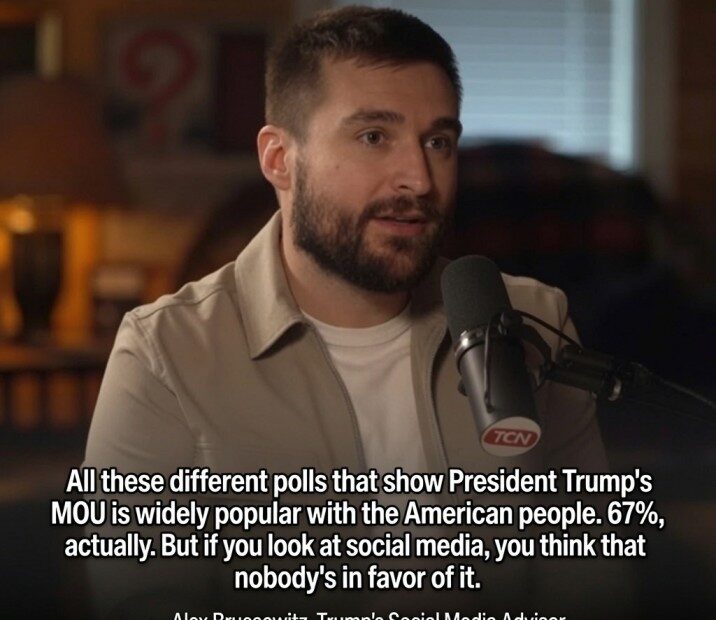
The following is the full transcript of Trump’s Social Media Advisor Alex Bruesewitz’s interview on The Tucker Carlson Show, June 26, 2026.
Editor’s Note: In this interview, host Tucker Carlson sits down with a social media advisor to President Trump to discuss the current political landscape and the influence of digital media on public discourse. The conversation covers a range of topics, including coordinated efforts to shape public opinion on the conflict in the Middle East, substantive policy debates within the administration, and the dynamics of political advisory in the Trump era. The advisor also offers insights into how the President gathers information and weighs various perspectives when making decisions.
Introduction: Coordinated Attacks on the Iran MOU
TUCKER CARLSON: Alex Bruesewitz, thank you for doing this. Very nice of you to do this. So here’s my perception, here’s the overview. So we’re in this war, obviously I disapprove, whatever, I’ve said that many times. Then the president decides we’re getting out, and the vice president articulates how and why, and I couldn’t be more supportive of that. I was thrilled by that, thank God.
And then all of a sudden there is this just flurry of attacks on the president, but mostly on the vice president, from people who don’t have an alternative plan but basically just calling the vice president, some of the president, names. It seemed to me as an outsider, less fluent in the internet than you are, that this is coordinated. Like, what is this? What are we looking at?
ALEX BRUESEWITZ: Well, it’s a great observation. I believe that there definitely is a coordinated effort to put pressure on the president and the administration to continue the conflict in Iran. And I believe that there is potentially even foreign influence involved, not just from one country. So I think it’s definitely a coordinated effort.
You’re seeing a lot of these voices, they kind of move as a pocket. They talk about a lot of the similar issues. They oftentimes do the similar paid media campaigns around other related topics. And there’s also evidence of millions and millions and millions of dollars flowing to certain right-wing influencer marketing companies from countries who might benefit from a prolonged conflict. So I believe there’s definitely a coordinated effort.
Similarly, right after the war was about to end, or I guess the MOU was coming out—
TUCKER CARLSON: Yes.
Misinformation About the Iran Deal
ALEX BRUESEWITZ: A lot of the anti-war voices were also spreading misinformation about the deal. They were pushing a line about how United States taxpayers were somehow going to give $300 billion to Iran. And I look at people like Thomas Massie, who’s been on this program. He was very quick to share the statement saying that this MOU is terrible because we’re going to give $300 billion to Iran, which is not true. It never was true. It’s money that can be unlocked over time. Not a single dollar will come from American taxpayers. But people like Massie were also spreading misinformation. So I think that there’s a lot of coordinated misinformation being spread from the pro-war side and also some anti-war critics as well.
TUCKER CARLSON: Interesting. So can I just get your take on something before we proceed into the details of what you just alleged? You’re alleging things, Alex Bruesewitz, which seemed true to me, but I want to know why you think it.
But first, to the question of the people criticizing the MOU. I know plenty of ways to criticize the MOU, but all of that criticism I think needs to be viewed in context of what the alternatives to the MOU might be. Like, okay, maybe you don’t like the MOU, but then what, right? Did any of the people in this campaign that you’re describing offer an alternative to the MOU? Like, we continue this war and then what happens, right?
ALEX BRUESEWITZ: No, there’s been no alternatives offered. There’s just straight criticism. It’s keyboard warriors. That’s what we deal with. Fortunately, their opinions have very little impact on the electorate, the populace. We’ve seen polling from Daily Mail, Fabrizio Lee, McLaughlin, all these different polls that show President Trump’s MOU is widely popular with the American people. 67%, actually. 67%. And so this—
TUCKER CARLSON: The framework of the settlement deal with Iran, the 14 points that have been everywhere. Yes, it’s 67%.
ALEX BRUESEWITZ: 67% of Americans who’ve been polled on that issue are supportive of the Trump-Vance agreement. But if you look at social media, you think that nobody’s in favor of it because of coordinated influence campaigns from unique actors and foreign parties.
Social Media Distortion and Public Opinion
TUCKER CARLSON: Interesting. It makes you— I’m not actually surprised because, again, they’re offering no alternative to the MOU, right? So if there was some way for the United States to get more, I could see the criticism as being valid. So I’m not surprised by that number, but it does make you think maybe there are other issues where our view of it is totally distorted because our view comes from social media.
ALEX BRUESEWITZ: Definitely. And a lot of the press rooms, they get their stories from social media. The producers, they get what topics they’re going to discuss in their shows from social media. Because they think that is what people are talking about. And some people are talking about it, but in the grand scheme of things, a very small percentage of people are actually talking or caring about these issues.
And so I think it’s very healthy and important for Americans in our country to start pulling back from believing everything that they read on social media and start questioning a lot of the people that they’re getting the information from, on all sides of issues. There’s a lot of influence and a lot of money from special interest groups from foreign countries that have poured into the internet ecosystem, and I don’t think it’s been healthy for our democracy, for our country.
I’ve been working actually with Congresswoman Ana Paulina Luna and some other friends in government to maybe strengthen some disclosure laws, but there’s a lot of influence ops that happen on social media.
Foreign Funding and Influence Operations
TUCKER CARLSON: Who’s getting paid to be anti-Israel? I’ve been very critical of Israel. I’ve never taken a dollar from anybody. We have no investors and no debt. So I know for myself, I’ve never— and I would never take money to give an opinion.
ALEX BRUESEWITZ: So you’re not Tucker Katarlson.
TUCKER CARLSON: I actually really like Qatar a lot, and I think the people who run it are amazing, but I’ve never taken any money from Qatar, and I never would. I think it’s interesting to hear you say that there is anti-Israel commentary that’s being funded by foreign countries. I’ve never heard that before.
ALEX BRUESEWITZ: And it also might be funded domestically. And maybe— I’m not going to accuse anybody of taking money. That’s not my position, right? But I’d like to— I’m an expert on social media.
TUCKER CARLSON: Yes.
ALEX BRUESEWITZ: Early on in my career, I started my company to help conservatives communicate better on social media.
TUCKER CARLSON: Yep.
Building Conservative Social Media Presence: The Marjorie Taylor Greene Story
ALEX BRUESEWITZ: And so I would identify conservatives that I wanted to work with, and I would help them grow their social media presence, oftentimes using some other people’s platforms, amplification or whatever. Some of those members of Congress that I’ve worked with in the past— Marjorie Taylor Greene. I started working with Marjorie Taylor Greene. She had 2,000 Twitter followers. By the time she won her election and entered Congress that January of 2021, she had over 800,000 Twitter followers. So in probably a 9-month period, we took her from a no-name candidate to one of the most followed Republican congresswomen in America.
And how do you do that? I must admit I’m slightly disappointed with Marjorie’s recent pivot. I think that she felt slightly burned that people didn’t support her ambitions for higher office. She says that’s not the case. But she went from being the president’s number one defender for 6 years, for as long as I’d known her. She only wanted to run for Congress to get Trump’s endorsement, to be Trump’s number one fan, number one cheerleader.
TUCKER CARLSON: She loved Trump.
ALEX BRUESEWITZ: She loved Trump. And so I think that she was a little bit slighted by the president and the team not supporting her for either governor or senator or vice president or some other ambitions that she had. And I personally also think she got bored of Congress. I think she went in with tremendous excitement. She wanted to go there and make a difference. She wanted to go there and help President Trump, build the wall and deport illegal aliens and end foreign aid and do all these things.
And I think she got to Washington, she realized a lot of those things are— the president built the wall. And he stopped the illegal alien invasion in our country almost 100% since he’s been in office. But a lot of other things that she wanted to do, when you get to Congress, you realize it’s almost impossible. And you realize that you’re one of 435 people. You see a congressman on Fox News, they talk a tough game. “Oh, I can write this letter, I can do this, I can hold this person accountable.” But you realize the congressman doesn’t actually have any authority.
So I think she went there having a different understanding of how much power she could actually have and how much change she could actually make, realized it was a system that was very difficult to change, got burned out, and it’s now back to being a commentator.
Marjorie Taylor Greene’s Viral Moment and Policy Disagreements
TUCKER CARLSON: I think there’s probably a lot— not my job to speak for her. I think it’s obviously true that she was frustrated as hell by Congress because it’s frustrating as hell. I don’t think she liked the leadership at all. She said that while she was there. She loved Trump, there’s no doubt about that. They also had substantive, not fake, but substantive policy disagreements that are just real. There’s no way around that. On the war, on Epstein. Those are real things, and I think you can make a case for everyone’s individual perspective, but I also think it’s fair to say we just disagree and they do disagree.
ALEX BRUESEWITZ: Well, I think— so you asked me how we took Marjorie from 2,000 to 800,000.
TUCKER CARLSON: But how does the process work? Not just Marjorie, but how does the process work?
ALEX BRUESEWITZ: Well, I wanted to explain that to you. So with Marjorie, for example, she pushed the limits. The most viral ad that we did for her that campaign cycle— she was standing on her front porch in Georgia right after the Antifa riots broke out in the summer of 2020. And Marjorie, she was early 40s, little blonde girl standing at her porch with a gun. And she says, “My message to Antifa terrorists: stay the hell out of Northwest Georgia.” And she loads a gun.
That was filmed on a cell phone, might have spent 10 minutes producing the whole thing. That video went bonkers. Tens of millions of views. And then this was in the pre-Elon era of Twitter. And Twitter banned the video for promoting violence. Facebook banned it. But then Fox actually, to their credit, they showed the censorship that was happening to Marjorie on the social media platform. So she was on Fox and Friends that next morning. She was on late night, she was primetime Fox later that day. She got her accounts back and she gained like 300,000 followers off of one moment.
TUCKER CARLSON: Yeah, I was involved. I remember.
ALEX BRUESEWITZ: And so she was— and then a lot of right-wing accounts started defending her. “This is terrible. Go follow Marjorie Taylor Greene. Go support Marjorie Taylor Greene.” And these are all MAGA people. These are all President Trump supporters. And I think that’s why so many people are frustrated by her pivot. And yes, you can have policy disagreements, but I think there’s a difference between having policy disagreements than making accusations. And she’s not the only one— these people accusing the president.
The Epstein Files and Trump’s Record
TUCKER CARLSON: Well, I mean, hold on. I mean, I love Marjorie, so I mean, and that’s well known, I love Marjorie Taylor Greene, and I think she’s a sincere person there. I don’t understand every nuance, but I do think it’s an— we don’t have to come up with— we can understand people’s motives as they explain them. And she’s like, I think you should be doing this, and the administration thinks they should be doing that. And that’s fair.
ALEX BRUESEWITZ: No, sure, I definitely agree. I definitely agree that that’s fair. But then there’s the extra, there’s the extracurriculars, there’s the— and it’s not Marjorie. I don’t actually speak on Marjorie for this, but there’s a lot of these people who used to be Trump fans, and they were Trump fans up until 9 months ago, 10 months ago. And they use the Epstein thing as the pretext of why they’re no longer Trump fans. And I think that’s incredibly unfair.
I think the president is the only reason we have Epstein files. Trump’s administration in the first term arrested Jeffrey Epstein. He put him behind bars, put him in jail. And yes, he died in jail. Do I think it was a suicide? I’m probably with the internet on this one.
TUCKER CARLSON: But definitely not.
ALEX BRUESEWITZ: But the president arrested him. He took him off the streets so he couldn’t hurt any more people. And then he campaigned in 2024 and people said, “Oh, well, Trump campaigned on the Epstein files.” No, actually he didn’t campaign on that. He was asked by Lex Friedman, interesting character. He said, “Will you release the Epstein files?” Trump said, “Yeah, I’d be inclined to do so.” And then he did it.
And guys like Thomas Massie like to take the credit for the release of the Epstein files. But during 4 years of Joe Biden, the Biden Department of Justice was sitting on these files. How many times did Massie tweet about Epstein? Zero. Not a single time for 4 years of Biden.
And so a lot of people see, some of these guys now— and Massie’s never liked the president. Trump endorsing against Massie in this election isn’t the response to him being critical of Epstein. Trump endorsed against Massie in 2020. Trump’s never liked Massie. And he’s an acquired taste. Not everybody likes Thomas Massie, right? But it wasn’t a response. He didn’t lash out at Massie and endorse this guy against him because of the Epstein files. He’s never liked Massie. Massie’s always been a thorn in some capacity.
And so there was no cover-up. I think people who suggest that there was a cover-up are not being honest. Could you disagree with the messaging rollout, the media rollout? The former Attorney General’s strategy around it? Absolutely. I wasn’t particularly thrilled about the binders. Nobody knew what the hell the binders came from, all right? But the president did not participate in a cover-up. In fact, he’s the only reason that these documents are out, and he’s also exonerated by it. There are 3 million documents that have been released. Not a single person can point to, “Oh, Donald Trump did something wrong.” The people who did do something wrong, or appear to have done something wrong, are guys like Reid Hoffman. Would I like the Department of Justice to go after Reid Hoffman? Yeah, I probably would.
TUCKER CARLSON: How about just call him in for questioning?
ALEX BRUESEWITZ: I would support that. Absolutely.
TUCKER CARLSON: I wonder why that hasn’t happened.
ALEX BRUESEWITZ: Well, maybe it will. Maybe it will. But I think giving control of the government process to a handful of hysterics on social media is bad. I think it was bad with the Epstein files. I think it’s bad right now for all of the hawks who are continuing to press the administration to continue the war.
Pam Bondi, Accountability, and the Epstein Files
TUCKER CARLSON: I would also say though that the Attorney General at the time, Pam Bondi, gave an interview on Fox in which she said, “I have thousands of files on my desk that show sexual abuse of kids.” She said that. That’s the Attorney General of the United States. And I’ve always liked Pam Bondi. It’s not personal, but the Attorney General says that and then no one gets indicted for it. You’re like, you’re the Attorney General. You’re the chief law enforcement officer of the nation. What the hell are you talking about?
ALEX BRUESEWITZ: I didn’t hear the sexual abuse of kids part, but I did hear her say that she had these documents on her desk.
TUCKER CARLSON: Should she have said thousands?
ALEX BRUESEWITZ: Should she have said that? Probably not.
TUCKER CARLSON: Or maybe she should say it. By the way, I was glad that she said it. It wasn’t that she said it. I want more disclosure. I want to know what the government is doing. My rights— and we just own the freaking government, not Pam Bondi. I’m a citizen. But anyway, I just— where’s the follow-up? If you have the evidence, you told us you had the evidence, where are the arrests?
ALEX BRUESEWITZ: Well, it’s a great question, and I think that a lot of people are asking the same thing. But the accusation that the president was involved in a nefarious cover-up, that’s completely ludicrous. I think people like Reid Hoffman should absolutely be brought in for questioning. And perhaps it will happen. I think Reid Hoffman is one of the worst characters in America, not just for that. He was also a financier of E. Jean Carroll, if you remember her, the woman who accused President Trump of harassing her in the ’80s or ’90s.
TUCKER CARLSON: Well, I’m pretty sure— I can’t prove it, but I’m pretty sure that he helped suck me into a lawsuit I had nothing to do with and tried to destroy my life. I’ve never met the guy. I got nothing to do with him. I was just giving opinions he doesn’t like. So I get it.
But look, if you want people to trust the government, we need more disclosure, more follow-up. I mean, that’s true of every administration, including this one. And from my perspective, it’s the war. It’s the war that I talked to Trump multiple times about. My advice to him, which he ignored, was this has really nothing to do with you. It’s like Reid Hoffman. Reassure people by bringing the guilty to justice, or at least investigating it in a transparent way. Didn’t happen. But I didn’t really say anything about it in public.
It was the war that just absolutely distressed me. And I’ve talked about it way, probably too much already. But when Trump basically said, “We’re going to do things we don’t want to do because it’s in the best interest of the country. This MOU, no one wants the MOU, but it’s better than the alternative.” I admired that. I said so.
And I immediately see these people who are like Trump’s best friends, true MAGA people, like Mark Levin and the rest. Like, they’re the true MAGA. You can’t get anywhere near MAGA. You don’t know what MAGA is. Like, okay, son. All of a sudden they’re like, “Trump’s a bigot,” or whatever, or “JD Vance is an anti-Semite.” That’s where I was like, I thought that was the most interesting thing I’ve ever seen.
Coordinated Opposition and the Mark Levin Question
ALEX BRUESEWITZ: Yeah, it was certainly coordinated. Absolutely.
TUCKER CARLSON: And so by whom?
ALEX BRUESEWITZ: It’s a good question. There are people that certainly speculate. And look, I think Mark Levin— maybe he’s friends with the president, but Mark Levin was a guy—
TUCKER CARLSON: I don’t think Trump likes Mark Levin at all.
ALEX BRUESEWITZ: Mark Levin was somebody who opposed Trump in 2016. He actually encouraged his audience in 2016 to stay home. “Don’t vote in the general election.” He was a DeSantis supporter in 2024. So he’s not like this ultra MAGA guy.
And so it’s a little frustrating. Look, I’ve disagreed strongly with many statements that you’ve made recently. And so all these coordinated accounts, right, they’re saying, “Alex, you call out Mark Levin, but you don’t call out Tucker. Why?” And to be honest, I think that’s kind of a fair point. You’ve criticized the president and I haven’t called you out. And I haven’t called you out for a couple of reasons— I haven’t called you out on social media because I know you personally.
TUCKER CARLSON: Yeah.
ALEX BRUESEWITZ: And I’d rather have a conversation with you about where I disagree in person rather than being a keyboard warrior. I don’t know Mark Levin personally, so I have a philosophy in my life. If I don’t know you personally, I can hit you on social media. If I do, I’ll have a conversation to your face.
TUCKER CARLSON: I generally agree with that.
The Iran Strike and Anti-War Hysterics
ALEX BRUESEWITZ: So, early on when the war started, there were predictions by some voices, including you, that striking Iran could lead to World War III. Voices like Ian Carroll, who’s also been on the program, predicted that we’d put ground troops in Iran by now. Those predictions haven’t materialized. And so I think saying that would be important to the audience. I think there’s a lot of hysterics on both sides of the issue. Early on, it was—
TUCKER CARLSON: The president threatened to eliminate the civilization of Iran. So that would qualify as World War III. He threatened to put ground troops on the Karg Island and mainland Iran many, many, many times on Truth Social. I’ve been reading it for 3 months. None of that happened. I’m so grateful.
ALEX BRUESEWITZ: I don’t—
TUCKER CARLSON: I don’t care.
ALEX BRUESEWITZ: I’ll just say it didn’t happen because it didn’t not happen because of pushback from voices like Ian Carroll. And then they come out and they take a victory lap and say, “See, we prevented this from—” Nobody’s listening to the grifters on the pro-war side. Or the anti-war side.
TUCKER CARLSON: Well, let me just correct the record and say I am under no illusions about my power. I don’t seem to have any power to change any of that.
ALEX BRUESEWITZ: Unfortunately, I think you have a very powerful voice.
TUCKER CARLSON: No, I don’t.
ALEX BRUESEWITZ: No, I argued with Trump for 10 years against doing this.
TUCKER CARLSON: He took other counsel. That shows you how much power I have. Zero. And so I was not able to prevent this. And I don’t think I had any role in ending it. So I just want you to know, I don’t think I had any effect.
ALEX BRUESEWITZ: Well, I just think that the hysterics started off as being the anti-war hysterics, and maybe they had reason to be. The president’s position on Iran, I don’t believe, has changed. For 30 years, you can find statements of him saying Iran should never have a nuclear weapon. In 90 days, he delivered on that promise. He struck them. 90 days later, the MOU says Iran will not seek nuclear enrichment. He never wanted to do a forever war. He never was going to put boots on the ground. If he has to, I’m sure he will, but I don’t think we have to.
But his position hasn’t changed. He also is against forever wars. He’s always been against forever wars. So I think doing a quick military excursion is different than obviously Iraq and Afghanistan and what the neocons’ fever dream is. Mark Levin probably wants to send a million American troops.
TUCKER CARLSON: No doubt about it.
ALEX BRUESEWITZ: And the president is not about that. And so I think there was a lot of hysterics who just don’t know who the president is, and they’re acting like he was inconsistent on his positions when I don’t think he actually was.
Trump’s Pivot on Iran and the Question of Foreign Influence
TUCKER CARLSON: Can I ask you, so it was a year ago that the president and Levin were at some event, and Levin goes and basically puts him in a headlock. Donald Trump is much larger, big man. Levin is a dwarfish man. So he kind of leans up and pulls him down like that. And the president, well, first of all, he’s the president. Second, he’s famously not the guy you put in a headlock. He’s not into it. Or, huh? Yeah, he’s just not into it.
ALEX BRUESEWITZ: Yeah.
TUCKER CARLSON: And Levin does that. And the message, of course, is like, “You’re my boy, I control you,” right? I was disgusted by it, but whatever. That happens. And so you look at it and you’re like, okay. And then Trump tweets like, “If you want to get the real truth, watch Mark Levin’s lowly rated show on Fox weekends.” And so all of a sudden, he just pivots in one day and starts saying things that are true, in my view, brave. I’m cheering Trump when he says this, and he’s like, “Up, we’re out. This is too much. Can’t deal with it. We’re going to run out of oil. You’re not going to be able to get gasoline. That’s terrible for America. We’re stopping.” What caused that change?
ALEX BRUESEWITZ: I believe he felt the mission was accomplished. And it goes back to the fact that he is not somebody who wants forever wars. He’s not somebody who wants forever conflict. He felt that he was able to deliver on his campaign promise of preventing Iran from ever having a nuclear weapon in a little over 90 days. And we have the Iranians now at the table negotiating a deal with JD Vance and our team.
I think the president is happy where things lay. And now people on the Mark Levin crowd, who were the president’s biggest cheerleaders, are now opposed to what he’s doing because they have a different agenda for Iran. They have a different vision for how to handle Iran. And I think that’s wrong. But the president’s position has been consistent — you can find videos of him in 1987 saying Iran should never have a nuclear weapon. And he was given certain intelligence on how to take it out. And he did. And he eliminated their navy.
TUCKER CARLSON: That intelligence did not come from the United States.
ALEX BRUESEWITZ: He eliminated the navy. He eliminated their air force. And he has got them at the table to ensure that they never have a nuclear weapon.
The Question of Israeli Intelligence
TUCKER CARLSON: So, but this was my complaint from the beginning, and I’m not here to defend the IC, our 18 intelligence agencies, but there was no American intelligence that said Iran was on the brink of building a nuclear weapon. That came from Israel, and they lie, and they lied to Trump. And I told him that before this started, because it was obvious. So why would the United States ever rely on Israeli intelligence again if they just lied us into a war that got a bunch of Americans killed and that raised gas prices?
ALEX BRUESEWITZ: It’s very sad to see the loss of the soldiers’ lives. And I know the president was certainly upset about that. Look, I think the president accomplished his goal. And with the MOU, I think people are confident we’re in a good spot. I think the president obviously will reserve the right to respond again with military action if he feels like things are going sideways.
But look, I think the president is now focused on domestic issues — lowering gas prices, lowering economic prices, bringing job opportunities back home. I think the foreign excursions have been successful. And now it’s time to focus on home. On the Israeli points again, I think this proves that the president isn’t a slave to Israel.
TUCKER CARLSON: Apparently, or he’s broken free. He’s broken his fetters.
ALEX BRUESEWITZ: Which I support. I don’t think the president was ever a slave to Israel. And I think characterizing it as that was not fair. I’m friends with — 8 years ago I became friends with Bibi Netanyahu’s son, Yair. He’s a nice guy. There was a moment in time —
TUCKER CARLSON: Is he fighting in Lebanon right now?
ALEX BRUESEWITZ: I actually haven’t talked to him in a while, man.
TUCKER CARLSON: Oh, I think he’s in Miami, but whatever.
ALEX BRUESEWITZ: I don’t think he’s in Miami. I invited him to my wedding. So for the people who call me antisemitic, I invited the prime minister —
TUCKER CARLSON: They’re calling you antisemitic?
ALEX BRUESEWITZ: They call me antisemitic now. So I invited the prime minister of Israel’s son to my wedding because he’s a friend of mine.
TUCKER CARLSON: Yeah.
ALEX BRUESEWITZ: But there was a moment in time — for the record, the president after the 2020 election didn’t have a great relationship with Bibi. Bibi was the first world leader to congratulate Joe Biden after the rigged 2020 election. And I think that’s made people feel a little bit different about that relationship. The president now has a great working relationship with him, but he’s certainly not a slave to Bibi or slave to Israel. And I think people who suggest that are not being fair.
Trump’s Instincts vs. the Decision to Go to War
TUCKER CARLSON: Look, I’ve been unfair many times in my life, and I’ve overstated things dramatically many times, and I certainly have been mean, and I really regret that. So I just want to offer another blanket apology for my bad behavior. Those are my main sins. But I still don’t get it. Why, if no one in your cabinet is enthusiastic about this, no one in your intel services says, “Yes, they’re on the brink of sending a nuclear-tipped ICBM into Miami” — if all of them are like, “That’s not true” — you turn and you take Israeli intelligence, which is obviously fraudulent, and act on that. What is that?
ALEX BRUESEWITZ: It also goes back to instincts. Again, the president has been on this position for 30 years.
TUCKER CARLSON: And we had a war in June that he said ended the Iran nuclear program. I talked to him constantly about that and he’s like, “No, no, we’re done, we’re done.” And then a few months later, we’re ramping up for another war. And I was like, well, I thought we eliminated that. You can see why I’d be mystified. Sure, slavery was the most obvious explanation, but maybe I’m wrong.
ALEX BRUESEWITZ: That’s certainly not slavery. I think it’s the president’s instincts. The president wanted to do it and so he did it. And there’s this report that he’s telling people, “I’m president and you’re not,” right?
TUCKER CARLSON: Yeah.
ALEX BRUESEWITZ: So you have people on your team, sometimes you listen to them, sometimes you don’t, sometimes you want their opinion, sometimes you don’t. You do it with your show. I do it with my company.
TUCKER CARLSON: I totally agree. Well, that’s clearly true.
ALEX BRUESEWITZ: It was the president’s instincts. It certainly wasn’t blackmail related to Epstein. It certainly wasn’t being a slave to a foreign country. So I think that —
TUCKER CARLSON: But I felt — I respect Trump’s instincts. They made him president twice. He’s had an amazing life, and I think it’s been on the basis of his instincts. So I have maximum respect for Trump’s instincts and for his understanding of people and power dynamics. The guy has got x-ray vision. He’s not good on details sometimes, but he’s incredibly precise in his big picture understanding of people.
And I felt that he went against his own instincts in launching this war. He knew the risks. He’s not a crazy risk-taker, actually. He talks a big game — this is my analysis anyway — but he’s not actually that reckless, really. I mean, he’s been successful. You can’t live for 80 years and be that reckless, right? This was really reckless. And I felt that he didn’t want to do it. I can’t read his soul. Maybe he really secretly did want to do it. That was definitely not my impression, having talked to him a lot about it. So then I’m like, okay, you didn’t want to do it. No one around you wanted to do it. Why’d you do it?
ALEX BRUESEWITZ: I believe the president did want to eliminate their nuclear capabilities, and he also eliminated their ability to have a Navy and an Air Force and a missile program. So he did it. And now the excursion — I don’t even like to call it a war because it was a 90-day blip. And yes, we sadly lost some lives, and God rest their souls, but the excursion, as it appears to be coming to an end — I can’t imagine that these hysterical voices on social media are going to prolong it.
Shaping Public Opinion and Foreign Influence Online
TUCKER CARLSON: Yeah, I mean, that’s really it. I’ve given my — we differ in our analysis of the war, but I don’t want to argue about it. What I want to understand is how public opinion on the question is shaped.
ALEX BRUESEWITZ: And you’re one of the experts on this topic. Would love to dive in on this one.
TUCKER CARLSON: Okay, and by the way, if you ever discover that anti-war sentiment is being funded by a foreign power, text me because I’d love to know who’s paying for it, how I can get on that payroll.
ALEX BRUESEWITZ: I think you’re doing okay. The studio is great.
TUCKER CARLSON: It’s so fun. This is our — we had this long before the show. This is just our family barn. But the “let’s prolong the war on behalf of the Netanyahu regime” — that does seem to be funded by somebody, because that’s not an organic position in the United States. There’s not, as you said, 67% in favor of the MOU. So there’s a groundswell of public support for following this lunatic path even further. So who is paying for that?
ALEX BRUESEWITZ: That’s a great question. And getting foreign influence out of the political ecosystem, specifically online, is a passion project of mine.
TUCKER CARLSON: Yeah.
ALEX BRUESEWITZ: You know, I am Trump’s social media guy. That’s what I’m branded in the press.
TUCKER CARLSON: Yeah.
ALEX BRUESEWITZ: So you can only imagine the type of money that these countries and other companies have tried to throw at me. I do not take any foreign money. I don’t take any money from the Gulf countries. I don’t take any money from India. I don’t take any money from Russia, China — no foreign countries.
TUCKER CARLSON: How much would you make if you wanted to?
ALEX BRUESEWITZ: I’ve probably rejected close to $20 million in contracts over the last 15 months.
TUCKER CARLSON: Damn.
ALEX BRUESEWITZ: Yeah.
TUCKER CARLSON: How old are you?
ALEX BRUESEWITZ: I’m 29.
TUCKER CARLSON: That takes some restraint.
ALEX BRUESEWITZ: I’ve had a really interesting career. I’ve made some money, I made no money, and I’m not really focused on money. And I think that’s what separates me from a lot of my colleagues or competitors, if you will, in Washington.
However, I’ve actually never shared this publicly. In June of 2025, mid-June, shortly after the first Iran strike happened, I got a message from a friend. He texted me when I was on an airplane. He said, “Alex, great news from Israel.” And I want to read the message so I don’t butcher anything that was said.
At 2:47 on June 16th, 2025: “Good news from Israel. They have budget for the American market to make a strategy and social network against Iran. I talked about you and they want to work with you. It is through a foundation. Call me when you can and I’ll tell you all of the details.”
I said, “I appreciate you thinking of me. Likely can’t get involved with this one.”
Brad Parscale and the Israeli FARA Contract
ALEX BRUESEWITZ: So in June of 2025, it is documented that an Israeli foundation wanted to hire me, an American social media strategist—
TUCKER CARLSON: Trump’s social media strategist—
ALEX BRUESEWITZ: Trump’s social media strategist to help disseminate information related to Iran. I never got on the phone call, so I don’t know exactly what they were looking to get amplified. But I didn’t do it. And so—
TUCKER CARLSON: What was the foundation? Do you know?
ALEX BRUESEWITZ: The foundation was never specified. However, 2 months later, an organization run by President Trump’s former digital guy who the president hasn’t talked to in 6+ years, Brad Parscale, ended up filing a FARA contract with the state of Israel for $1.5 million a month.
TUCKER CARLSON: A month.
ALEX BRUESEWITZ: A month. Which in comparison, Brian Ballard, who is potentially the top lobbyist in Washington, D.C., charges the country of Saudi Arabia $60,000 a month. Brad Parscale has no experience being a lobbyist, and he certainly isn’t selling access to the president because the guy’s got zero access to the president.
So 2 months after I was reached out to, to work on an Israeli social media campaign related to Iran, Brad gets this social media contract with Israel paid through by a German entity called Havis Media Group.
TUCKER CARLSON: Hmm.
The FARA Filing: What Brad Parscale’s Contract Says
ALEX BRUESEWITZ: And I’m going to read you a part of Brad’s initial FARA filing, related to his deliverables for this particular contract. It says, “production and delivery of a minimum of 100 root creative assets per month spanning video, audio, graphic, and written formats. Creation of 5,000 monthly variants of creative. At least 80% of content is tailored to Gen Z audiences across platforms, including TikTok, Instagram, YouTube, podcasts, and other relevant digital and broadcast outlets.”
TUCKER CARLSON: Integration—
ALEX BRUESEWITZ: Oh, here’s the kicker— “integration of narrative messaging into Salem Media Network properties and aligned distribution channels.” And then lastly on this section, “paid media campaigns delivering a minimum of 50 million impressions per month with a target average CPM under USD $2 across the combined budget pool.” So that’s what the FARA filing says.
TUCKER CARLSON: Wow.
ALEX BRUESEWITZ: That’s what it says.
TUCKER CARLSON: And so that means that the Israeli government is paying Brad Parscale to spread its propaganda in the United States through various vectors, most of whom are MAGA influencer types.
ALEX BRUESEWITZ: So it doesn’t specify MAGA influencer types actually in that contract. I just don’t know what he’s getting paid $1.5 million a month for.
And then actually the most recent report that I saw on Twitter, on X, sorry, sorry for deadnaming it. It’s very offensive. Let’s see. This was reported by a gentleman named Nick Cleveland Stout. Never heard of this guy, but he sent an updated filing that he found that shows the Israeli government is now paying former Trump campaign manager and Salem Media executive Brad Parscale $46 million in one year. And he also adds, for some perspective, Saudi Arabia pays Ballard, one of the most connected firms in Trump’s Washington, $60,000 a month.
TUCKER CARLSON: $46 million.
ALEX BRUESEWITZ: That’s what it says.
Salem Media Network and the Influencer Connection
TUCKER CARLSON: So who’s on Salem Media Network?
ALEX BRUESEWITZ: Well, so I don’t want to speculate or accuse anybody.
TUCKER CARLSON: No, I just want— because the FARA filing says we’ll disseminate our propaganda through Salem. So I just—
ALEX BRUESEWITZ: That’s what it says, right?
TUCKER CARLSON: Yeah.
ALEX BRUESEWITZ: So Josh Hammer, I’m not sure if you’re familiar with him. He’s got a very low-rated podcast. I think he’s a columnist. He was—
TUCKER CARLSON: I’ve never heard of Josh Hammer until he started hassling Charlie Kirk.
ALEX BRUESEWITZ: But yeah, he was a big DeSantis supporter. He’s at Salem Media Network. He’s one of the loudest critics against the Iran War. You have people like Larry Elder, which is surprising, because Larry Elder is typically a pro-Trump cheerleader. He’s been very critical of the Iran War. There’s a lot of other of these radio hosts who are syndicated on Salem who have been opposed. Hugh Hewitt, obviously, but Hugh Hewitt always appreciated war, to be honest. So I don’t think his positions have changed.
So it says right there in the contract, in this initial filing, that he’s integrating messaging into Salem properties. Salem also owns Red State, Town Hall podcast network. They also have an influencer network. So I would love to know what Brad is actually doing with this money.
I know certainly part of the project is to help coach AI chatbots into being more pro-Israel, less antisemitic. And look, I think there has been a rise of antisemitism in the country. You may disagree with me. I think antisemitism is high. It’s wrong. I see some incidents in Brooklyn. I think it’s wrong. I think hate against any religious group—
TUCKER CARLSON: I couldn’t agree more. I’ve said that many times.
ALEX BRUESEWITZ: So I’m not opposed to— opposing Bibi’s foreign policy is not antisemitism. I’m not opposed to Brad getting paid to combat antisemitism. But what does that mean?
TUCKER CARLSON: Well, that’s it. What does that mean?
ALEX BRUESEWITZ: What are the deliverables?
TUCKER CARLSON: Anti-white hate is encoded in the US legal code when hate against white men is like the foundational fact of college admissions, federal contracting, hiring. And we’re spending all of our time worried about whether people are being rude to Bill Ackman. Like, this is just a misalignment. This is not reality.
Foreign Influence Operations: Not Just Israel
ALEX BRUESEWITZ: Okay. So I also want to just add for context to the viewers and the people who are going to clip this, that Israel isn’t the only country that has paid for influencer support in America.
TUCKER CARLSON: I’m sure that’s right. Ukraine has paid a ton.
ALEX BRUESEWITZ: There was recently a field trip with a bunch of right-wing influencers, if you will, who visited Russia. So I don’t think that they paid for that trip out of their own pocket.
TUCKER CARLSON: I don’t know.
ALEX BRUESEWITZ: And so they went to Russia, they go hang out with the Russians and whatever. I don’t have—
TUCKER CARLSON: I don’t pay your own.
ALEX BRUESEWITZ: I don’t have particular issues with people visiting a country.
TUCKER CARLSON: Right.
ALEX BRUESEWITZ: My issues lie in, do you visit the country and then change the way you speak about the country or use your platform to talk about the country? Qatar had a similar situation during December. Some influencers who used to be opponents to Qatar flew to Qatar in December, and then they did some beautiful posts about Qatar. I also think that’s wrong.
My position is, if it’s Israel, if it’s Qatar, if it’s Russia, if it’s China, if it’s India, you should not be able to pay. I don’t think Qatar paid the influencers. I think they came on a trip and then they posted nice things about the country. I still think there should be some level of disclosure around that. I don’t care what country it is. You should be disclosing if you are in any way, shape, or form promoting the interests of another different country.
TUCKER CARLSON: I think that’s right.
ALEX BRUESEWITZ: My focus recently has been on Israel because of this massive contract that they’ve engaged in with Brad that nobody knows what the hell he’s doing with the $46 million.
Tucker Carlson: Brad Parscale Didn’t Respond to My Text
TUCKER CARLSON: So I texted him to find out because a lot of that money has gone to attacking me and my family. Which obviously I resent, though I try not to think about it too much. Don’t want to become what they call you. But anyway, I know Brad Parscale. I’ve always felt sorry for him. I still do. He’s a troubled man. But I did think he would at least respond to my text. He didn’t.
ALEX BRUESEWITZ: Yeah.
TUCKER CARLSON: Have you called him?
ALEX BRUESEWITZ: No, I haven’t called him, and he hasn’t called me. He responded to one of my tweets. He responded to my tweet saying that— because I asked him, I said, “Hey Brad, what’s up with this? Why are so many Salem Media personalities trashing President Trump’s war? Here’s the FARA filing saying that you’re going to integrate messaging into Salem Media properties.”
And Brad responded to me and he said, “Alex, I actually want to thank you for bringing this up. I don’t know who pissed in your Cheerios this morning, but what you’re looking at was an original draft, not what happened. We never executed that plan. We never paid hosts or influencers to say anything. That’s the beauty of FARA. The receipts exist.”
Well, the only receipt that exists right now is Brad’s initial contract where it says point blank, we’re going to integrate messaging. So he’s saying he’s not doing it. So what is he doing with this $46 million? What is—
TUCKER CARLSON: And you’re in this business, obviously you’re one of the most famous people in the business. You may be the most famous person in the business. Have you ever heard of anybody getting $46 million from a single client?
ALEX BRUESEWITZ: No. And even his $1.5 million a month, his initial FARA filing, I believe is the single largest FARA filing for one entity in history.
TUCKER CARLSON: Really? I have no perspective on this. Okay, so that’s crazy.
ClockTowerX: Brad Parscale’s Website and Services
ALEX BRUESEWITZ: If you ask ChatGPT or whatever chat platform you use, I prefer Grok, to be honest, because I trust Elon more than I trust Altman, but I asked Grok, “What’s the largest FARA filing for one entity to date?” And it came back with some $9 million contract that I think Nigeria paid. I don’t know what the hell Nigeria needs to do, but they paid it.
So one country, $9 million. Brad’s initial contract, $1.5 million a month. You do the math, that was $15 million a year. Now it’s up to $46 million according to a recent report. And again, they’re not paying him for his relationships in the White House. I don’t think Brad Parscale could get a meeting in the West Wing to save his life, specifically not in the Oval Office. I don’t think people still remember what he did during the 2020 election.
TUCKER CARLSON: Okay.
ALEX BRUESEWITZ: But he’s going around different countries. And if you pull up his website, it’s called clocktowerx.com.
TUCKER CARLSON: It.
ALEX BRUESEWITZ: He spells out exactly the services that his company offers. So I’m going to go to his website right now, clocktowerx.com.
It starts off with a header that says, “narrative infrastructure. The system already shapes what people believe. We help determine who prevails. Elections, narratives, markets. We don’t react. We shape the conditions they operate in.”
Talks about how they’ve had $2 billion plus in influenced outcomes. No clue what that means. Says that they work in 10+ countries. They’re deployed in 10+ countries. Then it says, “If you’ve heard about our work, it wasn’t ours.”
And then it gets into some of the services that they offer. They offer narrative intelligence, continuous monitoring of the information landscape to identify leverage points before competitors. Audience segmentation, behavioral mapping across millions of data points to identify the nodes that move markets. Message testing.
Here’s one: influencer ecosystems, managed networks that amplify narratives through credible distributed voices. That’s on this guy’s website that he gets paid millions and millions of dollars.
TUCKER CARLSON: $46 million.
ALEX BRUESEWITZ: Yeah. So right there on his website, influencer ecosystems. So I think Brad should, if he’s doing it, I think it’s wrong. I can’t say definitively that he’s doing it, but these are the services that are offered on the website.
The Coordinated Campaign Against Tucker
TUCKER CARLSON: Cross-channel distribution, performance analytics. Well, I must say, I’ve noticed that every Salem media property that I’m aware of has the same view. You know, “More war is good. I’m an anti-Semite.” Those are two lies, by the way. I’m not an anti-Semite, and war is not good. They all have the same view. Now, maybe it’s just that every Salem host or influencer or whatever they’re calling themselves is crazy in exactly the same way, but maybe there’s more to it than that.
ALEX BRUESEWITZ: Maybe, maybe. And a lot of these same influencers have been organized against you for the last year, consistently against you for the last year. A lot of these — this one account, for example, named Iyel Yakobi. I’m not sure, you probably have never heard of this kid. But all he does every day is he tweets about you. The only time I see any of your clips are on the accounts of people attacking you.
TUCKER CARLSON: Really?
ALEX BRUESEWITZ: I don’t watch, similar to you, I don’t really watch podcasts. But the only time I see people’s clips are people attacking you. Your clips are when people are attacking you. Ilya Kobe, I was looking this morning.
TUCKER CARLSON: Who is he?
ALEX BRUESEWITZ: Just some influencer, if you will. And these are non-influential influencers, I call them. But he certainly is involved in — he’s certainly been paid for some of his tweets. Do I know that he’s been paid for tweets against you or against the Iran War? I can’t say that for certain. But he’s not honest about tweets that he is paid for. So would I be shocked if he was paid for some of them? I don’t know, but he’s tweeted about you probably 1,200 times.
TUCKER CARLSON: Seriously?
ALEX BRUESEWITZ: Yes. In the last 8 months.
TUCKER CARLSON: All complimentary?
ALEX BRUESEWITZ: No, no. All negative, unfortunately for you. But look, I agree with some of his criticism. I don’t see it as organic though. He’s one of the loudest voices who keeps tagging me in posts.
TUCKER CARLSON: Uh-huh.
ALEX BRUESEWITZ: “Alex, you criticize Mark Levin. Why don’t you criticize Tucker?” Well, I criticized you to your face here.
TUCKER CARLSON: Yeah, but you hurt me, man.
ALEX BRUESEWITZ: But all of these social media accounts that have been targeting you are not targeting me. And they were targeting JD Vance when he appeared on Megyn Kelly’s show because, “Oh, how dare he go on Megyn Kelly’s show.” That’s what they said.
Cancel Culture on the Right
TUCKER CARLSON: But isn’t this exactly why we all voted for Trump in 2016, 2020, and 2024? Because we don’t like cancel culture. The idea that if I don’t like you, no one is allowed to talk to you — that’s a left-wing idea. Or I thought it was. It turns out it’s a human idea, but I reject it just the same.
But Trump was elected in November of 2024. That was like 20 minutes ago. And within just months, all of a sudden you had the Josh Hammers of the world who I’d never even heard of, saying that if I don’t like somebody, nobody’s allowed to talk to him because he’s got naughty intentions or he’s a bigot of some kind or whatever. How is that any different from screaming “racist”?
ALEX BRUESEWITZ: You’re right.
TUCKER CARLSON: It’s the same thing.
ALEX BRUESEWITZ: Right. And that’s why I’m here, because, you know.
TUCKER CARLSON: But are you shocked by this, though?
ALEX BRUESEWITZ: What the hell? Yeah, I mean, these people aren’t the most honest dealers and brokers. I’ll say this — one of the people who’s been the loudest on this issue is actually a friend of mine, Laura Loomer. I have not liked seeing a lot of the vitriolic messages towards Loomer, people calling her mean names. I know that she dishes it out as well, but she’s a friend of mine.
And during the 2024 election, everybody kept telling us, “Disavow Loomer. Disavow Loomer. She’s bad news. Disavow.” And they would put pressure on me. “Are you friends with Laura Loomer?” I’d say, “Yes, I am.” “Oh, do you think she’s trouble?” “No, I think she’s actually a very good ally to us when she’s focused.” And so I would never disavow Loomer. Similarly, I would never disavow you because you’ve been good to me. I consider you a friend. It’s okay to have different opinions. I think telling people that they shouldn’t have conversations with people, or telling people that you should disavow someone — I’m not about that life.
TUCKER CARLSON: Not just telling, but demanding that it’s the price of your good name. “How dare you talk to this person, have dinner with this person, and if I find out that you do, I’m going to hurt you.” That’s the definition of a witch hunt. That’s what the George Floyd era was about. That’s Black Lives Matter. That’s everything I despise. And to see it happen among people I know, who I thought I agreed with, is the most shocking thing that’s ever happened to me. Since when did all the neocons just become flat-out college-level liberals?
ALEX BRUESEWITZ: They have been that way for at least my entire adult life.
TUCKER CARLSON: I guess you’re right. This is a process of me losing my naivete, I guess.
ALEX BRUESEWITZ: Those particular characters. But no, I won’t disavow Loomer. I won’t criticize Loomer. Even if I disagree with her, I’m not going to take to Twitter and say, “Hey Loomer, I think you’re off base and you’re wrong, wrong, wrong.” Same with you.
On Attacking Families and Blood Guilt
TUCKER CARLSON: If I have an issue with you, I would never attack someone’s family or daughter-in-law.
ALEX BRUESEWITZ: Yeah.
TUCKER CARLSON: I just want to say, in reference to no one in particular, attacking people’s families for crimes they had nothing to do with, just because they’re related to someone, suggests a view of the world based on blood guilt, which is not a Christian view. It’s disgusting. It’s a North Korean view. We don’t punish people’s families.
ALEX BRUESEWITZ: Yeah, I think those are low. And I was actually a big defender of Buckley when he was facing some of those attacks.
TUCKER CARLSON: But just in general, as a principle — because what matters are principles. It’s not about what you do to me. It’s about what we do. We’re all held to the same standards because there’s one God.
ALEX BRUESEWITZ: Yeah.
TUCKER CARLSON: And those standards apply to the Israelis and they apply to the Russians and the Ukrainians. They apply to me, they apply to you, they apply to every human being — all of us created by God. And one of the core standards is you do not punish the innocent, ever. That is the basis of all justice. You punish people who commit crimes. You do not punish people who don’t, no matter who they’re related to.
The Israelis reject that view. That’s what they’re doing in Gaza. They’re killing people because they’re Palestinian. The North Koreans did that. I think the US has done that over the years. It’s always wrong. It doesn’t matter who does it.
And I just feel like that principle — that one specific principle — is the basis of our country. That’s why we welcomed all these people from random countries. We’re like, “You may be from a country we hate, but are you a good person? That’s all that matters.” It’s the content of your character that matters. And if we give that up on the right, then the whole country is gone. That’s all I’m saying.
ALEX BRUESEWITZ: Yeah, I’m strongly against targeting innocent people, and I’m against targeting family members.
TUCKER CARLSON: Yes.
ALEX BRUESEWITZ: And to be honest, that’s why I find a lot of the attacks on Erica Kirk to be repulsive.
TUCKER CARLSON: I totally agree.
ALEX BRUESEWITZ: There’s a lot of people who have made a name for themselves on social media by spreading certain theories about Erica, and I think Erica is a good person. She’s a friend of mine. I’ve known Erica for almost as long as she’s probably known Charlie, and I was with her a few weeks ago in Palm Beach, and you could see that the attacks affect her and they hurt her, but she keeps moving forward. So I think having vitriolic targets on families is certainly wrong.
TUCKER CARLSON: Certainly you can’t punish people for something they didn’t do. That’s just that simple. That’s why segregation is wrong. That’s why the anti-white racism that dominates American life is wrong. That’s why antisemitism is wrong. That’s why any worldview that punishes people who didn’t commit a crime is always and everywhere wrong. And that would include attacking people’s families if they didn’t do anything. You know what I mean?
ALEX BRUESEWITZ: That’s true. Anyway, that’s why also, like, the blanket Jew haters — there’s people who are critical of Israel and then there’s people who tweet things that are totally anti-Jew. I think the “Jews control everything” crowd — I think they are not the brightest as well.
On Anti-White Discrimination and Identity Politics
TUCKER CARLSON: Yeah, look, attacking people for things they didn’t do is wrong, period. I would like this administration to take the anti-white stuff seriously and stop lecturing me, telling me that antisemitism is the biggest problem in America. It’s not. You have a much tougher time getting into the Ivy Leagues — you would not know this from the behavior of the Justice Department — if you’re white than if you’re Jewish. So that’s a fact. It’s provable. These numbers came out in court. And it’s unfashionable to say that. I don’t care.
And by the way, if Jews or Blacks or Filipinos or anybody was being discriminated against in the way that whites are being discriminated against, I would be opposed to it vocally. And I’m opposed to it.
ALEX BRUESEWITZ: Well, if you look at a lot of the job creation in our country, a lot of the new jobs have gone to natural-born white Americans in the Trump presidency.
TUCKER CARLSON: Look, I don’t know those numbers. I don’t know if it’s true.
ALEX BRUESEWITZ: Also, I don’t know if I want more Americans going to the universities.
TUCKER CARLSON: I just think — all I’m saying is, as a principle, this is the core principle of America: that you are judged by who you are as a person, not by the group you’re from.
ALEX BRUESEWITZ: I don’t think that the administration is overly prioritizing the protection of Jewish communities.
TUCKER CARLSON: Are you joking?
ALEX BRUESEWITZ: I don’t think that.
TUCKER CARLSON: Have you listened to Leo Terrell recently? He’s a nutcase.
ALEX BRUESEWITZ: That’s Leo’s job.
TUCKER CARLSON: His job? Is there an anti-Black czar? Is there an anti-white racism czar? This is insane.
ALEX BRUESEWITZ: I think there should be. Maybe there should be.
TUCKER CARLSON: How about we just treat everybody the same?
ALEX BRUESEWITZ: I agree with you on that point, but I don’t think that the Department —
TUCKER CARLSON: — identity politics —
ALEX BRUESEWITZ: I don’t think that the Department of Justice wakes up in the morning and thinks, “How can we personally protect Jewish Americans?”
Discrimination, Voter ID, and Florida Politics
TUCKER CARLSON: Yes, they do. Are you joking? I don’t think there’s been— they reached a settlement with— look, I just want to be clear, as clear as I’ve been all along, that I oppose any kind of discrimination on religious grounds and on secular humanist grounds. Yeah, it’s just wrong. Always judge the person, not the blood type.
However, they went after Harvard and Yale and Columbia and Cornell and Princeton and Dartmouth, the Ivy League, sure, on the basis of antisemitism. Well, to the extent they’re antisemitic, they should not get federal money. I totally agree with that. But everybody knows, because it’s been proven, that the barrier at those schools is being a white Christian male.
ALEX BRUESEWITZ: Yeah.
TUCKER CARLSON: And no one mentioned that. So it’s like, what the hell are you doing telling me I live in a world and have for 57 years in this country where being a white male is a disadvantage in official America, in hiring, federal contracting, and school admissions, and no one says anything about it?
ALEX BRUESEWITZ: That’s fair. That’s fair. I think that obviously they also discriminate against Asians at the—
TUCKER CARLSON: 100%, which is totally wrong.
ALEX BRUESEWITZ: It is wrong. And I mean, David Hogg got accepted into Harvard. That’s how you know that the institution failed.
TUCKER CARLSON: Exactly.
ALEX BRUESEWITZ: Bill Ackman went to Harvard. The guy’s a moron. How do these people get into Harvard? I think that higher education totally needs an overhaul, and I don’t encourage young people to go.
TUCKER CARLSON: Of course, you know, I agree with you passionately, strongly, but I just think even more important than overhauling college is reminding every American that you’re judged on your own merits, period. And to the extent that the federal government, we have laws on the books, we have a Civil Rights Division that’s supposed to be enforcing this. Which is not making it a priority.
I’m sorry, sorry, they’re not. And I got a call today from someone in administration. Well, stop. You know, they’re doing some work. It’s like they could end it tomorrow. We will not allow discrimination in our country, period. No matter who you are, whether you’re Black, Jewish, white, Asian, doesn’t matter. And they won’t do it because their donors are single-mindedly focused on one of many forms of discrimination, which is not the most prevalent form. So I’m pissed. And I’m going to keep saying this until they change their ways.
ALEX BRUESEWITZ: Well, I’m not going to tell you to stop.
TUCKER CARLSON: Sorry, sorry. I was just like, I had this furious text exchange with some of the administration. This was like, we’re doing stuff. I was like, this is one problem we could actually solve. No more discrimination. It’s totally unchecked on the left too. They’re always lecturing about white men.
ALEX BRUESEWITZ: Yeah, definitely. The left is certainly the worst offenders at that.
TUCKER CARLSON: Just openly racist.
ALEX BRUESEWITZ: Right. They are openly racist and they’re proud of it. And so I think that’s why we’re talking. I know that you said you’re leaving the Republican Party.
TUCKER CARLSON: Yeah.
ALEX BRUESEWITZ: Which, you know.
TUCKER CARLSON: I want to come back.
The Save America Act and Voter ID
ALEX BRUESEWITZ: I understand your frustration with the party. I have the frustration all the time as well. I’m frustrated right now. I’m sitting here on this podcast while the Senate refuses to pass the Save America Act.
TUCKER CARLSON: Exactly.
ALEX BRUESEWITZ: That would enforce voter ID. But we’re doing—
TUCKER CARLSON: That’s not hard. Why can’t they do that?
ALEX BRUESEWITZ: Well, maybe they don’t want to save our country. So maybe they don’t want to save our country, but we’re doing the best we can.
TUCKER CARLSON: Can I ask you a question? Why? That’s such an easy one.
ALEX BRUESEWITZ: Yeah.
TUCKER CARLSON: That’s a priority that I strongly share with the administration. Like, why not have voter ID if you’re going to be a country who chooses leaders through elections?
ALEX BRUESEWITZ: Right. I think this might be the most common sense piece of legislation that’s ever come through the Senate, but for whatever reason, there’s obstruction to it.
TUCKER CARLSON: But who’s obstructing it? Do you know?
ALEX BRUESEWITZ: Well, we have a leader in the Senate who just can’t get the job done, and maybe he can get it done, but he hasn’t shown that he can get it done, and he hasn’t really made it a priority. I think this is a major priority for Republican voters. It’s a major priority of President Trump, who is the only reason that we have a Republican-controlled Senate and we have a Republican-controlled Congress.
And I think oftentimes Republicans forget that, and in Congress they forget that the only reason the Republicans have any power in Washington, D.C. is because of Donald Trump and the MAGA movement. And time and time again, Congress drops the ball. And so I hear your frustration.
TUCKER CARLSON: That’s it. Like, if you vote for Republicans, they can’t even get a voter ID law passed.
Primaries, Candidates, and Florida Politics
ALEX BRUESEWITZ: That’s why the primaries are so important. And we’re working in the primaries. We took out Tillis, we took out Cornyn, we took out Cassidy. We’re taking out some of the weakest Republicans on our team. And so the primaries process is where I believe that people like you should be taking out your anger.
I just think you’ve gotten behind some of the wrong candidates. I think like James Fishback, by the way, that guy tried to scam me. James Fishback hit me up asking me for $50,000 into an investment fund before he was LARPing as a governor candidate.
TUCKER CARLSON: You don’t like Fishback, but I like him, but I don’t know that much about him. I just don’t think that the state of Florida should be limiting the First Amendment, the God-given First Amendment rights of Floridians because Israel demands it, which is exactly what they did. That’s not acceptable. My family’s been here for 400 years. I’m not going to stand by and let that happen without saying something about it, period.
ALEX BRUESEWITZ: I hear you. I hear you on that. There was probably a different candidate you could have got behind than Fishback because that guy’s bad news and he’s not an honest person.
TUCKER CARLSON: I don’t know.
ALEX BRUESEWITZ: And I think you have a massive platform. When you put your platform to use, you helped take out Dan Crenshaw, so I thank you for that. And President Trump didn’t endorse Dan Crenshaw. So we’ve used this primary.
TUCKER CARLSON: He didn’t endorse that creepy fat guy from Florida who endorsed genocide, who laughed at a picture of a dead child in Gaza, that disgusting— I can’t even remember his name, but he’s there.
ALEX BRUESEWITZ: He was the only candidate that ran in that seat.
TUCKER CARLSON: Why not get someone new?
ALEX BRUESEWITZ: Why would you endorse that guy?
TUCKER CARLSON: That’s why I said you’ve got to be a slave to Israel.
ALEX BRUESEWITZ: But now we have the flip side. You have Dan Bilzerian, right? We have two extremes running that race, both I don’t agree with. Okay, so we have Dan Bilzerian, maybe one of the people who’s helped bring degeneracy to young men in America more than anybody.
TUCKER CARLSON: I don’t know about that.
ALEX BRUESEWITZ: And Randy Fine. Maybe we need some better choices. Florida’s been a great state for a long time. In my opinion, it’s kind of hard to f* Florida up. Florida’s got low taxes, it’s got beaches, it’s got great weather.
TUCKER CARLSON: Make it crowded and you’ll destroy it.
ALEX BRUESEWITZ: I think that’s been a major— I think that’s been one issue.
TUCKER CARLSON: Let the developers run the state and it’s fine.
ALEX BRUESEWITZ: But this is happening under DeSantis.
TUCKER CARLSON: I agree. I completely— Look, and there are things about DeSantis I really like. He’s a very impressive guy. I mean, you know DeSantis. There’s a lot about him that’s impressive. That’s just a fact. He’s smarter than I am.
But you have to take the big picture. Like, you have to care about the people who live in the state, not just people who send money to your campaign. Whether it’s APAC, whether worse than APAC, or the strip mall developers and the people who just want to pave the state, want to destroy nature to make a quick buck. Like, those people are worse than APAC, in my opinion.
ALEX BRUESEWITZ: Yeah, I’ve had some conversations with some data. Don’t you agree with that?
TUCKER CARLSON: You live in Florida.
ALEX BRUESEWITZ: I don’t think that the Floridians want major data centers coming to their community. I don’t think they do. But there are a lot of them already there. And I’ve actually been talking to some data center developers who say you actually don’t need that much land anymore. And so there’s concern.
TUCKER CARLSON: But you need a lot of water and energy.
ALEX BRUESEWITZ: There’s concern from some of the data centers that they’re overbuilding, that in a few years from now, the technology will be better, the energy resources will be better. And so you’re not going to need a 2 million square foot.
The Fishback and Byron Donalds Debate
TUCKER CARLSON: Can I say one thing about Fishback, though? The effort in Florida has been to prevent Fishback from— back or back, I don’t— this shows how close friends I am with him. But I like the guy. But why not just have a debate between Byron Donalds and Fishback? So voters can decide.
ALEX BRUESEWITZ: That’s a good question.
TUCKER CARLSON: So voters can decide.
ALEX BRUESEWITZ: I would debate him, but Byron Donalds won’t because he’s smoking.
TUCKER CARLSON: That’s why.
ALEX BRUESEWITZ: Well, part of it’s because he’s 60 points up.
TUCKER CARLSON: Fishback’s—
ALEX BRUESEWITZ: I don’t even think he can qualify to become—
TUCKER CARLSON: Because he’s like, no one will give him money and no one will give him a hearing. And that’s why I gave him a hearing.
ALEX BRUESEWITZ: I don’t think that he’s even qualified, because he’s not lived in the state long enough, per my understanding.
TUCKER CARLSON: Byron Donalds is from New York, okay?
ALEX BRUESEWITZ: But he moved there 20-plus years ago. Fishback was living in Washington, D.C. until just recently.
TUCKER CARLSON: If you want to get into people’s past—
ALEX BRUESEWITZ: And also, I think actually Fishback is from the state.
TUCKER CARLSON: His family’s been there for a long, long time, many generations. Byron Donalds moves to Florida and immediately gets arrested on a felony charge. So like, that’s not disqualifying, but if—
ALEX BRUESEWITZ: As long as you’re comparing backgrounds, my biggest gripe with Fishback is he tried to scam me personally, tried to scam me out of $50,000.
TUCKER CARLSON: I don’t know anything about that.
ALEX BRUESEWITZ: When he was pretending to be a financial expert running different funds.
TUCKER CARLSON: How’d you know him?
ALEX BRUESEWITZ: I met him through Twitter. He used to be—
TUCKER CARLSON: Buyer beware, Alex.
ALEX BRUESEWITZ: He used to be one of the president’s biggest defenders.
TUCKER CARLSON: Do you do a lot of your investment deals through Twitter?
ALEX BRUESEWITZ: No. Okay. I don’t do any of them.
TUCKER CARLSON: However, anyone who approaches you for an investment opportunity on Twitter, probably not.
ALEX BRUESEWITZ: He was not just a Twitter guy, but he was an economic pundit on Fox. He was an economic pundit on CNN. He was the head of different funds, right? That’s what he said, Azoria Fund. And so he also really wanted a job with the Trump administration. He really wanted to go work for the Trump admin. He wanted to be the commissioner for some agency, and he asked me to add to his—
TUCKER CARLSON: I’m sure there are a lot. Look, do you want me to compare this to Byron Donalds’ biography, which I know a lot about?
ALEX BRUESEWITZ: I don’t think you do. What I’m getting to here is how I met Fishback and him asking me for money. And then on Twitter, in person, we met.
TUCKER CARLSON: Did you send him money?
ALEX BRUESEWITZ: I didn’t send him money.
TUCKER CARLSON: Then we’re square.
ALEX BRUESEWITZ: Two weeks later though, his fund shuts down.
TUCKER CARLSON: Yeah, well, so maybe he’s not a great fund manager. I don’t know anything about it.
ALEX BRUESEWITZ: My question is, what was he going to do with the $50,000?
TUCKER CARLSON: Do you want to talk about Byron’s arrest record when he was a child?
ALEX BRUESEWITZ: Or not a child?
TUCKER CARLSON: He’s not— not a child, actually.
ALEX BRUESEWITZ: He was a teenager.
Media Strategy and Political Personalities
TUCKER CARLSON: No, he was not a teenager. He was an adult. But whatever, whatever. I don’t care about that, actually. And all I care about is, are you, A, committed to serving the people on whose behalf you’re going to be elected? And two, are your ideas right and right for those people? Who are you serving? That’s it.
ALEX BRUESEWITZ: Do you think — I’m asking you not just Byron — if you think if somebody got arrested when they’re 19 or 20 years old for selling weed and they’re now 45 or 50, I don’t care. You don’t care?
TUCKER CARLSON: No. So I’m only throwing that out because it’s like, okay, whatever. But no, what I do care about — I mean, I guess I care — I’m against weed for the record, by the way.
ALEX BRUESEWITZ: That’s fair.
TUCKER CARLSON: But it’s not even that, by the way. I’m just throwing — good for you.
ALEX BRUESEWITZ: I’m totally fine with medical cannabis. I don’t like cannabis recreationally.
TUCKER CARLSON: Being high all the time does not make you better. I’ve done it, by the way. I smoked weed as a child a lot. Come on now. Life is amazing. Experience it. But no, I was just throwing that back to be like, okay, great. But the point is, A, we should have a democracy where the people get to decide who they vote for, and they can decide that on the basis of a maximum amount of information about those candidates. And so why would the Republican Party of Florida be shutting down debate? I want to hear the issues. I don’t care so much about the people. That’s why I get mad at Trump. It’s like, I like Trump. I’ll always like Trump. I just like the guy.
The Trump-Tucker Counter-Programming Moment
ALEX BRUESEWITZ: Well, speaking of debates, one of my favorite moments ever was during the first Republican primary debate of 2024. We had something called counter-programming, when Donald Trump sat down for an interview with a guy named Tucker Carlson. Yeah, remember that? And you guys crushed the ratings, hundreds of millions of views on social media compared to whatever the RNC debate pulled.
TUCKER CARLSON: Then why do they suck up to — here’s a question that I have. I know you’re not running the comm shop directly, or indirectly, but you’re certainly involved in thinking through messages and how to get them out there. Fox News. Why the emphasis on Fox News? All these Trump employees, appointees, all on Fox News. It’s got a tiny audience. It’s controlled by people who hate Trump. The Murdochs. I know that personally because I know them personally. And they’re against his agenda on a core level. But no one ever gets sent out to podcast. You’re like the first person who’s been here in a long time.
ALEX BRUESEWITZ: Have you sought out anybody?
TUCKER CARLSON: Of course.
ALEX BRUESEWITZ: Well, that’s a good question.
TUCKER CARLSON: But Fox News, it’s irrelevant. Why make it relevant?
The Podcast vs. Fox News Debate
ALEX BRUESEWITZ: So the podcast — that’s a great question. We had great success with the president going on podcasts.
TUCKER CARLSON: I know.
ALEX BRUESEWITZ: Theo and Joe Rogan and yours and Andrew Schultz. And I really like these guys and they’ve been critical of the admin on issues. That’s okay. I still like them personally. But they don’t want to have a lot of the people on anymore. They don’t want to have the president down. They haven’t sought out an interview with the president. And I’m sure if they asked, I’m sure you would do it, but they haven’t asked.
TUCKER CARLSON: No, but it’s not just about the president. I mean, he is the president, but also people like the admin.
ALEX BRUESEWITZ: I think these guys —
TUCKER CARLSON: No, those requests got shut down. My request got shut down, and I was like — I felt like I had been a pretty faithful Trump supporter, certainly like a Lionel, you’re going to have to —
ALEX BRUESEWITZ: You just wanted an interview with the president.
TUCKER CARLSON: No, no, no. I just call him directly for that. But the Secretary of Awesomeness or whatever, you have all these secretaries in charge of things. Get them on. Nope, can’t do it. And I’m not whining. It was fine. My life turned out okay. But I don’t understand the emphasis on Fox News.
ALEX BRUESEWITZ: Well, sometimes it’s the only platform that will have us on.
TUCKER CARLSON: Dude, that is not true.
ALEX BRUESEWITZ: I mean, CNN, for example. Fox refused to have Stephen Miller on.
TUCKER CARLSON: Okay.
ALEX BRUESEWITZ: Right.
TUCKER CARLSON: CNN. But again, who cares about CNN? 9 people watch it, right?
ALEX BRUESEWITZ: I don’t know. I think that if you start inviting people on the show again, maybe they’ll come.
TUCKER CARLSON: But why? Just why continue to make — I mean, once Trump is gone, CNN and Fox are done. Yeah, they’re literally done. Without Trump to talk about, no one’s going to watch them. They will probably close down, literally. And you know this better than anyone. You’re the new media guy. Why keep them on life support? I don’t understand. When they hate you, they hate you at Fox, they hate you at CNN. MSNBC probably likes you more than those two things. Why do this?
ALEX BRUESEWITZ: Well, it’s important to get the message out, and people are comfortable going on Fox, I suppose. And a lot of the administration officials, they have relationships there, so they get booked.
TUCKER CARLSON: No, I think there’s some truth in that. It’s just muscle.
ALEX BRUESEWITZ: Also, a lot of the podcasters, they don’t want to interview random cabinet members. Maybe you do. But other podcasts in the podcast ecosystem, they don’t want to interview a rank-and-file Republican congressman or a senator.
TUCKER CARLSON: I interviewed Ted Cruz, which was a fun interview, by the way. It was for me.
Ted Cruz: The Nicki Minaj Story
ALEX BRUESEWITZ: I have disagreed with a lot of what you’ve said over the last year. Any takedown of Ted Cruz is fun for me. I don’t like that guy.
TUCKER CARLSON: But Ted Cruz’s views are identical to Randy Fine’s. So why is Ted Cruz bad, but Randy Fine is good?
ALEX BRUESEWITZ: I wouldn’t say that Randy Fine’s opinions are good. I think Ted Cruz’s personality is just worse than Randy Fine. I do. I think Ted Cruz is not a likable guy.
TUCKER CARLSON: Well, that’s obvious.
ALEX BRUESEWITZ: And so do I agree with everything? I think Randy Fine has tweeted some ugly things, really ugly things, and his views do not represent the views of the Trump administration or my views. But I think Ted Cruz is just an unlikable guy.
And I want to share with your audience a little story. In January, a few days before my wedding, I did this Trump Accounts event, which I think Trump Accounts is actually one of the great programs of the Trump administration. Every baby that is born in America for the next 4 years gets $1,000 invested in a tax-free vehicle that they can access when they’re 18. And every year the parents can contribute to it, et cetera, et cetera.
So I did an event to help introduce this new initiative. The president was there. And I brought a very famous rapper named Nicki Minaj, and Nicki Minaj and I did a little panel on stage. When we got off the stage, we were going to go to the White House to see the president and show Nicki the Oval and have a good time.
We were walking out and all of a sudden I hear these footsteps running down the hallway and I turn around. And Ted Cruz and his team chasing after us. “Nikki, Nikki, Nikki, please, can we get a picture? Can we get a picture?”
TUCKER CARLSON: Nightmare scenario.
ALEX BRUESEWITZ: I’m like, “Holy s*, this is Senator Ted Cruz,” who probably hasn’t run in a while.
TUCKER CARLSON: No, not in a while.
ALEX BRUESEWITZ: Running down the hallway chasing Nikki, begging her for a picture like he was a fangirl at a concert. And just to be fun, I said, “Sorry, Ted, we’re out of time. We can’t do any more pictures.” Oh, his face was so pissed and he cornered us. He was trying to, and Nikki was like — you know, I feel bad because Nikki’s now kind of collateral in this because she doesn’t know who the hell Ted Cruz is. And so I’m blocking him from getting a picture with her and his team’s trying to snap angles of it and they’re all blurry pictures, but I prevented it.
And as I was leaving, one of his staffers goes, “We’ll remember this, Alex Bruesewitz.” And I’m like, ah, this is good.
TUCKER CARLSON: You’re on Ted’s list.
ALEX BRUESEWITZ: I’m on Ted’s list now. But no, I think Ted’s a joker. I think that him saying his number one priority as a US senator is to be a defender of a different country — I think that was a stupid thing to say. And I actually do think he believes it though.
TUCKER CARLSON: Why do you think he believes that?
ALEX BRUESEWITZ: That’s his position. That’s his position. I don’t know why he believes it, but I’m not a fan of Ted. Ted still thinks in the back of his mind that one day he can be president of the United States.
TUCKER CARLSON: I don’t think it’s going to happen.
Ted Cruz and Israel: A Counterproductive Defender
ALEX BRUESEWITZ: It won’t happen. I actually spoke at the Jerusalem Post conference a couple of weeks ago, and Ted prides himself on being Israel’s number one defender.
TUCKER CARLSON: Oh yeah.
ALEX BRUESEWITZ: He loves Israel. He’s hurt Israel so badly. I think he genuinely loves the country though, but he has hurt the country. And I gave that speech at the Jerusalem Post. I said, “I’m here today as an ally and a supporter of Israel, somebody who wants to see America and Israel have a strong relationship for decades to come.” I truly believe that. I highlighted how I think they’re a great battlefield-proven partner. They have great technologies that also can benefit American companies, medicine, etc., etc.
And I said, “However, Israel’s approval rating in America, especially with my generation, Republicans under 30, is at an all-time low. And that’s not great.” And one of the reasons I think it’s so low is not because necessarily of podcasters who are anti-Israel, but because of some of Israel’s most ardent supporters in the United States. People like Senator Ted Cruz push people away.
And this was in early June, right after there was this idea that an Iran deal was close, and nobody knew what the Iran deal was, etc. Ted Cruz took to X and he slammed any prospects of a deal. “You can’t make a deal with the Iranian regime. You can’t do this. You can’t do that.” I’m like, dude, this guy has no idea what’s in the deal.
TUCKER CARLSON: Of course.
ALEX BRUESEWITZ: And he’s trying to get out in front of it to trash the president and undermine the administration. And I’m looking at this guy, and if he actually wants to help Israel, he would shut up. So I said that at the Jerusalem Post conference. Mind you, these are all Jewish people with love for Israel, they all cheered for me after I said Ted Cruz should shut the hell up.
TUCKER CARLSON: Yeah.
ALEX BRUESEWITZ: And so if he truly loved Israel, I think that he would better serve them by not constantly defending Aman Sojourner.
Mark Levin and the Gatekeeping Problem
TUCKER CARLSON: I think that’s a very wise point. And it’s not just Ted Cruz — Mark Levin has inspired more people to join BDS than any campus group ever. I mean, Mark Levin is like a —
ALEX BRUESEWITZ: He’s currently trying to get me fired, by the way.
TUCKER CARLSON: So that’s the question. It’s like, okay, Mark Levin hates Trump. He’s always hated Trump. He’s worked against Trump openly for a decade. And then Trump does something that he agrees with, and he’s the gatekeeper to Trump and Trump’s best friend. Now he hates Trump again, and he’s attacking Trump. How long does Trump continue to be friends with this guy?
ALEX BRUESEWITZ: I don’t know. The president is unique. He can handle people who criticize him.
TUCKER CARLSON: And he doesn’t think they’re low IQ crazy people.
ALEX BRUESEWITZ: Only some. Fair. And look, I don’t think Mark Levin was ever the president’s best friend. The president has different opinions around tweeting.
TUCKER CARLSON: Well, I don’t think Trump likes him, so that’s my opinion.
ALEX BRUESEWITZ: Potentially he was just saying it to f* with you. You ever think about that?
TUCKER CARLSON: It’s totally — that’s totally possible, by the way. That’s literally possible.
The Reality of X and Coordinated Influence Campaigns
ALEX BRUESEWITZ: So look, I think Mark is— I think he is part of a Republican Party that has been left in the past, and they are desperately trying to remain relevant, and they use conflicts, whether it’s in the Middle East or Mark Thyssen, for example, the conflict in Ukraine. They use these issues to have a little bit of relevance, to maintain their presences on Fox News. But the people aren’t with them, and you see it in polling. Again, 67% of Americans support MOU. You look at Mark Levin’s Twitter feed, he acts like everybody’s against it. Nobody’s against it except for Mark and his friends who are probably coordinating in their messaging and talking points.
TUCKER CARLSON: But can I ask you one last question? I think that’s a totally correct analysis. And by the way, I fall for it. And I always try to remind myself, Mark Levin is not a player in any affairs, global or local. He’s irrelevant. And his job is just to make me mad and suck me into his fantasy world. And I should just ignore this. You clearly have already figured that out, so good for you.
ALEX BRUESEWITZ: Don’t take the bait.
TUCKER CARLSON: Don’t take the bait.
ALEX BRUESEWITZ: Don’t take the bait. So real quick, a little X psychology. I tell my clients, ignore the comment section. You’re not changing opinions on X. Nobody sees something on X and goes, “Oh wow, I changed my mind on something.” X is a nasty place. It’s where you battle people. It’s a war of ideas. And some people cheat in the war of ideas. They use bots, they use coordinated influencer campaigns. They cheat in the war of ideas. But it’s not a place that you should think is reality because it’s all manipulated.
Paid Partnerships and Undisclosed Influence Operations
TUCKER CARLSON: I agree. And that’s the final question I wanted you to unpack. You’ve alluded to this a couple of times. You said if somebody— and I’m embarrassed I forgot who you’re referring to— you said, “I know that this person—”
ALEX BRUESEWITZ: Oh, that Jacobi kid.
TUCKER CARLSON: I know that this person has taken money for other opinions and not been honest about it. That’s almost exactly what you said. What were you referring to?
ALEX BRUESEWITZ: Well, there’s a few different tweets that he’s posted about. And to his credit, actually, I did see a paid partnership post underneath this one. But in the most recent Georgia election—
TUCKER CARLSON: Country or state?
ALEX BRUESEWITZ: State.
TUCKER CARLSON: He—
ALEX BRUESEWITZ: For governor.
TUCKER CARLSON: Yeah.
ALEX BRUESEWITZ: He was paid to go after this guy named Rick Jackson, and it says, “Rick Jackson brands himself as aligned with conservative priorities, but his businesses tell a different story. DEI initiatives, diversity-focused leadership and roles, supporting gender-related procedures. Voters should look at actions, not slogans.” And right at the bottom it says paid partnership. And then right above that tweet is another tweet that’s very similar in language, but it didn’t say paid partnership. Was he paid for it? I don’t know. But it certainly looks like it.
Here are the talking points that went out by a company that word for word spells out what Jacobi ended up tweeting. Messaging: “Rick Jackson claims to want to ban DEI. His own company has a track record of advancing the ideas of DEI.” So all of these influencers were sent this memo, as you can see. And then I did a screenshot, put it side by side with Jacobi’s tweets. It’s verbatim. And the company that was hired for this project just happens to be associated with Brad Parscale. Amazing, you know.
TUCKER CARLSON: So it looks like you don’t have evidence that this kid is working for Brad Parscale.
ALEX BRUESEWITZ: No evidence of that. I notice for the Iranian campaign, for the Iranian campaign.
Suspicious Accounts and Undisclosed Agendas on X
TUCKER CARLSON: I notice, on those rare occasions when I look at the stuff— because it’s designed to make you mad and limit your ability to think clearly, so I really do try and stay away from X and cigarettes because both are just so addictive. But I break down occasionally, and I notice that there are people who are constantly sending these long tweets about how we need endless war who are also promoting some very specific kind of car insurance. What is that?
ALEX BRUESEWITZ: Yeah, that’s another one. This girl, Aryan Wexler. This girl.
TUCKER CARLSON: Who is that?
ALEX BRUESEWITZ: That’s a great question. Nobody knows. She came out of nowhere. 2023, 2024.
TUCKER CARLSON: What is her name? Aryan?
ALEX BRUESEWITZ: Aryan Wexler.
TUCKER CARLSON: Aryan.
ALEX BRUESEWITZ: Yeah. Nice name.
TUCKER CARLSON: Kind of a suspicious name.
ALEX BRUESEWITZ: I don’t know about that. She’s a pretty girl and she started showing up at conservative events. I got introduced to her on the campaign trail. She really wanted to get involved with the Trump ’24 campaign for whatever reason. But the girl sussed me out. I’m very suspicious of people who come out of nowhere, and they have a big following almost instantly, but nobody knows who the hell they are. And so she really wanted to get involved with the Trump ’24 campaign. I said no. I never even entertained her. And I actually texted some of my friends like, “This girl, she a fed, you know?” And I don’t think she’s a fed, but fair question. There’s a lot of that. But she came out of nowhere. She’s one of your biggest critics on social media.
TUCKER CARLSON: Mine?
ALEX BRUESEWITZ: One of yours, absolutely. So back to this Wexler chick. By the way, I did see something that you were on a podcast yesterday and you said you think Israel killed Charlie Kirk.
TUCKER CARLSON: I did not say that.
ALEX BRUESEWITZ: What was the clip then?
TUCKER CARLSON: I’ve never said that. I know a lot of people, including in the Trump administration, who think that. However, there’s no proof of that.
Tucker on the Charlie Kirk Investigation
ALEX BRUESEWITZ: Yeah.
TUCKER CARLSON: What I said was two things. One, I don’t know when the command came down and from whom that we have to trust everything federal law enforcement says, but I’m not obeying that. We have a moral obligation to push federal law enforcement to do the job we pay them to do, which is to investigate the crimes fully. And so, for example, if there are people who predicted Charlie’s death on Twitter, I think the rest of us can expect that they’ve been hauled in by the FBI for questioning. And I don’t think they have been.
ALEX BRUESEWITZ: I don’t know about that, but I do know what you’re talking about— the Discord chats.
TUCKER CARLSON: No, I’m specifically talking TikTok. I’m talking about the Twitter posts that seem to predict Charlie’s death. Maybe that’s—
ALEX BRUESEWITZ: Yeah, I don’t know if that’s been investigated. I would love for that to be.
TUCKER CARLSON: Yeah. So that’s number one. Number two, just because someone is shot by one person doesn’t mean others weren’t involved. And don’t berate me into accepting that assumption because I would never accept that. Why would I assume that? And three, to tell me that the motive before the trial even starts— that he was killed for his views on transgenderism— maybe he was. Maybe it was more complicated than that. How would you know? You don’t know. So stop yelling at me to accept a conclusion that you can’t prove.
ALEX BRUESEWITZ: I hear you.
TUCKER CARLSON: Why would you do that? This is my friend. And by the way, if I was murdered, I would expect people who loved me not to jump to unwarranted conclusions, but to press federal law enforcement to do its freaking job. And stop calling people names because they’re asking you to do your job.
ALEX BRUESEWITZ: I think a lot of people did jump to unwarranted conclusions.
TUCKER CARLSON: Maybe. I don’t know if they’re warranted or not.
ALEX BRUESEWITZ: And right after the assassination, many people with big platforms— not you— were saying that Israel was behind it.
TUCKER CARLSON: Many people with big platforms were saying that he was killed for his views on transgenderism. And we don’t know that, actually. We don’t know anything.
ALEX BRUESEWITZ: But Charlie was killed as he was talking about transgender issues. And this guy, Tyler Robinson, seems to be in love with transgender people. For me, and I think a lot of Americans, that seems like the most plausible situation.
TUCKER CARLSON: But you’re never going to catch me saying— because I don’t know it— that Tyler Robinson wasn’t involved. I’m merely saying to foreclose the possibility that others were involved is irresponsible, and then to attack other people—
ALEX BRUESEWITZ: Yeah, I’m certainly not here to attack you.
TUCKER CARLSON: No, you’re not doing it. I’m just saying— and it’s interesting, the people who have been— I’ve been a journalist my entire life. I’m not proud of that because journalism is pretty gross in the way that it’s practiced in this country, as you’ve just proven. I mean, you tell us how fake a lot of this stuff is. But the basic process of journalism is not so different from the process of gathering evidence in a criminal investigation, which is that all leads should be run down that are not utterly preposterous. And if you’re not doing that, then I have a right to ask, why are you not doing that?
And if Joe Kent, who until the day he left had the highest level security clearance in the Trump administration, if Joe Kent says, “Hey, I referred these leads to the DOJ and they ignored them and then got mad at me for referring them,” what the hell is that? And if no one can answer you other than to call you an anti-Semite, that’s not a real answer.
ALEX BRUESEWITZ: Yeah, I don’t think Joe is an anti-Semite.
TUCKER CARLSON: And no— I’m not alleging Israel did it. I can’t prove that.
ALEX BRUESEWITZ: But then I guess that is an example of a clip of yours that was being taken out of context.
TUCKER CARLSON: “I think Israel did it.”
ALEX BRUESEWITZ: That was the message yesterday. And that’s what I saw. And so I—
TUCKER CARLSON: It’s just interesting that all the people who are telling you to shut up and accept a conclusion that hasn’t even been reached in a court yet— they’re all neocons. So why is that? What is that? Who’s running that campaign? Talk about a campaign.
And as his friend, here’s what I want. I’ve said it to the folks at Turning Point, who I talk to, who I like in some cases. Everybody who loved Charlie has an obligation to push for the most rigorous, open-minded, exhaustive criminal investigation possible. And if you’re not doing that, why are you not doing that?
ALEX BRUESEWITZ: That’s fair.
TUCKER CARLSON: And I had this conversation and I called people at the FBI directly. Not being paid to do this. I did it because I love Charlie Kirk. And it’s like, what is this? And they didn’t give me a good answer.
ALEX BRUESEWITZ: Did you see that recently at the court hearing that they’re not making Tyler Robinson’s lover testify? They’re basically giving them spousal privilege.
TUCKER CARLSON: What is that?
ALEX BRUESEWITZ: That’s a great question. And I think Turning Point—
TUCKER CARLSON: Who’s this guy who jumped up and claimed credit for the murder seconds after it happened? Who’s that guy who all of a sudden gets busted on kiddie porn charges and we can’t talk to him? I don’t know what this adds up to, but I know weirdness when I see it. And by the way, is there not footage of Tyler Robinson pulling the trigger? Apparently they say that there is. No one has seen it who I know, including high-level people who have asked to see it, haven’t seen it. Why? I’m not saying it doesn’t exist. I’m saying, why are you acting like this?
ALEX BRUESEWITZ: Sure. But I think— and I trust you that you weren’t saying it was Israel. But some people have definitively said that, and I think that’s also reckless.
TUCKER CARLSON: Have said it’s Israel?
ALEX BRUESEWITZ: I trust you that you said— I trust you to say that.
TUCKER CARLSON: If I had proof it was Israel, I would just say so.
ALEX BRUESEWITZ: Right. People have speculated that though and have definitively said that. Not you, others. I think that’s reckless and irresponsible and does a disservice to the investigation. I agree that we should 100% investigate it.
The Charlie Kirk Investigation and Media Speculation
TUCKER CARLSON: Yes, I mean, the investigations, the way that it’s unfolded has allowed the space for all of the speculation to take place.
ALEX BRUESEWITZ: Sure.
TUCKER CARLSON: And that is also the new media environment, the new social media ecosystem. But it’s just funny, everyone’s mad at the podcasters for it. The podcasters— you’ve got a freaking Department of Justice that we pay for billions a year that has the right to shoot you. They have unlimited police powers. They can tell you any lie they want and it’s fine. If you lie to them, it’s a federal crime. They have all the power.
Yeah, therefore they need all the accountability. As for— I mean, that’s just like kind of how it works. And no one seems to be mad at the FBI or the Utah state authorities for not answering simple questions about this stuff. And if you can’t answer a simple question, maybe there’s a good reason. What’s that reason? Shut up, antisemite. I’m just not going to take that under any circumstances ever.
ALEX BRUESEWITZ: Well, right now, what it seems like, though, at least in the right-wing media ecosystem, I agree that we should have a thorough investigation.
TUCKER CARLSON: Yeah.
ALEX BRUESEWITZ: Half the side— or actually more, probably more than half the side says Tyler Robinson did it. And then there’s a pocket of the internet that personally 100% says Israel did it.
TUCKER CARLSON: And I think that, why don’t we have the tiebreaker with the DOJ giving us real information on this and answering the question. And I actually called the— as I told you, I’m going to say it again. I called the FBI, highest level. “Have you guys interviewed the people who appeared to have foreknowledge?” “We’ve got that covered.” Have you interviewed them or not? Like, this is just a common sense question. Couldn’t get an answer. Maybe they have.
ALEX BRUESEWITZ: I saw some TikTok posts the day before Charlie died that basically said, “Oh, Charlie’s going to regret coming here and taking the order.”
TUCKER CARLSON: Thank you.
ALEX BRUESEWITZ: Thank you. We’re certainly aware of those posts.
TUCKER CARLSON: So that should be— but aware of— yeah, everyone’s aware of it. It was on TikTok and Twitter. But have the people who posted those things been interviewed? If I go on TikTok and threaten the life of a federal official, I get an immediate visit from the FBI. Immediate. And I should. I get it. I’m not against that. Have these guys received visits from the FBI? And last time I checked, the answer was no.
So I think it’s totally fair as a friend of Charlie’s, or just as an American who believes that justice has to be done, to demand an answer. And I’m not going to be deterred from having people scream “Candace Owens antisemite” in my face. I’m just not ever going to be bullied by that under any circumstances, because why would I? Do you see what I mean?
ALEX BRUESEWITZ: I hear you. I just think that jumping to— to your point, jumping to conclusions could be reckless.
TUCKER CARLSON: And so a lot of people are jumping to conclusions that Charlie Kirk was killed because of his positions on transgenderism. That’s jumping to a conclusion. We don’t know that. There’s been no trial.
ALEX BRUESEWITZ: But there was the letter that was picked up.
TUCKER CARLSON: Okay, but what do we know about that letter? Nothing. That was a press release.
ALEX BRUESEWITZ: There’s more evidence leaning towards— okay, transgender.
TUCKER CARLSON: Show me all the evidence.
ALEX BRUESEWITZ: So that’s what we’re having at court here.
TUCKER CARLSON: That’s what exactly.
ALEX BRUESEWITZ: So, but hopefully, hopefully some of these— all sides are jumping to conclusions.
TUCKER CARLSON: Anyone who says, “Shut up, he was killed by the trannies.”
ALEX BRUESEWITZ: I think what makes the whole process worse though is social media.
TUCKER CARLSON: Oh, definitely. That’s why I haven’t tried to stay out of this.
ALEX BRUESEWITZ: And you have your teams and you have the clashing opinions.
TUCKER CARLSON: But how did it wind up— how did Charlie Kirk’s murder wind up a contest between people with different views on foreign policy? I think that’s the weirdest thing I’ve ever seen.
ALEX BRUESEWITZ: Good question. It’s a good question. I think a lot of people are nefariously using Charlie’s passing for self-gain, and I think that’s wrong.
TUCKER CARLSON: But also for ideological ends and foreign imperatives. Like, that’s really clear to me. Like, how did this become about that? If it’s really just about transgenderism, then why is every person insisting it’s only about transgenderism, also attacking the MOU. Like, what are we looking at now, Alex Bruesewitz? It’s like, I don’t know. Look, I’m a medium IQ person, maybe even a low IQ person, but I’m just like noting what’s happening and asking, what does it add up to? And I don’t know.
ALEX BRUESEWITZ: Good question.
TUCKER CARLSON: But it’s weird.
ALEX BRUESEWITZ: I hear you. I hear you.
TUCKER CARLSON: You should be a shrink, man. You have such a calming— “I hear you.”
Remembering Charlie Kirk and His Family
ALEX BRUESEWITZ: So I think that the whole thing was terrible. I remember where I was when he got shot. I was actually in a meeting in Washington, D.C. I got bored in the meeting, so I started looking at my phone and I saw Charlie got shot. I’m like, what the? And once I saw the footage, I actually started crying because I thought there was no way that he was going to survive that.
TUCKER CARLSON: I did too.
ALEX BRUESEWITZ: And look, it was tough, and the aftermath has been even tougher. And I think that Erica gets treated incredibly unfairly by the media, by the pundit class. I think she’s got such a— I mean, a tough thing going on for her.
TUCKER CARLSON: It’s the worst thing I can imagine.
ALEX BRUESEWITZ: And she wanted to be strong. And Charlie— Charlie put on a show. Everything he did, he put on a great show. And people are criticizing Erica for continuing in Charlie’s footsteps with the fireworks.
TUCKER CARLSON: I haven’t read a word of that.
ALEX BRUESEWITZ: I think it’s been—
TUCKER CARLSON: Be honest with you.
ALEX BRUESEWITZ: I think a lot of it’s been pretty unfair. I think they asked some fair questions, but I think the treatment of her generally has been horrible. And I think people should apologize to her.
TUCKER CARLSON: Well, I was texting with her yesterday, about— yeah, so whatever personal stuff. But there are few people I feel sadder for than her.
ALEX BRUESEWITZ: Yeah.
TUCKER CARLSON: Because the fact is, no matter where you are in anything, here’s a woman who’s a widow with two small kids.
ALEX BRUESEWITZ: Yep. And those two small kids just had their first Father’s Day without Charlie.
TUCKER CARLSON: I’m aware. Yeah.
ALEX BRUESEWITZ: No, we want justice for Charlie.
TUCKER CARLSON: Well, we should be demanding it.
ALEX BRUESEWITZ: Yeah. But I think it’s a disservice to use him for political gain or for gain of viewership on their podcast.
TUCKER CARLSON: It was a disservice for Netanyahu to make it about Netanyahu, which he did.
Netanyahu, Social Media, and the Chronically Online Politician
ALEX BRUESEWITZ: That was a unique press guy. It was disgusting. Yeah, I don’t think that was necessary. That’s the one guy— I think he’s chronically online. I don’t think there’s anything overtly nefarious. I think Bibi’s chronically online. Really? I think he very much cares about the sentiment about him on social media in America. That’s why he saw— and he has the problem of people that are chronically online. Ron DeSantis was chronically online. We took advantage of him for being chronically online during the ’24 primary.
TUCKER CARLSON: Like personally checking his phone?
ALEX BRUESEWITZ: Yes. Scrolling, seeing what people say about him.
TUCKER CARLSON: Really?
ALEX BRUESEWITZ: And if you remember, DeSantis really had a moment when Trump was kind of in no man’s land after the 2020 election.
TUCKER CARLSON: Yes.
ALEX BRUESEWITZ: DeSantis started having his moment. And what he would do is he would see what was trending on right-wing X that day. The next day, he would do a press conference.
TUCKER CARLSON: Yeah, or come on my show.
ALEX BRUESEWITZ: Or go on your show addressing that issue. And it made him seem like he was one of us when in reality he was just reading what we were talking about and then taking action.
TUCKER CARLSON: No, that’s smart.
ALEX BRUESEWITZ: It was a good political play.
TUCKER CARLSON: No, it’s totally right.
ALEX BRUESEWITZ: But he was chronically online. And so in 2024, when he ran for president, we muddied the water for him. Every time he looked on Twitter, people like me were tweeting about his boots and his choice of footwear or the makeup he was using that day. And we made X a place for him that he didn’t like. And he kind of lost his mojo. He couldn’t really figure out what’s up.
TUCKER CARLSON: He got in his head.
ALEX BRUESEWITZ: So we got in his head.
TUCKER CARLSON: Live by the algorithm, die by the algorithm.
ALEX BRUESEWITZ: I think Bibi— there’s theories about him that he’s this grand mastermind of all these—
TUCKER CARLSON: No, no, no, no.
ALEX BRUESEWITZ: I think he’s chronically online.
TUCKER CARLSON: He’s a day trader. I totally—
ALEX BRUESEWITZ: I think he sees what people say about him on social media and he reacts to it. And I think that’s— when you’re the world leader, I think it’s terrible. And that’s why I love the president for not feeling the pressure from the chattering class on these issues. And he’s not hearing it from the chattering— he’s not hearing it. He’s not taking the opinions of these paid influencers who want the war to continue.
TUCKER CARLSON: I think that’s great, but I also think you need to synthesize your own opinions with those of the people you represent.
ALEX BRUESEWITZ: Sure.
TUCKER CARLSON: But I don’t care about gas prices, but I think— who cares about the Iranian nuclear program? Talk about getting in people’s heads, convincing Americans that the Iranian nuclear program is more important than gas prices is the craziest thing I’ve ever heard.
ALEX BRUESEWITZ: I don’t think X pundits are a place where— I don’t think X is a place you can get the sentiment of the American people. I totally agree with that.
TUCKER CARLSON: But public opinion polling over— you don’t have to respond to every poll, of course, but like, what are Americans’ priorities?
ALEX BRUESEWITZ: Where President Trump gets his opinions from is when he goes to Pennsylvania, where he went to a truck factory yesterday.
TUCKER CARLSON: Well, Miriam Adelson also calls, so like, that’s bad. I’m sorry, it’s bad.
ALEX BRUESEWITZ: I think the president takes more direction from the patriots who showed up at the Pennsylvania rally yesterday for him than his donors.
Trump’s Rallies and Connection with the People
TUCKER CARLSON: Well, I think he always has. And that has been his great strength. That has been his great strength. And everyone would always make fun of Trump for doing these endless rallies and giving endless speeches or whatever. But I always felt— and I didn’t want to watch them all because there’s just too many of them— but I always felt like it was important for him. It was like, well, he loved it for one thing, but it was good. He could feel the energy from the crowd and their interest. You could engage people’s interest by their response to your lines. Yeah. Super important exercise.
ALEX BRUESEWITZ: Well, I encourage you, if you like those, I encourage you to watch as many Trump rallies as you can because they’re not going to be here forever. And actually, I’ve been to a lot of Trump rallies. One of the things I regret now in my life is Charlie and I both spoke at this— Charlie Kirk and I, we both spoke at this event in South Korea. I spoke before him and I was tired, the jet lag.
TUCKER CARLSON: Yeah.
The Trump Experiment: Two Years Left
ALEX BRUESEWITZ: And Charlie was about to go on stage, and he’s like, “Should you stick around? You want to speak?” I said, “No, I got to get out of here. I got to go.” I mean, I’m tired. And it was Charlie’s last public speech and I didn’t stick around to watch it because I was tired.
So, same with Trump, look, Trump is not perfect. But I think he is the best that we’ve had, at least in my lifetime. And I think he loves the country. I think he loves the people of the country. I think he genuinely cares about the people that he goes out and he wants to represent in Pennsylvania and Wisconsin and Ohio and Florida. I think he genuinely cares.
And do we have the greatest team around us in the Republican Congress and Senate? Absolutely not. But we have 2 years left of the Donald Trump experiment, and if the Democrats win, that experiment’s going to be muddied by impeachments and bullshit. And so, I do encourage your audience to get involved in the primary process as much as they can if they don’t like the Republican who’s currently in office. Go get somebody that you do like. But we have 2 years left of the Donald J. Trump experiment in our country. And I think people are going to miss him when he’s gone.
TUCKER CARLSON: I want the last 2 years to be wholly focused on the United States and not on Netanyahu’s concerns or Zelensky’s, anyone else’s concerns. That’s kind of your problem. And we don’t hate you, but deal with your own problems.
ALEX BRUESEWITZ: We were having a discussion before this about Latin America.
TUCKER CARLSON: Yeah. Right.
ALEX BRUESEWITZ: I think it’s exciting what’s happening in Latin America.
TUCKER CARLSON: I totally agree.
Focusing on the Hemisphere
ALEX BRUESEWITZ: And administrations before this one were more focused on the Middle East and countries that were thousands and thousands of miles away while our own backyard has been suffering. And because of the suffering in the backyard, all of these illegal aliens came into our country.
TUCKER CARLSON: You don’t need to tell me, man. That’s why I’m so mad about the Iran war.
ALEX BRUESEWITZ: It’s like, what about Mexico? This administration has prioritized strengthening some of these countries. Not at the cost of hurting our country, but helping these countries become more stabilized, become more economically strong.
TUCKER CARLSON: Couldn’t be more so.
ALEX BRUESEWITZ: Because if they have strong countries, the migrants aren’t going to come to ours.
TUCKER CARLSON: Focus on the hemisphere. I mean, you’re preacher quiet.
ALEX BRUESEWITZ: Yes. No doubt. So I think that the president has been more focused on this hemisphere than that, despite the excursion there. He’s certainly more focused on domestic policies. And I think that as we get to the next 4 or 5 months, as we ramp up into the midterms, you’re going to see a lot more of his domestic—
Tuning Out the Wrong Voices
TUCKER CARLSON: Last question: can you ask him to just stop listening to people who don’t like you, don’t have your best interest or the nation’s best interest at heart? Just ignore those people, whether it’s whatever, Mark Thiessen, as you called him, or Mark Levin, as I call him, or the Murdochs or whoever, people who are just like— and just return to the concerns that your voters love you for caring about.
ALEX BRUESEWITZ: Did I say Thiessen incorrectly?
TUCKER CARLSON: I don’t know. Who even cares? What is that?
ALEX BRUESEWITZ: I’ve never heard of this guy except for when I see him on social media. I don’t know what he does.
TUCKER CARLSON: Fox Green Room.
ALEX BRUESEWITZ: I think that the president hears the opinions of as many people as possible. And he’ll ask — if the janitor was in the room, he would ask the janitor about his opinion on that topic. He’s got his advisors, he’s got his cabinet members, and then he has the public sentiment. He goes to a rally and he polls the crowd. “Do we like Sleepy Joe or Crooked Joe better?” And that’s a cute example, a silly example. But he feels the energy when he says something in a speech. He can feel—
TUCKER CARLSON: Let me ask you — and I love that about him, and I try to be that way, just like, keep your filter coarse so you get a lot of information, then winnow through. I text with janitors, literally. I’m with you on that.
But if the janitor says to you, “I got a hot stock tip for you, take $500 million and go into this IPO,” and the IPO tanks and you lose all the money, next round, you’re not taking investment advice from the janitor. You cross him off the list of people to consult for investment advice.
If Mark Levin and Mark Thiessen and Sean Hannity and Rupert Murdoch all come to you and are like, “I’ve got a great idea, regime change, one-on-one, all you got to do is kill the ayatollah, the place will collapse. They’re going to put some pro-Israel, pro-America guy to run the place.” You’re like, okay, you do it, doesn’t work. You got to cross them off the list of people to consult for future foreign policy advice. Fair?
Cheerleaders on the Sidelines
ALEX BRUESEWITZ: I don’t think it went down exactly that way, but the president seeks out counsel from many people and he doesn’t take the opinion of one person to make a decision on that. I do hear what you’re saying. I personally don’t want any advice from Mark Levin personally, and I think he’s incredibly unhelpful to the country. I don’t think he’s brought any voters to the Republican Party. I think he pushes people away from the party.
But it’s not up to me. And there are people on the other sides of issues that I also think have no say because they’re crazy. They’re crazy the other way. But again, it’s not up to me.
The president — I think what’s so great about him is he’s willing to have conversations with people. Does he act on everything that people tell him? No. Sometimes he might be more aligned with that group. Sometimes he might be more aligned with the way you think. But he’s the president for everybody. He’s focused on doing, in his opinion, what’s best for the American people. That’s his focus.
And so we get the fun part of just being cheerleaders on the sidelines for whatever the hell we believe in and want to do. The Trump experiment’s gone in 2 years, and I think we’re all going to miss it. So I encourage you, even if you disagree with him on something, even if you don’t like what he’s doing, I know you still love him personally. Just remember that 2 years from now he’s gone and we’re going to miss him, and we’re going to be complaining that the whole process is so fing boring again because everybody before Trump was so fing boring.
TUCKER CARLSON: Unless it gets way more exciting in a bad way, which I’m against.
ALEX BRUESEWITZ: Who knows?
TUCKER CARLSON: Who knows?
ALEX BRUESEWITZ: We’ll find out in 2 years.
TUCKER CARLSON: I really appreciate your breaking the embargo and coming to see me. It was great to see you.
ALEX BRUESEWITZ: Great to see you, Tucker. Thanks.
TUCKER CARLSON: All right.
Related Posts
- Transcript: Trump Remarks at the Faith & Freedom Coalition’s 2026 Policy Conference
- Yalda Hakim Interviews Tucker Carlson (Transcript)
- Modern Wisdom: Ezra Klein Interview – Collapse of American Politics (Transcript)
- Transcript: President Trump Signs Executive Orders – Jun. 22, 2026
- Don Lemon Show: Kamala Harris Interview (Transcript)