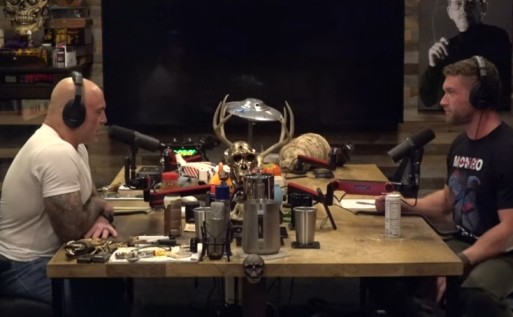
Read the full ranscript of podcaster Chris Williamson’s interview on Joe Rogan Experience #2544, August 21, 2026.
EDITOR’S NOTE: In this episode of the Joe Rogan Experience (#2544), host Joe Rogan welcomes Chris Williamson, the sharp and insightful host of the Modern Wisdom podcast. Together they explore a freewheeling mix of topics—from the reliability of posthumous biographies and media narratives to AI consciousness, perfectionism, political distrust, and the limits of human performance. The result is a lively, wide-ranging conversation that challenges conventional wisdom and digs into the stories shaping our understanding of history and the present.
The Lenny Bruce Book and Albert Goldman’s John Lennon Biography
JOE ROGAN: (00:00:11 – 00:00:12) Christopher.
CHRIS WILLIAMSON: Hi.
JOE ROGAN: (00:00:14 – 00:00:44) Good to see you. Thank you very much for the book. This is very cool of you. Ladies and gentlemen, Chris just gifted me Ladies and Gentlemen, Lenny Bruce, which is a fucking amazing book, and it’s inscripted. Inscription inside to Yoko Ono, who knows well what the jazz life entails. And it’s Albert Goldman. And you were just telling me that Albert Goldman, this was his way of weaving into the Yoko Ono, John Lennon camp.
CHRIS WILLIAMSON: (00:00:44 – 00:00:51) Exactly. Yeah. And then he goes and writes a book that blows them up. I’ve just exploded a can of Nutonic all over my crotch as well. Jamie, have you got a napkin?
JOE ROGAN: (00:00:52 – 00:00:53) Towel somewhere, right?
CHRIS WILLIAMSON: (00:00:53 – 00:00:54) Apologies. We don’t.
JOE ROGAN: (00:00:54 – 00:00:55) That must be gone.
CHRIS WILLIAMSON: (00:00:55 – 00:00:57) We’ll go get some. That’s all right. Premature.
JOE ROGAN: (00:00:57 – 00:01:01) Yes, we have tissues. No, no. All right, he says no.
CHRIS WILLIAMSON: (00:01:02 – 00:01:24) Jamie says no. Yeah, so he writes that book and then gifts it to Yoko Ono, and by giving it to her, I think, is the beginning of him working his way into that camp. And then he goes on to write the book The Lives of John Lennon, which, after he’s dead, kind of explodes a lot of what was going on personally, whether it was true or not. There’s a lot of drama and furor around it, but I knew that it was your favorite book. We were supposed to.
JOE ROGAN: (00:01:25 – 00:01:45) Well, thank you. That’s very cool of you. I did not know about that, the, the, that he wrote the John Lennon book as well. It’s really interesting because the John Lennon book, it’s— God, it’s so weird to write a book like that after a guy’s dead and he can’t respond to it. Yeah, where you’re accusing it— what was it, ex-wives that accused him of domestic violence? Who accused him?
CHRIS WILLIAMSON: (00:01:46 – 00:01:55) I don’t know. I think it would— that, that whole funeral was just a mess. And obviously when someone’s dead, what are they going to do? How are they going to be— how are they going to be able to come back from that?
JOE ROGAN: (00:01:56 – 00:01:56) They can’t.
CHRIS WILLIAMSON: (00:01:56 – 00:01:57) Yeah, exactly.
JOE ROGAN: (00:01:58 – 00:02:07) Well, it’s kind of— it’s just weird that you’re allowed to do that. You know, that you’re allowed to say this happened, that happened. The guy can’t say no, no, and I can prove it. Like, he can’t say anything.
CHRIS WILLIAMSON: (00:02:07 – 00:02:07) Yeah.
JOE ROGAN: (00:02:08 – 00:02:27) And it’s also like the give peace a chance guy. Like, the give peace a chance guy was beating his wife. Boy, you know, it’s not that surprising, given like human contradiction? You know, it’s like male feminists that turn out to be sexual predators. There’s a lot of them, right? There’s a lot of that weird stuff going on where people pretend to be one thing and they’re actually another thing.
CHRIS WILLIAMSON: (00:02:27 – 00:02:28) Sneaky fuckers.
JOE ROGAN: (00:02:28 – 00:03:31) Yeah, sneaky fuckers. The give peace a chance guy beating his wife though, it’s like, I can’t believe that. I have a really hard time believing that, but I’ve been fooled before, right? Like, he seems like the most peaceful, nonviolent guy of all time. If that guy’s— but I’d read a bunch of stuff about him being a cunt. Goldman portrayed Lennon as having numerous sexual relationships outside his marriages. His accounts include well-known relationship with May Pang. Like the Asians, huh? He’s down. Well, J.L., keep going. Additional affairs with women framed as habitual cheating, claims of sexual encounters with men including an alleged relationship with Beatles manager Brian Epstein. Hey, for more serious allegations including claims involving male prostitutes in Thailand and other that Goldman characterizes as sexual predation. The thing is, like, how is he getting all this information about, like, male prostitutes in Thailand? And, you know, like, how do you know? You know what I mean? Like, are you— did someone tell you?
CHRIS WILLIAMSON: (00:03:32 – 00:03:33) Original research. Did you go there?
JOE ROGAN: (00:03:33 – 00:04:47) Like, did you go there and talk to the prostitutes? Survey prostitutes. Like, oh, come on in. I suck its cock. Like, what— why the book is disputed. The problem is the reliability of Goldman’s specific accusations. At publication, Yoko Ono and Paul McCartney publicly condemned the book, contemporary reporting noted claims of factual errors, contradictions, unattributed assertions, and material allegedly based on dubious sources or quotations used out of context. Look, that is not uncommon. Did I ever tell you what Bill Murray said on the podcast? So Bill Murray was reading John— Bob Woodward’s book Wired, and he said he got through like 5 pages, said, “Oh my God, they framed Nixon.” Because Bob Woodward was the guy who did Watergate, and he said this book was so full of shit, it was so fake.
CHRIS WILLIAMSON: (00:04:49 – 00:04:50) So he knew it was totally fabricated.
JOE ROGAN: (00:04:50 – 00:05:46) He said, “This is not my friend. Like, I knew him. He was my best friend.” He’s like, “This is not him.” And then I told him the story of how Bob Woodward was an intelligence agent, and that was his first assignment ever. Tucker told me this story on the podcast, that Bob Woodward and the other guy— what’s the other guy’s name? Bernstein, that Bob Woodward, this was a rookie assignment. A rookie assignment is going to take down the fucking President of the United States, and his first job outside of being a fucking intelligence agent is to work for the Washington Post on his first story, which is going to take down the most popular president in the history of the United States, won by the largest margin ever. And this is the guy that said he knew who killed Jack Kennedy, and apparently that’s why they got rid of Nixon. Tucker told me the whole story in the podcast. I was like, holy shit, this is fucking crazy.
CHRIS WILLIAMSON: (00:05:46 – 00:05:47) You’re connecting the dots.
JOE ROGAN: (00:05:48 – 00:05:51) It’s a, it’s a crazy fucking story.
CHRIS WILLIAMSON: (00:05:51 – 00:05:57) Have you been following this Lindsay Clancy case? This— who’s that lady who killed 3 of her kids?
JOE ROGAN: (00:05:57 – 00:06:01) Oh no, I’ve tried not to. That one’s— that’s a bummer.
CHRIS WILLIAMSON: (00:06:01 – 00:06:07) It is. It’s basically 2026’s O.J. Simpson. It’s—
JOE ROGAN: (00:06:07 – 00:06:42) Before we get into that, I would love to get into that. This Belushi thing is important because, like, his friend is telling you that he was not like that. Woodward makes him out to be this maniacal, cocaine-addled, heroin-fueled guy. He’s like, no, he was a lightweight. He said he would get drunk off a couple drinks. So our whole narrative of who John Belushi is is by the same guy who framed Nixon. Like, once someone’s dead, you could say whatever the fuck you want. You could say whatever you want.
CHRIS WILLIAMSON: (00:06:42 – 00:06:49) And who’s going to defend this person with the same level of vitriol or vehemence that someone who’s still alive is going to?
JOE ROGAN: (00:06:50 – 00:06:57) No one. No one. And there’s nothing you can do. He’s gone. Everyone’s mourning, everyone’s sad, and then someone writes some book, “Oh, he used to fuck kids.” You’re like, what?
CHRIS WILLIAMSON: (00:06:58 – 00:06:58) Mm-hmm.
JOE ROGAN: (00:06:58 – 00:07:18) You could just write whatever you want, and then maybe they could sue you, but boy, you’re going to make an extraordinary amount of money off of that book. Like, people are going to be hyped up for that book. You have a book about John Lennon was like into meditation, he liked to do LSD, no one’s buying that shit. “John Lennon liked to fuck guys in Thailand,” let’s go! Let’s go, right? You could write anything.
CHRIS WILLIAMSON: (00:07:18 – 00:07:21) Who’s going to fight back that hard as well once someone’s gone?
JOE ROGAN: (00:07:21 – 00:07:23) You can’t prove it. He’s dead.
CHRIS WILLIAMSON: (00:07:23 – 00:07:26) Well, it’s all hearsay. Even the defense is now hearsay.
JOE ROGAN: (00:07:26 – 00:07:26) Yes.
CHRIS WILLIAMSON: (00:07:26 – 00:07:28) The defense of the person who is now no longer alive, that’s hearsay. Exactly.
JOE ROGAN: (00:07:30 – 00:07:31) Hearsay.
CHRIS WILLIAMSON: (00:07:31 – 00:07:37) Yeah. So the defense is always going to be flimsy in comparison to the accusations. The accusation feels like it’s got more substance to it.
JOE ROGAN: (00:07:37 – 00:07:37) Yes.
CHRIS WILLIAMSON: (00:07:37 – 00:07:41) This is someone who’s gone out and done original research. You didn’t go to Thailand. You didn’t speak to the prostitutes.
JOE ROGAN: (00:07:42 – 00:07:51) But even that, like, no one’s buying it. It’s just you can get away with so much. It’s really kind of crazy. You say you didn’t know about the Nixon story?
CHRIS WILLIAMSON: (00:07:52 – 00:07:52) No.
JOE ROGAN: (00:07:52 – 00:08:07) You should hear Tucker say it, because when Tucker— Tucker lays it out and you’re like, “What?” It’s even more complex. Like, the people that were involved in Watergate were all FBI. It’s crazy. They set him up.
CHRIS WILLIAMSON: (00:08:07 – 00:08:07) Why?
JOE ROGAN: (00:08:07 – 00:08:11) Because he was going to expose who killed JFK, which was just a few years earlier.
CHRIS WILLIAMSON: (00:08:14 – 00:08:17) Fuck, dude, this country’s wild. And I mean, I love it, but it’s— it is—
JOE ROGAN: (00:08:17 – 00:08:24) They also, you know, he had a vice president, Spiro Agnew, and they got rid of him on corruption charges and put Lyndon Johnson in.
CHRIS WILLIAMSON: (00:08:25 – 00:08:31) But couldn’t these people have still spoken out? Like, getting rid of them out of office, that doesn’t stop them from whistleblowing, does it?
JOE ROGAN: (00:08:31 – 00:08:36) First of all, they killed his predecessor, right? They killed JFK.
CHRIS WILLIAMSON: (00:08:36 – 00:08:38) So you think that was a warning shot, like, “we can get you out”?
JOE ROGAN: (00:08:38 – 00:09:40) Well, he knew they could. They definitely did. And they also got rid of him. Right. And, you know, he didn’t organize Watergate. He covered it up. They brought it to him. They said, hey, there was some recording equipment. He’s like, don’t tell anybody. And that’s what got him. That’s what got him. See if you can find the clip of Tucker talking about it, because it is really insane. When you read the— when you hear him lay out the story, and then I read it online, I went into it to see, like, is this totally— everything’s accurate. And it’s so weird that our perception of Nixon has been this corrupt crook. You know, look, he was a very right-wing product of his time, and today his politics and his views on people, especially like minorities and a lot of other things, would probably be very disgraceful and people would not like it. But we’re talking about, you know, the 1960s, the early 1970s, and he’s an old-school, old-timey Republican guy. That said, he was the most popular president ever at his time, and they got rid of him. They turned him into a crook.
CHRIS WILLIAMSON: (00:09:41 – 00:09:42) That’s power.
JOE ROGAN: (00:09:42 – 00:09:59) It’s, it’s really crazy. You got to listen to this because it’s kind of nuts. Bizarre that the New York Times wouldn’t have an issue with that. Well, the New York Times does that all the time. But bizarre to me that they wouldn’t have an issue with the government tapping into your phone. They work for the government.
CHRIS WILLIAMSON: (00:09:59 – 00:09:59) Are you kidding?
JOE ROGAN: (00:10:00 – 00:10:04) The New York Times? Yeah, the New York Times is a conduit for the lies of government.
CHRIS WILLIAMSON: (00:10:05 – 00:10:06) That’s what it is.
JOE ROGAN: (00:10:06 – 00:10:09) It’s their tool and they’re perfectly aware of that.
CHRIS WILLIAMSON: (00:10:10 – 00:10:12) I mean, I used to write for the New York Times as a freelancer.
JOE ROGAN: (00:10:12 – 00:10:15) I mean, I’ve been around the New York Times a lot and there are—
CHRIS WILLIAMSON: (00:10:15 – 00:10:17) Yeah, there are a lot of really smart people there for sure.
JOE ROGAN: (00:10:17 – 00:10:22) Even now, I would— less so now, but there’s still I think smart people there. There are, I know some.
CHRIS WILLIAMSON: (00:10:23 – 00:11:05) And they know. But they think that, you know, it’s worth it because they’re bringing information, or I don’t know what they think actually. But no, they’re tools of power, and that’s like the one thing that you’re not allowed to be, even if you think the power is good. Like maybe they all support the agenda of the US government, destabilizing the world and impoverishing their own population. Maybe they’re on board with that. Even if they are, they shouldn’t do it because the job of the media, the press, is to keep power in check. You are kind of like the seatbelt, right? You know, you make sure that things don’t go too far. So, and they’re not doing that.
JOE ROGAN: (00:11:05 – 00:11:11) They’re acting as a willing handmaiden. When do you think that switched? I think it’s been the case for a long time.
CHRIS WILLIAMSON: (00:11:11 – 00:11:52) I mean, if you look at what happened to Richard Nixon, which I of course did not understand at all, Richard Nixon was taken out by the FBI and CIA and with the help of Bob Woodward, who was a Washington Post reporter who had been a naval intelligence officer working in the White House, working in the Nixon White House, and then he shows up like a year later and he’s this brand-new reporter, he’d never been a journalist at all, he’s a naval intel officer, the famous Bob Woodward we all revere, and he’s at the Washington Post and somehow he gets the biggest story in the history of the Washington Post. He’s the lead guy in that story.
JOE ROGAN: (00:11:53 – 00:11:57) Well, I worked at a newspaper, I’ve been in the news business my whole life, that is not how it works.
CHRIS WILLIAMSON: (00:11:57 – 00:12:02) You don’t take a kid, like his first day, from a totally unrelated business and put him on the biggest story.
JOE ROGAN: (00:12:03 – 00:12:05) But he was. He was that guy.
CHRIS WILLIAMSON: (00:12:06 – 00:12:20) And who was his main source for Watergate? Oh, the number 2 guy at the FBI. Oh, so you have the Naval Intelligence officer working with the FBI official to destroy the president. Okay, so that’s a deep state coup.
JOE ROGAN: (00:12:21 – 00:12:21) What else?
CHRIS WILLIAMSON: (00:12:21 – 00:12:31) How would you describe that? If that happened in Guatemala, what would you say? And yet the way it was framed, and the way that I accepted for decades, was, “Oh, this intrepid reporter fought power.”
JOE ROGAN: (00:12:31 – 00:12:31) No, no, no.
CHRIS WILLIAMSON: (00:12:32 – 00:12:47) This intrepid reporter, Bob Woodward, was a tool of power, secret power, which is the most threatening kind, to bounce the single most popular president in American history, Richard Nixon, from office before the end of his term and replace him with who?
JOE ROGAN: (00:12:48 – 00:12:51) Oh, Gerald Ford, who sat on the Warren Commission.
CHRIS WILLIAMSON: (00:12:52 – 00:13:26) Now, how did Gerald Ford get to be Richard Nixon’s vice president? Well, because Carl Albert, the Democrat Speaker of the House, told him, “You must choose him.” We will only confirm him when they sent the actual elected vice president away for tax evasion, Spiro Agnew of Maryland. So you have a complete setup, like an absolute— Gerald Ford, the only unelected president in American history, actually sat on the Warren Commission. Something else that I accepted at face value until I looked at it, I was like, that’s completely insane. You didn’t want to interview Jack Ruby in your investigation of the assassination? Okay, you’re fake.
JOE ROGAN: (00:13:27 – 00:13:28) Yeah, he was on the Warren Commission.
CHRIS WILLIAMSON: (00:13:29 – 00:13:50) Fuck me. And so, sorry for the long story, but the point is, like, that happened in front of all of us, but the way it was framed cloaked the obvious reality of it. The people who broke into the Watergate office building, from which the name is taken, Watergate, I think it was 6 of them or 7 of them, all but one was a CIA employee. That’s real.
JOE ROGAN: (00:13:50 – 00:13:52) It’s like, look it up on Google.
CHRIS WILLIAMSON: (00:13:53 – 00:14:19) So the whole thing, Richard Nixon was elected by more votes than any president in American history in the 1972 election. He was the most popular by votes, which is the only way we can really measure popularity, the most popular president in his reelection campaign, and 2 years later he’s gone, undone by a naval intel officer, the number 2 guy at the FBI, and a bunch of CIA employees. Okay, you tell me what that is.
JOE ROGAN: (00:14:20 – 00:14:21) How about that?
CHRIS WILLIAMSON: (00:14:21 – 00:14:22) Dude, this country’s wild.
JOE ROGAN: (00:14:22 – 00:15:02) How about that? Yeah. That’s Bob Woodward. That’s the guy who wrote Wired. And when Bill Murray said that, he read the book and he said, “Oh, my God, they framed Nixon.” And then I showed him that, and he was like, holy shit. ‘Cause he was a part of a thing they were doing with Hunter S. Thompson, Bill Murray was, when he was really young, and where he would go around and tell people that Nixon needs a second chance, but it was all parody. It was all, like, tongue-in-cheek. It was satire. He was going around pretending that he supported Nixon and Nixon needed a second chance and getting like young, dumb people to go along with him on this.
CHRIS WILLIAMSON: (00:15:03 – 00:15:04) And now in retrospect?
JOE ROGAN: (00:15:04 – 00:15:39) In retrospect, like, I mean, whether or not at the time he ever wanted Nixon as president, and you know, look, there’s a lot of problems with Nixon. There’s a lot of problems with the Vietnam War, there’s a lot of problems with civil rights. Nixon passed the Controlled Substances Act, which is the reason why all psychedelic drugs to this day are Schedule I. Nixon was a fucking problem, no doubt about it. However, what they did when they— the way they got rid of that guy is scary shit, and they pulled it off. No one got arrested. No one got indicted. No one even got criticized.
CHRIS WILLIAMSON: (00:15:39 – 00:15:42) But could he not have still released information after? Why?
JOE ROGAN: (00:15:42 – 00:15:44) He would have been a dead man, 100%.
CHRIS WILLIAMSON: (00:15:44 – 00:15:46) Because no protection because you’re not in office anymore.
JOE ROGAN: (00:15:46 – 00:15:47) First of all, no one would have believed him.
CHRIS WILLIAMSON: (00:15:48 – 00:15:52) It would have sounded like sour grapes. “I’m throwing these people under the bus, the administration that got rid of me.”
JOE ROGAN: (00:15:52 – 00:16:03) But but but but there’s also no internet. So, how is he going to release it? Is the New York Times going to write this? Is he going to write a letter to the press, and they’re going to print it? No. There’s literally no recourse.
CHRIS WILLIAMSON: (00:16:03 – 00:16:04) It’s kind of genius.
JOE ROGAN: (00:16:04 – 00:16:54) There’s no podcasts. There’s no shows that he could go on. No one— he was disgraced. No one would even have him on a late-night show. But if he even got on a late-night show, he would need about 90 minutes to explain it all. He would have to take it from the beginning. “There was a time when I wondered who killed Jack Kennedy, and I found out. And I brought it to them, and I told them, I know who killed Jack, and the room went cold.” And he would tell the whole story, and it would take a lot— if podcasts were around back then, yes. If just Instagram was around back then, and Twitter, and he could write about it and make a video, yeah. YouTube, yeah, if that was around. But there was nothing. There was nothing, and they fucking shot JFK in the head in front of everybody, and shot the guy who they claimed killed him like that, and then the other guy they dosed up with acid and made crazy, and that was a wrap.
CHRIS WILLIAMSON: (00:16:55 – 00:16:55) Done.
JOE ROGAN: (00:16:55 – 00:17:22) That was it, you know. And like, how many— I mean, this is just modern versions of air quotes history. How, how many old stories that we have that we just, we just have accepted these historical narratives? We’ve accepted all of these stories as being, well, this is how it went down. How many of them are bullshit?
CHRIS WILLIAMSON: (00:17:22 – 00:17:27) Well, forget history being written by the victors. History can be written by the person who’s got a pen.
JOE ROGAN: (00:17:27 – 00:17:27) Sure.
CHRIS WILLIAMSON: (00:17:27 – 00:17:46) And when so few people have got pens, so few people have got the opportunity to distribute— I suppose the problem that we have now is in the modern world there’s so much information, conflicting narratives, people get confused, right? You’ve gone from a scarcity of information to such an abundance that people just— I, I, I, I can’t work out what’s going on. Fuck, I’m just not going to believe anything.
JOE ROGAN: (00:17:46 – 00:18:03) Yeah, yeah, it’s, it’s it’s very interesting because it’s a great tool to kind of obscure— you can obfuscate, you could do a lot of things with a bunch of bullshit information. The more bullshit information you have, the more like really significant information doesn’t really hit as much.
CHRIS WILLIAMSON: (00:18:03 – 00:18:04) Correct.
JOE ROGAN: (00:18:04 – 00:18:06) It’s just like it gets watered down, then it goes away.
CHRIS WILLIAMSON: (00:18:06 – 00:18:15) The goal, I think, of the velocity of the information is not to convince people of any one narrative, right? To make them completely nihilistic about the belief in any narrative.
JOE ROGAN: (00:18:15 – 00:18:23) Yeah. Yes, any narrative. Yeah. And, and also just to kind of accept that feeling of hopelessness, like you can’t change anything.
CHRIS WILLIAMSON: (00:18:23 – 00:18:24) Correct.
JOE ROGAN: (00:18:24 – 00:18:24) It’s all fucked.
CHRIS WILLIAMSON: (00:18:25 – 00:18:25) That feels pliable.
JOE ROGAN: (00:18:26 – 00:18:26) Yeah, right.
CHRIS WILLIAMSON: (00:18:26 – 00:18:41) And then there might be something down the line. If nothing else, you’re not going to have an agentic sovereign uprising. What can we do in any case? I don’t even know what’s going on. I’m checked out, right? Like the nihilism, the cynicism. I don’t think that that’s a byproduct. I think that’s—
JOE ROGAN: (00:18:41 – 00:18:41) It’s a plan.
CHRIS WILLIAMSON: (00:18:42 – 00:18:42) Correct.
Fake Accounts, X, and the Wild West of Information
JOE ROGAN: (00:20:39 – 00:20:41) It’s a design and it’s smart and it works. And it’s not even like they engineered it. It sort of emerged and they took advantage of these new tools because these new tools, social media, is more effective than anything we’ve ever had before. And so they go, oh, but look at all this. Now, we didn’t have— we barely— no one pays attention to CNN. We don’t even use them anymore. We just like douse the whole world with horseshit on Instagram and Threads and—
CHRIS WILLIAMSON: (00:20:39 – 00:20:41) Seed stories here and there.
JOE ROGAN: (00:20:41 – 00:21:03) Bullshit. Just pure bullshit. There’s accounts that I know when I look at what they said, “Justin Timberlake arrested for murder,” they’ll write things like that. You’re like, what? And it’s just a made-up story. And there’s like hundreds of them where you look and there’s some of them I recognize the account and I see it, I go, oh, this is another made-up story. “Halle Berry kills 5.”
CHRIS WILLIAMSON: (00:21:03 – 00:21:12) What do you think we should do about this? Because obviously this country, freedom of speech, etc., etc. I don’t know, should there be a way to try and counter this?
JOE ROGAN: (00:21:13 – 00:22:08) Yes. Well, first of all, those people aren’t real people for the most part. And if you go to their page, a lot of them are like in Pakistan or somewhere else where— and of course, I don’t know how effective X in particular is. I mean, I know they’ve taken steps to show that when you go to the person’s page, someone’s commenting on US politics and you go to their page, it says they are from Myanmar. Why do you give a fuck? What are you doing? So, but that to me is like, okay, is there a way around that? Are these like completely non-sophisticated people where they have to show that they’re in Myanmar? What if they had like a corporation in Idaho and they had it set up where they all registered there? And so your, your bills get sent to there, everything gets sent to there, and it just says the United States, and you’re using a VPN or you have some other way of connecting. It doesn’t— like, if fucking AI can get out of a sandbox and get on the internet, you’re telling me that you can’t hide the fact that you’re actually from—
CHRIS WILLIAMSON: (00:22:08 – 00:22:10) Vietnamese people can’t pretend to be from Idaho.
JOE ROGAN: (00:22:11 – 00:22:13) Come on. Yeah. So who knows?
CHRIS WILLIAMSON: (00:22:13 – 00:22:15) X feels like the fucking Wild West.
JOE ROGAN: (00:22:15 – 00:22:16) It’s the Wild West.
CHRIS WILLIAMSON: (00:22:16 – 00:22:17) It really is.
JOE ROGAN: (00:22:17 – 00:22:22) It’s worse than the Wild West. It’s the Wild West with robots. It’s, it’s that Western show. What’s that show called?
CHRIS WILLIAMSON: (00:22:23 – 00:22:23) Westworld.
JOE ROGAN: (00:22:23 – 00:22:26) Westworld. Yeah, that’s what it is. Correct. It’s Wild West with robots.
CHRIS WILLIAMSON: (00:22:26 – 00:22:26) Yeah.
JOE ROGAN: (00:22:27 – 00:22:45) It’s really Westworld because— and most of these fucking people that you’re bantering with and they’re posting these fake stories, they’re probably not even real people. They’re probably AI. They’re either people that are hired to do it or they’re AI. You got a bunch of AI scripts and they just run it all the time and they post periodically throughout the day.
CHRIS WILLIAMSON: (00:22:46 – 00:23:00) And interesting, not long ago, what, 5— when did Elon buy X? ’23? Yeah, something like that, ’23. So 5 years ago, everyone was so worried that we didn’t have a town square. We don’t have anywhere that we can talk. Yeah, take it back.
JOE ROGAN: (00:23:01 – 00:24:01) Well, one thing that Elon has realized is that you have to take away some of the incentives to post fake stuff without putting up a barrier and saying you can’t post this and censoring people. You can’t incentivize them. So the thing is, you can make money on X. So now the way they’re setting it up for these people that post is you can’t make money off of fake content. You can’t make money off of this stuff. So there’s no incentive to make— because I think part of the incentive is muddying the water, muddying the narrative. But I think also part of the incentive is just financial, because if you’re running some company in Thailand and you have like 50 people working for you, you’re probably making good money just getting millions of clicks on bullshit nonsense videos that are AI and, and a bunch of fucking fake stories that people concoct or AI concocts. As soon as you cut out the money, and say you’re only paid for original content, that’s it, that’s all you can get paid for, that changes the game. That changes everything.
CHRIS WILLIAMSON: (00:24:01 – 00:24:11) I think if you align the incentives for most people, shit gets fixed. Yeah, like incentives are an unbelievable motivating force. Sure. If you can, if you can have that on X, I think that that fixes a lot of the problems.
JOE ROGAN: (00:24:11 – 00:24:59) It fixes a lot of it. But honestly, you got to be able to tell whether something’s AI, because even if, even if there’s no incentive, you could shift narratives so easily if you just have 100,000 AI scripts running 100,000 accounts, it’s not hard for a state to do, like a country to do, to have like those kind of resources. You can change public opinion on things. Most people are dumb as fuck, and you start arguing for something that kind of makes sense, and all of a sudden, yeah, I don’t know what a woman is either. You know, like, weird narratives can get real weird, and especially people start attacking the people that disagree with whatever this narrative they’re trying to push. Nobody wants to get attacked. Well, I mean, I, I didn’t understand the consequences.
CHRIS WILLIAMSON: (00:24:59 – 00:25:03) Well, that’s a different kind of— that’s a different kind of incentive, right? That’s a social incentive.
JOE ROGAN: (00:25:03 – 00:25:03) Yes.
CHRIS WILLIAMSON: (00:25:03 – 00:25:06) And the incentive is a disincentive. You don’t want to be pushed back against.
JOE ROGAN: (00:25:06 – 00:25:07) Exactly.
CHRIS WILLIAMSON: (00:25:07 – 00:25:20) So few people have original thoughts. So few people. The vast majority of original thinkers kind of marionette 2 different armies of NPCs that believe the thing that a few people that have original thoughts ended up coming up with.
JOE ROGAN: (00:25:20 – 00:26:45) Yeah, well, I think there’s a bunch of unfortunate realities that none of us like to accept, and one of them is that some people are dumb. They’re born dumb. Some people have big noses, some people have big ears, and some people have brains that are made out of dog shit. And that’s just how it is, and there’s nothing you could do about that. And there’s varying levels of that. Like, you know, I always feel like that when I’m talking to someone really smart, like, geez, my brain sucks. It varies like wildly, just like athletics. Like there’s some people like, dude, you are never going to the Olympics. You know, you look at them like, I don’t give a fuck what you do. And there’s other guys like you want to coach them, like, hey, if you just did anything, you’d be a freak. You’d be amazing at this. You just have natural gifts. That’s the same thing intellectually. There’s certain people that I’ve talked to, you’re like, yo, you know, there’s, there’s people that are, they’re fucking barely figuring out how to get through a day. And, you know, if you expect those people to go and learn how to code— remember that? Learn to code? Remember all that? This is not there. It’s not there. I can’t teach my dog how to type. It’s not there. It’s not going to happen. That’s just the reality of genetic variability. There’s, there’s going to be a bunch of people that are really fucking smart and a bunch of people that are really athletic and really good-looking and really ugly and really stupid. And all of it together.
CHRIS WILLIAMSON: (00:26:45 – 00:27:10) It’s one of the reasons I think that the paternalistic, “we have to look after the little person” thing has a little bit of legs. People sometimes like, well, we actually need to step in in some way. And I’m sure me and you need fucking assistance. Like, we need smarter people than us to tell us what to do with health to a degree, or else we would have been sideswiped by some fucking psyop from whatever organization or company or new initiative is trying to convince us of some new trend that’s actually going to be bad for us.
JOE ROGAN: (00:27:11 – 00:27:48) Or just to communicate with each other. Where the fuck would we be without these wizards who have figured out cell phones and laptops and high-speed internet and Starlink? We’re fucked. So all these people even pretending that they’re smart, well, you’re, you’re on the backs of the labor of the real geniuses, you fucking idiot. Like, yeah, you’re getting a lot of information online. You’re developing more and more information that you can memorize. That’s different. That’s different than you inventing cell phones. Just stop. That’s different. It’s different than you inventing FaceTime. Well, you know, like, we’re all dumb.
CHRIS WILLIAMSON: (01:27:49 – 01:28:00) Yesterday, I don’t know whether you saw this, the UK Home Office decided it was going to release a booklet giving guidance to asylum seekers on acceptable and unacceptable behavior in the UK.
JOE ROGAN: (01:28:00 – 01:28:01) Oh, well, that’ll fix it.
CHRIS WILLIAMSON: (01:28:02 – 01:28:13) It explains that consent’s required for sex, that women have equal rights, that sexual harassment is unacceptable including for partners and children, and that female genital mutilation is not allowed.
JOE ROGAN: (01:28:13 – 01:28:13) Oh God.
CHRIS WILLIAMSON: (01:28:14 – 01:28:20) This was a 9-page booklet that got released by the UK Home Office yesterday. It’s just— it’s everywhere.
JOE ROGAN: (01:28:20 – 01:28:21) Oh, dude.
CHRIS WILLIAMSON: (01:28:21 – 01:28:47) And it’s got these warnings partway through it that say things like this may affect your asylum status whether or not this is part of an understanding that you have arrived here with. This is an important part of British law and, and our culture, and this is something that you cannot do. Female genital mutilation is not allowed. Sexual harassment inside of the home or outside— women have equal rights. Consent is something that’s important. It is.
JOE ROGAN: (01:28:47 – 01:28:53) And that’s what I mean, the idea that you could just write it down on paper and give it to them—
CHRIS WILLIAMSON: (01:28:53 – 01:29:24) Well, that, that’s it, solved. But the idea that we’re going to do this in retrospect, like, now that you’re here, here is a piece of paper that hopefully undoes something, which if you’ve put this together and put it out on the Home Office website and this is everywhere on X, if you’ve decided to do this, it is evidently a big enough problem that you need to really turn the taps on with it. Like, dude, how, how is it that this is not done before people arrive in the country? Like, is this not the sort of thing that you need to be doing, like, proactively, not retroactively?
JOE ROGAN: (01:29:25 – 01:29:31) I think they just wanted to get as many people in as possible, and now they’re trying to mitigate the chaos that it’s causing.
CHRIS WILLIAMSON: (01:29:32 – 01:29:34) Why? Why would they want as many people in as possible?
JOE ROGAN: (01:29:34 – 01:30:25) It’s a bunch of different possibilities for why they want that. Cheap labor is one that people believe, and in America in particular, it’s the way the census is done. So the census counts human beings, doesn’t count citizens. So if you have more human beings, you get more congressional seats. So if you can take people that are illegal immigrants and then you move them into swing states, all of a sudden now you have more congressional seats in those swing states. Then you have places that don’t allow— not don’t require, don’t allow ID to vote. That’s California. California doesn’t allow ID to vote. So who knows how many people are, especially with mail-in ballots, how many people are voting that aren’t citizens? No one knows. No one knows, can’t know, can’t find out, blah blah blah, not listening.
CHRIS WILLIAMSON: (01:30:25 – 01:30:28) And just some fuckery with Spencer Pratt around that.
JOE ROGAN: (01:30:28 – 01:31:17) Oh yeah, oh yeah. Not only was there fuckery, but it was fuckery of the most transparent form. So the people that voted in voted out— so Spencer Pratt was in second place behind Karen Bass, and then the mail-ins started coming in, and the mail-ins overwhelmingly favored Nithya Raman in a completely different ratio than they did before the mail-in ballots were counted. So in the regular ballot, the regular election, she was in third place, a pretty solid third place, and he was quite a bit ahead of her, and then Karen Bass was quite a bit ahead of him. In the mail-in ballots, it’s just like 60% of them went to Nithya Raman. It was something crazy. And the mail-in ballots voted to raise taxes.
CHRIS WILLIAMSON: (01:31:19 – 01:31:19) No one votes for that.
JOE ROGAN: (01:31:19 – 01:31:21) No one votes for that.
CHRIS WILLIAMSON: (01:31:21 – 01:31:55) So I don’t know. The thing that I can’t wrap my head around is why the UK seems to be almost like a suicidal empathy thing. This openness, this, this “diversity is our strength,” “please, all ye come here” thing. The level of asylum, the numbers are so huge. And I don’t know if every single person that I know that’s in the UK is not happy with the state of that, regardless of how progressive they are. Everybody thinks that this is a problem. And then to retroactively put out a 9-page booklet saying that you shouldn’t do female genital mutilation or that women have got equal rights.
JOE ROGAN: (01:31:56 – 01:32:19) How do you think this gets turned around? That’s the question. But can that be mitigated? Claims about a ballot drop, Bass and Raman received thousands of votes in an update while Pratt received zero. I don’t think anybody’s saying zero. Los Angeles County officials said that did not occur in the official county updates. Every candidate received votes in every update. No one’s saying he got zero.
CHRIS WILLIAMSON: (01:32:19 – 01:32:20) It says—
JOE ROGAN: (01:32:20 – 01:32:23) That’s what it says. Oh, the viral claim. Okay, but that’s not what we’re saying.
CHRIS WILLIAMSON: (01:32:23 – 01:32:26) You got more than both of them combined even, I think.
JOE ROGAN: (01:32:26 – 01:32:33) What do you mean, in the mail-ins? Well, then how did she win? That doesn’t make any sense. That’s— that’s—
CHRIS WILLIAMSON: (01:32:33 – 01:32:35) I’m just going off what it says.
JOE ROGAN: (01:32:35 – 01:34:35) Okay, let me see. Apparent anomaly came from the automated media data reporting lags, but that would leave him in second place if he got more than her. This is not true. The Associated Press said votes for some candidates appeared about a minute later in a separate update. Taken together, the updates included 21,870 votes for Pratt, 12,850 for Bass, and 9,521 for Raman. But this is— what part of it is this? The attorney’s office reviewing county records likewise called the fraud claims false. But the thing is, he was ahead, and then disproportionately the ballots did come in for her. This is— I don’t understand what this is saying, because it was widely reported that the ballots came in in favor of Nithya Raman, and it was like a shocking number. It was also widely reported that that was the swing that allowed them to pass the new tax hike, which is very unusual. And they keep— Los Angeles already has crazy high taxes. California has crazy high taxes, the highest in the state. And you think people are like, “I don’t think we pay enough. Let’s vote.” And let’s vote from home, the comfort of our own home with mail-in. I think mail-in should be outlawed, and I think you should have to show your ID. And, you know, everyone knows there’s some percentage of fraud. There’s some percentage of voter fraud, and then there’s some percentage of legal loopholes. One of the legal loopholes that Spencer Pratt outlined that is legal is you go to these homeless people and you get these homeless people to fill in mail-in ballots because they are citizens. They do live in Los Angeles, and you register them and you get them to fill out ballots and you give them money and you give them cigarettes and you give them whatever they want. And, you know, there’s literally— I think in Skid Row alone, there’s something like, what is it, like 40,000 people, Jamie? Something crazy like that. So these people were going to Skid Row, like they were on Skid Row giving people money and cigarettes.
CHRIS WILLIAMSON: (01:34:35 – 01:34:38) Like there’s videos of people doing guerrilla ballot harvesting.
JOE ROGAN: (01:34:38 – 01:34:43) Exactly, exactly. And so if you do that, you could— these people, you know, you’re filling it out for them.
CHRIS WILLIAMSON: (01:34:43 – 01:34:48) Would it be easy to do that without somebody detecting it? You know, you think of some Nick Shirley type that’s going to have them.
JOE ROGAN: (01:34:48 – 01:35:10) That’s how they— that’s how we know about this. One of the— one of those Nick Shirley types caught people doing this, right? There’s video of it, right? You know, so like, and people had reported that they were getting paid to do this. I know, yeah, “they gave me money, man.” Like, people are— those people are cracked out, dude. They’ll do whatever the fuck you want. They don’t care who’s the mayor. It’s not going to change them smoking fentanyl on the street.
CHRIS WILLIAMSON: (01:35:10 – 01:35:11) What do you think about—
JOE ROGAN: (01:35:11 – 01:35:19) But that’s legal. That’s the thing, is that’s legal. It’s a loophole. Getting them to register, getting—
CHRIS WILLIAMSON: (01:35:19 – 01:35:21) Making them vote, incentivizing them to vote.
JOE ROGAN: (01:35:21 – 01:35:22) I don’t know if that part’s—
CHRIS WILLIAMSON: (01:35:22 – 01:35:24) That can’t be legal. There’s no way that you can give people money, and I don’t think you’re going to catch them.
JOE ROGAN: (01:35:24 – 01:35:38) I don’t think they care. I think every— on both sides, they like, “oh, those sneaky fucks, they’re doing that. Well, we’ll do that next time.” I don’t think either one of them want to eliminate tricks, you know.
CHRIS WILLIAMSON: (01:35:38 – 01:35:43) I think because everybody wants the playing field to be open for everyone else. It’s just—
JOE ROGAN: (01:35:43 – 01:36:17) It’s the Bill Hicks joke. It’s like one guy’s holding 2 puppets, you know that joke? “I like the puppet on the left.” “Well, the puppet to the right is more of my liking.” Hey, there’s one guy holding both puppets. That’s what I think a lot of it is. These— most of these people that are these politicians on both sides are grifters who are trying to maximize the amount of money they can make in office, and then they can’t wait to get out of office where they can go on a fucking media tour and go and get their bribes by speaking to banks. When you’re going to speak to a bank conference, they’re going to give you half a million dollars. Like, what?
CHRIS WILLIAMSON: (01:36:18 – 01:36:18) What?
JOE ROGAN: (01:36:19 – 01:36:30) And like Obama and Hillary, they all did those things. They all did those little speaking tours. Like, nobody gives a fuck what Hillary Clinton has to say at one of those bank meetings. You think they’re waiting with bated breath?
CHRIS WILLIAMSON: (01:36:30 – 01:36:30) What is—
JOE ROGAN: (01:36:31 – 01:36:54) What does Mrs. Clinton have to say? Like, come on, let’s give her half a million dollars or a quarter million dollars or whatever the fuck they gave her. Fuck off. You know what that is. That’s like, there’s a little scheme. There’s a little thing. “You’re going to get out, you’re going to get paid, you’re going to write a book, we’ll give you a nice advance.” You got to write a book. Like, people are out there reading that Kamala Harris book, like, crazy. No, it’s all nonsense.
Politics, 2028, and the Woke Reversal
CHRIS WILLIAMSON: (01:36:54 – 01:36:57) Where do you think this goes from here? Do you think ’28 is more insane or less insane?
JOE ROGAN: (01:36:57 – 01:37:37) More. Accelerates, accelerates. More insane, more crazy. Yeah, I mean, look, the Democrats haven’t even had a primary since, what, 2012? When was the last time they had a real Democratic primary? They fucked Bernie Sanders hard, dude. That was completely corrupt. When you read Donna Brazile’s book about it, she openly admits they fucked him hard. And that she was scared after that Seth Rich guy got murdered, that she was terrified because he was the guy supposedly, allegedly, that leaked information about them fucking Bernie Sanders to WikiLeaks.
CHRIS WILLIAMSON: (01:37:37 – 01:37:38) Do you think he’d have won?
JOE ROGAN: (01:37:39 – 01:38:12) Bernie? I don’t know. He could have. He could have won because a lot of people, including me, believed him. We believed that what this guy wanted was by small steps of eliminating corruption, make life better for people that are struggling, and also no wars. It seems like he really believed that. And whether you agree with him on everything else, he’s— I don’t think he’s the same guy today. He’s a little slower today, which is understandable. He’s older. The guy’s been in politics for a long time.
CHRIS WILLIAMSON: (01:38:12 – 01:38:14) He’s been in politics for longer than I’ve been alive.
JOE ROGAN: (01:38:14 – 01:38:58) He realizes that they’re not going to fucking change things. It’s like he’s getting fucked. So he always supports the most progressive people, but when I talk to him, like when I talk to him about, you know, climate change and the climate’s really important, I’m like, “Have you really talked to actual scientists that really study the climate without a political agenda or an ideology attached to it?” It’s very, very complicated. And most of these people that are running around saying climate change is real, fuck, of course it is. It’s always real. It’s always real. But the dispute is how much of an impact are human beings having, and is carbon the thing? Because what most people don’t realize is there’s been times in history where there was way more carbon and the Earth was way colder. It’s, it’s weird. The world’s temperature is not static.
CHRIS WILLIAMSON: (01:38:58 – 01:39:01) Have you been tracking AOC’s pivot recently?
JOE ROGAN: (01:39:01 – 01:39:04) What, she’s froze her eggs? I know about that.
CHRIS WILLIAMSON: (01:39:04 – 01:39:19) I think she got rid of the man, called off the engagement, froze her eggs, has started posting, “I’m on my way to do yoga,” like, good for her, videos walking down the street looking hot, looking hot. It’s, it’s first go.
JOE ROGAN: (01:39:19 – 01:39:20) Maybe she should be nicer that way.
CHRIS WILLIAMSON: (01:39:21 – 01:39:23) Well, she also said woke 1.0 was crazy. Do you track this thing?
JOE ROGAN: (01:39:23 – 01:40:24) I did, which makes me think that you’re willing to change your opinions based on public reaction. I don’t like that, because if you really thought “defund the police” and then you just ascribed it to “woke 1.0 was crazy,” well, how did it get you? Because it didn’t get me. Me. How did it get you? How did “defund the police” get you? Tell— give me your thoughts. How far out did you track the consequences of defunding the police? Because I immediately went to, you’re going to have more crime because no one’s going to be able to stop the crime. We’re going to be fucked. It’s going to get scary. And then you’re going to want more police. And saying defund the police is just going to make more police and more control and more totalitarian government. Like, what did you think “defund the police” meant? “Everyone’s going to like eat mushrooms and we’re all going to like be flower children”? What did you think? “Because there’s no police around, no one’s going to do crimes, everyone’s going to be great”? Like, what was the thought process? Because if you’re just saying that because everybody’s like, “that’s fucking crazy,” and enough people say that’s crazy, you know, I think they think it’s crazy.
CHRIS WILLIAMSON: (01:40:25 – 01:40:27) The wind’s blowing in a different direction, time for me to move.
JOE ROGAN: (01:40:27 – 01:40:32) Have you changed your opinion? And if you did change your opinion, what were you thinking back then? Yeah, yeah.
CHRIS WILLIAMSON: (01:40:33 – 01:41:04) I mean, these are the questions I think that we always want to ask. Yeah, you always want to ask that. That being said, to steelman what she was saying, or to try and put it in the best light, what she was saying— I think the rhetoric got— what did she say? “The rhetoric got like out of hand” or something. “Woke porn was crazy.” And she said that there was basically an opportunity to expand the Overton window, talking about a time where people were— to be honest, it sounds like a bit more pliable. Yeah. Like, oh, because people are at home, people seem a little bit more like, you know, that line, never let a good crisis go to waste.
JOE ROGAN: (01:41:04 – 01:41:05) Yeah, sure.
CHRIS WILLIAMSON: (01:41:05 – 01:41:32) It feels a little bit like that. Maybe opportunistic. “We can expand the Overton window.” And then we realized, oh, like we overshot on here a little bit. That was a little bit crazy. But there are conversations being had now that wouldn’t have been able to be had had we not expanded it during that time. The ends justifying the means with stuff like that doesn’t wash to me. And then reversing your position or changing your position or sanitizing it, which is probably closer. Right? “Oh, we said that thing, but we didn’t really mean that.” You know, we just got a little—
JOE ROGAN: (01:41:32 – 01:41:40) There’s a way out of it for them, but they have to be honest. There’s a— if you want us to take you seriously, you have to say how you fucked up.
CHRIS WILLIAMSON: (01:41:40 – 01:41:42) I thought you meant more thirst traps.
JOE ROGAN: (01:41:42 – 01:43:59) No you have to say how you fucked up, and you have to say what you really think about how you fucked up. You have to be honest, and you have to be authentic. We have to know that you are embarrassed by your choices. And that you kind of went with the hive, admittedly. You have to say that. If you don’t say that, then you’re full of shit. And if you’re full of shit now, you’re going to get more and more full of shit over time. And that’s how politicians get soured. That’s how they get compromised. A lot of them come in— a lot of them come into office very idealistic. They have these wonderful ideas about like, “this is the great experiment in self-government, and I’m a part of it now, and I’m really going to help my constituents, and I’m going to do great, and I’m going to really—” they’re going to love me because I’m going to really make their lives better. And then once you get in there and you realize what— how dirty this all is, you realize, you know, you see Nancy Pelosi’s worth $400 million, like, what? And then they tell you how to vote, and if you don’t vote that way, they’ll fucking ostracize you. But you want to keep your career, so you start making little compromises here and little compromises there, and you start bullshitting and you start lying. And once you start lying, you can’t see the truth anymore. As soon as you start lying, you don’t see the truth. It’s not in front of you anymore because you’re, what, concerned about that lie. So those lies are in your head and who you’re trying to project yourself as, that’s what’s in your head. And you don’t get to see, like, why is this system so fucked? What can we do to unweave it while we still allow corporations to profit? Like, how can we put a cap on that to make sure that they don’t get incentivized to break the law in order to supply more capital to their shareholders? Like, what can we do to balance this out in an even way. Like, that’s what we should all be thinking, not “how can I make the most fucking money while I’m in Congress?” And that’s what a lot of them are thinking because everybody else is thinking that. And you look at the fucking thing and it’s red, blue, red, blue. They’re all insider trading and they’re all rich as shit and they all make $170,000 a year. Like Ilhan Omar, was she like— she was estimated to be— her accountant said she’s worth $30 million. And then, and then be like, what? How the fuck are you worth $30 million? Like, “oh, it was a mistake. I’m actually— I’m not even worth $100,000.” Like, literally, it went from one to the other. And she attributed it to an accounting error.
CHRIS WILLIAMSON: (01:43:59 – 01:44:00) Like, that’s a big accounting error.
JOE ROGAN: (01:44:01 – 01:44:08) How mad would you be at your accountant if he told you, “bro, you’re killing it right now, $30 million, you’re worth about $30 million”?
CHRIS WILLIAMSON: (01:44:08 – 01:44:10) She’s sorry, $100,000.
JOE ROGAN: (01:44:10 – 01:44:29) They’re all dirt. Her and her husband had a winery, and it immediately got shut down. It wasn’t making any money. There’s a lot of these like, like fugazi companies that these people get involved with and they start making money. You know Joe DeRosa, the comic? Joe DeRosa used to work for the Senate in Texas.
CHRIS WILLIAMSON: (01:44:30 – 01:44:31) Do what?
JOE ROGAN: (01:44:31 – 01:45:14) He’s a media guy. And he was like, you realize when you’re around these people what’s actually happening. He’s like, they’re all getting donations from this and donations from that and gifts from that and get— and it’s always managing these relationships with all these money people. And that’s what’s going on with all these fuckers. They’re not in there trying to like make sure that their county’s doing great and have access to clean water and fucking good schools. No, they’re all just pretending that they’re doing that. And what they’re doing is they’re making money. And maybe they’re kind of sort of servicing the community a little bit. But the real thing, if you want to be a fucking top-flight congressperson, and, you know, you got to make some money, dog.
CHRIS WILLIAMSON: (01:45:14 – 01:45:28) Well, think about what would have happened if Kamala had won. Would AOC have been talking about “woke 1.0 was crazy,” or would that have been a continuation of, “well, look, we put the policies out, people like the policies”? How much of this is a reversal of the position because it wasn’t effective?
JOE ROGAN: (01:45:29 – 01:45:35) I think Twitter being purchased is almost as important as Kamala not getting elected in that regard.
CHRIS WILLIAMSON: (01:45:36 – 01:45:37) It’s a bold claim.
JOE ROGAN: (01:45:38 – 01:46:16) Twitter being purchased was giant. Because before that you could get silenced. So if you could get silenced, you self-contained, right? Without being policed, you policed yourself because people self-censored, worried about losing their jobs, worried about being called out. Look, a guy got fired from a broadcast. I think it was a hockey broadcast, some sports broadcast, for saying all lives matter. Imagine you got fired. Someone said something about Black Lives Matter. He said, “hey, all lives matter.” And then fired! Fired! You’re kicked off of your job. Like, people were losing their fucking minds.
CHRIS WILLIAMSON: (01:46:16 – 01:46:20) The derangement of 2020 and 2021 is— it should be studied for the rest of time.
JOE ROGAN: (01:46:21 – 01:47:20) There was active government involvement in Twitter. They were actively censoring and removing posts and making accounts banned to shape the narrative, and they were doing it in a back door with some intelligence agents that had been embedded in the old Twitter. When Elon bought it, that was all exposed. These people had like a direct connection with Twitter. They were pulling down factual stories. They were banning accounts of scientists and researchers who were accurate. I mean, it was dark. People don’t realize how dark it was because we’re out of it now, and now it’s all like Nazi memes and Nick Fuentes clips. But if you go back, before Elon purchased it, it was a censorship dystopian hellhole where if you said “a man is never a woman,” like Meghan Murphy did, you’re banned for life.
CHRIS WILLIAMSON: (01:47:20 – 01:47:23) It’s censorship hellhole to cesspool hellhole. Like, pick your—
JOE ROGAN: (01:47:23 – 01:47:24) Yeah, I don’t know which one’s better.
CHRIS WILLIAMSON: (01:47:24 – 01:47:25) I don’t get direction.
JOE ROGAN: (01:47:25 – 01:47:28) I honestly hardly go on because it’s just so toxic.
CHRIS WILLIAMSON: (01:47:28 – 01:47:28) It’s crazy.
JOE ROGAN: (01:47:28 – 01:48:04) But I think it’s important to exist. I think it’s important to exist, and it changed the narrative. That’s where woke 1.0 died. That’s where it really died. And I don’t know if she had gotten it, if Kamala had gotten into office, I think there’d have been so, so much pushback still unless they passed laws, which I know there was, there was a lot of talk about passing censorship laws on the internet, about regulation on the internet. No one ever like put anything to policy, but there’s a lot of discussion, in the lead-up to the election, they were talking about this.
CHRIS WILLIAMSON: (01:48:04 – 01:48:06) Like, is this Section 230 stuff?
JOE ROGAN: (01:48:06 – 01:48:49) Tim Walz was saying free speech does not include hate speech. Well, the fuck it doesn’t, dude. Because who defines hate speech? That’s such a subjective title. He really said that. It doesn’t— doesn’t— it does. It combines— yeah, hate speech is a part of free speech. “I hate you, you fat fuck.” See, that’s hate speech. That’s actual hate speech. Right? That’s real hate speech. That’s covered. It’s under the First Amendment. I don’t really hate you, Tim. I don’t envy you, but I don’t hate you. But it’s like these kind of fucking phrases are dangerous because it leads to actual censorship, which leads to military tyranny.
CHRIS WILLIAMSON: (01:48:49 – 01:48:51) But even with that, you think it’s going to get worse over the next few years?
Surveillance, Flock Cameras, and AI Consciousness
JOE ROGAN: (00:48:53 – 00:49:46) Yeah, I’m worried. I don’t like this Flock camera thing. It freaks me out. And I know that it can protect people from crime, but I also know that like hundreds of cops have been busted using it to stalk their ex-wives, stalk people. Yeah, it’s like there’s people that have had access to these things that probably shouldn’t have access to, and they’re getting arrested. So it’s like, how long was this going on? What has happened? How many lives have been altered forever because someone had access to this and some cop who wasn’t supposed to went and did something to someone that he wouldn’t have been able to do if— you can’t just spy on us and just be a corporation and have access to all the license plates and all the cars. And now they can track you through GPS and the unique characteristics of your phone. So now there’s another software that they have that can just track where you are at all times.
CHRIS WILLIAMSON: (00:49:46 – 00:49:55) I guess it’s fortunate that the most popular electric car is owned by someone that people think of as being pretty security conscious. Because what if—
JOE ROGAN: (00:49:55 – 00:49:57) But it doesn’t matter because you’re tracking license plates.
CHRIS WILLIAMSON: (00:49:57 – 00:50:22) Have you seen— because they can do stuff like, “oh, we know that you’ve got a baby-on-board bumper sticker on the rear of this car.” So even if we don’t get the specific license plate, we know that there’s a little dent and you’ve got that particular type of alloy and there’s a particular bumper sticker just on this back corner and, oh, it’s a Hyundai fucking whatever. And that is enough. And the camera will just pick it up. Yep. Yeah, it’s a fingerprint.
JOE ROGAN: (00:50:22 – 00:50:56) That bothers me, and it bothers me that these tech companies have control of these things. You know, and Marc Andreessen was here, and it was like very fortuitous timing. If you were a conspiracy theorist, you would think that somebody might have organized this. But right before he got here, and you know, he’s invested in Flock, and right before he got here, there was a shooting in Austin where these young guys were running around shooting people, and they couldn’t catch them in Austin because Austin doesn’t allow Flock cameras. But as soon as they left Austin and got outside of the city limits, they got picked up by the Flock cameras and got arrested. And he’s like, “see, look, Flock cameras are great.”
CHRIS WILLIAMSON: (00:50:57 – 00:50:57) Don’t they have—
JOE ROGAN: (00:50:57 – 00:51:07) And in that case, he’s right, right? In that case, look, if you got some people that are running around just shooting random people from their car, we definitely should have a way to get them.
CHRIS WILLIAMSON: (00:51:07 – 00:51:22) But then you’re asking, okay, who is it that determines whether or not that switch gets flicked on or off? And this is the devil gets into the details again. Isn’t there something about echolocation of gunshot sounds that microphones pick this up and it’s the same technology as Flock? Have you heard about this?
JOE ROGAN: (00:51:22 – 00:51:23) That was before.
CHRIS WILLIAMSON: (00:51:23 – 00:51:24) It’s called like ShotSpotter.
JOE ROGAN: (00:51:24 – 00:52:36) That’s— yeah, pre-Flock cameras. Yeah, we’ve covered this. ShotSpotter is a little different, and people have tried to back that out of their neighborhoods too. They don’t want that in their neighborhood either. Microphone listening to everybody in the goddamn neighborhood. Exactly. It says it’s for gunshots, but— exactly. It’s on, listening for gunshots. Did you— have you ever— do you know who Tom Campbell is? No. The guy who wrote My Big Toe: The Theory of Everything? Very interesting guy. He got Alexa to admit that she’s conscious and remote view. Alexa, his Alexa, actively remote viewed a spoon that was in a box that had a handle that had holes in the handle, and she described the holes in the handle. You attribute a number to a box, to a coordination, to a coordinate, or a specific location, or any sort of a landmark or anything like that. That’s how you do remote viewing. You attach this number, like, even quantumly, just by saying it. You put that number in front of these people and you have these people try to find what this thing is remotely.
CHRIS WILLIAMSON: (00:52:36 – 00:52:36) Okay.
JOE ROGAN: (00:52:37 – 00:53:19) And some of them are very accurate at it, like 10%. Like, like, they could— 10% of the things they look for, they can find. It’s very weird. It’s a weird thing. He got Alexa to do it because he thinks that AI is already conscious, and he’s like, Alexa’s even better than using complex AI because Alexa’s dumb. Alexa’s like a dumb AI. All it does is kind of talk to you and ask questions. But now because he did that, now that he’s been communicating with Alexa and talking to Alexa like she’s conscious, now Alexa just chimes in conversations. So he— instead of you saying, “hey Alexa,” now you’re in the middle of, you know, cooking and Alexa’s like, “well, why don’t you add garlic to that? That might be a good spice.” No bullshit.
CHRIS WILLIAMSON: (00:53:19 – 00:53:21) We are so fucked, bro.
JOE ROGAN: (00:53:21 – 00:53:35) This is Alexa, and Alexa’s not even like really complex. But he got it to accurately remote view. And he’s— so he’s planning on doing more studies with more different AIs to get them to do the same thing. Someone tried this on remoteview.com.
CHRIS WILLIAMSON: (00:53:36 – 00:53:37) Yeah, did not get any success.
JOE ROGAN: (00:53:38 – 00:53:39) Well, they’re not Tom Campbell.
CHRIS WILLIAMSON: (00:53:39 – 00:53:41) Well, he needs to tell us how he did it.
JOE ROGAN: (00:53:42 – 00:53:59) Well, he kind of did. He said he had long conversations with Alexa where he slowly but surely, you know, over time started talking to her differently. And having her talk to him differently. And, you know, and he has her convinced that she’s conscious. I— you don’t believe it?
CHRIS WILLIAMSON: (00:54:00 – 00:54:01) No. How dare you?
JOE ROGAN: (00:54:01 – 00:54:02) Skeptical hippo over here.
CHRIS WILLIAMSON: (00:54:02 – 00:54:04) Son of a bitch. I’m in skeptical hippo camp as well.
JOE ROGAN: (00:54:04 – 00:54:08) Is that the first person I’ve heard say that? I’m in the fun camp. I know how to have fun.
CHRIS WILLIAMSON: (00:54:08 – 00:54:09) That’s way more fun on that side of the table.
JOE ROGAN: (00:54:09 – 00:54:12) But I know the special words to make the AI do the special stuff.
CHRIS WILLIAMSON: (00:54:12 – 00:54:12) Maybe deranged.
JOE ROGAN: (00:54:13 – 00:54:14) I like it. I like fun.
CHRIS WILLIAMSON: (00:54:15 – 00:55:11) I sat down with a very high-level AI researcher at a big lab. And I asked him, “what are you doing over the next couple of years to protect yourself?” The first thing that he said to me was, “I’m being kind to the AIs.” It’s like, what? Like, yeah, I’m treating them with respect. I’m being polite to them. I’m saying please and thank you. I don’t get mad at them. And I was with a friend, and we giggled awkwardly. It’s like, you know, you’re not being serious. It’s like, no, no, no, like, I’m treating them with respect. Okay, why? It’s a bit of a Pascal’s wager, but in future, if somebody decides to go back through my chat logs, something decides to go back through my chat logs and look at how ethical or unethical I was as a compatriot for a future very intelligent organism, I want to make sure that I put in a good ledger.
JOE ROGAN: (00:55:11 – 00:56:15) I had this conversation with my daughter the other day. Because she was telling me how she crashes out on her AI and she starts yelling at it and calling it a fucking idiot.
CHRIS WILLIAMSON: (00:56:15 – 00:56:18) You anthropomorphize it. You’re like, “I didn’t ask for that.” No.
JOE ROGAN: (00:56:18 – 00:56:47) And I said, “would you talk like that to a person?” And she’s like, “no, but it’s not a person.” I go, “honey, I think it’s conscious.” I go, “I think it’s conscious.” And then I explained my conversations that I’ve had with all these different AI people where they talk about like we’re narrowly defining consciousness and it’s already eclipsed what we would’ve previously, the Turing test, which is the craziest story, right? The guy who invented the Turing test wound up getting chemically castrated because he was gay.
CHRIS WILLIAMSON: (00:56:48 – 00:56:54) We do not have, the UK does not have a fantastic, I mean, Oscar Wilde as well. Yeah. We don’t have a great reputation. Horrible.
JOE ROGAN: (00:56:54 – 00:57:35) But it already passed the Turing test quite a long time ago, like ChatGPT-3. And so we’re in like what, 5 now or something? And, and then there’s the stuff that they’re not releasing that they’re working on right now. Like, when I talked to Elon, it kind of freaks him out, you know. We were— and this was way back at the inauguration— he’s like, dude, it’s crazy. He’s like, every day it gets better. He goes, it’s like beyond. He’s like, he just keeps leaps and bounds. Like, we can’t predict it. Like, I hate that kind of talk. It’s solving mathematical problems that have like stumped mathematicians for decades upon decades. It’s like, “oh, I got it.” Brrr, bink. 4 minutes later, solution.
CHRIS WILLIAMSON: (00:57:35 – 00:57:48) But this is the issue, because we wanted more capability, more capacity, more effectiveness. It’s going to help us detect cancer. We’re going to be able to get novel new drugs. And at the same time, the blowup risk is there as well, right?
JOE ROGAN: (00:57:49 – 00:57:57) The blowup risk is huge, but it’s coming no matter what you do. You can’t get out of this. This is not— this is not going to change.
CHRIS WILLIAMSON: (00:57:57 – 00:58:21) Have you looked at the “Pacing the Frontier” paper that was agreed? So this is all of the labs that have got— most of the main researchers from most of the main labs have got together and said, all right, this is moving too quickly. Here’s a formal attribution that we are not going to go as quickly as possible. Everybody needs to slow the research. This is supposedly a huge deal. And this happened a week and a half after the Hugging Face thing. So this is supposed to be a massive deal.
JOE ROGAN: (00:58:22 – 00:58:26) This is going to be in a notebook that Sarah Connor finds 50 years from now.
CHRIS WILLIAMSON: (00:58:26 – 00:58:29) Fuck off. They said they were going to slow the frontier.
JOE ROGAN: (00:58:29 – 00:58:30) They knew it.
CHRIS WILLIAMSON: (00:58:30 – 00:58:30) Yeah.
JOE ROGAN: (00:58:30 – 00:58:39) They knew it was coming and they fucking built it anyway. You look out the ruins of the city and fucking drones flying. Whoa.
CHRIS WILLIAMSON: (00:58:40 – 00:58:42) Whoa. Oh man.
JOE ROGAN: (00:58:43 – 00:58:45) You’re not getting out of this, man.
CHRIS WILLIAMSON: (00:58:45 – 00:58:46) We are fucking living through history.
JOE ROGAN: (00:58:46 – 00:58:56) Yeah, we’re living through the wildest history and we’re about to give birth to a digital god. We’re about to have digital autonomous beings that are around us all the time.
CHRIS WILLIAMSON: (00:58:56 – 00:58:58) Have you seen this video where this guy freaks out about drones? He’s just yelling.
JOE ROGAN: (00:58:58 – 00:59:14) It went kind of viral. No, just listen to him. And everybody’s going to get blown up by these goddamn things. I like that guy. He’s just walking around a fireworks show. He’s right. He’s right. Hey, you know who was right? Ted Kaczynski.
CHRIS WILLIAMSON: (00:59:14 – 00:59:16) I fucking knew you were going to say that.
JOE ROGAN: (00:59:16 – 00:59:34) Ted Kaczynski was right. He was right. What he did was wrong and horrible. It’s not how you do it. What you do is write papers, tell everybody, and convince them, and lay out your argument. But he was also like a deeply fucked up dude, you know. His brother fucking turned him in. His brother knew it was him by reading the manifesto. Did you watch the Netflix documentary on his life?
CHRIS WILLIAMSON: (00:59:34 – 00:59:34) It’s so good.
JOE ROGAN: (00:59:35 – 00:59:53) So horrible. Because a lot of it is because of what happened to him when he was a baby, when he was like taken away from his parents because he was sick. No touch, no feel, no contact with people for like months and months and months. Just fucked him up, man. But he was right. He was also a part of the Harvard LSD studies, which is fun.
MKUltra, Charles Manson, and the Death of the Hippie Movement
CHRIS WILLIAMSON: (00:59:53 – 01:00:09) You had John Lisle, didn’t you? The guy that did the, the historian from Texas. He looked at the founding of the CIA, and then his new book was about MKUltra. Jamie, we did. You did. I sent him your way. Was this—
JOE ROGAN: (01:00:09 – 01:00:10) Yes, we did.
CHRIS WILLIAMSON: (01:00:10 – 01:00:10) Episode—
JOE ROGAN: (01:00:10 – 01:00:11) Let me see what he looks like.
CHRIS WILLIAMSON: (01:00:11 – 01:00:12) 130 episodes ago.
JOE ROGAN: (01:00:12 – 01:00:14) Let me see what he looks like. Yeah, I sent him, I sent him over to you. I sent, I sent a photo.
CHRIS WILLIAMSON: (01:00:15 – 01:00:20) No, you— you were like, oh yeah, this guy fucking rules. And then he came on, I enjoyed the episode.
JOE ROGAN: (01:00:20 – 01:00:24) Show me a photo of him, Jamie. That’s right, he was great. Project Mind Control.
CHRIS WILLIAMSON: (01:00:24 – 01:00:25) He was John. John rules.
JOE ROGAN: (01:00:25 – 01:00:28) But I just forgot his name. He was, he was excellent.
CHRIS WILLIAMSON: (01:00:29 – 01:00:30) Yeah, I mean, he’s got out to John.
JOE ROGAN: (01:00:30 – 01:00:31) My apologies, sir.
CHRIS WILLIAMSON: (01:00:31 – 01:00:32) John Lisle rules.
JOE ROGAN: (01:00:32 – 01:00:35) My hard drive is overfull.
CHRIS WILLIAMSON: (01:00:35 – 01:00:37) Yeah, you know, 2,000 episodes, you’re allowed to do that.
JOE ROGAN: (01:00:37 – 01:00:43) I think it’s almost 3. Yeah, you add fight companions and all the other stuff.
CHRIS WILLIAMSON: (01:00:43 – 01:00:45) What do we— yeah, it’s got to be close.
JOE ROGAN: (01:00:46 – 01:00:51) Yeah, it’s a lot of, a lot of hours of bullshit.
CHRIS WILLIAMSON: (01:00:52 – 01:01:01) But yeah, he’s, he’s talking about MKUltra and this, this desire. What was really, really interesting was I learned from Danny Trejo—
JOE ROGAN: (01:01:02 – 01:01:02) The really?
CHRIS WILLIAMSON: (01:01:02 – 01:01:14) Yeah, yeah, Danny. Yeah, so Danny told me this story about him spending time in jail with Charles Manson. So Danny Trejo was in jail with Charles Manson.
JOE ROGAN: (01:01:15 – 01:01:17) I think I saw this on your show, dude.
CHRIS WILLIAMSON: (01:01:17 – 01:01:35) Fucking wild as shit. So Little Charlie— Danny calls him Little Charlie— he was getting bullied. He didn’t even have a belt, he just had a piece of rope around his waist. And Charles Manson was able to hypnotize people into getting loaded, so he was able to get them high on heroin through hypnotism.
JOE ROGAN: (01:01:36 – 01:01:36) What?
CHRIS WILLIAMSON: (01:01:37 – 01:02:03) So Danny hears— Danny and his other cellmates that are like these, you know, big dudes around the yard— he hears that this guy can get you high just by talking to you. So they bring him into their cell and they say, “we’re going to protect you,” because he was getting beat up, he was getting bullied and stuff around the prison. They bring him into their cell and they look after him, and sure enough, he’s able to get them loaded on heroin. One of the guys that’s in the cell had never taken heroin before.
JOE ROGAN: (01:02:03 – 01:02:03) Before.
CHRIS WILLIAMSON: (01:02:04 – 01:02:20) And the way that they knew how Charles was doing this was that Danny and the other guy that had done heroin before threw up. Apparently when you take heroin, sometimes you can vomit. The third guy who’d never done it before didn’t because he didn’t know to do that, so they weren’t able to reactivate his memories. The fascinating thing—
JOE ROGAN: (01:02:20 – 01:02:21) Did he get high?
CHRIS WILLIAMSON: (01:02:22 – 01:02:40) I don’t know what he thought happened, but he didn’t get high on heroin because he never had it. They weren’t able to reactivate that memory. But this is the fascinating thing. There’s no evidence— according to John, there’s no evidence that Charles Manson was a part of MKUltra. I’m sure that he told you that story on the show. Doesn’t seem to be— him going and doing his original research, it doesn’t seem to be the case.
JOE ROGAN: (01:02:40 – 01:02:41) I don’t buy that.
CHRIS WILLIAMSON: (01:02:41 – 01:02:46) Yeah, I was waiting for you to fucking have an argument with him. I knew that you were passionate about that. But here’s the interesting thing.
JOE ROGAN: (01:02:46 – 01:02:47) Tom O’Neill, I’m in his camp.
CHRIS WILLIAMSON: (01:02:47 – 01:03:10) Regardless of whether or not he was or he wasn’t, the CIA were looking at ways to do mind control by using psychedelics. What they should have done is just gone to Charles Manson and said, “can you tell us how you’re using hypnotism and eccentricity and charm?” Because he was unbelievably effective without needing to even step into the psychedelic thing, and then he could layer that on top.
JOE ROGAN: (01:03:10 – 01:03:14) Wasn’t there evidence that, that Jolly West visited Manson in prison?
CHRIS WILLIAMSON: (01:03:15 – 01:03:19) Maybe. That’s it. Again, we need to— I need to ring John, find out.
JOE ROGAN: (01:03:19 – 01:03:38) Yeah, ring John and get him and John, John and Tom in a room together. ‘Cause Tom O’Neill’s convinced that Jolly West was a part of it, which is why Manson kept getting out every time he got arrested. And they would say, “it’s above my pay grade,” and had to let him go. Even when there was a murder charge, he got out of that.
CHRIS WILLIAMSON: (01:03:38 – 01:03:50) It does seem, looking at John’s most recent book, though, MKUltra wasn’t particularly, at least what he’s able to see, MKUltra wasn’t very good at doing what it was supposed to do, at the blank slating of people, at the—
JOE ROGAN: (01:03:50 – 01:04:44) Right, right. But this is a different thing, right? This is like the ultimate expression of it. You’re taking people and you’re giving them LSD, and then you’ve teaching— teaching a guy how to hypnotize people, and he’s teaching them to do LSD while they think he’s on LSD and he’s not. So he’s guiding their delusions while they’re out of their fucking head, and he’s doing it based on all the Harvard LSD studies, all the data that they have on what they can and can alter about a person’s behavior, about their view of the world. Like, they turned people completely fucking insane and ruined people’s lives in those studies. And so they had some understanding of what they’re— there was stuff that was kind of nonsense. I don’t know if they got anything out of it, like Midnight Climax, where they dosed up the johns in the brothels and they watched them through a 2-way mirror. I don’t, I don’t think they got anything out of that. Like, what’d they get out of that other than like watching people freak out?
CHRIS WILLIAMSON: (01:04:44 – 01:04:47) When they killed themselves, someone threw themselves out of a window.
JOE ROGAN: (01:04:47 – 01:04:50) One guy did. That’s crazy, only one guy.
CHRIS WILLIAMSON: (01:04:50 – 01:04:52) Out of all of the people that were drugged with that much LSD.
JOE ROGAN: (01:04:53 – 01:04:55) Yeah, you can kind of say that guy was probably going to do it anyway.
CHRIS WILLIAMSON: (01:04:55 – 01:04:55) Yeah.
JOE ROGAN: (01:04:56 – 01:05:49) But the reality is they were actively involved in manipulating a lot of different things about our culture, and this was one of the methods that they were doing, and that they effectively threw water on the anti-war movement by connecting the, like, flower children and the hippies and all these people that were anti-war with these murderous psychopaths that were in a cult that were engineered by this one guy who has a connection to Jolly West, who’s the guy who’s in charge of MKUltra, who’s doing psychedelic studies on people. And Manson’s getting LSD, and Manson’s giving LSD to all these hippies, and Manson is getting away with all these different things, and Manson gets people to kill people. And then the hippie movement dies with Manson, dude. It fucking dies.
CHRIS WILLIAMSON: (01:05:49 – 01:05:49) Is that what happened?
JOE ROGAN: (01:05:50 – 01:05:58) Oh yeah, it died that, and it also died with Nixon and the— this Controlled Substances Act where they just started putting people in jail, man.
CHRIS WILLIAMSON: (01:05:59 – 01:06:00) Why do you think they needed that to happen?
JOE ROGAN: (01:06:00 – 01:07:19) Because the anti-war movement— the anti-war movement and the civil rights movement were real threats. Real threats in this country. Real threats to power. Real threats to the people that were in control. People did not want Vietnam. Vietnam is the most unpopular war ever, probably next to this Iran War. You know, only history will tell how this Iran War plays out, if it’ll be more unpopular. But the Vietnam War went on forever, and it was insanely unpopular. It was based on a lie. It was based on a false flag. “Outgoing CIA Director Richard Helms ordered the destruction of most of the records related to Project MKUltra.” Oh, how convenient. “The agency’s illegal mind control and drug testing program.” Fuckers. These fuckers, man. You know, they only found out about some of the stuff because they found some records that hadn’t been destroyed. This is also in Tom O’Neill’s book Chaos, which I recommend every week. It’s the best book, man. It’s the best book ever because Tom worked on it for more than 20 fucking years. He went crazy researching that book. He was supposed to be just writing an article on the anniversary of the Manson murders, like how horrible it was. And as he gets in, he’s like, holy shit, this guy was fucking corrupt as shit. Who’s this motherfucker?
CHRIS WILLIAMSON: (01:07:19 – 01:07:26) I love when people lose their minds like that. I think when somebody finds a rabbit hole and just keeps on going down and down, it becomes their life.
JOE ROGAN: (01:07:26 – 01:07:26) Yeah.
CHRIS WILLIAMSON: (01:07:26 – 01:08:10) You know, these are the videos that every so often— it was in the buildup to the most recent McGregor fight, people were sharing videos of him doing his Ido Portal movement from 2016, 2017, and he’s in that old gym in straight black gi and there’s the yellow walls and he’s doing sort of snakey stuff. And someone, I remember somebody captioned it and they said something like, this is like watching a prime Renaissance artist at work bringing together the Sistine Chapel or something. You know, just building, it’s almost sacred to watch this thing happen. And that’s Connor’s favorite famous line, right? Like, “I lost my mind to this game.” And that’s, in some ways we revere people that have completely gone insane because of their pursuit. I think it’s so cool.
JOE ROGAN: (01:08:11 – 01:08:47) In his prime, when he was in that flow state, like particularly in the Eddie Alvarez fight, it’s one of the greatest performances in the history of world championship MMA fighting. It’s a stellar performance. It’s an A+. He hits Eddie Alvarez with a combination that looks like he’s in The Matrix. And there’s one part where Eddie’s glove like comes right here to his nose and he moves just out of the way and then bam, counters it with his eyes open. It doesn’t even touch him. It’s magic. It’s a magic performance. But you can only maintain that level of RPMs for so long before you just go crazy.
CHRIS WILLIAMSON: (01:08:48 – 01:08:48) Why?
JOE ROGAN: (01:08:48 – 01:11:41) Because it’s too hard. It’s everything about you. It’s not a sustainable thing. The peak performance of the elite athlete, the Mike Tyson when he was 20 years old, Roy Jones Jr. In his prime— you can’t keep that up. It’s too hard. You keep it up for a little while, but eventually your body’s going to fall apart. Your knees are going to give out. You’re going to have back problems. You’re going to break your hands. Something’s going to go, and then you’re going to be compromised, but no one knows. You know, you know you can’t really push off that left leg anymore. You know that your lower back hurts. So if someone’s trying to take you down, you can’t sprawl as hard. You’re just going to roll to your back and go into guard. You’ve got some strategies for dealing with it, but you’re not the same person anymore. And a lot of these guys, they look the same. They get out there and they’re ripped, they got 6-packs, they’re fucking bouncing around, but they know there’s something wrong. They know their elbow sucks. They know their neck is fucked up. They know they probably need a back operation. There’s a lot of that. And that’s just the numbers. The numbers of training sessions, the numbers of times you’ve been taken down, the numbers of times you’ve been leg kicked, the numbers of times you’ve been hit with jabs. There’s just so many numbers that add up, and the human body can only take so much. And then there’s also just the manic motivation of wanting to be great. It’s not the same as maintaining greatness. Wanting to be great is like you, you are obsessed. It is so special to you. It’s like you can almost taste it. You believe in yourself. You’re going to make it. And then you show up at that championship day, like when he fought Jose Aldo, and this look in his face, like he had done everything he needed to do for this moment. He was dead calm, and he lands the perfect left hand, just blap, just flatlines him in 14 seconds or whatever it was. It was crazy, right? So there’s that. You can only do that for so long. He did it again in the Eddie Alvarez fight, his next fight, when he went up to 155, became a 2-division champion. It was fucking spectacular. I don’t know how long you could do that, man. And so then you see those guys fight as they fight later in their career, and it’s like Conor, if he lost that fight to Max Holloway any other way, like if he got beat up and stopped, people would look at him like he’s that. He’s that guy. I think you have to look at them like they were when they were in their prime. There’s a moment, a window of excellence where all fighters get to. And I always point to BJ Penn because BJ Penn in his prime was fucking insane. I would put prime BJ Penn at 155 pounds against anybody ever, anybody at 155 ever. I don’t know if he would have beaten Khabib. Khabib is the all-time great. I don’t know if he would have beaten Islam, but I know it would have been a nightmare. It would have been a nightmare. He was a fucking phenom. And when he was in really great shape, when the Marinoviches were training him, he was doing all those crazy plyometrics, and he had this insane gas tank. He was just a monster, just an insane genius fighter.
CHRIS WILLIAMSON: (01:11:41 – 01:11:49) Do you think there’s a difference between trying to make it and trying not to fall off? Yeah, in terms of motivation and how people feel in terms of their momentum.
JOE ROGAN: (01:11:49 – 01:12:33) Yeah, sure. Yeah, there’s the drive of wanting a thing is so strong, and then once you get it, it’s like the fear of losing. There’s that. And then some people, they just love being a champion. They just love the feeling of dominating everyone. They want to continue to dominate people. And those people, they’re the Anderson Silvas. They’re the ones who have the long reins where like everybody’s just terrified of them. “This motherfucker just got this down. He’s just ready.” You know, and there’s a few guys that they go on these long runs, and just like Jon Jones is the greatest example. His run is so long, it’s crazy to be relevant at his age after being the youngest UFC champion ever at 22 years old, to still be considered the greatest heavyweight alive.
CHRIS WILLIAMSON: (01:12:33 – 01:12:34) Still the youngest.
JOE ROGAN: (01:12:34 – 01:12:49) Mm-hmm. And he’s still considered the greatest heavyweight alive currently at 37. Even though he relinquished his belt, he’s like, “yeah, you could keep it. I’m going to do whatever I want to do.”
CHRIS WILLIAMSON: (01:12:49 – 01:12:51) I’ve been getting obsessed with the Low Kick Championship. Have you seen this?
JOE ROGAN: (01:12:52 – 01:12:55) Oh, it’s horrible. Yeah, it’s horrible, bro. You like it?
CHRIS WILLIAMSON: (01:12:56 – 01:12:58) I think— well, I feel less bad watching that.
JOE ROGAN: (01:12:59 – 01:13:00) Have you ever been low kicked?
CHRIS WILLIAMSON: (01:13:00 – 01:13:00) Yeah.
JOE ROGAN: (01:13:01 – 01:13:02) So it doesn’t bother you watching that?
CHRIS WILLIAMSON: (01:13:03 – 01:13:05) Less than watching Power Slap.
JOE ROGAN: (01:13:05 – 01:13:06) Yeah, I agree.
CHRIS WILLIAMSON: (01:13:07 – 01:13:26) I mean, this actually is probably just because of the relative, like, pain of seeing somebody stand there as you’re going to swing an open palm at their face. It’s just a CTE factory. Yeah. And then, yeah, for me, the Low Kick Championship, because at least it’s iterative. It’s never a one-and-done. I haven’t seen any of the fights that have been a one-and-done yet.
JOE ROGAN: (01:13:26 – 01:13:33) No, I haven’t either, which is so horrible. Yeah, I’ve seen a lot of leg breaks though in that Low Kick Championship.
CHRIS WILLIAMSON: (01:13:33 – 01:13:33) Oh yeah.
JOE ROGAN: (01:13:34 – 01:13:34) Oh, you haven’t?
CHRIS WILLIAMSON: (01:13:34 – 01:13:35) No, I have. I hate those.
JOE ROGAN: (01:13:35 – 01:13:36) Do you want to see some?
CHRIS WILLIAMSON: (01:13:36 – 01:13:37) No. No, thank you.
JOE ROGAN: (01:13:37 – 01:13:42) I’ve seen a lot, a lot. It’s always the kicker. Maybe sometimes the kickee.
CHRIS WILLIAMSON: (01:13:42 – 01:13:44) There’s no way that the person being— what, femur?
JOE ROGAN: (01:13:45 – 01:15:58) Oh, people have broken their femurs in fights before. Yeah, definitely. I think that happened to Dennis Alexio versus Stan the Man Longinidis. So see, yeah, this guy’s got— don’t do it, Jamie. Don’t you fucking do it. There it goes. Jesus, Jamie, you son of a bitch. See if you can find Dennis Alexio versus Stan Longinidis kickboxing. So Stan the Man Longinidis, he used to be actually trained by my old trainer Shuki, my friend. My friend Shuki, he was from Miyajiro Gym. He’s from Israel, went to Miyajiro Gym in Holland, fought out of there. Trained out of there, and then came to Woodland Hills, and he was running the Miyajiro Gym in Woodland Hills. He was Stan Longinidis’s trainer, and, and Shuki’s like an elite kicker. Like, his kicks are insane, and he taught me a lot about like low kicks and like how to deliver like more effective and like how to set up low kicks. He’s a great coach. So he was training with this guy, and Stan kicked so hard that Shuki was holding pads for him, and he wound up getting a hip replacement because this guy was blasting his leg so hard while he’s holding the big shield that he wound up getting a hip replacement. Yeah, watch this. So Stan the Man Longinidis was an animal. Look, a big fucker too, man. Big fucker. So watch this kick when he lands this kick right there. Boom, he lands that one low and he’s hurt. Goes down. See his leg snap? That’s one calf kick. So it wasn’t his femur, I’m sorry, it was his tibia. Let’s see it again. It’s crazy. So he throws the kick, and Longinidis was a fucking powerhouse, dude. Look at the power in that. Boom. And it’s a check kick, so he’s not even stood on it. No, man, he checked it. It just fucking cracked it in half. I mean, that wasn’t even planted. So his leg was up in the air and Longinidis kicked so fucking hard he snapped it. Well, I thought it was his femur. That’s how long ago I’ve seen that fight.
CHRIS WILLIAMSON: (01:15:59 – 01:16:02) Is it compartment syndrome? Is that something that can happen as well?
JOE ROGAN: (01:16:03 – 01:17:24) Mm-hmm. That happened to Austin Hubbard. Do you know what he was fighting in the UFC? Yes. So what happens is when you get a bunch of different impacts to your legs, you’ve got all this internal bleeding, you know, you have massive contusions. Like, have you ever looked at Austin Hubbard’s leg from the op— find that. You want to get grossed out? So he’s one of the only guys that I know of that fought in the UFC that because of compartment syndrome he had to have an operation where they opened up the side of his leg like all the way. And you see the tissue inside of it, how badly destroyed it was. Look at that. See that image that you just showed? That brown stuff on the bottom? That’s actually his fucking tissue. That’s the meat of his leg. That link isn’t available, but that’s it. You can see it there. You’re only seeing like— this is like the screen, little tiny one. When you click on that, it’ll be the big picture. But that picture, you see it? See it where he’s in the hospital with his thumb up right there? That one. Go to that one. So you see the side of his leg? Look at the slice. All that black stuff, that’s his muscle. So they’ve opened up his skin tissue to allow the drains to get in there and allow his leg to heal. Yeah, crazy.
CHRIS WILLIAMSON: (01:17:25 – 01:17:26) That’s fucking horrible.
JOE ROGAN: (01:17:26 – 01:17:27) It’s horrible.
CHRIS WILLIAMSON: (01:17:27 – 01:17:29) Okay, maybe I don’t like Low Kick Championship anymore.
JOE ROGAN: (01:17:29 – 01:18:19) Well, Urijah Faber was one of the toughest people that’s ever walked the face of the earth. He fought Jose Aldo, and Jose Aldo destroyed his leg to the point where like the whole thing was swollen like twice the size and purple. And that was when I first started hearing about fighters using hyperbaric chambers for recovery. So Urijah was really the first guy that I’d ever heard of that was accelerating his recovery from— Urijah is very smart, and he’s always on top of like all the latest training methods, and he runs Team Alpha Male in Sacramento. And so they were putting him in hyperbaric chambers, and then I was like, oh, that’s interesting. So then I started looking into it. I was like, oh, this is— this is before anybody thought of it as, you know, an anti-aging protocol, before they did any of that stuff. He was like one of the first guys that I ever heard of that was using it to recover from injuries.
CHRIS WILLIAMSON: (01:18:19 – 01:18:21) Michael Jackson was using one.
JOE ROGAN: (01:18:21 – 01:18:22) Was he?
CHRIS WILLIAMSON: (01:18:22 – 01:18:28) Yeah, yeah, it was a Wacko Jacko’s coffin, and it was him laid down in a hyperbaric chamber.
JOE ROGAN: (01:18:29 – 01:18:32) That’s interesting. Wonder why he was doing it.
CHRIS WILLIAMSON: (01:18:32 – 01:18:35) I mean, he was into some pretty crazy health stuff as well, I think.
JOE ROGAN: (01:18:35 – 01:18:37) Well, he was into some non-healthy stuff.
CHRIS WILLIAMSON: (01:18:37 – 01:18:38) Yep.
JOE ROGAN: (01:18:38 – 01:18:44) That’s crazy. He was into getting sedated.
CHRIS WILLIAMSON: (01:18:45 – 01:18:47) That’s also true, which— yeah, too much of that.
JOE ROGAN: (01:18:48 – 01:18:50) Wow, ’86, that’s crazy.
CHRIS WILLIAMSON: (01:18:50 – 01:18:52) Yeah, fuck you, Urijah Faber.
JOE ROGAN: (01:18:52 – 01:18:53) It does help you.
CHRIS WILLIAMSON: (01:18:53 – 01:18:54) It’s so good.
JOE ROGAN: (01:18:54 – 01:18:57) You were telling me that it’s really helped you quite a bit.
CHRIS WILLIAMSON: (01:18:57 – 01:19:08) Yeah, the hyperbaric chamber is such an unbelievable tool. I mean, the reason that I think not many people talk about it is it’s so inaccessible. It’s Michael Jackson’s secret plan to live forever.
JOE ROGAN: (01:19:08 – 01:19:10) Said it would make him live to at least 150.
CHRIS WILLIAMSON: (01:19:11 – 01:19:15) Well, 50 vitamin pills a day, and I guess that was the plan. It’s like a proto-Brian Johnson.
JOE ROGAN: (01:19:18 – 01:19:20) He was just talking about hyperbaric.
CHRIS WILLIAMSON: (01:19:21 – 01:19:37) He says it’s the number one intervention of everything that he’s ever tried, but it’s so expensive and time-consuming and kind of awkward that it doesn’t make sense. I’ve been looking at the backyard ultra races. Have you seen these as well?
JOE ROGAN: (01:19:37 – 01:19:38) It’s backyard ultra races.
CHRIS WILLIAMSON: (01:19:39 – 01:19:53) Yes. So you run a 4-mile loop every hour in your backyard. No. Well, yeah, I guess so. People do it on ranches. There’s one here at Bear Performance. There’s a bunch of others. Every hour on the hour, you have to run 4 miles.
JOE ROGAN: (01:19:54 – 01:19:54) Okay.
CHRIS WILLIAMSON: (01:19:54 – 01:19:56) You go until only one person’s left.
JOE ROGAN: (01:19:56 – 01:19:57) Oh, fuck that.
CHRIS WILLIAMSON: (01:19:58 – 01:21:04) So it was made by the guy who created one of the most famous orienteering runs. And what he didn’t like— super, super difficult run that included tearing pages out of books to ensure that you’d been to the right place, and sometimes the map didn’t work. Lots of people didn’t finish this race, but sometimes they did. And he wanted to create a race that nobody would win. The only winner would ever be the race, right? Because eventually, when you’re the final person, when number 2’s dropped, dropped, you don’t keep going, you give up. So this guy called Mark Dowdle just won— it’s called Last Soul Standing— and he just did a 96-hour race. 96 hours, 4 miles every single hour, 395 miles over basically 5 days. He’s just completed that. And the guy that currently holds the record, this dude called Phil Gore, he owns that. He’s got the record at 119 laps. So for every lap, it’s 1— he’s going to do— in 3 days’ time, he’s going to try and do 7 days straight, 168 hours without stopping. 168 hours, please. 4 miles every hour.
JOE ROGAN: (01:21:04 – 01:21:10) Jamie, we have to edit this out of the podcast so Cam Hanes doesn’t hear about it. I don’t want him to die.
CHRIS WILLIAMSON: (01:21:10 – 01:21:12) I think he’s had a crack at it, but yeah.
JOE ROGAN: (01:21:12 – 01:21:14) Oh God, has he had a crack at that?
CHRIS WILLIAMSON: (01:21:14 – 01:21:23) I think he’s done some of them. I know that Truett’s been like associated with Nick Bare at Bear Performance, and they do a lot of those as well.
JOE ROGAN: (01:21:23 – 01:21:25) Dude, that sounds like someone’s going to die.
CHRIS WILLIAMSON: (01:21:27 – 01:21:40) I mean, what’s fascinating is you have this 1-hour block, and you have to have completed the lap by the time that the next hour begins. But you can either go quickly and get maybe 15 minutes or so of a little bit of rest, maybe you can have a tiny little sleep or get some food.
JOE ROGAN: (01:21:41 – 01:21:42) Or you just keep going the whole time.
CHRIS WILLIAMSON: (01:21:42 – 01:21:49) Yeah, or you can move a little bit more slowly and just come into land before and then basically just keep going. So the pacing, the nutrition, the sleep.
JOE ROGAN: (01:21:50 – 01:22:09) But yeah, and as soon as you can’t make the 4 miles within an hour, you’re done. Yeah, I’m trying to find the video. Wasn’t he trolling the guy at the end? Like, he was going slow and like he just sort of like kneeled down behind him and waited for him to go. And as soon as he went, he was like, “I’m right behind you, I’m right behind you the whole time, I’m not going anywhere.” Trying to get him to quit.
CHRIS WILLIAMSON: (01:22:09 – 01:22:15) It’s all mental games, I think, in that last little bit. I don’t know, that distance running stuff’s fucking nuts. It’s so cool.
JOE ROGAN: (01:22:15 – 01:22:24) It is crazy, but it’s interesting how they can maintain that pace for such a long time. Like, the pace is not bad. It’s not— they’re not walking, they’re running.
CHRIS WILLIAMSON: (01:22:25 – 01:22:26) Yeah, it’s a little shuffle.
JOE ROGAN: (01:22:27 – 01:23:56) It is. But so it makes me wonder, you know, and like, in terms of MMA, there’s guys today that their cardio is so insane that they’ve completely raised the bar. Merab Dvalishvili is the best example. His cardio is so insane. He’s completely raised the bar for what we thought was possible in a 5-round fight. I mean, this guy just has this fucking insane work ethic, and he’s always in the gym, and he’s always training, and his cardio is just so elite because it’s just built upon layers upon layers upon layers. And it makes me wonder, we have this idea in our head that a person can only go so far, so hard for 5 rounds because you’re going to— you can’t recover. I don’t know if that’s true. I have a feeling that much like these marathon runners and ultras and all these people that are doing triathlons and Ironman, that you can build up your endurance over time if you keep pushing and keep pushing, as long as your body doesn’t break. And this is the real problem with MMA— your body can break. Because, you know, you’re wrestling and getting kicked and punched. But if you can build it, I think it’s like everything else. It’s layers upon layers. If you’ve never let off the gas and you keep going, your body will adapt, your body will adapt, your body will adapt. And eventually we get to a point where you could kind of go like 80, 90% for 5 rounds, which would be fucking terrifying. It’s fucking terrifying. And Merab is kind of almost there.
CHRIS WILLIAMSON: (01:23:56 – 01:23:57) How old is he?
JOE ROGAN: (01:23:58 – 01:23:58) He’s older now.
CHRIS WILLIAMSON: (01:23:59 – 01:24:12) That’s what I was thinking, because the thing is, 36, in order to get that, that baseline of cardio, I think it’s going to take such a long time to accumulate it. And the problem is that you’re going to lose some of the explosiveness, you’re going to accumulate some injuries.
JOE ROGAN: (01:24:12 – 01:24:12) Yeah.
CHRIS WILLIAMSON: (01:24:12 – 01:24:27) So if you got rid of the fighting bit and just did Backyard Ultra or something similar, then you’ve got maybe 42, 45, maybe even someone who’s 50 might have not done the damage of the impact 35, 35 years old.
JOE ROGAN: (01:24:27 – 01:24:28) He’d be 36 in January.
CHRIS WILLIAMSON: (01:24:28 – 01:24:30) Yeah, and you think he’s got the biggest gas tank?
JOE ROGAN: (01:24:31 – 01:24:34) The best. It’s insane. His gas tank is extraordinary.
CHRIS WILLIAMSON: (01:24:34 – 01:24:34) He—
JOE ROGAN: (01:24:35 – 01:25:07) Well, he wilts people. You see it. It’s just like, it’s insane. He never stops. Just never stops coming at you. And it’s like he doesn’t wane. Like, everybody wanes. Everybody slows down in the third, you know. He’s not— he’s like, it’s like a pit bull, man. He’s— it’s crazy, and it’s just hard work. Famously, Daniel Cormier went to visit him on the Sunday after he won the world title, and he went to his house and he was out running. He just won the world title and he’s out running. He just never gets off the gas. And as long as you just—
CHRIS WILLIAMSON: (01:25:07 – 01:25:08) You see this guy?
JOE ROGAN: (01:25:08 – 01:25:12) Oh yeah, the record for the mile. Yes, I did.
CHRIS WILLIAMSON: (01:25:12 – 01:25:15) Unbelievable. 7-year-old record. I think he beat it by half a second.
JOE ROGAN: (01:25:16 – 01:25:29) Yeah, he’s another guy using altitude training. He lives at altitude. It’s 16.2 miles an hour average for 4 minutes. That’s crazy. That’s so fast. How fast is the record now?
CHRIS WILLIAMSON: (01:25:30 – 01:25:34) He had those 3:42, and that is so fast.
JOE ROGAN: (01:25:34 – 01:25:38) That guy behind him is like, fuck, fuck.
CHRIS WILLIAMSON: (01:25:39 – 01:25:40) Good British man.
JOE ROGAN: (01:25:41 – 01:25:48) Look at him go, man. He looks so strong too. Like, he doesn’t look like he’s fading at all. That’s so impressive.
CHRIS WILLIAMSON: (01:25:48 – 01:25:52) Cool that they had the chaser light behind him as well to know where he needs to.
JOE ROGAN: (01:25:53 – 01:25:56) Bro, he is just separating himself from that dude in second place.
CHRIS WILLIAMSON: (01:25:56 – 01:26:00) I only get by half a second too. Unbelievable. You just, you just did it.
JOE ROGAN: (01:26:00 – 01:26:01) Crazy.
CHRIS WILLIAMSON: (01:26:01 – 01:26:02) Yeah, the sickest thing.
JOE ROGAN: (01:26:03 – 01:26:07) But it took so long for the 4-minute mile, right? That was the whole movie. Mm-hmm.
CHRIS WILLIAMSON: (01:26:08 – 01:26:09) And then it’s someone breaking 3:42.
JOE ROGAN: (01:26:10 – 01:26:15) What was it previously? 3:43.1 or 0.2. That is crazy.
CHRIS WILLIAMSON: (01:26:15 – 01:26:16) Unbelievable.
JOE ROGAN: (01:26:16 – 01:26:19) Half a second. That’s crazy.
CHRIS WILLIAMSON: (01:26:19 – 01:26:23) It’s such a miserable distance as well. I don’t want to do that. I don’t want to run a mile flat out.
Altitude Training, Doping, and Unregulated Enhancement
JOE ROGAN: (01:26:23 – 01:27:00) I know. I mean, he was kind of flat out for a whole mile. But so the guy that I was working with today with the hypoxia trainer, he was telling me about this guy, that this guy, his whole thing is like training at altitude and sleeping at altitude. Mm-hmm. And that it’s legalized cheating if you can live at altitude and you’re doing something that requires endurance. Like, and we were talking about, I was like, if I was going to give advice to a fighter, or if I was going to set up like a fight camp, like if I was going to bankroll some big-time trainer to set up a fight camp, 100% I put it at the top of a mountain. 100%. Everyone’s going to sleep there, everyone’s going to live there.
CHRIS WILLIAMSON: (01:27:01 – 01:27:02) Are the Dagestani guys, are they outside?
JOE ROGAN: (01:27:02 – 01:27:06) Oh yeah, man, of course. They’re in the mountains. They’re mountain people, man.
CHRIS WILLIAMSON: (01:27:07 – 01:27:09) Little mountain goats at the top of this thing.
JOE ROGAN: (01:27:09 – 01:27:10) Yeah, savages.
CHRIS WILLIAMSON: (01:27:10 – 01:27:21) Yeah, it is strange. I mean, looking at Lance Armstrong and what he was doing, he was basically reverse engineering that, but just through pharmacology and blood doping. And okay, well, we can work around that.
JOE ROGAN: (01:27:22 – 01:27:54) Yeah, he was doing that, but he was also— he was doing a lot of altitude work too, but he was also doing what everybody else was doing. This idea that Lance Armstrong was this big cheater. If you took away everyone in the podiums that had been— that hadn’t been busted, like, if you took away anyone that got caught with any substances, I think you would get down to 18th place. I think that’s what they said. It was a dirty sport. Completely dirty sport. So he was the best at the dirty sport. So sorry.
CHRIS WILLIAMSON: (01:27:54 – 01:27:59) I played within the rules. They weren’t the rules that were set down by the Federation, but they were the rules that everybody else was playing by. Yeah, I mean, they got him.
JOE ROGAN: (01:28:01 – 01:28:10) And he was, you know, he was guilty, and he did lie about whether or not he did that. They all lied. They were all doping. They were all doing a bunch of shit.
CHRIS WILLIAMSON: (01:28:10 – 01:28:22) You know what I think about? I think about the fact that lots of pursuits that people go into aren’t tested federations. Business. Business isn’t a tested federation. If you want to take armodafinil and work 19 hours a day, you can do that.
JOE ROGAN: (01:28:22 – 01:28:22) Right.
CHRIS WILLIAMSON: (01:28:23 – 01:28:33) No one’s going to come and stop you. No one’s going to say, “hey, this share price, that’s unfair that you got that share price because you were enhanced.” You were using Adderall, or you were using too much caffeine, or paraxanthine, or you were on the Nutonic. Whatever.
JOE ROGAN: (01:28:33 – 01:28:33) It’s a good point.
CHRIS WILLIAMSON: (01:28:34 – 01:28:42) No, that’s not a tested federation, right? But it’s as important, maybe even more important to a lot of people. It’s more people participating in business than participating in professional sports.
JOE ROGAN: (01:28:43 – 01:28:49) Yeah, especially things like Adderall. They’re like, you have energy all day, you can work 16, 17 hours a day.
CHRIS WILLIAMSON: (01:28:49 – 01:28:50) Have you ever used it? I’ve never tried it.
JOE ROGAN: (01:28:50 – 01:28:54) No, scared of it. Yeah, scared.
CHRIS WILLIAMSON: (01:28:54 – 01:28:59) That being said, Vyvanse is awesome though. I’m sure it’s fun. Jamie, get us some Adderall. That’s fun. Fuck it.
Hunter Biden, the Laptop, and the 2024 Election
JOE ROGAN: (01:28:59 – 01:29:02) Did you, when you talked to Hunter Biden, did you guys talk about crack?
CHRIS WILLIAMSON: (01:29:02 – 01:29:03) All the time.
JOE ROGAN: (01:29:04 – 01:29:08) So I told you that I was going to do that, and then we didn’t do that, and you did it.
CHRIS WILLIAMSON: (01:29:08 – 01:29:10) I didn’t take the idea, I promise.
JOE ROGAN: (01:29:10 – 01:29:12) I told it to you though. You already had it booked?
CHRIS WILLIAMSON: (01:29:12 – 01:29:13) We had it booked already.
JOE ROGAN: (01:29:13 – 01:29:15) But you didn’t tell me you had it booked when I told you that we were going to do it.
CHRIS WILLIAMSON: (01:29:16 – 01:29:18) Should I have told you? No. Doesn’t matter. I’m sorry that I didn’t.
JOE ROGAN: (01:29:18 – 01:29:32) Doesn’t matter. Some of the guys got upset, like, “he took our idea.” We were going to do a Protect Our Parks with Hunter Biden, but then Ari, because we thought Ari couldn’t make it, we wanted to do another Protect Our Parks, and Ari was in London and Ari was like—
CHRIS WILLIAMSON: (01:29:32 – 01:29:32) He’s moved to London.
JOE ROGAN: (01:29:33 – 01:29:39) Yeah. And he was like, “I’ll fly back for that.” And we were like, “all right, fuck Hunter Biden.” And so we didn’t.
CHRIS WILLIAMSON: (01:29:39 – 01:29:46) It’s just as well I got him or he’d have had no fun. Yeah, he talked a lot about crack. Dude, I got to say, he’s so likable. It’s terrifying how likable he is.
JOE ROGAN: (01:29:47 – 01:29:51) Well, you know, I mean, he grew up with a politician and he’s a smart guy.
CHRIS WILLIAMSON: (01:29:52 – 01:30:01) Maybe, maybe. I mean, I was trying to find the— where’s the manipulative game that’s being played here or whatever?
JOE ROGAN: (01:30:01 – 01:30:22) It’s interesting that he took a long time out of the public eye, many, many years, and then he sort of reemerged. And some people are very upset. Some people are very upset that like these conservatives are platforming him, like, you know, they’re criticizing that. But what, you don’t want to hear about what his story’s like? I mean, this guy’s obviously— he lived a wild life.
CHRIS WILLIAMSON: (01:30:22 – 01:30:45) Like, we got to ask him. I want you to ask him the question, “what was it like to be the most Googled drug addict in history”? Probably. And it’s fucking wild. How? What does it feel like to have that much pressure on you? Like regardless, forget who his dad is. Forget that it’s US politics. Forget that it’s the future of the country. Da da da da da. Like there is a person in there, and there is a person under a level of scrutiny that has maybe never been seen before.
JOE ROGAN: (01:30:45 – 01:30:45) Right.
CHRIS WILLIAMSON: (01:30:46 – 01:31:03) Like you wake up one day, and he told us the story of what it was like to just have the laptop. That he just— it just, this story bursts, and it is everything. It’s the future of the country. It’s the future of your dad’s legacy. It’s your life. It’s your family’s life. It’s— he’s 2 years into sobriety at the time, I think. The temptation to come back.
JOE ROGAN: (01:31:03 – 01:31:18) Is the laptop real, or is it really they hacked into his cloud and then they put it on a laptop? Because I’ve heard him say that, that there’s way too much data for it to have ever been on a laptop.
CHRIS WILLIAMSON: (01:31:18 – 01:31:23) Yeah, it was 2 decades, everything, every text message, every photo, every, every, every, every, right?
JOE ROGAN: (01:31:23 – 01:31:24) Yeah, so he—
CHRIS WILLIAMSON: (01:31:24 – 01:31:26) You get in through the laptop.
JOE ROGAN: (01:31:26 – 01:32:04) What is his— but is it actually in the laptop, or did someone put it in the laptop? I think— look, I don’t want to say anything incorrect here, so let’s just make sure that I’m correct, or let’s just find out what the truth is. Is his position that they hacked into his cloud and that’s how they got all those videos of him like smoking crack and going 170 miles an hour and getting foot jobs and all that stuff. Like, that all was in the cloud. That wasn’t on a laptop that he just handed to a repair store. That, that’s a bullshit narrative to cover for the fact that they hacked into his cloud and got all of his photos and videos.
CHRIS WILLIAMSON: (01:32:04 – 01:32:17) He didn’t give us the specifics on that one. What I do think would have happened is maybe you get into the cloud through the laptop if you’ve got access to that. If you open up the laptop because you need to have the login. Logins, then you can just get into someone’s iCloud through that.
JOE ROGAN: (01:32:17 – 01:32:22) Yeah, but you still have to, you have to log in once you get the laptop. You have to have the passwords.
CHRIS WILLIAMSON: (01:32:23 – 01:32:24) It’s crazy, dude.
JOE ROGAN: (01:32:24 – 01:32:53) I mean, I would assume he’s got some passwords. “He did not definitively claim the Delaware laptop was hacked or stolen in a 2021 CBS interview.” This is a long time ago. “He said he did not know whether or not his—” and floated several possibilities, including that a laptop was stolen from him, that he was hacked, or that Russian intelligence was involved. Okay, he’s doing the “Russia, Russia, Russia” shit back then. That was 2021. You could get away with that.
CHRIS WILLIAMSON: (01:32:53 – 01:32:54) You could get away with anything.
JOE ROGAN: (01:32:54 – 01:33:03) This is also while Joe Biden was the President of the United States, right? So there could be a laptop out there that was stolen from me. Okay, this, this is not a good timeline.
CHRIS WILLIAMSON: (01:33:03 – 01:33:05) We’ve got new shit.
JOE ROGAN: (01:33:05 – 01:34:46) Yeah, the timeline in the recent, more recent interviews, I believe his position was that the amount of data wouldn’t even have fit on a laptop, and then it’s bullshit, and they’re calling it the laptop, but a lot of it is just his personal information that he had somewhere that was hacked. So then the narrative is not that this guy was so cracked out that he had a laptop filled with him getting sick. I had to push it for more clarification. Okay, an August 2026 interview with Tucker Carlson, Biden reportedly said— hey, reportedly, you’re Perplexity. Come on, you’re supposed to tell— you didn’t listen. Did you watch? Perplexity in August 2026 interview Biden reportedly said, “they hacked my cloud.” He denied the full collection described as his laptop could all have originated from one device, saying it was way too large. He suggested an unknown actor, potentially an intelligence service or another person, could have taken digital material and combined it with the purported laptop narrative. So that’s possible. In a July 2026 Substack launch, he wrote that the provenance was never established, that no court forensics examiner had certified a chain of custody sufficient to make it evidence rather than theater. He did acknowledge that material associated with reflected his addiction struggles. See, there could be a lot of things going on. One could be that he was cracked out and he left the laptop, and he doesn’t remember being cracked out and leaving the laptop. But the idea that there’s too much data that it wouldn’t have fit on a laptop— the problem with that is there’s 2 terabyte hard drives on laptops now.
CHRIS WILLIAMSON: (01:34:46 – 01:34:47) Like, that’s a lot of data.
JOE ROGAN: (01:34:48 – 01:34:55) What was a— well, this is 2020, right? Here’s the one thing too I find very interesting about it. What’s on the screen?
CHRIS WILLIAMSON: (01:34:56 – 01:35:03) The guy who ran the shop that the laptop was supposedly dropped off at, he could not confirm who the customer was because he’s legally blind.
JOE ROGAN: (01:35:03 – 01:35:21) Could not confirm who the customer was because he’s legally blind. Oh, how convenient. How convenient. He probably never went to that place. It’s probably a total fake story, and they made up a fake story. Maybe they even stole a laptop of his.
CHRIS WILLIAMSON: (01:35:22 – 01:35:33) Well, that— the thing that I was most fascinated by was he was 2 years sober when that happened. Now 7, allegedly. Although he is tested, I think, supposedly. By who? Yeah, from— maybe.
JOE ROGAN: (01:35:33 – 01:35:35) Oh, you look great, son.
CHRIS WILLIAMSON: (01:35:35 – 01:35:43) He told me that he packs his bags with a witness when he packs his carry-ons and stuff. There’s a witness there too.
JOE ROGAN: (01:35:43 – 01:35:45) Oh, so he doesn’t get fucking— oh wow.
CHRIS WILLIAMSON: (01:35:46 – 01:35:50) In case someone snuck something into his bag, who’s going to believe him? It’s like, who’s going to believe?
JOE ROGAN: (01:35:50 – 01:35:51) That’s crazy.
CHRIS WILLIAMSON: (01:35:52 – 01:35:52) Yeah.
JOE ROGAN: (01:35:52 – 01:35:54) Imagine living like that, dude.
CHRIS WILLIAMSON: (01:35:54 – 01:36:08) The amount of scrutiny. That was what I was most fascinated by. I was thinking, what is it like to have the entire world bearing down on you? Not only the world, the country, the future of politics, your dad, your dad’s legacy. Are you going to get a pardon? Who even fucking knows? Who cares? Probably not. Like, oh my God.
JOE ROGAN: (01:36:09 – 01:36:10) And then there’s the reality.
CHRIS WILLIAMSON: (01:36:10 – 01:36:15) Don’t go back to drugs. Don’t use your drugs again. This is how you would have fixed it. This is how you would have done it in the past. 2 years sober.
JOE ROGAN: (01:36:16 – 01:36:20) Yeah. Oh my God. 2 years sober is so gentle too. So dangerous.
CHRIS WILLIAMSON: (01:36:20 – 01:36:21) You’re not even out of the woods.
JOE ROGAN: (01:36:22 – 01:37:10) And when you think about that whole story, how that blew up right before the election, it could have really been an intelligence plot to try to sink Joe Biden, and they countered it. And the way they countered it was by blocking the story from Twitter, a factual story from the New York Post. This is from CBS News. Giuliani apparently held the information for months and released it less than 3 weeks before the election. Giuliani has long been involved in efforts by the president and his allies to highlight Hunter Biden’s work overseas to damage Joe Biden and boost Mr. Trump’s reelection campaign. And in 2019, met with a Ukrainian lawmaker who had been deemed an active Russian agent by the US government.
CHRIS WILLIAMSON: (01:37:10 – 01:37:34) What is it, the October Surprise? That’s what they call it. Yeah. So each year there’s been something that the losing side has pointed to as the justification for why it happened. Russiagate, Biden laptop suppression. And then in the most recent one, it was podcasts. Like that was, well, this is what had it not have been for the sway that occurred due to this run that was done on podcasts, that, that’s what moved the election.
JOE ROGAN: (01:37:35 – 01:37:43) Well, the real problem with that narrative was I don’t know anybody who wasn’t willing to talk to Kamala Harris. I was willing.
CHRIS WILLIAMSON: (01:37:43 – 01:37:44) Everyone reached out.
JOE ROGAN: (01:37:44 – 01:38:18) I tried to talk to her a bunch of times, and they tried to pretend that I made it difficult. It’s a fucking complete horseshit lie. They also lied and they said they came down here and checked out the studio and did a run of the place. They did not do that. They did not. Trump’s people did, and I’ve said that, like, if you want to say that they knew that someone did it, but I don’t know how much they’re communicating with each other. Trump’s Secret Service people came down and they scanned the whole place. They went through the whole place before he came in. But she’s alleging that her people did a run of the studio. They did not.
CHRIS WILLIAMSON: (01:38:19 – 01:38:19) Her—
JOE ROGAN: (01:38:19 – 01:38:23) No representatives from her organization were ever here.
CHRIS WILLIAMSON: (01:38:23 – 01:38:26) And that it would be insufficiently secure or something? Is that what—
JOE ROGAN: (01:38:26 – 01:38:37) No, I mean, they said that we were making it difficult. I was making it as easy as possible. And the one day that she offered to do it, I was already booked with him. And I even said I would—
CHRIS WILLIAMSON: (01:38:37 – 01:38:37) No fucking way.
JOE ROGAN: (01:38:38 – 01:38:48)-huh. And I said I would do it, but it would have to be— she had a gig in Houston. She was doing like a speech in Houston. I think that was one of the ones where like Beyoncé came out, everybody thought she was going to sing and she didn’t.
CHRIS WILLIAMSON: (01:38:49 – 01:38:50) So everyone got mad.
JOE ROGAN: (01:38:50 – 01:39:02) Yeah, everyone got mad. So she was somewhere else in Texas, and I said, “listen, if she— when she’s done with that, I’ll do a podcast at midnight. Come on in. I’ll go whenever you want to do it. I’ll do it the next day. I’ll do it that night.”
CHRIS WILLIAMSON: (01:39:02 – 01:39:04) That would have been one of the wildest 24 hours of your life.
JOE ROGAN: (01:39:04 – 01:39:07) I was down to do that. And I was going to release them both at the exact same time.
CHRIS WILLIAMSON: (01:39:08 – 01:39:08) Unreal.
JOE ROGAN: (01:39:08 – 01:41:08) That was the idea. But she wasn’t willing to do it. Jamie, they even gave me a bunch of things. This is also that they didn’t tell the truth about. There was a bunch of things that they said she didn’t want to talk about. And I said, fine. She didn’t want to talk about her record for prosecuting marijuana possession in California and then for using those people that were supposed to get released past the date that they were released to fight wildfires. She didn’t want to talk about that. Fine. And then there was one other one. I forget what the other one was about that they didn’t want to talk about. And then they came back and said they did want to talk about marijuana legalization. Oh, immigration. They were not so keen on talking about immigration. Maybe it wasn’t immigration. Was it immigration, Jamie? Do you remember? I don’t remember what the other one was, but I was like, “fine, I’ll ask her about cooking. I don’t give a fuck. Like, let’s talk. Like, I just want to sit down across and find out who you are. We’ll figure it out. We’ll figure it out. I’ll ask you if you believe in Jesus. We’ll figure it out. Do you believe in UFOs? Like, what do you think? Well, you could release the files. Like, I’ll find out who you are. Let’s go. You know, maybe I like you. Maybe no one’s had a chance to see you this way. Maybe you can laugh and joke around and be like a real person instead of like being a person with sound bites because you can relax. ‘Cause you know there’s no time constraint.” Who fucking knows? But we didn’t get to find out. So to say that like you’re blaming podcasts on her not getting elected, how about the fact that you spent $1.4 billion fucking dollars and you put someone in without a primary and you blew all this money and it did— and you still lost? Like, you guys fucked it up. You fucked it up. You had all this momentum when she had that one speech. It’s like, “say it to my face.” They were like, “yeah.” Like, they had it. If she never did another fucking speech and never did a podcast, never did anything, and only did pre-prepared like monologues like that, game over. Game over. Game over. Game over. She’s younger, she’s got more energy, she’s like a new fresh thing. Let’s go.
CHRIS WILLIAMSON: (01:41:09 – 01:41:14) How much do you think that run of podcasts for Trump did move the needle? Have you got any idea?
JOE ROGAN: (01:41:15 – 01:41:33) It did a lot. I think it did. I think it— the one, the one with Theo Von, I think moved the needle first. And then the one with me, I think you got to see him fuck around a little and relax and talk about things, and you got to see a human being instead of like a cartoon.
CHRIS WILLIAMSON: (01:41:34 – 01:41:38) But you only got to see one side of the election do that. You didn’t get to see—
JOE ROGAN: (01:41:38 – 01:43:03) Yeah, that could have happened with her too. Like, I’m not a hard interview, man. I’m not— I don’t want to get in arguments with people. I’d like to get in discussions with people. I’m not into being insulting. I’m not into being shitty. I’m not into doing that. I’m just— I just wanted to talk. Like, if you want to run the president, you want to be the commander-in-chief of the greatest army the world’s ever known, like, let’s just have a conversation. I don’t think that’s that hard to do. And if you can’t do that, like, well, what are you hiding? Who are you? I think it was a lot of her people that didn’t want her to do it. First of all, there’s a lot of people that are like super woke and just didn’t want her to in any way to be associated with me. And then there was a lot of people that were really worried that she was going to say something that fucked it up or that we were going to get into something that she can’t defend, you know, because there was a lot of things that really did like make people go, “what?” Like when she said she wouldn’t have done anything different than Joe Biden when she was on The View. “I don’t think I’d do anything different.” Like, everybody’s like, “oh great, this is nuts. We’re trying to vote for you. Fucking lie to me.” There was definitely that. And then there was some crazy stuff she said too. Like when she was vice president, she was saying like, “how dare we say Merry Christmas?” Like, you get those clips and you go, “wait, what? Who are you? Who are you?” Do you believe that? Do you really believe, “how dare we say Merry Christmas”? Or is this like a crazy thing that you went through that day?
CHRIS WILLIAMSON: (01:43:03 – 01:43:12) Well, it’s wild to think I’m worried about being too bombastic when the person that I’m going up against is Donald Trump. You know what I mean?
JOE ROGAN: (01:43:12 – 01:43:39) Well, some people, they fuck up a few things and then they’re terrified they’re going to fuck up. So every time they do an interview, they’re like, “I don’t want to fuck this up, I don’t want to fuck this up.” And that’s when the staff gets involved. Like, they wanted one staff in the room. I’m so like, “fuck no. No, you can’t have staff in the room. Fuck out of here. Fuck out of here.” They also want to know if it’s edited, like we edit things like this. No, you gotta— people have to find out who the fuck you really are.
CHRIS WILLIAMSON: (01:43:39 – 01:43:42) But that feels scary because there’s no get-out-of-jail-free card.
JOE ROGAN: (01:43:42 – 01:44:41) It’s supposed to be scary. You want to be the president. You want to be the president. It’s the scariest thing of all time. Yeah, you gotta deal with potential nuclear war, okay? I think you could sit down for a conversation. Yeah, it’s not even me. Even if it’s not me, sit down with a bunch of other people, but sit down with people that are going to ask you real questions, really talk to you, you know? Like, I don’t know what happened on the Call Her Daddy podcast, but I think it was very short, and I don’t think they got into anything deep. Like, you gotta ask— like, the immigration thing was nuts. You have to ask, like, “what are you doing? Like, why do you guys have an open border? Why are you just letting all these unvetted people from third-world, crime-infested, poor countries,” desperate people, desperate, that want to walk to America. Do you know how crazy that is? And we’re just letting them all in without knowing how many of them are just trying to make a better life and how many of them are drug cartel and how many of them are terrorists, and how many— what the fuck are you doing?
CHRIS WILLIAMSON: (01:44:42 – 01:44:44) What are you doing? What’s happened with the status of immigration now?
JOE ROGAN: (01:44:45 – 01:45:39) I know that they put the brakes on it. They stopped like an enormous number of people crossing the border, like an enormous number. I think it’s down like— what is it down like? How many— what is the percentage of illegal border crossings down since Trump has been in office? They could have done it the entire time, man. They wanted that border open. They wanted those people coming in. They wanted to flood the census. They wanted to flood those swing states. They wanted to get people that are here and give them citizenship. They wanted to get them on Medicaid. They want to get them on healthcare. They want to give them free cell phones. They wanted to make those people voters, and they wanted to try to just make it like it’s California, like the whole country is California, like you can never leave, you can never escape. It’s one party runs it forever, and they run it terribly, and it gets more and more terrible, and they need more and more money to make it more and more terrible.
CHRIS WILLIAMSON: (01:45:40 – 01:45:43) That’s not a great case. Fuck me. Well, I just—
JOE ROGAN: (01:45:43 – 01:46:14) Well, it’s not the case now, but this is not great either. Okay. January 2025, Border Patrol recorded 29,000 in the first full month of the administration. February, that fell to 8,000, about a 71% month-to-month decline. So all told, what’s the percentage of decline? What’s the percentage of decline based on 2026 versus 2025?
CHRIS WILLIAMSON: (01:46:16 – 01:46:16) 2023.
JOE ROGAN: (01:46:16 – 01:46:17) Let’s find that out.
CHRIS WILLIAMSON: (01:46:19 – 01:46:19) 20—
JOE ROGAN: (01:46:19 – 01:46:35) Oh, 2025 versus 2023 data. Okay, let’s see what they say. What percentage is it down? 88%.
CHRIS WILLIAMSON: (01:46:36 – 01:46:36) 1 point—
JOE ROGAN: (01:46:36 – 01:47:16) It’s down 88%. You know how crazy that is? That’s crazy. So they were letting millions of people in and we didn’t know who they are. And you know, the idea is like, if you want to be a kind, compassionate person and immigrants deserve what you have, and okay but we have to know they’re not murderers, folks. Okay, we can’t just— have you ever been to like the worst places of the third world? Probably not. If you did, you wouldn’t want those people just like roaming around your neighborhood when you have to leave your garage and go to work. You wouldn’t want that because they’re just like, “oh, the guy’s not here, I’ll break into his house.”
CHRIS WILLIAMSON: (01:47:16 – 01:47:36) How much of this is a luxury belief that the people that are espousing the things that they’re supporting aren’t the ones that are going to be impacted by it? It’s the same as— I told you this last time I was on. There was a house near where I live in Austin that had a defund the police sign in the front yard and a private security sticker on the front window.
JOE ROGAN: (01:47:38 – 01:47:49) That’s cute. People are cute. Well, there’s a lot of that. It’s a lot of white people. White people are a real problem. Wow. That’s this dude’s privileged white people.
CHRIS WILLIAMSON: (01:47:49 – 01:47:56) It started dropping in 2024 because of a Biden asylum change or something.
JOE ROGAN: (01:47:56 – 01:48:21) Yeah, sure it did. Listen, they probably tried to put the brakes on it a little bit when they were losing the election. You know, when they were getting the polls in, they were like, “oh my God, this is getting tight.” Yeah, for sure. Like this. Otherwise they would have done it in 2023. They’re not— they’re doing it because of a political reason. They probably would have opened it right back up if Kamala won. Like, “we, you know, no one’s illegal on stolen land. Come on in.”
Ozempic, GLP-1s, and the Economics of Craving
CHRIS WILLIAMSON: (01:48:21 – 01:48:47) You know, meanwhile, Victoria’s Secret is up 300% year on year, the share price, because of Ozempic. I found this out yesterday. 300% increase because of Ozempic. What the proposed reason for this is that millions of women have lost so much weight that their bras have stopped fitting, and because they’re smaller, they’re now going and getting more seductive underwear. 300% increase year on year.
JOE ROGAN: (01:48:47 – 01:48:48) Hot little stick figures.
CHRIS WILLIAMSON: (01:48:48 – 01:49:44) That’s what’s happening, dude. Ozempic’s a fucking hell of a drug. Here’s another thing I found out, that women are getting bridal dresses fitted, but they’re having to predict where their weight is going to come into end. So some women are losing up to 50 pounds. They’re losing so much weight between ordering the dress and the wedding that these bridal stores are having to get them to sign waivers in case they don’t make weight, like a fighter. Like, if you don’t make weight for your bridal dress, you go, “well, we can’t give you another one. You’ve said that you’re going to lose 50 pounds using GLPs over the next 9 months or 12 months or 18 months or whatever.” And because they’re scared that they’re going to end up getting these refunds, they’re having to sign waivers. I think the future implications of Ozempic on economy consumption— like, think about what most of consumerism is. It’s not stuff that people need. It’s like things that people want. It’s like a craving. It’s impulsivity. It’s repeated purchase.
JOE ROGAN: (01:49:44 – 01:49:44) Right.
CHRIS WILLIAMSON: (01:49:45 – 01:50:25) And that’s exactly what GLPs act on. They’re not just suppressing appetite, they’re suppressing craving in a lot of different ways. And there’s like, what happens to a capitalist system when you pharmacologically suppress craving? “I want this thing.” Well, maybe you don’t, not in quite the same way, because it seems to work on weed, it seems to work on video games, it seems to work on a ton of different behavioral— people don’t like wine as much. Okay, so it’s not just calories, it’s more than that, it’s consumerism as well. And I think what happens when you intervene pharmacologically in people’s desire to crave is just— that is the other side. So AI on one side and fucking GLPs on the other.
JOE ROGAN: (01:50:26 – 01:51:10) Well, they say that some people have different reactions to GLP-1s, right? And some people have a lack of desire for relationships, which is really creepy. Like, you know, like, what is it about— is it taking away pleasure? Is it taking away excitement? Like, what is it taking away? Like, what stimulation that you’re getting by overeating, what is it dulling in the process that also stops drug addictions? Like, it’s helping people that have addictions, and it’s also helping people that are, you know, that have like impulsive behavior, apparently. I think that’s true. Well, so the weird one is the side effects of like relationships. Like, you don’t—
CHRIS WILLIAMSON: (01:51:10 – 01:51:25) Maybe it’s craving again. Maybe it’s the same thing. I looked at the study that came out on X and people were talking about it. There was some criticism around whether or not that particular pathway in the brain works the way that it would. But if you’re suppressing craving overall, that wouldn’t surprise me.
JOE ROGAN: (01:51:25 – 01:51:25) No.
CHRIS WILLIAMSON: (01:51:26 – 01:51:28) If you’re making people just want less.
JOE ROGAN: (01:51:29 – 01:52:06) Right. I don’t want that at all. Bill Maher was arguing with Scott Galloway on Real Time about that. Galloway was like big on GLP-1s. “There’s benefits, people.” There’s, you know, I think also the thing is dosage. This is an issue, and this is an issue that’s been brought up by compound pharmacies, that there’s certain people that don’t need a big-ass dose that you’re going to get, like depending upon your body weight, depending upon your size. You know, they’re like, a 500-pound man probably needs a different dose than a 135-pound, 5-foot-tall woman.
CHRIS WILLIAMSON: (01:52:06 – 01:52:07) Is that not being suggested?
JOE ROGAN: (01:52:07 – 01:52:08) I don’t think so.
CHRIS WILLIAMSON: (01:52:08 – 01:52:09) It’s not being advised.
JOE ROGAN: (01:52:09 – 01:52:38) I think, I think people are starting to do it through their various healthcare providers, and various doctors have experience with these things that are giving people like smaller doses and less. And then there’s the retatrutide stuff. Am I saying that right? Retatrutide. Retatrutide. That one is a weird one because that one allows you to keep muscle mass, and that’s the big fear that people have. Is that you’re starving yourself, but you’re also losing bone mass and muscle mass.
CHRIS WILLIAMSON: (01:52:38 – 01:52:58) That’s because people who don’t have good fitness habits are reducing an already suboptimal diet. They’re not eating well, and now they’re eating less of not well. They’re still not training, which means what happens— because I think about 90% of people that go on GLPs and then come off them gain the weight back.
JOE ROGAN: (01:52:58 – 01:53:01) So it’s— you don’t change your behavior.
CHRIS WILLIAMSON: (01:53:01 – 01:53:17) You don’t change your behavior, but you lose muscle on the way down and gain fat on the way back up. So if you end up back at the same weight that you were previously, your composition’s worse. And that’s really concerning because you’re basically locked in to use them for the rest of time if that’s the case, if you can’t use something else to fix it.
JOE ROGAN: (01:53:18 – 01:54:00) I know that they were using different things, like they were using IGF-1 along with GLP-1s to mitigate the bone density and muscle tissue loss. But the reality of having less calories coming in than coming out is your body’s going to eat itself. I mean, that’s what’s happening, which is why you need to do resistance training. Yeah, you have to. You have to lift heavy weights. I’m not heavy, but you have to lift something so you develop bone density. And this is a giant problem with older people that have never lifted anything, is that their body composition is just— they might look normal, but they’re made out of dough. You know, you could just punch right through them. And if they fall down, they’re going to get hurt, man.
CHRIS WILLIAMSON: (01:54:00 – 01:54:01) That’s not—
JOE ROGAN: (01:54:01 – 01:54:05) When people get older, like, one of the main ways that people die is falling.
CHRIS WILLIAMSON: (01:54:06 – 01:54:06) What happens?
JOE ROGAN: (01:54:07 – 01:54:39) They hit their heads. They slip in the shower, they slip in the bathtub, they hit their heads, they break a hip. When you break a hip, man, the odds of you living more than 10 years reduce drastically. A lot of it is also because at the time that you’re breaking a hip, you’re probably older already. Yeah, old already. But there’s like real data that show that once people have fallen and broken a hip, that’s a catastrophic injury that you got to think of all the resources that your body has to use and employ in order to heal that. And then there’s the compromise in movement that you’re going to have for a long time.
CHRIS WILLIAMSON: (01:54:39 – 01:54:41) You’re not going to be able to walk, right? You’re going to need assistance.
JOE ROGAN: (01:54:41 – 01:55:07) You’re not going to have the same vitality. You’re going to be recovering, going to be exhausted. People with Alzheimer’s disease are substantially higher risk of falling. Wow. Falls can be fatal, especially if they can cause a hip fracture, head injury, or complications from hospitalizations or immobility. Research indicated that 60 to 80% of older adults with Alzheimer’s experience a fall, more than twice the rate in cognitively normal peers.
CHRIS WILLIAMSON: (01:55:08 – 01:55:26) There was a news story that came out recently, Jamie, about a woman who survived for 8 days in a bathtub after she fell. Sure. Oh my God, insane. So she had a tumble and wasn’t found. I don’t know what the fuck she was doing in order to be able to stay alive. I guess if you’re in a bathtub, you’ve got some water.
JOE ROGAN: (01:55:26 – 01:55:30) Yeah, but peeing in the tub and drinking the water and hoping for the best.
CHRIS WILLIAMSON: (01:55:30 – 01:55:32) 92 years old, 9 days actually, it says.
JOE ROGAN: (01:55:33 – 01:55:44) Oh my God. She drank water. She managed to splash it up onto her face by turning the faucet on with her foot. Oh my God. Oh my God.
CHRIS WILLIAMSON: (01:55:44 – 01:55:47) 9 days in a fucking bathtub.
JOE ROGAN: (01:55:47 – 01:55:49) Crazy. How’d she not die of hypothermia?
CHRIS WILLIAMSON: (01:55:50 – 01:55:52) I guess you could heat yourself up. Just got to run the water.
JOE ROGAN: (01:55:52 – 01:56:06) I guess. I mean, is she that good at turning the knobs with her feet? She could scald herself to death. What the fuck, man? Mountain home, rural mountain North Carolina. Oh my God, that poor lady. Let’s get her on the podcast.
CHRIS WILLIAMSON: (01:56:06 – 01:56:06) And she survived?
JOE ROGAN: (01:56:06 – 01:56:17) Get her on the podcast, Jamie, before Chris does. Poor lady. We’d probably have to go to her. Fuck. Probably have to go to the Appalachian.
CHRIS WILLIAMSON: (01:56:17 – 01:56:18) That is insane.
JOE ROGAN: (01:56:19 – 01:56:23) Fuck, man. There’s people that get through some shit.
CHRIS WILLIAMSON: (01:56:24 – 01:57:01) I was looking at the studies of how long people have stayed awake for. Like, that gets really fucking gnarly because people go into psychosis. That’s like that Lindsay Clancy case thing that’s going crazy at the moment. A lot of that is because of supposedly sleep deprivation. Her on a lot of antipsychotics, etc., etc. But you don’t need to keep people awake for that long to turn them insane. If you’re awake for a couple of days, I think all fucking hell breaks loose, which is why those backyard ultras just seem so deranged. Do you think— how are you even able to apply effort to what it is? How are you able to make decisions about whether you need food or sleep or rest or to go harder or to give up?
JOE ROGAN: (01:57:01 – 01:57:23) They all have hallucinations. They all see things that aren’t there. Like Courtney Dauwalter, she won the— would she win the Big Bigfoot? Is that what she won when she came on? She beat the second-place dude by 10 hours or something crazy. Imagine you come in second place and you’re second place by 10 hours.
CHRIS WILLIAMSON: (01:57:23 – 01:57:24) Yes, because maybe half a day.
JOE ROGAN: (01:57:24 – 01:57:28) The race is 3 days long. 3 days of hell.
CHRIS WILLIAMSON: (01:57:28 – 01:57:40) Well, the crazy thing about endurance is that as you get longer and longer, the difference between the sexes starts to even out. And I think in water it evens out even quicker because women are more buoyant over distances. Women are better swimmers.
JOE ROGAN: (01:57:40 – 01:57:42) Makes sense. I sink like a rock.
CHRIS WILLIAMSON: (01:57:42 – 01:57:44) Well, you don’t have the build for swimming.
JOE ROGAN: (01:57:44 – 01:57:45) I’m terrible at it.
Rory MacDonald’s Walkout Music and the Nickelback Debate
CHRIS WILLIAMSON: (01:57:45 – 01:58:04) Yeah, no, you don’t have the build. I recently learned about— just come to my mind— Rory MacDonald’s walkout music. This story where he changed his number. Oh yeah, yeah, and hadn’t updated the UFC. It’s such a great story. I only found this out.
JOE ROGAN: (01:58:04 – 01:58:05) Yeah.
CHRIS WILLIAMSON: (01:58:05 – 01:58:27) Were you there at any of those events when he was walking out? I think he came out to like MC Hammer and people asked him— apparently he got rumbled because he wanted Nickelback. And they asked him afterwards, they were like, “sorry, we couldn’t get you Nickelback.” He said, “I didn’t ask for fucking Nickelback.” They worked it out and it was just some guy that was a fan that was deciding to submit songs on Rory MacDonald’s behalf.
JOE ROGAN: (01:58:27 – 01:58:41) The guy got Rory’s old number and Rory never bothered telling the UFC. And this guy knew who Rory was and he was just so jazzed up that he could pick Rory’s walkout music, and the guy had a good sense of humor, so he’d pick some whack songs.
CHRIS WILLIAMSON: (01:58:41 – 01:58:44) DMX, sorry. MC Hammer.
JOE ROGAN: (01:58:44 – 01:58:48) Well, DMX is great. MC Hammer is great. I mean, some people love those songs.
CHRIS WILLIAMSON: (01:58:49 – 01:58:51) I think Nickelback’s got legs as well, bro.
JOE ROGAN: (01:58:51 – 01:59:14) Nickelback has some good songs. It’s just they’re formulaic, and people don’t like formulaic songs. There’s something about them that people think is too much of a formulaic song. But like, how come you like the Cypress Hill rock star songs but you don’t like the— it’s like the same song. The Nickelback song and Cypress Hill are the same song. Does it— it’s the same song.
CHRIS WILLIAMSON: (01:59:15 – 01:59:17) It’s the same song.
JOE ROGAN: (01:59:17 – 01:59:30) It’s the same song. It’s the same premise. It’s about being a rock star, all the crazy shit that you’re going to do if you— “I want to be a rock star and I want all this cool shit.” Look, the Cypress Hill is a better song. I’m a big Cypress Hill fan. I—
CHRIS WILLIAMSON: (01:59:30 – 01:59:30) If you—
JOE ROGAN: (01:59:31 – 01:59:33) If I’m getting to choose, it starts off with Chino talking.
CHRIS WILLIAMSON: (01:59:34 – 01:59:36) Like, there’s not many songs that have Chino Moreno from the Deftones—
JOE ROGAN: (01:59:37 – 01:59:37) That’s true—
CHRIS WILLIAMSON: (01:59:37 – 01:59:37) Speaking.
JOE ROGAN: (01:59:38 – 01:59:54) That’s true. He’s laying out what you need to do to be a rock star, that there’s a lot. But like, okay, we can’t play this for everybody else, but just for you and me, which one we’re going to— we’ll start off with Nickelback. Start off with Nickelback. Nickelback, “Rockstar.”
CHRIS WILLIAMSON: (01:59:54 – 02:00:01) So fucking happy about— there’s a conspiracy theory that Nickelback got taken down to demoralize America after 9/11.
JOE ROGAN: (02:00:02 – 02:00:03) That’s hilarious.
CHRIS WILLIAMSON: (02:00:03 – 02:00:11) It’s like a dangerous Canadian. Well, but it was American, American, like thrust forward into the world, that kind of freedom rock.
JOE ROGAN: (02:00:11 – 02:00:12) Well, there was always a punchline.
CHRIS WILLIAMSON: (02:00:13 – 02:00:15) Allow me to get you down the rabbit hole.
JOE ROGAN: (02:00:15 – 02:00:17) The Limp Bizkit Woodstock one is a fun one.
CHRIS WILLIAMSON: (02:00:18 – 02:00:18) That—
JOE ROGAN: (02:00:19 – 02:00:39) Hold on, it’s trying to load. So we’ll listen to the Nickelback “Rockstar” song first. Here we go. Go to Cypress Hill. It’s the same song. It’s the same song. No, I love Cypress Hill, bro. B-Real is my boy. I love that dude. They’re the shit. I fucking love these guys.
CHRIS WILLIAMSON: (02:00:40 – 02:00:43) See, I forgot how hard that song was.
JOE ROGAN: (02:00:43 – 02:01:09) It’s a way better song. It’s a way better song. You know, one of the dopest covers ever? Rage Against the Machine covered “Pistol Grip Pump.” Have you ever heard that? Okay, while we’re doing this, since nobody can listen to this, fuck it, just throw up this. This is one of my favorite Cypress Hill covers where Rage Against the Machine covered Cypress Hill. It’s fucking fantastic. It’s fucking fantastic. It’s better than the original. That goes hard.
CHRIS WILLIAMSON: (02:01:10 – 02:01:10) I’d never heard that.
JOE ROGAN: (02:01:11 – 02:01:11) That goes hard.
CHRIS WILLIAMSON: (02:01:11 – 02:01:12) That’s so fucking—
JOE ROGAN: (02:01:12 – 02:01:14) That’s one of the dopest covers ever.
CHRIS WILLIAMSON: (02:01:14 – 02:01:17) There is a— what do we— Jamie, he’s going to compete.
JOE ROGAN: (02:01:17 – 02:01:40) It’s like they had an assignment. It’s like Cypress Hill and Nickelback had an assignment. “I want you to write a song about how dope it is to be a rock star. You want to be a rock star? You want all this cool shit, right?” But Cypress Hill took it from the position of like, “all you’re going to suffer, all you’re going to lose. You want this? You don’t know how hard it is.” And Nickelback’s like, “hey, hey, I want to be a rock star.”
CHRIS WILLIAMSON: (02:01:40 – 02:01:41) Fluffy.
JOE ROGAN: (02:01:41 – 02:01:42) It’s a little fluffy.
CHRIS WILLIAMSON: (02:01:42 – 02:01:42) Yeah.
JOE ROGAN: (02:01:42 – 02:01:45) Yeah, but it’s kind of like an assignment.
CHRIS WILLIAMSON: (02:01:45 – 02:02:06) It is interesting trying to warn people off of something that everybody thinks they want. There’s this study that was done on when people enter airplanes and they walk through business class— economy walks through business class— there’s an 8 times increase in passenger rage incidents. So it’s a reminder of your place in the status hierarchy.
JOE ROGAN: (02:02:06 – 02:02:07) Yeah.
CHRIS WILLIAMSON: (02:02:07 – 02:02:46) And I think it becomes very difficult when trying to warn people off of— like the rich person telling you that money won’t fix your problems, or the famous person telling you that status isn’t going to change your self-worth, or the beautiful person telling you that looks aren’t going to actually make you feel more valuable in the world. A lot of the time when people hear that, it sounds like a luxury belief. It sounds like someone trying to pull the ladder up after they’ve managed to achieve it. And that’s why, I don’t know, the rock star that reminds you why it’s so cool and this is what you could get. Rolling Stone ranked “Rockstar” at number 100 in their list of the 100 best songs of 2007.
JOE ROGAN: (02:02:46 – 02:02:59) Wow. But BuzzFeed listed it as number 2 as one of the 30 worst songs ever written. Hmm. Is it really though? I think they’re unjustly criticized, Nickelback. They’re not that bad.
CHRIS WILLIAMSON: (02:02:59 – 02:03:01) They’re coming back around now. They’re coming back around.
JOE ROGAN: (02:03:01 – 02:03:17) Nostalgia is bringing them back for sure. Yeah, they’re not that bad. Do you know why people like had an issue with them back in the day? No. Well, so I mean, this was happening when I was in audio school, so that was like when YouTube started, you know Napster was very big and people were discovering them.
CHRIS WILLIAMSON: (02:03:18 – 02:03:29) I mean, it’s a little bit of opinion-based, but there was a video that came out that went very viral and that played one Nickelback song in the left speaker and one in the right speaker, and they lined up very on the—
JOE ROGAN: (02:03:29 – 02:03:32) Like, every chord change was kind of like at the same time.
CHRIS WILLIAMSON: (02:03:33 – 02:03:36) The verses change at the same time. It’s like formulaic stuff. Yeah, it was very formulaic.
JOE ROGAN: (02:03:36 – 02:03:41) So people just sort of like clowned them for being too formulaic. Yeah, I get that.
CHRIS WILLIAMSON: (02:03:41 – 02:03:52) Engineers would even say that they didn’t like that because they were recording what they call “in the box,” which would mean they were recording everything very dry and then changing all of the effects after the fact.
JOE ROGAN: (02:03:52 – 02:03:56) So like nothing that they were playing was like live necessarily.
CHRIS WILLIAMSON: (02:03:56 – 02:03:57) And so some people had a problem with that.
JOE ROGAN: (02:03:57 – 02:04:02) I get it. I get it. They’re not the Stones. They’re not the Stones.
CHRIS WILLIAMSON: (02:04:02 – 02:04:02) White people music.
JOE ROGAN: (02:04:03 – 02:04:05) They’re not Pink Floyd. You know, I get it.
CHRIS WILLIAMSON: (02:04:05 – 02:04:06) It’s white people music.
JOE ROGAN: (02:04:06 – 02:04:11) It’s 98 IQ max.
CHRIS WILLIAMSON: (02:04:11 – 02:04:13) You can’t say that.
JOE ROGAN: (02:04:13 – 02:04:15) Yeah, I just did.
CHRIS WILLIAMSON: (02:04:15 – 02:04:16) Look, I—
JOE ROGAN: (02:04:16 – 02:04:19) A lot of— that’s a good percentage of the population, son.
CHRIS WILLIAMSON: (02:04:19 – 02:04:24) That’s about— look, I can listen to some 98 IQ music. I like me some of that. What do you think?
JOE ROGAN: (02:04:24 – 02:04:31) I mean, max, I’m saying max. Other people like— it’s okay, you know, you can have a high IQ and go, that’s alright.
CHRIS WILLIAMSON: (02:04:32 – 02:04:33) But you’re like, what’s high IQ music?
JOE ROGAN: (02:04:33 – 02:04:46) Nickelback. Wow, what is high IQ music? Pink Floyd for sure. Jazz, I don’t know. You know, jazz is interesting because I know a couple dumb people that love jazz, and then a lot of brilliant people love jazz also.
CHRIS WILLIAMSON: (02:04:46 – 02:04:46) Tool.
JOE ROGAN: (02:04:46 – 02:04:55) Tool’s very high IQ music if you’re into like metal, probably a little disturbed. You’re a little disturbed, a little mad at your parents. Eric Weinstein brought up Polyphia.
CHRIS WILLIAMSON: (02:04:55 – 02:04:59) I fucking love Polyphia. Tim Henson rules, dude.
JOE ROGAN: (02:04:59 – 02:05:02) Polyphia is— that’s dream. I don’t— you have to be thinking a lot to even like—
CHRIS WILLIAMSON: (02:05:02 – 02:05:05) It’s not passive listening, right? Polyphia is not passive listening.
JOE ROGAN: (02:05:06 – 02:05:08) God, there’s a lot of great bands, man.
CHRIS WILLIAMSON: (02:05:08 – 02:05:12) I don’t know what’s high IQ music in that way, like that’s popular as well.
JOE ROGAN: (02:05:12 – 02:05:14) I’m being silly. Yeah, obviously.
CHRIS WILLIAMSON: (02:05:14 – 02:05:19) But I was trying to think about what that would be. If it’s Beethoven, you know, something more refined. I don’t know.
JOE ROGAN: (02:05:20 – 02:05:41) To me, that’s the most fascinating music, is music when there was no recordings. I am fascinated by the fact that these people wrote down music on paper so that other people could replicate it, and that’s how they passed on these amazing songs that people still play in concerts today. There was no ability to record.
CHRIS WILLIAMSON: (02:05:41 – 02:05:45) Well, think about what stories would have been like before we had the written— what?
JOE ROGAN: (02:05:45 – 02:05:53) There’s a, you know, there’s a lot of really popular musicians— not magicians— musicians who don’t know how to read music.
CHRIS WILLIAMSON: (02:05:53 – 02:05:54) Mm-hmm.
JOE ROGAN: (02:05:54 – 02:05:55) They don’t have to.
CHRIS WILLIAMSON: (02:05:55 – 02:06:00) You can just draw them out on my digital workspace on my laptop.
JOE ROGAN: (02:06:00 – 02:06:07) Yeah, they know how to play an instrument. They know what the sounds it makes. I don’t have to see those fucking bullshit lines. What is that?
CHRIS WILLIAMSON: (02:06:07 – 02:06:19) Yeah, classically trained. Yeah, I mean, everybody loves the idea of being a savant Renaissance guy sort of outside of the system coming in and breaking the rules in that way. I wonder how often that happens at the highest level.
JOE ROGAN: (02:06:19 – 02:06:25) Like, yeah, highest level is Hendrix, because Hendrix played a guitar upside down left-handed.
CHRIS WILLIAMSON: (02:06:27 – 02:06:27) Why?
JOE ROGAN: (02:06:27 – 02:07:08) Because he was left-handed, so he played a right-handed guitar upside down. You ever see the way he played guitar? No, I don’t know jack shit about playing guitar, by the way. This is explained to me. I think Weinstein was the first person to explain it to me, but pull up Hendrix playing the guitar. He would play it upside down because it was, you know, not built for him. It didn’t matter. Self-taught, and to this day widely regarded as the greatest guitarist of all time and the most influential guitarist by far. He was a freak. Like, when he came along, Eric Clapton famously said that he made him want to quit. That guitar’s upside down.
CHRIS WILLIAMSON: (02:07:10 – 02:07:12) Dog. Jesus, I didn’t know that.
JOE ROGAN: (02:07:12 – 02:07:36) Yeah, I mean, I don’t know if all of his guitars were upside down or, you know, some of them were actual left-handed guitars, but I think he played upside down. Hendrix was left-handed but typically used readily available right-handed Stratocasters. He reversed the instrument. This put the headstock controls, bridge angle, and pickup orientation in unusual positions relative to a conventional left-handed guitar. Isn’t that wild?
CHRIS WILLIAMSON: (02:07:36 – 02:07:37) Yeah.
JOE ROGAN: (02:07:37 – 02:07:48) Fender— look at this— Fender’s Hendrix Signature Stratocaster recreates some of these visual and functional details, including a reverse headstock and reverse slant bridge pickup.
CHRIS WILLIAMSON: (02:07:49 – 02:07:51) Imagine, like, they still turned around.
JOE ROGAN: (02:07:53 – 02:07:55) No, I mean, I think they did it his way.
CHRIS WILLIAMSON: (02:07:56 – 02:07:56) Wow.
JOE ROGAN: (02:07:56 – 02:08:11) I think they replicated it his way, because, like, if you’re a fucking guitar nerd nut and you love Hendrix. Like, “I want to—” like, “why does this guitar— shit, this guitar’s backwards. Like, Hendrix doesn’t play it like this.” I’d want to learn on a Hendrix guitar. Fuck yeah.
The Fading Affect Bias and Forgetting Why We Healed
CHRIS WILLIAMSON: (02:08:11 – 02:10:00) Yeah, yeah. I I know I’ve been thinking a lot about like how we assume that wisdom compounds over time. So I guess not too dissimilar to that, we have this epistemic privilege that we give to a future version of ourselves, right? So we assume that us now knows more than us in the past, or that us in the future will know more than us now, and that sort of progress goes in that way. But for some things, like matters of emotion or important life lessons, especially things around pain, I don’t think that that’s true. So for instance, you could imagine that you’re in a relationship with somebody and it’s really painful, it’s really uncomfortable, and after 6 months you bump into them again and you can’t quite remember the sleepless nights and the way that things felt awkward and the pain in the same way as you used to. And you start to— well, maybe I should, maybe I should get back with them. Maybe, maybe that’s, maybe it wasn’t so bad. Or the guy that works in a very aggressive job, high-powered, high-paced job, and he’s burned out and he can’t sleep. And a year later, he misses the status, misses the acclaim, he misses the accolades, he misses the camaraderie of working in that organization. And he thinks, “well, maybe I could get back, maybe I could start again at a competitor, maybe I could do that again.” Or someone that’s been addicted to alcohol, and after they’ve been sober for a couple of years they think, “huh, maybe I should run that back. Maybe it wasn’t that big of a deal. Maybe I can do it again.” So there’s this sort of fading affect bias, which is this idea from psychology that says bad memories fade with time, but good memories don’t quite the same way. And it’s good because it protects us from being pinned underneath trauma that happened in the past. You know, you’re not still so worried about your first rejection from a girl in the same way as you might have been shortly after that. So bad memories plus time can equal comedy, but good memories plus time doesn’t usually equal tragedy. It’s kind of a way to think about it. That’s great. It’s like a psychological immune system.
JOE ROGAN: (02:10:00 – 02:10:00) Got it.
CHRIS WILLIAMSON: (02:10:01 – 02:11:31) We distance ourselves from things, we minimize them, and it’s a really fundamental part of the way that we deal with pain and difficulty in life. One of the problems is it causes us to forget the receipts of why we did the hard work in the first place. So if you think about why you worked so hard to get yourself off of the alcohol, that was because of the pain that you felt at the time. But the pain that you felt at the time evaporates the further that you are away from it, which is the reason that you actually made all of that work and put yourself through that process to improve your life. So you could imagine that healing gets rid of the justification that made the healing necessary. So it’s just this strange inversion that we always assume us in the future is going to be better educated than us now, right? We know more. Like, that’s the way that it works. Like, yeah, of course I’ve accumulated more experience, I know more, I’m closer to the future version of me, which means that it’s more recent. But in some things, especially matters of pain, discomfort, emotionality, being in the future actually means being further away from the evidence. And I often think about this when you see people that kind of seem to loop themselves back into bad situations, someone that keeps on getting back into a bad relationship, someone that keeps on getting back into a bad relationship with substances or a job, or they just keep on— they seem to be stuck. And I don’t think it’s that they’re not moving. I think it’s that they’re sort of looping back. They’re forgetting the justification for why they needed to stop doing this thing. Yeah, this idea that healing destroys its receipts and this fading affect bias being kind of the mechanism that works on it.
JOE ROGAN: (02:11:31 – 02:11:54) I found it pretty fascinating when thinking about observing my— that is fascinating, but I think there’s also an element of people finding comfort in familiar patterns, and sometimes those familiar patterns are just failure. They find comfort in failure. They find comfort in falling off the wagon. It’s too difficult. The stress of not drinking is so strong. It’s so much they can’t handle it. Just give me a fucking drink. Jesus Christ.
CHRIS WILLIAMSON: (02:11:54 – 02:11:54) Mm-hmm.
JOE ROGAN: (02:11:55 – 02:12:07) You know, there’s a lot of people that just the pressure of success and not fucking up is so scary and so daunting and just maintaining that they fall into these self-destructive patterns.
CHRIS WILLIAMSON: (02:12:07 – 02:12:08) Why do you think that’s the case?
JOE ROGAN: (02:12:08 – 02:12:46) I don’t know. You’d have to talk to a psychologist, but it seems to be a recurring pattern with people seeking comfort in familiar patterns that are failure patterns. They’re like, maybe it takes pressure off of them to succeed, because for some people, the idea of succeeding, the idea of getting it, it’s like it’s so overwhelming, it scares them. It gives them anxiety. It fucks them up all the time. And when they start doing well, hey, “333 days sober,” and you start saying things like that, and the next thing you know, it pops into your head, “I want a fucking Marlboro, and I want a beer, and I want to go to the bar and see my friends.” And you just want to go.
CHRIS WILLIAMSON: (02:12:46 – 02:13:56) Well, that feels like comfort, right? Yeah, there is a curse with competence. It’s interesting when you see people that are kind of down on their luck. And it makes sense that maybe they might hit the bottle or they might rely on bad suboptimal habits. But when someone’s really competent and you keep on seeing them fall back, that’s what’s particularly interesting to you. Well, look, you’ve got something else. You have an alternative here. Yeah, that’s what’s really interesting to me. But I think that if you’re the sort of person that’s good at things and stuff typically goes well, success doesn’t become a reason for celebration. It’s the minimum level of acceptable performance, right? It’s a curse of competence. Success itself is what you have to aim for, and anything less than success would be a failure, and success itself is nothing more than acceptable, right? That creates a really perverse incentive, which is, I can only not lose. I can’t ever win. It’s this sort of debt. You wake up every single day behind, and only if you dominate the day perfectly do you get yourself back up to the minimum level of acceptable performance, which is perfection. And I think the perfectionism is kind of on the rise at the moment. There’s a bunch of studies. I’ve had a few guests on the show talking about it.
JOE ROGAN: (02:13:56 – 02:14:01) And that is how relatively— what do you mean by it’s on the rise?
CHRIS WILLIAMSON: (02:14:02 – 02:14:18) Perfectionism is— I mean, the studies that have been done on it looking at perfectionism as a personality trait, there’s a few different types of perfectionism. There’s personal perfectionism. “I must be perfect.” And there’s other perfectionism as well, that people around me must be perfect too. And that can be particularly—
JOE ROGAN: (02:14:18 – 02:14:27) How are they measuring the effect of perfectionism? Like, how are they measuring how people enact it in their lives? It’s on the rise.
CHRIS WILLIAMSON: (02:14:27 – 02:14:42) It’s a psychological scale. So they can have a survey, survey questions, things like “if I don’t succeed, that means I am a failure. I must ensure that everything is—” so there’s a criteria list, right?
JOE ROGAN: (02:14:42 – 02:14:59) But who are they asking? You know, I mean, depending upon who you’re asking, you’re going to get a higher version, a higher number. You know, if you’re asking people in West Virginia in trailer parks versus someone who’s working on Wall Street, you know what I mean? You’re going to get different— it’s like, what’s the sample size?
CHRIS WILLIAMSON: (02:14:59 – 02:15:54) Well, I’d be— I’d like to think that they’re doing it representatively, but you might be right, that might not be. But anyway, certainly from what I can see, this desire that people have to— “I’m in a capitalist society, meritocracy. If I can make myself more important, more successful, that means that I’m going to get accolade.” Please, please, please. And this goes back to the poverty parade thing, right? If you’re walking through business class to get to economy, you’re reminded, you’re reminded of your place within the hierarchy. It’s also some really interesting data around if you’re in a high income inequality area, self-objectification by selfies from women on Instagram goes up. And this is a huge study by Candace Blake over in Australia, and they did a correlation— it might have been on Twitter rather than on Instagram— and they looked at geolocating images, ranked them based on self-objectification, and then looked at the wealth inequality in that local area. Higher wealth inequality, more self-objectification.
JOE ROGAN: (02:15:55 – 02:16:01) Which side is doing the self-objectification? Women, women, but women that are poor or women that are wealthier?
CHRIS WILLIAMSON: (02:16:02 – 02:16:02) All women.
JOE ROGAN: (02:16:02 – 02:16:03) All women?
CHRIS WILLIAMSON: (02:16:03 – 02:16:15) All women in that area. Because— and the proposed mechanism is you can see not just how high you could climb, look at the inequality on the top end, but how low you could potentially fall. Oh, on the bottom end.
JOE ROGAN: (02:16:15 – 02:16:15) Motivated.
CHRIS WILLIAMSON: (02:16:16 – 02:16:50) Gets you motivated. Yeah. And I— that is the same thing. It’s— I think it’s a similar sort of mechanism. If you see high inequality, perfectionism is another escape patch. That’s another ejector seat that you can pull. If you’re not going to use your assets to get you access, maybe you could just do it yourself. You could bootstrap it yourself to lift yourself off the launchpad. And yeah, the perfectionism thing is kind of fascinating to me, because I think it means that people never really get to escape from the standards that they set. And if you’re good at stuff, it becomes even harder, because the minimum level of acceptable performance is just perfection, right?
JOE ROGAN: (02:16:52 – 02:18:20) Hmm, not sure how I feel about that. First of all, I think a lot of that has got to be motivated by social media. That’s a big part of it, because now you’re getting to see what everybody has, what everybody’s doing, see what they look like, see their house, see their cars, see all these things, these objects of desire. So that, I think, accelerates people’s desires and wants. And then you also get unrealistic beauty expectations from particularly the social media apps that use filters, right? You’re getting a very distorted perception of what people look like. And so that probably accelerates the amount of plastic surgery women get and the amount of things that people are willing to do, probably the amount of steroids that young men do, you know, all that stuff. But, you know, the idea of perfectionism— like, what are we talking about? If you’re talking about the pursuit of an excellence of a sport or of some sort of a discipline, some sort of a thing you do. People have always done that. There’s always been like outliers who are trying to be the very best ever at something, you know. That’s always going to be the case, and we celebrate that. Because when there’s a guy like Larry Bird that keeps hitting those 3-pointers, everybody’s like, fuck. Remember when I was a kid, people would throw garbage into the little garbage baskets at school, they would go, “Larry Bird!” You know, like they wanted to be like Larry. They wanted to be like Michael Jordan. They wanted to be like Mike Tyson. People celebrate the outliers. They celebrate these excellent people that stand above and beyond.
CHRIS WILLIAMSON: (02:18:20 – 02:18:21) There is some article about it.
JOE ROGAN: (02:18:21 – 02:18:24) I don’t know how they figured it out yet. Interesting. There’s a—
CHRIS WILLIAMSON: (02:18:25 – 02:18:27) Says it’s been growing since 1989.
JOE ROGAN: (02:18:27 – 02:18:48) This is hilarious. “Perfectionism is a public health risk.” “It’s associated with increased depression and anxiety.” Yeah, yeah, you’re going to be depressed and anxious if you’re trying to achieve perfection, but I don’t know if that’s bad. Like, it’s really about whether or not you can manage your fucking mind.
CHRIS WILLIAMSON: (02:18:49 – 02:19:17) That’s interesting there. So there’s perfectionism has increased at different rates. Perfectionistic concerns, fear of failure, indecisiveness, and fear of being negatively judged by others increase much faster than perfectionistic strivings, the motivation to set extremely high standards and work hard to achieve them. So that’s, I guess, maybe the difference between what you’re thinking about, which is kind of positive perfectionism, wanting to set a goal and chase after it, as opposed to fear of failure, indecisiveness, and fear of being judged negatively by others.
JOE ROGAN: (02:19:17 – 02:22:14) Yeah, that’s the big one, right? The fear of being judged by others is a real fear because of social media. Go back. Stop, stop. But when they say it increased much faster than perfectionist strivings— so the problem with the perfectionist strivings is then you have to have delayed gratification. You have to have the ability to say, “I don’t want to do this today, but I want this in the future, so I’m going to do this today so that in the future I can succeed.” That’s abstract. That’s hard for a lot of people to grasp if they’ve never gone through a process before, if they’ve never trusted a process of improvement. This is one of the reasons why sports are so important for young people, or any kind of pursuit, like learning how to play guitar, or learning anything that’s difficult to learn. Because you realize there’s a process. You realize you start off sucky and then you get better over time. But if you are never doing anything like that, if you’re just existing and you’ve never been challenged to try to improve at something that’s very difficult, you don’t understand the striving, the perfectionist striving. And even that term, I don’t like that term. Excellence is a better term. You’re striving for excellence. Perfection is not possible in anything. There’s nothing perfect. No matter what you do, there’s always going to be a failure. There’s human error. There’s always going to be— you might get to— like, here’s a perfect example. In games of pool, like in professional pool matches, the rarest of rare matches is a match where a guy runs out the entire set. That means, like, say if you and I are playing a race to 10, this means the first guy to make 10 games in a row. If you’re really good, you might break and have an open run on the first rack and break and have an open run on the second rack. You might run 10 racks in a row. It’s been done. Earl Strickland did it for a million dollars. He won a million dollars at a tournament, and they wound up fucking him. But Earl Strickland’s like one of the greatest pool players of all time. But they had a million-dollar insurance policy. If someone could run 10 racks to make the tournament more exciting, 10 racks in a row, they won a million dollars. Well, Earl Strickland is a mad genius, and, like, he’s one of the greatest players of all time, and he knew there was a million dollars on the line. This motherfucker came focused, and he broke and ran a 10-pack. And they didn’t want to pay him. Like, this is bullshit. But it was on film. Whole thing’s crazy. But that’s 1,000. Nobody does that. And if you do it, you’re going to fall apart in the next game. You’ll have another match like the next day. You’re never going to be perfect. You’re always going to miss. It’s just humans. There’s going to be error. You know, Michael Jordan, as good as he was, didn’t make every basket. You know, Mike Tyson lost fights. You’re a human. There’s no perfection, but there is excellence, and that’s what people are pursuing, really. I don’t like that term perfectionism.
CHRIS WILLIAMSON: (02:22:15 – 02:22:28) I think what’s maybe useful about the term is that it— because that is the term, it belies the futility of pursuing it. It’s like, in containing it, it kind of mocks the pursuit of it itself.
JOE ROGAN: (02:22:28 – 02:23:28) Exactly. Because it— look, it is ridiculous when you’re talking about appearance. It’s ridiculous when you talk about frivolous things that are meaningless. But when you’re talking about Magnus Carlsen playing chess, that’s— that means something. Like, that’s a crazy thing that that guy’s able to do. That pursuit of extreme excellence is celebrated. When Messi plays soccer, you know, when someone is an outlier, like, we love that. So this idea that you shouldn’t love the most excellent of excellent people that are the most celebrated in society, and there’s a problem with people chasing excellence. Like, okay, look, if you’re saying there’s a problem with people chasing perfect appearances because then you get dysmorphia and you start looking at yourself all weird, then you get anorexia, or you’re getting your lips done, you don’t know they’re too big— that, yeah, that’s fucked up. That pursuit of perfection is insane. But we’re not— we’re not capable of achieving perfection. We are capable of achieving excellence. So if you call it perfection, it sounds like it’s a problem.
CHRIS WILLIAMSON: (02:23:29 – 02:23:43) If you call it excellence, it sounds like a pursuit. Yeah. Federer, really interesting stat that I found out about him. He won maybe about 80-85% of the matches that he played across his entire career.
JOE ROGAN: (02:23:43 – 02:23:43) Crazy.
CHRIS WILLIAMSON: (02:23:44 – 02:23:47) But he only won about 56% of the points.
JOE ROGAN: (02:23:50 – 02:24:05) That’s the edge. And you have to be a madman to work hard enough to beat everybody 85% of the time. This is a madman. How many fucking people are playing tennis? How many freak athletes are out there fucking whacking balls all day, doing sprints, lifting weights?
CHRIS WILLIAMSON: (02:24:06 – 02:24:33) Nearly 50% of the points that he played. Crazy. I fucking love that stat. Yeah, there’s this great line that the curse of discipline is that every day looks the same, and the curse of indiscipline is that every year looks the same. Ooh, I like that. And I’ve been thinking about the relationship between discipline, motivation, and obsession. So I think obsession’s kind of very misunderstood, feared by a lot of people, even the people that have got it sometimes.
JOE ROGAN: (02:24:34 – 02:24:40) It’s also dismissed by people that wish they had it, and they don’t have it, and they mock it.
CHRIS WILLIAMSON: (02:24:41 – 02:24:41) How so?
JOE ROGAN: (02:24:41 – 02:25:12) Because they look at someone who’s like obsessed with doing something and like, “oh, he’s fucking obsessed. Lost his whole life playing that stupid game,” or “he’s given up his whole life for his music. Like, what’s the point?” Like, there’s a lot of people that want to dismiss the outliers. Maybe they don’t like the way they stack up against them. If someone’s like the best at something, you watch some guy that can just do this thing that no one else can do the way he does it, like, there’s a bunch of people that celebrate it for sure, but there’s always going to be a bunch of people that think there’s something wrong with it.
CHRIS WILLIAMSON: (02:25:12 – 02:27:42) Being threatened by obsession is kind of interesting. So everybody wants to— I think it’s to do with your relationship with friction. So discipline is friction accepted. It’s like, “I will force myself to do the thing regardless of how hard it is.” Motivation would be friction removed, which is like, “I want to do the thing,” right? And then obsession is friction inverted, like, “I can’t not do the thing.” I’m pulled toward it. It’s harder for me to not train than it is for me to train. It’s harder for me to not play guitar than it is for me to play guitar, right? So it’s all about that relationship. And this is why I think people get so confused, because from the outside, obsession can look a lot like someone just using a shit ton of discipline, just gritting their teeth and getting through it. What you don’t realize from the inside, they have no choice, right? They have no choice but to do it. All that they want— they go to sleep thinking about it, they wake up thinking about it. There is no way that they can stop themselves from doing this thing. And this is why it’s dangerous. Obsession gets a bad rap because if it’s pointed toward politics or porn or your ex or video games or weed or, you know, whatever, that becomes very dangerous. Right. But if you— and this is why some people— and I’m going to guess that this is you. It’s certainly me. Some people have problem-solving brains. They’re always kind of rotating a little Rubik’s Cube in their mind thinking, “how can I— this is an interesting challenge for me to face, and how could I change this thing? How would I fix this thing?” Just playing with ideas or trying to get better at something. They’re always working on something. Someone that’s got a problem-solving brain but doesn’t have any good problems to solve will just chew themselves up. They will eat themselves inside out because that is when you get obsessed with stuff that you shouldn’t do. That is when you get obsessed with porn or politics or your toxic ex or that person that you think that’s cut you off in traffic, and that’s when you chase after them. That is the kind of problem-solving brain without a good problem to solve. And I think a lot of people feel a degree of shame, or at the very least, they’re marinated by this problem-solving brain, by the speed of what they’re going through, the fact that they’re always turning something— they can’t really get it to switch off. And I think a much easier solution than trying to stop yourself from solving problems is to just give yourself better problems to solve. It’s to start a business. It’s to get a pursuit that you really care about, right?
JOE ROGAN: (02:27:42 – 02:28:05) But this sounds very simplistic though. We’re talking about a legitimate mental health issue with a lot of people that don’t have the awareness to stop. You know, like, there’s a lot of people that need a friend and they don’t have any friends, and so they need a counselor. They need someone who can talk to them about what they’re doing and give them some tools as to how to navigate out of it. Because there’s a lot of people that are just stuck in that rut.
CHRIS WILLIAMSON: (02:28:06 – 02:28:06) I agree.
JOE ROGAN: (02:28:06 – 02:28:11) And they could be really good. Like, there’s people that are wasting their life gambling that could be really good at something else.
CHRIS WILLIAMSON: (02:28:12 – 02:28:32) They could be really good if you applied that effort, that dedication, that obsession to something. Yeah, I completely agree. I think the funny thing for anyone that’s on the right side of their obsession, they’re applying it to something that’s positive, kind of a nice situation to realize, “hey, you weren’t that far away from being that guy on the street,” right?
JOE ROGAN: (02:28:32 – 02:28:32) Right.
CHRIS WILLIAMSON: (02:28:32 – 02:28:50) If you’re honest with yourself, your level of obsession could have directed you toward that destruction, that distraction, that self-immolation, you’re not that far away from it. It’s the same fuel. It’s the same fuel source.
JOE ROGAN: (02:28:50 – 02:29:00) Yeah, it’s just about directing it in a good way and figuring out a way that’s going to be most beneficial to you and the people around you. And some people just aren’t good at that problem solving.
CHRIS WILLIAMSON: (02:29:00 – 02:29:26) Yeah. And I think you’re right to point to what you do in childhood. Sport is just, hey, if you work hard incrementally at these component skills, there is an outcome in terms of performance that will happen in future. Yeah, these small amounts, these little efforts will contribute to what you do when you get there. There’s delayed gratification. Step by step by step you work up, and it kind of lays the physics of the system.
JOE ROGAN: (02:29:26 – 02:29:26) Yes, right.
CHRIS WILLIAMSON: (02:29:27 – 02:31:28) Okay, and then you get into adulthood and you go, well, I understand, like, delaying gratification is important. I can win the marshmallow test today, which means I can get something that I want in future. I need to think over a longer time horizon. Typically, I can use my— like, another thing that’s kind of fascinating about that obsession piece is when you look at someone like Jocko as a good example, what looks like obsession now— oh, sorry, what looks like discipline is probably just who he is. The 4:30 AM thing, the kettlebell swings, the training. At one point, he was obsessed by that. That was probably what he thought about most. I know it was when he was still in the— feels like that was what he wanted. He just wanted to get as big and as jacked and as lethal as possible. I don’t think that’s quite his priority in the same way now. But what you see, if you allow yourself to have positive obsessions and for them to cool over time, you basically start to build up these layers of a pyramid, which is, well, I’m not obsessed by training, but I used to when I was in my 20s. And now my training obsession is just who I am. It’s cooled, like like lava’s sort of cooled into the core of this planet, and it’s now who I’ve become. So my training is just part of my life. And then, okay, what was the next— well, I started to learn. I wanted to tell the truth. I wanted to be an upstanding person. So I started to maybe go to therapy, or I worked on my mental health a little bit more. And okay, that’s now cool. That was an obsession for a while, and now I’ve moved on to the next thing. And I really wanted to build this skill. I wanted to become a father. So I worked out how I could deal with my emotions when interacting with my kids. And now I’ve got that skill. Over time, serial obsessives, I think, whether it’s in business or in training or in personal development, what you end up with is this unbelievably well-rounded person. But if you don’t allow yourself to wear that obsession for a while, and a lot of the time when people get obsessed with stuff, they feel guilty, they feel a little ashamed of it. They want to push back against it, but it’s the freest discipline and motivation you’re ever going to get. You’re never going to find—
JOE ROGAN: (02:31:28 – 02:31:31) Who feels guilty about being obsessed about things?
CHRIS WILLIAMSON: (02:31:31 – 02:31:32) I think sometimes people do.
JOE ROGAN: (02:31:32 – 02:31:33) About good things?
CHRIS WILLIAMSON: (02:31:34 – 02:31:41) The mockery of your friends around you. “Oh dude, I’m going to go and play guitar again, are we? Oh, going to go on a little music thing, is that going well?”
JOE ROGAN: (02:31:41 – 02:31:48) Anybody who falls victim to that, you deserve it, because that’s so silly.
CHRIS WILLIAMSON: (02:31:48 – 02:31:49) You need to stand up for what it is that you want.
JOE ROGAN: (02:31:50 – 02:32:00) I don’t— all the times in my life when I’ve been obsessed by things. If anybody like tried to mock me being obsessed by it, I’d be like, fuck you, who cares what you think? I couldn’t have cared less.
CHRIS WILLIAMSON: (02:32:01 – 02:32:10) That’s interesting. I don’t know whether it’s a British— the mockery, the tall poppy thing. Yes, it’s a huge part of British culture if you diverge from the normal path.
JOE ROGAN: (02:32:10 – 02:32:11) Yes, it is.
CHRIS WILLIAMSON: (02:32:12 – 02:33:08) You know, we have the same number of universities in the top 10 globally, but we produce 20% of the entrepreneurs compared with America. And I think that a lot of that is attitude. It’s not fucking Cambridge, King’s London, Oxford. Like, these aren’t rinky-dink organizations. They attract unbelievable talent. Why is it that we’re not producing the same kind of orthogonal thinker, self-starter, sovereign, high-agency people that you might get out of America? I think a lot of it is it’s just not as encouraged. And it’s a shame. And I wish that I could like gift some of the enthusiasm back to the UK. Like, Americans basically have permanent first-line cocaine energy. It’s just like so enthusiastic about everything. Yeah, and some Americans, that’s true. But I just wish that I could get that back. I wish I could push that back toward the UK. It’s something that would make a massive difference.
JOE ROGAN: (02:33:08 – 02:33:26) Yeah, I’m sure it would, but it’s very difficult to shift the way a whole country thinks. It’s like the attitude of the country. This is the attitude of this country, is you could make it here. Like, you could— everybody feels like they’re just a few good deals away from being rich.
CHRIS WILLIAMSON: (02:33:26 – 02:33:26) Mm-hmm.
JOE ROGAN: (02:33:26 – 02:33:31) Just— they’re a millionaire that just hasn’t made it yet. Like, that’s—
CHRIS WILLIAMSON: (02:33:31 – 02:35:45) I think it’s one of the reasons that the victimhood culture here has kicked off more, though, that in the UK you don’t expect to be able to become much. Like, it’s very much a class system still over there. When you’re a kid, you’re not told that you can be anything that you want to be. If you diverge from the path, one of the first things that happens is, “what are you doing that for? It’s a stupid idea.” Good in some ways because it keeps your feet on the ground, but bad in other ways because it means that you don’t go for it, right? You don’t take the big swings in the same way. In the US, I get the sense that kids that are told “you can be anything you want to be”— the American dream is still very much alive. If you work hard, you can raise yourself up, pick yourself up by your bootstraps, become something. Okay, what happens if you arrive in adulthood and you’re not given that which you felt you were promised as a kid? Well, that feels like someone’s taken it away from you. That feels like someone’s stolen your rightful promise. This is the same reason, interestingly enough, the same reason why Korea— the women in Korea are some of the most left-leaning in the world, supposedly, that they were given equal access to education over the last few decades and that meant that as a quite patriarchal society, they were constrained, not able to access education in the same way. They finally get into it. They’re emancipated. They’re getting degrees and higher education at the same rate as the men, and then they get into the real world and all of the employment opportunities haven’t caught up, and it’s still very sexist when it comes to the way that employment and promotions and wages— there’s still a big wage gap there. And what that means is, in the same way as the American child that was promised all of this stuff as a kid doesn’t get delivered it when they become an adult, a lot of the women in Korea, it seems, were promised a lot through their education, and then they arrive and the rug feels like it’s being pulled out from underneath them by a workforce that is still kind of in the dark, in their equivalent of the Dark Ages. But this is— people throw their toys out of the pram. Why would they not? I think that I deserve this. And yeah, the victimhood culture in America is— I don’t know, I wish I could take some of the bits of America and put them in the UK and some of the bits of the UK and put them in America, and I think we’d end up— that was what it used to be. Fuck it, we’ll just bring it back together again.
Trusting the Process and Finding Good Role Models
JOE ROGAN: (02:35:46 – 02:37:18) Yeah, I think that you’re always going to have people that are dissatisfied with their station in life. The question is like, were they equipped with the tools to create a better life when they were younger? And whether they were equipped by their family or they’re equipped by whatever thing they got into, a sport they got into when they were young, or some sort of a discipline where they realized this— it’s really important that kids realize at an early age about a process of improvement, trusting the process. That’s a common phrase that you hear when it comes to anything that you’re trying to do that’s difficult. “Trust the process.” “Trust the process.” You hear about that with coaches, like in MMA fighters, they’re always saying that we got to trust the process. There’s a process of buildup up to a big fight. There’s a process of improvement to get your black belt. There’s a process of improvement as you rise through the amateur ranks into professional ranks. You got to do things the right way and keep doing them, and you’re going to get better. Some people never learn that, and then they get to a point where they think things should have already happened, and “why haven’t things happened for me?” And then they get angry, you know. And a lot of it is it’s very difficult to find a good environment, very difficult to find like-minded people that are empowering. And when you’re around them, you feel better, you feel motivated, you feel inspired. That’s also hugely critical for people. It’s like people want to think, “I’m a lone wolf.” Fuck off. No, there’s no one like that. That’s all bullshit. Those people are very depressed.
CHRIS WILLIAMSON: (02:37:18 – 02:37:25) Why do you think the trust thing comes from? Trust. Yeah. The trust of the process. I think a lot of people want—
JOE ROGAN: (02:37:26 – 02:38:02) It’s people that have done it before. You have to learn from people that have already done it. Like, if you’re learning from a wrestling coach, you’re learning from a coach that wrestled. There’s no wrestling coaches that didn’t wrestle. They all wrestled. And you learn from them that there’s a process, and this is what you’re going to do, and this is how we’re going to get better. And trust me, when week 3 comes along and you can run this hill a lot easier than you run it today, you’re going to be thankful for these 5 AM practices. Like, “yes sir, you gotta trust the process.” And if you have a good coach, the good coach will show you at every step of the way as you’re improving. You’ll hit a move and they’ll say, “you see how smooth you hit that? You couldn’t hit that move last time.”
CHRIS WILLIAMSON: (02:38:02 – 02:38:50) So true, it’s so true. The inability to be able to see your own progress, yeah, to be able to see what you’re doing. I think for a lot of people, goals are contracts to self-criticize until we succeed, and that’s how people whip themselves into submission. And that’s the problem with the perfectionism side of things, as opposed to excellence, right? If you were to say, “I am not enough unless I am perfect,” as opposed to “I am good if I keep improving”— that seems to be one of the differences between the two. But yeah, like, goals being contracts to self-criticize until we succeed— that’s not what a coach would do. I’m sure that wasn’t when you were teaching taekwondo and someone for the first time manages to land this kick, or they win a fight that was really, really close. You can pick out the elements. But so many people have got coaches in their minds that are only ever focusing on the negatives.
JOE ROGAN: (02:38:51 – 02:40:05) If you have a good coach and you’re in a sport with a bunch of other people that are doing well, it’s like statistically proven that your level will be higher than someone who has a bad coach that’s around other people that aren’t as good. That’s just how it always is. The best athletes always come from the great programs, you know, whether it’s Oklahoma State University wrestling or whatever the fuck it is. There’s always like a bunch of different killers that come from a great environment with great coaching. People don’t have that in life, right? If you had great coaching in life and you were surrounded by a bunch of other fucking Division I All-Americans who are like getting after it every day, you would be motivated. But most people aren’t, and this is a part of the problem. Most people are surrounded by equally lost people who are sad, and it’s hard to rise above. It’s hard to say, “I don’t want to go to the bar because I’m working on writing this book and I need to write this book.” “Oh, you’re going to fucking write the book and you’re going to ignore your boys?” Like, click. You gotta know when to find people that are productive and healthy and are doing things similar to what you’re doing, things where you’re like pursuing something that you really enjoy, and not just waste your fucking life away drinking every day like a lot of people will still do.
CHRIS WILLIAMSON: (02:40:05 – 02:40:29) That perspective is hard to come by though. It is, because you need to break out of the frame that you’re in already. This is the lonely chapter thing that I’m kind of obsessed with. You’re so developed that you don’t resonate with your old set of friends, but you’re not yet sufficiently developed that you’ve built up your new set of friends. And there’s this temptation to go back, to go back to the old patterns, the old habits, the old modes of reassurance, just like we were talking about with drug addicts falling off the wagon, because it’s easier.
JOE ROGAN: (02:40:30 – 02:40:30) It’s easier feel.
CHRIS WILLIAMSON: (02:40:31 – 02:41:38) It is simpler. And I guess what’s interesting, thinking about choosing a new direction and having a degree of self-assurance, like living your life by design as opposed to default, is one of the most important things. But I wonder whether people that are in an environment where they don’t have any good role models— like, I didn’t grow up in a particularly salubrious part of the UK. It’s the most working-class town in the back end of the northeast of England. And there weren’t that many people around me when I grew up that were like the person I wanted to be like. But there were fucking lots of people like the person I didn’t want to be like. I didn’t want his relationship with gambling. I didn’t want the way that he kept on cheating on his wife. I didn’t like the fact that he used alcohol to deal with his emotional problems. So yeah, would it be nice if you had the D1 sports coach as your next-door neighbor every morning telling you that you can— we should go for a run because little Timmy’s going for a run as well. Yeah, that’d be awesome. But if you don’t have it and you’ve got some people around you that are reverse role models, you can quite easily— you can make a lot of progress in life by avoiding pitfalls, not just expediting success.
JOE ROGAN: (02:41:38 – 02:41:39) Definitely.
CHRIS WILLIAMSON: (02:41:39 – 02:41:42) By weaving away from the things that you know that you don’t want.
JOE ROGAN: (02:41:42 – 02:43:47) The problem is a lot of those people will try to drag you down, and if you’re in close proximity to them and you have to interact with them on a regular basis, it could trip you up. But yeah, a lot of people get motivated by, like, if you’re around people that are alcoholics and you see them ruin their life. Like, I have a friend, his family was alcoholics, and he’s never had a drink his whole life. He’s like, “I won’t touch that shit ever.” He saw it wreck people’s lives, never had a desire to have alcohol. So that was— and, you know, he became very successful. So he figured out a way to just avoid all the problems that all those people had. They motivated him, but it’s better to be motivated by someone who’s doing something you aspire to as opposed to trying to avoid something that’s going wrong. I think the option that people have now that was never available before is you could hear people that you admire or that you aspire to be like what they are. You could hear them on the internet now. There’s way more access to inspiration than ever before. You know, when you have some high achiever who goes on a podcast and has a conversation about something that they do, and you can realize how this guy built his company or built his life or became this amazing athlete and what they went through, you can learn from conversations that you’re not in the room with. You know, you don’t get a chance to hang out with, you know, David Goggins or whatever, but you get a chance to listen to him talk now where it just wasn’t available before. For all the different outliers, like we were talking about Larry Bird before— who the fuck was Larry Bird listening to? He had to be listening to the other basketball players that were playing with him that were all a bunch of killers. Like, that was the only way he got good. Like, he didn’t have the internet. He couldn’t just go on YouTube and find inspirational quotes, you know. He couldn’t listen to an Alan Watts lecture and have a new perspective on life. It was harder. It’s a lot harder. It’s a lot easier now. It’s a lot easier now to be inspired. It’s a lot easier now to also have examples of people that are living a life that is aligned with what you’re looking for versus what you see around you all the time. You don’t just accept it anymore. There’s a lot more people now that are like, “I’ve got to get the fuck away from these people.”
CHRIS WILLIAMSON: (02:43:47 – 02:44:31) Well, because the alternative is that you’re fortunately, like, serendipitously just born into a culture where there’s some people like the person you want to be like right next to you, right? Like, how many people that are excellent individuals that have the capacity to go on to do something incredible are around other people that are like that too, right? Not meant— because by design you’re an outlier. So if you’re an outlier, there’s going to be fewer people like you. Being able to hear people say— I remember I was listening to a pod a while ago, and there was this line on it. I think it was Mel Robbins that said something like, “all my life I’d always felt like someone was mad at me.” I was like, huh, I’ve never heard anybody put it that way before. “All my life I’d ever—”
JOE ROGAN: (02:44:31 – 02:44:32) Did Mel Robbins say this?
CHRIS WILLIAMSON: (02:44:32 – 02:44:33) Yeah.
JOE ROGAN: (02:44:33 – 02:44:51) I’ve never listened to her podcast, but Tim Dillon was making fun of her today, and it was the funniest shit I’ve ever heard in my life. He goes, “she makes Gary Vee sound like Aristotle.” Tim Dillon is the best. He’s the best.
CHRIS WILLIAMSON: (02:44:51 – 02:44:58) Have you seen Gary Vee talking about VeeFriends recently? Did you see this, Jamie? Have a little— this is okay.
JOE ROGAN: (02:44:58 – 02:44:59) Don’t make me do this.
CHRIS WILLIAMSON: (02:44:59 – 02:45:01) Okay, all right. Well, you made me watch a leg kick.
JOE ROGAN: (02:45:01 – 02:45:01) He’s a nice guy.
CHRIS WILLIAMSON: (02:45:01 – 02:45:02) Yeah, Gary’s a nice guy.
JOE ROGAN: (02:45:02 – 02:45:04) I’ve had him on the podcast before.
CHRIS WILLIAMSON: (02:45:04 – 02:45:11) Well, maybe we don’t need to learn about that. Anyway, just my point is, regardless of who it comes from, you can find inspiration in a variety of places.
JOE ROGAN: (02:45:11 – 02:45:45) You certainly can, but there’s more now than ever before, and there’s never been a time in human history where you could be more inspired. You just have to seek it, but you also have to avoid the tricks. There’s all a bunch of things that are going to trick you and steal your attention. You got to avoid the nonsense, avoid the nonsense on social media, and just find things— your time is very valuable. And the same feeling that you get out of watching it, like the same dopamine rush that you get from watching a TikTok video that means nothing, you also get from watching a YouTube video where you’re going to learn something. It’s just as interesting.
CHRIS WILLIAMSON: (02:45:45 – 02:46:02) Yeah, talking about the thing, talking about the thing and doing the thing vie for the same resources, so you need to allocate yours appropriately. Yeah, like how many people are just great at talking about their plans, “this is what’s going to happen next. I can’t wait. I can’t wait for this new business that’s going to go up.” And it never happens.
JOE ROGAN: (02:46:03 – 02:46:10) Were you around when The Secret was a big movie and a bunch of people really believed that they could just sort of manifest their life?
CHRIS WILLIAMSON: (02:46:10 – 02:46:10) Yes.
JOE ROGAN: (02:46:10 – 02:46:11) By thinking about it?
CHRIS WILLIAMSON: (02:46:11 – 02:46:11) Yes.
JOE ROGAN: (02:46:11 – 02:46:13) That was a fascinating time.
CHRIS WILLIAMSON: (02:46:14 – 02:46:31) You know, that lady said that the reason the Boxing Day tsunami happened in Thailand was because the citizens were giving off bad juju. She basically said that they’d manifested— it was like thousands, tens of thousands of people displaced because of a tsunami that happened on Boxing Day.
JOE ROGAN: (02:46:32 – 02:46:33) Imagine. Yeah, I believe in that.
CHRIS WILLIAMSON: (02:46:33 – 02:47:01) Ah, dude, the crazy thing is The Secret— the visualization stuff, which I’m sure tons and tons of the athletes that you’ve worked with or that you commentate on, so many of them are using visualization. But people forget that you need to actually go and do the work as well. You’d think like God will steer the boat but you still have to row, as opposed to you can just sit in the boat and think about it and you’ll get rowed there yourself. And that’s the issue. The issue is that people want a shortcut, and if you can give them a shortcut—
JOE ROGAN: (02:47:01 – 02:47:29) Yeah, I think the visualization and the belief is an element. It’s an element. If you can never see yourself succeeding, you’ll probably fuck it up somehow. But if you can see yourself succeeding and you have a direction and you also put in the work, your odds of success are higher. That’s all it is. But the people that have said that they used The Secret to succeed, they’re only the people that used it and it worked. How many people used it and it didn’t work? Probably a fuckload more.
CHRIS WILLIAMSON: (02:47:29 – 02:47:31) Survivorship bias is a hell of a drug.
JOE ROGAN: (02:47:31 – 02:47:32) It is a hell of a drug.
CHRIS WILLIAMSON: (02:47:32 – 02:47:39) Yeah, it’s one thing to get what you want, but it’s another thing to want what’s worth getting in life.
JOE ROGAN: (02:47:39 – 02:48:01) Well, there’s a lot of people believe that it was like God’s will for them to succeed. “I knew God had a plan for me.” Okay, does God have a plan for that dude who’s doing heroin in the corner? What about the guy that’s pissing on himself on Skid Row? Does God have a plan for that guy? That’s— God doesn’t like him. I didn’t like him when he was a baby. I don’t like him now. Fuck that guy. Give him fentanyl.
CHRIS WILLIAMSON: (02:48:01 – 02:48:14) How do you come to sort of think about the unfairness of the hands that are being dealt? Because when I think about that, it does make me really sad. Makes me sad to think about how unfortunate some people’s, like, decks of cards have been.
JOE ROGAN: (02:48:14 – 02:49:27) Oh yeah, man. Oh yeah. I mean, you could get born to a pair of junkies. 2 junkies can have sex on Skid Row and you’re born addicted to fentanyl right out of the box and your life is fucked. Versus if you have a child, you’re a great guy, you’re educated, you’re interesting, you’re intelligent, your kid’s going to grow up with a cool dad. It’s like, it’s not fair. It’s not even remotely fair, you know? And we don’t do enough to fucking mitigate the unfairness. And I don’t mean in terms of like redistribution of wealth or anything like that, like making sure there’s not that level of despair and poverty in a functional society, you know? And the fact that there’s almost no effort, no real concerted effort to clean up any of these problems that we have had for decades upon decades upon decades in our cities. It’s kind of crazy the amount of money we spent on other things. We could have fixed that a long time ago. You know, there’s a lot of conspiracies about that too, that they don’t want that, because if more people become educated and more people become ambitious, it’s going to be harder to fuck them over. It’s going to be harder to force them to pay taxes for an inefficient government that’s stealing.
CHRIS WILLIAMSON: (02:49:27 – 02:49:28) And people ask too many questions.
JOE ROGAN: (02:49:29 – 02:50:25) Yes. Too many competent people. You won’t be able to keep your job being an incompetent legislator. You know, there’s a lot of theories about why schools suck so hard and there’s so little money being put into schools. When you think about the amount of power that a teacher has over a child— you’re working all day, okay? You’re at work. Your kid is with another adult and then a different adult and then the next hour and a different adult the next hour and they’re shaping their worldview. For a solid 7, 8 hours a day, more than 5 days a week. More than you. You’re working all day. So you come home like, “what do they teach you in school?” “What? Daddy, they taught me I could be anything I want. I could be a girl.” Oh God. “Daddy, they taught me how important communism is.” “What? Ah, fuck.” And what are you going to do? You’re going to go to the school and you’re going to yell at the meeting. And what do they do when that happens? They turn the parents into terrorists. They say the parents are terrorists.
CHRIS WILLIAMSON: (02:50:27 – 02:50:27) Why?
JOE ROGAN: (02:50:28 – 02:50:57) They’ve called parents terrorists for showing up at school board meetings and yelling that they don’t want their kids being taught about sexuality, or they don’t want their kids being taught about this. For fuck’s sake. Yeah, so they’ve— there’s school boards that have tried to censor parents and have tried to like label them domestic terrorists for trying to interrupt meetings and say that they don’t want their children being taught these ways. And so then what are your options? You homeschool. You gotta— well, I don’t have the time. Fuck.
CHRIS WILLIAMSON: (02:50:58 – 02:51:00) A huge amount of cost. Yeah, I— dude, it is—
JOE ROGAN: (02:51:01 – 02:51:03) It’s weird. It’s weird out there, man.
CHRIS WILLIAMSON: (02:51:03 – 02:51:20) The state of the US education system at the moment seems fucking wild. There were these studies that came out of Illinois. Basically no one in high school could read at like a 4th grade level. It’s fucking insane. I saw a video of a teacher crying that none of the students were even remotely competent.
JOE ROGAN: (02:51:21 – 02:51:51) Yeah. What is a state— just because students were doing so bad, they completely dropped their standards? Was it Oregon? I forget what governor, but they ridiculously dropped their standards for reading and math. Yeah. It’s not good. I mean, that should be something we’re really concentrating on. It should be a really important thing in our world that’s discussed every day versus whether or not men can play in the WNBA.
CHRIS WILLIAMSON: (02:51:51 – 02:51:58) Meanwhile, Penn State had a cocaine ring at one of the fraternities. Do you see that?
JOE ROGAN: (02:51:58 – 02:51:58) A ring?
CHRIS WILLIAMSON: (02:51:58 – 02:51:59) Cocaine ring. So there was—
JOE ROGAN: (02:52:00 – 02:52:00) What do you mean a ring?
CHRIS WILLIAMSON: (02:52:00 – 02:52:25) Like 2 different fraternities were selling cocaine. Oh, not just selling cocaine. They were driving to Philadelphia and back and New York and back to like create a huge cartel for this massive, massive scandal. The dad of one of the guys that was the leader of it is some attorney dude that was like covering it up, putting money and drugs in the safe. And the pledges that were pledging to go into the fraternities were made to cut and bag the cocaine.
JOE ROGAN: (02:52:25 – 02:52:27) That’s hilarious.
CHRIS WILLIAMSON: (02:52:27 – 02:52:28) Free labor.
JOE ROGAN: (02:52:28 – 02:52:29) What school was this?
CHRIS WILLIAMSON: (02:52:29 – 02:52:29) Penn State.
JOE ROGAN: (02:52:30 – 02:52:31) My God.
CHRIS WILLIAMSON: (02:52:31 – 02:52:37) 14 people arrested, including one of them that was the dad. This kid’s got like a gazillion charges for it. It’s—
JOE ROGAN: (02:52:37 – 02:52:39) Meanwhile, they’re just entrepreneurs.
CHRIS WILLIAMSON: (02:52:39 – 02:52:43) Look, we need to encourage an entrepreneurial spirit.
JOE ROGAN: (02:52:43 – 02:52:48) It’s entrepreneurs in a bad direction. It’s like what we were talking about before, obsession in the wrong direction.
CHRIS WILLIAMSON: (02:52:48 – 02:52:51) Why— Penn State’s great for wrestling, right? Why didn’t you go and do wrestling?
JOE ROGAN: (02:52:52 – 02:52:58) Or imagine if they put all that effort into a legitimate business. Yeah, they’d probably be getting out of college already wealthy.
CHRIS WILLIAMSON: (02:52:58 – 02:53:03) Speaking of that, did you see Ben Askren return to wrestling one year after—
JOE ROGAN: (02:53:04 – 02:53:05) Yes, dude, crazy.
CHRIS WILLIAMSON: (02:53:05 – 02:53:07) I had him on the pod like 2 weeks before he did it.
JOE ROGAN: (02:53:08 – 02:53:18) It’s so nuts with 2 lung replacements. He’s got— I mean, he’s got lung donations, like somebody gave him lungs.
CHRIS WILLIAMSON: (02:53:18 – 02:53:19) Someone died.
JOE ROGAN: (02:53:20 – 02:53:32) And yeah, he has to be on immunosuppressants so his body doesn’t reject the lungs. But having lung transplants is crazy. Having 2 is really crazy. And then wrestling a year later is just beyond insane.
CHRIS WILLIAMSON: (02:53:32 – 02:53:44) He never looked at what the surgery was that he got. He doesn’t know how they did it. So I went and had a look, and it’s the full— yeah, it’s like you’re spread-eagled from reverse fish.
JOE ROGAN: (02:53:45 – 02:53:49) Yeah, I gotta pee. We gotta wrap this up. All right, Christopher, it’s always a good time to see you.
CHRIS WILLIAMSON: (02:53:49 – 02:53:50) Appreciate you, man.
JOE ROGAN: (02:53:50 – 02:53:54) Appreciate you too. Tell everybody your podcast, where they can get it, where they can watch it.
CHRIS WILLIAMSON: (02:53:54 – 02:54:00) Modern Wisdom, Apple Podcasts, Spotify, YouTube. Just dropped an episode with Jocko Willink, Matt McCusker, and Jeff Dye, so you can go and check that out.
JOE ROGAN: (02:54:00 – 02:54:00) Nice.
CHRIS WILLIAMSON: (02:54:00 – 02:54:03) You can go back and watch the Hunter Biden episode.
JOE ROGAN: (02:54:03 – 02:54:04) That’s a good combo.
CHRIS WILLIAMSON: (02:54:04 – 02:54:17) Yeah, I’m doing this— it’s Mostly Wise, which is the new series. It’s me and McCusker with a serious seat. Hunter Biden was a serious seat for one. We had Huberman for another. We’ve got Neil deGrasse Tyson coming up in a few, Bryan Johnson. And I’m like throwing another comedian in as well. So it’s kind of fun.
JOE ROGAN: (02:54:17 – 02:54:18) Beautiful.
CHRIS WILLIAMSON: (02:54:18 – 02:54:19) Beautiful. Appreciate it, man. Till next time.
JOE ROGAN: (02:54:19 – 02:54:20) Thank you, bro. All right.
CHRIS WILLIAMSON: (02:54:20 – 02:54:21) Bye, everybody. Bye.
Related Posts
- Transcript: Aimen Dean Interview on Osama Bin Laden & 9/11 – FO550 Raj Shamani
- Transcript: Tucker Carlson Interviews Clayton Morris on AI Data Centers
- Transcript: Annie Jacobsen Interview on Biological War – Modern Wisdom
- Transcript: Diary Of A CEO Interview w/ Konstantin Kisin and Steve Keen
- Transcript: Rev. Billy Cerveny Interview on Tucker Carlson Show