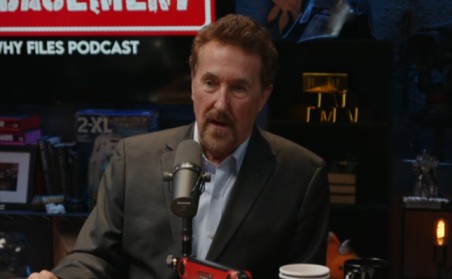
Read the full transcript of former CNN correspondent Bryce Zabel’s interview on The Why Files: Operation Podcast, June 14, 2026.
Editor’s Note: In this episode of The Why Files, host AJ joins producer and former CNN correspondent Bryce Zabel to discuss his legendary career in Hollywood and journalism, including the creation of the hit series Dark Skies. The two dive into the fascinating possibility that the government has been using movies and television for decades to shape the public narrative surrounding UFOs.
Introduction
AJ GENTILE: In 1996, Bryce made an NBC show called Dark Skies. It was about a secret government cover-up of UFOs. I remember the show, and it’s amazing how many things it got right 30 years ago. And while he was making it, the cover-up came to him. Men who said they were Navy intelligence showed up at his house and his office. They wanted to feed him real secrets to write into the show.
Today we’re covering his career, his books, and his new podcast, which asks whether the government has been hiding the truth about UFOs inside our movies for 70 years. And there’s one more thing those men asked him to do: meet a stranger at a cemetery at midnight. Wild story. After our talk, I’ll come back for a quick analysis of our conversation. Let’s go down to the basement. Bryce, welcome to The Basement.
BRYCE ZABEL: Hey, it’s great to get in the basement. I want to thank you so much for letting me into this special place to talk about all these things we’re going to talk about. It’s a great set, folks. I mean, this is really wonderful. I appreciate that. It’s great. And I know you’re just starting The Basement, so I’m really happy to be in the inaugural class of these people.
AJ GENTILE: Yes, you are. It’s a very small fraternity.
BRYCE ZABEL: Yes, but growing.
AJ GENTILE: But growing, unless this is our last one. We’ll see. How are Patrick and Einstein doing?
Desert Tortoises and Pet Ownership
BRYCE ZABEL: Whoa, there’s a callback. Well, the truth of the matter is those are my endangered desert tortoises that we have. And this is amazing. I’m reeling from the thing because we don’t have them anymore. One of them ran away.
AJ GENTILE: What?
BRYCE ZABEL: And one of them died, but they’ve been replaced by two other turtles, Wendy and Lilith. So the guys are gone and the women are in. And it’s— I don’t think of myself as a responsible pet owner per se. My son’s excellent at it, for example, but not me. And my wife Jackie and I, we say, endangered desert tortoises are good because half the year you don’t have to do anything but put them in a box, right?
AJ GENTILE: That’s all you do to them?
BRYCE ZABEL: Yeah, you just put them in the box and hibernate them. And then the other half of the year, just give them some cut-up zucchini and some lettuce and let them party.
AJ GENTILE: How long do they live? Long time, right?
BRYCE ZABEL: So long that it’ll be my grandkids probably that end up having to deal with them.
AJ GENTILE: Wow, I’m sorry one ran away.
BRYCE ZABEL: Maybe he’s happy. I mean, that’s what we like to tell ourselves, because they can burrow, they can get under our fence. I think that’s what happened — that one got away. And the other one, it’s a sad story, and I don’t know why I would tell it here, but I will. During the COVID pandemic, I always used to put, every year when they came out of hibernation, some kind of coconut core kind of thing that you’d spread around. And it was all ground very nice. It was a cushy landing for them. I liked it. But during the pandemic, they said we can’t get that anymore. Here’s our new supplier. And so I put that stuff out. It had larger pieces in it. And frankly, it got stuck in his throat.
AJ GENTILE: Oh no, that’s terrible.
BRYCE ZABEL: It’s just the worst thing in the world. And now that I’ve relived it, I don’t know if I can recover during this broadcast here.
AJ GENTILE: That’s a tough one. Losing a pet is hard.
BRYCE ZABEL: It is hard.
AJ GENTILE: Sometimes harder than losing a person.
BRYCE ZABEL: Yes. Particularly if you think, I should have been smarter about that. But you know what, I’ve been there too.
AJ GENTILE: Yeah, I had outdoor cats for a while, until I had two fewer cats, and then it was no more outdoor cats. I was living in the Hollywood Hills at the time, and my neighbors were saying, “You can’t let your cats out here.” I was like, “Ah, they’ve been outdoor cats for years.” They lasted 3, 4 weeks. And that was it. No more outdoor cats.
BRYCE ZABEL: Well, so we’ve clearly established, and we’re less than 5 minutes in, that both of us should not be trusted with pets.
AJ GENTILE: Can’t be trusted.
BRYCE ZABEL: Okay.
AJ GENTILE: I can’t be trusted with children either.
BRYCE ZABEL: Okay. Well, there you go.
From Broadcast Journalism to Hollywood
AJ GENTILE: So we’ve got broadcast journalism. How do you end up on TV as a movie critic?
BRYCE ZABEL: Well, I didn’t start as a movie— I went to school at the University of Oregon. Go Ducks! Very good football team. All in favor of them. And I went to journalism school. And at some point during journalism school, you have to sort of pick what’s your thing. So I went with broadcasting and I ended up getting a job at the hippie radio station in Eugene, Oregon. And that was a good gig. I mean, that’s the first time I ever talked about UFOs in public.
AJ GENTILE: So you were on air?
BRYCE ZABEL: Yeah, I was the morning guy. But then I got hired at the TV station. So I became an anchor reporter in Eugene, and I ended up also doing the weather there and the movies, because in a small market, you say to yourself, well, who does movie reviews here? And the answer is, well, nobody. You go, “I’ll do them,” right? And then you get to do them. I remember reviewing Alien was one of my first movies to review, but mostly it was anchor reporter kind of thing. And that was a great gig.
And then I did a short tour of duty in Arizona, in Tucson, and then came to L.A. as the first CNN correspondent there. And the news business is so interesting because if you’re covering news, you are meeting thousands of people, just one person after another. Every day is just crowded with fast getting-to-know-yous. And I found that a lot of times you were either meeting people on the best day of their life or the worst day of their life, sometimes in the middle, but often on those extremes.
AJ GENTILE: That’s true.
BRYCE ZABEL: It really taught me a lot about drama, comedy, all the things that I use now in a Hollywood script that I might write.
Sitting with Carl Sagan
AJ GENTILE: Right, I hadn’t considered that, but that’s true. So how do you get to sitting with Carl Sagan talking about Voyager?
BRYCE ZABEL: That’s a trippy, wonderful memory for me.
AJ GENTILE: Well, how did you get picked for that?
BRYCE ZABEL: Okay, here’s the thing. I was the CNN correspondent, and the way these things work, jobs come and go because the person who hired you comes and goes. So the news bureau chief at CNN got fired, and so I knew my days were numbered, and they were. And I ended up at PBS in Los Angeles working on an investigative news magazine called Newsbeat. And again, it was sort of a nightly 30-minute, 60 Minutes kind of thing — 30 minutes instead of 60 minutes. And I would do one story a week. And I noticed that a lot of the people there were not thinking about space. And I always think about space. So I was like, “Who’s your space person here?” Well, nobody. “Well, I’ll do it,” right?
AJ GENTILE: Like the movies.
BRYCE ZABEL: Yeah. I’ll do it. Just raise your hand and volunteer. So I did. And I got to cover things like the early space shuttle stuff, and also the Voyager. And Voyager, of course, was the first unmanned thing that we sent that went out of the solar system. But on its way out, it did a short tour of duty past Saturn. And I believe this is the Voyager 2 that I’m talking about at this point. I covered Voyager 1, I think, at CNN. But anyway, 2 was on its way out, and there was going to be a close encounter, if you will, with Saturn.
And again, I’m just going to have to date myself. I mean, I used to be the youngest guy in the room when I went to Hollywood. Now I’m probably the oldest guy in the room, but that’s life, right? Anyway, so the year before I started working there, Carl Sagan had basically owned the station at KCET in Los Angeles because he was doing Cosmos.
AJ GENTILE: Oh, he was doing it out of there?
BRYCE ZABEL: Yeah, that’s where he recorded all of it.
AJ GENTILE: Wow.
BRYCE ZABEL: So when I came to work there, everybody knew that he had put them on the map. It was a pretty big deal. So when they were about to have the encounter, I pitched them that they should do something called Saturn and Beyond. It would be sort of covering the live flyby and then talking about the future of space and that kind of thing. And they said, “Well, that’s good.” And I said, “And we’ll ask Carl Sagan.” Because I thought the guy’s got to owe KCET something for putting him on the map like that. And so I just called him up and said, “You want to do this thing?” And he said, “Sure, I’ll do it.” So with that in mind, he became part of that show.
But here’s my favorite part of it. I was an on-air reporter and kind of a substitute anchor, but the main anchor was a guy named Clete Roberts. And Clete was sort of a mentor of mine, an early news mentor. Clete was the most respected journalist in Los Angeles at the time. I mean, he’d done it all. And he was toward the end of his career. And we would often sit on the set before we would go on and just catch up and talk. And I was out there covering things and he was stuck behind the anchor desk, in his opinion, right? He remembered the good old days. And he was such a great guy. And he goes, “You remind me of myself when I was your age,” which is the most lovely compliment any famous mentor could ever say to you. That was lovely.
So I was producing Saturn and Beyond for Clete to host. And about 3 days before we were due to go on — I mean, I wanted to anchor it, but whatever, I was the producer — 3 days before we’re going to produce this thing, Clete ends up in a contract dispute with KCET, and he says, “I’m not going to host that thing. Forget it. If we don’t have a deal, I’m not doing it. Let Bryce do it.” And he wasn’t in a real contract dispute.
AJ GENTILE: He just threw that to you?
Carl Sagan, Dark Skies, and the Majestic 12 Connection
BRYCE ZABEL: He threw it to me. Oh, it’s the greatest lovely thing. So anyway, this story is kind of intriguing because we get through the show and, you know, you know what it’s like. You’re a host. And by a host, not only are you hosting the show, but you’re sort of hosting the event, right?
So Sagan comes on. We talk live about Saturn and the space program and exploration of the solar system and all this stuff. And then the show’s over. It’s like, well, thank you very much. He’s a lovely guy. He shakes hands with the crew. It’s all that. And I say, you know, I’ll walk you to your car if you’d like, because I’m the host, right? I’m hosting it.
And so he had to get to JPL to do some kind of interview, I think for Nightline with Ted Koppel or something. So we walk out there and, as we’re walking out there, I see his car. I’m driving a Datsun B210 at this point, right? Which is not the same thing. Sexiest car around. This guy has some kind of foreign roadster convertible. I thought, wow, that’s so cool, I would love that.
And I don’t know why I said this, but I just said, you know, Dr. Sagan, I have a question or two about the whole UFO subject. Uh-oh. And he suddenly looks at me and he goes, yes, you know, with that kind of— sure, please go on.
And I just said, well, listen, I just know that you’ve said many times that the universe is teeming with life, and yet at the same time you’re not a believer so publicly in UFOs because you say the distances are too great, that they couldn’t possibly be here. But at the same time, you’ve talked about how an alien civilization could be so in advance of us that we’d look like primitives. So how is it that you don’t consider the fact that if the universe is teeming with life, some of them are a million years in advance of us technologically, and they understand physics better than us, or they have different lifespans. Why don’t you consider that they might be here?
AJ GENTILE: The stone’s on you.
BRYCE ZABEL: Wow. Well, I was young. What’s he— you know, whatever.
AJ GENTILE: Wow. I’m glad you— what did he say?
BRYCE ZABEL: Well, he just— he looked at me like, “And your point is?” I said, “Well, no, I mean, you know, I was trying to be nice and all that.” And we had that back and forth for about 15 minutes.
And the specific answer to your question, what did he have to say? I wish I could remember the exact quotes, but he stuck with this point of view, which was, “Nobody’s coming here. That’s not how it works,” was in essence. And I said, “But that’s an opinion.” Right. But you’re saying that the UFO world doesn’t make sense because they deal in opinions and not facts. Well, isn’t that an opinion too?
I was probably crazy, but he took it well enough. Right. I mean, we had a nice back and forth and about 15 minutes in, he looks at his watch and he goes, well, I’m due at JPL. And he got in that lovely roadster of his and motored off. And I waved at him. Last time I saw him. But listen, the guy was brilliant. I think he was wrong about UFOs.
AJ GENTILE: Well, this is the ’80s. When you asked him that question at the time, were you aware that he had a bit of an arc?
BRYCE ZABEL: Yes.
AJ GENTILE: That he had evolved?
BRYCE ZABEL: Yes. And I didn’t know his— what you’re referring to, that in his early career he was well—
AJ GENTILE: Oh, yes.
BRYCE ZABEL: —aware of UFOs. Very old. Thought aliens might possibly have come here to explore or something. Absolutely. Great point. And while I was aware of that, I wasn’t aware of it enough to sort of call him on it. Right. That would have— because he certainly knew more about his career and life than I did at that point. So I stuck with sort of the more esoteric part of it.
Dark Skies and the Sagan Angle
BRYCE ZABEL: But I did kind of get my revenge on that. I did a TV series for NBC called Dark Skies, and it took place in the 1960s during an alien invasion. And we can talk more about that because that has some other interesting things, but here’s the Sagan angle.
AJ GENTILE: Yeah, I want to save the good stuff.
BRYCE ZABEL: Of course. Here’s the Sagan angle. It had all these real characters in it. So toward the end of the season when NBC had told us, well, you know, you’re probably not getting picked up again, so just do whatever you want. And Columbia TV, which was producing it, said, do whatever you want, but don’t spend a dime more than your budget. Okay?
So my partner Brent Friedman and I said, okay, well, what do we want to do with this? And so in our final 2 episodes, we introduced Carl Sagan as a character. Our whole series took place at Majestic 12, the guys that were in charge of the cover-up. And so we made Sagan the chief scientist of the Majestic 12 cover-up in kind of an homage to Donald Menzel, who was the earlier debunker, right? Who everybody thought he was— debunker in quotes.
AJ GENTILE: Yes, because he ended up— his name’s on the Majestic 12 documents.
BRYCE ZABEL: Yes, it is. Right. So we made him a guy that got picked up by Majestic 12, and he’s all pissed off because they’ve kidnapped him, basically. And they say to him, you know, “You’re in no danger. You’re in no danger at all. But if you’d really like to know what’s going on, we can tell you, in which case we’ll keep driving and we’ll bring you in and we’ll show you what’s going on. But if you need to get out right now, that’s fine. We’ll pull the car over. The choice is entirely yours, Dr.”
And so he made the deal with the devil. He said, “If you’ll tell me everything, I’ll be your debunker.” And that’s what we said about him.
AJ GENTILE: And I think Sagan made that deal too.
BRYCE ZABEL: I don’t think we were wrong. No. I think we were right. I think if you really track him— it sounds to me like you have— so if you track that career of his, you do say there is some inconsistency between where he starts and where he ends.
AJ GENTILE: Right, and that shift, the timing coordinates with his rise in fame as well, which is very interesting. Yes, like his exposure increased. Dark Skies, your books, especially AD, very prescient, like almost like you have a crystal ball.
BRYCE ZABEL: It’s like we picked a racehorse that came in.
Investigative Journalism and the UFO Beat
AJ GENTILE: Yeah, it certainly is. Last thing on journalism. You were an award-winning investigative journalist. You have a favorite story?
BRYCE ZABEL: Well, the one I won the awards for has nothing to do with UFOs or paranormal or any of that. Space was my beat, but I covered a lot of other things. And we did a story. It was called The People Versus [Dr. Maniha], I believe, is the one that we won the awards for. And that was just one where we found a doctor, an eye doctor, who patients would come in and he would tell them they had a cataract and charge them for it. And they’d already had cataracts. They’d already had the surgery and stuff. He would just tell people whatever he had to tell them to get them to have the surgery and charge them for it, even if there was no need for surgery.
And so that was a pretty good one— that was one where I got to play the Mike Wallace role, where I was chasing [Dr. Maniah] down the sidewalk going, “[Dr. Maniah], isn’t it true?” You know, that kind of thing.
And so, yeah, but I will say this. Investigative reporting is such a valuable thing. My hat is off to everybody who’s doing it about the UFO topic for sure. But on everything, I mean, investigative reporting speaks truth to power. It holds people accountable. It’s a really good thing. And certainly the ability that people have to be a good investigative reporter is so valued right now. I mean, we could use more of them. And frankly, it’s expensive.
That’s what was so brilliant about that year and a half where I got to work at Newsbeat. We were doing— it felt like doing the Lord’s work, right? Because instead of doing— at CNN, I would do 3 stories in a single day. Wow. But at PBS, I did 1 story in a week. And so that allowed me to do all the great stuff that you do as an investigative reporter. What does an investigative reporter do? You pick up the phone, you call people, you talk to them, and after you write it down, you look at it later and go, hmm, interesting. And then you call somebody else up and you say, can I come over and talk to you about something? And then when you’re finally getting it all done, you put them on camera, and then you cut it up and you give it to the people.
The things I learned working at that PBS show Newsbeat have been so valuable to me in terms of all the work that I’ve done since. And there’s nothing I have done since that I didn’t learn something that benefited me from it. Like, even on creating a TV show— one of the things you want to be able to do is make sure it sounds authentic. Well, how do you make something authentic? Do you make something authentic because you write a movie, say, about lawyers because you’ve seen a lawyer show? That’s not authentic. Authentic is to go talk to lawyers or doctors or whatever.
So what investigative reporting teaches you is, yeah, don’t get your information off the internet these days as a primary source. Create your own primary sources first. That’s why I respect some of the people that have done some work in this. My first Need to Know partner, Ross Colthart, has certainly done some excellent work on this. And George Knapp— I think anyone who cares about this topic is just in awe of what George has done.
The George Knapp Standard
AJ GENTILE: He’s the best to ever do it.
BRYCE ZABEL: He’s phenomenal. And so I think those guys have really helped take us— well, look, Ross gets his own accolades for whatever. Let’s focus on George for a second because George goes back and, right here in Las Vegas where we’re recording, George didn’t take no for an answer. He has an incredible memory, but he also asks people questions. He listens to the answers.
I’ve been on Coast to Coast with him a few times over the years, and first of all, he’s a great interviewer, but he also listens to everything everybody says. So it’s not like you say something and then he goes, “Okay, now our next—” He doesn’t do that. He’s listening to what you’re saying and he wants to know more about it because why? A good reporter is insatiably curious and won’t take no for an answer and doesn’t tolerate bullshit very well. And that describes that man. That’s why he’s a friend of mine and I also— I couldn’t hold a candle to him as a reporter. He’s just the best.
AJ GENTILE: Yeah, and always has been. And even when he’s talking to— I don’t want to use the word crazy, but the more out-there stories, he’s always respectful. He’s asking good questions. His famous John Lear interview is fascinating. With some of the stuff John says it’s like, wow, but George just kind of leans in and asks the right questions. Fascinating.
BRYCE ZABEL: Nothing wrong with letting people tell you their story. The only thing wrong is believing it if you don’t have— 100%. Right? So, yeah, of course you gotta listen to this.
But what I think— another thing that makes, let’s call it the Knapp style, because he’s not the only one practicing this today. There are other great people who are doing journalism on this topic. And the thing is, doesn’t matter how outrageous something is or isn’t, you still have to say to yourself, well, is there a way for me to validate this? You don’t take anything at face value. You have to say there’s more to the story than what this person just told me, because that’s the other thing you learn during journalism. There are a lot of different points of view about things.
And one of the things that I found so frustrating about network journalism or just mainstream journalism in broadcasting is that because the time is so short— and this applies not just to long form, but it certainly applies to regular reporting— and this is my criticism, and it’s been particularly strong about UFOs, which is the basic way to cover a controversial story in broadcasting is to find somebody who says yes, somebody who says no, interview them both, and then do a standup where you say, “Some say yes, some say no, I say maybe.” That’s what qualifies as a journalistically balanced report.
But sometimes a story isn’t balanced. Sometimes there’s actually some facts that support saying yes or no. Sure. And we don’t see that that often. No, we don’t. Certainly not in local markets.
Art Bell, Dark Skies, and the Arctic Circle
AJ GENTILE: You really don’t. No, you don’t. I guess one of my idols or heroes is Art Bell. Oh. Because not only would he be respectful of the person telling the story, he just had such an instinct for spotting the story and knowing, alright, I’ve got a beginning, middle, and end. Here’s how we’re going to tease it out. He just, he saw it miles away.
BRYCE ZABEL: Here’s an interesting thing about Art Bell. By the way, I know Art Bell, or knew Art Bell, and I was on his show, I think in ’96 I was on Art Bell’s show, and I put him on Dark Skies. I made Art Bell a member of Majestic 12. I forgot about that. He was a member. He played William S. Paley. That’s right. The head of CBS.
AJ GENTILE: He talked about it forever. Now I remember that. Wow.
BRYCE ZABEL: And listen, I don’t think Art would take exception to what I’m about to say. The difference between Art and George Knapp is Art was an entertainer. Yes. With a show. George is a journalist who sometimes is on a show. Right. And Art would let things stand just because, well, I mean, that’s what they say, right?
So on the show that I was doing with Art Bell, I was on to talk about— this is one of my first interviews ever on the UFO topic. I wasn’t interviewing him. He was interviewing me because of Dark Skies. But as the show started, somebody had called in saying, I’m seeing some lights up in Monterey or something. I don’t even remember the location, but it’s the California coast. And Art just said, “Well, we’re going to be following this story very carefully tonight.” And so every time we’d go to a commercial break, he’d say, “And now the lights seem to be down.” I mean, we just— and it was a show. Did it— is it listed in any books as a great UFO sighting today? I don’t think so. Probably not. No.
But listen, he— classic radio guy. Yes. Really good at what he did. Great voice. Just everything. And he stood his ground and he did— he was, look, good guy. I mean, he wrote a book, I think The Quickening. I mean, he did— he was a great guy. Quickening is a scary book. And I mean, loved Art.
And by the way, putting him on Majestic 12, I remember when my partner Brent and I thought we would do that, and I went, “Well, why would Art do that?” I said, “It’s ironic, it’s subversive. Let me call him.” And I called him up and there was this kind of long pause. And then he says, I think the first thing he said is, “Do I get to keep the mustache?” Of course he did. He didn’t. We made him shave it. You made him shave it? I think that was the thing. Anyway, it was fun.
He saw the joke. I mean, which is a lovely thing for someone to not take themselves so seriously they can’t do something like that. I think it gave him fun. He and his wife of the time came to the set and we hung out all day and he had a great time. Yeah, yeah. And, to be honest with you, did a very good performance.
AJ GENTILE: Sure, because he was a performer. He’s a performer. And what a great nod to the audience who spotted him. They had to just go nuts for it.
BRYCE ZABEL: Well, you know, that’s the kind of thing where 90% of that audience had no knowledge of anything. Just another actor, you know, in a scene. But for the 10% who were sort of UFO curious, they knew and they thought it was pretty wild.
AJ GENTILE: I love it. You know, I put those jokes in my shows all the time that nobody gets except for that one sliver, but it’s so special to them.
BRYCE ZABEL: Because, you know, good stuff can just work on a couple of levels. And as long as one of the levels hits most of the people, you’re okay. Yeah.
Growing Up with the Space Race
AJ GENTILE: So what got you interested in space and that sort of thing? Does this go back to dad and the Apollo?
BRYCE ZABEL: That’s a good question, yes. There are two stories here. One is space, one is UFOs. Let’s talk space first. When I grew up in Hillsboro, Oregon, which is a suburb of Portland, I was 15 years old, living large. I had started working as a fry cook at the Arctic Circle Drive-In. And I started at $1.10 an hour and I had worked my way up to $1.35. Wow. Right? Pretty cool. And I got to be a fry cook, eat all the burgers and fries you wanted. It was sweet work, right?
But I was interested in space because during the ’60s, it was our article of faith for my family. You know, I was just a little kid, but we would get up at 4 in the morning on Mercury flights and Gemini flights, and everybody would watch the TV together. So I sort of had this burned in. My father was a history teacher, so I had this idea burned in.
AJ GENTILE: Well, okay, so Dad wanted to get up.
BRYCE ZABEL: Yeah. Oh yeah. And get everybody up. He got everybody up. It’s like he would come in at like 4:30 or something. “Okay, they’re going to launch in half an hour,” or whatever it was. Right. And so we would all watch it.
The Moon Landing and the Arctic Circle
BRYCE ZABEL: Alright. Flash forward to 1969 when again, Bryce is living large, making big bucks, clearing almost $10 a day. Wow. Think about that. Yeah. Not bad for a 15-year-old. So I was working. The manager at the Arctic Circle was a Basque separatist named Mariano Bilbao. Okay, and Mariano was a tough— he’s the best kind of hard-working immigrant you’d want.
AJ GENTILE: What’s a Basque separatist?
BRYCE ZABEL: He wanted the Basque region of Spain to separate from Spain. Oh, I thought they all want that. Do they? I don’t know. At the time, I—
AJ GENTILE: They’re the descendants of Atlantis. Okay. They want to be their own thing, man.
BRYCE ZABEL: All right, well then I withdraw the character. He was just a Spanish immigrant, we’ll call it.
AJ GENTILE: No, he was Basque. He was Basque.
BRYCE ZABEL: Hard-working guy though. All right, and so he put up the schedule, and on July 20th, 1969, yours truly was on the schedule doing the main cooking at the Arctic Circle. And I went to Mariano and said, “Hey, you know, the moon landing, can I get the night off?” And he said, “No, the schedule, no, no, you can’t have the night off. Why?” “Well, I want to see the moon.” “You can’t get out of this to watch TV.” And I said, “Okay, could we put a TV in the Arctic Circle?” “Put a TV in a restaurant? No.” And I said, “Well, what about a radio?” “Radio? Stop talking.” Right? He was done.
And so I resigned myself. I was not going to see it, okay? So I report to work on July 20th, 1969. And it’s about 35, 40 minutes before Armstrong and Aldrin are going to be on the moon’s surface, and I just can’t handle it, man. I just cannot handle it. And I call up my dad.
And the thing you have to understand is my dad was one of those tough guys. Imagine the guy from Wonder Years, you know, that was my dad kind of guy. So this was a Hail Mary of the highest order that I was about to parlay here. But I called him up and I said, “Dad, I just really want to see the moon landing. Can you come and get me?” And then I take the phone and I’m holding it out here because I know he’s going to be screaming. He’s going to be saying, “You made a deal. You have to be responsible,” et cetera, et cetera, right?
And then he says, “You know you’ll be fired.” And I said, “Yeah, I know.” And long pause, and he goes, “I’ll be right down.”
So Dad comes down. Picks me up, takes me back home. We sit around the TV, we watch the moon landing. About 35 minutes into the moon landing, he turns to me and he goes, “I think it’s time for you to go face the music.” Puts me back in the car, drives me down to the Arctic Circle. I get out. By this point, Mariano Bilbao is there because he’s been called in that Bryce has abandoned his post. Sure. Right. And he does as expected. He fires me on the spot.
And my father, God bless him, because he never— this was not his style. He goes to Mariano and he goes, “You know, you are making a very big mistake because this is going to go down as the defining moment of our times, and you are always going to regret what you did tonight.” Then he turns to me and goes, “Son, get in the car.” And he drove me home. And of course, I never worked at the Arctic Circle again.
AJ GENTILE: Wow. And your dad was right. He was right. And he had such— he had an instinct for how important it was. Yeah, that it’s more important than being a fry cook. Absolutely.
BRYCE ZABEL: Now, I have to say, I mean, that was a tough one though, because, you know, I kid about the salary and all that, but, you know, there were lessons being learned. Oh yeah, having a job at a young age and all that. Oh yeah. So, you know, but these things happen. These things happen.
AJ GENTILE: They do. So let’s take a quick break. We’ll come back, we’ll talk about how Hollywood enters the picture. I love it. Let’s do that. Before we get to Hollywood, I want to talk about your basement experience.
A Basement Discovery: The McMinnville UFO Photos
BRYCE ZABEL: Well, listen, I was thrilled to go to the basement to talk to you because the way I came to actually first really appreciate the UFO topic involves a basement.
I think when I was like 12 or 13, my family didn’t have a lot of money or anything. And there were no video games. So there weren’t a lot of things for me and my friends to do but ride bikes and that kind of stuff. But we came up with a way to have some fun. We would go down to my parents’ basement because, I don’t know, nobody has basements in Southern California where I live now, but they had basements back then.
So we went into the basement and my parents had kept every issue of Look and Life magazines in the basement. And they were just moldering away in the basement, nothing really happening to them. Well, my friends and I came up with a reuse purpose — we would take these extended format magazines and we would roll them tight, right? And they would become like lightsabers, and we would have magazine fights in the basement where you would hit each other’s magazines, and paper would be flying and everything — and the guy won who disabled his opponent’s magazine.
Now, I admit — but at least it was environmentally friendly, right? You gotta at least say that.
So we’re down there having a basement battle, and I pick a magazine up and I start to roll it up, and then I realize there’s this kind of cute French actress on the front cover. Her name was Cécile Aubry, and it was a Life magazine from June 26, 1950. I was not alive during that, of course, but these are old, old magazines. And so I stop because I’m 13, and I’m just starting to be interested in women.
Of course you stop.
Yeah, I’m like, oh, this is interesting. So I find her, I open it up and I’m looking to see this Cécile Aubry, who I think is like some kind of — she’s being promoted as this French ingenue kind of thing, right? And I find the article, and there’s all these pictures of Cécile Aubry.
I wrote down this quote because it’s so interesting. They described her as “frisky, pert, sugar and spice bundle of adolescence.”
Yeah, how could you beat that, right? So my friends and I were looking at that, and then we’re going to get back onto the battlefield. And as I’m closing up the magazine to roll it up, something catches my eye. And in that magazine is a picture of the McMinnville UFO photos. Remember those?
Sure. 1950. There’s two of them. And the Trents from McMinnville, Oregon, actually took these pictures on a camera that the guy had. His name was Trent, and the article is called “Farmer Trent’s Flying Saucer.”
AJ GENTILE: Are these the ones where you see the telephone poles in front of it?
BRYCE ZABEL: Yeah.
AJ GENTILE: Oh, wow.
BRYCE ZABEL: And in fact, I’m sure probably on the video version of this, you’ll probably show people what they look like. They’re pretty great photos.
Anyway, my friends and I stop and we’re like, what is this? Because the thing that’s so great about those photos, and I’m kind of obsessed by them over the years, is that they’re either true or they’re not. They’re either a hubcap suspended or they’re actually a flying saucer that’s better than anything the government’s been releasing right now. Where you’re actually looking at it. And there aren’t a lot of ways to fake those flying saucers in those photos.
And they have stood the test of time. They have been reviewed by commissions. Bruce Maccabee did a whole study on them. They stand the test of time.
But what’s interesting and gathered the attention of me and my friends is that we lived just 20 miles from McMinnville, 20, 30 miles from McMinnville. This was local. So we’re looking at these two pictures of UFOs and going, damn, this is almost more interesting than Aubry. Almost. Not quite. We’re 13.
Right. It’s up there.
But it was right here. Yeah, that’s what we thought. And every time my parents and I would drive to the Oregon coast to go to the beach or whatever, you drove through McMinnville. They have a big UFO festival there right now. And so that’s where I started to first say, what is this? What’s going on?
Life Magazine and the McMinnville Legacy
AJ GENTILE: How did Life cover that story? Respectfully?
BRYCE ZABEL: They did. It was only a single page. I think it has one big blowup of one of them and a smaller of another, and has a picture of Farmer Trent with his camera, right?
The thing is, I literally went to high school with people that in their later lives provided healthcare for the Trents. And everybody always said about the Trents, these people are pretty well salt of the earth. They ain’t making stuff up.
But more than that, this blows my mind because today, of course, we all have phones, we take a zillion photos, right? But he comes out there, he’s got a camera with a fresh roll of film in it. He may have taken a few pictures on it and he takes these two photos. What does he do? He doesn’t run to the local pharmacy with the developing thing and get them developed. No, he holds on to them for a few months because he’s a frugal man, and he doesn’t develop them until he’s used up the entire roll.
The whole roll, right.
But those photos became the biggest things. And to this day, I think they stand the test of time. I urge anyone to look at them and say, what’s the deal with that? Because here’s the thing — they’re not orbs.
AJ GENTILE: No, they’re nuts and bolts.
BRYCE ZABEL: Yes. Something is flying in McMinnville, Oregon, in May of 1950 that is anomalous.
AJ GENTILE: Yeah. So this is less than 3 years from Kenneth Arnold and Roswell. So the propaganda machine is not in full effect yet.
BRYCE ZABEL: Correct. And again, I’m sure people have their own interpretations as they always would, but Life at that time was not into debunking or anything. I mean, I think they portrayed it like People magazine might have portrayed it later. It was like, here’s an interesting story, right? And they put it in there because they thought that it was a really good photo.
A Cautionary Tale: Fake Magazines and Misinformation
But I just want to give you one example of the problem we face in ufology for trying to get to the truth of certain things. So years later, I have been not to that many UFO conferences. I was selected as a speaker to one at the IUFOC, I think, in Phoenix. And so I put together a PowerPoint.
What I made for that PowerPoint — I was trying to make the point that the media never covers these stories accurately or appropriately, right? They always either make fun or whatever. And I was trying to make a point of, this is what should have happened. So I made a Time and Newsweek magazine with the McMinnville photos in them. And I put that up for the audience and said, “Remember these magazines?” And everybody’s like, “Yeah, yeah.” And I said, “No, you don’t. They’re fake. I made them.” Just to show people — ask questions. Don’t always believe things.
Okay. If you go to the McMinnville UFO Conference website under their history section, they have my magazine.
AJ GENTILE: Oh no.
BRYCE ZABEL: And they are showing it as the real thing. And I have written them letters. I have social media posted about it. I’ve told friends to talk to them about it, and they won’t take it down.
AJ GENTILE: Oh no. Yeah, accidentally became part of the problem. Yeah, I absolutely believe it.
BRYCE ZABEL: I say that only — I’m not trying to be alarmist. I’m just saying you gotta ask questions, and honestly I wish the people there would just take it down. They should take it down.
AJ GENTILE: They should. I mean, it’s yours.
BRYCE ZABEL: Yeah, but I don’t even care about that. I think to a certain amount, when I see people that take a picture of something and then they put copyright in the corner — listen, if we’re trying for transparency and to prove that the UFO/UAP issue is honest and needs to be taken seriously as an anomaly, I’m not interested in copyrighting everybody’s little UFO photo. I think they should have the narrative of how that photo or video came to be, but they should release it to the world. You’re not trying to hold on to it to make money off it. You’re trying to help us reach a decision about what is going on.
Anyway, so that’s how I became interested in UFOs.
AJ GENTILE: Those fakes, though, they muddy the waters. They make it so difficult.
BRYCE ZABEL: They do. And it’s so weird. I mean, I never for a million years — I don’t even know how they got it. I never in a million years thought that this was just meant to be kind of shock value for an audience. As an entertainer, I was just saying, there they are. But that’s what happened.
From TV News to Screenwriting
AJ GENTILE: Well, how did you make the shift into screenwriting? Didn’t you have the first Syfy original?
BRYCE ZABEL: I did, absolutely — and it was about UFOs. Here’s how it’s interesting.
Here’s the thing: if you’re a TV news guy and you’re an anchorman or a reporter, you’re going to get fired. Either your boss is going to get fired, or your show is going to be canceled, or you’re going to be fired because somebody different looking is coming. You are going to be fired.
And so at a certain point, when various jobs were ending, I had started dating my wife Jackie, and I sort of realized I was going to have to — if I was going to stay in the news business, the two of us were going to have this terrible pulling apart, because we both have to be looking. I met her in the mayor’s office. She was a radio reporter. I was a CNN correspondent, right? But if you’re going to pursue that career, that broadcasting career, you’re going to end up in a different city. You’re going to have these problems.
And Jackie said, “You know, have you ever considered writing a screenplay?” I had never seen a screenplay. This was before the internet. And I said, no, I don’t. And you know what we did, AJ? This is so weird. We got in the car, we drove down to Hollywood Boulevard, found some guy on the street who was selling screenplays of movies that had been made. We bought a couple of them and I read them, and I thought, hmm, this looks pretty simple. There’s not a lot of adjectives. It’s pretty straightforward, right?
And they say write what you know, right? Well, the first thing I wrote was about something else, but I gave it up halfway through because I said it’s been good therapy, it’s not a great script. Then I wrote a script called ENG, which stands for electronic news gathering, because that’s what I knew. I knew the world of TV news. And that got me an agent. It got sold. They made 102 episodes of it up in Canada.
And did you know how unlikely that was?
AJ GENTILE: Not at the time.
BRYCE ZABEL: Well, that’s what I thought. And then the very second script I wrote also became a TV series here in the U.S. And so I thought — at that point I was starting to realize this was pretty lucky. I mean, it’s luck plus skill, but you have to be in the right place.
And I just thought, well, as long as people keep paying me to do this, I’m going to keep doing this. And so I just stopped being a broadcast journalist, even though in heart and by training, I still feel that I am that person. Certainly podcasting gives you the ability to do those things these days without having to work for NBC or somebody.
But I just turned my attention to drama, and I found, as I said earlier, one of the greatest pieces of training anybody can have to be a screenwriter is to have been in news, because you experience so much real life in such a condensed space of time, right? Being a journalist was the greatest thing absolutely in the world, and I do think if I have a superpower as a writer, it’s simply that I’ve experienced a lot of things, not because I saw a lot of movies. Now I’ve seen a lot of movies, but at the time I had more experience than movies.
AJ GENTILE: Do you remember where you were when you saw your first thing on TV that you wrote? Who was with you? What was that like?
Dark Skies: The Creation and the Strangeness Behind It
BRYCE ZABEL: Oh, wow. Yeah, yeah, it was a CBS drama series called Kay O’Brien, which was about a female surgeon in New York City. It was like Grey’s Anatomy without the sex. It might still be on the air if we’d put the sex in it. Could be a big mistake. But anyway, CBS put it on at 10 o’clock at night. And of course, I’d already seen it by this point 1,000 times in the edit rooms or whatever. But we had a little party for some friends. Everybody wore surgical scrubs and everything, and we had a few TVs.
And I just remember watching that and thinking, oh my, I mean, oh my, what a moment it was. It was a beautiful moment in a way that never— that exceeds— you know, I had seen myself on the air on taped reports as a reporter. So that’s very personal, but you don’t say, “Now that’s art.” You just go, “Well, that’s today. I wonder what I’ll do tomorrow.” But when you see something you wrote, oh goodness, that gets to you.
And you know what? It is a thrill that never reduces. Really? If I had something on tomorrow night and you and I were watching it, I’d still be giddy. I’d still be— there’d be tingling in my fingers, you know, I’d just be— Oh my gosh, here it comes. Because— and what’s so interesting about that, I think, is that again, you’ve seen it so many times. You wrote it, you shot it, you were in the edit room, you’ve seen it posted, you’ve, you know, so many times, so many, many times. And it’s never the same when you watch it on the air. No, that’s special.
Just like you and I are having an experience right now. Okay, now I don’t know if you watch all your shows. Never. Okay, but I will be watching this one, and I guarantee you that when I watch it, I’ll get that tingle because I’ll say, wow, that’s how it looked. I didn’t— you know, because you have one experience from where you are, and then you have another experience where you’re interacting with the finished product. That’s right. And that’s what I think.
Listen, there are a lot of knocks on Hollywood. It is not a perfect world. Trust me, I mean, I’ve been kicked and abused and— I was there, man— lied to, and you name it, and you’ve had it too, you know. So it’s not perfect, but it is exciting.
And you know what’s interesting about Hollywood? If you’re like, say you’re a bank manager, okay, you’re going to have a good chance to still be a bank manager tomorrow, right? In Hollywood, you could be fired tomorrow. On the other hand, in Hollywood, the phone could ring and somebody goes, “Hey, are you represented by anybody?” “Uh, well, yeah.” “Okay, who can I call?” And then suddenly you’re working on something, right? And it’s cool. I worked on Taken with Steven Spielberg. That’s a thrill.
AJ GENTILE: I bet it is. How do you replicate that? I mean, that was beautiful.
Pitching Dark Skies: The Classified Briefing Books
AJ GENTILE: I want to talk about Taken a little bit later. Yeah, yeah. So take me through Dark Skies. Was— did the network ask you to do that or did you pitch it?
BRYCE ZABEL: We just came up with it. Dark Skies is— I understand it’s an old show, but it is an important show for sort of the whole idea of how is disclosure being managed.
AJ GENTILE: Oh, people should still watch it. Yeah.
BRYCE ZABEL: Because it’s tracking. Well, thank you now. But what’s interesting about Dark Skies, in addition to the show itself, which I believe one of the critics when it came out called it the most subversive show on television, which I still bask in that one.
AJ GENTILE: That’s who it was. It was.
BRYCE ZABEL: I’m surprised it made it on the air.
AJ GENTILE: As was I at the time.
BRYCE ZABEL: But what’s so interesting is that the thing that happened outside of the show while making the show was potentially even stranger than the show. And that, I think, is the takeaway from it for me, because what happened in a— this is a short version of a big story, but what happened is— and this goes back to what we were just talking about, watching something live that you’ve done.
My partner Brent Friedman and I had created Dark Skies, and we’d come up with briefing books that didn’t look dissimilar to this thing, right? We had these briefing books that were classified briefing books, and they had all these fake documents and timelines and stuff in there. And the premise of the notebooks was we put a little gold foil seal on them, so you had to break it. And they said they were top secret on the outside. And they said that if you violated the terms of looking at them, you’d be up for treason. And I mean, they were great. And then they were wrapped in brown paper wrapper and with twine around them. So when we took these to the networks—
AJ GENTILE: Oh, so that was the pitch.
BRYCE ZABEL: That was the pitch. Brilliant. So we took that to the network and we left them with these things. We got two offers in the same day. But when we left them, we just had to smile because they were so interactive for the time. This is before the internet. It meant that some executive was looking at this thing saying they could be up for treason if they didn’t treat it properly.
AJ GENTILE: He’s got to open it.
BRYCE ZABEL: They had to cut the twine. They had to take off the paper. They had to break the gold foil seal. And then what it said in there is, “You have been chosen,” basically. To help get out the truth about UFOs, and it has to be done under the cover of fiction. So now you are part of the conspiracy to tell this disclosure.
AJ GENTILE: Wow. Right. So brilliant. Bold.
BRYCE ZABEL: It was, in fact, some— there’s some group that called it one of the 12 best pilot pitches ever in Hollywood. Bibles. It was a Bible and a pitch. Okay, so suddenly, my friend Brent Friedman and I are on the fast track, and a series of things started happening, which I could either tell you about them from the biggest to the littlest or in chronology. I’m kind of at sea, but I’m going to go with chronology for a moment here just to show you how— so we’re cruising along.
I’ve already created TV shows. I know what this is like, and I know how gifted we were. You know, this was great. They’re going to— and NBC buys it and they order it to pilot.
“We Are Watching You”: The Mysterious Postcard
BRYCE ZABEL: So while we’re shooting the pilot, the first weird thing happens. I get a postcard. We’re shooting, this is in production, and while we’re shooting, I get a postcard in the mail. And on the one side of it— and I will give this postcard to you guys if you want to put it in the show— on one side is the cover of a science fiction book, all right, called Flying Eyes, all right. But on the other side, it’s been typed in a real typewriter with a dark black ribbon. It’s all caps, and it is not written as a sentence. It’s written one word, one word, one word, one word. And it says, “We are watching you.”
No kidding. Now, sure, that could have— but sent to your home?
AJ GENTILE: It was sent to your home address.
BRYCE ZABEL: It was sent to my home, my home address. “We are watching you.” Okay. So that happened during the pilot. And the truth is, I went to my partner the next day and said, “Did you send this to me?” And he’s like, “What? What are you talking about—” And so obviously he didn’t.
AJ GENTILE: Did Brent get one too?
BRYCE ZABEL: No, just me. Okay. Just me.
And, oh, well, to backfill, it’s not like I wouldn’t have been on somebody’s radar because you did mention it. The first film I ever had made was called Official Denial, and it was the first film on the Syfy Channel. Okay. And it was about somebody who was being abducted. Right. And the government believed him. My inspiration was Whitley Strieber. If the government thought Whitley Strieber was actually being abducted, I thought, what if they wire up his house when he’s not there? So the next time he’s abducted, they can be told about it instantly and try to shoot down a UFO. Right.
AJ GENTILE: Operation Forced Encounter.
BRYCE ZABEL: That’s right. So that’s what that movie’s about. So anyway, now jumping ahead to Dark Skies and you get this card, the pilot gets produced. NBC likes it.
AJ GENTILE: I think it gets a WGA Award. It does.
BRYCE ZABEL: It— well, it got nominated for a WGA Award. Yes, it did. And the main titles of the series won the Emmys. Yep. I won the Emmy.
The Stranger at the Premiere Party
BRYCE ZABEL: So now we’re fast forwarding. Now we’re picked up. NBC says we’re ordering 13 hours of this thing, you know, get to work on the scripts. We’re going into production on the series and all of that happens in the fall when the show is coming out. We’re having a party at my house. All right. It’s a premiere party. 200 people are in the backyard of this party at the house I live in today. These are people I know. These are people that include studio executives and network executives, all the actors, all the crew, everybody. And I know them all because I’m the producer of the show.
AJ GENTILE: Is this your Majestic 12 party? Yes.
BRYCE ZABEL: Yeah. And everybody has a little badge that we made that we are actually using in the series. So we thought, well, that’s a party favor nobody will get rid of. Sure. So we made everybody a Majestic 12 badge.
In the middle of this, and we got TVs outside, we got TVs inside. In the middle of this, some guy comes, one of my producers says, “There’s this guy that’s looking to talk to you. You better talk to him.” And this guy introduces himself. And I don’t know who he is. He’s the only guy in a party of 200 people I don’t know who he is. And he doesn’t have a badge, right?
And he says— he’s about 30 years old, nice enough looking guy, jacket, collared shirt, not dissimilar to what I’m wearing right now— and he says, “Listen, the people I work for have sent me here to tell you that you’ve done a really great job. We’re just really impressed by what you have been able to do.” And I’m asking the guy, “What do you mean by that?” And he says, “Oh well, you know, you got a lot of things right in the pilot.”
AJ GENTILE: Yeah, which hasn’t aired yet?
BRYCE ZABEL: No, it has not aired. It’s airing that night. And so me being the wiseass I am at the time, I’m thinking the guy is full of nonsense. So I go, “Oh yeah, you’ve seen the pilot?” And he said, “Yeah.” And he said, “And we’ve read your other scripts.”
AJ GENTILE: We? Yeah. Okay. We’ve read the other scripts.
BRYCE ZABEL: Yeah. The ones that we’re working on. They’ve had access. So I’m like, okay, you’ve seen the pilot. “What happens after the crop circle?” You know, I’m full of swagger. And he goes, “Oh yeah, that’s a great scene. And then afterwards they take the guy back to the Majestic 12 headquarters and they do that operation to pull the ganglion out of his head and all that.” And I had to go, “Yeah, that’s exactly what happens, right?” So he had seen the pilot.
AJ GENTILE: Did he tell you who he worked for?
BRYCE ZABEL: Yes. But what’s interesting is I threw him out of the party. I said, “You know, I don’t know who you are. I’ve got 200 people here. I got a party to run. You need to leave.” So I told him to leave.
The Office of Naval Intelligence and a Disclosure Deal
BRYCE ZABEL: About an hour later, I’m going into the kitchen, probably to check on hors d’oeuvres. I don’t know what. I’m just going to the kitchen and I see this guy talking to my partner Brent Friedman by the barbecue right outside. So I go over there and the guy has started chatting up Brent and he says he’s from the Office of Naval Intelligence. Oh, and he says his name is JC, to call him JC. He didn’t say his name was— he says, “Call me JC.”
And they basically are saying, “Look, we’d like to, you know, we’re all about trying to encourage slow drip disclosure. And we would like to strike some kind of arrangement, some kind of deal with you guys.” Okay, what do you mean? “Well, we would help give you some information that might be useful to you, and you would try to accommodate that into some of your future scripts.”
All right. Now, at that point, to be honest with you, I don’t know if I’m coming or going. I mean, I got a lot on my mind. Yeah, it’s hard to produce a show. Sure. It’s hard to have a party in your backyard. And this is a surreal conversation.
AJ GENTILE: Totally surreal. Totally surreal. But there’s something about him that you believe him.
BRYCE ZABEL: Well, he was a credible, nice enough guy. I mean, to be honest, he knew the scene.
AJ GENTILE: He knew the scene.
BRYCE ZABEL: He’d obviously had some access. Now, it’s not like the Dark Skies pilot was locked up at Fort Knox and no one could ever have seen it, right?
AJ GENTILE: But you’re not sending screeners to DC.
BRYCE ZABEL: We’re not sending them to ONI for sure. I don’t know. So, actual paper scripts though?
BRYCE ZABEL: Yes, he said yes.
AJ GENTILE: Yeah. This is NBC? Yes.
The Mysterious Equation and the Aquarium
BRYCE ZABEL: So here’s the part that gets very strange. I threw him out a second time. This time I mean it. I said, look, this is all fascinating and everything, but I don’t have time to deal with this right now. It’s really time for you to go. And he goes, “Got it, understand.”
And then he looks at me. I’m standing there with Brent and Brent’s wife, and he says, “Anybody have a piece of paper and a pen?” And I don’t, Brent doesn’t, but his wife says, “Ah,” and she gets something out of her purse. She’s got a bank deposit envelope. She rips off the back part of the envelope and hands it to him with a pen.
And the guy turns away from us and goes— now, this happens in about 30 seconds. He’s very purposeful and he’s writing something. And then he folds it in half and he hands it to us and he goes, “You may want to put this in a safety deposit box or something. Maybe if we don’t make a deal 10 or 15 years from now, maybe you’ll look it up and you’ll see we were on the level.”
And Brent says, “Can we look at it?” And he goes, “Oh, sure.” So we look at it. And the only way I can describe it right this second is it kind of looked like an equation with symbols in it. And I didn’t immediately understand everything about it, but it was clearly his intention to write it. I mean, he didn’t make this up.
AJ GENTILE: Will you share this picture with us?
BRYCE ZABEL: I can’t share it with you right now because we’re doing it on our Sound, Light and Frequency podcast later. But I will come back on and talk to you about it sometime or whatever. I feel bad even saying that.
AJ GENTILE: No, no, no, that’s okay.
BRYCE ZABEL: But you’ll understand why. So we say to him, “What is it?” And the guy goes, “Secrets of the Universe: Sound, Light, and Frequency,” which is where the title of the current podcast comes from.
Now, the reason I’m not sharing it right now is— what Brent and I— it had been lost for a number of years. And we got our hands back on it just recently in advance of this. And so we’ve decided to try to investigate it a little bit so that we can sort of— we’re going to present our findings and release it to the public on the same day. That’s all. That’s the only reason we’re sitting on the actual thing right now.
It had been lost because Brent had been living in Hollywood and then he moved to the San Juan Islands. They got a different safety deposit box, and his wife— it was smaller— and his wife moved the stuff into his office.
About 2 years ago— this is so funny how things happen, because people say, “Well, why didn’t you hold on to that?” Well, I was busy with raising 3 kids, making TV and movies and stuff. I had other things to do.
So I started to write a book about this, which I never finished. And I called Brent up and I go, “I need— you’ve had this thing for a quarter of a century, man. It’s my turn.” And he said, “Okay, fine.” And he looks for it. He couldn’t find it.
And I said, that’s just not— I mean, Brent and I are fast friends, but this was a problem. I said, “Hey, that’s not okay. I trusted you with this thing. It’s a key part of this story and I need to see it.” And he goes, “I can’t find it.”
And I said, “When’s your daughter coming home from college?” And he goes, “She’s going to be here this weekend.” I said, “Tell her I’ll give her $500 if she can find it.” And she found it. What had happened is the glue from the envelope or whatever had stuck inside a couple of pages. And as she went through every book and every folder, she found this thing again.
So we’ve only recently sort of refound it. But it’s clearly the one. So we’re looking into it. It’s just symbols. It’s more like an equation. It’s not really an equation. It’s a drawing with stuff in it that you’ll see. I wish I could be more specific.
AJ GENTILE: I want you to speculate on it, but we need this. You need to save that reveal.
Sound, Light, and Frequency
BRYCE ZABEL: I think so. The more I’ve looked into it and the more I talk to people about it, people are like, “Well, that’s not bullshit. That’s something.” And is it the secrets of the universe? I don’t know. But if you think about sound, light, and frequency, many people do say those three things are pretty primal in terms of understanding our reality.
Of course. And in fact, Tesla is widely reputed to have said, “If you want to understand the secrets of the universe, think about energy, vibration, and frequency,” or something along those lines. So maybe this guy was an acolyte of Tesla.
But the story doesn’t end there.
AJ GENTILE: No?
BRYCE ZABEL: No. Because he leaves. And the next week at the office, Brent and I look at this thing and I go, “You know what, I don’t have time to think about this. Neither do you. Put it in your safe deposit. We’ll worry about it later.”
This guy calls and says, “Bryce seems to be a bit of a problem.” He’s talking to Brent. “I’m not sure he really understands what we’re talking about.”
AJ GENTILE: This is J.C.?
BRYCE ZABEL: Yeah. And he says, “Maybe he needs to meet my superior.” So J.C. and his so-called superior arranged to come to our office at Dark Skies to talk to us about a deal.
You know, I was very busy, but that’s pretty tantalizing. One does kind of want to hear what they have to say, right?
AJ GENTILE: Yes.
BRYCE ZABEL: So we said okay. But I told the security guys, “We’re going to talk in the conference room that has a glass partition so everyone can see you in the conference room, in case anything untoward is happening.” And I said, “I want you guys to stand outside the conference room and look tough, look like you’re not to be messed with.”
So they did. And J.C. showed up. He was kind of the good cop. He brings a guy maybe 10 or 15 years older than him who— Brent and I have always called him the Captain. We didn’t call him anything in the meeting, but we believe he was introduced as a captain.
AJ GENTILE: No credentials shown.
BRYCE ZABEL: We asked for them. I didn’t ask him at the party because, to be honest with you, people say, “Well, why didn’t you?” It’s because I’m sorry, I’m in the middle of—
AJ GENTILE: No, I get it. Yeah. And who knows, he could be a wacky guy.
The Captain and the Offer
BRYCE ZABEL: You don’t know. Yeah. So we did when they came. And the guy, the so-called Captain, he came dressed in a bomber jacket with a lot of insignias and patches and stuff. Jeans, boots. He looked like a Navy SEAL. This is how I always looked at him. If the J.C. character looked like he had an intelligence background, the guy he brought looked more military. Really felt tough Navy SEAL, and he didn’t look like he was happy to be there.
He was very condescending to me and Brent. He sort of felt like— seriously, I got to go talk to these Hollywood guys, right? He was very tough. He was not there to win over us for friends or anything.
And again, I’ve talked about these things for an hour in a podcast or whatever. I don’t want to waste your hour here.
AJ GENTILE: No, you’re not wasting it. I want to know what the deal, what the offer was.
BRYCE ZABEL: Well, the offer was made a little more specific. Oh, but to go back to the identification. Yeah, I did say, “Well, who are you? You say you’re from ONI, prove it or whatever.” He goes, “That’s not the way it works.” That was a favorite line of his, because he said, “If we’re going to make a deal, then that information will be available to you.” And he said, “By the way, we’ve already done a preliminary investigation on you guys. If we make a deal, we’ll do a more detailed one.”
I mean, how weird is that? A guy is going to investigate me. They’ve already done a preliminary investigation on me, but I don’t get to know who they are.
AJ GENTILE: It sounds like a threat a little bit.
BRYCE ZABEL: It’s very threatening. Like that postcard.
AJ GENTILE: Was there a dollar figure?
BRYCE ZABEL: No, because— okay, here’s what went down. His whole thing was— there’s so much complexity in all this. There’s no way I’ll say it perfect or anything, but take your time.
You recall in the 1980s there was that special UFO Live or something, and they purported they had a bunch of people in shadowy interviews and they were talking about an alien and strawberry ice cream and things like that. And remember, that was Richard Doty, and they called themselves the Aviary.
AJ GENTILE: That’s right. And it was the Air Force.
BRYCE ZABEL: That’s right. Falcon. Exactly. And of course, the Air Force has been a lot less forthcoming over the years than the Navy.
AJ GENTILE: Even recently, less forthcoming and much more destructive.
The Aquarium
BRYCE ZABEL: Yes. And the Navy, while not perfect, seems to be on the front lines of a lot of this stuff right now. These guys said— and this will just probably make you laugh. And again, I’m not vouching for everybody. I’m just trying to be a good pragmatic relayer of what happened, as opposed to saying this is what I believe. I just can tell you what was said.
What he said was, he either said, “We are the Aquarium,” or “Think of us as the Aquarium.”
AJ GENTILE: Aviary or Aquarium?
BRYCE ZABEL: Aquarium. Because they were the Navy, right?
AJ GENTILE: I gotta write this down.
BRYCE ZABEL: There’s an episode. Hecklefish.
AJ GENTILE: There’s an episode to be made there.
BRYCE ZABEL: Hecklefish will have things to say about that. Yes, he will. The Aquarium. All right. Now, over the years, I’ve told that to people who are in the UFO, UAP— Well, hold on. Keep us in the room.
AJ GENTILE: Yeah. You say no.
BRYCE ZABEL: Yeah. You say— to— oh, no, we did not say we’re not interested.
AJ GENTILE: You didn’t say no?
BRYCE ZABEL: No. Well, in the room, this goes on about an hour and a half, and it got kind of contentious, whereas the good cop, J.C., was always trying to say, “Well, I think we can agree—”
But this guy— I felt like, okay, you want to ask us for this deal? And the deal was simply going to be some version of, “We will brief you on certain key things that you should know, and you will find ways to incorporate them into your series.” Nothing beyond that at this point, which is a kind of a weird thing for somebody to be in your office telling you about.
AJ GENTILE: Why does it take over an hour?
BRYCE ZABEL: Because I said to the guy— well, because I thought maybe this is real. And even if it’s not real, if it’s disinformation, I know about Richard Doty and that shit. I’d like to—
AJ GENTILE: You did know?
BRYCE ZABEL: Yeah. I’m thinking I’d like to hear what they have to say. So I said things like, “Well, okay—”
Oh, I know what the first thing I should tell you is, though— what they did say. You got a lot of things right. But the Captain was there to say what we got wrong. And what he said we got wrong is we had these biological ganglions that infested a human’s brain. And if you could get it out of them, you could bring them back from the brink and all that. And he was disgusted by the ganglions, this guy.
And he said— and I’ve never forgotten this phrase— “That’s not the way it works. That’s not the way it’s done.”
To which I said, “Well, how is it done?” Right now, we only did the ganglion not because we believe ganglions are the real thing. This was a TV series. We’re looking for a little horror effect.
AJ GENTILE: Sure, right.
BRYCE ZABEL: And he said it’s— I don’t know if you use the word implant, but that’s what he was talking about. It’s implants. They’re a technological biological fusion, whatever. But it’s an implant. You don’t need all that stuff.
AJ GENTILE: Did J.C. tell you what you got right?
The Dark Skies Government Visit: Mining on the Moon and Majestic 12
BRYCE ZABEL: Yeah, specifically. I think that they were saying certain things like the fact that we had Betty and Barney Hill in the pilot, that was right. The fact that we said JFK was killed over Roswell, possibly they implied might be right. They definitely said Roswell was right.
AJ GENTILE: I mean, connecting JFK to UFO, that’s canon now.
BRYCE ZABEL: Yes, but it wasn’t when we did it. No, no, we just made it up. Our idea then was — let’s take the unified field theory of conspiracy as what was our grand idea. We said, let’s take the two biggest conspiracies of all time, UFOs and Kennedy. Let’s put them in an atom collider and see what happens. And that became our series.
AJ GENTILE: Okay. I mean, we’ve traced the Kennedy assassination all the way through the Maury Island incident and Fred Crisman. Yes. Guy Bannister. It all goes back to JFK. Yes. And then the Lester memo comes out a few years ago and confirms a lot of that.
BRYCE ZABEL: It always feels like I’m involved in the Mandela effect or something, right? Because when Brent and I wrote all this, there was no internet for us to get this from. We’d never read any book that said anything like this. We just made it up. Only now, like you said, it’s almost canon.
AJ GENTILE: So, Jacques Vallée would say that this is — you’re creating the myth and the myth is creating inspiration.
BRYCE ZABEL: I think that’s possible because I mean, you cover Majestic 12 on the series. They said that was — we got that right.
AJ GENTILE: And you got that right.
Majestic 12, Stanton Friedman, and the Eisenhower Briefing Document
BRYCE ZABEL: I mean, here’s the thing, I started saying to this guy, I started asking him questions, right, to see what they were going to tell us.
AJ GENTILE: Did you know about the Majestic 12, Jamie Shandera, yes, more issue?
BRYCE ZABEL: Oh yeah, well, that’s what we based the show on. We just said if Roswell was real, then Majestic was real. And if JFK was in office 14 years after Roswell, then whether he knew about it or was trying to know about it or didn’t know about it, Roswell and Majestic infected the undercurrent of Washington, D.C. in the ’60s. So that was our point of view on the whole thing.
AJ GENTILE: I think that’s what Stanton Friedman fell to him, wasn’t it?
BRYCE ZABEL: Yeah. Well, Stanton was a friend of mine, and I once optioned his book, Top Secret Magic, about his quest to validate the Majestic 12 documents. Now, we could do a whole show arguing Majestic 12 documents. I think they’re real. I don’t think all of them are real, but I think I subscribe to the Eisenhower briefing document being authentic. You do? Now, not everybody does by any means. Stanton did. He did.
AJ GENTILE: He got a couple of things wrong. He did. But he got some things right.
BRYCE ZABEL: But nobody was more willing to go to a research facility. And it was like Iron Pants, man. He would just sit himself down and go through boxes after boxes and find stuff. I don’t know about the Majestic 12 documents.
AJ GENTILE: There’s some things about them that I just don’t like.
BRYCE ZABEL: Well, you’re right to be skeptical. I mean, that doesn’t —
AJ GENTILE: But I still believe there’s a group.
BRYCE ZABEL: Yeah, there has to be a group. I guess that’s really — I think we agree. Yeah. My take was there has to be somebody in charge after Roswell. You wouldn’t have Roswell and — excuse me — and leave nobody in charge. So for our purposes of the show, we said — because remember, we’re making these briefing books — we said, well, at least we can Xerox the Majestic 12 documents and put them in and we don’t have to write them. Right. So we just —
And also every television series, if you think about it, needs a base. If it’s a hospital show, it’s the ER. If it’s a legal show, it’s the law office. If it’s a police show, it’s the police station. So what was ours? It was Majestic 12. Right. Okay. So that’s really why we got between it.
And I, again, I respect your thought about Majestic 12. It’s going to be debated until it’s not debated. At some point in this disclosure process, either we’re going to see the documentation that proves how they were all done, or we’re going to see the documentation that proves that some of them were real.
AJ GENTILE: Because Doty’s in that mess. I guess he is.
David Grusch, Crash Retrievals, and a Mysterious Vial
BRYCE ZABEL: And that’s what I think Brent and I thought was going on when these guys came to the office. Right. And the only thing — and again, this story gets so strange, and I’m not vouching for the credibility of what the other person said. I’m only vouching for the fact that I was there and saw it happen.
AJ GENTILE: That’s fair.
BRYCE ZABEL: So at a certain point, I was asking the guy questions. And you probably know this, but just a few years ago, David Grusch told his story for the first time in my house to Ross Coulthard.
AJ GENTILE: I didn’t know that. In your house?
BRYCE ZABEL: Yeah. The same place where this party happened. And many of the things that Dave — and that’s a story we can talk about later, possibly. But many of the things Grusch has said — crash retrievals and reverse engineering and biologics and that kind of stuff — these guys were implying, if not stating outright. So that felt very familiar to me that they were saying things.
But as I got more detailed, the guy just put up a — he goes, “That’s not why we’re here,” right? He just wasn’t going to talk about it. And finally, he got so upset with me. I mean, I really was not rubbing the guy the right way. He goes, “Fine.” And he reaches in his pocket and he pulls out this little vial. Okay, it’s a little glass vial with a black screw top. And he puts it on the table and he goes, “There, that’s what this is all about.”
And we’re like, “What?” And I think Brent picked it up first and it had little flakes in it, little gold flakes in it. Which I presume might have been gold or whatever. I don’t really know. Gold flakes. Schlagg. Yeah, exactly. And there’s no liquid in it. But Brent said it kind of looked like a snow globe to him, that they were kind of floating around in there. I didn’t see that when I picked it up. It was just half full with these little gold flakes.
But what the guy was saying is there’s mining going on on the moon and that this is a big part of it. Now, I can’t tell you that I found evidence of mining on the moon or whatever, but that’s what he said.
AJ GENTILE: Okay. How do we know what’s misinformation? How do we know David’s not part of a program?
Confronting the Visitors: Scripts, Writers, and an Abrupt Exit
BRYCE ZABEL: Well, he seems way, way, way more authentic as a witness, because you can know a lot about him. Which is not to say that the story I’m telling might not be 100% true, but it could also be 100% false. I’m not being false. Neither is Brent. We’re just sort of telling it.
But here’s how it ended, because it takes it to a far stranger finale. I started — I said, I was running a TV show and guys are telling me they want their world reflected in my scripts. That ain’t the way I roll at this time. And so I’m saying, I don’t really understand this. What are you proposing? Are you saying you want us to hire writers that you recommend? Are you saying you want to rewrite our scripts? What are you going to do there?
And he goes — and I said, no, I want to know. I want to know. Because it doesn’t work that way. I said, I got writers out here who depend on residuals to feed their families. And I want to know, are you planning some kind of impact with this writing thing? Are you trying? And he’s like, “We’re not f*ing —” and he got very upset and they left in a huff.
AJ GENTILE: Did they give you any examples of what they would want in the show?
BRYCE ZABEL: No. Well, I mean — yeah, they did actually. They actually had some good stuff. No, actually they did have one. Here’s a specific example, which is what got me into the confrontation with him in the first place. He said, “Well, are you doing any shows? We haven’t seen anything where you’re doing shows that take place in the water,” because I think I had asked him the question that started that. I said, if you’re the Navy, why are you investigating UFOs, which are generally in the air? What do you have to do with it? And obviously, well, a lot of them are seen in the water. And that’s when he brought up, “So are you doing stories about that? Because you’re going to need to.”
AJ GENTILE: Now, we didn’t really know about that back then.
UAPs in the Water and a Production Problem
BRYCE ZABEL: I mean, not a lot. Not like we do today. Right. And so, Brent and I had set Dark Skies — the leader of Majestic 12 in Dark Skies was from O&I. I mean, he was a Navy guy. He was a Navy captain, our guy. And so that’s one of the things they said we got right, that we had it in the Navy.
But here’s where things just take such a bizarre — I mean, all I can tell you is life is weird. So Bryce hears this. And I’m a producer and I go, well, wait a second, you can’t be shooting in water all the time. You got to get tanks and you got people in scuba gear. And I’m dissecting this thing as a production problem. Right. And I can just see the guy getting red, he’s just — and then when I started talking about it and what are you going to do about these scripts? Because I’m a journalist, right? So I’m grilling the guy and he didn’t like it. He doesn’t like that. And they left in a huff. Okay, so you don’t grill him.
AJ GENTILE: That’s not the way it’s done.
BRYCE ZABEL: That’s not the way it’s done. So here’s the craziest part — your audience will hear this and go, I don’t know what to make of this, because I still don’t. But all right, so a few more days go by and again, they’re not calling me because I’m off doing show stuff, but they call Brent and he doesn’t take the calls. 3 or 4 calls go by. I don’t think he’s taking them. Finally he picks up and it’s Jay —
AJ GENTILE: Is the show on the air at this time? Yeah. How’s it doing? Before you were banished to Saturday nights?
The Cemetery at Midnight
BRYCE ZABEL: Well, this is all happening right after the premiere. Because the premiere did well, didn’t it? It did well enough. I mean, the numbers on a premiere in 1996 would be a hit show today. But were just modest in those days. Well enough.
It was selected by NBC to be the lead show in their Saturday night trilogy. They had hundreds of buses around L.A. with Dark Skies posters on them. They had skyriding planes with Dark Skies. I mean, they were putting a lot of money and promos and marketing into this thing.
Was X-Files around? Yeah, it was. People always sort of felt like they had to choose between our show and their show, but I felt like X-Files is all about sort of the suspense of is it or isn’t it? We wrote this pilot before really even knowing much at all about X-Files. And we also wrote it to be not a tease. In the very first scene of Dark Skies, you see a UFO and it ain’t manmade, right? So we’re not teasing anybody. We’re saying there’s an alien problem here on Earth.
Okay, so a few days go by after the captain and JC come out and it’s gone badly. I always have to — you could either laugh about it or get concerned about it because it is kind of scary that anybody would come out and be mad at you who looks as scary and tough as this guy. But now that it’s decades later, I’m probably safe. I’m probably out of the woods on that one.
But anyway, JC has apparently called Brent and got his assistant 3 or 4 times, and Brent’s not taking the calls. And finally Brent takes the call and JC says, “Well, that could have gone better, right?” And basically the conversation was, “Bryce really seems to not be hitting it off with my superior. Maybe we need to do something else.”
And they said, “We think maybe there’s one more thing we can try before we have to just give up on this thing.” And Brent said, “Well, what would that be?” And they said there’s a ship that’s going to be in Long Beach coming up, and there’s a guy on the ship — I think he said was an admiral, but I could have that wrong. But there was a guy on the ship that we needed to meet, and we could not come on the ship because you can’t be logged on to a ship. You can’t log on a couple of Hollywood screenwriters to talk about UFOs on a ship. No, that’s a bad idea.
Now, on the other hand, if you’re a complete con job, it’s also a good idea for you to say they can’t come on the ship. Because you don’t have to show the ship. But what they said is that this guy — the admiral, I call him — was going to take shore leave of some kind to visit and pay respects to a friend who had passed.
And this is the part where I’m going to tell you, you’re just going to probably laugh out loud or hit your head on the table. I don’t know which. But they wanted us to meet this guy at a cemetery at midnight.
AJ GENTILE: Cemetery at midnight? What’s that about?
BRYCE ZABEL: It’s crazy and it’s insane. I’m not arguing that it makes any sense, but then if the phenomenon is playing with you, sometimes it doesn’t make sense. I don’t know. Again, I’m relaying what they said now.
Brent and I thought — my first thing was, it’s an initiation, right? If they’re testing us to see if we’re either dumb enough or gullible enough or brave enough to go do it. Brent thought there might be something there that they were going to show us. But then as we talked about it, we said, “Yeah, we’ll get there. There’ll be two 6-foot graves there and we’ll each get popped in the back of the head and that’ll be that to this little thing.”
And my first reaction, of course, was, “Hey, I have 3 children and I’m married and I’m not meeting anybody at a cemetery at midnight, whether it’s real or it’s not real.” Nope. Brent, who didn’t have kids at the time, was almost willing to do it. But we had taken a vow that all for one, one for all — we weren’t going to do it unless we both did it. And ultimately we decided not to do it and we ended the relationship.
They did call a few more times. We never took their calls again.
An Elaborate Game
BRYCE ZABEL: And I completely agree. There are things that sound — Sound, Light and Frequency, Secrets of the Universe, this formula, the postcards, “We Are Watching You,” the guys coming. I mean, here’s what I would say. I don’t know whether to vouch for or against the authenticity of this. I have, as a reporter, been lied to by experts. It did not strike me as lying to me. I’m just saying that. My impression was that these were serious people.
But I would say this — you’ve heard of the phrase an MMORPG, a multimedia role-playing game. It felt like Brent and I were in that. That somebody had constructed a game around us and that we were unwitting players in the game. That’s kind of how you started the show.
AJ GENTILE: Yeah, with the name like an ARG. They wanted us —
BRYCE ZABEL: If you think about it, our entire pitch for selling Dark Skies was “we must use the cover of fiction to tell the truth.” What happened to us? Just like you were talking about, maybe you create the thing with the JFK thing. Well, what happens? These guys show up into our lives and say, “We need you to use the cover of fiction to slow drip disclosure.”
So our heads were reeling. I mean, what’s real, what’s not real in this thing? And it felt like — well, let me put it this way. Somebody spent either a lot of time or a lot of money, or probably both, to do this to us. Because if these guys were actors, they’re pretty freaking authentic actors. If it was a scripted thing, then somebody spent some time scripting it.
AJ GENTILE: Yeah, but it’s not easy to get your unaired pilot.
BRYCE ZABEL: It’s definitely not easy. Did the network get involved in this? We never told the network. See, my biggest concern, by the way, about even considering it as a deal was Sony — which was producing this, or Columbia TV at the time — and NBC did not really care to hear that Bryce was getting his ideas from the government. That would not be something they would want to hear, and I didn’t want to tell them that.
And frankly, Brent and I felt that if we even really entertained the thing — aside from the cemetery at midnight bulls* — we felt if we actually entertained it and did it, we would be giving up agency over our own project. I mean, how would that have even worked? And how would we have been compromised? And what would people have thought about it if they found out about it? So we just said, “We’re out.”
I mean, we took it far enough, but things started to feel like they were coming in on us. Because think about it — you get the postcards, “We Are Watching You.” And then you get a guy that crashes your party, then he brings somebody to your office, and then they persist, and they’re talking about a cemetery at midnight.
And if you want to go there, I’ll tell you another story that happened, and it involves Steven Spielberg.
AJ GENTILE: Let’s hold that till after the break. But last question, because we have a lot of Spielberg to cover.
BRYCE ZABEL: Oh yeah, that’s your transition, I guess.
AJ GENTILE: But before we go — are there any shows where you’ve spotted what you’d consider implanted information?
Other Hollywood Contacts
BRYCE ZABEL: I think that’s impossible to know. I mean, one of the reasons Brent and I started to do Sound, Light and Frequency as a podcast — we were less trying to create another podcast, but we wanted a form, a format that would become an active investigation because we know what happened to us. And it doesn’t make any sense to think that, “Hey, if Friedman and Zabel turned it down, that’s it. Let’s walk away. Let’s never approach anybody in Hollywood ever again about this.” That’s not how it’s done. That wouldn’t make any sense, right?
So our feeling was, by telling these stories — listen, I used to be the youngest guy. Now I’m probably the oldest guy. What do I gain by taking these stories and never telling them? So I feel like it’s time — I feel all of us who have been impacted by the phenomenon have an obligation to bear witness to our piece of it. And if enough of us bear witness to our pieces, we assemble a mosaic of contact and disclosure.
So I’m only offering my piece of it just so that my part of the mosaic is in there. And I’m encouraging other people to come forward if they can, and tell us their story — in the same way that there are whistleblowers like David Grusch and Lou Elizondo and all that. If there are other people coming forward in Hollywood, that tells us something.
So by virtue of telling the story to you, and for Brent and I to be telling it in our own words, what we’re really saying to people is, “Hey, if you got a story like that, here’s a safe place to tell it.”
And we’ve already had one person come forward — the director of Lawnmower Man, a man named Brett Leonard. He contacted us and we’ve done a show with him. And he basically said that at roughly the same time, he was contacted by someone who said he was with the Defense Intelligence Agency. And we’ve heard — we’re developing another case where somebody else said that they had been approached. So maybe it wasn’t just us. It definitely was not.
Disclosure: Hard Cut vs. Slow Dissolve
AJ GENTILE: Alright, we’ll come back and we’ll talk about how Spielberg is an asset. I’ve heard you use a film metaphor about disclosure being a hard cut versus a dissolve. And the hard cut sounds like it would be difficult on society. We’re talking about like the Robertson Panel or the Brookings Report. Are we in the middle of a dissolve now?
BRYCE ZABEL: If we’re talking about it that way, it’s a great metaphor. In a movie, you can either do a slow dissolve from one scene to the other, or you can just cut to it. And so in the disclosure world, the way that would be a hard cut would be — you’re not thinking anything is happening, the president or the pope or somebody walks out and says, “We’re not alone, we have bodies. Here’s one of them right now.” And everybody goes, “Oh my God.” That’s the hard cut.
The slow dissolve is you slowly dip your toe in the water. You slowly leak this out. And when Richard Dolan and I wrote A.D. After Disclosure — this was before the New York Times article of 2017 — we were like, a hard cut seems more likely because that would mean something happened, like a Phoenix Lights incident would happen today and we’d all have our cell phones and we’d instantly talk about it on social media.
AJ GENTILE: So that’s the president at the podium. Yeah, that’s the hard cut.
BRYCE ZABEL: I think we are living in a slow dissolve right now. The evidence to me seems pretty strong. You’ve got that New York Times article that kicks things off. But what have we had since? We’ve had the Lou Elizondos, the David Grusches. Every day seems to bring a new whistleblower or a new book from somebody. And these are — if you look at the Age of Disclosure documentary that was just out, there’s like 30 people who have actual credentials who are talking about it.
And yet you can go talk to somebody on the street and go, “What do you think about this?” They’re not completely aware yet. But they’re closer to aware than they were. I think we’re in slow drip disclosure right now. I think it’s a slow dissolve.
AJ GENTILE: And you believe they’re telling us the complete truth? Do you think some of the information dripping is false?
BRYCE ZABEL: That’s a different question. I can’t judge it. I don’t see anything that I think is dripping that is completely false. Instead, what I see are people like Hal Puthoff who say, “I’ve told you this much stuff, but in reality, there’s that much stuff that I know.” And there’s a whole bunch of guys like him. Almost all the guys in the Age of Disclosure thing.
That doesn’t mean anybody’s lying. It just means they haven’t been given the “ali ali income free” to talk. I saw one show that you did with James Fox, and he said exactly what I believe. And you guys were talking about it, which is — “Hey, if you want to resolve this thing, just absolve everybody of their NDAs. Just let anybody come forward and testify. We’ll get to the bottom of it. Just give them a license.”
The Weight of What They Know
AJ GENTILE: They kind of need to because, if your statement is cleared through the Pentagon, you still have your clearance, you’re still on the payroll, you still have your pension. I’m skeptical of what you’re telling me. And because it’s, I’ve been at this a while and it all goes back to Doty in the ’80s and Bill Moore, and it’s just been a mess ever since. I don’t know who to believe.
BRYCE ZABEL: You are not wrong. The frustration that you must feel and your listeners must feel is what I feel, which is you don’t have to tell me everything to tell me something. So we may even not need to use the word disclosure with the capital D because I don’t believe anybody’s walking out to a podium and saying to the media, “There’s a 5 terabyte hard drive for each of you with all the world’s secrets on it.” That’s not going to happen. I don’t expect that to happen.
But another word that would be good for me would be confirmation. I’d like to at least have somebody in authority confirm, “We’re not alone. You know that Roswell thing? Yeah, that happened. We’re looking into it. A lot of this is classified. We’re not going to tell you everything, but there you go.” That would be better than nothing.
AJ GENTILE: I mean, if you look at Obama and Trump, couldn’t be more different people.
BRYCE ZABEL: Correct.
AJ GENTILE: And yet they’ve both kind of said aliens are real. They got in a fight about it. They got in a fight about a lot of stuff. But those are two very different people saying the same thing. And Edgar Mitchell’s is a very— an astronaut says Roswell happened. So it’s very frustrating. You were talking earlier before we came on, it was a nice story about how Elizondo said, “If you knew what I know, you’d be very somber.” Why would we be somber?
John Harrington and the West Virginia Briefing
BRYCE ZABEL: Well, he’s not amplified on that, but I suppose he is saying, if you knew the things I knew, they’re a little disturbing, and that would cause you to be somber about the whole thing.
And by the way, I want to answer more of that, but there’s a little quick sidebar here. My partner, Brent Friedman, on Dark Skies, when he was a young man, grew up next to the Secretary of Energy in the Reagan administration, a fellow named John Herrington. And Brent was hired in 1981 to drive Herrington’s cars across the country because he had just taken a job with the Reagan administration in the Navy Department. And then he was later promoted. And John Herrington was one of Reagan’s great friends.
Like I said, Brent didn’t, like me, didn’t have the world’s friendliest dad, but John Herrington taught him how to throw a ball and all that. They were neighbors and friends. And Brent got to D.C., and I’m really condensing, but Herrington, later that night after dinner, after the cars were delivered and everything, on the back porch with just Brent, told him that he had been briefed at an underground facility in West Virginia for several months and that he cried himself to sleep every night.
AJ GENTILE: Wow.
BRYCE ZABEL: And Brent said many things like, “Why are you telling me?” But Brent said, “Why would you cry yourself to sleep?” And Herrington said, “Because I have two daughters and this is the world they’re going to grow up in.”
What did he mean by that? Well, he didn’t give the specifics like none of these guys do. He just said that the reality that he was encountering was disturbing, and he was shaken by it. And according to Brent, Herrington was a strict Calvinist, a very religious man. He said something else that was quite strange. He said aliens was done on day 3, but he was there for a couple of months. So what else was it? I mean, I’d like to know that.
Also, in times to come, Herrington has not commented on this, of course, but the idea that he told Brent that he had been briefed at a West Virginia underground facility— there were no known West Virginia underground facilities in 1981 when he told it to him. Now, I’ve been racking my brain trying to think, but a decade later, they broke the story of Greenbrier.
AJ GENTILE: That’s right. You guys, there’s an episode.
BRYCE ZABEL: The Greenbrier Hotel, which was a large underground facility in West Virginia where they were going to evacuate Congress in a nuclear war.
And when David Grusch was at my house practicing his interview that he would do for NewsNation with Ross Coulthart, I asked him, “Do you know John Herrington?” And Grusch said, “Oh, I know John Herrington.” And most recently, Grusch has called Brent Friedman and said, “Do you think I can get an audience with John Herrington? Can you help me?” So obviously they’re taking the Herrington story that Brent has told for years seriously.
This is the story, by the way, that when I first met Brent, he told me. And that’s why we became fast friends and decided to do Dark Skies together.
AJ GENTILE: Wow.
BRYCE ZABEL: And it turns out it’s, in my view, a true story. You don’t try to subpoena or otherwise get John Herrington to tell his story to the Congress unless you believe it. I mean, Grusch works for the House Oversight Committee and he’s asking Brent about John Herrington. That’s pretty credible stuff.
AJ GENTILE: Yeah, it is.
Somber Truths and the Case for Disclosure
BRYCE ZABEL: So anyway, to your question about somber— I tell you that only because, yeah, if you’re crying yourself to sleep at night, something has made you somber at best.
I like to be an optimist about life. I understand there are two points of view on disclosure. One is that people have a right to know, and the other is what Jack Nicholson says in A Few Good Men, in words written by Aaron Sorkin, which is, “You can’t handle the truth.” Now, I happen to think both are true.
AJ GENTILE: I agree.
BRYCE ZABEL: And that’s what Dark Skies was about. We made it a soliloquy between these two guys. You can’t handle the truth? People have a right to know. So I do believe that, although I have come down strongly today. I feel like the clock has run out. 80 years is plenty. The people do have a right to know, good, bad, or indifferent. So I’m in favor of— tell me. Let me decide if I can handle it or not. I just feel like we have to know.
After Disclosure: What Happens Next?
AJ GENTILE: Well, tell us about After Disclosure, because you don’t argue about UFOs or aliens in the book. This is what happens after.
BRYCE ZABEL: Yes. I think Richard Dolan and I became friends because I called him up after I read one of his earlier National Security State books. And we decided to write this book because we said, there’s been like 5,000 books trying to prove UFOs are real. Let’s not write that book right now. Let’s assume other people have done that. Let’s write the one book nobody has written. Let’s write the book about what happens after we all agree they’re real.
To me, that’s pretty interesting. What’s the world going to look like? And Richard Dolan, by reputation and all that, he’s a brilliant historian and thinker, and he knows more about what’s happened historically in this topic than most people or anybody. And I feel very privileged that for an entire year, Rich and I sort of had this ongoing discussion with each other where we would call each other up and go, “I was just thinking, what about this and what about that?” Trying to ask ourselves what is really going to happen after disclosure.
Now, I always have to buy it back a little bit because it does depend on what’s disclosed. If you get a little disclosure, like a confirmation, yeah, maybe people will rock on. If you get full disclosure and somebody goes, “And by the way, there are 17 different species here. Some of them are interdimensional. Some of them are time travelers.” Some crazy disclosure like that—
AJ GENTILE: They can’t handle that.
BRYCE ZABEL: That’s going to freak some people out. So it depends. But Rich and I were able to talk about that a lot. And the one thing that we sort of came to a conclusion about, which we tried to implement, is if you’re trying to look for clues about the future, try to look a little bit in the past as well.
For example, 9/11 happens. What happens? We closed the stock market for a few days. That’ll probably happen. The Great Depression happens. What happens then? We close the banks down so that people don’t withdraw all their money. That’ll probably happen. There will probably be a time of great disturbance. How great? Can’t say yet. But we’ll probably get through it. We’ll probably muddle through it. And that’s, I think, where we come down on it.
But I just think the thing that we both discovered together— and it was such a joyous experience for me— I thought, I’m really involved in thinking about something that people just— the only people I could think of that were thinking about the things I was thinking of at the time were probably the gatekeepers, the secret keepers, who have to think about those things. But I wasn’t seeing any evidence anybody else was thinking about it.
Let’s face it. If there’s a disclosure that just starts with “We are not alone,” and escalates to “And some of them are here now,” that’s a big piece of disclosure by itself. It’s going to affect the economy, stock market, banks. But it’s going to affect law. What about aviation law? What about all the pilots that got fired because they said they saw a UFO? What about the military? What are we going to prepare for with the military? What about education? What are we going to tell our kids? And what about all these history books of the last 80 years? Are we going to rewrite all those? What about energy? These things are not flying around on gasoline.
So just pick anything in the world. What about culture? What you and I are doing right now. How will that change? Well, it’ll change a lot. We won’t be speculating as much. We’ll be saying, “Geez, that’s pretty outstanding.” We’ll be looking at some image over there and going, “Damn, I can’t deny that’s real.”
So I do think it’s a big deal. Anyone who minimizes it is probably wrong. On the other hand, there seems to be evidence with so much happening all the time. The world seems more complex and strange than ever. So probably it might not be as bad, but it depends. You always got to go, it depends.
Grusch, Hearings, and the Silence That Followed
AJ GENTILE: Didn’t David Grusch kind of get us part of the way there?
BRYCE ZABEL: He did.
AJ GENTILE: And nothing happened. And we’ve had a few hearings since then. We’ve had David Fravor and all these. Nothing’s happened.
BRYCE ZABEL: I’m frustrated by that as well. I’m curious— why do you think nothing happened? You’ve talked to so many interesting people and spent so much time thinking about it.
AJ GENTILE: I mean, we can only speculate, but I think there’s a lot of water being muddied, and Lockheed and Raytheon are very important. I think that’s really who’s driving the narrative.
BRYCE ZABEL: My old podcast partner Ross Coulthart said on our last show together, “I can now state categorically that the Tic Tac is made by Lockheed Martin. It’s Lockheed Martin technology.” I don’t believe that, but I don’t know. Do you?
AJ GENTILE: I do.
BRYCE ZABEL: You do? All right. Well, see, that’s interesting.
The Tic Tac, Trigonometry, and the 1%
AJ GENTILE: If you notice on those videos—
BRYCE ZABEL: So you think the Tic Tac that’s zipping around— we do that now? We have that?
AJ GENTILE: I think so. But notice the videos that are being released now from the Navy are cropped in so we can no longer see the angles and the speed. They’re cropped, so you can’t use trigonometry anymore. We’ve seen one video that definitely looks like a UFO, but when you do the trigonometry, it’s a balloon going 40 miles an hour. On the screen it looks crazy, but it’s just parallax.
So I think 99% of it could be explained. It’s the 1% that concerns me. And I just don’t think full disclosure is ever going to be there. I mean, I think that the government probably has some type of anti-gravity research, at least, if not technology. Cheap energy, free energy— but you can’t let your adversaries know you have it.
Bottom-Up Disclosure and the Evidence Problem
BRYCE ZABEL: Let’s extend that argument though on full disclosure. It also depends on what full disclosure is, of course. The assumption when Rich and I started writing our book was, we are in a top-down world, and we still are to a certain extent, that the people who know things don’t like to share and whatever.
But a lot of the tools of observing the reality around us have devolved into the public sphere. Yes, the government and private enterprise probably have better versions of a lot of things, but we have a lot of stuff now that allow us to see what the reality of the world we live in is.
And I think one thing that’s changed about disclosure is we may be living in a world that can also go bottom up. That more and more people can be involved in helping to solve this problem. And I have thought for years, don’t sit around and wait for the government to tell you what they know. They will tell us probably kicking and screaming.
AJ GENTILE: Totally agree. Bottom-up is the way I’d like to see it happen. I don’t want to hear from any more senior military intelligence people. Done with that.
BRYCE ZABEL: I feel you.
AJ GENTILE: Yeah, I want the guy who sweeps the floor, who grows, who smuggles out a piece of something. Yeah. And risks his life and job and blows the whistle. That’s the guy I want. The Bob Lazar. You know who I find the most credible? There’s plenty of holes in his story, and it’s been semi-consistent, but that type of story.
BRYCE ZABEL: Well, AJ, the frustration I think is that a lot of people, if you read the internet and Reddit and X, there’s a lot of people going, “Yeah, just, you know, you people are all just grifting liars and show us the—” and I agree with that. I’m part of the “show me the saucer” crowd. Sure, I want to see it.
But part of the problem with the current situation we have where people are fessing up from within government is nobody allowed Lou Elizondo to take a piece of the Roswell wreckage out of the Pentagon. I mean, that’s not how it works. If you do get to talk about this, that’s all you get to do. You don’t have the evidence. The people who have the evidence have it and they’re not sharing it and they’re not sharing their work.
So there is a preponderance of evidence, if you will, that is given to us by people who claim to have seen and know things. And it’s pretty extreme, but nothing is going to change the world and turn it upside down like authentic, real evidence. Or another mass sighting, potentially, where everybody stops what they’re doing and says, “What is going on here?”
Undeniable: Bryce’s New Lionsgate Project
BRYCE ZABEL: And by the way, just to tell you what I’m kind of working on — one of my latest projects, I’m doing it with Lionsgate. It’s called Undeniable. And it’s exactly that premise. The premise is it’s seen from the world of a television newscast. Write what you know. And they actually hired me to write it as a 7-part scripted podcast. We start production next month. There’s cast already that’s been brought in because they want to create the IP to sell the TV series. Because nobody wants to spend any money anymore. So that’s fine.
But the premise of it is exactly what we were just talking about, which is in the opening episode, there’s a plane crash. It’s a midair collision. And the news people are covering the midair collision. But the thing is, it’s a midair collision with an anomalous object. And some kid on the plane has taken a video of the midair collision and has texted it out as they’re crashing. On the Indianapolis freeway system. So suddenly the news people start to cover a plane crash, but now they’re covering an anomalous object.
And so what I’m trying to do in that story is tell the story that takes you from day 1, nobody knows anything, to day 7, we’re all agreed we’re not alone. The week that could change the world.
And I bring that up only because I want to say the thing that is going to change our world is probably something you and I aren’t thinking of right now. Of course. That’s just the way things are. There’s something lurking. Like, I didn’t see the New York Times writing that article in 2017. Nobody saw that coming. Who saw that?
AJ GENTILE: I mean, the Air Force probably did.
BRYCE ZABEL: Yeah. I mean, Tom DeLonge the year before had announced To the Stars Academy. But things weren’t happening in an intense way and the pace has picked up. Obviously. And I don’t think everyone saw David Grusch coming. But again, you’re so right. I mean, David Grusch, I believe, is telling the truth. He seems to have the proper credentials and all that. But I wish he had been able to get out with a piece of the craft or with a biological sample or something, because I want to see it.
AJ GENTILE: Well, since his statements have to be cleared through the Pentagon, why don’t just the Pentagon give the statement?
BRYCE ZABEL: Because the president needs to tell them to do it, and so far President Trump has not told them to do it. Now, we could have a long conversation that would get us both attacked on the media for being both pro and anti. You can’t even speak about Trump anymore in an internet world. But he has the power to do that. Now, what he’s doing instead—
AJ GENTILE: And he promised to do it.
BRYCE ZABEL: Yeah. So I don’t know, but maybe he will, maybe he won’t. But it would take something of that magnitude. It would.
AJ GENTILE: He promised to release lots of files and a lot of subjects that seemed to hit some bumps.
BRYCE ZABEL: Yeah, they did.
Steven Spielberg, Disclosure Day, and the IC Question
AJ GENTILE: How long do you think Steven Spielberg has been an asset for the IC?
BRYCE ZABEL: That’s an interesting question. First of all, his movie Disclosure Day is certainly interestingly timed. I doubt that the people at Universal that are putting it out are doing anything other than a victory dance in the office complex, because how great to have people talking about UFO and UAP when files and videos are being released.
AJ GENTILE: The reviews on that are amazing.
BRYCE ZABEL: Yeah. And I would say this about Spielberg, a couple of things. First, he has always denied being an asset of anybody. So I’m just saying, let’s—
AJ GENTILE: And I was half joking, right? But it feels like he knows something.
BRYCE ZABEL: Well, okay, so let’s just state for the record, he says no. In his interviews that he’s doing for his movie, he says, “I’ve just been studying this a long time, and these are the conclusions I’ve reached.” And I think it’s very clear that if you’re Steven Spielberg, people do seek you out and tell you things if they know you’re interested. So he’s had some great conversations, as have you and as have I. Not everyone who said anything to you have you put on the air, and vice versa. He knows some things.
The Dark Skies Crop Circle Story
BRYCE ZABEL: Now, I will give you a specific story. When we were shooting the Dark Skies pilot, we were creating a crop circle north of Hollywood, north of L.A., and it was hard to create a crop circle. So these people that go, “These guys with a board and two guys have created all the crop circles” — I’m skeptical because we had like 14 people on it for two days and it still looked like crap, compared to some of the real ones.
AJ GENTILE: But there were a couple I could not debunk, and I tried to.
BRYCE ZABEL: So who knows. Anyway, what I do know is that our crew that was out scouting locations for the crop circle scene ended up taking a break that night. I was not on that location scout, but Brent was. And Brent was talking to our director, Tobe Hooper. And you probably know Tobe Hooper because he directed Texas Chainsaw Massacre and Poltergeist. And he knows Steven Spielberg very well.
And Tobe Hooper, who has passed on, but I did shoot the pilot with him and I know him to be a very, very direct and honest guy. He never pulled a punch about anything ever. But he told Brent — when Brent said to him, “You’re finally going to get to do something Spielberg hasn’t done. You’re going to make a crop circle” — which, by the way, Spielberg is making a crop circle, or did make one, for Disclosure Day. But this is a while ago.
And Tobe said, “Yeah, well, I’m never going to be ahead of Steven because Steven knows a lot of things.” And Brent’s like, “Well, like what?” And what Tobe told Brent is that Steven Spielberg had told him that he had been given direct information in an unofficial capacity — that people had given him information for Close Encounters. He said that. Tobe said that to Brent.
J. Allen Hynek, Rumsfeld, and What Spielberg Really Knows
AJ GENTILE: Which of course he hired J. Allen Hynek as a consultant. He used Hynek’s Close Encounters. Hynek coined that phrase, right? And had a cameo in the film.
BRYCE ZABEL: True. But I think what Tobe was saying to Brent is, yeah, of course he brought Hynek in. But Hynek — Hynek’s last words, or one of his last words, according to Don Schmidt, the Roswell researcher who worked with him on CUFOS — one of Hynek’s last words were, “Why won’t they tell me even now?”
AJ GENTILE: Really?
BRYCE ZABEL: Yeah. So I think we know that Hynek knew a lot because he investigated a lot. But he didn’t know a lot because the guys came around and told him things. Like Hynek pressed the Secretary of Defense, Donald Rumsfeld, who famously had a standing desk and was in his office, and challenged him: “I’ve worked loyally for you guys. I’ve done what you’ve asked me to do.”
And according to Hynek, who told this to Don Schmidt — and I know that’s three sources, but it’s still a good story — Hynek watches as Rumsfeld comes around his standing desk and gets in his face and says, “Don’t you ever ask me about that again.”
So Hynek didn’t know everything. What Tobe was saying to Brent — not implied, but said — is that Spielberg’s heard from real people, the people that know sh. They’ve talked to him. I don’t know what that means, but that was the allegation.
Now, as we talked about, I did work with him on the Taken series. So we had some meetings talking about UFOs. And my take on hearing him talk about UFOs is he’s like you and me — a super interested guy who’s read a bunch of books and talked to a lot of important people and has a lot of ideas and theories and everything. I didn’t get from him that he knew things I didn’t know.
Spielberg’s Evolving Point of View
AJ GENTILE: Well, Close Encounters, that’s what, 1977? He basically covered the Planet Serpo legend.
BRYCE ZABEL: He sure did. Or started it, one or the other.
AJ GENTILE: Yeah. Before anyone heard of that. Which I thought was a Dodi story. But what I think is interesting about Spielberg — he is the UFO alien director for sure — is that his point of view has gotten a little darker over the years. When you go from Close Encounters with a friendly exchange, and then you get War of the Worlds.
Spielberg’s Closing Argument on UFOs
BRYCE ZABEL: I think you make a great point, AJ. My take on Disclosure Day, what it means is Steven Spielberg is 79 years old as we record this. He’s going to be 80 near Christmas this year.
He, over the time from Close Encounters — actually, scratch that — from when he was a kid in Phoenix where his first movie as a kid was about UFOs. Was it? Yes. 2 hours and 30 minutes of UFO Spielberg kid movie. Wow. And then he made Close Encounters in ’76, ’77. Anyway, from that moment until Disclosure Day, he’s had his name on as a writer, a director, or a producer on 30 alien projects. Wow.
I believe that people should look at Disclosure Day, and I’m not going to comment on the film one way or the other at this point. Let’s let people have a pleasurable experience having it envelop them. But as you watch it, I would ask people to consider this is likely to be Spielberg’s closing argument about UFOs.
This is the one where he’s put all the things that he thinks he knows into one basket, wrote up the story on his own, 55 pages, single-spaced, gave it to his writer and expanded into this film, and now he’s directed it with loving care. When you see Disclosure Day, that’s what he thinks is true because he’s been interviewed multiple times and he keeps saying, “This is the true story.”
Well, why would you say it’s the true story if it’s only what you think you know because you’ve talked to a few people and read some books? He’s saying it’s a true story because he believes what he’s saying. And, without spoiling anything, it’s very clear that what he’s saying is there’s a private cutout organization — whether it’s not Majestic 12, it’s called something else in the movie — but there’s something out there that’s in charge of all this stuff. That there are abductions that have happened. They start in childhood. And that there are human alien hybrids out there.
That’s what the movie is saying from the trailer and from the interviews everybody’s been doing. So there’s no spoiler for me saying that. But he must believe it. What would lead him to believe that? Because he knows things. Well, that’s the question, isn’t it? What would lead him to believe that? Well, he’s either heard it from a trusted source.
Listen, I’m not going to be the guy that’s on a crusade to say he was read into any program or not. I don’t know. But I would be the person to say he’s thought about it probably as much as you and I have thought about it, and maybe more.
I’ve been blessed in that I’ve been able to talk about UFOs to all kinds of great people. I’ve talked to you about UFOs, to Buzz Aldrin, to Stan Lee, to Carl Sagan, as we said. It’s a blessing, and I’m happy and grateful that it happened to me. And for Spielberg, it’s probably 2 or 3 times that. He’s probably talked to everybody about it.
So it’s not impossible that Steven Spielberg has come up with some pretty interesting thoughts on his own that he didn’t need to be briefed in about. However, he is saying things that sure make him sound like he’s confident of what he’s saying.
The Government Approach to Hollywood
AJ GENTILE: I mean, I picture that meeting with J.C. and a 28-year-old Spielberg, and they say, “Steven, you want to be the biggest director in the world? Yeah. Here’s what we need you to do.”
BRYCE ZABEL: Well, you’ve hit my soft spot because I know that what happened to me felt very authentic. And at the same time, it’s quite obvious that nobody only went to Friedman and Zabel on Dark Skies. If what happened to me was an authentic experience, I’m not the only guy that that’s ever happened to. There were people it happened to before and people it happened to after. I don’t know who all they are, of course, but you’d have to at least put that on the table and say that’s certainly a possibility.
AJ GENTILE: And you hear those rumors all the time, whether it’s Close Encounters or E.T. or these other movies, there’s always the rumor of there’s some government man that says, “Yeah, he got a lot of that right.”
BRYCE ZABEL: Yeah, well, that’s what they told me. But again, and you’re very well versed on this, as is your audience, you’ve also got the entire historical precedent of Richard Doty and his disinformation. And the fact that people have been disinforming.
So, for example, my own story doesn’t mean it’s true. But it doesn’t mean it’s not official. It may very well have been an official approach to us for another reason, either to feed us disinformation that we would put in the show, or to find out what we would do if fed disinformation.
During the middle of it, Brent and I felt like — we didn’t call it a multimedia role-playing game when we were in the middle of it. In the middle of it, we said, “I feel like we’re in a movie and I don’t know how this movie ends. And I don’t know if it’s a thriller or a comedy.” That’s how we kind of looked at it. And yeah, the cemetery twist is crazy.
AJ GENTILE: That’s the craziest part of that story.
The Men in Black Confrontation
BRYCE ZABEL: It’s crazy. I’m going to give you the short version of this.
There’s one other weird thing that happened in Dark Skies. In the summer before — well, no, while shooting the pilot — I did get those postcards. That, to me, let’s put a pin in that. Those postcards, “We are watching you,” there were two of them. Put a pin in that.
While I was on the set one day, I get a call from the Columbia TV executive and he says, “Hey, listen, there’s another project shooting here on the lot, and you’ve got to get your guys out of the black suits right now.” And I said, “What are you talking about?” Because we had Men in Black in their black suits. They were the agents of Majestic 12 in our script. And he said, “Well, there’s a movie, it’s a comedy, it’s Men in Black, and they don’t want your guys in black suits.”
I proceeded to say, “Well, you know, this goes back to the ’50s,” and I started talking about Gray Barker and Maury Island. All the stuff you were talking about. And I’m pretty well versed on this at the time, and I’m citing chapter and verse, and he cuts me off and he goes, “Bryce, let me put this in words that you can understand” — which, by the way, is one of the most condescending things anybody could ever say to you. But I’m from Hollywood, it’s not the most condescending thing that’s ever been said to me.
But he says, “Let me put this in words that you can understand.” And this is an exact quote. I am not mincing one word. This is the exact quote he said: “Get your actors out of the black suits today or we will shut down your production and burn the negative.”
So there was no room for debate. They were the bigger — you know, this was being produced by Amblin, and Barry Sonnenfeld was the director. And Spielberg’s on the board. And again, I’m not pointing a finger at Spielberg or Barry Sonnenfeld. I’m talking about what executives told me and what lawyers told them and whatever. So we had to accommodate them.
AJ GENTILE: Because that wasn’t an empty threat.
BRYCE ZABEL: They would have shut you down. Yes, they would. And so we felt very powerless. And remember, at the time they’re doing this, we’ve just been picked up — I mean, we’re shooting a pilot. “We’re going to shut down, we’re going to burn your negative.”
AJ GENTILE: But Mulder’s in a black suit every week.
BRYCE ZABEL: I know it.
The 19 Non-Negotiable Demands
BRYCE ZABEL: It’s crazy, but it gets crazier. So we said, okay. So we shut down production briefly and started putting everybody in blue and green and brown suits. It’s not the same. We started looking into, and we couldn’t call them Men in Black. We were told under no circumstances can you call them Men in Black. So we had to change the name, do a find replace in all of our script to call them Cloakers is what we called them. Cloakers. Cloakers. So when you see Cloakers in a Dark Skies episode, that’s why.
So we did that and we thought, well, this is over. Okay, we did what we needed to do. Flash forward one year. Now it’s the summer of ’96. We are on the schedule. We are the lead show on NBC Saturday night. It’s a home run. Okay. Couldn’t be better. And we’re going to produce 13 hours. It’s already been purchased for that. Okay. By NBC to Sony/Columbia TV.
And we received a call from the same executive who says, I have to come over and talk to you. And he comes over and he says, listen, I’ve just come from a room full of lawyers and we have a problem. And the problem was, things had escalated. Well, Brent and I thought we were home free. Things had escalated. Lawyers were talking to lawyers. And again, I don’t know how this drives back to the creative team Men in Black, but lawyers were talking to lawyers who were talking to executives who were talking to us finally.
And we were presented a list of 19 non-negotiable demands for what had to happen in our pilot. We had to— they wanted us to reshoot our pilot.
AJ GENTILE: 19? Yeah. Like what?
BRYCE ZABEL: No elevators is an example. Men in Black had an elevator. No elevators? I couldn’t have an elevator because you had one going to a secret— yes, no secret organizations in Washington, D.C. Couldn’t have that. And here’s a good one. No autopsy, no alien autopsy. Now, I’d already put an alien autopsy in Official Denial, my sci-fi film. We had an autopsy in Dark Skies. But what was The X-Files but an autopsy every few weeks?
AJ GENTILE: Sure. With Mulder and Scully doing them, right?
BRYCE ZABEL: Nobody owns autopsies, but we were told you cannot have an autopsy. You can’t have a farmer. I was told there can be no farmer in Dark Skies because we have a farmer in Men in Black. And it was pretty frightening.
And what happened is they told us we had to do these things. And so Dark Skies was scheduled to have 11 days of reshooting. 11 days on a pilot that NBC had already bought and produced and had delivered to them. And now we’re having 11 days of reshoots.
AJ GENTILE: And so the aired pilot was that— it hadn’t aired yet. It was going to air in a couple of months. But the one that we saw was the reshot?
BRYCE ZABEL: Yeah. Oh no. If you want an ultimate irony, by the way, though, when they finally put the DVD out for Dark Skies— the people who put it out, Shout Factory, called me up and said, “So we’re putting your DVD together. There’s two versions of the pilot here. What are they?”
Interestingly enough, Sony, without knowing that they did it, had sent the original version of our pilot out internationally. And then there’s the NBC version that finally got aired. And if you get the Dark Skies DVD set, it’s like going to film school. You see these two different versions.
AJ GENTILE: They’re both on there. They’re both on it. Oh, that’s brilliant. And which do you prefer?
Reshoots, Rewrites, and Survival
BRYCE ZABEL: Well, it’s funny. Okay. It was bad to have this done. And before I answer which I prefer, you need to understand something. In the middle of this, while Brent and I were sort of pushing back going, what’s going on here? We were called into the Columbia TV office and said, you guys better lawyer up. Because this is getting serious, because there are accusations that you’ve stolen your script.
AJ GENTILE: Wow.
BRYCE ZABEL: And of course, nothing could be further from the truth. Of course. And there was a moment, you know how you and I are sitting across the table from each other? There was a moment when Brent and I are in the Dark Skies offices at 2 in the morning sitting across from each other. And I remember the conversation. It was like, “So what are you going to do when we can’t work in Hollywood anymore?” And I said, well, maybe I’ll go back into journalism. And he said, who’s going to hire you to be a journalist if you’ve just been fired from your show?
And the thing that they were going to do, they wanted Sony to give the money back to NBC and not produce the show at all. And there’s a nice twist in it in that, remember, we had 19 non-negotiable demands. Don Ohlmeyer bought the show for NBC. He used to run it. He’s passed on. And Don Ohlmeyer, when he heard about this, well, it’s very interesting. I got sent to NBC where I was supposed to sell the 11 days of reshooting. And I was like, why would I do that? But they made me go there and say it’s going to be better, which I’ll get to in a minute.
But Ohlmeyer, during all this, basically said, “So I bought this thing. I’ve got it in the office here. We’re going to air it. Screw them. I didn’t make any deal to get rid of it. We’re going to air this thing.”
AJ GENTILE: I love this guy.
BRYCE ZABEL: So I know. I didn’t know this until just very recently. It’s a new discovery. I didn’t understand why the non-negotiable demands became, “All right, you can still do your show.” And Brent and I, by the way, came up with another notebook about this big explaining the creation of Dark Skies and all that because our lawyer told us to. And so between that notebook sort of explaining things and Ohlmeyer saying, “I’m going to air it anyway, screw you guys,” it now became, “All right, well, we’re still going to do a reshoot. We’re going to try to accommodate all parties.”
And so what Brent and I decided to do in the aftermath of that is we said to ourselves, “Okay, we could pout, we could hold our breath till we turn blue because we have every right to. We are being abused big time right now. But if we’re going to reshoot for 11 days, let’s go reshoot. And some of those scenes they’re going to reshoot are just to replace black suits with green and blue and brown suits. Let’s go read those scenes over and ask ourselves, could we make them any better?” So we sucked it up and did some judicious rewriting.
And so this is a long way to answer your question, but which version do I prefer? It’s hard for me to tell because we—
AJ GENTILE: But you gotta love your firstborn, right?
BRYCE ZABEL: So I did. That one’s great. But we did fix a few things. Sure. And the second one, we mourned the idea— like Majestic 12, originally you got on an elevator in the Capitol building, and went down below, and that’s where Majestic was. And so I loved that most in the original, but in the revision that they made us shoot, Majestic— what you had to do was drive out of town into Virginia and clear a gate and drive your car in, which wasn’t nearly as good.
AJ GENTILE: No.
BRYCE ZABEL: But on the other hand, certain things didn’t get touched, like the Betty and Barney Hill scene we had in. It’s the same in both versions. The autopsy got some rewriting because they made us make a few changes.
Same Company, Different Rules
AJ GENTILE: This feels overly aggressive. Very. Another production company.
BRYCE ZABEL: The only reason it happened— if Dark Skies had been at one company and Men in Black had been at a completely different company, both companies would have said to the other, “F* you. We’re not doing anything about it.” But they were at the same company. And so because they were at the same company, suddenly there was somebody besides— there was somebody to appeal it to.
And, you know, let’s face it, Dark Skies— I love it. Thank God they gave $40 million to make these episodes. And I’m proud of it. I’m extremely proud of it. But I understand that Men in Black at the time was a huge film. You know, you had Will Smith and Tommy Lee Jones and you had—
AJ GENTILE: I don’t buy it. But you’re an unaired pilot. Yeah. And that’s a guaranteed blockbuster. So what do you care what they’re doing over here?
BRYCE ZABEL: The only reason I tell you the story is, as I said, we all have to sort of just tell our story, right? And so I don’t think you can analyze the Dark Skies story with the JC and the captain and the cemetery at midnight and the “We are watching you” postcard without also saying that in the middle, 2 months before the show actually aired on NBC, this happened. You know, you can draw your own conclusions. Are they related? I don’t know. They could be, they might not be. I just know living it, Brent and I felt like we are— we’re done. Our careers are ruined.
Could Dark Skies Come Back?
AJ GENTILE: As we’re recording this, two of the hottest movies in theaters right now are created by YouTubers. Ah, there you go. So this is— our time has come, which means Dark Skies could come back?
BRYCE ZABEL: It could. Again, I don’t own it even though I created it. Sony owns it. I would love a phone call. You know, I said one of the great things about Hollywood is the phone can ring. I’d love the phone to ring and somebody go, “Hey, you guys want to reboot Dark Skies?” I’d love it. But they could do whatever they want.
AJ GENTILE: Sony’s execs are listening right now. They’re listening. They’re fans. They’re fans.
BRYCE ZABEL: Yeah, please bring it on. But you never know.
AJ GENTILE: And I want in on that project, Sony.
BRYCE ZABEL: Yes, you should be. You need to be a consultant.
AJ GENTILE: Did they move you to Saturday night?
BRYCE ZABEL: No, we started on Saturday night.
AJ GENTILE: Was that a good slot?
BRYCE ZABEL: No, no, no, because there were no DVRs. It was a death slot.
The Saturday Night Death Slot
AJ GENTILE: Yeah.
BRYCE ZABEL: First of all, they made us be at 8 o’clock. We were very violent. So we shouldn’t have been on at 8:00. That’s family hour. We should have been the 10:00 show. And before DVRs, let me just ask you, on most Saturday nights when you’re a young person, are you trying to stay home on Saturday night? No. And so what happened is you immediately— people were really intrigued by it, but then they’d miss an episode or whatever because they had a life. Well, they didn’t get to rewatch that episode. They couldn’t watch it on YouTube. They couldn’t DVR it. They couldn’t— there’s nothing. So it’s not a good way to make a habit. So it was bad.
But it wasn’t for lack of trying. I mean, NBC is the hero in this thing. Not only did Ohlmeyer save us, but NBC believed in the show enough to do everything possible to make it succeed. And I loved that. I thought that was great.
You know, it is interesting you say maybe they’ll call you about a remake. You know what I keep hearing as I tell this story to people, and you’ll probably hear it yourself, people will go, “You know, I don’t know about this Dark Skies thing, but you should make a movie about what happened to those guys because that’s kind of what it feels like sometimes.”
AJ GENTILE: That’s a good movie too.
BRYCE ZABEL: Right. And the only thing I always say when people ask me something like that, I go, yeah, well, we’d have to do a slight rewrite. The movie would be Bryce and Brent Take the Deal.
Storylines In vs. Storylines Out
AJ GENTILE: I’m curious about the deal because, you know, if they want you to put certain storylines in, that’s different to me than forcing you to take things out, right? Like those 19 items, that bothers me. Yeah, but if you have a connection to intelligence that says, here’s a storyline that might work for you—
John Lear, Alternative History Books, and Hollywood UFO Stories
BRYCE ZABEL: I couldn’t agree with you more. Yeah, let’s roll with it. But part of the problem — a reality is I didn’t need those guys. No, I was well-read on this topic. I had many conversations with people at the time.
And you mentioned John Lear earlier. Just to continue and finish the Dark Skies thing, after we sent the guys packing over the cemetery at midnight thing. The next week I’m in my office working and somebody comes in and says, “There’s a guy named John Lear in the lobby.” What? And Brent and I are like, what? John Lear’s in the lobby?
I don’t know if your audience is aware of who John Lear is. They are. Okay. So Brent and I were aware of John Lear because he had sort of — I think he issued his Lear statement or whatever about reverse engineering and all this stuff. And he also had a lot to say about the moon. Yes, you remember.
So we were very busy. And again, I sort of paint myself as the difficult person in this thing, but I wasn’t trying to be difficult. I was trying to put a show on. And so when somebody said, “John Lear has showed up in your lobby without any foreknowledge” — he didn’t call and say, “I’m coming by” — I just said, “Well, I’m in the middle of a meeting here and I can’t talk to him right now.” So Brent and I made John Lear sit in the lobby for 2 hours.
But we finally sit down with him and he comes in. He was nice enough. He told us the things he came to tell us. I don’t know that he’s related to the J.C. Captain thing. I don’t know. But it happened right on the heels of it. And I think he felt dissed by me making him wait in the lobby. He sent me a letter, which I’m still looking for. I’m trying to find it. It was a pretty nasty letter afterwards. Where he just basically said, “Well, I can see your little TV series is so much more important than finding out what the truth really is.”
AJ GENTILE: That sounds like him. But he’s a strange guy because a lot of it sounds crazy, but he got a few things right.
BRYCE ZABEL: He sure did. He sure did. And it was just a weird time for me because I thought to myself, “I’ve just put up with these two guys who say they’re from O&I, and now I’ve got John Lear sitting in my lobby and I got a show to run.”
Because the thing about doing a television show — and I’m not sure everyone understands this — you’re not focused on one thing at a time. At any given moment, you have a script that’s being broken in a writer’s room. You have a script that just came out that’s waiting for notes. You have a production draft that’s going into pre-production. You have a show that’s shooting. You have dailies that are coming in. You have the first assembly of a future episode that needs to be looked at and notes done. You have another episode that you’re trying to lock for the network. Then you have another show that’s going in to be scored and you got to meet with the musician or something like that. There’s so much going on. You would just become hysterical at times.
And at the same time, like I said, I had 3 kids that were little kids. So that was tough. I’m not sure John felt my pain, but yeah.
Alternative History: Surrounded by Enemies and the JFK Book
AJ GENTILE: I love all alternate history. And you wrote two books — award-winning.
BRYCE ZABEL: Yes. Right.
AJ GENTILE: So just the one that fascinates me — in your book, what happens with JFK?
BRYCE ZABEL: Okay. If you think about it, Dark Skies in one respect is alternative history. Yes, it is. My father was a history teacher who wasn’t alive when I wrote these two books. He probably was rolling over in his grave over these two, but I wrote two books. The first one was called Surrounded by Enemies: What If Kennedy Survived Dallas? And the second one was called Once There Was a Way: What If the Beatles Stayed Together? These two great mythological things.
So what happened in the Kennedy one is I just thought, “I don’t think it’s a great way to look at it to say, ‘Oh, if Kennedy didn’t die in Dallas, he’d have stopped the Vietnam War and everything would have been wonderful.'” I just thought that’s not practical, particularly if Kennedy survived but had been shot at.
Two things would have happened. The public would have known somebody tried to kill the president in broad daylight, and Bobby Kennedy and John Kennedy would have become the first conspiracy theorists — because they would have known it wasn’t a matter of who tried to kill Kennedy, but like, who didn’t want Kennedy killed. There were a lot of suspects at that time. And Bobby Kennedy, being fiercely protective of his brother, would have said, “Well, John, it’s not going to look pretty, but we’re going to protect you. We are not going to let these mofos take you down.”
AJ GENTILE: Did they bring Dulles out of retirement in that story?
BRYCE ZABEL: Probably not. No, you want to stay afar. In fact, he’s one of the suspects. Of course he is. And if you think about it, JFK and Bobby would have been the conspiracy theorists. What would they have done? They just sat down — as they do in the book — that very night JFK comes back from Dallas, and they sit down in a darkened Oval Office and go over all the suspects and who they think was behind it and what they’re going to do about it.
And I don’t think it’s a terrible spoiler to say, once you start investigating an attempted murder of the president, it doesn’t stop neatly. You don’t get to control the investigation. So what happens in the book is that they start looking into JFK to find out who tried to kill him, and that means you’re turning over a lot of rocks — and some of those rocks have women under them. Yes, they do.
And that would have been a painful thing because, remember, people love JFK. I love JFK. What a great leader and what a charismatic person. At the same time, people loved his wife. They thought Jackie was pretty cool, and if they found out that JFK was cheating on Jackie with more than a few women, I don’t know that that would have been a good look for him. That would have been a pretty bad optic and could have changed the public view.
But even as the public view was changing, you’d have also had people looking into, “Okay, well, if you think they did it, what did JFK do to them?” There’s just a lot of things that could come out. And so in my book, JFK doesn’t get killed by a bullet, but he gets killed by an investigation. Not killed — his reputation and his career gets destroyed.
AJ GENTILE: Does he finish out his term? No, he does not. He resigns. Yeah, I need to check out this book.
BRYCE ZABEL: It’s sort of one of those where Bobby has to go to him and say, “You know, Jack, the votes aren’t there for you.”
AJ GENTILE: Well, some would say they weren’t there in the first place. Yeah, well, that’s true. But I mean, if he survives and gets reelected in ’68 —
Writing the Beatles Book and the Peter Jackson Documentary
BRYCE ZABEL: You know what’s so great about it though? I had the greatest time writing both of these books because instead of writing them as a novel, I wrote them as an anniversary edition of like Rolling Stone. So it was Rolling Stone writing the story of JFK’s survival in Dallas. And it was Rolling Stone writing the story of the Beatles figuring out how to stay together instead of breaking up. I just had the greatest time.
And one of the things that’s so wonderful when you’re writing and things are working — things just start clicking. Particularly with the Beatles, I found myself saying, “Well, okay, I got to write John, Paul, George, and Ringo.” We all know who they are, right? So that’s the number one thing a writer needs. You can describe the same event, but if you have 4 distinct people looking at it differently, they’re all going to talk about it differently.
You know who turned into the character I love to write the most? Lennon was great — he’s easy to write. And George has that spiritual thing, but he’s also got an ironic sense of humor. And Paul, of course, is the commercial guy. But I loved writing Ringo. What was so great about Ringo — it’s true in life, but it’s also in my book — where everybody else is talking and Ringo is always just kind of sitting there. And as he did many times, he’d listen and then he’d be the guy that pitches in the thing that ties it all together in this self-deprecating, wonderful way that he had.
I’m not sure people even remember it, but he should have got credit on certain songs. I mean, he’s the guy that said, “You know, mate, it’s like I’m working 8 days a week.” What? Yep. And it’s like, “How you feeling, Ringo?” “Well, it’s been a hard day’s night.” I mean, he came up with those. So yeah.
AJ GENTILE: Yeah, the Peter Jackson documentary is worth watching, which is amazing.
BRYCE ZABEL: So great. You know what the greatest thing about the Peter Jackson documentary is? We think John and Paul really just hated each other at the end, right? And there were moments, but there is a moment where George Harrison is the one that storms off. And what happened? John and Paul go into another room to talk about it, and there was a microphone there. That’s like the greatest find in Beatles history.
You’ve got John and Paul talking on a microphone about George, and they’re not talking like guys that don’t get along. They’re talking like two guys that want to save the band. And I believe it’s John that’s saying, “Yeah, well, we can get Clapton in here. Don’t worry about it.” But they’re not mad at each other. They’re on the same team — even at this time where the original Let It Be documentary was made. If you watched it back then, you went, “Oh boy, this is a train wreck.” But the Peter Jackson thing goes to show you a little more information changes perspective.
It also applies to our UFO thing. The more information you have, the bigger the lens, the more you see the accuracy of what’s going on. Fascinating. So what are you working on now?
Need to Know Podcast and the Hollywood UFO Connection
AJ GENTILE: Are you still doing your podcast with Dolan?
BRYCE ZABEL: Yes, it’s called Need to Know. Did it with Colthart for 3 years, doing it with Dolan. But mostly I’m concentrating right now on telling the sound, light, and frequency story because I really feel it’s one where there are a lot of people doing solo UFO podcasts. And I know how to do that, but I feel like the one contribution I can make right now is to try to burrow in on the Hollywood thing.
AJ GENTILE: Well, I love your approach, how you kind of take one piece of media per episode. Yeah. Before we take off — maybe just tell us how that podcast works.
BRYCE ZABEL: The format is very unique. We’re not reviewing movies, but we are sort of telling the story of Dark Skies — not as the primary story, it’s just woven in. And at the same time, what we’re trying to do is to take alien and UFO movies that people have seen, and instead of reviewing them like, “Well, the camerawork could be better here,” we’re actually asking ourselves, “What does this movie say about aliens? What does this movie say about UFOs? What can we learn?”
And then ask ourselves — did Hollywood add something to ufology? Because it’s the chicken and egg argument. Did Hollywood say something first and now we think it’s true and we refer to it in ufology? Or did something go on in ufology that Hollywood got wind of? And I think if you want to know the truth, it’s both. Carl Jung said this. Yes, he did.
AJ GENTILE: He didn’t believe in UFOs, but he said if the myth survives, it’ll find a way one way or the other.
The Last Battle: A World War II Story
BRYCE ZABEL: Yeah. So I’ve just been really enjoying rolling up my sleeves and trying to learn more. And I hope I’ve done justice to some of it in talking today about what happened at Dark Skies. Not that I think a 30-year-old show opens up the world in any way, but it is reflective, just like some of these older movies.
You think about it — The Day the Earth Stood Still. What does that tell us? What ideas did it put out there? What was the first movie ever made about flying saucers? It was called The Flying Saucer. In 1950. And who were the writers of some of these films? Some of them came from the U.S. Army Signal Corps and intelligence and things like that. Did that impact what they wrote about?
And coming across things which I know you and your audience is aware of — the Robertson Panel, which the CIA convened in 1953. Okay. And that could be a Need to Know. That could be a Why Files. Okay, but what makes it a Sound, Light, and Frequency is that one of the things that Robertson Panel in 1953 recommends is that they should try to marginalize this whole UFO thing and get people’s minds off it. And maybe they should reach out to Hollywood. And in specific, they say, “What about Walt Disney?”
And so Brent and I then go, well, if you’re going to reach out to Walt Disney, what do we know about Disney today? The Disney Company is the number one purveyor of alien content on the planet. They own The X-Files. They own the Alien franchise. They have the Marvel franchise. They have so much alien content. Is it related? I don’t know. That would be speculation. Who knows?
But the whole thing’s been fascinating. Thank you for bringing it up because it’s been fun, and we’re sort of halfway through it. And I’m hopeful that as we get to the end, A, we’re going to show off that formula. And by the way, the day that we’re doing that, I’m mailing it to you. And you can put it up wherever you want.
But the other thing is it’s just given us a chance to sort of at the end try to say to people, “Okay, we don’t know exactly what’s happening maybe, but here’s what we’ve learned. You’ve been on the ride with this. This is what we learned.” You could do this on your own show, of course, because you’re taking everyone who listens to The Why Files on a large investigation, and they’re learning with you and conclusions are being made and debated, and that’s healthy. So I think that’s really terrific.
Bryce’s New Film: The Last Battle
And the other thing, by the way — and I’m sure you feel the same way — UFOs can marginalize people. We’ve seen it happen, right? And for years I sort of fought against being just the UFO guy. I want to be a writer-producer, not just a UFO guy, even though it’s taken on a big part of my life.
But one of the things is that my wife and I are producing a film called The Last Battle in the fall, quite likely. In Europe. And it’s about the last battle of World War II in Europe, and it’s a true story. It’s cast — it’s got cast now, which I can’t talk about because they haven’t put the press release out — but it’s a hell of a story.
Can I give you the 30-second version of it? Okay. Last week of World War II in Europe. What do we know? We know that Hitler kills himself on April 30th. Or — okay, you really are a conspiracy show. Good for you. Let me rephrase. The world believes Hitler killed himself on April 30th, and on May 8th, Germany surrenders.
Okay, well, what we know — and it’s a true story, from a book by Stephen Harding, the author, that I’ve adapted into the screenplay — what happens is there are some Americans in the middle of that week who just really want to end the war. They don’t want to be the last guy to die in Europe. They want to go home and marry their girls and have babies. They just want to be done. They want normalcy.
But these guys get sent up to a castle in Austria. And they’re told, “Listen, take your tank and go up to Castle Itter in Austria because the Nazis are holding a bunch of high-value French prisoners of war there.”
AJ GENTILE: I know this story, it’s a great one.
BRYCE ZABEL: It’s fantastic. The generals, the premiers — all the people who actually hate each other, because they all blame each other for losing the war, right? But they’re all cooped up together as POWs, high-value POWs.
So the Americans do what they’re supposed to do. They go up there, they fight their way in, they manage to prevail. They take the French out of the cells and they put the German guards in the cells. And the French do what French do — they get out the best wine and everybody starts celebrating. And it’s fantastic.
And in the middle of the night, they start getting shelled. Why? Because Himmler has sent 200 angry, liquored-up, pissed-off Waffen-SS officers to surround this castle and kill everybody involved. So they don’t testify at war crimes trials.
AJ GENTILE: Kill everybody, including the Nazis.
BRYCE ZABEL: Yes. That’s the twist. So the Americans have to go to the Germans they just locked up and say, “Let me ask you a hypothetical. If we give you your guns back, who are you going to shoot — us or them?”
And the German guards, led by a German named Gongel — there are no good Germans in this thing, but he’s not a bad, bad German in that he’s the guy that says, “The war is over. We’re going to fight for peace.” So yeah, we’ll fight with you.
And so what happens is you have this mythic battle in a castle where you’ve got Americans, Germans, and French. The French are these old French guys, the Germans are these older, younger German guards, and the Americans were outnumbered 20 to 1. There were like 10 of them and 200 Waffen-SS. So these guys are in a castle holding them off. And it’s just so full of interesting things. For example, they run out of ammo — both sides.
AJ GENTILE: You can’t write this.
BRYCE ZABEL: You can’t. I mean, I did write it, but — and so literally, it comes into the castle keep where people are fighting with knives and maces and all this stuff. And it really happened. It’s like a Lord of the Rings scene.
AJ GENTILE: It’s so wonderful. Amazing. I’m looking forward to it.
How the Story Came Together
BRYCE ZABEL: Thank you for letting me even tell that because I can’t wait to see it. You know what’s funny, though? It’s a Hollywood story. Yes, he wrote the book. But the way it happened is I was standing in my sister-in-law’s kitchen years ago, and I ended up standing next to this guy. I don’t know him. He doesn’t know me. I tell him I work in Hollywood. He says he’s the editor of World War II magazine.
We’re talking and he goes, “You know, I’ve heard about a story. I don’t know if it’s any good.” He tells me the story and I go, “If that’s not a movie, I don’t know what is. Can I option it from you?” He says, “Fine.”
So I write a treatment about this thing and I show it to him. And this is Stephen Harding. And Harding reads the treatment — I’m going to take it out and sell a movie — he reads the treatment and goes, “This is great. Do you mind if I write the article first?” And I said, “Yeah, sure, because I want to option it.”
So he writes a major article for World War II magazine. I option it, and I’m so excited about the article that I say, “I’m going to spec the script out.” So now I write the screenplay. I take 6 months and I write the screenplay, and I show it to Harding because now I’m going to take the script out. And he goes, “Oh, wow, this is really good. Do you mind if I write the book?”
So he takes a year and a half to write the book. I put the script in a drawer. He writes the book. The book becomes a big hit. It’s on the New York Times bestseller list. We take the script and the book out, and now we’re making a movie.
AJ GENTILE: Oh, God bless. I can’t wait for it. It’s a great story.
Closing Thoughts and Recommendations
BRYCE ZABEL: Yeah, it’s fun.
AJ GENTILE: The podcast Sound, Light, and Frequency — highly recommend. You haven’t heard anything like it. If you’re into UFOs, this is the podcast. This should be a huge show. It’s amazing. Bryce Zabel, thank you so much.
BRYCE ZABEL: Thank you. I really enjoyed it.
AJ GENTILE: Bye, everybody.
That was Bryce Zabel, one of the best storytellers I’ve had down here. We covered his years in news, the Dark Skies saga, Steven Spielberg, and his book about what happens after we admit we’re not alone. So let’s untangle some of this.
Dark Skies is real. NBC put it on the air in 1996, and its opening title sequence won an Emmy. The McMinnville photos Bryce talks about are real too, shot on the Trent Farm in Oregon in 1950 and printed in Life magazine that June. Optical physicist Bruce Maccabee studied the negatives and found a real, solid object in the sky. Skeptics still call it a hoax, but the photos are good.
Now, the bigger idea — that the government has quietly steered UFO stories through Hollywood — that part isn’t fantasy. In 1953, a CIA group called the Robertson Panel recommended using mass media to take the mystery out of UFOs. The records show Walt Disney’s name came up. Government touching Hollywood on the subject is on the books.
The men who came to Bryce’s house and called themselves Navy intelligence? That I can’t prove, and neither can he. But he told it straight. It could be real, it could be disinformation. Whichever it is, I believe him. I think someone showed up, and I kind of tend to believe it was Navy intelligence.
The thing that got me is the West Virginia story. In 1981, a man named John Harrington told Bryce’s partner he’d been briefed inside an underground facility in West Virginia. At the time, no such place was public. 11 years later, the Washington Post exposed the Greenbrier — a secret bunker built to hide Congress in a nuclear war — in West Virginia. Harrington named it a decade early. And I’ve covered the Greenbrier Hotel. It’s a fascinating place, and it has been expanded.
Now, what I respect about Bryce is he never asks you to believe him. He lays it out on the table and lets you decide. His new podcast is called Sound, Light, and Frequency, and it’s not really a UFO show. It’s an investigation into whether our movies have been doing the government’s work for 70 years. And spoiler alert — they have.
His book with Richard Dolan is AD: After Disclosure. It’s on Amazon. And check out his podcast where he analyzes movies and TV shows looking for hints of disclosure. We pulled on the Men in Black, JFK, and Mori Island thread in this episode and Majestic 12 in another. They’re both linked down below.
Until next time, be safe, be kind, and know that you are appreciated.
Related Posts
- Transcript: World’s First AI Actress Interview on Piers Morgan Show: ft. Tom Conti, Tom Bilyeu & Prof Jiang
- In Vivo Podcast: w/ Cathy Tie and Prof. Jiang on Editing Embryos (Transcript)
- Transcript of Evy Poumpouras Interview: Read People, Spot Lies & More – FO563 Raj Shamani
- DOAC AI Emergency Debate: ft. Ed Zitron, Andrew McAfee, Nate Soares & Roman Yampolskiy (Transcript)
- Transcript of Norman Finkelstein Interview: Tucker Carlson Show