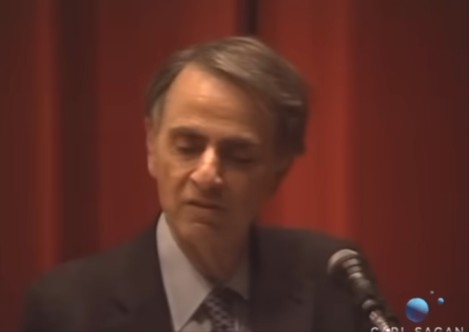
Read the full transcript of planetary scientist Carl Sagan’s 1994 lecture on The Age of Exploration.
Editor’s Note: In this compelling 1994 “lost” lecture, renowned planetary scientist Carl Sagan reflects on the historical tendency of human cultures to place themselves at the center of the universe—a conceit he refers to as a “great demotion” as science has consistently challenged our anthropocentric view. Through a rich exploration of history, biology, and astronomy, Sagan illustrates how our understanding of our place in the cosmos has evolved from geocentric myths to our current, more humbling perspective of humanity as a lonely speck in a vast cosmic arena. Ultimately, he argues that instead of seeking comfort in artificial self-importance, we should find true significance in our responsibility to cherish our “pale blue dot” and work together to build a better future.
Introduction and Acknowledgments
CARL SAGAN: Thank you, Dale.
I never knew that Tommy hit you up for my salary. I’m grateful to you both. It’s true that Tommy Gold recruited me for Cornell. I remember the inducements: a very small and exceptionally good astronomy department, superb ancillary departments in physics, chemistry, and biology, a beautiful campus, laboratory facilities, which were, by some standards, very generous. But still, I hesitated.
And I remember Tommy made the final inducement. I think knowing full well what he was doing, he took me on a little trip to upper Enfield. And I thought, my goodness, here is a national park as exquisite. Well, it’s not really a national park. Here is something as exquisite as any national park I’ve ever been in. And it would be right on my doorstep.
And that is the missing ingredient. And Tommy was extremely persuasive on every level of inducement. And I thank him very much for the invitation. I’ve lived now in Ithaca longer than I have lived in any other place in my life. And I’m extremely grateful to Cornell and the town of Ithaca.
I consider this my true roots.
Humanity as Hunters and Foragers
I didn’t know what it was I was going to talk to you about tonight, and so I tried to pick a topic which was sufficiently broad and ambiguous that whatever I thought I would talk about would fit. However, what I’ve decided to talk about doesn’t fit. Well, maybe it does.
We humans have had civilization only for about 10,000 years. Our species is a few hundred thousand years old. Our genus, the genus Homo, is a few million years old. And therefore, for the vast bulk of our tenure on Earth, we were something other than sedentary. And the word has such an aura of self-congratulation, civilized. What were we?
We were hunters and foragers. We wandered in small, itinerant, extended families. And our knowledge of the hunt-and-gatherer lifestyle is due to a few courageous and far-seeing anthropologists who went and lived with the few remaining hunter-gatherer groups before they were finally and utterly destroyed by civilization.
The anthropologist from whom I learned the most about hunter-gatherers is actually here with us, Richard Lee of the University of Toronto. He studied a people, the Kung San of the Kalahari Desert in the Republic of Botswana.
And I want to just give a little flavor about my understanding of our ancestors from Richard Lee’s study of the Kung San. I want you to know I practiced before the mirror for about half an hour.
Technology: A Deeply Human Trait
The first thing that I think is very important is that they are highly technological. The technology is wood and stone and domestication of fire technology. But it’s absolutely technology. And there are experts and other people who are not quite as good at the technology. But not only are they technological for fun, they are technological because their lives depend upon it.
Chipping and flaking stone tools back before they had a little trickle of metal into their economy is very difficult to do. Of course, they did it superbly well. And the archaeological and anthropological record is clear that we were technologists all the way back to the beginning.
So the idea that science and technology is something new, something unusual — something we can even find books that say is not really very human — is completely backwards. Technology is, if anything, the most characteristically human activity, although as I’ll mention later, it is not exclusively a human activity.
Tracking, Science, and the Origins of Observation
Now, one very interesting insight, I thought, is hunt-together tracking techniques. A small group with their bows and poisoned arrows and digging tools and a few other lightweight technological contrivances is following the game. They come near a stand of trees. They take one close look at the ground. Immediately, they know how many animals went by, what their ages and sexes were, how long ago they passed. This one is lame in the back left foot. At the pace they’re going, we should be able to overtake them in another two hours if we hurry.
Now how do they know all that? In fact, what do they notice in order to follow the game on which their lives pretty well depend?
One thing is a hoof print. Different animals have different characteristic shapes of their hooves. Different size animals leave different size hoof prints. But the decay of the hoof crater, the falling of pebbles in, the collapse of the raised rims, debris blown into it, tells you age. And in fact, it reminds me of nothing so much as determining ages of planetary surfaces by looking at how fresh the impact craters are. I think the reason that studying cratering physics seems so natural to us is because we’ve been doing it for a million years.
They also know that herd animals in the hot sun like to avoid the sun. If there is a shadow on the ground, they will deviate from their path to just run through the shadow a little bit.
Now, I don’t claim that every contemporary — well, there are none, but back 10, 20 years ago — every contemporary Kung San made a scientific calculation, did the trigonometry of the angle of the sun. That’s not what it’s about. This was tradition. Each generation taught the next. But someone had to have figured it out. And that someone had to be a scientist. And this is another reminder that we’ve been scientists and technologists from the beginning.
The Geocentric Conceit: Every Culture at the Center
Now having said that, I want to turn to the important and rueful fact that every human culture has considered itself at the center of the universe. What’s this about?
Well, I think it’s very straightforward. Back then in hunter and forager times, many modes of modern nocturnal entertainment were unavailable. Some were available, but many were not. Television was not available. So over the dying embers of the campfire, people watched the stars. And they did it, I imagine, for many reasons.
One, it is just dazzling. And we today living under light-polluted skies and in cities with light pollution have mainly forgotten how gorgeous the night sky can be. It is not only an aesthetic experience, but it elicits unbidden feelings of reverence and awe.
Secondly, people made up stories about the stars. They invented Rorschach tests up there, follow the dots, constellations. “Look like a bear to you, Og?” “Yes, I guess it does.” And then force their children to memorize these absolutely arbitrary patterns. “I don’t see the bear’s tail, dad.” “Shut up.”
And then myths were invented either before or after. So these were visual reminders of stories. The bear ate your grandpa, something like that. It was put up in heaven as an example. Or there was the story first, and then people put the bears up there.
But beyond that, there was something enormously practical. That is, the stars and their rising and setting are a great clock and calendar in the sky. And in the absence of artificial timepieces, that’s extremely important. Because there are certain seasons of the year when the herds are running. There are certain seasons of the year when the trees are ripe with nuts or fruit. And if you know what those seasons are, and you know what the moment is, you can prepare. And you can also eat.
The Stars, the Sky, and the Illusion of Centrality
Now, the most superficial examination of the sky shows the stars are rising in the east. Some of them pass directly overhead, and some of them pass on small circles close to the horizon. But they all rise in the east. They all set in the west. And then in the daytime, they do something else. They somehow go around the bottom of the Earth that none of us has ever seen. It’s flat as a board, of course. And then the next morning, they come up again in the east.
Now, there’s absolutely no doubt from this fact — that the stars, the planets, the sun, and the moon all go around us, and we’re obviously not moving — that we are at the center of the universe. It’s an observed fact. Anybody who denies that, there’s something wrong with them. This is the geocentric conceit.
Now, not only did every culture draw this conclusion, but I think it’s clear that our ancestors took enormous personal satisfaction in it. Because think about it. We are at the center of the universe. The center of the universe is surely an important place. Not only that, what other animals, what plants, make use of the apparent motion of the stars? Only us. Therefore, the stars have been put there for our benefit.
And the sun and the moon are practical objects. There was some confusion. Maybe you know the old story about the Persian wise man and philosopher who was asked which is more useful, the sun or the moon, and replied, “Of course, the moon, because the sun shines in the daytime when it’s light out anyway. Whereas the moon only shines at night when we need a little light.”
But even when people got things a little wrong, the centrality of our position was stunning. And I imagine an extraterrestrial visitation of the sort that there is absolutely no evidence for, coming upon the Earth, of course, running around the sun once every year, and then listening in on what people all over the planet are saying. And they’re saying, “We’re at the center. We’re important. We’re special. Everything goes around us.” And then I imagine the extraterrestrials thinking of us as, I don’t know, the planet of the idiots.
But that’s too harsh, because there’s a resonance here between the most obvious interpretation of absolutely straightforward observational facts that every person can verify for him or herself — a resonance between that and our emotional hopes and needs, the idea that the universe is made for us, not because of any particular merit of ours, but just because we’re here or just because we’re human.
Chauvinism, Nationalism, and the Human Tendency Toward Self-Centrality
To me this seems to resonate with the same psychic wellsprings responsible for the view that our nation is special and the center of the universe, which, by the way, is the literal meaning of the “Middle Kingdom” — for centuries applied by the Chinese to China. And even those who haven’t made it that explicit, nationalists of all stripes. You can see it, by the way, in the maps, how often each nation has itself at the center of the map. And other nations look at it as extremely peculiar to see Peru at the center of the map. What’s it doing there? It’s weird.
And the same psychic wellsprings that say that our gender or our ethnic group or our particular melanin content in the skin or a particular language or headdress or clothing styles or convention of pulling out the handkerchief when we sneeze or anything is important and central. And all those alternative ways of being human are somehow less central, less important, less worthy than we are. We have a weakness.
And scientists are creatures of the culture in which they swim, in which they have grown up. And so we also are vulnerable to this siren song, which we can call chauvinism, or geocentrism, or anthropocentrism.
Copernicus and the Challenge to the Geocentric View
So you know the story about what happened next, except for a little blip associated with the name of Aristarchus of Samos. We went on — every human culture, every great philosopher, every scientist, every religious leader — thinking we were at the center of the universe. We put it in various guises in our scriptures, declared the scriptures to be infallible, thereby making it not just a secular but a religious crime to even think about the issue.
Until in the late 15th century, an astronomer cleric from Poland named Nicholas Copernicus thought he had an alternative idea, namely that the sun was at the center and the Earth, like the other planets, went around it. He knew that this was dangerous stuff. And so he withheld the publication of his book until he was on his deathbed.
And even then, the way it worked out, when the book was published, it had a preface by a well-meaning friend of his, Alexander Osiander, which essentially said, “Dear reader, when you look at this book, it may appear that the author is saying that the Earth is not at the center of the universe. He doesn’t really believe that. You see, this book is for mathematicians. If you’re not a mathematician, close the book.” I’m paraphrasing slightly.
“Mathematicians find that if you wish to know where Jupiter will be two years from next Wednesday, you can get a good answer by assuming that the Sun is at the center. This is a mere mathematical fiction, and it does not challenge our holy faith. And please have no emotional angst in reading this book.”
And this peculiar split-brain compromise actually lasted for almost two centuries, in which people actually said, “Well, it’s all right. It’s only for mathematicians. The Bible says the Earth is at the center. We all believe that.”
Galileo and the Defense of Copernicus
And then, as you know, Galileo made a forthright and brilliant defense of Copernicus based in part on a set of observations from the newly invented astronomical telescope. And the church got increasingly annoyed. Galileo remained obdurate.
I once had the pleasure, at the behest of Franco Pacini, director of the Arcetri Observatory — who is also with us here today — to actually trod in Galileo’s footsteps and hold a close replica of his telescope.
In any case, when Galileo became too insistent, the princes of the church showed him the instruments of torture in the dungeons. They weren’t making any particular point, just thought he’d like to see them. And shortly thereafter, Galileo made his famous confession in which he abjured the abominable doctrine that the sun and not the earth was at the center.
But the stage had been set. The debate went on. And when in the 18th century, Bradley discovered the aberration of light, and then in the 19th century, the long-sought annual parallax was found, the opposition collapsed. And now everybody has thought that the Earth is not at the center of the universe.
Except I think there’s a lot of evidence that we are all geocentrists with a heliocentric veneer that’s been painted on us. Think, for example, about our language. “Sunrise.” “I was up before sunrise.”
Our Place in the Universe: Challenging Human Centrism
CARL SAGAN: Sunset. It was a gorgeous sunset. But the sun isn’t rising or setting. The Earth is turning. Think of how difficult it is for us to simply parse a simple word or phrase which conforms to the Copernican perspective. “Billy, be sure to be home before the rotation of the earth makes the local horizon occult the sun.”
Billy’s gone before you’re halfway through. Why isn’t there any snappy phrase like sunrise or sunset in the Copernican context?
Recent opinion polls show that 25% of adult Americans do not know that the Earth goes around the sun and takes a year to do it. In China, the figure is 70%. If you bear in mind that the Copernican perspective gets a lot of press in the United States, I mean, there is NASA. There are television programs other than In Search Of, or Obscure and Erroneous Mysteries, or whatever it’s called. We do hear that the sun is at the center, and still a quarter of us have missed it.
And in China, you can see where there isn’t a NASA and where the television programs are much less sophisticated. A much larger percentage of people have missed it. If anything like China is typical, it may be that today, five centuries after Copernicus, most people on this planet still think in their heart of hearts that the Earth is at the center.
So I think congratulations on our insights in deducing are important. There’s something fantastic and great about human beings. There is then actual observation of the circumstances. Nobody ever thought to look before. And then the result is the daunting and disquieting discovery, no, we’re not at the center. No, we’re not important.
And to my mind, many of the key findings of science, much of the modern scientific perspective, evolves from debates with that character. So let me just try to outline a few examples.
Not at the Center of the Galaxy
CARL SAGAN: Shortly after Copernicus, there are people who said, OK, maybe we’re not at the center of the universe. Maybe the sun is. But we’re close to the sun. Look, we’re almost at the sun. So we’re almost at the center of the universe. It’s almost as good.
Well, was the sun at the center of the universe, which we can loosely translate as at the center of the Milky Way galaxy? Well, the answer is no. We are not at the center where it looks important, or at least well-lit. Instead, we are in, or at least near, an obscure spiral arm 30,000 light years from the center of the Milky Way galaxy in the galactic boondocks.
If you were an intergalactic traveler coming into the Milky Way, what would you think of someone who said, “Excuse me, captain, that’s the center of the Milky Way. It’s true. But count out spiral arms with me. See, there is one. There’s another one really big and beautiful. There’s another one. Then over there, you see that somewhat obscure spiral arm? Well, don’t look exactly in it, but just a little out of it. See over there? I know it’s hard to see. Take a closer look right there. No, not that one. That one, see? Yeah. The guys who live on that one say they’re at the center of the universe, and the entire universe is made for their benefit.”
What would you think of those guys? And then suppose you had the information. There’s not one soul on that planet who thinks otherwise. Every one of them thinks they’re at the center of the universe.
Beyond the Milky Way
CARL SAGAN: Then there was a moment when it was thought, well, at least the Milky Way is the only galaxy. But no, that’s not the case. Not only are there other galaxies, there may be as many as 100 billion of them.
Then there was a moment when the Hubble flow was discovered, when it was found that the galaxies are all running away from us, the more distant galaxies running away the faster, as if we had committed some dreadful cosmic social blunder. There were people who breathed a sigh of relief. This was in the 1920s. “Look, we’re at the center. Our galaxy, at least, we’re not at the center of our galaxy. But our galaxy is at the center of the entire universe.”
And this is based upon a serious misapprehension. There is no center to the universe, at least in ordinary three-dimensional space. And astronomers in any one of these galaxies would see all the others running away from them in the same way that we do.
The Question of Other Planets
CARL SAGAN: Then there was, for a long time, all through my growing up and undergraduate and graduate school career, the statement, there are no other planets. That is, in no other solar system. There was always a nearby star that was suspected to have planets, and it never did. Barnard’s star was, for a long time, a leading hope. And if there are no other planets, if life has to arise on planets, then there’s no other life, and there’s no other intelligence. And so in that sense, we’re at the center of the universe.
Well, one of the things about the age we live in, the last 15 years, is that this chauvinism is in the process of teetering and collapsing. Because we find that more than half of the nearby young sun-like stars have circumstellar disks of gas and dust, extremely like what has been deduced for the birthing grounds of the planets in our solar system, the key datum being that the orbital planes of the planets are very largely coplanar.
And this was, by the way, something that Isaac Newton, no less, thought he could deduce the hand of God from. That is, God took each planet and threw it in the initial condition, all in the same plane. But Kant and Laplace independently knew better. And they used nothing more than Newtonian physics. Newton had just missed it. That the conservation of angular momentum meant that an irregular spinning contracting cloud would collapse into a disk, and the planetary formation would occur in the disk. And therefore, you had to have, collisions aside, coplanarity of the orbits of the planets.
Not only are there amazingly numerous such circumstellar disks, but we now have the first bona fide extrasolar planetary system going around a star that must be at the bottom of the list of potential candidates that anyone would have imagined — a pulsar named B1257+12. This particular pulsar is something like the size of the Cornell campus. It’s something like an atomic nucleus, the size of the Cornell campus, spinning at 10,000 RPM, 10,000 revolutions per minute. It’s a supernova remnant. There was a colossal catastrophe that blew off most of the mass of that star. And going around it are at least three planets, two roughly Earth-like mass, one roughly lunar mass, a little in closer than Mercury, Venus, and the Earth.
And whether these planets survived the supernova explosion or formed recently out of the supernova debris, whichever it is, the processes which lead to planets look to be a very broad and general application. And the technology is now improving so that in the next 10, 20, 30 years, in other words, in the lifetime of most of the students in this audience, we ought to have completed comprehensive surveys of the nearest few hundred stars, maybe much more than that, to see what planetary systems they have. So this chauvinism, I think we can also chalk off.
Are We Special in Time?
CARL SAGAN: Now, there’s been the view that if there’s nothing special about us in space, maybe there’s something special about us in time. We’ve been put here by the creator to take care of things. Stewardship is the very engaging word that is often used. Who knows what would happen to the environment without us? So we have an obligation to make sure everything goes as God would have wished it.
The only trouble with this idea — while there are several, but for me the principal trouble with this idea — is that 99.998% of the lifetime of the universe, from its beginning to now, was over before any human appeared on the scene. So if we are the caretakers, where have we been for most of the time we’re supposed to be doing our job?
We have been terribly lax. I could see that the chief gardener might be very annoyed with us, which in turn might explain a great deal. We could not have been put here as caretakers because we have not been taking care, A, because we weren’t here, and B, because when we have been here, we haven’t been doing very well either.
Special Relativity and Privileged Frames of Reference
CARL SAGAN: Then there was the view that if there is nothing special about our position in space or our position in time, there’s something special about our motion. We have a privileged frame of reference. This was the classical absolute motion physics that every great physicist bought into until 1905.
Albert Einstein, a keen critic of privilege in the social sphere, immediately mistrusted the contention that the planet we happen to live on was affixed to an imaginary frame of reference which had special merit with regard to the laws of nature, and instead asked what kind of physics would it be if you deduced the same laws of physics no matter what planet you lived on and what star you lived on. And that is one approach to special relativity, which is repeatedly confirmed and is the way the universe is put together. Another chauvinism biting the dust.
The Great Demotions
CARL SAGAN: Now, this is a set of what Annie Drehan has called “the great demotions.” And there are people who find it very upsetting, who still long to be at the center. And one area where you can see the emotions not hidden but written out in clear is in special creation. The notion that we are the particular objects of the devotion of the creator of the universe, that we’re different from the other animals, never mind plants, not just in degree, but in kind.
And you know the list. No one else has altruism, compassion. No other animal loves their young. Nobody else can foresee the future consequences of present actions. Nobody else has art or music. Nobody else can use tools. Nobody else can make tools.
And this list that goes on and on is essentially agreed to by Plato, Aristotle, St. Augustine, St. Thomas Aquinas, Hobbes, Locke, all the great figures in philosophy, with the single exception of David Hume. Hats off to him. Bought into by all scientists, including highly skeptical ones up until the year 1859, bought into, of course, by all the religious leaders of at least the Western religions, especially the Judeo-Christian Islamic religion.
Darwin and the Challenge to Human Uniqueness
CARL SAGAN: And in 1859, Charles Darwin made the first and heroic effort at pricking this balloon, showing that one species could, in fact, evolve by absolutely natural processes without anything foreordained from another species. And then when he got up the courage — it took a great deal of it — more than a decade later, he published his second book on the subject, suggesting not only does it apply to lots of species, but us too. We and the chimps have a common ancestor. They’re our cousins.
This contention really makes a lot of people upset. Have you been to a zoo lately? Have you looked at what a chimpanzee does? “Maybe you’re related to chimps, buddy, but I’m not.”
Well, we can learn about chimp behavior in zoos about as well as we can learn about human behavior in jails. And for exactly the same reasons. They don’t bring out the best in us.
What Chimpanzees Can Teach Us
CARL SAGAN: But when people like Jane Goodall devote themselves to observing chimpanzees in their natural habitats, the chimps get used to them, the chimps have no trouble recognizing after a while that the humans are somewhat inept chimps. Then we find very different behavior.
And I can’t resist telling the story of Geza Teleki, an anthropologist and animal behaviorist who wished to learn chimpanzee technology, particularly the termite fishing industry in which they are adept. And so he apprenticed himself for nine months to a chimp named Leakey, who was expert.
Now, the chimpanzee termite fishing industry goes as follows. You find a reed, not any kind of reed, the right kind of reed. You strip it of supernumerary branches, feel that it’s right, and then go to the enormous termite mound. Now each night, the termites cover over the entrances to their nests. The chimp takes one look, scratches away to three places where the entryways have been walled up, takes the reed or grass stem in one deft motion, puts it down into the termite mound, gives a few twists, carefully pulls it out. The thing is covered with termites. The chimp goes, “yum, yum, yum, yum.” And here is a good source of protein.
Now, if a human were dropped down in this same place and had a need of protein, this source is unavailable to humans. Teleki, spending full time on this problem for months, could, A, not break off the right kind of reed — in fact had to use the leftovers that chimps had picked out — could not after nine months find the openings to the apertures that the chimp takes one look at and opens up. Could not put it down deftly. Would do that and the thing would come out accordioned. Could not wiggle it enticingly to get the termites on, and could not withdraw it without scraping off almost all the termites. At the end of nine months, he’d come up with one termite per.
Chimps know how to do stuff. And how do young chimps know to do what Geza Teleki did not learn how to do? They were apprenticed for years. By the way, in Teleki’s wonderful paper, in the acknowledgments, he thanks his patient tutor and apologizes for his failures because they are not the fault of the being he was apprenticed to. It’s just humans aren’t very good at this stuff.
There is, in fact, a bonobo, a kind of chimp, who lives in Atlanta, who not only knows how to use stone tools, but knows how to make stone tools. This source of human pride is, again, misplaced.
Now, of course, there are differences between chimps and us. And we have electric light bulbs, and police cars, CD players, and nuclear weapons, all sorts of things that chimps don’t have. But we can say that they don’t have any technology.
The Anthropic Principle and Human Conceit
And when it became possible in the late 19th century to do DNA-based sequencing, you could get a quantitative measure of the relationship between humans and chimps. And it turns out that the two species share 99.6% of their active genes. So one way to look at that is 0.4% is a much larger number than we had guessed. And another way to look at that is you want to know about us, take a look at chimps. There’s a lot there to learn.
In any case, the idea of special creation is really an idea for another time. If nothing else but the molecular biological evidence were available, it would be very clear that there is nothing in us that is qualitatively different from our nearest chimpanzee relatives. That then takes us to the present stands where these great chauvinism battles are taking place. One is the search for extraterrestrial intelligence. We have not found life, much less intelligence, anywhere else yet.
We send spacecraft to other planets to look for life. We construct large radio telescopes and listen if anyone is sending us a message lately. Both of these activities have led to occasional tantalizing data, but none of it of a sufficient quality to say that we’ve detected life or intelligence elsewhere. In our ignorance, the geocentrists find hope. They confuse absence of evidence with evidence of absence.
You haven’t found life elsewhere? There isn’t any. We’re the only living creatures on the planet, on the universe, on this planet. You haven’t found intelligence elsewhere? There isn’t any elsewhere.
It’s only here. We are at the center of the intellectual cosmos. And while I could give you what I consider to be a strong plausibility argument why this conceit is also erroneous, it’s only fair to say that nobody knows the answer to this issue. We have not found life or intelligence elsewhere.
We are in the course of looking. Maybe we will find it tomorrow. Maybe it will take centuries. Maybe we will never find it. And all we have to do is keep an open mind.
There’s no other approach. You don’t have to make up your mind in the absence of evidence.
And then finally, there is a new and, to my mind, bizarre field for this debate, something called the anthropic principle, which would be much better called the anthropocentric principle, which comes in strong, weak, and various shades of middling flavors. The weak anthropic principle says, if the laws of nature and the fundamental constants of nature were significantly different, then the paths which led to us would have been different, and we wouldn’t be here. That is unexceptionable, certainly true, no problem. But then there is a strong anthropic principle, which to my mind is dangerously close to the following argument.
We would not be here if the laws of nature and the values of the physical constants were other than they are. Therefore, the laws of nature and the physical constants are as they are in order for the universe to produce us. God had us in mind at the time the universe was made. And here we are back at the center of the universe again.
There are many things which can be said about this, including the point that Philip Morrison, among others, has made that who has traced through what other laws of nature and physical constants will lead to the functional equivalence of life and intelligence, it’s impossible to do.
You can also argue against it that it is not very vulnerable to experimental investigation. But I would just like to point out that there’s something telling about calling it the anthropic principle, because the same laws of nature and the same physical constants are required to make a rock as to make a person. Why is it not called the lithic principle? So there’s a strong and weak lithic principle. And in the strong lithic principle, the laws of nature and the physical constants are as they are so rocks could come into being, not nearly as satisfying, right?
But if rocks could philosophize, I bet you we would hear nothing of the anthropic principle. And at the cutting edge of rock philosophy would be the lithic principle.
The Pale Blue Dot
CARL SAGAN: I have only two slides. If I can show the first one, please.
This is an absolutely typical astronomical photograph of what’s called a star field. Now, focus is important, please. Oh, went right through it. That’s pretty good. Back a little. Yeah, good.
Now, take a look up here. What you are looking at is some, I’m not sure, 10,000 stars, something like that. One in front of another so that they seem so closely packed that from a greater distance or with a smaller aperture telescope, you could not even tell they are individual stars. This is what the Milky Way is. It’s stars in line of sight so closely packed that it looks like a continuum of light.
Many of these stars are more or less like the sun. As I was saying before, it now looks as if planets are a frequent, if not invariable, accompaniment of star formation. And again, I ask you to consider the contention that the only life and intelligence in the universe is, let’s say, that dot. No, not that one. That one right there. See? That’s it. Nowhere else.
Maybe hard to extrapolate from one example, and one example is all we have. But this is so resonant with the other human conceits I tried to outline in the great demotions that I am suspicious of it for that reason alone.
Lights, please. I want to conclude with one of the many psychic rewards that planetary exploration has brought to me. As Ed Stone outlined in his talk this morning, there was a moment when the two Voyager spacecraft had completed their close-up reconnaissance of the Jupiter, Saturn, Uranus, and Neptune systems. No other planets that we were going to rendezvous with further out in the solar system. It was now possible to turn the cameras close to the sun, and if the worst happened and we burnt out the optics, so what? There was nothing else we were going to photograph.
Because I had wanted, from the time of the Saturn encounter, to take a picture of the Earth from that remote vantage point. And at the same time, I want us to get to Uranus and Neptune and see what was there. And the spacecraft phenomenally outperformed its design specifications. And the bulk of our knowledge of the outer solar system has come because JPL did such a brilliant job with these extraordinary spacecraft coming in on time, under cost, and vastly exceeding the fondest hopes of their designers.
Anyway, as Ed well knows, it was by no means easy, even though the downside was almost nil, to turn the cameras back. And it required an actual intervention by the NASA administrator to get it done. But it was done.
Now, it was clear that because the Voyager 1 picture was taken from beyond the orbit of Neptune, that the Earth would appear only as a single picture element, a single pixel. You would not even see continents. You could not tell any detail. I still thought it would be useful to do, in the same sense that the great frame-filling Apollo 17 picture of the whole Earth has become a kind of icon of our age because it said something very powerful to us, including the fact that from that perspective, national boundaries were not in evidence.
Well, these pictures were taken in part due to the excellent estimates of exposure times by Carolyn Porco. And I’d like to show you in the last slide. Due to motion, the Earth momentarily, no chauvinistic implications. This is just foreground optics, the Earth in a sunbeam. Wait a little bit, and it’s not in the sunbeam. So there it is.
I mean, take a look. It’s a pale blue dot. That’s us. That’s home. That’s where we are. On it, everybody you love, everybody you know, everybody you’ve ever heard of lived out their days there. The aggregate of all our joy and suffering, thousands of confident ideologies, religions, economic doctrines, every hunter and forager, every hero and coward, every creator and destroyer of civilizations, every king and peasant, every young couple in love, every hopeful child, every mother and father, every inventor and explorer, every revered teacher of morals, every corrupt politician, every uncorrupt politician too, every superstar, every supreme leader, every saint and sinner in the history of our species lived there.
The Earth is a very small stage in a great cosmic arena. Think of the rivers of blood spilled by all those generals and emperors, presidents and prime ministers, party leaders, so that in glory and triumph, they could become the momentary masters of the corner of a dot. Think of the endless cruelties visited by the inhabitants of one part of the dot on the scarcely distinguishable inhabitants of another part of the dot. How frequent their misunderstandings, how eager they are to kill one another, how fervent their hatreds, our posturings, our imagined self-importance. The delusion that we have some privileged position in the universe seemed to me challenged by this point of pale light.
Our planet is a lonely speck in the great, enveloping cosmic dark, in our obscurity, in all this vastness. There is no hint that there’s anyone who will come and save us from ourselves. That will happen only if we do it. It’s been said that astronomy is a humbling experience, and I would add, character building. To me, this is one of many demonstrations through astronomy of the folly of human conceits.
To me, this picture underscores our responsibility to deal more kindly with one another and to preserve and cherish the pale blue dot, the only home we’ve ever known. Thank you.
Q&A Session
UNIDENTIFIED SPEAKER: Thank you, Carl, for a great speech. I’m already looking forward to your 70th birthday. Professor Sagan will answer questions for a while. If there are microphones in the aisles, if you could come to the microphone, it will make it much easier. He’ll field the questions himself.
CARL SAGAN: Thank you, Dale. I’d be glad to answer questions on anything I’ve been talking about, or anything else that’s on your mind. I don’t promise to be able to answer everything, but I’d be glad to give it a shot.
Professor James Henderson is not asking a question, but merely taking a picture.
AUDIENCE QUESTION: I’d like to know two things. First one is, who said “billions and billions?”
CARL SAGAN: That I can answer very quickly. It’s someone named Johnny Carson. I never said it. I never, ever said it.
He’s off the hook, everybody. I mean, it’s sort of like Humphrey Bogart never said, “Play it again, Sam.” Nobody believes it. But he didn’t. “It’s elementary, my dear Watson.” In the movies, he says it. Basil Rathbone says it. But in the Arthur Conan Doyle books, he never says it.
AUDIENCE QUESTION: OK, so we also want to know, what, if any one thing in particular, would you have yourself be remembered by?
CARL SAGAN: You know, I hate the one only kind of question. What’s your favorite scientist? What’s the greatest discovery in the history of the world? I don’t know. I have to leave the decision about how I’m going to be remembered, which I hope will not have to be faced for some time, to others. But thanks very much for the question.
On the Evolution of Consciousness
AUDIENCE QUESTION: I was interested in your great demotions and I certainly — where among the great demotions would you fit in, or would you fit in at all, the appearance of consciousness among humans?
CARL SAGAN: Yes, that’s an important question. I’ll repeat it because her voice, while lovely, is very soft. The question is, what about the evolution of consciousness? Isn’t this another of the conceits that only humans are conscious. I’m paraphrasing. But would I include that in the demotions?
Annie Drehan and I wrote a book called Shadows of Forgotten Ancestors, in which we tried systematically to look at each of these, what I’ve called, conceits. And I think the most startling thing we’ve learned, or I’ll speak for myself that I learned in the course of doing that book, was how we kept getting it wrong on these issues.
Now, consciousness has various meanings. If it means an awareness of the external world and modifying your behavior to take account of the external world, then I think microbes are conscious. If you mean deep thoughts, like Bishop Barclay’s contention that nothing exists except what’s in his mind, I’m with the microbes myself.
You see, how do you know that I think any thoughts? Only because I happen to be communicating to you. You can’t easily tell that I have philosophical thoughts by looking at me drinking this cup of water, right? So imagine that I was mute, that I could not communicate by speech or writing or anything else. Then how would you know if I had such thoughts?
The evidence for not just the so-called higher apes, but running through the apes and the monkeys, to me, is very persuasive that they have thoughts. Not only deep philosophical thoughts, but useful practical thoughts like lying, like deceit, like planning to fool others, thinking about it far in advance.
But let me just give one little image, which I like, because it covers many different grounds. These are the results of work at the Arnhem colony in the Netherlands, where there’s a large free-roaming community of chimps. Males are testosterone-riven and subject to raging hormonal imbalances. They get angry at each other and pick up rocks. They go quite a distance to get the rocks in order to confront the guy who they don’t like and throw stones.
The very act of going over there out of sight of the enemy to pick up the stones and then bring them back to throw the stones shows thinking ahead, understanding a goal and aware of yourself and the opposition. But the most interesting thing is it is common for female chimps, seeing the males burdened with their stones, to walk up to them and disarm them. Pluck the stones out of their arms, open up their fingers, and throw the stones away. And when the males in a huff gather them up, the females disarm them again. So not only do the males know what they have in mind, the females know what they have in mind.
On the Existence of God and Purpose
AUDIENCE QUESTION: And that, to me, not only is consciousness, but a social arrangement I’d like to see more of in humans. My question is, given all these demotions, what is your personal religion? Is there any type of God to you? Is there a purpose, given that we’re just sitting on this speck in the middle of this sea of stars.
CARL SAGAN: Now, I don’t want to duck any questions. And I’m not going to duck this one, even though I have high religious percentages who are close friends of mine in this room. But let me ask you, what do you mean when you use the word God?
AUDIENCE QUESTION: Well, I guess my question, is there a purpose for, I mean, given all these demotions, why don’t we just blow ourselves up? Why don’t we? What is our purpose?
CARL SAGAN: I mean, turn the question around. If we do blow ourselves up, does that disprove the existence of God?
AUDIENCE QUESTION: No, I guess not. I mean, it’ll be a little late to make the discovery, but still. I guess what I’m asking is since, as we kind of make God almost go away in this, as he threw these demotions, and I don’t mean he, because who knows what God is, but…
CARL SAGAN: But still saying it makes it sort of icky, doesn’t it?
AUDIENCE QUESTION: Yeah, yeah. It’s tough. We like it to be a he, don’t we? We’ve been trained to think of it as a he. Yeah.
CARL SAGAN: It seems that through the ages, humans have created a mythological framework that has always involved some kind of, often involves some kind of higher spiritual powers. And as every human culture has done that, as that goes away, as we know more and more, it seems harder and harder to prove that anything might exist like that. Where does that leave us?
On our own. Which to my mind is much more responsible than hoping that someone will save us from ourselves so we don’t have to make our best efforts to do it ourselves. And if we’re wrong and there is someone who steps in and says, “OK, that’s all right,” I’m for that. But we hedged our bets. It’s Pascal’s bargain run backwards.
I’ll say another word. The word God covers an enormous range of different ideas. And you recognize that in the way you phrase the question. Running from an outsized, light-skinned male with a long white beard sitting in a throne in the sky and tallying the fall of every sparrow, for which there is no evidence — to my mind, if anybody has some, I sure would like to see it.
To the kind of god that Einstein or Spinoza talked about, which is very close to the sum total of the laws of the universe. Now, it would be crazy to deny that there are laws in the universe. And if that’s what you want to call God, then of course God exists.
And there are all sorts of other nuances. There is, for example, the deist god that many of the founding fathers of this country believed in, although it is a secret whose name may not be spoken in some circles — a roi finiant, a do-nothing king, the god who creates the universe and then retires, and to whom praying is sort of pointless. He’s not here. He went somewhere else. He had other things to do. Now, that’s also a god.
So when you say, “Do you believe in God?” if I say yes or if I say no, you have learned absolutely nothing.
AUDIENCE QUESTION: I guess I’m asking you to define yours if you have one.
CARL SAGAN: But why would we use a word so ambiguous that means so many different things? It gives you freedom to define it. It gives you freedom to seem to agree with someone else with whom you do not agree. It covers over differences. It makes for social lubrication. But it is not an aid to truth, in my view. And therefore, I think we need much sharper language when we ask these questions. Sorry to take so long in answering this, but this is an important issue.
On Carl Sagan’s House
AUDIENCE QUESTION: Hi. Me and some of the other students here at Cornell were wondering about your house. Was it some kind of power plant? What was it before it was your house?
CARL SAGAN: Right, right, right. Good. I guess what I said — I tried to answer questions even that aren’t related to what I talked about. I really let myself in for it. OK.
That is a study that Annie and I work in and where we live. It was a long time ago the headquarters of the Cornell Sphinx Head Society, in which God knows what abominable rites were performed. But I can assure you these days, it is extremely placid. And he says she’s not so sure. Anyway, it’s very benign, whatever its early history, which goes back to, I think, 1892. It also was once a sculpture studio of a remarkable Cornell professor, designer of nuclear accelerators and sculptor par excellence, named Bob Wilson.
On Astrology and Extrasensory Perception
AUDIENCE QUESTION: Yeah. I want to know what your views were on astrology. I know it’s a related science — astronomy. On astrology. Extrasensory perception.
CARL SAGAN: Astrology is a hoax.
AUDIENCE QUESTION: Hoax? H-O-A-X? So what about the documented proof of studies where ESP, clairvoyance — you totally disagree?
CARL SAGAN: That’s different. That’s different.
AUDIENCE QUESTION: OK, well that’s wrong. Astrology is different for me as being clairvoyant. Sorry to confuse the two.
CARL SAGAN: But no, I’m happy to answer. I just want to be clear. Extrasensory perception, telekinesis — do they exist? And do certain individuals have it? And how did it arrive into society?
If it exists, it would have arrived by evolution, by natural selection, the same way as everything else. But what do we mean by extrasensory perception? There is an African freshwater fish that establishes static electric fields and then detects its prey by perturbations in the electric field. We can’t do that at all. It doesn’t correspond to any of our senses. Does this fish have ESP? In a sense, yes.
If it does have ESP, is this mysterious? Is it a challenge to science? Or is it just another way of perceiving the world? It’s a different way of perceiving the world. So therefore, if there is ESP, I think the chances are excellent that it can be well understood by science. But to the best of my knowledge, there isn’t any ESP.
On the Use of Animals in Biomedical Research
AUDIENCE QUESTION: Hi. I’d like, first of all, to say that it must be a true privilege to be able to develop a career in something as stimulating intellectually and spiritually as astronomy. Now, my question to you is, what’s your opinion on the use of animals in biomedical research?
CARL SAGAN: I have struggled greatly with this issue, in part because I have a graduate student, Peter Wilson, who holds my feet to the fire on this issue. For example, I have a 20-year-old leather jacket that I used to wear to Cornell that I don’t wear anymore. I do wear it around the house, if truth be told. I am very conflicted on this issue.
That gratuitous pain should not be inflicted on other animals, or for that matter plants, I think, is clear. And that animals should not be made to suffer for fairly trivial goals — the making of lipstick, for example — I think is clear.
To argue, though, that animals should not be used in the pursuit of medicines and medical procedures that might save the lives of humans is not so clear to me. And Charles Darwin had just the same distinction. He was way ahead of his time in opposing gratuitous pain, but would also not argue that no animal experiments should be done.
And I think if I had to explain, somehow it was my job to do so, to some people whose child was dying because a medical procedure was unavailable, which might very well have been available if animal experimentation had been performed — I don’t know how I would do that justification.
Now, you might say to me that I’m putting humans higher than other animals. And where do I come off doing that, especially at the end of an evening where I’ve been decrying chauvinism? This, to me, is like the argument that is sometimes said — Dave Morrison mentioned it in his talk today — why should we take any steps to save ourselves if an asteroid is going to hit the Earth, since asteroids have hit the Earth in the past?
And others have gone, so we might be here, so we’ll go, so whatever it is. The raccoons will have their chance, or the ants, or the sulfur oxidation state altering submarine worms will inherit the Earth. At this point, I have no difficulty in — since I happen to be, it’s an accident of birth, a human being — to justify human beings trying to survive under sometimes trying circumstances. That’s my judgment.
I’m sure if I were a lizard up here, I would be talking about, “Yes, let’s sacrifice the human so we can get better medicine for the lizards. After all, I’m a lizard.” I’m sorry, I can’t help it. I’m a human. I’m not saying this as if I know what your point of view is, but I’m just trying to clarify how I think about it.
On Extraterrestrial Visitation and the Plains of Nazca
AUDIENCE QUESTION: I’d first like to say happy birthday, Professor Sagan. I’m sorry I didn’t get you a present. Now, there are various structures in the Andes and also formations and crops in northern England, which people say are results of extraterrestrial interference or appearances. The Plains of Nazca. I was just wondering about your views of whether or not we actually have been landed upon.
CARL SAGAN: Well, one way to look at this is, first of all, where did all this stuff about the Plains of Nazca being somehow mysterious and extraterrestrial come from? It came from a guy named Erich von Däniken, a Swiss hotelier who wrote a book called Chariots of the Gods, which became a worldwide bestseller, in which he argued as follows.
On the plains of Nazca in Peru, there are large drawings. Some of them look like spiders. Some look like turkeys. Some are straight lines. Von Däniken concluded that the straight lines were airfields. And the other stuff was messages that dullish humans were instructed in carving in the desert of Peru by extraterrestrial overseers.
Why? What’s this about? We don’t know how to draw big pictures without extraterrestrials telling us what to do? Some of those straight lines are six inches across. How big are the airplanes that land on those airfields? What are we to imagine? An interstellar spacecraft effortlessly crosses hundreds, thousands of light years. The cargo door is open, and out come little propeller-driven airplanes about that size, like my 3-and-a-half-year-old son plays with. And they land in Peru and tell people, “We got toy airplanes. Please make airports for us. And by the way, make a big turkey.” This is silly.
The common feature in all of von Däniken’s fantasizing is that he sells our ancestors short. He goes to Egypt. He sees pyramids. “Boy, those are big. How big are the constituent blocks? 100 tons,” says von Däniken. “I couldn’t lift a block that weighed half that. Therefore, human beings are unable to lift blocks of that mass. Therefore, extraterrestrials did it. QED.”
But if he had read Herodotus, never mind archaeology — this Herodotus written, it’s in English translation, it’s in German translation — we have an idea about quarries and logs as rollers and rafts up the Nile and how humans could do it. We’re perfectly capable of building things big. Even those of us who lived a long time ago, even those of us with dark skin, people know how to build big. And the idea of extraterrestrial visitation being required every time a naive observer can’t figure out how something could be done is silly.
The one possible positive aspect of von Däniken is that it might, in frustration, drive an occasional reader into archaeology.
On Humanity’s Place in the Universe
AUDIENCE QUESTION: Thank you. Happy birthday. I’ll be honest with you. A friend of mine, well now an acquaintance of mine, sold me the idea that Steven Spielberg was going to be here, so that’s why I came. But look, I’m really happy. I’m sorry, I’m not done.
The first I heard of it, I’m awfully sorry that you were disappointed. I know, but I’m glad I came because when you were doing all that thing about pointing out where Earth is and how little we are compared to the universe, wouldn’t it be easier for humans to think that we’re not the center of the universe if we have all this data now? It’s easier. Now why can’t we believe? The hard challenge now is to think that we are, in some way and somehow, the center of the universe in some kind of way. Not physically, not intellectually, but somehow — I don’t want to make it like a purpose, but so…
CARL SAGAN: Yes you do.
AUDIENCE QUESTION: Okay, it’s a purpose. But no, but you know what? It’s now easier for us to believe, okay? It’s easier, we can put our mind at rest. But somehow, aren’t we closing our mind? Aren’t we closing our mind? By not saying that we’re not in some way the center of the universe.
CARL SAGAN: But imagine that you’re an octopus.
AUDIENCE QUESTION: OK. OK, wait, wait, wait. What about organisms that are not at the center of the universe? OK, I’ll change it. I mean, humans, because we can communicate and understand each other. I’m just saying it because, man, we’re a gutwurk. But what I’m saying, your organisms.
CARL SAGAN: My mind is open. You come up with evidence we’re at the center of the universe. I will gladly confess defeat.
AUDIENCE QUESTION: Not now, but.
CARL SAGAN: Hello.
Closing Remarks and Final Q&A
AUDIENCE QUESTION: First of all, I’d like to say I’m glad I didn’t get to ask my first question about God, and I left it to him. But my second question, which might be oversimplified, is if every matter has an antimatter and the Big Bang Theory created the universe, which is supposedly the matter, where is the antimatter in the Big Bang Theory?
CARL SAGAN: There is quite sophisticated cosmological speculation and theory on this. Clearly, if there is an excess of one over the other, and the universe is well mixed, then since matter and antimatter annihilate each other, whichever had a —
Would you stay and talk to people after we discuss the audience? My good friend, the emeritus everything, the emeritus dismisser suggests that it’s time to come to an end.
Let me take Dale, if I may, one or two more questions, and then I’ll stop.
AUDIENCE QUESTION: Do you think that we’re now as demoted as we can get? Or do you think that — can you see? What further humiliations can you see for us in the near future?
On Future Humiliations and Human Self-Worth
CARL SAGAN: Dr. Wing asked, what further demotions, humiliations do I foresee for us.
You see, the idea that our sense of self-worth comes not from anything that we’ve done, not from anything worthy, but by an accident of birth is where the crux of the humiliation is, in my opinion. I would say those of us worried about being demoted, those of us who wish for us to be important, should do something important. We should make an easily understandable, achievable, and inspiring goal for the human species, and then set out and do it. That would give us the confidence that we sorely lack by being dependent on our self-esteem being based on nothing we do.
We want to have self-esteem. Let’s make a planet in which nobody is starving. Let’s make a planet in which men and women have equal access to power. Let us make a planet in which no ethnic group has it over another ethnic group. Let’s have a planet in which science and engineering is used for the benefit of everybody on the planet.
And my personal idiosyncrasy, let’s have a world in which we go to other worlds.
I think I’ll stop there. Thank you.
Related Posts
- Transcript: Maya Angelou’s Greatest Life Lessons on Oprah Podcast
- Transcript: The Next 50 Years: Humanity, AI, Power w/ Yuval Noah Harari
- How to Stand Out in an AI World by Thinking Better, Not Faster: Sol Rashidi (Transcript)
- Modern Wisdom: w/ Alex Petkas on True Story Of The Odyssey (Transcript)
- Reconstruction: Malcolm Gladwell Interviews Barack Obama (Transcript)