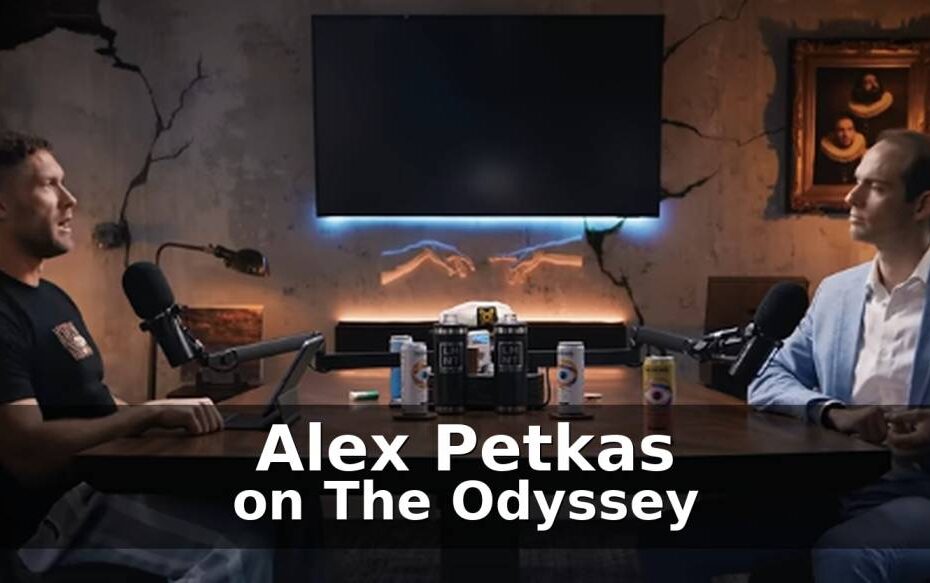
Read the full transcript of historical and author Alex Petkas’ interview on Modern Wisdom podcast, July 18, 2026.
Editor’s Note: In this interview, host Chris Williamson sits down with Alex Petkas to explore the history, mysteries, and enduring legacy behind Homer’s ancient Greek epic, The Odyssey. They delve into the potential historical truths of the Trojan War and debate the true identity of the legendary blind poet who supposedly authored the tale. Along the way, Petkas breaks down the profound cultural themes embedded in Odysseus’s journey, ranging from the restoration of societal order to the complexities of ancient heroism. Ultimately, the conversation highlights why these timeless archetypes remain incredibly relevant for finding grounded wisdom in today’s chaotic era of information overload.
Why The Odyssey Matters
CHRIS WILLIAMSON: Why is The Odyssey such an important story?
ALEX PETKAS: Well, it’s a story that has affected a lot of people, I think because it has all of these really universal themes and problems that it relates to. I mean, any good literature does that, but maybe The Odyssey in particular.
I mean, Chris Nolan talks about it as this sort of archetypal story that is somehow in all of the movies that he’s done. There’s the theme of returning to your home, sacrificing on behalf of the community. One of the things that I think is really timely about The Odyssey, and I don’t really know how much the movie’s going to get into this, but it’s kind of a story about the collapse of the patriarchy and how it gets restored, what it takes to restore that, which maybe is timely for our day.
CHRIS WILLIAMSON: Who wrote it?
ALEX PETKAS: So Homer is the short answer. Who’s Homer? Homer is the author, according to the Greeks, of the Iliad and the Odyssey, these 2 poems that modern scholars will kind of quibble about. Was it one guy? Was it 2 guys? Was it a whole kind of crowd of men working, or people working in this tradition? And we can get into that a little bit, but essentially Homer is the attributed author who is this semi— a very blessed epic bard. He’s an epic poet, and this is a really special type for the Greeks.
The epic poet is— I mean, there are other poets that sing other kinds of songs, and poetry and song are very aligned in the Greek mind, and there’s a lot of interesting reasons for that. He’s traditionally conceived of as this blind bard who lived maybe in the 8th century BC.
And the fascinating thing for me about the Iliad and the Odyssey, which kind of are in dialogue with each other on some level, is, okay, the Greeks discover writing in the 8th century BC. They sort of steal it from the Phoenicians and modify it a little bit, make some improving tweaks. So the first time that they can really write down their language is this 700s BC. And out of the blue emerges 2 of the greatest works of literature ever written. Many people think the greatest. And it’s all kind of, maybe not declined from that, but everybody’s always—
CHRIS WILLIAMSON: The first album was really difficult to follow up.
ALEX PETKAS: It’s almost like, what if today we were still talking about the first movie ever made? Nobody’s ever going to top Metropolis or Nosferatu. And there’s probably still people today that think that, but most would say that we’ve developed a little bit as the movie culture has gotten somewhat better.
But for the case of Homer, it’s kind of amazing that these things emerge, straight from the mind of Zeus, almost fully formed with all these incredibly rich layers and they’re so resonant and they have this depth to them, all these symbolic aspects to them. And how did that happen? I think is a really interesting question.
The Origins of the Story
CHRIS WILLIAMSON: Is there any indication that this story existed before him? Is it his story?
ALEX PETKAS: So the backstory of this is if you look at Homer and look at his language and look at the themes in it, all right, it’s in Greek, but Greek is an Indo-European language. All of the Indo-European languages derive from the Indo-Europeans, this steppe people from Middle Central Asia that went, spread out and conquered all of these regions.
Other Indo-European languages include Latin and Celtic and Germanic, also Indian or Sanskrit, basically. The Indic peoples also have this Indo-European kind of cultural inheritance, especially in northern India. And it’s a people that used to be called the Aryans. And now, Twitter anons will call them Aryans.
So if you look at Homer’s language and themes, you can find very striking, recognizable patterns in the Vedic epic tradition of the Mahabharata. And there’s a kind of common ancestor, a common poetic tradition, so the argument goes, and I think it’s really right, that goes back thousands of years. So Homer’s stories are uniquely Greek on some level, but they’re also kind of developments that have been around for thousands and thousands of years of oral culture that kind of hits writing right around the 8th century. And it’s a kind of distillation of thousands of years of stories. And the stories of the Trojan War and the Greek heroes probably go back at least hundreds of years before Homer in their—
CHRIS WILLIAMSON: Is there anything else to know about Homer? Was he blind? Was he who people think he is?
ALEX PETKAS: Well, ancient poets, we don’t know a lot about their lives, typically the really ancient Greek ones. And so people often, like later Greeks, would look at clues to try to figure out who these guys were. And there’s actually one of the reasons people think Homer is considered a blind poet is because there’s actually a blind epic bard in the Odyssey.
CHRIS WILLIAMSON: In the Odyssey itself, in the same way as painters in the Renaissance would paint themselves into their works.
ALEX PETKAS: Yeah, very much that sort of thing. And the idea is that the gods have robbed him of his sight, but they’ve given him this deeper vision into the mysteries of the universe and human suffering and so forth.
The Story of The Odyssey
CHRIS WILLIAMSON: All right, tell me about the story. What happens?
ALEX PETKAS: So I want to get into the narrative and the details, but the story’s pretty simple. There’s a backstory. You might have heard of the Trojan War. That happens before the poem begins in the poem’s chronology. But 10 years of war at Troy. The cause of war was Helen of Troy, or Helen of Sparta, was seduced by this playboy Trojan prince, Paris, and he spirited her away to Troy, stole her away from the Greeks. Menelaus, of Sparta. And the Greeks assembled this massive army to go and take her back essentially and get some plunder along the way.
After 10 years, they finally end up sacking and destroying the city. And the man responsible for the victory ultimately in the Greeks’ eyes, and certainly in the eyes of the Odyssey, is Odysseus himself because he came up with the idea of the Trojan horse. And that was his idea.
CHRIS WILLIAMSON: What year was this in?
ALEX PETKAS: So this is, you know, maybe it happened, maybe it didn’t. I like to ascribe to the school of higher naivete. If we can’t disprove it, let’s just say maybe something like that happened.
CHRIS WILLIAMSON: Yep.
ALEX PETKAS: And there’s a lot of debates about this, but it would have been 1200 BC. Roughly.
CHRIS WILLIAMSON: So it’s a combination of maybe some real world stuff with lots of mythology, trying to sort of root something in reality, but then also build it out into a bigger imagination.
ALEX PETKAS: Yeah, I think it’s better to think of Homer as historical fiction rather than just pure fiction. That’s certainly how the Greeks would have thought about it. Like they believe that the Trojan War happened for the most part. And none of them are going to say it happened exactly like Homer told the story. But they thought it happened and Homer’s in the 8th century imagining this conflict 400 years earlier.
CHRIS WILLIAMSON: Okay. So it’s a sequel in kind. It’s a story sequel to this epic myth that may have happened, may not have happened quite the way that we think it does. So this is set in about 1200 BC, right?
The Iliad and The Odyssey
ALEX PETKAS: Yeah. And the Odyssey is kind of a sequel to the Iliad, which is a somewhat longer poem. And this is a story about what happens at Troy itself. And Achilles is the big hero there. And famously Achilles dies, Paris shoots him in the heel — his Achilles heel, the only vulnerable spot on him — before the city actually gets taken.
But Achilles doesn’t die in the Iliad, his death is kind of hinted at. And then the Odyssey kind of picks up a little bit after the Iliad, well, 10 years after the Iliad would have ended, and makes the case that Odysseus was actually — there’s this kind of dialogue between the Iliad and the Odyssey of who is the best of the Greeks, or the best of the Achaeans, as Homer calls them.
CHRIS WILLIAMSON: Because in the first book, it was Achilles, and in the second book, it’s Odysseus.
ALEX PETKAS: Yeah, obviously it’s Achilles because whenever Achilles is there, the Greeks win, win, win, win, win. And whenever Achilles is absent from the battle, the Trojans win, win, win, win, win. But at the end of the day, who was it that was responsible for the victory?
CHRIS WILLIAMSON: Did Homer write these in sequence? Did he write the Iliad first?
ALEX PETKAS: Well, this is what the ancient critics thought. This is the kind of traditional narrative. Homer is one guy, and he wrote the Iliad as a young man in the kind of vigor of maybe he’s 35 and hanging around guys like you see in the Iliad, warriors. I mean, he’s seen spears go in and out of faces and just the incredibly gruesome stuff that you see in the Iliad, a little bit in the Odyssey, but that he’s one of those warrior class people or hanging around those kind of guys, knows people like Achilles and Diomedes.
And then in his older age, he pens the Odyssey, and it’s a slower story. It’s more kind of, there’s a little more digressions, there’s more kind of slices of daily life or peacetime. And so he’s kind of writing this in the twilight of his years.
And I kind of like that because the Iliad is just so visceral and stark and immediate and violent and glamorous. It kind of glamorizes war, not uncritically. But then the Odyssey is kind of, if it’s a poem by an old man, it’s also written for a wider audience. I think this has a lot to do with its appeal today too, and kind of in modernity. It incorporates a higher range of human experience, and maybe it’s for the young especially. Telemachus, who’s this young guy that kicks off the poem — that might be the real target audience of the Odyssey. It’s like a broader range of people. And there’s also women much more explored in depth in the Odyssey.
Where The Odyssey Begins
CHRIS WILLIAMSON: That’s the background. That’s how we arrive at the beginning of it.
ALEX PETKAS: Yeah. So all the Trojan War has ended. Odysseus had some trouble getting home. It’s actually 20 years after the Trojan War started when the Odyssey timeline begins. And we learn in the first 100 lines or so of the Odyssey that Odysseus kind of got off course trying to get back from Troy. Several of the Greeks had this experience.
And on his way home, he met these monsters and strange people, and he pissed off the god Poseidon. And for a variety of reasons, many of which are his own faults, many of which may be not only his fault, he is stuck on this island with this divine nymph, Calypso. And she’s kind of got him as a prisoner and she wants to make him her husband. And so he’s stuck there away from home.
And then everybody at home back in his homeland, which is an island called Ithaca, is wondering where he is. Did he die? He didn’t die at Troy. The stories about the Trojan War are circulating in the kind of world of the poem. People know something of what happened, but there’s no news of Odysseus. What happened? Did he get lost at sea? Did he just abandon his family? Is he going to go off and do more pirate adventures among the Ethiopians? What’s going on with Odysseus? Nobody knows.
And the poem kind of starts with this background in place — misadventures, meeting monsters, stuck on Calypso’s island. And that’s all kind of before the story actually begins. And the story begins when the gods have this meeting and Poseidon happens to be distracted. He’s pissed off at Odysseus and doesn’t want him to get home. But Poseidon’s off partying with the Ethiopians.
CHRIS WILLIAMSON: As you do.
ALEX PETKAS: As one does, as the gods often do. I mean, they’re a good hang.
CHRIS WILLIAMSON: The Ethiopians.
ALEX PETKAS: The Ethiopians, yeah, yeah.
CHRIS WILLIAMSON: They’re a good hang. Okay, that’s news to me.
The Structure of the Odyssey
ALEX PETKAS: Read Herodotus. There’s many details. Were they northern? Were they southern? Who knows? But they were fun and they’re far. So Poseidon’s distracted. And then Athena says, “All right, we’re going to do something about Odysseus now.”
Athena is kind of Odysseus’s divine champion. She’s his favorite goddess. He’s her favorite hero. And she goes to Zeus, the king of the gods and sort of lord of the cosmos. And she says, “Odysseus was a pious man. He was a good king. He was a good dad. It’s just not fair that he just rotted away on this island with this nymph and his son is just growing up without a father. We got to do something about this.”
And Zeus says, “All right, we’ll do something about this. Poseidon will just have to deal with it.” And that’s how the action kind of kicks off in the Odyssey. Long story short, Odysseus gets released from the island by the gods’ will. Telemachus, his son, is sent on this kind of vision quest, rite of passage initiation journey, and Athena helps him out with that. Odysseus tells a story at the center of the book. And if you want to just skip all of the not A+ interesting parts of the Odyssey and just get to the famous monsters and adventures, you can go to book 9 through 12 where Odysseus basically tells all of the backstory in his own voice to an audience of people that he’s met.
CHRIS WILLIAMSON: So how much of the story is what happens when he gets back and how much is the retelling of what happened before?
ALEX PETKAS: So the first 8 books are him and Telemachus. There’s 24 books. So the first 4 books are Telemachus. Then there’s 4 books about Odysseus getting from Calypso’s island to this sort of intermediary destination, Scheria, it’s called. The Phaeacians are these people that help him get home. He tells them his story. And then from 13 to 24 is him and Telemachus back on Ithaca and how they solve the big problem that has arisen at home, which we haven’t treated yet, which is that his house is infested with suitors trying to woo his wife away, trying to steal his wife away.
CHRIS WILLIAMSON: 50% of the book is Love Island.
ALEX PETKAS: 50%, right?
CHRIS WILLIAMSON: It’s the original Love Island.
ALEX PETKAS: Yeah.
CHRIS WILLIAMSON: The Lodicetas were Love Island.
ALEX PETKAS: Sirens.
CHRIS WILLIAMSON: Yeah. Okay.
ALEX PETKAS: The Phaeacians. Yeah. There’s a lot of kind of sexual tension.
CHRIS WILLIAMSON: Okay.
ALEX PETKAS: Especially Odysseus with the Phaeacians, which we should get to.
Telemachus and the Rite of Passage
CHRIS WILLIAMSON: Okay. So what’s the rite of passage thing?
ALEX PETKAS: Yeah. So it’s good to start with Telemachus probably. So when you start the Odyssey, it’s kind of like, “Wow, I thought this was about Odysseus.” And page after page, you don’t meet the guy really until—
CHRIS WILLIAMSON: Why is this f*ing idiot son in this story so much?
ALEX PETKAS: He’s a weak little— but that’s kind of the point. Telemachus is stuck there at home.
CHRIS WILLIAMSON: How old is he?
ALEX PETKAS: He’s 20. So Odysseus left him as an infant essentially, and he’s never met his dad, only heard about him. And he’s kind of grown up in this world of women, his mom and the maidservants who are very loyal. There are loyal servants of Odysseus here and there, but Telemachus’s grandfather is kind of too old to do anything, and he’s kind of shattered by Odysseus’s absence.
So I think it starts with Telemachus because Homer really wants to get you to feel viscerally what it’s like when the father figure is absent, like how bad things get. When the leader is gone. And that kind of motivates the rest of the story. So Telemachus is 20, he’s getting bossed around. There’s 108 suitors at his house from all over Western Greece, princes and big shots.
Why Is Penelope So Desirable?
CHRIS WILLIAMSON: Why is Odysseus’s wife so desirable?
ALEX PETKAS: That’s a good question. So Penelope is her name, famously. I mean, late 30s at the youngest, maybe early 40s. Why are 108 eligible young rich bachelors coming to try to Love Island her?
I think it’s— obviously women can be very attractive and alluring at that age. But for 108 eligible young rich bachelors to come and try to Love Island her—
CHRIS WILLIAMSON: Yeah, it’s closer to Bonnie Blue than Love Island. But yeah.
ALEX PETKAS: Right. That’s the counterexample. You know, you’re always supposed to— how could this go wrong?
CHRIS WILLIAMSON: Yeah.
ALEX PETKAS: And now he has a lot of options. She’s desirable. She’s very smart and well-bred, blah, blah, blah. But the real reason I think she’s desirable is mimetic desire. It’s the kind of the Gerard—
CHRIS WILLIAMSON: F*ing knew you were going to say that.
ALEX PETKAS: You know? Yeah. I went there.
CHRIS WILLIAMSON: I want the wife of the guy that’s a hero, because if I can take her, that means I’m a hero too.
ALEX PETKAS: 100%.
Mimetic Desire and the Suitors
ALEX PETKAS: I think that’s one of the reasons why she’s just not impressed by any of these young lads, because she knows what they’re trying to do. They’re trying to usurp the status of the greatest hero alive, maybe ever, by just picking off his wife. And then, “I’ll have Odysseus’s wife.” The Temu Odysseus.
CHRIS WILLIAMSON: Temu. Yeah. Like the Chinese knockoff of Odysseus. And they’re like, “Hey,” and she goes, “I don’t need your Huawei phone.”
ALEX PETKAS: “I’ve got an iPhone at home.” And they’re like, “Oh sweetie, iPhones are dead, they’re never coming back. You gotta—”
CHRIS WILLIAMSON: Yeah, Huawei.
ALEX PETKAS: “Oh, it’s just backordered. It’s backordered, I believe.” So I think that’s why she doesn’t want to have anything to do with any of them, but she’s kind of wondering, “Is he actually ever coming back?” So there’s a kind of dramatic tension there.
CHRIS WILLIAMSON: What’s that like for the son to be around this situation?
ALEX PETKAS: Well, the suitors have been there for like 4 years. He was 16 maybe when they came. He’s far outnumbered. He doesn’t feel like he’s in control of his own house. And in fact, it’s kind of anarchy. When the patriarchy is removed, Penelope doesn’t just suddenly step in and become the man of the house. It doesn’t work like that in Greece, at least. It’s kind of the rule of the most assertive at the time, which is these suitors. And there’s a kind of jockeying for status among them. But certainly Telemachus is the bottom of the food chain as far as they’re concerned, because they outnumber him and they’re older. So he doesn’t feel like he can reassert himself.
Athena’s Intervention
ALEX PETKAS: And this is exactly where Athena comes in, to try to twist the situation. So she comes down herself. Zeus sends Hermes to go and sort out Odysseus with Calypso, but Athena comes herself in disguise as a man, Mentes. She takes on this alter ego and shows up at Odysseus’s house one day.
She doesn’t get greeted at the gates, which is very bad hospitality. So the suitors are abusing the hospitality of the house, and they’re actually not doing this whole courtship thing the way you’re supposed to. The right thing to do from the Greek perspective would have been to go and talk to Penelope’s dad and say, “All right, well, she’s eligible now. Which one of us do you approve of?” But instead, they’re just eating away at the cows and enjoying the fruits of the land, the estate of Odysseus’s house. They’re eating him out of house and home, eating Telemachus out of house and home. They’re being bad guests and they’re not acting like they own the place on all these levels.
So when Athena gets there, she’s just sort of left hanging, even though she looks really respectable. And this is seen as an incredibly bad faux pas. And Telemachus greets her and he’s visibly annoyed that these people haven’t greeted her. He extends her hospitality and welcomes her in.
Long story short, she says— he explains the situation. She’s like, “My boy, have you heard of the story of what Orestes did?” And Telemachus says, “No, tell me.”
The Story of Orestes
ALEX PETKAS: Well, Orestes was the son of Agamemnon. Agamemnon was the king of the Greeks, the leader of the Greeks at Troy, the biggest of the kings. He organized the expedition to capture Helen and they won. And when he came back, practically upon arrival, he gets murdered by his own wife who was seduced by his cousin who wanted to steal the throne from Agamemnon.
So Agamemnon’s murdered by his cousin and his own lovely wife, Clytemnestra. And then they rule Argos in his absence for a few years. And then Orestes, his son, sneaks back in and murders them both — murders his own mother and his uncle — and takes back Argos for the bloodline of Agamemnon.
And Athena says, “You might have to do just such a thing with these suitors.” So she’s trying to stir him up by this example. Is she trying to create a rift between him and his mother? I don’t think that’s what’s going on.
CHRIS WILLIAMSON: You could have read it in that way using that example, right?
ALEX PETKAS: But it does kind of point to the issue of, “Hey, your mom has her own mind and she could go astray. You have to be the man in the situation no matter what. You have to be dangerous. You have to become a man of violence, potentially. You have to be able to scare these guys.”
CHRIS WILLIAMSON: Okay. So Athena’s come in to cockblock 108 suitors.
ALEX PETKAS: Yeah.
Telemachus’s Journey and the Suitors
ALEX PETKAS: Yeah. And to get Telemachus to man up finally and go on his quest. And basically she says, here’s what you got to do. Confront the suitors, call out their injustice, and then get out of town and go and meet some of your dad’s friends. Meet some of Odysseus’s old buddies on the mainland. And this is what he does in short.
And so he goes and he meets Nestor, this old guy, one of the wisest of the Greeks, very old, very talkative old man. It’s kind of funny. And Nestor at Pylos tells Telemachus some news. He hasn’t heard about Odysseus other than he got blown by the storm off into oblivion. Nobody knows what happened to him. But Nestor tells Telemachus about, gives some more details about Agamemnon actually, which is interesting for the bigger plot.
So when Agamemnon left to go to Troy, his wife was really good. When he left, Clytemnestra is a wise woman. She’s well-born. She was actually the sister of Helen, who also started off good. This is kind of the threat. Good women can go wrong if the circumstances are wrong. What did he do to keep her on the straight and narrow? He left a bard there to look after her. So Agamemnon kind of left a Homer there with his wife Clytemnestra to tell her improving stories and tell her stories of what goes wrong when women behave badly or whatever it is. But the poet is sort of seen as this upholder of the moral order.
CHRIS WILLIAMSON: Slightly self-serving by Homer though.
ALEX PETKAS: You might think of it as pro-bard propaganda. I think that would be fair, but it is not just Homer that thinks this. This is a very deep Greek idea that you could see it in Plato, you could see it in the tragedians. The poets are kind of, especially in an oral culture, the ones who remember the things that need to be passed down from generation to generation. So they have a lot of moral credibility if they’re good ones. And there can be bad ones too.
Basically, Aegisthus, Agamemnon’s cousin, knew that he couldn’t get to Clytemnestra. He kept making advances at his cousin’s wife and she just kept swatting him away. And then he realized, ah, the poet is the problem. So he captures the poet and he sends him off to a desert island. And then Clytemnestra was morally defenseless. And that’s when Aegisthus swooped in and seduced her because the poet was away.
So yeah, I think this really does match how the Greeks would have thought of why you need epic poetry. It is actually a kind of moral pillar of society. So anyway, Nestor says, that’s all I know, but Menelaus is alive. Go talk to Menelaus. Maybe he knows more. And Telemachus goes to talk to Menelaus and he actually meets Helen of Troy. But sorry, she’s back to being Helen of Sparta at this point. She’s come back and repatriated.
CHRIS WILLIAMSON: Yeah.
ALEX PETKAS: Returned to her rightful owner. So yeah, and Helen, it’s a really interesting interaction with Helen. She’s still kind of chastened. She’s become a matriarch instead of a maiden, but she’s still kind of got that spooky allure, femme fatale charm. She gives Telemachus — she slips some kind of drug into his drink at one point so he can enjoy himself better at this party that they’re at. They’re throwing a big feast when he arrives, marrying off Menelaus’s 2 kids. And they start to tell stories and Helen puts a drug in his drink that would make any man forget about all desire of returning home. And even if his parents were slaughtered before his eyes, he would not care until the next day. I think it’s symbolic of the power of the female charms over a man.
CHRIS WILLIAMSON: Helen of Troy not showering herself in glory across these 2 books. Fact, definitely rolling some dice into the fray.
Helen of Troy and the Power of Self-Awareness
ALEX PETKAS: And the interesting thing too is — so I could quibble with Emily Wilson on a translation point here, the more popular Odyssey translation these days. So Helen is the first person to recognize Telemachus. It’s common to not — like, you welcome in a guest before you ask them who they are. Only after you’ve fed them and given them a nice robe to wear or whatever, then do you ask them who they are. But Helen recognizes Telemachus immediately and she says, “If I’m not mistaken, you are the son of Odysseus, who Odysseus left as a tiny infant when the Greeks all came to Troy to take me back, the shameless one.”
And the Greek there actually says it could be translated as “shameless bitch.” The kounops is the Greek word, means dog face. It’s a very rude thing. She calls herself a bitch or something. She kind of insults herself. And it’s really disarming, I think.
Emily Wilson translated that line as something like, “They came to take me back, the one who hounded them,” or something. The hound is kind of an allusion to the dog piece, but it kind of softens the fact that Helen is really kind of slightly more flattering. But the point is she seduces you by saying the bad thing that you had in mind about her. How can this woman just pretend like we don’t all know the terrible things she did? And that’s the first thing she names and just like, oh.
CHRIS WILLIAMSON: You can get away with anything with enough self-awareness.
ALEX PETKAS: Yeah, yeah. She kind of insults herself to draw you in. And she does this in the Iliad too. She’s a really tricky woman, but she’s behaving herself and Menelaus seems happy. There’s a little bit of tension between the two of them. It’s a really interesting scene in Book 4.
But the point of this whole quest, to sum up the Telemachus piece, is he has to prove himself to the peers of his father when his father’s not there. And he does this by making the journey, asking about his dad, and saying, “I’m just trying to get my house in order,” and kind of behaving himself well. He acts very tactfully. He’s pious. And on this trip, the houses that he meets are all these well-ordered households that there’s this great contrast with the chaos at home.
And one of the things that signals that they’re well-ordered is there’s all these sacrifices to the gods. Every time before a meal, they pray to the gods, they wash their hands, they have a sacrifice. Never do the suitors pray before a meal. It’s a sign. They’re godless. They’re chaotic. They’re not doing what they’re supposed to be doing. So Homer cares a lot about these things in the Odyssey more than he does about the Iliad. These are little things that sort of signal good order in culture and society.
CHRIS WILLIAMSON: Okay. And is that the end of this rite of passage?
ALEX PETKAS: Yeah. That’s basically the — Menelaus invites Telemachus to stay as long as he wants. And Telemachus says, “I gotta get back. You’ve been very kind. I could stay here a whole year. It’s so nice.” Menelaus is like one of the richest Greeks alive.
CHRIS WILLIAMSON: Thanks for drugging me.
ALEX PETKAS: Yes. I’ve had a really good time, let me tell you.
CHRIS WILLIAMSON: Yep.
ALEX PETKAS: But I gotta get back. Menelaus offers him these horses. It’s like really nice. It’s like offering a kid a Ferrari. And Telemachus says, “My island is not horse country. It’s goat country. There’s no place to ride around horses. It’s an ugly, scraggly little island. But that’s home for me.” He knows he has to get back and take on the challenge and suffer to become who he is.
But that is the kind of end of it. And while he’s away, it should be mentioned, the suitors also plan — they find out that he snuck off and they plan to ambush him with a ship on his way back and murder him. So he’s got a target painted on him.
CHRIS WILLIAMSON: What a bunch of bastards they are.
ALEX PETKAS: Again and again, Homer wants you to know these guys are bad. All of them are bad. They deserve everything that’s coming to them.
The Suitors as Symbols of Chaos and Entropy
CHRIS WILLIAMSON: What are they supposed to represent philosophically at this stage?
ALEX PETKAS: I think there’s the whole anarchy versus patriarchy going on. There’s the kind of usurped glory. I think the Odyssey —
CHRIS WILLIAMSON: Good men, bad men, absence of good men means that there’s a vacuum for bad men to step in.
ALEX PETKAS: 100%. And I think there’s a kind of broader arc of the Odyssey — it is about the clash between order and entropy and the dissolution of complex societies into kind of barbaric or animal soup. And the suitors kind of represent those forces of violence and turmoil and primordial soup out of which order needs to be established sometimes, sometimes violently.
CHRIS WILLIAMSON: Yeah.
ALEX PETKAS: And that’s justice. That’s importantly — to establish that is about justice.
Odysseus on Calypso’s Island
CHRIS WILLIAMSON: Okay. And then we switch and Odysseus wakes up one day on Calypso’s island, needs to get home.
ALEX PETKAS: Staring off into the ocean, sitting there weeping, longing for his homeland. Calypso is this incredibly hot divine goddess who — he’s washed up ashore on her island and she offered him hospitality. And basically they’ve been sleeping together for the past 8 years.
CHRIS WILLIAMSON: Okay.
ALEX PETKAS: But Odysseus points out, “Never did they win the heart within me.” So it was kind of a proposal.
CHRIS WILLIAMSON: Got my penis, but not my heart.
ALEX PETKAS: Yeah. It was just sex, baby. And Homer seems to take this as an acceptable explanation.
CHRIS WILLIAMSON: We’re going to darken the environment appropriately.
ALEX PETKAS: Just kidding. It’s about to get spooky.
CHRIS WILLIAMSON: Yeah, exactly. Yeah. Okay.
ALEX PETKAS: So yeah, he wakes up — this is Book 5 — and Hermes arrives as he was sent from Zeus. And Hermes goes to Calypso first. Well, first he gets to the island and he’s just stunned. It’s so beautiful. It’s just lush fruit trees and pleasant breeze and verdant and perfect. Not too hot, not too cold. It’s not like Houston humid.
CHRIS WILLIAMSON: So what people are saying is, it’s like Hermes arrives and he goes, “I’m so glad I’m not in f*ing Houston.”
ALEX PETKAS: Yeah. Well, Houston is humid, but there’s no place sweeter than one’s homeland.
CHRIS WILLIAMSON: Yeah.
ALEX PETKAS: So yeah, even the gods are amazed at how beautiful and how nice of a place this would be to spend eternity, which is precisely what Calypso is promising Odysseus. She says, “Forget about your wife, forget about your son, just stay with me forever. I will make you immortal, and not just immortal, you’ll be young and beautiful the rest of your years.”
Sometimes goddesses forget to promise the whole youth thing. There’s a bad story about this happening with this guy Tithonus, who the goddess Dawn, Eos, managed to get it arranged so that he would be immortal, but forgot to ask Zeus that he would be made youthful forever. And so he just gets older and older and older.
CHRIS WILLIAMSON: Just decrepit.
ALEX PETKAS: And never dies. And he kind of shrinks to a little bug.
CHRIS WILLIAMSON: Always got to read the small print.
ALEX PETKAS: Yeah. And you never know when you make a deal with a goddess — there might be some loophole that screws you over.
CHRIS WILLIAMSON: Okay.
Odysseus Escapes Calypso’s Island
ALEX PETKAS: Yeah. It doesn’t always, it’s not always bad.
CHRIS WILLIAMSON: Hermes arrives. It’s real nice. Odysseus has been piping Calypso for ages.
ALEX PETKAS: Yeah. Unwillingly.
CHRIS WILLIAMSON: Yeah. Yeah.
ALEX PETKAS: But Hermes says, you’ve got to let him go. And Calypso hems and haws. “This is not fair. He’s my boy toy.” But she says, “All right, I’ll help him get out of here.”
CHRIS WILLIAMSON: Is Calypso like a god?
ALEX PETKAS: So she’s a nymph, which is a divine, yeah, she’s a goddess basically, sort of lesser divinity. And to all accounts, very beautiful. I mean, she goes to Odysseus after Hermes gives her the bad news and she says, “All right, well, I have to let you go. Zeus told me I have to let you go, but you don’t actually have to go. We could still do the whole immortality thing. I mean, what does your wife have that I don’t have?”
And Odysseus says, “Look, you’re right. You are far more beautiful than my own wife, and this place is really nice. But I miss my homeland and I miss my wife and my kid.”
And she’s essentially promising him something that, like, why is this unsatisfying? And it’s kind of like your island vacation. It lasts a week. It’s nice. I needed that. All right, time to get back to work. But what if the island vacation lasts weeks and weeks and months and months? We probably all felt that feeling. I think it’s easy to understand why this offer is ultimately not appealing, to spend the rest of your eternity on this leisurely vacation with a little umbrella and your drink.
But it’s also particularly pointed for Odysseus. In the story, Homer gives these people epithets, these recurring adjectives that describe them in the poetry. Odysseus is many-turned, polytropos. He is much many-crafted, very crafty, polymathos. He is also much suffering or much enduring, politlas. So all of the things that make Odysseus what he is, that he’s crafty, that he’s well-traveled, that he endures and endures, it’s what makes him special and what makes him who he is. It makes up his identity. None of that would be true if he stayed on that island. He would kind of — it would be kind of like a loss of identity. So I see why it’s not appealing.
But she says, “I’ll help you go.” And she goes to her tool shed.
CHRIS WILLIAMSON: Chick with a tool shed, that’s hot.
ALEX PETKAS: Yeah, well, that was a vote of confidence for her. Yep. Apparently he’s not that great a conversation, but practical enough.
CHRIS WILLIAMSON: Wonderful.
ALEX PETKAS: She brings him an auger and an axe, whatever you need to make a boat. And she says, “All right, here are the tools, there are the trees, crack on, you’re on your own.” So he has to make his own raft.
CHRIS WILLIAMSON: He’s here on his own?
ALEX PETKAS: Yeah, completely on his own. Totally. He’s lost all of his comrades at this point. They’re all dead. Sometimes it’s his fault, sometimes it’s their fault, sometimes both, but they’re all gone. 12 ships, I think, is what he took to Troy. So a lot of guys dead. And he has to make his own boat.
The Symbolism of Odysseus Building His Raft
And that’s a really interesting symbolic moment there. So Odysseus — we talked about Athena being his patron goddess. Athena is the god of craft. She’s a kind of warrior goddess. She’s a virgin goddess. She’s depicted with the spear and the helmet. But she’s a warrior goddess in the sense that sometimes you need to win wars through trickery and craft. She is also the goddess of weaving. She’s the goddess of the olive. The olive tree is a very domestic tree. You have to plant it and wait many years before it ever gives you anything worthwhile. And the older and older it gets, the more and more olives it makes. And so it’s the sign of civilization.
Athena is this goddess of civilization and also kind of a goddess of technology. So the fact that Odysseus knows how to make his own boat, a seaworthy boat, is kind of important. It’s kind of symbolic. He’s about to go into the sea, which is the realm of Poseidon, who is this god of wild nature. He’s the god of storms at sea, earthquakes, the brute force of nature. And so Odysseus is going to confront those brute forces, the Poseidon world, with the kind of technology of Athena. That’s really encapsulated well in that image. And this is a really important kind of polarity throughout the whole story, because order and chaos again.
CHRIS WILLIAMSON: Yeah.
ALEX PETKAS: Yeah. And this is actually the Greeks really think of the world in these binaries. There’s civilization and barbarism, nature and culture, male and female. There is cooked and raw. Do the people here eat their food cooked or do they eat it raw? That’s kind of a dividing point between man and animal, or man and kind of wild men. So Odysseus is clearly on one side of that throughout the story. And we’ll see why that matters in a little bit.
But so he escapes the island of Calypso. He has to do it nicely too, right? Like he has to have an amicable breakup, because you don’t want to piss off a goddess if you don’t have to. And then he gets to this island of —
CHRIS WILLIAMSON: He’s built the ship.
Shipwrecked and Washed Ashore
ALEX PETKAS: So he’s built the boat. Yes. He builds the raft. Not a great raft, but it’s seaworthy. And he’s at sea for, you know, he ends up being at sea for 20 days sailing, sailing, sailing. And at some point Poseidon finishes his party with the Ethiopians and he’s like, “What the hell?” And he smashes Odysseus’s raft with a storm. And Odysseus eventually has to swim to shore.
Calypso gave him all of these fine luxurious robes as a parting gift, and he has to take all that off because if he keeps it on, he’s going to sink and die. So he ends up scrambling ashore on this new land totally naked, which I think is very symbolic. It’s a kind of death and rebirth. Yeah, almost like baptism. And he gets to shore and just collapses underneath an olive bush.
Then he wakes up because a ball bounced into the grass next to him. And he discovers that he’s on a civilized place. There are humans there. In fact, a bunch of attractive nubile young ladies are washing some clothes in this little river.
And so he has to come up with a plan at that point. So this is a great scene because he basically — the next couple of stages for his journey have to do, just like kind of like treating Calypso well to the extent he could, he has to really use women’s agency to get him what he needs next, to get home, to accomplish this goal.
Odysseus Meets the Princess Nausicaa
And the first woman he meets happens to be the princess of the island. She’s the daughter of the king and queen, as he finds out. Her name is Nausicaa. There are a lot of paintings of this scene. I mean, many scenes of the Odyssey, but this one in particular. Odysseus is stark naked and he emerges from his bush and he holds a little branch in front of his private parts so as to have a little bit of dignity, and approaches these girls. And all of them just scream and run away because he looks horrific. I mean, he probably looks like Tom Hanks from Castaway at this point, and he’s caked in brine. They’re thinking, “Is this guy going to try to savage us? Ravage us?”
CHRIS WILLIAMSON: Oh, please no. Mr. Seaman, don’t savage me. Yeah. Yeah.
ALEX PETKAS: And that is an aspect of it. There’s this kind of tension. So all the girls run away except the princess. Now, Nausicaa is like — she’s taller than the rest. She’s more attractive than the rest. She’s clearly braver than the rest. And she’s just standing there waiting for him to explain himself. And she’s 20-ish. Homer tells us, and he kind of builds up to this. She’s actually gone down to the coast thinking about marriage, with marriage on her mind. She wants to clean some clothes and look nice and sort of make an appearance around town and see if any of the young men want to make a pass at her. She’s ready to kind of move on to the next stage.
And so Odysseus addresses her from a few feet off. “Wow, fair maiden, princess. I don’t know whether you’re a goddess or a mortal. Wow, you are just — I’ve never seen anything like you. You’re so beautiful. One time I saw something that was almost as beautiful as you. It was this little palm tree that grew up by the altar of Apollo at Delos, and I was leading many men there.”
So he’s kind of giving her a little backstory about himself as a respectable man. And he says, “May your parents or your brothers be happy if you’re immortal, and may you find a great husband,” kind of playing on the tension a little bit. “And could you please get me a towel and show me to the town?”
And she’s kind of flattered. Like, it worked. He’s charmed her. He’s already got her charmed. And he doesn’t refer to the fact that he’s got a wife and kid at home. He’s just kind of concealing that and luring her in a little bit.
Odysseus Charms His Way Into the Royal Court
And long story short, she ends up telling him what he needs to do, and that is, “Go talk to my mom, the queen.” Not that she totally runs the show, but she’s kind of like the back door to get to the king. Her mom is Arete, who is the queen of the island. And Odysseus makes his way there and he kind of sneaks into the palace alone. She does give him more than a towel. Her handmaidens give him some actual clothes and some oil to rub himself. He takes a bath in the river. So he looks a little better, less like a wild seaman.
And he sneaks in and he embraces Arete by the knees and says, “Oh lady, I’ve traveled many days and been shipwrecked and I’m just trying to make my way home. Please, I supplicate you, as Zeus is the god of suppliants, would you please help me?”
CHRIS WILLIAMSON: Blah, blah, blah.
ALEX PETKAS: And he speaks well and she says, “All right, stranger, you seem like a decent noble man. Let me introduce you to my husband.” She introduces him to Alcinous the king. And Odysseus, just like, charisma 11 out of 10. He charms his way into the ruling family of the island just with his words. And in fact, before they even know his name, they offer their daughter in marriage to him. It just gives you a sense of what he’s famous for, right? Persuasion.
But if he had screwed it up with the princess, if he had screwed it up with her mother, he could have lost his head, basically. If he had offended them somehow, if he had given any hint of savaging, it would have been over for him. So these women have power, but they’re dangerous too. They could go either way.
And then basically, they throw a feast for him. They say, “We’ll get you home. We’re going to send you home.” And he declines the marriage invitation, of course. “Let’s get you on one of our magic ships.” They have these magic ships. “But first, let’s have a feast for you.” And so they throw this big party and they invite all the special people from the town. And that’s where he tells his story, eventually, at that party.
The Cyclops and the Art of Trickery
CHRIS WILLIAMSON: A lot of shrewdness that being upheld, like the canniness of Athena to be able to work around the issues of Poseidon, of Odysseus being able to leave in a gentle manner that doesn’t get him on the bad side of Calypso, his ability then to cajole and play the game when he lands on this new island. So a lot of it is an upholding of being canny, being like a slick operator.
ALEX PETKAS: Yeah. I mean, would Agamemnon have charmed his way in with this young princess?
CHRIS WILLIAMSON: I don’t know.
ALEX PETKAS: Maybe. But this is the arts of Athena. And these kind of tricky, canny things are what he’s going to need to eventually clean out the suitors and get his home back. So yeah, he is a hero who can’t use violence in his great arc. A little bit of violence, but mostly it’s trickery, and in places where he’s just vastly outmatched in force.
Demodocus and the Story of the Trojan Horse
ALEX PETKAS: There’s this moment actually when he’s at this party at the Phaeacians’ house, where we meet Demodocus, the blind bard. So there’s some athletic games, the Phaeacians challenge him to show his stuff, and he’s like, “No, just leave me alone, I’m tired, I was 20 days at sea.” And they’re like, “Oh, come on, you probably can’t even throw a discus.” And he’s like, “All right, punks.” And he stands up and he chucks this giant discus way bigger than any of the other discuses, way further than any other kids. And he shows them up.
But then after the meal, they’re relaxing and listening to the bard Phemius. He tells a few stories, some of them famous. He tells a story of Ares and Aphrodite, Ares stealing Hephaestus’s wife away — very pregnant sort of tales of what goes wrong when the husband is away, putting that fear in your mind, like, what is going to happen?
But then after the last story, Odysseus himself asks the bard Demodocus to tell the story of the Trojan Horse, and nobody knows who he is yet. They still don’t know. And Demodocus tells the story — the Greeks build a horse, they put a bunch of warriors in there, Odysseus included. It was Odysseus’s plan. The other Greeks go off to an island. The Trojans see this horse and they think it’s some kind of talisman of power. Various versions of why did they bring this giant horse into their walls? But they do it and they bring it up to the citadel, doors close. At night, the Greeks slip out, open the gates, city is sacked.
CHRIS WILLIAMSON: Long story short.
ALEX PETKAS: But it’s interesting — while Demodocus is telling this story, apparently he’s a good bard, tragic. Odysseus just starts crying and he’s trying to be discreet about it. But Homer says he weeps like a woman who’s lost her husband at war and whose city has been sacked and she’s being led away by her captors. So it’s almost like he’s weeping like the victims of the tragedy he inflicted upon Troy. It’s a very poignant moment. Does that mean that he’s sort of having sympathy for the people that he destroyed at Troy? And Homer kind of leaves it open.
But Alcinous, the king, can tell. He says, “You know, maybe that’s enough epic poetry for tonight. Our guest is very tired. You can see him hysterical.” So he says, “Stranger, I could tell that this story was bothering you. Did you have a brother, or a cousin, or perhaps a father who went off to fight at Troy?” — right after they’ve heard the story of how Odysseus sacked Troy.
And Odysseus says, “All right, I’ll tell you who I am at last.” And that’s when the great narrative begins in Book 9, which is, I think, the high point, the best part of the story. And Odysseus is kind of playing the bard here, notably. He’s basically allowed to be Homer for 4 books, just narrating these amazing tales, fellating himself. Well, and he doesn’t always come off as the best guy in the stories, which is interesting. But they do shine a good light on him. He learns from his mistakes. And there’s a moment, a pause in the storytelling in Book 11, where everybody’s just gawking, jaws dropped, and he’s enchanted the room, just like Homer enchants the room.
CHRIS WILLIAMSON: What’s he telling? He’s telling the story of Troy.
Odysseus Reveals Himself
ALEX PETKAS: He says, “I’m Odysseus. I was kept by Circe and Calypso, but they never swayed the heart in me. I’m from Ithaca. I’m just trying to make my way back to Ithaca. It’s a crappy, rocky island, but everyone’s homeland is most dear to them.” And then he tells the story of right after they left Troy, what happened on the return journey.
Some of the familiar faces appear now. They try to have a cattle raid on these Thracians, the Cicones, and it goes well for a while. And then the Thracians invite their friends and basically slaughter and chase all the Greeks back to their ships. And Odysseus has to kind of run tail between his legs back to his ships and they go on. So it’s the first sign that things aren’t going to go perfectly.
And then they meet the Lotus Eaters. That’s the next people they meet. A very tempting spot. The Lotus Eaters are basically like potheads, I think. The lotus flower just makes you want to forget your return journey home and just sit and eat lotus until you die. Kind of like opium — they were aware of opium, but that’s the idea. And then the next monster they meet, it’s clear that they’re sort of being tempted as they’re traveling back. And they get blown off course to this island of the Cyclopes. And that’s like the grand — I think one of the best stories of this whole journey that brings a lot of these themes to the fore.
CHRIS WILLIAMSON: Why?
The Cyclopes: Force Without Order
ALEX PETKAS: Well, okay. Cyclopes are — Emily Wilson translates Cyclopes a couple of places in her translation as “Cyclopean people,” like they’re people temporarily afflicted with being one-eyed monsters. I don’t know.
CHRIS WILLIAMSON: Her take is a very DEI approach to a story from 3,000 years ago.
ALEX PETKAS: Yeah, I know Emily. She’s a good scholar. She’s good to her people. But I like to take some potshots at her translations because her take would be that the Cyclopes are kind of — Odysseus is this Greek colonizer and he’s looking at everything through the Greek man colonizer lens. And then all of these people that he meets are just like people, and they’re strange, but maybe they have their own way of doing things. But the Cyclopes’ way of doing things is to be a giant one-eyed monster that eats people. So, okay.
CHRIS WILLIAMSON: So that’s the indigenous wisdom of the Cyclopes.
ALEX PETKAS: Yeah.
CHRIS WILLIAMSON: All right.
ALEX PETKAS: He plays this trick on the Cyclops. They go in the cave, and the Cyclops eats some of his men and traps Odysseus and his men with this big rock.
CHRIS WILLIAMSON: So you’re watching the troops of Odysseus dwindle after each different stage.
ALEX PETKAS: Yeah, round after round.
The Cyclops story is really interesting because the way that Odysseus describes it is they live in little family units. They do not care about the gods. They think Zeus is a chump, and every man is a law to his own wife and children. So they’re giant forceful men that think law and order is for pussies. They’re kind of like extreme libertarians. They don’t have a social order other than the household, and this makes them vulnerable. This makes them underestimate the power of trickery.
CHRIS WILLIAMSON: They’re not coordinated. They’re not unified.
ALEX PETKAS: Yeah, exactly. And the Cyclops himself, Polyphemus, is the one that Odysseus faces. He had actually heard a prophecy that someday some man named Odysseus would come and blind him. And after he gets blinded, he tells this story and he’s sort of raging. He says, “A prophet once came and told us that I would get blinded by a man named Odysseus, but I thought he would be a strong man, not some little pipsqueak.” So he was not on guard for craft. They’re men of force. Again, it’s this binary of force and wildness versus cleverness and civilization.
And Odysseus tricks him after they’re trapped in the cave. The Cyclops is gradually eating the men that Odysseus brought with him and making him watch. Odysseus gives him some wine, some really good wine, and the Cyclops just doesn’t have the cultural antibodies of moderation. He just slams it. It’s like giving whiskey to the Native Americans or whatever. He gets really drunk and he says, “Stranger, this is really good stuff.” And Odysseus says, “Your gift, your guest-friend gift, Cyclops” — he’s a very bad host too, kind of like the suitors — “your gift is going to be, I’ll eat you last.”
Congratulations. He passes out drunk. And meanwhile, Odysseus has made this stake, a 6-foot stake that he’s carved while the Cyclops was away tending his sheep and hardened with the point in the fire. It’s a very kind of technological act too, kind of like building the ship.
CHRIS WILLIAMSON: Yeah, more craft.
ALEX PETKAS: Yeah, more craft. And they stab him when he’s drunk in the eye and he’s blinded. That’s how he defeats the Cyclops — craft.
“Nobody” — The Famous Trick
ALEX PETKAS: And oh, of course that’s how he gets cursed in the first place because he makes the mistake as they’re kind of sailing away from the Cyclops’ island. The Cyclops is foaming at the mouth and raging at them.
CHRIS WILLIAMSON: Where are they?
ALEX PETKAS: I should have probably mentioned the famous trick. When he introduces himself, he says, “My name is Nobody.” And then when the Cyclops gets stabbed in the eye, he calls out to his fellow Cyclops libertarians in the other households and he says, “Nobody is hurting me. Nobody is just forcefully harming me.” And they say, “Well, if nobody’s hurting you, then that’s just tough luck. Maybe you’re sick and Zeus just makes people suffer. There’s nothing we can do about it.”
CHRIS WILLIAMSON: Oh, very funny.
ALEX PETKAS: And there’s actually a play on words there because if you get into the Greek, when he says “nobody’s hurting me,” it’s utis. Nobody is utis. But if you put the “no” in an if clause, so the other Cyclopes respond, “If nobody is killing you,” then the negative changes to a may. So it’s “if maytis is killing you,” and “if trickery is killing you” is how it sounds. It’s 2 words in their mouth, but we hear it as one word. “If trickery is killing you.” So basically, it’s just a very funny way of saying trickery killed him and not violence, or trickery blasted his eye.
CHRIS WILLIAMSON: There’s a double entendre to it.
ALEX PETKAS: Yeah.
CHRIS WILLIAMSON: How’d he get cursed?
The Cyclops’s Curse and Poseidon’s Wrath
ALEX PETKAS: So yeah, he gets cursed by basically giving the Cyclops his name. He says, “If anybody asks you how you got blinded, tell ’em Odysseus did it.” And Polyphemus says, “Ah, I knew it, I knew it.” And then he says, “Father Poseidon.” And Odysseus is like, “What? Father Poseidon?” Poseidon is the father of Polyphemus, the Cyclops. Little did he know—
CHRIS WILLIAMSON: Oh, he f*ed up his son.
ALEX PETKAS: Little did he know that he was blinding the son of the sea god Poseidon. And so Polyphemus curses him, “May he never get home, or may he have a really, really, really, really hard time and lose all of his companions.” And Poseidon listened, and that’s what happened.
Circe’s Island and the Magic of Moly
CHRIS WILLIAMSON: This is locked in on him still telling the story. So everybody sat around. Mouths open.
ALEX PETKAS: Yeah.
CHRIS WILLIAMSON: Holy sh*t, this is an epic story.
ALEX PETKAS: And time is — I mean, this is only one of the — it’s like a fourth of the way through his long storytelling. So it’s really an epic narrative.
ALEX PETKAS: Maybe a couple more episodes are worth kind of highlighting. So eventually they make their way to this other island, Circe’s Island. And here’s another strange woman that he has to deal with. Circe is a divine witch goddess, sort of like Calypso style, but a little bit more kind of dangerous or dark.
And Odysseus sends his men into the island. They see smoke coming up from this hut and he sends his men in. He waits at the ships. The men go, they find this hut in this clearing, and there are wolves and lions just prowling around like tame animals. Strange. And then there’s this enchanting lady bustling around her hut singing these strange songs. She sees them. “Oh, gentlemen, please, right this way.” And they go and accept her hospitality. She feeds them, and she whacks them all on the head with a magic wand and turns them into pigs. So one of the men escapes.
CHRIS WILLIAMSON: As a pig?
ALEX PETKAS: As a human. He doesn’t go in. All the other guys are pigs. He just hustles back to Odysseus, tells him what happened.
CHRIS WILLIAMSON: “It’s f*ed in there. There’s this chick. She’s got a wand. All the guys are pigs. We shouldn’t go.”
ALEX PETKAS: Yeah. Let’s leave immediately. Go to the ship.
CHRIS WILLIAMSON: This is like almost as bad as that Cyclops guy.
ALEX PETKAS: Yeah. And this happens a few times on the journey. People are like, “Please, Odysseus, can we just leave?” He’s like, “No, I just want to see what might be in store for us here. Maybe they want to give me a present.”
And then this is another one of those instances, but he draws his sword and he’s like, ready for action, charges in, and Hermes stops him. He says, “Odysseus, if you go in there, you’re just going to become a pig. She’s going to turn you into a pig. Stop and let me help you.” And he pulls out of the ground this root — it’s a plant with black root and a white flower. He says, “This is moly.” And this is not where we get the word “holy moly,” but if that helps you remember. I looked it up. I was like, that’s too good. No, it is too good. But it is a famous plant.
And he tells Odysseus the nature of this plant — what Homer called the physis of this plant. Physis is where we get the word physics — “nature” in Greek. And a lot of philosophers have made a lot about this. We could maybe go into it, but this is the first occurrence of the word “nature.” The idea that there is a nature, that things have natures, is an idea that had to develop.
But Hermes tells him the secret of this plant and Odysseus rubs it on himself or eats some — it’s not really clear what — but it’s an antidote to her magic. And so he goes in, the pigs and the wolves and the lions are there, and Circe beckons him in and she feeds him and he plays dumb. And then when she tries to whack him with the magic wand and turn him into a pig, nothing happens. And she’s like — he stands up and he draws his sword. He’s like, “All right, Circe, jig is up.” And she’s like, “How did you avoid my magic?”
And then she asks him, as you might expect, to go to bed with her. And Hermes had warned him that this might happen. “She’s going to ask you to go to bed with her. You’ve got to do it. No choice.”
CHRIS WILLIAMSON: Take one for the team, dude. Pipe the pig lady. Come on now.
ALEX PETKAS: Man up.
ALEX PETKAS: And he says, but she’s actually trying to unman you. It’s a trick. Maybe. Who knows? But you’ve got to get her to swear an oath that she’s not going to harm you. And Odysseus makes her swear an oath. “All right, we’ll go to bed, but no harm to me or my companions, and you’ve got to change him back.” And so she says fine. They still go to bed, and then she changes his men back, and Odysseus puts a shift in.
CHRIS WILLIAMSON: Yeah, the only people that Odysseus hasn’t had sex with so far have been the Cyclops. As far as I can see.
ALEX PETKAS: Yeah. Well, and who knows? He’s the one telling the story.
CHRIS WILLIAMSON: The Odysseus sex tour thus far. Matt Damon’s really got his work cut out for him.
ALEX PETKAS: “Known the minds of many people, many, many men and women.”
The Underworld and the Ghosts of the Dead
ALEX PETKAS: He’s taking one for the team day after day after day. And it takes about a year. She’s changed them back into men. And look, it’s a nice place, right? They get the food and there’s fun little animal pets to play with. But the men are like, “All right, Odysseus, it’s been a year. You’re having a good time. This is a fine enough place, but we kind of miss our homes. Can we get out of here?” And so he makes her help him get onto the next stage.
And the next stage, as she explains, is if you really want to get home, you have to go on a deeper, darker quest to the underworld. And basically he has to go consult this prophet, Tiresias, who’s dead. He’s blind, another blind wise person. Who’s died, famous Theban Tiresias. And to get to him, you don’t go down to the underworld in the Odyssey, you go out. And so you have to sail many days.
So long story short, he sails many days, it gets misty and weird, and they run aground finally on this strange land. And he has to do this rite, dig a trench with his sword and put honey and milk and barley, and he has to sacrifice some lambs and drain their blood out into the hole. And then the ghosts of the dead come. So you go out and then the underworld comes to you.
I think this is one of the best scenes in the whole book. All of these wraiths come, these gibbering wraiths, and they’re not intelligible. They’re not like souls, like your full identity is there. They’re sort of insubstantial remnants of people, you might say. But to get them to speak to him, he has to let them drink this concoction in the ditch, which includes blood. So they get blood and they kind of have a little moment of liveliness so they can actually speak face-to-face to Odysseus.
The first one he talks to is this guy Elpenor who fell off the roof and died. And Odysseus, “Will you bury me?” “Yes.” All right, next. Then he talks to Tiresias. Tiresias tells him, “You’re going to get home fine if you can keep your hands and your mouth off the cows of the sun. You’re going to run around on this island, the cattle of the sun. If you can restrain yourself and your men, you’ll get home. But if you eat of the cows of the sun, you’re going to get blasted and die.” So it’s going to take more kind of restraint to get home.
He also tells them about the suitors who haven’t actually arrived on the scene, but he’s a prophet. And so it’s going to be really, really tough to get back home. And Odysseus says, “All right, thank you.” There’s also this other prophecy about a quest he has to go on, which we can omit for now. It’s a very strange scene.
Meeting His Mother and the Famous Women
After that, he meets his mom because his mother has died since he’s left. He lets her drink the blood. He tries to embrace her. But his hands go right through her. And she tells him, “That’s how it is with the dead. You can’t embrace a dead person.” And she kind of explains to him how the whole afterlife thing works, which I think is important for Homer somehow, that the knowledge that upholds civilization includes this kind of metaphysical stuff, that weird afterlife stuff. That’s my read at least.
And then I think one of the most interesting things that is not often pointed out — the first group of the dead. So he meets, while he’s down there, the ghost of Achilles, ghost of Agamemnon, Hercules, a few other guys. But the first people that he meets are not these heroes, these famous heroes from the Iliad. It’s these famous women. The mother of Amphion, who built the walls of Thebes, and a few other mortals who had bedded with gods.
And as he’s kind of letting them drink of the blood and conversing with him, it’s almost like he’s satisfying his curiosity. He’s a very intellectually capacious man. He wants to know everything. He’s that kind of guy. And all of these women come and they tell him the stories of their sons or their fathers, their brothers. They kind of tell him about these heroes that he wouldn’t otherwise have access to.
I had a friend pass away a long time ago. He was a little older than me, and he was kind of a mentor. And after he died, I think this moment kind of helped me realize this. After he died, I was hanging out with his mom after the funeral, and she was just telling me all these stories about him as a young man that I never really understood — why he was so impressive or what he had to go through. And I think this is kind of about how women fit into the story of the making of a hero. It seems really important to me now. I never noticed it until that happened. They’re sort of serving that role, narrating the deeds of their family, upholding order.
Odysseus Meets Achilles: Glory vs. Family
Just one more person I want to mention while he’s down there among the dead — he meets Achilles. And this is the moment where you see this tension between the Iliad and the Odyssey, where Homer kind of poses the question, what is worth striving after?
Achilles died young. He traded a long life for eternal glory. He faced that choice in the Iliad and he made his choice, and the Iliad says that was the right choice. But when Odysseus meets the ghost of Achilles, he says, “Wow, you were so glorious in life, Achilles. It’s amazing to meet you now that you’re dead. We mourned you very much.”
And Achilles says to Odysseus, “Don’t make light of death in front of me. I would rather be a slave, a hireling of a man with no land to his name. Buloimain, kaparuroseon, theteuomenalo, andri paraklero, ome biotos poluse. I would rather be a hired servant, lowest status person on earth, than be king of the dead.”
So what does that mean? Achilles is telling him, maybe glory isn’t all that it’s cracked up to be. Maybe Odysseus is getting, or has the potential to get, the better thing in life, which is continuation of his line.
And the other thing that Achilles says to Odysseus is, “If I had one more day of life, you know what I would do? I would go to my father’s house because I have heard that there are men in my country insulting my father, and I would go and slaughter all of them. I would avenge my father’s name. And by the way, have you heard any news about my son?”
So Achilles, this great brilliant, glamorous warrior from the Iliad — what he cares about in death is his family. This is the thing that matters. I think that’s one of the big messages of the Odyssey. What really matters in the long run? What is permanent? What can you make permanent? Is glory permanent? Is people talking about you far and wide after you died? Is that really permanence, or is permanence sort of the biological continuation of the household?
Odysseus is maybe the greatest hero because he manages to get both of them, which requires cunning and craft and force, but also requires luck.
The Cattle of the Sun and the Return to Ithaca
So whatever Odysseus thought of that, he makes his way back to Circe’s island and there’s more temptations to face. He has to go through the sirens, Scylla and Charybdis. They finally meet the cattle of the sun and Odysseus falls asleep — a god puts sleep upon him, maybe it was fated. And while he’s asleep, his men sacrifice and eat all the cattle of the sun. But he doesn’t eat of the cursed beef.
CHRIS WILLIAMSON: Did he warn the men?
ALEX PETKAS: Yes, yes, he warned them again and again. And one of his leaders says, “Odysseus is asleep. He’s been lying to us this whole time about this and that. But maybe he’s telling the truth about the cows. Look, I’d rather eat and die than starve and waste away. We’re going to die anyway. We might as well have a good time while we do it.”
As soon as they eat the cows, the winds start to blow. They get stuck on this island. That’s why they get hungrier and hungrier. As soon as they eat the cows, the winds start to blow and they get on the ship, lightning bolt, they all die. Odysseus grabs a board and kind of floats to Calypso’s island. And then he ends his story and the Phaeacians say, “Wow, okay. So will you be packing soon? Let’s get you off to your homeland.” And they send him off on a ship back to Ithaca.
CHRIS WILLIAMSON: How easy is the journey?
ALEX PETKAS: That journey is incredibly easy. He sleeps the whole time. They put him down on the boat. He falls asleep. They get all the way to Ithaca. They take him off the boat. He’s still asleep. They stick him on the shore and they loaded him up with gifts. They stick all the gifts there on the shore and he wakes up and they’re gone. He’s like, “Wow.”
CHRIS WILLIAMSON: He’s like, “You f*ed.”
ALEX PETKAS: “Those bastards, they left me on a — what island is this? This doesn’t look like my home.” But eventually it turns out that it is Ithaca that they left him on.
CHRIS WILLIAMSON: It’s like he fast traveled in a computer game.
ALEX PETKAS: Yeah.
CHRIS WILLIAMSON: In a video game, he just pressed a button and moved on the map from one location to another.
Crossing the Boundary Between Myth and Reality
ALEX PETKAS: Yeah, it’s really weird. And I think it’s kind of like — was it all a dream? He was crossing this boundary from the adventurous mythical world, and the Phaeacians are kind of close to the gods. They don’t have pirates. They have these magical ships. They have maybe these robot golden dogs guarding the palace. Maybe they can move, maybe they can’t. Homer doesn’t really specify, but it’s an eerie, peaceful Shangri-La. Again, it’s kind of a temptation. He could have stayed there and married that hot young girl. It was a real temptation. And she was like a young Penelope too. It was a great catch. But he had more suffering to do. He left that all behind. And I think it’s like he’s crossing this metaphysical boundary almost between the world of monsters and myth to the world of harsh reality.
CHRIS WILLIAMSON: Where on the hero’s journey is he? Is he 6 o’clock? Is he 7 o’clock?
Facing the Final Boss: The Suitors
ALEX PETKAS: That’s a good question. Circe is sort of maybe serving that wise counselor role. Maybe Tiresias is. There’s a katabasis, the descent. He’s come out with the knowledge that he needs to get back. So he’s about basically about to face the final boss. And it’s a very long facing of the final boss. I mean, we’re only halfway through the book at this point.
But you know, he’s got to use all of these stratagems that he’s been sort of developing through his sufferings because there’s 108 suitors in the house. He has no idea if anybody of his servants are still loyal. He has no idea if one of these guys maybe has seduced his wife and she’s going to play real nice when he gets home and then they’re going to stab him in his bed.
CHRIS WILLIAMSON: Yeah. Agamemnon.
ALEX PETKAS: Right.
CHRIS WILLIAMSON: When does he meet his son?
The Return to Ithaca
ALEX PETKAS: So Odysseus makes his way to the swineherd’s hut, Eumaeus. He’s a pig tender and one of Odysseus’s slaves, but treated him really well. Loved Odysseus, did Eumaeus. And he offers him hospitality. The suitors took all the big fat pigs, but “I can give you a little kind of porker and we’ll have a nice meal.” He hosts him for a few days and Odysseus doesn’t tell him who he is. He spins this kind of cock and bull story about getting seized by Phoenicians or something. He’s keeping his cards to his chest.
And then it just so happens that Telemachus gets back from his travel. He eludes the kind of ambush that the suitors were trying to launch on him. And he actually makes his way to this very swineherd’s hut. That’s where they meet Odysseus in disguise at first. And then Eumaeus goes to town, and while he’s away, Odysseus reveals himself to his son. So the first guy that he reveals who he is to is his son, because he needs his son to help him launch a plan.
And it’s like gradually, a couple of people find out here and there. The nurse Eurycleia figures it out and he makes her swear to not tell anybody. And he eventually tells the swineherd right before they slaughter the suitors. And his wife actually finds out very last, funny enough. But he goes into this palace.
CHRIS WILLIAMSON: How does he find out about all of the suitors? Does he see them?
ALEX PETKAS: Well, Telemachus tells him and Eumaeus tells him what’s going on at home. And they say your wife has been faithful, but he doesn’t know, right? He still wants to test her. And he does, in disguise, eventually dressed as a beggar.
Testing the Suitors
And there are one or two cool scenes that are worth narrating about this whole arc before the final gratifying bloodbath. He goes in and he wants to kind of test out the suitors himself. He wants to see what the situation is in his palace. So he goes in dressed as a beggar and he gets harassed by some goatherd along the way that was a slave of his. And he’s like, “All right, I remember you.”
And he goes around begging for food as the suitors are all feasting and having a good time. Didn’t wash their hands, didn’t pray before their meal, of course. And he goes and he asks each of them for a little morsel. Most of them give him a morsel, but one of them, this guy Antinous, is one of the chief suitors. And he says, “Man, get out of here. You’re just cramping my style. You’re ruining the vibe. Eumaeus, why did you bring this beggar in here?”
And Odysseus kind of taunts him, but very subtly. “Oh, you seem like such a lordly prince, Antinous. Zeus brings suffering on us all. You might be down on your luck someday, just like I’m down on my luck. I was once like you.” And Antinous is like, “Shut up and leave.”
And Odysseus knows what he’s doing. He’s kind of needling him. He’s been riling him up, very politely and very calmly. And Antinous just hurls a bench at him. He gets the kid to lose his cool. And the bench just hits Odysseus and nothing happens. He’s like, “Do you feel better now?”
So I think he was sort of testing to see whether these were serious men. Confirmed his hypothesis that these are not serious men. They don’t know how to act. A hard killer, a cold-blooded warrior, would not throw a bench at a beggar. It’s ungentlemanly, it’s unmanly. If you want to get rid of this guy and you’re Odysseus or Agamemnon or Achilles, you’re going to pick him up and throw him outside yourself. You’re not going to hurl a bench at him.
Endurance and Restraint
So he prods and tests to see what’s going on in his household so he can come up with a plan. And one final moment that really underlines the endurance that this guy has to take — he’s been given a blanket and a little cot by his wife who doesn’t know who he is. He’s had a conversation with her and he’s told her this tale, and they give him a cot and he’s lying there stirring in his mind how he’s going to pull it all off.
And he sees the maids go out. There are like 50 maids and 12 of them have basically been sleeping with the suitors. They’ve been seduced. Maybe it’s not their fault, but Homer really treats it as though it’s their fault. And Penelope is really pissed. She says, “These are the maidens that have been disrespecting me and disrespecting your son. They’re sleeping with the suitors and they’re not loyal to the household. They’re causing me problems. They’re disobedient. They’re not on our side, essentially.”
He sees them going out and he just wants to get them right there. It’s a violent poem, but he says, “Endure, my heart. You have endured worse before when the Cyclops was eating your men.” So he has to use that same restraint that he used, because if he had charged at the Cyclops when the guy was awake, it would’ve been over.
CHRIS WILLIAMSON: So this is a skill that he developed.
ALEX PETKAS: Yeah, it’s a skill that he developed and he’s kind of reminding himself that the same kind of endurance that he had with the Cyclops is also helping him tolerate all the righteous indignation that he’s feeling about assholes in his house. Biding his time, biding his time. He’s a man of much endurance, right? It’s a marathon.
Penelope’s Contest
And how it eventually all kind of comes to a head is Penelope has this idea. Who knows where she gets it?
CHRIS WILLIAMSON: Why is Penelope in on this?
ALEX PETKAS: So she — I forgot to mention, there’s a kind of crisis point that comes about at the beginning of the book. She’s been weaving this funeral shroud for Laertes, Odysseus’s dad, who’s not dead yet, but will be dead any day now, really. And she’s been telling the suitors, “I just want to finish my funeral shroud and then I’ll pick one of you. Let me just do my wifely duty for my old household and then I’ll join your household.” And of course, she’s been weaving it during the day and unweaving it at night. She’s tricking them using the craft of Athena, right?
But one of the maidservants, one of these bad ones, told the suitors what she was doing. She was tricking them. So they’re like, “All right, you have to decide now. We know this is all bullshit about your—”
CHRIS WILLIAMSON: Okay, bitch, you f*ing knitting and unknitting.
ALEX PETKAS: Yeah. They’ve had enough. And so she’s basically feeling like she has to pick now, but she comes up with this contest. “All right. Maybe Odysseus is coming back.” She’s getting all these signs. Odysseus in disguise says, “I think your husband’s coming back. I really think he’s coming back and you should just wait another day.” And she’s like, “I have this idea for a contest.”
And she tells it to him and he says, “You should do exactly that. That is exactly what you will do,” which is get out Odysseus’s bow — a big, hard recurve bow that nobody could string but him — and set up these axes. Whoever strings his bow and shoots the arrow through the axe holes first can marry her.
And it’s a perfect trick. It’s a perfect contest because it brings out this mimetic rivalry. The suitors all go in and start trying to string the bow and none of them can even get the string on the bow. It’s just too big and they’re just not strong enough. And practically every single time they’re like, “Oh, I failed to string the bow of Odysseus. I do not measure up to Odysseus.” It kind of underlines the fact that this was what it was all about in the first place — trying to usurp Odysseus’s status, credibility, and his wife.
The Bloodbath
And then of course, he’s a beggar still. He’s like, “Oh, let me try it out, young lads.” And they’re like, “No, no, no, no, no, no, no. This would — no.” And they’re afraid, and they say this: “What if he actually strings the bow? What if this loser from out of town strings the bow? He’s going to make us all look bad.”
And he manages to get his hands on the bow and of course shoots the arrow through. And they’re like, “S*, well, now we’re ashamed.” But of course, by this time, Telemachus has hid all the weapons and the armor. Odysseus has had the swineherd lock the door. He’s had Eurycleia bolt the other doors. All the women are out. Penelope’s out safe. They’re all trapped in this prison, and Odysseus shoots them all down, spears them.
CHRIS WILLIAMSON: Hang on a second. So he’s closed all of the doors, and now it’s killing time.
ALEX PETKAS: It’s killing time.
CHRIS WILLIAMSON: But it’s just him. He’s not bringing his son in to do it.
ALEX PETKAS: So his son is there with him, and he’s got 2 other guys. There’s basically 4 of them against 108 — the goatherd and Philoetius, one other guy, but not Iliadic warriors, just worker dudes. His 2 worker dudes, his son, and he himself. And then all these suitors who are not entirely unarmed. Still, 108 guys — you might think they could take him.
But he set it up so well. He had to get them off guard. He had to have the bow, this great deadly bow that only he could use. He had to have the weapons sequestered away. And he kills the leaders first. Antinous, the guy who insulted him with the bench, is the first to get an arrow through the throat. He’s lifting up a cup and it just — he doesn’t suspect what’s going on. Instant death.
And it’s a bloodbath. It really is a bloodbath. If you’ve been an 18-year-old kid just waiting for the action scene, it’s very satisfying. Spears through guts and faces and such. And basically they all die. Every single one of them. Even the ones that are arguably less guilty than the others, there’s a kind of communal guilt.
CHRIS WILLIAMSON: Yep.
ALEX PETKAS: Some people think that he took it too far. Homer doesn’t think that he took it too far. The justice of Zeus was coming down upon them. That’s how everybody talks about it in the story.
One guy sneaks up to Odysseus and grabs him by the knees. Laertes, the prophet, begs for his life. “Odysseus, I was always trying to tell them to lay off. You know, I never touched your maidens. I was always the voice of reason.” And Odysseus says, “Well, you’re a prophet. I’m pretty sure that if you were here for 4 years, you prophesied many things to them about me being dead. And maybe you prophesied to your own heart that you would walk away with my wife. So die.” And he drives a sword through him.
It’s just terrifying. He’s become — and there’s a similar scene of failed mercy in the Iliad too, where Achilles kills a young kid. It’s really ugly. It’s really disturbing. But that’s sometimes what it takes, I guess, to reestablish the patriarchy.
The Bow as a Weapon of Trickery
But one final note on the bow. In the Iliad, the bow is a shameful weapon. It’s not honorable to kill somebody with a bow when you could kill them with a spear. You don’t face them head-on. It’s not man-to-man. The bow is a kind of tricky weapon. Paris uses the bow — he’s this unmanly playboy Trojan. Pandarus shoots Menelaus. It’s a kind of sucker punch move.
And Odysseus does his dirty work with the bow. It’s a weapon of trickery, doesn’t obey the rules of honor. But if you want to win at all costs, if you want to reestablish justice, maybe you need to be willing to use those weapons of trickery to bracket the whole honorable warrior thing and do what needs to be done. And that’s at least one interpretation of how it all ends.
CHRIS WILLIAMSON: And that’s how the story ends.
The Ending of the Odyssey
ALEX PETKAS: Well, actually, the story ends with all the suitors dead. And then immediately, Odysseus — so they actually end up hanging the 12 maidens who were sleeping with the suitors. A couple of other people get punished, but they clean the place up, heap up the bodies, and Odysseus tells them, “All right, a lot of these guys’ dads are nearby in the town. Some of them are off across the seas. We have to throw a party right now and make it sound like we’re having a really good time so they don’t suspect anything.”
So they start cooking up meats and they start playing music and it’s really bizarre, but they’re basically trying to buy time before people find out that there’s been a slaughter of some of the most prominent young men on the island.
Probably my favorite scene at the end is you actually get a snapshot of the suitors, gibbering wraiths going down into Hades and wailing. And Agamemnon and Achilles, the ghosts of Agamemnon and Achilles, just talking there, shooting the breeze. And the suitors come down and they’re like, “Oh, Odysseus slaughtered us.” And Agamemnon says, “That’s my boy.” They had it coming, of course, and the suitors complain.
But really interesting, like a kind of final moment there. Agamemnon says, “Amazing work, Penelope.” Penelope, the wife that he didn’t have, who had stayed faithful this whole time. And he says there’s a kind of ambiguity in the Greek. He says the glory of this person will last and be on the lips because of Penelope’s virtue for the rest of time. Who is this person?
Most translators — I’m paraphrasing — but most translators say the glory of Penelope will always redound and she will be an honor to women. But one interpretation is that the glory of Odysseus will last forever because of Penelope’s virtue, which will be sung among women.
And why is that interesting or important? I think the message would be Homer sees Penelope’s faithfulness and her trickiness. I mean, this bow scheme was really smart on her part, even though she didn’t really know. She had this intuition maybe. Penelope was crucial to the story of the greatest hero that ever lived. He could not have become Odysseus, the great, the best of the Achaeans, without Penelope’s help. It’s not like Penelope gets glory and Odysseus gets glory. They both get glory because they were a unit together. And that’s the Greek archetype of the matriarch, of what a good — what is happiness for a woman. It’s to uphold the glory of a great household, in short.
But the ending is very weird. The actual ending is the townspeople form up a posse and Odysseus forms up a posse and they start a battle, a revenge battle, and then Athena descends from heaven and says, “Stop.” And it’s a deus ex machina. It’s like the first deus ex machina — the god coming from on high and kind of solving this unsolvable problem in the plot. But the god makes peace and then a couple of people die. Odysseus kills a couple of guys, but then the battle stops and they all go home and shake hands and peace is reestablished somehow.
CHRIS WILLIAMSON: So he’s got the favor of the gods. It seems like he’s had mostly favor of the gods throughout, apart from Poseidon.
Divine Justice and the Favor of the Gods
ALEX PETKAS: Yeah, he’s got the favor of the Olympian gods of order, of Zeus and Athena. He eventually wins over Poseidon after the timeframe of the story. Tiresias tells him how he’s going to make amends with Poseidon. He doesn’t have the favor — there’s a lot of divine forces he has to struggle with, the sirens and Scylla and Charybdis, and the sun god kind of spares him, Helios.
But he has the favor of the gods because he is pious. And this is pointed out at the very beginning of the poem. He was always very meticulous doing sacrifices. He was always — okay, he’s a tricky liar, but only to his enemies. He doesn’t defraud a friend. He’s a just man. And that’s part of the lesson of the poem. Like, the good do win.
This is not clear in the Iliad, but there are two versions of divine justice, you might say. One of them is eye for an eye, Hatfield and McCoy. You kill my guy, I kill your guy. And then my son’s going to kill your son and your son’s going to — and it just never stops. That’s the kind of uncivilized, brute-like fury’s justice.
But Zeus and Athena represent the kind of justice that puts quarrels to an end, that actually makes a settlement that people can live in peace again. And so that’s the kind of justice that the Odyssey cares about. Homer has Zeus himself say that the world actually is a fair place if you play by the rules. “Look, mortals think that we bring suffering upon them, but it’s generally they who bring suffering upon themselves. The Aegisthus is a case in point. The guy Orestes murdered, his uncle, he had it coming. We told him not to murder his own cousin and seduce his cousin’s wife, but he did it anyway. And so what do you know? He got what was coming.”
CHRIS WILLIAMSON: So revenge, another big theme.
ALEX PETKAS: Yeah.
CHRIS WILLIAMSON: Yeah. Revenge.
ALEX PETKAS: Very much revenge. Revenge is absolutely a part of justice, but it can’t go on forever. Maybe that’s what the end of the poem is kind of about. There’s a danger there at the end that it’s going to keep spiraling and spiraling and spiraling, never end. But the gods intervene to make sure that doesn’t happen. And somehow it’s important to get to that point somehow as a civilization after something bad has happened.
Homer, Oral Poetry, and the Writing of the Odyssey
CHRIS WILLIAMSON: Now that we know what the story is, are there any other elements of the writing process or Homer’s role, how it was written, the history of this thing coming to light that are interesting?
ALEX PETKAS: Yeah, I think this oral poetry thing is really interesting. So Nolan is apparently casting this rapper Travis Scott, I think. I think he’s from Houston. I should know him better. But anyway, as a bard, as Demodocus, I think maybe as Phemius, because, hey, Homer is oral poetry. Rap is oral poetry. So maybe there’s something to that.
But I think that one of the differences between what we think of as slam poetry or oral poetry or rap is that a pillar of the moral universe in the way that Homer is a pillar of the moral universe, in the way these bars kind of —
CHRIS WILLIAMSON: Pious.
ALEX PETKAS: Is it —
CHRIS WILLIAMSON: When I think rap, I don’t usually think pious.
ALEX PETKAS: Would you have left, if you were going off to the Trojan War, would you have left your wife with Chance the Rapper?
CHRIS WILLIAMSON: Or even P. Diddy, or even Bob Dylan for that matter.
ALEX PETKAS: I mean, Allen Ginsberg, Lord Byron. Would you have left your wife with Lord Byron? It’s a different mindset.
But there are some parallels. The really interesting thing about oral poetry and the oral mental model of the universe, or the kind of mental universe of cultures that don’t have writing — if you go to an oral culture and you tell somebody, “Here’s what I want done,” like a detailed list of instructions, they’ll be like, “All right,” and they’ll go and do exactly what you told them to do. And then when they come back, they’ll say verbatim what you told them to do because the brain has just been so trained to store oral information.
When the Pilgrims came to Massachusetts in the 1600s, they were shocked at the Native Americans’ ability to just repeat verbatim. These Indian tribes, whatever, they didn’t speak English. You could say a sentence to them and they would repeat the exact sentence back to you perfectly verbatim without understanding a word. That was part of what you get when you don’t have writing — you have to really have this high-fidelity oral brain.
And when oral poetry encounters a written paradigm, when writing starts to be the way you store knowledge, you sort of lose that ability. It’s like Google Maps. Now I don’t know my way around my own town. Something gets offloaded cognitively. And that’s, I think, one of the reasons why Homer is this glimpse of the way that people think in this world that is lost to us.
We can’t really go back. Once you have writing, it’s too advantageous to ignore. Your enemies are going to beat you if you try to not have a written culture. It’s just so powerful. You need writing to have science and philosophy, all kinds of stuff, record keeping.
CHRIS WILLIAMSON: But something is also lost.
ALEX PETKAS: Yeah, something is profoundly lost. This tradition of storytelling and also the role of the storytellers shifts. The storyteller isn’t like the pillar of society that he is in Homer. And I think you have to understand that to understand why Homer has so much pro-bard propaganda in the Iliad, for example.
But I do think it’s still — these things still matter. The stories that we tell still really matter a lot for people’s ability to face their own problems and happiness and confidence in life. But it’s not so visceral for us.
The Nolan Film and Why the Odyssey Still Matters
CHRIS WILLIAMSON: How are you feeling in advance of the movie coming out?
ALEX PETKAS: I’m going to see it as soon as I can. It looks pretty awesome. People have complained about some casting choices. Helen of Troy seems to be an Ethiopian by the Greek —
CHRIS WILLIAMSON: Great at partying.
ALEX PETKAS: Yes, which are great at partying. So maybe there’s a logic to it.
People also complain about the Laestrygonians. I don’t think I mentioned the Laestrygonians. This is one of these monstrous people that Homer depicts. After he meets the Cyclops, there are these giant people. They’re not like super giants, but they’re giant enough. And they try to see if they can get a gift from the Laestrygonians or maybe make a little alliance. And his men meet them and they just get eaten. So the Laestrygonians just charge out in force and slaughter the Greeks. They’re the ones that are depicted with this sort of futuristic steel armor, plate mail armor. People complained about that. “Oh, it’s not historically accurate.” Yeah.
I think even if I don’t like the way that Nolan tells the story — which I don’t know, I think he’s a great director — he’s filmed the whole thing on IMAX. The first time it’s ever been done. It’s almost 3 hours. It’s going to be a good thing to watch.
I’m really excited about how we’re talking about the Odyssey and we’re debating about it, just having the debate about what does this mean. I think it tells you something about what’s going on in culture, that people care about this a lot, that Nolan would get so much criticism and so much attention from either direction. I think it shows that we sort of need this story somehow. So you’re going to see it?
The Odyssey Film, Translations, and the Hero’s Journey
CHRIS WILLIAMSON: I will absolutely go and see it. I also have an admission to make, which is for the first time in history, I’ve decided to put my personal burnout health ahead of the podcast. We had the offer to do half an hour with half the cast and half an hour with the other half of the cast, all on a single roundtable in New York in 10 days’ time. But I’d already booked to go and take like the one digital detox week that I’ve ever done. So I’d already booked this meditation retreat and I’d been working up to it. It’s something that I really needed.
And I promised myself in January that I was going to take this time off and mañana, mañana, mañana for like 150 days or whatever, like 25 weeks until I get to this. I’ve got this thing booked. And then I was like, yeah, sure. Like, of course, I love Nolan. I love The Odyssey. It’s going to be exciting. Matt Damon’s a legend. I get it. When it happens, a lot of the media week is precisely at the back end of when you’re supposed to be doing this thing. And I tossed and turned last week about it. And just the coin fell on the side of I’ve made way too many sacrifices for like 8 years of doing the show, 1,100 episodes.
And I was like, I think it’s going to be kind of a— I really hope that I don’t fing regret it. But it feels like a symbolic decision, to do something that helps my peace of mind and my longevity as opposed to like fire up the fing engines again. Let’s do it. Let’s spin up this huge production in New York as opposed to this one thing that was supposed to be for me.
So anyway, all that being said, I’ll be conflicted watching it because I’ll be thinking, f*, like that— one of the big moments of the movie’s promo could have been— or 2 of the big moments, right, with Tom Holland, Zendaya, would have been on the show. But I’m pretty excited for it. It looks pretty cool.
I’m not so excited for what might end up being another culture war flashpoint. Nolan, the stories that he puts out are controversial because of what happens inside of the movie. Is Inception— at the end of Inception, is he in the dream or is he in reality? Tenet, is the guy secretly the father of the main dude, or is he actually not related at all? That’s cool. Casting choices, is this some sort of cultural commentary? That’s less cool. So I hope that that doesn’t happen because I’m a massive fan of everything that Nolan’s done. I wouldn’t want it to be tarnished by that. But yeah, I’ll be excited by that, I guess. Do you know if he’s used the Emily Wilson translation as the source material?
ALEX PETKAS: He’s talked about that.
CHRIS WILLIAMSON: Yeah. How do you feel about that?
ALEX PETKAS: Well, he’s commented on her calling Odysseus “a complicated man.” I think this is the first line of the poem. “Tell me, Muse, of a complicated man.” It’s how she translates this. Politropos, many-turned. And to me, that sounds like he’s a man of many issues. I think that this is a guy that divine nymphs fall in love with. He’s like the most badass of all the Greeks that got back from Troy. It’s not the kind of guy that you would call complicated, probably. Complicated just seems a little bit like— how would you translate it?
CHRIS WILLIAMSON: What’s “many-turned” to you in that?
ALEX PETKAS: Well, that’s the kind of— somebody might say, well, that’s a failure to translate. It’s just, you have to interpret it to translate it. Polytropos. Tropos is this really multivalent word. It means turn, like he could be turning around in various places, kind of spinning about the seas. A turn is like a trick. There are many tricks. Or at least in later Greek, it’s a character. It’s like a kind of— tropoi is like your character. He could be a man of many sort of guises, many sort of personas that he can inhabit.
So I think that the word is about alluding to his mastery of craft and trickery, not to his moral ambiguity. I wonder how Nolan’s going to deal with this because, and he said something about, you know, Homer says, “lying Odysseus said to her, ‘I will tell you the truth, my lady,'” because he is a liar strategically. But my sense is that Wilson suspects Homer feels ambiguously about Odysseus. Like, is he really a hero worth emulating?
CHRIS WILLIAMSON: What do you think Homer feels about Odysseus?
ALEX PETKAS: 100% worth emulating. But that doesn’t mean he’s perfect. Like, you can be the greatest hero, and somebody to admire, but you can also make mistakes. Like giving your name to the Cyclops, falling asleep when your comrades are at risk of opening up the bag of the winds, or eating the cattle of the sun, or even being a little too curious. Curiosity is a vice in some Greek philosophy, like wanting to know too much without necessarily having an end in mind.
And this curiosity is brought up by the sirens example where he wants to know what the sirens say, plugs up his companions’ ears with the wax and doesn’t plug up his own, but he gets himself tied to the mast. Maybe that was playing with the line. He ended up fine from it. But I don’t think that Homer questions Odysseus’s values, which is civilization over barbarism, order over chaos, patriarchy over anarchy. That doesn’t seem complicated. That part doesn’t seem complicated to me.
The Uncomplicated Hero
CHRIS WILLIAMSON: How long has it been since we’ve had a movie that was a relatively simplistic hero? I mean, the closest thing has been f*ing Top Gun 2. And even in that, Tom Cruise is trying to do this retcon, make you the son of my ex-flight partner feel okay about me. There’s this like supplanted patriarch thing that’s going on where the parental figure comes back into his life and it’s the redemption of the son through the success of the new father, which is the old father’s name, like that, I guess.
I remember looking at this video essay that explained how the world of the hero is just unsatisfactory anymore, for some reason has been removed from movies, that it’s no longer enough for a protagonist who wants to make the world a better place to work real hard, overcome challenges, be flawed, but get through. Now it has to be somebody who has a dark streak and needs a kind of redemption that’s not quite there.
And then you get to come full circle all the way back around to something that’s more like Suicide Squad, which is the bad guys are actually the good guys, but the only way that they can be the good guys is if they are their bad guy self and their badness is— the virtue in their badness is closer to congruence than it is to actual virtue. It’s like they just know who they are and they are who they are and they’re deployed and all of the motivations for why they do these things, they’re pulled around.
And then Loki— is Loki in Avengers really part of the hero? He flip-flops back and forth so much you don’t really land in a satisfying place with him. He’s more a question mark, even though he ends up being unbelievably powerful. And fing Captain Marvel, who’s the most powerful person in the universe, appears to be fing off, just doing bullshit all the time.
I get the sense that that complicated hero thing is kind of more— obviously it’s in some ways richer, right? Because there’s conflict and there’s tension. But I think it would be cool to just see what an uncomplicated virtuous hero that’s flawed and overcomes his flaws would look like. Like, just follow me the f*ing hero’s journey, please. Just follow me some Campbell stuff from 12 to 12, and let’s see how that feels in 2026. I don’t want that to have to be an asterisk after every hero of good.
And I’ve got it in my head that part of the reason what I’m doing with the show at the moment, spending time doing more stories, which you’re just the f*ing best at. Your storytelling ability is like out of this world.
ALEX PETKAS: Learn from the best.
The Anti-Optimization Trend and Information Overload
CHRIS WILLIAMSON: Also doing episodes where it’s just me and the boys hanging, just chilling out, talking about what we’ve got going on. More storytelling from other areas of life too, like war stories and things like that from special forces guys.
A big part of that is I think people have got a degree of exhaustion with overthinking. I think there’s a big anti-optimization trend at the moment that we’re feeling, and it’s not necessarily people being against optimization. I think it’s people being against the fatigue of trying to be perfect. And that is at least in part fed into by the fact that they’re overwhelmed with information and they feel like there is more input than they have time to be able to metabolize it.
So this line that I came up with last year: most people consume information the same way that they consume calories, too high of a dosage to be able to metabolize. And that was great 500 years ago when there were like 3 books that you could read and almost everybody in the village couldn’t read. And maybe there wasn’t a printing press. I don’t know. That was like the 1400s, I think, something like that. Not so good now when there’s an abundance. We’ve gone from scarcity problem to an abundance problem. Same thing, calorie sparse to calorie dense, information sparse to information dense.
People are sort of like, “Oh, f*, I’m just a little overwhelmed with all of this. I don’t want everything to feel like homework. I don’t want everything to feel like there needs to be a decision that’s made to it.”
We’re going through a bunch of big business decisions on the show and some of the guys that I’m dealing with — I’m seeing in them, even these very, very impressive business people who are at the forefront of what they do — there is a sense when I’m speaking to them of, “Dude, just fing tell me what I want. Can you just fing tell me what I want? Please? Can you just give me a thing that you are high conviction in and just deliver that?”
I get it. I get it that there is a fatigue, an exhaustion, that a lot of people have.
Complexity in Story, Simplicity in the Hero
CHRIS WILLIAMSON: And I wonder — very long-winded way of saying — I wonder whether or not movies are going to start to mirror that with simplicity in the heroes. Again, complexity in the story, simplicity in the hero.
We had Adolescence, that thing on Netflix that was about young boys in the UK. And one of the reasons, pretty majestically, that the series made such an impact was that it did not really tell you what to think. There was a lot of question at the end. How much was the young boy actually impacted by what he’d seen on the internet? How much was he a disciple of the manosphere and like an incel? How much was he to blame versus the lack of supervision that had come from his parents? How much did the parents blame themselves? Was this a righteous comment on overreaches of the internet or just male loneliness? Both sides kind of Rorschach tested to see it as their own propaganda to some degree. Is this kid a psychopath? At what point does a boy become a man and then therefore become culpable for his own actions?
And what that resulted in was just this f*ing furor of people debating what this means. How important — what should we take away from this?
How many times do people want to find out — ask Nolan — is Leonardo DiCaprio’s character in the dream world or is he alive? In some ways, that’s not even Nolan’s decision to make. After you get to that stage of a story, it’s almost on you. But because of the lack of conclusion, it sucks in speculation and that’s what drives a lot of the conversation about this stuff.
I just generally get the sense, and am sort of making a bet at the moment, that not like telling people what to think, but just a little bit more simplicity, I think. The opportunity to sort of sit back in your own mind and just observe things as they go and not feel like this is another f*ing decision I need to make, or there’s more work that I’ve got to do.
I’m kind of exhausted by all of this stuff. My future — is AI going to take my job in 10 years’ time? I don’t know. About the Middle East? Apparently I should be worried about that. There’s some problems with gas prices I hear, or inflation, or Taiwan doing something with computer chips, and I don’t really know what I’m supposed to do.
All of that together is making people f*ing exhausted. And if you’re not careful, people are going to find escapes that are way more destructive than just being able to relinquish, listen to an awesome historian tell a story for a couple of hours, the oldest story that’s ever been written. And, okay, I’ve had a bit of a reprieve. Isn’t that nice?
You can’t iterate movies as quickly. I can iterate this podcast 3 times a week, and I have done for a very long time. And I can lick my finger and sort of tell where the cultural winds are going. And also, most of this is just me doing it for me. I don’t want to leave and feel like I’ve got this big laundry list of things to do. I’m just left with interesting philosophical questions and insights about the virtue of loyalty and justice and revenge, and when you’re supposed to apply aggression and when you’re supposed to sit back and when you’re supposed to be diplomatic and when you can be crafty and whether lying is justified in that.
All of that stuff’s just nice. I don’t feel burdened by it. I don’t feel burdened by learning about the story of The Odyssey in the same way as I feel burdened if it’s some very prescriptive new life direction that I need to take, and here is a huge big list of all of these things, but actually there’s not that much conclusion because maybe veganism might not be the thing for you. “Dude, just f*ing either make it simple and direct or just give me a little bit of chance to breathe.”
And I think at the moment, at least, I’m feeling in me that’s a motivation that I’m enjoying. That’s a sense, that’s a tether that I’m being pulled forward through. And yeah, maybe we’ll see that crossover into other mediums as well.
Homer, the Sirens, and the Temptation of Knowledge
ALEX PETKAS: This is a good time for Homer to come back for that reason, I think, because there is a kind of moral simplicity in a lot of ways to Homer. But he tells the story from multiple perspectives, partly because he’s just like Nolan — he’s got a wide audience. Homer, these epic poets travel from city to city. They’re going from Aeolus to Sparta to wherever, Ithaca. They have different people of different classes and different tastes everywhere. And they’ve got to get a story about Odysseus to work for a lot of different people. Some people are going to want to take the side of Odysseus, some people are going to see themselves in the suitors, or maybe that’s not a great example, but some people are going to say, “Hey, this is a lying bastard,” and other people are going to say, “No, he did what he had to do.”
And that’s kind of on you. To draw out the messages is not so much the poet’s job. I mean, he can have his own opinion, but really his job is to help you get charmed, get disengaged like Odysseus does for the Phaeacians, like the bards do in the story.
And I think also, if I could allegorize a little bit, the sirens in particular — that we didn’t go into too much — I think they’re really a timely image. For me, I kind of autobiographize Odysseus going to the sirens. The sirens are these divine — they’re kind of like bad bards. They’re these women who sing whatever they sing and they make you just want to go and listen to them. And piled up in front of the sirens’ island is just rotting bones of people who started listening and could just never leave and they starved and died.
And I think the reason that Odysseus wants to hear is because he’s this man of great curiosity. And when they actually speak to him — Homer — no, Odysseus tells the Phaeacians what the sirens told him. And the sirens say, “We can tell you the story of everything that happened at Troy, all the things that you didn’t know.” And I’m paraphrasing, but like all the things you didn’t know about the backstory, what was going on at Troy, all of the different perspectives of the generals that you were trying to guess at, but you just couldn’t know. “Well, we know them. We know everything that happens on Earth.”
Whether or not they would say the same thing to his crew, that’s what they’re saying to him. And this is the thing that a man of those kind of proclivities wants most in life, or at least he knows the power of that insider knowledge, that special insight into the universe, the moly. He’s seen how powerful it is to know the secrets of a little plant, the kind of power it can give you. “What if I could find out something interesting that I could apply to my morning routine from the sirens?”
For me, I think it’s also the temptation of being an academic — one of the reasons I left academia — because I had this “tell me more, tell me more, tell me more. I want to read more. I want to find out the end of that story. Oh geez, 5 more books I need to read.” And that can, if you follow that too far, you end up potentially a rotting pile of bones at the feet of the sirens, never getting home and never doing what you need to do. It’s this kind of temptation of knowledge.
And maybe there’s a person or two in your audience that can relate to the temptation of the university, but we can all relate to the doom scroll. And it’s often not just stupid humor all the time. A lot of it is you tell yourself, “I’m going to get some insight on what the Bitcoin price is going to do from this Iran thing.” And, “Oh, well, how can I ignore the blah, blah, blah.” And it all seems actionable. It’s constructed such—
CHRIS WILLIAMSON: It feels important.
ALEX PETKAS: It feels important. It’s designed to feel important because it’s risen up in the algorithm. And I think this really speaks to a profound inclination that people have, a temptation that people face that leads them not just to inaction, but to unreflection too.
Drowning in Information and the Propaganda of Apathy
CHRIS WILLIAMSON: Well, certainly if you’re permanently on absorb, you have very little time to reflect. If the fire hose of new information is spooking you in the face, you don’t have that much time to think about what you’ve already ingested.
ALEX PETKAS: At Wise Sage.
CHRIS WILLIAMSON: Yeah, yeah, yeah. That sense of “I’m drowning in information, I don’t know what to do about it.”
I had a Bill Thompson — this old information expert who worked at 3-letter agencies, US Army. He was basically the Special Forces Q from James Bond. He would help them to get to where they needed to. He would take phones apart, do all this sort of stuff.
And I was asking him — my current working theory is not that most of the propaganda and most of even the information online is trying to make people convinced of any one narrative. It’s to drown them in so much information that they become apathetic and they just sort of give up entirely. Now, that might be that at some point in future, their apathy can be formed into something useful and sort of thrust forward in some vector. But for the most part, I think when you fire hose people with information after long enough, they just go, “Dude, I’m f*ing — I have no idea.”
If you try and go down any rabbit hole, any conspiracy rabbit hole, for every one that you find out, there is an equal and opposite. The physics of the conspiracy system — for every conspiracy, there is an equal and opposite conspiracy, which is even deeper. And then there’s an equal and opposite one. The iceberg never stops. It just comes out the other side of the planet, and that’s the tip of the other side of the iceberg.
So yeah, this endless ouroboros of just looking at uncertainty and information. And I think I’m certainly feeling detoxed. I’m feeling somewhat salved after getting in touch with something that’s got a bit more firm foundations.
The Power of Heroic Narratives
ALEX PETKAS: And this is what you got to think is so appealing to a person like Alcinous maybe, or a person like Odysseus, or like a guy like Julius Caesar about a great story like that, because they’ve just got information coming in them and decisions to make and all the time. And a long narrative is a way of slowing down your brain and reflecting. But it’s not just entertainment. It has something useful in there, that narrative structure. We’re like programmed to ingest and process information in that way much more effectively in long form when it’s put into a story.
Because we can remember it and we can actually store that framework of here’s what happened with Odysseus. And then we can draw lessons out of it years and years later that we need because we have that archetypal narrative within us. And I think this is one of the reasons why an oral culture like the Greeks spent so much time on these kinds of stories about heroes, about somebody to emulate.
And mind you, they’re not simplistic. I mean, the Odyssey doesn’t, he makes a lot of mistakes. You can debate about his actions. The Greeks would debate about his actions. I mean, a lot of the later Greeks thought he was a bad guy. He was a liar. He’s a cheater. A lot of the later Greeks thought he was the greatest hero. I mean, there’s, it admits of debate.
And if you brought back real hero stories that didn’t always have them having a meth addict addiction on the side, or banging their secretary in secret, you could still have complexity. You don’t have to undermine everybody with a kind of secret mob story or a very open mob story. I think we need more of that. To get through what we’re facing. A lot of us, at least.
CHRIS WILLIAMSON: Heck yeah. Alex Petkas, ladies and gentlemen. Dude, you’re the best. Where should people go to check out all the amazing things you do?
ALEX PETKAS: Cost of Glory podcast available on YouTube, Spotify, Apple, @CostOfGlory on X, costofglory.com, Cost of Glory, Cost of Glory, Cost of Glory. Pretty easy to find if you look for me.
CHRIS WILLIAMSON: Dude, until next time, let’s come up with something else to talk about.
ALEX PETKAS: Do it.
CHRIS WILLIAMSON: All right. Goodbye, my beauties. See you next time. Dude.
ALEX PETKAS: Yeah.
CHRIS WILLIAMSON: F*ing the man.
ALEX PETKAS: So good. So good.
Related Posts
- Transcript: Should A Democracy Control the Right to Protest – Arghya Sengupta vs Saurabh Kirpal
- Transcript: Sebastian Kurz Interview on Figuring Out With Raj Shamani
- Transcript: ‘China’s AI Revolution under Xi Jinping’ – Kevin Rudd’s ANU CIW Lecture, 2026
- Transcript: True History of the Middle East w/ Simon Sebag Montefiore on TRIGGERnometry
- Transcript: Abdul El-Sayed’s 2019 Commencement Address At The University Of Michigan