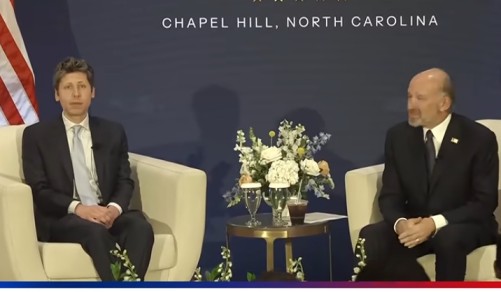
EDITOR’S NOTE: In this fireside chat at the G20 Innovation Ministerial held at The Carolina Inn in Chapel Hill, North Carolina, U.S. Commerce Secretary Howard Lutnick sits down with OpenAI CEO Sam Altman for a wide-ranging conversation on artificial intelligence, global economic growth, and the future of entrepreneurship. Altman traces his personal journey from AI enthusiast to the head of one of the world’s most consequential technology companies, while making the case that adopting AI is non-negotiable for every nation. The discussion covers OpenAI’s origins, the pivotal role of scaling laws, and how AI is poised to reshape economies, businesses, and daily life around the world. (Sep 2, 2026)
TRANSCRIPT:
From AI Nerd to OpenAI: Sam Altman’s Origin Story
HOWARD LUTNICK (00:00:02 – 00:00:50): Hello, everyone. Well, welcome to lunch. Not for you and me, but welcome for lunch. I think we’ve had a great day so far. And I’m honored to have with me Sam Altman joining us for our discussion about AI and where we’re going from here. So thanks for joining us. You have really the greatest countries in the world all around you. So would you mind giving us a little history? Like, how do you go from being Sam Altman to being the head of AI and really at the frontier? Like, sort of walk us through how you got from there to here.
SAM ALTMAN (00:00:51 – 00:01:56): First of all, thank you very much for having me. As you said, this is the greatest country in the world, and it’s a great honor to get to address all of you at the same time. I was always an AI nerd. I was a real sci-fi nerd as a kid. I thought AI was the coolest thing. I always wanted to work on it. I never really thought I’d actually get to do it. I kind of can’t believe this happened to me, but I always thought it was awesome.
I went to school to study it. At the time, nothing was working, and I kind of gave up on it, and I went on this side quest of entrepreneurship, which was also great. And then in 2012, everything changed. None of us paid enough attention, but there was a real watershed moment where all of a sudden deep learning started to work, and it got better with more compute. And I paid a lot of attention to that for the next couple of years, and by the time 2015 rolled around, I was like, hey, this is really going to happen. Like, we got to take it, we got to try. This could be like the most important thing ever. And so we thought for a while about what to do and started OpenAI.
HOWARD LUTNICK (00:01:57 – 00:02:00): And so what year did you start OpenAI?
SAM ALTMAN (00:02:01 – 00:02:06): The very end of 2015, we announced it, and then the first day of work was like January of 2016.
Building OpenAI: From Rubik’s Cubes to GPT
HOWARD LUTNICK (00:02:08 – 00:02:17): So, all right, so you start in 2016, and what are your— like, what’s the big goal that you start with and then how does that evolve?
SAM ALTMAN (00:02:19 – 00:03:52): So we knew that there was this magic piece of technology. We knew that we could apply compute to a problem and to learn it. And we knew that the more compute we used, the smarter and more capable the system got. We didn’t really know anything else. We didn’t know what kind of system we were going to build. This was way before the idea of language models. We were trying to train a robot hand to do a Rubik’s Cube. We were trying to, you know, show that we could play video games. And we were really developing the algorithms and trying to understand how this amazing property of the universe worked.
And then not until about 2018 did we start making progress on unsupervised learning. And then the first GPT-1 model. And not until 2020 did we train GPT-3, which was the first model that I think actually was over some threshold of usability. Even then, most people in the world looked at this and said, you know, okay, the model can generate a coherent sentence. That was really the limit at the time. Kind of impressive, but like, what is this going to mean? And why is this going to matter to the economy or society or anything else?
But we had discovered by this point these scaling laws which said, well, if we could apply like a trillion dollars of compute to this idea, something quite amazing would happen. And people said, well, you can’t apply a trillion dollars of compute, so it doesn’t matter. And we sort of said, why not? Let’s try.
The GPT-4 Moment: When Everything Changed
HOWARD LUTNICK (00:03:55 – 00:04:10): You’ve got the idea and it’s moving forward, but when does it come together that it’s really bottling knowledge? Like, how does that—
SAM ALTMAN (00:04:10 – 00:05:27): Different people at OpenAI would give you different answers to this, but I would say the kind of consensus, to the degree there is one, was the time of GPT-4. This was like— I believe this was like March of 2023, but I may be wrong on the timeline there. We had that model for maybe 8 months before it launched. So we had had time internally to really get to know it. And that was the time where people, even some of the people internally who had been skeptics of this approach, would look at it and said, this is going to go very far.
And it hasn’t been that long since that moment, you know, 3 and a half years now. And the fact that we now have a system, and we’re launching our new model soon, which is another step forward, and there’ll be many more step forwards coming soon after that, but that it is so capable that it is discovering new knowledge, doing science, able to add huge economic value, create entire pieces of complex software.
This is like a very crazy moment. I think it hit us, yeah, over a period of time, but centered around this GPT-4 period.
AI as the Greatest Boom in Entrepreneurship
HOWARD LUTNICK (00:05:29 – 00:05:44): So you understand that you can sort of capture education, right? You capture knowledge. How should the G20 economies think about this?
SAM ALTMAN (00:05:50 – 00:09:26): I don’t want to overstate things, but I’m very excited about our new model, so forgive me if I get a little bit too enthusiastic here. I think this, for example, will be the greatest boom in entrepreneurship and the creation and development of small businesses the world has ever seen. If you have a great idea but you didn’t have the resources or the ability to get enough capital together or hire enough experts to work on it or to figure out what it’s going to take to invent a new piece of science or manage a complex supply chain, you can do that with AI now.
And I remember after ChatGPT launched, one of the stories that has stuck with me the most from that moment was a guy that managed a laundromat. Apparently, laundromats are usually good businesses. Wouldn’t have been obvious to me. Apparently, they are. But this one was not going well, and he was using ChatGPT for everything — to make his marketing materials, to give him advice on legal contracts, to manage relationships with vendors. This long list of stuff. He was really the first person I met that had figured out how to use AI to effectively run a business.
And this was amazing to me at the time. Now, I know you all have heard stories about this a bunch, and it’s no longer surprising, but in 2023, the fact that someone was using ChatGPT, broken and embarrassing though it was at the time, to let them manage a business that otherwise they couldn’t have done was quite remarkable.
In 2025, we saw a real acceleration of this with coding agents and white-collar work agents. I think we’ll see a third thing soon where we’ll have these long-term persistent agents that can work like a real virtual collaborator constantly helping. But it’s amazing to me what is happening with the boom in entrepreneurship and business creation because of AI.
AI Adoption Is Non-Negotiable for Every Nation
If I were a country — you know, many of you are going to take very different approaches to how you regulate AI, how you welcome it into your country, how you use it. But for sure, I think it is non-negotiable that you have to use it. The economic growth and benefit to people that can come from this, the value to a country is too high to ignore.
There’ll be different ways people try to do this, but this is like, you know, the smartest people in the world decided to move to your country. To learn your language, to work very hard on whatever problem you’d like, to go discover new things that you need. And you can put as much of this to work as you want. Some of you will choose to build data centers, some of you will choose to rent data centers from other people because you don’t want them in your country. I think all that’s fine, but we want to help. We want to support not just our company, our whole industry. Like, we want to bring this incredible magic of, you know, intelligence in a bottle, education in a bottle to all of you.
I think this is an incredible moment for the world. What people can do with this and the economic boom that will come with it, the sort of individual increased quality of life. People talk about, you know, medical care and what that means, education and what that means, services that only very rich people used to have access to, now anybody can have with AI. And the ability for people to just come up with ideas and get them to fruition so quickly is going to be incredible.
Context, Creativity, and the Role of OpenAI
HOWARD LUTNICK (00:09:27 – 00:10:03): Do you think that your company can create the context that people can use to create their outcomes, or do you think there’ll be an industry sort of surrounding you that will contextualize it? ‘Cause if you think about it, you say the smartest people in the world move into my neighborhood and they’re willing to work for me, but if I don’t know what to ask ’em to do, it’s not really a fun dinner party having the smartest people in the world sitting with you and they can’t really have a conversation, right? So how do we think about context?
SAM ALTMAN (00:10:03 – 00:10:45): That’s not going to come from us, and I don’t think that should. We will provide this engine. You know, we will provide this incredible commodity of AI that you can use for whatever you want. But the people of the world, and I have complete trust in the people of the world’s creativity and ambition, will have to figure out what to ask it to do, what ideas to throw this at, what problems and what context in a particular society or company is important to understand what to do. So that won’t be our role. I don’t think we’d be good at it even if it were. But we will be able to enable everyone around the world to bring that context and those questions and those ideas.
How Governments Should Think About AI
HOWARD LUTNICK (00:10:47 – 00:11:23): So should the governments of the world think of AI and companies like your company different than they thought about prior technology? Meaning, if what you’re bringing them is, you know, the smartest people in the world, an educated capacity, then if they look at that as technology and they keep it out of their country or they constrain it, are they constraining their capacity to think and grow and build?
SAM ALTMAN (00:11:27 – 00:13:59): I am always tempted to say this time is different. This is really special. And I suspect— well, to zoom out even further than that, as a kid, my understanding of the world was that there were these few punctuated moments in history, each of which was a very different thing. You had the Agricultural Revolution. And then you had the Industrial Revolution, and then you had the Computer Revolution. And these were all completely different, unrelated things, and there were not that many lessons to learn from them, and they were best understood in isolation.
And even if you zoomed into one — pick the Industrial Revolution — the right way to understand that was 20 or 30 important pieces of technology that were all developed over a period of a couple hundred years that came together in this important way.
As an adult, I look at it as, you know, it has been a single revolution, a single exponential of technology. Each generation has built on the scaffolding of the generations before, put a new brick in place. People have been able to see a layer of scaffolding, to stick with the analogy. People have been able to climb and see a little higher and do the new thing.
If you think about what it took to get us to this point where we can build AI, it was all of those previous revolutions stacked together, and it was the collective discovery of science throughout society and the global economy that we all contribute to that made this incredible thing possible and now happen. And it is tempting whenever you’re in the moment to say this is the last revolution, this is the biggest revolution. There will be more after this. There will be bigger things after this. People will use AI to invent whatever thing that comes next. It’s probably very difficult for us to imagine right now.
And I think the right answer is to look at the history of technology as one continuous exponential, the history of the economy and society as one continuous exponential. And I really mean that. It’s not just the technology. It’s this social fabric and the kind of complex structure of the world that allows this technology to flourish and people to figure out what to do with it. And you have to embrace it continuously all the way through.
If you miss out on any part of it, you’re not ready for the next thing that will come. If you don’t enable your people and your businesses with AI, they will not invent the next level of the scaffolding. But there will be more things. And I think it is tempting to say this one is different and it clearly is really important, but I would view it as a continuum.
OpenAI’s DNA: What Sets It Apart
HOWARD LUTNICK (00:14:01 – 00:14:25): So we all read about the various companies at the frontier. Can you sort of differentiate them for us? What do you view OpenAI as best at? What’s the, you know, your DNA, if you will, that separates you from the others? And what are you great at? And just give us that sort of from your perspective.
The Pragmatic Centrists: AI, Entrepreneurship, and Global Growth
SAM ALTMAN (00:14:30 – 00:16:31): I think from what matters to this room, we are the pragmatic centrists. We realize we want to be accurate in how we talk about what we see in the future. We don’t want to fall into the trap of blind optimism. We don’t want to fall into the trap of doomerism. This is clearly complex. There’s clearly a combination of both excitement and anxiety, of transformation and risks that the world has to navigate. But by getting pulled into either extreme, we are not going to successfully figure out the challenges in front of us.
We want to be a reliable partner. We really do view what we are doing as a platform, as a service to the world. We realize that different people around the world are going to use it very differently, and we want to put some sufficient constraints on our system to avoid catastrophic risks, but we really do want to respect all of your sovereignty and that you’re going to use it in very different ways. And we personally may not always like it, but I don’t like everything that people do with electricity either, and I still think everybody should get to have it.
So, and then also I would say we want the whole global economy to succeed. We do not want to be the only company. We do not want to suck up all the value. We do not think that is good for global stability, nor do we think that’s possible for the way that people need to flourish and people need to stay at the center of this. And we want to enable every entrepreneur, every government, every big company in the world to thrive with this technology.
The last thing I’ll say that I think differentiates us from some of the other companies is we are very firmly and very proudly on team humanity. We would like to build tools for people. We would like people’s lives to be better. We think that people need to be at the center of the economy and society and global decision-making, and that people should run the future in AI.
Entrepreneurship as the Fire Starter
HOWARD LUTNICK (00:16:33 – 00:16:51): So it seems that entrepreneurship should be really the fire starter of all this, right? You’re— are you the kindling of it? I mean, maybe sort of tell me how entrepreneurship and OpenAI sort of work together.
SAM ALTMAN (00:16:53 – 00:18:22): But before OpenAI, I used to run a startup accelerator, and I had always been interested— not always. After I came to college, I’d always been interested in entrepreneurship. And then having had this incredible front row seat, I really became convinced that entrepreneurship was maybe the most important novel force in all of capitalism. And I fell in love with it. And watching what new companies were able to do, and watching how large of a percentage of the new ideas that mattered in the tech industry over the last, 20 years or whatever came from startups and not big companies.
Now, having seen this in other industries, I am a huge believer in entrepreneurship. I also think that I talk to a lot of people around the world, and they would much rather run a great lifestyle business than go work as a corporate cog. And I think that’s great too. We should enable that. One of the things I got excited about early with AI, of course AI is going to transform big companies, and of course AI is going to transform governments, but what AI can do for entrepreneurs and for people that want to take an idea and bring it into the world quickly is really quite amazing. When I was running the startup accelerator, it lasted for 3 months, and the work that we—
HOWARD LUTNICK (00:18:22 – 00:18:23): It lasted for 3 months?
SAM ALTMAN (00:18:23 – 00:18:47): You were in it for 3 months. And the work that we expected a startup to accomplish in 3 months is now probably doable in like 17 minutes with Codex. This is just amazing. The world has not caught up with what this is going to mean, not just for the economic value that gets created from that, but how quickly people can test ideas, build things, get feedback from real customers. We’re all just going to get much better stuff.
AI Adoption Is Non-Negotiable
HOWARD LUTNICK (00:18:49 – 00:19:06): So you use the term I want to sort of flesh it out a bit. Non-negotiable. Can you maybe help everybody understand what you mean about that and what that means for each of our partner ministers who are here today with us?
SAM ALTMAN (00:19:11 – 00:20:08): Again, I’m biased. I’m trying to talk my book here. Forgive me for this analogy. I think it would be approximately as bad of an idea to say we’re not going to have AI in our country as it was to say we’re not going to have electricity in our country, back 100+ years ago. I think this is something at that level. This is something that every person and every business and really the entire machine of society is going to need to deliver the quality of life that your citizens should demand.
Now, electricity also came with some complexities, and it took a little while for us to figure out how to make it safe, but we made fairly rapid progress as a society to make it generally pretty safe, even though it can do a lot of bad things. And at this point, we barely think about electricity. We turn these lights on, we expect them to work. If the power shut off and I had to scream because this microphone was not working, I would be annoyed about that.
HOWARD LUTNICK (00:20:10 – 00:20:10): You—
SAM ALTMAN (00:20:10 – 00:21:29): I won’t go through all the examples. I see all the phones on the table. It would be hard for society to function well without electricity at this point. But we don’t think about it much. We think about, there’s light at night. That’s great. We can hear these people speak in the room without them having to yell. That’s nice. Our phones can do these amazing things for us. We care about our phones. We don’t think too much about the electricity that gets generated to power them.
And I think the same thing is going to happen with AI. My prediction is we won’t be talking about AI as much as we do in a decade from now because we’ll just expect it everywhere. A kid growing up today will never be smarter than AI, but he or she will also never have understood a world where every product and service that they interact with is not really smart and really capable and really helpful. Because we’ll just be so used to that, we won’t think about the AI. We’ll just be like, yeah, I want my products to be good. If I have an idea, I want to be able to make it right away. I want this software to be created instantly for me. If I have a disease, I expect a cure to get discovered very quickly.
So I think countries need to embrace this. Again, there’s many ways to do it. People will set different rules. People will decide on what they want to build versus rent. But I think everyone will need this new commodity.
Challenges Ahead: Cybersecurity, Concentration of Power, and Inequality
HOWARD LUTNICK (00:21:31 – 00:21:42): If we look forward 5 years and we come back to North Carolina all together, what will be holding us back, do you think, in your opinion?
SAM ALTMAN (00:21:46 – 00:23:46): Well, there are clearly challenges that we have to get right along the way. There will be specifics. For example, I’m sure cybersecurity is a top-of-mind issue for many of you. We work with many of the governments in the room. We work with the state of North Carolina. We work with companies big and small. And I think we have a big challenge in front of us, to not try to sidestep this one. I think some things are going to go very wrong with cybersecurity unless people act quite urgently.
There will be other challenges in the next 5 years. People talk about biosecurity and the things we’re going to face there. There will be bigger ones yet to come. And I think if we don’t successfully navigate those, society will not be able to adopt AI to the degree or to the speed with which people deserve. So successfully navigating the risks and downsides in front of us is something that could go very wrong, and I think will set this technology back, could set this technology back a great deal.
Another thing that could go wrong is too much concentration of power. AI should be, in many ways, AI should be an equalizing force in the world. You talked about what it means to have like a reset on the educational capacity available to everybody. You can also see worlds where AI concentrates because some people make early investments and others don’t, and there’s bad inequities with compute or whatever. That’d be bad. So I think if we fail to make AI abundant, it ends up being something that is very hotly competed over, rich people spend a huge amount of money on, and that would be a bad outcome. So I think we need to make it abundant so that we get the benefits of lifting everybody up and not much worsening inequality.
Democratizing Intelligence Through Infrastructure
HOWARD LUTNICK (00:23:46 – 00:24:25): Right. As you said, if the smartest people in the world learned your language and all agreed to move to your country and work on whatever you wanted them to work on, that has to be the most incredible thing. Do you think that since you’ll have all the smartest people speaking all those languages, can’t they figure out a way, do you think, over time to deliver the same amount of compute more inexpensively without the same use of power, without the same— I mean, aren’t these the kind of things that are going to happen that will democratize it by sort of by itself in a way?
SAM ALTMAN (00:24:27 – 00:26:19): It will still require huge investment. But yes, we will continue to make things vastly more efficient and we’ll figure out how to make more and better chips and we’ll figure out how to make smarter algorithms. All of that will happen. But to put some numbers on the magnitude of how much we need this to happen, again, I don’t have these numbers in front of me. I’m not going to get this exactly right, but forgive me for the approximation.
At the beginning of 2020, the token leader in the world was an OpenAI employee using roughly 100,000 tokens a month. In the middle of 2026, the token leader that I know of— there may be somebody using more than this outside of OpenAI— was using hundreds of billions of tokens a month. So, a multi-million x increase in 6.5 years. And the average person on Earth had gone from using effectively zero tokens to 100,000 tokens a month. That was the global per capita thing.
If we just naively project this forward again, which seems like a reasonable thing to do to me, and I hate tokens as a unit here. It’s a dumb one. No one should care. But let’s just take that as shorthand for amount of intelligence. Then in another 6.5 years, the average per capita use of tokens will go up to— let’s round it down to 100 billion tokens a month. And the person using the most in the world will be using 100 quadrillion tokens a month. Even with great gains on efficiency, we are going to need to build much more infrastructure unless we want this to be a highly priced commodity, which we don’t. We want this to be abundant, we want this to be inexpensive, we want people to just be able to use this for whatever they need.
HOWARD LUTNICK (00:26:20 – 00:26:42): So that’s the driving force. If we globally can build enough, then intelligence will be broadly distributed, more democratized across the world. The world will be educated, or they’ll have the access to education. Is that sort of the—
The Cost of Light, AI Abundance, and Optimism for the Future
SAM ALTMAN (00:26:42 – 00:28:33): Absolutely. To go back to the analogy of electricity, there’s this amazing chart of what it cost to have an hour of light at night. And there was a time, one of the earliest data points you can find, is that it took an average of 5 hours of labor at the wage of the time to be able to pay for 1 hour of light at night.
Electricity came along, it fell, we figured out how to make more electricity, so there was the supply and demand change curve. It fell again. We figured out how to make vastly more efficient light bulbs. We went from incandescent lights to LEDs. A whole bunch of other things happened. And now an hour of light at night is not something that people think of at all about the cost. I don’t even know what the number is, but someone in here can do it. It’s like very cheap to run a 5-watt bulb for an hour.
If that hadn’t happened, if we— and all of those things together had to happen, lots of electricity generation, huge innovation on the efficiency, all of these things. If that hadn’t happened, then rich people get light at night and they can study more. They have a compounding effect. They can learn more, whatever. And poor people don’t.
So I think it’s been very good that energy has become abundant and that light at night has become relatively, like, shockingly inexpensive. If that same thing happens with AI, and anybody on Earth, rich, poor, whatever, can use AI to get the abundant services that they need and to express their ideas and to start their businesses and whatever else, and we fulfill our mission of making AI so inexpensive and so smart that people are just like, they think about it like they think of the cost of an hour at night, of light at night, I think that’d be really wonderful. And then this huge reset and democratization of education you’re talking about can happen.
On Doomers, Optimism, and the Promise of AI
HOWARD LUTNICK (00:28:34 – 00:28:56): So are you— look, there are doomers out there who worry about everything. But we know that if you look back through the Industrial Revolution, as you said, it always seems to work out fine. Are you fundamentally optimistic to what your products will do to the world and will serve the world?
SAM ALTMAN (00:28:57 – 00:31:06): I think part of the reason it tends to work out fine is people worry and they stress and they look at the downsides and they try to address those and they try to learn how we avoid accidents. So if we go back to an early example, even before electricity, of a technology, fire was incredible, incredible for human evolution, incredible for letting us cook our food and heat our homes at night and whatever else. It also burnt down whole cities.
A few times, and people really worried about that because we don’t want cities to burn down. And we figured out fire safety, and through a lot of human ingenuity, through a lot of good policy, definitely through learning from some very bad accidents, we figured out how to make it safer. Now, had we just said like, yeah, some cities are going to burn down, whatever, we got other problems to work on, probably wouldn’t have figured that out. And that wouldn’t have been as good.
So I think worry is warranted. Worry is how we anticipate problems and how we, from a matter of policy and a matter of technology, figure out how to address them. But I am optimistic that we can mitigate the downsides of this technology.
And if you look at what’s happened, if you look at what the doomers were saying 5 years ago about the chances of us being able to make AI of this level, of this sort of near-human, sometimes superhuman capacity level, broadly considered safe and reliable. Not perfect. There have been accidents. There will be accidents, of course. I don’t think most people would have thought it was going to go this well as it has so far.
And I believe in human ingenuity and the ability to solve very difficult, very complex problems. And I think we’ll keep doing that. And I think the economic value and the personal value is so huge. I met with someone just this morning who told— and again, I’m sure you’ve all heard stories like this— that they wouldn’t be alive without ChatGPT and that they had a very difficult disease and got a diagnosis that doctors weren’t able to give them. We shouldn’t take that away. Yeah, we need to figure out how to make the technology safe so that people can have more of that. Great.
Closing Remarks
HOWARD LUTNICK (00:31:06 – 00:31:22): So Sam, thank you for joining us. It was really an incredible conversation. 2 o’clock, so 2 PM in the ministerial room where we will have Alex Karp will be our next guest speaking to us.
SAM ALTMAN (00:31:22 – 00:31:23): He’s a good one.
HOWARD LUTNICK (00:31:23 – 00:31:28): He’s a good one. But thank you, Sam, for joining us. Thank you. We really appreciate it.
SAM ALTMAN (00:31:28 – 00:31:31): Thank you.
Related Posts