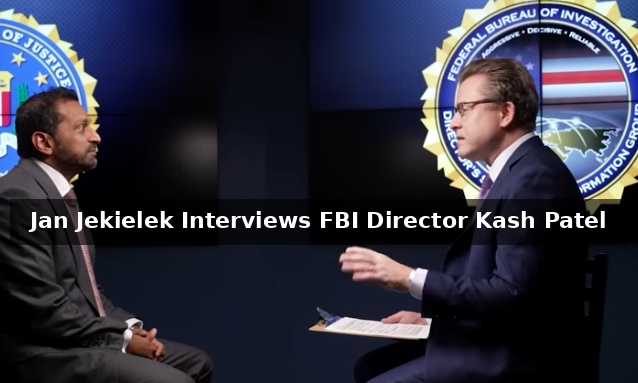
Read the full transcript of FBI Director Kash Patel’s interview on American Thought Leaders with host Jan Jekielek, August 9, 2026.
EDITOR’S NOTES: In this interview on American Thought Leaders, host Jan Jekielek sits down with FBI Director Kash Patel to discuss the bureau’s aggressive campaign against global scam empires. They examine Operation Blackout, a major international effort that dismantled large-scale scam compounds, seized billions in assets, and rescued thousands of trafficked victims. The conversation also covers pig-butchering crypto scams, partnerships with foreign agencies including China’s Ministry of Public Security, and broader FBI priorities from counterespionage to internal reforms.
Inside the FBI’s Command Center: The DSIC
JAN JEKIELEK: Director Kash Patel, so good to have you back on American Thought Leaders.
KASH PATEL: Jan, thanks so much for coming to the FBI headquarters and visiting our intelligence sharing spaces here.
JAN JEKIELEK: Well, this is crazy being in D6. So I understand this is — this was one of the major command centers during FIFA, during the World Cup, which I saw you saying there were no major incidents. It was a massive operation. So this was the hub. Just tell me about this space. Tell me about that before we start.
KASH PATEL: No, absolutely. Look, the American public should be proud of what the Trump administration accomplished during FIFA. To put it in perspective, we basically had 78 Super Bowls in 39 days across 11 different venues across the United States of America. We had 6.8 million people visit and attend the games during that time span. On top of that, we had all the teams at different base camp locations where they lived for the duration of their time at the World Cup. We had all the fan zones, we had all the pop-up zones across the country. So it was really the largest sporting event the world has ever seen. It was double FIFA’s prior World Cup record.
So what law enforcement had to do was meet the demands of the modern times, and the Bureau had to upgrade its spaces and our capabilities. So DSIC — our Director’s Strategic Information Center — this is a part of it, but this specific space was used during the World Cup to share classified intelligence with our classified interagency partners along the IC and also our Five Eyes partners to make sure we were getting threat reporting in from overseas, and what we were getting, we were sharing back out with them. And it all happened right here, staffed by people from across the IC in this room.
Drone Threats and Counter-UAS Operations at the World Cup
JAN JEKIELEK: And so, but there were some incidents that you managed to thwart along the way, and you’re open to talking about any of those?
KASH PATEL: Yeah, absolutely. So one of the biggest threats we had to prepare for at the FBI was drone mitigation and counter-UAS systems. And the federal government did not have a capability to work with our state and local partners, because nothing we do at the FBI — especially with the World Cup — could happen without our state and local partner law enforcement relationships. And they just don’t have the capabilities on counter-UAS systems.
So what we did, we set up the first-ever counter-UAS school at our Redstone Arsenal in Huntsville, Alabama. And we trained state and locals over two-week periods and cycled them through from around the country leading up to the World Cup. And we utilized that experience. The FBI had our — what we call Ground Intercept Teams, GIT teams — at every venue in the country to deploy the capabilities that we have, the tech that we have, along with our state and local partners.
And we interdicted, with our partners at DHS and the state and locals, 740-some drone interdictions flying over venue spaces either improperly or illegally, to make sure they didn’t pose a threat. And especially if they’re violating the law, then we worked with our DOJ partners on that matter.
Operation Blackout: Taking Down Global Scam Compounds
JAN JEKIELEK: Well, let’s dive into scam centers. You’ve just come back from a big trip overseas — Operation Blackout. So four key components to this. I’m actually interested in every single one, but let’s start with the largest seizure of Bitcoin — 127,000 Bitcoin seized in Operation Zephyr Exodus. And by the way, who comes up with the names?
KASH PATEL: Much more creative people than I. If you left it to me, they would be pretty boring. The president and the vice president stood up their amazing task force — the Anti-Fraud Task Force — and that’s for all the things related to healthcare, Medicaid, Medicare, and the programs that are stood up and use our taxpayer dollars to assist those. We can talk about that later.
The scam compound fraud is a slightly different variation, but no less egregious and illicit. So basically, we wanted a twofold approach — proactive through Operation Level Up, and also investigatively through Operation Blackout. Operation Blackout is our umbrella enterprise investigation where we went to the source of the scam center compounds, because they’re not stood up here in America.
And when I say compounds, these are actually villages stood up with forced labor and trafficked workers who are not allowed to leave and live there 24/7 in the cross-border regions of Cambodia, Burma, and Thailand. So over the last 14 months, thanks to President Trump, we had the incredible ability to have these relationships with law enforcement and world leaders in those regions of the world that we didn’t have before. And so we started engaging them, and we said, look, this is also affecting their citizens as well as ours, to the tune of hundreds of billions of dollars when you encompass the whole thing.
So we just finished our trip there to Cambodia, Thailand, and Indonesia, and we worked with their law enforcement capabilities and their military capabilities to conduct four operations — three in Southeast Asia and one in the Middle East in Dubai.
And in one of those operations that you named — Zephyr Exodus — we actually seized somewhere around $15 billion, give or take, in crypto from one of the largest scam center compounds, which means we got that money back. And we’re now working with our DOJ partners to redistribute it back to the people that it was stolen from.
But how they do it is they call you. They participate in these things called romance schemes. They call you and pretend to be —
JAN JEKIELEK: Pig butchering scams is another term for it.
KASH PATEL: Perfect word. And what that basically means is they fatten you up until you’re as big as you can possibly be for the take, and then they go in for it and steal your life savings, steal your pensions, steal your kids’ college tuition funds. And they do that with online phishing and vishing and email operations, telephone calls, as I was saying.
So you have to annihilate the entire compound. And so we did that with our partners. And I think what we’re most proud of in that endeavor is our partnership with the private sector. These scam compounds are literally in the middle of the jungle. It’s not like you can just drive over there. And they’re in disputed territories in the cross-border region, so it complicates things a little bit when it comes to diplomatic relations. But since it was affecting all of those nations’ citizens, they were great partners of ours.
And we worked with the private sector to shut off their communications and internet capabilities. We shut down 8,000 terminals which these scam compounds utilize to connect with the rest of the world, depriving them of the very oxygen they need to operate.
Operation Sand Dollar: The Dubai Takedown
And so in the Middle East, we did something similar. We had 300-plus arrests, freed a few thousand more trafficked workers, and seized ill-gotten gains through their scam compound operations. So they’re happening all over the world. They’re concentrated in Southeast Asia and other pockets like this location in the Middle East.
But thanks to our engagements under the Trump administration, we were able to call the Dubai police, the Royal Thai Air Force, the Royal Thai police, the Cambodian police, the Indonesian services, and even work with partners at MPS in China to have those officers on the ground. Because a lot of the criminal syndicates that run these enterprises are pretty much straight-up gangs that have found a way to make lots of money stealing from Americans and also stealing from other nationals from other countries. So they were willing participants and great partners.
For the first time ever, we did joint operational raids in all of these areas, and then we actually got the Royal Thai Air Force to go in there and literally blow up some of these compounds. Because that’s the ultimate win. If you just take them out, they’re going to send more people back in there. But if you completely rubble and raze — dismantle the infrastructure — then they can’t go back there. And that’s what we did.
The FBI’s First-Ever Scam Center Summit
JAN JEKIELEK: I mean, a big piece of this obviously is negotiation, communication. I’m just imagining, given what I’ve been learning being in D.C. the last few years, the sort of jurisdictional questions just in America — never mind trying to do it with as many countries as you did.
KASH PATEL: Yeah. And they were great partners. All the ones I mentioned — we actually had the FBI host the first-ever Scam Center Summit in Bangkok, Thailand, as part of our trip, where we had dozens of law enforcement agencies and I think 200 or 300 law enforcement partners show up, because that’s how committed they were to fighting this epidemic of crime.
And we also rolled out Operation Level Up. That’s our proactive piece. What we ask the American public and the rest of the world through our partners is: the second somebody emails you, the second somebody calls you and it sounds a little off, tell us. We have this IC3 — our Internet Crime Center — where people go and just report what’s happening to them.
Through that operation alone, we were able to prevent 10,000 Americans from being scammed out of $560 million. We literally had folks from across the country writing back to the FBI saying, “You saved our life savings, you saved our kids’ college tuitions.” And some of them were actually considering killing themselves because it’s such an embarrassing thing to be a victim of this atrocity, of this crime.
And so when we collect that information from them, we’re able to proactively stop it before it even starts. And we’re able to map it back to the networks that we established in these cross-border regions to say, “This is where it’s coming from. So if we target this one compound specifically, we’re going to annihilate a huge infrastructure that is doing this to millions of people around the world.”
So the FBI is leading out on Operation Blackout. It’s going to continue. I pressed to go to the region with specifically one ask: to complete the mission and annihilate the compounds wherever they are. And I think you’re going to see even bigger results by the end of the summer.
Scam Slave Labor: A Win for the World
JAN JEKIELEK: So just a couple of comments on this. I recently interviewed the director of a film called Scam Slave, and it was actually through some diplomatic work that one guy managed to get out, with a few others, from a specific African country because of diplomatic work. But these are — this is slave labor. People are lured in from all over the world. So you releasing thousands in each one of these operations is welcomed by many people. Hopefully that part gets publicity, because this is you countering some serious human trafficking — and not just in America, but in a broader way. But the effect of it is helping Americans.
KASH PATEL: Yeah, it’s a win for the world, right?
JAN JEKIELEK: Right.
KASH PATEL: As you said, my priority at the FBI is to safeguard Americans and prevent criminality from hitting American shores, and working with our partners, we do it internationally. But when a country gets to receive thousands of people back that were in forced labor, that’s a win.
JAN JEKIELEK: Have they all returned to their countries now?
KASH PATEL: Each of the ones that we’ve raided in these compounds, they’ve been returned.
Operation Sand Dollar: The Largest FBI-Led Scam Center Takedown in History
JAN JEKIELEK: Just one comment on Sand Dollar. You’ve described it as the largest FBI-led scam center takedown in history. How so?
KASH PATEL: It was a coordinated operation — this is the one I was talking about in the Middle East. So we actually brought in FBI, Dubai police, and MPS officers from China, because all three of our countries were being affected by this scam compound. And this was the largest US dollar-based — non-crypto, dollar-based — scam compound that was in operation at the time.
And the scam compound syndicate got smart. They said, “Look, they’re onto us in Southeast Asia. Let’s move to a different location where we think we have safe haven.” And they don’t — not in the UAE. And we alerted our friends at the Dubai National Police, and they said, “Let’s do this operation together.” And we took the whole thing down.
Working with China’s MPS
JAN JEKIELEK: It’s fascinating that you’ve been able to work with the MPS, right? Because you’re also on record, I think, in congressional testimony talking about the fact that the Chinese regime actually kind of enables these things in effect when they’re not affecting Chinese in particular. So tell me a little bit about that work.
Law Enforcement Cooperation with China: Targeting Criminal Syndicates
KASH PATEL: Well, so once we dig into this work, law enforcement has a unique role unlike some of the other agencies that all our governments around the world have in terms of intel and whatnot. So law enforcement, and thanks to President Trump’s engagement with President Xi, we created a lane. He created a lane for us to engage directly, even with those that would traditionally — America wouldn’t engage with. And we did that.
I’ve been to Beijing twice now in this seat. And no FBI director had gone there in, I think, over 11 years. And what we said was, look, the criminal syndicates, the gangs, the national gangs, whether they’re out of Southeast Asia, whether out of China, whether out of the Middle East — those are criminal syndicate enterprises that we can collectively annihilate because they’re fleecing your citizens too.
And they were more than willing to assist us in these operations and send their officers. I said, look, you have to have actual foot in the game here. We don’t just need intel sharing. We need your folks on the ground working with us to show the world that we are actually doing this. And that’s what we did in Southeast Asia and that’s what we did in the Middle East.
So where we can have law enforcement success, and annihilate these compounds and save Americans — most importantly for me, but the rest of the citizens of the world — from this illicit criminal syndicate, is somebody I’m going to engage with all the time.
Senator Rick Scott’s Skepticism and the Fentanyl Precursor Progress
JAN JEKIELEK: You posted something on X — as I follow you kind of avidly — talking about working on fentanyl, working on scam centers and so forth. And Senator Rick Scott responded, “This is how communist China works. They’ll do just enough to keep you interested, but they never keep their word.” That’s been our experience in our reporting as well. How do you deal with that?
KASH PATEL: So the senator is a great friend and partner and tremendous advocate of law enforcement. And we have different roles. Congress has a different role than the FBI, than does the CIA, NSA, and the Department of War. Our specific role is to combat crime that’s impacting Americans wherever it’s sourced.
And so for the first time in history, the FBI and the MPS are running 4 separate joint operations together: on countering fentanyl, on countering the cyber element that we’re talking about here — including scam compounds — on countering violent crimes against children, which is something everyone wants to do. And we’re also doing work on our most wanted fugitives. And so that’s our lane. And that’s the lane that the White House has supported the role of the FBI through President Trump’s engagement. Engage where you can.
And that’s what I told my counterparts in China. I said, “We are not going to agree on everything, but on these things, as my role as the FBI director, this is common ground for us to agree on.”
And on the fentanyl specifically, look, last year we saw a 20% reduction in opioid deaths in America. That’s a huge reduction, and that’s not by accident. When I went there 10 months ago, I said, look, the fentanyl precursors are a big problem. They are being sold to the Mexican drug cartels who are making and manufacturing this drug at a lethal and addictive level because of these rare compounds and components that are only sourced from certain areas of the world. I said, you guys — you, the folks in China — need to list them, essentially making them an illegal item to ship overseas. And they did that. They went out and listed 17 of them. And this summer they’re going to list, I think, 24 more.
But to generally talk about its impact besides the reduction in opioid deaths in America, we look at the intel reporting from the drug traffickers, the DTOs down south. And without getting into all the classified information, what we do see generally is the following: they’re complaining that they can’t get the fentanyl precursors they need to make the fentanyl the way they used to make it. They’re complaining that it is no longer as addictive as they want it to be, and they’re complaining that the lethality is not at the rate they would want it to be when they manufacture it.
Those 3 indicators represent a massive shift in the drug trade when it comes to fentanyl, and that’s a direct result of us working with MPS to get the fentanyl precursors shut off. There’s more work to do. There’s always more work to do, John. We’re not saying this is a win in totality, but that’s a lot of progress and that’s a lot of American lives saved. And that’s my priority.
Leverage Through Presidential Engagement
JAN JEKIELEK: Well, it also tells me that you have some real leverage. This is happening the way you’re describing.
KASH PATEL: Well, I think any leverage we have honestly is due to the president’s leadership and engaging. He went there and met with President Xi. He had the Busan Summit. And that opened a lot of doors for us. And we’re receiving audiences — like I did when I was just there a couple of weeks ago — with individuals that would never meet with law enforcement.
And we’re telling them and we’re having open and frank conversations. We’re saying, “This is our priority as the American law enforcement agencies. This is our priority at the FBI: fentanyl, violent crimes against children, cyber initiatives, and the fugitives — the people that are doing the most harm and seeking safe haven around the world.” And on each one of those 4, we’re getting actual deliverables for the American people.
Real-World Example: Cyber Fraud and the Nigerian Black Axe
JAN JEKIELEK: So I want to give you a kind of a real-world example and just to comment a little more, digging into this a little more so people can sort of imagine what this might look like.
A U.S. homebuyer was recently defrauded while purchasing a house. She believes she was wiring her closing funds to her title company, but cybercriminals had compromised the title company’s communications and redirected her to a fraudulent bank account. She lost nearly $140,000 in a single day, and she later learned that the scam was linked to the Nigerian Black Axe, a violent organized criminal network. Investigators said the proceeds were moved through countries such as Russia and China. And in her case, the FBI told her that the money ultimately ended up in China, and she has recovered only a tiny portion of it thus far. She feels she has no hope.
Okay, so how does the FBI work to get some of this money back when the money has ended up —
KASH PATEL: So like the seizures that we’re talking about, we work with our partners at the Department of Justice to bring prosecutions on all these cases everywhere we can. And through the court process, once the proceedings are concluded, we’re able to deliver the funds back to these individuals. I wish it would move faster, but at the same time, we have a responsibility to those that we charge — that they have the constitutional rights that they have. And we’re not going to short-change them on that. And I know that there’s the frustration in doing that versus giving American citizens back their hard-earned dollars and their life savings faster.
So we’re trying to do that, but we’re also taking the fight to places like Nigeria and Africa. And that’s the thing about proactively going in there — so there’s less of these individual victims who are already on the victimization end, versus getting in ahead of time and saying, “You’re going to be a victim, but now we’re going to cut it off ahead of time.”
Then we go to these countries and say, look, we’ve seized this money or we’ve frozen these assets. And we work with our partners at Treasury and we sanction individuals if these companies and entities don’t want to participate in the return of these funds that were stolen from American citizens.
Thankfully, the Trump administration has put on an interagency-wide approach to this fraud and said, look, it’s not just an FBI initiative. We can use these other levels we have — whether they’re OFAC sanctions or Treasury sanctions. And a lot of these individuals, as you highlighted, use certain streams to move the money. And if we’re able to sanction and shut off those pipelines, then we cripple their ability to move those ill-gotten gains, seize them, and return them back to these individuals.
Our hope is to make everyone whole. And we’re working towards that goal. But this was an initiative that we kicked off over the last 16, 17 months here at the FBI. It really hadn’t been undertaken before because it wasn’t a priority. And to me, that made no sense. And it didn’t to the administration either. So we made fighting fraud — whether it was in the scam compound arena or whether it was in the healthcare, Medicaid, Medicare fraud arena — and are going after it on both sides.
Recovering Money from Russia and China
JAN JEKIELEK: Have you been able to get any money back that ended up in places like Russia or China? China being a favorite kind of location with a lot of these — for example, with the fentanyl precursors, they’re laundering the money being paid and so forth. And also here it seems the Nigerians have been using that as a haven.
KASH PATEL: Where we have success is these criminal syndicates need to, at the end of the day, get their money out from somewhere. They’re not just sending it to a nation and saying, “Thanks, we’ll see you in 50 years.” So when I say we’re attacking the criminal syndicate network, we’re attacking the leadership that’s taking all this money, arresting and taking down those individuals and seizing it.
So what they do, Jan, is — Step 1, they set up the compound, the scam compound system: text messaging, phone calls, emails to target people and pig-butcher them. Step 2, they illegally steal their money, their life savings. Then they have to move the money — Step 3. But Step 4 is they have to launder the money back into a usable format for them.
And so what we’re doing on the back end is catching where they’re sending the money back to, and a lot of it is crypto wallets. So they’re transferring the cash, the U.S. dollar, into these crypto wallets that they don’t think we have access to. And thanks to our cyber capabilities and our initiatives at the FBI, we’re seizing those crypto wallets, and then we’re getting the individuals like this their money back through the seizure of the wallets — because the money’s not sitting in a bank account. The criminal syndicate has to use it to enrich themselves, buy fancy things, and also continue the criminal conduct, the criminal enterprise that they’ve embarked upon.
Advice to the Public: Report Early and Often
JAN JEKIELEK: What is your advice to people that might be watching? There are some people who are just afraid to use their credit card online ever.
KASH PATEL: It’s a couple of things. It is never too early to call 1-800-CALL-FBI or go to our IC3 — our ic3.gov website, our Internet Crime Center — where anyone can literally just shoot us a note and say, “Hey, I got this text, I got this email, I got this phone call, something seems a little off.” Our IC3 has received more complaints in the last 16 months than it did in, I think, the entirety of the 4 years preceding it.
JAN JEKIELEK: And you can handle that?
KASH PATEL: Thanks to this —
JAN JEKIELEK: Yeah.
KASH PATEL: Thanks to the rebuild of this infrastructure here at the Bureau, which didn’t even have the ability because no one had a focus on it. We are now able to use AI and triage this data as it’s coming in. And then what we do is we cut leads to our field offices based on where the victim is in the U.S., and we combine it with our enterprise investigation that we talked about — Operation Blackout and Operation Level Up — and we tie it right back into that and we say, “Okay, Mr. and Mrs. So-and-so were fleeced of $100,000. We found it. Now we can get it back to them.”
But the thing that Americans can do is call us often and early, because every single one of these is not a one-off. It’s tied to a criminal network overseas somewhere. And once we have more and more information, we’re able to do more of these compound raids and seizures and dismantlements. And that’s the ultimate win.
So my advice and my ask to the American public is — like on any high-profile case — we need your assistance. We need you to come forward. And we know that when you’re victimized in this fashion, it can be embarrassing, for sure. But when you come forward, you’re probably saving a handful of other people who would be victimized from being victimized. And it’s our best chance of getting you your money back because you’re —
JAN JEKIELEK: — you have a chance to get your money back and you’re providing valuable intelligence, right?
KASH PATEL: Yeah. So it’s extremely important. And now our work shows — not me saying it, but our work shows — in Operation Blackout, in our attack on the scam compound centers, that this is working. And we are seizing, what do we say, something like almost $16 billion worth of currency, crypto, from around the world. And once we, the FBI, have it, then we can use our legal system to get it back to the citizens.
Chinese Interference in the 2020 Election
JAN JEKIELEK: I want to switch gears a little bit here. One of the big things that we’ve been talking about at Epoch Times recently is the president announced that there was Chinese involvement in the 2020 election. There was interest. There was, for example, the one thing that was in the papers that were published was that all of the voter data from, I think, 220 million Americans was gathered. We have seen, of course, the things that John Solomon got declassified and so forth. But what else can you tell us?
KASH PATEL: Yeah, I think the president was right to go to the nation and the world and put forth this information, but it was only possible because the president directed us to declassify and divulge this information to the American public and the world. And so you saw that and how we unveiled that, or how the president unveiled it, and rightfully so.
And our part is smaller in this — ours being the FBI. We work with our partners at DHS and ODNI who have the technical capabilities, and also their remit is more on the sort of what happened overseas on these election infrastructure systems. And what we do is we work with them, we share our information. We made a lot of our information public through President Trump’s speech the other week. And then we’ll take referrals from them on matters that rise to the level of criminality and continue to work with them who are leading out on it.
JAN JEKIELEK: So you — are you looking to get more information from people around this?
KASH PATEL: We’re always working with our partners to say, if you, DHS and ODNI, have the institutional knowledge and also the specific capabilities to go out and get this information. Our role at the FBI is to share what we have, which we did. And our role at the FBI is to examine any conduct that could rise to the level of criminality.
And so the interagency — the way we work, whether it’s election issues or whether it’s homicides or gangs or scam compounds — it’s the same thing. They’ll get a tip, they’ll get information, they’ll cut us a lead and say, “Hey, we think this is something that might be criminal,” then we take it and work with our DOJ partners and our prosecutors to go to court and bring charges when we can.
JAN JEKIELEK: If someone were going to call the 1-800 number, right, that — then you would route that to DHS? Well, we would —
KASH PATEL: No, we would take their information and we’d say, “What does this relate to? Does it relate to infrastructure and a malign influence operation? Do we need to bring in the IC community?” Which we would do. And then if there’s something for us to advance on the law enforcement front, that’s our specific role, which is a smaller piece of that.
Espionage Arrests and the Counterespionage Mission
JAN JEKIELEK: You know, I want to talk a little bit about espionage. And I think you said it was 114 arrests of spies. You actually had like 62 removals of Chinese spies. You highlighted that. That seems, well, certainly a lot more than I’ve ever been aware of in one period of time.
KASH PATEL: It is. I mean, the numbers — we don’t always talk about stats, but behind the stats is the work that we’re putting in. And the twofold mission of the FBI is to defend the homeland and crush violent crime. And on defending the homeland piece, our adversaries are always looking to steal our secrets, to co-opt our citizens, and have them steal our secrets and send them back to places like Russia, China, DPRK, Iran, just to name a few.
We prioritized our counterespionage division to go after and cripple these adversarial attacks on our citizens and the theft of our classified information. The FBI, since I’ve been in the seat, has seen a 55% increase in espionage arrests alone — 55% from the last 16 months that I’ve been in compared to the prior two years of the Biden administration. That’s a massive uptick.
But that just shows you that we are laser-focused, pursuant to the president’s directive, to stop espionage activities, no matter who the source is, who the actor is, whatever form it comes in — whether it’s a direct adversarial attack through their intelligence officers or whether they go out and try to make friends with folks in U.S. government service, at the intel community, at the DOD, wherever it is. And we are arresting people nearly every week on espionage matters.
JAN JEKIELEK: And so there’s an example. A former Navy sailor was sentenced this year to over 16 years in prison for passing sensitive information about the USS Essex to the CCP, to Beijing. But here you’re talking about 62 removals. So how does that work exactly?
KASH PATEL: So we do a number of things. Our first line of defense is disrupt — stop it from happening, stop the areas and avenues our adversaries are utilizing to execute this espionage activity on Americans. Our second is, of course, to prosecute every single one of them where we can. And then we do a couple of things. So when we find the intelligence officers — the IOs — that are perpetrating this conduct, if they’re on American soil, we’re kicking them out. And that’s where these —
JAN JEKIELEK: So these would be people who are like on diplomatic visas or something?
KASH PATEL: Yes.
JAN JEKIELEK: And you just —
KASH PATEL: Yeah, who are seeking cover falsely by saying they’re a diplomat from, wherever, and they’re actually conducting intelligence operations illegally. And then some of these individuals that we don’t meet the criminal threshold — the people they co-opted who aren’t American citizens — we’ll expel them too. So it’s a combination.
Seizing Chinese Espionage Domains
JAN JEKIELEK: Fascinating. So there’s also 13 internet domains allegedly used by Chinese-backed actors you recently seized. They were targeting Americans who had security clearances specifically, so particularly problematic, I imagine.
KASH PATEL: Yeah. So we have a number of operations that focus just on that. We’ve learned through the tradecraft that is deployed by our adversaries that they are utilizing certain infrastructure and certain systems. And our big win through our cyber operations and things like Operation Gecko is to seize the domains and the infrastructure and shut them down.
Because they built — the adversary spent time building up this methodology of espionage that they thought we would never detect. And once we detect it, it’s great to identify the people that are involved, but the places in which it’s being conducted, whether it’s on the dark web or through other mechanisms — we at the FBI are just shutting them down and basically turning off the energy, the power, to that way of conducting espionage activities so they can no longer do it.
And so that instance is just one small example of where we’ve been successful. And the adversary thought we wouldn’t detect them, but thanks to our interagency partners, we did. And then we have the remit in the U.S. to go after it.
LinkedIn, Private Sector Partnerships, and Public Awareness
JAN JEKIELEK: What about LinkedIn? Because this is one place where there’s, as you well know, a sort of a hotspot for “talent recruitment,” so to speak.
KASH PATEL: Yeah. Look, we have to balance civil liberties and constitutional rights with proactively defending America, which is my primary job. And so what we do is we work with our private sector partners and they work with us to identify. I’ll give you an example. Reverting back to the scam compounds, Google and Meta have been two of our best partners because these adversaries are using these platforms to find victims, to perpetrate their frauds and their schemes and steal American dollars. They’re providing us proactively information when they see it so that we can put that into our enterprise investigation and shut it down.
It’s the exact same for espionage activities. And whether it’s LinkedIn or X or what have you, we’re asking them to be more proactive because they have a different set of authorities as a private sector company than we do in terms of providing us information. We have to, of course, and rightfully so, meet the requirements to get search warrants based upon probable cause and going to a judge and presenting with our prosecutors.
But the critical component of all this, I think, has been President Trump’s success on bringing private sector to law enforcement and saying, “We want to work together. We want your companies to grow.” But at the same time, I haven’t met a single CEO that’s told me they’re going to allow this criminal conduct to continue because it only hurts them.
And so we’re trying to also do an education campaign where we go out to the American public and say, “Look, are you on LinkedIn? Are you on Facebook? Are you on whatever platform and Google? There’s a decent chance that an adversary is looking to co-opt you as a spy or conduct espionage activities, or there’s a decent chance that they’re looking to defraud you or steal your money. Or just steal your data, which is just as bad.”
And so these companies have been very forward-leaning on that. But the American public — again, I go back to it — they’re our best partners. Every time they go on these platforms, we ask them to send us through our IC3 any information that they think is odd or off. And then we have a way to act pursuant to our authorities and engage the private sector and say, “Hey, did you know about this in this chat group or this site?” And then shut them down.
The FBI Philadelphia Transnational Repression Task Force
JAN JEKIELEK: You know, it’s interesting because in your FBI Philadelphia field office, you guys started up a task group right when you became director to counter transnational repression, or what’s commonly called TNR, which I think — I believe that’s the first time I’m aware of. It’s something that we track quite a bit and report on quite a bit because of our Chinese language arm, right? There’s a lot of that going on. And you kind of updated us back in March of 2026. We were tracking that. Tell me a bit about the work of that field office.
KASH PATEL: Philadelphia field office and our SAC up there — and their entire team — have been tremendous on the TNR fight. It’s a legitimate criminal enterprise. And by legitimate, I mean that the adversary is deploying that to repress nationals from their mainland here in the United States of America, and that crosses a legal threshold at a certain point and becomes illegal activity.
And so we felt that it wasn’t just a one-off, it wasn’t just happening here or there, but certain investigations are placed in certain field offices because they have the expertise and knowledge on it. But that doesn’t mean it’s just encompassing the Eastern Pennsylvania area of responsibility. They’re doing it across America. And we’ve been able to shut down a lot of these networks that are infiltrating America through public spaces, the internet, social media platforms, and also trace back who’s doing it.
And then most importantly, we want an end state to this. We want a disruption, a dismantlement, or prosecution. And a lot of these actors are actually disparate actors. They’re not necessarily sitting in the nation you think they would be sitting in. And so when we can’t legally get to them, or we can’t get enough evidence to meet the threshold for prosecution, we work with our partners again at places like Treasury and elsewhere to shut off their access to the international banking system, which they need to conduct their criminal activity. And when you do that, it’s as effective as putting handcuffs on them, essentially, because they can’t do it anymore.
Ultimately, for me, the prize is actually putting handcuffs on them. But if we can’t do that, then we work with our interagency partners and Secretary Bessent and his team, and the State Department as well. Secretary Rubio — fantastic partner for us on all of this work — because it requires diplomatic relations, it requires engagements with our embassies around the world, and it requires the State Department to deploy their authority in countries, designating and listing people and companies and entities on their sanctions list, which is equally as powerful as Treasury sanctions.
Transnational Repression and Terror Threats
JAN JEKIELEK: You know, it’s interesting because this, of course, goes on with people that are foreign nationals that happen to be residents here, but it’s also on Americans, whether it’s Chinese Americans. Or I suppose a really extreme form of transnational repression is Iran’s assassination attempt on the president. I hadn’t even thought of that until this moment, but that is actually very much a form of transnational repression.
KASH PATEL: It always — and so we’re covering down on all of it.
JAN JEKIELEK: You say about 640 planned terror attacks were foiled last year. That’s the number that I’m seeing.
KASH PATEL: 715. I hate to correct you.
JAN JEKIELEK: Okay.
KASH PATEL: Okay.
JAN JEKIELEK: Well, can you give me an example of one, with a little bit of detail?
Stopping Terrorist Attacks: Four Takedowns in 30 Days
KASH PATEL: I’ll give you an example. In December of last year, the FBI shut down four terrorist attacks in 30 days — in Southern California, in Texas, in Florida, and in New York — from ISIS-affiliated organizations and other terrorist-affiliated organizations.
On top of that, we did the “Pumpkin Day” takedown, which was separate and apart from that, hubbed out of Michigan but also sprawled through a couple of other jurisdictions, to include New Jersey and other places. What these individuals were looking to do was the equivalent of a cyber zero-day attack, but this was an actual overt criminal attack — to go out and attack places of worship, attack schools, attack places of business, and just attack Americans wherever they could.
JAN JEKIELEK: Like using cyber tools? I don’t —
KASH PATEL: Yeah, so cyber is the tool of the day, right? As our technologies advance, we have to keep up with the adversarial threat, which we’re doing, and we have to deploy that lawfully to surveil, monitor, and detect. So we work with our prosecutors to get search warrants up, to get surveillance warrants up, to get monitoring warrants up.
What we were able to do is, before these individuals — who wanted to disrupt America’s holidays last year, literally, and kill dozens, if not hundreds of people and cause a mass casualty event — we went in and took them all down. These are four unrelated operations, but related in the sense that they wanted to achieve the same end state, which is kill Americans, and we arrested them all. We stopped them cold.
That’s a pretty monumental achievement, especially during the holidays. But it’s because we were resourced and backed by the White House and the administration to get these sorts of achievements accomplished for the American people.
When you look at 715 — or the number of terror attacks that we’ve stopped just inside the U.S. — that shows me two things. One, the adversary is continuously looking to attack us on American soil, utilizing illegals, American citizens, USPERs, and foreign nationals. And so we want to go out at the right time to dismantle the entire criminal enterprise, not just a couple of them.
It’s a balance. We of course have to be left of boom, but we also have to make sure we have the evidence we need in a presentable fashion — lawfully collected — to not just disrupt and stop the attacks, but then to prosecute them. And all the individuals I just mentioned, they’re all on their way to federal prison for a very long time.
The DSIC: Cutting Response Times from Hours to Seconds
JAN JEKIELEK: Tell me a little bit more about the DSIC and what exactly it is.
KASH PATEL: The FBI is the lead law enforcement agency and coordination center for everything — from supporting state and locals to incidents like you saw in Idaho this past week, to responding to critical incidents, mass casualty events, and crime in general.
When I got here, the time from a critical incident or an event occurring in the field to getting leadership information — not just here, but to the White House and interagency — was up to three hours. Our team came in and rebuilt that. We said that doesn’t meet the modern-day threat dynamic. And now we’re down to less than 60 seconds. We are delivering in real time.
JAN JEKIELEK: Wait — tell me again, what went from three hours to 60 seconds?
KASH PATEL: Our ability to share information as it comes in. There’s a shooting in Texas, there’s a bank robbery in Ohio, there’s a mass casualty event out in California, or there’s a wildfire — whatever it may be. Leadership, not just me, but most importantly the White House and the president, needs real-time information — at least when it’s in my remit of law enforcement — to say, “This is the information we have.”
And what it does is accelerate our ability to deploy our assets, things like our Hostage Rescue Teams, which we didn’t even get to talk about — we’ll do that another time. But they’re deploying at a rate we’ve never deployed before, rescuing hostages across the country. We’re able to do that because we can get them the information they need to launch in their fixed-wing aircraft and go across the country.
Same with our Evidence Response Techs. We have the expertise in collecting evidence, which we work on with our state and local partners. We can’t do that if it takes three hours to get us the information that something happened and what the need is. Now we’re down to inside 60 seconds, and we’re launching those folks on standby in 30 minutes or less. That’s what the American people expect of this FBI, and that’s what this place has done for law enforcement.
The White House Correspondents’ Dinner Incident
JAN JEKIELEK: I was thinking about the White House Correspondents’ Dinner — the first one. And how quickly you guys were already offering some information at the White House. Within — I don’t know, was it an hour?
KASH PATEL: Yeah, I mean, what was it — 3,000 people? I was there, you were there. Thankfully, brave members of law enforcement stopped the threat before it took someone’s life. But we did the same thing — got the information to our leadership within minutes, deployed our mobile command centers on scene, had our HRT and SWAT operators and tactical operators on scene, had our Evidence Response Team — which I literally met on the floor where the incident occurred — collecting information, taking DNA, taking photographs, transporting the perp, and conducting lawful interviews and getting real-time information.
At the same time, working with the White House — as you saw — we literally went to the podium with the Attorney General and the president and provided transparency and information, because it was of such public importance. And that’s what this place was built to do: to support law enforcement and to rebuild trust here.
Enterprise Changes at the FBI
JAN JEKIELEK: As we were preparing for this, I got an email that you sent out to everyone — a very long email. I think you said in the email it’s the longest email you’ve ever sent — kind of cataloging, I mean, it took a while to read it — all of what you would call enterprise changes here at the FBI, one of them being the development of the DSIC. Can you just give me a few examples of the things that you think are the most important — the things that the American people should know about?
KASH PATEL: Yeah, absolutely. Look, at the end of the day, when we came into this administration — and I had worked in government for 16 years before that, as a prosecutor, in the intel community, and also at the White House — we saw a lot of flaws with how law enforcement was rolling out and how it was weaponized. And we said, “Okay, we’re going to restore the credibility and trust with the American public of the FBI.” That’s what I can help control.
We just looked at changes that were on the books to be made for 10, 15, 20 years. Why they weren’t made before, you’ll have to ask prior leadership. But we didn’t have time to waste.
So we did a couple of simple things, but most importantly, we listened to the field. I pushed out 1,500 FBI employees from Washington, D.C. permanently to the field. Almost a third of our workforce, before I got in the seat, was housed within 50 miles of the Washington, D.C. radius. That’s just illogical at every level to me. Field operations are conducted in the field, by field agents, driven through intelligence cultivated and collected in the field. So we sent 1,500 people out. That was one of the changes.
The other thing was the administrative bureaucracy at this agency was completely out of control. Nobody bothered to actually fix the problem — they just said, “We’ll put a Band-Aid on it.” And after you put on 50 or 60 Band-Aids on the same issue, it becomes an epidemic.
Rebuilding Infrastructure and Empowering the Field
Whether it’s things that nobody sees — like the rebuild of our entire IT infrastructure system — everybody thinks the FBI is running around like CSI, and we just weren’t. We didn’t have it, because the toolkit that California agents had was different from the folks in Maine versus those in Texas. And that shouldn’t be the way it is. So we rebuilt that entire infrastructure with our private sector partners.
We reduced the DIOG — the Domestic Investigations and Operations Guide, basically the field guidebook for how and what you can do. It used to be like this — I’m not kidding; if you ever want to hold a copy, I’ll let you do it. We shredded it by 40%, based upon changes that the field had been asking for, for years and years and years.
And we empowered our SACs to own their AORs respectively and say, “You drive ops, you drive field operations, you tell headquarters what you need resource-wise and admin-wise, and we’ll get it to you. But we are not going to direct the traffic in Washington State and in Idaho and in New Jersey,” because it’s different everywhere you go — the skill set is different, especially in tribal law enforcement areas.
Embracing AI and Rapid DNA Deployment
We also said yes to AI. When I got here, there were two AI test use cases in the Bureau’s history. We just surpassed our 125th in 16 months. We’re using AI on the admin side. We’re using AI to take care of our workforce, make their tenure at the Bureau as good as it can be, and also take care of them on the way out when they retire, in the fashion they should be.
We did little things like allow agents to keep their service revolvers at the end of their tenure here. They used to just be seized and melted down, which made no sense to me.
And we took AI in and put it on all three of our enclaves — our unclassified and classified spaces — because data that’s collected at the rate we’re collecting it is useless if you can’t triage it. We’re not replacing the human component to it, but to keep up with the adversary and the amount we’re collecting, we are ingesting AI from various private sector partners who have been fantastic, because they built the best AI infrastructure, AI models, large language models, and things like that, which we are now utilizing in law enforcement and rolling out across the country so agents in the field can immediately get to work.
I’ll give you an example: our rapid DNA deployment. It didn’t exist. Our state and local partners — who are our best partners outside of the American public — the officers, the sheriffs, the constables, the state troopers around the country — are the FBI’s best partners. The relationships have literally never been better, and that’s because of our investment in them and the things they’re asking for.
We talked about the counter-UAS mission, but on DNA — we didn’t have the capability to deploy out to the field. If we did a takedown like we did in West Virginia a month or two ago, of 35 gang members and drug dealers, we tested their DNA on site and got an answer on our CODIS information system about criminal history, background checks, and things like that, instantaneously. We were able to charge people we couldn’t have charged. We were able to execute search warrants we wouldn’t have been able to execute. And that is now being deployed throughout the field.
JAN JEKIELEK: I didn’t realize you could do it that quickly.
Streamlining FBI Operations and Partnerships
KASH PATEL: Now you can, if you put time and effort on it, and nobody had. So we did. And the last best example I have is going back to our state and local partnerships, our task force officers. The thing the FBI does best, the thing I tell our partners — like I just did yesterday in Wisconsin and the week before in Florida and South Carolina and elsewhere — is our joint operations are what gets it done. And we do that through our JTTFs and our joint task forces like Safe Streets and Operation Not Forgotten and things like that.
But we need local and state officers to come in. Our task force officer onboarding pipeline was 14 months, meaning if you applied, they would have an answer in 14 months. By that time, they were looking for their next promotion, and rightly so. So we eliminated a 750-person TFO backlog. Now we’re at zero. And we changed the administrative bureaucracy to say you have a maximum of 60 days from application — you being us, the Bureau — to acceptance. We’ll do all the background checks. We’ll get you in. Usually we get you in now in about 30 days.
And the mechanics of which that slowed it down were also these things called cross-deputizations. For whatever reason, we allowed another agency outside of the Bureau to do our deputizations, which took another 3, 4, or 5 months. Our SACs in the field now do their own deputizations.
The FBI National Academy and New Agent Pipeline
And the last thing is our National Academy. It’s the best program the FBI has for state and local partners. A lot of people don’t know about it, but 4 times a year we take law enforcement from around the country and around the world and have them sit in a 10-week program with FBI at Quantico. And it used to be 250 slots 4 times a year. We went to 300. We just got rid of the administrative bureaucracy.
And same thing for our BFTC pipeline. For intel analysts that want to come in, they were waiting 3, 4, or 5 months just to get an interview after their application hit. I said, “Why are we waiting?” We the Bureau can weed out people that don’t meet our standards, that don’t meet our fitness requirements if you want to be an agent, that don’t meet our technical requirements if you want to be in forensics, accounting, lab, evidence response teams, what have you, SABTs or bomb techs.
And so now, for the first time ever, we’re seeing the largest applications to be employed at the FBI in the FBI’s history. And our numbers are finally back up.
JAN JEKIELEK: I saw a sign as I was wandering through the building getting to this room — “Special agents interested in being a special agent.” I saw a sign.
A Privilege to Serve at the FBI
KASH PATEL: And it’s not just special agents. They’re 11,000 strong of our 36,000-person workforce. We need it all. We need forensic accountants. We need support staff. We need intel analysts. We need evidence response technicians. We need scientists. We need doctors. We need all of that expertise to make this place run. We need people who are experts in human resources to make this place run. So we just eliminated and shredded that bureaucracy that had been layered onto this place for far too long.
And also, if you don’t meet the standards here, I’m not going to shy away from that. This is a privilege to work at the FBI. And if you weaponize this place or if you politicize it, you won’t work here anymore. I won’t tolerate it because it will lead to — and has in the past — the degradation of the trust that the American people have in the Bureau. And so we’re going to continue on that as well. If you do your job and you live up to our high standards, this is going to be a great place to work for you.
JAN JEKIELEK: Well, Director Kash Patel, it’s such a pleasure to have had you on.
KASH PATEL: Thanks so much, Jan. I appreciate it. Thanks for coming to D.C.
JAN JEKIELEK: Thank you all for joining FBI Director Kash Patel and me on this episode of American Thought Leaders. I’m your host, Jan Jekielek.
Related Posts
- All-In Interview: w/ Saronic Co-Founders Dino Mavrookas & Vibhav Altekar (Transcript)
- Transcript of Andrew Wilson Interview: Joe Rogan Experience #2535
- Transcript of Cassie Coppersmith Interview: Joe Rogan Experience #2528
- Transcript of Darryl Cooper Interview on Iran Deep Dive: Tucker Carlson Show
- Transcript of Elizabeth Lane Interview on Propaganda Network: Tucker Carlson Show