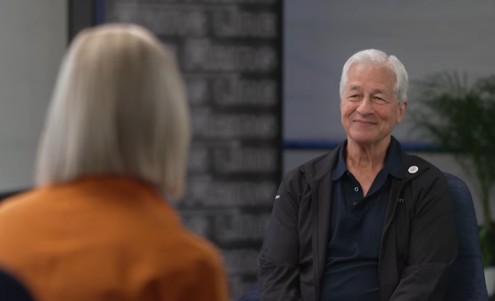
Read the full transcript of JPMorgan Chase CEO Jamie Dimon’s interview on Firing Line with Margaret Hoover, Premiered August 8, 2026.
EDITOR’S NOTES: In this episode of Firing Line with Margaret Hoover, JPMorgan Chase CEO Jamie Dimon joins the host to explore whether business can help address America’s housing crisis. He unveils a major $750 billion initiative focused on affordable housing and community development, while making the case for why capitalism paired with corporate responsibility remains essential to the country’s future.
Jamie Dimon on Affordable Housing and the American Dream
MARGARET HOOVER: Jamie Dimon, welcome to Firing Line.
JAMIE DIMON: Margaret, I’m thrilled to be here.
A $750 Billion Housing Initiative
MARGARET HOOVER: This week you announced a major housing initiative, $750 billion that you intend to pour into affordable housing over the next 10 years. That is a humongous number. Help us understand what $750 billion is.
JAMIE DIMON: So we announced this program. We already do a lot of mortgages and affordable housing, one of the largest in the country. We make mortgages. We want to do more. We want to get more people into homes. We want to make homes more affordable, reduce the cost of mortgages, have policy that actually helps people build more supply of homeownership.
And then affordable housing — we think the effort here can actually create 1 million affordable housing units. And we’re just one bank. Other people are doing a lot of these things too. So it’s part of our American Dream initiative where we hope to fix a lot of issues that face America and just do our part lifting it up.
MARGARET HOOVER: For the audience who’s trying to get their head around what $750 billion is — when you think about the TARP bailouts for the banks in the global financial crisis, that was a $700 billion effort. This is more.
JAMIE DIMON: Yeah. And just to be clear, we didn’t need it at all.
MARGARET HOOVER: And you didn’t need it.
JAMIE DIMON: No. The TARP gave us $25 billion. They made us take the $25 billion. We didn’t need the $25 billion. In fact, I wanted to give it back to them right away. But this is much bigger than that. This is a recognition that we all can do more to lift up all parts of society and make our economy work better for everybody.
Business as a Partner in Solving National Crises
MARGARET HOOVER: Does this reflect a different understanding of how a large financial firm should play with our most urgent crises in this country?
JAMIE DIMON: I think it is partially a recognition of that. So the American Dream Initiative is small business skills — helping small businesses by consulting or lending is part of the American dream, getting these kids jobs and skills. And I’m about to go meet a community group here about — it’s done a great job, Modesto, getting kids certificates in advanced manufacturing, robotics, etc., that gets them jobs. It’s also financial inclusion.
So yeah, this is a recognition that we already did it. But the team is very excited about — we say, you know what, more needs to be done. Here’s what we can do, our share. We’re not the only one doing it. And let’s double down on it. It’s mostly commercial. Part of it’s philanthropic. The philanthropic part is like catalyst money to get something going.
MARGARET HOOVER: Yeah, but this is a business. What’s in it for you guys?
JAMIE DIMON: Well, I said most is commercial.
MARGARET HOOVER: Yeah.
JAMIE DIMON: We’re very careful. We’re very diligent. We do $500 million of philanthropy a year. But we try to do philanthropy in a very specific way, which is to catalyze something that will become self-sustaining. Think of community development investment. Think of work skills. Think of helping people do the work skills here, double their output. That we will do.
I think it’s important. Most people I know — you look at the American system, it works great. But there is truth that certain people have been left behind and we all need to do more. And I think it is part of the job of a business. I think a lot of small businesses here already do a lot of this stuff. But we need to do more. And part of it, as you know, is policy. A lot of things we can do that would succeed is fixing policy that’s failing. You don’t have to spend any money at all. Just get the policy right about schools or immigration or taxation or certain regulations.
The Detroit Model: Public-Private Collaboration
MARGARET HOOVER: For years, the housing crisis and affordable housing has been, to your point, thought of as a public policy problem. So what gave you the idea that your business could partner with government to help solve the problem? Because it’s almost like you’re stepping up because government hasn’t been able to solve it itself.
JAMIE DIMON: Yeah, I think that’s true. But we’re not doing it as a criticism of government. I think it’s a recognition that government cannot do some of these things on its own. They need the help of the private sector.
And one of the great lessons — we started this years ago in Detroit. We had a great mayor, got elected by write-in votes, a white mayor in a Black town. And he said publicly, “Anyone who can help me — civic society, business, government, federal government — I want to get my city in better shape. I want to reduce crime. I want to get jobs. I want to make it safer. I want to get the schools to work. I want to get the hospitals to work.” And we called him up and said, “We’re all in.” We were a big bank in Detroit, so we had self-interest. We wanted to make Detroit better. It was one of the last towns that had not had a renaissance.
And it actually worked. It was good policy over time. I think he inherited 40,000 abandoned homes.
MARGARET HOOVER: You’re referring to Mayor Mike Duggan.
JAMIE DIMON: Mayor Mike Duggan, God bless him. Yes. And so that kind of inspired us that collaboration works. Yelling and screaming at each other doesn’t work. Bad policy doesn’t work. So good policy and collaboration.
And when I go talk to a lot of politicians, they want help. I’m not saying they don’t have the expertise. They want to understand the problems. We can give you a million ideas that can help. So in this town, in San Francisco, they’re reducing the cost of taking an industrial place and making it residential. They’re making it easier to buy something. They’ve reduced crime on the street. That’ll make it easier to move people to downtown. And all these things need to be done together to do it right. We know it works. And then we try to disseminate best practices.
Regulations: The Biggest Obstacle to Affordable Housing
MARGARET HOOVER: The announcement for this housing investment is riddled with words like “with the right policies” or “public-private partnerships,” “zoning reform,” “permitting reform,” “tax credits.” Is the biggest obstacle to building affordable housing money, or is it regulation?
JAMIE DIMON: It’s regulations. And it could be federal, it could be state, it could be local. The permitting takes too long. It’s harder to build. You can’t get space that’s close enough to town. There are a lot of local laws that you can’t build a second story, you can’t turn a second dwelling into a house, you can’t use the basement as an apartment. There are tons of laws.
I think in California, the analysis I’ve seen shows that it costs 40 or 50% more to build affordable housing than it does in Nevada. Sometimes it’s “not in my backyard.” Sometimes the regulations put a lot of social requirements — you have to use union work, you have to do all these various things. And if you want affordable housing, make it cheaper, make it easier to do.
Can a Bank Really Move the Needle?
MARGARET HOOVER: When people hear this announcement, the size of it, why should they believe that a bank can move the needle on the affordable housing crisis?
JAMIE DIMON: Look, we’re just doing our part. I think there are 2 things. One is to actually move the needle. Well, you can move the needle in 2 ways. Actually help communities do what they want to do — that’s number one. That will be real. If you go to Detroit and ask the mayor, he would say that JPMorgan and others made a huge difference in town.
The second is lead by example. Other people want to do it. I get calls from other CEOs sometimes who say, “If you’re doing that, we’d like to help you do it.” Programs that are very thoughtful and properly designed actually work. It moves the needle a little bit. If we all move them a little bit, that needle will move a lot.
I personally think that America could be growing at 3% a year if it fixed all these other policies without spending more money. And that would start to fix our deficit problem. It would give more money to governments to pay for certain things that we all think society needs. And I just think the best thing to do is come up with solutions, roll up your sleeves and get to work, because complaining about it obviously is not going to fix the problem.
CEO Responsibility and Civic Leadership
MARGARET HOOVER: When Americans look around at the prominent CEOs in the country today — I don’t need to say their names, we all know who they are — there’s some skepticism that they are as altruistic or service-oriented as this vision suggests. How many other major CEOs like you, not necessarily in financial firms, are thinking about their responsibility to this country in the way you are?
JAMIE DIMON: Well, first of all, my experience with CEOs — a lot of them are hugely patriotic. And if you go to the Business Roundtable website, you’ll see a lot of efforts companies are doing around a broad spectrum of things. And obviously, if you’re a healthcare company, it’s more healthcare. Financial services company, it’s more financial services.
MARGARET HOOVER: What if you’re a space company?
JAMIE DIMON: Well, I don’t know what some of them do, but my point is they’re also human beings. They’re all different. They all have different views and different things and different ways they work. And I can’t expect — it’s a free country — I can’t expect this person to do what we do or vice versa.
But I think you’d be surprised what all these companies actually do, how they try to get involved. And I think it’s good that they want to do more sometimes. I promote that because I think we need to fix some of our country’s problems. To stand up for what we believe in, how great this country is. And like I said, let’s get to work.
So there are a lot of things to do to actually build stuff. I went to a company yesterday called Zipline that makes — think of drones — but they saved 17,000 lives in Rwanda by delivering medicine to remote locations. They are now doing flights in America to get people medicines or foods or delivery. And just think about this. Instead of getting into a 4,000-pound car and driving for 35 minutes to pick up a $30 meal and deliver it, this drone delivers it in 4 or 5 minutes and doesn’t burn the CO2, doesn’t use as much energy. It’s safer on the roads. Traffic goes down. Traffic accidents go down.
America has this unbelievable ability to innovate like that. Unleashing it to help the military or security side — that’s going to be important too.
Inspiring the Next Generation of Business Leaders
MARGARET HOOVER: Do you think about inspiring a next generation of business leadership?
JAMIE DIMON: Yeah.
MARGARET HOOVER: To do the same thing?
JAMIE DIMON: Yeah, I think we should. I think we should educate ourselves about what this country stands for, has stood for always. I remind people the Constitution is a legal document. The Bill of Rights is a legal document protecting the rights of individuals against the mothership type of thing. But what’s the underpinning to that? It’s freedom of speech, freedom of religion. Family, country, God, civic responsibility. The Founding Fathers always spoke about civic responsibility. They expected political leaders to have civic responsibility. And it’s those values which underpin America.
We stopped teaching them. You can look at a lot of high school curriculums today, and they’re mostly teaching about how bad America was. Of course, there were some bad things in our past. We all know that. We should acknowledge that and fix them. But to take away the principles — they knew it wasn’t a perfect union when they built it. The word they said was, “on the path to a more perfect union.” And that’s true today.
MARGARET HOOVER: Is it really about character? Sometimes the character of leaders.
JAMIE DIMON: Yeah. Well, I think of being a leader of any kind — you could be a teacher in a classroom — it’s an honor, a responsibility, a privilege. It’s not like you get to be a bully or something like that. It’s a servant position. I know you’ve interviewed a lot of generals. And it’s amazing when they talk about their troops or their responsibility to the United States and the Constitution. It’s a servant job, and you have to do the right stuff. It’s hard to do the job sometimes, but it is a servant job. And we should be teaching those things all the time.
The American Dream: A Personal Story
MARGARET HOOVER: Your grandfather came to this country penniless from Greece. 2 generations later, you’re one of the most successful and powerful businessmen in America and in the world. How much is your faith in the American dream a result of your family’s experience?
The American Dream and National Interest
JAMIE DIMON: Quite a bit. You know, they came a lot like a lot of immigrants. They never finished high school. My parents taught you all the time, and my grandparents, have a purpose in life, pursuit of happiness. But purpose meant, you know, you could be a teacher or a doctor or a lawyer or a banker or a caregiver, but have a purpose in life. Work hard, treat everyone with respect, leave the world a better place. So that is part of what you learn.
But I’m also a student of history. If you read history, our leadership has been extraordinary at times, and they took this country from places that could have been quite bad to places that are quite good. And so I learned from that. You know, when you look at the world and what worked and what didn’t work, you have to look at the principles, what our founding fathers built. Their very thoughtful construction of the 3 branches of government and the Constitution and the Bill of Rights. It’s kind of extraordinary.
MARGARET HOOVER: And yet, according to a recent AP poll, only 22% of Americans under the age of 30 believe the American dream is achievable. Even you have acknowledged that it’s, quote, “slipping out of reach for too many people.”
JAMIE DIMON: Yeah.
MARGARET HOOVER: Is it achievable? Or is it just an idea of the past?
JAMIE DIMON: Yeah, no, it is totally achievable. I know I’m not a big fan of polls, and most of those people will be wrong. But, you know, you can’t fix problems you don’t acknowledge. And so if you look at the American dream, the middle class has gotten bigger. Most has gotten wealthier. The country is clearly wealthier, and the rich have gotten richer.
But the real issue is the bottom 20%. Their incomes have not gone up for 20 years and maybe longer than that. And they’re the ones who drive home to more crime-ridden neighborhoods. They’re the ones whose kids are going to schools that are not getting the best possible education that gives them the opportunity. So yeah, I think it’s true that for them it’s slipping. And I completely understand why they’re angry, why doesn’t it work for them?
Now, it’s been true in every country in the world. And this has been true for a long time, whether you’re Democrat or Republican, acknowledge the problem. And then start to say, how can you fix it? How can you get the schools to do the right thing? How can you reduce crime? And how can you create more jobs? And that’s what we should be working on, solutions to that problem.
I do think that’s a problem, and I think it causes a lot of the polarization today, some of the anger today, that people see that some people are doing very well and they’re not. And even the people who aren’t, by the way, good-hearted Americans, they’re not happy with that either. They don’t like to see their fellow citizens suffering at all. And they want to see that fixed, too.
The Security and Resiliency Initiative
MARGARET HOOVER: Last year, you launched the Security and Resiliency Initiative, a $1.5 trillion effort to advance manufacturing, defense, energy, frontier technologies. This is, again, aligned with the critical needs of the country, the national interest. Why do you feel so called to serve the national interests with your bank’s policies?
JAMIE DIMON: Yeah, I think the national interest is more important than JPMorgan. But I go back, I’ve always written about policy. And every now and then I get complaints from people like, don’t worry about policy, just run the bank. But here’s a very important point. JPMorgan probably will not be any better than our country. If our country doesn’t do well, JPMorgan will suffer.
The other thing which people should remember is that our country is the leader of the world. If we are not the leader in the world, there will be a huge vacuum and it will be not to our benefit. And so here’s some just basic principles. To be safe, have the best military in the world. If you want to have the best military in the world, you have the best economy in the world.
We asked ourselves this year, okay, what can we do to help? What are the problems? And we got this from military officers and politicians, political leaders, what are the things that are not working? And then we did some real deep dive analysis. We’ve shared it with people by industry. Where are we reliant on potential adversaries for things that we should not be reliant on? And that includes missile parts, includes rare earths, includes active pharmaceutical ingredients. It also includes things that are in cyber and AI and all these other things.
So we said, okay, let’s double down and do it. Take our ability, our capability. We’ve hired a lot of people. So we’ve brought it out to let’s make the world safe and secure for democracy. And I do believe that America is what makes the world safe and secure for democracy. If America is in a weakened state, and this is important too, if we’re not the strongest military in 25 years and the strongest economy, we won’t be the reserve currency either. The world will be fragmented and it’ll be very dangerous for us. So, to me, this is more about keeping the world safe for democracy and freedom. And the alternative isn’t very good.
Defense Investments and Eisenhower’s Warning
MARGARET HOOVER: Your investments are in the defense industrial complex. And it reminded me that Dwight Eisenhower, at the end of his term, was a general that won World War II, warned against the military industrial complex. How are your defense investments different from Eisenhower’s warning?
JAMIE DIMON: Yeah. So I do think there’s a legitimate complaint about business sometimes that it gets very self-serving. That’s what he was kind of referring to, as opposed to what is good for my country. You know, it becomes what is good for me or my company. And I think, like I said, most are patriotic, but they got to be reminded why we’re here.
So this is— we’re behind. I mean, the fact is that if you look at it, about 10 or 15 years ago, we should have looked at what was happening on rare earths, aluminum, certain steel, not all steel, certain steel production of certain equipment, and said we can’t rely on China for that. And we can’t allow mercantilist behavior. We need to do it here. We made a mistake. And, to me, we just— now we acknowledge it. Let’s go, just go fix it. And that’s what this is.
And we don’t have a lot of time. The war in Ukraine has pointed out we didn’t have productive capability to defend the United States if there was a real war that lasted for a long period of time. And that’s a hell of a statement. And so, as I said, if you believe America is necessary for the free world, this is something we have to do and we have to do it now.
The China Challenge
MARGARET HOOVER: China makes 70% of the drones in the world, electric vehicles, lithium-ion batteries, solar cells. Its shipbuilding capacity is 200 times that of the United States. In AI, they’re developing and quickly catching up. What are the actual risks to United States security and our economy if we find ourselves outmatched by the Chinese Communist Party?
JAMIE DIMON: Yeah, and it’s not just them. You have Russia, Iran. You have a bunch of people who have made it clear they like to dismantle the world.
MARGARET HOOVER: They’re also cooperating.
JAMIE DIMON: Yeah, well, here’s the best protection. What would they say? A great military is expensive. Fighting a war is very expensive. Losing a war is the most expensive. Every military officer will tell you one major principle of the military: have the best military. That is the best deterrent. It also helps the most allies. It helps the most world growth. It defends democracy.
And we still have, by the way, so if you actually speak to the military officers, they still have that. They’re just slipping, as you mentioned, in some of these categories, and we shouldn’t allow ourselves to slip. And I think that’s a sine qua non. Have the best military. And then you have to define exactly what that means by piece of equipment and training. But we have the best trained military in the world. We have the best equipment in the world. But it’s changing rapidly, as you sustained with drones. Some of these things are constantly changing the battlefield. So we have to move quicker too.
MARGARET HOOVER: You have hundreds of employees and millions of clients in China, which is run by the CCP. What responsibility do you think JPMorgan has to the national interest when doing business with our strongest potential adversary?
JAMIE DIMON: Totally, totally. We should look at the national interest. So there’s a very important distinction here. So we do business in China. We bank a couple hundred Chinese companies, but we also bank in China something like 2,000 or 3,000 multinationals. So I’ve told my board and I’ve been public about it, yes, it’s hard doing business there. I think America should engage with China, but no one wants us to leave China. Not those multinationals, not the American government, not the American military.
So I follow the law of the land. It’s the Treasury Department, the State Department, the military who tell us what we can and can’t do regarding China and Chinese companies and Chinese sanctions. And to that, we salute and do it. The best solution with China isn’t to go to war with China, it is to engage with them and have a peaceful resolution. We have a lot of common interests like anti-nuclear proliferation, anti-terrorism, grow your economies. And we’ve got a couple which aren’t the same. If they’re aiding and abetting Iran, it’s not the same. And anything that goes wrong in Taiwan is definitely not the same. And that’s government policy. I don’t set government policy, nor does JPMorgan.
A Look Back: Malcolm Forbes on Capitalism
MARGARET HOOVER: In 1988, William F. Buckley Jr., who hosted this program for 33 years, spoke to businessman Malcolm Forbes about the merits and the excesses of capitalism. Forbes acknowledged that capitalism isn’t perfect. Here is the clip. Take a look.
VIDEO CLIP BEGINS:
MALCOLM FORBES: In this country, we’re used to the— we take the functioning of capitalism for granted. But we’re not happy about those many who fall through the net, or we’re not happy with the unsolved problems. And it’s not just villainy, there are shortcomings in capitalism. It’s only vis-à-vis the alternatives capitalism’s looking better and more widely accepted, but it doesn’t mean it’s perfection. And I think the fact that so many people are, even if they’re not hurting, they’re upset that there are people hurting in the country. It’s not bad that there’s a conscience about capitalism’s shortcomings, but I don’t think they jump from that to a damnation of the system as used to, on the basis as it used to be at the turn of the century and after World War I, that the alternative was this millennium of communism and/or socialism.
VIDEO CLIP ENDS:
MARGARET HOOVER: You knew Malcolm Forbes.
JAMIE DIMON: Yeah, I’ve met him. Yeah, a couple of times. Yeah.
MARGARET HOOVER: He argued capitalism shouldn’t be judged by perfection, but against the alternatives.
JAMIE DIMON: Yeah.
MARGARET HOOVER: 40 years later, what do you think Americans think of capitalism?
JAMIE DIMON: Yeah. So this is great. This is a really important distinction. Every system has flaws.
MARGARET HOOVER: Yeah.
JAMIE DIMON: There’s never been a system that’s perfect. Some of the flaws people talk about today, if you go to any country, there are poor people, there are slums, there are problems under any system. So the notion that capitalism is the reason you have that, that’s not exactly right. That’s number one.
The other thing is some of it’s just bad people. There are bad people in capitalist societies. There are bad people in communist societies. There are bad people. And when you listen to people talk about capitalism, they’re confusing all these things at once. But I totally agree, it has left behind certain people. We should acknowledge that. Even the people it hasn’t left behind aren’t happy with the fact it’s left behind. They should have a conscience. I think people should say, I want to be part of lifting up all of society, not just my part of society or my part of the town or stuff like that. So I think that’s brilliant. Capitalism has brought billions of people out of poverty. It’s invented all this stuff, even the stuff China’s doing.
MARGARET HOOVER: What?
JAMIE DIMON: Well, capitalism invented a lot of stuff.
Government Stakes in Private Companies
MARGARET HOOVER: Last week, the Commerce Department announced that it had reached deals to provide federal funds to 7 technology companies under the condition that they give the government a minority stake. This is in addition to the government’s 10% stake in Intel, its golden share in US Steel, and taking a cut from Nvidia’s sales of chips to China. Does the critique— well, frankly, the loud criticism of socialism ring hollow when the federal government demands stakes in private companies?
JAMIE DIMON: So this has kind of been going on my whole life, by the way. It’s not completely new. They did it with GM during the crisis. And, you know, economically, should the government be in the private—
MARGARET HOOVER: not competing with the private sector?
Patriotism and American Values
JAMIE DIMON: Not really, unless there’s a reason that’s specific, necessary, and in my view, related to security and resiliency. But in general, I wouldn’t— I would not be in favor of the government buying lots of stuff and getting involved.
MARGARET HOOVER: In the lobby of your new New York City headquarters, there is an American flag that is always blowing with the wind. And it is said that you salute the flag every morning.
JAMIE DIMON: I do.
MARGARET HOOVER: What does patriotism mean to you?
JAMIE DIMON: I think it’s different for this company because it’s not nationalism per se, because you could be a patriot in a country that’s autocratic. I think patriotism here is that what this country stands for and what it stands for is extraordinary.
I tell a lot of people here, when I hear certain criticisms, I tell them, get in there, go around the world with me a little bit. And when you come back here, you will kiss the ground. And they don’t even understand the freedoms and liberties they have. And that if they understood that, they stood with that flag the way I do.
And I think it’s important we teach it. Why? Why did people die for this country? Why did they fight the Revolutionary War? Those values transcend most other things. And I think they’re perpetual. They’re forever. They’re not going to disappear over time.
MARGARET HOOVER: Jamie Dimon, thank you for joining me.
JAMIE DIMON: Margaret, thank you.
Related Posts