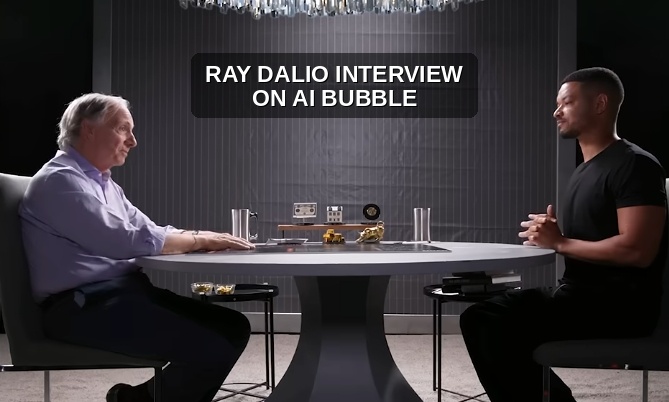
The following is the full transcript of investor Ray Dalio’s interview on The Diary Of A CEO Podcast, July 30, 2026.
EDITOR’S NOTES: In this episode of The Diary Of A CEO, host Steven Bartlett sits down with Ray Dalio—the legendary investor and founder of Bridgewater Associates who famously predicted the 2008 financial crisis. Dalio shares his unfiltered insights on the AI bubble, the forces driving the “big cycle,” the decline of the US and UK, and what he believes is coming next for the global economy and society. From practical advice on protecting wealth and navigating job disruption to the geopolitical shifts reshaping the world order, this conversation delivers a powerful roadmap for the turbulent times ahead.
Ray Dalio on the AI Bubble: Is History Repeating Itself?
STEVEN BARTLETT: Ray, for people that might not know who you are, you founded Bridgewater Associates in a 2-bedroom apartment in 1975, and you grew it to the world’s largest hedge fund. What was the total amount of cumulative net gains that you delivered for those investors over that period?
RAY DALIO: I think it was something like $53 billion. We produced about a 12% return with no, never any significant losses, and it was uncorrelated with other investments.
STEVEN BARTLETT: And you were one of the few managers to foresee the great financial crisis, which allowed Bridgewater to post positive returns of 9.5% in 2008 while the S&P 500 plunged by almost 40%.
Let me start with the thing that I’m most curious about, because I sat here with an investor called Jeremy Grantham, who you might know. He told me that we’re staring in the face of an AI bubble and therefore an economic collapse, potentially.
Jeremy Grantham: If you look at the data, it would be compatible with history for the peak to be very soon. Everything is in line. This is, I think, the biggest investment bubble in American history.
STEVEN BARTLETT: What’s your perspective on that?
What Is a Bubble and Why Does It Collapse?
RAY DALIO: He’s right. I don’t want to jump to conclusions as much as I want to explain reasonings that lead up to conclusions. I’m at a stage in my life that I want to help people understand cause-effect relationships.
What they call a bubble is when the price goes up a lot and companies do very well, and then it collapses. And that has implications for the economy. That has implications for the markets like the 1929 bubble, or the 2000 bubble, which is the dot-com bubble.
STEVEN BARTLETT: Does it impact real people as well? Because you said the economy—
RAY DALIO: Did the 1929 bubble bursting impact real people? Yes. The Great Depression followed because what happens is there’s a new technology that comes along that is revolutionary.
The dot-com bubble, which was 2000 — all the stuff that we have that’s wonderful new technology — people get into that technology. They say, “That’s miraculous. I can bet on that. I’m sure it’s going to be successful.” And then they bet on it and sometimes they borrow money to bet on it and they lose sight that the price of it matters.
So it goes up and up and it’s everybody’s thing. Right now we’re very excited about AI and we should be very excited because it’s got to be revolutionary changes. And it did at the same time. So I want to buy some of that, and everybody wants to invest in some of that. And what they do is they don’t pay attention to the price.
And there’s a certain mechanics. People will borrow money. Wealth is not the same as money. So you see a lot of people getting wealthy, but you can’t spend the wealth. You have to sell the wealth to get money because you can only spend money. So what happens is when they need money for one reason or another — taxes change or interest rates go up — and so they have to pay their debt service and so on. There is a pricking of the bubble so that what happens is it falls.
STEVEN BARTLETT: Okay.
RAY DALIO: And when that happens, people lose money. And as they start to lose money, the process works in reverse because when they made a lot of money, they have a lot of collateral. They can go borrow money because they’re worth a lot and that compounds on its way up. And then when it comes down the other way, it works the other way. You’ve got to pay your debt. And so on. Then you have to start to sell assets and then there’s less demand for things. So there’s less demand because if you’re losing money because you put some money in the stock market and that company and so on, you’re going to spend less. And as you spend less, then somebody else’s income goes down. You don’t go to the restaurants.
The economic downturns that typically follow a bubble, like the Great Depression — the late ’20s was fantastic. If you talk about changes and experiencing change, this was the first time there was electricity in houses. So that was the first time you would have refrigeration and you would have lighting in houses. This was the first time that you had cars popular that you could get. First time airplanes, first time you had radio.
And so everybody knew that they were going to be great in the future, and they were great in the future. But at the same time, what happens is as they buy them and stocks go up and they borrow money to buy them and so on, and the profits don’t live up to the price, then that causes this other dynamic and it produced the Great Depression.
Breaking Down the Bubble Mechanic
STEVEN BARTLETT: So let’s say that I buy this and this is a unit of artificial intelligence. So let’s say I buy one share in one of the big AI companies right now.
I go to the bank because I have this net worth, this paper worth $100. And I asked the bank for a 50% loan on this thing that I own. They give me $50. Now I have $50.
And then something happens in the economy, which means that the investors who’ve invested in this, and investors generally now need money to pay off their other debts that they have. So this could be a war, it could be some kind of event that takes place, and suddenly everybody rushes to sell their assets like this one.
And so when I go to sell this, the price of it has now plummeted to say maybe $25, but I took a loan at the bank for $50. So I owe the bank $50, but now this thing that I have, that was worth $100 a couple of months ago is now worth $25 and I’m $25 in the hole, so I have to quickly sell. And then with everybody selling, all the price of assets drops. People stop spending money at the restaurants. Like you say, there’s less money around and then the bubble has burst and we’re in this sort of declining—
RAY DALIO: You got it.
STEVEN BARTLETT: Okay, good. All right, fine.
RAY DALIO: And it happens because it must happen. In these tremendous changes, there’s very little that’s known. So anybody who’s in the business of making AI can’t be precise. They don’t know exactly how much money is going to come in. So there’s either one of two things. You either don’t invest enough and then the competition runs away, or you invest a huge amount and you can’t be precise. And so when that dynamic happens, it’s a problem. So yes, you said it very well.
So I’m going to repeat one other thing to emphasize. What’s quite common now is you can issue stock for — let’s say you raise $50 million and you value the company at $1 billion. Only $50 million was actually spent on that company. But now if you raise that, you are a billionaire, because the accounting value of that — what do you own? You own stock that is valued at $1 billion. Nobody paid $1 billion or whatever it is. And now you own that stock, but that stock you can’t spend because you can’t spend wealth. In order to spend it, you have to sell some of that stock to get money.
And quite often there’s an interest rate rise because, let’s say there’s a fever and there’s inflation, then the central bank wants to try to put the brakes on that a bit. What does that mean? It means people who have debt, in a sense, have to come up with more money. Because when you hold the debt, you have to come up with money to pay the debt. So that dynamic works between us. We’ve said it clearly. I think we understand the dynamic.
The Big Cycle: Bubbles, Politics, and Geopolitics
RAY DALIO: So they have to exist. Now we have another problem that’s existing. We’re talking about the bubble. But we also have some other things that are going on that happen around the same time. A big gap between the rich and the poor. And which also means the left and the right, the politics of it. Just as we have now. When you have the downturn, then you have people at each other’s throats.
So if we take politics, what you see is this — that they don’t have enough money, that the governments don’t have enough money. We have big budget deficits. Where do you get the money from in order to pay those bills? The UK has had, I think, 6 out of the last 7 years there’s been a new prime minister. And because there’s not enough money for the government, what you start to see is people come in with their claims, but there’s this question of how do we get the money? And then people who have money run. They say, “I don’t want to be in this tax zone.” And then they leave.
And so there’s a domestic political problem that is not people compromising the same way they used to compromise. So now you have the politics which compounds this, and then you have a world — this is what I call the big cycle — you have a world in which also the geopolitics changes. By geopolitics, I mean country to country.
There’s a system under normal circumstances when there’s a more dominant power, they impose their order and that becomes more peaceful. But when you have arguments of how things should go, those arguments start to turn into conflicts. And so those things tend to happen together. That’s why I refer to that as the big cycle — that dynamic. Now, that is the confluence of the money, the internal conflict politically, and the external conflict, which is what we’re going through.
And the problem is, I think, that people don’t know the cycle. So every day we go to our sources of information and you see this latest news, but they don’t connect the dots in understanding that cycle.
What Pricks the Bubble?
STEVEN BARTLETT: Closing off on this point of the bubbles, what is it that makes bubbles pop? So if we are in an AI bubble at the moment and it is going to pop at some point, what is the — they call it a black swan event.
RAY DALIO: There are a few of them. There are bubbles and then the things that prick the bubbles. The things that prick the bubbles typically in the beginning are something that means that I have to sell some wealth to get money. And that’s usually a rise in interest rates. It could be something like wealth taxes, something that means I’m very wealthy, but typically the tightness of money — because during that spot there’s inflation pressures and central banks decide that they want to tighten monetary policy and so on.
It becomes that the amount of money that I can get by owning that debt at the higher interest rates is greater than the amount of money I could get on my equity investments. That’s part of it.
Also, what you see is a lot more production of stock. And what I mean by that — issuance of stock — is think of the supply and the demand. There’s demand, and we’ve been talking about the demand that makes stocks go up, how we create this wealth. But there’s also supply. So you can issue stock. It’s very easy. There’s almost nothing that’s easier to produce than stock.
STEVEN BARTLETT: So if I own a company, I can just print more equity.
RAY DALIO: Yes. Today you could probably go out and say, “I’m going to make a company and I’m going to take it public.” And you go to your audience and your crowd and you can say, “I’m going to make stock.” So it becomes, when there’s a market that wants stock, there’s a production of stock. And that supply of stock together with the other that I’m mentioning — the need for getting money and so on — causes the bubble to pop.
STEVEN BARTLETT: Are you seeing signs that we’re in a bubble?
Signs We Are in a Bubble
RAY DALIO: Yeah, yeah, yeah. The classic signs that we’re in a bubble. And the bubble, I should emphasize, it’s not a you’re in a bubble or you’re not in a bubble. It’s a degree thing.
There is also that it’s in weak hands. I can look at now who is in these companies, and is it in strong hands or weak hands? Classic strong hands is that when weak investors — not knowledgeable investors — then put a lot of money into it, particularly if that’s in a leveraged way. Another way with debt, or they can buy options, a leveraged version of like — there are ETFs now that are leveraged versions of the stock market and so on. And so they get into that. It’s more like they’re crapshooting. And then that’s a sign of a bubble.
So I’ve listed a few of those signs. Those are the major signs of those bubbles. And so that when it goes down, then you get the fear, then you get the need to raise cash. And that dynamic works its way out in the form of then the reverse happening. In other words, everything becomes cheap and everybody has the spending and the things you mentioned.
Preparing for an AI Bubble Burst
STEVEN BARTLETT: If we are in an AI bubble and it is going to burst, I had a friend of mine contact me and he said, “Steven, I think we’re in this, an AI bubble,” and he’s running an AI company. He said to me, “I’m going to raise lots of money now so that when the markets come down and investors are fearful, they don’t want to invest in companies. People stop spending as much. They start thinking about their subscriptions and start canceling subscriptions. We’re going to be good. And we’re going to be able to buy up some of our competitors who are going to be struggling.” So he’s just raised hundreds and hundreds of millions of dollars for his AI company.
RAY DALIO: Right. And it’s probably like that easy.
STEVEN BARTLETT: Yeah, it was easy now.
RAY DALIO: Right.
STEVEN BARTLETT: The question here is, what should, at different levels — so the average Joe on the street up to entrepreneurs that are running companies — how do they all prepare for an economic bubble that might burst?
RAY DALIO: He’s such a good example. And what that does, and just following up on what we were saying a minute ago, is that increases the supply of AI stock.
STEVEN BARTLETT: Okay. Yeah. Because he sold stock.
RAY DALIO: Because he’s going to sell more.
STEVEN BARTLETT: Yeah.
RAY DALIO: Right. And so as he and others do that more, this greater supply of stock comes in and so he wants to get ahead of it in that dynamic. And then that contributes to the bubble. But how do they prepare?
STEVEN BARTLETT: How does the average person prepare?
The Basics of Money Management
RAY DALIO: I would also say something. The future is very unknown and people should not be timing. Sophisticated investors have a real challenge even in timing a bubble. So the important thing always is to diversify. Now we’re going to go back to money, the basics of money management.
I personally have gone through the cycle because I didn’t have any money and then I did, then I had a lot of money. And I remember the cycle very well. What happens is, as you start off, I used to count how many months I would be okay. I have a certain amount of money, how much money I would be okay if no more money came in. If I lost my job or whatever I did, I’d mostly never — I worked 2 years for somebody. But in other words, if money didn’t come in, it would be months and then years and so on to build that security, because I had to take care of my family and so on.
And so as we’re looking at these things, these are the choices that you have in order to be able to say, do I buy my house or apartment? Do I put my money into cash? And what happens to money is you have to put it into something because they’ll pay you interest on it. So that’s your cash deposit and so on. And people think that that’s the safest. It’s not. It’s the worst investment over a long period of time because inflation will eat it away.
STEVEN BARTLETT: You mean putting it in a bank, just leaving it in a bank?
RAY DALIO: In whatever form, a money market fund, whatever it is that is that short-term, I’ll deposit it and it’ll give me an interest rate.
STEVEN BARTLETT: Okay. Okay.
RAY DALIO: And that’s what they think about as cash. Nobody leaves it literally in cash because if it’s literally in cash, it doesn’t earn interest. So why shouldn’t I put it there and get some interest on it? And so that’s cash. And people think that that’s the safest and has the lowest return, guaranteed almost to have the worst return over the longer period of time.
STEVEN BARTLETT: People keep cash because it feels safer.
RAY DALIO: That’s right. And I’m saying it’s not safer because of inflation.
STEVEN BARTLETT: Explain that to me in simple terms.
RAY DALIO: Okay. Well, if I got no interest rate, then what I would do is I’d lose to the inflation rate.
STEVEN BARTLETT: And what’s the inflation rate?
RAY DALIO: Well, 3.5% or 4% happens to be about where it is now.
STEVEN BARTLETT: A year? Yeah, a year. So I lose $3.50 a year.
RAY DALIO: That’s right.
STEVEN BARTLETT: If I just leave it in cash.
RAY DALIO: That’s okay. Now I’ll get an interest rate on it if I put it someplace and it’ll give me maybe an interest rate that’s somewhere in that vicinity, similar to that.
STEVEN BARTLETT: 3, 4, 5, 4%.
RAY DALIO: And then I have to pay taxes on it.
STEVEN BARTLETT: Oh, you have to pay taxes on the gain?
RAY DALIO: Yeah.
STEVEN BARTLETT: Okay, fine.
RAY DALIO: Right. Even though you really didn’t gain relative to inflation, you still have to pay the taxes on whatever you’ve earned or something anyway. Over the long term, it’s a lousy return. Because also think about returns — they also come from productivity. And over a period of time, people learn how to do things better and so on.
Diversifying Your Portfolio
RAY DALIO: So then you can invest in, let’s call this stocks. That we’ll call that the stock market. This is cash. And then you think on the stocks, and then the stocks can go up or down. And then they have this dynamic that we’re talking about that creates these big cycles and the busts. And those cycles, when they go down, go down 60, 70%. That’s what a bear market looks like.
This is gold. And these are bonds and this is your house and that’s Bitcoin. So these are the choices. They each change for certain reasons. But what happens is they go like this. When gold goes up, it tends to be that the bonds will go down in value or your house. And these change in a certain way. And so the best thing to do is to have a diversified portfolio of that. When you have that rather than any one, you won’t reduce your return, but you will reduce your risk.
STEVEN BARTLETT: And diversified means having a little bit of each, right?
RAY DALIO: A certain amount. And you have to know how to balance them because of their volatility. This one, stocks, is more volatile than this one.
My own recommendations are you start first of all with what you need. Should I buy a place or should I use that money and I could travel more and so on? One of the advantages of the house, the apartment and whatever, is it’s your environment. Your environment is important. It produces forced savings. Sometimes that forced savings is good. It is typically taxed better. It’s a better vehicle for tax over a period of time.
But I’m not arguing for this alone. I’m saying when I’m looking at this, I think gold is very interesting because when all of these tend to do badly, this tends to do well. So it’s a very effective diversifier because this was money not until 1971, and it’s still the second largest reserve currency. Central banks hold reserve currencies. So it has qualities that are different from this, and this has qualities like when the value of money goes down because of inflation. This — bonds.
STEVEN BARTLETT: And bonds are basically lending the government money.
RAY DALIO: That’s right. If you lend the money at a certain interest rate and then inflation and interest rates rise, you’re kind of locked into that interest rate. And so it has its own problems.
The more important thing I would say is, you save up and you say, how many years can I live if money doesn’t come in? And then you take that and you say, how could I be secure? So I don’t want to put it into one thing that can go down 70%. So how do I diversify that? That’s my main headline.
Advice for Those Starting With Little
STEVEN BARTLETT: A lot of people in the comments of our last episode, they were asking this — how does this apply for someone who doesn’t have much money, maybe doesn’t have any assets? Say they’re 30 years old. They have $100 disposable income and they’re thinking about how to sort of secure their future. What is the advice for someone in that situation?
RAY DALIO: Your only asset is yourself. And I guess what you’re going to get from the government. How do you sell yourself at getting a better income? How are you getting money from the government? Selling yourself is the main thing.
This is one of the big problems now. With artificial intelligence and other machines replacing people in different types of jobs, it becomes more difficult. It produces that big wealth gap while you’re having more productivity. Everybody wants more productivity because it means how do you produce things more efficiently? But that contributes to the income gap because your productivity equals your income to a large extent. And then you have the political dynamic.
It’s tough to get yourself out of this position that you mentioned. I’m imagining that person. It’s not easy. There is this giant polarity. If you are in the top 10% of talent, the world’s your oyster. But nowadays, in order to be there, that’s difficult.
Find something that gives you the ability to sell your time for good money. Is that going to be that you’re driving an Uber? Is that going to be that you have the talent and you’re going to be able to understand AI and contribute that understanding to a company that values that? Or what is your skill?
You found this, and you found the way. But you need money. And the thing that you want to do, what you’re doing, and I’m lucky enough to do, is to make your work and your passion the same thing. And don’t forget about the money part.
Valuing Your Skills in the Right Context
STEVEN BARTLETT: Yeah. One of the things that I think I didn’t realize earlier in my career is that whatever skills you have will be valued differently in different contexts or industries, should I say. So for example, say that my skill here — and I’m not trying to flatter myself — but say my skill here is having conversations. There’s lots of places I could have conversations, and those places would value my ability to have conversations wildly differently per hour.
So I often think this and speak to my friends about this. When they tell me their skills, I say, “Let’s look at the different industries and how they would value the skills you currently have differently.” A good example — you could be an Uber driver or you could chauffeur Ray Dalio. Now, I imagine those 2 things pay wildly differently. But the same skill of driving a car, broadly speaking.
RAY DALIO: I agree with all that.
STEVEN BARTLETT: And so I think that’s one way. The other way is you go ask your current boss for a promotion. But again, they’re going to value you in the context of their other employees, the market in that industry, et cetera. So you might get 10%, but you’re not going to see a step change necessarily. So that’s something that I always say to people.
RAY DALIO: Absolutely right. And another law of something — and I think it’s almost a law of everything, it’s a law if you buy almost anything — is those at the top, whatever the thing you’re buying, if you’re buying a painting, a piece of furniture, a piece of clothing, a person’s time or whatever, command premiums that are many multiples of the average.
It’s almost like if you could invest 10% more of your time, your effort, your skill to go up, you will get twice as much for 10% better, something like that. So that’s part of the formula of life and a formula of employment. And so I think if you keep what you brought up and what I’m bringing up in mind, that helps you position yourself and know what to do.
Bitcoin as Part of a Diversified Portfolio
STEVEN BARTLETT: We didn’t mention Bitcoin actually, so I probably should talk about it because people are talking about it a lot right now. What’s your perspective on Bitcoin? I know the market in Bitcoin is down at the moment.
RAY DALIO: I have about 1% of my portfolio in Bitcoin because there’s different kinds of money. The money that you can’t print — that’s one kind. This is the other kind of money that you can’t print.
STEVEN BARTLETT: Gold.
Gold vs. Bitcoin, AI’s Impact on Jobs, and Economic Cycles
RAY DALIO: Yeah. You cannot crack it with technology. You can hold it, you own it. There’s a saying that it’s the only financial asset that is not somebody else’s liability. Somebody has to give you something for it. It has that. So in my category of wanting to make sure that I have some hard money, which for most people should be between 5 and 15% of their portfolio, I prefer that — I’m pointing to the gold bars here — rather than the Bitcoin.
STEVEN BARTLETT: Is it still, in your view, a gold-like asset?
RAY DALIO: Yes, it’s a type of money that can’t be printed, but there are technologies that can hurt it. In other words, if there’s quantum computing and it can be monitored by governments and so on, it could be taxed. And digital currencies are somewhat similar.
STEVEN BARTLETT: But you don’t like Bitcoin as much as gold because of privacy reasons as well.
RAY DALIO: And when the governments say, “I don’t want it,” they have the power therefore to do whatever they want with it. And central banks will not own any significant amount of that because of the reason I said. They want their transactions to be private and in their control. Think about how different it would be for Russia. They confiscated these kind of other assets. They didn’t get these.
STEVEN BARTLETT: Gold.
RAY DALIO: Okay.
STEVEN BARTLETT: Gold.
RAY DALIO: And so what you’re seeing, even particularly in this time of conflict, is that there’s a sense that if I’m holding this, others won’t get it.
AI, Automation, and the Future of Work
STEVEN BARTLETT: You mentioned a second ago the impact you think AI is going to have on the economy broadly, but also again to real people’s lives. There’s lots of debate. There’s been a debate over the last 10 years or so within the world of AI. You had the big AI CEOs originally saying that AI would cause job disruption. And you’ve even had some of the CEOs more recently saying work will become optional in a world of superintelligence. At the same time, we have robotics coming over the horizon. So you’ve got this sort of convergence of intelligence and then, physical muscles or ability. At the same time, we’re seeing AI accelerate and its capabilities. What does this mean for the average person and their job, and who’s going to benefit from this AI revolution in your point of view?
RAY DALIO: It means that you will either be cutting edge and capable and among that top fraction of a percent down to 10% of the population who is cutting edge and using it and accelerating, or you will — if you’re in a thinking job — be at risk of being replaced.
We’re coming into a world where we can automate everything. The evolution of man was we had the agricultural era and there was no real inventiveness. And then man invented the machine. And what the machine did is it replaced man’s physical necessity. So men used to be like oxen in the agricultural field and so on, and they were replaced by tractors. And then we entered the industrial age. First you had the printing press that allowed people to learn, and then you had these inventions, the industrial revolution, the first industrial revolution. And what you had is the replacing of the physical that man would do in factories and so on.
So the way I look at it is I look at the human body and I see it’s replacing the body and so on, and it’s coming up higher and higher. And then it replaces some aspects of the mind that you can computerize. And it’s coming up and up and it’s replacing higher and higher levels of thinking and reasoning. So that path is part of the evolutionary path that is happening.
So then you start to say, “What do I have to offer?” And so in answer to who benefits from it, those who benefit from it are those who are the capitalists with the ideas that replace the workers. And so if you look at the revenue for businesses when you buy something in a store, there’s revenue. And if you look at the share that is going to workers, you see that share going down. And if you look at the share that’s going to those who own that business, that share is going up. That’s how they share that revenue in terms of the cost, and you see that that’s rising.
And so this is an evolutionary process, and it’s true that what happens is you get more free time. So now the society has to think, “How do I deal with this?” So for example, the work week, which used to be a 60 or 70-hour work week, goes down to less than a 40-hour work week and there’s more time, but there needs to be, how do you create a bottom?
And so we’re going through this phase in which there is this upper end that is making incredible amounts of wealth as we describe, and then this lower end that is then having these challenges. We have a relatively good economy and the difficulty of college graduates to get employment has increased significantly. And I can tell you that in many businesses, it becomes more of a pain in the neck to have a college graduate do it. They have to train them. And many of those tasks, many of that thing can be done very quickly with the AI and with computerization. And as you get into robotics, you’re going to have that happen, right?
STEVEN BARTLETT: The speed of the disruption that we’re seeing because of the amount of capital that’s flowing into these AI frontier models like the Anthropics and OpenAIs, et cetera, is quite different from anything else, sort of the historical precedents as we’ve seen through the Industrial Revolution where it took time to build the tractors.
RAY DALIO: There’s an element of speed. What happens usually is the bubble bursts and now you have the cyclical dynamic of that while the technology evolves, but the supply demand and the debt problem that we just talked about then come. And so unemployment is due to typically some sort of a combination of a financial crisis — like we talked about, the debt and stocks going down and people not having collateral and then therefore not buying assets — and that dynamic that causes the unemployment rate, that factor.
STEVEN BARTLETT: That’s the sort of economic reasons. But in terms of the AI agents, robotics being able to replace you, I’ve sat with Dara from Uber, and Dara said that he imagines in the future, the 9 million riders that they have around the world doing deliveries will be replaced by autonomous vehicles, autonomous robots. Those 9 million drivers’ careers will be out of work, conceivably — talking about being honest about the situation.
RAY DALIO: Yeah, I think, again, it goes to physical AI as well, right? So I think 20 years from now, you can imagine that those 9 million will be 20 million AVs maybe. But we have time between now and then, partially because we don’t operate in the virtual world, right? We operate in the physical world. You have to get the regulations up, you have to build the cars, you have to build the sensor stacks, the models have to get there. So there is time between now and then, but you can imagine the majority of our trips being fulfilled by robots of some kind.
The unemployment rate gets very influenced by the bubble bursting and the economy going down. You see that spike. You certainly have the evolutionary change that you’re referring to.
STEVEN BARTLETT: Okay. So it’s both. Okay.
RAY DALIO: In other words, there’s this evolutionary thing in which, like he says, the tractor replaces the laborer or the assembly line worker as technology is replaced. And that is an evolutionary thing that goes continuously for many years in the way that you’re describing. Because you asked about the unemployment rate, I just wanted to emphasize that the unemployment rate is very heavily affected by that bubble bursting.
STEVEN BARTLETT: So you’ve got 2 forces at once then. You’ve got when the bubble bursts, everybody, as we said, needs cash, so they start cutting their costs. So that’s when they start laying people off.
RAY DALIO: Yeah.
STEVEN BARTLETT: And they start looking around their company and go, “Forget growth, we just need to survive.” So we’re going to lay off that team and that team and that team. And you see unemployment going up. And then you’ve got this sort of underlying shift happening at the same time, which is workers are replacing their team members with AI agents or robotics, or in the factories, they’re now using robots to do factory work, et cetera. And that’s the sort of current slow march forward.
The Big Cycle: Debt, Wealth Gaps, and the Changing World Order
RAY DALIO: Right. So I have this chart. What this represents — this line is the evolution of technologies. In other words, we have greater and greater learning and doing things better. And that’s the evolution that we’re talking about, that also machines replace people or replace their tasks over that period of time. Then you have this big cycle, which typically lasts for about a lifetime on average, about 80 years. We went through that the last time in 1945. There are orders. There’s a monetary order, there’s a domestic political order, there’s a geopolitical order.
You have the bubble bursting. This is what we’re talking about, that dive. And then when you go through that, you break down these orders. And when they break down, then you would get rid of the debt burden. So you get rid of the monetary system as you’re used to it. You may get rid of the domestic order. Many countries’ orders, their systems end — they all end at some point. And so they can break down quite often in a time of great internal conflict. Does the system last? And that happens at that time.
And so that’s that big breakdown. But still what you’re talking about — and I agree with you — this keeps going up. Because learning, you don’t unlearn what you’ve learned. So as this goes up, you still keep this thing going up. But you have the big cycle, the debt, the conflict type of movement. And these little cycles are the cycles that we see in this roughly on average, let’s call it an 80-year period.
You see the recession, and recession has higher unemployment and so on. Then they stimulate monetary policy, they make money looser. Then the economy goes up and you have prosperity. Then you go into a bubble, and you run lower on capacity because you’re using up the capacity. Inflation rises, they tighten monetary policy. And then you have the recession that follows. So these movements from one recession to the next recession — that cycle that I’ve just described — on average has lasted about 6 years, give or take about 3. So that’s the way it looks.
STEVEN BARTLETT: So I’ll play this back to you to make sure I understand it. There is a sort of bigger macro bubble, which is over 80 years, which is the changing of the world order. Yeah.
RAY DALIO: Yep. You get deeper and deeper and deeper in debt over a lifetime. So let’s say your debt capacity — you have a certain amount. So the government’s debt capacity, for example, it can borrow. When you wipe it out here, then you can build it up and build it up until it starts to squeeze. Debt service starts to squeeze out.
STEVEN BARTLETT: And that’s a changing of the world order.
RAY DALIO: That is one of the ingredients, right? So we have too much debt. At the same time, what you’re building up is you’re building up great wealth gaps because capitalism — and I love capitalism — but here’s the reality, it creates big differences in income and wealth. And when it does that, that also creates differences in people’s opportunities because the rich people can educate their children well and they can give them all the benefits. Education is a big benefit. And that’s why there should be broad-based, excellent education. But all of that happens.
And so you see wealth gaps build up. So like the Industrial Revolution leads into the Gilded Age. The Gilded Age looks a lot like now, people buying expensive things and looking very gilded. And then it leads to the robber barons. And the robber barons are people who are considered to be taking advantage — the billionaire class — and it becomes that cycle. So that’s the way it works.
STEVEN BARTLETT: So you’ve got this 80-year sort of boom, and then there’s a collapse which sort of ends in conflict and the changing of the new world order. And then within there you have these little bubbles, which are really economic bubbles that go up and down — recession, people get very excited, they contract, they get excited, they contract. And then you have the straight line here, which is the sort of technological improvement across the spectrum of ideas and technologies and all these things.
RAY DALIO: And it keeps going.
STEVEN BARTLETT: And it keeps going regardless of this boom and bust, because as you say, people never forget. So a couple of questions on this then. I don’t even know which one to dive into first, but let’s go for — I guess, just closing off on the last point that I was getting at — is there’s this narrative that there’ll be new jobs created because of AI and robotics and everyone will be fine. A lot of this narrative comes from Silicon Valley.
The Future of Work and Human Value in the Age of AI
RAY DALIO: Who is producing the technology that doesn’t want to be attacked because they’re making a lot of money. They may have an act and they’re in the guild of desire to have a certain perspective. I think objective people in Silicon Valley, and there are a number of them, would say it’s going to have a big employment impact.
But you can see it in the wealth. Who owns stocks and who doesn’t own stocks? Now if you own stocks, you’re very happy now. And if you don’t own stocks, you’re not getting that benefit of owning stocks. So that in and of itself creates a greater wealth gap, even aside from employment. So there are these forces to create the greater wealth gaps.
STEVEN BARTLETT: Roughly 61% of US adults own stock in some form, and most of them hold it indirectly through their retirement plan. Only 20% of Americans directly own individual stocks or shares through a brokerage account. While over half of Americans own stocks, ownership is heavily concentrated. The top 10% of households hold almost 90% of the stock.
How do you feel about this narrative coming from predominantly Silicon Valley that there’ll be new jobs created that we can’t yet forecast and everyone will be fine? They point to the Industrial Revolution. They say, look, when the tractors came, we thought everyone was finished. When factories came, we thought everyone was finished. But look, we figured some other stuff out.
RAY DALIO: Because if you look at that, this is the thing I’m saying — as your body is more and more replaced with your mind, then you can do that. But when your mind is replaced and your body is replaced, what is it that you have to sell?
STEVEN BARTLETT: What is it that we have to sell as humans once our body and our minds are replaced?
RAY DALIO: What man has is emotions and intuitions. There are certain things that artificial intelligence doesn’t have. And so if you have to get down to what those things are — does the robot give a good massage? What is it that is left? And so we will wrestle with what it is that is left.
But I think that for the foreseeable future, those who can work very well where they have an exceptional human intelligence and work in partnership with the artificial intelligence, they are going to be at the cutting edge of all of this.
Advice for the Next Generation
STEVEN BARTLETT: So if you had kids that were 16 years old now, and they said, “Dad, what do you think based on everything you know about the future? What should I be doing?”
RAY DALIO: First of all, there’s the question of what matters most in your lifestyle. So I’m going to get philosophical, not assuming that the highest income is the best. Because happiness — you want happiness and health. And there’s very little correlation between the amount of money you have and the level of happiness that you have past a basic level.
I could answer your question the obvious way, which is to say to earn the most amount of money. But I want to start off by saying that my experiences are like — I love being in nature and it doesn’t cost me hardly anything. It depends where your pull is. So don’t lose sight of your pull and what it’s about.
What you want to do is you want to get above the level that you don’t have to panic — just how many months can I live — and to be able to secure that and to be excited and have that passion, or whatever it is, the life that I want to have. So I just want to emphasize, keep that in mind.
But then also, my principle is make your work and your passion the same thing, and don’t forget about the money part. So know your nature. This is what I tell my grandkids — you have a feel and you also have a nature. It’s not just your preferences. People think differently. Some are more adventurous, some are less adventurous, some are more conceptual or artistic and can think with imagination, and they love doing that. Some people don’t like that. Some people want to make life more concrete and more certain. That’s your nature. You’re a lot born with that nature and you also learn it in your earlier years. We know this of how neuroplasticity works.
So we are all on a journey to find the match between our nature and our path. And you find that path, but you can’t forget about the money part while you’re pursuing that.
STEVEN BARTLETT: Don’t forget about the money. So if your grandkids came to you and they said, “I want to become a lawyer,” would you say, “Listen, that’s forgetting about the money because I think AI might take that job?” Or would you say yes? Would you, if they said, “I want to be—”
RAY DALIO: I think you—
STEVEN BARTLETT: I want to do a thinking job.
RAY DALIO: Let me say that history has shown that it’s not the most intelligent people or the most intelligent species that are the most successful. And it’s not necessarily those that work the hardest, although these things are very important. It is those species and people who are also most adaptable.
And so there’s going to be great change in your lifetime. Yes, today it’s artificial intelligence. But if you went back not long ago, we didn’t even know artificial intelligence would exist the way it today exists. And the future will be like that. So when you’re nailing it down — it used to be, make sure that you know how to code. And then Claude Code comes along and all of those who are coding are worried about their jobs. So what is it that matters?
It is the approach to life in a sense that produces the general understanding and also the adaptability. I think a lot has to do with knowing yourself. That’s why in building Bridgewater, the personalities of the person were very important in what suited their jobs. And then I built this personality profile test. I made it online for anybody to go take. It’s about 30 minutes. It’s free online. It’s called Principles You. That’ll tell you a lot about your nature.
But your goal is to find that nature and what are the paths. And there are several paths and they’re constantly changing. You experiment, you learn. But you probably were pulled into this job by your nature, right? And you made it work. And here it is. It works in all of those dimensions, and it’s like that for everybody.
STEVEN BARTLETT: Yeah, it’s interesting because you look forward to the future and I think if I was a young person at this stage and I was trying to set out where to aim my career, I would be more confused now than ever before, especially because they’re also contending with this unemployability crisis amongst engineers.
RAY DALIO: But if you’re talking about being confused because you can’t anticipate the future, that’s right. That’s just the way it is. And if you say, what is it that I need given that reality? I need to learn. I need to know how to maximize the use of tools like AI to be able to increase what I know, and how do I use that to the best of my ability to be as useful as possible doing things that fulfill me?
So that’s what you need to do. Just get over the fact that you don’t know what the future’s going to be like. So if you’re looking for an answer — is it going to be a computer programmer, is it going to be this or that — no. Just maximize your ability to know, which is so easy to do nowadays. Maximize that and then use that to maximize your usefulness in jobs that make you happy.
That’s the best I can give in terms of advice to my 16-year-old, because I don’t want to mislead them that it’s the particular job. That’ll mislead them.
Wealth Inequality and the Limits of Capitalism
STEVEN BARTLETT: You talked about this 80-year cycle which results in this new world order, and it sounded like you were saying that near the end of the cycle you see wealth inequality and you see the Gilded Age where some people have lots of nice things and other people at the other end are struggling. And this is a function of capitalism.
RAY DALIO: First of all, it’s a reality that it’s not only just a wealth gap difference — if the majority system is not working for the majority well, you’re going to have a problem. And yes, it contributes to these things where one wants to create more opportunity through education and through other basics, that there’s a certain level, a floor, that nobody should go underneath, because it’s bad for them and it’s bad for the society.
And just to embellish on that point, my wife and I live in Connecticut. On a per capita income basis, I think it’s the second richest state, but 22% of the high school students have either dropped out of high school or are failing with absentee rates of greater than 25%. And as a result, a lot of it is gangs, shootings, drugs, and so on, that leads to a lot of incarcerations. And the bill for incarcerations has become larger than the education budget.
When you have that kind of cycle, the system has to work for most of the people. And it all comes down to productivity. The way I look at it is the government, run by almost anybody, can’t make these things run well. Governments do not make things run well. So what is it like to give them the money and expect that they’re going to make things work well?
And so you look at this set of circumstances and you say, who is going to make it work well? And I don’t know the answer. These are budget considerations and so on. You have to prioritize the things that make it work well. And you know what that is? That is educating people to be productive and civil. We don’t talk enough about civility — how we work together to be able to achieve a productive result.
And the way these cycles go, it’s more likely that they’re going to have a big fight and we’re going to have a debt problem and those kinds of things, than that we’re going to come together and work out how to achieve this environment which takes care of wonderful education and productivity of people and all of that, to make the society work better for most people. And that’s the way it looks, and that’s what’s happened.
STEVEN BARTLETT: Capitalism leads to inequality, it seems.
The UK’s Economic Crisis and Wealth Taxes
RAY DALIO: Yeah, that doesn’t have to. There are some societies like in Singapore, some of the Scandinavian countries, some societies, there is a floor that everybody can have good education, adequate housing, and adequate healthcare, the foundations.
Because if you go below those levels, the society will pay terribly for it because those people will become liabilities, not assets of the society. They’ll be disruptive.
STEVEN BARTLETT: So what about wealth taxes? Because this is the big debate now. The big debate in the UK at the moment is tax the rich. It’s been all over our news over the last couple of weeks. The big debate in New York and LA is wealth taxes and tax the rich. Good idea, bad idea?
RAY DALIO: It’s a very difficult idea in the following ways. I’m just talking about the mechanics. They have to sell the wealth and that contributes to get the money to pay the taxes. That’s one of those things that can cause the bubble to burst as we’re talking about.
And then operationally, it’s very difficult, unlike if they did it as stepped-up tax basis. In other words, right now when you die, your capital gains gets put aside and you don’t have to pay capital gains taxes. You pay inheritance taxes. And there are ways that you can raise taxes and not hurt the economy.
But we do have to realize that it will lessen investment because what wealth is mostly used for is to put it into investment. So you have to do this with, at the same time, the improvements in those that are going to improve productivity, like education and so on.
If you’re just making transfer payments, wealth payments, and you undermine the productivity of the society by doing that, in other words, you’re just giving it for consumption and so on, and the money’s going from what was capital expenditures and those kinds of investments that make a better, more productive society to go to, in a sense, consumption and so on that doesn’t produce that productivity, that’s going to be a problem.
So you have to think, how do you make people productive and how do you make your society productive for most people? Or you’re going to have to find a way where you say that other group of people who is not productive, productive. The overall society can have a higher level of productivity, but we’re going to still establish this bottom that I’m talking about, the bottom in education, the bottom in conditions. And then you have to say, who is capable of doing it, building a society that will be productive?
STEVEN BARTLETT: And who is that?
RAY DALIO: Well, as I say, you have this dynamic problem that typically a privately owned capitalist-owned business will do better than their government counterparty.
STEVEN BARTLETT: Okay. So business is more productive typically than a government entity.
RAY DALIO: That system.
STEVEN BARTLETT: So entrepreneurship, you need entrepreneurship. Yeah.
RAY DALIO: And capitalists. In other words, people who are capable of making the thing they’re responsible for productive, run efficiently. So you need those indisputably. And if you’re doing that in government, you need that in government in order to be able to do it.
And government has its own— first of all, it doesn’t attract many of those people. And then it also has by its nature, knowing many people have gone into it, it is almost dysfunctional as it causes all of this arguing and problems. So those who want to be most productive tend not to go there. And also it doesn’t distribute well. These people do not, they’re not on the ground. They don’t have the direct contact. They don’t know what it’s like. And as I’m describing, I see this—
STEVEN BARTLETT: Politicians.
RAY DALIO: Yeah, the politician who says, I’m going to— So you still have to come back to the question, who’s going to make it run efficiently?
The UK as a Cautionary Tale
STEVEN BARTLETT: What is the UK currently a cautionary tale of?
RAY DALIO: It’s the classic cycle. They have gotten overindebted, underproductive, and they’ve run out of choices. In other words, there’s not enough money.
STEVEN BARTLETT: Okay?
RAY DALIO: And because there’s not enough money to do all the things, then they’ve gotten this internal political conflict going. And you’ve had 6 out of the last 7 years, you’ve had a new prime minister because somebody else comes in and they got their promise. And the promise doesn’t pan out and it doesn’t take long to be that, “I don’t believe your promise anymore.” So you bring the people in and then you throw them out.
STEVEN BARTLETT: We just had a new prime minister yesterday.
RAY DALIO: Yeah, I know. It’s all part of this cycle. And so what happens is they don’t have the financial and the people move. It’s just logical, right? It’s just when you are heavily indebted, and you’re not as productive and you’ve got large wealth gaps, what are you going to do?
It’s politics. You’re going to say, “I can’t raise taxes because if I raise taxes, besides having great conflict, people are going to leave.” Okay, so I can’t cut benefits because those who are receiving whatever those benefits are, are the ones are suffering. I mean, what am I going to do, cut those benefits?
So now, okay, but wait a second, I’m running a big deficit or I don’t have enough money. So where does the money come from? How do I get out of not getting more in debt? And then what does that mean for the person who’s lending to you? They don’t want to lend to you, right? So you’re not going to get the money to finance the deficits.
STEVEN BARTLETT: So what is it they have to do to get out of that situation?
RAY DALIO: They’re going to have to have a major restructuring. You’re going to have to go bankrupt like that. Well, the way the central banks work now is they do a mixture of printing money, which produces inflation, and then restructuring the debt in some way, by maybe changing the maturity.
And in these cycles, quite often they put in capital controls because they think people are leaving, so they don’t want them to leave and take their money with them. So they put in capital controls that says you can’t leave with your money. And they’ll have exit taxes. And that’s the type of thing that happens until there’s a period of great turbulence. You go through a combination of restructuring the debt. Restructuring the debt means like quite often you lengthen the maturity of the debt.
STEVEN BARTLETT: Okay.
RAY DALIO: I think what’s needed is a strong middle.
STEVEN BARTLETT: What does that mean?
RAY DALIO: Right now there’s a left and right and they’re extreme, and as long as they’re at war with each other, that’s going to make things worse.
STEVEN BARTLETT: Yeah.
RAY DALIO: If you can find that middle course, so that those at most extreme are more alienated than those who say, “We’re going to have to figure this out together.” And then what I would do, that leadership, that core, I would have something like a bipartisan commission in which smart people, meaning who understand how economics and these things work, both parties work together to come up with a small and difficult plan. In other words, you’re going to have to make difficult changes in order to make that work well.
But if you can achieve that, sometimes in history, great leaders of opposing sides have been able to come up with a plan. I mean, that’s how the Constitution was made. You come up with a plan for operating that way, and then you impose those difficult changes. And when I say this, I say that that’s very difficult and very long shot. But unless you have bipartisan support, unless you do it in a way where the pain is shared and there’s a sense that we’re doing the right thing, as well as not a sense, just a reality of doing the right thing to make most people productive. That is the best path forward.
Advice for Young Entrepreneurs: Where to Build
STEVEN BARTLETT: If you were a young entrepreneur, 21 years old, would you build a company in the UK now if you had a choice? And if not, why not? And if so, why?
RAY DALIO: I would exist without and try to exist without borders.
STEVEN BARTLETT: What does that mean practically?
RAY DALIO: In other words, put aside all of these things that we’re talking about to a large extent and say, where are the places in the world that have the vibrancy, that have the capital, that have the elements that are needed. There are bright spots in the world, and I’d want to be around the most intelligence doing the most cutting-edge, terrific things and be global. In other words, don’t be just stuck in a provincial place.
Go to these places that are what I might call almost Renaissance states where good things are happening. And these qualities exist, not only good education, the civility, the vibrancy, be in those places, but be able not just in one. There’s a Hong Kong expression, I think, that “a smart rabbit has 3 holes.” And what it means is like if the one place that you go to, it may not be the place that remains the best place. There are riskier places. The riskier places are those that don’t have the elements I mentioned, the education, the civility, the productivity, all of those things.
STEVEN BARTLETT: So would one of those places for you be the United Kingdom? Because me and my friends talk about this sometimes. I’ve invested in lots of companies there and the founders come to me and ask me these kinds of questions, which is based on everything that’s going on with this turmoil and the big cycle, what’s going to happen if I continue to build my company here in the United Kingdom?
RAY DALIO: I think the United Kingdom, as it goes through these difficulties, is as a whole a more difficult place. And then there are pockets of it that when they’re operating are in their pockets, very stimulative having those elements, just like in the United States, there are places and pockets that have those. However, they’re within a system and a place that is not healthy.
The Wealth Tax Debate
STEVEN BARTLETT: The real dominant narrative we’re seeing, as I said this week, is that because there’s this problem, you said there’s not enough money. The most popular narrative, which I think is supported by about 70% of people, is that people over $10 million net worth — this is something proposed by one of my former guests, Gary Stevens — so he did a documentary last week, should have a 2% wealth tax.
My preferred way is to stop people from hoarding enormous amounts of wealth for enormous amounts of time. That’s basically my preferred method. There’s also the wealth tax method. There’s also capital gains as a method. There’s a lot of different ways here.
But you have to deal with the problem of if you do not tax very wealthy individuals and very wealthy families, their share of the pie will obviously grow over time. And they will, and they are, as we are watching, squeezing out ordinary families. And this is kind of, it would raise, I think they said $20 billion or something like that, but it would raise some money.
So the big debate in the country at the moment is, do we — one way to raise money would be this wealth tax. Proponents of that, or I should say people that are against that, say people will leave.
The Decline of American Power and the Changing World Order
RAY DALIO: If you took all of the money of people in the top, not, in other words, taxed at 100%, you’re not going to come up with enough money because it’s such a small percentage of the population. And, but, and that, but in addition, yes, the people will leave. Then you change the laws so that you make them retroactive. In other words, you say the law means you’re going to be taxed as of a past date so that if you leave, we’re going to get your money. Or then you put in capital controls. All of this has happened before.
Wealth taxes would be new. Wealth taxes are administratively difficult because how do you value all this wealth that is not easily valued and such things? But yes, what you’ve just said is well recognized.
STEVEN BARTLETT: You mentioned earlier that this big cycle takes place, this one here on the front of your book, The Changing World Order, happens roughly every 80 years.
RAY DALIO: Yes, it’s like health. What I mean is it varies on average. Let’s say, what is the life expectancy of a person? But life expectancies are how long people live vary. I wouldn’t emphasize too much the amount of time exactly as much as I would look at your condition.
STEVEN BARTLETT: Where are we in this at the moment in terms of the symptoms or markers of the next big collapse?
RAY DALIO: Well, we’re over in this vicinity over here. We’re on the, when we say that the US, the UK, a number of other countries, are later in that cycle when there’s the loss of the things that we’ve been talking about. Overindebtedness, more overindebtedness, the loss of power.
STEVEN BARTLETT: So we’re in the collapse period of the decline.
RAY DALIO: Yeah, the decline. I’ll call that the decline.
STEVEN BARTLETT: And you’ve studied this for how long in terms of, oh, 500 years.
RAY DALIO: The cycles for 500 years and in a number of countries that’s in that book. These are objective measures. This is not subjectivity. You can measure these things. You can measure the level of indebtedness, you can measure the education levels and the competitiveness. You can measure all these things in clearly measurable numbers that show the health, just like a physical exam.
One Dominant Power or Two? The Future of Global Superpowers
STEVEN BARTLETT: When there’s a new world order because of this decline through history over the last 500 years, has there ever been 2 superpowers that emerged as the dominant superpowers? Or does it just tend to be one?
RAY DALIO: In the past, prior to World War I, there was no— World War I happened and then World War II happened because the world came together and there was one world essentially. Before that, there were regions and they would have the different powers and you could have a powerful China or India could be very powerful at the same time as the UK or the Dutch and whatever would be powerful, and they weren’t in that one world.
And the basic issue is when you have one world and you have disagreements, you’re always going to have disagreements. How do you resolve those disagreements?
STEVEN BARTLETT: War.
RAY DALIO: War. Okay. Maybe it’s not physical war, maybe it’s whatever it is, but there’s a disagreement. Where does the borderline? Where does this— Okay. The rules-based order is a theoretical conception of the United States coming out of World War II because there’s the idea of how do you govern and you have representatives and you have them in the United Nations and so on. And that’s a nice theory, but the reality is when that comes in and is inconsistent with power, which wins? Power or that rules-based system?
So by nature, to answer your question, it tends to be a dominant power. We will see China and I think the United States. I think the most likely beneficial outcome is that it becomes more regional. Okay? China has no desire to occupy or control other countries for various cultural reasons and things that I can go into. And their basic objective is to not be cut off, not be harmed, and then also be as good as they can be and be competitive following their approach to a system, which is very much a top-down controlled system. That’s an extension of Confucianism, which is like the family, family, and that’s what they want to do.
You can possibly have this regional thing, but you’re not going to have the dominant world power if that’s the case. You have some chance that there’s a great conflict, but I think that there’s enough wisdom in a sense to not want to go there.
STEVEN BARTLETT: So there’s pretty much always been a superpower through different cycles. There’s been one dominant power through these historical cycles. You are saying that you believe in the next decline there won’t be one dominant power, which has been the US for the last 80-odd years. There will be 2 because you can’t foresee there being a conflict at the scale that would result in one dominant power.
RAY DALIO: The strength of each country will be how they take care of themselves. Are they going to be strong or are they going to be weak based on how they educate their population, how they spend their money, how they manage themselves. Those will determine the relative powers of those countries, right? And so that’ll be true certainly for the United States and China.
And so as we go forward, how will those systems deal with those issues in the best possible way? And that I would say, as long as the United States remains a power, but it has a risk of having a very bad set of circumstances through debt and conflict and these things that erode it, it’ll be from within that those things particularly could change that relative balance of power. And similarly, if China managed itself badly, that could change that.
Given that if they both remain powerful entities, then what you’re going to see is, I believe, more the recognition that there are regions, okay? Just like there’s the Americas, okay? And that becomes heavily much more the region and where that spills over. And then there’s the region around China, the APAC countries and that region, and that there would be the development within those regions. And I do see the avoidance of the big war that would be very detrimental.
There are issues like the Taiwan issue, but the Taiwan issue will be handled by, in my opinion, most likely not militarily in the sense that there will be a great war between the United States and China over it, but in the pressures that are going to be created so that there is a reunification.
The Iran War and America’s Eroding Global Influence
STEVEN BARTLETT: You mentioned conflict there. The United States are at war with Iran, and it seems to be a war that they can’t seem to get out of. This is going to have an impact, presumably, on lots of things you’ve described here, but also the feelings of people at home. As we face the prospect of the United States sending troops on the ground into Iran because the Strait of Hormuz is going to become this chokepoint to global energy, and they’re going to— and what does Trump do about that? It’s like Vietnam. He can’t leave, or else he is going to look bad. If he stays, he looks bad. Midterms coming up. What’s your thoughts on this war in Iran? Do you think it was a bad idea? Do you think it was a good idea? Do you think it plays a role in all of this stuff here?
RAY DALIO: Yeah. This war in Iran, I think, here’s what’s happening internationally. I get to speak to world leaders and so on, and particularly in Asia, there’s a recognition that the United States doesn’t want to fight a war. So the litmus test is, who controls the Strait of Hormuz? And the United States, because the population in the United States is worried about gas prices and losing people and they want it to be all over fast, you can’t fight a war that way. And so what you have is the United States will not show up in Asia.
STEVEN BARTLETT: What does that mean, show up in Asia?
RAY DALIO: In Asia, there are all these countries who believe that the United States was going to play an important role as a counterbalancing influence for power in the region because China’s the dominant power and the others are much less powerful. And so the United States being in there was going to balance those powers. And because they have a military presence, the idea of having bases in their countries was believed to be that that will help make that happen.
Now there’s a recognition that not only might they not show up, but maybe these bases can become liabilities and that the Chinese have a lot of influence and power under that set of circumstances. For example, chips come out of Taiwan. We could imagine what would happen if they blockaded chips leaving Taiwan. You’d see the world stock markets crash. You would see terrible things. That represents a non-military power, just even the ability to threaten that. Say the Chinese say for 5 days, we’re not going to allow it. What will the United States literally do?
Or if you go to countries like the Philippines, which has a treaty with the United States that’s like a NATO treaty, how would the American public react that we’re going to send military aircraft carriers and so on into the Philippines to stop the Filipinos from being picked on by the Chinese.
So what you’re seeing is a change that is very similar to the British Empire in terms of being weaker. I remember a time not long ago that the United States would just have to almost hint to a country that we would like this thing to be this way, or we would like it to do that, and they would do it because of the American power, not just military power, but economic power and so on. Well, as you’re seeing that power being eroded, for example, China is a larger trading partner with most countries than the United States is, or capital people turning up. So these things matter. So you’re seeing that kind of a shift in power.
I’m a global macro investor and my goal is to be as accurate as I possibly can. I can’t let biases stand in my way of doing that. So I look at statistics and measures and indicators and so on. So what I’m saying is clear. It is apparent, it’s mechanical.
STEVEN BARTLETT: So what does that mean for the Iran situation then? Does it mean that it—
RAY DALIO: Well, it means that it’s a very, very difficult situation. All through history, and the Chinese know this very well because their way of having a war is conveyed in The Art of War and also the tribute system as they call it, you cannot easily go in and control a country for a long period of time by occupying. There are 90 million Iranians and they will be there no matter what happens.
Now the question is, do you have what it takes to take control of the Strait of Hormuz by way of example, and in other words, do you allow that to be in the hands of the Iranians or do you not? And are you willing to pay the price to be able to put yourself in that position, which means take a lot of pain and then enforce that for, I don’t know, forever and ever into the future? Because it’s not just take control today. It means, okay, how is that going to go on? And what does that mean in these other locations? Is the United States going to do the same thing with the Chinese in Asia? They’re going to do the same thing all around, probably. Okay, so what does that mean? Okay, a change in the world order.
STEVEN BARTLETT: It sounds like a big mistake.
RAY DALIO: Oh yeah, it was a big mistake. And also what it did is it shone a light on the vulnerability. Before, it wasn’t apparent. The vulnerability of the United States in being able to enforce. You know, when there’s always the threat, “We’ll come in there, the strait is open, we’re not dealing with this,” and there’s always the threat that the United States will remain in control. And that would be true in Asia and other places. Now a light bulb goes off. In other words, like the British in the Suez Canal, we didn’t realize.
Closing Thoughts and Appreciation
STEVEN BARTLETT: Now we realize that threats no longer work, that that power no longer exists. I guess we shall see.
Ray, thank you so much for committing this season of your life to being more of a public educator because your books here that have been read by millions, millions, and millions of people, and the videos that you’ve produced that have been watched by tens and tens, hundreds of millions of people, have been so formative for so many of us understanding the world in simplified ways.
And what I love about the work that you do is you explain the world through principles versus tactics and strategies, which are a little bit more ephemeral than understanding the underlying principles. And I think it does 2 things. It helps us understand the world in ways that allow us to see past the current short-term moment that we’re in. But it also helps us think generally from a more macro perspective about how all these things connect together.
And I think that’s broadly applicable. The idea of principled thinking is broadly applicable to all areas of life, whether it’s your relationships or your business or your health or whatever it might be. You’ve really written the definitive books on this subject matter. I’ve got all of them here.
I mean, Principles is the first one that I ever read, but then I watched all of your videos on your YouTube channel, which explain it in animated ways. Those are absolutely stunning videos. They’re unbelievably stunning videos. And it’s funny because I’ve watched a lot of YouTube videos in my life, but there’s some that I have just never forgotten.
And your book and your video about the book on your YouTube channel, which I’ll link to below, a video on YouTube that I’ve just never forgotten because it suddenly helped me understand the bigger picture in a way that I don’t think I would have ever understood otherwise. I didn’t go to my history classes in school. I’m never going to read history books necessarily. So that video you made, but also the book itself really helped me understand there’s always a bigger picture.
And funnily enough, I go looking for the bigger picture and the cycles, should I say, in all other facets of life and psychology. Because when you’re dealing with humans, you are dealing with cycles. That’s what I’ve come to realize. And you can find them and spot them everywhere and then prepare for them accordingly.
So thank you for the wonderful work that you do in this regard. I’ll link all of these books below. Highly recommend reading them. And they’re not for boffins or super smart people. They’re for everybody. And they’re written in such a way. So I appreciate that.
RAY DALIO: Thank you for saying that. I find the videos are very digestible. One, How the Economic Machine Works — I think it’s in 30 minutes and it’s been watched by 140 million people. And people get it. So I think it’s my responsibility to try to communicate also in a clear, simple, digestible way. So I like to take a concept that’s in a book and make it into a 30, which is to try to pass along what might be helpful to people. So thank you.
STEVEN BARTLETT: Thank you for committing this season of your life to that. I really appreciate it. And so do many millions of my listeners. So thank you.
Related Posts
- Transcript of Sophie Rain Interview: Iced Coffee Hour Podcast
- Transcript of Mohandas Pai Interview: Raj Shamani FO539 – Truth About India’s Tax System
- Transcript of Alex Hormozi Interview: The Diary Of A CEO – Jul 20, 2026
- Transcript of Scott Bessent Interview: The Way I Heard It with Mike Rowe
- How To Buy A Used Luxury Car Safely