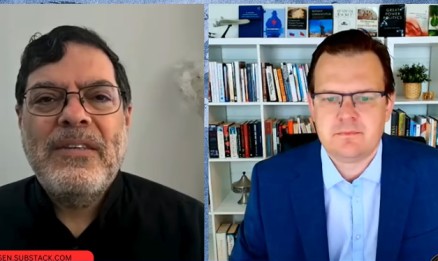
Read the full transcript of Professor Seyed Mohammad Marandi’s interview on Greater Eurasia Podcast, August 1, 2026.
EDITOR’S NOTES: In this interview on the Glenn Diesen channel, Professor Seyed Mohammad Marandi—former advisor to Iran’s nuclear negotiation team—joins host Glenn Diesen to unpack the recent mass entry of tens of thousands of Moroccans into Spanish territories in North Africa. Marandi frames the coordinated border crossings as a calculated move, possibly encouraged by the United States and Israel, to reward Morocco’s loyalty while disciplining Spain for policies that diverge from the Western consensus, particularly on Israel. The conversation expands into a broader analysis of how declining U.S. hegemony shapes the treatment of proxies and allies, the ruthless dynamics of power in the Middle East, and Iran’s stance amid ongoing regional conflicts. Together they explore the risks of miscalculation, the fragility of current alliances, and what these events reveal about the shifting global order.
Introduction
Glenn Diesen: Welcome back, everyone. Professor Seyed Mohammad Marandi joins us again, a professor from Tehran University and also a former advisor to Iran’s nuclear negotiation team. So thank you for coming back on the program.
Professor Seyed Mohammad Marandi: Thank you very much for inviting me, Glenn. It’s a great pleasure being with you.
Morocco’s Coordinated Border Crossing into Spain
Glenn Diesen: I want to start off with a bit of a different topic today, yet still related to what we usually discuss. That is, we see that somewhere between 50,000 and 60,000 Moroccans stormed across the border into Spain, or more specifically, the Ceuta Spanish territory in North Africa. And this is, well, from the video footage we see, they’re arriving in trucks, and it seems very much coordinated, as it would have to be.
I was wondering, how do you make sense of this? Because you see some EU diplomats as well saying that this was obviously organized by the Moroccan government, which is seen then as a way of contesting the sovereignty of this territory. So again, it does have huge political significance. It’s not merely, you know, refugees essentially.
Professor Seyed Mohammad Marandi: Yes, I mean, the issues between Morocco and Spain aside, the timing, I think, is very important. The threats made by Trump, by Netanyahu against Spain, and how Spain will pay the price for its policies. And the scenes that we’ve seen, which clearly show that this is something that’s being done systematically and in a very organized manner, I think just shows that this is not something that was just natural.
And it had very much to do with the fact that Spain is pursuing policies that are a bit different from the rest of Europe and the rest of the countries that are called the collective West by some friends. Of course, others would say the Spanish government doesn’t do nearly enough. But in any case, what it has done has created anger among senior pro-Israeli politicians in the West. And it’s widely believed that this is a punishment for its policies.
The U.S. and Israel Punishing Disobedient Allies
Glenn Diesen: Yeah. Well, I saw that earlier this year you had people like Mario Díaz-Balart, one of Marco Rubio’s top allies and also an influential member of the US Congress because he has several congressional positions where he, among other things, oversees foreign assistance funding. Again, he’s been very vocal on this issue, and he was making the point that these Spanish territories should not be considered a geographical territory of Spain, but the territory of Morocco.
And again, this isn’t his principled position or views on history or morality. It’s accompanied by some strong comments that Morocco is proving itself to be a loyal ally while Spain is not. So it just seems that given the animosity towards Spain vis-à-vis the way of wanting to reward Morocco for its — what’s a polite word — not obedience, loyalty, does it fit within a wider context or a way for the US to reward those who remain loyal, essentially making the alliance system more valuable?
Professor Seyed Mohammad Marandi: Well, you know, first of all, Morocco, the regime, the king is a very close ally of the Israeli regime. And throughout these last three years where the world has turned against Netanyahu and Zionism and the Israeli regime, he has remained very close. And although all those countries in the region that had ties with Israelis continue to have ties, in his case, he’s more like the UAE in that the relationship has not seen any signs of strain, nor has the regime been trying to at least distance itself. They continue to have military relations at a time when the Israeli military is carrying out these massacres.
So this is definitely — I mean, I don’t have proof, but it is widely believed that this is to punish the Spanish government for its policies that are much more in line with global public opinion, and I would imagine European public opinion, in criticizing the Israeli regime. And this is to hurt Spain or the current Spanish government.
I think though, and again I can’t say for certain because during the past few months my focus has been very much on Iran because of the war, but I think the problem with this policy or this behavior of the United States and the Israeli regime is that it further exposes the Israeli regime for what it really is.
Tucker Carlson, for example, has been saying that, and he has huge influence, but also a lot of insider knowledge. He is not an ordinary journalist. Many ordinary journalists are bright, they’re smart, but he has insider information. He has a lot of access that we don’t have. And he says that the Israelis have been seeking the destruction of Europe. They have no love for the Europeans.
And so this sort of behavior towards the Spanish government because of its policies, the language that we’re seeing from Netanyahu’s son, from Israeli officials, from Trump, and the way in which this was carried out at this particular time, I think shows that the Israeli regime has no regard — or it and its supporters have no regard — for European governments and European sovereignty.
That’s how they function in West Asia. That’s how they behave in Lebanon. That’s how they behave in Gaza, the West Bank, towards Iran. They bomb countries, they slaughter leaders, they wipe out communities with no shame. And so pursuing such a policy against Spain shouldn’t surprise anyone.
Trump’s Threats Against Spain and the Saudi Nuclear Deal
Glenn Diesen: No, and I saw the comments by Tucker Carlson as well, that Europe is not just Spain, but Europe in general is also a target. Of course, he has become very critical of Israel for very good reasons over the past years. But obviously Trump has been very vocal in his desire to punish Spain. He’s been talking about them being kicked out of NATO, putting a blockade on all trade. He hasn’t made direct threats about stripping it of territory, but you see this kind of idea that loyal allies should be elevated while the disobedient ones should be punished.
It seems like a wider issue now in that region. That is, as the alliance system is obviously fractured or weakened in the Middle East due to the US making a target out of its allies, we also see the deal now being made with Saudi Arabia, a nuclear deal that is linked directly to Israel as well. That is, they have to normalize relations with Israel, and then essentially they get to sideline all international rules and have a nuclear program without strict inspections and restrictions.
I was wondering, how do you see this and how does it affect Iran? Because I saw a journalist raise the question during a press briefing: “Why should Saudi Arabia be allowed to have this program but not the Iranians?” And the answer was quite straightforward — America will get preferential commercial deals out of this before anyone else. This is America first. Also, Saudi Arabia is an ally, Iran is not. So essentially, this is how the world is structured. Those who bow to the empire will get special treatment. Those who do not will not even have the rights within the Non-Proliferation Treaty, such as having a civilian nuclear program. How do you see this impacting proliferation and the wider region?
Professor Seyed Mohammad Marandi: You’re absolutely correct. In the case of Saudi Arabia, though, I think it’s a combination of two things. One is this mentality that you rightly pointed out, but it’s also the interests of the Israeli regime that prioritize even America first here. Because Trump ultimately, or the US government, is like a magician. First, they negotiate the deal for, I presume, many months, if not years. And then at the last moment, after everything has been agreed upon, like a magician — now you see it, now you don’t — “You can’t have this deal unless you recognize the Israeli regime.” So even there, the Israeli regime’s interests have been prioritized over that of the United States.
But that aside, US policy has been like that everywhere. I mean, Greenland, Canada, the hostility that the United States has shown through its trade war with the Europeans. Trump does not view Europe with respect. And perhaps to a degree that is also in line with Israeli policy, because as Tucker Carlson points out, Israel hates the Europeans.
And so when you look at how the Trump White House behaves towards Saudi Arabia with these twin components — one, America first, but then Israel first above America first — I think it helps one better understand US policy towards Spain. It has to be obedient to the United States, but first and foremost, it has to support the Israeli regime and its policies. And the United States and the Israelis are willing to go very far to harm countries. No country knows that better than Lebanon, Yemen, Iran, or Syria in that regard. They’re willing to go very far and to be very ruthless if you do not obey the demands of this class of people.
The Declining Hegemon and Its Treatment of Allies
Glenn Diesen: Yeah, well, it’s often pointed out, especially in political economy, that a hegemon which is very comfortable where power is truly concentrated can often be seen as a generous — not just generous, but a benign hegemon — because it can give some collective benefits. It can be quite generous to allies. You saw especially the US towards the Europeans after World War II, its frontline states, being able to build them up.
However, there’s always the warning that once the hegemon is declining, the main objective is to hold on to hegemony, and then it will have to take on a very different character. That is, it would begin to extract more from its allies. It would use them as instruments, probably against the rival states which are rising, and all the rules of the past are essentially thrown out the window. And well, that’s more or less what we’re seeing now — the declining hegemon is getting uglier.
But it’s also not just rewarding good allies, but also punishing the disloyal countries. And of course Spain is here on top of the list. But within the Middle East, how does the US deal with its Gulf states, its proxy states, which no longer follow its rules? I mean, I saw this report now of a Qatari LNG tanker going towards Pakistan being blocked by the US because it used the Iranian corridors. In other words, it didn’t follow the rules — it was making deals independently of the United States, and even loyal allies which participate in attacks on Iran are now punished. How severe do you think this is? It will probably have some effect on their calculations, I assume.
Qatar, Pakistan, and the Iranian Strait of Hormuz Corridor
Professor Seyed Mohammad Marandi: Oh yeah, you’re absolutely correct. In our region, the United States is increasingly becoming intolerant. It’s been like that for a very long period of time, especially under Trump. But the case of Qatar and Pakistan is very interesting in that Iran has said it will not allow ships to travel through the Strait of Hormuz unless they go through the Iranian-designated corridor. That was something that was agreed upon in the MOU. The Iranians were supposed to manage the Strait of Hormuz during the period when the MOU was being implemented.
And of course, the Americans then decided to violate the MOU and create their own corridor with the help of the Qatari, Saudi, and Kuwaiti governments. And that’s what led to the renewed fighting, because that was a violation of the deal. The Iranians for days warned them not to do this. They ignored Iran. And like all the other articles of the MOU, the United States continued to violate Article 5, and we are where we are now.
But it’s interesting that Qatar — all it wanted to do was get its LNG ship out of the Persian Gulf and to Pakistan, both allies of the United States. Pakistan has been working closely with the United States. The Pakistani government was involved in Egypt when Trump implemented or declared that ceasefire with Gaza, despite the fact that it was a one-sided deal that benefited the Israeli regime. And Qatar, of course, has been hosting US forces and assisting the United States in bombing Iran.
And all they did was use the Iranian corridor. And as far as I know, the Iranians are not receiving any fees from ships at the moment until the two months finish. The Iranians, from what I understand, have no plans to take fees. So all they did was use the Iranian route to send the ship from Qatar to Pakistan, but the Americans blocked it. And now the ship is being held by the United States.
So the United States has punished both Qatar, which has been faithful — Trump’s plane was a gift from Qatar — and Pakistan, a faithful ally. But the United States behaves in a very ruthless manner towards allies, in line with what you were saying a few minutes ago.
The Israeli Factor in U.S. Foreign Policy Decline
Glenn Diesen: Yeah, well, several weeks ago, we also saw Oman being in talks with Iran about finding some way of organizing or managing the strait together to avoid conflict. And Trump’s response was, well, if they make a deal with the Iranians, we will blow them up. That is Oman. It is quite— it shouldn’t be funny, but it kind of is. I mean, this is how you talk to friendly countries.
Well, it kind of shows that it is a difficult time for the US, because the whole world order was organized around their global primacy, and it is slipping, and they’re looking for new ways of shoring up that power. Not advocating what they’re doing, but one can see the difficult position they’re in.
In general though, the key problem of the MOU and the Iranians even administrating the Strait of Hormuz is that again it would be more power or administration over the international system, which is now out of U.S. control. And I think that’s probably why they can’t accept it.
But now it appears that they might be heading towards massive strikes. We see these talks about shutting off all electricity across all of Iran. Again, Trump has a big mouth. He talks a lot, but it does appear from some of the force buildups and activities that this could be the direction they’re going. I was just wondering, how do you see the developments now moving forward? Again, no crystal ball, just the possibility.
U.S. Sacrificing Its Interests for Israel
Professor Seyed Mohammad Marandi: Well, again, I think all of this makes sense when you look at them together. What the United States is doing to its European allies is not in the interest of the United States. Even as the United States is declining, its ruthlessness is only going to hurt the relationship in the long run.
But also, this policy is at least partially, in this case mostly, influenced by the Israeli regime. So the United States is sacrificing its relationship with at least part of Europe because the Israeli regime wants this. In other words, because Spain has been pursuing, according to Trump, policies that have to do with the US war against Iran and policies that have to do with the Israeli regime’s behavior in West Asia. So the United States is willing to sacrifice for the Israeli regime.
Also in the Persian Gulf, Qatar, which is a client regime and obedient to the United States — and the United States has benefited from these countries in the Persian Gulf more than any other country by far. I mean, the wealth that comes from oil and gas, most of it goes to the United States. China is a distant second. The trade relationship with China is probably greater, but when you include the amount of money that they put into US stocks and bonds and the stock market, and the relationships and the support that they give to the West, there’s just no comparison there.
These countries are of great benefit to the United States, but the United States is willing to humiliate them, to harm them — like with the Saudis and the nuclear deal, or when Trump said that Mohammed bin Salman can kiss his behind, in front of, I think, at least a large number of Saudis in the audience. All of these are harmful to the United States, but if you look at a broader picture, there’s the Israeli element everywhere. Everywhere you look, there’s Israel.
The “Israel First” Element Accelerating U.S. Decline
And with Pakistan too. I mean, Pakistan is in deep trouble. The economy is not doing well. The Pakistani government is, as I said earlier, a close ally of the United States. Trump and the leadership in Pakistan are friends, but the United States behaves like this simply because the United States is hostile towards Iran. And of course, its hostility towards Iran is because of Israel.
So the “Israel first” element in US foreign policy is hurting the United States at a time when the United States is on the decline. And it’s only making things much worse. And it prevents the United States from managing the decline. The United States could behave very differently and manage this decline in a way that it still preserves a lot of its global influence in the face of its rivals — or its chief rival, let’s say China — but it chooses not to do so. To a very large degree, it’s because of the Israeli regime across the Mediterranean and West Asia.
In the case of Iran, it’s the same thing. The United States prioritizes Israel. It’s willing to constantly speak about crimes against humanity.
Iran’s Resolve in the Face of U.S. Threats
You and I were supposed to speak last night, and I proposed to leave it for this morning to see if the United States does carry out those mass airstrikes that they’ve threatened to carry out and that Western journalists have been told about. We’ve been told throughout the last few months that Iran would be wiped out, that the civilization would be wiped out, that Iran would be obliterated, that Iran would be sent back to the Stone Age. And no doubt this is destroying the United States’ image across the world, just like the genocide in Gaza, or the genocide in southern Lebanon and the ethnic cleansing there, or the dirty war in Syria.
Now, all of this has to do with Israel. If you remove the Israeli element from U.S. foreign policy, the relationship between the United States and countries across West Asia and North Africa and Southern Europe, and the populations across those regions, would be very different from what it is today. So I just think that it’s clear as day that the Israeli regime is a burden to the United States. It is a very destructive element in US foreign policy and in the United States being able to preserve its power.
But in general, the Iranians have a policy of ignoring what Trump says. Getting back to the threats of major strikes against Iran — from the very beginning, during the 40-day war, when things began to go south, the Americans and Trump in particular began to make these threats against Iran. At first, he thought he would win the war very easily. Unconditional surrender — that was the demand. And then after a week, maybe two weeks, it became clear that this was not going to happen. And then gradually it became clear that actually it was Iran that was winning the war.
Back then, we have to remember, the United States did not have the shortages that we’re hearing about today. The shortages of interceptors and missiles were not being discussed. The United States was firing missiles and using interceptors without any fear of shortages, but they still lost the war. And that’s why I think that today, when they speak about these shortages, that is significant — if this is an accurate assessment of the situation. But still, without the shortages, the United States failed against Iran.
The Consequences of Striking Iranian Infrastructure
So back then, in any case, Trump began threatening Iran, and that didn’t force Iran to change its position — obliterating Iran, wiping it off the map, sending it back to the Stone Age, erasing this civilization. He couldn’t make Iran budge. And as we saw over the past few days, the threats that have been made against Iran to destroy its electrical grid, to destroy its bridges repeatedly — these threats have been made, and then last night we were told that they’re very close to carrying out this operation. And of course it’s the weekend. So we were waiting to see what he’d do, but it didn’t shift the Iranian position.
And that is because the Iranians are determined, no matter what happens, come what may — whether the United States starts bombing Iran’s critical infrastructure. There was talk of destroying Tehran’s electrical power plants. That means leaving a city of 14 to 15 million people, depending on the time of day, without electricity — hospitals without electricity. That would mean many infants would die, children would die. That would create enormous hardship for ordinary Iranians. The same Iranians that, by the way, the Americans pretended that they wanted to save from the, you know, “evil regime.”
But ultimately, we saw that the Iranians did not shift their policy and they remained committed to their position. So even if the United States had carried out the strikes last night against Iran, Iran would have continued to fight. What it would have done was to strike back at Kuwait, the Emirates, the Israeli regime, Saudi Arabia, Bahrain, Qatar, and so on for the role that they’ve played in this. And perhaps Oman too, and perhaps Jordan, for the role that they played in this destructive war.
The Risk of Global Economic Depression
And that would of course have led to a global economic depression, because the shortages that have now accumulated in the global market, especially with regards to oil, have reached very close to a tipping point. But if people suddenly in the morning see images of fires raging across the region and electrical power plants destroyed and desalination plants destroyed and oil and gas facilities destroyed, that would cause immediate panic on the markets, and no amount of manipulation would work anymore — the markets would collapse. And I think that a global economic depression would be inevitable, and it would come in and strike very swiftly.
The Destruction of U.S. Soft Power
But in addition to that, we also have the image of the United States being further destroyed across the world because of the Israeli regime. To strike Iranian critical infrastructure, or to threaten to strike Iranian critical infrastructure, is something that has been normalized. People are hearing about it every day. That’s not helping the United States. That’s destroying the United States.
Whether one believed that US hegemony was benign or not, the image of the United States under Obama, under Clinton, even under Bush, was very different from what it is today. Back then, especially under Obama and Clinton, the United States was by many seen as a benign power. I didn’t see it that way at all. I don’t see any fundamental difference between Obama and Trump, but that’s a different issue. But back then, if you look at global public opinion and how the United States was viewed across the world, it was very different from what it is today. And that soft power was of immense importance to the United States, even when confronting Iran.
Glenn, one of the achievements of the United States against Iran was being able to convince younger people — not all younger people, but a significant proportion of younger people — that the United States was not the problem. The problem was Iran. And that soft power reached its height with Obama. I mean, Bush came in and wrecked the US image — not like Trump, but wrecked the US image. And then Obama came to power and the US image was restored. And many young people, students of mine, acquaintances of mine, were impacted and believed that the United States was a benign hegemon. Trump has destroyed that. That has been utterly wrecked. And I see that not just among Iranians, but across the world.
And by destroying that soft power — and of course Gaza, you have to include Gaza and all these other issues alongside this — the destruction of this soft power has enormous consequences for the United States. So again, all of this goes back to Israel and the Israeli regime. Regardless of what you think of the United States, the Israeli regime has been nothing but a burden to the empire and has done nothing but damage to the United States. It is not an asset, whatever they may say. It has wrecked the United States financially. It has wrecked the United States from an economic perspective. And from a soft power perspective, it has utterly demolished the United States. I see that in Iran. And I think that when you look at polls that are taken by American institutes across the world, it’s clear as day that this is the case.
The Decline of U.S. Hegemony and Its Regional Proxies
Glenn Diesen: Yeah, the soft power issue, I think, is going to— well, it’s becoming evident already. And what you say about the Iranian youth, I have heard similar comments from Russia that is often, well, many youth or even liberals often assume that, well, if just one of the problems of the ongoing tensions with the US was, you know, Russia, if they would change some of their ways, then a lot of the conflicts will go away.
I don’t think anyone believes this anymore today, that it’s not the internal character of the state, it is the hegemonic ambitions of the United States that puts very strong limitations on the ability it has to have a relationship with the states that doesn’t bow to everything.
I know at least in Russia it’s popular to make the point that America doesn’t have allies, it has vassals. And it’s making that point itself now, I feel, especially in the Middle East, but not only.
And on the soft power issue, you see what the US can do to leaders is one thing. That is, you know, you see Trump, he can threaten Spain in front of people like Mark Rutte or Friedrich Merz, and they say nothing. So they will prioritize appeasing the United States. But this kind of, as you said, the whole point of soft power is, yes, you can have an obedient political class, but below, besides this, you see something very different. You see these politicians collapsing in the polls. We see our population growing very skeptical of the United States. So again, it’s not sustainable.
I mean, for God’s sake— the US can even threaten to take Greenland and they will still show up to bow to Trump. It’s quite incredible to see your own leaders not just ignore national interests, but all signs of dignity.
But yeah, what I wanted to ask though is, you know, when you have front lines—
Professor Seyed Mohammad Marandi: Sorry to interrupt, Glenn, sorry to interrupt, but it’s like if you’re with the empire, you are going to go down with the ship. So the Europeans, of course it’s not just Trump, it was also Biden — the policies that they pursued against Iran, the policies that they pursued against Russia, the policies that they pursue against China — they’ve all served to weaken Europe during the past few years. And the decline of Europe is even faster than that of the United States.
But also look at our own region. The United States has sacrificed all these countries that it has been, as Trump would say, milking for all these years. Why? Because of their obedience. In other words, their obedience to the United States has served to weaken them and destroy them, as we’re seeing in this war.
And then in East Asia as well, the United States uses Japan, it uses Korea, it uses other countries as tools against China. Yet, for example, in the case of Korea, they forced the Koreans to purchase THAAD missiles. And it was a very problematic, controversial policy that was pursued by the Korean government. And then once they were installed, the United States took them away and gave them to the Israelis. So the Koreans paid the political price and the financial price, I assume, by obeying US policy, but they were harmed anyway.
So the United States shows that by being a US ally, you’re not helped, you’re harmed. And then the United States imposes laws with regards to the production of chips and also policies with regards to industry that show no regard for allies like Korea or for Europeans. So it seems that if you stick with the empire, you’re the loser. You get hurt. You suffer as a result. You’re not benefiting from being subordinate to Trump or the Trump regime or the United States.
Frontline States and the Dilemma of U.S. Dependence
Glenn Diesen: Well, yes, that problem with the declining hegemony though — it has a strong impulse to use the frontline states as instruments to take out its rivals, essentially push them into war. But it seems like the frontline states then have 2 possibilities and competing impulses of their own.
That is, one, they can go closer to the US for protection for the conflicts they’ve been pushed into. And the US was the main instigator of the Ukraine war, yet the Europeans now lean completely into the US for protection. You see some of this same logic among some of the Gulf states.
The alternative is then to distance a bit from the United States as the source of the conflict. But then again, these are mutually exclusive.
I was wondering, how do you see this now in West Asia? Because you probably saw this open letter being signed by hundreds of Jordanian politicians and public figures. It was making the point that they should distance themselves, or at least push out, ask the US troops to leave the country because it’s bringing havoc to the country. And again, Jordan has demographics that suggest a revolution would be possible, that not everyone is happy with the government policies.
And vis-à-vis what’s happening in Kuwait, where they’re just looking the other way and they could essentially be destroyed as a consequence, absorbed into Iraq. So I was wondering, how do you see this, especially with Jordan? Because it often doesn’t pop up in the news as often as the other Gulf states.
Arab Discontent and the Fragility of U.S.-Aligned Regimes
Professor Seyed Mohammad Marandi: I think we’re reaching a breaking point and it’s unclear when this is going to happen. But as time goes by, all of these governments that are loyal to the United States, allies of the United States across our region and North Africa — things are going to become increasingly difficult for many of them to continue with these policies. They are authoritarian, they are police states, and they have support from Western intelligence agencies to preserve power.
But when we go back to the so-called Arab Spring, or the awakening, that happened after an incident in Tunisia which led to the uproar across the region — back then I think it was clear how fragile many of these regimes were. And of course the oil and gas-rich countries in the Persian Gulf tried to manage this wave of popular discontent by destroying Libya and then destroying Syria, and turning attention away from their own authoritarian regimes. And of course, this was in line with the interests of the empire in the long run.
But I think the situation today is far more fragile than it was back then. And while the United States and Western journalists and Western diplomats like to think that all is well in these countries, the amount of discontent is enormous.
You can sort of tell — and this is not scientific — but you can tell from the comment sections in mainstream Arabic media owned by these dictatorships. Qatar has a huge media empire, the Saudis have a huge media empire, the Emiratis have a huge media empire. They may be different from one another, but they all are aligned with the United States. They’re all aligned with broader Western interests.
But when you look at popular opinion in the Arab world, they are siding with the resistance. They side with Iranians. They cheer the Iranians when the Iranians fire missiles at US assets in these countries. So obviously the sectarianism that these countries promote, the racism that these media empires — not just like Al Jazeera or Al Arabiya or Sky News Arabic or anything like that, they have literally thousands of different types of media outlets to use, and cultural centers or so-called religious centers that they use to build their narrative. But you still see that the people are cheering for the resistance for the most part, and that is, I think, a huge sign of discontent.
And that’s going to be a major problem. For people in Jordan to make such statements under such a government shows how unhappy they are. And often things seem very normal on the surface, yet many things are happening underneath the surface.
And again, when the so-called Arab Spring happened, no one predicted it — or very few people predicted it. But it was a time when things were moving forward apparently very normally, and then within a very short period of time you had chaos from the Arabian Peninsula to West Asia to North Africa. The Israelis were terrified and they did manage it ultimately, the West, but they only made the situation in the region worse. In other words, they kicked the can down the road by wrecking much of West Asia and North Africa, but they did not solve the problem for the empire.
The U.S. Defeat and Its Consequences for Regional Stability
And I think today things are far more dangerous for the United States and the Israeli regime — far more dangerous than they were back then. Especially because they are now increasingly on the decline, and therefore their ability to maintain hegemony is much more limited than before, as we saw in this war.
The war with Iran, I think, is clear in that it shows — for the first time — the United States has been seen as incapable of winning a war. I mean, we know that the United States failed in Iraq and in Afghanistan, largely, by the way, due to General Soleimani and the policies of Iran, which supported the resistance in Iraq and Afghanistan.
Despite the huge differences with the Taliban, the Iranians helped the Taliban expel the United States. And even some Tajiks, the Persian speakers, or the Shias, the Hazaras, the Uzbeks, and others — some of them became very angry with Iran. But Iran believes that the priority is to defeat the empire, just as its policy in Syria was to defeat the empire.
Back in Syria, some of these people became very sectarian and believed that Iran was pursuing a sectarian policy, but it wasn’t. They were supporting the United States and using a sectarian policy in their support of US policy. But in Syria and in Afghanistan, Iran was pushing back against the empire.
So the United States’ failure in Afghanistan and in Iraq was clear. And of course Iran played its role, but this defeat is very different from the defeat that the United States experienced there. Here, the United States never got anywhere near Tehran. The United States was never able to overthrow the government or take huge amounts of territory and then ultimately failed because of the costs or because of the difficulties that it faced.
The United States was defeated as a power on the battlefield, as we would read in wars of past where 2 countries would fight against one another and the aggressor failed. This is another example, but in this case, it’s the superpower, it’s the hyperpower, it’s the country that everyone feared across the world. So I think that this is going to weaken the United States enormously.
It makes those regimes that the United States supports and backs much more vulnerable — not only because of the damage that has been done, but because these regimes lose confidence in the United States. And it’s the United States that keeps them in power. So when you see people in Jordan unhappy with policy, I think that’s a very bad sign for the government, because the government has been weakened. People are angered by seeing the government supporting Israel. And on the other hand, the government looks and sees that the United States, the hegemon, is not the power that it thought it was.
The Jordan Attack and Iran’s Escalation Strategy
Glenn Diesen: Yeah, well, on the topic of Jordan though, we saw one of the reasons why Trump was all angry again and wanted to bomb all of Iran, take out its electricity — because of the attack Iran did on the bases in Jordan. Now, for Trump, he framed it as, “We were negotiating with the Iranians and they were not honest. They attacked us out of nowhere.” I didn’t know the negotiations were ongoing or serious at all, but it appears that the source of the anger was that Trump had decided, “Okay, now we’re going to stop the bombing, so Iran also has to do it.” The idea that Iran can only retaliate proportionally to what the US is doing.
I guess, well, if I was Iranian, I would be worried about being too predictable in this way, because then you cede all of the escalation control to the Americans. I was also wondering how you interpret that event, because we can take Trump’s word on it, but how do you see this?
Iran’s Confidence and the Empire’s Miscalculations
Professor Seyed Mohammad Marandi: Well, in the West, they say this is a surprise attack. And Trump was saying this was a surprise attack, not that it was carried out in secret, but meaning that it was like something unexpected, something that shouldn’t have happened. It was not normal for this to take place. But that’s not a meaningful assessment.
The United States waged war against Iran and we are at war. The United States had restarted the war after violating all of its commitments in the MOU, attacked Iran for 30 days, and then suddenly stopped for 3 days. The United States doesn’t dictate when there’s a ceasefire and when war starts. There is no ceasefire between Iran and the United States. And of course, as we speak, the United States has imposed a siege on Iranian ports and on the Strait of Hormuz. So that’s an act of war and it’s an act of war directed at ordinary Iranians.
So the Iranians have been very clear that when they struck the US assets in Jordan, that it is their right and that they will continue to do so. Whenever required, it came at a time when the Israeli regime and Trump — Netanyahu and Trump — were to talk and to take decisions with regards to war. So the Iranians were sending a message to the United States and the Israeli regime that we are confident in our position. We will attack whenever we think it’s appropriate. We’re not intimidated by any means, and that we will take the initiative whenever we think necessary.
And also, the United States had gathered troops in Jordan. They had gathered assets there, which Iran saw as a threat. And so Iran struck them to deter that threat against Iran. So again, that’s sending a message to the United States that you cannot just gather your troops and your equipment and threaten Iran and Iran will just sit back and wait till you strike first. No, Iran will not wait because we are at war, because the war has already started, because there’s no ceasefire, because you’re waging war against us. So we will carry out this attack.
But I think what this does more than anything else, it just shows how confident Iran is about its position. Iran is not going to just wait till the Americans strike and then strike back. Iran does this for moral reasons and religious reasons. Iran cannot start wars. And so it hasn’t started wars. But in this case, the war is already — there is war. We are at war. This is not a ceasefire.
But Iran, by not waiting for the United States to initiate a new phase of the military conflict and striking first, I think it’s showing a large amount of self-confidence. And we see that — we saw that in the last 24 hours. Many people were expecting the United States to carry out a serious strike on Iran last night and to take out our electricity. And if they had done so, maybe you and I wouldn’t have been able to have this conversation right now. But it didn’t change the Iranian position. The Iranians said, if you strike, we will strike back. So it shows Iran’s confidence. And the strikes on Jordan again show Iran’s confidence. And militarily speaking, it weakened the United States. It was actually very — the 2 strikes on Jordan were very effective. And it took out key assets of the United States, which would have been needed for an air operation against Iran.
Glenn Diesen: Now, I often make the point that this illusion of escalation control, something the political West had throughout the hegemonic era, that this is possibly the greatest danger there is now in terms of miscalculations that will spark wider wars, be it against Iran or with Russia. Anyways, I want to thank you for taking the time on weekends.
Yemen, Saudi Arabia, and the Cascading Miscalculations
Professor Seyed Mohammad Marandi: I’ll keep this very short, but just one final point. Another miscalculation was with regards to Yemen. Striking the Yemeni airport has led to Yemen striking back at Saudi Arabia. And then Yemen has said that they are not going to accept the siege on their women and children anymore. And so they’ve imposed a counter-siege on Saudi Arabia.
Now Saudi Arabia can create a coalition of countries, which of course it would be an immoral coalition because it’s the Saudis that have carried out genocide against Yemen, the Saudis who have imposed a siege for many years against the women and children of Yemen. And this coalition is assisting the Saudis in continuing this barbaric policy. But it’s going to fail.
And the Saudis are harming themselves at a time when the Persian Gulf is closed. They cannot leave the Persian Gulf because of the Strait of Hormuz and the conflict between Iran and the United States. They need the Red Sea. So they provoked Yemen — many say with the encouragement of the United States — and that has backfired.
And then, even though it was Yemen that took credit for bombing Saudi oil installations, the Saudis, because they didn’t want to strike back at Yemen — because they were afraid that the Yemeni armed forces would again strike more oil and gas targets — they went and bombed Iraq. They retaliated against the Iraqi people and killed a large number of people. And that has created outrage across Iraq. And now the Iraqis are saying they’re going to retaliate.
So the miscalculations — whether on the battlefield with Iran or with regards to the people of Iraq or the people of Yemen — the miscalculations that the empire and its proxies are making, I think, are acting as catalysts that will bring down the empire and will ultimately bring down those proxies. And we’re seeing it at multiple levels and across the region.
Glenn Diesen: I think the assumption was always in the hegemonic era, at least, that is why many of the states bombed was, well, that these were essentially bloody nose attacks. That is, we’ll bomb you a little bit, but if you try to push back or defend yourself, then we’ll be really angry. So this schoolyard bully approach where, you know, just sit there while I punch you a little bit and then it won’t get any worse. And you see Trump always leaning into this — “Oh, now I’m really angry. If they dare to do this or that, then I’m really going to destroy them.” But as long as one doesn’t shy away from pushing back, it doesn’t work anymore, it seems.
And I think ultimately it could be good for the United States as well as a lesson to learn that it has to adjust to the new reality, the new distribution of power. Same with Europeans pretending you’re living in the unipolar moment when you’re already in the multipolar world — it’s incredibly destructive. So hopefully there will be a steep learning curve and we’ll all come out better at the other end. But as I said before, thank you for taking time out of your weekend. Thanks again.
Professor Seyed Mohammad Marandi: Thank you very much for having me. It’s a great pleasure, Glenn.
Related Posts
- Transcript of Episode 1: Origins of the War In Ukraine – John Mearsheimer
- John Mearsheimer: Ukraine Is Landlocked & Donbas Enters Endgame (Transcript)
- Joe Kent Interview: Iran Trap, U.S. Ground Invasion & Israeli Deception (Transcript)
- Transcript: Laura Loomer Interviews Volodymyr Zelenskyy
- Transcript of Lawrence Wilkerson Interview: Iran War Escalates Toward Global Crisis