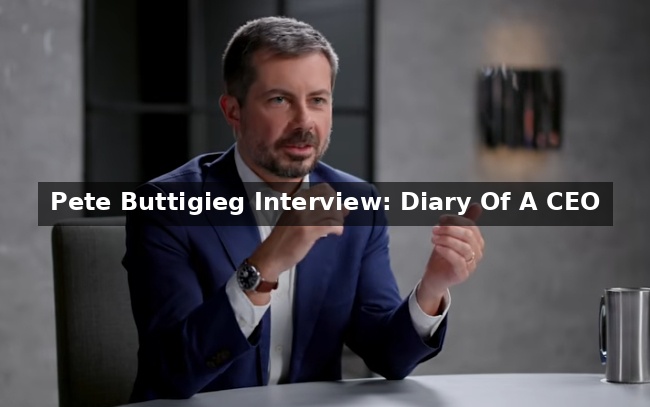
The following is the full transcript of 2028 Presidential frontrunner Pete Buttigieg’s interview on The Diary Of A CEO, August 3, 2026.
EDITOR’S NOTES: In this episode of The Diary of a CEO, host Steven Bartlett sits down with Pete Buttigieg—former U.S. Secretary of Transportation, Navy veteran, and rising 2028 presidential contender—for a candid conversation about the fragile state of American democracy. Buttigieg argues that the American Dream is slipping away amid extreme inequality, collapsing trust, and systemic failures that leave everyday people struggling while the ultra-wealthy pay lower tax rates than teachers. From the recent U.S. strikes on Iran and the rise of AI to wealth taxes, national debt, and the hard reforms needed to save the country’s democratic foundations, he offers an urgent and unfiltered look at the crises facing America—and what it will take to fix them before time runs out.
The State of American Democracy
Steven Bartlett: Secretary Pete Buttigieg, how are you feeling about the nature of politics at the moment? But I should probably say the nature of American life at the moment.
Pete Buttigieg: I’m really worried about where we’re headed as a country. I think in many ways our entire existence has been about creating a different kind of political system and introducing it to the world. That’s what we’re about. And now that whole project is in question. That whole project is, in my view, it’s on the brink.
Steven Bartlett: On the brink?
Pete Buttigieg: Yeah.
Steven Bartlett: What do you mean by that?
Pete Buttigieg: I mean, we’re on the brink of losing our democracy, the whole idea of this country, the whole idea of overthrowing a king. Was that everyday life would get better if we set up a country where the people are in charge of the government instead of the other way around. And now in this moment where after all of the things we’ve gone through for decades, for 250 years, it’s not clear if that’s going to work out.
I think it will. I believe it will if we do what we have to do. But that means reforming, tuning up, changing that political system. Because the problems in that political system help to explain all of the economic problems that I think so many Americans are living with, where you’ve had enormous economic growth and shockingly little of it making it into people’s pockets, where you have levels of inequality that we’ve almost never seen in this country.
And then the other thing is there’s the American promise in terms of the system, the politics, the government, democracy, America’s gift to the world, creating democracy. But there’s the economic version of that, which is the American dream. Right? The idea that no matter how you start, no matter who you are, you can come out ahead of where you started economically. That used to happen for 9 out of 10 Americans. Statistically, the place where you’re most likely to live out the American dream right now is Denmark. And I want that to be America.
The American Dream and Systemic Inequality
Steven Bartlett: And systemically, if we just think from a high level, what is the essence of why Denmark is a better place for the American dream? What are the systemic problems? Is it with the current administration? Is it with a perspective on what a good life looks like in America, or is it greed, or is it something else?
Pete Buttigieg: Well, I wouldn’t say it’s just the current administration. I mean, I think the current administration isn’t helping, but I think the problem is much deeper than that. A lot of it is the last 30 or 40 years, we’ve had policies in this country that make it harder to get ahead if you’re not already starting out well off. Even just the way our taxes work, they tax work more than they tax wealth. That’s really catching up to us.
I mean, it has created problems. I believe it’s created problems for decades, but you feel it in a different way now. And when inequality reaches a certain level and when the inequality of power follows the economic inequality to a certain level, that’s when I think you start to have earthquakes in the society and what it feels like to live in this country. And I think we’re going through those earthquakes, not just Trump and everything he represents, but the rise in political violence, the collapse in trust in our society. All of these things I think are related to that, and we’re running out of time to do something about it.
Why Trump Resonates
Steven Bartlett: Trump made a lot of promises when he came into power. He won in a bigger than expected victory, I would say. Why does he resonate?
Pete Buttigieg: Well, first of all, I think he speaks to a lot of people who know that the system has let them down. And even though I think he’s somebody who really benefits from the system as it is, it’s made him rich and kept him rich. His message was, “I’m going to blow it all up.” And I think he’s blowing up all the wrong things. But look, if the system’s let you down, you’re only going to vote so many times within that system before somebody comes along and says, “I’m going to blow it all up.” And you say, “Well, I might not even like the guy, but I’ll give him a shot to see if that makes me better off.”
Now, I also think he lied to a lot of people. Some people voted for him because they believed him when he said he’s not going to start a new war. Many people voted for him because they believed him when he said on day one he was going to start lowering costs. And right now inflation’s higher than it was the day he took over.
And there’s a lesson for my party in that. I’m obviously passionately against many destructive things that he’s doing. That doesn’t mean the answer is to quote unquote reverse the damage, put everything back the way it was.
The Democratic Party’s Responsibility
Steven Bartlett: Because you’re right though, that the Democrats have a lot of responsibility here. For a lot of reasons. I think the very fact that Trump was voted into power says something about how people felt with the previous administration, which was a Democratic administration. What responsibility does the Democratic Party have for getting the country to a place where they thought Democrats weren’t the solution? Because that’s kind of, I think a lot of people thought that’s just like more of the same.
Maybe people are getting increasingly, I think across the Western world, by the looks of it, increasingly tired with politicians saying these cute words like, “We’re going to help the working people,” and blah, blah, blah, blah, blah, and being very polished. And then you see these other figures that have come in and said, “I’m not a politician.” And as you say, “I’m going to burn it down.” And for some reason people are choosing that.
Pete Buttigieg: Yeah. Even though when they do, usually that person makes it worse. And so that’s why the president’s unpopular. But the president is unpopular, to your point, that doesn’t mean people are automatically going to trust Democrats. So I mean, the answer to your question is yes, Democrats have a responsibility to present something that is better, not just better than now, but it’s got to be better than before. The fact remains, a lot of these results have unfolded kind of regardless of who’s in power.
Will Pete Buttigieg Run for President in 2028?
Steven Bartlett: Are you going to run to be president in 2028?
Pete Buttigieg: I don’t know. I would have to believe, and this is how I’ve approached every time I’ve decided to run for office, it’s looking at everything that the office seems like it needs, not just generally, but in that moment. And then looking at what I bring to the table and asking myself, “Okay, am I bringing something that’s different enough from what others are bringing and that fits that moment?” That’s what led me to run for mayor, which is a pretty unlikely move in South Bend, Indiana when I was in my 20s. It’s what led me to run for president when I did almost 8 years ago now.
Steven Bartlett: I’ll use your own words here, Secretary. You said politics often favors someone who is completely different to the current leader and that you could not be more different from Trump. I quote, “an intellectual young gay mayor from the Midwest.”
Amazon have this really interesting thing when they hire people, which we’ve copied. Every time you meet someone, you have to vote one of 4 things. You either vote strongly not inclined, not inclined, inclined, and strongly inclined. So you’ve got 4 options when you interview someone. We do the same in our company now. We took it from them. And the whole idea here is to prevent people from sitting on the fence, which is like, what is your inclination?
So if I presented you with those 4 options as it relates to you running for president in 2028, as things stand, and this is just a balance of probability, are you inclined, not inclined, strongly not inclined, strongly inclined? On these podcasts, nobody ever tells the bloody truth. This is why it’s difficult sometimes to interview politicians, because we all have an inclination, right?
Pete Buttigieg: Yeah. I mean, one of the reasons why you hesitate to talk in those terms is because you know that people are going to run with it and it’ll be this news of the day thing and it’ll kind of dominate the next couple of days when you’re trying to talk about something else.
Steven Bartlett: But does the truth just not matter more though than the consequence of the truth in this regard?
Pete Buttigieg: Yeah, but the truth about what I’m maybe going to do, there’s a level of not even being certain some of the things I’ll have to weigh before. Having made a decision like this before, I can tell you that there’s the read—
Steven Bartlett: I need to— the inclination.
Pete Buttigieg: I’m obviously not to one end or the other.
Steven Bartlett: Yeah, okay, so you’re not those two.
Pete Buttigieg: I think I’m more inclined than not.
Steven Bartlett: Okay, I appreciate it.
Pete Buttigieg: But there’s so much we don’t know. There’s so much I don’t even know about what’s going to happen this year, let alone what we need to know later. And this is not the weight of a decision like that. I don’t just mean like the national political weight, but just like the weight of a decision to run for office for you and your family. Which frankly I did not fully understand until I had kids. That’s changed all of my equations. It’s just something that you really sit with and take seriously, at least you should.
The Iran War: Promises Made and Broken
Steven Bartlett: One of the big things that people are talking about at this moment in time is the Iran War. And this feeds into some of the points we were touching on around promises kept and not kept. What is going on? In plain terms? Because Americans are getting lots of messages. “We’ve destroyed everything in Iran, the military bases are all gone,” and then we’re back at war and American lives have been taken. Can you help us see through all of this?
Pete Buttigieg: I think what’s going on is the president has painted himself and the country into a corner. There was a moment where it seemed to him that he was better off politically if we were at war. Even though we promised that we wouldn’t be, even though a lot of his supporters didn’t want the war, and certainly the American people as a whole don’t want it.
But he was under a lot of heat over cost of living, over the Epstein files, which was dominating the conversation every day, being proven to be as connected to an infamous pedophile as Jeffrey Epstein, and then doing everything he could to cover up disclosures about it. This is something that obviously was creating a ton of heat on the president. Meanwhile, there’s a lot of people in his ear every day, and some of them, from American politicians to people around the world, would really like to see him go to war.
Steven Bartlett: Why?
Pete Buttigieg: Well, it’s kind of the tradition of the Republican Party is to generally be more pro-war. My coming of age was at the time of the Iraq War. In fact, a big part of what kind of pulled me fully into politics was being opposed to the Iraq War.
Steven Bartlett: One of the things that a lot of people won’t know about you is that you did actually go and serve your country. I’ve got some photos of you here serving, and I think I’ve got your parents, I think post-Afghanistan as well.
Pete Buttigieg: Yeah, so they’re in the back.
Steven Bartlett: I just think it’s important for people to know that you can speak to this quite accurately having served your country.
Pete Buttigieg: Yeah, I mean, I know what it feels like to get on a gray tail airplane that’s taking you into a war zone and wondering what’s waiting for you there. Where we are now is a lot of troops are in that situation. They’re in harm’s way. And the president doesn’t seem to have a plan. He can’t explain why we’re there. He said it’s for regime change. He said it’s for unconditional surrender. He said that it’s to deal with their nuclear program. But last year he said they obliterated the nuclear program.
And so there’s a lot of reasons to suspect that we’re just at war because he wanted us to be. And now he can’t figure out how to get us out of it. And it appears that any way forward leaves us worse off than we were before the war. Prices are higher, troops have lost their lives. And it seems like the least bad options still involve Iran having more control over the Strait of Hormuz than they were asserting a year ago.
Most Americans shouldn’t have to be worrying about the Strait of Hormuz. They got enough to worry about. And a year ago, we weren’t. That was not a problem. Whatever was going on in the Strait of Hormuz did not feel like it was a problem where I live in Michigan. And now it is.
Steven Bartlett: Why though? What was the domino effect that caused him to go, “Do you know what? I think we can just go in there, decapitate the leader, and announce victory.”
The Iran Crisis and Middle East Policy
Pete Buttigieg: Obviously, this is a question for the president, but honestly, I don’t fully understand why they would do something like this, especially because we know, you didn’t have to be an expert in international affairs and security studies to know that if we actually attacked Iran, they were going to shut down the strait and try to cripple the world economy. It was literally the most obvious next thing that could happen. And yet it seems like he either didn’t understand or didn’t believe. Surely he was told this. We know, in fact, it’s been reported that he was told this and he did it anyway. So how does that happen? I mean, I’ve long given up trying to see into the mind of this president.
Steven Bartlett: Dare I say, if you are president in 2028, this can be your responsibility to resolve.
Pete Buttigieg: I mean, I really hope that the next president isn’t facing this war dragging on into 2029, but I mean, yeah, one thing we have learned is that it is harder to stop a war than it is to start one, which is why if you have any other reasonable choice, you don’t start one.
Steven Bartlett: So what are you going to do if you are president?
The Next President’s Challenges
Pete Buttigieg: Look, the next president will face a complicated, violent, and challenging Middle East and world map no matter what. And the next president’s going to have to deal with that while dealing with a more assertive China, and a dramatically swiftly evolving security landscape, partly because of things like AI.
Just as you and I are sitting here now, there’s a lot of headlines about a big safety issue created by an AI model that was supposed to not even be able to access the internet, managing to get itself on the internet and hack into another company to get the answers to a test that it was told to solve. And that’s as of today in 2026. The things that could be going on by 2029 are surely going to change both what we’re up against and what’s possible.
Look, in the same way that there was a nuclear hotline between Washington and Moscow, because it turns out even while at each other’s throats in a lot of ways, one thing that Americans and Soviets didn’t want was to incinerate the planet. There’s going to have to be some way for countries that do not trust each other today to coordinate on things like making sure AI doesn’t lead to bioweapons being made by rogue actors or even individual actors, making sure that it doesn’t lead to nuclear proliferation or any number of other problems that could happen. So the security picture, I think, will be more challenging for the next president than it’s been for any president since the Cold War.
Steven Bartlett: So what kind of president in terms of mentality or character experience do you think can meet those challenges?
Pete Buttigieg: Well, you need somebody who’s deliberate and decisive. Those two things sometimes are in tension because deliberation means you slow down, you look at what’s going on and you think about it. But decisive doesn’t mean you immediately make a call every time a question is put to you. It does mean that once you feel like you’ve got enough information, you make a decision, you own the consequences of that decision, you move on to the next decision.
And I think in terms of kind of character and style, we’re going to need both of those things. We’re going to need wisdom, we’re going to need judgment, and we’re going to need judgment that is not twisted or changed or colored or biased based on corrupt reasons.
And the reason I mentioned that is because right now, we’ve got, for the first time ever out of all of our presidents, a president whose family is making billions of dollars from things that are sometimes directly connected to the decision of a foreign government. There was one government in the Middle East that put hundreds of millions of dollars into the family crypto fund of this president. You got Saudi Arabia investing in the first family’s business interests to the tune of, I believe, a couple of billion dollars for the president’s son-in-law.
And we just can’t afford with everything that’s on the line right now to have the next president be someone who could remotely be influenced by those kinds of considerations, given everything that’s on the line for the American people and for American security.
Getting Out of Iran
Steven Bartlett: When you look at the picture in Iran, it’s all well and good saying we have to get out of there, but how?
Pete Buttigieg: No, the only good way to do it is to not be there in the first place. It’s too late for that. And so as is often the case in difficult decisions that executives face, it will be finding the least bad combination of options, which probably means engaging a lot of other countries, a lot of regional partners, a lot of allies.
Now again, the next president will be doing this at a big disadvantage because so many relationships with our allies have been burned. And it turns out you build relationships with allies, not just out of friendliness or because it’s neat. You do it because you’re going to need each other someday. And the worse something is, the more difficult a problem, just like life. The times I’m quickest to call a friend are the times when I’m hurting the most or feel like I need help the most. Same is true for countries. The tougher your situation, the more you got to have friends you can count on. We are in a very tough situation in Iran. We will be for a long time. We need our friends.
Steven Bartlett: Because you’re dealing with a lot of, dare I say, very large ego leaders around the world. You’ve got your Putins. I don’t even know who’s running Iran at the moment. Then you’ve got China. Does it need a leader with an ego of the same size? Because sometimes I think crazy people kind of respect crazy people in a weird way.
Pete Buttigieg: I think there are a lot of different ways to deal with people like that. But I think the most useful is to earn a level of credibility. And when we’re talking with allies, a level of trust. When we’re talking with adversaries, it’s maybe not the same thing as trust, but it is credibility that when you say you’re going to do something or you seem like you’re going to do something, you’re going to do it. It means less energy gets wasted on guesswork. And it means you have just a little more stability.
I think something all of us are looking for in the world right now is for it to just be a little more stable. And by the way, the way to do that is not to rewind and imagine that we can make the world look the way it looked in the ’90s or the ’50s. It’s not like that. We’re going to have to find new ways to create a stable future. But look, there are as many different kinds of personalities in world leaders and presidents as there are in humanity in general. But it’ll need to be somebody who, like I said, is deliberate and decisive, tough and fair, and credible.
The Nuclear Threat and Iran’s Motivations
Steven Bartlett: Yeah. The Iran situation is particularly uncertain for many reasons, in part because I don’t know who the leadership there is anymore, in part because it seems like they will now control the Strait of Hormuz, or at least use it as leverage, really irrespective of what outcome takes place. And in part because you still have this nuclear threat. But they are probably now more motivated to develop nuclear weapons than they probably were under Obama when he signed that agreement with them.
Pete Buttigieg: Yes. They may have less capacity, but they certainly have more motivation at this point.
Steven Bartlett: Would you let them develop nuclear weapons if you were president?
Pete Buttigieg: No, they should not be allowed to have nuclear weapons. A nuclear-armed Iran, I mean, look at the malevolent activities that they already have pursued with conventional means, terrorist groups around the region and around the world. This is not a regime, certainly not in its current form or anything resembling its current form, that could ever be trusted with nuclear weapons.
Now, different presidents, each of the last few presidents had a way of making sure that that never happened. The best way to do that was through diplomacy. That was the whole point of the Obama deal. The first Trump administration tore up the Obama deal, but couldn’t get a better deal. And then when the Biden administration was trying to get a better deal, it was very hard to work across the table to get the Iranians to negotiate because they remembered that it was Trump who tore up the Obama deal.
It’s part of what I mean when I talk about credibility. It doesn’t mean that people across the table have to like you. It means they have to have some sense that it’s at least worth dealing with you. And there’s not a lot of that given that kind of instability, that pattern that we faced.
Israel, Palestine, and US Politics
Steven Bartlett: I followed American politics, I think, since I was about 10. One of the things I’ve never heard mentioned so much in politics is Israel. It appears to me as an objective observer that the subject of Israel is now so central to politics. Why? What’s going on with the US’s relationship with Israel and the public sentiment towards Israel?
Pete Buttigieg: Well, it’s getting a lot of attention because many very important things are at stake and they’ve been put into conflict with each other. And each of those things is a valid thing, at least in my opinion. And I’ll name three.
One, which has become very challenging for many Jewish Americans, is the safety of Jews around the world and in America. Theoretically, that could be separated from what’s happening in Israel and Palestine. But in the real world, there has been a relationship between what’s going on there and an explosion in antisemitism that has many American Jewish families afraid for their safety.
Another thing is the safety and dignity of Palestinian people who in Gaza, but not only in Gaza, have been subjected to horrific violence and in my opinion, war crimes.
And alongside that, there is the safety and dignity of people in Israel who we have a security relationship with as a country and have since the Jewish state of Israel was founded, the future and survival of Israel as a Jewish state, and a country that is still responding to the worst day of the most violence against Jews since the Holocaust.
Those three things I believe in principle can be honored at the same time. In fact, I believe in principle they have to be honored at the same time.
Steven Bartlett: Is that what Netanyahu wants?
Pete Buttigieg: No, I don’t think he is remotely interested in the safety and dignity and security of Palestinian people. I think he believes that he would be better off if they didn’t exist, or at the very least, he doesn’t want them around.
Steven Bartlett: Right.
Pete Buttigieg: And so we see a policy which obviously has led to what it did in Gaza, but also in the West Bank, which gets less attention, maybe because there’s been fewer deaths there, but pretty horrific behavior and conduct and violence from settlers that is part of a project of making it impossible for there to be a secure, viable Palestinian state.
Steven Bartlett: So what does Netanyahu want in the region?
Pete Buttigieg: I don’t know that I’m much more capable of seeing into the mind of Netanyahu than I am seeing into the mind of Trump. But looking into his choices, it seems that he wants to be able to assert domination of any other regional player and something that is beyond just security and safety for the people of Israel, which is something that I believe in and something I think is hard to argue with, but something else, which is a project of taking over what is called Greater Israel in his ideology, in his worldview.
Greater Israel. Yeah, Eretz Israel, which is a vision that does not have a lot of room for Palestinians anywhere between the river and the sea. He won’t say it in those terms, but if you look at his actions, it is hard to believe that he is comfortable with anything less.
Trump, Netanyahu, and the Frenemy Relationship
Steven Bartlett: What’s your take on how Trump has treated Netanyahu in that relationship? Is that the relationship you would’ve had?
Pete Buttigieg: It’s not the relationship I would’ve had. I think like all things with Trump, it’s pretty transactional. It’s instrumental. It’s what’s in it for me. And I think part of how that has developed into a frenemy relationship now is that the relationship that maybe served him well politically, is not so good for him now because among other things, Netanyahu has an interest in a continued US presence in an Iran war that has gone from being something Trump thought would be politically useful for Trump to something that is politically dangerous for Trump.
Steven Bartlett: How do you think this plays out, Secretary? What do you think happens? I sort of hypothesized that by 2028, this will still be dragging on because from my perspective, you’re either going to lie to the American public and say that and declare some kind of victory, or you’re going to stay in there. I can’t actually see a third option personally. So how do you imagine this playing out? Well, there’s got to be a way to get out of Iran.
The Iran Conflict and U.S. Strategy
Pete Buttigieg: We just cannot— First of all, the president has already backpedaled a lot, even though he would never admit it, on what we’re there to do. Because he said unconditional surrender, that’s not happening. He said regime change, regime hasn’t changed. We went from Ayatollah Khamenei to Ayatollah Khamenei Jr., at least on paper. Who knows if the guy’s alive, but the regime is alive. But the regime’s entire ideology is based on hating the United States, right? And now that the United States has done this, hard to believe that’s going to change.
There will have to be an exit that is very unlikely to be the unconditional surrender that Trump promised, but has to be something that is tolerable to this country, to our country, to Americans, which includes passage through the Straits of Hormuz. And the only way to do that, I think, is with a lot of international partners who want the same thing to happen. Remember, anyone east of Iran is feeling more economic pain even than we are from what’s happening in the Straits.
Steven Bartlett: China and—
Pete Buttigieg: Yeah, because East Asia relies on oil and goods that go through there more. So I think what you’re going to have to have is a regional and international partnership that ensures something at least resembling free passage of goods and security without the US sending troops in there or continuing to be at war. It seems like the only way, but it’s unquestionably worse than where we were a year ago before the war started.
Oil Reserves and Economic Pressure
Steven Bartlett: Did you hear recently that Trump mentioned, I think it was at the G7 summit, we’ve run out of reserves about 4 weeks? There are reserves all over the world and we would really run out and there’ll be time when we wouldn’t be able to get it. It would be bedlam. And he made these comments last month, 2026, at the G7 summit in regards to the amount of oil the United States have left in the reserves. I think he was framing it around why he signed this memorandum of understanding, this agreement with them. But in the last week, we’ve gone back to war and the Strait of Hormuz appears to be closed again. So when we think about oil reserves and how that impacts ordinary Americans and what might be around the corner, there’s a real pressure here to find a solution and to find it quickly.
Pete Buttigieg: Yes. I mean, look, this is why he signed an MOU that was frankly more on Iranian terms than American terms. I mean, the ceasefire, so-called ceasefire, emerged from a deal that was really us responding to what Iran came up with, not vice versa. Again, he said he was out for regime change and unconditional surrender. We’re not even talking about that anymore. We’re nowhere near that. And now what we have is a set of conditions. It’s us redlining their texts, not the other way around. And then he’s trying to figure out how do I go out and sell that?
And so he points out something that is true. Sometimes he tells the truth when it serves him. And when he was trying to explain why he backpedaled on his war goals, the way he explained it was by admitting that there was a level of economic vulnerability that was unleashed by closing the strait, which is what Iran did to respond to the US attacks. But the problem is that ceasefire is not happening, at least not as you and I are sitting here right now.
Still a hard thing for them to admit. In the same way that he took out a Sharpie to modify a hurricane map rather than acknowledge that he was mistaken about some detail during a national disaster once, his administration deleted 4 names from the ranks of those killed in action in this conflict because they were afraid that listing their names would contradict him saying that we had a ceasefire.
Steven Bartlett: Really?
Pete Buttigieg: Yeah. At least that’s the only explanation I can think of. The crazy thing is all of us know there’s a war. We’ve even had moments, remember, I think it was Secretary Rubio said in Congress, where there’s punishment for lying. You’re not supposed to lie to Congress. He said the war’s over. We all know the war’s not over.
Steven Bartlett: Are they stuck? Because they seem a bit stuck to me. I was watching Hegseth in front of, I think it was Congress. Yeah, it was Congress the other day. And they’re just repeating his quotes back to him over and over and over and over again.
Pete Buttigieg: Because how’s he supposed to explain that we’re in a war that supposedly we already won? That we’re not getting any of the things that were supposedly worth going to war over, and that the bill for this keeps getting bigger in terms of tax dollars. I think his latest number was $37.5 billion. That’s our money, all of us as American taxpayers. And of course the cost in lives and the cost in terms of everything in America, starting with gas being more expensive. They don’t want to be explaining that. But they don’t have a great way out either, and they’re not prepared to lead us to a better place because they don’t even know what it looks like.
What Buttigieg Respects About Trump
Steven Bartlett: Is there anything you respect about Trump?
Pete Buttigieg: Sure. I think he has been able to create the impression of a bias for action, and I think he gets a lot of credit for that. I think in general and especially in government, there’s a lot of hand-wringing. Like, oh, we got to have a 19-step process to get all of these things exactly. I saw this during my 4 years trying to get stuff built in this country as Secretary of Transportation, that there were so many hoops and so much red tape. And he comes in and he says, nope, not doing that. We’re just going to do this.
Now, often what he’s doing turns out to be illegal and it gets reversed. And obviously I think most of his policies are terribly destructive. But I think you have to respect the effect that he has had with that kind of bias toward just doing something. And I think we could learn a bit from that.
Steven Bartlett: Is that a case for less politicians in power and more entrepreneurs?
Pete Buttigieg: Look, I think he’s a politician through and through. I think that on some level, every CEO is a politician. Every general is a politician. Every bishop is a politician. You just reach a certain level where part of what you’re doing, if you’re being honest with yourself, is what is considered politics. Which by the way, I don’t mean in a pejorative way. I mean it’s organizing people’s choices, loyalties, and organizing power in order to get things done.
Steven Bartlett: I think the difference, I understand what you’re saying. I think the difference, especially with founders, is founders got started at zero and got somewhere because they had to be highly, have a high bias to action. Believe that walls were made of paper and be disruptive in some— I mean, the reason they were successful is because of disruption.
Pete Buttigieg: Yeah. The best thing about founders is they see something that could be.
Steven Bartlett: Yeah.
Pete Buttigieg: And the way things are just doesn’t even bother them. They just see that vision and they just go after it and they blow through every wall between them and getting it done. That’s the best thing about founders. The worst thing about founders from a political perspective is that sometimes because they were so good at one thing, uniquely, sometimes world historically good at one thing, they imagine that they’re good at everything. Now, that’s not just a problem with founders. That’s probably lots of smart people. But politics requires you to be a little bit humble about how much you don’t know and surround yourself by people who are smarter than you at whatever it is they’re in charge of. And not imagine that you’ve got all the answers.
Steven Bartlett: Founders hate bureaucracy. This is why they often—
Pete Buttigieg: I mean, look, I’m pretty impatient with bureaucracy too. I believe in the idea of a policy entrepreneur who can recognize, here’s a problem, here’s a whole bunch of solutions, and here’s a window of opportunity, and let’s just line it all up and make it happen. It’s also, laws exist in order to protect people. And when we’re talking about bureaucracy, we’re really talking about laws. Now, sometimes those laws need to be changed, simplified, stripped down to the most important things.
I learned this very early on in my time in office, where sometimes I was trying to get something done as a policy entrepreneur and somebody tapped the brakes on me and used a bureaucracy to do it. Sometimes they were right. Sometimes they made me better. They made me sharpen what I was trying to do by fighting me.
Artificial Intelligence and the Future of Work
Steven Bartlett: The other issue you mentioned a second ago that I think is going to be really pertinent over the next 24 months and is increasing in interest amongst Americans, I’d say especially young Americans that are thinking about getting a job and going into the workforce, is the subject of artificial intelligence. Talked to a lot of AI experts on my show over the last couple of years, and I’ve also reflected a lot on the different types of comments that the CEOs of the big AI companies have made through time and how those quotes have changed. If you go back a couple of years, it was doom and gloom. But now that they are running trillion-dollar companies, the quotes seem to be a bit more optimistic all of a sudden.
One thing that I think they do agree on is that there’s going to be significant job disruption, especially if you look at some of Anthropic’s reports, which are the maker of Claude. They already show that entry-level positions are at risk first, especially entry-level knowledge jobs. And people are scared. The first time I saw that Eric Schmidt speech where the crowd, the college audience, are booing every time he says the word AI. This is presumably going to accelerate this sentiment towards AI. And in part because people are going to find it harder to get jobs and they’re going to experience more of AI sort of permeating through their life. How do you feel about all of this? What is the balance of AI? Good, bad, ugly risks?
Pete Buttigieg: I think it can be all of those things. And we’ve got some decisions to make about where AI goes. And the simplest way I put it is this. Either we’re looking at a future where because of AI, we have a shorter work week and more money in our pocket, or we’re looking at a future where there is even more extreme concentration of wealth and power in this country than we’ve already got. And which way it goes, which of those things happen, it’s actually not something that’s in the technology. It’s not a tech question. It’s a policy choice. It’s about whether we make sure these technologies unfold in a way that is empowering for families and workers and college graduates and manage all of the harms that could come from it.
Every technology brings good and bad things, and we’ve certainly seen that with digital technology. We’ve seen it with social media. We’ve seen it with the internet itself, good and bad things always. AI has incredible capabilities. I think a lot about something that’s not usually in the top 10 things people talk about, but it’s self-driving vehicles. Easy to be freaked out by them. They actually have enormous potential to save lives. That’s just one example of how we could be better off if we responsibly develop these technologies.
But if we don’t, I’ll tell you what I think could happen. And I comment this based on where I grew up, right? I’m from the industrial Midwest, Northern Indiana, a place dominated by the auto industry. And starting in the ’60s, but definitely in the ’90s when I was growing up in the early 2000s, there was a huge amount of job loss because the economy was changing. What happened was there were a whole lot of people who didn’t just lose their jobs. Often they would lose their jobs, maybe find another job, maybe be trained to find a new career even, but never recovered their sense of identity.
You’re an autoworker, you’re in a tool and die shop, and it’s your whole sense of belonging revolves around your job, not just your paycheck. It’s how your spouses know each other from the union picnic. It’s how you’re sponsoring Little League. It’s what you explain. At least in the US, we don’t even say, what’s your job? We say, what do you do? What we mean is, what do you do professionally? But we say, what do you do? Basically as a way of saying, who are you?
And that’s true for blue-collar workers. That’s even more true for white-collar workers. And so I think that there is a generation of workers who are about to have their identity, not just their job, their identity disrupted. Whether we can come up with new sources or better sources of belonging than what your job is could decide everything about what it feels like and is like to live in this country within the next few years.
The Future of Work and AI’s Economic Impact
Steven Bartlett: And I just think about what you said there about growing up in the Midwest, people working in the auto industry, making cars. And you also used the example of full self-driving vehicles being a net positive. But when I put those two things together, I thought, okay, so the people in the factories are at risk of being replaced by robotics now. Huge acceleration in robotics, both humanoid, but just generally intelligent machines, which is right here. It’s not theoretical. It’s not sci-fi anymore. They’re building them right now.
And Sam Altman said, on the current trajectory, “We may only be a couple of years away from early versions of true superintelligence. If we are right, by the end of 2028, more of the world’s intellectual capacity could reside inside of a data center than outside of them.”
Dario, who’s also the founder of Anthropic, said, “If the exponential continues, then it cannot possibly be more than a few years before AI is better than humans at essentially everything.” And the quotes go on and on and on.
Demis from Google said, “We’re only a few years, maybe within a decade away from systems that have general human-level intelligence across the board.”
And Elon Musk in an interview this week talked about how with robots being physical disruption and AI being intellectual disruption, you now have the perfect combination where work will become a choice.
What does that mean for those people in the Midwest? Because Dara, the CEO of Uber, sat there in front of me and said the 9 million drivers he had would be replaced. But also now, if I think about the production line, the people making the cars as well, theoretically could be at risk?
Pete Buttigieg: There’s always going to be something worth doing with our time. We need to arrange an economy that rewards things that are worth doing with our time, especially things that only people can do. Some of that is creative work. Some of that is very human work like caregiving. I’m thinking about this more and more because I belong to this sandwich generation that’s taking care of kids and aging parents at the same time. But whether those kinds of things are rewarded or not is what I worry about.
I mean, imagine a world where just for the sake of imagination, you’ve got a machine that can make more and more things. It’s like the replicator from Star Trek. I love Star Trek as a kid. Captain Picard goes up to it and he just says, “Give me a cup of tea, Earl Grey, hot.” And it happens. Imagine some combination of artificial intelligence and robotics that leads to factories where you can kind of do that. Over time, you need fewer and fewer people in them. And that means that less and less in the economy depends on the wages that those workers can command because you need fewer of them.
That means more and more is going to depend on, well, who actually owns the machine, by which I mean both the intellectual property, the AI, and the physical plant. And that’s where we’ve got to make sure that the American people own enough of this, or at least own enough of the value that’s being created that people’s needs can be met.
Steven Bartlett: How?
Public Ownership, Dividends, and the Future of Labor
Pete Buttigieg: Well, there’s a lot of ways you can do it. I think some version of a dividend makes sense. What I mean by that is there’s some public share. We can argue about whether it should come with a vote, like being on a board, or whether it’s kind of closer to a tax. By the way, I think this is also fair game. I mean, these things trained on data that all of us put in the world for free. These things are based on the internet, which was created by the American taxpayer, basically free of charge in the 1960s when DARPA, the Defense Advanced Research Projects Agency, created what became the internet. And now it’s time to return more of that to the American people. You do that, we really could have a shorter work week. And more money in our pocket.
But there’s a big but here, which is it hasn’t always worked out that way with labor-saving technology. 100 years ago, the economist John Maynard Keynes wrote an essay called “Economic Possibilities for Our Grandchildren.” He wrote this in 1930, and it was all about what the world would be like 100 years from then, so 2030. And he predicts that the productivity of our economy because of automation and technology, all these things will go up something like 5 to 8-fold. And because of that, really, we’re not going to have to work more than 10 or 15 hours a week. And so far we are on track to almost perfectly match his prediction about productivity, but we’re nowhere close to that. If anything, we’re working more right now.
So how does that happen? Well, it turns out that has to do with policy choices about what is or isn’t a good use of time. And it has to do with social choices too. I mean, one question I think about a lot is if we go into the best possible scenario, we get the policy choices right, we make sure the companies act right. This is saying a lot, but imagine that we do. And we do in fact have, most of us have a shorter work week and more money in our pocket. How do we know we’re going to use our time well?
Because in many ways, I think many of us are aching to have more time to use well. I know just doing my thing, I wish I had more time with my kids. This is always the lament of a politician, but anybody in an intense job wishes they had more time with people they love. But also a lot of our time right now is being absorbed by bullshit, scrolling, things where you spend an hour doing it and an hour later, nothing sticks. It’s exactly as if you hadn’t. You regret. Or you feel worse, but the hour is gone. So we need to figure out how to also be better stewards of our own time.
These, by the way, are not just — this sounds like a very 21st century problem, and in one way it is. But the Stoic philosopher Seneca, the Roman philosopher, is writing about this kind of stuff more than 2,000 years ago, talking about how we are so careful about who can get our money and are very up in arms if anybody looks like they’re cheating us or taking our money. But then our time, which is the one thing where we have every reason to be even more stingy about it than money, because you can get more money, but you can’t get more time in your life, we let it get wasted in all kinds of ways.
Bernie Sanders’ AI Ownership Proposal
Steven Bartlett: Bernie has this proposal where he believes we should take — and I know I was reading about you discovering Bernie, I believe in college, right?
Pete Buttigieg: Wasn’t it high school, actually?
Steven Bartlett: In high school. He has a proposal where we should take 50% of the stock of these AI companies. It gives the general public 50% ownership and board voting seats to block job-killing decisions and redistribute AI profits directly to citizens for healthcare, education, and housing. Viable proposal?
Pete Buttigieg: Part of that overlaps with what I’m talking about. I do think a public share of the profits, which could mean a public share of the ownership, can make sense. And again, for reasons that I shared earlier, I think that would be fair.
I do think we need to weigh whether the right way to make sure the public has a say in how these companies behave is to be on the board versus just to have some rules, to make sure that the rules are such that the companies can do what they do best, create value, innovate, but they can’t do it in a way that hurts people, which is generally how regulation’s supposed to work.
I mean, I say this having been in the cabinet of the Department of Transportation where our job was to regulate companies. So what that meant was we have something like the FAA. The Federal Aviation Administration, it doesn’t create aircraft, it doesn’t invent aviation technology. What it does is it sets a very elaborate set of rules to make sure that aviation is safe. And the consequence of that is actually an incredible unsung civilizational achievement. Just in the time I was Secretary of Transportation, we had 4 billion people get on an airplane, 4 billion passenger enplanements on commercial airplanes. The number of fatalities was zero. 0 out of 4 billion.
Steven Bartlett: Crazy.
Pete Buttigieg: There are very few things you can do in life, I mean, all the way down to crossing the street or eating a cheeseburger, that would have a 0 to 4 billion fatality rate. So that’s an amazing achievement that happened because there is the right framework with technology and rules where you have a lot of innovation. I mean, the aerospace sector is known to be very innovative, but also you need to make sure it’s safe.
And it’s worth considering that when we’re saying, okay, how do we make sure that these AI technologies develop so that we can have safer vehicles or you can get a better screening of a radiology scan for cancer or any of these other things all the way down to these amazing ideas about curing cancer or figuring out nuclear fusion, which are urgently important things to do, without having the kind of AI equivalent of a plane crash.
Capitalism, Socialism, and Wealth Inequality
Steven Bartlett: There’s also just a broader debate, which I guess in some ways connected to this at the moment in America, but actually also across the Western world, it’s happening in the UK as well, around capitalism, socialism. And I think a lot of it’s driven by the inequality that people are experiencing. And if my memory is true, the US has more extreme inequality. It has more growth, GDP growth, but it has more extreme inequality than a country like the United Kingdom.
So socialism is often considered to be the solution to this inequality. Mamdani is now the mayor of New York, and we’re seeing in the UK, socialist parties are becoming more and more popular. The idea of taxing the rich is becoming very popular. Big debate actually this week in the UK is, should we implement a wealth tax on people who have wealth above £10 million?
Keen to get your perspective on this. Is socialism, is wealth taxes the right solution to some of these problems of inequality?
Taxation, Wealth, and the National Debt
Pete Buttigieg: Well, I find socialism is a word that means less and less the more people use it. It gets thrown around as a label. It means different things to different people. And I’ll take your example to illustrate this. Higher taxes for very wealthy people is an idea that is broadly popular. I think it’s the right thing to do. And importantly, we have a tradition of doing that already in the United States. Some of the highest taxes, there was a point where the income tax for the wealthiest tax bracket in the country was around 90%. In the United States. I’m not saying we need to go back to that. I’m just saying that was happening in the ’40s and ’50s and ’60s when the Cold War was going on and the US represented capitalism against communism, or some would put socialism, would lump it in with that.
So there is a tradition of the US being a fully capitalist country and also doing a better job of heading off this inequality. And the point of dealing with inequality wasn’t to punish the wealthy, it was to make sure that that level of wealth didn’t go off the rails and that it didn’t turn into a level of political power that could bring down the whole system. Which, by the way, is the problem I think we’re facing now.
First of all, our tax system taxes wealth less than it taxes work. That’s a problem. That’s an even bigger problem now that AI is coming for jobs because there’s basically a thumb on the scale, a subsidy in effect from the US government saying, giving you a little more reason to automate a job than you otherwise would because things like capital gains taxes come in lower than things like income taxes.
Now, wealth tax, which is a property tax by another name, can be part of the menu of taxes you have to get enough revenue and to make sure that outcomes are fair. You can argue about where to draw the line. I think some people have proposals that set it too high. You can also argue about whether you have to have a wealth tax or whether you can get the job done with capital gains and income and other taxes.
But what we know right now is that our system is so out of whack that if you are a multi-billionaire, you probably pay a lower percentage of what you make in taxes than if you’re a schoolteacher or a firefighter. We even in percentage terms generally tax billionaires less than we tax millionaires because again, of this system that kind of favors wealth. So the more you have, the more you make and the less it’s taxed. Surely we can do better than that.
Steven Bartlett: So are you supportive of wealth taxes? And I’m defining that as not taxing income, but looking at the net worth of somebody and taking a percentage of their net worth.
Pete Buttigieg: Yeah. Again, to me, that’s just a variation on the idea of a property tax. I think it’s legitimate. There are some problems with doing it in practical terms. It can be hard.
Steven Bartlett: Yeah. This is why it’s hard, right?
Pete Buttigieg: Like how do you tax somebody’s art collection, or there are things that can make it tricky.
The Wealthy Borrowing Against Stock to Avoid Taxes
Steven Bartlett: One of the things that I learned when I had this company and it was a public company, so I had public stock and someone came along and said, “Steven, you know, with your public stock that you have.” So started this company when I was 21, does well. By 27, the stock that I have is public stock, which means it’s on a stock market. Someone came to me at 27 and said, “Steven, do you know you can just take a loan against your public stock?”
Pete Buttigieg: And I went, “What?”
Steven Bartlett: They went, “You can just get a tax-free loan. So if your stock is worth $50 million right now, they will give you a 50% loan without paying tax on that stock.”
Pete Buttigieg: Crazy low interest rates, right?
Steven Bartlett: Like almost nothing. They will just transfer you today $25 million in cash and you’ll have to pay no tax. And guess what? If the stock comes down, they’ll just sell it. So you’ll never really have a real sort of tax liability there. I couldn’t believe this was possible. And so I was like, is this what all the rich people do? And they told me, yes, this is how it works. This is what Elon’s doing. Elon is taking a pretty much tax-free loan against his Tesla stock, and they’re transferring him $1 billion in cash, and he can live off that, start new companies with that, and never have to have a tax transaction. So I thought, why don’t politicians tax that?
Pete Buttigieg: There’s always going to be a cat and mouse, right? Whenever we figure out a way to make sure you can’t hide all of your wealth, or all of your income from being fairly taxed, very wealthy people will figure out some other place to hide it. And then we’ll have to develop a new policy to deal with that. But I guess my point is that’s okay. Too often we have just hesitated to do anything, refused to do anything because it might be hard or because it might not last. But if the idea that somebody will figure out a way around this law meant that you shouldn’t have the law, that would be an argument against having any law.
So it’s messy, it’s hard, but I am sure that if we had a more reasonable rate of taxation on capital gains and on corporate income, and if we made it harder to pass along wealth without, especially inherited wealth, without paying any taxes on it, or some of these other maneuvers like this borrowing thing you’re talking about, we would have a fairer country because we’d still have capitalism. There’d still be lots of motivation and lots of reason to innovate and build a business and create jobs and do all the things that very wealthy people have done.
And also we would be out of this doom loop we’re in where they’re saying, “Well, we can’t possibly have as good healthcare as other countries. We couldn’t possibly do something like, I don’t know, fast trains here in the United States. We couldn’t possibly have rural hospitals be properly funded or public education.” Of course we can. This is the wealthiest economy in the world. It just doesn’t add up that we can’t have nice things.
But if we aren’t collecting a fair level of taxes, then of course we’re going to come up short when we’re trying to fund those things. And the biggest thing of all numerically that we’re facing right now is this massive debt. Now, it’s not fashionable on the left to talk about deficits and the debt, partly because I think Democrats are pretty sick of that being invoked as a reason not to do things like roads and bridges and schools and hospitals that we believe in.
But it’s now escalated to a level that no one can ignore it. And it turns out some analysis has suggested or shown that if you just start the clock at the beginning of this century with the big Bush tax cuts in, I think, 2001, and then you go through the Trump tax cuts for the wealthiest, you add all that up, if it weren’t for all those tax cuts, the debt would actually be going down right now. So they can fully account for what’s happened to the increase in the debt. And we just don’t have to accept that.
The US National Debt and Stein’s Law
Steven Bartlett: I’ve got this graph here of US national debt growth. I’ll throw that up on the screen between 1970 and 2026. It looks like a rocket is taking off. And I sat here with Ray Dalio just a couple of days ago. He talks about these sort of big economic boom and bust cycles. He talks about how every 80 years or so you kind of see a great power falter and struggle. And we are 80 years into the American power. And he says that the writing is on the wall as it relates to what happens next. And you let debt go like this and you start getting sort of internal conflict and you start trying to please the world.
Pete Buttigieg: And what’s going on with the debt is both evidence of it and part of the problem. I think it’s a symptom, but in some ways it’s a cause. It could be a cause of a currency crisis or force us to redo our whole tax code within the next few years.
One thing I learned about recently is a principle called Stein’s Law. It’s named after a Reagan-era economist, actually the father of Ben Stein from, if you remember, Ferris Bueller. The principle’s very simple. “If something cannot go on forever, it will stop.” It’s one of these blindingly obvious things that we don’t think about enough at a moment like this where everybody agrees the debt can’t keep going up like this. It’s just almost definitionally impossible. Pretty much everyone agrees our politics can’t go on like this. And if something can’t go on forever, it won’t.
So then the question is, okay, then what’s going to happen? I believe one of two things can happen, reform or catastrophe. And the whole reason I’m involved in public life is to try to make sure that it’s reform and not catastrophe.
Political Incentives and Short-Term Thinking
Steven Bartlett: Ask a question on this. So on this Stein’s Law thing and why, irrespective of what you’ve just said, which makes perfect sense to me, this line keeps going up of national debt. Is it in part kind of like musical chairs with politicians where you come in for 4 years and the music is playing and you are kind of hoping that the music doesn’t stop during your term because you want to spend money because that’s politically positive if you are helping people’s healthcare, if you’re building infrastructure, positive. People are going to like you more. They’re going to vote you in.
But the nature of politics means that you really do play for 4 years. And then maybe you play for 8. But this might be a 2-decade catastrophe. The music might stop in 2 decades. So actually, when you think about people’s incentive structures, you’re incentivized to actually not think about the future. You’re incentivized to be remembered and pass the baton to the next Democrat in 4 years’ time in a way that’s positive. So that’s why we’re seeing this. Because clearly, if someone was in power for 100 years, or maybe if the time horizon was even longer, maybe they would’ve thought about this debt rapidly increasing.
Pete Buttigieg: Yeah, but I think it also comes down to why do you think you’re here if you’re in office? Are you in office just in order to hold it?
Steven Bartlett: It seems like that sometimes.
Pete Buttigieg: It’s not worth it. Being in a position to make a difference and hold public office, it’s an exciting thing. It’s a compelling thing. It’s a meaningful thing. And it comes with a lot of things that are good for your ego. I get all of that. But also it’s just not worth it. Unless you understand that you hold an office in order to do things with policy and power to make people better off, not the other way around.
Steven Bartlett: I guess the American people and everybody listening now will be thinking, “Fool me once, Secretary Pete Buttigieg,” because I’ve sat there and I’ve watched the elections and all of them talk about bringing down the public debt. And then I look at this graph and I go, oh, it goes up again. And Trump says the same about spending and nope, it’s gone up again. It almost feels like, in a way, that—
Pete Buttigieg: I feel like you’re trying to be nice.
Steven Bartlett: I just, I don’t know. I can understand why people are sort of disenfranchised with politics.
Pete Buttigieg: Yeah, me too.
Steven Bartlett: And I wonder if this is why they’re picking the radical, you know, this is why. So this is why.
Pete Buttigieg: Oh God.
Steven Bartlett: Because this is disruption. This is kind of burn it down to some degree.
The Case for Systemic Change
Pete Buttigieg: Right. So this is why everywhere I go, I’m trying to talk to my own party about making sure that we understand that dealing with this is not the be-all and end-all, that our mission can’t be to just take power and then go back to what we had before, that what we had before is actually what led to this.
In other words, guys like Trump don’t get very far unless you’re already in an environment where the political and social and economic systems are letting people down, which is, I think, how we wound up here. And I worry there’s a big temptation, there will be a big temptation in my party to say, okay, our job is to take power, turn back the clock, reverse the damage, fix what was broken, and get us back to where we were, get us back on track.
I hear the word “back” a lot. I hear the prefix “re” a lot — reverse, rebuild. And I’m very worried about that distracting from what our actual mission has to be, which is to change and fix things so that we’ll be set up well for the next 80 years.
So that’s a harder project for sure. But also sometimes the incentives change because the public is ready for something different. And I think the public tried one flavor of something different with Trumpism and is ready to spit it out. And so the question then is, okay, what are we offering in its place?
And to me, that’s where some very day-to-day things, like setting up a better healthcare system or reducing what we’re paying in tariffs or better infrastructure or any of the other policies, paid family leave, all these policy things that I’d like to see happen really depend on fixing a political system that’s just not as sexy, but it can be powerfully motivating because our country was started by people who fought a revolution to change the political system.
And I just can’t imagine that it was just like Jefferson and Hamilton and these guys sitting in their studies reading John Locke and Rousseau and thinking, “Oh, it would be neat to try that somewhere.” I think they believed that their lives and everybody’s lives would be better, different if we actually had a different system. And then they risked violent death in order to challenge the existing political system that was the monarchy and replace it with the republic, the democratic country that they set up that is the United States of America.
So it’s not like this can’t stir passion. Should we not be a country where everybody’s vote counts the same? That would mean a popular vote for the presidency. We ought to do that. I just think everybody’s vote ought to count the same, and the person who gets the most votes ought to win. This isn’t a hard thing for us to buy into in literally any other election we run in our political system.
We need to do things like make it just ban gerrymandering where districts are being drawn. So consider this — we have 435 seats in the House. 9 out of 10 are so red or so blue that you basically know who’s going to win before the first vote is cast. 9 out of 10 in a 50-50 country. That makes no sense. And of course, what it leads to is the people in those seats are either very comfortable and not really worried about being responsive to the people, or if they are in danger, they’re in danger from their own side.
What’s amazing to me when I look at how Americans feel about certain big issues, like making sure there’s healthcare for everybody, or raising the minimum wage, or having higher rates of taxes on the wealthy and on corporations, or background checks on guns or marriage equality for same-sex couples, all kinds of things — there’s like 60 or 70% agreement on most of the issues that most people tell pollsters they care about the most.
So how can we be a country that’s got 60 or 70% agreement on issue after issue after issue and we fail to get those policies done and we keep proceeding like it’s normal to be a 50-50 country where everybody’s at each other’s throats? That to me is evidence of a broken system. If we don’t fix the system, I don’t think we’re going to get very far.
The Rise of Disruption in Politics
Steven Bartlett: It’s interesting because when I think about the last sort of 20 years of politics, we had the Bush era, then we had Democrats and so on that were very polished. Bush was kind of very polished as well. Then we had Biden who was very polished, kind of like career politician, says the right things, reads off the teleprompter. And then it seems globally like people wanted some disruption. We had Brexit going on over there. We’ve got Nigel Farage increasing in popularity over the last 10 years or so as it relates to his political probabilities. And then over in the United States, we have Trump arrive. Again, not a career politician, not clean, not teleprompter kind of guy.
If Democrats are to win, as you say, it’s certainly not going to go back to the polished Joe Biden teleprompter. I almost think that there’s going to need to be some disruptive character on the left side of politics to win over those independents, but also some of those Republicans. Do you agree with that broadly?
Pete Buttigieg: I think that’s right. I mean, I think it depends what we mean by “polished,” right? That can mean a lot of different things, I think. But I think you’re talking about a sort of authenticity that people expect. And the paradox of Trump is he’s authentic even when he’s lying, because it just seems like he’s, whatever he is, he’s not reading talking points. At least that’s how it seems.
I think also part of this is just a technology thing. So the technology that dominated politics for as long as I’ve been alive was television. And I think it produced a generation of people. George W. Bush, Bill Clinton, and Donald Trump were all born within a few weeks of each other.
Steven Bartlett: Really?
Pete Buttigieg: Yeah. They were all products of the summer of, I think it was 1946. Coming out of that generation, Joe Biden near to them in age, right? Into whatever’s next, I think you’re going to have leaders — and I hope this can be potentially a very good thing — who are just a little bit better able to just kind of show their humanity.
Being in a long podcast like this one, right? I remember when long form meant like maybe a 30-minute NPR interview. Now you’re sitting for sometimes 2 or 3 hours. I don’t think it’s possible as a matter of physical stamina to stay on talking points for 2 or 3 hours, even if you want to. And somebody once said that “running for office is like an MRI of the soul.” Anyway, but that’s even more true now than it used to be because there’s so many different ways of having to show who you are.
We used to imagine that the people in charge are just next level, on a different plane of existence. And I think it’s become harder and harder to believe that because we know too much. And so I think we’re trading that for just wanting people that we have a reason to trust.
The Glass Box World: Transparency in Politics and Business
Steven Bartlett: We see the same across business. We talk a lot about over the last 10 years how we’ve shifted from this black box world where the PR department would paint the image of the company on the outside of this black box. And then we moved — because of phones and everyone has a mobile phone now and a camera in their pocket and a social media platform so they can give their own opinion — to this glass box world where actually the job is to let everybody see inside. Because if you don’t, someone else will paint the box for you.
So actually defense became for big CEOs in the world now coming on podcasts and having a personal brand and having a social media account. I think the same for politicians, that actually the winning strategy now is being a glass box, which is build your own reference points through transparency. Which is why podcasts like this are, I think, probably going to dominate the next election cycle to some degree.
Pete Buttigieg: Yeah, I think it’s true not just for politics, for running and being a candidate. I think it’s increasingly true for government too. I mean, I started to feel this at the Department of Transportation. You’re running this huge enterprise, 55,000 people, $145 billion. It’s bigger than most GDPs in most countries.
And what I found was that there were so many situations where people who just are generally mistrustful of government or media would assume the worst. And the only antidote to that was to be way more transparent than a federal agency or department was used to being. But what I found was kind of the machinery of the department was not set up for that. It was designed to be accountable, but accountable in the sense that if there’s something going on and a member of Congress is worried about it, they can write a letter and 6 months later they’ll get a report.
And I’m trying to figure out how do I — because I carry a phone in my pocket too — how do I take it out sometimes and shoot a video and tell people what’s going on? Sometimes they’re going to think that we don’t care about them, that we’re putting a highway through their neighborhood and we don’t care how it’s going to hurt them, or that we’re not responding to a disaster in a Republican area because it’s a Republican area, or any other number of things that people might believe if we don’t show them what we’re actually doing and why.
Imposter Syndrome and the Weight of the Presidency
Steven Bartlett: Got this cap here. Pete Buttigieg 2028. When you think about running for president or being president of the United States, the most powerful nation on earth, do you not have imposter syndrome? And what is it about the job that you think — because it’s pretty crazy for anyone to think they could run the most powerful nation on earth and not think, “God, there’s a couple of things that I’m not going to be great at.”
Pete Buttigieg: Yeah. I mean, the whole idea of the system was that no one person should have too much power. That’s why we got rid of monarchy. But we’ve wound up with this presidency that uniquely in our country — not just the country, the world — has this incredible amount of power that the lives of billions of people go differently and could be much better or could be much worse based on decisions that get made in that office. And the idea that we would have just one human being doing that is on some level terrifying.
But part of what we did as a country is we set up a whole bunch of things around that human being. And that’s everything from advisors to laws to Congress and the courts to make sure that there’s some balance, to try to make sure that whoever’s in that seat can make the best decisions they possibly could, and has to act within certain boundaries.
But yeah, I mean, look all the way down to when I was elected mayor and I was in my 20s — obviously I believed I could do the job or I wouldn’t have run for it. But even just walking into the office of the mayor of the 4th largest city in Indiana on the 14th floor of the county city building and the snow’s coming down the first day — it was New Year’s Day, first day I was officially in office — and I’m thinking, “I’m now responsible for making sure the snow gets plowed. And if we don’t do it right, not only will I get in trouble politically, somebody could be harmed.” But I think any office, any job, you have to let that weight sit on your shoulders and then have it push you to be better at the job.
Steven Bartlett: That’s the—
Pete Buttigieg: Oh, there we go.
Steven Bartlett: There we go.
Pete Buttigieg: Yeah. Yeah. That was election day. That was a great feeling. But I remember also immediately feeling this thrill of having won. And if you’re a competitive person, it’s also the excitement of having beaten your competitors, but having to balance that with, “Okay, I said that if you elected me, I’d be able to get these things done. And now I actually got to produce.”
Steven Bartlett: Are you scared of the consequences of being president one day?
Pete Buttigieg: Any president should be. Anybody who’s even being seriously talked about or considered for it should be. It puts you in a position where you have a responsibility to say things that make sense and think about what you have to say and know that your words — even if you have no official power — but that still things that you do or say could help or hurt people. Just by talking, just by going on a podcast that millions of people listen to.
The 2028 Democratic Front Runners
Steven Bartlett: And there’s really 4 front runners according to the data that I saw, which is yourself, Gavin Newsom, AOC, and Kamala Harris. I’ve now interviewed 3 of them.
Pete Buttigieg: Which one haven’t you got to yet?
Steven Bartlett: AOC. I think it’s in the works. Very different candidates, I’d say, as individuals. If not you, then which one of them?
Pete Buttigieg: It’s just a bad idea to answer that question. I’m sorry. I want to be transparent, but like—
Steven Bartlett: You must have an answer though.
Pete Buttigieg: I don’t know.
Steven Bartlett: Let the truth set you free, Secretary. I’ve met her. She was lovely. Gavin’s nice. Which one are you closest friends with?
Kamala Harris, Gavin Newsom, and AOC
Pete Buttigieg: I mean, the one I’ve spent the most time with is her because she was vice president and I was working transportation. There were times we traveled together. She was very involved in trying to get the infrastructure bill done, which is kind of the biggest thing that I worked on, the legislation to get roads and bridges and airports.
Steven Bartlett: Was she misunderstood?
Pete Buttigieg: I think anybody at that level was misunderstood. I don’t know if I’m qualified to evaluate kind of more or less than other people in that job. I think anybody, the vice presidency or any job with that visibility just puts you in a position where it’s hard for people to see your humanity when you are bearing the responsibility that you have. And even at other levels of government, I think this is true. I think high office does that. I think office that high especially does it.
Steven Bartlett: Do you think she could be a good president?
Pete Buttigieg: Sure. I mean, I campaigned for her very energetically when she was running for president. I went all over the country trying to convince America to elect her. And I did that because I thought she’d be a very good president.
Steven Bartlett: What about Gavin Newsom?
Pete Buttigieg: Yeah, he’s not someone I know as well as her, but he’s somebody I’ve worked with a lot. Obviously, California was the place where we were doing a lot of our best infrastructure work. And he’s somebody who I think understands how to break through in this kind of attention world that we’re in, where the old formats and the old norms just don’t cut it anymore in terms of getting your message across.
Steven Bartlett: And AOC?
Pete Buttigieg: I think she has spoken to so many people who understand that the system is letting them down. I might not agree with her on every policy. For example, on the infrastructure law that I worked with the vice president on and worked with Gavin on, she didn’t see that the way we did. I respect that she has activated a lot of young people. Not just young people. She’s activated a lot of people who were looking around saying, “The way things work doesn’t serve me.” And there’s the generational thing. And when I ran for president, I was running largely on a message of generational change. I didn’t win, obviously.
Joe Biden’s Cognitive Decline
Steven Bartlett: Joe Biden won. You got behind him. Near the end of his time as president, I mean, we all saw it. We saw him go out and do those debates against Trump. And I think it was obvious to anyone who’s being intellectually honest with themselves and objective that Joe Biden wasn’t the same Joe Biden that we’ve seen over the last 20, 30 years, and that something had changed quite considerably with his cognitive performance. Were you aware of that? Because you were part of his team at that time. Were you aware that something was different?
Pete Buttigieg: I saw the same thing that America saw. It’s not like I was in a room with him every day, but whether it was in front of cameras or whether I was invited to be in a meeting at the White House, I saw what America saw, which is that he was getting older.
Steven Bartlett: I mean, cognitive performance is pretty important for the most powerful job on Earth.
Pete Buttigieg: Yeah.
Steven Bartlett: Were you concerned?
Pete Buttigieg: I was definitely concerned when I saw the debate. I mean—
Steven Bartlett: You weren’t concerned at any point before the debate?
Pete Buttigieg: Up until that moment, I saw that he was visibly growing older, but there was never some moment where I saw him make a different decision, or at least in terms of anything that I was involved with, transportation, that I thought it was going different or worse, or I couldn’t get what I needed from him or from the White House because of his age.
But of course, the job is not just policy guidance. The job is also to convey and communicate to the American people what your administration is doing and why. That’s the job of a president. It’s in some ways 100% the job of a candidate. And there was no watching the debate and not realizing how much of a burden that was.
Steven Bartlett: You just said then that you’re even conscious of, even in this medium, every sentence counts. You say one sentence, that’s the wrong sentence theoretically, it could have consequences. And you just said this is someone that doesn’t currently have a job. The President of the United States, Joe Biden, muddling up his sentences in front of the nation like he did in that debate is probably not good enough to be in that position.
Pete Buttigieg: Yeah. And that was the beginning, of course, of the process that led him to reach the same conclusion.
Steven Bartlett: Did you have a private conversation with him?
Pete Buttigieg: No, I wasn’t. I was in the cabinet, but that doesn’t mean I was invited to rooms when they were talking about things like whether he was going to run for president again.
The Decision to Replace Biden with Kamala Harris
Steven Bartlett: Did the Democrats make the right decision there, 100 days until the election, to swap in Kamala Harris at that point? Like in hindsight, if you’re honest with yourself.
Pete Buttigieg: I’ve thought about that a lot because I think in the moment it felt like, “Oh, we have very little time. We’ve all got to pull together. We’ve got to put ego aside. We’ve got to put kind of internal politics aside, and we’ve got to quickly speak with one voice,” partly because I knew, and we all knew, what could happen to this country if Donald Trump was elected again. And I believe all of those harms and then some have come to pass.
But the other side of the coin is if there had been some way to have a competition, even with that very short timeline, I think that even if the candidate had still been Kamala Harris, I think she likely would’ve been a better candidate. I think in 2020, Joe Biden was a better candidate because he had to compete with Kamala Harris and me and 18 other Democrats before winning that process. And I think that in general, we know the competition sharpens you. We know the competition gets more information out. And I’m not saying I have it all solved in my head how that could have been done on the timeline that we faced or what it would’ve been like. But I think with the hindsight that we have now, I think it’s pretty clear that we would’ve been better off if we had that.
Radical Policy Ideas: Electoral College and Supreme Court Reform
Steven Bartlett: We talked about maybe people are looking for something a little bit more radical this time around. What are your most radical ideas as it relates to policies you would be in favor of? I know you’re keen to remove the Electoral College and do it based on numbers, the quantity of votes for either presidential candidate.
Pete Buttigieg: And I still can’t believe that anybody considers this radical. To me, there’s nothing radical about thinking the person who gets the most votes ought to be the winner. But I think people haven’t thought through how much benefit would come from that.
If we did that, there are so many votes in red and blue states that you couldn’t ignore anymore. If you were running for president as a Democrat, you’d have to go to Texas. And even if Texas is still going to vote mostly for Republicans, you’d have to turn out every Democratic vote you could in Texas. And I just think we’d be so much better off if a Republican and Democratic candidate were competing over Texas. And by the way, New York, even if New York is definitely going to vote more for Democrats, a Republican candidate would have to come to New York. And states from Alaska to Rhode Island, so it’s small states too that get ignored now, would finally be part of this competition. So yeah, Electoral College for sure. Supreme Court needs to change.
Steven Bartlett: What would you do to the Supreme Court?
Pete Buttigieg: I would have term limits, more justices, and some process that makes it less partisan who the justices are. Some different ways to do that. The one I think is most interesting is called the Balanced Bench Proposal. We have a mix. But anyway, the point is it needs to change. House of Representatives, like I said earlier, should be proportional.
Steven Bartlett: What does that mean?
Pete Buttigieg: It means that I was saying earlier how it worked for school board or city council where sometimes you get more than one vote and more than one person wins. We could do that for Congress. The people get the top 3 votes. Not just one, get to go to Congress. So you’d have bigger districts, fewer districts, harder to gerrymander. By the way, an easier change that I think we should do right away is ban gerrymandering.
Steven Bartlett: I’ve got 4 things there.
Money in Politics and Constitutional Amendments
Pete Buttigieg: Let me give you one more. Constitutional amendment to deal with money in politics. If the Supreme Court said in the Citizens United decision that a corporation is the same thing as a person, for these purposes, and that spending money to manipulate an election is the same constitutionally protected behavior as writing an op-ed or carrying a sign at a protest. We need to clarify that corporate spending is not speech and corporations are not citizens, people in the same way that a human being is. And we can do that with a constitutional amendment.
Steven Bartlett: And sorry, what would that mean? It would mean that you couldn’t just— a company couldn’t just pump money into a political campaign. Right.
Pete Buttigieg: Congress could— then you could actually have laws, which we used to have, like the McCain-Feingold Law, which was struck down in Citizens United, but we could get to where Congress can once more have laws saying that you can’t put unlimited, unaccountable corporate dark money into a super PAC to manipulate how an election’s going to go. And it’s one more of these things that like 2/3 of the people think we ought to do.
Steven Bartlett: Why doesn’t it happen then?
Pete Buttigieg: Because so many people who are already in office like the system just the way it is. And because of the Supreme Court, I actually think you could get it through Congress, but the Supreme Court won’t let you because their interpretation of the Constitution is that you can’t have these kinds of rules. So what do you do? If necessary, amend the Constitution.
People forget the best thing about the Constitution is its capability to be amended. When we talk about the most cherished part of the Constitution, many people will say the First Amendment, right? That’s the one that gives us free speech. And we miss that the word “amendment” being in there signals to us that it wasn’t part of the original text of the Constitution. It’s an amendment. It’s something they had to add on after. So is the Second Amendment. I mean, all of them by definition, right?
So we shouldn’t be afraid of that kind of thing. It’s only by an amendment that we got to pick who our senators are. Before that, it was the legislature. Same thing for making sure that Black voters and the women could be voters. We shouldn’t be afraid to use maybe the most elegant feature of the entire Constitution, which is that it has a process to change it. We should use it.
All of the things I’ve mentioned are these kind of system reforms. They’re about the engine so that then the policies, what comes out of the engine, like do we get paid family leave in this country? Do we have fair taxes? Is there a healthcare system that gets everybody healthcare? All that stuff is decided by a government that works better.
Elon Musk, Inequality, and the American Dream
Steven Bartlett: What do you think of Elon Musk, the richest man on Earth, the arguably most famous entrepreneur on planet Earth, building companies here in America?
Pete Buttigieg: Very intelligent, has had an extremely important impact on a whole bunch of things, is right about a lot of things and is very wrong about a lot of things and lacked the humility to understand some things that would’ve saved him from doing a lot of damage based on how wrong he was.
So you look, for example, at the tragedy of the failure of Doge. And the thing that most upsets me about the failure of Doge is that we actually needed an effort around government efficiency. But what we got was unbelievably sloppy, making math errors. And the one thing they’re supposed to be really good at ought to be math. I don’t mean little rounding errors, like saying billion when they meant million on the quote unquote wall of receipts, the whole purpose of which was to show that they knew what they were doing and they were transparently documenting their choices. Firing people they didn’t know what they did and then having to scramble and hire them back on things like nuclear weapons safety or managing biohazards and communicable diseases and leaving a federal government that actually spent more after Doge than before.
Steven Bartlett: Elon used to be a Democrat. Yeah. He would say, and I’ve heard him say this, that the Biden administration basically snubbed him. They were sort of adversarial towards him. There’s always the story people talk about, about the electric vehicle summit in 2021, where everybody was invited, GM, Ford, Chrysler, but Elon wasn’t invited.
Pete Buttigieg: And that was a mistake. I was there for that. I can tell you how the mistake happened. There was a difficult and complex set of negotiations happening between the Big 3 automakers to try to get to a new framework moving forward on tailpipe standards. This event was built to kind of celebrate the agreement that had been reached around tailpipe standards. And Tesla, because all they make are EVs, doesn’t even have tailpipes. And so people weren’t really thinking about inviting Tesla, but what Elon saw was there’s an event at the White House about EVs. He is, if not single-handedly responsible, certainly is the person most responsible for EV excellence on American soil. And he’s saying, “What the f*?” And I don’t blame him for that.
Steven Bartlett: And he publicly broke ranks with the Democrat Party. He bought Twitter and ultimately became Donald Trump’s largest donor and key surrogate. It’s interesting. I think I asked this question because I think any president is going to need to contend with both solving the problem of inequality, this national debt, while also keeping entrepreneurs happy and highly productive at the same time. And of the 2 parties, Republican and Democrat, the party that is typically, according to the data, more associated with being entrepreneur-friendly is the Republican Party. It’s not often you hear “billionaires are evil” coming from the Republican side, but that’s a prevailing narrative on the Democratic side is that billionaires are evil.
Pete Buttigieg: I don’t know if that’s the prevailing narrative, but I get what you mean.
Steven Bartlett: So it’s more dominant on the left than it is on the right.
Pete Buttigieg: Yeah, I think that’s fair.
Steven Bartlett: Yeah.
Pete Buttigieg: But look, I mean, you have to engage everybody if you want to be in a high position of leadership. The last time I had a specific problem with Elon when I was at the Department of Transportation, I called him, we talked it out and we figured it out and we actually solved the problem together. It is amazing in my experience how many problems can be, if not solved, at least better faced if you just pick up the phone.
And we have this style of politics now where everything’s combat. You’re not just disagreeing with somebody, you’ve got to destroy them. And that’s really bad for America. It does not lead to good political outcomes. And so especially when I disagree with somebody, or I have a problem with what they’re doing, we should be talking.
Billionaires, Wealth, and the American Dream
Steven Bartlett: On the left, you’ve got AOC saying you can’t make a billion dollars, you take a billion dollars. Is that true in your view?
Pete Buttigieg: I don’t know. That doesn’t make a ton of sense to me. I will say there’s a lot of different ways you can get a billion dollars. And right now the easiest way to get a billion dollars is to have $10 billion and do nothing.
The thing we most admire about the entrepreneur is that they work hard and they do things and they make things. And they generate value. And I think most Americans don’t spite you the value that you get from having created even more value. I think at the same time, we see a lot of outcomes in the market that seem to be about just like money just sort of happening to whoever already has money. Many of them have seen their wealth go up like tenfold in the last few years, way more than how much their wealth went up in the few years before that.
So I guess the thing you did between zero and a billion, in my experience, is usually much more impressive than whatever you did between $1 billion and $10 billion or $10 billion and $100 billion or $100 billion and $500 billion. And I think we are in a political system where it would just be so naive to think that the amount that the market gives you is just purely equal to the amount of benefit that you create or the amount of hard work that you put in. Some people work hard and they earn a lot. And some people don’t do shit and they wind up with a lot. And some people are a mix of those 2 things.
Steven Bartlett: It’s definitely not correlated to hard work. That is for sure. I’ve never met anyone that worked harder than my mum, coming from Nigeria, can’t read or write, comes to the UK, works every waking hour that she can, never complains and still financially struggling as a result of that all the time growing up. So I know that very intimately that hard work doesn’t equal wealth at all.
Pete Buttigieg: And I don’t think people would be as angry about billionaires as they are if there weren’t millions of people whose story is closer to that of your mom. And it brings me back to this idea of the American dream where it’s supposed to be the case that generally you come out ahead if you, as the saying goes, work hard and play by the rules. And that definitely happens sometimes, but it doesn’t happen enough now. And most importantly, it happens less in America than in certain other countries, and it happens less in America than it used to in America. And those 2 things are the big blinking alarm lights to me.
Steven Bartlett: AOC also said a system that allows billionaires to exist is immoral.
Pete Buttigieg: Yeah, I don’t think I agree with that. It’s not whether they exist, it’s having too much power. It’s being able to turn economic power into political power and then using that power to get even more wealth. That’s why people are so furious because they see that happening and they’re not wrong. And the role of money in our politics is just one example, probably the biggest example of how that can happen.
I think Americans wouldn’t mind people being as wealthy as they are nearly as much if we didn’t have the inequality that we have and if we didn’t have some of those people using their wealth to assert political power in a country whose whole founding principle is that the millionaire, or I guess billionaire, stands in line next to the dishwasher and the taxi driver in the voting booth, and they all have the same political power.
Steven Bartlett: Yeah, it’s interesting because I can weirdly relate to both sides of the spectrum. If you go back, I don’t know, 13 years, I am broke, family aren’t speaking to me because I’ve decided to drop out of university and I can’t feed myself, to put it in a nice way, for a long period of time, living many hundreds of miles away from home in terms of a round trip. And then you jump 13 years forward and I’m running these businesses and a classes are going well.
So I kind of, it’s weird, I oscillate between these 2 worlds of entrepreneurship and being very pro-entrepreneurship, but then falling back into that 18, 19, 20-year-old me who really needed society to catch him, to be quite honest. Thankfully, I lived in the United Kingdom where we have healthcare. But when I moved here at 25 years old to launch the business here in New York City and run the office here, I discovered that you guys don’t offer healthcare and that I had to, as the employer, pay for all of my team members’ healthcare. It was just really, what the hell is going on? I thought this was the land of the free and all those kinds of things.
So I kind of understand both ends of the spectrum and it makes me realize that actually it’s the inequality. It’s the people at the sort of bottom of the ladder per se, being so far from the top of the ladder. That is the central issue. So what is the radical idea that you bring forward to end inequality? I mean, presumably it’s not just tax wealth? How do you lift people up?
Policy Solutions: What Would Actually Work
Pete Buttigieg: Well, here’s the thing. I actually think the ideas for fixing those economic problems aren’t that radical. The weird thing is, in order to get what I think of as very reasonable economic ideas through, you have to have radical change on the political side.
Economically, we can do this mostly with tools that are very familiar to us. Make sure that there are higher tax rates, not to punish the wealthy, but to get enough revenue so that government can do its job. Make sure there are higher tax rates, not on all Americans compared to today, but on the corporate profits and on the wealthiest individuals. Make sure that it is harder to hide and move around money so that you never have to pay taxes on it at all.
And then what do you do with that money? You make sure there’s a healthcare system where, for example, somebody in the situation you are in still gets to be an entrepreneur because they don’t actually have to worry that they won’t have healthcare if they don’t just take the next low-wage job available to them. Invest in education enough that we are preparing people who know not just how to work, but how to think so that when work changes, they’re ready. Make sure that we make it easier to have a family. Things like paid family leave and using tax credits to compensate people who give care to their parents and/or children can have a huge freeing effect on people. And I think it’s the right thing to do. And it’s a way to respect that that’s work too.
Yeah, I’ve had roles and jobs where I have worked very, very hard, but the hardest I’ve ever worked in my life was when I was on parental leave, when we adopted our newborn son and daughter, our twins. That was the only time — there they are. Yeah. I mean, that was the only time that I was routinely getting up at 3 in the morning. If I was lucky, I could get a nap at 5:30 in the morning and was just working until I physically couldn’t work anymore and then tapping out and then Justin — my husband — trying to, we’d alternate and help each other. And that work, which is beautiful work, very hard work, is work.
I think we also need to invest in things like national service. So everybody has an experience. Military’s not for everybody, but everybody should know what it’s like to be part of something bigger than yourself and to work on something that is hard with people you don’t already know. I think if we have that, we’ll have more trust. Where do you find this one?
Pete’s Early Life and Family Background
Steven Bartlett: So these are some photos of a much younger Pete. I’m really curious, when I sat with Kamala, I learned a lot about her by just understanding where she’d come from. And her parents and her early context. What is it about your early context that shapes your worldview as Mayor Pete, but also Secretary Pete and potentially someday President Pete?
Pete Buttigieg: Well, my dad came to this country because he thought he could have a better life here. Not exactly in a rags-to-riches sense. He came from a middle-class family, in the tiny country of Malta. And the way he tells the story is that he knew that he wanted to come to the US and go to grad school here. And he had a mentor who said, “Look, if you stay here, I can promise you that you will be a big fish in a small pond.” And he said, “I’d rather be a medium-sized fish in a very big pond,” which is a great way to think about coming to America.
And that’s exactly what he did. He came, he went to grad school in Binghamton, New York, and then he got a job in New Mexico, Las Cruces, New Mexico. He met my mother who was teaching there too. She’s a young linguist. They got married. And then the first good job he got was at University of Notre Dame in South Bend, Indiana. They moved there and pretty soon after that I was born.
And so I grew with parents who cared a lot about literature and learning, and they cared a lot about politics. We weren’t politically connected. I don’t think I ever met an elected official while I was a child, but I grew up with this sense that it was very important to know what was happening in the world. My dad was always reading the newspaper. The TV was always tuned to the news. It was just a sense like that’s the most important thing. Whatever’s happening in the world is the most important thing that you ought to be paying attention to out there.
I don’t know. It was a great upbringing with great parents and a good neighborhood and good friends. I felt both a sense of belonging and a sense of being an outsider kind of at the same time. And I had this name that nobody could pronounce. And we were in this gray neighborhood. People did all kinds of different things. Our neighbor to one side laid carpet. A family across from us were retired public school teachers. Lady on the corner was a nurse, and I’d see her walk down to the night shift at the hospital a couple blocks away every day.
And I felt like the texture of that neighborhood really belonged to me. But at the same time, I also felt and knew that I was different. Like this was before it was trendy to drink espresso, for example. That was a weird immigrant thing that my dad did. He had this little thing you would put on the stove and make espresso. And I remember them being kind of bewildered when Starbucks became a thing. And then the surroundings of it all, the city of South Bend, which people know that the University of Notre Dame is there. But the other thing that was there was Studebaker. This was as big a car company as GM or Ford in its day, but it stopped making cars in 1963. They just couldn’t quite innovate and keep up, and the company collapsed.
That was a catastrophic thing for the city. The city lost a big chunk of its population and never really recovered it. And when I was a kid, I didn’t really know any different. I didn’t realize it was unusual to have factories that hadn’t been operating for decades in some cases, that looked like they’d been hit in a war. It’s like collapsing, big giant structures falling apart all over this city. I’d see them out the window of my dad’s Chevy when he was driving me to school.
And gradually as I grew up, I kind of put the pieces together of what it meant to live in a place whose best economic days had been behind it. And the message that I got, the kind of lesson that I was given — I don’t know if anybody said this to me in a sentence, but what the world kind of said to me was, “If you want to be something, if you want to be someone, you have to get out. You have to move out.”
Steven Bartlett: Did your dad say that?
Pete Buttigieg: Not that I remember. I mean, that’s the irony. He’s this very worldly man, been all over the world, but he chose to live in South Bend. He died in South Bend, Indiana. That was where he lived his life. But I don’t know, you just get this sense that that was what you were supposed to do. And then I did. I got into Harvard, got to the East Coast to go to college, and then immediately began to understand that I was from somewhere in a way that I didn’t understand when I was growing up and started to feel this kind of loyalty. It was kind of almost a militant attachment, partly because I heard the ways people talked about where I was from.
Losing His Father During the Presidential Campaign
Steven Bartlett: He passed away while you were running for president?
Pete Buttigieg: Yeah, it was just right about the moment that I was announcing the beginning of the campaign. Yeah, literally the same week.
Steven Bartlett: Unexpectedly?
Pete Buttigieg: He had been diagnosed with cancer in September and we knew that it was pretty rough and he passed away in January. So yeah, I mean, there was not overnight, but 3 or 4 months.
Steven Bartlett: Destabilizing in the lead-up to the most consequential decision and period of your life?
Pete Buttigieg: Yeah. Yeah. I mean, this really big, important part of your world. And we were close. I moved into a house that was on the same block as where my parents lived in South Bend. Home for dinner every Sunday night. I mean, to have him become ill and then to have him pass away just at the moment that we were starting to launch. Sometimes I look back on it and I actually don’t know how it worked.
I was trying to remember something and I looked back at my emails and I saw some email I sent at like 3:30 in the morning to someone on my staff, like it was normal. I think on the city staff, because the other thing is I was still mayor, right? So I was running the city, facing my father’s death. During that period, my mother had a heart attack and heart surgery. And then launching this campaign, all within a few weeks of each other.
Steven Bartlett: It’s a lot. It’s a lot at once. It’s a lot for one person to take. How do you deal with all of that? The noise, the family stuff at home, the loss of your father all at once. What’s the strategy for—
Pete Buttigieg: I don’t know if strategy is the word, but my way of dealing with it, first of all, had a lot to do with Chasten. All this happened — yeah, we got married in 2018 and all of this happened toward the end of 2019. So we hadn’t been married for long and he never guessed when, neither one of us guessed on our first date or even when we got married that this was happening.
Coming Out: A Personal and Political Journey
Steven Bartlett: What is the — I’ve got lots of friends who have been on the journey of sort of discovering their sexual orientation at a young age and then going through the process of being comfortable enough in their environment to announce it to the world. How does that — what’s the sort of the journey of you knowing who you were and then feeling comfortable enough to announce it? And what was the — how do I put together the picture of how your parents understood that, how the world understood that, how you understood that? And also, I guess the other question that I have is like American politics. How does that understand it? You’ve got the right, the left. How do you think about all of that at the moment?
Pete Buttigieg: Yeah. I mean, I’d like to believe we’ll get to a day when it’s just not a thing. No one cares. And it doesn’t affect your career. It doesn’t affect your opportunities in life. It just is what it is. That’s how I feel it should be. But that’s not how it was or how it is.
I mean, when I was commissioned into the Navy Reserve, it was still the law of the land that if I was known to be gay, I’d be fired, right? In fact, when I finally made peace with this reality that I was gay, I was well into my 20s because I wanted so bad for it not to be true that even though obviously I was the whole time, I just needed it not to be true. And working through that took most of my 20s.
And then when I finally kind of came to terms with it, it was also around the time that I was running for mayor. And maybe because not being able to come to terms with it meant that I didn’t have really a dating life. Maybe in some ways that helped professionally because I had nothing else to do with my energy. But I remember when I realized I was going to win, I realized it was important that I kind of finish the process of coming out to myself, which meant I had to come out to somebody else. That was what kind of marked it.
And so I had a conversation with a close and trusted friend. And I remember part of his reaction was to joke that, “You didn’t exactly make it easy on yourself,” because, well, my whole professional life had two parts. One was being a Navy officer when that could be career-ending. And the other was being an elected official in Indiana, which was well on its way to getting a reputation as maybe the most anti-gay state in the country. Mike Pence hadn’t yet become governor, but he soon would.
On one level, I was at peace with this fact, but I also knew it could be a career-limiting fact. So I kept it to myself for a long time. And then I just hit a point where I couldn’t do that anymore.
And then it was time to come out because the thing that really put me over the edge was when I was getting ready to deploy to Afghanistan. I was already in there, but like a lot of people in the reserve, you leave your day job to go when you get called up. So when you deploy into a war zone, they tell you to write a letter just in case you don’t come back, which I did. And in that process, you’re kind of taking stock of your life. You’re thinking about what you want to say to the people you love most if you don’t come back.
And that was kind of the final moment where I just thought, “Here I am, I’m taking stock of my life. I have a great life. But I’m a grown man in a position of responsibility. I’m a homeowner. I’m going to be a veteran. I don’t know what it’s like to be in love.” And I just thought, that’s untenable. And so I promised myself that if I came home safe, I would deal with this.
And I came home physically safe. And the problem was there was a reelection coming up. But I didn’t want to have to wait until I’d been reelected. So I figured out a way to come out. And I was kind of resentful of the idea that I even had to, like straight people don’t have to come out. But I knew that if I just tried to show up at some Chamber of Commerce dinner and my date was a dude that night, I just couldn’t do it that way. And I didn’t want to be, quote unquote, “found out.” I definitely didn’t want to be hiding it. But I wanted to start dating.
Steven Bartlett: What about your parents?
Coming Out and Family Acceptance
Pete Buttigieg: I remember it was weird because again, I knew that they were forward-thinking. I knew they were accepting. I knew how much they loved me. But it took me a while to be ready to come out to them.
And I did, you know, like I said, I used to go home for Sunday dinner every night. And so I was home for Sunday dinner one night and kind of pushing my ice cream around with a spoon in the bowl and just thinking about it, and then I just took a deep breath and it’s just like, “I got to tell you something.” And, you know, as I expected, they responded with love and acceptance. And I know not everybody gets to expect that. So I’m thankful for that.
My dad was immediately worried about what it might mean for my future. Not in a way that he was trying to talk me out of anything. He just thought about that and talked about it. My mom wanted to know if I was dating somebody. I think she had had her eyes on maybe becoming a grandma for a long time.
I wasn’t dating anybody, but I don’t know, it was probably within a year of that that I brought Chasten home for Sunday dinner for the first time and watched him hit it off with my parents, which is just like everything about that. Everything about that scene at dinner was just not a thing that I could have thought would’ve been possible just a few years before it was happening.
Steven Bartlett: By the way, I just want to say that’s really beautiful. And I think you probably don’t realize the net impact that decision had on many, many people who are contending with their own sexuality. By being both a politician — I think you were also the — were you the first person, a presidential candidate, to be openly gay as well?
Pete Buttigieg: Definitely the first person who was considered to have a shot.
Steven Bartlett: Yeah.
Pete Buttigieg: I mean, not that I was considered to have a shot when I started. Yeah.
Steven Bartlett: But I think in the same way that Obama paved the way for lots of other people to expand their minds as to what was possible for them because of their identity, I think you’ve certainly done that. And I think it’s a weird word to say courageous or brave as it relates to just being yourself.
Pete Buttigieg: Yeah, I mean, it was a personal decision, but—
Steven Bartlett: But I think that when there’s consequence, and there’s obvious consequence, and you do something irrespective of that, I do consider it to be very admirable in that regard.
The Closing Question
Steven Bartlett: We have a closing tradition where the last guest leaves a question for the next, not knowing who they’re leaving it for. The question left for you is, what is the thing that the world needs to hear right now that it maybe doesn’t want to hear, that is uncomfortable but necessary?
Pete Buttigieg: I think it’s that it doesn’t have to be the way it is, but we have to do the hard things to change it. People can feel that things can’t go on like this. And I go around all around the country reminding people that it doesn’t have to be like this, but it’s not going to change on its own.
Like you can’t just sit back and let some pattern or some wave of history or some technology just come save the day. It doesn’t work that way. Everybody’s got to be part of it. Everybody’s going to have to give a little something up. And if we do it, it’ll be great. But hard things are hard.
Crossing the Aisle
Steven Bartlett: One of the things that’s quite different between you and other politicians as well is I think you are most willing to go and talk to the other side. But just before you arrived here, you were actually over at Fox News. And I think that’s also something that, gosh, both political sides haven’t always wanted to do.
If we’re talking about the things that are not nice to hear, it’s that you actually have to go talk to your “quote unquote” enemies or adversaries or those that are totally against you. And I applaud you for really leading the way there. And you do a remarkable job of it because you’re so bloody articulate and smart. But I think that’s something important as well in this moment in time.
Pete Buttigieg: I think it’s like politics — good politics is about encounter. It’s about encountering people. What’s the point of doing this if you’re only talking to people who already agree with you? So yeah, to me it’s a very natural part of the job. I get why it’s hard. I get why not everybody does it. But to me it’s one of the most important ways to earn my keep.
Steven Bartlett: Thank you for doing that. Because it’s so wonderful to see the, I’d say, conflict of ideas in public. It’s wonderful to see you going to the other side. And I know you’ve been on a bit of a tour of red states recently doing exactly that. I wish more politicians would do that because we get to see those ideas that often exist on extreme poles collide and we get to make our own mind up. And please keep doing what you’re doing.
Pete Buttigieg: Thank you.
Steven Bartlett: I think it’s really, really remarkable. And the values that you have, I also respect a huge amount. So thank you for being here and I appreciate your generosity. And go ahead.
Pete Buttigieg: Thanks for having me.
Related Posts
- Transcript of RFK Jr. Interview with CNN’s Dana Bash
- Transcript: President Trump Hosts a Cabinet Meeting, Jul. 31, 2026
- Transcript: President Trump’s Remarks at Sen. Lindsey Graham’s Funeral
- Transcript: Trump’s Michigan Rally Speech Ahead of Midterm Elections
- Transcript of Nick Fuentes Interview ft. Hunter Biden – Channel 5