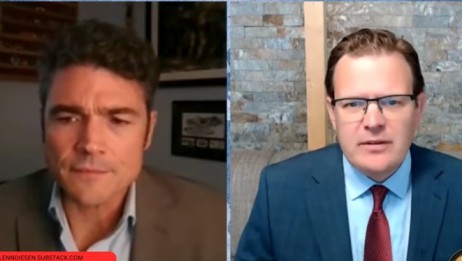
Episode Notes: In this insightful interview hosted by Glenn Diesen, former National Counterterrorism Center Director Joe Kent discusses the escalating tensions and strategic miscalculations surrounding the U.S. conflict with Iran. Kent breaks down the geopolitical fallout, the growing pressures on regional actors like the Gulf states and Yemen, and the delicate state of American foreign policy in the Middle East.
Following is the full transcript of Joe Kent’s interview on Eurasia Podcast, July 25, 2026:
Introduction
GLENN DIESEN: Welcome back, everyone. We have the great pleasure of being joined today by Joe Kent, the former director of the National Counterterrorism Center, who resigned back in March of 2026 in opposition to the war against Iran. So thank you for coming back on the program. It’s a great pleasure.
My first question was if you were surprised by Washington’s decision to reenter the war with Iran? Because I thought with the memorandum of understanding, the US was able to pull out. But what do you see the strategy being this time around?
How Israel Drew the U.S. Into the Iran Conflict
JOE KENT: Unfortunately, I was disappointed. I just think that fundamentally the Israelis got us into quite the bind. The Israelis played their hand very, very well. They understood that this war would become politically unpopular at home. And then they understood that President Trump would need to negotiate. He would seek more negotiations.
And so what the Israelis did very effectively was they got us on board with killing the Supreme Leader very early on, understanding that that would almost negate any possibility that we would have of reaching a diplomatic solution because it would cause a rally around the flag effect, which I think is putting it very mildly. I think if you attack any country, you’re going to have a rally around the flag effect. We killed not just political leadership, we also killed the Ayatollah who was the source of emulation for millions of Shias, mostly in Iran, but also in Iraq as well. So we galvanized the Iranian people around the flag. And so really there’s limited options that we have diplomatically. And they knew that that would frustrate President Trump and that would make him escalate.
The MOU, I hoped that it would give us that off-ramp, but unfortunately really early on, we saw the Trump administration, President Trump kind of caved to some domestic pressure from the Israel lobby and from the neocons. And we cut that side deal with the Lebanese government, which basically, if you read the MOU, you’re like, well, these 2 things can’t exist in the same world. And the Iranians basically said, okay, well, that negates it.
At the same time, we are playing this game where we are trying to escort or encourage ships to not coordinate with the Iranians, which again, it was in the MOU. And people can say, well, the MOU is bad, but we did sign it. And so, yeah, should the Iranians have shot at ships? No. But they basically said they were going to shoot at ships if we violated the MOU.
So what I see now is the president just being incredibly frustrated. But unfortunately, that frustration is blinding him to what put us into the MOU in the first place. I was a little bit encouraged when President Trump was justifying the MOU. He said that, you know, he said the thing out loud, which is one of the things that President Trump does. He says that, look, we had to sign the MOU because we are approaching an economic crisis. So that was like a bit of reality from him that gave us all a little bit of hope.
But now here we are; we’re kind of back to trying to use military force. But we’ve seen this movie play out before. That’s why I think we’re in just such a dangerous period right now, where I think the president could be convinced to do some things either boots on the ground or some other form of escalation that’s just going to drive us further into this quagmire.
The Question of Strategy and Success
GLENN DIESEN: Yeah, I was also a bit optimistic when I heard him make some remarks saying that, for example, well, the Iranians have the right to have ballistic missiles. The Saudis have them. I mean, this is the kind of things you would expect to hear if you want to pull away from this, which is why, yeah, it was unfortunate to see him jumping back into this war.
But again, it does beg the question of what’s going to be done different this time around. You said there’s a possibility of a ground invasion. Do you see political support for this in the US? And also, if they do this, what is the likelihood of success here? Because it looks— there’s a lot of things that could go wrong, I guess.
JOE KENT: A big problem that we’ve had from the beginning of this war, just militarily speaking, is what is success? We haven’t gotten a clear answer from the administration. And if I were still in the military, that’s what I’d be asking.
At the end of the day, and we had these discussions in the lead-up to the 12-Day War and Midnight Hammer, it’s like, what is our actual goal here? Because if you start military operations without clearly defining what your military strategic objectives are, what the success criteria is, and the end state, and at which time we will say that the operations are complete and they’re over, then this is how you end up in these endless quagmires. And this is a lesson that I really hope that we had learned from our experiences in the war on terror, Vietnam, et cetera.
But we’re kind of back to this fundamental question. So without clearly defining that, which the president still has not done, he oscillates back and forth between speaking regime change language, but then the second someone says, well, isn’t that regime change?
The Iranians have basically said they’re not going to do that. Now, the Iranians are still saying— they’re not coming out and saying they’re going to develop a nuclear weapon. They’re just saying that they’re not going to hand back over the Straits of Hormuz. So again, we just really shot ourselves in the foot by killing the Ayatollah because I think we’ve taken away the ability to negotiate. And I think because we’ve launched 2 attacks during negotiations that the people in Iran right now, the leadership there, I don’t think they can give President Trump a diplomatic win.
The Risks of a Ground Invasion
So now we’re back to, okay, we’re going to do a ground incursion. What would that ground incursion look like? And this is where I get a little bit worried because I think what the Pentagon has had to do is they’ve had to say, okay, we’ve done an air campaign for quite some time now, Mr. President. We’re kind of running out of things to bomb that are going to be effective. And so if you want to force open the Straits of Hormuz, here’s how we could do it militarily. Hopefully they’re caveating that with saying in the short run, because I think, could we seize some of the islands? We could. The US military is very powerful, but could we hold them in the long term?
If you go back to our success rate at actually holding ground effectively, I mean, I just think back to our recent wars to the east and west of Iran in Iraq and Afghanistan, we had a hard time holding ground. And that was from insurgents that were armed with IEDs, RPGs, mortars, et cetera. They weren’t armed with sophisticated ballistic missiles and drones. So I think our ability to actually have real success on the ground is very limited.
I think we could come into a situation where the Iranians either let us come in, they let us land, they let us hoist the flag and say we had some great victory, and then they just hangar rest and isolate our air power from our ground forces with ballistics and drones, creating basically a hostage-like situation. Or right as we come in, they start vectoring their fire.
We saw from the attack in Jordan that they just did with the ballistics this past weekend that tragically cost us 3 American soldiers. We’ve seen that they can actually vector in pretty effectively and accurately with very powerful missile systems from a good distance away. I mean, Jordan is a ways away from Iran. So that should make us take pause about having our naval forces anywhere near Iranian shores right now, but we would have to have our naval forces near Iranian shores to actually put boots on the ground.
So I just fear that because the president has been frustrated with the limitations of air power, that now he’s going to say, well, what else do you have? And the Pentagon’s job, CENTCOM’s job is to provide the president with those options. So I do fear that they are handing him a menu of different options of places they could seize. And out of frustration, the president’s going to say, well, nothing else has worked. Let’s just try this. I hope that doesn’t happen, but that’s the direction that it looks like things are heading.
Can the Strait of Hormuz Be Reopened by Force?
GLENN DIESEN: Yeah, also reacted a bit to the tendency to always measure success in terms of death and destruction being inflicted on the opponent because again, to what end? I often think because if the Iranians see this as an existential threat, they’re going to be willing to absorb that cost. And also if their capabilities aren’t dependent on a huge functioning air force or navy, then, and you know, if it’s drones, what does it matter how much is destroyed if they can still continue to fight?
But I take your argument though on the difficulty in holding these islands if America takes them. That is, yeah, I don’t see how the supply and support is going to be very tricky. But would it be enough though to open the Strait of Hormuz? Because do the Iranians need to hold the islands in order to close off the straits?
JOE KENT: No, they don’t. And this is what’s so frustrating. I mean, I think anybody with a map could just see how tight that choke point is right there. So the Iranians don’t need those islands. They don’t need to have that logistical support. They basically just need the ability to get some mines or to be able to shoot ballistics and to shoot drones in that very narrow waterway. Where they have a good deal of ground that they actually hold, and it’s high ground too, making matters even worse.
But even then, even if we were to take and push into the shoreline and take everything that surrounds the Straits of Hormuz essentially and occupy it, I mean, the Iranians have proven with their ballistics and their drones that they could still hit ships in the Straits of Hormuz. And now, could we deny that airspace for a period of time? We probably could. I’m not 100% confident on that, but maybe we could. Let’s just say that we could. We can’t do it indefinitely. So, I mean, this is Iran’s backyard. They control the waterways.
We just— I think we just refuse to accept that because it is so frustrating that the waterway, the Straits of Hormuz, was open before the war and it’s not going to go back to that same status without us being willing to sacrifice something. I don’t think President Trump has gotten that through his head yet. So he still thinks that he can take a military tool and beat the Iranians over the head with it and that they will say, okay, fine, we cry uncle, we’ll go back to the pre-28 Feb status in the Straits of Hormuz. He just hasn’t accepted the fact that that’s not going to be the case at all.
Trump’s Dilemma: No Exit, No Victory
Now, I think he’s got other options and we can talk about those. I think it’s pretty simple. If we stop being the aggressors in the Straits of Hormuz, I don’t think the Iranians have any desire to charge a toll on everyone or anything like that going forward. But Trump refuses. He’s trapped in this box where he refuses to leave without some piece of paper, a declaration, something where he can say the Iranians signed this and gave me a victory, or he wants a total military victory. And I just don’t think that there’s a conceivable way he’s going to get either one of those right now, but he refuses to just walk away from the table.
He’s fallen into the, whatever you want to call it, the gambler’s fallacy, the sunk cost fallacy where he just cannot walk away. And that’s why I really fear he’s going to continue to escalate because he just sees right now the military as being his only tool.
Escalation Risks and Regional Spillover
GLENN DIESEN: Well, on this escalation though, how are you reading it? Because it appears that the war is having, well, some less intensity than it did in the 2 first rounds. But on the other hand, it appears that more actors are being pulled in, especially Yemen. And also what they’re prepared to target is also escalating, it seems. I mean, the energy facilities, desalination plants, I don’t know, the future of Kuwait suddenly starts to look possibly problematic.
Where do you see this escalation actually going? Because I think this could be a problem, the illusion or delusion of having escalation control, as you suggested, the ability to, for example, go back to the old status quo of simply having the Strait of Hormuz open. This is not available. What is it that could go wrong here?
Iranian Strategy and U.S. Escalation
JOE KENT: And there’s so much that could go wrong. I think the Iranians for a while were observing a pretty deliberate escalation ladder. But as we escalated and we started hitting civilian infrastructure, I think the Iranians took the gloves off to a certain extent. And I think they’re now using this period of tit for tat. It’s not just tit for tat with the Iranians. I see them executing a pretty deliberate strategy where, like you said, they’re targeting Kuwait. They’re trying to push our bases basically out of the region. Which I think we should just accept that because our bases proved to be a strategic liability and not an asset. But the longer we try and hold onto them, we’re presenting more targets for the Iranians to hit.
But I think in the short to medium range, the Iranians are saying, okay, if we’re going to expend our ballistics and our drones, let’s try and just hammer these bases. The Iranians basically in the last 24 hours have come out and said to the Gulf states, hey, if your hotels or other areas are housing American troops, they’re going to be fair game as well. So clearly their goal, it’s not just to kill Americans, that’s definitely a byproduct, but their goal is to push American troops out of all these different Gulf bases that are along the border with Iran, providing them more strategic depth to secure, basically to secure their own borders.
So I see the Iranians as following a pretty pragmatic strategy here. Their strategy makes a lot of sense. Now, ours does not make anywhere near as much sense. We’re essentially just pouring gasoline on that by saying, now we’re going to go after their oil infrastructure. Now we’re going to go after their desalinization plants. Now we’re going to go after their bridges. At the end of the day, this is Trump’s frustration where he bombed all the military targets and the regime didn’t flinch. And so now he’s saying, okay, I’m going to inflict even more pain. What I don’t think he’s realized is that there’s no amount of pain that the Iranians are not going to endure. They’re not at any point in time going to say, oh, you hit our oil infrastructure in Khuzestan, so now we’re going to tap out. Like, that’s just not going to happen.
Meanwhile, as the Iranians retaliate, they are taking away a lot of our strategic territory, and that’s going to have an effect with the Gulf countries. The Gulf countries are going to have to slowly start moving away from us. You saw the Saudis say like, okay, America, you already proved that your security guarantees really aren’t worth that much. Now we want this nuclear deal. We want to be able to have our own nuclear program. So this conflict, whether we realize it or not, it is reshaping not just the way the Gulf power arrangement is ordered, but it’s also affecting our status on the world stage.
Not to mention, like you said, what’s taking place right now with Yemen. The Houthis had kind of sat this war out up until this point, and then just recently they shot at 2 Saudi vessels. They turned around a good deal of other ones. So that basically is going to shut down the Straits of Hormuz because one of the pressure release valves that we had, so to speak, was that east-to-west pipeline that put out in the Port of Yanbu on the Red Sea that kind of allowed the Saudis to get some of their oil and gas out bypassing the Straits of Hormuz. Well, the Houthis just said checkmate on that.
And people should remember that in 2025, when we focused all of our combat power on the Houthis in an effort to break the Houthis, we weren’t able to do it. And again, that’s just because we didn’t appreciate the resolve, but we also didn’t appreciate the terrain. We didn’t appreciate just how mountainous Yemen is and how far along their ballistics and their drone program is. We didn’t really appreciate just how tight that area is. You don’t need a lot of sophisticated technology to hide in those mountains and to be able to put effective fires down on the Red Sea. It’s just geography.
And so none of those factors have changed, but now we’re also committed to a fight in the Straits of Hormuz. And so now you’re looking at somewhere between 25% and 30% of the world’s oil flow that is being hampered right now. And so now the Houthis and the Iranians realize that time is 100% on their side. The more economic pain that they can inflict on us, the more battlefield gains they can get by pushing us back off their bases, and the more pressure domestically that Trump’s under, which again, that takes me back to really being concerned with Trump doing something very, very drastic, very irrational here very soon.
Iranian Willingness to Inflict U.S. Casualties
GLENN DIESEN: Well, about the casualties though, because the Iranians have been striking pretty hard at these US bases, which you said they would like to get away. And again, if I was Iranian, that probably would have been top of my priority list as well, to have hostile bases gone. But please correct me if I’m wrong, but I got the impression in the first 2 rounds of this war that the Iranians would be a bit cautious about inflicting military casualties on the Americans because this could hamper any off-ramp or any political settlement to walk this one back. But if their faith in any political solution and diplomacy in general is going away, do you think they’re now opening up to be prepared to hit US troops some harder? Or again, I know there would be some speculation involved, but how are you seeing this?
JOE KENT: I think in the early phases of the war, I believe that the more moderate wings of the Iranian regime, however you want to look at it, I think they still kind of had more of a seat at the table. And they were able to drive more of the Iranian strategy. And a lot of that was just due to how chaotic I think the initial portions of the fight were. We did kill the Ayatollah very early on, but there was a mourning period. And then just seeing the Iranian and Iraqi, for that matter, the response and the world’s response, the Lebanese response, the Shia worldwide response to the Ayatollah’s funeral, plus the killing of — the tragic killing of the civilian schoolgirls inside of Iran.
The Iranians now, I think, are definitely playing for keeps. They’re willing to inflict a lot more American casualties. I think they also realize that if they can inflict American casualties, more people here in America will turn against the war. Now, I am afraid that yes, more people will turn against the war inside of America, but the more Americans we lose, it does lock us into this blood debt where we say that we can’t leave now because we’ve taken losses. We have to avenge our fallen. So that’s a problem, but I don’t think the Iranians necessarily care about that.
I think they say that the Americans have hit us very, very badly. And in terms of not just national pride, not just in terms of vengeance, but in terms of future deterrence, we have got to deal them a blow that lets them know that they can’t just come in here and kill our civilians and kill our leaders, because if we don’t, they’ll continue to do it to us. And there’s some logic there. So the Iranians are hitting back very, very hard now.
And I think that they initially just hit the bases inside the Gulf, but I think that they want to force the hands of all the different Gulf countries right there to come to us quietly and just say, hey, get your guys out of here. This relationship’s no longer worth it. Maybe call us when things calm down. That’s the result that I think the Iranians are going after right now.
And I think all these different Gulf states, they’re in a tough spot because they’ve relied on us for so much over the years. And then once the war started, we proved to be pretty unreliable. They still want to have a good — the leaders at least still want to have a good relationship with us. But in terms of their own street, I mean, look at Kuwait, there’s a lot of Shia in Kuwait. And a lot of those Shias in Kuwait, they have family just right across the Shatt al-Arab in Khuzestan. A lot of them have Persian and Arab Iranian family members. Same thing, Bahrain. I mean, the only reason that Bahraini government didn’t get overthrown in the Arab Spring was because the Saudis cruised across the causeway.
And then Iraq too, that’s another word. Iraq is literally doing shuttle diplomacy between Washington, DC and between Tehran. So all these different countries right now, I think, are sitting on powder kegs domestically because of what’s happened. But then also the Iranians pretty much nightly are making it so that their relationship with us just pragmatically isn’t really worth it. And I think we’re going to have to be realistic and probably give them a little bit of wiggle room to say, okay, fine, we won’t have our guys, our bases and our troops in your countries for the sake of your own self-preservation.
But if we push them on it and we say, no, you have to stand with us and you have to be part of this very vocal, boisterous coalition against the Iranians, I think things are going to hit a boiling point really, really quickly.
Trump’s Shift from Anti-War Stance
GLENN DIESEN: Do you get an impression though that, well, Trump obviously shifted, but I was wondering why, because when he again got his second presidency, he seemed at least to me to genuinely want to put an end to all of these wars. And again, there was a strong logic behind it, which is why I thought his position was, well, exactly what the US would need. That is, all of these wars makes the US overstretched, it’s exhausted. Also, along these Eurasian powers, be it the Russians, Chinese, Iranians, suddenly they have a common goal in collectively balancing the US. It just seemed like an overarching strategy in terms of adjusting to this new distribution of power.
It would make sense for the US to pull a bit back, allow these Eurasian giants to begin to balance each other instead of the US, which would give the US some time to restore its economic power also, and societal political stability, essentially a more sustainable approach to the region. But this essentially was my impression that Trump was communicating. That is, let’s put an end to these forever wars. They undermine our security and they cost us an arm and a leg. But it’s so profoundly different from what he’s saying now. Did it all change with the invasion of Iran, or how do you see this?
The Israeli Influence on U.S. Politics
JOE KENT: And that is the question right there that I think we’ll be asking for quite some time because I agree with you. I mean, President Trump, even in his first term, even though things weren’t perfect, he didn’t get his way every single time, he was taking steps to try and get us out of these wars. When there was an attempt to escalate us towards a war with Iran, he balanced it out by, he used deliberate military strikes like when he killed Soleimani, but then he backed off.
So to me, and this is a big reason why I was honored to be appointed to the position that I had. I supported President Trump from basically the time my late wife was killed in Syria until just a couple months ago was because I believe that President Trump saw things from a realist perspective and he was doing the right thing for our country. But also just fundamentally, I thought that President Trump, just as a politician, he understood that if you started messing around in the Middle East, it would consume your entire presidency. And that is exactly what’s happened.
Now, as to why this changed? I honestly, I truly, I don’t know. I struggle. I go back and forth between, did he get tricked? Did he get deceived? There was definitely a lot of that that was taking place in the lead-up to this war. He was being told by advisors that, hey, Iran was a paper tiger. They didn’t really hit us. They didn’t hit us at all during the 12-Day War. Look at the response to Midnight Hammer. These guys are all talk. Your entire intelligence community’s wrong. Look what you did in Venezuela. There’s protesters on the streets. This is what the Israelis were definitely telling him.
Meanwhile, the rest of, I would say, the intelligence community, the Department of War, we were all saying like, hey, look, we dodged a bullet in the 12-Day War. All these capabilities that we are worried about, they’re still there. The Straits of Hormuz is still where the Straits of Hormuz is. Just look at the map. If they wanted to shut it down, they could.
So there’s a good chance that he just didn’t listen and they played to his ego and all that. I still have a hard time believing that fully. And then once he saw, by early March, once he saw that this war was not going well, for him not to just do a very Trumpian 180. President Trump can change his mind and he convinced you that that was his plan the entire time. That’s one of the political gifts he has.
And so it took me 2 weeks once the war started for me to resign because I figured within the first week, once he started seeing how little options he had, he was going to flip the table and just say like, yeah, no, actually this was somebody else’s idea, not mine. And we are going to be kind of out of this thing. Some damage done for sure, but we wouldn’t still be in this quagmire.
There’s always the Israel lobby. I mean, they did give President Trump a lot of money. He is around a lot of people who are very sympathetic to Israel. He does have relationships with people in the Israeli government who I believe we’ve given way too much access to. So I don’t know the full answer. I do think that the answer is somewhere in between. It’s like the lethal confluence of President Trump’s ego, the people he has around him, the donor class, and now he’s locked into this trap. So I think that’s a question we’ll be debating and studying for quite some time.
The Growing Split Over U.S.-Israel Relations
GLENN DIESEN: Yeah, the Israeli influence on the US is obviously quite profound. There seems to be an interesting split now though in the US because there seemed to always have been a consensus that the US and Israel has to be joined at the hip. But now we see some people doubling down in terms of deepening the partnership between the US and Israel. On the other hand, you now see more opposition towards Israel than, well, at least I’ve seen in my lifetime.
Does this split, you think, impact the Trump administration in any way? Because I get the impression that Vance is leaning a bit towards America First should mean not Israel, while the Lindsey Grahams and those would obviously want to put Israel— they think Israel first is the same as America first, it seems.
JOE KENT: Yeah, I think Trump himself is not as worried about it because he doesn’t have to run for reelection again. And then he also just— Trump still has it in his head that MAGA and America First is whatever he says it is. But the people who have to worry about a political future, which obviously the vice president and probably everybody else in his cabinet, but most prominently Marco Rubio. This is going to be the fight in 2028, 100%. Probably on the Democrat side too. It’s an open election in 2028. So the Democrats will have a contested primary. We’ll have a contested primary on the Republican side. And I think this issue is going to be very front and center.
I think Vice President Vance is in a very tough spot. His name is, he’s part of this ticket, so he has to support the president that he’s serving. He can’t just resign like other members, like I could, like other members of the cabinet can. So he’s had to thread the needle where anytime he’s gotten an opportunity, I think he has tactfully pointed out where the Israelis and our relationship with the Israelis have led us astray in this conflict. And so I think we’re going to hear more from him on that, especially after the midterms and as the ’28 cycle really heats up.
But then you’ve got the Marco Rubio-Ratcliffe wing of the Republican Party, the establishment Republicans who now want to rebrand themselves as this new version of MAGA that Trump has been trying to put out there for the last 18 months. And so it’s going to be quite the fight.
I don’t think that the numbers in terms of younger voters, they’re not on Israel’s side. So Israel has a lot of influence right now, and maybe for the next couple election cycles they still will because they can put a lot of money down in elections. And unfortunately, the American system does allow for money to influence elections. I don’t agree with it, but it is what it is. That’s the system.
But I think that there’s an expiration date on that that’s approaching very, very quickly. And so if I were an Israeli under the age of Benjamin Netanyahu, I’d be worried about the future. I would be worried about our long-term relationship with America because right now, whether it’s a Democrat or a Republican, chances are whoever occupies the White House next is not going to be anywhere near as pro-Israel as President Trump is.
I mean, just the other day, unfortunately, the Section 219 of the NDAA wasn’t stripped out. The NDAA passed the House. It’s probably, I hope not, but it’s probably going to pass the Senate. But just the other day, there was a bill put forward by Massie calling for us to basically cut off all foreign aid going to Israel. The bill failed, but there was 103 Democrats and 1 Republican, Massie, who voted to defund Israel. That’s 104 representatives. 5 or 6 years ago, there would’ve been 2 or 3 that would’ve voted for that. So the numbers are moving in the direction kind of away from the Israel lobby. So that gives me some hope. It still puts us in a bind in the short term because they still have a lot of influence.
Why Israel Is Sitting Out the War Against Iran
GLENN DIESEN: Yes, if I was Israeli, I would think that yes, over the past few decades we wouldn’t have to make any concessions and we could essentially dictate the outcome we want in all parts of the Middle East because again, the all-powerful, only superpower in the world stands behind us and we could do whatever we want. But given that the US doesn’t enjoy that same position in terms of capabilities, but also, as you suggest, the intentions or the preparedness to support Israel in anything it does, it also appears to be slipping.
So with that lack of all the changing intentions and capabilities of the US, you would think that Israel would start to look for some diplomatic pathways with its neighbors and adjust to this new reality, but they seem to be going the other way. That is just knocking out Iran and going for a full victory. But this is a very dangerous all-or-nothing strategy, it seems to me. But given they’re so committed to take out Iran, what is— why isn’t Israel fighting this war as well now? The US is fully back into the war, but the Israelis appear to be sitting on the sidelines. Alliance? I thought they were the ones who wanted this war. Do you see them joining anytime soon?
JOE KENT: Not in a meaningful way. I mean, this has always been the Israeli calculus. I mean, they got us to effectively go after most of the regimes that threatened them and toppled them post-9/11. I mean, that was their plan and the Clean Break theory they laid out in 1996, and we executed it almost to a T up until Iran. And Iran was the country they always needed the most help with.
Look, the Israelis, whenever I spoke with Israeli intelligence, they always had a clear-eyed assessment of Israel, or I’m sorry, of Iran. They understood how big and how challenging and the advances they’ve made with their military technology. And so that’s why they needed our help. And that’s why basically everything you’ve seen the Israelis say in the lead-up to the war to get us into the war, it was part of a sales pitch.
I mean, the Iranians, the Israelis were never too concerned about the Iranian nuclear program. They knew that that was the hook that we would bite onto. That would help sell the war to us. And so the Israelis have us right now where they want us, and that’s why the Israelis played their hand very well. They got us on board of killing the Supreme Leader right away to make it so that we couldn’t negotiate with the Iranians, locking us into this feud. And so now they’ve got President Trump right where they want him. He wants to get a diplomatic agreement like we talked about, not going to happen. And so now he’s just seeking a military solution.
And so basically, as long as they can get Trump to continue to escalate and they can get some form of regime decapitation, which they’ve already gotten to a certain extent. But whenever I would run this scenario before the war with my Israeli counterparts and I said, if we kill the Supreme Leader, this is going to be mayhem. The guys that come after him are probably going to be even more hardline and radical. The Israelis completely understood that.
Their whole theory, and this is what they do in Gaza, this is what they do in Lebanon, this is what they’ve done multiple places over and over again. They want to mow the grass. They want to just keep killing leaders until they either get total chaos that they have some degree of control over that is never intense enough to strike them, or they think eventually you kill them long enough and they eventually become weak, but they need us on board to do that in Iran because they lack the military capability to do it.
And that’s why I think just this last week you saw, I think it was Smotrich come out and just say like, no, we’re not going to get back in the war. We’re pretty happy with the way things are right now. Yeah, because Americans are doing the fighting and the dying and Trump’s locked into a scenario where basically he sees his only way out as being a military solution.
So from an Israeli perspective, I think that that’s accurate. Like, hey, sit back. Worry about Lebanon because America, we’re not going to do much against Hezbollah in Lebanon. So make your gains in Lebanon, especially push the boundaries of that. Keep pushing north of the Litani River because America’s now bogged down with Iran. Maybe get involved inside Syria, which it looks like they’re going to do as well. Keep pushing aggression against the Turks while America handles the big dog, the big fight against Iran.
So again, this should be another clarifying moment for us. We got in this war because of the Israelis, and now the Israelis are just coming out and saying like, no, we’re good with the way things are. We have no desire to participate in this. So until we can accept the Israelis with clear eyes, we’re going to keep getting put in these positions.
Israel’s Next Strategic Target: Turkey
GLENN DIESEN: Well, you mentioned them mowing the grass or just trying to weaken strategic rivals. And of course, the Israelis have done this quite well with the Palestinians, Syria, Lebanon, well, most of their neighbors. But it looks like there’s a different target now, though, Turkey. This is interesting to me, and also not just because it’s such a huge and I would say powerful country, but also as a NATO state. Why do you think Turkey would be essentially now seen by many such as Naftali Bennett as being possibly a bigger challenge for Israel in the future, even more so than Iran?
Syria’s Fragile Balance and Regional Instability
JOE KENT: On? Yeah, I think fundamentally Israeli politicians just really need to have a foreign country to go after to rally people around their cause, whatever that may be. I think that’s just a fundamental problem that the Israelis have with the way their government functions.
But at the end of the day, I do think that Turkey’s one of the bigger powers in the region, in the Middle East, and they’re another very geographically significant country, which is why they’re in NATO. They have a very big and a very powerful military. They have a very effective intelligence service, and they are a direct threat to Israel being the top dog or the hegemon in the Middle East. So I think that just fundamentally puts them on a collision path.
I think initially inside Syria, they were generally aligned. They wanted Assad gone. The Israelis wanted Assad gone because Assad was close with Hezbollah and with Iran, and that was the whole supply line for Hezbollah. And then the Turks wanted him gone too because they wanted to be able to have more control inside of Syria. And so there was a moment there where they were aligned, but now their friction point is back to being who controls Syria.
I think that the Israelis want to continue to expand. They want full control beyond Golan Heights. They want to basically make Syria their little vassal state. The vast majority of Syria is Sunni. I think they would like to use a lot of Shara’s contemporaries basically as their proxies against Hezbollah, but then also against any other pro-Iranian factions that are out there.
And then the Turks, I think, have a very different view. I think the Turks want to continue to have Syria be their zone of influence. They want more access to the Mediterranean. They want access to the oil pipelines. So I just think they’re heading towards a collision course.
There’s a lot of different factors there too. Now you see the Israelis reaching out. The Israelis have a Druze community as well inside Israel that’s always been close to the Druze community inside Syria. So that’s a factor. But then you also see the Kurds — the Kurds who are a very effective fighting force, been at war, various factions of the Kurds anyways. The Kurds are by no means a monolith, but now you see the Israelis talking a lot more about the Kurds and how the Turks are treating the Kurds. So I hope on this case, the Kurdish factions don’t take the bait and don’t take too much from the Israelis.
But again, I think this is another friction point. I think Shara, as much as I dislike him and think we made a huge mistake putting him in charge and acknowledging him — he’s there now. He’s in a very tough position because he’s caught between these two powers who want to pull him in different directions. He was brought to power by a very hardline Sunni jihadi Salafist faction that is not going to be comfortable with him saddling up and getting too close to Israel. But at the same time, I think he probably has some factions that say, yeah, we could go to war with Hezbollah, we could go after all of our different minority groups. And then how do the Turks feel about that?
So Shara is in a very tough spot himself as well. So this is another place where the more you look at all the different players and the different factions that are there on the board, there is no upside to America being involved in any of it. But yet we continue to insert ourselves right smack dab in the middle of it.
GLENN DIESEN: Yeah, I did want to ask how stable do you think the situation is? Because I see the same — that is the whole post— no, sorry, the anti-Assad coalition. I mean, what brought the US, Israel, Turkey, everyone on the same side essentially, it was limited to getting rid of Assad. But I think the post-Assad era of Syria, a lot of that, the foundations for that alliance or coalition would then begin to go away. And as you said, especially the Israelis and the Turks now see themselves on opposing sides in terms of who should control that territory, or at least enjoy the influence.
But how stable is it? Can it remain the way it is now, or do you see something exploding there as well? Because it looks like the whole region is destabilizing. You mentioned, of course, Iran, we talked about Turkey, now you have the Red Sea being shut down by Yemen. There’s just a lot of variables which are difficult to control. I’m almost expecting something to happen in Syria soon, but how stable is it, or do you think it can remain the way it is now for the foreseeable future?
The Threat of Collapse: Syria, Lebanon, and Iraq
JOE KENT: I think it’s pretty unstable. I mean, again, I was no fan of Shara. I think at his core, he’s still an al-Qaeda terrorist. However, he’s kind of the glue that’s holding the whole country together because he has relationships with all these different factions that brought him to power.
He’s also just recently had to absorb probably around close to 100,000 internally displaced personnel who were held in these different IDP camps that were basically incubators for ISIS. These were the families of ISIS members and even some ISIS members themselves that were basically held in containment areas. He had to basically absorb all of them back into his population. He didn’t put them back in camps. They basically just let them go back into the general populace.
And then all the different jihadi factions that aligned around HTS, around Shara to have them actually come in and overthrow Assad — there’s always been a debate over how much control he can actually exert over any of these different factions. There’s a lot of these factions that are still controlled literally by foreign fighters who’ve sworn allegiance to al-Qaeda, and sometimes they listen to Shara and sometimes they don’t listen to Shara.
So now the question is, for how long can Shara get away with being close with America and having Trump say things like, “Yeah, I think Shara should go after Hezbollah,” and maybe some of them do just want to go and fight. But I think it’s going to be really hard for him to have even a general tolerance of the Israelis for very long because of the base that brought him to power. That’s going to be contentious. So I think that’s probably one of the bigger overlooked factors that are taking place right there.
But at the same time, Shara’s existence and the way that the West and the Israelis have kind of embraced him — that has really, I think, just heightened a lot of the support for Hezbollah inside even Lebanon. You even have probably non-Shias who are just like, “Yeah, I remember the last time that ISIS was in charge and they came across the border, and the only people that saved us from them was Hezbollah.” And so a lot of Lebanese, I think, in their very complicated system, are like, “Well, we don’t really support any kind of disarmament of Hezbollah because they were a bulwark against the head choppers who were just up on our border previously.”
Same thing in Iraq. We’re telling the Iraqi Shia militias that they need to demobilize and become part of the Iraqi government. I think that that’s well on its way, but I think there’s some factions there and I think there’s a lot of Iraqis who are going to say, “I don’t know, we need these forces because of what took place in the past” — not that long ago, just a decade ago, when ISIS rolled across the berm and took over large swaths of Iraq.
So I do think Syria definitely has some hot embers underneath the ashes there that could kick off really, really quickly. Not to mention everything going on with the Turks that we just talked about.
GLENN DIESEN: How do you see, again, also the stability then of Lebanon and Iraq? Because you mentioned before the Israelis had played their cards very well. I thought the same in Lebanon. That is, the deal they made with the government, it seemed to put the Lebanese government at odds with Hezbollah, possibly sparking a civil war. This seemed like a good move for Israel if they want to essentially outsource conflict. Not from a moral perspective, but strategically — if that is the goal, that’s a good way of playing it.
But also Iraq, as you said, you had to have these internal tensions being drawn a bit between the US and Iran. You see a lot of militias, Iraqis operating closer now to Kuwait. The Iranians might give them an opening to absorb Kuwait in the future. I mean, how stable is this, or do you expect to see anything — I know you don’t have a crystal ball, but how likely do you think it is of something big possibly happening towards this end?
Lebanon, Iraq, and the Risk of Escalation
JOE KENT: I mean, it definitely could happen. On the Lebanese side, anytime we’ve tried to come up with some sort of a plan that’s going to undermine Hezbollah, it ends up just making Hezbollah even more powerful. All the different things that Israel has done to them over the years, the strategic decapitation the Israelis did was pretty impressive. The pagers, the walkie-talkies, killing Nasrallah. I never thought they were going to kill Nasrallah.
So this is the thing with the Israelis. The Israelis can be tactically very brilliant and tactically very, very effective, but then strategically it never seemed to quite work out for them. And then it was so foolish of us, in my opinion, for us to jump in and cut that parallel deal, not only because it undermined the MOU, but when you just look at the general fundamentals of it, it put us, it puts CENTCOM in the middle. Basically, we’re playing referee between the different factions inside Lebanon.
And look, we tried this back in the ’80s and it ended in tragedy with American Marines getting blown up by Hezbollah. And so again, I just don’t see a scenario that works out well where us as outsiders, we come in, we try and co-opt some of the minorities and we say, now you guys have to turn against Hezbollah. Now, from an Israeli perspective, like you said, that is a recipe for there being internal strife there, which the Israelis are completely okay with.
This is something else that we just never, I think, have fully internalized. The Israelis are comfortable with chaos. And a lot of times Israeli strategy, the goal is chaos. They will never come out and tell us that because they know Americans, like our Western American minds, we have an aversion to chaos. We want to see a simple math problem that you support these guys and these guys and it weakens the other guys and then everybody rides off into the sunset. That’s how the American mind works. But the Israelis, they’re completely okay with some degree of chaos taking place there.
So I think again, Lebanon is a powder keg. And now the Iranians have done something very interesting where they have included Hezbollah in Lebanon in the last couple rounds of negotiations, when before they could give covert support that everybody knew wasn’t very covert, but they knew Iran was supporting Hezbollah, but they weren’t coming out and making that part of any kind of deals. The Iranians weren’t saying, “But what about Hezbollah?” during the negotiations for the JCPOA. But they are now, because the Iranians are basically saying, “Hey, we can exert power throughout the entire Middle East.” That’s why about a month ago, or maybe more than a month ago, they did that ballistic attack on Israel because of Israel’s actions inside Lebanon.
So that old game where we could play one faction against the other without having the Iranians do anything, that’s out the window. But we’re still playing like that’s the case. We’re still playing like it’s the 1980s there.
Iraq: A Complicated Ally
JOE KENT: Iraq is very interesting too. We have a good relationship with the government of Iraq, but we sometimes forget that the government of Iraq, it’s the Shia Dawa Party, it’s the Badr Corps, it’s people that are very closely aligned with the Iranians, that most of them are pragmatic and they really want to have a good relationship with us. They want stability. They want to have a good trade relationship with Iran. They don’t want to get sucked back into the sectarian strife.
I spent a lot of time both in the military in Iraq, and I was back over there two or three times as the National Counterterrorism Center director. And Iraq is a very good counterterrorist partner when it comes to fighting ISIS and Al-Qaeda. We just have to realize that a lot of that government, a lot of the military, but especially the popular mobilization forces, they’re not loyal to Iran. Not all of them. There’s different factions that are, that are smaller, but those are the most capable ones. Those are the ones you see doing the drone attacks, doing the ballistic attacks.
But there’s a lot of the other ones there that if we continue a massive war against Iran, when push comes to shove, especially if there’s a fatwa from Ayatollah Sistani, who’s an Iranian cleric that lives in Najaf in Iraq, we’re going to be looking at a whole new world and we’re kind of on a razor’s edge with that. And so the leadership that we help install in Baghdad, they probably tell us everything that we want to hear and they’ll probably do most of the things that we want them to do, but there will be a breaking point.
And Iraq is still a majority Shia country. They have longstanding ties of kinship with Iran, but also hostility going back to the Iraq-Iran War. So it is complicated. But a scenario does exist, I think, that if we keep pushing this thing, elements of the Iraqi militias might go into Kuwait and do something on behalf of the Iranians to be part of that resistance banner. So all these things are possible. They’re all on the table. The more we escalate inside of Iran, I think the closer we move towards something catastrophic happening where Iran uses their proxies in a very effective way.
The Straits, the Fork in the Road, and Two Iranian Factions
GLENN DIESEN: Yeah, I think the big card to play, as we said before, was to have Yemen assist them with shutting down the Red Sea. I think this is going to be a complete disaster for the global economy. But overall though, what do you see happening next now? I mean, again, no crystal ball, but you do see all the different players, their interests, and the direction this is all going in terms of escalation. Is there anything you’re keeping your eye on, something of specific concern?
JOE KENT: It’s to what degree the Houthis decide to shut down the Bab el-Mandeb. I mean, if they keep this pressure up right now where they’re just not letting the Saudi tankers through, I think that’s going to be effective enough. And that combined with the Straits of Hormuz, that just puts us in an economic bind. And then President Trump is going to be at a fork in the road where he can either walk away, which is what I’ve been advocating since day one — just walk away from this whole thing, reset diplomatically, use economic sanctions relief, et cetera, to get the straits back open — or, and this is what I fear he’s going to do, he’s going to try and use military force, which is going to kind of lead to any one of the horrible scenarios we just talked about where then you’re in the valley of unintended consequences where you think you have a plan, but when the bullets and the ballistics and the drones are flying, you don’t necessarily have a plan.
What I fear, the fork in the road for the Iranians — and I don’t know which way this is going to land — I think you have a lot of really pragmatic, really patient strategic leaders inside of Iran who are saying, “Hey, if we keep the status quo right now and we keep slowly pushing the Americans back off of our border, but we make sure we heavily restrict the Straits of Hormuz, we make sure the Houthis heavily restrict the Red Sea, then over time, probably just the course of a couple months, we’re really going to have the Americans in a very, very bad spot. This is going to strategically work out in our favor. Then we can work with China, we can start settling oil transactions in the yuan, not the dollar.” That’s really going to hammer the Americans.
But I do think you have another faction there inside of Iran who are saying, “Foot to the ass, let’s inflict some major American casualties. And then if they want a war, let them come on in and we’ll inflict some more major American casualties.” And I think a lot of them are saying right now, if we don’t do this, if we don’t punch America back really hard right now, number one, domestically, we’re going to be in trouble because they killed our Supreme Leader. Shia martyrdom culture combined with nationalism is a very powerful thing.
But then also I think they’re just saying pragmatically from a deterrent standpoint, just like we had hawks here in America who were saying for 47 years the Iranians have been at war with us, I think that their counterparts in Iran are saying, “For 47 years we have dealt with this aggression, invaded countries on our borders. They just killed our Supreme Leader.” The list goes on. “If we don’t hit them now while we have momentum, we’re never going to get this opportunity again.” And that’s why I fear a mass casualty scenario and almost the Iranians just goading us to come in in some kind of a ground incursion.
So I think those are kind of the two different paths this thing could go on. Again, I hope that President Trump just has a moment of clarity and realizes just how bad this is and just walks away from it like a businessman would. I just want him to put his businessman hat back on. I want 2019 Donald Trump to surface just for a brief moment to get us out of this mess. But every day, every second this goes on, I feel like that window of opportunity closes more and more.
The Law of Unintended Consequences
GLENN DIESEN: Yeah, it’s the unknowns as well, which is a thing of great concern. And as you said, the law of uncertain consequences — I think this isn’t really appreciated. I think it was Mike Tyson who said that everyone has a strategy until they get punched in the face. I think about that often because that—
JOE KENT: Words to live by.
GLENN DIESEN: Yeah, very much so. I just have a last question though about the internal politics of Washington. You and Tulsi Gabbard were, you know, the kings of ending the forever wars, it seemed. And Tulsi Gabbard, she didn’t take a harder stand on this, such as yourself. I thought, you know, everyone has to play the game in Washington in their own way. But she eventually stepped down as well. Did it surprise you that she didn’t take a more principled stance against another forever war?
Tulsi Gabbard’s Departure and the Loss of Restraint in the Cabinet
JOE KENT: Not really. I mean, I was around her quite a bit, so I kind of knew what her strategy was. I think she believed that she had more influence taking things at a more quiet level. And then she was in the primary, she was in the president’s cabinet. So I think she felt that by accepting that job, her job was to keep all criticism and all advice private. But you’d have to ask her to get a clear answer. So I don’t really know exactly what her calculus is, but that’s my general feeling is that she felt that she would be more effective that way. And then her husband got the cancer diagnosis and she had to step down.
We’ll see what she does here in the future. But again, losing Tulsi out of the cabinet, it’s a big loss because now the voices of more realism and more restraint I think are very, very limited right now inside the cabinet. Obviously the vice president, who we talked about before, he’s in a hard position as well, but I don’t know how much backup the vice president has right now when he’s saying, “Hey, I think this is a bad idea.” So not having Tulsi in the room anymore is a big loss.
GLENN DIESEN: Definitely. Well, thank you so much for being so generous with your time. It’s been very enlightening. So yeah, thanks again.
JOE KENT: Anytime, Glenn. Thank you so much.
Related Posts
- Transcript: Laura Loomer Interviews Volodymyr Zelenskyy
- Transcript of Lawrence Wilkerson Interview: Iran War Escalates Toward Global Crisis
- Transcript of Robert Pape Interview: Diary Of A CEO – Mass Casualty Attack
- Michael Hudson: The U.S. Plan to Revive Geoeconomic Dominance (Transcript)
- Prof. Jeffrey Sachs: How the Military-Industrial Complex Produces Perpetual War (Transcript)