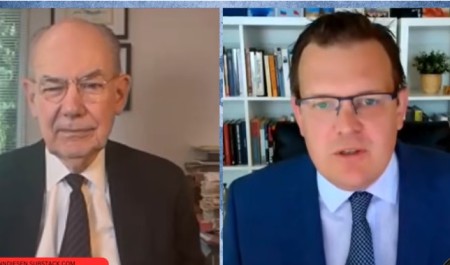
Read the full transcript of political scientist John Mearsheimer’s interview on Greater Eurasia Podcast with host Glenn Diesen, July 15, 2026.
Editor’s Note: In this discussion, political scientist John Mearsheimer analyzes the escalating conflict in the Middle East and the shifting dynamics of the war in Ukraine. He argues that U.S. attempts to apply military and economic pressure against Iran and Russia have largely backfired, pushing these nations closer together and strengthening their resolve. Mearsheimer warns that Western leaders are neglecting fundamental principles of balance-of-power politics and nuclear deterrence, creating an increasingly dangerous environment as these regional conflicts intensify.
Introduction
GLENN DIESEN: Welcome back. We are joined today by Professor John Mearsheimer. It’s July 15th, 2026, and the topic of discussion is the war in Iran, which looks like it could become a regional war. So thank you for coming back on the program.
JOHN MEARSHEIMER: My pleasure as always, Glenn.
The Escalating Regional Conflict
GLENN DIESEN: So we see many things happening now. There’s an intense escalation, but it also appears that a lot of countries are now getting pulled into what could be a much, much wider war.
That is, well, Iran obviously is being bombed heavily by the United States. The US claims it has reimposed the naval blockade. The Iranians, of course, they’re retaliating, focusing especially then on Bahrain, Kuwait, Jordan. And Yemen joined the fight by striking Saudi Arabia. I think the Saudis are now mobilizing their troops. Also, Iran has now threatened to close down access to the Red Sea.
So it’s all getting very complicated. And I was wondering, how are you reading the situation? Because there’s a lot to sink your teeth into here.
JOHN MEARSHEIMER: I would just add that it appears that the Iranians have shut down Fujairah, their 2 important ports where oil is continuing to come out of the Middle East. One is Yanbu, which is the Saudi port on the Red Sea. And as you said, it looks like the Houthis may shut down the Red Sea. And that means that the Saudi oil going to Yanbu will not come out of the Red Sea.
And I would just note quickly that even if the Houthis don’t shut down the Bab el-Mandeb Strait, which is what closes off or potentially could close off the Red Sea, the Iranians could just attack Yanbu and shut down the flow of Saudi oil coming out of Yanbu. And as I said, they’ve already shut down the flow of oil coming out of Fujairah, and that’s the United Arab Emirates port on the Sea of Oman that is outside of the Strait of Hormuz.
So just very important to understand the UAE has been shipping probably about 1.7, 1.8 million barrels a day out of Fujairah, and that’s now been cut off. And it looks like the Saudi oil flow out of the Red Sea is likely to be cut off as well. So I just wanted to emphasize that those 2 places, Fujairah and Yanbu, really do matter. And both are now involved in the mix in a serious way.
I think to answer your question, Glenn, what’s happening here is that the war is escalating. More horizontally than vertically. You remember we had this big air war from February 28th to about April 8th, and then the air war ended and we transitioned on April 13th to the blockade. Well, these tit-for-tat attacks that are now taking place every day for probably about the past 8 days are not the same as the air war. They’re not that extensive.
And a lot of people are wondering whether we will vertically escalate and in effect go back to the air war that took place in the first 40 days of this conflict. That has not happened yet. But there is, and you described it very well, this horizontal escalation that is taking place. I don’t think that Jordan had been hit before 2 days ago, but it’s clear that the American base in Jordan is now being pounded. And of course, the Gulf states are being pounded.
And it looks like, you know, we see substantial horizontal escalation. Especially when you throw in the whole Yanbu and Fujairah scenarios that I described when I began talking. So this one is escalating for sure.
Theories of Victory: The American Perspective
GLENN DIESEN: Well, it’s always difficult to make predictions, but a good place of, or point of departure would be to assess the strategies of each side. That is, what are the objectives they aim to achieve? You know, what resources can they mobilize to achieve those objectives? How do you see the theory of what a victory might look like if you see it from the American perspective versus the Iranian? What is it that each side want to achieve here, and how can they actually achieve it?
JOHN MEARSHEIMER: Yeah, great question. Let’s just start with the Americans. I don’t believe that they have a theory of victory. I believe that President Trump is just flailing around.
If you go back to June 17th and the memorandum of understanding that was signed that day, that was basically a surrender document. It’s quite clear that the Iranians won on almost every point. If you look at the 14 articles, it looks clear to me that the Iranians won and we, the United States, lost.
So the question you then have to ask yourself is, given what’s happened since that memorandum was signed on June 17th, what have we done militarily to change the situation? Where is our new course of leverage coming from? I mean, we obviously didn’t have much coercive leverage before the signing of the June 17th Memorandum of Understanding. Otherwise, we wouldn’t have signed it because it was a surrender document. So you have to be able to make the argument that we now have some sort of military capability or economic capability to change the situation that existed on June 17th.
If you look at what Trump has done, he’s done 2 things. One, he’s now reinstituted the blockade. And the blockade, the original blockade went from April 13th until June 17th when the memorandum of understanding was signed. That’s a little over 2 months. It didn’t work. That’s why we signed the Memorandum of Understanding. Just didn’t work. So why do we think it’s going to work now? I have no idea what they’re thinking. I can’t see why it’s going to work now when it didn’t work in the past.
The second thing that’s happened is since last Tuesday — this is July 7th — President Trump has gotten back into the tit-for-tat business with the Iranians. And since last Tuesday, July 7th, up till today, July 15th, the Iranians and the Americans are engaged in a tit-for-tat campaign. Well, if a serious strategic bombing campaign didn’t work in the first 40 days, and we’ve played the tit-for-tat game before — we played it between June 26th and June 29th, and it didn’t work — why do we think it’s going to work now?
And if you look at what’s actually happening in this tit-for-tat campaign, there’s no evidence that we have the upper hand. The Iranians are pounding countries like Kuwait, Bahrain, Jordan, and so forth and so on. The Iranians have shut down Fujairah, as I said. So this tit-for-tat campaign does not appear to me, or hardly anybody I know, to be working.
So the tit-for-tat campaign isn’t working, and another blockade is not going to work. So how do we get the coercive leverage to get a new memorandum of understanding where we do much better the next time than we did on June 17th? I don’t see a plausible story there that can support the argument that we are going to win this time, whereas we did not last time.
The Iranian Strategy and the Role of the Hardliners
GLENN DIESEN: Yeah, no, well, one gets the impression sometimes that there might not actually be a plan in place. That is, I saw, of course — yes, you did as well — Trump, he announced this 20% fee on all ships transiting the Strait of Hormuz. And then, I think it was only 24 hours later, he had to start walking back saying, “Ah, this is — we’re not going to put fees on ships. This shouldn’t be fees anywhere.”
It’s just very hard to see. All of this essentially suggests that there might not actually be a strategy here, that they’re just going, you know, day to day, which, if this is the case, is quite concerning.
But if you see it from the Iranian perspective, what is it that — I mean, is it only to make sure that the US bases get wiped out? They put the global economy at stake, given that the world would blame the US and Israel. Or how do you see it — what’s the silver bullet here for the Iranians? Is it controlling the Strait of Hormuz, or how does Iran win? Or to some extent, perhaps it already did win.
JOHN MEARSHEIMER: Well, look, there’s going to be some sort of agreement at some point in time, in all likelihood. I mean, I find it hard to believe that you’re not going to get some sort of understanding. I mean, just think about the nuclear issue. The United States and the Israelis are desperate to get a nuclear agreement. And you can’t get a nuclear agreement unless you stop this fighting and you get a new memorandum of understanding. There’s just no way around that.
So there are just all these issues on the table — economic and political and military — that were encapsulated in the 14-point memorandum of understanding on June 17th. And the point is that somewhere down the road, you’re going to get another memorandum of understanding or something that looks like that. I don’t know exactly where we’re headed, but there has to be, in my opinion, some sort of agreement. This can’t go on forever, certainly from an American point of view.
So then the question is, how do the Iranians think about this? Now, on June 17th, when they signed the Memorandum of Understanding, there were a lot of people usually referred to as the hardliners in Iran who thought it was too early to cut a deal. “You don’t want to cut a deal now. You’ve got the United States over a barrel. You got them right where you want them. Let’s just keep this war going. And the more time goes by, the better the deal we get.” That’s what the hardliners said.
They also said, “You really can’t trust the Americans. You have to have the Americans in a desperate situation before you can really work out a deal.” The hardliners, however, lost, and the middle-of-the-roaders won, and you got the Memorandum of Understanding, which was signed by the Iranians.
Well, I argued at the time — not publicly, but to a number of my friends who agreed with me — that the hardliners were right. They should have waited. And the hardliners have now triumphed. And the Iranians are not just going to go back to the memorandum of understanding easily. They’re going to drive a really hard bargain because they understand that the longer the war goes on, the better that is for Iran because the more bargaining leverage they have.
The closer we get to the cliff economically and the more desperate the Trump administration gets, the more likely it is that Iran will get a really good deal and that the Americans will be forced to stick to that deal. So I think what’s happening inside Iran now is that the hardliners have won and they have no interest in going back to negotiations anytime soon. And furthermore, if they do go back to negotiations, whenever that is, they want to drive a really hard bargain. And the longer they wait, the more coercive leverage they have.
Trump’s Escalation Dilemma and the Munitions Problem
So I think that actually what Trump is doing is he’s playing right into the hands of the hardliners. And the longer that he continues to escalate, the more coercive leverage the Iranians have.
And I think, to be honest, that Trump understands this. This is why I think he’s saying that if this isn’t settled by next week, what he’s going to do is attack bridges and power stations. That’s what he said. Well, why is he talking about going after bridges and power stations next week? Because he knows that he cannot let this go on.
And the other reason — just to add to the mix — the other reason he can’t let this go on is the United States does not have sufficient munitions to wage a long war. Remember, we stopped the 40-day war on April 8th in part because we were running out of munitions, and we don’t want to go back to a full-scale air war because we don’t have the munitions. So a tit-for-tat is a tolerable alternative strategy, but only for a while, because after a long period of time, a tit-for-tat strategy eats up all that spare weaponry or remaining weaponry as well.
So Trump has a vested interest in bringing this to an end, and that’s why he’s talking about going after bridges and going after power stations. But the problem there is, as we’ve talked about many times, as you go up the escalation ladder, the Iranians can do all sorts of things to you. You don’t have — you meaning the Americans — don’t have escalation dominance here.
And what’s happening with regard to Fujairah and Yanbu and the Red Sea more generally is just evidence of that. The Iranians are basically saying, “If we can’t let Iranian oil into world oil markets, no oil will come out of the Middle East. We’re going to shut down the flow of all oil.” This would have disastrous consequences for the international economy.
The Wider Consequences of War and the NATO Alliance
GLENN DIESEN: Yeah. And as you said, what can be added here is why start next week with bridges and power stations? I mean, these things could have been attacked early on. But I think Trump also knows that once the US decides to go after critical infrastructure, the Iranians would do the same, of course, in the Gulf states. This is the reason. So it just looks like for the Iranians, all they have to do is, if the US goes up the escalation ladder, to absorb the pain and then retaliate in kind against the US allies in the Gulf states.
But then, what does Trump do? Because it seems like the whole strategy is premised on the idea that Iranians would get hammered and then essentially cry uncle — “We will submit to US demands.” I just don’t see this happening given how much is at stake here.
But let me ask you, what do you see being the wider consequences of this war — that is, a defeat for the United States — because it has depleted a lot of military resources. You can argue there’s going to be an economic consequence for this, obviously geostrategic with the shift of power in the Middle East. But if you look at the wider implications, that is the US security umbrella worldwide, I see reports from Japan and South Korea that their military assets are either being diverted away or not arriving. You hear similar comments from the Europeans. How do you see — what will be the consequence of this war? Because it seems difficult to measure. A defeat here would be quite different than, let’s say, a defeat in Afghanistan or Iraq.
JOHN MEARSHEIMER: Well, I think if you’re talking about the alliance structure and the American basing structure in the Persian Gulf itself, I think this is going to have huge consequences. There’s no way that can be avoided. The question that you’re raising is what happens outside of the Gulf.
I think with regard to East Asia, the United States has already weakened its deterrent posture with regard to containing China. I think there is no doubt about that. As I have said on the show before, instead of pivoting to Asia, we have been pivoting away from Asia because we have moved a lot of precious assets, military assets, out of East Asia to the Middle East in recent months. So we have weakened our hand in East Asia.
But the fact is, Glenn, the United States and the East Asian allies need each other, and they will continue to work together. I think there’s no doubt that the South Koreans and the Japanese, among others, have real doubts about American judgment at this point in time. As you watch the Trump administration flail around, it’s probably quite disconcerting if you’re a Japanese or South Korean leader to think that you depend on the United States of America to provide a security umbrella for you, because that can’t help but not be very reassuring.
But again, the South Koreans, the Japanese, the other East Asian countries allied with the United States just don’t have much choice but to work with America to contain China. And of course, from the United States’ point of view, containing China is of great importance. So I think in the final analysis, the effects of this defeat in the Gulf will only have limited effects on America’s alliance structure in East Asia.
With regard to Ukraine and Russia, and therefore the question of what America’s commitment to Europe looks like, it’s very hard to read that situation. It looked up until recently like Trump was trying to greatly reduce the American military footprint in Europe and shift the burden of dealing with Russia in Ukraine over to the Europeans. And that appears to have changed though. If you look at what happened at the G7 meeting in France in mid-June, and if you look at what happened at the NATO summit in Ankara in early July, it looks like the Americans — and here we’re talking about President Trump — he has enthusiastically endorsed the European campaign to help Ukraine wage war against Russia.
So it doesn’t look like our commitment to Europe and to NATO is at the moment being diminished. But it’s very hard to say how this will play itself out over time, in good part because Trump changes his view every other day. And he can turn on the Europeans on a dime. So who knows exactly what will happen there? But for the time being, it looks like this disaster in the Gulf is not having negative effects on the NATO alliance.
The Narrative of Ukraine Winning: Propaganda or Reality?
GLENN DIESEN: Well, just to follow up on the NATO alliance, it does appear that a key narrative push at the moment, especially coming out of Europe and Ukraine, is that the tide has turned and Ukraine is winning. And it’s quite likely this is what is impacting Trump’s decision, because he’s made some comments to that end, arguing that the Ukrainians are doing very well now. And this is kind of the common talking point from all the European leaders as well.
I do see especially a lot of the Russian oil tankers in the Black Sea and the Sea of Azov having been hit. But how do you see this? Do you see a shift in the tide of this war? I spoke 2 or 3 weeks ago with George Beebe — the former CIA director for Russian analysis — and he essentially called it NATO war propaganda. But again, the Ukrainians are hitting things. The capabilities are growing, the involvement of the West is growing. So how significant do you see a shift here? Or do you think what impacts Trump is just the narrative control?
JOHN MEARSHEIMER: Well, I think what impacts Trump is the narrative. I think the argument is being made in the propaganda campaign in the West that not only is the drone war, which you described, working very well, but also the Russians are in deep trouble on the battlefield. In effect, the Ukrainians have turned the tide and have not just stymied the Russians, but are beginning to push them back in particular places.
So it’s not just the drone war, it’s also what’s happening on the battlefield. And then I think the third dimension in the propaganda campaign is to make the argument that the Russian economy is hurting badly and Putin is becoming increasingly unpopular, and it’s not clear that he can remain in office. So if we keep up the drone campaign and we continue to help Ukraine on the battlefield, that will in effect topple Putin at some point, do damage to the Russian economy, and in effect knock the Russians out of the ranks of the great powers.
You remember early in the war, in the first year of the war in 2022, the Americans occasionally talked openly about delivering a significant defeat to Russia and knocking it out of the ranks of the great powers. And you actually see that kind of rhetoric coming back. And I think the Americans are once again making the argument that sanctions provide a magic tool for damaging Russia. Not just drones, but sanctions as well.
As you know well, Lindsey Graham and Richard Blumenthal, 2 senators, have long been pushing a new sanctions bill against Russia. And it looks like that bill, although it’s been watered down a bit, is likely to pass the Senate. And Trump has said that he likes the bill. This is a bill that’s designed to cripple the Russian economy. It’s quite important to understand that we’re back to aiming to cripple the Russian economy, and Trump endorses the bill.
And you have to marry that to what’s going on in this drone war. It’s quite clear that the Europeans believe that they can help Ukraine win the drone war — the long-range drone war, not the drone war on the battlefield so much — but they can give huge numbers of drones to the Ukrainians and help the Ukrainians build up their industrial capability to produce drones, and that will allow Ukraine to inflict serious damage on the Russian economy and on Russian military capabilities. That is the story they tell.
So I think what is happening here is that the West, to include the United States, is ramping up the pressure on Russia because they think they are winning the war. Now, I want to be very clear. I think if you look at what’s happening on the battlefield — and I think the battlefield is what really matters — the Russians are winning. They’re rolling back the Ukrainians. The Ukrainian army is in desperate straits. The only thing that’s really keeping it going is the presence of drones. I think there’s no question about that on the battlefield, but it’s not clear that the Russians won’t ultimately overwhelm the Ukrainian forces because they’re stretched so thin.
So I think on the battlefield, which matters the most, the Russians are winning. But there’s no question that we’re back to sanctions, and we think that this drone campaign — this long-range drone campaign — can have a significant effect on the Russian economy and on Putin’s standing.
NATO’s Growing Involvement and Russia’s Strategic Dilemma
GLENN DIESEN: Yeah, well, I saw — I think it was today — von der Leyen making the statement that they now have an agreement between the EU and Ukraine for co-producing drones. And it seems also like an effort to have the EU make more long-range drones to attack deep inside Russia and essentially say, “Well, we’re not transferring drones, we’re not participating — these are Ukrainian-made.” But it kind of begs the question of where this is all going, because the Russians are looking at to what extent the West is involved in this.
It’s a difficult question to answer because there’s a lack of evidence. There’s a lot of war propaganda out there. On the other hand, it’s very hard to imagine, especially for the drone attacks on Saint Petersburg, that they weren’t being assisted by NATO. But what do we actually know about NATO’s involvement in these attacks on Russia?
JOHN MEARSHEIMER: Well, let me come at this from a slightly different angle than I usually approach the subject. I believe that one of the principal reasons that the Russians attacked Ukraine in February of 2022 is they believed — quite correctly, I think — that Ukraine was becoming a de facto member of NATO.
Now, if you fast forward to the present, I think that what’s happening here is — and you can hear it in the rhetoric from people in the West — that Ukraine has gone to great lengths to in effect become not only a de facto member of NATO, but a de facto member of the EU. And it’s very important to understand that the EU has become a more militarized institution since the war started in February of 2022.
So when Ukraine works overtime to become a de facto member of NATO and a de facto member of the EU, what that means is that you have an intermingling, a coming together of Ukrainian military capabilities, Ukrainian intelligence, and Western intelligence, and the ability to build weapons. I mean, Trump said that he was going to grant the Ukrainians a license to build Patriot missiles inside of Ukraine. Just think about what this means. This is just another way of saying Ukraine is becoming a de facto member of NATO, a de facto member of the EU. It’s being integrated into the West militarily.
And again, at the same time, what’s happening here is we’re going back to sanctions in a big way with this Blumenthal-Graham bill. And we have the drone campaign — the long-range drone campaign. So I think from Russia’s point of view, it is very clear that the West is joined together with Ukraine, even if Ukraine is not a formal member of the EU or a formal member of NATO, and that it is the West — to include the United States now — and Ukraine that is waging war against Russia.
And I think if you listen to the Russians speak, they are in effect saying that is the case. They understand what’s going on. You and I are not the only 2 people on the planet who have figured this out.
So the question the Russians face is, what do they do about this? And what they do about it is a function of 2 factors. Number one, how serious is the threat? How serious is the threat of new sanctions? How serious is the problem of a long-range drone campaign against the Sea of Azov, against the Black Sea, against Crimea, against Moscow, and so forth and so on? And then the question is, what are the targets that the Russians can hit in Europe to bring an end to this close coordination between the Europeans on one hand and the Ukrainians on the other hand? It’s not obvious what the Russians can do to break the growing link between Ukraine and the West. And this, of course, segues into the whole Sergei Karaganov argument about what Russia should do in the face of this threat.
But the point I’m making to you, Glenn, just to encapsulate my argument, is that Ukraine and the West are growing closer and closer together. The West is becoming more invested in the Ukraine war than it ever has been. And from the Russian point of view, it’s quite clear that what the West and Ukraine together want to do is they want to defeat Russia. And the question is, how can Russia avoid that outcome?
Russia’s War Objectives and Territorial Ambitions
GLENN DIESEN: Yeah, well, I had this here now, from Moscow as well, that they see the diplomacy with the US as being essentially nonsense, while with the Europeans there’s no diplomacy at all. And as you said, I think there’s a good understanding now that NATO’s waging a war on Russia. But given this problem that is Ukraine and Europe or even NATO are growing closer and closer together, how do you think this will impact the Russian objectives for what the end of the war will look like?
Because again, the Russians invaded in 2022 to decouple Ukraine from the NATO alliance because they see this as an existential threat. Does this increase then or expand the demands in war? Do they need more territory? I saw Putin make a reference to liberating Novorossiya, and that’s a very different piece of territory. Now you’re talking Nikolaev, you’re talking Odessa, you’re talking Kharkov. I mean, this is a very different territorial ambition.
Is this where they’re headed, given that there is no diplomatic path, there’s no willingness to even talk to Russia from where the Europeans are? But also, as you said, if they’re getting closer and closer, any deal that comes with a promise of Ukrainian neutrality, I would assume it wouldn’t be worth much. Because as we’ve seen now with the war on Iran, we can sign any documents we want, we’re not actually going to implement them. So how do you think the war objectives of Russia are changing given that the West is wedding itself so closely now to Ukraine?
JOHN MEARSHEIMER: Well, I’ve long argued that this war will eventually end with Russia conquering a large slice of Ukrainian territory and Ukraine coming out of this conflict as a dysfunctional rump state. Now, the key question that is raised by your comments is how much territory will the Russians take and how dysfunctional and how small will that rump state be.
The more the war goes on and the closer the relationship between the Europeans and the Americans on one side and the Ukrainians on the other side is, the closeness of that relationship will affect how the Russians think about taking territory and how dysfunctional they want that rump state to be. I think given what’s happening, the Russians have a vested interest in taking much more territory than the 4 oblasts they’ve already annexed. And I think they certainly want to take Odessa and they want to make sure that Ukraine has no ports on the Black Sea. And moreover, they want to make sure that Ukraine is as dysfunctional a rump state as possible. The more dysfunctional Ukraine is, the better.
This is why people like you and I have argued for a long time the Ukrainians should have cut a deal with the Russians, accepted the fact that they have to be a neutral state, and then done everything to improve relations with Russia so that they minimized how dysfunctional Ukraine turned out to be. But that’s not the direction that this conflict is going in. And given the pressure that’s being put on the Russians, and given that the Ukrainians and the West want to win the war, want to knock the Russians out of the ranks of the great powers, the Russians have a deep-seated interest in wrecking Ukraine as much as they can, taking as much territory as they can. So I think that’s where the incentive structure is today for the Russians.
But the big question that you have to ask yourself is, do the Russians have the capability to take a lot more territory? As you and I both know very well, as everybody knows very well, the Russians have had a devil of a time conquering all of the territory in those 4 oblasts that they annexed. They’ve really only conquered all of the territory in one of the 4 oblasts. Although they do control a huge amount of territory in the other 3, but they don’t control all the territory. So the question is, once they do capture all the territory in those 4 oblasts, will they then have the military capability to take more territory, to take Kharkiv, to take Odessa, at some reasonable cost? And I think at this point in time, it’s hard to be certain what the answer is to that question. So that’s the capability side of the story. But going back to the incentives, there’s no question that they have a powerful incentive to do everything they can to wreck Ukraine and take as much territory as they can absorb.
Iran’s Surprising Military Performance Against the US
GLENN DIESEN: Yeah, well, certainly the violence has escalated though. It appears that they’re using much more powerful weapons now and hitting a lot more targets as well. But I wanted to pivot a bit back to the war with Iran, because I think that the Russians as well as the Chinese and even the Iranians were a bit surprised by their success against the United States. Because the US is immensely powerful, and one would have assumed that the Iranians wouldn’t have come out on top. At least this was the assumption for many people. So how do you explain this? How can the US lose this war essentially?
JOHN MEARSHEIMER: Well, let me just say that I think before the war started, if you go back to February 27th, the day before the war started, I think almost everybody thought that the Iranians would do reasonably well, but hardly anybody thought that they would do as well as they have done. I think the Iranians themselves are surprised by how well they have done. I’m surprised. I mean, I thought all along the Iranians would do very well. I thought they would shut the Strait of Hormuz, but I did not fully appreciate how well Iran would do in the fighting.
Now, what’s going on here? I think there are sort of 2 dimensions. One is the Strait of Hormuz. They have shut the Strait of Hormuz, and the United States has been unable to alter that situation. The United States, despite all Trump’s rhetoric, has not been able to reopen the strait. And it’s quite clear that Iran is now going to control the strait forever. And I don’t think anybody fully appreciated just how extensive Iran’s ability would be to shut down the strait and how neutralized the Americans would be in the process. So I think that’s point one.
I think the more important point in terms of why we were surprised has to do with missiles. I think going back to the 12-day war in June of 2025, this is when Iran fought against the United States and Israel in a short 12-day war. It was quite clear then that Iranian missiles were quite effective, but the war was quite short. It was only 12 days, and the propaganda in the West was sufficient to disguise the fact that those ballistic missiles that the Iranians had were deadly effective. And of course, after the 12-day war in June 2025, the Iranians learned lessons and they went out and they improved their ballistic missile capability and they improved their drone capability.
So when the war started on February 28th, the Iranians had a huge arsenal of ballistic missiles and drones, and those ballistic missiles were deadly accurate and had high explosive warheads. So they could do an enormous amount of damage. And what we have discovered as the war has worn on — and here I am talking about the war that started on February 28th — is that the Iranian missile capability and drone capability gives them a significant advantage over the United States and Israel in this war. This is why we stopped the air war after 40 days. This is why we can’t win the tit-for-tat campaign.
If you listen to the Americans and their Gulf allies talk, it seems like they shoot down every incoming Iranian ballistic missile and knock down every Iranian drone, and hardly any of those Iranian weapons get through to the target. But there’s enough footage coming out now that makes it clear that this is not true and that the Iranians are pounding Bahrain, pounding Kuwait, pounding Jordan, and so forth and so on. This Iranian missile capability is truly awesome. And you marry that to their drone capability, and you see that the Iranians are in a position where they have more coercive leverage over us than we have over them.
And I don’t think that people fully appreciated that before the war. I mean, we knew again from the 12-day war last year that those Iranian ballistic missiles were quite formidable, but I don’t think we fully appreciated just how formidable that inventory of Iranian missiles and drones really is. And we have now found out. So I think what’s really allowed the Iranians to do so well against the Americans and against the Israelis is, number one, the fact that they control the Strait of Hormuz and we can’t take that control away from them. And number two, they have this truly impressive arsenal of drones and ballistic missiles.
Shifting Geopolitics: The Broader Strategic Picture
GLENN DIESEN: Well, how do you think this — again, taking a step back — fits within the wider geostrategic picture for the United States? Because most of the US-led security architecture in the world seems to be aimed towards containing primarily 3 big countries. In Europe, of course, we have NATO, which has the purpose of containing and weakening the position of Russia. In East Asia, there’s also an elaborate security architecture for the US to contain China. And in the Middle East, of course, the US cooperation with the Gulf states is intended to not just weaken but also defeat Iran.
Now, on these wars against Iran and Russia, we saw that — at least the way I read it — the objective of the US with the war on Russia since 2014 has been to knock out Russia so they can focus on China instead, using Ukrainians to knock out Russia. Keith Kellogg said this in very clear words, but you also heard it from many other American leaders. It didn’t work. Instead, we saw Russia and China get closer than ever.
Now the objective seemingly was to knock out Iran. Yes, it would have deprived Russia of an important partner, but I think it would have weakened China to a much larger extent. But now, will the Iranians link themselves closer as well to Russia and China? I mean, they have their own issues between them, so I guess there are limits to how far this can go. But how do you see the wider geostrategic picture shifting as a result of this war? Because the defeat in Iran — it just seems like this would transform a lot of geopolitics. As you said before, the security architecture, the security umbrella of the US would be weakened, at least in East Asia, also to some extent in Europe, and definitely in the Middle East. But meanwhile, you would have these other Eurasian powers getting closer than ever. Or is it too premature to say?
The Emerging Russia-China-Iran Alliance
JOHN MEARSHEIMER: It is awfully early in the game. There’s no question about that. But let me make a couple observations.
First of all, I think that before February 28th, the Russians, the Chinese, and the Iranians had powerful incentives to work together to deal with the United States. I think before February 28th, it was clear that the United States was an adversary of all 3 of those countries. The United States was much more powerful than Iran and Russia and even more powerful than China. And therefore it made sense for those 3 countries to coordinate.
I think since February 28th, since the war started, the incentives for those 3 countries to work together have increased greatly. As we just talked about, President Trump starting in mid-June when he went to the G7 conference, and then when he went in early July to the NATO conference, made it quite clear that he, President Trump, was putting his crosshairs once again on the Russians, that he was not adhering to the spirit of Anchorage and instead was looking to inflict punishment on Russia.
So, the Russians today clearly understand that they have a powerful incentive to help Iran, and the Chinese have figured that out as well. And those 2 countries, China and Russia, have been helping Iran. They have been providing Iran with extensive intelligence, and they have provided Iran with military equipment. And that situation is likely to continue in the future because, again, those 3 countries — and you could add North Korea to the mix — have a vested interest in working together to balance against the United States, which is an enemy of all 3 of those countries, or all 4 if you want to include North Korea. And I don’t believe that’s going to change anytime soon.
With regard to a continuation of the war, I think you could make an argument that from China’s point of view and from Russia’s point of view, the longer the United States remains pinned down in this war in Iran, the better it is for those 2 great powers. If I were playing China’s hand, I would be content to see the United States mired in an endless conflict in the Persian Gulf. I would not want to see the United States end its military presence in the Persian Gulf and pivot full force to East Asia. That is not in my interest if I am China.
What I want to do is, if I am China, keep the United States pinned down in the Middle East, and by the way, keep the United States pinned down in the Ukraine war. The more weapons that the United States gives to Ukraine, the less weapons they have to use in East Asia to contain China.
So I think if you just sort of look at this war and what’s happening, number one, it drives Iran, China, and Russia close together. It gives them powerful incentives to help each other deal with the Americans. And at the same time, it gives the Chinese and the Russians a powerful incentive to keep the United States pinned down in the Middle East so as to minimize the amount of trouble that the United States can cause in East Asia or in Ukraine.
Europe’s Military Buildup and the Ukraine War
GLENN DIESEN: Yeah, I remember from the Russian side — when the war in Syria was going on, the key — well, the one objective of Russia was to have this very limited cooperation they had with Iran, to try to build on it, to overcome some historical mistrust and essentially build on it to develop a strategic partnership. And of course, then after Russia invaded Ukraine and the Iranians stepped in to help, this grew further. And then of course, the US went to war with Iran, and the Russians assisted as well as the Chinese. This partnership only strengthened and strengthened.
It seems like this has been a terrible, terrible mistake on the side of the United States to bring these powers, which used to have much more daylight between them, to bring them this close together.
But you keep mentioning all the weapons that would’ve been sent to Asia or sent to Europe, which is now going to the Middle East. But as the US is ramping up in all these wars at the same time, you see the same logic in Europe — the idea that now they have to arm themselves to the teeth. Is it possible that the military capabilities will increase even though they have more military ambition? Because, well, if the situation demands it, isn’t it possible it wouldn’t be problematic for the Chinese, for example, if the US and Europeans now for years just prioritize building up huge arsenals of weapons? Because, again, I’m not sure how serious the inventory problem is in the United States.
JOHN MEARSHEIMER: Well, the Europeans and the Americans are different actors from China’s point of view. China doesn’t really care whether the Europeans build up their military capability because the Europeans are not going to engage the Chinese militarily in any meaningful way. These European militaries are talking about building up their forces to deal with Russia, not to deal with China. They’re going to be focused laser-like on what they see as the Russian threat.
The Americans are a completely different story because the Americans view China as what they call the pacing threat, the greatest threat that the United States faces. And the United States is interested in building up military forces in East Asia to contain China. And many people in the U.S. national security establishment see a commitment to Ukraine as a drain on resources for East Asia. And the same, of course, is true with the Middle East. So you have a different incentive structure for the Europeans and the Americans, and the Chinese view the Europeans and the Americans in very different ways.
Just to go to the Europeans for a second, I kind of don’t understand exactly what they’re doing. I mean, they’re building up their own military capability because they say they’re sort of getting ready for war with Russia, which they seem to think is inevitable. Are the Europeans really going to fight in Ukraine against Russia? I find that hard to believe.
I think what the Europeans want to do is they want to use the Ukrainians as a battering ram. The reason the Europeans are not serious about negotiating a settlement to the Ukraine war is because the Europeans are not dying. They’re using the Ukrainians for that purpose, and the Ukrainians are foolish enough to go along with this bizarre approach, right? So the Europeans say to the Ukrainians, “Just keep fighting, just keep fighting. We’ll give you money, we’ll give you weapons.” And Ukraine is bleeding to death in the process, but the Europeans are not dying.
And I find it hard to believe that the Europeans are going to build up military capability that’s designed to fight against the Russians. I don’t think the Russians want to fight against the Europeans for one second. And I think in the final analysis, the Europeans are not going to want to fight against the Russians. They’re going to want the Ukrainians to do that.
Well, if that’s the case and you’re a European, shouldn’t you just build up your industrial base, produce more weapons, and give those weapons to the Ukrainians so that they can continue to do the fighting? That seems to be in good part what the Europeans are doing these days. I don’t know about the long term, but for the moment they want to get more weapons to Ukraine.
But the real problem is that it’s really not weapons that the Ukrainians need. What they need is manpower. They need soldiers on the front line. But you don’t see the Europeans rushing to send soldiers to Ukraine to fight on the front line. And this all raises the question of how long Ukraine can last without more soldiers.
So, I think the Europeans will build up their weaponry and they will build up their fighting forces, but I think before they achieve significant levels of weapons-producing capability and before they build their actual forces up to where they could actually fight a war against the Russians, the Ukrainians will lose on the battlefield to the Russian military.
Europe’s Narrative Problem and the Risk of Miscalculation
GLENN DIESEN: Well, I can see the attraction of keeping the war going though for the Europeans. That is, if it pulls the United States back into Europe as it does now, then the Europeans would have a powerful America standing behind them, and they would have Zelensky standing in front of them willing to send every single Ukrainian to the front if necessary, to weaken Russia. So it does give Europeans some, well, a favourable position, if you will.
That being said, I’m wondering also if they actually know what’s actually happening on the front lines, because it’s important to understand — if you, well, in any European country now, if you say that the Russians are winning, this is considered to be a pro-Russian argument. So there are no discussions at all about objective reality. How do you measure what’s happening on the ground? It’s just recognising reality. If it doesn’t fit well with the narrative, it’s simply considered to be pro-Russian or anti-Ukrainian. So everyone kind of has to say the exact same thing, and it doesn’t have to be based on any evidence.
It’s just — it was a bit like Nord Stream. If you said, “Well, that makes no sense, that Russia would blow up their own infrastructure,” well, that would be considered to be a pro-Russian thing to say. So everyone, no matter how silly it sounded, everyone had to essentially repeat the same mantra. And it’s quite ridiculous, but this is where Europe is at the moment.
So I’m wondering if they actually know what’s happening, because if everyone is saying the same thing, in human nature, we tend to adjust to the group.
But I’m also worried that if they set these dates — “the war will start in 2029, we’ll prepare our military infrastructure” — at some point, why would the Russians wait? A bit like the Iranians, why would they wait for the adversary to shape the battlefield exactly the way they want it before the firing begins? It just seems to me that the Russians would throw the first punch as they did in Ukraine if they think peace isn’t possible.
Anyways, do you have any final thoughts before we wrap up?
The Escalation Trap: How the Ukraine War Could Spiral Out of Control
JOHN MEARSHEIMER: Well, I think what you see here, Glenn, is that the Europeans are getting more and more involved in what’s going on in Ukraine. The European commitment to Ukraine is deepening. And you just sort of say to yourself, how does this one end?
In other words, what if the Russians begin to roll up the Ukrainians on the battlefield? You and I think that the Russians are winning the war. They’re winning it at a slow pace, but there’s no question in my mind, and I think it’s your view as well, that the Russians are on the offensive and they are succeeding on the battlefield, albeit slowly.
So the question is, if the Ukrainian military begins to crack, what are the Europeans going to do at that point in time? Again, you just want to think about how deeply committed the Europeans are to this war. And if it looks like Ukraine is going to lose, and Ukraine then begins to lose, what are the Europeans going to do? Are they going to just say, “Well, we tried, we lost, that’s the end of it?” Or are they going to try to escalate? Are they going to try to rescue the situation? Are they going to become desperate?
That is one side of the equation, but then there is the Russian side of the equation. What if the long-range drone war is really beginning to affect the Russian economy and they are getting desperate? What if the pressure on Putin is growing greatly because this war has just dragged on for so long? That he feels he has to do something to end it or to go back to the drone campaign. He has to go back to end the drone campaign or to go back to the battlefield. He has to do something to speed up the victory. What if forces like that begin to come into play in a major way on the Russian side? What are they going to do? Aren’t they going to escalate?
So what I’m saying to you, Glenn, is if you sort of think about where this one is going, you could tell a story where the Europeans are put in a position where they have to escalate and the Russians are put in a position where they have to escalate. And let’s say that doesn’t happen and the war just goes on and on. Is it really feasible for this war to last for another 2 or 3 years? Isn’t one side going to try to do something at one point to put an end to it? And here we’re talking mainly about the Russians. And then the question is, how does that play itself out?
What I think I’m saying here is that this is a very dangerous situation. I think early on in the war, it was possible to walk away from the war for the Europeans and for the Americans. And it was possible for the Russians to make a compromise deal back then. This was certainly true at Istanbul. If you think about where we were at Istanbul compared to where we are now and where we seem to be headed, I mean, the idea that the United States is now sort of back in the fight, and Trump is enthusiastic about new sanctions, really serious secondary sanctions against Russia, and that we’re going to — we meaning the West in this case — go to great lengths to help Ukraine ramp up the drone campaign against Mother Russia. I mean, I don’t see how this has a happy ending. The Russians can only tolerate so much. And then the Sergei Karaganov logic comes into play. You’re backing a great power into a corner.
And then just to repeat myself, to go back to the European side of things or the Western side of things, we’re now so deeply involved in this war, so deeply committed that losing is not going to be easy. And by the way, just to expand on this, Glenn, let’s just talk about the Americans. We talked earlier about the fact that the Americans have effectively suffered a humiliating defeat in the Middle East. Let’s assume that that defeat is codified in a new memorandum of understanding at some point. And then after that, it looks like the Ukrainian military is collapsing and the Russians are going to win. And we, the United States, are backing the Ukrainians. This would be a second defeat in a row.
What is the United States going to do in that circumstance? Now, I want to be clear. I’m not saying that’s going to happen. As you and I both know, who knows for sure exactly what’s going to happen? We’re kind of feeling our way around in the dark here. But we can tell all sorts of plausible stories about how this really ends up — here we’re talking about the Ukraine war — in a disastrous way.
This is just a very dangerous situation, and all the forces are pushing the situation in more dangerous ways, not in less dangerous ways. It’s not like I expect when you and I talk a month from now or 2 months from now, we will be saying, “Thank goodness that these set of decisions were made so that the temperature has been lowered.” If anything, I think you and I expect the temperature to rise. And this is a very dangerous situation, especially when you consider that the Russians have nuclear weapons and the Americans have nuclear weapons as well.
GLENN DIESEN: Yeah, well, I never hear any arguments though in terms of where, how this is going to end positively, because in Europe they’re all very enthusiastic about sending weapons. They’re talking about how many Russians they’re killing, all of these things. But they never get into it. How do they expect the Russians to respond? Because the assumption is always if we make sure more Russians are dying, the war will become more unpopular, and Putin will have to walk away.
And my question would always be, well, Russia can’t walk away because this is an existential threat for them. They know what’s going to happen if Russia walks away at some point. Well, Starmer and Reznikov said what will happen. NATO troops will begin to move into Ukraine. They will pack the country up with drones and long-range missiles. And much like the day after the coup in 2014, you’re going to have CIA bases appearing across the Russian border to destabilize Russia.
So this isn’t acceptable, this idea that if you just kill enough Russian soldiers, weaken them, then somehow they will just pack up and submit, capitulate. It just seems like a fantasy. This is only heading towards a massive war. And if we have exhausted their conventional military capabilities, well, it’s a bit like the Iranian logic. Well, then they need a nuclear deterrence. Same as the Russians. If we are able to exhaust them, they will have to use nuclear weapons instead. They’re not going to capitulate.
I mean, it should all be obvious, but the thing is, as I said, in Europe, if you say that this is an existential threat for the Russians, that’s considered to be a pro-Russian argument. Because the only acceptable answer is that this is opportunistic imperialism. Putin woke up one day, he wanted territory. This is the only thing that the war is about. So when Russia leaves, the war is over. This is the logic. And if you argue against it, it’s a pro-Russian argument, which means you’re gone. No one can have a discussion with you. So I just don’t see any possible solutions. I think it’s only escalation from here on and we’re heading towards war.
The Forgotten Lessons of Cold War Deterrence
JOHN MEARSHEIMER: I would just say, Glenn, and I believe I’ve said this on the show before, we never did any of this in the Cold War. We did not behave like this because we fully understood that backing the Russians into a corner would potentially lead to disaster. We’re talking about a country that’s armed to the teeth with nuclear weapons. The idea that we’re going to knock the Russians out of the ranks of the great powers and get away with that scot-free — why does anybody believe that?
I mean, we did not believe that during the Cold War. Some people thought you could defeat the Soviet Union with a splendid first strike. In other words, just go in with your nuclear arsenal and eliminate their ability to fight a nuclear war or any other kind of war. You could win with a nuclear first strike. Some people believed that early in the Cold War. But other than that, the idea that you could sort of back the Russians into a corner and bring them to their knees — I mean, we just didn’t think this way.
By the way, think about the end of the Cold War and think about the brilliant job that President George H.W. Bush’s administration did in ending the Cold War. They went to great lengths, as you well remember, not to humiliate the Russians, and to let the Russians down gently because they understood that they were dealing with a nuclear-armed superpower and they didn’t want to back it into a corner. They knew it had to be treated gently. But we have given up thinking about the world in those terms. It’s really quite remarkable.
There was an article recently in Foreign Affairs, and I love the title of the article. It’s called “The Strange Defeat of Nuclear Deterrence.” And the woman, Rose Gottemoeller, who wrote the piece is basically talking about the fact that nuclear deterrence, which seemed to matter so much in the past because people understood the basic logic, in very important ways is not understood by all sorts of people. They don’t think that nuclear deterrence applies very much in the Russian case. They think the fact that the Russians have nuclear weapons and have red lines doesn’t really matter. You could push the Russians around and get away with it.
Again, that’s not the way we thought in the Cold War. We fully understood once they had an assured destruction capability that you better be extremely careful in dealing with the Russians. When they went into Hungary in ’56 and Czechoslovakia in ’68, do you think we helped the Hungarians or the Czechoslovakians? Absolutely not, for good strategic reasons. We did not want to threaten the survival or the great power status of the Soviet Union. The same logic should apply here, but it doesn’t seem to apply. And where all this ends is very hard to say, but it is hard to tell a story where you have a happy ending.
GLENN DIESEN: I agree. Well, on that as well, I’ve heard that comment as well, that if I have warned that we should be worried about pushing the Russians too far because they have a nuclear deterrent, well, respecting the Russian nuclear deterrent — that’s also pro-Russian because now it means we’re empowering Putin to use nuclear weapons for blackmail. So yeah, the thinking is terrifying. I was kind of hoping for a while that this kind of rhetoric was merely setting up a favourable negotiation position, but I’ve become very convinced that they believe in their own nonsense essentially, and it’s terrifying, to be honest.
JOHN MEARSHEIMER: Well, if anything, all of this makes meaningful negotiations less possible. What’s paradoxical here is that people in the West, and this includes President Trump now, think that putting greater pressure on Russia either with drones or sanctions increases the chances of bringing them to the negotiating table. They’ve got it completely backwards. It’s going to have exactly the opposite effect. It’s going to lead to Sergei Karaganov.
GLENN DIESEN: I agree. I just saw the different EU leaders with Zelensky in Paris and they were saying, “We need to strike more in Russia because this will bring Putin to the negotiation table.” He was at the negotiation table. It’s the Europeans that refuse to even talk. They want to sit at the table, but they don’t want to talk to Russia. None of this makes any sense at all.
And then you have Starmer, he came out with this argument that we need peace now, same as Merz, and peace means ceasefire. And as soon as the ceasefire is in place, NATO troops can move into Ukraine.
JOHN MEARSHEIMER: I mean, it’s —
GLENN DIESEN: But everyone, I think, with a little bit of ability to think would know that this would cancel the possibility of any peace if this is what peace means. But again, I’m not sure if they believe their own nonsense or if this is just a way of deceiving. Anyways, we’re living in the age of political midgets, it seems. We really need the old statesmen back, I think, the Cold War statesmen, but yeah, here we are.
The Return to Great Power Politics and Nuclear Deterrence
JOHN MEARSHEIMER: I think, Glenn, just my final point on this, I think that what we need are strategic thinkers, and I think what we need is an elite in Europe and in the United States that thinks strategically. And I think what happened is that during the unipolar moment, when the United States was the only great power on the planet, Russia was badly weakened, China was not yet a great power, the United States and its European allies developed a way of looking at the world that was at odds with basic balance of power politics that paid little attention to nuclear deterrence and red lines.
And we came to think, we in the West came to think that international politics had fundamentally changed and the United States could do pretty much anything it wants and get its way. And I think that’s carried over into the present, into the new multipolar world that we live in.
And I find it quite remarkable how little most people who came of age in the unipolar moment know about nuclear deterrence. During the Cold War, everybody who moved into the strategic realm, who got interested in national security affairs, got schooled on the ABCs of nuclear deterrence and conventional deterrence. You learned to think about great power politics in quite sophisticated ways because we all understood that we were operating in a very dangerous world.
In unipolarity, that went away because there was only one great power, the United States, and the United States and its European allies thought that they were pretty much free to do everything and those old rules had gone away and worrying about nuclear deterrence didn’t matter that much. Then we moved back into this new polar world in around 2017. And it appears to be the case that most people have not really come to terms with the fact that we’re back in the realm of great power politics.
We’re back in a world where nuclear deterrence really matters, and you have to think seriously about what it means to live in a nuclear world and what you can do vis-à-vis other powers that happen to have nuclear arsenals of their own. I mean, people like you and I, we talk similar to the way we talked back in the Cold War, but all sorts of other people, when you listen to them talk, have a very different way of thinking about the world. And it’s all very dangerous. And you see this manifested in the way the Europeans and even the Americans treat the Russians these days. Again, we would’ve never done this in the Cold War.
GLENN DIESEN: I guess it’ll take some time for the thinking to change. Hopefully, the learning curve will be a little bit steeper so we don’t end up in a massive war with the Russians. Anyways, John, as always, thank you so much for taking the time. It’s always enlightening.
JOHN MEARSHEIMER: My pleasure, Glenn.
Related Posts
- Pepe Escobar: Yemen Joins the War, and the Entire Middle East Could Go Up in Flames (Transcript)
- Guermantes Lailari Interview: American Thought Leaders (Transcript)
- Chas Freeman: All-Out War With Iran & Dark Future for Israel (Transcript)
- Transcript: Theodore Postol Interview: Evidence of Patriot PAC-3’s Near-Zero Interception Rate
- Transcript of Talking Post: John Mearsheimer Interview: Making it Make Sense