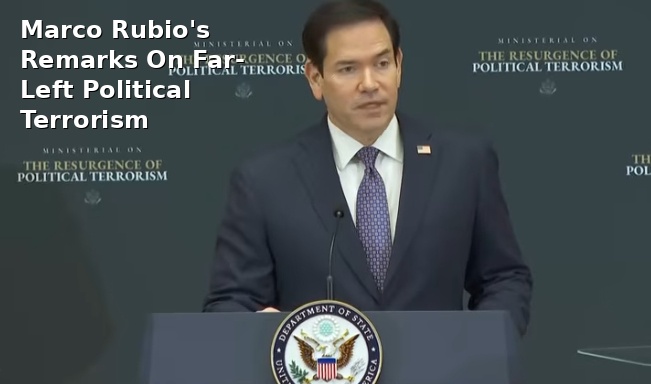
The following is the full transcript of Secretary of State Marco Rubio’s keynote speech addressing the global resurgence of political terrorism during a high-level ministerial meeting, July 16, 2026.
Editor’s Note: In this keynote speech, U.S. Secretary of State Marco Rubio addresses what he describes as an urgent, rising threat of political terrorism from the far-left across Western nations. He argues that traditional counterterrorism efforts have historically focused on Islamist extremism, creating a “blind spot” that has allowed radical leftist violence to proliferate unchecked. Rubio calls for a united, transnational coalition among global partners to dismantle these interconnected extremist networks and defend against attacks targeting civil infrastructure and democratic stability.
Introduction
MARCO RUBIO: Thank you. Thank you all. Thank you all for joining us here today. I’m very honored that this distinguished group of people that have traveled from around the world to be a part of this important conversation—we’re grateful to you.
I also want to thank members of the president’s team and cabinet that are here today: our FBI Director, Kash Patel, who’s here with us. Thank you. Our Secretary of Education, Linda McMahon, has joined us as well. You’ll hear shortly from Stephen Miller, the president’s deputy chief of staff and one of his top advisers on homeland security issues as well. And, of course, our Secretary of Treasury, Scott Bessent, is here.
But again, I want to thank all of you, all of you that are here today. I want to thank the whole team here at the State Department as well for putting this together. It truly is an unprecedented event, an unprecedented moment, I should say, in our history.
The Sacred Obligation to Protect
So let me start by saying that the most essential duty of the state, the first responsibility, frankly, of any government of any kind, is the protection of its people. It’s the protection of its country. This is a sacred obligation that should transcend all political and all ideological divisions. It is why, for example, we have militaries. It’s why we have intelligence agencies. It’s why counterterrorism bureaus exist, why police forces exist. Keeping our people safe is the reason why every country represented here has all of these things.
The Fight Against Radical Islamist Extremism
We are all very well acquainted, of course, by now, with what has been described as traditional terrorist threats. For twenty-five years, the term “counterterrorism,” at least in the West, has meant first and foremost the fight against radical Islamist extremism, and there’s a very poignant reason for that.
On September 11 in the year 2001, nineteen men murdered 3,000 people here in my country. Then that same enemy struck Europe, murdering nearly 200 commuters aboard trains in Madrid in 2004, and fifty-two more aboard London buses and the Underground in the following year. The entire architecture of Western counterterrorism was rebuilt from the studs around these singular traumatic events.
That made sense at the time. Our job was to keep our people safe, and the realm of terrorism, the specter of global jihad, was the premier threat to their safety. And so we went to work, and we assembled a global coalition working with many of the friends that are represented here in this room today. And we destroyed the ISIS caliphate. We killed al-Baghdadi and al-Zawahiri and bin Laden, and we built intelligence and law enforcement systems capable of anticipating and stopping attacks before the public even hears about them.
Every country represented here today has disrupted a terrorist threat at some point emanating from this source. Jihadist attacks and plots in the United States are down by two-thirds since ISIS’s peak. The number of people killed by jihadist terrorism in Europe dropped by roughly 97% from the year 2015 to the year 2024.
In other words, to a very great extent, our counterterrorism strategy has worked. The threat has not disappeared, of course. It will continue to exist, particularly so long as we tolerate immigration systems that import these threats directly into our respective homelands, but this threat has been severely diminished. The world looks very different today because of it.
The Blind Spot: Far-Left Extremism
For far too long, however, our counterterrorism doctrine has had a blind spot—a blind spot when it comes to extremist violence from the political left. Even today, the very idea that far-left terrorism could be a serious threat is treated as a right-wing fever dream, or worse, as a dangerous fascist conspiracy. It’s treated this way by many in the press, by many in academia and our universities, and by many of our legacy institutions.
You will no doubt see this dogma rear its head in the coverage of this very conference, in spite of the clear and undeniable reality, in spite of the objective numbers and statistics, in spite of the fact that in this room today there are representatives from across the political spectrum. We will hear that this kind of organized violence and terror will be dismissed. It will be dismissed as a partisan fiction.
A whole industry grew up in our countries around the study of extremism. We have think tanks and fellowships and journals and consultancies with the unspoken understanding among them that only one kind of political violence was a true threat to the system. A bomb planted by a neo-Nazi group was a nefarious and murderous act of evil. It is. But a bomb planted by a Marxist revolutionary, well, that’s merely a tragic excess of idealism. Perhaps its means were misplaced or overzealous, but its ends were virtuous and just. That’s the implication of how they treat it.
For years, this extraordinary ideological prejudice was embedded in the way we talked about political violence and extremism. It was repeated again and again until it was accepted as the neutral and objective baseline, so entrenched in the mainstream conventional wisdom that it came to be regarded as an apolitical fact.
It is the reason why here in my country, so many people in positions of power have repeatedly dismissed acts of violence and even terrorism as legitimate forms of political expression, so long as they served a left-wing cause.
It is why, during those so-called George Floyd riots in the summer of 2020, as criminals and extremists burned and looted their way through America’s great cities and nearly brought the country to its knees, city governments all across the country simply refused to prosecute the people conducting these acts of violence and terror.
It is the reason for the now-infamous image—maybe you all recall this—of a news anchor from a very prominent agency standing in a neighborhood consumed in flames, while the caption at the bottom read that the protests were “mostly peaceful.” This was something worse than a double standard. Left-wing violence was not just excused. It was treated as sacrosanct, a protected class unto itself. That era has to end.
Why We Are Here
The coalition in this room today includes political leaders and experts and law enforcement officials from more than 60 countries across the world. You have come here from a wide range of governments, parties, and political persuasions. Some of your governments and ours disagree publicly. Sometimes we disagree sharply about trade, about energy, about immigration. You did not come here today because you have been persuaded on every single aspect of the American view of the world.
You are here because two weeks ago, a 72-year-old woman was burned on over 80% of her body in her own home in Greece, and she died, executed by a firebomb because her daughter dared to stand for office.
You are here today because for five days this winter, the lights went out in Berlin—the longest blackout in the city since the Second World War, sparked by an attack that left tens of thousands of households without power in the freezing cold and left an 83-year-old woman dead.
You are here because a month after that Berlin blackout, a French 23-year-old succumbed to traumatic brain injuries, beaten to death on the streets of Lyon by a group of far-left militant thugs.
You are here because your political leaders are being attacked and stabbed and shot in your streets, because your businesses have been bombed, because your railways have been sabotaged, because your police officers have been beaten and burned.
You are here because this is real, and it is getting worse, and it can no longer be denied, and it can no longer be ignored, because it is time to crush this evil forever.
A History of Far-Left Terror
The simple fact is, none of this that I’ve just described is new. Far-left political terrorism is not a recent-day, modern novelty. It is not a fiction manufactured by conservative politicians. For most of the modern era, it was, in fact, the dominant form of political violence.
Every one of our friends here from the nations of the Western Hemisphere remember the decades of kidnappings and bombings and assassinations and executions—the violent terror of the Tupamaros, of the Montoneros, of the FARC, of the ELN. You remember the inhuman savagery of Peru’s Shining Path, the Maoist fanatics who massacred the peasant villages of Peru, hacking pregnant women and newborn infants to death with axes and machetes. You remember the tens of thousands of Marxist guerrillas trained to kill in Castro’s terrorist camps.
All of you here from Europe remember. You remember the machine-gun massacres of Italy’s Red Brigades, which held the five-time prime minister captive for fifty-five days before subjecting him to a revolutionary so-called “people’s trial” and executing him in 1978. You remember the Red Army Faction’s nearly three-decade campaign of bombings, kidnappings, and assassinations in Germany, murdering dozens and injuring hundreds more. You remember the November 17 organization in Greece, the Marxist extremists that terrorized Athens for more than a quarter century, including, by the way, shooting my country’s CIA station chief dead outside of his home in front of his wife as they were returning home from a Christmas party.
And here in America, we remember. We remember the same reign of deadly terror justified by the same slogans, motivated by the same wicked ideas. We remember the Weather Underground, which bombed the Pentagon, which bombed the State Department, and bombed the Capitol. We remember the Black Liberation Army, which staged armed robberies and executed police officers at point-blank range. We remember the Symbionese Liberation Army, which shot a public school superintendent to death with cyanide-packed hollow-point bullets.
In one eighteen-month period between 1971 and 1972, the FBI counted some 2,500 bombings on American soil—a rate of nearly five a day. The overwhelming share of that violence came from left-wing extremists. Between 1970 and 1980, 93% of terrorist attacks in the West came from the far extremist left.
These are numbers that would shock most Americans today, because we’ve been taught to believe that this kind of political violence simply doesn’t exist, or that it’s being exaggerated. But it does exist, and we’re actually underestimating it. And our nations bear the scars to prove it.
A New Wave of the Old Evil
And today, we face a new wave of this old evil. Here in the United States, the share of left-wing terrorist attacks and plots has risen to levels not seen in decades. In Germany, far-left violence has jumped by more than 40% in just the last year alone. In Greece, more than 80% of radical violence is now driven by far-left and anarchist actors.
These are not abstract statistics. Americans have seen what those numbers mean. An all-out assault on our immigration officers. Sniper attacks. Explosives. Armed ambushes. A transgender shooter opening fire on Catholic elementary school students as they pray, his gun marked with slogans like, “Where is your God now?” A healthcare executive executed in cold blood in the streets. Multiple assassination attempts on a sitting president. And the murder of the greatest conservative activist of a generation, a man who happened to also be a husband and the father of two young children, shot and killed while speaking to a crowd of students.
The Nature of This Evil
This is a distinctive and unique evil. It has always been driven by a hatred above all else, a hatred for civilization itself. It is a revolt of the worst against the best, a revolt of the weak and the cowardly against the strong and the good. It is perpetrated by those who cannot build, who cannot create, who cannot achieve great things, and take their revenge upon the world for their own inadequacy by seeking to destroy those who can. This is what radical leftism is.
It may wear various different slogans and ideologies across place and time. They can call themselves anti-capitalist or anti-imperialist or communist or anarchist or Marxist, but the fundamental character is always the same. It is a poisonous resentment cloaked in the language of equality and justice and liberation, an overwhelming need to tear down what greater men have built, to wreck what is beautiful and what is right on behalf of people who are only filled with ugliness and have nothing else to offer the world. Through violence and through terror, they once again seek to impose their ugliness on all of us.
The Old Dogma Was Wrong
The old dogma was wrong. The old dogma was wrong. None of this is driven by idealism. It’s not utop-an. In fact, it is the opposite.
One of the criticisms you sometimes hear of communism, for example, is that it sounds good in theory, but it never works in practice. That’s actually not true. Communism does not sound good in theory. The world that envisions for all of us is small, flat, gray, leveled of all exception, drained of all that is good and noble in the human soul. The world it envisions is a world without courage, a world without creativity or ambition, a world without heroes or glory or great causes to strive towards, without a world without miracles, without myths, without men who rise above the rest to do incredible and extraordinary things.
And the world communism envisions is a world without god. For these architects of revolutionary violence, the towering achievement of our civilization, for them, it’s an unbearable humiliation, a reminder of what they cannot do and a reminder of what they cannot be. So they choose instead to destroy. They attack pipelines. They attack railroads.
They attack power grids and laboratories. The physical embodied symbols of power and invention and achievement. This is the nature of the terrorism we face today. They despise the West because the West is great. This is an international conference because we are facing an international.
We are facing a transnational threat. These are not distinct and isolated cells. They are interconnected networks. They do not recognize our borders. They do not believe, in fact, in the nation state itself.
Building a Global Coalition Against Far-Left Terror
They coordinate. They communicate. They travel. They train, and they act together, sharing the same infrastructure, sharing the same enemies, sharing the same mission. Antifa militants and their comrades travel from across Europe and to the Americas to participate in each other’s attacks, to funnel propaganda and training materials and target information through shared encrypted channels, moving through underground networks of safe houses and finance and sustain their operations through transnational funds.
And they work alongside hostile foreign states that share their mission, like Iraq’s Iranian proxy networks who are increasingly intimately tied to leftist militant groups around the world. The Cuban regime’s sprawling intelligence and ideological network helped to build the far left in our country and in our hemisphere, and it remains inextricably linked to the far left groups and movements across and beyond the West.
Today’s far left terrorists can raise money in one country. They can host their communications in a second country. They can receive training in a third country. They can recruit militants in a fourth country, and then together strike a target in a fifth country. And so we have no choice but to confront this menace together. We will either cooperate across our borders or the terrorists will continue to exploit the gaps between them.
The Trump Administration’s Strategy
Under President Trump, for the first time, the United States is building the infrastructure, the partnership, and the strategy to defeat the scourge of far-left terror. The president signed National Security Presidential Memorandum Number Seven, outlining a comprehensive strategy to investigate and disrupt Antifa terror networks and their allies.
Last November, the State Department designated four violent far-left extremist groups as foreign terrorist organizations, and there will be more designations soon. In December, we announced rewards for justice offering up to $10 million for information disrupting the financing behind these groups.
In May, we convened the first counterterrorism law enforcement workshop, joining American law enforcement officials and their counterparts in our partner nations together to map and develop strategies for dismantling these networks. The next workshop will be cohosted with our partners in Germany. The coalition we’re building together is already bearing fruit, and we are here today to build on that work.
A Call for Unity
We can and we must identify and map this threat and rebuild our counterterrorism architecture to defeat it, just as we have done together before. Now we must do it together again. Through intelligence and information sharing, through coordinated law enforcement strategy, through financial targeting and disruption, we will dismantle these networks brick by brick.
It is time for the people of the civilized world to defend ourselves, to stand united against this encroaching darkness, and fight for what is ours. It is easy to destroy great things. It is far more difficult to make them. The enemies of civilization are only capable of the former. They are only capable of destroying great things. All they know is destruction. But we have built great things together. We have done it time and again. We know what we must do, and now we must do it.
Thank you for coming today.
Introducing Stephen Miller
And now I want to introduce someone I work with very closely and who has been a leader in this field. He is a deputy chief of staff and one of the key advisers to President Trump. He also heads up all of our homeland security initiatives and understands this issue probably as well as anyone in the United States government, Stephen Miller.
Related Posts